MACHINE LEARNING
By
B.Deepak
3rd B.Tech EEE
Machine Learning (ML)
ML is a branch of artificial intelligence:
– Uses computing based systems to make sense
out of data
• Extracting patterns, fitting data to functions, classifying
data, etc
– ML systems can learn and improve
• With historical data, time and experience
– Bridges theoretical computer science and real
noise data.
Supervised and Unsupervised Learning
Supervised Learning
– For every example in the data there is always a
predefined outcome
– Models the relations between a set of descriptive features
and a target (Fits data to a function)
– 2 groups of problems:
• Classification
• Regression
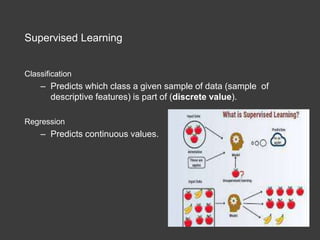
Supervised Learning
Classification
– Predicts which class a given sample of data (sample of
descriptive features) is part of (discrete value).
Regression
– Predicts continuous values.
Unsupervised Learning
– There are not predefined and known set of outcomes
– Look for hidden patterns and relations in the data
– A typical example: Clustering
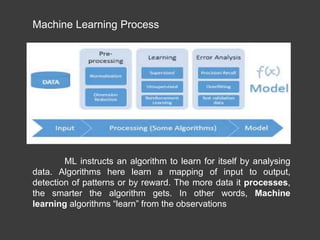
Machine Learning Process
ML instructs an algorithm to learn for itself by analysing
data. Algorithms here learn a mapping of input to output,
detection of patterns or by reward. The more data it processes,
the smarter the algorithm gets. In other words, Machine
learning algorithms “learn” from the observations
Machine Learning Workflow
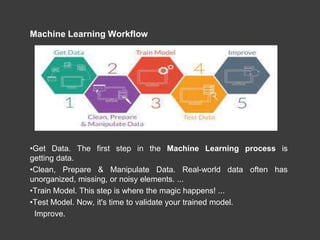
•Get Data. The first step in the Machine Learning process is
getting data.
•Clean, Prepare & Manipulate Data. Real-world data often has
unorganized, missing, or noisy elements. ...
•Train Model. This step is where the magic happens! ...
•Test Model. Now, it's time to validate your trained model.
Improve.
ML as a Process: Model Building
Data Splitting
– Allocate data to different tasks
• model training
• performance evaluation
– Define Training, Validation and Test sets
Feature Selection (Review the decision made previously)
Estimating Performance
– Visualization of results – discovery interesting areas of the
problem space
– Statistics and performance measures
Evaluation and Model selection
– The ‘no free lunch’ theorem no a priory assumptions can be
made
– Avoid use of favorite models if NEEDED
ML in real-life
THANK YOU

Machine learning

  • 1.
  • 2.
    Machine Learning (ML) MLis a branch of artificial intelligence: – Uses computing based systems to make sense out of data • Extracting patterns, fitting data to functions, classifying data, etc – ML systems can learn and improve • With historical data, time and experience – Bridges theoretical computer science and real noise data.
  • 3.
    Supervised and UnsupervisedLearning Supervised Learning – For every example in the data there is always a predefined outcome – Models the relations between a set of descriptive features and a target (Fits data to a function) – 2 groups of problems: • Classification • Regression
  • 4.
    Supervised Learning Classification – Predictswhich class a given sample of data (sample of descriptive features) is part of (discrete value). Regression – Predicts continuous values.
  • 5.
    Unsupervised Learning – Thereare not predefined and known set of outcomes – Look for hidden patterns and relations in the data – A typical example: Clustering
  • 6.
    Machine Learning Process MLinstructs an algorithm to learn for itself by analysing data. Algorithms here learn a mapping of input to output, detection of patterns or by reward. The more data it processes, the smarter the algorithm gets. In other words, Machine learning algorithms “learn” from the observations
  • 7.
    Machine Learning Workflow •GetData. The first step in the Machine Learning process is getting data. •Clean, Prepare & Manipulate Data. Real-world data often has unorganized, missing, or noisy elements. ... •Train Model. This step is where the magic happens! ... •Test Model. Now, it's time to validate your trained model. Improve.
  • 8.
    ML as aProcess: Model Building Data Splitting – Allocate data to different tasks • model training • performance evaluation – Define Training, Validation and Test sets Feature Selection (Review the decision made previously) Estimating Performance – Visualization of results – discovery interesting areas of the problem space – Statistics and performance measures Evaluation and Model selection – The ‘no free lunch’ theorem no a priory assumptions can be made – Avoid use of favorite models if NEEDED
  • 9.
  • 10.