Machine Learning
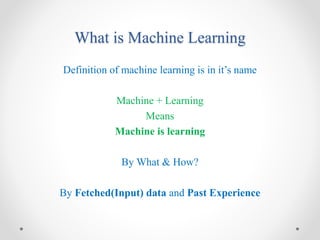
What is Machine Learning
Definition of machine learning is in it’s name
Machine + Learning
Means
Machine is learning
By What & How?
By Fetched(Input) data and Past Experience
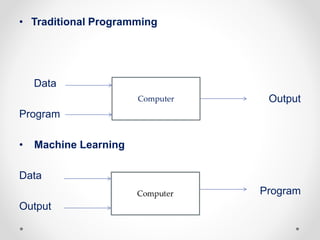
• Traditional Programming
Data
Output
Program
• Machine Learning
Data
Program
Output
Computer
Machine learning
definition
• A branch of artificial intelligence, concerned with the design
and development of algorithms that allow computers to evolve
behaviors based on empirical data.
• As intelligence requires knowledge, it is necessary for the
computers to acquire knowledge.
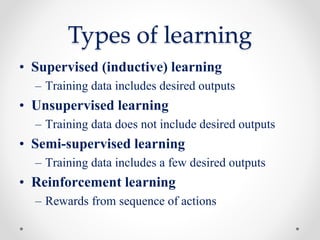
Types of learning
• Supervised (inductive) learning
– Training data includes desired outputs
• Unsupervised learning
– Training data does not include desired outputs
• Semi-supervised learning
– Training data includes a few desired outputs
• Reinforcement learning
– Rewards from sequence of actions
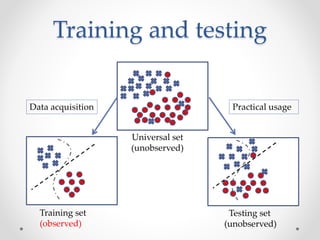
Training and testing
Training set
(observed)
Universal set
(unobserved)
Testing set
(unobserved)
Data acquisition Practical usage
• Training is the process of making the system able to learn.
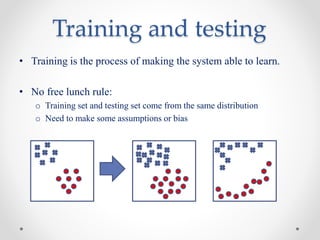
• No free lunch rule:
o Training set and testing set come from the same distribution
o Need to make some assumptions or bias
Training and testing
Algorithms
• The success of machine learning system also depends on the
algorithms.
• The algorithms control the search to find and build the
knowledge structures.
• The learning algorithms should extract useful information
from training examples.
List of Common Machine
Learning Algorithms
• Linear Regression
• Logistic Regression
• Decision Tree
• SVM
• Naive Bayes
• kNN
• K-Means
• Random Forest
Applications
• Face detection
• Object detection and recognition
• Image segmentation
• Multimedia event detection
• Spam and fraud detection
• Web Advertising

Machine learning

  • 1.
  • 2.
    What is MachineLearning Definition of machine learning is in it’s name Machine + Learning Means Machine is learning By What & How? By Fetched(Input) data and Past Experience
  • 3.
    • Traditional Programming Data Output Program •Machine Learning Data Program Output Computer
  • 4.
    Machine learning definition • Abranch of artificial intelligence, concerned with the design and development of algorithms that allow computers to evolve behaviors based on empirical data. • As intelligence requires knowledge, it is necessary for the computers to acquire knowledge.
  • 5.
    Types of learning •Supervised (inductive) learning – Training data includes desired outputs • Unsupervised learning – Training data does not include desired outputs • Semi-supervised learning – Training data includes a few desired outputs • Reinforcement learning – Rewards from sequence of actions
  • 6.
    Training and testing Trainingset (observed) Universal set (unobserved) Testing set (unobserved) Data acquisition Practical usage
  • 7.
    • Training isthe process of making the system able to learn. • No free lunch rule: o Training set and testing set come from the same distribution o Need to make some assumptions or bias Training and testing
  • 8.
    Algorithms • The successof machine learning system also depends on the algorithms. • The algorithms control the search to find and build the knowledge structures. • The learning algorithms should extract useful information from training examples.
  • 9.
    List of CommonMachine Learning Algorithms • Linear Regression • Logistic Regression • Decision Tree • SVM • Naive Bayes • kNN • K-Means • Random Forest
  • 10.
    Applications • Face detection •Object detection and recognition • Image segmentation • Multimedia event detection • Spam and fraud detection • Web Advertising