by
Huy Huu Nguyen. PhD
1
Ho Chi Minh City, 20 Feb 2017
An Introduction to Road Safety
Engineering
Ho Chi Minh City University of Transport
Department of Transport Planning
----------------o0o-----------------
2
Objectives
 To introduce “Road Safety Engineering”
 To emphasize the important role of engineering approaches
 To introduce “Towards Safer Road” Manual
 To introduce some typical safety deficits with regards to
human factors
 To outline some key principle in planning and design of
safe road network
3
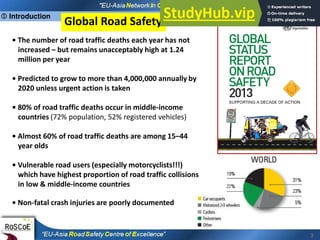
Global Road Safety
• The u er of road traffi deaths ea h year has not
increased – but remains unacceptably high at 1.24
million per year
• Predicted to grow to more than 4,000,000 annually by
2020 unless urgent action is taken
• 80% of road traffic deaths occur in middle-income
countries (72% population, 52% registered vehicles)
• Al ost 60% of road traffi deaths are among 15–44
year olds
• Vulnerable road users (especially motorcyclists!!!)
which have highest proportion of road traffic collisions
in low & middle-income countries
• No -fatal crash injuries are poorly documented
 Introduction
4
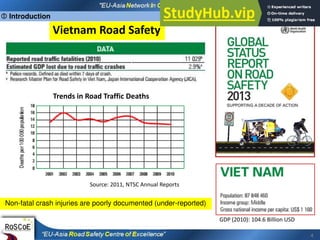
Vietnam Road Safety
Non-fatal crash injuries are poorly documented (under-reported)
Trends in Road Traffic Deaths
Source: 2011, NTSC Annual Reports
GDP (2010): 104.6 Billion USD
 Introduction
5
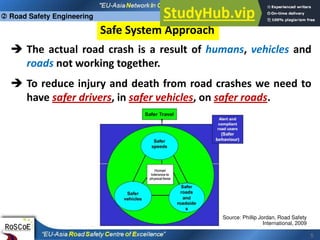
Safe System Approach
Source: Phillip Jordan, Road Safety
International, 2009
 The actual road crash is a result of humans, vehicles and
roads not working together.
 To reduce injury and death from road crashes we need to
have safer drivers, in safer vehicles, on safer roads.
 Road Safety Engineering
6
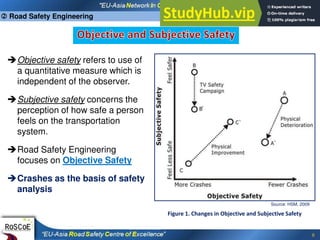
Figure 1. Changes in Objective and Subjective Safety
Source: HSM, 2009
Objective safety refers to use of
a quantitative measure which is
independent of the observer.
Subjective safety concerns the
perception of how safe a person
feels on the transportation
system.
Road Safety Engineering
focuses on Objective Safety
Crashes as the basis of safety
analysis
 Road Safety Engineering
7
"a rare, random, multi-factorial event in
which one or more road users have failed to
cope with their environment.”
 Road crashes are:
 rare- 1 in 200 people injured every year
 random- impossible to predict where and
when the next crash will happen
 multi-factor- combination of behavioral,
vehicle and road factors.
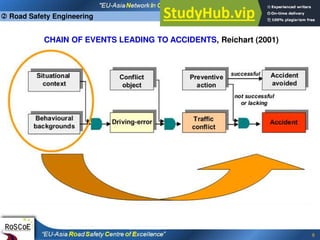
 The multi-factor nature of crashes
suggests a chain of events involving:
 Behavioral (human) factors
 Vehicle factors
 Road factors
 Road Safety Engineering
8
CHAIN OF EVENTS LEADING TO ACCIDENTS, Reichart (2001)
 Road Safety Engineering
9
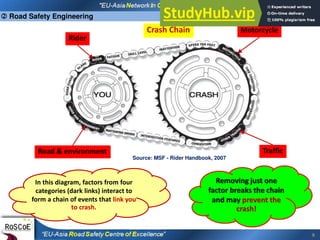
In this diagram, factors from four
categories (dark links) interact to
form a chain of events that link you
to crash.
Removing just one
factor breaks the chain
and may prevent the
crash!
Crash Chain
Source: MSF - Rider Handbook, 2007
Rider
Motorcycle
Traffic
Road & environment
 Road Safety Engineering
10
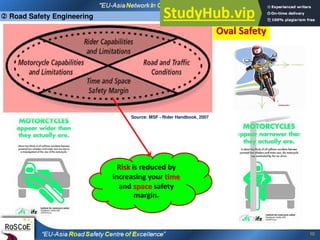
Oval Safety
Source: MSF - Rider Handbook, 2007
Risk is reduced by
increasing your time
and space safety
margin.
 Road Safety Engineering
11
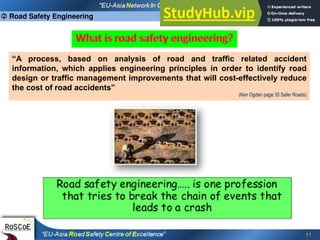
“A process, based on analysis of road and traffic related accident
information, which applies engineering principles in order to identify road
design or traffic management improvements that will cost-effectively reduce
the cost of road accidents”
(Ken Ogden page 35 Safer Roads)
 Road Safety Engineering
12
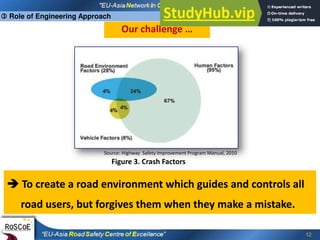
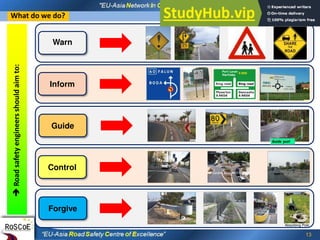
Our halle ge …
 To create a road environment which guides and controls all
road users, but forgives them when they make a mistake.
Figure 3. Crash Factors
Source: Highway Safety Improvement Program Manual, 2010
 Role of Engineering Approach
13
What do we do?

Road
safety
engineers
should
aim
to:
Guide
Warn
Forgive
Absorbing Pole
Inform
Control
14
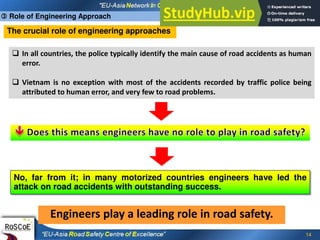
The crucial role of engineering approaches
 In all countries, the police typically identify the main cause of road accidents as human
error.
 Vietnam is no exception with most of the accidents recorded by traffic police being
attributed to human error, and very few to road problems.
No, far from it; in many motorized countries engineers have led the
attack on road accidents with outstanding success.
Engineers play a leading role in road safety.
 Role of Engineering Approach
15
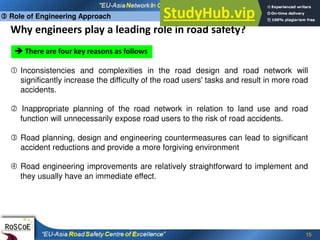
Why engineers play a leading role in road safety?
 There are four key reasons as follows
 Inconsistencies and complexities in the road design and road network will
significantly increase the difficulty of the road users' tasks and result in more road
accidents.
 Inappropriate planning of the road network in relation to land use and road
function will unnecessarily expose road users to the risk of road accidents.
 Road planning, design and engineering countermeasures can lead to significant
accident reductions and provide a more forgiving environment
 Road engineering improvements are relatively straightforward to implement and
they usually have an immediate effect.
 Role of Engineering Approach
16
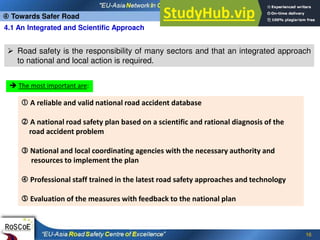
4.1 An Integrated and Scientific Approach
 Road safety is the responsibility of many sectors and that an integrated approach
to national and local action is required.
 The most important are:
 A reliable and valid national road accident database
 A national road safety plan based on a scientific and rational diagnosis of the
road accident problem
 National and local coordinating agencies with the necessary authority and
resources to implement the plan
 Professional staff trained in the latest road safety approaches and technology
 Evaluation of the measures with feedback to the national plan
 Towards Safer Road
17
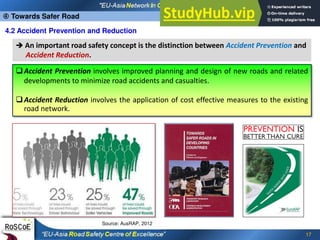
4.2 Accident Prevention and Reduction
 An important road safety concept is the distinction between Accident Prevention and
Accident Reduction.
Accident Prevention involves improved planning and design of new roads and related
developments to minimize road accidents and casualties.
Accident Reduction involves the application of cost effective measures to the existing
road network.
Source: AusRAP, 2012
 Towards Safer Road
18
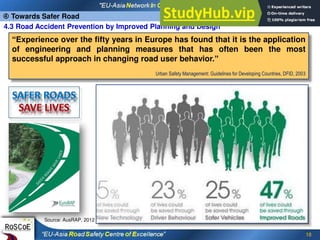
“Experience over the fifty years in Europe has found that it is the application
of engineering and planning measures that has often been the most
successful approach in changing road user behavior.”
Urban Safety Management: Guidelines for Developing Countries, DFID, 2003
4.3 Road Accident Prevention by Improved Planning and Design
 Towards Safer Road
Source: AusRAP, 2012
19
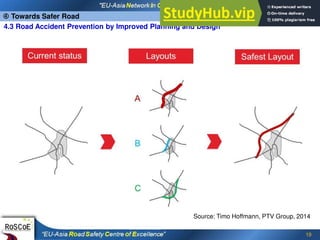
 Towards Safer Road
Source: Timo Hoffmann, PTV Group, 2014
4.3 Road Accident Prevention by Improved Planning and Design
20
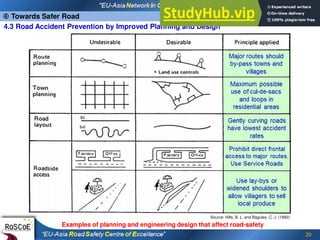
 Towards Safer Road
Source: Hills, B. L. and Baguley, C. J. (1992)
Examples of planning and engineering design that affect road-safety
4.3 Road Accident Prevention by Improved Planning and Design
21
 Towards Safer Road
4.3 Road Accident Prevention by Improved Planning and Design
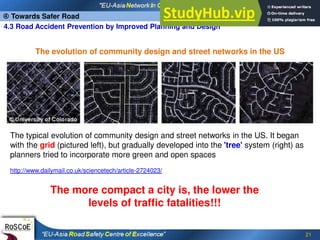
The typical evolution of community design and street networks in the US. It began
with the grid (pictured left), but gradually developed into the 'tree' system (right) as
planners tried to incorporate more green and open spaces
http://www.dailymail.co.uk/sciencetech/article-2724023/
The more compact a city is, the lower the
levels of traffic fatalities!!!
The evolution of community design and street networks in the US
22
 Towards Safer Road
4.3 Road Accident Prevention by Improved Planning and Design
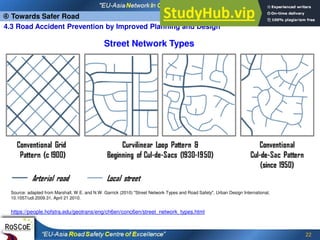
Street Network Types
Source: adapted from Marshall, W.E. and N.W. Garrick (2010) "Street Network Types and Road Safety", Urban Design International,
10.1057/udi.2009.31, April 21 2010.
https://people.hofstra.edu/geotrans/eng/ch6en/conc6en/street_network_types.html
23
 Towards Safer Road
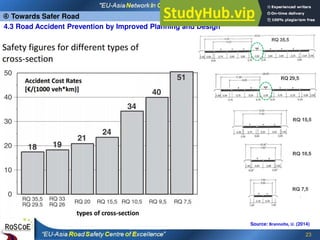
Source: Brannolte, U. (2014)
4.3 Road Accident Prevention by Improved Planning and Design
24
 Towards Safer Road
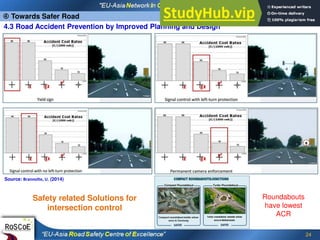
Source: Brannolte, U. (2014)
4.3 Road Accident Prevention by Improved Planning and Design
Safety related Solutions for
intersection control
Roundabouts
have lowest
ACR
25
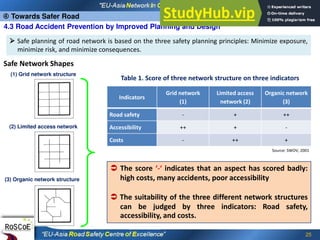
 Safe planning of road network is based on the three safety planning principles: Minimize exposure,
minimize risk, and minimize consequences.
Safe Network Shapes
Source: SWOV, 2001
Table 1. Score of three network structure on three indicators
Indicators
Grid network
(1)
Limited access
network (2)
Organic network
(3)
Road safety - + ++
Accessibility ++ + -
Costs - ++ +
 The score ‘-‘ indicates that an aspect has scored badly:
high costs, many accidents, poor accessibility
 The suitability of the three different network structures
can be judged by three indicators: Road safety,
accessibility, and costs.
(3) Organic network structure
(2) Limited access network
(1) Grid network structure
 Towards Safer Road
4.3 Road Accident Prevention by Improved Planning and Design
26
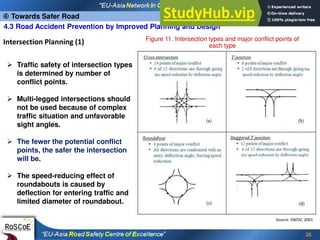
Intersection Planning (1)
 Traffic safety of intersection types
is determined by number of
conflict points.
 Multi-legged intersections should
not be used because of complex
traffic situation and unfavorable
sight angles.
 The fewer the potential conflict
points, the safer the intersection
will be.
 The speed-reducing effect of
roundabouts is caused by
deflection for entering traffic and
limited diameter of roundabout.
Source: SWOV, 2001
Figure 11. Intersection types and major conflict points of
each type
 Towards Safer Road
4.3 Road Accident Prevention by Improved Planning and Design
27
 Towards Safer Road
4.3 Road Accident Prevention by Improved Planning and Design
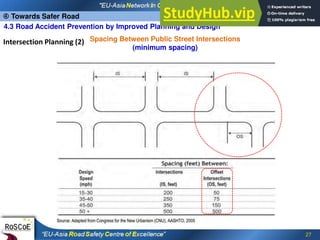
Spacing Between Public Street Intersections
(minimum spacing)
Intersection Planning (2)
28
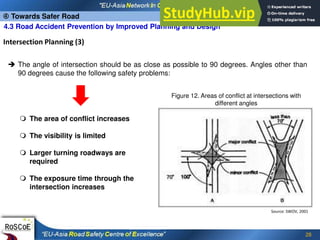
Intersection Planning (3)
Source: SWOV, 2001
Figure 12. Areas of conflict at intersections with
different angles
 The angle of intersection should be as close as possible to 90 degrees. Angles other than
90 degrees cause the following safety problems:
 The area of conflict increases
 The visibility is limited
 Larger turning roadways are
required
 The exposure time through the
intersection increases
 Towards Safer Road
4.3 Road Accident Prevention by Improved Planning and Design
29
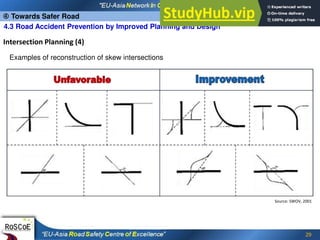
Intersection Planning (4)
Examples of reconstruction of skew intersections
Source: SWOV, 2001
 Towards Safer Road
4.3 Road Accident Prevention by Improved Planning and Design
30
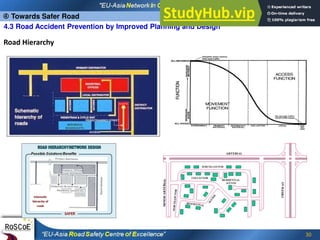
Road Hierarchy
 Towards Safer Road
4.3 Road Accident Prevention by Improved Planning and Design
31
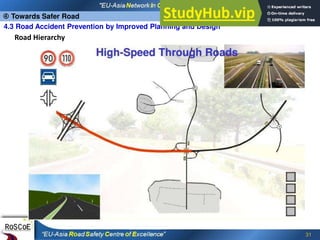
Road Hierarchy
 Towards Safer Road
4.3 Road Accident Prevention by Improved Planning and Design
32
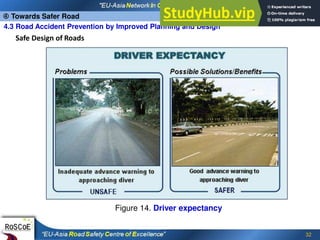
Safe Design of Roads
4.3 Road Accident Prevention by Improved Planning and Design
 Towards Safer Road
Figure 14. Driver expectancy
33
Safe Design of Roads
4.3 Road Accident Prevention by Improved Planning and Design
 Towards Safer Road
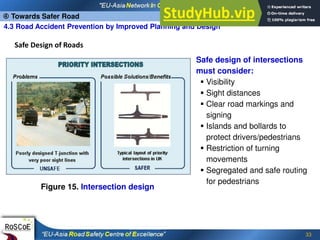
Figure 15. Intersection design
Safe design of intersections
must consider:
 Visibility
 Sight distances
 Clear road markings and
signing
 Islands and bollards to
protect drivers/pedestrians
 Restriction of turning
movements
 Segregated and safe routing
for pedestrians
34
4.4 Approaches to Accident Reduction
 Towards Safer Road
 There are four recognized approaches to accident reduction by the application
of cost effective treatments of existing roads. These are:
 Single sites: treatments of specific sites or short lengths of roads at
which accidents cluster;
 Mass action: application of a known remedy to locations which have
common accident factors;
 Route action: application of remedies to a road having above
average accident rate for that type or class of road;
 Area action: aggregation of remedial measures over an area with an
accident rate above a predetermined level; particularly aimed at
dealing with scattered accidents and usually in urban areas.
35
Nguyen Huu Huy. PhD
EU-Asia Road Safety Centre of Excellence (RoSCoE)
Office:
Prince of Songkla University
Sirindhorn Applied Engineering Research Building
Hat Yai, 90112
Thailand
Contact:
Phone: +84 939098090
E-mail: huycongtrinh@yahoo.com
Website: www.nice-roads.com
Thank You

An Introduction To Road Safety Engineering

  • 1.
    by Huy Huu Nguyen.PhD 1 Ho Chi Minh City, 20 Feb 2017 An Introduction to Road Safety Engineering Ho Chi Minh City University of Transport Department of Transport Planning ----------------o0o-----------------
  • 2.
    2 Objectives  To introduce“Road Safety Engineering”  To emphasize the important role of engineering approaches  To introduce “Towards Safer Road” Manual  To introduce some typical safety deficits with regards to human factors  To outline some key principle in planning and design of safe road network
  • 3.
    3 Global Road Safety •The u er of road traffi deaths ea h year has not increased – but remains unacceptably high at 1.24 million per year • Predicted to grow to more than 4,000,000 annually by 2020 unless urgent action is taken • 80% of road traffic deaths occur in middle-income countries (72% population, 52% registered vehicles) • Al ost 60% of road traffi deaths are among 15–44 year olds • Vulnerable road users (especially motorcyclists!!!) which have highest proportion of road traffic collisions in low & middle-income countries • No -fatal crash injuries are poorly documented  Introduction
  • 4.
    4 Vietnam Road Safety Non-fatalcrash injuries are poorly documented (under-reported) Trends in Road Traffic Deaths Source: 2011, NTSC Annual Reports GDP (2010): 104.6 Billion USD  Introduction
  • 5.
    5 Safe System Approach Source:Phillip Jordan, Road Safety International, 2009  The actual road crash is a result of humans, vehicles and roads not working together.  To reduce injury and death from road crashes we need to have safer drivers, in safer vehicles, on safer roads.  Road Safety Engineering
  • 6.
    6 Figure 1. Changesin Objective and Subjective Safety Source: HSM, 2009 Objective safety refers to use of a quantitative measure which is independent of the observer. Subjective safety concerns the perception of how safe a person feels on the transportation system. Road Safety Engineering focuses on Objective Safety Crashes as the basis of safety analysis  Road Safety Engineering
  • 7.
    7 "a rare, random,multi-factorial event in which one or more road users have failed to cope with their environment.”  Road crashes are:  rare- 1 in 200 people injured every year  random- impossible to predict where and when the next crash will happen  multi-factor- combination of behavioral, vehicle and road factors.  The multi-factor nature of crashes suggests a chain of events involving:  Behavioral (human) factors  Vehicle factors  Road factors  Road Safety Engineering
  • 8.
    8 CHAIN OF EVENTSLEADING TO ACCIDENTS, Reichart (2001)  Road Safety Engineering
  • 9.
    9 In this diagram,factors from four categories (dark links) interact to form a chain of events that link you to crash. Removing just one factor breaks the chain and may prevent the crash! Crash Chain Source: MSF - Rider Handbook, 2007 Rider Motorcycle Traffic Road & environment  Road Safety Engineering
  • 10.
    10 Oval Safety Source: MSF- Rider Handbook, 2007 Risk is reduced by increasing your time and space safety margin.  Road Safety Engineering
  • 11.
    11 “A process, basedon analysis of road and traffic related accident information, which applies engineering principles in order to identify road design or traffic management improvements that will cost-effectively reduce the cost of road accidents” (Ken Ogden page 35 Safer Roads)  Road Safety Engineering
  • 12.
    12 Our halle ge…  To create a road environment which guides and controls all road users, but forgives them when they make a mistake. Figure 3. Crash Factors Source: Highway Safety Improvement Program Manual, 2010  Role of Engineering Approach
  • 13.
    13 What do wedo?  Road safety engineers should aim to: Guide Warn Forgive Absorbing Pole Inform Control
  • 14.
    14 The crucial roleof engineering approaches  In all countries, the police typically identify the main cause of road accidents as human error.  Vietnam is no exception with most of the accidents recorded by traffic police being attributed to human error, and very few to road problems. No, far from it; in many motorized countries engineers have led the attack on road accidents with outstanding success. Engineers play a leading role in road safety.  Role of Engineering Approach
  • 15.
    15 Why engineers playa leading role in road safety?  There are four key reasons as follows  Inconsistencies and complexities in the road design and road network will significantly increase the difficulty of the road users' tasks and result in more road accidents.  Inappropriate planning of the road network in relation to land use and road function will unnecessarily expose road users to the risk of road accidents.  Road planning, design and engineering countermeasures can lead to significant accident reductions and provide a more forgiving environment  Road engineering improvements are relatively straightforward to implement and they usually have an immediate effect.  Role of Engineering Approach
  • 16.
    16 4.1 An Integratedand Scientific Approach  Road safety is the responsibility of many sectors and that an integrated approach to national and local action is required.  The most important are:  A reliable and valid national road accident database  A national road safety plan based on a scientific and rational diagnosis of the road accident problem  National and local coordinating agencies with the necessary authority and resources to implement the plan  Professional staff trained in the latest road safety approaches and technology  Evaluation of the measures with feedback to the national plan  Towards Safer Road
  • 17.
    17 4.2 Accident Preventionand Reduction  An important road safety concept is the distinction between Accident Prevention and Accident Reduction. Accident Prevention involves improved planning and design of new roads and related developments to minimize road accidents and casualties. Accident Reduction involves the application of cost effective measures to the existing road network. Source: AusRAP, 2012  Towards Safer Road
  • 18.
    18 “Experience over thefifty years in Europe has found that it is the application of engineering and planning measures that has often been the most successful approach in changing road user behavior.” Urban Safety Management: Guidelines for Developing Countries, DFID, 2003 4.3 Road Accident Prevention by Improved Planning and Design  Towards Safer Road Source: AusRAP, 2012
  • 19.
    19  Towards SaferRoad Source: Timo Hoffmann, PTV Group, 2014 4.3 Road Accident Prevention by Improved Planning and Design
  • 20.
    20  Towards SaferRoad Source: Hills, B. L. and Baguley, C. J. (1992) Examples of planning and engineering design that affect road-safety 4.3 Road Accident Prevention by Improved Planning and Design
  • 21.
    21  Towards SaferRoad 4.3 Road Accident Prevention by Improved Planning and Design The typical evolution of community design and street networks in the US. It began with the grid (pictured left), but gradually developed into the 'tree' system (right) as planners tried to incorporate more green and open spaces http://www.dailymail.co.uk/sciencetech/article-2724023/ The more compact a city is, the lower the levels of traffic fatalities!!! The evolution of community design and street networks in the US
  • 22.
    22  Towards SaferRoad 4.3 Road Accident Prevention by Improved Planning and Design Street Network Types Source: adapted from Marshall, W.E. and N.W. Garrick (2010) "Street Network Types and Road Safety", Urban Design International, 10.1057/udi.2009.31, April 21 2010. https://people.hofstra.edu/geotrans/eng/ch6en/conc6en/street_network_types.html
  • 23.
    23  Towards SaferRoad Source: Brannolte, U. (2014) 4.3 Road Accident Prevention by Improved Planning and Design
  • 24.
    24  Towards SaferRoad Source: Brannolte, U. (2014) 4.3 Road Accident Prevention by Improved Planning and Design Safety related Solutions for intersection control Roundabouts have lowest ACR
  • 25.
    25  Safe planningof road network is based on the three safety planning principles: Minimize exposure, minimize risk, and minimize consequences. Safe Network Shapes Source: SWOV, 2001 Table 1. Score of three network structure on three indicators Indicators Grid network (1) Limited access network (2) Organic network (3) Road safety - + ++ Accessibility ++ + - Costs - ++ +  The score ‘-‘ indicates that an aspect has scored badly: high costs, many accidents, poor accessibility  The suitability of the three different network structures can be judged by three indicators: Road safety, accessibility, and costs. (3) Organic network structure (2) Limited access network (1) Grid network structure  Towards Safer Road 4.3 Road Accident Prevention by Improved Planning and Design
  • 26.
    26 Intersection Planning (1) Traffic safety of intersection types is determined by number of conflict points.  Multi-legged intersections should not be used because of complex traffic situation and unfavorable sight angles.  The fewer the potential conflict points, the safer the intersection will be.  The speed-reducing effect of roundabouts is caused by deflection for entering traffic and limited diameter of roundabout. Source: SWOV, 2001 Figure 11. Intersection types and major conflict points of each type  Towards Safer Road 4.3 Road Accident Prevention by Improved Planning and Design
  • 27.
    27  Towards SaferRoad 4.3 Road Accident Prevention by Improved Planning and Design Spacing Between Public Street Intersections (minimum spacing) Intersection Planning (2)
  • 28.
    28 Intersection Planning (3) Source:SWOV, 2001 Figure 12. Areas of conflict at intersections with different angles  The angle of intersection should be as close as possible to 90 degrees. Angles other than 90 degrees cause the following safety problems:  The area of conflict increases  The visibility is limited  Larger turning roadways are required  The exposure time through the intersection increases  Towards Safer Road 4.3 Road Accident Prevention by Improved Planning and Design
  • 29.
    29 Intersection Planning (4) Examplesof reconstruction of skew intersections Source: SWOV, 2001  Towards Safer Road 4.3 Road Accident Prevention by Improved Planning and Design
  • 30.
    30 Road Hierarchy  TowardsSafer Road 4.3 Road Accident Prevention by Improved Planning and Design
  • 31.
    31 Road Hierarchy  TowardsSafer Road 4.3 Road Accident Prevention by Improved Planning and Design
  • 32.
    32 Safe Design ofRoads 4.3 Road Accident Prevention by Improved Planning and Design  Towards Safer Road Figure 14. Driver expectancy
  • 33.
    33 Safe Design ofRoads 4.3 Road Accident Prevention by Improved Planning and Design  Towards Safer Road Figure 15. Intersection design Safe design of intersections must consider:  Visibility  Sight distances  Clear road markings and signing  Islands and bollards to protect drivers/pedestrians  Restriction of turning movements  Segregated and safe routing for pedestrians
  • 34.
    34 4.4 Approaches toAccident Reduction  Towards Safer Road  There are four recognized approaches to accident reduction by the application of cost effective treatments of existing roads. These are:  Single sites: treatments of specific sites or short lengths of roads at which accidents cluster;  Mass action: application of a known remedy to locations which have common accident factors;  Route action: application of remedies to a road having above average accident rate for that type or class of road;  Area action: aggregation of remedial measures over an area with an accident rate above a predetermined level; particularly aimed at dealing with scattered accidents and usually in urban areas.
  • 35.
    35 Nguyen Huu Huy.PhD EU-Asia Road Safety Centre of Excellence (RoSCoE) Office: Prince of Songkla University Sirindhorn Applied Engineering Research Building Hat Yai, 90112 Thailand Contact: Phone: +84 939098090 E-mail: huycongtrinh@yahoo.com Website: www.nice-roads.com Thank You