OPERATING THE ROAD NETWORK FOR SAFETY
• Apart from the opportunities which engineers and planners have to influence road
safety during the planning and design of new roads and networks, there is also scope
on existing roads to rectify earlier insensitive designs by better operational control and
the application of accident reduction countermeasures
• Through selective use of traffic management and other techniques it is possible to
create safer, less congested and more efficient road networks.
• The use and operation of the existing roads can be optimised without recourse to major
reconstruction. Such an approach is particularly relevant to the needs and financial
resources of developing countries
The general approach is applicable to both new and established urban areas and is based
upon recognition of several underlying principles:
1. Potential for conflict and accidents will exist wherever access is provided to roads
carrying moving traffic and wherever roads intersect
2. Safety will be improved if road users clearly and unambiguously understand which
road has priority at intersections
3. Pedestrians, cyclists and slow-moving vehicles (e.g. animal drawn) should be
segregated from other moving vehicles
4. Effective land-use controls can avoid many of the road safety problems which would
otherwise occur with unrestrained development; and
5. A safe road network is one where there is maximum differentiation between roads
intended primarily for access and roads intended primarily for through journeys (or
movement). 27
• Specialist traffic engineers within municipal engineering departments work
full-time in monitoring operational aspects of the road network for which they
are responsible
• Problem locations, whether in terms of congestion, parking, road safety or
environmental nuisance are identified through surveys and site visits and
studies are undertaken to find ways to improve any deficiencies
• Consultations are held with the town planning authorities, local traffic safety
organisations, traffic police and other emergency services to devise suitable
traffic management countermeasures to overcome any deficiencies which
have been identified
• Implementation is normally undertaken in close cooperation with the traffic
police. Often a very high traffic police enforcement presence is provided for
the initial few weeks after implementation until drivers become familiar with
the new system
• Considerable advance publicity is normally organised through the newspapers
, TV and radio stations
• Consultations are also normally held with local residents, shopkeepers and
others likely to be affected by the proposals. All are given an opportunity to
comment upon the proposed schemes during the development stage so that,
as far as practical
OPERATING THE ROAD NETWORK FOR SAFETY
28
• Successful and safe operation of road networks, therefore,
depends upon professionals within municipal engineering
departments working with other interested professionals, such as
traffic police and town planners, constantly to monitor the system
in order to identify deficiencies and potential problems.
• In developing countries traffic police often have the dominant
responsibilities for the traffic engineering and operational aspects
of the road system. Where this is so they should take the lead in
coordinating activities with engineers and planners.
OPERATING THE ROAD NETWORK FOR SAFETY
29
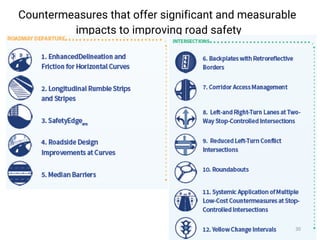
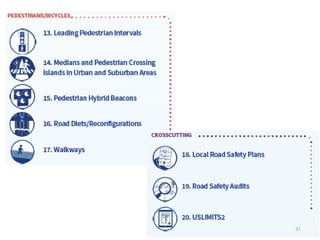
Countermeasures that offer significant and measurable
impacts to improving road safety
30
31
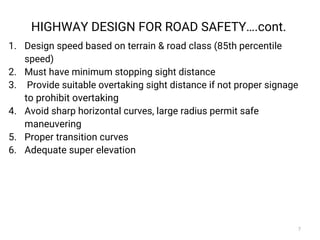
HIGHWAY DESIGN FOR ROAD SAFETY….cont.
1. Design speed based on terrain & road class (85th percentile
speed)
2. Must have minimum stopping sight distance
3. Provide suitable overtaking sight distance if not proper signage
to prohibit overtaking
4. Avoid sharp horizontal curves, large radius permit safe
maneuvering
5. Proper transition curves
6. Adequate super elevation
7
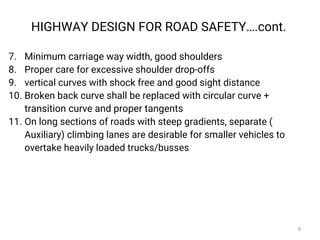
7. Minimum carriage way width, good shoulders
8. Proper care for excessive shoulder drop-offs
9. vertical curves with shock free and good sight distance
10. Broken back curve shall be replaced with circular curve +
transition curve and proper tangents
11. On long sections of roads with steep gradients, separate (
Auxiliary) climbing lanes are desirable for smaller vehicles to
overtake heavily loaded trucks/busses
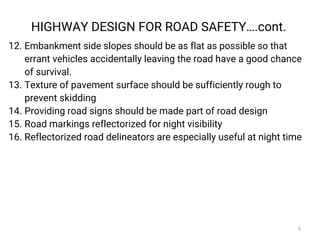
HIGHWAY DESIGN FOR ROAD SAFETY….cont.
8
12. Embankment side slopes should be as flat as possible so that
errant vehicles accidentally leaving the road have a good chance
of survival.
13. Texture of pavement surface should be sufficiently rough to
prevent skidding
14. Providing road signs should be made part of road design
15. Road markings reflectorized for night visibility
16. Reflectorized road delineators are especially useful at night time
HIGHWAY DESIGN FOR ROAD SAFETY….cont.
9
17. Safety barriers are intended to prevent vehicles going off the
road and deflect them back
18. Roads should be illuminated adequately (4 lux-30 lux secondary-
main roads)
19. Raised pedestrian sidewalks, kerbs and guard rails
20. Junction designs should incorporate good features such as
channelization, acceleration and deceleration lanes, separate
right turning pockets, signage and markings
21. Traffic impact attenuators or crash cushions should be provided
wherever warranted
HIGHWAY DESIGN FOR ROAD SAFETY
10
Road Safety Audit (RSA)
• RSA is the formal safety performance examination of an existing or future road
or intersection by an independent, multidisciplinary team
• It qualitatively estimates and reports on potential road safety hazards and
identifies opportunities for improvements in safety for all road users
• The auditor or audit team report to the client project manager who will instruct
the design team to respond with alternative designs
The aim of an RSA is to answer the following questions:
• What elements of the road may present a safety concern: to what extent, to
which road users, and under what circumstances?
• What opportunities exist to eliminate or mitigate identified safety concerns?
RSA to ensure that new road schemes, improvements to highways and traffic
management measures are designed, and implemented to operate as safely as
possible
11
Definitions
• Road Safety Audit: The evaluation of road schemes during design and
construction, before the scheme is opened to traffic, to identify potential
safety hazards which may affect any type of road user and to suggest
measures to eliminate or mitigate those problems.
• Audit Team: A team of a minimum of two persons, independent of the Design
Team and approved by the Overseeing Organisation. The Audit Team shall
comprise staff with appropriate levels of training and experience in road
safety engineering, accident investigation and road safety audit, as set out in
memoranda produced from time to time by the Overseeing Organisation.
Each member of the Audit Team shall consider
• Design Team: The group undertaking the various phases of scheme
preparation and supervision of construction on behalf of the Design Office.
This may be a team within the Design Office or a separate consultant.
• Audit Team Leader (ATL): The person nominated and approved as Audit Team
Leader.
• Design Team Leader (DTL): The person within the Design Team responsible
for managing the scheme design.
12
Scope of the Audit
• The Road Safety Audit shall only consider matters that have an
adverse bearing on road safety. It shall consider safety under all
operating conditions.
• The primary purpose of a Road Safety Audit is to identify potential
safety hazards within the scheme design or construction as they
could affect road users. A road safety audit is not a check of
compliance with design standards. The audit shall not be
concerned with structural safety.
• For certain categories of scheme it may be necessary to confine
the scope of the audit so that only particular pre-defined elements
of the road layout are assessed.
13
Principles of Road Safety
Road Safety Audit is the systematic application of safety principles. Specific aims
are:
• To minimize the risk of accident occurring on the road project and to minimize
the severity of accident that does occur.
• To minimize the risk of accidents occurring on adjacent roads in the network
as a result of a scheme.
• To recognize the importance of safety in highway design to meet the needs
and perceptions of all types of road users and to achieve a balance between
needs where they may be in conflict.
• To reduce the long-term costs of a road project, bearing in mind that unsafe
designs may be expensive or even impossible to correct at a later stage; and
• To improve the awareness about safe design practices among those involved
in the planning, design, construction, operation and maintenance of roads.
Two basic concepts underlying the aims of road safety audit
1. Prevention is better than Cure
2. Drive, Ride, Walk in Safety
14
Principles of Road Safety
A safe environment should:
• Warn the driver of any substandard or unusual features.
• Inform the driver of conditions to be encountered.
• Guide the driver through unusual sections.
• Control the driver's passage through conflict points or sections, and
• Be forgiving of the driver's errant or inappropriate behaviour.
• Similar situations must be treated in similar way
It is better to avoid:
• Insufficient or deficient treatment
• Incorrect or misplaced treatment
• Exaggerated treatment
• Dissimilar treatment for similar situations
15
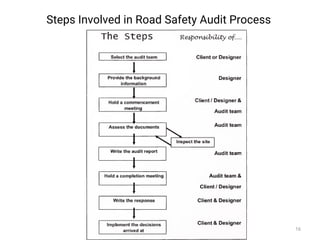
Steps Involved in Road Safety Audit Process
16
Stages of Audit
• Road safety audits and subsequent actions shall in general be
completed at six specific stages
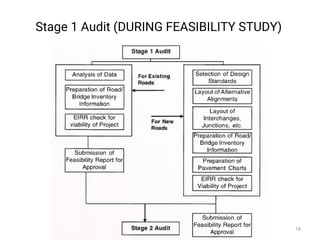
Stage 1 Audit (DURING FEASIBILITY STUDY)
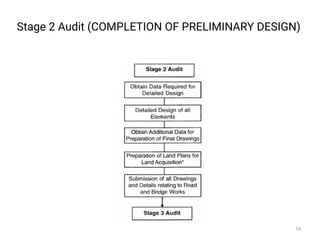
Stage 2 Audit (COMPLETION OF PRELIMINARY DESIGN)
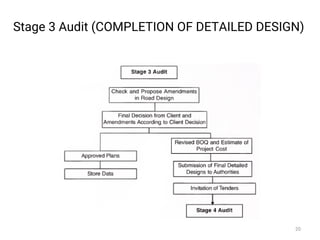
Stage 3 Audit (COMPLETION OF DETAILED DESIGN)
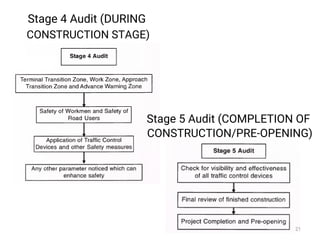
Stage 4 Audit (DURING CONSTRUCTION STAGE)
Stage 5 Audit (COMPLETION OF CONSTRUCTION/PRE-OPENING)
Stage 6 Audit (ON EXISTING ROADS OR DURING OPERATION &
MANAGEMENT)
In the case of minor schemes or temporary works some of the stages
may be omitted or combined.
17
Stage 1 Audit (DURING FEASIBILITY STUDY)
18
Stage 2 Audit (COMPLETION OF PRELIMINARY DESIGN)
19
Stage 3 Audit (COMPLETION OF DETAILED DESIGN)
20
Stage 4 Audit (DURING
CONSTRUCTION STAGE)
Stage 5 Audit (COMPLETION OF
CONSTRUCTION/PRE-OPENING)
21
Details required for RSA team
The list below describes the items that should be provided for road
safety audit.
• Design Brief
• Departures from Standard
• Scheme Drawings
• Other scheme details, e.g. signs schedules, traffic signal staging
• Accident data for existing roads affected by the scheme
• Traffic surveys
• Previous Road Safety Audit Reports and Designer’s Responses
• Previous Exception Reports
• Start date for construction and expected opening date
• Any elements to be excluded from audit
22
Code of good practice and checklists
ELEMENTS OF A GOOD RSA AND MEASURE OF ITS SUCCESS
• As to what makes a good safety audit report will depend on the audit team
and its due diligence in assessing the designs and drawings and a detailed
inspection of the project.
• A good safety audit report will restrict itself to road safety issues, explain each
of the safety issues in some depth and provide practical and implementable
recommendations.
• A good report would also not indulge in blame game.
• The success of a safety audit shall not be measured by cost-benefit approach,
but by the depth of analysis of the design features, identification of issues of
safety concerns and the recommendations that are accepted by client.
• In the initial stages, good number of recommendations may be found to be
acceptable by the client. However, with more and more awareness raising
among designers safety features would get in-built into the design of the
project and it may not be surprising to find that the number of
recommendations from the audit team get reduced. The objective of carrying
out RSA would have then served its intended purpose.
23
• Checklists are useful to assist the audit team. They describe the performance and
situations that can affect the road safety of selected types of project and audit stage.
• These checklists should be used as a guide to focus audit towards important matters
that should be covered and not overlooked.
• Each project is different and will raise specific issues that may contain further safety
implications. When reviewing each of the points, the team should consider that the
road user would have to cope with conditions at night and in adverse weather
conditions also.
• The safety audit team should visit the site for identifying the deficiencies from safety
angle of the stretch and should suggest remedial measures.
• The team should check planning, cross-sections, alignment, roadside furniture and
facilities available, junctions, facilities for vulnerable road users, signs, marking and
lighting and also road side hazards
• Some sort of questionnaire should be prepared for each kilometre. The
questionnaire should include various aspects covered under the methodology of the
safety audit.
Checklists
24
Checklists
Checklist 1 Stage 1 Audit (DURING FEASIBILITY STUDY)
Checklist 2 Stage 2 Audit (COMPLETION OF PRELIMINARY DESIGN)
Checklist 3 Stage 3 Audit (COMPLETION OF DETAILED DESIGN)
Checklist 4 Stage 4 Audit (DURING CONSTRUCTION STAGE)
Checklist 5 Stage 5 Audit (COMPLETION OF CONSTRUCTION/PRE-OPENING) shown in next slide
Checklist 6 Stage 6 Audit (ON EXISTING ROADS OR DURING OPERATION & MANAGEMENT)
Checklist 7 Planning
Checklist 8 Alignment
Checklist 9 Cross Section
Checklist 10 Intersections and Interchanges
Checklist 11 Road Signs
Checklist 12 Road Markings
Checklist 13 Lighting
Checklist 14 Roadside Hazards
Checklist 15 Roadside Facilities
Checklist 16 Vulnerable Road Users
Checklist 17 Development Proposals
Checklist 18 Maintenance Work
25
CHECKLIST 5 - STAGE 5 AUDIT (COMPLETION OF
CONSTRUCTION/PRE-OPENING)
1 ) Have all recommendations from the previous stages been followed? If not, why not?
2) Involve the site engineer
3) Test the installations of traffic control devices as a road user: by car, by truck, by bus,
by cycle and on foot - from disabled road user angle. Also in the dark/ night hours.
4) Examine the carriageway for defects, especially at junctions to existing roads.
5) Has the opening of the road facility been adequately publicized?
6) How will the transition phase proceed?
7) Check that provision for emergency vehicle access and stopping is safe?
8) Check that all delineators and pavement markings are correctly in place.
9) Check that all signs and other traffic control devices are correctly in place. Check that
they are likely to remain visible at all times.
10) Check that the road markings as installed have sufficient contrast with the surfacing
and are clear of debris.
11 ) Check that all lighting operating is effective from safety point of view.
12) Check that no roadside hazard has been installed or overlooked.
13) Check that the form and function of the road and its traffic management are easily recognised
under likely operating conditions.
14) Check that all temporary arrangements, signing, etc, have been removed and replaced by
permanent arrangements.
15) Other checks made at discretion of auditor or client. 26
Vehicular characteristics
Static characteristics
1. Maximum dimensions of road vehicles
Width= 2.5m,
Height=3.8-4.2m for single decked, 4.75m for double decked
Length =11m for single unit with 2axles
12m for single unit with more than 2axles
16m for tractor semi trailer combination
18m for tractor and trailer combination
2. Weight of loaded vehicle
Single axle 10.2 tonnes, Tandem axle 18 tonnes
3. Axle configuration: no. of std. axles count used in pavement structure design
4. Power to weight ratio of vehicle: it characterizes the ease with which a vehicle
can move (human powered vs motorized vehicles, heavy vs light vehicle)
5. Turning Radius and Turning Path: radius of circle traced out by vehicle when its
steering turned to the max. extent possible. Effective width of vehicle increases
near turns
3
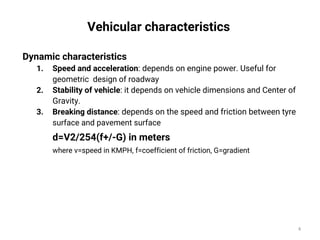
Dynamic characteristics
1. Speed and acceleration: depends on engine power. Useful for
geometric design of roadway
2. Stability of vehicle: it depends on vehicle dimensions and Center of
Gravity.
3. Breaking distance: depends on the speed and friction between tyre
surface and pavement surface
d=V2/254(f+/-G) in meters
where v=speed in KMPH, f=coefficient of friction, G=gradient
Vehicular characteristics
4
Road user characteristics
a. Physical characteristics:
a. Vision:
very distinct vision:- zone of acute 3 degree angle cone about retina center
Satisfactory vision:- 10 to 12 degree cone about retina center (sign board location)
Peripheral vision: deals with total visual field of two eyes, 1600 horizontal, 1150 vertical,
varies with speed, the angle of cone falls from 1100 at 30kmph to 400 at 100kmph
Glare recovery time:- 3 to 6 seconds
b. Hearing: an aid to vehicle driver and pedestrian
c. Temporary physical characteristics are fatigue, alcohol /drugs & illness.
b. Mental characteristics:
a. Knowledge: Specific information about traffic
b. Skill: ability acquired by training
c. Intelligence: The capacity to acquire and apply knowledge
d. Experience: The accumulation of knowledge or skill that results from direct
participation in events or activities related to traffic
5
Road user characteristics
c. Psychological factors:
Perception, Intellection, Emotion and Volition (PIEV) theory
Perception is the process of perceiving the sensations received through eyes, ears,
nervous system and the brain. the exact time required for this is dependent upon
the individual’s psychological and physiological build-up
Intellection is the identification of the stimuli by the development of new thoughts
and ideas. It is slightly different from simple recognition by past experiences,
which is part of normal perception process.
Emotion is the personal trait of the individual that governs his decision making
process, after the perception and intellection of the stimuli
Volition is the will to react to a situation
Break reaction time is the time lag between the perception of danger and the
effective application of the breaks
IRC/AASHTO suggests Perception and Break reaction time as 2.5seconds
d. Environmental factors: traffic stream characteristics, facilities to the traffic,
atmospheric conditions and the locality
6

road safety engineering RSE unit -2.pdf

  • 1.
    OPERATING THE ROADNETWORK FOR SAFETY • Apart from the opportunities which engineers and planners have to influence road safety during the planning and design of new roads and networks, there is also scope on existing roads to rectify earlier insensitive designs by better operational control and the application of accident reduction countermeasures • Through selective use of traffic management and other techniques it is possible to create safer, less congested and more efficient road networks. • The use and operation of the existing roads can be optimised without recourse to major reconstruction. Such an approach is particularly relevant to the needs and financial resources of developing countries The general approach is applicable to both new and established urban areas and is based upon recognition of several underlying principles: 1. Potential for conflict and accidents will exist wherever access is provided to roads carrying moving traffic and wherever roads intersect 2. Safety will be improved if road users clearly and unambiguously understand which road has priority at intersections 3. Pedestrians, cyclists and slow-moving vehicles (e.g. animal drawn) should be segregated from other moving vehicles 4. Effective land-use controls can avoid many of the road safety problems which would otherwise occur with unrestrained development; and 5. A safe road network is one where there is maximum differentiation between roads intended primarily for access and roads intended primarily for through journeys (or movement). 27
  • 2.
    • Specialist trafficengineers within municipal engineering departments work full-time in monitoring operational aspects of the road network for which they are responsible • Problem locations, whether in terms of congestion, parking, road safety or environmental nuisance are identified through surveys and site visits and studies are undertaken to find ways to improve any deficiencies • Consultations are held with the town planning authorities, local traffic safety organisations, traffic police and other emergency services to devise suitable traffic management countermeasures to overcome any deficiencies which have been identified • Implementation is normally undertaken in close cooperation with the traffic police. Often a very high traffic police enforcement presence is provided for the initial few weeks after implementation until drivers become familiar with the new system • Considerable advance publicity is normally organised through the newspapers , TV and radio stations • Consultations are also normally held with local residents, shopkeepers and others likely to be affected by the proposals. All are given an opportunity to comment upon the proposed schemes during the development stage so that, as far as practical OPERATING THE ROAD NETWORK FOR SAFETY 28
  • 3.
    • Successful andsafe operation of road networks, therefore, depends upon professionals within municipal engineering departments working with other interested professionals, such as traffic police and town planners, constantly to monitor the system in order to identify deficiencies and potential problems. • In developing countries traffic police often have the dominant responsibilities for the traffic engineering and operational aspects of the road system. Where this is so they should take the lead in coordinating activities with engineers and planners. OPERATING THE ROAD NETWORK FOR SAFETY 29
  • 4.
    Countermeasures that offersignificant and measurable impacts to improving road safety 30
  • 5.
  • 6.
    HIGHWAY DESIGN FORROAD SAFETY….cont. 1. Design speed based on terrain & road class (85th percentile speed) 2. Must have minimum stopping sight distance 3. Provide suitable overtaking sight distance if not proper signage to prohibit overtaking 4. Avoid sharp horizontal curves, large radius permit safe maneuvering 5. Proper transition curves 6. Adequate super elevation 7
  • 7.
    7. Minimum carriageway width, good shoulders 8. Proper care for excessive shoulder drop-offs 9. vertical curves with shock free and good sight distance 10. Broken back curve shall be replaced with circular curve + transition curve and proper tangents 11. On long sections of roads with steep gradients, separate ( Auxiliary) climbing lanes are desirable for smaller vehicles to overtake heavily loaded trucks/busses HIGHWAY DESIGN FOR ROAD SAFETY….cont. 8
  • 8.
    12. Embankment sideslopes should be as flat as possible so that errant vehicles accidentally leaving the road have a good chance of survival. 13. Texture of pavement surface should be sufficiently rough to prevent skidding 14. Providing road signs should be made part of road design 15. Road markings reflectorized for night visibility 16. Reflectorized road delineators are especially useful at night time HIGHWAY DESIGN FOR ROAD SAFETY….cont. 9
  • 9.
    17. Safety barriersare intended to prevent vehicles going off the road and deflect them back 18. Roads should be illuminated adequately (4 lux-30 lux secondary- main roads) 19. Raised pedestrian sidewalks, kerbs and guard rails 20. Junction designs should incorporate good features such as channelization, acceleration and deceleration lanes, separate right turning pockets, signage and markings 21. Traffic impact attenuators or crash cushions should be provided wherever warranted HIGHWAY DESIGN FOR ROAD SAFETY 10
  • 10.
    Road Safety Audit(RSA) • RSA is the formal safety performance examination of an existing or future road or intersection by an independent, multidisciplinary team • It qualitatively estimates and reports on potential road safety hazards and identifies opportunities for improvements in safety for all road users • The auditor or audit team report to the client project manager who will instruct the design team to respond with alternative designs The aim of an RSA is to answer the following questions: • What elements of the road may present a safety concern: to what extent, to which road users, and under what circumstances? • What opportunities exist to eliminate or mitigate identified safety concerns? RSA to ensure that new road schemes, improvements to highways and traffic management measures are designed, and implemented to operate as safely as possible 11
  • 11.
    Definitions • Road SafetyAudit: The evaluation of road schemes during design and construction, before the scheme is opened to traffic, to identify potential safety hazards which may affect any type of road user and to suggest measures to eliminate or mitigate those problems. • Audit Team: A team of a minimum of two persons, independent of the Design Team and approved by the Overseeing Organisation. The Audit Team shall comprise staff with appropriate levels of training and experience in road safety engineering, accident investigation and road safety audit, as set out in memoranda produced from time to time by the Overseeing Organisation. Each member of the Audit Team shall consider • Design Team: The group undertaking the various phases of scheme preparation and supervision of construction on behalf of the Design Office. This may be a team within the Design Office or a separate consultant. • Audit Team Leader (ATL): The person nominated and approved as Audit Team Leader. • Design Team Leader (DTL): The person within the Design Team responsible for managing the scheme design. 12
  • 12.
    Scope of theAudit • The Road Safety Audit shall only consider matters that have an adverse bearing on road safety. It shall consider safety under all operating conditions. • The primary purpose of a Road Safety Audit is to identify potential safety hazards within the scheme design or construction as they could affect road users. A road safety audit is not a check of compliance with design standards. The audit shall not be concerned with structural safety. • For certain categories of scheme it may be necessary to confine the scope of the audit so that only particular pre-defined elements of the road layout are assessed. 13
  • 13.
    Principles of RoadSafety Road Safety Audit is the systematic application of safety principles. Specific aims are: • To minimize the risk of accident occurring on the road project and to minimize the severity of accident that does occur. • To minimize the risk of accidents occurring on adjacent roads in the network as a result of a scheme. • To recognize the importance of safety in highway design to meet the needs and perceptions of all types of road users and to achieve a balance between needs where they may be in conflict. • To reduce the long-term costs of a road project, bearing in mind that unsafe designs may be expensive or even impossible to correct at a later stage; and • To improve the awareness about safe design practices among those involved in the planning, design, construction, operation and maintenance of roads. Two basic concepts underlying the aims of road safety audit 1. Prevention is better than Cure 2. Drive, Ride, Walk in Safety 14
  • 14.
    Principles of RoadSafety A safe environment should: • Warn the driver of any substandard or unusual features. • Inform the driver of conditions to be encountered. • Guide the driver through unusual sections. • Control the driver's passage through conflict points or sections, and • Be forgiving of the driver's errant or inappropriate behaviour. • Similar situations must be treated in similar way It is better to avoid: • Insufficient or deficient treatment • Incorrect or misplaced treatment • Exaggerated treatment • Dissimilar treatment for similar situations 15
  • 15.
    Steps Involved inRoad Safety Audit Process 16
  • 16.
    Stages of Audit •Road safety audits and subsequent actions shall in general be completed at six specific stages Stage 1 Audit (DURING FEASIBILITY STUDY) Stage 2 Audit (COMPLETION OF PRELIMINARY DESIGN) Stage 3 Audit (COMPLETION OF DETAILED DESIGN) Stage 4 Audit (DURING CONSTRUCTION STAGE) Stage 5 Audit (COMPLETION OF CONSTRUCTION/PRE-OPENING) Stage 6 Audit (ON EXISTING ROADS OR DURING OPERATION & MANAGEMENT) In the case of minor schemes or temporary works some of the stages may be omitted or combined. 17
  • 17.
    Stage 1 Audit(DURING FEASIBILITY STUDY) 18
  • 18.
    Stage 2 Audit(COMPLETION OF PRELIMINARY DESIGN) 19
  • 19.
    Stage 3 Audit(COMPLETION OF DETAILED DESIGN) 20
  • 20.
    Stage 4 Audit(DURING CONSTRUCTION STAGE) Stage 5 Audit (COMPLETION OF CONSTRUCTION/PRE-OPENING) 21
  • 21.
    Details required forRSA team The list below describes the items that should be provided for road safety audit. • Design Brief • Departures from Standard • Scheme Drawings • Other scheme details, e.g. signs schedules, traffic signal staging • Accident data for existing roads affected by the scheme • Traffic surveys • Previous Road Safety Audit Reports and Designer’s Responses • Previous Exception Reports • Start date for construction and expected opening date • Any elements to be excluded from audit 22
  • 22.
    Code of goodpractice and checklists ELEMENTS OF A GOOD RSA AND MEASURE OF ITS SUCCESS • As to what makes a good safety audit report will depend on the audit team and its due diligence in assessing the designs and drawings and a detailed inspection of the project. • A good safety audit report will restrict itself to road safety issues, explain each of the safety issues in some depth and provide practical and implementable recommendations. • A good report would also not indulge in blame game. • The success of a safety audit shall not be measured by cost-benefit approach, but by the depth of analysis of the design features, identification of issues of safety concerns and the recommendations that are accepted by client. • In the initial stages, good number of recommendations may be found to be acceptable by the client. However, with more and more awareness raising among designers safety features would get in-built into the design of the project and it may not be surprising to find that the number of recommendations from the audit team get reduced. The objective of carrying out RSA would have then served its intended purpose. 23
  • 23.
    • Checklists areuseful to assist the audit team. They describe the performance and situations that can affect the road safety of selected types of project and audit stage. • These checklists should be used as a guide to focus audit towards important matters that should be covered and not overlooked. • Each project is different and will raise specific issues that may contain further safety implications. When reviewing each of the points, the team should consider that the road user would have to cope with conditions at night and in adverse weather conditions also. • The safety audit team should visit the site for identifying the deficiencies from safety angle of the stretch and should suggest remedial measures. • The team should check planning, cross-sections, alignment, roadside furniture and facilities available, junctions, facilities for vulnerable road users, signs, marking and lighting and also road side hazards • Some sort of questionnaire should be prepared for each kilometre. The questionnaire should include various aspects covered under the methodology of the safety audit. Checklists 24
  • 24.
    Checklists Checklist 1 Stage1 Audit (DURING FEASIBILITY STUDY) Checklist 2 Stage 2 Audit (COMPLETION OF PRELIMINARY DESIGN) Checklist 3 Stage 3 Audit (COMPLETION OF DETAILED DESIGN) Checklist 4 Stage 4 Audit (DURING CONSTRUCTION STAGE) Checklist 5 Stage 5 Audit (COMPLETION OF CONSTRUCTION/PRE-OPENING) shown in next slide Checklist 6 Stage 6 Audit (ON EXISTING ROADS OR DURING OPERATION & MANAGEMENT) Checklist 7 Planning Checklist 8 Alignment Checklist 9 Cross Section Checklist 10 Intersections and Interchanges Checklist 11 Road Signs Checklist 12 Road Markings Checklist 13 Lighting Checklist 14 Roadside Hazards Checklist 15 Roadside Facilities Checklist 16 Vulnerable Road Users Checklist 17 Development Proposals Checklist 18 Maintenance Work 25
  • 25.
    CHECKLIST 5 -STAGE 5 AUDIT (COMPLETION OF CONSTRUCTION/PRE-OPENING) 1 ) Have all recommendations from the previous stages been followed? If not, why not? 2) Involve the site engineer 3) Test the installations of traffic control devices as a road user: by car, by truck, by bus, by cycle and on foot - from disabled road user angle. Also in the dark/ night hours. 4) Examine the carriageway for defects, especially at junctions to existing roads. 5) Has the opening of the road facility been adequately publicized? 6) How will the transition phase proceed? 7) Check that provision for emergency vehicle access and stopping is safe? 8) Check that all delineators and pavement markings are correctly in place. 9) Check that all signs and other traffic control devices are correctly in place. Check that they are likely to remain visible at all times. 10) Check that the road markings as installed have sufficient contrast with the surfacing and are clear of debris. 11 ) Check that all lighting operating is effective from safety point of view. 12) Check that no roadside hazard has been installed or overlooked. 13) Check that the form and function of the road and its traffic management are easily recognised under likely operating conditions. 14) Check that all temporary arrangements, signing, etc, have been removed and replaced by permanent arrangements. 15) Other checks made at discretion of auditor or client. 26
  • 26.
    Vehicular characteristics Static characteristics 1.Maximum dimensions of road vehicles Width= 2.5m, Height=3.8-4.2m for single decked, 4.75m for double decked Length =11m for single unit with 2axles 12m for single unit with more than 2axles 16m for tractor semi trailer combination 18m for tractor and trailer combination 2. Weight of loaded vehicle Single axle 10.2 tonnes, Tandem axle 18 tonnes 3. Axle configuration: no. of std. axles count used in pavement structure design 4. Power to weight ratio of vehicle: it characterizes the ease with which a vehicle can move (human powered vs motorized vehicles, heavy vs light vehicle) 5. Turning Radius and Turning Path: radius of circle traced out by vehicle when its steering turned to the max. extent possible. Effective width of vehicle increases near turns 3
  • 27.
    Dynamic characteristics 1. Speedand acceleration: depends on engine power. Useful for geometric design of roadway 2. Stability of vehicle: it depends on vehicle dimensions and Center of Gravity. 3. Breaking distance: depends on the speed and friction between tyre surface and pavement surface d=V2/254(f+/-G) in meters where v=speed in KMPH, f=coefficient of friction, G=gradient Vehicular characteristics 4
  • 28.
    Road user characteristics a.Physical characteristics: a. Vision: very distinct vision:- zone of acute 3 degree angle cone about retina center Satisfactory vision:- 10 to 12 degree cone about retina center (sign board location) Peripheral vision: deals with total visual field of two eyes, 1600 horizontal, 1150 vertical, varies with speed, the angle of cone falls from 1100 at 30kmph to 400 at 100kmph Glare recovery time:- 3 to 6 seconds b. Hearing: an aid to vehicle driver and pedestrian c. Temporary physical characteristics are fatigue, alcohol /drugs & illness. b. Mental characteristics: a. Knowledge: Specific information about traffic b. Skill: ability acquired by training c. Intelligence: The capacity to acquire and apply knowledge d. Experience: The accumulation of knowledge or skill that results from direct participation in events or activities related to traffic 5
  • 29.
    Road user characteristics c.Psychological factors: Perception, Intellection, Emotion and Volition (PIEV) theory Perception is the process of perceiving the sensations received through eyes, ears, nervous system and the brain. the exact time required for this is dependent upon the individual’s psychological and physiological build-up Intellection is the identification of the stimuli by the development of new thoughts and ideas. It is slightly different from simple recognition by past experiences, which is part of normal perception process. Emotion is the personal trait of the individual that governs his decision making process, after the perception and intellection of the stimuli Volition is the will to react to a situation Break reaction time is the time lag between the perception of danger and the effective application of the breaks IRC/AASHTO suggests Perception and Break reaction time as 2.5seconds d. Environmental factors: traffic stream characteristics, facilities to the traffic, atmospheric conditions and the locality 6