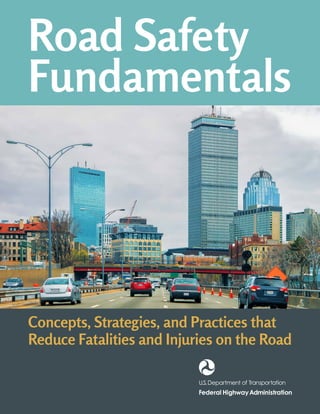
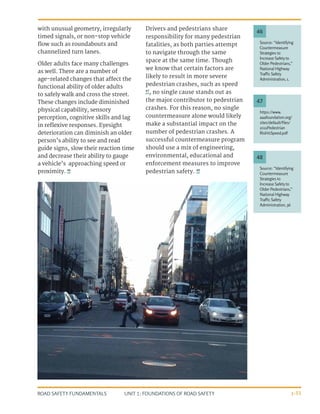
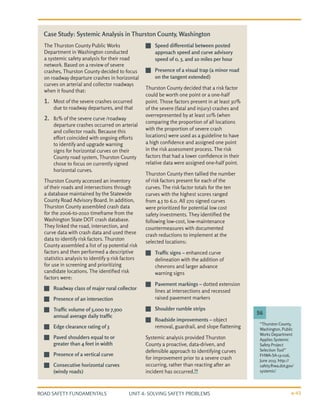
Road Safety
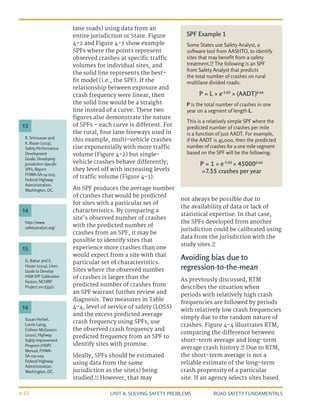
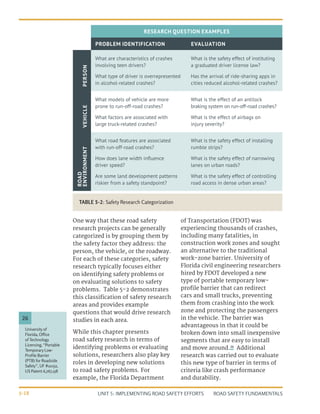
Fundamentals
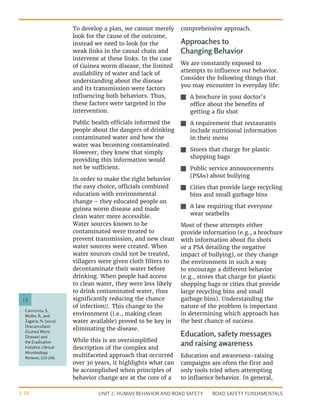
Concepts, Strategies, and Practices that
Reduce Fatalities and Injuries on the Road
Notice
This document is disseminated under the sponsorship of the U.S. Department of Transportation
(USDOT) in the interest of information exchange. The U.S. Government assumes no liability for the use
of the information contained in this document.
The U.S. Government does not endorse products or manufacturers. Trademarks or manufacturers’ names
appear in this report only because they are considered essential to the objective of the document.
Quality Assurance Statement
The Federal Highway Administration (FHWA) provides high-quality information to serve Government,
industry, and the public in a manner that promotes public understanding. Standards and policies are
used to ensure and maximize the quality, objectivity, utility, and integrity of its information. FHWA
periodically reviews quality issues and adjusts its programs and processes to ensure continuous quality
improvement.
This document can be downloaded for free in full or by individual unit at:
https://rspcb.safety.fhwa.dot.gov/rsf/
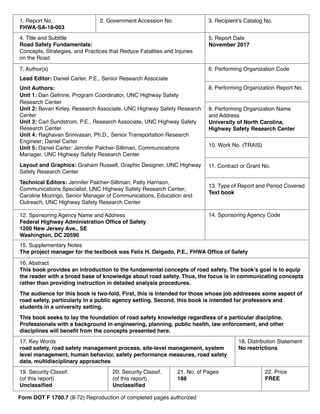
1. Report No.
FHWA-SA-18-003
4. Title and Subtitle
Road Safety Fundamentals:
Concepts, Strategies, and Practices that Reduce Fatalities and Injuries
on the Road
7. Author(s)
Lead Editor: Daniel Carter, P.E., Senior Research Associate
Unit Authors:
Unit 1: Dan Gelinne, Program Coordinator, UNC Highway Safety
Research Center
Unit 2: Bevan Kirley, Research Associate, UNC Highway Safety Research
Center
Unit 3: Carl Sundstrom, P.E., Research Associate, UNC Highway Safety
Research Center
Unit 4: Raghavan Srinivasan, Ph.D., Senior Transportation Research
Engineer; Daniel Carter
Unit 5: Daniel Carter; Jennifer Palcher-Silliman, Communications
Manager, UNC Highway Safety Research Center
Layout and Graphics: Graham Russell, Graphic Designer, UNC Highway
Safety Research Center
Technical Editors: Jennifer Palcher-Silliman; Patty Harrison,
Communications Specialist, UNC Highway Safety Research Center;
Caroline Mozingo, Senior Manager of Communications, Education and
Outreach, UNC Highway Safety Research Center
9. Performing Organization Name
and Address
University of North Carolina,
Highway Safety Research Center
12. Sponsoring Agency Name and Address
Federal Highway Administration Office of Safety
1200 New Jersey Ave., SE
Washington, DC 20590
14. Sponsoring Agency Code
15. Supplementary Notes
The project manager for the textbook was Felix H. Delgado, P.E., FHWA Office of Safety
16. Abstract
This book provides an introduction to the fundamental concepts of road safety. The book’s goal is to equip
the reader with a broad base of knowledge about road safety. Thus, the focus is in communicating concepts
rather than providing instruction in detailed analysis procedures.
The audience for this book is two-fold. First, this is intended for those whose job addresses some aspect of
road safety, particularly in a public agency setting. Second, this book is intended for professors and
students in a university setting.
This book seeks to lay the foundation of road safety knowledge regardless of a particular discipline.
Professionals with a background in engineering, planning, public health, law enforcement, and other
disciplines will benefit from the concepts presented here.
17. Key Words
road safety, road safety management process, site-level management, system
level management, human behavior, safety performance measures, road safety
data, multidisciplinary approaches
18. Distribution Statement
No restrictions
19. Security Classif.
(of this report)
Unclassified
20. Security Classif.
(of this report)
Unclassified
21. No. of Pages
188
22. Price
FREE
5. Report Date
November 2017
6. Performing Organization Code
8. Performing Organization Report No.
10. Work No. (TRAIS)
11. Contract or Grant No.
13. Type of Report and Period Covered
Text book
2. Government Accession No. 3. Recipient’s Catalog No.
Form DOT F 1700.7 (8-72) Reproduction of completed pages authorized
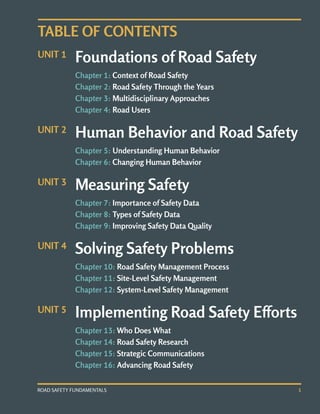
UNIT 1
	 Foundations of Road Safety
		Chapter 1: Context of Road Safety
		Chapter 2: Road Safety Through the Years
		Chapter 3: Multidisciplinary Approaches
		Chapter 4: Road Users
UNIT 2
	 Human Behavior and Road Safety
		Chapter 5: Understanding Human Behavior
		Chapter 6: Changing Human Behavior
UNIT 3
	 Measuring Safety
		Chapter 7: Importance of Safety Data
		Chapter 8: Types of Safety Data
		Chapter 9: Improving Safety Data Quality
UNIT 4
	 Solving Safety Problems
		Chapter 10: Road Safety Management Process
		Chapter 11: Site-Level Safety Management
		Chapter 12: System-Level Safety Management
UNIT 5
	 Implementing Road Safety Efforts
		Chapter 13: Who Does What
		Chapter 14: Road Safety Research
		Chapter 15: Strategic Communications
		Chapter 16: Advancing Road Safety
TABLE OF CONTENTS
ROAD SAFETY FUNDAMENTALS 1
ROAD SAFETY FUNDAMENTALS
2
INTRODUCTION
This book provides an introduction to many of the fundamental concepts
of road safety. These concepts cover areas such as the nature of road safety
issues, human behavior in the road environment, and identifying and
solving road safety problems. The goal of this book is to equip the reader
with a broad base of knowledge about road safety. Thus, the focus of the
text is in communicating concepts rather than providing instruction in
detailed analysis procedures.
The audience for this book is two-fold. First, this is intended for those
whose job addresses some aspect of road safety, particularly in a public
agency setting. This is especially relevant for individuals who have been
tasked with managing road safety but who do not have formal training in
road safety management. In order to show practical applications of each
road safety concept, this book contains many examples that demonstrate
the concepts in real-world settings. Second, this book is intended for
professors and students in a university setting who can use individual units
or this entire book to add an emphasis on road safety as part of graduate-
level work. Each unit provides learning objectives and sample exercises to
assist professors as they incorporate content into their courses.
As a final note, this book is intended to lay the foundation of road safety
knowledge regardless of a particular discipline. Professionals with a
background in engineering, planning, public health, law enforcement, and
other disciplines will benefit from the concepts presented here.
ROAD SAFETY FUNDAMENTALS 3
ABOUT THIS BOOK
This book is divided into five units according to major topics of road safety
knowledge. Each unit is divided into multiple chapters that address the
primary concepts of the unit. The beginning of each unit provides a list of
learning objectives that indicate what the reader will be able to understand,
describe, identify, or otherwise do by the end of the unit.
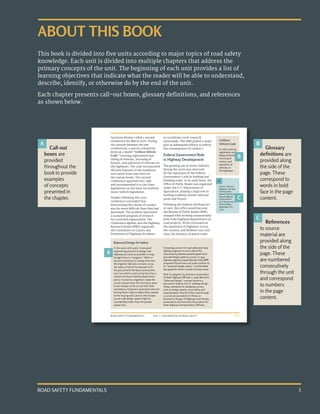
Each chapter presents call-out boxes, glossary definitions, and references
as shown below.
UNIT 1: FOUNDATIONS OF ROAD SAFETY
ROAD SAFETY FUNDAMENTALS 1-13
Secretary Hoover called a second
conference for March 1926. During
the interim between the two
conferences, a special committee
drew up a model “Uniform Vehicle
Code” covering registration and
titling of vehicles, licensing of
drivers, and operation of vehicles on
the highways. The code incorporated
the best features of the numerous
and varied State laws then on
the statute books. The second
conference approved this code
and recommended it to the State
legislatures as the basis for uniform
motor vehicle legislation.
Studies following this 1926
conference concluded that
determining the causes of crashes
was far more difficult than they had
presumed. The problem warranted
a sustained program of research
by a national organization. The
Conference agreed, and the Highway
Research Board (HRB) organized
the Committee on Causes and
Prevention of Highway Accidents
to coordinate crash research
nationwide. The HRB played a major
part in subsequent efforts to reduce
the consequences of crashes.8
Federal Government Role
in Highway Development
The growing use of motor vehicles
during the 1920s was mirrored
by the expansion of the Federal
Government’s role in funding and
building roads. In its early form, the
Office of Public Roads was organized
under the U.S. Department of
Agriculture, playing a large role in
funding roadways within national
parks and forests.
Following the Federal Aid Road Act
of 1916, this office would become
the Bureau of Public Roads (BPR),
charged with working cooperatively
with State highway departments on
road projects. Work continued on
the expansion of highways across
the country, and between 1921 and
1939, the distance of paved roads
Balanced Design for Safety
In the 1920s and 1930s, it was good
engineering practice to design new
highways as much as possible in long
straight lines or “tangents.” When it
became necessary to change direction,
the engineer laid out a circular curve,
the radius of which he selected to fit
the ground with the least construction
cost, but which could not be less than a
certain minimum fixed by department
policy. In practice, engineers made the
curves sharper than this minimum when
it was cheaper to do so, but with little
consistency. Engineers expected motorists
driving these roads to adjust their speeds
to the varying radii, and on the sharper
curves safe design speed might be
considerably lower than the posted
speed limit.
Increasing concern for road safety led many
highway engineers to worry about this
inconsistency between posted speed limits
and safe design speed on curves. In 1935,
highway engineer Joseph Barnett of the BPR
proposed that all new rural roads conform to
an “assumed design speed,” a comfortable
top speed for drivers outside of urban areas.
With its adoption by American Association
of State Highway Officials in 1938, Barnett’s
“balanced design” concept became a
permanent feature of U.S. roadway design.
Today, standards for designing curves,
such as design speed, curve radius and
superelevation (the tilt of the road through
a curve) are provided in A Policy on
Geometric Design of Highways and Streets,
produced by the American Association for
State Highway Transportation Officials.
Source: America’s
Highways, 1776-1976:
A History of the
Federal-Aid Program.
Federal Highway
Administration
(U.S. Government
Printing Office,
Washington D.C.,
1976).
8
Uniform
Vehicle Code
A code covering
registration and
titling of vehicles,
licensing of
drivers, and
operation of
vehicles on
the highways.
Call-out
boxes are
provided
throughout the
bookto provide
examples
of concepts
presented in
the chapter.
Glossary
definitions are
provided along
the side of the
page. These
correspond to
words in bold
face in the page
content.
References
to source
material are
provided along
the side of the
page. These
are numbered
consecutively
through the unit
and correspond
to numbers
in the page
content.
A
A
B
B
C
C
UNIT 1: FOUNDATIONS OF ROAD SAFETY ROAD SAFETY FUNDAMENTALS
1-b
After reading the chapters and completing
exercises in Unit 1, the reader will be able to:
J
J DESCRIBE the importance of road
safety and how it relates to public
health, economic, environmental
and demographic trends
J
J RECOGNIZE roles and responsibilities
of various disciplines and approaches
to improving road safety
J
J DISTINGUISH between nominal
and substantive safety
J
J IDENTIFY key points in the history of
road safety in the U.S., including key
legislation and agency formation, and
understand how these decisions have
shaped today’s roadways
J
J IDENTIFY different groups of road users
and challenges unique to each group
LEARNING OBJECTIVES
Foundations
of Road Safety
UNIT 1
UNIT 1: FOUNDATIONS OF ROAD SAFETY
ROAD SAFETY FUNDAMENTALS 1-1
Context of Road Safety
Road safety is an important part
of everyday life. Across the nation,
people use roads and sidewalks to
get to work, school, stores, and
home. Public agencies work to
ensure that people arrive at their
destination without incident.
However, not every trip is without
incident. Deaths and injuries
resulting from motor vehicle crashes
represent a significant public
health concern. The World Health
Organization (WHO) estimates that
motor vehicle crashes kill more than 1
million people around the world each
year, and seriously injure as many as
20 to 50 million.1
These crashes affect
all road users, from vehicle drivers
and passengers to pedestrians,
bicyclists, and transit users.
Though road safety in the U.S.
has steadily improved over
time, it remains a priority for
transportation agencies, legislators,
and advocacy organizations. Over
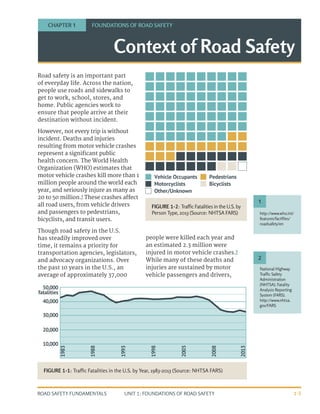
the past 10 years in the U.S., an
average of approximately 37,000
people were killed each year and
an estimated 2.3 million were
injured in motor vehicle crashes.2
While many of these deaths and
injuries are sustained by motor
vehicle passengers and drivers,
CHAPTER 1 FOUNDATIONS OF ROAD SAFETY
http://www.who.int/
features/factfiles/
roadsafety/en
National Highway
Traffic Safety
Administration
(NHTSA). Fatality
Analysis Reporting
System (FARS).
http://www.nhtsa.
gov/FARS
1983
50,000
fatalities
40,000
30,000
20,000
10,000
1988
1993
1998
2003
2008
2013
Vehicle Occupants
Motorcyclists
Other/Unknown
Pedestrians
bicyclists
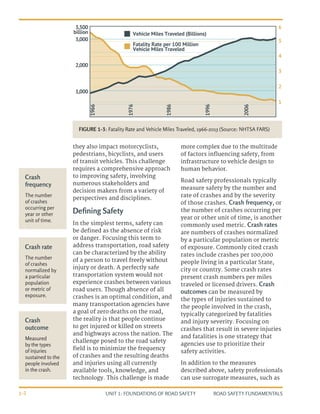
FIGURE 1-1: Traffic Fatalities in the U.S. by Year, 1983-2013 (Source: NHTSA FARS)
FIGURE 1-2: Traffic Fatalities in the U.S. by
Person Type, 2013 (Source: NHTSA FARS)
1
2
UNIT 1: FOUNDATIONS OF ROAD SAFETY ROAD SAFETY FUNDAMENTALS
1-2
they also impact motorcyclists,
pedestrians, bicyclists, and users
of transit vehicles. This challenge
requires a comprehensive approach
to improving safety, involving
numerous stakeholders and
decision makers from a variety of
perspectives and disciplines.
Defining Safety
In the simplest terms, safety can
be defined as the absence of risk
or danger. Focusing this term to
address transportation, road safety
can be characterized by the ability
of a person to travel freely without
injury or death. A perfectly safe
transportation system would not
experience crashes between various
road users. Though absence of all
crashes is an optimal condition, and
many transportation agencies have
a goal of zero deaths on the road,
the reality is that people continue
to get injured or killed on streets
and highways across the nation. The
challenge posed to the road safety
field is to minimize the frequency
of crashes and the resulting deaths
and injuries using all currently
available tools, knowledge, and
technology. This challenge is made
more complex due to the multitude
of factors influencing safety, from
infrastructure to vehicle design to
human behavior.
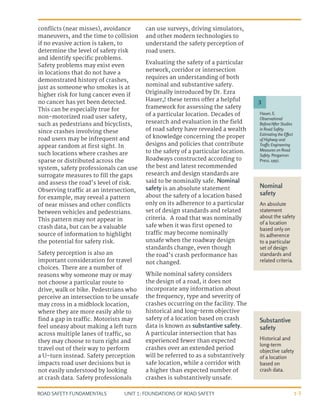
Road safety professionals typically
measure safety by the number and
rate of crashes and by the severity
of those crashes. Crash frequency, or
the number of crashes occurring per
year or other unit of time, is another
commonly used metric. Crash rates
are numbers of crashes normalized
by a particular population or metric
of exposure. Commonly cited crash
rates include crashes per 100,000
people living in a particular State,
city or country. Some crash rates
present crash numbers per miles
traveled or licensed drivers. Crash
outcomes can be measured by
the types of injuries sustained to
the people involved in the crash,
typically categorized by fatalities
and injury severity. Focusing on
crashes that result in severe injuries
and fatalities is one strategy that
agencies use to prioritize their
safety activities.
In addition to the measures
described above, safety professionals
can use surrogate measures, such as
Crash
frequency
The number
of crashes
occurring per
year or other
unit of time.
Crash rate
The number
of crashes
normalized by
a particular
population
or metric of
exposure.
Crash
outcome
Measured
by the types
of injuries
sustained to the
people involved
in the crash.
1966
3,500
billion Vehicle Miles Traveled (billions)
Fatality Rate per 100 Million
Vehicle Miles Traveled
6
5
4
3
2
1
3,000
2,000
1,000
1976
1986
1996
2006
FIGURE 1-3: Fatality Rate and Vehicle Miles Traveled, 1966-2013 (Source: NHTSA FARS)
UNIT 1: FOUNDATIONS OF ROAD SAFETY
ROAD SAFETY FUNDAMENTALS 1-3
Nominal
safety
An absolute
statement
about the safety
of a location
based only on
its adherence
to a particular
set of design
standards and
related criteria.
Substantive
safety
Historical and
long-term
objective safety
of a location
based on
crash data.
conflicts (near misses), avoidance
maneuvers, and the time to collision
if no evasive action is taken, to
determine the level of safety risk
and identify specific problems.
Safety problems may exist even
in locations that do not have a
demonstrated history of crashes,
just as someone who smokes is at
higher risk for lung cancer even if
no cancer has yet been detected.
This can be especially true for
non-motorized road user safety,
such as pedestrians and bicyclists,
since crashes involving these
road users may be infrequent and
appear random at first sight. In
such locations where crashes are
sparse or distributed across the
system, safety professionals can use
surrogate measures to fill the gaps
and assess the road’s level of risk.
Observing traffic at an intersection,
for example, may reveal a pattern
of near misses and other conflicts
between vehicles and pedestrians.
This pattern may not appear in
crash data, but can be a valuable
source of information to highlight
the potential for safety risk.
Safety perception is also an
important consideration for travel
choices. There are a number of
reasons why someone may or may
not choose a particular route to
drive, walk or bike. Pedestrians who
perceive an intersection to be unsafe
may cross in a midblock location,
where they are more easily able to
find a gap in traffic. Motorists may
feel uneasy about making a left turn
across multiple lanes of traffic, so
they may choose to turn right and
travel out of their way to perform
a U-turn instead. Safety perception
impacts road user decisions but is
not easily understood by looking
at crash data. Safety professionals
can use surveys, driving simulators,
and other modern technologies to
understand the safety perception of
road users.
Evaluating the safety of a particular
network, corridor or intersection
requires an understanding of both
nominal and substantive safety.
Originally introduced by Dr. Ezra
Hauer,3
these terms offer a helpful
framework for assessing the safety
of a particular location. Decades of
research and evaluation in the field
of road safety have revealed a wealth
of knowledge concerning the proper
designs and policies that contribute
to the safety of a particular location.
Roadways constructed according to
the best and latest recommended
research and design standards are
said to be nominally safe. Nominal
safety is an absolute statement
about the safety of a location based
only on its adherence to a particular
set of design standards and related
criteria. A road that was nominally
safe when it was first opened to
traffic may become nominally
unsafe when the roadway design
standards change, even though
the road’s crash performance has
not changed.
While nominal safety considers
the design of a road, it does not
incorporate any information about
the frequency, type and severity of
crashes occurring on the facility. The
historical and long-term objective
safety of a location based on crash
data is known as substantive safety.
A particular intersection that has
experienced fewer than expected
crashes over an extended period
will be referred to as a substantively
safe location, while a corridor with
a higher than expected number of
crashes is substantively unsafe.
Hauer, E.
Observational
Before/After Studies
in Road Safety.
Estimating the Effect
of Highway and
Traffic Engineering
Measures on Road
Safety. Pergamon
Press. 1997.
3
UNIT 1: FOUNDATIONS OF ROAD SAFETY ROAD SAFETY FUNDAMENTALS
1-4
Unlike nominal safety, substantive
safety operates on a continuum and
allows for a range of explanations
as to why a particular safety
problem exists.
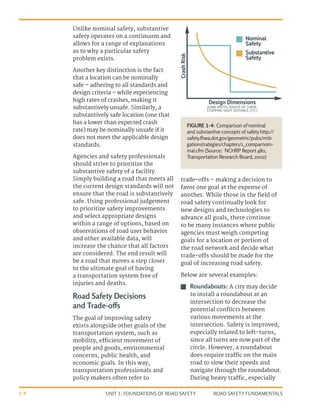
Another key distinction is the fact
that a location can be nominally
safe – adhering to all standards and
design criteria – while experiencing
high rates of crashes, making it
substantively unsafe. Similarly, a
substantively safe location (one that
has a lower than expected crash
rate) may be nominally unsafe if it
does not meet the applicable design
standards.
Agencies and safety professionals
should strive to prioritize the
substantive safety of a facility.
Simply building a road that meets all
the current design standards will not
ensure that the road is substantively
safe. Using professional judgement
to prioritize safety improvements
and select appropriate designs
within a range of options, based on
observations of road user behavior
and other available data, will
increase the chance that all factors
are considered. The end result will
be a road that moves a step closer
to the ultimate goal of having
a transportation system free of
injuries and deaths.
Road Safety Decisions
and Trade-offs
The goal of improving safety
exists alongside other goals of the
transportation system, such as
mobility, efficient movement of
people and goods, environmental
concerns, public health, and
economic goals. In this way,
transportation professionals and
policy makers often refer to
trade-offs – making a decision to
favor one goal at the expense of
another. While those in the field of
road safety continually look for
new designs and technologies to
advance all goals, there continue
to be many instances where public
agencies must weigh competing
goals for a location or portion of
the road network and decide what
trade-offs should be made for the
goal of increasing road safety.
Below are several examples:
J
J Roundabouts: A city may decide
to install a roundabout at an
intersection to decrease the
potential conflicts between
various movements at the
intersection. Safety is improved,
especially related to left-turns,
since all turns are now part of the
circle. However, a roundabout
does require traffic on the main
road to slow their speeds and
navigate through the roundabout.
During heavy traffic, especially
Design Dimensions
(LANE WIDTH, RADIUS OF CURVE,
STOPPING SIGHT DISTANCE, ETC.)
Crash
Risk
Nominal
Safety
Substantive
Safety
FIGURE 1-4: Comparison of nominal
and substantive concepts of safety http://
safety.fhwa.dot.gov/geometric/pubs/miti-
gationstrategies/chapter1/1_comparnom-
inal.cfm (Source: NCHRP Report 480,
Transportation Research Board, 2002)
UNIT 1: FOUNDATIONS OF ROAD SAFETY
ROAD SAFETY FUNDAMENTALS 1-5
if it is unbalanced among the
intersection legs, this may
cause a decrease in the overall
throughput of the intersection.
However, this is a trade-off to
produce fewer crashes.
J
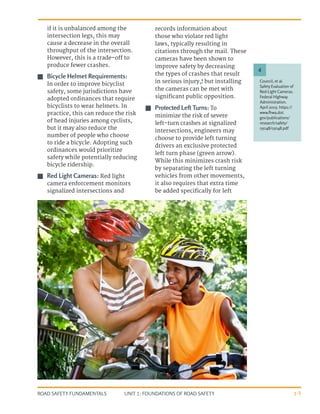
J Bicycle Helmet Requirements:
In order to improve bicyclist
safety, some jurisdictions have
adopted ordinances that require
bicyclists to wear helmets. In
practice, this can reduce the risk
of head injuries among cyclists,
but it may also reduce the
number of people who choose
to ride a bicycle. Adopting such
ordinances would prioritize
safety while potentially reducing
bicycle ridership.
J
J Red Light Cameras: Red light
camera enforcement monitors
signalized intersections and
records information about
those who violate red light
laws, typically resulting in
citations through the mail. These
cameras have been shown to
improve safety by decreasing
the types of crashes that result
in serious injury,4
but installing
the cameras can be met with
significant public opposition.
J
J Protected Left Turns: To
minimize the risk of severe
left-turn crashes at signalized
intersections, engineers may
choose to provide left turning
drivers an exclusive protected
left turn phase (green arrow).
While this minimizes crash risk
by separating the left turning
vehicles from other movements,
it also requires that extra time
be added specifically for left
Council, et al.
Safety Evaluation of
Red-Light Cameras.
Federal Highway
Administration.
April 2005. https://
www.fhwa.dot.
gov/publications/
research/safety/
05048/05048.pdf
4
UNIT 1: FOUNDATIONS OF ROAD SAFETY ROAD SAFETY FUNDAMENTALS
1-6
turns, which can increase delay
for the rest of the traffic at the
intersection.
J
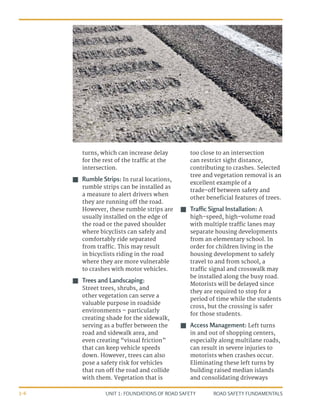
J Rumble Strips: In rural locations,
rumble strips can be installed as
a measure to alert drivers when
they are running off the road.
However, these rumble strips are
usually installed on the edge of
the road or the paved shoulder
where bicyclists can safely and
comfortably ride separated
from traffic. This may result
in bicyclists riding in the road
where they are more vulnerable
to crashes with motor vehicles.
J
J Trees and Landscaping:
Street trees, shrubs, and
other vegetation can serve a
valuable purpose in roadside
environments – particularly
creating shade for the sidewalk,
serving as a buffer between the
road and sidewalk area, and
even creating “visual friction”
that can keep vehicle speeds
down. However, trees can also
pose a safety risk for vehicles
that run off the road and collide
with them. Vegetation that is
too close to an intersection
can restrict sight distance,
contributing to crashes. Selected
tree and vegetation removal is an
excellent example of a
trade-off between safety and
other beneficial features of trees.
J
J Traffic Signal Installation: A
high-speed, high-volume road
with multiple traffic lanes may
separate housing developments
from an elementary school. In
order for children living in the
housing development to safely
travel to and from school, a
traffic signal and crosswalk may
be installed along the busy road.
Motorists will be delayed since
they are required to stop for a
period of time while the students
cross, but the crossing is safer
for those students.
J
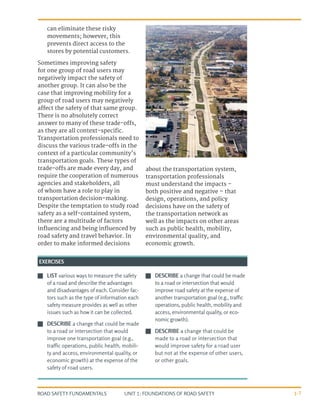
J Access Management: Left turns
in and out of shopping centers,
especially along multilane roads,
can result in severe injuries to
motorists when crashes occur.
Eliminating these left turns by
building raised median islands
and consolidating driveways
UNIT 1: FOUNDATIONS OF ROAD SAFETY
ROAD SAFETY FUNDAMENTALS 1-7
J
J LIST various ways to measure the safety
of a road and describe the advantages
and disadvantages of each. Consider fac-
tors such as the type of information each
safety measure provides as well as other
issues such as how it can be collected.
J
J DESCRIBE a change that could be made
to a road or intersection that would
improve one transportation goal (e.g.,
traffic operations, public health, mobili-
ty and access, environmental quality, or
economic growth) at the expense of the
safety of road users.
J
J DESCRIBE a change that could be made
to a road or intersection that would
improve road safety at the expense of
another transportation goal (e.g., traffic
operations, public health, mobility and
access, environmental quality, or eco-
nomic growth).
J
J DESCRIBE a change that could be
made to a road or intersection that
would improve safety for a road user
but not at the expense of other users,
or other goals.
EXERCISES
can eliminate these risky
movements; however, this
prevents direct access to the
stores by potential customers.
Sometimes improving safety
for one group of road users may
negatively impact the safety of
another group. It can also be the
case that improving mobility for a
group of road users may negatively
affect the safety of that same group.
There is no absolutely correct
answer to many of these trade-offs,
as they are all context-specific.
Transportation professionals need to
discuss the various trade-offs in the
context of a particular community’s
transportation goals. These types of
trade-offs are made every day, and
require the cooperation of numerous
agencies and stakeholders, all
of whom have a role to play in
transportation decision-making.
Despite the temptation to study road
safety as a self-contained system,
there are a multitude of factors
influencing and being influenced by
road safety and travel behavior. In
order to make informed decisions
about the transportation system,
transportation professionals
must understand the impacts –
both positive and negative – that
design, operations, and policy
decisions have on the safety of
the transportation network as
well as the impacts on other areas
such as public health, mobility,
environmental quality, and
economic growth.
UNIT 1: FOUNDATIONS OF ROAD SAFETY ROAD SAFETY FUNDAMENTALS
1-8
Road Safety Through the Years
CHAPTER 2 FOUNDATIONS OF ROAD SAFETY
When examining current efforts to
address road safety, it is useful to
view them in the context of American
transportation history. Recent
decades have witnessed numerous
advances in the field of road safety.
This growing national consciousness
about the need for safer roads
provides a stark contrast to the first
half of the twentieth century when
the focus was on highway expansion.
The following chapter will provide
an overview of the major milestones
and achievements that led to the
transportation system we have today,
as well as the policies and practices
that were implemented to address a
growing safety problem.
Late Nineteenth Century and
the Popularity of Bicycling
An exploration of the history of
road safety in the U.S. can begin at
many different points – some of
our roads were developed as pre-
colonial routes and others were
trails blazed by Native Americans.
In terms of lasting influence on the
modern transportation network,
however, it is most useful to begin
the discussion in the late nineteenth
century.
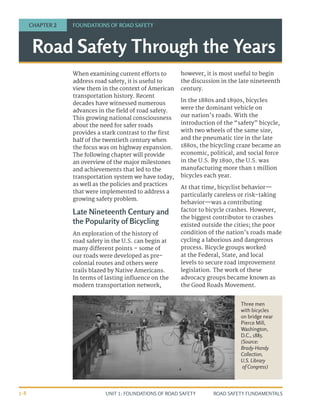
In the 1880s and 1890s, bicycles
were the dominant vehicle on
our nation’s roads. With the
introduction of the “safety” bicycle,
with two wheels of the same size,
and the pneumatic tire in the late
1880s, the bicycling craze became an
economic, political, and social force
in the U.S. By 1890, the U.S. was
manufacturing more than 1 million
bicycles each year.
At that time, bicyclist behavior—
particularly careless or risk-taking
behavior—was a contributing
factor to bicycle crashes. However,
the biggest contributor to crashes
existed outside the cities; the poor
condition of the nation’s roads made
cycling a laborious and dangerous
process. Bicycle groups worked
at the Federal, State, and local
levels to secure road improvement
legislation. The work of these
advocacy groups became known as
the Good Roads Movement.
Three men
with bicycles
on bridge near
Pierce Mill,
Washington,
D.C., 1885.
(Source:
Brady-Handy
Collection,
U.S. Library
of Congress)
UNIT 1: FOUNDATIONS OF ROAD SAFETY
ROAD SAFETY FUNDAMENTALS 1-9
To build support, advocates tailored
their message to farmers with
the argument that bad roads,
by increasing transportation
expenditures, cost more than good
roads. While engineers, writers, and
politicians joined the movement,
bicyclists dominated the Good Roads
Movement until cars arrived in the
early twentieth century.5
By the close of century, automobiles
had slowly begun to share the roads
with bicyclists and pedestrians,
benefitting from many of the road
improvement efforts spearheaded
by cycling groups. In 1899, a motor
vehicle struck and killed a New
York City pedestrian. This event
marked the first time in the U.S.
that a person was killed in a crash
involving a motor vehicle.6
Rise of Motor Vehicles in the
Early Twentieth Century
In 1905, only 78,000 automobiles,
most of which were confined to the
cities, traveled the U.S. Ten years
later, 2.33 million automobiles were
traveling the country’s roads, and by
1918, this number had increased to
5.55 million. Mass production made
this increase possible as it lowered
vehicle manufacturing costs, putting
vehicles within the reach of the
middle class. As more vehicles
became available at a lower price,
the pattern of daily travel in the U.S.
began to shift. Longer vehicle trips
replaced shorter trips by foot or
bicycle, and development patterns
began to follow suit. The motor age
had arrived, and with it a new kind
of highway would evolve, designed
specifically for motor vehicles.
Expansion of automobile use had
immediate positive effects on the
national economy and quality of life
around the country. Yet proliferation
of motor vehicles also had a negative
side. As millions of new drivers
took to the roads, traffic crashes
increased rapidly—tripling from
10,723 in 1918 to 31,215 in 1929.7
Consequences of Speeding
As in modern times, in the early days of the
automobile, posted speed limits were set
far below the speed of which most motor
vehicles were capable.
With faster and heavier traffic, it became
dangerous to drive in the middle of
the road and the States began painting
centerlines on the pavements to channel
traffic in lanes. At 40 miles per hour, these
lanes appeared uncomfortably narrow to
most motorists, especially when passing
trucks. The lane lines also caused trucks
to run closer to the shoulder, causing the
slab edges and corners of the road to
break. To provide greater safety and
reduce edge damage, State highway
departments built wider pavements
and made new roads straighter.
These improvements along with mechanical
advances in vehicles, such as more
powerful engines and four-wheel brakes,
in turn encouraged even faster speeds.
Thus, after 1918, highway design followed
a spiral of cause and effect, resulting in
faster and faster speeds and wider and
wider pavements. The motivating force
behind this spiral was the driving speed
preferences of the great mass of vehicle
operators. The public authorities were
never able to impose or enforce speed
limits for very long if the majority of drivers
considered the limits unreasonably low.
Now, many current engineering practices
use the 85th percentile speed – or the
speed at which the majority of drivers travel
– as the method of setting speed limits.
Source: Richard
F. Weingroff, “A
Peaceful Campaign
of Progress and
Reform: The
Federal Highway
Administration at
100,” Public Roads
57, no. 2 (Autumn,
1993),http://www.
fhwa.dot.gov/
publications/
publicroads/93fall/
p93au1.cfm
Soniak, Matt. When
and Where Was the
First Car Accident?
Mental Floss.
2 December 2012.
http://mentalfloss.
com/article/31807/
when-and-where-
was-first-car-
accident
Source: America’s
Highways, 1776-1976:
A History of the
Federal-Aid Program.
Federal Highway
Administration
(U.S. Government
Printing Office,
Washington D.C.,
1976).
5
6
7
UNIT 1: FOUNDATIONS OF ROAD SAFETY ROAD SAFETY FUNDAMENTALS
1-10
Shifting Attention to Safety
Recognizing the rise in crashes and
resulting injuries and fatalities,
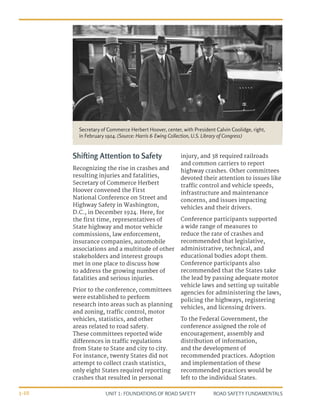
Secretary of Commerce Herbert
Hoover convened the First
National Conference on Street and
Highway Safety in Washington,
D.C., in December 1924. Here, for
the first time, representatives of
State highway and motor vehicle
commissions, law enforcement,
insurance companies, automobile
associations and a multitude of other
stakeholders and interest groups
met in one place to discuss how
to address the growing number of
fatalities and serious injuries.
Prior to the conference, committees
were established to perform
research into areas such as planning
and zoning, traffic control, motor
vehicles, statistics, and other
areas related to road safety.
These committees reported wide
differences in traffic regulations
from State to State and city to city.
For instance, twenty States did not
attempt to collect crash statistics,
only eight States required reporting
crashes that resulted in personal
injury, and 38 required railroads
and common carriers to report
highway crashes. Other committees
devoted their attention to issues like
traffic control and vehicle speeds,
infrastructure and maintenance
concerns, and issues impacting
vehicles and their drivers.
Conference participants supported
a wide range of measures to
reduce the rate of crashes and
recommended that legislative,
administrative, technical, and
educational bodies adopt them.
Conference participants also
recommended that the States take
the lead by passing adequate motor
vehicle laws and setting up suitable
agencies for administering the laws,
policing the highways, registering
vehicles, and licensing drivers.
To the Federal Government, the
conference assigned the role of
encouragement, assembly and
distribution of information,
and the development of
recommended practices. Adoption
and implementation of these
recommended practices would be
left to the individual States.
Secretary of Commerce Herbert Hoover, center, with President Calvin Coolidge, right,
in February 1924. (Source: Harris & Ewing Collection, U.S. Library of Congress)
UNIT 1: FOUNDATIONS OF ROAD SAFETY
ROAD SAFETY FUNDAMENTALS 1-11
Secretary Hoover called a second
conference for March 1926. During
the interim between the two
conferences, a special committee
drew up a model “Uniform Vehicle
Code” covering registration and
titling of vehicles, licensing of
drivers, and operation of vehicles on
the highways. The code incorporated
the best features of the numerous
and varied State laws then on
the statute books. The second
conference approved this code
and recommended it to the State
legislatures as the basis for uniform
motor vehicle legislation.
Studies following this 1926
conference concluded that
determining the causes of crashes
was far more difficult than they had
presumed. The problem warranted
a sustained program of research
by a national organization. The
Conference agreed, and the Highway
Research Board (HRB) organized
the Committee on Causes and
Prevention of Highway Accidents
to coordinate crash research
nationwide. The HRB played a major
part in subsequent efforts to reduce
the consequences of crashes.8
Federal Government Role
in Highway Development
The growing use of motor vehicles
during the 1920s was mirrored
by the expansion of the Federal
Government’s role in funding and
building roads. In its early form, the
Office of Public Roads was organized
under the U.S. Department of
Agriculture, playing a large role in
funding roadways within national
parks and forests.
Following the Federal Aid Road Act
of 1916, this office would become
the Bureau of Public Roads (BPR),
charged with working cooperatively
with State highway departments on
road projects. Work continued on
the expansion of highways across
the country, and between 1921 and
1939, the distance of paved roads
Balanced Design for Safety
In the 1920s and 1930s, it was good
engineering practice to design new
highways as much as possible in long
straight lines or “tangents.” When it
became necessary to change direction,
the engineer laid out a circular curve,
the radius of which he selected to fit
the ground with the least construction
cost, but which could not be less than a
certain minimum fixed by department
policy. In practice, engineers made the
curves sharper than this minimum when
it was cheaper to do so, but with little
consistency. Engineers expected motorists
driving these roads to adjust their speeds
to the varying radii, and on the sharper
curves safe design speed might be
considerably lower than the posted
speed limit.
Increasing concern for road safety led many
highway engineers to worry about this
inconsistency between posted speed limits
and safe design speed on curves. In 1935,
highway engineer Joseph Barnett of the BPR
proposed that all new rural roads conform to
an “assumed design speed,” a comfortable
top speed for drivers outside of urban areas.
With its adoption by American Association
of State Highway Officials in 1938, Barnett’s
“balanced design” concept became a
permanent feature of U.S. roadway design.
Today, standards for designing curves,
such as design speed, curve radius and
superelevation (the tilt of the road through
a curve) are provided in A Policy on
Geometric Design of Highways and Streets,
produced by the American Association for
State Highway Transportation Officials.
Source: America’s
Highways, 1776-1976:
A History of the
Federal-Aid Program.
Federal Highway
Administration
(U.S. Government
Printing Office,
Washington D.C.,
1976).
8
Uniform
Vehicle Code
A code covering
registration and
titling of vehicles,
licensing of
drivers, and
operation of
vehicles on
the highways.
UNIT 1: FOUNDATIONS OF ROAD SAFETY ROAD SAFETY FUNDAMENTALS
1-12
increased from 387,000 miles to
nearly 1.4 million miles.9
The BPR
recognized that the antiquated
highway system was one of the
contributing causes of the high
crash toll, but did not go so far as
to identify primary crash causes or
recommend potential solutions.
During this time, an emphasis was
placed on expanding the Federal
role in the process of highway
design and development. This
effort culminated in 1944 when
Congress approved the development
of a National System of Interstate
Highways along with that year’s
Federal Aid Highway Act. Though
expansive in scope, calling for a
40,000 mile network, the legislation
was not accompanied by any funds
to support the development of
these highways. Without funding,
the legislation did not significantly
expand the highway system.
Road safety continued to present
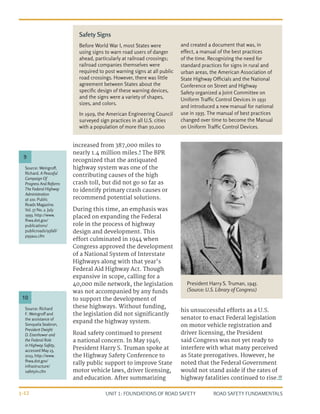
a national concern. In May 1946,
President Harry S. Truman spoke at
the Highway Safety Conference to
rally public support to improve State
motor vehicle laws, driver licensing,
and education. After summarizing
his unsuccessful efforts as a U.S.
senator to enact Federal legislation
on motor vehicle registration and
driver licensing, the President
said Congress was not yet ready to
interfere with what many perceived
as State prerogatives. However, he
noted that the Federal Government
would not stand aside if the rates of
highway fatalities continued to rise.10
Source: Weingroff,
Richard. A Peaceful
Campaign Of
Progress And Reform:
The Federal Highway
Administration
at 100. Public
Roads Magazine.
Vol. 57 No. 2. July
1993. http://www.
fhwa.dot.gov/
publications/
publicroads/93fall/
p93au1.cfm
Source: Richard
F. Weingroff and
the assistance of
Sonquela Seabron,
President Dwight
D. Eisenhower and
the Federal Role
in Highway Safety,
accessed May 23,
2013, http://www.
fhwa.dot.gov/
infrastructure/
safetyin.cfm
9
10
Safety Signs
Before World War I, most States were
using signs to warn road users of danger
ahead, particularly at railroad crossings;
railroad companies themselves were
required to post warning signs at all public
road crossings. However, there was little
agreement between States about the
specific design of these warning devices,
and the signs were a variety of shapes,
sizes, and colors.
In 1929, the American Engineering Council
surveyed sign practices in all U.S. cities
with a population of more than 50,000
and created a document that was, in
effect, a manual of the best practices
of the time. Recognizing the need for
standard practices for signs in rural and
urban areas, the American Association of
State Highway Officials and the National
Conference on Street and Highway
Safety organized a Joint Committee on
Uniform Traffic Control Devices in 1931
and introduced a new manual for national
use in 1935. The manual of best practices
changed over time to become the Manual
on Uniform Traffic Control Devices.
President Harry S. Truman, 1945.
(Source: U.S. Library of Congress)
UNIT 1: FOUNDATIONS OF ROAD SAFETY
ROAD SAFETY FUNDAMENTALS 1-13
Post War Development
and Growth
Economic conditions following
World War II led to even higher
levels of driving and automobile
ownership. Personal savings of
almost $44 billion created a market
for housing and other types of
goods, chief among them new
automobiles. Automobile production
jumped from a nearly 70,000 in 1945
to 3.9 million in 1948.
Because of this increase in
vehicle production, motor vehicle
registrations spiked and the number
of drivers on the nation’s roads and
highways reached unprecedented
levels. Under wartime rationing of
rubber, and specifically tires, States
had implemented speed controls to
reduce wear and tear and improve
tire longevity. With the end of
rationing and emergency speed
controls at the conclusion of the
war, highway travel returned to
pre-war levels and began a steady
climb of about 6 percent per year,
which would continue for nearly
three decades.
While the increasing popularity of
low density housing development
(i.e., the suburbs) and the
availability of motor vehicles created
perfect conditions for more driving,
the nation’s roads and highways
were unprepared for the increase in
traffic. Under wartime restrictions,
States were unable to adequately
maintain their highways. With
widespread operation of overloaded
trucks and reduced maintenance,
the State highway systems were in
worse structural shape post-war
than before the war.
Development of the Interstate
Highway System
Though the National System of
Interstate Highways had been
established by legislation in
1944, little progress was made
over the next decade. Without
funding, established routes were
slow to develop. That changed in
1956, when President Dwight D.
Eisenhower signed the Federal-
Aid Highway Act of 1956. This
legislation linked the development
of the interstate highway system to
the interest of national defense and
assigned funding that would rapidly
expand the highway network.11
The
act established a dedicated funding
stream and a plan for highway
development that launched the
nation into an unprecedented era of
expansion in which new interstate
corridors linked cities and towns to
one another.
http://www.
fhwa.dot.gov/
publications/
publicroads/
06jan/01.cfm
11
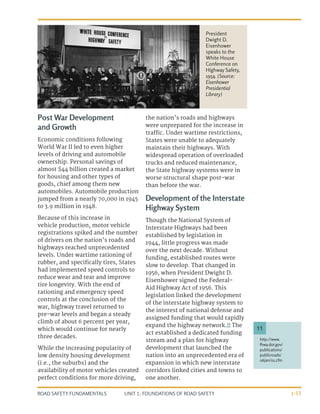
President
Dwight D.
Eisenhower
speaks to the
White House
Conference on
Highway Safety,
1954. (Source:
Eisenhower
Presidential
Library)
UNIT 1: FOUNDATIONS OF ROAD SAFETY ROAD SAFETY FUNDAMENTALS
1-14
Despite the enthusiasm of political
and business leaders, the growth
of this system was not without
its critics. These critics primarily
denounced the destruction of homes
and separation of communities
that sometimes resulted from new
highways bisecting established
neighborhoods. Though this opposition
halted projects in some locations,
it did not stop the expansion of the
interstate highway system.
Highway Safety Act of 1966
In 1964, the U.S. faced a sharp rise
in the number of traffic fatalities.
An increased number of vehicles
on the roadways combined with a
public culture that did not prioritize
roadway safety consciousness led
to 47,700 deaths on the nation’s
highways, an increase of 10 percent
over the number of fatalities that
occurred in 1963. These deaths
prompted the nation to take a hard
look at road safety efforts and
resulted in Congressional hearings in
March 1965 to raise public awareness
of the growing national crisis.12
To respond to these trends, the
nation needed a change of direction
in the design and operation of its
roads and vehicles. This change
began with reviewing safety
standards in these areas and
conducting research to identify
effective measures to improve
safety. The 1960s was a pivotal
decade for road safety due to the
passage of laws that provided
funding and new policies. On
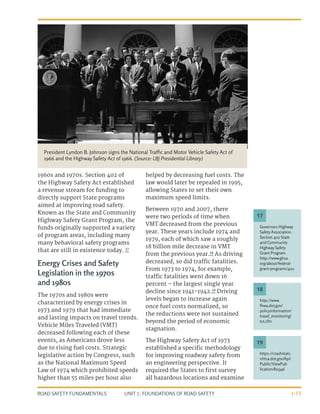
September 9, 1966, President
Lyndon B. Johnson signed the
National Traffic and Motor Vehicle
Safety Act of 1966 and the Highway
Safety Act of 1966. The signing
ceremony in the Rose Garden
of the White House marked a
transformation in the role of the
Federal Government in road safety.
This role had been growing during
the Eisenhower administration, but
became a larger area of emphasis as
fatalities on the nation’s highways
climbed toward 50,000. Those in
the federal government observed
that the steps taken during the
previous two decades to reverse the
climbing number of fatalities had
failed, and they believed that road
safety should no longer be left solely
to the responsibility of the States,
the automobile industry, and the
individual drivers.13
This legislation established the
U.S. Department of Transportation
(USDOT) and transformed the
Bureau of Public Roads into the
Federal Highway Administration
(FHWA). New bureaus were added to
address safety in areas of growing
concern, such as the Bureau of
Motor Carrier Safety and National
Highway Safety Bureau (these
would later become the Federal
Motor Carrier Safety Administration
and the National Highway Traffic
Safety Administration, respectively).
The USDOT proceeded to develop
programs and initiatives and
pave the way for activities still in
place today.14
Advances in vehicle design
and policy were also an area of
emphasis during the 1960s. In
1968, federal legislation required
vehicles to provide seat belts. 15
Federal law also required States to
begin implementing motorcycle
helmet laws in order to qualify for
particular sources of funding.16
These requirements led to more
widespread implementation of
safety policies through the late
Source: Richard
F. Weingroff and
the assistance of
Sonquela Seabron,
President Dwight
D. Eisenhower and
the Federal Role
in Highway Safety,
accessed May 23,
2013, http://www.
fhwa.dot.gov/
infrastructure/
safetyin.cfm
12 13
http://www.
fhwa.dot.gov/
infrastructure/
50interstate.cfm
Federal Motor
Vehicle Safety
Standard (FMVSS)
No. 218,
https://www.federal
register.gov/
documents/2015/05/
21/2015-11756/
federal-motor-
vehicle-safety-
standards-
motorcycle-helmets
Title 49 of the
United States Code,
Chapter 301, Motor
Vehicle Safety,
https://www.gpo.
gov/fdsys/pkg/
USCODE-2009-
title49/html/
USCODE-2009-
title49-subtitleVI.
htm
14
16
15
UNIT 1: FOUNDATIONS OF ROAD SAFETY
ROAD SAFETY FUNDAMENTALS 1-15
1960s and 1970s. Section 402 of
the Highway Safety Act established
a revenue stream for funding to
directly support State programs
aimed at improving road safety.
Known as the State and Community
Highway Safety Grant Program, the
funds originally supported a variety
of program areas, including many
many behavioral safety programs
that are still in existence today. 17
Energy Crises and Safety
Legislation in the 1970s
and 1980s
The 1970s and 1980s were
characterized by energy crises in
1973 and 1979 that had immediate
and lasting impacts on travel trends.
Vehicle Miles Traveled (VMT)
decreased following each of these
events, as Americans drove less
due to rising fuel costs. Strategic
legislative action by Congress, such
as the National Maximum Speed
Law of 1974 which prohibited speeds
higher than 55 miles per hour also
helped by decreasing fuel costs. The
law would later be repealed in 1995,
allowing States to set their own
maximum speed limits.
Between 1970 and 2007, there
were two periods of time when
VMT decreased from the previous
year. These years include 1974 and
1979, each of which saw a roughly
18 billion mile decrease in VMT
from the previous year.18
As driving
decreased, so did traffic fatalities.
From 1973 to 1974, for example,
traffic fatalities went down 16
percent – the largest single year
decline since 1941-1942.19
Driving
levels began to increase again
once fuel costs normalized, so
the reductions were not sustained
beyond the period of economic
stagnation.
The Highway Safety Act of 1973
established a specific methodology
for improving roadway safety from
an engineering perspective. It
required the States to first survey
all hazardous locations and examine
http://www.
fhwa.dot.gov/
policyinformation/
travel_monitoring/
tvt.cfm
Governors Highway
Safety Association.
Section 402 State
and Community
Highway Safety
Grant Program.
http://www.ghsa.
org/about/federal-
grant-programs/402
18
17
https://crashstats.
nhtsa.dot.gov/Api/
Public/ViewPub
lication/811346
19
President Lyndon B. Johnson signs the National Traffic and Motor Vehicle Safety Act of
1966 and the Highway Safety Act of 1966. (Source: LBJ Presidential Library)
UNIT 1: FOUNDATIONS OF ROAD SAFETY ROAD SAFETY FUNDAMENTALS
1-16
the causes of crashes at these sites.
A benefit/cost analysis was then
performed to prioritize needed
improvements. This process set
the stage for the current safety
management processes and would be
refined and improved over the years.
The Highway Safety Act of 1973 also
clarified the relationship between
the Federal Government and the
States. The Federal Government
was to direct policy and program
components, while the States were
responsible for implementing those
policies and programs.20
During the 1970s, Congress also
established the Motor Carrier Safety
Assistance Program (MCSAP).
This program provides financial
assistance to States to reduce the
number and severity of crashes
and hazardous materials incidents
involving commercial motor
vehicles (CMV) through inspection
and enforcement programs
focused on trucks, carriers,
and driver regulations. 21
Vehicle safety continued to be a
priority in the 1970s and 1980s, as
more States began to implement
laws requiring the use of seat belts
and motorcycle helmets. New York
became the first State to adopt a
mandatory seat belt law in 1984, and
other States soon followed suit.22
The Federal Motor Vehicle Safety
Standard 213 brought attention
to child passenger safety. This
standard was the first to outline
specific requirements for restraint
systems designed for children.
Multimodal Shift in the 1990s
The 1990s saw a shift from
transportation policies that focused
on motor vehicle safety and
efficiency to an acknowledgement of
alternate modes of transportation,
such as bicycling, walking and use
of public transit. The Intermodal
Surface Transportation Efficiency
Act of 1991 (ISTEA) added a
multimodal perspective to the
Federal-aid highway program.
While ISTEA was not specifically
focused on transportation safety, it
created some programs to promote
safer travel. For example, ISTEA
enhanced road safety with new
programs that encouraged the
use of safety belts and motorcycle
helmets.23
The legislation also
required the installation of airbags
for drivers and front passengers in
all cars and trucks.24
In 1998, the Transportation Equity
Act for the 21st Century (TEA-21)
provided more focus for roadway
safety planning by establishing
safety and security as planning
http://www.iihs.org/
iihs/topics/laws/
safetybeltuse
22
Source: “What is
the Motor Carrier
Safety Assistance
Program (MCSAP)?”
accessed May 23,
2013, https://www.
federalregister.gov/
documents/2000/03/
21/00-6819/motor-
carrier-safety-
assistance-program
21
Source: “HSIP
History,” accessed
October 22, 2013,
http://safety.fhwa.
dot.gov/hsip/gen_
info/hsip_history.cfm
and “Subchapter J—
Highway Safety: Part
924—Highway Safety
ImprovementProgram,”
accessed October
21, 2013, http://www.
gpo.gov/fdsys/pkg/CFR-
2003-title23-vol1/pdf/
CFR-2003-title23-vol1-
chapI-subchapJ.pdf.
20
Source:
“Intermodal Surface
Transportation
Efficiency Act of 1991
Information,” last
updatedMay16,2013,
accessedJuly05,2013,
http://www.fhwa.
dot.gov/planning/
public_involvement/
archive/legislation/
istea.cfm.
23
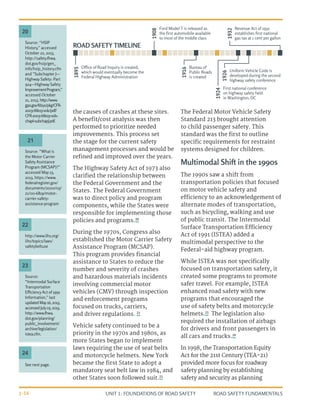
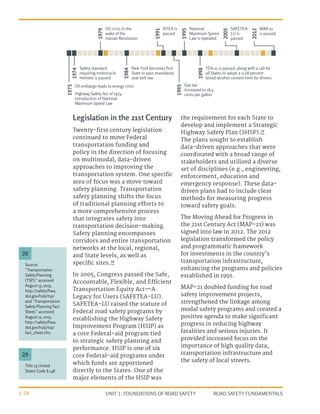
1893
Office of Road Inquiry is created,
which would eventually become the
Federal Highway Administration
1908
Ford Model T is released as
the first automobile available
to most of the middle class
1916
Bureau of
Public Roads
is created
1924
First national conference
on highway safety held
in Washington, DC
1926
Uniform Vehicle Code is
developed during the second
highway safety conference
1932
Revenue Act of 1932
establishes first national
gas tax at 1 cent per gallon
ROAD SAFETY TIMELINE
See next page.
24
UNIT 1: FOUNDATIONS OF ROAD SAFETY
ROAD SAFETY FUNDAMENTALS 1-17
http://www.history.
com/this-day-in-
history/federal-
legislation-makes-
airbags-mandatory
24
priorities. Prior to TEA-21, a State or
Metropolitan Planning Organization
(MPO) may have incorporated
safety in its goals or long-range
transportation plan, but specific
strategies to increase safety were
seldom included in statewide and
metropolitan planning processes
or documents.
TEA-21 established the Highway
Safety Infrastructure program (not
to be confused with the Highway
Safety Improvement Program,
which would be developed several
years later), which funded safety
improvement projects to eliminate
safety problems.
The TEA-21 legislation also
encouraged States to adopt and
implement effective programs to
improve the quality (e.g. timeliness,
accuracy, completeness, uniformity
and accessibility) of State data
needed to identify safety priorities
for national, State and local road
safety programs.25
Not to be lost among the TEA-21
legislation, another pivotal moment
in transportation legislation came in
2000 when an important provision
related to alcohol was included in
the USDOT appropriation act. The
appropriation carried a requirement
that all States must enact laws to
limit the legal blood alcohol content
(BAC) of drivers to 0.08 percent.26
This limit was in line with similar
limits imposed on drivers in other
countries, though some European
countries limit the legal BAC to 0.05
percent.
While 19 States and Washington,
D.C., had already enacted this law,
the Federal mandate provided a
further incentive for other States
to do so: States that did not pass
the law by 2004 would forego a
portion of their transportation
funding. Though specific laws vary,
each State now recognizes the legal
limit of 0.08 percent blood alcohol
content.27
http://www.ghsa.org/
html/stateinfo/laws/
impaired_laws.html
27
Rodriguez-Iglesias,
C.; Wiliszowski, ClH.;
Lacey, J.H. Legislative
History of .08 Per
Se Laws, National
Highway Traffic Safety
Administration,
Report No. DOT HS
809 286, June 2001
26
Source: “TEA-21
– Transportation
Equity Act for the 21st
Century Fact Sheets,”
last modified April 5,
2011, accessed June
2, 2013, http://www.
fhwa.dot.gov/tea21/
factsheets/index.htm
25
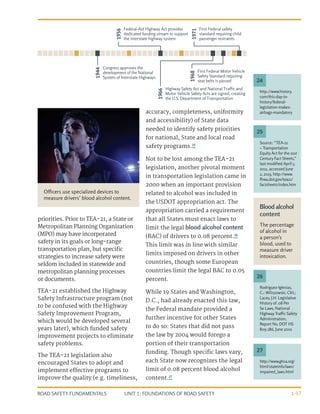
Blood alcohol
content
The percentage
of alcohol in
a person’s
blood, used to
measure driver
intoxication.
1944
Congress approves the
development of the National
System of Interstate Highways
1956
Federal-Aid Highway Act provides
dedicated funding stream to support
the interstate highway system
1966
Highway Safety Act and National Traffic and
Motor Vehicle Safety Acts are signed, creating
the U.S. Department of Transportation
1968
First Federal Motor Vehicle
Safety Standard requiring
seat belts is passed
1971
First Federal safety
standard requiring child
passenger restraints
Officers use specialized devices to
measure drivers’ blood alcohol content.
UNIT 1: FOUNDATIONS OF ROAD SAFETY ROAD SAFETY FUNDAMENTALS
1-18
Legislation in the 21st Century
Twenty-first century legislation
continued to move Federal
transportation funding and
policy in the direction of focusing
on multimodal, data-driven
approaches to improving the
transportation system. One specific
area of focus was a move toward
safety planning. Transportation
safety planning shifts the focus
of traditional planning efforts to
a more comprehensive process
that integrates safety into
transportation decision-making.
Safety planning encompasses
corridors and entire transportation
networks at the local, regional,
and State levels, as well as
specific sites.28
In 2005, Congress passed the Safe,
Accountable, Flexible, and Efficient
Transportation Equity Act—A
Legacy for Users (SAFETEA-LU).
SAFETEA-LU raised the stature of
Federal road safety programs by
establishing the Highway Safety
Improvement Program (HSIP) as
a core Federal-aid program tied
to strategic safety planning and
performance. HSIP is one of six
core Federal-aid programs under
which funds are apportioned
directly to the States. One of the
major elements of the HSIP was
Source:
“Transportation
Safety Planning
(TSP),” accessed
August 13, 2013,
http://safety.fhwa.
dot.gov/hsip/tsp/
and “Transportation
Safety Planning Fact
Sheet,” accessed
August 13, 2013,
http://safety.fhwa.
dot.gov/hsip/tsp/
fact_sheet.cfm.
Title 23 United
States Code § 148
28
29
1973
Oil embargo leads to energy crisis
Highway Safety Act of 1973,
introduction of National
Maximum Speed Law
1979
Oil crisis in the
wake of the
Iranian Revolution
1974
Safety standard
requiring motorcycle
helmets is passed
1998
TEA-21 is passed, along with a call for
all States to adopt a 0.08 percent
blood alcohol content limit for drivers
2012
MAP-21
is passed
1984
New York becomes first
State to pass mandatory
seat belt law
1993
Gas tax
increased to 18.4
cents per gallon
1995
National
Maximum Speed
Law is repealed
2005
SAFETEA-
LU is
passed
1991
ISTEA is
passed
the requirement for each State to
develop and implement a Strategic
Highway Safety Plan (SHSP).29
The plans sought to establish
data-driven approaches that were
coordinated with a broad range of
stakeholders and utilized a diverse
set of disciplines (e.g., engineering,
enforcement, education and
emergency response). These data-
driven plans had to include clear
methods for measuring progress
toward safety goals.
The Moving Ahead for Progress in
the 21st Century Act (MAP-21) was
signed into law in 2012. The 2012
legislation transformed the policy
and programmatic framework
for investments in the country’s
transportation infrastructure,
enhancing the programs and policies
established in 1991.
MAP-21 doubled funding for road
safety improvement projects,
strengthened the linkage among
modal safety programs and created a
positive agenda to make significant
progress in reducing highway
fatalities and serious injuries. It
provided increased focus on the
importance of high quality data,
transportation infrastructure and
the safety of local streets.
UNIT 1: FOUNDATIONS OF ROAD SAFETY
ROAD SAFETY FUNDAMENTALS 1-19
U.S. Department
of Transportation.
Strategic Plans.
November 2015.
https://www.
transportation.gov/
mission/budget/
dot-budget-and-
performance-
documents#
StrategicPlans
30
J
J RESEARCH a federal transportation law
addressed in this chapter and write a
summary about the law, emphasizing
the safety aspects.
J
J FIND a recent news article that involves
road safety (more than just a local news
article on a recent crash) and write a
summary describing the effort under-
taken by the public agency, how it was
received by the public, and whether it
was shown to be effective in increasing
road safety.
J
J USE https://www.govtrack.us to find a
transportation bill currently proposed
or under review by Congress. Describe
how the legislation would be expected
to affect road safety.
J
J RESEARCH the legal driving Blood
Alcohol Content (BAC) by state in the
U.S. and create a table showing the
comparison. Select one state where
the legal BAC is lower than the federal
requirement, locate a paper or news
article describing how that BAC level
was decided, and write a summary.
EXERCISES
Conclusion
Exploring the history of travel
trends and safety in the U.S. helps
illustrate how past decisions have
led to the transportation system
seen today. Safety has not always
been a deciding factor in how roads
are built. However, today, safety
is a top priority of the USDOT.30
Most State and local transportation
agencies share USDOT’s goal;
some have even set goals to reduce
total traffic fatalities to zero.
These “vision zero” and “toward
zero deaths” goals are guiding
transportation projects by requiring
safety to be incorporated into every
step of project planning, design,
construction and operation.
Future safety issues will certainly
arise as technological advancements
lead to changes in the vehicle
fleet. Autonomous and potentially
driverless vehicles are being
developed and tested across the
world. Though safety improvements
are touted as a benefit of these
advanced vehicles, safety will
continue to be a priority as they
begin to share the roads with older
vehicles, bicyclists, and pedestrians.
As can be learned from the history
of road safety in the U.S., complex
problems must be met with safety
advancements, legislative action,
and collaboration.
UNIT 1: FOUNDATIONS OF ROAD SAFETY ROAD SAFETY FUNDAMENTALS
1-20
Road safety is a complex issue, and
any efforts to improve safety must
address not only the roadway but
also road user behavior, vehicle
design, interaction between
road users, and the effect of the
roadway on all road users. Road
safety partners include anyone
who influences road user safety,
including those in infrastructure
safety, behavioral roadway safety,
transportation planning, public
health, public safety and many other
disciplines. Each of these disciplines
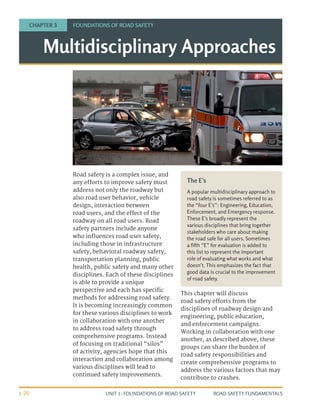
is able to provide a unique
perspective and each has specific
methods for addressing road safety.
It is becoming increasingly common
for these various disciplines to work
in collaboration with one another
to address road safety through
comprehensive programs. Instead
of focusing on traditional “silos”
of activity, agencies hope that this
interaction and collaboration among
various disciplines will lead to
continued safety improvements.
This chapter will discuss
road safety efforts from the
disciplines of roadway design and
engineering, public education,
and enforcement campaigns.
Working in collaboration with one
another, as described above, these
groups can share the burden of
road safety responsibilities and
create comprehensive programs to
address the various factors that may
contribute to crashes.
Multidisciplinary Approaches
CHAPTER 3 FOUNDATIONS OF ROAD SAFETY
The E’s
A popular multidisciplinary approach to
road safety is sometimes referred to as
the “four E’s”: Engineering, Education,
Enforcement, and Emergency response.
These E’s broadly represent the
various disciplines that bring together
stakeholders who care about making
the road safe for all users. Sometimes
a fifth “E” for evaluation is added to
this list to represent the important
role of evaluating what works and what
doesn’t. This emphasizes the fact that
good data is crucial to the improvement
of road safety.
UNIT 1: FOUNDATIONS OF ROAD SAFETY
ROAD SAFETY FUNDAMENTALS 1-21
Roadway Design
and Engineering
Several types of transportation
professionals are responsible for
roadway safety engineering.
Broadly speaking, the roadway
safety engineering community
includes transportation planners
and engineers.
Transportation planning plays a
critical role in determining the shape
of the transportation system and
provides an early opportunity for
professionals to address safety needs.
Before a road project is designed or
built, it is influenced by any number
of comprehensive and strategic
transportation plans that are
coordinated to ensure that the system
being developed is one that matches
the vision of the local community.
Planners work with stakeholders
such as the general public, business
owners, policy makers, and
advocates to establish plans for how
the transportation system can best
serve every group’s needs.
In the past, the traditional planning
process focused on economic
development, environmental quality,
and mobility as the three primary
concerns. Most States consider
infrastructure safety improvements as
part of preservation or improvements
projects or within operational
changes undertaken by traffic
offices. States are now able to use
the Highway Safety Improvement
Program (HSIP) to fund safety
projects in at high priority locations.
This program allows development
of targeted solutions and approaches
that address the contributing
factors to collisions, thereby
seeking to achieve a higher return
on safety investments.
Roadway engineers work on the
design, construction and system
preservation of the roadways. In
particular, engineers are charged
with designing roads that minimize
the chance that crashes will occur
while balancing the needs for
efficiency and mobility. Engineers
also work to design roads and
intersection in such a way that
minimizes crash severity and
injury risk when crashes do occur.
Engineers affect the safety of the
built environment by incorporating
safety in to the planning process at
the beginning of a project; selecting
design alternatives that prioritize
safety considerations; using
design elements that maximize
the safety of each part of the road
or intersection; ensuring quality
and safe construction, operation,
and maintenance of the roads;
and addressing safety problems at
existing locations.
Infrastructure improvements such
as paved shoulders, rumble strips,
and improved nighttime visibility
may prevent drivers from veering
off the roadway, and still other
opportunities exist for improving
the roadside and road user behavior.
For example, when a driver veers
off the roadway, it is important to
provide a roadside environment that
reduces the potential for crashes and
injury. Roadside slopes and objects
such as drainage structures, trees,
and utility poles are examples of
roadside elements that engineers
can target for improvements to
road safety performance. One
engineering method to increase
roadside safety is to create a clear
zone—an unobstructed, traversable
roadside area that allows a driver to
stop safely or regain control of the
vehicle that has left the roadway.
UNIT 1: FOUNDATIONS OF ROAD SAFETY ROAD SAFETY FUNDAMENTALS
1-22
Engineering solutions must
incorporate the different needs
and preferences of a variety of user
groups. As mentioned previously,
this often means that tough
decisions and trade-offs must be
made to arrive at infrastructure
solutions that balance the needs of
different users. This trade-off can
be illustrated with an example of a
signalized intersection. Improving
intersection safety for pedestrians
may involve adding pedestrian
crossing time to the signal or
separating turn movements to
eliminate high risk conflicts.
Protected left-turn phases can
also improve safety for vehicles, as
shown previously. But these new
or longer signal phases either add
time to the cycle length or keep
the same length while reducing
time for the through movements.
Regardless, the result is more delay
to both pedestrians and motorists.
In such situations, it is necessary
to consider all of these needs and
select the appropriate signal timing
that meets the needs of all users.
Adhering to design standards –
creating nominally safe conditions
– is only one aspect of the complex
roadway design and engineering
field. Addressing substantive safety
through design strategies requires
an understanding of multiple
perspectives, trade-offs and
user needs.
Public Education and
Enforcement Campaigns
Public education and communications
campaigns are commonly used
to improve road user attitudes
and awareness. The structure
and delivery methods of these
campaigns can take many forms.
However, they generally involve
materials (media advertisements,
informational brochures, posters,
presentations, etc.) to inform
people of a desired behavior and
the benefits of such behavior (or
conversely, the risks of an unwanted
behavior).
While standalone informational or
educational campaigns can improve
awareness or perceptions about road
safety issues, they are unlikely to
change road user behavior. Rather,
campaigns that educate the public
about increased law enforcement
efforts aimed at a particular
behavior have been shown to be
effective. Generally referred to as
“high-visibility enforcement” these
campaigns increase the perceived
enforcement of a particular law.
When people believe there is a high
probability of being caught, they are
more likely to follow the law. The
Click it or Ticket campaign is one of
the most widely known examples
of high-visibility enforcement.
In this case, simply enforcing the
seatbelt law was not sufficient.
The key to this program’s success
was the media coverage and other
informational campaigns telling the
public that law enforcement officers
are looking for people who are not
wearing a seatbelt. In other words,
for those people who do not typically
wear a seatbelt, the law itself
was not sufficient motivation to
change. The motivation came from a
Countermeasures That Work
Countermeasures That Work31
is a
comprehensive guidance document
providing details of different programs
and interventions that are effective
in improving safety. The guide is
published regularly by NHTSA.
Countermeasures
that Work: A
Highway safety
Countermeasures
Guide for State
Highway Safety
Offices, 7th edition,
2013 DOT HS 811 727
31
UNIT 1: FOUNDATIONS OF ROAD SAFETY
ROAD SAFETY FUNDAMENTALS 1-23
perceived threat of being caught and
ticketed.
When safety professionals analyze
possible educational campaigns, they
must consider the factors that affect
people’s behavior and the probability
that the campaign will change such
behavior. Simply communicating
safety messages and enforcing
laws may not lead to a change in
behavior if a road is designed in a
way that allows (or unintentionally
encourages) unsafe behaviors. For
example, to address a speeding
problem on a wide multilane
arterial where the posted speed is
35 miles per hour, enforcement
and education may not be the only
solution. Narrowing the roadway
and creating more “visual friction”
along the roadside may be needed
to alter the desired design speed of
the road. Supplemental education
and enforcement campaigns can
then help reinforce the proper
behavior. This emphasizes the need
for cooperation and coordination
between disciplines to accomplish
Targeted Enforcement
To reinforce pedestrian safety laws,
police departments can initiate targeted
enforcement operations at crosswalks.
Under this approach, a law enforcement
officer in plain clothes will attempt
to cross the street at an uncontrolled
crosswalk. Drivers who do not yield
to the officer will be pulled over and
either cited or warned by patrol vehicles
waiting beyond the crosswalk. More
info: http://www.nhtsa.gov/staticfiles/
nti/pdf/812059-PedestrianSafetyEnforce
OperaHowToGuide.pdf
UNIT 1: FOUNDATIONS OF ROAD SAFETY ROAD SAFETY FUNDAMENTALS
1-24
meaningful improvements to
road safety.
While there is evidence to suggest
some success for well-designed and
executed safety education campaigns
when they are targeted at children,32
the same results have not been
shown for teens and adults when
an educational campaign stands
alone. Though well-intentioned,
these approaches generally assume
that people are not performing
the desired behavior simply
because they lack the appropriate
information. However, this idea fails
to take into account the fact that,
in general, most human behavior is
not the result of conscious, rational
deliberation. People are largely
influenced by emotions, values,
social context, and culture, among
many other factors. Thus, simply
being presented with information
or facts alone is unlikely to lead to
any lasting behavior change. In the
context of transportation safety,
most people do not engage in risky
or undesirable behaviors due to a
lack of knowledge about the desired
behavior. Instead, people act based
on a variety of contributing factors.
For example, consider the behavior
of a pedestrian on a multi-lane
undivided arterial. The goal of
the pedestrian is to get to a bus
stop located directly across the
street from his current location.
The pedestrian almost certainly
knows that the desired behavior
is to walk a quarter mile to the
signalized intersection, wait and
cross with the crossing signal, and
then to backtrack a quarter mile to
the bus station. However, instead
the pedestrian chooses to cross in
the middle of the block. The fact
is that there are many factors that
influence the pedestrian’s decision
to cross mid-block (time, ability,
weather, etc.), but likely the most
important factor is that doing so
just makes sense. People are wired
to choose the option that makes
the most intuitive sense. Efforts to
change this behavior only through
signs, posters or other educational
campaigns will likely have only
minimal effect.
Similar examples can be found
throughout the transportation safety
field. Most people already know they
should wear their seatbelt, obey
posted speed limit signs, and limit
distractions while driving. Yet some
people refuse to wear a seatbelt,
Bicycle Safer Journey
Bicycle Safer Journey is an educational
program intended to provide bicycle
safety skills and education to children.
The program uses interactive video
lessons to teach children safe bicycling
skills and provides resources for
parents and teachers. The program
can be accessed online at http://www.
pedbikeinfo.org/bicyclesaferjourney.
Zegeer, C. V.,
Blomberg, R. D.,
Henderson, D.,
Masten, S. V.,
Marchetti, L.,
Levy, M. M., Fan,
Y., Sandt, L. S.,
Brown, A., Stutts,
J., & Thomas, L. J.
(2008b). Evaluation
of Miami–Dade
pedestrian safety
demonstration
project.
Transportation
Research Record
2073, 1-10.
32
UNIT 1: FOUNDATIONS OF ROAD SAFETY
ROAD SAFETY FUNDAMENTALS 1-25
some people speed, and some people
text while driving. Knowledge alone
is not enough.
Successful education and
enforcement campaigns recognize
the reality of people’s behaviors and
apply this knowledge to the safety
efforts. For example, social norms
and cultural influences can provide
some explanation for why certain
behaviors are common - even those
behaviors known to be unsafe.
Marketing interventions based on
social norms have been applied
to the areas of distracted driving
and driving under the influence of
alcohol. Such methods provide a
way to examine safety problems and
Media Campaign Effectiveness
Well planned and executed media
campaigns centered on reducing
alcohol-impaired driving can be
effective in reducing the occurrence of
alcohol related crashes. A study in 2004
pointed to a 13 percent decrease in
alcohol related crashes following these
types of campaigns.33
Click It or Ticket
Click It or Ticket is a successful seat belt
enforcement campaign that has helped to
increase the national seat belt usage rate.
The program uses public education to
communicate the law and risks of not
using seat belts in a variety of settings.
The campaigns provide waves of education
and enforcement along with high visibility
media coverage to publicize and sustain
the campaign. NHTSA manages this
campaign annually with assistance from
the State Highway Safety offices, law
enforcement agencies, and national- and
local-paid advertising.
Elder, R.W., et
al. Effectiveness
of mass media
campaigns for
reducing drinking
and driving and
alcohol-involved
crashes: a
systematic review.
July 2004. http://
www.sciencedirect.
com/science/
article/pii/
S0749379704000467
33
UNIT 1: FOUNDATIONS OF ROAD SAFETY ROAD SAFETY FUNDAMENTALS
1-26
what might be done to address them
through education and enforcement.
Comprehensive
Safety Programs
While each discipline has its own
strengths, significant improvements
in roadway safety are more likely
when a program encompasses
many disciplines rather than
just one. Interdisciplinary team
efforts can take on safety problems
using multiple approaches and
are therefore greater in scope
than individual disciplines
working in isolation. The need
for this “multiple approach”
solution requires collaboration
among many parties. This type of
collaboration is most clearly seen
when agencies seek to create a
comprehensive safety plan. Creating
a comprehensive safety plan for
a city, county, or state must be a
data driven process. In doing so,
agencies first begin by analyzing
their safety data to identify
emphasis areas where concentrated
efforts are likely to yield the largest
reduction in fatalities and serious
injuries.
A State’s Strategic Highway Safety
Plan (SHSP) is an example of a
comprehensive safety plan, and one
of the best examples of a multi-
disciplinary, data driven planning
effort. A State SHSP provides
a framework for developing a
coordinated and comprehensive
approach to addressing road safety
across a State. In the development of
a State’s SHSP, safety stakeholders
from across the State and across
disciplines will consider all the
data available (i.e., crash, injury
surveillance, roadway and traffic,
vehicle, enforcement, and driver
data) that will help an agency
understand where more safety
emphasis is needed.34
Beyond crash
records, an agency may choose to
rely on alternate data sources like
roadway characteristics and its own
knowledge of crash risk to pursue
systemic safety strategies. A systemic
approach proactively identifies
locations that may have a high risk
of crashes but where the risk has
not yet resulted in actual crashes.35
Strategic
Highway
Safety Plan
Provides a
framework for
developing a
coordinated and
comprehensive
approach to
addressing road
safety across
a State.
https://safety.
fhwa.dot.gov/shsp/
guidebook/
34
http://safety.fhwa.
dot.gov/systemic
35
UNIT 1: FOUNDATIONS OF ROAD SAFETY
ROAD SAFETY FUNDAMENTALS 1-27
Demographic data showing where
population growth has occurred,
or where it is expected, can also
influence an agency’s safety plans.
One of the most critical components
of the SHSP is an evaluation of past
efforts, so that the agency can know
what strategies are working and so
that progress toward goals can be
measured and tracked over time.
Road safety planning, like the field of
safety itself, is multidisciplinary in
nature and relies upon the expertise
and involvement of numerous
perspectives. Once developed, these
safety plans influence activities
ranging from roadway design and
engineering to law enforcement and
safety education.
Each of the agencies and
organizations involved in
transportation safety brings a unique
and valuable perspective to bear on
the roadway safety problem. Their
competing philosophies, worldviews
and problem solving approaches,
however, can make collaboration
difficult. Creating a foundation
for effective collaboration and
establishing a process to support
collaborative efforts are two ways
to overcome these barriers. One
way to create a foundation for
collaboration is to ensure that each
agency understands the impact
that its actions have on road safety
and that each makes safety its top
priority. The example of a State
Strategic Highway Safety Plan shows
this type of collaboration. The SHSP
process brings together all potential
areas of safety emphasis, including
intersections, non-motorized
users, rural crashes, and others,
and uses a data driven approach
to identify priorities and areas
of need. This foundation can be
further strengthened by identifying
which agencies or organizations are
responsible for implementing each of
the strategies identified in the SHSP.
In the U.S., no single player manages
all programs and disciplines that
impact road safety. Therefore,
collaboration among all players is
fundamental to consistently reduce
serious injuries and fatalities.
J
J FIND the website for your State or
local road safety program. Identify
initiatives that your State or local
agency is implementing in the areas of
planning, engineering, education, and
enforcement.
J
J CONSIDER a hypothetical situation
where it is your job to convene a team
of professionals to visit a high crash
intersection and explore possible
solutions to the safety problem. Create
a list of the people who should be
included on that team and briefly
describe each person’s role. Be sure to
consider the many different types of
programs and strategies that can be
used to improve road safety.
J
J SELECT an area of concern, either a
specific type of road user or an unsafe
behavior, and discuss how road safety
in this topic area could be addressed or
improved through multiple disciplines.
Possible topics include:
J
J Older drivers
J
J Underage drinking
J
J Fatigued or drowsy driving
J
J Pedestrians
EXERCISES
UNIT 1: FOUNDATIONS OF ROAD SAFETY ROAD SAFETY FUNDAMENTALS
1-28
Drivers of motor vehicles are far
from the only users of the road,
despite accounting for the majority
of trips taken in the U.S. The public
right-of-way on most roads is
usually shared by a number of
different users, traveling by a
variety of modes for any number of
different reasons. Transportation
professionals must understand
the mobility and safety needs of
different user groups and how
they interact with one another to
gain a better understanding of
safety problems and their
potential solutions.
Road user groups include:
J
J Passenger vehicle drivers
and occupants
J
J Drivers of trucks
and other large vehicles
J
J Motorcyclists
J
J Pedestrians
J
J Bicyclists
Passenger Vehicle Drivers
and Occupants
Passenger vehicles are typically
defined as sedans, pickup trucks,
minivans, and sport utility vehicles
and represent the primary mode
of transportation for the majority
of Americans. Since these vehicles
account for the vast majority of
registered vehicles and vehicle
miles traveled, it is not surprising
that much of the transportation
infrastructure prioritizes the needs
of these drivers.
However, despite the priority given
to drivers of passenger vehicle,
there remain many unresolved
safety issues for these drivers. At
the core of most of these issues are
the driver’s actions while navigating
the road network. Engineers may
work to make a road nominally
safe by ensuring it follows the
latest recommendations and design
standards. However, drivers do not
always interact with the road system
as road designers expect them to.
Thus, a nominally safe road may
be much less safe in a substantive
sense. While the common reaction
has been to assume that some
fault or “driver error” led to the
crash, this approach fails to take
into account a common behavioral
principle known as behavioral
adaptation. Simply put, behavioral
adaptation refers to the unconscious
process by which people react to
their environment -- people cannot
be considered to be a constant in
the system.
Consider a town that wants to
resurface and widen a two-lane
collector roadway through an
older neighborhood with mature
street trees. The existing road has
9.5 foot wide lanes, a 30 mi/h (48
ki/h) speed limit, and street trees
between the roadway and sidewalk.
Design guidance may suggest a
typical lane width of 12 feet and a
wider roadside clear zone. It is easy
to assume that the safest choice
would be to design a road with the
widest lanes possible and removal
Road Users
CHAPTER 4 FOUNDATIONS OF ROAD SAFETY
UNIT 1: FOUNDATIONS OF ROAD SAFETY
ROAD SAFETY FUNDAMENTALS 1-29
of the roadside hazards. However,
after this resurfacing and widening
project was completed, both traffic
speeds and crash severity along this
roadway may increase considerably.
On the surface, this may seem
counterintuitive.
In essence, most people drive at
a speed that feels safe to them.
To reach this “safe speed,”
people unconsciously assess the
roadway and its characteristics.
Navigating a narrow, curvy road
with significant roadside hazards is
more challenging than navigating a
straight, wide road with large clear
zones, so people unconsciously
drive slower and more cautiously on
the narrow road. When the driving
task is made easier by widening
the lanes and removing roadside
hazards, people will not maintain
their original behavior. In fact,
the assumption should be that
people will adapt to this change
and unconsciously change their
behavior accordingly, in this case by
increasing their speed.
Behavioral adaptation is not
specific to passenger vehicles.
When designing the transportation
infrastructure, engineers must
consider how human behavior plays
affects all roadway users. Roadway
designers must design roads not
for the way in which they would
like users to behave, but for the
way in which users actually behave.
Behavior of drivers and other road
users will be covered in a greater
detail in Unit 2.
The intended speed of this road is 35 miles per hour, but the wide design of the road and
the number of lanes leads drivers to drive much faster.
UNIT 1: FOUNDATIONS OF ROAD SAFETY ROAD SAFETY FUNDAMENTALS
1-30
Drivers of Trucks and
Other Large Vehicles
Much of the transportation
network across the country serves
an important commercial need.
Truck drivers, in particular, play
a significant role in the national
economy and are responsible for
moving goods between and within
cities and States. Large trucks
account for only 4 percent of
registered vehicles in the U.S., but
they make up 9 percent of total
vehicle miles traveled and accounted
for 12 percent of total traffic fatalities
in 2013.36
These large trucks share
space on the roads with passenger
vehicles, and have their own safety
needs. Nationally in 2013, there were
just under 4,000 people killed in
crashes involving large trucks, and
71 percent of them were occupants
of the other vehicle involved in the
crash. However, large truck safety
has improved over time. Between
2004 and 2013, the miles covered by
large trucks increased by roughly 25
percent, while fatalities involving
large trucks decreased by about 20
percent (from 4,902 to 3,906).37
Commercial trucks are not the
only large vehicles on the roads.
Transit vehicles occupy space on
our roadways as well, though they
typically serve pedestrians and
bicyclists. Transit vehicles that share
space with passenger vehicles also
have unique needs and challenges.
Many of the safety issues associated
with transit vehicles are similar to
those of large trucks. Bus operators
have to consider how stopping
in traffic impacts the flow and
operation of the transportation
system, and must also consider the
safety of their passengers boarding
and disembarking the vehicle.
Road designs that accommodate
large vehicles can sometimes be
directly at odds with designs that
favor pedestrians and bicyclists.
For example, a pedestrian is
more comfortable crossing an
intersection if the turns are very
tight, where the distance between
corners in minimized to shorten
the walking distance and decrease
the time in the roadway. Large
trucks and buses, however, require
a larger turning radius (when
compared to passenger vehicles)
in order to turn safely. When
designing intersections for large
trucks, designers are tempted to
increase the amount of space in an
intersection and widen the corners.
This change will make the turn
easier, but it will also be more
uncomfortable (and possibly less
safe) for pedestrians. As described
previously, these trade-offs need
to be assessed and discussed when
planning road projects.
Motorcyclists
In recent years, motorcycling
has become increasingly popular
throughout the U.S. Since 2000 the
number of registered motorcycles
in the U.S. has nearly doubled. 38 39
The result was a 71% increase in
the number of motorcyclist
fatalities (from 2,897 in 2000
to 4,957 in 2012). Motorcyclists
represented 15 percent of all traffic
fatalities in 2012, compared to
just 7 percent of fatalities in 2000.
40
Motorcyclists are significantly
overrepresented in traffic fatalities
since they account for only
3 percent of registered vehicles
and 0.7 percent of total vehicle
miles traveled in 2012.41
http://www-nrd.
nhtsa.dot.gov/
Pubs/812150.pdf
http://www.
fhwa.dot.gov/
policyinformation/
statistics/2013/pdf/
mv1.pdf
https://www.fhwa.
dot.gov/ohim/hs00/
pdf/mv1.pdf
http://www-fars.
nhtsa.dot.gov/
Main/index.aspx
http://www-nrd.
nhtsa.dot.gov/
Pubs/812035.pdf
36
38
39
40
41
37
UNIT 1: FOUNDATIONS OF ROAD SAFETY
ROAD SAFETY FUNDAMENTALS 1-31
In general, many of the roadway
modifications done to improve
safety for passenger vehicles can
pose a challenge for motorcyclists.
Rumble strips can be difficult to
traverse, especially at low speeds.
Guard rails, in particular cable
barriers, can present a serious
hazard to a motorcyclist impacting
one at a high speed. Within the
driving environment, motorcyclists
are small compared to larger
vehicles and can be difficult to see,
especially early or late in the day
when lighting levels are lower.
Pedestrians
Walking is the most basic form
of transportation. At some point
during a typical day, nearly every
person is a pedestrian. People walk
to get to a bus station, to go from
home to school, or to get from a
parked vehicle to the front door
of a business. Some walking trips
are taken out of necessity – not
all households own a vehicle, 42
and children and individuals with
disabilities may not have the option
to drive. Many more walking trips
are taken by choice, especially for
exercise or health. A 2012 survey
found that 39 percent of trips taken
by foot are done for exercise or
personal health purposes. 43
Walking
is also more common in densely
populated urban areas, due to the
close proximity of destinations and
other services like transit stations.
Regardless of the reasons for
walking, this mode accounts for
nearly 11 percent of all trips taken
in the U.S., according to the 2009
National Household Travel Survey
(NHTS). 44
The NHTS shows that
about a third of all trips taken in
the U.S. are shorter than one mile,
and 35 percent of these trips are
taken by foot. In the 2005 Traveler
Opinion and Perception Survey
(TOP), conducted by FHWA, data
showed that about 107.4 million
Americans (51 percent of the
traveling public) use walking as a
regular mode of travel. 45
Pedestrians (along with bicyclists)
are among the most vulnerable road
users, and this is reflected in crash
data. The 4,743 pedestrians killed
in 2012 represented 14.1 percent
of total traffic fatalities in the U.S.
that year. Between 2008 and 2012,
motor vehicle fatalities decreased 13
percent, while pedestrian fatalities
increased 8 percent. Within the
population of pedestrians, there
are certain groups which are
especially vulnerable. These include
young children, older adults, and
individuals with disabilities.
https://info.ornl.gov/
sites/publications/
Files/Pub50854.pdf
http://www.
pedbikeinfo.org/
data/factsheet_
general.cfm
http://www.
pedbikeinfo.org/
cms/downloads/15-
year_report.pdf
http://www.fhwa.
dot.gov/reports/
traveleropinions/
1.htm
42
43
44
45
UNIT 1: FOUNDATIONS OF ROAD SAFETY ROAD SAFETY FUNDAMENTALS
1-32
Road Diet
In 2008, Seattle Department of
Transportation implemented a road diet
on a 1.2-mile (1.9-kilometer) section of
Stone Way North from N 34th Street to N
50th Street. In addition to serving motor
vehicles, this segment of Stone Way North
helps connect a bicycle path with a park.
Within five blocks are eight schools, two
libraries, and five parks.
The modified segment was originally
a four-lane roadway carrying 13,000
vehicles per day. For this corridor,
the city’s 2007 bicycle master plan
recommended climbing lanes and shared
lane markings (previously known as
“sharrows”). The cross section reduced
the number of travel lanes to add bicycle
lanes and parking on both sides. The
resulting corridor saw a decrease in the
85th percentile speed, while the overall
capacity remained relatively unchanged
despite the reduction in the number
of lanes. The number of bicyclists on
the corridor increased by 35 percent,
but crashes involving bicyclists did not
increase. Pedestrian crashes declined by
80 percent following the project.
Summarized from a 2011 Public Roads
article: http://www.fhwa.dot.gov/publications/
publicroads/11septoct/05.cfm
Before (left) and after (right) pictures of Stone Way North. (Source: Seattle DOT)
Young children are a vulnerable
road user group, and may be more
likely than adults to rely on walking
as a primary transportation mode
– especially before they are old
enough to drive. One area of concern
is creating a safe environment for
young children when they walk to
school. Safety professionals need
to ensure that sidewalks and street
crossings have the appropriate
measures to assist children in
traveling safely, and educate
children about safe walking.
Another vulnerable portion of the
pedestrian population includes
those who are blind or visually
impaired. These pedestrians have
increased challenges in navigating
the road safely, particularly at
street crossings. Challenges faced
by a blind or visually impaired
pedestrian include finding the
appropriate crossing point at an
intersection corner or midblock
location, determining the appropriate
time to cross, and crossing quickly
and accurately. Both crossing and
traversing a sloped sidewalk can be
equally difficult for an individual in a
wheelchair, where even slight cracks
or bumps in the sidewalk can present
major obstacles. The difficulties of
these challenges increase at locations
UNIT 1: FOUNDATIONS OF ROAD SAFETY
ROAD SAFETY FUNDAMENTALS 1-33
with unusual geometry, irregularly
timed signals, or non-stop vehicle
flow such as roundabouts and
channelized turn lanes.
Older adults face many challenges
as well. There are a number of
age-related changes that affect the
functional ability of older adults
to safely walk and cross the street.
These changes include diminished
physical capability, sensory
perception, cognitive skills and lag
in reflexive responses. Eyesight
deterioration can diminish an older
person’s ability to see and read
guide signs, slow their reaction time
and decrease their ability to gauge
a vehicle’s approaching speed or
proximity. 46
Drivers and pedestrians share
responsibility for many pedestrian
fatalities, as both parties attempt
to navigate through the same
space at the same time. Though
we know that certain factors are
likely to result in more severe
pedestrian crashes, such as speed
47
, no single cause stands out as
the major contributor to pedestrian
crashes. For this reason, no single
countermeasure alone would likely
make a substantial impact on the
number of pedestrian crashes. A
successful countermeasure program
should use a mix of engineering,
environmental, educational and
enforcement measures to improve
pedestrian safety. 48
Source: “Identifying
Countermeasure
Strategies to
Increase Safetyto
Older Pedestrians,”
National Highway
Traffic Safety
Administration, 1.
https://www.
aaafoundation.org/
sites/default/files/
2011Pedestrian
RiskVsSpeed.pdf
Source: “Identifying
Countermeasure
Strategies to
Increase Safetyto
Older Pedestrians,”
National Highway
Traffic Safety
Administration, 36
46
47
48
UNIT 1: FOUNDATIONS OF ROAD SAFETY ROAD SAFETY FUNDAMENTALS
1-34
Bicyclists
Bicyclists were some of the first
users of U.S. roads, and the group
that made the earliest push to
improve road conditions. In recent
years, bicycling has seen a rise in
popularity for both recreation
and transportation. Data from
the 2009 NHTS showed that while
only 1 percent of all trips are
taken by bicycle, the number of
bicycle trips doubled between
1990 and 2009.49
While bicyclists account for only 1
percent of all trips, the 726 bicyclist
fatalities in 2012 represented 2
percent of all traffic fatalities
that year.50
While the number of
bicyclists killed has risen only
slightly since 2008, the decline in
motor vehicle deaths means that
bicyclists account for an increasing
share of total traffic fatalities.
Bicyclists face unique challenges
as road users. More often than not,
bicyclists share space with motor
vehicles and are considered legal
users of the road in most locations.
Many potential bicycle riders are
not comfortable sharing the road
with heavy vehicular traffic and
may be deterred from riding their
bicycles. Intersections can also
pose a challenge to bicycle riders
when they include high volumes
of turning traffic and a large
number of lanes. These barriers
to bicycling, busy street segments
and intersections, often discourage
potential riders even when the rest
of a bicycle network is comfortable.
Many bicyclists are willing to go out
of their way to use a route that has
lower vehicle volumes and speeds, or
bicycle facilities that are separated
from traffic. Safe bicycle facilities
can also improve connections to
shopping, transit, jobs, schools, and
essential services.
Conclusion
Successful road safety programs
will consider the needs of all users
when planning and developing
transportation projects. Each user
group plays an important role in
the transportation system, and
each has unique safety needs that
safety professionals must consider.
Road user decisions are influenced
by a variety of factors, and the
combinations of factors that result
in particular travel behavior cannot
easily be categorized or understood
in simple terms.
J
J PROVIDE an example of a road
project where the changes resulted in
improvements for one user group, but
negatively impacted another group. This
example could be hypothetical or based
on a real world experience.
J
J VISIT the Fatality Analysis Reporting
System (FARS) Encyclopedia home page
(http://www-fars.nhtsa.dot.gov/Main/
index.aspx). Use the data available
for the most recent year to document
fatality numbers for the different road
user groups discussed in this chapter
(e.g. motorists, pedestrians, bicyclists).
What other information on road user
safety can you find with the tools
available in FARS, and what data is
not included?
EXERCISES
http://www-nrd.
nhtsa.dot.gov/
Pubs/812018.pdf
50
http://www.
pedbikeinfo.org/
cms/downloads/
15-year_report.pdf
49
UNIT 1: FOUNDATIONS OF ROAD SAFETY
ROAD SAFETY FUNDAMENTALS 1-35
THIS PAGE INTENTIONALLY LEFT BLANK
After reading the chapters and completing
exercises in Unit 1, the reader will be able to:
J
J EXPLAIN the systems that drive human
behavior and give examples of each
J
J EXPLAIN why it is important to
consider the nature of human
behavior when designing and
implementing systems or programs
LEARNING OBJECTIVES
Human
Behavior and
Road Safety
UNIT 2
UNIT 2: HUMAN BEHAVIOR AND ROAD SAFETY
ROAD SAFETY FUNDAMENTALS 2-1
Understanding Human Behavior
Introduction
Guinea worm disease is a parasitic
infection that occurs in remote
parts of Africa. Symptoms of Guinea
worm disease can be debilitating
and lead to secondary infections,
both of which can affect an infected
person’s ability to perform everyday
tasks including working, harvesting
food and caring for children. The
disease is caused by drinking water
contaminated with Guinea worm
larvae. When a worm is mature,
it creates a painful blister on the
infected person’s skin. If the person
immerses the affected body part
in water, it can temporarily relieve
the pain from the blister. However,
this also allows the worm to release
eggs into the water, continuing the
infection cycle by spreading the
disease to others1
.
There were 3.5 million cases of
Guinea worm disease throughout
the world in 1986. By 2015, there
were only 22 cases. In 30 years the
disease has been nearly eradicated
— the only human disease to be
eradicated besides smallpox2,3
. How
were such large advances made in
only 30 years, and what does this
have to do with road safety?
Unlike smallpox, there are no known
medicines or vaccines that prevent
Guinea worm disease. Eradication,
therefore, required a different
approach: changing human
behavior.
The Human Factor
A report from the National
Cooperative Highway Research
Program (NCHRP) defines “human
factors” as follows:
Human factors is an applied, scientific
discipline that tries to enhance the
relationship between devices and
systems, and the people who are meant
to use them. As a discipline, human
factors approaches system design with
the “user” as its focal point. Human
factors practitioners bring expert
CHAPTER 5 HUMAN BEHAVIOR AND ROAD SAFETY
Cairncross, S.,
Muller, R., and
Zagaria, N. (2002).
Dracunculiasis
(Guinea Worm
Disease) and
the Eradication
Initiative. Clinical
Microbiology
Reviews, 223-246.
World Health
Organization and
the Carter Center,
Eradication of
Guinea Worm
Disease: Case
Statement, 2016.
Available at: https://
www.cartercenter.
org/resources/pdfs/
health/guinea_
worm/2016-gw-case-
statement.pdf
WHO,
Dracunculiasis
Fact Sheet. May
2016. Available at:
http://www.who.
int/mediacentre/
factsheets/fs359/en/
1
2
3
UNIT 2: HUMAN BEHAVIOR AND ROAD SAFETY ROAD SAFETY FUNDAMENTALS
2-2
John L. Campbell,
Monica G. Lichty; et
al. (2012). National
Cooperative
Highway Research
Program Report
600: Human
Factors Guidelines
for Road Systems
(Second Edition).
Washington, D.C.:
Transportation
Research Board.
Kahneman, D. (2011)
Thinking, Fast and
Slow. Farrar, Straus
and Giroux
4
5
knowledge concerning the capabilities
and limitations of human beings that
are important for the design of devices
and systems of many kinds.4
In road safety, the term human
factors is typically used to describe
how people respond to the
roadway environment. However,
people are not simply users of the
transportation system. Humans
also design, engineer, build and
maintain the roadway environment,
the vehicles using it and the laws
governing behavior of roadway users
and vehicle manufacturers. In that
sense, the entire transportation
system is a product of human
factors. The term human factors
conveys an oversimplified notion
of the role of human behavior in
transportation safety. The human
part of the equation is more complex
than simply a list of discrete factors.
Key Principles of
Human Behavior
To understand human behavior, it is
important to bear in mind four key
principles.
J
J Human behavior is guided by two
different systems (deliberative
and intuitive).
J
J Humans are not exclusively
logical, rational beings.
J
J Human behavior is heavily
influenced by the environment.
J
J Humans make mistakes.
Let’s discuss these concepts as they
relate to road safety.
Human behavior is guided
by two different systems
Human behavior is largely guided by
two different systems – a deliberate,
rational system (deliberative) and
an implicit, unconscious system
(intuitive)5
.
The deliberative system is a
conscious system wherein a person
considers information using rational
thought, logic and reasoning in
deciding on an action.
For example:
When driving home after work,
a driver decides to change routes
to avoid an area that is usually
congested at this time of day.
In this example, the driver
considered the available information
(time of day and previous
experience with that location)
and made a conscious decision to
take another route.
The intuitive system is an implicit,
unconscious process by which
a person makes nearly
instantaneous decisions and
takes a resulting action.
For example:
As a driver approaches a signalized
intersection, the light turns yellow.
Without conscious thought, the
driver either proceeds through the
intersection or comes to a stop.
In this example, the driver receives
information from the environment
(the yellow light), combines it with
an understanding of the specific
circumstance based on the driver’s
previous experiences, and takes an
action almost immediately. It is
important to realize the intuitive
system acts nearly instantaneously
without the driver’s awareness of
the process.
UNIT 2: HUMAN BEHAVIOR AND ROAD SAFETY
ROAD SAFETY FUNDAMENTALS 2-3
We often incorrectly assume that
human behavior is largely controlled
by the deliberative system when,
in fact, most behaviors are a result
of the intuitive system. In other
words, most human behavior is not
the result of conscious, rational
deliberation. For most actions, we
don’t have enough time or available
information to do a logical analysis
before acting. The intuitive system
allows us to act without this time-
consuming conscious decision-
making process.
To think of this another way,
consider the deliberative system
as similar to the decision making
process of a computer. Computers
function exclusively using a
deliberative system. They take
in information, process it using
explicit algorithms and deliver a
result. However, humans do not
function this way. They generally
make decisions that appear to reflect
instinctual processes rather than
systematic rational considerations.
Humans are not exclusively
logical, rational beings
Although people take in and
interpret information, they do so in
the context of a number of factors,
such as prior experience, emotions,
cultural norms, moral beliefs, social
pressures, convenience, habits and
financial considerations, among
many others. Rational calculations
based on objective evidence are
often not even possible, and when
they are, they must compete with
these other influences. This is why
people often make decisions that are
not necessarily the most appropriate
choice for their health and well-
being.
We know that cooking dinner
at home may be healthier, but
sometimes it is easier and more
convenient to have a pizza delivered
instead. We know we should exercise
more and get the recommended
amount of sleep each night, but
work, family and other obligations
Flossing and human behavior
At some point in your life, you have
probably been told that regular flossing
is good for your dental health. Through
the years, you’ve likely had conversations
about flossing with your dentist or dental
hygienist who encouraged you to floss
more. Perhaps they showed you the proper
way to floss and sent you home with your
own floss in an effort to encourage you
to start. For a few days or weeks after the
appointment, you may have deliberately
flossed more regularly. But if you’re like
most people, you soon reverted to old
habits, and the floss sat unused in a
cabinet. Why do we do this?
Typically, programs aimed at influencing
human behavior take an educational or
informational approach on the assumption
that people act a certain way because
they lack knowledge about the potential
consequences, benefits or alternatives.
Surely, if people simply were aware of the
benefits of flossing or the consequences
of not flossing, they would change their
behavior and become regular flossers. This
approach appeals to the belief that human
behavior is rational.
Although commonly used, this approach
fails to take into account the complexities
of human behavior. Other factors influence
our behaviors – flossing is inconvenient,
takes time and can be uncomfortable. The
negative consequences of not flossing (e.g.,
gum disease) are not immediately visible.
Although people repeatedly hear messages
explaining why flossing is important, rates
of flossing among the general population
remain low.
UNIT 2: HUMAN BEHAVIOR AND ROAD SAFETY ROAD SAFETY FUNDAMENTALS
2-4
can make this difficult. We know we
should get a flu shot, but a fear of
needles may keep us away.
Humans are largely intuitive beings
which means their actions are rarely
the result of a systematic, rational
decision making process. For years,
many people did not brush their
teeth daily, even though the benefits
of brushing were widely known.
It was not until mint flavoring
was added to toothpaste that daily
brushing became the norm. That
is, information about the benefits
of brushing did little to change
behavior; what convinced people
to brush was a desire for the clean
feeling they associated with the
mint.6
Because the factors that
affect human behavior are complex
and interrelated, behavior is not
easily changed. When attempting
to change the behavior of others,
we tend to assume that people are
entirely logical and rational beings.
However, experience repeatedly
shows this is not the case.
This situation is not unique to
dental hygiene. We regularly do
things that we generally realize are
not in our best interest. We don’t eat
the recommended amounts of fruits
and vegetables. We don’t get enough
sleep. We don’t exercise as much as
we should. Think about examples
from your own life.
Human behavior is heavily
influenced by the environment
Often the environment has a much
stronger influence on a person’s
behavior than internal conditions
(e.g., attitudes and personality)
commonly assumed to be influential.
The environment includes the
physical environment, as well as
social and organizational contexts,
such as policies and social norms.
Given that most behavior is
intuitive, people generally do
not know the true reasons for
their actions, nor can they validly
articulate what might influence their
actions. People can usually provide
explanations for their behavior after
the fact, but research shows people
are often not aware of the strong
influence of environmental factors
on their behavior. An example in
Unit 1 of this book describes a town
that aims to resurface and widen a
Duhigg, Charles.
The Power of Habit:
Why We Do What
We Do in Life and
Business
Gates TJ, Qin
X, Noyce DA.
Effectiveness of
Experimental
Transverse-Bar
Pavement Marking
as Speed-Reduction
Treatment on
Freeway Curves.
In Transportation
Research Record:
Journal of the
Transportation
Research Board, No.
2056, Transportation
Research Board
of the National
Academies,
Washington, D.C.,
2008, pp. 95–103.
Federal Highway
Administration.
Engineering
Countermeasures
for Reducing
Speeds: A
Desktop Reference
of Potential
Effectiveness.
http://safety.fhwa.
dot.gov/roadway_
dept/horicurves/
fhwasa07002/ch7.
cfm.
6
7
8
Optical Speed Bars
Optical Speed Bars (OSBs) have
shown promise in reducing vehicle
speeds in advance of hazardous
locations7
. OSBs are a series of white
rectangular markings, placed just
inside both edges of the travel lane
and spaced progressively closer, to
create the illusion of increasing speed
when traveling at a constant rate as
well as the impression of a narrower
lane8
. A compelling characteristic of
optical speed bars is that they operate
on intuitive, rather than conscious,
decisions made by drivers/riders. By
creating a sense of increasing speed
as riders approach a dangerous curve,
they should induce riders to slow down
– as an instinctive reaction rather than
a conscious decision.
UNIT 2: HUMAN BEHAVIOR AND ROAD SAFETY
ROAD SAFETY FUNDAMENTALS 2-5
two-lane collector roadway through
a neighborhood with mature trees.
However, after completing the
project, both speeds and crash
severity increased. Behavioral
adaptation refers to the unconscious
process by which people react to
their environment. While driving,
people unconsciously assess the
roadway and its characteristics and
modify their behaviors accordingly.
This may seem counterintuitive,
but as discussed, human behavior is
an intuitive process that is heavily
influenced by the environment. A
wider road with limited roadside
hazards feels safer and people
unconsciously adapt their behavior
accordingly. You should assume
people would not maintain their
original behavior when the driving
environment is changed.
Roadway designers must design
roads not for the way in which they
would like users to behave, but for
the way in which users actually
will behave. In general, people
don’t just do what they are told to
do — by a sign, a law or another
person. Instead, they integrate
information from many parts of
their environment along with their
own historical experience as they
determine (usually non-consciously)
what they should do in a given
situation12
.
Humans make mistakes
Both our deliberative and intuitive
systems can lead us to make
mistakes. Actions reached by a
deliberative process can be mistaken
if we fail to consider all relevant
information or if we process it
incorrectly. Similarly, our intuitive
system can lead to errors in
situations with which we have little
or no experience. Experience helps to
refine the intuitive processes, so the
likelihood of mistakes declines with
exposure to situations. However,
mistakes are inevitable and the
transportation infrastructure needs
to be designed with the recognition
that road users will make mistakes
and that they will often make them
in predictable ways.
Have you ever looked down at your
speedometer and realized that you
were driving substantially over the
speed limit? You probably didn’t
make a conscious (deliberative)
decision to exceed the speed limit.
Instead, you reached that speed by
taking cues about the proper speed
from your environment (intuitive).
Characteristics of the road, such as
wide lanes, multiple travel lanes,
Cialdini. R.B.
(20005). Basic
Social Influence Is
Underestimated.
Psychological
Inquiry, 16: 158-161
Cialdini, R.B.,
Demaine, L.J.,
Sagarin, B.J., Barrett,
D.W., Rhoads,
K., & Winter, P.L.
(2006). Managing
social norms for
persuasive impact.
Social Influence,
1: 3-15
Cialdini, R.B.
(2007). Descriptive
social norms as
underappreciated
sources of
social control.
Psychometrika, 72:
263-268
9
10
11
Etzioni, Amitai.
Human Beings Are
Not Very Easy To
Change After All,
Saturday Review,
June, 1972.
12
Environment affects behavior
Research has shown that people are more
likely to help another person (in a non-
emergency situation) if they see someone
else helping first. Social psychologist
Robert Cialdini demonstrated this by
counting donations given to a street
musician with and without a colleague first
modeling the behavior by donating money.
He found that many more people gave the
musician money when the behavior was
modeled than in the control condition with
no behavior modeling (eight donations
in the modeled condition versus one
donation in the control condition). Further,
when people in the modeled condition
were asked why they donated, no one
realized that they had been influenced
by the behavior of another person.
Instead, they attributed their donations
to something else, such as enjoyment of
the song or how they felt about the person
playing the music9,10,11
.
UNIT 2: HUMAN BEHAVIOR AND ROAD SAFETY ROAD SAFETY FUNDAMENTALS
2-6
presence of a median and long
gentle curves, convey the message
that the road can accommodate
high speeds. Additionally, the speed
of other vehicles is a particularly
salient indicator of the right speed.
Recall this example from Unit 1
(Figure 1-1). Although the posted
speed limit is 35 mph, many people
drive much faster than that. This is
not because they all have a blatant
disregard for safety. Instead, they
are unconsciously taking cues
from their environment, which is
telling them it is safe to travel at a
higher speed. Add to this the fact
that modern vehicles have been
engineered for occupant comfort, so
many of the auditory and haptic cues
(e.g., wind noise, bumps, road noise,
etc.) that previously gave drivers
feedback about their speed have been
eliminated. On a road
with very few other vehicles, the
only clear clue to one’s speed is
the speedometer.
Roads constructed according to the
recommended design standards may
be considered safe, but in reality,
they may only be nominally safe.
The fact that some road designs
encourage higher speeds can
make it substantively unsafe. The
transportation system is designed,
built, maintained, governed and
used by humans. It is often cited
that human error contributes to
more than 90% of traffic crashes,
most often referring to a road user
error. However, it is important to
remember that errors by road users
are not the only human errors that
can occur.
For example:
On a rural two-lane road, an SUV
FIGURE 2-1: Example of unconscious clues leading to higher speed
UNIT 2: HUMAN BEHAVIOR AND ROAD SAFETY
ROAD SAFETY FUNDAMENTALS 2-7
J
J MAKE a list of your own driving
behaviors. What behaviors involve the
deliberative system? What behaviors
are intuitive?
J
J WORK with your state department of
transportation to identify a crash cluster
in your area. It’s highly unlikely that many
drivers have independently made the
same mistake at the same location.
What characteristics of the roadway —
as designed or built — may have
contributed to this cluster of crashes?
What modifications might be made that
would not be offset by
behavioral adaptation?
EXERCISES
driver over-compensates when a tire
slips off the roadway causing the
vehicle to roll over and strike a tree
on the opposite side of the road.
Where was the human error in
this example? Was it in the driver
who didn’t stay on the road and
overcompensated with steering? Was
the road maintained improperly or
inadequately? Could the crash have
been prevented if edgeline rumble
strips had been installed, or if the
road had a paved shoulder instead
of a soft gravel shoulder? Should the
tree next to the roadway have been
removed? Could SUVs be designed so
they are less susceptible to roll over?
The answer is that a combination
of several of these caused the crash,
not simply the driver’s error. Just as
in airplane crashes, it is quite rare
that any single factor in a motor
vehicle crash was the sole reason for
the crash or for its severity.
Meeting nominal safety does not
guarantee that a crash will never
occur, nor does it guarantee that
users will behave in the intended
way. Those in charge of the road
should use professional judgement
to prioritize safety improvements
and select appropriate designs
within a range of options based on
consideration of road user behavior.
Unit 3 discusses how many kinds
of data, such as crash data and
behavioral observation, can be used
to evaluate the substantive safety of
the road.
UNIT 2: HUMAN BEHAVIOR AND ROAD SAFETY ROAD SAFETY FUNDAMENTALS
2-8
Changing Human Behavior
CHAPTER 6 HUMAN BEHAVIOR AND ROAD SAFETY
Let’s return to the Guinea worm
disease example. You may be
wondering why something so
seemingly unrelated to improving
safety in a modern transportation
system was used to introduce this
unit. The fact that Guinea worm
disease is nearly extinct in only 30
years is a tremendous achievement.
The fact that it was done through
behavior change alone, without the
use of vaccines or medication, is
unprecedented.
Road safety professionals would
be wise to consider the successful
approach to eradicate Guinea worm
disease. Although the desired
behaviors may be different, the
general strategies for influencing
human behavior are the same. Even
though changing human behavior
is exceedingly difficult, it is
possible to achieve behavior change.
However, this requires that we take
into account the nature of human
behavior instead of assuming that
simply providing information is
sufficient.
Understanding factors that
influence human behavior
To change human behavior,
it is important to identify and
understand not only the target
behavior but also any other factors
that influence the behavior.
Attempting to change a behavior
without a full understanding of
the many contributing factors will
almost certainly fail.
FIGURE 2-2: Guinea worm disease hotspots in Africa
UNIT 2: HUMAN BEHAVIOR AND ROAD SAFETY
ROAD SAFETY FUNDAMENTALS 2-9
Doctors knew that Guinea
worm disease spreads by people
drinking contaminated water, and
contamination of the water supply
occurred when an infected person
used the water supply to temporarily
relieve the symptoms of infection.
Hence, the eradication campaign
focused on two main behaviors:
J
J Drinking contaminated water
J
J Using drinking water sources
to temporarily relieve the pain
caused by the infection
Simply identifying these behaviors
was not sufficient. In order to be
successful, public health officials
considered many other factors
influencing these behaviors.
Why were people drinking
contaminated water?
J
J Availability - Uncontaminated
drinking water may not have
been available in the community.
J
J Money – People and
communities lacked financial
resources to obtain clean
drinking water.
J
J Understanding – People did
not know that the water was
contaminated and/or how the
disease was transmitted.
J
J Lack of immediate consequences
– Guinea worm disease
symptoms did not appear until
one year post-infection.
Why were people using drinking
water to relieve the pain caused by
the infection?
J
J Immediate benefit – Water
submersion resulted in
immediate pain relief.
J
J Limited availability of water –
Because water is scarce, most
water sources were used for
drinking.
J
J Unavailability of alternative
treatments – The lack of medical
infrastructure meant limited
access to treatment options.
J
J Money – People lacked financial
resources to obtain medical
treatment even when available.
J
J Understanding – People lacked
knowledge about how the
disease is transmitted.
A thorough understanding of the
factors that influence behavior is
necessary to develop a plan for
behavior change.
Other Factors Behaviors Outcome
Limited water availability
Money
Lack of understanding
Lack of immediate
consequences
Drinking
contaminated
water
Using drinking
water sources
to relieve pain
Guinea worm
disease spreads
Immediate benefit
Unavailability of other
treatment
FIGURE 2-3: Guinea worm disease factors, behaviors and outcomes
UNIT 2: HUMAN BEHAVIOR AND ROAD SAFETY ROAD SAFETY FUNDAMENTALS
2-10
To develop a plan, we cannot merely
look for the cause of the outcome,
instead we need to look for the
weak links in the causal chain and
intervene at these links. In the case
of Guinea worm disease, the limited
availability of water and lack of
understanding about the disease
and its transmission were factors
influencing both behaviors. Thus,
these factors were targeted in the
intervention.
Public health officials informed the
people about the dangers of drinking
contaminated water and how the
water was becoming contaminated.
However, they knew that simply
providing this information would
not be sufficient.
In order to make the right behavior
the easy choice, officials combined
education with environmental
change – they educated people on
guinea worm disease and made
clean water more accessible.
Water sources known to be
contaminated were treated to
prevent transmission, and new clean
water sources were created. When
water sources could not be treated,
villagers were given cloth filters to
decontaminate their water before
drinking. When people had access
to clean water, they were less likely
to drink contaminated water, thus
significantly reducing the chance
of infection13
. This change to the
environment (i.e., making clean
water available) proved to be key in
eliminating the disease.
While this is an oversimplified
description of the complex and
multifaceted approach that occurred
over 30 years, it highlights what can
be accomplished when principles of
behavior change are at the core of a
comprehensive approach.
Approaches to
Changing Behavior
We are constantly exposed to
attempts to influence our behavior.
Consider the following things that
you may encounter in everyday life:
J
J A brochure in your doctor’s
office about the benefits of
getting a flu shot
J
J A requirement that restaurants
include nutritional information
in their menu
J
J Stores that charge for plastic
shopping bags
J
J Public service announcements
(PSAs) about bullying
J
J Cities that provide large recycling
bins and small garbage bins
J
J A law requiring that everyone
wear seatbelts
Most of these attempts either
provide information (e.g., a brochure
with information about flu shots
or a PSA detailing the negative
impact of bullying), or they change
the environment in such a way
to encourage a different behavior
(e.g., stores that charge for plastic
shopping bags or cities that provide
large recycling bins and small
garbage bins). Understanding the
nature of the problem is important
in determining which approach has
the best chance of success.
Education, safety messages
and raising awareness
Education and awareness-raising
campaigns are often the first and
only tools tried when attempting
to influence behavior. In general,
Cairncross, S.,
Muller, R., and
Zagaria, N. (2002).
Dracunculiasis
(Guinea Worm
Disease) and
the Eradication
Initiative. Clinical
Microbiology
Reviews, 223-246.
13
UNIT 2: HUMAN BEHAVIOR AND ROAD SAFETY
ROAD SAFETY FUNDAMENTALS 2-11
the goal of such campaigns is to
communicate information with the
assumption that once the audience
is aware of the information, they
will then act in the desired manner.
In other words, educational
campaigns appeal to the deliberative
system and assume that human
behavior is usually a product of
rational thought. Because of this,
information alone almost never
works. However, information
can be helpful as part of a more
comprehensive program.
Far too often information-based
approaches are used in isolation,
without careful consideration
of whether the problem can be
effectively addressed through
raising awareness alone. Is the
information new to the audience?
Is it likely that knowing this
information will produce the desired
outcome? To draw from a previous
example: does simply knowing that
you should floss convince you to
floss regularly?
Consider the effect of an educational
campaign on Guinea worm disease.
Would an educational or awareness
raising campaign be enough to
produce lasting and consistent
behavior change? On the one hand,
there was a lack of knowledge
about the disease among those
affected, especially about how the
disease was transmitted. However,
this education cannot influence
the additional — and likely more
important — factors contributing to
the problem. For example, education
will not improve the availability
of clean drinking water or access
to alternative medical resources,
nor will it provide the financial
resources necessary to increase
access to either. Thus, an education
campaign, on its own, would not
This tip card from the early 1900s was likely ineffective in changing the crossing habits
of people since it relied solely on providing information.
UNIT 2: HUMAN BEHAVIOR AND ROAD SAFETY ROAD SAFETY FUNDAMENTALS
2-12
have been a successful tactic.
Instead, health officials needed a
more comprehensive approach.
The same considerations can be
applied to road safety problems.
Consider the following example:
Your city manager notices an
increase in pedestrian crashes
following the placement of a new
bus stop on Elm Street, a busy
multi-lane road without a median.
The bus stop is located in the middle
of the block across from a large
shopping center (Figure 2-4). The
nearby intersections on either side
are signalized and have street lights,
crosswalks and pedestrian signals.
The intersection and crosswalks
meet all applicable design standards
and are therefore nominally safe.
Although city engineers intended
that people would cross the street
at the intersections, observations
show that many people are crossing
mid-block from the shopping
center to the bus stop, resulting in
frequent conflicts with vehicles. The
city wants to improve safety in this
area and has decided to undertake a
media campaign encouraging people
to cross only at crosswalks.
What behavior is being targeted?
Crossing Elm Street midblock.
What are the other factors influencing
this behavior?
J
J Convenience – Crossing mid-
block provides a more direct
route to the bus stop. People
coming from the shopping center
are likely carrying shopping
bags, which could be difficult to
carry long distances.
J
J Previous experience – It is likely
that people have successfully
crossed similar streets (or even
the same street) in this manner
many other times, so their
limited previous experience
suggests this is a safe option. (we
say limited experience because
people not likely to be aware of
the location’s crash history).
J
J Time pressure – Buses run on a
schedule, and people may want
to cross as quickly as possible to
be sure they catch the next bus.
Is an educational or awareness
raising campaign targeting this
behavior likely to be effective? No.
In all likelihood, people who are
Bus Stop
Shopping Center
FIGURE 2-4: Example of shopping center and bus stop
UNIT 2: HUMAN BEHAVIOR AND ROAD SAFETY
ROAD SAFETY FUNDAMENTALS 2-13
crossing the street in this spot know
there are crosswalks at the nearby
intersections. They are crossing the
street here because it is easier and
more convenient, and their previous
experiences tell them they will be
successful. Additional information
is unlikely to alter these factors;
therefore an informational or
awareness-raising campaign alone
will not be effective. However, that
does not mean that all hope is lost.
Improving the safety of pedestrians
crossing Elm Street is still possible
with the right approach.
Changing the environment
A preferred alternative to education
is changing the environment.
We know that people act based
on information gleaned from the
world around them, and that most
of our behavior is unconscious and
driven by the intuitive system. By
changing the environment, people
can be moved towards the behavior
of interest. In other words – if you
can’t change the person, change the
world so that the person will follow.
We know that people are crossing
Elm Street mid-block because it is
quicker, easier and more convenient
than using the crosswalks at the
nearby intersections. Information or
awareness campaigns are unlikely
to influence this behavior because
the behavior is not due to a lack of
awareness or information. Instead,
we need to change the environment
so that the pedestrians are no longer
crossing somewhere other than a
marked crosswalk.
Possible changes to the environment
include building a wall or putting
up a fence to deter people from
crossing at the mid-block, or
building a pedestrian bridge to keep
people out of the flow of traffic.
These solutions might be cost
prohibitive, and research shows that
most pedestrians will still cross a
street at ground level even when a
pedestrian bridge is available.14,15
Moore, R.L., Older,
S.J., Pedestrians
and Motors are
Compatible in
Today’s World.
Traffic Engineering,
Institute of
Transportation
Engineers,
Washington, DC,
September, 1965.
Rasanen, M,
T. Lajunen, F.
Alticafarbay, and C.
Aydin, Pedestrian
Self Reports of
Factors Influencing
theUseofPedestrian
Bridges, Accident
Analysis and
Prevention, 39, pp.
969-973, 2007.
14
15
FIGURE 2-5: Pedestrian hybrid beacon (Source: pedbikeimages.org/Mike Cynecki)
UNIT 2: HUMAN BEHAVIOR AND ROAD SAFETY ROAD SAFETY FUNDAMENTALS
2-14
Another approach would be to move
the bus stop closer to the existing
crosswalks, assuming people will
choose to cross at the crosswalk
since it is now more convenient.
Finally, another alternative would
be to install a marked crosswalk
with a pedestrian hybrid beacon
close to the area where people
are crossing (Figure 2-5). This
solution recognizes the factors
influencing people’s behavior and
provides an alternative that would
improve safety and be acceptable to
pedestrians.
We know that people respond
in predictable ways to their
environments — far more than to
internal conditions like attitudes
and personality. Environment can
include both the physical (built)
environment and things like
policies, laws and social norms.
Let’s revisit the speeding example
from earlier in the unit (Figure 2-1).
Although the posted speed limit
is 35 mph, in reality many people
drive much faster than that. What
might we do to get drivers to slow
down on this road? One option is
to post additional speed limit signs
or run local PSAs about the dangers
of speeding. However, consider
whether informational signs would
result in lower speeds. Are drivers
speeding because they are not aware
of the speed limit? Are drivers
unaware of the potential dangers of
high speeds? The answer to both of
these questions is “not likely.”
One example of environmental
change to reduce driver speed is the
use of traffic calming measures.
Features such as speed humps and
mini roundabouts are examples of
physical alterations to the driving
environment that influence how
road users respond. In the previous
speeding example, the overall
design of the road has already been
established, but the lanes could be
narrowed or even reduced to one
in each direction to communicate,
“This is a road where you should
drive slower.” Traffic calming
addresses the intuitive system in that
it results in drivers slowing down
Pickrell, T. M., & Li,
R. (2016, February).
Seat Belt Use in
2015—OverallResults
(Traffic Safety
Facts Research
Note. Report No.
DOT HS 812 243).
Washington, DC:
National Highway
Traffic Safety
Administration.
Tison, J. & Williams,
A.F. (2012).
Analyzing the First
YearsoftheClickItor
Ticket Mobilizations
(DOT HS 811 232).
Washington, D.C.:
National Highway
Traffic Safety
Administration.
17
16
Seat belt usage in
the United States
Seat belt use in the United States has
a remarkably similar, though opposite
trajectory to that of Guinea worm
disease. Though seatbelts were required
in U.S. vehicles starting in the late
1960s, use of this equipment was low.
Observational surveys from the early to
mid-1980s found use of 5-14 percent.16
By 2015, however, observed seatbelt use
had climbed to 88.5 percent.17
As with Guinea worm disease, no single
effort was responsible for increasing seat
belt use in the United States. Instead,
efforts that focused on changing the
environment (e.g., enactment of seat belt
and child passenger safety laws) were
coupled with high visibility enforcement
(e.g., Click-it-or-Ticket). Education played
a role in these efforts, but not in raising
awareness for the dangers of not wearing
seat belts. Rather, education was needed
to inform people that belt use is required
and, especially, to create the perception
among the driving public that police
were actively enforcing seat belt laws.
UNIT 2: HUMAN BEHAVIOR AND ROAD SAFETY
ROAD SAFETY FUNDAMENTALS 2-15
without being aware of doing so.18
Consider behavior in
addressing travel safety
Making strides in road safety is
possible. However, as with the
near eradication of Guinea worm
disease, significant achievements
will not happen overnight. When
implementing a program or
intervention aimed at changing
behavior, it is important to
remember that any road safety issue
is likely the result of a combination
of factors. Consequently, it is
unlikely that any one program or
intervention will completely solve
the problem. However, combining
behavioral science principles with
engineering design can help to
produce significant advances.
See Unit 4 for a discussion of
how to identify and address
road safety problems.
Conclusion
In short, human behavior
is extraordinarily complex.
Consequently, it is difficult to
influence. Simple, common sense
approaches like merely raising
awareness or otherwise providing
information about an issue virtually
never succeed.
Humans are not exclusively
logical, rational beings.
We often assume human behavior is
controlled by a logical deliberative
process when, in fact, most
behaviors are a result of an intuitive
process. Many factors influence
behavior including education,
emotions, cultural norms,
religious beliefs, social pressures,
convenience, habits and finances.
Understanding human behavior
and the many factors that influence
behavior is crucial to solving
safety problems.
People generally don’t simply
do what they are told to do.
Information and awareness-raising
campaigns are often the first tools
used in efforts to influence behavior.
However, these approaches are
too often adopted without careful
consideration of whether the
behavior is likely to be changed
merely with information (which the
public often already has).
The environment heavily influences
human behaviors. We are constantly
processing information and
adjusting our behaviors accordingly.
Most of this behavior is unconscious
and driven by the intuitive system.
Changing behavior requires
an understanding of all
influencing factors.
Before attempting to influence
behavior, it is essential to identify
and understand the important
factors influencing a behavior.
Targeting a behavior without a full
understanding of these factors will
almost certainly be unsuccessful.
Because so much of what we do is
intuitive and heavily influenced by
our environment, we sometimes
respond to the transportation
infrastructure in ways not
anticipated by the engineers who
designed it. By changing the
environment, people can be nudged
towards the behavior of interest.19
In other words, if you can’t change
the person (and you usually can’t!),
change the world so that the person
will follow.
Thaler, R.H., and
Sunstein, C.R.
Nudge: Improving
Decisions About
Health, Wealth, and
Happiness.
19
Lewis-Evans, B.
& Charlton, S.G.
(2006), Explicit and
implicit processes
in behavioural
adaptation to
road width.
Accident Analysis
& Prevention, 38,
610-617.
18
UNIT 2: HUMAN BEHAVIOR AND ROAD SAFETY ROAD SAFETY FUNDAMENTALS
2-16
The transportation system is
designed, built, maintained, governed
and used by humans.
Using the term human factors
to refer exclusively to the
user perspective (i.e., drivers,
pedestrians, etc.) can easily convey
an oversimplified notion of the role
of humans in the transportation
system. From design to use, humans
play a role in every step of the
transportation system. In that sense,
the entire transportation system
is a product of human factors. For
that reason, safety professionals
must consider both the role of the
environment (e.g., transportation
infrastructure) and the user when
trying to understand behavior
and develop solutions to safety
problems.
In sum, significant advances in road
safety are possible, but changes
will not happen overnight. Human
behavior is not easy to change.
With thoughtful, comprehensive
approaches that take into account
an understanding of human
behavior and the environment
in which people live, we can
develop programs, policies and
countermeasures that have a better
chance of significantly improving
road safety.
J
J CREATE a causal diagram to model the
behavior(s) and environmental factor(s)
that contribute to the following.
J
J The flu
J
J Unhelmeted motorcyclist fatalities
J
J Using the causal diagrams from
exercise 1, IDENTIFY the weak links
in the causal chain and describe an
intervention aimed at changing the
target behavior(s).
EXERCISES
Bus stop with crossing pedestrians in Portland, Ore. (Source:pedbikeimages.org/LauraSandt)
UNIT 2: HUMAN BEHAVIOR AND ROAD SAFETY
ROAD SAFETY FUNDAMENTALS 2-17
THIS PAGE INTENTIONALLY LEFT BLANK
UNIT 3: MEASURING SAFETY ROAD SAFETY FUNDAMENTALS
3-b
After reading the chapters and completing
exercises in Unit 3, the reader will be able to:
J
J DESCRIBE why measuring safety
is important
J
J IDENTIFY the different types
of available data
J
J UNDERSTAND the challenges
and accuracy of data
J
J SELECT data for different
road safety objectives
LEARNING OBJECTIVES
Measuring
Safety
UNIT 3
UNIT 3: MEASURING SAFETY
ROAD SAFETY FUNDAMENTALS 3-1
Importance of Safety Data
Good quality safety data are the core
of any successful effort to improve
road safety. Local, State, and Federal
agencies use crash data as well as
roadway, vehicle, driver history,
emergency response, hospital, and
enforcement data to improve road
safety. All of these data sources can
be used, in isolation or jointly, to
produce projects, programs, and
guide policies that reduce injuries
and save lives. These types of data
are collectively categorized as safety
data in this book.
Safety professionals in many
disciplines – highway design,
transportation planning,
operations, road maintenance,
law enforcement, education,
emergency response services,
policy makers, infrastructure
program management, road safety
management, and public health –
use safety data to identify problem
areas, select countermeasures, and
monitor countermeasure impact.
Road safety management and
project development has become
increasingly data-driven and
evidence-based. This approach
to road safety emphasizes safety
performance (i.e., number of
crashes), rather than solely adhering
to engineering standards, personal
experience, beliefs, and intuition.
For example, in the past, road
improvements were considered
“safe” if the improvements met
the standards contained in the
Manual on Uniform Traffic Control
Devices (MUTCD) and A Policy on
Geometric Design of Highway and
Streets, also known as the Green
Book1,2
. However, most of these
standards are engineering based
(i.e., nominal safety as discussed
in Unit 1), and were not necessarily
based on an evaluation of actual
road safety performance. Presently,
transportation professionals use
safety data (such as crash data,
road characteristics, and traffic
volume) to evaluate road safety
performance and inform their
decisions. This substantive approach
challenges professionals to quantify
the expected consequences and
outcomes of safety strategies in real
measurements, such as the expected
number of crashes, injuries,
and fatalities.
The selection of road safety
measures and treatments can
benefit from an understanding of
the intricacies and limitations of
safety data. This unit presents many
kinds of safety data, explores the
current process used to collect data,
and discusses the impact that these
processes have on data quality (i.e.,
accuracy and reliability). The unit
also discusses ways to improve data
quality and analysis.
Relating Nominal and
Substantive Safety to Data
The concepts of nominal and
substantive safety were first
introduced in Unit 1 of this textbook.
Nominal safety refers to whether
CHAPTER 7 MEASURING SAFETY
Manual on Uniform
Traffic Control
Devices (MUTCD),
Federal Highway
Administration,
2009.
A Policy on
Geometric Design
of Highways and
Streets, American
Associations of
State Highway
Transportation
Officials, 6th
edition, 2011.
1
2
UNIT 3: MEASURING SAFETY ROAD SAFETY FUNDAMENTALS
3-2
or not a design (or design element)
meets minimum design criteria
based on national or State standards
and guidance documents, such as
the AASHTO Green Book or the
MUTCD. Substantive safety refers to
the actual safety performance, such
as expected number of collisions by
type and severity on a road.
The contrast of these concepts is
directly linked to this discussion of
safety data. To determine if a road
is nominally safe we do not need
safety data; we only need to know if
all design standards were followed.
However, we need high quality
safety data and data analysis to
determine if a road is substantively
safe. Typically, the analysis includes
estimating the expected number of
crashes and comparing it against the
road’s actual safety performance.
More information on safety analysis
is presented in Unit 4, Solving Safety
Problems.
Use of Safety Data in Road
Safety Management
Data are integral to safety decision
making, both in prioritizing
investments and in identifying
analyzing the most effective
techniques and interventions.
The more comprehensive and
accurate the data, the better the
resulting decisions. Understanding
contributing factors to crashes and
how best to implement potential
countermeasures is complex, and
it may involve a variety of agencies
and historical data challenges.
Because of this complexity, both
accurate data and high quality data
analysis is necessary for road safety
management. A great database is
only as useful as the analysis and
application of that data. Table 3-1
explores the relationship between
data quality and data analysis quality
and shows why agencies should
strive to improve both of these areas.
UNIT 3: MEASURING SAFETY
ROAD SAFETY FUNDAMENTALS 3-3
Crash data analysis using
quantifiable metrics and
scientifically defensible methods can
help decision makers improve road
safety by reducing more injuries and
saving more lives at a lower cost.
Accurate crash data help determine
crash and severity trends, such as
increases or decreases in certain
types of crashes. Data also help
safety professionals pinpoint high
crash locations and identify high-
risk users, such as younger drivers,
older drivers, impaired drivers,
and motorcyclists. Examining
the characteristics of crashes
allows road safety professionals to
identify contributing crash factors
related to roadway environment,
design, or behavioral adaptations.
This type of analysis will lead
to a more effective selection of
countermeasures that will reduce
future crash occurrences or crash
severity. Planners and engineers can
use crash data to show quantitative
information to decision makers on
how specific planning guidance,
design proposals, or engineering
countermeasures can save lives.
Safety professionals could seek to
improve safety by relying merely on
their gut judgment. The results of
such an approach, however, would
be quite unreliable. As shown in
Table 3-1, safety professionals can
improve their decision making
process by using high quality data
together with robust analysis
processes. This unit will focus on
the data itself. The use of the data in
safety management is presented and
discussed in Unit 4.
Good quality safety data and
analysis are the keys to identifying
real safety issues on roads and
evaluating the best methods for
improving safety. The following
chapters provide an overview of
different types of safety data and of
ways in which agencies can improve
the quality of their data.
TABLE 3-1: Data and Analysis Quality Comparison
HIGH QUALITY ANALYSIS LOW QUALITY ANALYSIS
HIGH
QUALITY
DATA
BEST CASE
The agency is likely to reach the best
safety decisions. Analysts are aware
of data capabilities and limitations.
This is the most expensive to achieve,
due to the need for good data and
training on how to conduct analyses.
MISSED OPPORTUNITY
The agency needs to invest in high
quality analysis. Otherwise, the agency
has wasted money in databases
that are not being utilized to their
potential. Good data with poor
analysis will lead to poor decisions.
LOW
QUALITY
DATA
PROMISING
A robust analysis that recognizes
the limitations of the data can
still produce useful results.
The agency should focus on
improving data quality.
WORST CASE
Poor data and poor analysis will lead
to bad decisions. The agency may be
better off relying on judgment.
UNIT 3: MEASURING SAFETY ROAD SAFETY FUNDAMENTALS
3-4
As highway safety analysis
methods continue to evolve, it
is equally important to focus on
quality data to conduct these safety
analyses. Transportation agencies
can and should incorporate road
characteristics, traffic volume, and
enforcement and citation data,
and other information into their
safety analysis processes. This will
enable them to better identify safety
problems and prescribe solutions
that improve safety and make more
efficient use of safety funds.
Single sources of safety data also
do not give a complete picture
of the safety risks on our roads.
For example, using crash data by
itself leaves safety practitioners
with purely reactive approaches—
identifying locations where
crashes have already happened.
By combining crash data with
other types of data, more details
begin to emerge. For example, by
combining crash data and detailed
road inventory information, safety
practitioners can develop a more
in-depth understanding of the road
attributes that contribute to crash
risk. This will allow them to adopt
a proactive approach, seeking out
those factors associated with a high
risk of crashes and addressing sites
that share those “elements” before a
crash occurs.
Crash, roadway, and traffic data
should be integrated or combined
using common or “linking”
reference systems, such as mileposts
or geospatial position. These data
should also have the ability to be
linked to the State’s other road
safety databases, including citation
data or injury surveillance systems.
Additionally, commercial motor
vehicle data could also be linked
based upon common data elements
involved in crashes and inspections.
Not all types of safety data are
available or used by all practitioners.
Safety data exist in distinct
databases that are maintained by
different agencies and often are
accessible only to those agencies.
One role for safety professionals is
to bring together safety databases
Types of Safety Data
CHAPTER 8 MEASURING SAFETY
Roadway
elements
Physical
features of the
road such as
travel lanes,
shoulder width,
pavement
condition,
and roadside
characteristics
Chicago’s Use of Injury Data
to Benchmark Safety Goals
and Progress
Chicago DOT completed a
comprehensive pedestrian crash
analysis in 2011 to inform the citywide
Chicago Pedestrian Plan. This analysis
evaluated various crash types,
contributing environmental factors, and
different age groups using the Illinois
Department of Transportation crash
data files. The findings present crash
density citywide, by ward, and around
schools. The data also highlighted
key crash conditions and served as a
benchmark for measuring the City of
Chicago’s road safety goals.
Reference:CityofChicago2011Pedestrian
Crash Analysis, Summary Report,
Chicago Department of Transportation,
AccessedSeptember2016athttps://www.
cityofchicago.org/city/en/depts/cdot/supp_
info/2011_pedestrian_crashanalysis.html
UNIT 3: MEASURING SAFETY
ROAD SAFETY FUNDAMENTALS 3-5
and analyze them using logical and
statistically robust processes.
Safety data can be categorized into
two groups based on criteria of core
data needs for safety evaluations,
data availability, accuracy, and
usefulness to safety practitioners
and researchers. Some safety data
are used often and are critical to
safety analysis for many agencies.
Other safety data are used less
often but can be supplemental to
specific safety analyses. This chapter
provides general information on
safety data in these two groups:
Critical data
J
J Crashes
J
J Traffic volume
J
J Road characteristics
Supplemental data
J
J Conflicts and
avoidance maneuvers
J
J Injury surveillance and
emergency medical systems
J
J Driver history
J
J Vehicle registrations
J
J Citations and enforcement
J
J Naturalistic
J
J Driving simulator
J
J Public opinion
J
J Behavioral observation
Crash Data
Description
Crash data is the most widely used
type of safety data, and it is essential
in road safety analysis. Crashes
are currently viewed as the most
objective and reliable measurements
of road safety. However, there
are challenges with crash data,
such as human error in reporting,
unreported crashes, and the length
of time it often takes for crashes to
be entered into a database. Crash
data is also the primary measure
of effectiveness for safety efforts,
since the goal is to decrease crash
occurrences and lower the severity of
crashes that do occur. Crash records
typically provide details on events
leading to the crash, vehicles, and
people involved in crashes, as well as
the consequences of crashes, such as
fatalities, injuries, property damage,
and citations.
Data collection process
Crash data collection begins when a
State highway patrol trooper or local
police officer arrives at the crash
scene. The officer completes a crash
report, documenting the specifics
of the crash. While the specifics
and level of detail of the crash data
vary from State to State, in general,
the most basic crash data consist of
where and when the crash occurred,
what type of crash it was, and who
was involved. The specific data
collected on crashes is determined
by State agencies, local government
agencies, and often a coalition of law
enforcement agencies. The exact data
fields and coding differ from State to
State. The level of detail in a crash
report may also differ by the severity
of a crash. For instance, in some
States property damage only crashes
(PDO) are self-reported and, thus,
often have less information than
injury crashes, which are reported by
law enforcement officers.
States also differ in the threshold
of what is required for a crash to be
reported. Reporting of crashes can
vary by threshold requirements, such
as “only injury crashes” or “PDO
crashes over an estimated $2,000
in damage.” These thresholds are
UNIT 3: MEASURING SAFETY ROAD SAFETY FUNDAMENTALS
3-6
Case identifier: The unique identifier
within a given year that identifies a
specific crash within a State.
Crash county: The county or equivalent
entitywhere the crash physically occurred.
A
Contributing
circumstances,
road: Apparent
condition of the
road that may
have contributed
to the crash.
Light
conditions:
The type/level of
light that existed
at the time of
the motor
vehicle crash.
Relation to junction: The coding of
this data element is based on the location
of the first harmful event of the crash. It
identifies the crash’s location with respect
to presence in a junction or proximity to
components typically associated with
junction or interchange areas.
Roadway
surface
conditions: The
roadwaysurface
condition at the
time and place
of a crash.
Type of intersection: An intersection
consists of two or more roadways that
intersect at the same level.
Contributing
circumstances,
environment:
Apparent
environmental
conditions
which mayhave
contributed to
the crash.
Weather
conditions:
The prevailing
atmospheric
conditions that
existed at the
time of the
crash.
Crash location: The exact location on
the road where the first harmful event
of the crash occurred. It is best if this
information includes a geolocation based
on a Geographic Information System
(GIS) or Linear Referencing System (LRS)
location coordinates.
Crash city/place: City/place (political
jurisdiction) in which the crash occurred.
Crash date and time: The date (year,
month, and day) and time (00:00-23:59)
when the crash occurred.
Crash classification: Used to identify
ownership of the land where the crash
occurred and identify the characteristics of
the crash with respect to its location on or
off a trafficway.
D
A
D,E,F,G,H
Driver
information
Vehicle
information
E
F
G
H
C
B
B,C
I,J
K,L,M
I
K
M
L
J
UNIT 3: MEASURING SAFETY
ROAD SAFETY FUNDAMENTALS 3-7
FIGURE 3-1 (above, left): Data elements on a crash report form. (Source: North Carolina DOT)
First harmful event: The first injury or
damage-producing event that
characterizes the crash type.
Location of first harmful event relative
to the trafficway: The location of the first
harmful event as it relates to its position
within or outside the trafficway.
Manner of crash/collision impact: The
identification of the manner in which two
motor vehicles in transport initiallycame
together without regard to the direction
of force. This data element refers only
to crashes where the first harmful event
involves a collision between two motor
vehicles in transport.
Work zone-
related: A crash
that occurs in
or related to a
construction,
maintenance, or
utility workzone,
whether or not
workers were
actually present
at the time of
the crash. Work
zone-related
crashes mayalso
include those
involving motor
vehicles slowed
or stopped
because of
the workzone,
even if the first
harmful event
occurred before
the first
warning sign.
School bus-related: Indicates whether
a school bus or motor vehicle functioning
as a school bus for a school-related
purpose is involved in the crash. The
school bus, with or without a passenger
on board, must be directly involved as
a contact motor vehicle or indirectly
involved as a non-contact motor vehicle
(children struckwhen boarding or
alighting from the school bus, two vehicles
colliding as the result of the stopped
school bus, etc.).
Source of
information:
Affiliation of
the person
completing the
crash report.
O
Q
Q
R
R
S
S
N
P
Crash sketch/
diagram
Crash
narrative
N,O,P
UNIT 3: MEASURING SAFETY ROAD SAFETY FUNDAMENTALS
3-8
unrelated to the number of crashes
that are actually occurring on a road,
but the reported numbers could look
quite different. Changes to the crash
reporting thresholds can happen
abruptly and may significantly affect
the crash data. Consider how the
safety of a road, based on reported
crashes, would appear in the years
before and after a crash reporting
threshold change from $1,000 to
$4,000. You would expect to see
fewer reported crashes after the
change, since crashes with damage
below $4,000 would no longer be
reported, even though there may
be no real change in the number of
crashes occurring.
After the crash investigation is
completed by the officer for the
investigating agency, it usually
undergoes an internal quality review.
Passing the internal review, the
crash report is sent to the State crash
database. In some cases, the data is
transmitted electronically, while in
other cases the State agency receives
a paper copy of the crash report.
The agency that maintains crash
data for the State may be the State
department of transportation
(DOT), the department of motor
vehicles (DMV), or a State law
enforcement agency. This agency
will in turn make the data available
to various other agencies. Federal,
State, and local governments, as
well as metropolitan planning
organizations, advocacy groups, auto
and insurance industries, and private
consultants request crash data to
conduct various transportation
planning activities and analysis.
The agency maintaining the
data may provide raw or filtered
datasets to local agencies and to
national databases, such as the
National Highway Traffic Safety
Administration’s (NHTSA’s) Fatality
Analysis Reporting Systems (FARS).
The time between the crash
occurrence and the availability
of the crash data from the State
crash database varies and typically
depends on the type of crash
reporting system and the State
and local government capabilities.
This time period between crash
occurrence and the report’s
availability for analysis defines the
timeliness of the crash data. While
some agencies can provide complete
data with a very short turnaround
(i.e., less than a month), others take
significantly longer (i.e., up to two
years) due to backlogs and personnel
shortages. Agencies who have the
majority of their crashes reported
electronically from law enforcement
typically have shorter turnarounds
on the crash data.
Common data elements
Common data elements for crash
data include information on date,
location, injury severity, types of
vehicles, and characteristics of
persons involved. Crash narratives
and diagrams are typically found in
the original crash reports, though
generally not in the crash database.
Narratives and diagrams are most
useful when the safety professional
desires to know the exact location
of the crash, such as the particular
approach of an intersection.
NHTSA developed the Model
Minimum Uniform Crash Criteria
(MMUCC) in 1998 as a model set
of data elements that should
be collected to enable safety
professionals to conduct data-driven
analyses. States are encouraged
to adopt MMUCC standards,
UNIT 3: MEASURING SAFETY
ROAD SAFETY FUNDAMENTALS 3-9
though they are not required to
match these recommendations.
MMUCC, currently in its fourth
edition, recommends the crash data
elements listed below. Chapter 9
presents further information on
MMUCC on page 3-30.
Data sources and custodians
Crash details may be available from
different sources or systems. State
agencies and institutions typically
maintain the State crash database.
These include State departments
of transportation, departments of
motor vehicles, departments of
public safety, or in some cases, State
universities under contract to a
specific department. Local agencies,
such as cities or metropolitan
planning organizations, may also
maintain their own crash databases
within local record management
systems. These local systems
are most frequently housed by
the local police, public works, or
transportation departments.
Transportation safety applications
Crash data serve as the primary
observable measure of safety
(or lack thereof) on the road.
Transportation professionals can use
crash data to analyze a single crash,
a specific site, an entire corridor,
or a large area, such as in regional
or Statewide planning. Crash data
can be used to provide guidance to
transportation decision makers and
to guide the formation of safety
legislation.
Coordination or integration with
other data sets
In transportation departments,
other data elements frequently used
along with crash data include road
characteristics and traffic volume
data. For example, by combining
road characteristics with crash
data, safety professionals are able
to identify road elements that may
lead to higher frequency or injury
severity of crashes, and therefore
develop a systemic approach to
reduce that crash risk at many of
the locations that have those risk
elements. Using traffic volume,
agencies can calculate crash rates
(e.g., crashes per road vehicle) to
better identify locations requiring
safety improvements.
Data challenges and gaps
Some of the most common issues
found in crash reporting include
incomplete data (for example a
driver’s blood alcohol content is
often missing), delays in entering
the data into databases, inaccurate
crash locations, and wrongly
assigned fault and wrong choice of
crash type. Some of these issues can
be fixed by training police officers
and those who enter the data into
the database, as well as by using
technology checks in data collection.
Agencies should periodically conduct
independent quality checks on the
accuracy and reliability of their data.
Caution on the use of crash rates
Crash rate calculation (crashes per
amount of traffic) is a simplistic
measure that may be useful when
comparing sites with similar
characteristics and traffic volumes.
However, the relationship between
crashes and volume is not linear and
can therefore lead to wrong conclusions
if that assumption is made when
considering volume increases on a road
or comparing roads of different types.
Unit 4 discusses how an analyst can use
safety performance functions to avoid
this error.
UNIT 3: MEASURING SAFETY ROAD SAFETY FUNDAMENTALS
3-10
Traffic Volume Data
Description
Traffic volume data indicates how
many road users travel on a road or
through an intersection. The most
prevalent type of volume data is
a count of daily use by motorized
vehicle traffic. This type of traffic
volume data can be measured
in many ways depending on the
intended use. Volume measurements
include:
J
J Annual average
daily traffic (AADT)
J
J Average daily traffic (ADT)
J
J Total entering vehicles (TEV)
for intersections
J
J Turning movement counts
J
J Vehicle miles traveled (VMT)
J
J Pedestrian counts
J
J Bicyclist counts
J
J Percentage of traffic for specific
vehicle types (e.g., heavy trucks
or motorcycles)
AADT is the average number of
vehicles passing through a segment
from both directions of the mainline
route for all days of a specified
year. As AADT requires continuous
year-round counting, these data
are often unavailable for many road
segments. In these cases, ADT is
used to estimate AADT by using
shorter duration counts of that road
and then adjusting those volumes
by daily and seasonal factors. Other
data used for crash analysis include
turning movement counts and
TEV at intersections and VMT on a
road segment, which is a measure
of segment length and traffic
volume. VMT are useful for highway
planning and management, and a
common measure of road use. Along
with other data, VMT is often used
to estimate congestion, air quality,
and expected gas tax revenues, and
can serve as a proxy for the level of
a region’s economic activity. Volume
data is also occasionally collected
for bicyclists and pedestrians at road
segments and crossing locations.
The Oregon DOT identified pedestrian and
bicycle crashes as one of its primary focus
areas for infrastructure funding. While
pedestrians and bicyclists account for more
than 15% of all traffic fatalities statewide,
the locations of serious injuries and
fatalities appear to be random. Therefore,
in 2013, ODOT set out to develop a
program that focuses the limited available
funding for infrastructure countermeasures
on locations with the greatest crash
potential. In order to identify these higher-
risk locations, ODOT is working to discover
behavioral patterns and road conditions
that lead to pedestrian and bicycle crashes.
While a promising approach, this analysis
is constrained by the limited availability
of road information (e.g., bicyclist and
pedestrian volumes, the presence of
crosswalks, turn lanes, driveway activity,
and sight distances). While the lack of
these data does not preclude such an
analysis, it does reduce the certainty of the
findings. An additional benefit from this
effort is that it has helped ODOT identify
current data deficiencies which ODOT is
currently working to fix.
Reference: Pedestrian and Bicycle Safety
Implementation Plan, Oregon Department
of Transportation, February 2014. Accessed
September2016athttps://www.oregon.gov/
ODOT/HWY/TRAFFIC-ROADWAY/docs/
pdf/13452_report_final_partsA+B.pdf
ChallengeswiththeUseofCrashDatatoSystemicallyIdentifyHighRiskLocations
UNIT 3: MEASURING SAFETY
ROAD SAFETY FUNDAMENTALS 3-11
Data collection process
Volume data can be collected
automatically or manually. Vehicle
volume data is typically collected
using automated counters,
such as magnetic induction
loops, pneumatic tube counters,
microwave, radar, or video detection.
These automated counters can also
be configured to classify vehicles
and produce counts by vehicle
type (e.g., trucks, single passenger
vehicles, etc.). For shorter durations
or occasional counts, transportation
agencies use manual traffic counts
performed by observers, either in
the field or through video cameras.
Manual counting is also used often
for bicyclist or pedestrian counts,
although there are a number of
additional technologies, such as
infrared beams, that can be used
to collect non-motorized volume
data. These manual counts can range
in length from one-hour counts
to full-day counts, depending on
the agency’s needs and practices.
Fitness tracking apps may also
provide additional information
to jurisdictions regarding where
bicyclist and pedestrian activity is
occurring. Some care is needed when
using these data due to the self-
selection bias present from users
having to opt-in to the tracking
and only using for specific types of
activities (e.g., fitness cycling rather
than commuting).
Each State has its own traffic data
collection needs, priorities, budget,
and geographic and organizational
constraints. These differences
cause agencies to select different
equipment for data collection, use
different data collection plans,
and emphasize different data
reporting outputs. The FHWA Traffic
Monitoring Guide (TMG) highlights
best practices and provides guidance
to highway agencies in traffic
volume data collection, analysis,
and reporting3
. The TMG presents
recommendations to improve
and advance current programs
with a view towards the future of
traffic monitoring. Traffic data is
used to assess current and past
performance and to predict future
performance. Some States are
utilizing traffic data from intelligent
transportation systems (ITS) to
support coordination of planning
and operations functions at the
Federal and State levels.
Common data elements
Volume data must include the
counted volume, location, date, and
duration of the count. Depending
on the method used, the volume
data may also contain information
on vehicle classification, speed,
or weight; lane position; weather;
and directional factors. From these
data, transportation professionals
can calculate the average number of
Traffic Monitoring
Guide, Federal
Highway
Administration,
Office of Highway
Policy Information,
September 2013.
3
What’s the difference between
ADT and AADT?
Short term traffic counts are typically
collected at a location for a 12-, 18-, or
24-hour period. Average Daily Traffic
(ADT) is the count of traffic calculated
to reflect the 24-hour (daily) volume
of the date it was collected. The
Annual Average Daily Traffic (AADT) is
calculated for an entire year from the
ADT by adjusting that simple average
traffic volume to take into account the
different travel patterns that occur
during short duration count periods. For
example, a summer traffic count taken
in a beach vacation town would need
to be adjusted downward to reflect the
average traffic volume for the year, since
traffic would be much higher in
the summertime.
UNIT 3: MEASURING SAFETY ROAD SAFETY FUNDAMENTALS
3-12
vehicles that traveled each segment of
road and daily vehicle miles traveled
for specific groups of facilities,
vehicle types, and vehicle speeds.
Data sources and custodians
State highway agencies collect
and maintain traffic volume data
for State-controlled roads. These
data are shared with the U.S.
Department of Transportation in
order to monitor road usage and
safety trends. Local jurisdictions
also collect and maintain traffic
volume data; the scope, consistency,
and quality of these data varies by
jurisdiction.
Transportation safety applications
Agencies use volume data to support
activities in design, maintenance,
operations, safety, environmental
analysis, finance, engineering,
economics, and performance
management. For instance, total
traffic volume estimates or forecasts
on a section of road are used to
generate State and nationwide
estimates of total distance traveled.
Annual traffic volumes are also
essential in network screening,
diagnosis, and the selection of
countermeasures (see further
presentation of these processes in
Unit 4). When selecting appropriate
crash modification factors (CMFs)
to estimate the benefit of potential
countermeasures, a safety
practitioner must use traffic volumes
to confirm that the CMFs are suitable
for the site in consideration.
Coordination or integration with
other data sets
Other data elements frequently
used with traffic volume data
in safety applications include
road characteristic inventories
and crash data. For example, an
agency that uses traffic volume and
crashes together can identify sites
with highest potential for safety
improvements and target specific
crash types. This allows them to
better identify and prioritize locations
for safety improvements.
Spatial Data and Road Safety
Many of the types of data presented in this
chapter can be stored in a spatial format
and displayed in a GIS. GIS is a particularly
powerful tool designed to store,
manipulate, analyze, and visualize data
that is linked to a location. This makes it
valuable to highway safety practitioners
who can use a common referencing system
for much of their highway data and link it
together in GIS. For example, a single GIS
database can contain road attributes, such
as number of lanes, pavement condition,
and lighting; crash information; and
traffic volumes. This information can then
be used to analyze crash hotspots and
trends, such as multi-vehicle crashes in the
vicinity of signalized intersections.
This GIS map displays signalized
intersections as squares and crashes
as dots and allows the analyst to easily
identify crashes occurring within 150 feet
of a signalized intersection (denoted by
circular areas around each intersection).
UNIT 3: MEASURING SAFETY
ROAD SAFETY FUNDAMENTALS 3-13
Data challenges and gaps
One of the biggest challenges in
collecting accurate volume data is
implementing a quality assurance
process to ensure that counts are
accurately recorded. Traffic volume
for most roads is also based on
sampling, which leads to estimates
of volume on much of the road. As
technology continues to develop and
become more prevalent on our roads
and in our vehicles, the accuracy will
improve considerably. Additionally,
pedestrian and bicyclist counts are
more susceptible to higher variability
due to their lower volumes;
thus, longer count durations and
additional locations are required for
accurate data applications.
Road Characteristics Data
Description
Road characteristics data is also
referred to as road inventory data.
The most basic road characteristics
data typically includes road name or
route number, road classification,
location coordinates, number of
lanes, lane width, shoulder width,
and median type. Intersection
characteristics typically include
road names, area type, location
coordinates, traffic control, and
lane configurations. The collection
of these data elements supports
an enhanced safety analysis and
investment decision making when
combined with other datasets, such
as crash information.
Data collection process
Road characteristics data can be
collected through several methods
including photo or video logs, field
surveys, aerial surveys, integrated
GIS and global positioning systems
(GPS) mapping, and vehicle-
mounted Light Detection and
Ranging (LIDAR) technology. Some
States find it more cost effective to
purchase these data from third party
providers.
Common data elements
Transportation agencies typically
collect those road characteristics
that they need or can be collected
based on the available funds. Road
characteristics are collected for many
different purposes, such as road
maintenance and improvement
projects. Given that States have
different priorities and funding
structures, the elements of road
characteristics data is not the
same from State to State or among
local agencies.
To provide guidance on road
characteristics that are the most
needed for safety analysis, the FHWA
developed the Model Inventory of
Roadway Elements (MIRE). MIRE
provides a recommended (but not
required) list of road characteristics
elements specifically for safety
analysis. The elements are divided
into the categories shown in Table
3-2. Chapter 9 presents further
FIGURE 3-2: This image from the FHWA
Model Inventory of Roadway Elements
(v. 1.0) illustrates roadway elements.
UNIT 3: MEASURING SAFETY ROAD SAFETY FUNDAMENTALS
3-14
information on MIRE on page 3-32.
Data sources and custodians
Road characteristics data are
collected at both the local and
Statewide levels. At the local level,
having data on details, such as
traffic control devices, sidewalks, or
the number of travel lanes, can be
beneficial for safety evaluations and
safety project prioritization. These
data are maintained by the city or by
a higher level agency such as a MPO.
State road characteristics data
include physical road attributes,
traffic control devices, rail grade
crossings, and structures, such
as bridges and tunnels. Each
State highway agency, some
local transportation and public
works departments, and regional
planning agencies collect and
maintain road characteristics data.
In addition, most States also have
supplemental inventory data for
bridges as part of the National
Bridge Inventory and railroad grade
crossings as part of the Federal
Railroad Administration’s Railroad
Grade Crossing Inventory. These
databases usually can be linked to
the Statewide road inventory.
Transportation safety applications
Road safety professionals can
use road characteristics data to
access data about the physical
characteristics of crash sites
or other priority sites. Road
characteristics data is essential for
network screening, development
or calibration of crash prediction
models, and related applications.
These data are also valuable on the
large scale level to estimate where
crashes are expected to occur on the
system.
Coordination with other data sets
Road characteristics data can be
linked with crash and volume data to
improve safety analysis and problem
identification. Combining datasets in
this way allows safety professionals
to identify areas with a high
TABLE 3-2: Categories of MIRE Elements
CATEGORY EXAMPLES OF MIRE DATA ELEMENTS
Roadway Segment Roadway classification
Paved surface characteristics
Number and type of travel lanes
Shoulder, median, and roadside descriptors
Pedestrian and bicyclist facilities
Traffic volumes
Roadway Alignment Curve and grade information
Roadway Junction Traffic control devices
Intersection features
Interchange and ramp descriptors
UNIT 3: MEASURING SAFETY
ROAD SAFETY FUNDAMENTALS 3-15
potential for safety improvements
(by means of a network screening
process) and identify appropriate
countermeasures. However, the
road characteristics data must share
a common reference system with
the crash and volume data in order
to link them together. The most
common methods of linking road
data with crash or volume data use
a linear referencing system, such as
routes and mileposts, or a spatial
referencing system, where all files
share the same coordinate system.
Data challenges and gaps
Collecting accurate road
characteristics data can be a time-
consuming and expensive process.
Data collection that is done only
for part of a road network results
in gaps in inventories of road
features such as the location of
guardrails, shoulder widths, and
rumble strips. Transportation
agencies are continually looking for
newer technologies to streamline
the collection of this detailed data.
Also, it is more common for road
characteristics data to be fuller
and more detailed for State system
roads compared to local roads,
since local agencies typically have
less funding, fewer staff, and less
general prioritization for collecting
road characteristics data.
CRASH DATA
Determine proportional
issues from specific
vehicle types
Calculate
crash rates
Calculate
predicted crashes
from safety
performance
functions
Prioritize maintenance
activities
Prioritize systemic
improvements
Determine
risk factors
Develop safety
performance
functions for
predicting crashes
ROAD DATA
VOLUME DATA
FIGURE 3-3: Using Safety Data Together
UNIT 3: MEASURING SAFETY ROAD SAFETY FUNDAMENTALS
3-16
Supplemental Safety Data
In addition to the critical
transportation safety datasets
(crashes, road characteristics, and
traffic volume), there are many
other datasets that can be used and
combined to conduct additional
types of evaluations on the
effectiveness of programs, human
behaviors and safe decision making,
and public opinions.
Conflicts, Avoidance Maneuvers,
and Other Interactions
Observing conflicts between road
users, avoidance maneuvers, such as
swerving or hard braking, and other
interactions, such as failures to yield
can provide valuable information
on road safety. These other
measures of safety are referred to
as surrogate measures. They occur
more frequently than actual crashes
and therefore enable agencies to
identify safety risks more quickly
and in a proactive manner (i.e.,
before the crash occurs). However,
by their nature of being surrogates,
there is potential for inaccuracy in
determining which types of conflicts
are good indicators of crashes.
Surrogate safety data is collected
by in-field observers or through
recordings that capture the
behaviors and interactions of road
users. These recordings can be
made through stationary cameras or
dashboard-mounted video cameras.
Observing interactions between road users, like these drivers and crossing pedestrians,
can be a good way to gain supplemental data about safety effects.
UNIT 3: MEASURING SAFETY
ROAD SAFETY FUNDAMENTALS 3-17
Increasingly, researchers are using
programs to automatically identify
potential events. This eliminates the
need to scan visually through the
entire video.
Observing interactions between
road users can provide valuable
information on the safety effect
of certain road elements, such
as signals or signs, and help
identify the probability of crashes
under different conditions. If a
reliable relationship between the
observations and crashes is known,
such studies may also provide
insights into the potential for safety
issues between road users, such
as between vehicle drivers and
pedestrians.
However, one of the biggest
challenges for using observations of
road user interactions is that they
are surrogate measures of safety.
To date, we lack good research
that would quantitatively equate
surrogate measures of safety to
crash data. If such relationships
were known, safety professionals
could conduct evaluations with a
large number of surrogate measures
in a relatively short period of time.
This contrasts with the need to wait
for years for sufficient crash data to
support a good analysis.
Injury Surveillance and Emergency
Medical Systems Data
Injury surveillance systems
(ISS) typically provide data on
emergency medical systems (EMS),
hospital emergency departments,
hospital admissions/discharges,
trauma registry, and long-term
rehabilitation. This information
is used to track injury causes,
severity, costs, and outcomes.
Although an injury associated with
a traffic crash is only one type of
injury in these medical systems,
traffic crash injuries can be a useful
source of data in bridging the gap
between traditional traffic safety
and public health issues. Hospital
records are also often the only
source of information on bicycle
and pedestrian crashes that are not
recorded by the police, such as those
that occur in non-roadway locations
like parking lots and driveways.
Evaluation of Children Involved
in Off-Roadway Crashes Using
Trauma Center Records
Many off-roadway crashes are not
reported by law enforcement and
are thus missed when conducting
safety evaluations using police crash
reports. One group that is particularly
affected by this lack of data is young
children injured by passenger vehicles
in driveways and parking lots. This
lack of information provides safety
professionals with little knowledge
about crash risk factors and actual
incident rates that could be used
to allocate resources and promote
safety interventions and good design
and behaviors. A 2010 study (Rice et
al.) in California used records from
eight trauma centers to identify the
frequency and characteristics of these
crashes. This study highlighted the
inconsistencies with external cause-
of-injury codes used by emergency
departments, but suggests that there
is value to surveillance of off-roadway
pedestrian injuries at trauma centers as
a way of identifying incidents that are
not captured by other data sources.
Reference: Rice TM, Trent RB, Bernacki
K, Rice JK, Lovette B, Hoover E, Fennell
J, Aistrich, AZ, Wiltsek D, Corman E,
Anderson CL, Sherck J. (2012). Trauma
center-based surveillance of nontraffic
pedestrian injury among California
children. Western Journal of Emergency
Medicine; 13.2.
UNIT 3: MEASURING SAFETY ROAD SAFETY FUNDAMENTALS
3-18
Hospitals often use the external
cause of injury classifications to
code causes of patient injuries,
including those from traffic crashes.
These data can provide a description
of injury severity, type of crash (e.g.,
motor vehicle passenger, bicyclist),
and, in some cases, the location of
incident. However, the data is often
incomplete or non-specific. In order
to provide a more comprehensive
understanding of motor vehicle
crash outcomes, NHTSA developed
the Crash Outcome Data Evaluation
System (CODES), which links crash,
vehicle, and behavior characteristics
to their specific medical and
financial outcomes. Hospital injury
data most often includes date, injury
severity, cause, and demographic
information. Personal identifying
information is not included.
Hospital data can be used by
a variety of governmental and
non-governmental agencies to
investigate the causes of injuries.
Based on this analysis, the agencies
can develop a safety campaign
to reduce injuries to particular
demographics. It can also be used
to identify the full magnitude of
crashes for a specific user group or
demographic that is not recorded
or reported by law enforcement.
For example, hospital data can
help safety professionals better
understand the number of bicyclist
crashes, since many bicycle-related
crashes are not reported to law
enforcement.
Hospital data are often difficult
to use for those who administer
roads, primarily the State DOT. The
data is time consuming to acquire
and may not contain complete
data. Additionally, since there are
no personal identifiers relating
hospital injury data to specific crash
records, the linkage is difficult and
is seldom done. For these reasons,
State DOTs rarely use these data; it
is most often employed by public
health researchers. However, there
continues to be efforts at both
Federal and State levels to develop
better ways to integrate injury
surveillance and emergency medical
systems data with crash data.
Hospital data
can be used
to investigate
causes of
injuries, and
is often the
only source of
information on
some bicycle
and pedestrian
crashes.
UNIT 3: MEASURING SAFETY
ROAD SAFETY FUNDAMENTALS 3-19
Driver History Data
Departments of Motor Vehicles
(DMVs) maintain driver history data
on all licensed drivers in the State.
DMVs typically create a driver record
when a person enters the State
licensing system to obtain a driver’s
license or when an unlicensed
driver commits a violation or is
involved in a crash. State driver
history databases interact with the
National Driver Register (NDR)
and the Commercial Driver License
Information Systems (CDLIS) to
prevent drivers with a history of at-
fault crashes or inordinate number
of citations from obtaining multiple
or subsequent licenses.
The driver history data contain
information such as:
J
J Basic identifiers (e.g., name,
address, driver license number)
J
J Demographics (e.g., age,
birth date, gender)
J
J Information relevant to license
and driver improvement actions
(e.g., license issue, expiration
and renewal dates, license
class, violation dates,
suspension periods)
One challenge with using these data
is that they are almost never shared
outside a DMV. State or local DOTs
do not have access to these data
while developing their HSIPs (or
conducting location specific safety
studies). Sharing driver history data
nationally is limited and could be
improved by creating inter-agency
data sharing partnerships that
address privacy concerns and allow
State DOTs to work with the data.
Vehicle Registration Data	
Vehicle registration data includes
information about registered
vehicles in a State and is also
typically maintained by the DMV.
Vehicle registration systems may
also contain information regarding
commercial vehicles and carriers
registered in a particular State and
licensed to travel in other States.
These data can provide information
on the vehicle population within a
State or county to be used in large
scale safety analysis. These data
can also help identify owners in the
event of a crash or traffic violation.
Typical vehicle registration data may
include owner information, license
plate number, vehicle make, model,
and year of manufacture, body type,
vehicle identification number, and
miles traveled. Common data for
commercial vehicles may include
U.S. Department of Transportation
(DOT) number, carrier information,
and inspection or out-of-service
information.
Citations and Enforcement
Citation data refers to data on
individual drivers that records any
illegal actions that were cited by a
law enforcement officer. It includes
traffic violations, such as reckless
driving, driving under the influence,
and not carrying adequate car
insurance; traffic crashes; driver’s
license suspensions, revocations,
and cancellations; and failures to
appear in court. The data can also
include the traffic infractions that
have been adjudicated by the courts.
These data are helpful in identifying
and tracking those individuals
with a higher potential for unsafe
driving behaviors. In an attempt to
control crash occurrences, States
may monitor high-risk drivers
by reviewing their driver history
UNIT 3: MEASURING SAFETY ROAD SAFETY FUNDAMENTALS
3-20
records, paying particular attention
to driver citations. Ideally, States
track a citation from the time it is
issued by a law enforcement officer
through its disposition in a court of
law. Citation information tracked
and linked to driver history files
enable States to screen drivers with
a history of frequent citations for
actions known to increase crash
risk. States have found citation
tracking systems useful in detecting
repeat traffic offenders prior to
conviction. It can also be used to
track the behavior of particular law
enforcement agencies and the courts
with respect to dismissals and plea
bargains. Many law enforcement
agencies use citations as a method
of tracking and measuring the
effectiveness of enforcement efforts.
Some constraints exist with the
use of citation and enforcement
data to help prevent crashes. Some
States have difficulty in maintaining
accurate citation information
because local jurisdictions may
collect different data elements
from varying citation forms.
Obtaining and managing judicial
information is also a challenge
because of the various levels of court
administration and jurisdiction.
Unfortunately, in some States
judges do not have access to the
offender’s driver history at the time
of sentencing, so many offenders
escape the stricter penalties
sanctioned for repeat offenses.
In addition, the traffic safety
community often lacks access to
adjudication information due to
privacy concerns.
Naturalistic Driving Data
Naturalistic driving data are driver
behavior data collected during
actual driving trips through
technology placed in the vehicle.
This technology typically includes
video camera views of the driver,
speed and vehicle motion sensors,
and location tracking equipment.
Data such as video might be
collected on a continuous basis, or
only after certain events like hard
braking. Using data collected by
this equipment, researchers are
able to gather information on the
underlying causes of crashes by
observing drivers in a natural driving
situation. Frequently collected
data include road environment
information, such as weather;
driver information, such as eye
movements; and information
on vehicle movement including
location on the road, acceleration,
deceleration, and speed.
These data are used to evaluate how
drivers interact with and react to
the road, other road users, and other
environmental features. Driver
observation is used to understand
fundamental issues of driver
behavior and to develop improved
safety countermeasures. The data
are primarily used in research
studies on a variety of topics. The
data from the SHRP2 program
have been used to study safety
Strategic Highway
Research Program 2
The largest naturalistic study in the
United States to date is the second
Strategic Highway Research Program
(SHRP2), which included over 3,400
drivers participating in the study.
SHRP2 data includes over 5,400,000
individual trips and over 36,000 crash,
near crash, and baseline driving events.
FHWA provides more information on
SHRP2 at https://www.fhwa.dot.gov/
goshrp2.
UNIT 3: MEASURING SAFETY
ROAD SAFETY FUNDAMENTALS 3-21
issues including prevention of road
departures, driver reaction to posted
speed limits, and driver response
to curves in the road, in addition to
many non-safety-related topics.
A challenge with collecting a large
amount of naturalistic data is the
high cost of recruiting participants,
instrumenting vehicles, and
reducing and analyzing the data.
The process of coding (observing)
the behaviors of the driver while
driving is time-consuming and is
typically conducted on a frame-by-
frame basis, leading to expensive
data collection and lengthy study
periods. The data are highly private
(i.e., contains videos of driver faces),
and therefore are typically difficult
to access or distribute. Despite these
challenges, naturalistic driving data
provides a unique and extremely
insightful look at fundamental
issues of road safety.
Driving Simulator Data
Due to the high cost of naturalistic
driving studies and the rarity of
traffic crashes, driving simulators
are often used to efficiently and
safely evaluate driver behavior
under different conditions.
Researchers are able to study
many different conditions and
complex environments without
exposing drivers to danger
through replicating a wide range
of road, traffic, and environmental
conditions, as well as driver
behaviors such as distractions,
impairment, and fatigue. New types
of road designs can be guided by
the use of simulators, particularly
complex features, such as urban
highway interchanges.
Driving simulators like this one are often used to evaluate driver behavior under specific
conditions and in a cost-effective way.
UNIT 3: MEASURING SAFETY ROAD SAFETY FUNDAMENTALS
3-22
Simulators can also be used
for driver education to teach
people about the effects of driver
distractions or to prepare young
drivers for different conditions
before they encounter them on the
road. Truck simulators are used to
replicate the driving environment
for different types of commercial
trucks and used to safely train
new drivers.
Public Opinion Data
Feedback from the general
public can be a useful source of
information for safety professionals.
Safety professionals can use
information on road safety issues
and concerns from the public to
identify specific locations or types of
conditions where people have real or
perceived traffic safety concerns.
There are many different ways to
collect this information, such as a
phone-based survey, web-based
tools (pins on maps or online
forms), meetings, or intercept
surveys. Common data collected
are the type of concern, location,
and type of mode (i.e., walking,
bicycling, transit user, or driving).
These data are typically collected at
the local level, frequently as part of
a transportation planning process
or as a collaborative effort with law
enforcement. Bringing residents
and police officers to join the road
safety audit teams or diagnosis
teams during their field visits is also
a beneficial way to learn about the
experiences of the road users in the
study area.
These data may provide valuable
insights about what the travelling
public perceives as dangerous;
however, it may be a biased sample
based on those who self-select
to provide the information to the
researching agencies. Findings
will be subjective as each person
perceives a condition based on
their individual experiences only.
Different persons perceive different
issues and recommend different
“best” solutions for the same
condition. Conclusions based on
survey findings should be used with
care.
Behavioral Observation
Observational surveys of road user
behaviors are an effective method
of data collection on information
that may otherwise be inaccurately
recorded due to self-reporting bias
or are difficult to capture through
other means. Several examples
of data typically recorded using
direct observation are the use of
mobile devices (texting or calling),
right turn on red, safety belt use,
motorcycle or bicycle helmet use,
and traffic control violations, such
as rolling through stop signs.
0
20
40
60
64.3%
60.7%
2014
DOT-Compliant
Helmets
Noncompliant
Helmets
No
Helmet
2015
4.8%
10.6%
30.9%
28.7%
FIGURE 3-4: Observations of
motorcyclists showed how many were
wearing DOT-compliant helmets (Source:
National Occupant Protection Use Survey)
UNIT 3: MEASURING SAFETY
ROAD SAFETY FUNDAMENTALS 3-23
These data are collected through
observing road users on the road.
Large scale surveys collecting a high
number of observations will provide
the most accurate sample of the road
user population in the study area.
Additionally, robust observation data
will cover differing road types and
land use characteristics and contain
observations at different times of
day, week, and season. An example
of a large-scale data collection
effort is the National Occupant
Protection Use Survey conducted
annually by NHTSA. In 2013, over
52,000 occupants were observed in
nearly 40,000 vehicles. The data,
summaries, and evaluations from
this program may be viewed on the
NHTSA website4
.
Data Users
While many agencies use safety
data, most of them have different
goals. For example, a city traffic
engineer may have a specific scope
for identifying and treating specific
high priority sites, whereas a safety
analysist with a State may be focused
on safety at the system level.
Moreover, safety researchers and
graduate students may be focused on
a whole range of safety evaluations
that are not intended to be action
plans to improve safety at a specific
site or system. Each type of data user
may have different levels of access to
these various types of safety data.
The following tables provide
common uses and data needs for
these different types of data users.
https://crashstats.
nhtsa.dot.gov
4
TABLE 3-3 (above/next page): Data Use bySafety Professionals, Academics and Researchers
ACADEMICS
AND
RESEARCHERS
DATA TYPE USEFULNESS ACCESSIBILITY OFTEN PAIRED
Crash Essential High
Road characteristics,
Traffic volumes
Road characteristics Essential High
Crash,
Traffic volumes
Traffic volumes Essential High
Crash,
Road characteristics
Naturalistic driving Supplemental Moderate
Conflicts/avoidance
maneuvers
Supplemental Low
Road characteristics,
Traffic volumes
Citations Supplemental Low
Crash,Traffic volumes,
Road characteristics
Driving simulator Supplemental Low Road characteristics
Behavior observation Supplemental Low
Crash,
Road characteristics
Injury surveillance Supplemental Very low
Driver history Supplemental Very low
Vehicle registration Supplemental Very low
Public opinion Supplemental Very low
UNIT 3: MEASURING SAFETY ROAD SAFETY FUNDAMENTALS
3-24
SAFETY
PROFESSIONALS
FOR
SPECIFIC
SITES
DATA TYPE USEFULNESS ACCESSIBILITY OFTEN PAIRED
Crash Essential High
Road characteristics,
Traffic volumes
Road
characteristics
Essential High
Crash,
Traffic volumes
Traffic volumes Essential High
Crash,
Road characteristics
Public opinion Supplemental High
Crash,
Road characteristics
Conflicts/avoidance
maneuvers
Supplemental Low
Road characteristics,
Traffic volumes
Citations Supplemental Low
Crash,Traffic volumes,
Road characteristics
Behavior
observation
Supplemental Low
Crash,
Road characteristics
Injury surveillance Non-essential Very low
Driver history Non-essential Very low
Vehicle registration Non-essential Very low
Naturalistic driving Non-essential Very low
Driving simulator Non-essential Very low
SAFETY
PROFESSIONALS
FOR
SYSTEM
LEVEL
ANALYSIS
DATA TYPE USEFULNESS ACCESSIBILITY OFTEN PAIRED
Crash Essential High
Road characteristics,
Traffic volumes
Road
characteristics
Essential High
Crash,
Traffic volumes
Traffic volumes Essential High
Crash,
Road characteristics
Public opinion Supplemental High
Crash,
Road characteristics
Conflicts/avoidance
maneuvers
Non-essential Low
Road characteristics,
Traffic volumes
Citations Non-essential Low
Behavior
observation
Non-essential Low
Injury surveillance Non-essential Very low
Driver history Non-essential Very low
Vehicle registration Non-essential Very low
Naturalistic driving Non-essential Very low
Driving simulator Non-essential Very low
UNIT 3: MEASURING SAFETY
ROAD SAFETY FUNDAMENTALS 3-25
Insurance data
(e.g., carrier, policy number, expiration
date, claims cost)
These data can provide insights into
associations between insurance status and
safety.
Demographic data
(e.g., population by gender, age, rural/
urban, residence, and ethnicity)
These data can be used for normalizing
crash data to a state’s general population.
Safety program evaluation data
(e.g., surveys, assessments, inspections)
These data can provide feedback on the
effectiveness of a new safety program.
Maintenance data
(e.g., guardrail replacement)
These data may indicate where unreported
crashes are occurring.
J
J IDENTIFY possible relationships
between the safety data presented
in this chapter and census data (e.g.,
traffic safety vs. population density).
J
J CONSIDER if, in the future, vehicles
store pre-crash data in a “black box”
type of event recording device. What
types of data would you like it to store
and how would you use this data (i.e.,
what types of analysis would you
recommend conducting)?
J
J EXPLORE what type of safety analysis
could be made possible using
communication between vehicles
(V2V) and also between vehicles
and infrastructure (V2I - i.e., roads,
intersections, etc.).
J
J DETERMINE how safety professionals
can incorporate operational data, such
as those from dynamic tolling lanes and
speed sensors, into a safety analysis
program.
EXERCISES
Other Types of Road Safety Data
Additional types of data can also be useful to road safety professionals. These types of
data may include:
UNIT 3: MEASURING SAFETY ROAD SAFETY FUNDAMENTALS
3-26
Quality Measures Of Data
The previous chapters in this unit
have made the case that data are
critical when seeking to improve
road safety. However, simply having
data is not enough. Good decisions
require good data. When collecting,
recording, maintaining, and
analyzing safety data, road safety
professionals must focus on the
quality of data. Data-driven analysis
tools are continually advancing and
can help set priorities and select
appropriate safety strategies, but
the need for quality data to drive
these tools is clear. Professionals
commonly recognize that data
quality can be measured on six
criteria – timeliness, accuracy,
completeness, uniformity, integration,
and accessibility. Each of these
criteria are presented in this chapter.
Timeliness
Timeliness is a measure of how
quickly an event is available within
a data system. State and local
agencies can use technologies to
automate crash data collection and
quickly process police crash reports
for analytic use. However, some
agencies still rely on traditional
methods, such as paper form data
collection and manual data entry;
these data collection methods can
result in significant time lags. Many
States, however, are moving closer
to real-time data collection methods
by using electronic reporting to
improve the timeliness of data
collection and submission.
Accuracy
Accuracy is a measure of how
reliable the data are and whether
they correctly represent reality. For
example, exact crash location is
an important detail for accuracy. A
crash occurring at the intersection
of First Street and Main Street
should be recorded as occurring at
that intersection. Accurate data are
crucial during the analysis phase to
generate road safety statistics and
to pinpoint safety problems. Errors
may occur at any stage of the data
collection process. Common data
accuracy errors include:
J
J Typographic errors (for data
entered manually )
J
J Inaccurate and vague
descriptions of the crash location
J
J Incorrect descriptions or entry
of road names, road surface,
level of accident severity,
vehicle types, etc.
J
J Subjectivity on details that rely
on the opinion of the reporting
officer (e.g., property damage
thresholds, excessive speed
for conditions)
Technology can and is currently
being used to improve accuracy and
reduce errors. Automatic internal
data quality checks are important for
this purpose. These types of checks
would determine if two data fields
contain possibly conflicting data,
and if so, bring it to the attention
of the data analyst. An example of
Improving Safety Data Quality
CHAPTER 9 MEASURING SAFETY
UNIT 3: MEASURING SAFETY
ROAD SAFETY FUNDAMENTALS 3-27
conflicting data fields would be a
crash type recorded as “rear end”
but the crash report says that one
car was hit on the “side”.
Completeness
Completeness is a measure of
missing information. It may range
from missing data on the individual
crash forms to missing information
due to unreported crashes.
Unreported crashes, particularly
non-injury crashes, present a
drawback to crash data analysis.
Without knowing about these
crashes, we cannot recognize the
full magnitude of certain types of
crashes (e.g., pedestrian involved
crashes). Non-injury crashes, or
property damage only (PDO) crashes,
involve damage less than a specified
threshold (e.g., $1,000); these
thresholds vary from State to State.
The parties involved in PDO crashes
Many police officers now use in-car computers to complete and submit electronic crash
reports, increasing the timeliness of data availability. (Source: Town of Hanover, NH)
are typically not required to report
the crash and often agree to work
out the financial damages personally
or through their automobile
insurance policies. In some States,
even when PDOs are reported, they
are not always added into the crash
database.
In addition to the limitations from
absent data due to unreported
crashes, fluctuations in the
thresholds (i.e., dollar amounts) can
make it difficult to compare data
from previous years. Unreported
PDO crashes are one of many
measures of “completeness”
that road safety professionals
must consider when collecting
and analyzing data. A lack of
complete data hinders the ability to
measure the effectiveness of safety
countermeasures (e.g., safety belts,
helmets, and red light cameras) or
change in crash severity.
UNIT 3: MEASURING SAFETY ROAD SAFETY FUNDAMENTALS
3-28
Crash Data Improvement Program
The Federal government established
the Crash Data Improvement Program
(CDIP) to provide states with a
means to measure the quality of the
information within their crash database.
It is intended to provide the states with
metrics that can be used to establish
measures of where their crash data
stand in terms of its timeliness, the
accuracy and completeness of the
data, the consistency of all reporting
agencies reporting the information in
the same way, the ability to integrate
crash data with other safety databases,
and how the state makes the crash data
accessible to users. Additionally, CDIP
was established to help familiarize the
collectors, processors, maintainers, and
users with the concepts of data quality
and how quality data help to improve
safety decisions. CDIP also included a
guide that presents information on each
data quality characteristic and how to
measure them.
Reference: Crash Data Improvement
Program, National Highway Traffic Safety
Administration, https://safety.fhwa.dot.
gov/cdip/summary.cfm
Uniformity
Uniformity is a measure of how
consistent information is coded in
the data system or how well it meets
accepted data standards. Numerous
law enforcement agencies within
each State, some of which are not
the primary users of the crash
data, are responsible for crash data
collection. The challenge for States
is ensuring there is consistency
among the various agencies when
collecting and reporting crash data.
One example of inconsistent or non-
uniform data can be the location of
a crash. If one agency, for example
the State highway patrol, uses
GPS to document a crash at one of
several entrances (driveways) to a
shopping center, but the city police
use a linear reference system (e.g.,
distance from an intersection), there
is a potential for inconsistent crash
location data.
The Model Minimum Uniform
Crash Criteria (MMUCC) is used by
States to ensure uniform crash data.
MMUCC is an optional guideline
that presents a model minimum
set of uniform variables or data
elements for describing a motor
vehicle crash. This uniformity
assists transportation safety
professionals and governments in
making decisions that lead to safety
improvements. Similarly, MIRE
provides a recommended list of
elements to use when reporting road
and traffic characteristics, thereby
increasing uniformity of road
network data. More information on
MMUCC and MIRE is presented at
the end of this chapter.
Integration
Data integration is a measure of
whether different databases can
be linked together to merge the
information in each database into
a combined database. Each State
maintains its own crash database.
However, crash data alone do not
typically provide sufficient details
on issues like environmental risk
factors, driver experience, or medical
consequences. Linking crash data
to other databases, such as road
characteristics, driver licensing,
vehicle registration, and hospital
outcome data assists analysts
and planners in evaluating the
relationship of the circumstances
of the crash and other factors (e.g.,
human, road, medical treatment) at
the time of the crash. In addition,
integrated databases promote
collaboration among agencies, which
UNIT 3: MEASURING SAFETY
ROAD SAFETY FUNDAMENTALS 3-29
Moving Ahead for
Progress in the 21st
Century Act, Section
1112, §148(f)(2)
5
can lead to improvements in the
data and the data collection process.
Some data are more challenging to
integrate with other data sets. For
example, hospital data are difficult
to integrate with crash data due to
the lack of a common identification
system (as well as medical privacy
laws). This is different from crash,
road characteristics, and volume
data, which can share a common
referencing system on the road and
thus be integrated and linked more
easily for analysis.
Spatially-located data in a GIS
system can be integrated simply
based on spatial position. This
geographic integration can assist
agencies in bringing together data
that were gathered by various
departments or agencies that may
use different data storage standards
and reference systems.
Accessibility
Accessibility is a measure of how
easy it is to retrieve and manipulate
safety data in a system, in particular
by those entities that are not the
data system owners. Complete,
accurate, and timely data easily
made available to localities, MPOs,
and other safety partners can greatly
enhance transportation planning
and safety investments. Agencies
or departments who house safety
data, especially crash data, should
consider how accessible the data
are to external parties and how the
process of obtaining data could be
streamlined.
Data Improvement Strategies
Local, State, and Federal agencies,
as well as non-governmental
organizations, require accurate
data to be available for analysis and
problem solving. Thus, programs to
improve data should be in the work
programs of all agencies invested in
road safety. Data could be improved
by changes in policy, technology,
assessments, and training.
Policy
With so many agencies and
organizations involved in the
data collection process, published
policy is a necessity. A standard
set of procedures can provide a
clear expectation of each agency’s
roles and responsibilities in data
collection. Federal guidance and
State legislation or administrative
policy and regulations generally
form a basis for policy. An
example of Federal guidance
comes from the provision in the
MAP-21 transportation legislation
that requires States to collect a
comprehensive set of roadway and
traffic fundamental data elements
(FDEs) on all public roads5
.
Technology
Technology plays an important role
in data collection improvement.
Federal legislation provides funds
that allow States to improve their
data collection systems with
the latest technology for quality
data collection and integration.
Technology is not static and is
always changing. Some technology
examples that help facilitate data
collection include electronic crash
reporting systems, GPS location
devices, barcode or magnetic
strip technologies, wireless
communications, error checking,
and conflicting fields.
Assessments
Assessments are official evaluations
that government agencies conduct
UNIT 3: MEASURING SAFETY ROAD SAFETY FUNDAMENTALS
3-30
Federal Highway
Administration
Roadway Safety
Data Program,
http://safety.fhwa.
dot.gov/rsdp/
technical.aspx
6
to determine the effectiveness of a
traffic safety process or program. A
team of outside experts conducts a
comprehensive assessment of the
highway safety program using an
organized, objective approach and
well-defined procedures that:
J
J Provide an overview of the
program’s current status
in comparison to
pre-established standards
J
J Note the program’s strengths
and weaknesses
J
J Provide recommendations for
improvement
Both FHWA and NHTSA provide
these types of assessments, such
as the Roadway Data Improvement
Program (RDIP), which can improve
the quality of an agency’s data
through expert technical assistance
and fresh perspectives. When
State agencies request an RDIP
assessment, an FHWA team reviews
and assesses a State’s roadway
data system for the content of the
data collected; for the ability to
use, manage and share the data;
and to offer recommendations for
improving the road data. The RDIP
also examines the State’s ability to
coordinate and exchange road data
with local agencies, such as those in
cities, counties, and MPOs6
.
Training
Education and training of
transportation professionals play
a vital role in improving data
and data collection. For example,
law enforcement officers create
the crash data that is used by
safety professionals to conduct
studies and evaluate road safety.
Thus, law enforcement need to
understand how crash data are
used in policy development and
investment decisions, infrastructure
improvements, and safety planning.
Through proper education and
training programs, law enforcement
can have a broader perspective
of their contribution to reducing
crashes through improved
data reporting. Other examples
include training transportation
professionals on the latest data
collection tools and technology,
advising court officials and
adjudicators on important changes
to safety legislation and penalties,
and training personnel on how to
handle crash reports with inaccurate
or missing information.
Federal Guidance
The following two sections present
examples of Federal guidance that
leads State agencies into improving
the quality of their safety data.
Model Minimum Uniform Crash
Criteria
Statewide motor vehicle traffic
crash data systems provide the
basic information necessary for
effective road safety efforts at any
level of government—local, State,
or Federal. Unfortunately, the use of
State crash data is often hindered by
the lack of uniformity between and
within States. Data definitions, the
number and type of data elements,
and the threshold for collecting
data varies from jurisdiction to
jurisdiction. The Model Minimum
Uniform Crash Criteria (MMUCC)
was developed to help bring greater
uniformity to crash data collection
and provide national guidance to
data collectors. MMUCC represents
a voluntary and collaborative effort
to generate uniform, accurate,
reliable, and credible crash data to
UNIT 3: MEASURING SAFETY
ROAD SAFETY FUNDAMENTALS 3-31
MMUCC Example Element
The following is the MMUCC format for
“Person Data Element Derived from
Collected Data.”
PD1. Age
Definition: The age in years of the person
involved in the crash
Source:This data element is derived from
Date of Birth (P2) and Crash Date and
Time (C3).
Attribute:
•	 Age in years
Rationale: Age is necessary to
determine the effectiveness of safety
countermeasures appropriate for various
age groups.
support data-driven highway safety
decisions at a State and a national
level. MMUCC serves as a foundation
for State crash data systems.
Since MMUCC is a minimum set of
recommended crash data, States
and localities may choose to collect
additional motor vehicle crash-
related data elements if they feel
the data are necessary to enhance
decision-making. Implementation
of MMUCC is a collaborative effort
involving the Governors Highway
Safety Association, FHWA, NHTSA,
and the Federal Motor Carrier Safety
Administration (FMCSA).
The MMUCC Guideline is updated
every four or five years to address
emerging highway safety issues,
simplify the list of recommended
data elements, and clarify
definitions of each data element.
MMUCC Data Elements
MMUCC consists of data elements
recommended to be collected by
investigators at the crash scene.
From the crash scene information,
additional data elements can be
derived to assist law enforcement.
Additional data elements are
available through linkage to driver
history, hospital and other health/
injury data, and road inventory data.
Each group of data elements has a
unique identifier that describes the
type of data element and whether it
is derived or linked data.
MMUCC data elements are divided
into four major groups that describe
various aspects of a crash: crash,
vehicle, person, and roadway. Each
data element includes a definition,
a set of specific attributes, and a
rationale for the specific attribute.
For the entire list of MMUCC data
elements, refer to the latest edition
of the MMUCC Guideline located at
www.mmucc.us.
The MMUCC data elements represent
a core set of data elements. The
fourth edition (2012) of the MMUCC
Guideline contains 110 data elements
and recommends that States collect
all 110 data elements. To reduce the
data collection burden, MMUCC
recommends that law enforcement
at the scene should collect 77 of the
110 data elements. From crash scene
information, 10 data elements can
be derived, while the remaining 23
data elements should be obtained
after linkage to other State data
files. States unable to link to other
State data to obtain the MMUCC
linked data elements should collect,
at a minimum, those linked data
elements feasible for collecting on
the crash report. At the same time,
States should work to develop data
linkage capabilities so they eventually
are able to obtain, via linkage, all of
the information to be generated by
the MMUCC linked data elements.
UNIT 3: MEASURING SAFETY ROAD SAFETY FUNDAMENTALS
3-32
FIGURE 3-5: MIRE Data Elements Category Descriptors (Source: MIRE version 1.0)
ROADWAY SEGMENT ROADWAY ALIGNMENT
Segment location/linkage elements
Segment classification
Segment cross section
Segment roadside descriptors
Other segment descriptors
Segment traffic flow data
Segment traffic operations/control data
Other supplemental segment descriptors
Horizontal curve data
Vertical curve data
ROADWAY JUNCTION
At-grade intersection/junctions
Interchange and ramp descriptors
Model Inventory of Roadway Elements
Critical safety data include not
only crash data, but also road
inventory data, traffic data, and
other information. State DOTs need
accurate and detailed data on road
characteristics as they develop
and implement strategic highway
safety plan (SHSPs) and look toward
making more data driven safety
investments.
With the need for and availability of
so many types of data, the question
becomes “How can transportation
agencies be sure that they are
collecting the necessary roadway
data to make effective road safety
decisions?” MIRE is a vitally
important resource that defines the
data needed to help transportation
agencies build a road characteristics
database that will lead to good
safety analysis. MIRE defines 202
individual characteristics of the road
system that should be collected.
These characteristics are referred to
as data elements. The elements fall
into three broad categories:
J
J Roadway segment descriptors
J
J Roadway alignment descriptors
J
J Roadway junction descriptors
Most State and local transportation
agencies do not have all the data
needed to use analysis tools such
as SafetyAnalyst, the Interactive
Highway Safety Design Model, and
other tools and procedures identified
in the Highway Safety Manual.
MIRE provides a structure for road
inventory data that allows State and
local transportation agencies to use
these analysis tools with their own
data rather than relying on default
values that may not reflect local
conditions.
As the need for road inventory
information has increased, new and
more efficient technologies to collect
road characteristics have emerged.
However, the collected data need a
framework for common information
sharing. Just as MMUCC provides
guidance for consistent crash data
elements, MIRE provides a structure
for roadway inventory data elements
using consistent definitions and
attributes. It defines each element,
provides a list of attributes for
coding, and assigns a priority status
rating of “critical” or “value added”
based on the element’s importance
for use in analytic tools, such as
UNIT 3: MEASURING SAFETY
ROAD SAFETY FUNDAMENTALS 3-33
SafetyAnalyst.
The latest version of MIRE can be
viewed and downloaded from the
FHWA Office of Safety site, http://
safety.fhwa.dot.gov/tools/data_tools/
mirereport/.
Figure 3-5 displays a breakdown of
the major data element categories
and subcategories contained in
MIRE. MIRE further breaks down
each subcategory into individual
data elements. For a complete listing
of MIRE data elements, refer to the
MIRE publication.
While the complete list of MIRE
elements is rather extensive, there
are a basic set of elements within
MIRE called the Fundamental Data
Elements (FDE) that an agency
needs to conduct safety analyses
regardless of the specific analysis
tools used or methods applied. As
discussed, the need for improved
and more robust safety data is
increasing due to the development
of a new generation of safety data
analysis tools and methods.
Linking Data Through A
Referencing System
The types of road safety data
presented in this unit are only useful
as much as they are capable of being
linked through a common geospatial
relational location referencing
system. States recognize that they
must have a common relational
location referencing system (i.e.,
geographic information system or
linear referencing system) for all
public roads if they are going
to integrate different types of
safety data. If all safety data are
referenced to the same system, the
road characteristics data can be
linked with the crash data, which
would permit the State to identify
locations on all public roads where
crash patterns are occurring that
can be reduced through known
countermeasures.
In most States, development of a
common referencing system for all
public roads will require significant
effort and cooperation with local
agencies. The Federal Highway
Performance Monitoring System
requires GIS-based referencing for
all roads in the Federal-aid highway
system, interstate highways, and
public roads not classified as local
roads or rural minor collectors.7
However, significant travel occurs
on local roads and rural minor
collectors. Some local agencies
have or are developing, their own
GIS-based referencing systems for
roads in their inventory data. Light
detection and ranging (LIDAR)
systems are often used to accurately
survey the road network. The State
should work with local agencies
to incorporate these referencing
systems into the State base map.
Once the referencing systems
are combined, attribute data for
additional mileage can be added
when either State or local agencies
develop or expand inventories.
Moreover, as stated above, this will
lead to the ability to link crashes
with inventory and traffic data,
enabling the State to use the more
advanced problem identification
methods on more and more miles of
public roads.
Memorandum on
Geospatial Network
for All Public Roads,
Office of Highway
Policy Information,
August 7, 2012.
Accessed October
2017 at https://
www.fhwa.dot.gov/
policyinformation/
hpms/arnold.pdf
7
UNIT 3: MEASURING SAFETY ROAD SAFETY FUNDAMENTALS
3-34
J
J SELECT a scenario below. Assume that
you are using crash data as your primary
data to inform your decisions. Explain
how each of the six quality criteria
discussed in this chapter could affect
your evaluation of the current safety
situation and your recommendations.
J
J You are prioritizing intersections in
a city to be treated with enhanced
visibility treatments, such as
larger signs, wider markings, and
additional signal heads.
J
J You are developing a public
outreach effort to communicate
the need to yield to pedestrians at
crosswalks. You wish to focus your
efforts to the areas of the city where
failing to yield to pedestrians is the
most rampant.
J
J You are recommending safety
improvements to an interchange
that was identified based on having
a higher number of expected
crashes than other interchanges of
the same type.
Given the scenario you selected above,
how do you think the availability of
other types of data could affect your
recommendations? Such data may
include any of the data types covered
in Chapter 3.2. (e.g., EMS and hospital
injury data, enforcement citations,
public complaints, or other data). What
additional information could this reveal?
J
J IDENTIFY programs or policies that exist
in your state or local agency to improve
data. This may include any of the types
of safety data covered in Chapter 3.2.
EXERCISES
Conclusion
Data are crucial to improving road
safety. Safety data consist of various
kinds of data that can be used
to identify safety problems and
priorities so that safety partners
in many agencies can address
important issues. Data such as crash
data, traffic volume data, and road
characteristics data are often used
and are critical for safety analysis
by many agencies. Other data, such
as conflict observations, emergency
medical data, and citation data, can
be useful in a supplemental role for
specific studies. Regardless of the
type of safety data, the quality of the
data is vitally important. Agencies
that collect safety data should
strive to improve their timeliness,
accuracy, completeness, uniformity,
integration, and accessibility to
maximize their potential to drive
good decisions.
UNIT 3: MEASURING SAFETY
ROAD SAFETY FUNDAMENTALS 3-35
THIS PAGE INTENTIONALLY LEFT BLANK
UNIT 4: SOLVING SAFETY PROBLEMS ROAD SAFETY FUNDAMENTALS
4-b
After reading the chapters and completing
exercises in Unit 4, the reader will be able to:
J
J IDENTIFY three major components
of road safety management
J
J DEFINE the process of conducting
site-level and system-level
safety management
J
J USE safety data to identify safety
issues and develop strategies to
solving those issues
LEARNING OBJECTIVES
Solving Safety
Problems
UNIT 4
UNIT 4: SOLVING SAFETY PROBLEMS
ROAD SAFETY FUNDAMENTALS 4-1
Road Safety Management
Road safety management refers to
the process of identifying safety
problems, devising potential
strategies to combat those safety
problems, and selecting and
implementing the strategies.
Effective safety management is
also proactive and looks for ways
to prevent safety problems before
they arise. High quality safety data
should be used to determine the
nature of the road safety problems
and how best to solve them. As
discussed in Unit 3, the clearest and
most readily available indicators of
road safety problems are crash data.
These data can be used to identify
safety problems on a large or a small
scale. Other data, such as roadway
characteristics, traffic volume,
citations, and driver history, can be
integrated with crash data to assist
in identifying safety trends and high
priority locations.
Data quality issues should not
prevent a data-driven process
Every transportation agency will
acknowledge that it does not have
perfect data. All data have issues
related to accuracy, coverage,
timeliness, and other factors. One
agency’s crash data may have an
incomplete record of low severity
crashes. Another agency may
have very little data on the traffic
volume on low volume rural roads.
However, data quality issues should
not prevent a transportation agency
from using the data to drive its
safety management efforts. Even
while the agency strives to improve
its data, the data on hand should be
used in the process of identifying
safety problems and devising
solutions to those problems.
Data needs for safety analysis
High quality safety analysis
demands high quality data.
Unfortunately, poor data availability
and low quality limit the types of
analyses that can be conducted.
The data requirements depend on
the type of analysis and what safety
questions are being asked. Table
4-1 provides examples of various
categories of safety analysis and lists
the data that would be needed to
conduct them.1
CHAPTER 10 UNIT 4: SOLVING SAFETY PROBLEMS
Applying Safety
Data and Analysis to
Performance-Based
Transportation
Planning,
e-Guidebook,
FHWA, http://safety.
fhwa.dot.gov/tsp/
fhwasa15089/
appb.cfm
1
UNIT 4: SOLVING SAFETY PROBLEMS ROAD SAFETY FUNDAMENTALS
4-2
TABLE 4-1: Safety analysis categories, questions, tools and data needs.
SAFETY ANALYSIS
QUESTION DATA NEEDS
BENCHMARKING
How many fatalities
and serious injuries are
occurring in my area?
How does this
compare to other
areas of my State?
Total crashes
Total fatalities and serious injuries
High-level roadway data — roadway ownership,
functional classification
Agency geographic boundary information
CRASH
TRENDS
AND
CONTRIBUTING
FACTORS
What type of road users
are involved in crashes?
When are the
crashes occurring?
What are the major
contributing factors
to crashes?
Crash severity — fatality, injury type,
property damage only
Crash incidence data — time of day, day,
month, weather, etc.
Crash type — road departure, intersection,
head-on, angle, etc.
Contributing factors — age, impairment,
seatbelt usage, speed, etc.
SITES
FOR
SAFETY
IMPROVEMENT
What locations
(intersections or
segments) show the
most potential for
safety improvements?
Crash severity
Crash location
Roadway and roadside characteristics — intersection
control, number of lanes, presence and type of
shoulder, presence and type of median, posted
speed, horizontal and vertical alignment, etc.
Traffic volume data — intersection total entering
traffic volume, roadway segment volume per
million vehicle miles.
Calibrated safety performance functions,
if predictive methods are used
SAFETY
RISK
FACTORS
What are the common
characteristics of
locations with crashes?
What are the
countermeasures
to address these
characteristics?
How should we prioritize
system-wide
implementation?
Crash severity
Crash location
Roadway and roadside characteristics — intersection
control, number of lanes, presence and type of
shoulder, presence and type of median, posted
speed, horizontal and vertical alignment, etc.
Traffic volume data — intersection total entering
traffic volume, roadway segment volume per
million vehicle miles.
UNIT 4: SOLVING SAFETY PROBLEMS
ROAD SAFETY FUNDAMENTALS 4-3
Safety data as
performance measures
A transportation agency has many
types of data at its disposal for
identifying safety problems, but the
agency must select which type(s)
of data will be the performance
measures used to identify the road
safety emphasis areas. Federal
legislation has focused increasingly
on fatal crashes and serious injury
crashes as performance measures
for road safety.
Table 4-2 provides examples of
performance measures developed
by the National Highway Traffic
Safety Administration (NHTSA)
and the Governors Highway Safety
Association (GHSA) that could be
used to identify safety priorities.2
The sources of the data could be
State crash data files, the Fatality
Analysis Reporting System (FARS),
surveys conducted by the State,
or grant applications from law
enforcement and other departments.
The section on Network Screening
in Chapter 11 presents a more
detailed discussion of crash-based
performance measures and how they
can be used to identify sites that are
high priority for safety treatment.
TABLE 4-2: Safety performance measures and data sources (Source: NHTSA 2007)
DESCRIPTION SOURCES
Number of traffic fatalities (three-year or five-year moving averages) FARS
Number of serious injuries in traffic crashes
State crash
data files
Fatalities/VMT (including rural, urban, and total fatalities) FARS, FHWA
Number of unrestrained passenger vehicle occupant fatalities,seat positions FARS
Number of fatalities in crashes involving a driver or motorcycle operator
with a blood alcohol concentration of .08 g/dL or higher
FARS
Number of speeding-related fatalities FARS
Number of motorcyclist fatalities FARS
Number of unhelmeted motorcyclist fatalities FARS
Number of drivers 20 or younger involved in fatal crashes FARS
Number of pedestrian fatalities FARS
Observed seat belt use for passenger vehicles,front seat outboard occupants Survey
Number of seat belt citations issued during grant-funded
enforcement activities
Grant activity
reporting
Number of impaired-driving arrests made during grant-funded
enforcement activities
Grant activity
reporting
Number of speed citations issued during grant-funded activities
Grant activity
reporting
National Highway
Traffic Safety
Administration
(NHTSA). 2007.
Performance
Measures
Discussion. 408
Team Document
#005, October
29, 2007.
National Highway
Traffic Safety
Administration.
2
Performance
measure
A numerical
metric used
to monitor
changes
in system
condition and
performance
against
established
visions, goals,
and objectives.
UNIT 4: SOLVING SAFETY PROBLEMS ROAD SAFETY FUNDAMENTALS
4-4
Components of
safety management
The safety management process
can be viewed in three general
components. These components
are carried out by the agency (or
agencies) responsible for managing
the safety of the road system:
J
J Identifying safety problems – The
agency uses crash data and other
safety data to identify road safety
problems or problem locations.
J
J Developing potential safety
strategies – The agency develops
potential strategies to address
the identified safety problems.
These strategies might also be
referred to as countermeasures
or treatments.
J
J Selecting and implementing
strategies – The agency weighs
the potential strategies and
decides which ones to implement.
Levels of safety management
Although all road safety
management follows the same
three general components listed
above, the specific steps of the
safety management process will be
different depending on the scope.
The process might be intended to
address specific site-level issues,
such as crash patterns at high
priority intersections, curves, or
corridors. On a larger scale, the
process might be intended to
address system-level issues, such as
problems that can be addressed by
policies, design standards, or broad
ranging campaigns of education or
enforcement. The following chapters
will discuss safety management for
these two levels: Chapter 11 presents
site-level safety management;
Chapter 12 presents system-level
safety management.
UNIT 4: SOLVING SAFETY PROBLEMS
ROAD SAFETY FUNDAMENTALS 4-5
Site-level safety management
is the process of identifying and
addressing safety issues at high
priority sites. This contrasts with
safety issues that are addressed for
an entire transportation system (i.e.,
all roads in a city, county, or State).
System-level safety management is
covered in Chapter 12.
Agencies responsible for road
safety often conduct some form
of site-level safety management.
They identify particular sites of
concern and determine how best
to address the safety problems at
these priority sites. The methods
of identifying priority sites and
the safety strategies used to treat
the sites differ according to the
type of agency. A department of
transportation (DOT) may install
a sign or pavement marking; a law
enforcement agency might increase
enforcement in the area of the site.
Regardless of the type of agency, it
is important to conduct site-level
safety management in a manner that
uses good analysis methods driven
by safety data.
Chapter 10 presented road safety
management in terms of three
general components:
J
J Identifying safety problems
J
J Developing potential
safety strategies
J
J Selecting and
implementing strategies
When discussing site-level
safety management, these three
components can be further divided
into six distinct steps. This six-
step process is common to the
engineering discipline and is
presented in Part B of the first
edition of the Highway Safety
Manual3
(HSM). The process, shown
in Figure 4-1, will be the framework
for the discussion of site-level safety
management in this chapter. The
material presented in this chapter is
based on the guidance presented in
the HSM and material from a series
of documents entitled “Reliability
of Safety Management Methods”
published by FHWA. These FHWA
Site
A narrowly
defined
location of
interest for
safety analysis,
such as an
intersection,
road section,
interchange,
or midblock
crossing.
Highway Safety
Manual, First
edition, American
Association of
State Highway
Transportation
Officials, 2010.
3
Site-Level Safety Management
CHAPTER 11 UNIT 4: SOLVING SAFETY PROBLEMS
1. NETWORK SCREENING
2. DIAGNOSIS
3. COUNTERMEASURE
SELECTION
4. ECONOMIC APPRAISAL
5. PROJECT PRIORITIZATION
6. SAFETY EFFECTIVENESS
EVALUATION
FIGURE 4-1: Schematic Illustrating the
Steps of Site-level Safety Management
UNIT 4: SOLVING SAFETY PROBLEMS ROAD SAFETY FUNDAMENTALS
4-6
documents provide in-depth
guidance and examples on the
following topics:
J
J Network screening – The network
screening guide describes various
methods and the latest tools to
support network screening.4
J
J Diagnosis - The diagnosis
information guide describes
various methods and the latest
tools to support diagnosis.5
J
J Countermeasure selection -
The countermeasure selection
information guide describes
various methods and the
latest tools to support
countermeasure selection.6
J
J Safety effectiveness evaluation
- The safety effectiveness
evaluation guide describes
various methods and the
latest tools to support safety
effectiveness evaluation.7
J
J Systemic safety programs - The
systemic safety programs guide
describes the state-of-the-practice
and the latest tools to support
systemic safety analysis.8
The six steps of the site-level safety
management process relate to the
three general components of safety
management as shown in Table 4-3.
Each step is presented in more detail
through the following sections
in this chapter.
SAFETY
MANAGEMENT
COMPONENTS STEPS OF SITE-LEVEL SAFETY MANAGEMENT
IDENTIFY
SAFETY
PROBLEMS
Step 1. Network screening: Identify locations that could benefit
from treatments to reduce crash frequency and severity.
Step 2. Diagnosis: Identify crash trends and patterns based on
reported crashes, assess the crash types and severity levels,
and study other elements that characterize the crashes.
DEVELOP
POTENTIAL
SAFETY
SOLUTIONS
Step 3. Countermeasure selection: Identify appropriate
countermeasures to target crash contributing factors and
reduce crash frequency and severity at identified locations.
Step 4. Economic appraisal: Estimate the economic benefit and
cost associated with implementing a particular countermeasure
or set of countermeasures.
SELECT AND
IMPLEMENT
STRATEGIES
Step 5. Project prioritization: Develop a prioritized list of
safety improvement projects, considering available resources.
Step 6. Safety effectiveness evaluation: Evaluate how a particular
countermeasure (or group of countermeasures) has affected
crash frequency and severity where it was installed.
TABLE 4-3: Steps of the Site-level Safety Management Process
Srinivasan, R., F. Gross,
G. Bahar (2016),
Reliability of Safety
ManagementMethods:
Safety Effectiveness
Evaluation, Report No.
FHWA-SA-16-040,
Federal Highway
Administration,
Washington, D.C.
Srinivasan, R., G.
Bahar, F. Gross (2016),
Reliability of Safety
ManagementMethods:
Diagnosis, Report No.
FHWA-SA-16-038,
Federal Highway
Administration,
Washington, D.C.
See next page.
Bahar, G. R. Srinivasan,
F. Gross, (2016),
Reliability of Safety
ManagementMethods:
Countermeasure
Selection, Report No.
FHWA-SA-16-039,
Federal Highway
Administration,
Washington, D.C.
Srinivasan, R., F. Gross,
B. Lan, G. Bahar
(2016), Reliability of
Safety Management
Methods: Network
Screening, Report No.
FHWA-SA-16-037,
Federal Highway
Administration,
Washington, D.C.
7
5
8
6
4
UNIT 4: SOLVING SAFETY PROBLEMS
ROAD SAFETY FUNDAMENTALS 4-7
Step 1. Network screening
Network screening refers to the
process of selecting high priority
sites that need safety treatment,
often through an analysis of crash
data. There are many ways in
which an agency can use crash data
to prioritize sites, ranging from
simplistic methods, which are easy
to understand and implement but
can be inaccurate or ineffective,
to more advanced methods, which
require statistical expertise and
more data but provide a better
prioritization of sites.
For many years, the most prevalent
methods for ranking specific sites
for safety improvements were based
on historical crash data alone. Many
agencies still use these methods
to allocate their road safety funds.
Agencies that prioritize sites by
historical crash frequency identify
those sites that have the highest
number of crashes in a certain
time period (typically three to five
years). This serves to assist agencies
in addressing the magnitude of
the problem, that is, attempting
to address the highest number of
crashes. By its nature, this method
typically identifies sites that have
high amounts of traffic (either
vehicles, pedestrians, or other road
users). However, this method may
miss abnormally hazardous sites
that do not present a relatively
large number of crashes. Another
variation of the crash frequency
method uses crash severity, in
which agencies weight the crash
frequency by giving greater weight
to higher severity crashes. This
method counteracts some of the
bias in the crash frequency method.
For example, a general high crash
frequency may prioritize a busy
intersection that has many crashes,
but a closer examination reveals
that most crashes are low speed, low
severity rear-end crashes. The crash
severity method would lower the
priority of this intersection in favor
of other sites where more serious
crashes occur.
Some agencies prioritize sites
by the historical crash rate. This
method incorporates traffic volume
to augment the crash data. The
crash frequency at a site is divided
by the traffic volume – either the
annual average daily traffic (for road
segments), total entering volume
(for vehicle traffic at intersections),
or other volumes, such as pedestrian
crossing volume. The typical unit
for this method is crashes per
100 million vehicle miles traveled
for road segments or crashes per
100 million entering vehicles for
intersections. Crash rate in these
units is calculated as:
(from previous page)
Gross, F., T. Harmon,
G. Bahar, K. Peach
(2016), Reliability of
Safety Management
Methods: Systemic
Safety Programs,
Report No.
FHWA-SA-16-041,
Federal Highway
Administration,
Washington, D.C.
8
Crash
frequency
The number
of observed
crashes
per year.
Crash
severity
The level of
injury severity
of the crash
as an event,
typically
determined
by the highest
severity injury
of any person
involved in
the crash.
Crash rate
The number
of observed
crashes
per unit of
traffic volume
passing through
the location.
Crash rate per
100 million vehicle
miles traveled
=
(C×100,000,000)
(V×365×N×L)
C = Number of crashes in the study period
V = Traffic volumes using average annual
daily traffic (AADT) volumes
N = Number of years of data
L = Length of the roadway segment in miles
This approach of prioritizing sites by
crash rate serves to counteract the
bias of crash frequency that overly
prioritizes sites with high volume,
since higher volume decreases
the crash rate. However, it may
inefficiently prioritize sites with
very low volumes.
UNIT 4: SOLVING SAFETY PROBLEMS ROAD SAFETY FUNDAMENTALS
4-8
Agencies might use a combination
of these two methods. They may set
a minimum crash rate to generate
an initial list of priority sites and
then prioritize that group by crash
frequency or severity. Regardless,
these simplistic methods are known
to have potential biases. One of
the most prevalent biases is that
the crash history used to prioritize
sites with these methods usually
reflects only the short-term trend
of crashes. Given that the year-
to-year occurrence of crashes at
a location is random, it can be
the case that a short-term crash
history (one to three years) may
be relatively high, but in the long
run (ten years), the crashes would
return to a lower amount, even if
no safety improvements were done.
This effect creates selection bias or
regression-to-the-mean (RTM) bias in
the safety analysis of this location.
As the years progressed, many
transportation safety professionals
recognized that while these
simplistic methods did identify
sites that benefited from safety
improvement, they were not the
locations where safety funds could
be spent the most effectively. The
selection of high crash sites was
subject to RTM bias. Also, sites
with high numbers of crashes were
typically complex and required
expensive reconstruction in order
to reduce crashes appreciably. The
question became, “How could road
safety funds be spent in a way that
provided the biggest bang for the
buck?”
As the science of road safety
advanced, researchers developed
more advanced approaches
for prioritizing sites for safety
improvements. Dr. Ezra Hauer
pushed forward a movement to
identify “sites with promise.”9
The
main idea was to identify sites that
experienced more crashes than
would be expected from a site with
that particular set of characteristics.
In many cases, these abnormally
performing sites could be addressed
with low cost safety treatments,
such as larger signs or pavement
markings with greater visibility. This
approach uses statistical regression
models that predict crashes for a
given set of characteristics. These
models demonstrate the advantage
of bringing together different types
of safety data, which in this case
could include crash data, roadway
characteristics, and traffic volume.
Regression-
to-the-mean
The fact that
a short term
examination of
crash history
at a location is
likely inaccurate
(e.g., lower or
higher than
its true safety
performance).
When a longer
time period of
crash history is
examined, the
crash frequency
will “regress”
to its “mean”
and provide a
better picture
of the long term
average crash
frequency.
Comparing road segments by
crash frequency and rate
Road Segment A: A three-mile section of
road that has had four crashes over five
years and has a traffic volume of 4,000
vehicles per day.
Road Segment B: A three-mile section
of road that has had 10 crashes over five
years and has a traffic volume of 12,000
vehicles per day.
If an agency is comparing these
segments based on crash frequency,
they would prioritize road segment B
for having 10 crashes compared to road
segment A which had four crashes.
If comparing these segments based on
crash rate, the agency would calculate
the crash rate of road segment A as
(4 crashes x 100,000,000) / (4,000
vehicles per day x 365 x 5 years x 3 miles)
= 18.2 crashes per 100 million vehicle
miles traveled. Following the same
calculation, road segment B has a rate of
15.2 crashes per 100 million vehicle miles
traveled. According to crash rate, the
agency would prioritize road segment A.
The prioritization of these two segments
changes when traffic volume is taken
into account.
Hauer, E. (1997),
Observational Before
After Studies in Road
Safety, Elsevier
Science, New York.
9
UNIT 4: SOLVING SAFETY PROBLEMS
ROAD SAFETY FUNDAMENTALS 4-9
The most basic of these regression
methods calculates predicted
crashes. This method requires
information about certain geometric
and operational characteristics, such
as traffic volume, number of lanes,
and type of road.
An SPF is developed or calibrated
using data from an entire
jurisdiction or State, so it is
independent of the crash history
of the specific site. This means
that the predicted crash value is
unaffected by the bias caused by
RTM. Using SPFs, transportation
agencies can predict crash values for
many sites and prioritize the sites
according to the highest predicted
values. Another use of the predictive
method is in systemic safety
treatments, presented in Chapter 12
under Risk Based Prioritization.
Predicted
crashes
The frequency
of crashes per
year that would
be predicted
for a site based
on the result
of a crash
prediction
model, called
a safety
performance
function (SPF).
TABLE 4-4:PerformanceMeasuresforNetworkScreening(Source: Highway Safety Manual, 1st ed.)
PERFORMANCE MEASURE
ACCOUNTS
FORTRAFFIC
VOLUME
ACCOUNTS
FOR
RTM BIAS
ACCOUNTS
FOR CRASH
SEVERITY
1.Average crash frequency No No Not explicitly*
2. Crash rate Yes No Not explicitly*
3. Equivalent property damage only
(EPDO) average crash frequency
No No Yes
4. Relative severity index No No Yes
5. Critical rate Yes No Not explicitly*
6. Excess predicted average crash
frequency using method of moments
No No Not explicitly*
7. Level of service of safety Yes No Not explicitly*
8. Excess predicted average crash
frequency using SPFs
Yes No Not explicitly*
9. Probability of specific crash types
exceeding threshold proportion
No
Not affected
by RTM bias**
Not explicitly*
10. Excess proportion of
specific crash types
No
Not affected
by RTM bias**
Not explicitly*
11. Expected average crash frequency
with empirical Bayes adjustments
Yes Yes Not explicitly*
12. EPDO average crash frequency
with EB adjustment
Yes Yes Yes
13. Excess expected average crash
frequency with EB adjustment
Yes Yes Not explicitly*
*	 While these measures do not explicitly
mention severity, analysts can adapt any of the
measures to consider any severity level.
**	 These two measures will not be affected by
RTM only if they are based on data from a
long time period.
UNIT 4: SOLVING SAFETY PROBLEMS ROAD SAFETY FUNDAMENTALS
4-10
The first edition of the HSM lists
several benefits of the predictive
method, including:
J
J RTM bias is addressed as the
method concentrates on long-
term expected average crash
frequency rather than short-
term observed crash frequency.
J
J Reliance on availability of
limited crash data for any one
site is reduced by incorporating
predictive relationships based on
data from many similar sites.
J
J The method accounts for the
fundamentally nonlinear
relationship between crash
frequency and traffic volume.
Agencies can also use the predicted
crashes in combination with actual
crash history at the site of interest to
calculate expected crashes. A method
called empirical Bayes (EB) brings
these two values together to reflect
a crash frequency that incorporates
the general crash prediction from the
SPF with the real world experience
of crash history at the site to provide
an accurate estimation of how many
crashes should be expected at the
site (see more detailed discussion
of the EB method later in this step).
Some agencies may also calculate
excess crashes as a measure for site
prioritization. This is the difference
between the expected crashes and the
observed crash frequency at the site.
Performance measures
in network screening
The key to effective network screening
is selecting an appropriate performance
measure. Network screening
methods should appropriately
account for three major factors that
can affect the screening outcome:
J
J Differences in traffic volumes
J
J Possible bias due to RTM
J
J Crash severity
Table 4-4 lists the thirteen
performance measures discussed in
the HSM with an indication of their
ability to account for these major
factors. While some measures directly
account for crash severity (e.g.,
relative severity index), analysts
can adapt any of the measures to
account for crash severity.
SPFs can be obtained in two ways:
1) SPFs can be developed from scratch
using crash, roadway, and traffic volume
data from roads and intersections in the
State. This requires significant data to be
collected on hundreds of sites. A statistical
expert must use these data to develop SPFs
that are tailor made for that State.
2) SPFs can be obtained from national
resources, such as the HSM; then
calibrated for the particular State of
interest. This requires data to be collected
on a smaller number of sites than is
required for developing a new SPF.
The crashes predicted by the SPF are
compared to the crashes observed on the
State’s roads, and an analyst calculates
a calibration factor to adjust the SPF
prediction appropriately for the State.
SPF development or calibration is typically
handled by the State DOT. FHWA provides
guidance on deciding between developing
a new SPF or calibrating an existing one.10
States that decide to develop new SPFs
can refer to guidance in a related FHWA
publication.11
NCRHP provides guidance
for those who decide to calibrate
existing SPFs.12
Where can I get safety performance functions for my State?
Bahar, G (2014),
User’s Guide to
Develop Highway
Safety Manual
Safety Performance
Function Calibration
Factors, HR 20-
7(332), National
Cooperative
Highway Research
Program, American
Association of
State Highway and
Transportation
Officials, Standing
Committee on
Traffic Safety,
Washington, DC.
R. Srinivasan and
K. Bauer (2013),
Safety Performance
Development
Guide: Developing
Jurisdiction-Specific
SPFs, Report
FHWA-SA-14-005,
Federal Highway
Administration,
Washington, DC
Srinivasan, R.,
D. Carter, and
K.Bauer (2013),
Safety Performance
Function Decision
Guide: SPF
Calibration vs SPF
Development,
Report No.
FHWA-SA-14-004,
Federal Highway
Administration,
Washington, DC.
12
11
10
Expected
crashes,
excess
crashes
See next page.
UNIT 4: SOLVING SAFETY PROBLEMS
ROAD SAFETY FUNDAMENTALS 4-11
Accounting for differences
in traffic volumes
As discussed earlier, analysts have
traditionally used crash rates to
account for differences in traffic
volume among sites. Crash rate
is the ratio of crash frequency to
exposure, which is typically the
traffic volume. Crash rates implicitly
assume a linear relationship
between crash frequency and traffic
volume; however, many studies
have shown that the relationship
between crashes and traffic volume
is nonlinear, and the shape of this
relationship depends on the type
of facility. Nonlinear relationships,
such as SPFs, are more appropriate
than linear relationships, such as
crash rates to account for differences
in traffic volume among sites.
SPFs are a more reliable method to
account for differences in traffic
volume among sites because they
reflect the nonlinear relationship
between crash frequency and traffic
volume. The SPF is an equation that
represents a best-fit model that
relates annual observed crashes to
the site characteristics including
annual traffic volume and other
site characteristics. Typically, SPFs
are estimated for a particular crash
type for a type of facility (e.g.,
run-off-road crashes on rural two
Predicted
Crash
Frequency
10
5
0 100,000
Traffic Volume (AADT)
Predicted
Crash
Frequency
40
30
20
10
0 100,000
Traffic Volume (AADT)
Excess
crashes
The difference
between the
expected
crashes and the
observed crash
frequency at
the site.
Expected
crashes
The frequency
of crashes
per year that
represents the
combination of
the predicted
crashes and
the observed
crashes that
actually
occurred at
the site.
FIGURE 4-3: Example of SPF for single-vehicle crashes on rural, 4-lane freeways
FIGURE 4-2: Example of SPF for multi-vehicle crashes on rural, 4-lane freeways
UNIT 4: SOLVING SAFETY PROBLEMS ROAD SAFETY FUNDAMENTALS
4-12
lane roads) using data from an
entire jurisdiction or State. Figure
4-2 and Figure 4-3 show example
SPFs where the points represent
observed crashes at specific traffic
volumes for individual sites, and
the solid line represents the best-
fit model (i.e., the SPF). If the
relationship between exposure and
crash frequency were linear, then
the solid line would be a straight
line instead of a curve. These two
figures also demonstrate the nature
of SPFs – each curve is different. For
the rural, four lane freeways used in
this example, multi-vehicle crashes
rise exponentially with more traffic
volume (Figure 4-2) but single-
vehicle crashes behave differently;
they level off with increasing levels
of traffic volume (Figure 4-3).
An SPF produces the average number
of crashes that would be predicted
for sites with a particular set of
characteristics. By comparing a
site’s observed number of crashes
with the predicted number of
crashes from an SPF, it may be
possible to identify sites that
experience more crashes than one
would expect from a site with that
particular set of characteristics.
Sites where the observed number
of crashes is larger than the
predicted number of crashes from
an SPF warrant further review and
diagnosis. Two measures in Table
4-4, level of service of safety (LOSS)
and the excess predicted average
crash frequency using SPFs, use
the observed crash frequency and
predicted frequency from an SPF to
identify sites with promise.
Ideally, SPFs should be estimated
using data from the same
jurisdiction as the site(s) being
studied.13
However, that may
not always be possible due to
the availability of data or lack of
statistical expertise. In that case,
the SPFs developed from another
jurisdiction could be calibrated using
data from the jurisdiction with the
study sites.15
Avoiding bias due to
regression-to-the-mean
As previously discussed, RTM
describes the situation when
periods with relatively high crash
frequencies are followed by periods
with relatively low crash frequencies
simply due to the random nature of
crashes. Figure 4-4 illustrates RTM,
comparing the difference between
short-term average and long-term
average crash history.16
Due to RTM,
the short-term average is not a
reliable estimate of the long-term
crash propensity of a particular
site. If an agency selects sites based
SPF Example 1
Some States use Safety Analyst, a
software tool from AASHTO, to identify
sites that may benefit from a safety
treatment.14
The following is an SPF
from Safety Analyst that predicts
the total number of crashes on rural
multilane divided roads:
P = L × e-5.05
× (AADT)0.66
P is the total number of crashes in one
year on a segment of length L.
This is a relatively simple SPF where the
predicted number of crashes per mile
is a function of just AADT. For example,
if the AADT is 45,000, then the predicted
number of crashes for a one mile segment
based on the SPF will be the following:
P = 1 × e-5.05
× 450000.66
=7.55 crashes per year
R. Srinivasan and
K. Bauer (2013),
Safety Performance
Development
Guide: Developing
Jurisdiction-Specific
SPFs, Report
FHWA-SA-14-005,
Federal Highway
Administration,
Washington, DC.
G. Bahar and E.
Hauer (2014), Users
Guide to Develop
HSM SPF Calibration
Factors, NCHRP
Project 20-7(332).
Susan Herbel,
Lorrie Laing,
Colleen McGovern
(2010), Highway
Safety Improvement
Program (HSIP)
Manual, FHWA-
SA-09-029,
Federal Highway
Administration,
Washington, DC.
http://www.
safetyanalyst.org/
13
15
16
14
UNIT 4: SOLVING SAFETY PROBLEMS
ROAD SAFETY FUNDAMENTALS 4-13
on high short-term average crash
history, crashes at those sites may
be lower in the following years due
to RTM, even if the agency does not
install countermeasures at those
sites.
If RTM is not properly accounted for,
sites with a randomly high count
of crashes in the short term could
be incorrectly identified as having
a high potential for improvement,
and vice versa. In this case, scarce
resources may be inefficiently used
on such sites while sites with a truly
high potential for cost effective
safety improvement remain
unidentified.
One approach to address RTM bias
is to use the EB method. The EB
method is a statistical method
that combines the observed crash
frequency (obtained from crash
reports) with the predicted crash
frequency (derived from the
appropriate SPF) to calculate the
expected crash frequency for a site of
interest. This method pulls the crash
count towards the mean, accounting
for the RTM bias.
The EB method is illustrated in
Figure 4-5, which illustrates how
the observed crash frequency is
combined with the predicted crash
frequency based on the SPF.18
The
Bauer and Harwood17
provide a more
complex SPF for fatal and injury crashes on
rural two lane roads. This model provides
a crash prediction that is more tailored to
characteristics of the site, such as curve
radius and vertical grade of the road:
NFI
=	 fatal-and-injury crashes
per mile per year
AADT =	 annual average daily traffic
(vehicles/day)
G =	 absolute value of percent grade; 0%
for level tangents; ≥ 1% otherwise
R =	 curveradius(ft);missingfortangents
IHC
=	 horizontal curve indicator:
1 for horizontal curves; 0 otherwise
LC
=	 horizontal curve length (mi);
not applicable for tangents
ln =	 natural logarithm function
Bauer, K. and
Harwood, D., Safety
Effects of Horizontal
Curve and Grade
Combinations on
Two-Lane Highways,
Federal Highway
Administration,
Report No. FHWA-
HRT-13-077, January
2014.
Susan Herbel,
Lorrie Laing,
Colleen McGovern
(2010), Highway
Safety Improvement
Program (HSIP)
Manual, FHWA-
SA-09-029,
Federal Highway
Administration,
Washington, DC.
17
18
SPF Example 2
Observed
Crash
Frequency
Years
Short Term
average
Short Term
average
Long Term
average
FIGURE 4-4: Chart to illustrate RTM phenomenon (Source: HSIP Manual, 2010)
NFI
= exp [-8.76+1.00×ln(AADT)+0.044×G+0.19×ln(2×5730/R)×IHC
+4.52×(1/R)(1/Lc
)×IHC
]
UNIT 4: SOLVING SAFETY PROBLEMS ROAD SAFETY FUNDAMENTALS
4-14
EB method is applied to calculate
an expected crash frequency
or corrected value, which lies
somewhere between the observed
value and the predicted value from
the SPF.
Mathematically, the expected
number of crashes can be written
as a function of the predicted value
from the SPF and the observed
crashes in the following manner:
average crash frequency are provided
in Part B of the HSM. For example,
if the observed crash frequency in a
particular site was nine crashes per
year, the predicted crash frequency
from the SPF was 6.4 crashes per
year, and the w was 0.3, then Nexpected
will be as follows:
Crash
Frequency
aaDT
Predicted number from SPF
Expected number using Eb
Observed number
SPF
Nexpected
=	expected average crash frequency
for a certain study period
w =	weighted adjustment to be placed
on the SPF prediction (0 < w < 1)
Npredicted
=	predicted average crash frequency
predictedusingan SPFfor thestudy
period under the given conditions
Nobserved
=	observed crash frequency at the
site over the study period
The weight w is a function of the
predicted crash frequency (Npredicted
)
and a statistical parameter called the
overdispersion parameter of the SPF.
Procedures to estimate the expected
=
=
w × Npredicted
+ (1 - w) × Nobserved
0.3 × 6.4 + (1 - 0.3) × 9
Nexpected
Nexpected
Equation 1 We can prioritize sites by calculating
the difference between the EB
expected crashes at a particular
site and the predicted crashes from
an SPF. By comparing EB expected
crashes at a particular site instead
of observed crashes, we account for
possible bias due to RTM.
The first eight measures presented
in Table 4-4 do not account for
possible bias due to RTM. Measure 9
(probability of specific crash types
exceeding threshold proportion) and
measure 10 (excess proportion of
specific crash types) are not affected
by RTM unless they are based on
short-term crash history. Measure
11 (expected average crash frequency
with EB adjustments), measure
12 (EPDO average crash frequency
= 8.22 crashes per year
FIGURE 4-5: Schematic to illustrate the empirical Bayes method (Source: HSIP Manual, 2010)
UNIT 4: SOLVING SAFETY PROBLEMS
ROAD SAFETY FUNDAMENTALS 4-15
with EB adjustment), and measure
13 (excess expected average crash
frequency with EB adjustment)
account for possible bias due to RTM
using the EB adjustments.
Accounting for crash severity
The severity of crashes at a location
can (and should) have a bearing on
the priority of the site for safety
treatment. Three of the measures in
Table 4-4, measure 3 (EPDO average
crash frequency), measure 4 (relative
severity index), and measure 12
(EPDO average crash frequency with
EB adjustment), directly account for
crash severity. Measures 3 and 12 use
the EPDO method, which converts
all crashes to a common unit,
namely property damage only (PDO)
crashes. Using these measures, the
analyst assigns points to each crash
based on its crash severity level.
A PDO crash typically receives one
point and the points increase as the
severity of the crash increases.
While other measures do not
explicitly mention severity, analysts
can adapt any of the measures to
consider any severity level. For
example, an analyst could use
crash frequency and focus on the
frequency of fatal and severe injury
crashes to priority rank sites. It is
important to note that the severity
distribution of crashes may be a
function of site characteristics
including AADT. For example,
sections with higher AADT values
may be associated with lower speeds
and consequently fewer severe
crashes.
Step 2. Diagnosis
Diagnosis is the second step in
the roadway safety management
process, following network
screening. Diagnosis is the process
of further investigating the sites
and issues identified from network
screening. The intent of diagnosis
is to identify crash patterns and the
factors that contribute to crashes
at the identified sites. Thorough
diagnosis can also identify potential
safety issues that have not yet
manifested in crashes. Diagnosis
often involves a review of the
crash history, traffic operations,
and general site conditions. While
safety professionals could review
these data from the office, a field
visit provides the opportunity to
observe road user behavior and
site characteristics that are not
available in the data. Sometimes,
safety professionals may also
conduct a field review at night or
at other times that crash history
has indicated to be of concern. It
is important to diagnose the cause
of the problem before developing
potential countermeasures, just
as a doctor examines symptoms
to diagnose an underlying disease
before formulating a prescription.
Otherwise, resources may be
misallocated if a countermeasure
that does not target the underlying
issues is selected and implemented.
The Haddon Matrix is a framework to
identify possible contributing factors
(e.g., driver, vehicle, and roadway/
environment) which are cross-
referenced against possible crash
conditions before, during, and after
a crash to identify possible reasons
for events. This comprehensive
understanding of crash contributing
factors is important for the diagnosis
of safety problems. An example of
the Haddon Matrix is presented later
under Countermeasure Selection on
page 4-20.
UNIT 4: SOLVING SAFETY PROBLEMS ROAD SAFETY FUNDAMENTALS
4-16
The HSM recommends that
diagnosis include the following
parts:
J
J A review of safety data
J
J An assessment of supporting
documentation
J
J An assessment of field conditions
Safety data review
An analyst can conduct a detailed
review of the crash data from police
reports to identify patterns. This
could involve reviewing the crash
type, severity, sequence of events,
and contributing circumstances.
Different visualization tools, such
pie charts, bar charts, or tabular
summaries, can be used to display
various crash statistics. In addition
to reviewing descriptive statistics,
analysts can use various methods
to identify underlying safety issues
based on the recognition of crash
patterns.
One method would be to identify
locations that have a proportion of
a specific collision type relative to
the total collisions that is higher
than some average or threshold
proportion value for similar road
types. Kononov found that looking
at the percentage distribution of
collisions by collision type can reveal
the “existence of collision patterns
susceptible to correction” that may
or may not be accompanied by the
overrepresentation in expected
or expected excess collisions.19
Heydecker and Wu originally
proposed this method.20
The method
is identical for different location
types. However, only similar
location types should be analyzed
together because collision patterns
will naturally differ. For example,
the collision patterns are different
for stop-controlled intersections,
signalized intersections, and two-
lane roads, so the method would be
applied separately to the three types
of facilities and separately for urban
and rural environments. Another
method would be to investigate
sites that experience a gradual or
sudden increase in mean collision
frequency.21
Following the detailed review of
the crash data, the analyst can
create collision diagrams, condition
diagrams, and crash maps to
summarize the crash information
by location. A collision diagram
is a tool to identify and display
crash patterns. Many resources,
including the HSM, provide guidance
on developing collision diagrams.
Examples of collision diagrams are
shown in Figure 4-6 and Figure 4-7.
Each crash at the site is displayed
according to where it occurred,
what type of crash it was, how
severe it was, and various other
characteristics. An analyst uses
symbols to visually represent many
of these characteristics.
Condition diagrams include a
drawing with information about
the site characteristics including
information about the roadway
(e.g., number of lanes, presence
of medians, pedestrian and bicycle
facilities, shoulder information),
surrounding land uses, and
pavement conditions. Condition
diagrams can be overlaid on top of
collisions diagrams to gain further
insight to the crash patterns.
Crash mapping involves the use of
geographic information systems
(GIS) to integrate information
from the roadway network with
information from geocoded crash
data. If the geocoded crash data are
Heydecker, B. J., and
J. Wu (1991), Using
the Information
in Road Accident
Records Proc., 19th
PTRC Summer
Annual Meeting,
London.
Hauer, E. (1996),
Detection of Safety
Deterioration
in a Series of
Accident Counts.
Transportation
Research Record
1542, 38-43.
Hauer, E. (1996),
Statistical Test
of the Difference
between Expected
Accident
Frequencies,
Transportation
Research Record
1542, 24-29.
Kononov, J.
(2002), Identifying
Locations
with Potential
for Collision
Reductions:
Use of Direct
Diagnostics and
Pattern Recognition
Methodologies,
Transportation
Research Record
1784, pp. 153-158.
20
21
19
UNIT 4: SOLVING SAFETY PROBLEMS
ROAD SAFETY FUNDAMENTALS 4-17
accurate, then crash mapping can
provide valuable insights into crash
locations and crash patterns.
Assess supporting
documentation
This step involves a review of
documented information about
the site along with interviews of
local transportation professionals
to obtain additional perspectives
on the safety data review from
the previous step. Examples of
supporting documentation include
traffic volumes, construction plans
and design criteria, photos and
maintenance logs, weather patterns,
and recent traffic studies in the area.
Assess field conditions
Field observations are useful for
supplementing crash data and can
help the analyst understand the
behavior of drivers, pedestrians,
and bicyclists. The first stage of
the field investigation should
be an on-site examination of a
road user’s experience. Those
conducting the assessment should
travel through the site at different
times of the day using different
modes of transportation (e.g.,
driving, walking, and bicycling).
Assessors should observe the mix
of vehicle traffic and other road
users. They should also observe
traffic movements, conflicts, and
FIGURE 4-7:
Example
Collision
Diagram at
a Ramp
FIGURE 4-6:
Example
Collision
Diagram at an
Intersection
UNIT 4: SOLVING SAFETY PROBLEMS ROAD SAFETY FUNDAMENTALS
4-18
operating speeds. Those conducting
the field review could determine
whether the road and intersection
characteristics are consistent
with driver expectation and if
roadside recovery zones are clear
and traversable.
Road safety audits
One method to assess field
conditions is a road safety audit
(RSA). This is the formal safety
performance examination of
an existing or future road or
intersection by an independent,
multidisciplinary team. An RSA
qualitatively estimates and reports
on existing and potential road safety
issues and identifies opportunities
for safety improvements for all
road users. FHWA encourages
States, local jurisdictions and tribal
governments to integrate RSAs into
the project development process for
new roads and intersections and to
conduct RSAs on existing ones.
The purpose of an RSA is to answer
the following questions:
J
J What elements of the road may
present a safety concern, and to
what extent, to which road users,
and under what circumstances?
J
J What opportunities exist to
eliminate or mitigate identified
safety concerns?
The multidisciplinary audit team
consists of people who represent
different areas of expertise, such as
engineering (e.g., design, traffic,
and maintenance), law enforcement,
safety educators, public officials,
community traffic safety advocates,
and others. Any phase of project
development (planning, preliminary
engineering, design, construction)
and any sized project from minor
intersection and roadway retrofits
to mega-projects are eligible for
an RSA.
Most State DOTs have established
safety review processes. However,
RSAs and a traditional safety reviews
are different. Table 4-5 shows the
difference between an RSA and a
traditional safety review.22
“Road Safety Audits
(RSA),” accessed
August 7, 2013,
http://safety.fhwa.
dot.gov/rsa/
22
TABLE 4-5: Differences between Road Safety Audit and Traditional Road Safety Review
(Source: FHWA)
ROAD SAFETY AUDIT TRADITIONAL SAFETY REVIEW
Independent, multi-disciplinary team
Safety review team within the project team
with only safety and/or design experience
Considers all potential road users (pedestrians,
bicyclists, motor vehicles, transit users)
Often concentrates only on motor vehicles
Accounts for road user capabilities
and limitations
Safety reviews do not normally
consider human factor issues
Always generates a formal report Often does not generate a formal report
Always generates a formal response report
Often does not generate a formal
response report
UNIT 4: SOLVING SAFETY PROBLEMS
ROAD SAFETY FUNDAMENTALS 4-19
Step 3. Countermeasure
selection
After diagnosing the safety
issues at the site, analysts select
countermeasures to address
the contributing factors for
observed crashes. The first part
of countermeasure selection is
to identify countermeasures to
target the underlying safety issues.
Analysts can use tools like the
Haddon Matrix and resources like
the NCHRP Report 500 series to
identify targeted countermeasures
to address or mitigate underlying
contributing factors.
Identifying contributing factors
The Haddon Matrix is a tool
originally developed for injury
prevention, but it is directly
applicable to highway safety in
both diagnosis and countermeasure
selection.24
The Haddon Matrix is
useful to gain a comprehensive
understanding of crash contributing
factors. Analysts can use the Haddon
Matrix to identify human, vehicle,
and roadway factors contributing
to the frequency and severity of
crashes prior to, during, and after
the crash event. Then, analysts
can identify targeted reactive and
proactive countermeasures to
address or mitigate the underlying
contributing factors for the given
site. Chapter 6 of the 1st edition of
the HSM provides further discussion
of the Haddon Matrix.
The Haddon Matrix is comprised
of nine cells to identify human,
vehicle, and roadway factors
contributing to the target crash
type or severity outcome before,
during, and after the crash. Pre-
crash factors speak to the factors
or actions prior to the crash that
contributed to the occurrence of the
crash. Crash factors speak to those
factors or actions that occurred at
the moment of the crash. Post-crash
factors speak to factors that come
into play after the crash that affect
the severity of the injuries or speed
of response. Examples of human
factors include fatigue, inattention,
age, and failure to wear a seat belt.
Vehicle factors include bald tires,
airbag operations, and worn brakes.
Examples of roadway factors include
pavement friction, weather, grade,
and limited sight distance.
Table 4-6 is an example application
of the Haddon Matrix from the
Highway Safety Improvement
Program (HSIP) Manual for crashes
in an urban area.25
The top-left
cell identifies driver behaviors or
characteristics that may contribute
to the likelihood or the severity of
a collision, such as poor vision or
reaction time, alcohol consumption,
speeding, and risk taking. These
http://www.irap.net/
http://toolkit.irap.
org/
Susan Herbel,
Lorrie Laing,
Colleen McGovern
(2010), Highway
Safety Improvement
Program (HSIP)
Manual, FHWA-
SA-09-029,
Federal Highway
Administration,
Washington, DC.
Haddon, W., Jr.
(1972). A logical
framework for
categorizing
highway safety
phenomena and
activity. Journal of
Trauma 12: 193–207.
23
25
24
International Road
Assessment Programme
The International Road Assessment
Programme (iRAP) conducts safety
inspections on high-risk roads in more
than 70 countries. The iRAP inspectors
perform a detailed road survey, focusing
on road attributes that are known to be
associated with crash risk. These include
intersection design, number of lanes,
roadside hazards, and provisions for
pedestrian crossings. The inspectors
use these data to develop a star rating,
which reflects the level of safety of the
road, and provide detailed feedback to
the government agency in the form of an
assessment report. iRAP also provides
a Road Safety Toolkit, which helps
engineers, planners, and policy makers
develop safety plans for all road users.23
UNIT 4: SOLVING SAFETY PROBLEMS ROAD SAFETY FUNDAMENTALS
4-20
factors should be considered when
selecting countermeasures. For
example, based on these human
factors, successful countermeasures
may be those that improve visibility
or reduce speeding. The matrix in its
entirety provides a range of potential
issues that can be addressed through
a variety of countermeasures
including education, enforcement,
engineering, and emergency
response solutions.
Countermeasure
resources and tools
Diagnosing a roadway safety
problem and identifying effective
countermeasures is a skill
developed through education,
training, research, and experience.
Many resources are available to
help transportation professionals
analyze and develop
countermeasures. Since the
transportation field continuously
generates new knowledge and
countermeasure approaches, it is
important to stay informed of the
available resources and tools.26
Some of the most useful resources
and tools for countermeasure
guidance and selection are listed
below (alphabetically):
J
J Bicycle Safety Guide and
Countermeasure Selection System
(BIKESAFE, www.pedbikesafe.
org/bikesafe) – This resource
provides practitioners with the
latest information available
for improving the safety and
mobility of those who bike.
The online tools provide the
user with a list of possible
engineering, education, or
enforcement treatments to
improve bicycle safety and/or
mobility based on user input
about a specific location.
J
J Countermeasures That Work: A
Highway Safety Countermeasure
Guide for State Highway Safety
Offices – This document serves
as a basic reference to help state
Highway Safety
Improvement
Program Manual.
Federal Highway
Administration,
Washington, D.C.,
2010, Chapter 3
26
TABLE 4-6: Haddon Matrix for crashes in an urban area (Source: HSIP Manual)
PERIOD HUMAN
VEHICLE/
EQUIPMENT
PHYSICAL
ENVIRONMENT
SOCIO-
ECONOMIC
PRE-
CRASH
Poor vision or
reaction time,
alcohol,speeding,
risk taking
Failed brakes,
missing lights,
lack of warning
systems
Narrow
shoulders,
ill-timed signals
Cultural norms
permitting
speeding, red
light running,DUI
CRASH Failure to
use occupant
restraints
Malfunctioning
safety belts,
poorly engineered
air bags
Poorly designed
guardrails
Lack of
vehicle design
regulations
POST-
CRASH
High
susceptibility,
alcohol
Poorly designed
fuel tanks
Poor emergency
communication
systems
Lack of support
for EMS and
trauma systems
UNIT 4: SOLVING SAFETY PROBLEMS
ROAD SAFETY FUNDAMENTALS 4-21
highway safety offices (SHSOs)
select effective, evidence-based
countermeasures for traffic
safety problem areas related
to user behaviors, such as
alcohol-impaired and drugged
driving, seat belts and child
restraints, and aggressive
driving and speeding.27
J
J Crash Modification Factors
Clearinghouse (www.
cmfclearinghouse.org) – This
website offers transportation
professionals a central, online
repository of crash modification
factors (CMFs) that indicate the
safety effect on crashes due to
infrastructure improvements.
The website also provides
additional information and
resources related to CMFs.
This site is funded by FHWA.
J
J FHWA Proven Countermeasures
(safety.fhwa.dot.gov/
provencountermeasures) –
FHWA regularly compiles a list
of countermeasures that have
been shown to be effective in
reducing crashes but have yet
to be widely applied on a
national basis.
J
J Handbook for Designing Roadways
for the Aging Population (safety.
fhwa.dot.gov/older_users/
handbook) – This FHWA guide
provides practitioners with a
practical information source that
links aging road user performance
to highway design, operational,
and traffic engineering features.
This handbook supplements
existing standards and guidelines
in the areas of highway
geometry, operations, and
traffic control devices.28
J
J Highway Safety Manual (www.
highwaysafetymanual.org) –
This document provides
science-based knowledge
and tools to conduct safety
analyses, allowing for safety
to be quantitatively evaluated
alongside other transportation
performance measures, such
as traffic operations,
environmental impacts,
and construction costs.
J
J National Cooperative Highway
Research Program (NCHRP)
Report 500 Series (safety.
transportation.org/guides.aspx)
– This resource is a collection
of 23 reports in which relevant
information is assembled into
single concise volumes, each
pertaining to specific types
of highway crashes (e.g.,
run-off-the-road, head-on)
or contributing factors (e.g.,
aggressive driving) related
to behaviors, vehicles, and
roadways. Countermeasures
are categorized as proven,
tried, and experimental.
J
J Pedestrian Safety Guide and
Countermeasure Selection System
(PEDSAFE, www.pedbikesafe.
org/pedsafe) – This resource
provides practitioners with the
latest information available
for improving the safety and
mobility of those who walk.
The online tools provide the
user with a list of possible
engineering, education, or
enforcement treatments to
improve pedestrian safety and/
or mobility based on user input
about a specific location.
Goodwin, A.,
Thomas, L., Kirley,
B., Hall, W., O’Brien,
N., & Hill, K. (2015).
Countermeasures
that work: A
highway safety
countermeasure
guide for State
highway safety
offices, Eighth
edition. (Report No.
DOT HS 812 202).
Washington, DC:
National Highway
Traffic Safety
Administration.
Accessed February
2017 at www.nhtsa.
gov/staticfiles/
nti/pdf/812202-
Countermeasures
ThatWork8th.pdf
Brewer, M., D.
Murillo, A. Pate
(2014). Handbook
for Designing
Roadways for the
Aging Population,
Report No.
FHWA-SA-14-015,
Federal Highway
Administration,
Washington, D.C.
27
28
UNIT 4: SOLVING SAFETY PROBLEMS ROAD SAFETY FUNDAMENTALS
4-22
Identifying and selecting
countermeasures
After identifying potential
countermeasures to target
the underlying issues, safety
professionals must estimate the
safety impact of countermeasures,
individually and in combination. It
is important to consider positive and
negative safety impacts. Subsequent
steps of the roadway safety
management process (i.e., economic
appraisal and project prioritization)
include the consideration of other
parameters, such as constructability,
environmental impacts, and cost.
The agency that will be making the
final decision on countermeasure
selection should make sure to
coordinate with other safety
partners to ensure that the
countermeasure is appropriate for all
parties. For example, a DOT should
coordinate with law enforcement
and emergency response to make
sure that a proposed engineering
installation will interfere with
enforcement activities or impede
emergency responders.
For infrastructure improvements,
CMFs associated with different
countermeasures provide a
mechanism for determining
the safety effect of different
countermeasures. A CMF is a
multiplicative factor used to
compute the expected number of
crashes after implementing a given
countermeasure at a specific site.
J
J If the CMF for a particular
treatment is less than 1.0, then
that countermeasure is expected
to reduce crashes.
J
J If the CMF for a particular
treatment is greater than 1.0,
then that countermeasure is
expected to increase crashes.
J
J A CMF of 1.0 implies that a
countermeasure will not have
any effect on safety.
For example, if the expected number
of crashes without a countermeasure
is 5.6 crashes per year, and the CMF
for the particular countermeasure
is 0.8, then the expected number of
crashes with the countermeasure is:
5.6 crashes per year x 0.8 =
4.48 crashes per year
It is important to recognize that
some countermeasures may decrease
some types of crashes but increase
other types. For example, installing
a traffic signal would be expected to
decrease severe collisions, such as
right angle and left turn crashes, but
it would be expected to increase less
severe crashes, such as rear ends.
The CMF Clearinghouse and the first
edition of the HSM provide CMFs
for a variety of countermeasures.29
Only those CMFs that passed a set
of inclusion criteria based on quality
and reliability were included in the
HSM. The CMFs in the clearinghouse
Guidance on CMF application
FHWA provides an extensive selection
of guidance on selecting and applying
CMFs through the CMF Clearinghouse
(www.cmfclearinghouse.org). They
present answers to frequently asked
questions, such as “How can I apply
multiple CMFs?” and “How do I choose
between CMFs in my search results that
have the same star rating but different
CMF values?” The website also houses
an archive of annual webinars in which
experienced CMF users talk about
issues related to applying CMFs in
real world situations.
www.
cmfclearinghouse.
org
29
UNIT 4: SOLVING SAFETY PROBLEMS
ROAD SAFETY FUNDAMENTALS 4-23
are provided for any published
study, regardless of quality, and
are continuously updated based on
the latest research. The CMFs in
the clearinghouse are reviewed and
given a star quality rating ranging
from one to five stars, based on the
quality of the study. Higher stars
imply a better quality CMF.
CMFs should be applied to situations
that closely match those from
which the CMF was developed.
Several variables can be used to
match a CMF to a given scenario
including roadway type, area type,
segment or intersection geometry,
intersection traffic control, and
traffic volume. However, it is
critical for practitioners to use
engineering judgment when a CMF
is not available for the situations
encountered as there are some cases
for which a CMF that was developed
for different conditions might be the
best available.
Step 4. Economic appraisal
An economic appraisal of alternative
countermeasures should be
conducted to ensure that safety
funds are being used as efficiently
as possible. This appraisal helps
transportation agencies achieve
their desired safety performance the
fastest and at the lowest possible
cost. An agency can compare
Rodegerdts et al.,
“NCHRP Report
572: Applying
Roundabouts in
the United States.”
Washington, D.C.,
Transportation
Research Board,
National Research
Council, (2007)
30
A city has a stop-controlled intersection
with an expected crash frequency of 10
crashes per year, consisting of one A-injury
crash, one B-injury crash, two C-injury
crashes, and six PDO crashes.
The city is considering installing a
roundabout at the intersection. Based on
a search of the FHWA CMF Clearinghouse,
they decide that they will use a CMF of 0.19
in the calculation of the crash reduction
benefit.30
This CMF applies only to serious
and minor injury crashes, so they do not
use it to estimate any reduction to fatal or
PDO crashes (see note).
They multiply the CMF by the expected
crashes before roundabout installation
to determine the expected crashes after
installation:
Thus, the benefit of a roundabout
installation is expected to be a reduction of
0.81 A-injury crashes, 0.81 B-injury crashes,
and 1.62 C-injury crashes per year.
NOTE: A roundabout would also likely bring
a reduction to fatal and PDO crashes (i.e.,
additional CMFs could be incorporated), but
the example has been simplified to a single
CMF for illustration purposes.
Calculating benefits due to crash reduction
CRASH SEVERITY FATAL
A-
INJURY
B-
INJURY
C-
INJURY PDO
I Expected Crashes per Year
before Roundabout 0 1 1 2 6
II CMF N/A 0.19 0.19 0.19 N/A
III Expected Crashes per Year
after Roundabout (I x II) 0 0.19 0.19 0.38 6
IV Crash reduction benefit (I
minus III) 0 0.81 0.81 1.62 0
UNIT 4: SOLVING SAFETY PROBLEMS ROAD SAFETY FUNDAMENTALS
4-24
the benefits expected from the
countermeasure to the estimated
costs of the countermeasure.
Some safety countermeasures have
a higher-cost value than others.
Geometric improvements to the
road, such as straightening a tight
curve to reduce run-off-road
crashes, tend to be very expensive.
Installing a curve warning sign
and in curve delineation may
address the same problem, but
at a much lower cost. Although
both countermeasures address the
same problem, the actual safety
benefit may not be the same. Safety
professionals take the relative costs
and benefits into consideration
when prioritizing among
countermeasures. Part of calculating
the cost of a countermeasure
is considering how those costs
vary over time, while taking into
consideration any maintenance
costs and long term effectiveness.
Estimating benefits
The primary benefit of a
countermeasure is a reduction
in crash frequency or severity.
To estimate the safety benefits,
a safety professional should use
CMFs, such as those discussed
in the countermeasure selection
step. CMFs can be applied to the
actual crashes or expected crashes
based on the EB method. Expected
crashes are preferred because they
account for possible bias due to RTM.
The estimated change in crashes
represents the expected benefit from
the countermeasure.
For each proposed countermeasure,
the change in crash frequency and/
or severity needs to be converted
to monetary value, based on the
monetary value of the type of
crashes reduced. This monetary
value is also called the crash cost.
Crash costs are based on costs to
society, such as lost productivity,
medical costs, legal and court costs,
emergency service costs, insurance
administration costs, congestion
costs, property damage, and
workplace losses.31
The benefit from the
countermeasure is the sum of the
crash costs for crashes prevented by
the countermeasure. Assigning costs
to crashes is a topic that is under
constant discussion and revision
nationwide. States differ widely
in the dollar amount that they
assign to crashes, though all States
apply higher values to more severe
crashes. The CMF Clearinghouse
provides a synthesis of crash costs
that are used by various States.32
Additionally, the first edition of the
HSM provided a list of crash costs by
severity level (Table 4-7). However,
since the publication of the first
HSM in 2010, the USDOT has issued
periodic recommendations that
dramatically raised the values. For
instance, the monetary value of a
TABLE 4-7: Crash Costs by Severity Level
in the Highway Safety Manual, 1st ed.
INJURY
SEVERITY LEVEL
COMPREHENSIVE
CRASH COST
Fatality (K) $4,008,900
Disabling Injury (A) $216,000
Evident Injury (B) $79,000
Fatal/Injury (K/A/B) $158,200
Possible Injury (C) $44,900
PDO (O) $7,400
Blincoe, L. J., Miller,
T. R., Zaloshnja, E.,
and Lawrence, B.
A. The economic
and societal
impact of motor
vehicle crashes,
2010. (Revised),
National Highway
Traffic Safety
Administration,
Report No. DOT HS
812 013, Washington,
DC, May 2015.
31
http://www.
cmfclearinghouse.
org/resources_
servlifecrash
costguide.cfm
32
UNIT 4: SOLVING SAFETY PROBLEMS
ROAD SAFETY FUNDAMENTALS 4-25
fatal crash was listed as $4 million in
the HSM, but recommended as over
$9 million in a 2013 policy memo
from USDOT.33
Although countermeasures are
primarily expected to reduce
crashes, there might be other
benefits, including reduced travel
times or lower fuel consumption. For
example, a roundabout can decrease
total delay at an intersection if
applied and configured properly.
An AASHTO publication provides
guidance on estimating these other
non-safety benefits.34
Estimating costs
The costs of the proposed
countermeasure include the startup
cost and the ongoing operational and
maintenance costs. These costs can
usually be estimated based on costs
of materials, labor cost per person-
hour, cost of additional right-of-
way, and past experience with
similar countermeasures. Table 4-8
illustrates the types of startup and
ongoing costs that would be incurred
for various countermeasures.
Service life
Another important consideration
when calculating the benefits
and costs of a countermeasure
is the length of time that the
countermeasure will last. This
is referred to as the service life.
Countermeasures, such as road
edgelines or pavement reflectors,
will have a much shorter service
life (e.g., three to five years) than
countermeasures, such as traffic
signal installation or sidewalk
construction (e.g., 20 years or
more). Many States have a standard
list of the service life values used
for common countermeasures.
The CMF Clearinghouse provides a
survey of service life values used by
various States for many different
countermeasures.35
Trottenberg,
Polly, and Robert
Rivkin, “Revised
Departmental
Guidance 2013:
Treatment of the
Value of Preventing
Fatalities and
Injuries,”
USDOT Office of
the Secretary of
Transportation, 2013.
User and Non-User
Benefit Analysis for
Highways, American
Association of
State Highway
Transportation
Officials, September
2010
http://www.
cmfclearinghouse.
org/resources_
servlifecrash
costguide.cfm
33
34
35
The previous example showed that a city
calculated a crash savings of 0.81 A-injury
crashes, 0.81 B-injury crashes, and 1.62
C-injury crashes per year by installing
a roundabout. The city has examined
guidance from the HSM, guidance from
USDOT, and experiences of other cities
and States and determined a standard set
of crash costs they will use for all benefit/
cost calculations. They apply these costs
to determine the monetary benefit of the
expected crash reductions:
Thus, the city expects a total monetary benefit of $324,000+$81,000+$97,200 =
$502,000 per year due to reduction in crashes.
Calculating monetary benefit of crash reduction
CRASH SEVERITY FATAL
A-
INJURY
B-
INJURY
C-
INJURY PDO
IV Crash Reduction Benefit 0 0.81 0.81 1.62 0
V This City’s Standard Crash Cost $5 mil $400,000 $100,000 $60,000 $10,000
VI Monetary benefit of crash
reduction (IV x V) 0 $324,000 $81,000 $97,200 0
UNIT 4: SOLVING SAFETY PROBLEMS ROAD SAFETY FUNDAMENTALS
4-26
i×(1+i)y
The service life is used in the
calculation of the present value
of the benefits and costs of the
proposed countermeasure. The
calculation of present value includes
a discount rate that reflects the time
value of money (i.e., present dollars
are worth more than future dollars).
Present value of countermeasure
benefits is calculated as follows:
costs, the final present value must
also include the startup cost in the
year of installation (see examples
in Table 4-8).
Methods for
economic appraisal
There are several methods for
using the values of estimated
benefits and costs to evaluate the
economic effectiveness of safety
improvement projects at a particular
site. In particular, these methods
TABLE 4-8: Examples of Countermeasure Costs
COUNTERMEASURE STARTUP COST
ONGOING COST
DURING SERVICE LIFE
Install curve
warning sign
Low – sign material, minimal
labor for installation
None
Install roundabout
High – Design plan, purchase
of additional right-of-way,
material, labor, traffic control
during construction
Low – maintenance of
grass and decorative
vegetation
Install traffic signal
High – Timing plan, material,
labor for installation, traffic
control during construction
Moderate – electricity,
bulb replacements, repairs,
modifications to timing
PV = 	
present value of benefits
A = 	annual benefit (i.e., monetary value of
crashes prevented)
i = 	
discount rate
y = 	service life of countermeasure
Calculating present value in this way
assumes a uniform annual benefit.
The HSIP Manual demonstrates
how to calculate present value if the
benefits or costs each year are not
the same.36
The present value of annual costs
(i.e., operational and maintenance
costs) can be calculated in the same
manner as for benefits. However, for
(1+i)y
-1
PV = A ×
Herbel, Susan,
Lorrie Laing, Colleen
McGovern, Highway
Safety Improvement
Program
(HSIP) Manual,
Federal Highway
Administration,
FHWA-SA-09-029,
January 2010
36
Calculating the present value
of a crash reduction benefit
From the previous example, the city
plans to install a roundabout and
expects to see a benefit from crash
reductions resulting in savings of
$502,000 per year. They estimate that the
roundabout will have a service life of 20
years and they determine that a discount
rate of 5% is appropriate. They calculate
the present value of benefits as:
0.05×(1+0.05)20
(1+0.05)20
-1
PV = $502,000 ×
= $6,256,030
UNIT 4: SOLVING SAFETY PROBLEMS
ROAD SAFETY FUNDAMENTALS 4-27
are useful in situations where a
safety professional is considering
several alternatives and desires to
choose the countermeasure with the
greatest benefit for the cost.
The HSIP Manual contains guidance
on three methods - net present
value, benefit/cost ratio, and cost
effectiveness index.37
Net present
value (NPV) is generally regarded
as the most economically
appropriate method, though the
other two methods have certain
advantages, as discussed below.
The following sections provide
quoted guidance from the HSIP
Manual on economic appraisal.
Net Present Value
The NPV method, also called the
net present worth (NPW) method,
expresses the difference between the
present values of benefits and costs
of a safety improvement project.
The NPV method has two basic
functions: 1) determining which
countermeasure(s) is/are most
cost efficient based on the highest
NPV and 2) determining whether
a countermeasure’s benefits are
greater than its costs (i.e., the
project has a NPV greater than zero).
The formula for NPV is:
NPV = PVB − PVC
PVB = Present value of benefits
PVC = Present value of costs
A countermeasure will result in a
net benefit if the NPV is greater than
zero. Table 4-9 summarizes the
NPV calculations of four alternative
countermeasures.
For Alternative A, the NPV can be
calculated as follows:
NPV = $1,800,268 − $500,000
= $1,300,268
The same calculation is performed
for the other three countermeasure
alternatives, and rank each
countermeasure based on its NPV.
As shown, all four alternatives
are economically justified with a
NPV greater than zero. However,
Alternative B has the greatest NPV
for this site based on this method.
Benefit/Cost Ratio and Analysis
The benefit/cost ratio (BCR) is
the ratio of the present value of a
project’s benefits to the present
value of a project’s costs.
Herbel, Susan,
Lorrie Laing, Colleen
McGovern, Highway
Safety Improvement
Program
(HSIP) Manual,
Federal Highway
Administration,
FHWA-SA-09-029,
January 2010.
37
ALTERNATIVE
COUNTERMEASURE
PRESENT
VALUE OF
BENEFITS (I)
PRESENT
VALUE OF
COSTS (II)
NET
PRESENT
VALUE (I-II)
ALTERNATIVE
RANK
A $1,800,268 $500,000 $1,300,268 3
B $3,255,892 $1,200,000 $2,055,892 1
C $3,958,768 $2,100,000 $1,858,768 2
D $2,566,476 $1,270,000 $1,296,476 4
TABLE 4-9: Net Present Value (Source: HSIP Manual, Chapter 4)
UNIT 4: SOLVING SAFETY PROBLEMS ROAD SAFETY FUNDAMENTALS
4-28
The formula for BCR is:
BCR = PVB / PVC
PVB = Present value of benefits
PVC = Present value of costs
Table 4-10 shows an example
of using BCR to prioritize four
alternatives.
A project with a BCR greater than 1.0
indicates that the benefits outweigh
the costs. However, the BCR is not
applicable for comparing various
countermeasures or multiple
projects at various sites; this requires
an incremental benefit/cost analysis.
An incremental benefit/cost analysis
provides a basis of comparison of the
benefits of a project for the dollars
invested. It allows the analyst to
compare the economic effectiveness
of one project against another;
however, it does not consider budget
constraints. Optimization methods
are best for prioritizing projects
based on monetary constraints.
An in-depth explanation of
incremental benefit/cost analysis
and an example is provided in
Chapter 4 of the HSIP Manual.
When conducting a benefit/
cost analysis, transportation
professionals compare all of
the benefits associated with
a countermeasure (e.g., crash
reduction), expressed in monetary
terms, to the cost of implementing
the countermeasure. A benefit/cost
analysis provides a quantitative
measure to help safety professionals
prioritize countermeasures or
projects and optimize the return
on investment.
Cost-Effectiveness Index
In situations where it is not
possible or practical to monetize
countermeasure benefits,
transportation professionals can
use the cost-effectiveness index
method in lieu of the NPV or BCR.
Cost-effectiveness is simply the
amount of money invested divided
by the crashes reduced. The result
is a number that represents the
cost of the avoided crashes of
a certain countermeasure. The
countermeasure with the lowest
value is the most cost-effective and
therefore ranked first.
Cost-Effectiveness Index = PVC/CR
PVC = Present value of project cost
ALTERNATIVE
COUNTERMEASURE
PRESENT
VALUE OF
BENEFITS (I)
PRESENT
VALUE OF
COSTS (II)
BENEFIT/
COST
RATIO (I/II)
ALTERNATIVE
RANK
A $1,800,268 $500,000 3.6 1
B $3,255,892 $1,200,000 2.7 2
C $3,958,768 $2,100,000 1.9 4
D $2,566,476 $1,270,000 2.0 3
TABLE 4-10: Example of Benefit/Cost Ratio Prioritization (Source: HSIP Manual, Chapter 4)
UNIT 4: SOLVING SAFETY PROBLEMS
ROAD SAFETY FUNDAMENTALS 4-29
CR = Total crash reduction
The Cost-Effectiveness Index
is a simple and quick method
that provides an indication of a
project’s value. Transportation
professionals can use this formula
and compare its results with other
safety improvement projects. The
Cost-Effectiveness Index method,
however, does not account for value
differences between reductions in
fatal crashes compared to injury
crashes, and whether a project is
economically justified.38
Table 4-11 summarizes the
calculations using the cost-
effectiveness index method to rank
alternative countermeasures, given
the present value of the costs and
the total crash reduction.
For Alternative A, calculate the cost-
effectiveness index as follows:
Cost-effectiveness index = 500,000/43
= 11,628
Calculate the Cost-Effectiveness
Index for the remaining alternatives
and rank each countermeasure based
on its Cost-Effectiveness Index
value. With this method, the lowest
index is the highest priority and
therefore ranked first. Alternative
A is ranked first, since it has the
lowest cost associated with each
crash reduction.
The above example uses the number
of crashes to determine the cost-
effectiveness index. Transportation
professionals can use this same
method using EPDO crash numbers,
which has the advantage of
considering severity.
Step 5. Project prioritization
If a transportation agency
is considering installing
countermeasures at one or more
sites out of a group of potential
sites, they will need to prioritize
which projects they will implement.
Ideally, the agency would implement
all projects that bring a safety
benefit (e.g., all those with a NPV
greater than zero or a BCR greater
than one). However, all agencies
work within a limited budget and
must prioritize where safety funds
are spent.
The agency can use steps 1 through
4 of this process to determine
which countermeasure(s) would be
used at each potential treatment
ALTERNATIVE
COUNTERMEASURE
PRESENT
VALUE OF
COSTS
TOTAL
CRASH
REDUCTION
COST-
EFFECTIVE-
NESS INDEX
ALTERNATIVE
RANK
A $500,000 43 $11,628 1
B $1,200,000 63 $19,048 3
C $2,100,000 70 $30,000 4
D $1,270,000 73 $17,397 2
TABLE 4-11: Cost-Effectiveness Index (Source: HSIP Manual, Chapter 4)
Highway Safety
Improvement
Program Manual.
Federal Highway
Administration
(Washington D.C.,
2010), Chapter 4
38
UNIT 4: SOLVING SAFETY PROBLEMS ROAD SAFETY FUNDAMENTALS
4-30
site and to conduct an economic
appraisal of the expected effect of
the countermeasure. The next step
is to determine project priorities.
The HSM discusses how projects
can be prioritized by economic
effectiveness, incremental
benefit/cost analysis, or various
optimization methods.
Prioritizing by
economic effectiveness
Projects can be prioritized by ranking
projects or project alternatives
by the economic appraisal values
produced in step 4. An agency
might select those projects with the
highest NPV, the highest BCR, or
the highest cost effectiveness index.
When using NPV the goal of a safety
professional should be to implement
all projects that have an NPV
greater than zero, since each one
brings a safety benefit. However,
this is not possible since funds are
limited, thus the goal should be to
implement the group of projects
that have the greatest combined
NPV when added together (NPV is
an additive property). Maximizing
the NPV of a group of projects is
different from prioritizing projects
with high NPV. In other words, it
may be best to implement numerous
low cost projects with low NPV than
one high cost project with a high
NPV – but not higher than the NPV
of all the low cost projects added up.
Prioritizing by incremental
benefit/cost analysis
This method involves ranking all
projects with benefit cost ratio
greater than 1.0 in increasing order
of their estimated cost. An analyst
calculates an incremental BCR
as such:
If the incremental BCR is greater
than 1.0, the project with the
higher cost is compared to the next
project on this list; however, if the
incremental BCR is less than 1.0,
the project with the lower cost is
compared to the next project on the
list. This process is repeated and the
project selected in the last pairing
is the considered the best economic
investment.
Prioritizing by
optimization methods
Optimization methods take into
account certain constraints when
prioritizing projects. Linear
programming, integer programming,
and dynamic programming (refer
to Chapter 8, Appendix A, HSM,
2010) are optimization methods
consistent with an incremental
benefit/cost analysis, but they also
account for budget constraints in
the development of the project
list. These optimization methods
are more likely to be incorporated
into a software package, rather
than manually calculated. Multi-
objective resource allocation is
another optimization method.
It incorporates nonmonetary
elements (including decision factors
not related to safety) into the
prioritization process.
Safety professionals may use
software applications to select
and rank countermeasures. The
SafetyAnalyst tool from AASHTO
includes economic appraisal
and priority ranking tools.39
The
economic appraisal tool calculates
(Cost of Project A − Cost of Project B)
(Benefit of Project A − Benefit of Project B)
Incremental BCR =
http://www.
safetyanalyst.org/
39
UNIT 4: SOLVING SAFETY PROBLEMS
ROAD SAFETY FUNDAMENTALS 4-31
the BCR and other metrics for a set
of countermeasures. The priority-
ranking tool ranks proposed
improvement projects based on
the benefit and cost estimates
from the economic appraisal tool.
The priority-ranking tool can also
determine an optimal set of projects
to maximize safety benefits.
Step 6. Safety
effectiveness evaluation
Once a countermeasure has been
implemented at a site, or group of
sites, it is important to determine
whether it was effective in
addressing the safety problem. For
a safety professional to evaluate the
countermeasure, he or she must
determine how the countermeasure
affected the frequency, type, and
severity of crashes. For example,
did the installation of a roundabout
reduce the frequency of angle
crashes? If so, by how much? Did
it cause an increase to any other
types of crashes? A countermeasure
evaluation can result in a CMF
for the countermeasure, which
quantifies the effect on crashes (see
CMF discussion in Step 4).
Two documents entitled A Guide
to Developing Quality Crash
Modification Factors40
(from FHWA)
and Recommended Protocols for
Developing Crash Modification
Factors41
(from NCHRP) provide
guidance on the different methods
for conducting evaluations. The
following is an overview of study
designs and methods for conducting
evaluations.
Categories of Study Designs
Study designs fall into two broad
categories - experimental and
observational. Experimental studies
are conducted when sites are
selected at random for treatment.
There is general consensus that
experimental studies are the most
rigorous way to establish causality.42
In contrast, observational studies
are conducted when sites are not
selected as part of an experiment but
selected for other reasons including
Carter, D., R.
Srinivasan, F.
Gross, and F.
Council (2012),
Recommended
Protocols for
Developing Crash
Modification
Factors, Prepared
as part of NCHRP
Project 20-07 (Task
314), Washington,
D.C. Available
at http://www.
cmfclearinghouse.
org/resources_
develop.cfm.
Accessed July 2016.
Elvik, R. (2011a),
Assessing Causality
in Multivariate
Accident Models,
Accident Analysis
and Prevention, Vol.
43, pp. 253-264.
Gross, F., B.
Persaud, and
C. Lyon (2010),
A Guide for
Developing Quality
Crash Modification
Factors, Report
FHWA-SA-10-032,
Federal Highway
Administration,
Washington,
D.C. Available
at http://www.
cmfclearinghouse.
org/resources_
develop.cfm.
Accessed July 2016.
41
42
40
UNIT 4: SOLVING SAFETY PROBLEMS ROAD SAFETY FUNDAMENTALS
4-32
safety. Truly experimental studies
are not common in road safety
partly because of potential liability
considerations (i.e., a random
selection may result in an agency
being held liable for failing to treat
some sites that have demonstrated
high crash history). Observational
studies are more common in
countermeasure evaluations
because most transportation
agencies prioritize installation sites
based on some kind of past safety
performance (see Step 1, Network
Screening).
Observational studies of
countermeasures can be broadly
classified into cross-sectional
studies and before-after studies. In
cross-sectional studies, an analyst
compares a group of sites with a
certain feature to a group of sites
without that feature. For example,
an analyst might compare the
safety performance of a group of
stop-controlled intersections to
that of a group of yield-controlled
intersections to determine the effect
of the type of traffic control on
crashes. Cross-sectional studies can
also be thought of as “with/without”
studies. In before-after studies, an
analyst takes a group of sites and
compares the safety performance in
the period before a countermeasure
is implemented to the period after
the countermeasure is implemented.
For example, in a before-after study,
an analyst could evaluate the effect
of converting a stop-controlled
intersection to a roundabout by
comparing safety data before the
roundabout conversion to the safety
data afterwards.
CMFs that result from cross-
sectional studies are not considered
to be as robust as those resulting
from a before-after study. In a
typical before-after study, an
analyst deals with same roadway
unit located in a particular place,
most likely used by the same road
users during the before and after
period. Since most of these factors
can be assumed to be constant or
almost constant in the before and
after periods, they are less likely
to cause significant biases. On
the other hand, “cross-sectional
studies compare different roads,
used by different road users, located
at different places and subject
to different weather conditions.
Besides, these roads will differ in
very many other ways that are not
measured.”43
However, there are
issues in both types of studies that
need to be addressed, and they are
briefly discussed below.
Cross sectional studies
Analysts use cross-sectional studies
to compare the safety of a group of
sites with a feature with the safety of
a group of sites without that feature.
The resulting CMF can be derived by
taking the ratio of the average crash
frequency of sites with the feature
to the average crash frequency of
sites without the feature. For this
method to work, the two groups
of sites should be similar in their
characteristics except for the
feature. In practice, this is difficult
to accomplish and multiple variable
regression models are used. These
cross-sectional models are also
called SPFs. The coefficients of the
variables from these equations are
used to estimate the CMF associated
with a treatment.
Guidance from FHWA on developing
CMFs says that “the basic issue
with the cross-sectional design is
Elvik, R. (2011a),
Assessing Causality
in Multivariate
Accident Models,
Accident Analysis
and Prevention, Vol.
43, pp. 253-264.
43
UNIT 4: SOLVING SAFETY PROBLEMS
ROAD SAFETY FUNDAMENTALS 4-33
that the comparison is between two
distinct groups of sites. As such,
the observed difference in crash
experience can be due to known or
unknown factors, other than the
feature of interest. Known factors,
such as traffic volume or geometric
characteristics, can be controlled
for in principle by estimating a
multiple variable regression model
and inferring the CMF for a feature
from its coefficient. However, the
issue is not completely resolved
since it is difficult to properly
account for unknown, or known
but unmeasured, factors. For
these reasons, caution needs to
be exercised in making inferences
about CMFs derived from cross-
sectional designs. Where there are
sufficient applications of a specific
countermeasure, the before-after
design is clearly preferred.”45
Gross, F., B.
Persaud, and
C. Lyon (2010),
A Guide for
Developing Quality
Crash Modification
Factors, Report
FHWA-SA-10-032,
Federal Highway
Administration,
Washington,
D.C. Available
at http://www.
cmfclearinghouse.
org/resources_
develop.cfm.
Accessed July 2016.
45
A CMF can be obtained from a cross
sectional model. Suppose the intent is
to estimate the CMF for shoulder width
based on the following SPF, which was
estimated to predict the number of crashes
per mile per year on rural two-lane roads in
mountainous roads with paved shoulders
(Appendix B of Srinivasan and Carter, 201144
):
Where, AADT is the annual average daily
traffic and SW is the width of the paved
shoulder in feet. If the intent is to estimate
the CMF of changing the shoulder width
from three to six feet, then the CMF can
be estimated as the ratio of the predicted
number of crashes when the shoulder
width is six feet to the predicted number
of crashes when the shoulder width is
three feet:
This ratio simplifies to:
CMF = exp [-0.0164 × (6-3) ] = 0.952
This CMF of 0.952 indicates that changing
the shoulder width from three to six feet
would be expected to reduce crashes (since
the CMF is less than 1.0). Specifically, the
expected change in crashes would be a
4.8% reduction (1.0 – 0.952 x 100 = 4.8).
However, it is important to recognize that
this CMF of 0.952 is the midpoint in a range
of possible values (i.e., the confidence
interval). This range can be calculated by
using the standard deviation of the CMF. In
order to estimate the standard deviation,
the standard error of the coefficient of SW
is needed, which was reported to be 0.0015
in the original study. The high and low ends
of the confidence interval are calculated
using -0.0164+0.0015, and then using
-0.0165-0.0015, and the difference between
the two is divided by two. The equation is
given below:
The approximate 95% confidence
interval for the CMF is (0.952-1.96×0.004,
0.952+1.96×0.004), which translates to a
range of 0.944 to 0.960. Since the entire 95%
confidence interval is below 1.0, the CMF is
statistically significant, thereby indicating
that widening the shoulder from three to six
feet is very likely to reduce crashes.
Srinivasan, R. and
D. Carter (2011),
Development of
Safety Performance
Functions for North
Carolina, Report
FHWA/NC/2010-
09, Submitted to
NCDOT, December
2011.
44
Using cross-sectional modeling to calculate a CMF for widening shoulders
Y = exp [ 0.8727 + 0.4414 × ln( ) + 0.4293 × ( ) -0.0164 × SW ]
StDev(CMF) = = 0.004
CMF=
exp [ 0.8727 + 0.4414 × ln( ) + 0.4293 × ( ) -0.0164 × 6 ]
exp [ 0.8727 + 0.4414 × ln( ) + 0.4293 × ( ) -0.0164 × 3 ]
AADT
10000
AADT
10000
AADT
10000
AADT
10000
AADT
10000
AADT
10000
exp [-0.0164+0.0015 × (6-3) ] - exp [-0.0164-0.0015 × (6-3) ]
2
UNIT 4: SOLVING SAFETY PROBLEMS ROAD SAFETY FUNDAMENTALS
4-34
Holmes, W.M., (2013).
UsingPropensityScores
in Quasi-Experimental
Designs. SAGE
Publications.
Wood, J., Porter, R.,
(2013). Safetyimpacts
of design exceptions
on non-freeway
segments. Transport.
Res. Rec.: J. Transport.
Res.Board2358,29–37.
Gooch, J.P., Gayah,
V.V.,andDonnell,E.T.
(2016), Quantifying
the Safety Effects of
Horizontal Curves
on Two-Way, Two-
Lane Rural Roads,
Accident Analysis
and Prevention, Vol.
92, pp. 71-81.
47
48
46
One way to account for some of
the limitations of cross-sectional
regression models is to use the
propensity scores-potential
outcome method. This method
uses the “individual traits of a
site to calculate its propensity
score, defined as a measure of the
likelihood of that site receiving a
specific treatment. Sites with and
without the treatment are then
matched based on their propensity
scores.”46
The matched data are
then used to estimate a cross
sectional regression model. The
propensity score method has been
shown to reduce selection bias by
accounting for the non-random
assignment of treatment sites.47
Recently, the propensity score
method is starting to be used in
place of traditional cross-sectional
methods to conduct evaluations.48
Other types of cross-sectional
methods include case control and
cohort methods. “Case-control
studies select sites based on outcome
status (e.g., crash or no crash) and
then determine the prior treatment
(or risk factor) status within each
outcome group.”49
Another critical
component of many case-control
studies is the matching of cases with
controls in order to control for the
effect of confounding factors. In
cohort studies, sites are assigned to
a particular cohort based on current
treatment status and followed over
time to observe exposure and event
frequency. One cohort may include
the treatment and the other may be
a control group without the
treatment. The time to a crash in
these groups is used to determine a
relative risk, which is the percentage
change in the probability of a crash
given the treatment.50
See next page.
Gross, F., B. Persaud,
and C. Lyon (2010),
A Guide for
Developing Quality
Crash Modification
Factors, Report
FHWA-SA-10-032,
Federal Highway
Administration,
Washington, D.C.
Available at http://
www.cmfclearing
house.org/
resources_ develop.
cfm. Accessed July
2016.
50
49
UNIT 4: SOLVING SAFETY PROBLEMS
ROAD SAFETY FUNDAMENTALS 4-35
Before after studies
An analyst can use a before-after
study to evaluate a countermeasure
by comparing the crashes before the
countermeasure was installed to the
crashes after installation. This study
design is advantageous because
the only change that has occurred
at the site is the countermeasure
installation (assuming the analyst
has researched the site histories
to discard any sites at which other
significant changes occurred).
There are issues for consideration
with this study design as well.
The analyst must know when the
countermeasure was installed and
must have data, such as crash and
traffic volume, available in the before
and after periods. For high-cost,
high-profile countermeasures, such
as road widening or traffic signal
installation, the installation records
will be readily available. However, for
low-cost countermeasures, such as
sign installations, there may be little
to no documentation on when they
were installed.
The analyst might simply compare
the number of crashes per year
before the countermeasure to the
number of crashes per year after the
countermeasure, known as a simple
or naïve before-after evaluation.
Although a simple before-after
evaluation can be done easily
using only crash data, it is prone to
significant bias. One of the most
influential biases for this method
is the possible bias due to RTM. As
discussed earlier, RTM describes a
situation in which crash rates are
artificially high during the before
period and would have been reduced
even without an improvement to
the site. Programs focused on high-
hazard locations are vulnerable to
the RTM bias. This potential bias
is greatest when sites are chosen
because of their extreme value (e.g.,
high number of crashes or crash
rate) in a given time period. A simple
before-after evaluation has a high
likelihood of showing a much greater
benefit from the safety treatment
than actually occurred.
As discussed earlier under the
network screening section, the EB
method is one of the methods that
has been found to be effective in
dealing with the possible bias due to
RTM. The following steps are needed
to conduct an EB before-after
evaluation:
1.	 IDENTIFY a reference group of
sites without the treatment, but
similar to the treatment sites
in terms of the major factors
that affect crash risk including
traffic volume and other site
characteristics. One way to
identify a reference group that
is similar to the treatment is to
use the propensity score method
discussed earlier under cross-
sectional studies.
2.	 Using data from the reference
site, ESTIMATE SPFs using data
from the reference sites relating
crashes to independent variables,
such as traffic volume and other
site characteristics. As discussed
in the following steps, SPFs
are used in the EB method to
predict the average number of
crashes based on AADT and site
characteristics. By selecting
the reference group to be
similar to the treatment group
in terms of the major risk
factors, we can reduce the
possible bias due to confounding
on these predictions.
Carter, D., R.
Srinivasan, F.
Gross, and F.
Council (2012),
Recommended
Protocols for
Developing Crash
Modification
Factors, Prepared
as part of NCHRP
Project 20-07 (Task
314), Washington,
D.C. Available
at http://www.
cmfclearinghouse.
org/resources_
develop.cfm.
Accessed July 2016.
50
UNIT 4: SOLVING SAFETY PROBLEMS ROAD SAFETY FUNDAMENTALS
4-36
This example is an illustration of an EB
before-after evaluation that was conducted
as part of NCHRP Project 17-35.51
The
countermeasure was a change from
permissive to protected-permissive left turn
phasing at signalized intersections in North
Carolina. Data from twelve locations were
used in this evaluation. A reference group
of 49 signalized intersections was identified
for the development of SPFs. The analysis
looked at total intersection crashes, injury
and fatal crashes, rear end crashes, and left
turn opposing through (LTOT) crashes. In
this example, only the data for LTOT crashes
will be used.
The SPF for LTOT crashes based on the data
from the reference group was:
LTOT crashes/intersection/year =
e-0.3696
(MajAADT/10000)0.5564
e0.6585×(MinAADT / 10000)
Where, MajAADT is the major road AADT
and the MinAADT is the minor road AADT.
The overdispersion parameter (k) for this
SPF was 0.5641.
In the first site of this study, there were 10
observed crashes in the before period (Xb
),
and the predicted number of crashes from
the SPF in the before period was 5.535 (Pb
).
The formula for obtaining the EB estimate
of the expected crashes in the before period
(EBb
) is as follows:
EBb
= w × Pb
+ ( 1 - w ) × Xb
Where, Xb
is the observed crashes in the
before period, and w is the EB weight that is
calculated as follows:
Where, k is the overdispersion parameter
for the estimated SPF.
In this example:
The EB estimate of the crashes in the before
period (EBb
) = 5.535*0.243 + 10*(1-0.243) =
8.917 crashes.
The predicted number of crashes from the
SPF in the after period was 11.391 (Pa
).
The formula for the EB expected number
of crashes that would have occurred
in the after period had there been no
countermeasure is given by:
π = EBb
× ( Pa
/ Pb
)
In this example, the EB expected number
of crashes in the after period had the
countermeasure not been implemented
(π) is equal to:
8.917 × ( 11.391 / 5.535 )
= 18.350 crashes
The variance of this expected number of
crashes is also estimated in this step:
Var( π ) = π × ( Pa
/ Pb
) × ( 1 - w )
Where, Pa
is the SPF predictions in the after
period. In this example, the variance of ππ
is estimated as follows:
Var( π ) = 18.350 × ( 11.391 / 5.535 )
× ( 1 - 0.243 ) = 28.603
This process was repeated for all 12 sites.
Based on the data for all the 12 sites that
were used in the evaluation, the actual
crashes in the after period were 115, the EB
expected crashes had the countermeasure
not been implemented was 131.933 with a
variance of 140.080.
(continued on next page)
Srinivasan, R. et
al., Evaluation of
Safety Strategies
at Signalized
Intersections,
NCHRP Report 705,
Washington, DC.
51
Using an EB before-after evaluation to develop a CMF for signal phasing changes
1
( 1 + k × Pb
)
w =
1
( 1 + 0.5641 × 5.535 )
w = = 0.243
UNIT 4: SOLVING SAFETY PROBLEMS
ROAD SAFETY FUNDAMENTALS 4-37
The formula for the CMF and its standard
deviation (StDev) are as follows:
Where, λsum
is the total number of crashes
that occurred in the after period, for all
the treated sites in the sample, πsum
is the
total number of expected crashes in the
after period had the countermeasure not
been implemented, and Var represents the
variance. Since crashes are assumed to
be Poisson distributed, Var(λsum
) is usually
assumed to be equal to λsum
. So, (Var(λsum
))/
(λsum
2
) will be equal to 1/λsum
.
In this example, the overall CMF was
calculated as:
This CMF of 0.865 indicates that the
countermeasure (changing from permissive
to protected-permissive left turn phasing)
would decrease crashes, since the CMF
is less than 1.0. It would be expected
to decrease crashes by 13.5%
(1.0 – 0.865 x 100 = 13.5).
Again, it is important to recognize that the
CMF is the midpoint of a range of possible
values (i.e., the confidence interval). The
standard deviation of the CMF can be
estimated as follows:
Based on this standard deviation
of the CMF, the approximate 95%
confidence interval is (0.865-1.96×0.111,
0.865+1.96×0.111), which translates
to a range of 0.647 to 1.083. Since this
confidence interval includes values greater
than 1.0, the CMF is not statistically
different from 1.0 at the 95% confidence
level. This indicates that there is less
confidence that this countermeasure
will reduce crashes compared to a
countermeasure whose CMF is significantly
different from 1.0.
λsum
πsum
Var ( πsum
) 2
π2
sum
CMF =
1 +
115
131.933
140.080
131.9332
CMF = = 0.865
= 0.111
1 +
StDev( CMF ) =
StDev( CMF ) =
Var ( λsum
)
λ2
sum
Var ( πsum
)
π2
sum
Var ( πsum
)
π2
sum
CMF2
+
( 1 + ) 2
1
115
140.080
131.9332
140.080
131.9332
0.8652
+
( 1 +
(
) 2
)
UNIT 4: SOLVING SAFETY PROBLEMS ROAD SAFETY FUNDAMENTALS
4-38
3.	 In estimating SPFs, CALIBRATE
annual SPF multipliers to
account for the temporal effects
(e.g., variation in weather,
demography, and crash
reporting) on safety. The annual
SPF multiplier is the ratio of the
observed crashes to the predicted
crashes from the SPF. In using
the annual SPF multipliers from
the SPFs to account for temporal
effects, it is assumed that the
trends in the crash counts are
similar in the treatment and
reference groups.
4.	 USE the SPFs, annual SPF
multipliers, and data on traffic
volumes for each year in the
before period for each treatment
site to estimate the number of
crashes that would be predicted
for the before period in each site.
5.	 CALCULATE the EB estimate
of the expected crashes in the
before period at each treatment
site as the weighted sum of the
actual crashes in the before
period and predicted crashes
from Step 4.
6.	 For each treatment site,
ESTIMATE the product of the EB
estimate of the expected crashes
in the before period and the SPF
predictions for the after period
divided by these predictions for
the before period. This is the EB
expected number of crashes that
would have occurred had there
been no treatment. The variance
of this expected number of
crashes is also estimated in
this step.
The expected number of crashes
without the treatment along with
the variance of this parameter and
the number of reported crashes after
the treatment is used to calculate
the CMF and the standard deviation
of the CMF. This procedure is
repeated for each treated site. Once
CMFs have been calculated for each
individual site in a group of treated
sites, the CMFs can be combined to
calculate the overall effectiveness
of the countermeasure. More details
on this procedure are provided in
the previously mentioned guidance
documents.52,53
In some cases, treatments may
be installed system-wide for a
particular type of facility. For
example, a jurisdiction may decide
to increase the retroreflectivity
of all their stop signs. Since sites
are not specifically selected based
on their crash history, the bias
due to RTM is minimal. However,
it is still necessary to account for
changes in traffic volume and other
trends. To evaluate the safety of
such installations, an EB method
could still be used, and while a
reference group is not necessary,
a comparison group is necessary
in order to account for trends.
SPFs can be estimated using the
before-data from the treatment
sites and these SPFs can be used
to account for changes in traffic
volumes. In addition, SPFs could be
estimated for a group of comparison
sites and the annual factors from
these SPFs can be used to account
for trends. Further details about
such evaluations can be found
elsewhere.54
Carter, D., R.
Srinivasan, F.
Gross, and F.
Council (2012),
Recommended
Protocols for
Developing Crash
Modification
Factors, Prepared
as part of NCHRP
Project 20-07 (Task
314), Washington,
D.C. Available
at http://www.
cmfclearinghouse.
org/resources_
develop.cfm.
Accessed July 2016.
B. Persaud and
C. Lyon (2007),
Empirical Bayes
Before After
Studies: Lessons
Learned from
Two Decades of
Experience and
Future Directions,
Accident Analysis
and Prevention,
39(3):546-55.
Gross, F., B.
Persaud, and
C. Lyon (2010),
A Guide for
Developing Quality
Crash Modification
Factors, Report
FHWA-SA-10-032,
Federal Highway
Administration,
Washington,
D.C. Available
at http://www.
cmfclearinghouse.
org/resources_
develop.cfm.
Accessed July 2016.
53
54
52
UNIT 4: SOLVING SAFETY PROBLEMS
ROAD SAFETY FUNDAMENTALS 4-39
System-level safety management
involves addressing road safety
issues that affect the broad
transportation system, as opposed
to treating specific high priority
sites. The size and scope of the
transportation system depends
on the agency or jurisdiction. For
a State DOT, the transportation
system would consist of all State-
owned roads, signals, bridges, and
other features across the entire
State, whereas the transportation
system for a town would consist of
a much smaller area and roadway
network. Road safety at a system-
level often has to do with policies,
whether design policies for the
construction and operation of roads
and intersections, driver policies for
licensing, or vehicle policies that
require certain safety technologies.
Other system-level efforts would
include broad media or enforcement
campaigns.
Recall that Chapter 10 presented
road safety management in terms of
three general components:
J
J Identifying safety problems
J
J Developing potential
safety strategies
J
J Selecting and
implementing strategies
This chapter will discuss how each of
these components can be addressed
at a system-level.
Identifying safety problems
To identify safety problems on a
system-level, safety professionals
analyze safety data that apply
to the entire jurisdiction. They
examine crash data and link crashes
to other safety data to determine
the nature and locations of safety
problems. Problem identification on
a system-level involves identifying
crash trends and using risk-based
methods to prioritize safety efforts.
Identifying crash type trends
Safety professionals can examine
crash types and contributing factors
to determine the nature of crashes
within their agency’s jurisdiction.
This type of examination may reveal
crash trends, such as those related
to alcohol involvement, seat belt
use, driver age, or vulnerable road
users. For example, crash data
might show that crashes involving
unbelted occupants have been
increasing over the past several
System-Level Safety Management
CHAPTER 12 UNIT 4: SOLVING SAFETY PROBLEMS
System-wide vs. systemic?
System-wide is a general term that refers
to treating safety issues across an entire
transportation system using policies or
campaigns. Systemic is a more specific
term that refers to identifying a subset
of a transportation system based on
risk factors and implementing safety
efforts that address the particular
characteristics of that subset.
See page 4-41 for more discussion
on the systemic approach.
UNIT 4: SOLVING SAFETY PROBLEMS ROAD SAFETY FUNDAMENTALS
4-40
years, or it might show that the
number of crashes involving
unbelted occupants is significantly
higher than other nearby agencies,
such as adjacent counties or
States. This would lead an agency
to consider how to increase seat
belt use, perhaps through media
campaigns, increased enforcement,
or educational campaigns in schools.
This type of agency-wide analysis
of crash data can demonstrate
broad scale trends that need to
be addressed through broad scale
efforts.
It is important that safety
professionals are specific when
identifying safety problems in
crash trends. For example, “crashes
involving teen drivers” is not
defined well enough, because the
causes of crashes for 16 year-olds
is markedly different from those
of older, more experienced teens.
Crashes in which teens are victims
of other drivers’ errors require
different solutions from those where
the teen was at fault. Similarly, the
cause of crashes depends greatly on
the specific time, place and driving
environment. A better target crash
type would be “crashes occurring
between 7-9 a.m. involving 16-year
old drivers.”
Example of safety
problem identification in
State Highway Safety Plans
A good example of identifying
safety problems from crash type
trends can be seen in how States
develop strategic highway safety plans
(SHSPs). The development of a SHSP
involves the identification of safety
problems on the State and local
roads. A State analyzes safety data
to determine the priorities, referred
to as emphasis areas. The analysis
can involve an examination of crash
proportions between categories of
crashes, crash trends, crash severity
(e.g., fatal and serious injury), or
more advanced crash modeling
techniques. As presented in the
call-out boxes, Ohio and Florida
conducted analyses of their crash
data and identified areas of concern.
Strategic
highway
safety plan
A statewide-
coordinated
safety plan
that provides a
comprehensive
framework
for reducing
highway
fatalities and
serious injuries
on all public
roads.
Florida’s emphasis on
motorcyclist safety
The State of Florida examined its crash
data to identify emphasis areas in the
development of their SHSP in 2012. One
area that continued to be a focus was
motorcyclist safety. The data indicated
that crashes involving motorcycles
had decreased somewhat during the
time period analyzed (2006 to 1010)
but remained a significant portion of
the crashes on Florida roads. Florida’s
safety professionals recognized that
since Florida hosts numerous national
motorcycle events, the state’s SHSP
should have motorcycle safety as an
emphasis area.
2010
2009
2008
2007
2006
2,324
2,548
Serious Injuries
Fatalities
2,813
2,758
2,850
383
402
532
550
550
FIGURE 4-8. Florida motorcycle crash
trend 2006-2010
UNIT 4: SOLVING SAFETY PROBLEMS
ROAD SAFETY FUNDAMENTALS 4-41
Risk based prioritization –
the systemic approach
Chapter 11 presented various
methods of selecting high priority
sites through a process of network
screening based on crash data. Many
safety professionals recognize that
this process of identifying specific
locations using past crash data does
not adequately address the fact that
there may be locations that pose
a safety threat but have not yet
experienced many (or any) crashes.
This recognition led to an increased
use of risk-based prioritization, also
called the systemic approach.55
In this approach, a transportation
agency identifies priority locations
based on the presence of risk factors
rather than crashes. In the medical
field, doctors pay attention to factors
that may elevate a person’s risk for
disease. A history of smoking, poor
eating habits, and a lack of exercise
may indicate a higher-than-average
risk for heart disease, even if the
person has not yet experienced heart
problems. Similarly, a section of
road with certain characteristics,
such as sharp curvature, old
pavement, or lack of visibility, may
be at risk for run-off-road crashes,
even if none have occurred yet.
Agencies can be proactive in their
approach to safety management
by identifying and treating these
sites before crashes occur. These
treatments are often low cost, such
as signs and markings, so many
systemic-identified locations can be
treated within an agency’s limited
budget.
An agency using the systemic
approach selects the focus crash
type(s) and identifies risk factors
associated with the focus crashes.
Risk factors are site characteristics
(e.g., design and operational
features) that are common across
Systemic
The process of
identifying road
or intersection
characteristics
that increase
the risk of
crashes and
selecting
locations
for safety
treatment
based on the
presence of
these risk
factors.
Ohio’s emphasis on
older driver safety
Ohio developed a SHSP in 2014 in which
they identified fifteen emphasis areas. One
of the emphasis areas was the safety of
older drivers (65 and older). The crash data
showed that older driver-related crashes
accounted for 18% of highway deaths and
16% of serious injuries. They recognized
that these numbers would likely increase
with an aging population. The crash trends
over the time period examined (2003 to
2013) showed a slight upward trend to
older driver serious injuries and a slight
downward trend to older driver fatalities.
This contrasted to other types of crashes
that experienced significant declines.
These reasons motivated Ohio to make
older driver safety an emphasis area in their
2014 SHSP.
http://safety.fhwa.
dot.gov/systemic/
55
UNIT 4: SOLVING SAFETY PROBLEMS ROAD SAFETY FUNDAMENTALS
4-42
locations with the focus crash
type(s). The agency can identify risk
factors by analyzing crash data from
their jurisdiction or by reviewing
previous research studies. Using
the list of risk factors as a guide, the
agency identifies a list of sites with
those specific characteristics, and
then develops targeted treatments
to address or mitigate the specific
risk factors. The agency can apply
crash history and other thresholds
to reduce the list of sites based on
available resources and program
objectives.
The systemic approach has two
attractive features. First, an agency
can employ the systemic approach
even for roads or intersections where
crash data are not fully available
(e.g., where location accuracy is
questionable or underreporting is
a problem). For instance, locating
crashes accurately and precisely in
rural areas or on non-State owned
urban roads can be difficult. Second,
the systemic approach is useful
for treating safety issues where
crashes are highly dispersed, such
as on rural or low volume roads.
Specifically, agencies can use the
systemic approach to address
existing and potential safety issues
across a large portion of the network
(e.g., shoulder rumble strips on all
rural, two-lane roads with a certain
shoulder width and traffic volume
level).
Developing potential
safety strategies
After safety professionals analyze
data and identify safety problems,
they must develop potential
strategies to address the problems.
It is important to engage safety
stakeholders and other partners
when selecting potential strategies
as they may provide unique
perspectives. Safety professionals
should seek to involve local officials,
citizens, and safety partners to
produce effective multidisciplinary
strategies. For example, addressing
a particular safety problem with
law enforcement and education
can be far more economical than
implementing a multimillion-
dollar engineering fix. On the other
hand, law enforcement tends to
be effective only during the time
in which it is active, so a more
permanent engineering measure
may be needed in some cases. It is
often the case that a combination
of strategies is necessary to
effectively address the multitude of
contributing factors.
On a system level, agencies must
think broadly across the many
disciplines represented by those
who have a stake in road safety.
Potential strategies might address
infrastructure policies and practices
(e.g., design standards, speed limits,
etc.) or they may be directed at
specific population focused efforts
(e.g., seat belt laws, helmet laws,
young driver restrictions, etc.).
Just as the identification of problems
was based on safety data, so too
must the development and selection
of strategies be driven by the data.
If an agency identified concerning
trends in certain types of crashes,
then they should further examine
the crash data to determine how
best to address the safety problem.
For example, Figure 4-9 shows an
example of alcohol-related crashes
where an agency identified a spike in
frequency (or high pole) of crashes
occurring near 2:00 AM. Further
examination revealed that bars in
UNIT 4: SOLVING SAFETY PROBLEMS
ROAD SAFETY FUNDAMENTALS 4-43
The Thurston County Public Works
Department in Washington conducted
a systemic safety analysis for their road
network. Based on a review of severe
crashes, Thurston County decided to focus
on roadway departure crashes in horizontal
curves on arterial and collector roadways
when it found that:
1.	 Most of the severe crashes occurred
due to roadway departures, and that
2.	 81% of the severe curve /roadway
departure crashes occurred on arterial
and collector roads. Because this
effort coincided with ongoing efforts
to identify and upgrade warning
signs for horizontal curves on their
County road system, Thurston County
chose to focus on currently signed
horizontal curves.
Thurston County accessed an inventory
of their roads and intersections through
a database maintained by the Statewide
County Road Advisory Board. In addition,
Thurston County assembled crash data
for the 2006-to-2010 timeframe from the
Washington State DOT crash database.
They linked the road, intersection, and
curve data with crash data and used these
data to identify risk factors. Thurston
County assembled a list of 19 potential risk
factors and then performed a descriptive
statistics analysis to identify 9 risk factors
for use in screening and prioritizing
candidate locations. The identified risk
factors were:
J
J Roadway class of major rural collector
J
J Presence of an intersection
J
J Traffic volume of 3,000 to 7,500
annual average daily traffic
J
J Edge clearance rating of 3
J
J Paved shoulders equal to or
greater than 4 feet in width
J
J Presence of a vertical curve
J
J Consecutive horizontal curves
(windy roads)
J
J Speed differential between posted
approach speed and curve advisory
speed of 0, 5, and 10 miles per hour
J
J Presence of a visual trap (a minor road
on the tangent extended)
Thurston County decided that a risk factor
could be worth one point or a one-half
point. Those factors present in at least 30%
of the severe (fatal and injury) crashes and
overrepresented by at least 10% (when
comparing the proportion of all locations
with the proportion of severe crash
locations) were used as a guideline to have
a high confidence and assigned one point
in the risk assessment process. The risk
factors that had a lower confidence in their
relative data were assigned one-half point.
Thurston County then tallied the number
of risk factors present for each of the
curves. The risk factor totals for the ten
curves with the highest scores ranged
from 4.5 to 6.0. All 270 signed curves
were prioritized for potential low cost
safety investments. They identified the
following low-cost, low-maintenance
countermeasures with documented
crash reductions to implement at the
selected locations:
J
J Traffic signs – enhanced curve
delineation with the addition of
chevrons and larger advance
warning signs
J
J Pavement markings – dotted extension
lines at intersections and recessed
raised pavement markers
J
J Shoulder rumble strips
J
J Roadside improvements – object
removal, guardrail, and slope flattening
Systemic analysis provided Thurston
County a proactive, data-driven, and
defensible approach to identifying curves
for improvement prior to a severe crash
occurring, rather than reacting after an
incident has occurred.56
“Thurston County,
Washington, Public
Works Department
Applies Systemic
Safety Project
Selection Tool”
FHWA-SA-13-026,
June 2013. http://
safety.fhwa.dot.gov/
systemic/
56
Case Study: Systemic Analysis in Thurston County, Washington
UNIT 4: SOLVING SAFETY PROBLEMS ROAD SAFETY FUNDAMENTALS
4-44
that jurisdiction closed at 2:00 AM.
This could lead to potential strategies,
such as increased enforcement of
impaired driving at that time of night
and in the vicinity of bars.
It is also important to use the data
to determine the necessary scope of
the intervention. If the data show
that the problem exists year-round,
then the solution needs to match
that. For example, a “safe ride
program” for drinkers to get home
on New Year’s Eve is not going to
significantly impact the problem of
impaired driving overall.
Critical thinking is needed to
develop effective solutions to the
safety problems at hand. Analysts
should look for characteristics of
crash trends that could be addressed
by practical strategies. An NCHRP
report on an integrated safety
management process states that
safety professionals should use
safety data to perform “further
analyses of those characteristics
that are found to be significantly
or practically over-represented on
a percentage or rate basis.”57
The
report gives a set of guidelines to be
considered in analyzing crash data to
identify trends and develop potential
safety strategies:
1.	 ASK the questions, “Is this
information sufficient for action
item development? If not, what
further information is needed to
act on this finding?”
2.	 CONSIDER cross tabulations of
two variables within the subset
of data that pertains to the
activities under consideration
if one or more of the following
types of conditions hold:
J
J If the activities are time
critical (e.g., all selective
0
5
10
15
20
22:00
20:00
18:00
16:00
14:00
12:00
10:00
8:00
6:00
4:00
2:00
0:00
Example of a high pole in a jurisdiction
where bars close at 2:00 a.m.
NUMBER
OF
COLLISIONS
TIME OF DAY
FIGURE 4-9. Example of “high pole” in crash data (Source: NCHRP Report 501)
Consider How Specific Behaviors
Influence the Safety Problem
Safety professionals must identify
and target road user behaviors that
contribute to the identified safety
problem. The target behavior should
be specific. For example, “safe driving”
is not a specific behavior that can be
changed because it involves a number of
different behaviors. However, “speeding
on Main Street” is a specific behavior
that can be targeted. It is also important
to consider the factors influencing this
behavior. Why are people speeding on
Main Street? Which social, cultural, or
environmental factors are influencing
this behavior? Does it vary by time of day
or week, perhaps reflecting the kind of
drivers who are speeding?
Bahar, G., M.
Masliah, C. Mollett,
and B. Persaud,
Integrated Safety
Management
Process, National
Cooperative
Highway Research
Program, Report
501, Transportation
Research Board
of the National
Academies,
Washington, D.C.,
2003
57
UNIT 4: SOLVING SAFETY PROBLEMS
ROAD SAFETY FUNDAMENTALS 4-45
enforcement strategies),
perform a time-of-day by
day-of-the-week analysis.
As an example, alcohol-
related crashes will likely be
over-represented in the early
morning and on weekend
days. A logical approach is to
perform a cross tabulation of
time-of day by day-of-the-
week to determine the best
times and days for driving
under the influence (DUI)
selective enforcement. The
goal of the procedure at
this point is to determine
additional details (who, what,
where, when, and how) for
those crash types identified
by the analyses performed to
this point.
J
J If the over-represented
variable is not constant
over all crash severities,
cross tabulate the variable
by severity (e.g., nighttime,
rural, and older-driver
crashes tend to be more
severe).
J
J If the activities can be
targeted to geographic
location, age group,
gender, race, or any other
demographic factor within
the crash records, consider
these variables for cross
tabulation with other over-
represented variables.
3.	 CONSIDER creating subsets
of the data for additional
comparisons where activities
are to be targeted to a particular
subgroup of the population. For
example, insight into a graduated
driver’s license strategy can be
obtained by comparing 16-year-
old causal driver crashes against
17- to 20-year-old causal
driver crashes. As another
example, insight into youth
alcohol enforcement activities
can be attained by comparing
alcohol-related crashes of 16-
to 20-year-old causal drivers
against alcohol-related crashes
of their 21-year-old and older
counterparts. Each of these
types of comparisons can
show differences between the
respective subpopulations.
4.	 USE the results of each analysis
to determine what further
information is needed before
the best decision can be made,
and repeat the analysis with the
additional information.
5.	 PERSIST and maintain a thread
of evidence until the information
available has been exhausted.
If the information generated
indicates a significant factor,
create further subsets of the data
(e.g., youth-pedestrian crashes),
and repeat the entire analysis.
6.	 REJECT any strategies and
activities at this point that
the data clearly show to be
counterproductive (i.e., activities
that will consume resources
that could be better applied
elsewhere). Maintain a list of
all potential strategies and
corresponding activities that will
be subjected to further analysis
in the optimization procedure.58
Many system-level safety strategies
focus on behaviors of drivers
and other road users. Resources
like Countermeasures That Work
provide a useful listing of potential
safety strategies for system-level
safety management.59
The excerpt
from Countermeasures That Work in
Goodwin, A.,
Thomas, L.,
Kirley, B., Hall, W.,
O’Brien, N., & Hill,
K. Countermeasures
That Work: A
Highway Safety
Countermeasure
Guide for State
Highway Safety
Offices, Eighth
edition, National
Highway
Traffic Safety
Administration,
Report No. DOT
HS 812 202,
Washington, DC,
2015.
Bahar, G., M.
Masliah, C. Mollett,
and B. Persaud,
Integrated Safety
Management
Process, National
Cooperative
Highway Research
Program, Report
501, Transportation
Research Board
of the National
Academies,
Washington, D.C.,
2003
59
58
UNIT 4: SOLVING SAFETY PROBLEMS ROAD SAFETY FUNDAMENTALS
4-46
1. Laws
† When enforced and obeyed
2. Enforcement
† Can be covered by income from citations
†† For aggressive driving, but use of short-term, high-visibility enforcement campaigns for
speeding is more widespread
3. Penalties and Adjudication
4. Communications and Outreach
Effectiveness:
	 Demonstrated to be effective by several
high-quality evaluations with consistent results
	 Demonstrated to be effective in certain situations
	 Likely to be effective based on balance of evidence
from high-quality evaluations or other sources
	 Effectiveness still undetermined; different methods of
implementing this countermeasure produce different results
	 Limited or no high-quality evaluation evidence
COUNTERMEASURE EFFECTIVENESS COST USE TIME
1.1 Speed limits 

 $ High Short
1.2 Aggressive driving laws 

 $ Low Short
COUNTERMEASURE EFFECTIVENESS COST USE TIME
3.1 Penalty types and levels 

 Varies High Low
3.2 Diversion and plea agreements 

 Varies Unknown Varies
COUNTERMEASURE EFFECTIVENESS COST USE TIME
4.1 Public Information
supporting enforcement 

 Varies Medium Medium
COUNTERMEASURE EFFECTIVENESS COST USE TIME
2.1 Automated enforcement 

 $$$ Medium Medium
2.2 High-visibility enforcement 

 $$$ Low Medium
2.3 Other enforcement methods 

 Varies Unknown Varies
†
†
††
FIGURE 4-10. Potential Safety Strategies to Address Speeding and Aggressive Driving
UNIT 4: SOLVING SAFETY PROBLEMS
ROAD SAFETY FUNDAMENTALS 4-47
Figure 4-10 gives a list of potential
strategies for addressing speeding-
related crashes, from either
laws, enforcement, penalties and
adjudication, or communications
and outreach. The list also includes
an indication of the effectiveness,
cost, current usage, and time of each
strategy, which are all important
considerations when selecting safety
strategies to implement.
If the agency identifies safety
problems from a systemic analysis,
the potential safety strategies
should address the types of crashes
that were related to the roadway
characteristic risk factors. These
strategies may often be engineering
improvements related to the
risk factors. For example, if an
examination of crash trends may
highlight run-off-road crashes,
and a systemic analysis would
identify the type(s) of road on which
run-off-road crashes are likely to
occur. Table 4-12 shows a list of
potential safety strategies that could
be implemented for engineering
treatments for a run-off-road crash
problem. In a systemic approach,
these engineering treatments would
be implemented across some or all
roads meeting the risk factors that
increase the likelihood of run-off-
road crashes.
Example of system-level
safety strategies in
state highway safety plans
SHSPs provide many good examples
of system-level strategies that
address safety problems identified
through analysis of crash and other
safety data. The previous section
showed how Ohio and Florida
had identified safety priorities on
older drivers and motorcyclists,
respectively. The SHSPs from these
States also demonstrated the types
of safety strategies each State
intended to pursue to combat the
safety problems in these areas.
Selecting and
implementing strategies
A transportation agency must
determine which of the potential
strategies they will implement
to address the identified safety
problems. Since system-level safety
solutions can involve broad changes
to policies, design practices, or
jurisdiction-wide road user behavior,
there are different issues to consider
compared to implementing a
safety countermeasure at a specific
Florida’s strategies for
motorcyclist safety
After identifying motorcyclist safety as
an emphasis area in their 2012 SHSP,
Florida identified a list of strategies to
address motorcyclist safety. Example
strategies include:
J
J Promote personal protective
gear and its value in reducing
motorcyclist injury levels and
increasing rider conspicuity
J
J Promote adequate rider training
and preparation to new and
experienced motorcycle riders
by qualified instructors at State-
approved training centers
J
J Incorporate motorcycle-friendly
policies and practices into roadway
design, traffic control, construction,
operation, and maintenance
J
J Develop and implement
communications strategies that
target high-risk populations and
improve public awareness of
motorcycle crash problems and
programs.
UNIT 4: SOLVING SAFETY PROBLEMS ROAD SAFETY FUNDAMENTALS
4-48
OBJECTIVES COUNTERMEASURES
RELATIVE
COST TO
IMPLEMENT
AND OPERATE
EFFECTIVE-
NESS
15.1 A: KEEP
VEHICLES
FROM
ENCROACHING
ON THE
ROADSIDE
15.1A1: Install shoulder
rumble strips
Low Tried
15.1 A2: Install edgelines
“profile marking”, edgeline
rumble strips or modified
shoulder rumble strips on
section with narrow or no
paved shoulders
Low Experimental
15.1 A5: Provide improved
highway geometry for
horizontal curves
High Proven
15.1 A6: Provide enhanced
pavement markings
Low Tried
15.1 A7: Provide skid-
resistance pavement surfaces
Moderate Proven
15.1 B:
MINIMIZE THE
LIKELIHOOD
OF CRASHING
INTO AN
OBJECT OR
OVERTURNING
IF THE VEHICLE
TRAVELS OFF
THE SHOULDER
15.1 B1: Design safer slopes
and ditches to prevent
rollovers
Moderate Proven
15.1 B2: Remove/relocate
objects in hazardous locations
Moderate
to High
Proven
15.1 C: REDUCE
THE SEVERITY
OF THE CRASH
15.1 C1: Improve design of
roadside hardware
Moderate
to High
Tried
15.1 C2: Improve design and
application of barrier and
attenuation systems
Moderate
to High
Tried
TABLE4-12.Potential SafetyStrategiesforRun-Off-RoadCrashes(Source: NCHRP 500, Volume 6)
UNIT 4: SOLVING SAFETY PROBLEMS
ROAD SAFETY FUNDAMENTALS 4-49
location. Many more people will
be affected by the system-level
changes. This carries great promise
in that safety might be improved
across an entire system, but it also
carries unique challenges.
Agencies will need to consider the
following questions when selecting
strategies to implement:
J
J Safety effectiveness – How
likely will it address the safety
problem?
J
J Public acceptance – How will
the strategy be accepted by the
public? What kind of marketing
will be needed to communicate
the intent and benefit of the
strategy?
J
J Stakeholders and partners –
Which parties will need to be
involved in implementing the
strategy?
J
J Cost efficiency – What kind of
return on the dollar would be
expected?
J
J Time – How long will it take to
implement the strategy?
Communication is critically
important for system-level safety
strategies. Both the general public
and road users affected by the
strategy must understand the
benefits. Other public agencies
may need to integrate their efforts
with the proposed safety strategy.
Administrators, lawmakers,
and other key decision-making
personnel must understand how
the strategy will improve road
safety for their constituency and
bring an overall financial benefit.
Unit 5 provides more discussion on
communication, marketing, and
outreach for agencies who seek to
implement system-level safety
strategies.
Evaluating a system-level strategy
(e.g., program or intervention) to
determine its effectiveness is a
critical but often overlooked step.
The transportation agency in charge
should evaluate the effect of the
safety strategy using good quality
data; ideally the same type of data
that was used to identify the safety
problem initially. If a program or
intervention is not effective, the
overseeing agency should consider
why this might be the case. Can the
program be improved, or should
other approaches be considered
instead? If successful, how can the
intervention be institutionalized
to ensure long term support (and
therefore lasting change)? Finally,
it is important to remember that
success or failure in one location
does not guarantee the same results
at a different location.
Ohio’s strategies for
older driver safety
Ohio identified three strategies to
address the older driver emphasis area
in their 2014 SHSP:
J
J Coordinate older driver messages
developed by multi-agency
communication committee.
J
J Create a comprehensive and
coordinated outreach effort that
educates older drivers and their
caregivers on driving risks and
remedies.
J
J Encourage roadway design and
engineering measures that reduce
the risks of traffic crashes for older
drivers.
UNIT 4: SOLVING SAFETY PROBLEMS ROAD SAFETY FUNDAMENTALS
4-50
Example of System-Level
Safety Management
The following provides an
example of using system-level
safety management to address a
specific problem. This example
demonstrates the three general
components of safety management
presented in this unit.
1. Identify the safety problem.
County A noticed a large number
of crashes involving 16-17 year old
drivers occurring weekdays between
11:00am and 1:00pm. Neighboring
counties have not experienced this
problem. County officials coordinate
with school district staff to tackle
this issue.
In exploring the problem, the
officials discover that County A is
the only jurisdiction that has an
open campus lunch policy allowing
students to leave school during
their lunch period. Allowing teens
to leave campus during lunch
means there are many young,
inexperienced drivers on the roads at
the same time. They may be carrying
additional passengers which
research has established leads to
an increased risk of a fatal crash.60,61
The brief lunch period also results in
pressure to get back in time for the
next class. Combined, these factors
lead to a risky driving situation and
an increased risk of crashing.
2. Develop potential safety strategies.
In this situation, an informational
approach that simply tells teenagers
about the problem would likely
not make a difference. Teens are
not crashing because they lack
information about the importance of
safe driving or the consequences of
unsafe driving. Teens are crashing
largely because they lack the driving
experience that equips most drivers
to intuitively/near instantaneously
do the things necessary to avoid
crashing. Because of this, changing
the environment is more likely
to be effective.
The officials recognize that
eliminating the policy that allows
students to leave campus during
lunch would lead to a reduction in
crashes during this time. This policy
would eliminate exposure to the
risky driving situation and reduce
the potential for crashes.
3. Select and implement strategies.
The school districts accordingly
eliminate the policy allowing
students to leave campus during
lunch. They recognize that this
policy change should be evaluated
to determine its safety effect. Crash
data would be needed to examine
whether the closed school lunch
policy has an effect on weekday
crashes between 11:00am and
1:00pm. However, it will take many
years to accumulate enough data
for this evaluation. In this example,
there is a proxy measure that can
be used in the interim. A before and
after observational survey with an
appropriate control could quantify
the number of students leaving
campus during lunch before and
after the change. In this case the
officials know that the proxy measure
(reduced driving from 11:00am to 1:00
pm) is a guaranteed indicator of crash
reduction for this specific problem.
However, it is not often the case that
proxy measures are so closely aligned
to the outcome of interest.
Chen, L., Baker, S.P.,
Braver, E.R., & Li,
G. (2000). Carrying
Passengers as a Risk
Factor for Crashes
Fatal to 16- and
17-Year-Old Drivers.
Journal of the
American Medical
Association, 283,
1578-1582.
61
Tefft B.C., Williams
A.F., & Grabowski
J.G. (2013). Teen
driver risk in relation
to age and number
of passengers,
United States,
2007-2010. Traffic
Injury Prevention,
14, 283-292.
60
UNIT 4: SOLVING SAFETY PROBLEMS
ROAD SAFETY FUNDAMENTALS 4-51
Unit Summary
Solving road safety problems
requires a comprehensive process
to identify safety problems,
develop potential safety strategies,
and select and implement those
strategies. To get the most effective
results, this process must be based
on solid safety data, particularly
good quality crash data. The
methods of undertaking the safety
management process will depend on
the scope of the effort.
Safety management of individual
sites involves a six-step process of
screening the network for high-
priority sites, diagnosing the safety
issues at those sites, selecting
appropriate countermeasures,
conducting an economic appraisal
for all options, prioritizing the
countermeasure projects based on
estimated costs and benefits, and
evaluating the countermeasure
performance afterwards. Safety
management at a system-level
involves identifying safety problems
by examining crash trends or using
a systemic approach to identifying
high-risk road characteristics.
State agencies who are developing
system-wide safety strategies
must examine the data trends
and the road users involved. They
must consider factors, such as how
system-wide policies and programs
will be accepted by the public and
who will be the partners to involve
in implementing the safety strategy.
UNIT 4: SOLVING SAFETY PROBLEMS ROAD SAFETY FUNDAMENTALS
4-52
J
J PRESENT an example road safety
problem and compare and contrast the
ways in which the problem could be
addressed at a system-level vs. site-level.
J
J Your state has a small, rural,
mountainous county where a large
number of motorcycle crashes are
happening. The crash rate per registered
motorcycle in this county is nearly 10
times the state average. Upon further
investigation you learn that this county
is a popular motorcycling tourist
destination. People come from all over
the country to ride the curvy mountain
roads. In fact, the majority of people
involved in crashes are not from that
area at all. Clusters of crashes occur
on certain curves. What are some
approaches that could be used to reduce
crashes in this county? How could these
approaches be evaluated? In particular,
DETAIL how you would apply the three
major components described in this
unit:
J
J 	
Identify the safety problem
J
J 	
Develop potential safety strategies
J
J 	
Selecting and implement strategies
When you work through this process,
recall the discussion of human behavior
from Unit 2. What are possible behaviors
leading to the safety problem? What
other factors could be influencing this
behavior? How does this affect your
identification and selection of potential
safety strategies?
J
J If possible, OBTAIN three to five years of
crash data for an intersection or section
of road in your area. You will likely need
to contact the controlling agency – the
State DOT, county, or city. Describe how
you would apply the steps in Chapter
11 on site-level safety management to
this location (the network screening
step would not apply since this location
is already identified). Consider safety
strategies across a range of disciplines
(e.g., engineering, law enforcement,
public communication and education,
etc.).
J
J This exercise should be conducting
using the Excel spreadsheet that
accompanies this book. The goal of this
exercise is to USE selected performance
metrics to create a ranked list of sites
for further investigation as part of a
network screening effort. The Excel
spreadsheet includes nearly 1,400
intersections, or sites. Each site has a
unique ID number, traffic volume data,
and other information about its location
and characteristics. Three performance
metrics have been calculated for each
site. These have been calculated using
five years of data (2010-2014) and one
year of data (2014), resulting in a total of
six performance metrics per site. Your
assignment is to rank the sites using
these various performance metrics and
document the results. Document the
twenty highest priority sites based on
each method. Use the results to answer
the following questions:
J
J 	
What were some of the sites
that routinely ranked in the top
twenty? What were some of their
characteristics (volumes, number of
lanes, stop/signal control)?
J
J 	
Were there any sites that were
only occasionally present in the
top twenty? What were some
characteristics of these sites?
EXERCISES
UNIT 4: SOLVING SAFETY PROBLEMS
ROAD SAFETY FUNDAMENTALS 4-53
THIS PAGE INTENTIONALLY LEFT BLANK
UNIT 5: IMPLEMENTING ROAD SAFETY EFFORTS ROAD SAFETY FUNDAMENTALS
5-b
After reading the chapters and completing
exercises in Unit 5, the reader will be able to:
J
J IDENTIFY the current road safety
partner agencies and define their role
in addressing safety problems
J
J DEFINE three areas of
road safety research
J
J DEFINE the characteristics of
strategic communications
J
J RECOGNIZE potential avenues for
advancing road safety efforts
LEARNING OBJECTIVES
Implementing
Road Safety
Efforts
UNIT 5
UNIT 5: IMPLEMENTING ROAD SAFETY EFFORTS
ROAD SAFETY FUNDAMENTALS 5-1
Who Does What
The greatest gains in road safety
occur when transportation agencies
work together rather than tackling
problems alone. This can be
challenging given the fragmented
nature of transportation governance
in the U.S. There are numerous
agencies operating in different focus
areas and at different levels. This
chapter presents an overview of the
various agencies and organizations
that have a direct hand in advancing
road safety and the initiatives that
they undertake.
U.S. transportation agencies are
typically structured around particular
focus areas, such as roadway,
vehicles, or road users. This
approach is also seen on the
international scale – the United
Nations (U.N.) used a generalization
called the “Five Pillar” structure as
part of the Decade of Action for Road
Safety. 1
The U.N. recognized that
efforts to improve road safety must
address various pillars including
road safety
management, safer roads and mobility,
safer vehicles, safer road users, and
better post-crash response. 2
Likewise, U.S. transportation
agencies are organized to address
focus areas that are similar in theme
to the U.N. five pillars, though not
the same. Table 5-1 shows how
agencies at all levels (Federal, State,
and local) address five focus areas in
road safety.
CHAPTER 13 IMPLEMENTING ROAD SAFETY EFFORTS
United Nations,
A/RES/64/255,
Geneva, 2010
Global Status
Report on Road
Safety 2013:
Supporting a
Decade of Action,
World Health
Organization, ISBN
978 92 4 156456 4,
2013.
1
2
TABLE 5-1: Transportation Agencies by Focus Area
FOCUS AREA FEDERAL STATE LOCAL
Road Design /
Environment
Federal Highway
Administration
Departments of
transportation
City public works
Metropolitan/rural
planning organizations
Road User
Behavior
National Highway
Traffic Safety
Administration
Federal Motor
Carrier Safety
Administration
Highway safety offices
Departments of
motor vehicles
Health departments
No specific agency
Vehicle Design /
Technology
Departments of
motor vehicles
No specific agency
Law Enforcement No specific agency
State police /
highway patrol
Police departments
Transit Safety
Federal Transit
Administration
No specific agency
Metropolitan planning
organizations
Municipal transit agencies
UNIT 5: IMPLEMENTING ROAD SAFETY EFFORTS ROAD SAFETY FUNDAMENTALS
5-2
Federal Agencies
The Federal role in implementing
road safety initiative is carried out
largely through the U.S. Department
of Transportation (USDOT) and the
many agencies under that department.
These agencies are each tasked with
a specific focus area as the Federal
Government seeks to address safety
issues for various modes of travel.
These agencies include:
J
J Federal Highway Administration
J
J National Highway Traffic Safety
Administration
J
J Federal Motor Carrier Safety
Administration
J
J Federal Transit Administration
J
J Federal Railroad Administration
Federal Highway
Administration
www.fhwa.dot.gov
Focus Area: Road Design
and Environment
The Federal Highway Administration
(FHWA) works to reduce highway
fatalities through partnerships with
State and local agencies, community
groups, and private industry. The
FHWA Office of Safety advocates
designs and technologies that improve
road safety and administers safety
programs, such as the Highway
Safety Improvement Program (HSIP).
FHWA’s Resource Center also provides
technical assistance, technology
deployment, and training. FHWA has
a significant role in safety research
through the Office of Safety Research
and Development, which develops
and implements safety innovations
through teams of research engineers,
scientists, and psychologists.
In addition, FHWA oversees
the Local and Tribal Technical
Assistance Program (LTAP/TTAP),
which provides information and
training programs to local agencies
and Native American Indian tribes
to improve road safety.3
Further,
FHWA maintains division offices in
each state to deliver assistance to
partners and customers in highway
transportation and safety services at
the State level.
National Highway Traffic
Safety Administration
www.nhtsa.gov
Focus Areas: Road User Behavior
and Vehicle Design and Technology
The National Highway Traffic
Safety Administration (NHTSA)
focuses on the safety of the vehicle,
driver, and road user. NHTSA
investigates safety defects in motor
vehicles, establishes and enforces
safety performance standards for
motor vehicles and motor vehicle
equipment, sets and enforces fuel
economy standards, collects data,
and conducts research on driver
behavior and traffic safety, and
helps states and local communities
reduce the threat of impaired
driving and other dangerous
road user behaviors.
NHTSA carries out research and
demonstration programs in many
behavioral areas including impaired
driving, occupant protection, speed
management (shared with FHWA),
pedestrian, motorcycle and bicycle
safety, older and younger road users,
drowsy, and distracted driving.
NHTSA is also the lead Federal
agency for emergency medical
services (EMS) and 9-1-1 systems.
“About the National
Program,” last
updated June 20,
2013, accessed June
20, 2013, http://
www.ltap.org/about/
.
“Who We Are and
What We Do,”
accessed June 20,
2013, https://www.
nhtsa.gov/about-
nhtsa.
3
4
UNIT 5: IMPLEMENTING ROAD SAFETY EFFORTS
ROAD SAFETY FUNDAMENTALS 5-3
Federal Motor Carrier
Safety Administration
www.fmcsa.dot.gov
Focus Areas: Road User Behavior
and Vehicle Design and Technology
The Federal Motor Carrier Safety
Administration (FMCSA) focuses
on reducing crashes, injuries, and
fatalities involving commercial use
of large trucks and buses. FMCSA
develops and enforces research-
based regulations that balance
safety and efficiency. The agency
manages safety information systems
to enforce safety regulations with
regards to drivers who have high
risk in factors, such as health, age,
experience, and education.
FMCSA also targets educational
messages to carriers, commercial
drivers, and the public.5
Some key
programs administered by the
agency include:
J
J Commercial Driver’s License
Program: FMCSA develops,
monitors, and ensures
compliance with the commercial
driving licensing standards for
drivers, carriers, and States.
J
J Motor Carrier Safety Identification
and Information Systems: FMCSA
provides safety data, State
and national crash statistics,
current analysis results, and
detailed motor carrier safety
performance data to industry
and the public. This data allows
Federal and State enforcement
officials to target inspections
and investigations on higher risk
carriers, vehicles, and drivers.
J
J Safety education and outreach:
FMCSA implements educational
strategies to increase motor
carrier compliance with the
safety regulations and reduce
the likelihood of a commercial
vehicle crash. Messages are
aimed at all highway users
including passenger car drivers,
truck drivers, pedestrians,
and bicyclists.6
The Federal Motor Carrier Safety Administration develops, monitors, and ensures
compliance with commercial driving licensing standards.
“About FMCSA,”
accessed June 20,
2013, https://www.
fmcsa.dot.gov/
mission/about-us.
“Key FMCSA
Programs,”
accessed October
15, 2013, https://
www.fmcsa.dot.gov/
mission/we-are-
fmcsa-brochure.
5
6
UNIT 5: IMPLEMENTING ROAD SAFETY EFFORTS ROAD SAFETY FUNDAMENTALS
5-4
Federal Transit Administration
www.transit.dot.gov
Focus Area: Transit Safety
The Federal Transit Administration
(FTA) seeks to improve public
transportation by assisting State and
local governments with planning,
implementation, and financing of
public transportation projects.7
FTA
manages many transit-oriented
safety programs including:
J
J Bus and Bus Facilities: This
program provides capital funding
to replace, rehabilitate, and
purchase buses and related
equipment and to construct bus-
related facilities.
J
J Public Transportation Emergency
Relief Program: This program
helps States and public
transportation systems pay
for protecting, repairing, and/
or replacing equipment and
facilities that may suffer or have
suffered serious damage because
of an emergency including
natural disasters.
J
J Research, Development,
Demonstration, and Deployment
Projects: This program supports
research activities that improve
the safety, reliability, efficiency,
and sustainability of public
transportation.
J
J Transit Safety and Oversight: FTA
has the authority to establish and
enforce a new comprehensive
framework to oversee the
safety of public transportation
throughout the United States
as it pertains to heavy rail,
light rail, buses, ferries, and
streetcars.8
The Federal Transit Administration seeks to improve public transportation, such as buses.
“Federal Transit
Administration,”
last updated
September 6,
2013, https://
www.usa.gov/
federal-agencies/
federal-transit-
administration.
“MAP-21 Programs,”
accessed October
16, 2013, https://
www.transit.dot.
gov/regulations-
and-guidance/
legislation/map-21/
map-21-program-
fact-sheets.
7
8
UNIT 5: IMPLEMENTING ROAD SAFETY EFFORTS
ROAD SAFETY FUNDAMENTALS 5-5
Federal Safety Programs
Federal agencies advance road
safety through numerous programs
and initiatives. Federal programs
can be very influential due to large
funding sources provided by Federal
legislation. These funds are often
distributed to State and local levels
to implement various improvements
to roads and intersections.
Specific funding programs can
change with each new piece of
transportation legislation. However,
it may be useful to look at an
overview of some of the types of
current and past funding programs.
Below are listed a few programs
that have been widely used through
the years to develop and implement
improvements to road safety:
J
J Highway Safety Improvement
Program (FHWA)
J
J Traffic Records Improvement
Grants (NHTSA)
J
J Safety Data Improvement Program
Grant (FMCSA)
Highway Safety Improvement
Program (FHWA)
HSIP is a Federal program focused
on infrastructure improvements that
will lead to significant reduction in
traffic fatalities and serious injuries
on all public roads. HSIP is Federally
funded and administered by FHWA,
but it is implemented by the State
departments of transportation
per the strategies laid out in the
State’s Strategic Highway Safety
Plan (SHSP). Funding is provided
for safety-related infrastructure
improvements, such as sidewalks,
traffic calming, or signing upgrades.
The States are required to develop
a data-driven, strategic approach
for improving highway safety
through the implementation of
such infrastructure improvements.9
States are also required to report to
the U.S. Secretary of Transportation
on progress made implementing
highway safety improvements and
the extent to which fatalities and
serious injuries on all public roads
have been reduced.
Traffic Records Improvement
Grants (NHTSA)
NHTSA administers Federal funding
to encourage States to implement
programs that will improve the
timeliness, accuracy, completeness,
uniformity, integration, and
accessibility of State data used in
traffic safety programs. The Federal
SAFETEA-LU legislation established
this program of incentive grants,
and the funding continued under
subsequent legislation. The funds
were to be used to evaluate the
effectiveness of efforts to make
safety data improvements, to link
safety data systems within the State,
and to improve the compatibility
of the State data system with
national data systems and data
systems of other States. A State
may use these grant funds only to
implement such data improvement
programs. To qualify, a State must
meet certain requirements including
a functioning Traffic Records
Coordinating Committee (TRCC),
a strategic plan to address data
deficiencies, and a regular traffic
records assessment.10
Safety Data Improvement
Program Grant (FMCSA)
The Safety Data Improvement
Program (SaDIP), administered
by FMCSA, provides financial and
Data-driven
An approach
of which the
priorities are
determined by
examination of
crash data or
other objective
and reliable
safety data,
rather than
priorities set by
preferences of
a few parties,
current “hot”
topics, or high
profile rare
events.
Source: “Highway
Safety Improvement
Program (HSIP),”
accessed August 12,
2013, http://safety.
fhwa.dot.gov/hsip/
and “HSIP History,”
accessed August
12, 2013, http://
safety.fhwa.dot.
gov/hsip/gen_info/
hsip_history.cfm.
NHTSA, Section
408 SAFETEA-LU
Fact Sheet,
https://one.
nhtsa.gov/Laws-
&-Regulations/
Section-408-
SAFETEA%
E2%80%93
LU-Fact-Sheet
9
10
UNIT 5: IMPLEMENTING ROAD SAFETY EFFORTS ROAD SAFETY FUNDAMENTALS
5-6
technical assistance to States to
improve data collected on truck
and bus crashes that result in
injuries or fatalities. The assistance
is provided to State departments
of public safety, departments
of transportation, or State law
enforcement agencies. SaDIP funds
have been used to hire staff to code
safety performance data, purchase
software for field data collection,
and revise outdated crash forms.
FMCSA maintains the Motor Carrier
Management Information System
(MCMIS) and supplies access to the
system for designated employees in
each State through SAFETYNET, an
online network of safety data. States
use MCMIS and SAFETYNET to enter
data on motor carriers, drivers,
compliance reviews, inspections,
and crashes. At the national level,
FMCSA uses the data to characterize
the safety experience of commercial
motor vehicles, and to help States
with the task of identifying high
risk carriers and drivers. The data
are also used by motor carrier
companies, safety researchers,
advocacy groups, insurance
companies, the public, and a variety
of other entities.
State Agencies
All fifty States, the District
of Columbia, and Puerto Rico
administer road safety programs.
State agencies administer roadway
systems, driver licensing, injury
prevention programs, traffic law
enforcement, and other road safety
activities. However, assignment of
these responsibilities varies widely
from State to State. In many cases,
two or three government agencies
are responsible for most or all
of these activities. Other States
distribute these responsibilities
to numerous agencies and
offices. Regardless of how these
responsibilities are distributed,
States share a vital role in improving
road safety for all citizens.
In general, State agencies that
address road safety issues include:
J
J State departments
of transportation
J
J State highway safety offices
J
J State departments
of motor vehicles
J
J State highway patrols
J
J State health departments
State
departments of
transportation
oversee design,
construction,
maintenance,
and operation
of roads.
UNIT 5: IMPLEMENTING ROAD SAFETY EFFORTS
ROAD SAFETY FUNDAMENTALS 5-7
State Departments
of Transportation
Focus Area: Road Design
and Environment
Each State has a department of
transportation (DOT), which
oversees the design, construction,
maintenance, and operation of the
State’s roads. This agency may
also be called the State Highway
Administration or Department
of Roads. State DOTs have many
official responsibilities. For highway
safety issues, State DOTs have
official transportation planning,
programming, and project
implementation responsibility.
These agencies typically oversee
all Interstate highways and most
primary highways (State highways).
State DOTs focus on roadway
safety, and thus work in direct
partnership with FHWA. They serve
as liaisons between the Federal and
local transportation agencies and
provide resources and technical
assistance to local agencies. State
DOTs coordinate the use of Federal
HSIP funds to improve roads and
intersections on the local level.
In some States, the DOT
administers, maintains, and
operates county and city streets or
secondary roads. State DOTs also
work cooperatively with tolling
authorities, ports, local agencies,
and special districts that own,
operate, or maintain portions of the
transportation network.
The State DOT typically leads
the development of the SHSP, a
statewide-coordinated safety plan
that provides a comprehensive
framework for reducing highway
fatalities and serious injuries on
all public roads. The State DOT
also develops long-range (20 to
30 year) transportation plans
and short range (five to 10 year)
plans that outline the vision of the
transportation network and which
projects will be constructed to fulfill
that vision.
State Highway Safety Offices
Focus Area: Road User Behavior
State Highway Safety Offices
(SHSOs) administer a variety of
national highway safety grant
programs authorized and funded
through Federal legislation.11
The
governor of each State appoints a
highway safety representative to
administer the Federal Highway
Safety Grant Program and numerous
other highway safety programs
designated by Congress. The
governor’s representative promotes
safety initiatives in the State, such
as high visibility enforcement
campaigns like Click It or Ticket.
The State Highway Safety Office
focuses on behavioral aspects of
roadway users, and thus works in
direct partnership with NHTSA.
Safety programs implemented by
the SHSO include:
J
J Encouraging safety belt, child car
seat, and helmet use
J
J Discouraging impaired driving
J
J Promoting motorcycle safety
J
J Improving the skills of younger
and older drivers
State Departments
of Motor Vehicles
Focus Area: Vehicle Design
and Technology
State Departments of Motor Vehicles
“SHSO Programs &
Funding,” accessed
June 20, 2013,
http://www.ghsa.
org/about/federal-
grant-programs.
11
UNIT 5: IMPLEMENTING ROAD SAFETY EFFORTS ROAD SAFETY FUNDAMENTALS
5-8
(DMVs) administer State programs
for driver licensing, and automobile
inspection and registration.
Generally, DMVs reside either within
the State DOT or a department of
public safety. A few States have a
cabinet-level DMV.
The DMV is responsible for
identifying at-risk drivers and
maintaining driver records. The
agency also implements driver
license standards, monitors
graduated licensing programs, and
establishes requirements for driver
education. Some State DMVs also
serve as the primary owners of the
statewide crash data.
State Highway Patrols
Focus Area: Law Enforcement
State highway patrols (also known
as State police and State patrols)
operate in every State except Hawaii.
State police patrol highways and
enforce motor vehicle laws
and regulations.
State law enforcement agencies play
an important role in reducing the
frequency and severity of crashes.
At the scene of crashes, State police
direct traffic, administer first aid,
call for emergency equipment,
write traffic citations, and
complete crash reports.
State highway patrols also
investigate motor vehicle crashes,
which are important sources of
State and Federal crash data. They
work closely with State highway
safety representatives to identify
enforcement needs. They play a
vital role in implementing impaired
driving laws, safety belt use, and
other safety programs. Certain
troopers in the State highway
patrol are tasked with inspecting
large trucks to ensure the driver
and the vehicle comply with safety
regulations, such as vehicle size and
weight, driver hours of service, and
medical fitness.
State Health Departments
Focus Area: Road User Behavior
State health departments also
play an important role in reducing
crash severity. These agencies
are typically responsible for
statewide trauma center planning.
State health departments provide
training, certification, and technical
assistance for EMS providers,
administer injury prevention
programs, and maintain trauma and
injury databases. Some State health
departments coordinate with other
public agencies and community
groups to promote young driver
safety, older driver safety, child
passenger safety, and pedestrian
and bicycle safety.
State highway
patrols enforce
motor vehicle laws
and regulations,
investigate
crashes, and
work to identify
enforcement
needs.
Comprehensive
Using all types
of strategies to
improve road
safety, such as
infrastructure
improvements,
lawenforcement,
and campaigns
to change
driver behavior.
This is seen in
the types of
crashes which
serve as the
focus areas of
an SHSP, such
as speeding
related crashes,
which are most
effectively
addressed
through a
combination
of speed
enforcement,
engineering
modifications,
and behavioral
campaigns.
Coordinated
People from
many agencies
come together
to develop an
SHSP, including
those from the
department of
transportation,
department
of motor
vehicles, state
highway patrol,
public health,
universities,
and others.
UNIT 5: IMPLEMENTING ROAD SAFETY EFFORTS
ROAD SAFETY FUNDAMENTALS 5-9
State Safety Plans
and Programs
State agencies use numerous
approaches to improve road safety
within their State. Often, they seek
to identify State-specific safety
issues and direct Federal or State
funding to solve those issues. State
agencies take the lead in developing
statewide safety plans or programs,
many of which are encouraged or
required by the Federal Government.
Although States differ in their
specific safety improvement efforts,
the following plans or programs are
developed in every State:
J
J Strategic Highway Safety Plan
J
J Long Range Transportation Plan
J
J Statewide Transportation
Improvement Program
J
J Railway-Highway
Crossing Program
J
J Highway Safety Program
Although the HSIP was previously
covered under Federal safety
programs, it should be noted that
the State plays the major role
in selecting locations that need
safety improvement, designing,
and implementing the safety
improvement, and reporting annually
on all the HSIP funded projects that
were constructed that year.
Strategic Highway Safety Plan
A State’s SHSP is a statewide-
coordinated safety plan that provides
a comprehensive framework for
reducing highway fatalities and
serious injuries on all public roads.
An SHSP identifies a State’s key
safety needs and guides investment
decisions toward strategies with the
highest potential to save lives and
prevent injuries. Since 2005, Federal
legislation has required States to
develop, implement,evaluate, and
update their SHSP.12,13
The State DOT develops an SHSP
in a cooperative process with local,
State, Federal, tribal, and private
sector safety stakeholders. It is
a data-driven, multi-year plan
that establishes statewide goals,
objectives, and key emphasis
areas. The development of an SHSP
provides a venue for highway safety
partners in the State to align goals,
leverage resources (i.e., combine
Federal and State resources), and
collectively address the State’s
safety challenges.14
An ideal SHSP meets several criteria:
J
J It addresses engineering,
management, operation,
education, enforcement, and
emergency service elements of
highway safety as key factors in
evaluating highway projects.
J
J It considers safety needs of, and
high-fatality segments of, all
public roads.
J
J It considers the results of
State, regional, or local
transportation and highway
safety planning processes.
J
J It describes strategies to reduce
or eliminate safety hazards.
J
J It gains approval of the governor
of the State or a responsible
State agency.15
As mentioned on page 5-5, in order
to spend HSIP funds, a State must
have a current SHSP, produce a
program of projects or strategies to
reduce safety problems, and evaluate
the SHSP on a regular basis.16
Coordinated,
Comprehensive
See previous
page.
“Strategic Highway
Safety Plans:
A Champion’s
Guidebookto Saving
Lives 2nd ed.,”
Federal Highway
Administration
(Washington,
D.C., October
2012), History and
Background, http://
safety.fhwa.dot.
gov/hsip/shsp/
guidebook/ovrvw.
cfm
“Map-21,” Title
23 U.S.C. (2012),
accessed August 19,
2013, http://www.
gpo.gov/fdsys/pkg/
PLAW-112publ141/
pdf/PLAW-
112publ141.pdf
“Highway Safety
Improvement Plan
(HSIP),” accessed
August 14, 2013,
http://www.fhwa.
dot.gov/map21/hsip.
cfm.
“Strategic Highway
Safety Plan (SHSP),”
accessed August 13,
2013, http://safety.
fhwa.dot.gov/hsip/
shsp/
.
12
15
16
13 14
UNIT 5: IMPLEMENTING ROAD SAFETY EFFORTS ROAD SAFETY FUNDAMENTALS
5-10
Long-Range
Transportation Plans
Long-range transportation plans
(LRTPs) identify transportation
goals, objectives, needs, and
performance measures over a 20- to
25-year horizon and provide policy
and strategy recommendations
for accommodating those needs.
LRTPs are prepared at both the
State and MPO level. LRTPs are
fiscally-unconstrained and typically
present a systems-level approach
that considers roadways, transit,
pedestrian, and bicycle facilities.
LRTP’s have wide scopes; the
components of the plan may be
policy-oriented and strategic or
focused on specific projects. The
types of improvements range
widely, as well. Safety-focused
improvements in a LRTP may be
directed at infrastructure, such
as building new interchanges
or bringing certain highways
up to current design standards,
or behavioral efforts, such as
addressing seat belt use or
aggressive driving.
Statewide Transportation
Improvement Programs
The Statewide Transportation
Improvement Program (STIP)
identifies the funding and
scheduling of transportation
projects throughout the State that
support the goals identified in
the LRTP. STIPs are short-range
(typically an outlook of five to ten
years) and fiscally constrained,
meaning that the projects must have
designated funding. While many
STIP projects are constructed for
capacity or mobility reasons (i.e.,
build a bypass or widen a road),
there are also STIP projects that are
focused on improving safety, such
as widening shoulders or installing
rumble strips. Projects included in
STIPs must have identified funding
sources (e.g., HSIP, State, or local
funding). The State DOT identifies
projects in areas outside MPOs,
such as rural areas and smaller
urban jurisdictions, for inclusion
in the STIP.17
Railway-Highway
Crossings Program
The Railway-Highway Crossings
Program funds safety improvements
to reduce the number of fatalities,
injuries, and crashes at public grade
crossings.18
A grade crossing is a
location where a public highway,
road, street, or private roadway
(including associated sidewalks and
pathways) crosses a railroad track at
the same level as the street. These
locations are high-risk spots for
road users. The United States has
more than 200,000 grade crossings.19
Types of crossing improvements
that the Railway-Highway Crossings
Program implements include:
J
J Crossing approach improvements:
projects such as channelization,
new or upgraded signals on the
approach, guardrail, pedestrian/
bicycle path improvements near
the crossing, and illumination
J
J Crossing warning sign and
pavement marking Improvements:
projects such as signs,
pavement markings, and/or
delineation where these project
activities are the predominant
safety improvements
J
J Active grade crossing equipment
installation/upgrade: projects
such as new or upgraded flashing
lights and gates, track circuitry,
“Railway-Highway
Crossings Program,”
accessed August
9, 2013, http://
www.fhwa.dot.gov/
map21/rhc.cfm.
Title 49, United
States Code, § 5304
Railroad-Highway
Grade Crossing
Handbook 2nd ed.
Federal Highway
Administration
(Washington D.C.,
August 2007)
18
17
19
UNIT 5: IMPLEMENTING ROAD SAFETY EFFORTS
ROAD SAFETY FUNDAMENTALS 5-11
wayside horns, and signal
improvements such as railway-
highway signal interconnection
and pre-emption.20
Highway Safety Program
Each State administers a Highway
Safety Program, approved by the
U.S. Secretary of Transportation.
The program is designed to reduce
deaths and injuries on the road by
targeting user behavior through
education and enforcement
campaigns.21
The State conducts
this program through the State
highway safety office. A State is
eligible for SHSP grants by having
and implementing an approved
Highway Safety Plan (HSP). The
HSP establishes goals, performance
measures, targets, strategies, and
projects to improve highway safety
in the State. It also documents the
State’s efforts to coordinate with
the goals and strategies in the
SHSP. However, the Highway Safety
Program is distinct from an SHSP.
SHSPs target improvements to
infrastructure and road users, and
are broad in content and context,
while highway safety programs
focus more on road user behavior.22
An HSP might address issues such
as excess speeds, proper use of
occupant protection devices, driving
while impaired, and quality of traffic
records data.23
The Railway-Highway Crossings Program funds safety improvements at crossings.
“MAP-21,” Title
23, U.S.C. (2012),
accessed August
16, 2013, http://
www.fhwa.dot.
gov/map21/docs/
title23usc.pdf, Sec.
148.
“MAP-21,” Title
23, U.S.C. (2012),
accessed August
16, 2013, http://
www.fhwa.dot.
gov/map21/docs/
title23usc.pdf, Sec.
402.
“Railway-Highway
Crossings Program
Reporting
Guidance,”
accessed August
9, 2013, http://
www.fhwa.dot.gov/
map21/guidance/
guiderhcp.cfm.
22
21 23
20
UNIT 5: IMPLEMENTING ROAD SAFETY EFFORTS ROAD SAFETY FUNDAMENTALS
5-12
Local Agencies
Local agencies, such as city and
county governments, play an
important role in improving road
safety and identifying and selecting
transportation projects. These agencies
that administer roads at the local level
may be called by various names: public
road agency, department of public
works, departments of transportation,
or road commissions. Due to their
smaller size, many local agencies
may not have a staff member who is
specifically focused on road safety.
The urban nature of their jurisdiction
naturally causes their efforts to be
focused on different types of road
safety topics than a State DOT.
For example, a city transportation
department would typically focus on
urban elements such as sidewalks,
transit accommodations, and high
density access management, where
as a State DOT would typically be
focused on more rural elements, such
as high speed curves and isolated
intersections.
Most safety issues for local streets,
intersections, or corridors are the
responsibility of the city or county
government. These agencies
supplement State laws, establish
traffic laws in their jurisdictions,
and determine penalties for
noncompliance. Local law enforcement
agencies investigate crashes and
submit crash data to State and Federal
agencies. City and county planning and
engineering staff help plan and design
roads, bike lanes, and sidewalks. Many
local police departments partner with
State police to implement impaired
driving, work zone safety, motorcycle
safety, heavy truck, and safety belt
education and enforcement programs.
In some States, the State DOT owns
many of the major roads in the city
and may coordinate with the local
agency to identify potential safety
improvements and get them installed.
Many local agencies also collaborate
with the State DOT to develop a Local
Road Safety Plan.
At the regional level, metropolitan
planning organizations (MPOs) plan,
program, and coordinate Federal
highway and transit investments.
When an urban area meets certain
minimum characteristics (e.g.,
population), Federal law requires the
creation of an MPO for the region
to qualify for Federal highway or
transit funds in urbanized areas.
MPOs do not typically own or operate
the transportation systems in their
jurisdiction. MPOs play a coordination
and consensus-building role in
planning and programming funds for
capital improvements, maintenance,
and operations. MPOs involve local
transportation providers in the
planning process by coordinating
with transit agencies, State and
local highway departments, airport
authorities, maritime operators,
rail-freight operators, Amtrak, port
operators, private providers of public
transportation, and others within the
MPO region.26
Charlotte Pedestrian Safety
The City of Charlotte developed its
Transportation Action Plan (TAP) in
2011 to describe how to reach its safety
and mobility transportation goals. The
plan emphasized the safety of all road
users and included objectives such as
constructing 375 miles of new sidewalk by
2035.24
To support the goal of pedestrian
safety, Charlotte developed Charlotte
WALKS, the city’s first comprehensive
Pedestrian Plan. This plan identified new
strategies to meet the pedestrian safety
and walkability goals in Charlotte’s TAP.25
The City of
Charlotte
Transportation
Action Plan Policy
Document, 5 Year
Update, August 22,
2011.
http://charlottenc.
gov/Transportation/
Programs/Pages/
default.aspx
The Transportation
Planning Process
Briefing Book,
Federal Highway
Administration
and Federal Transit
Administration,
2015 Update,
http://www.fhwa.
dot.gov/planning/
publications/
briefing_book/
fhwahep15048.pdf
24
25
26
UNIT 5: IMPLEMENTING ROAD SAFETY EFFORTS
ROAD SAFETY FUNDAMENTALS 5-13
Other Safety Partners
Although government agencies have
the support of large budgets and
institutional authority to
implement improvements to road
safety, they are not the only entities
working to improve road safety.
Government agencies work with
partners from a variety of fields
to improve the nation’s roadways
including those in private industry,
special interest groups, and
professional organizations.
Private industry
Automobile Manufacturers
Auto manufacturers have a critical
effect on road safety by designing
vehicles that assist the driver in
avoiding crashes and that absorb
energy in crashes that do occur.
Federal standards stipulate that
vehicles must have certain safety
improvements, such as seat belts,
air bags, and electronic
stability control.27
However,
auto manufacturers have also
implemented various non-required
safety improvements. These
improvements typically make use of
emerging technologies or materials.
For instance, in the early 2000’s,
auto manufacturers began
manufacturing vehicles that
had “smart” technologies to
improve safety, such as collision
warnings and assisted braking.
These technologies, which were
not required by the government,
addressed some of the most
common crash types, such as rear
end crashes. These improvements
also set the stage for more
advanced automated vehicle
designs and technologies.
Insurance Companies
Insurance companies often assist
in identifying ways to improve
safety on the nation’s roads. The
most notable organization in this
respect is the Insurance Institute
for Highway Safety (IIHS) and its
sister organization, the Highway
Loss Data Institute (HLDI). These
are organizations that study road
safety issues and use insurance data
to provide data-based evidence of
safety by vehicle make and model.
These organizations are funded
by a pooled group of insurance
companies and associations. IIHS
runs the Vehicle Research Center,
which conducts crash tests of many
vehicle types to encourage auto
manufacturers to produce safer
vehicles and inform the consumer
on vehicle safety ratings.
Title 49 of the
United States Code,
Chapter 301, Motor
Vehicle Safety;
and Federal Motor
Vehicle Safety
Standard (FMVSS)
No. 218
27
UNIT 5: IMPLEMENTING ROAD SAFETY EFFORTS ROAD SAFETY FUNDAMENTALS
5-14
Special interest groups
Special interest groups are
associations of individuals or
organizations that promote their
common interests by influencing the
legislative process at the local, State,
and/or Federal levels of government.
Many interest groups also serve
other functions, such as providing
services and information to their
members. Interest groups fill a
vital role in advancing the cause of
safety-related legislation.
A few examples of road safety-
focused interest groups include the
AAA Foundation for Traffic Safety,
National Safety Council, Mothers
Against Drunk Driving (MADD),
the American Council of the Blind,
and the National Federation of the
Blind. There are many other interest
groups involved in influencing
transportation and safety legislation.
These groups engage
in a variety of activities,
such as sponsoring independent
research and evaluation,
mobilizing citizens to contact their
legislators in support of or against
certain pieces of legislation, and
disseminating policy reports in
support of or against legislation
affecting the safety of the road users
they represent.
Professional organizations
Professional organizations bring
together road safety professionals
from common backgrounds or
spheres of influence to foster
discussion and advancement of
safety issues. Members of these
organizations who recognize
emerging road safety issues can
use the power of the group to
advocate legislation or sponsor
research to address these issues.
These organizations often hold
regular conferences that allow
safety professionals to network,
share ideas, and gain knowledge
from others in their field. The
organizations also provide training
opportunities that help advance and
disseminate road safety knowledge.
There are many professional
organizations covering many
disciplines that relate to road safety.
While this textbook is not intended
to provide an encyclopedic listing, a
few examples are listed below.
American Association of
State Highway Transportation
Officials (AASHTO)
AASHTO members consist of
representatives from highway
American Council of the Blind
(ACB) and National Federation of
the Blind (NFB)
The ACB and NFB represent the
interests of people who are blind or
visually impaired. These organizations
work to inform legislators, city and
State agencies, and the public about
road safety issues that are unique to
individuals with visual impairment.
They promote policies and practices
that assist visually impaired individuals
in traveling safety and independently.
These include enhancements, such as
auditory stop announcements on buses
and accessible pushbuttons that provide
information about street crossing
signals.
UNIT 5: IMPLEMENTING ROAD SAFETY EFFORTS
ROAD SAFETY FUNDAMENTALS 5-15
and transportation departments
in the 50 States, the District of
Columbia, and Puerto Rico. AASHTO
provides tools such as Safety
Analyst, an analytical software
package, and publishes the Highway
Safety Manual, which provides
an analytical and quantitative
framework for analyzing a road’s
safety performance. AASHTO focuses
on emerging safety issues through
its Standing Committee on Highway
Traffic Safety. AASHTO inspired the
development of a national safety
plan called Toward Zero Deaths,
committed to reducing the number
of highway fatalities to zero.
Institute of Transportation
Engineers (ITE)
ITE is an association of
transportation professionals
who are responsible for meeting
mobility and safety needs. ITE
promotes professional development
of its members and facilitates
the application of technology and
scientific principles to the safety
of ground transportation. ITE’s
Transportation Safety Council covers
issues, such as roadside safety,
pedestrian and bicyclist safety, and
work zone safety.
Association of Transportation Safety
Information Professionals (ATSIP)
ATSIP focuses on data and is the
leading advocate for improving the
quality and use of transportation
safety information. ATSIP furthers
the development and sharing of
traffic records system procedures,
tools, and professionalism. Its goal
is to improve the quality of safety
data and encourage their use in
safety programs and policies.
Governors Highway Safety
Association (GHSA)
GHSA represents the State and
territorial highway safety offices
that implement programs to
address behavioral highway
safety issues including occupant
protection, impaired driving, and
speeding. GHSA provides leadership
and advocacy for the States and
territories to improve traffic safety,
influence national policy, enhance
program management, and promote
best practices.
International Organizations
As of 2017, there is no U.S.
organization that combines the
narrow focus of improving road
safety and a broad multidisciplinary
approach. The current inventory
of U.S. professional organizations
is usually specific to a type of
discipline, such as engineering or
behavioral science. Looking beyond
the U.S. borders shows that other
countries have formed organizations
that bring together many different
disciplines to address road safety
including the following:
J
J World Road Association (PIARC,
after its former name Permanent
International Association of Road
Congresses), www.piarc.org/en/
J
J La Prévention Routière
Internationale (PRI), www.lapri.org
J
J United Nations Road
Safety Collaboration,
www.who.int/roadsafety/en/
J
J Global Road Safety Partnership,
www.grsproadsafety.org
J
J International Road Federation,
www.irf.global
UNIT 5: IMPLEMENTING ROAD SAFETY EFFORTS ROAD SAFETY FUNDAMENTALS
5-16
J
J RESEARCH a recent road safety project
in your city, county, State, or region.
Identify the roles and responsibilities
of the Federal, State, and/or local
governmental agencies in the project.
Prepare a brief report for a
class presentation.
J
J USE your local, State, or regional
highway department’s website to
determine its most pressing road safety
concerns. Prepare a brief report that
explains the concerns, how the agency
identified them, the proposed remedies,
and the agency’s next steps.
J
J PREPARE a brief presentation that
summarizes how your local government
administers roadway programs. Identify
the form of government (city, county,
municipality, parish, etc.), the local
agencies, and their responsibilities to
roadway safety programs.
J
J RESEARCH a private or nonprofit
interest group that works to improve
road safety. Prepare a class presentation
that includes a brief historyof the interest
group, a synopsis of important and
successful campaigns, and a summary
of its current work. Some examples of
private or nonprofit interest groups
include the Automobile Association
of America (AAA), Mothers against
Drunk Driving (MADD), the Insurance
Institute for Highway Safety (IIHS), and
the American Bikers Aimed Toward
Education (ABATE), and many others.
J
J RESEARCH your local, State, or regional
transportation safety planning group.
Prepare a brief report that identifies the
group’s current safety goal(s), explains
how the group plans to alleviate the
safety challenge(s), and describes the
group’s strategic communications plan.
J
J RESEARCH a private sector or industry
association that works to improve road
safety. Prepare a class presentation that
includes a brief history of the interest
group, a synopsis of important and
successful campaigns, and a summary
of its current work. Some examples of
private sector or industry associations
include the American Insurance
Association (AIA), the American Traffic
Safety Services Association (ATSSA),
the American Road and Transportation
Builders Association (ARTBA), the
National Association of CountyEngineers
(NACE), the American Public Works
Association (APWA), and many others.
J
J FIND OUT how professional associations
like the National League of Cities, the
American Association of State Highway
Transportation Officials (AASHTO), the
Governor’s Highway Safety Association
(GHSA), and the Standing Committee
on Highway Traffic Safety (SCOHTS)
influence road safety policy.
What are some examples of past
successful campaigns?
J
J Using the State DOT website,
RESEARCH your home State’s Highway
Safety Program. Prepare a brief
presentation that identifies the State and
describes how it is working to improve
roadway safety. You may want to focus on
the State’s efforts with a particular road
user or road safety provider. Be sure
to include details about how the State
identified the safety challenge(s), how
the State chose its countermeasure(s),
and how its efforts measure against
national performance criteria.
EXERCISES
UNIT 5: IMPLEMENTING ROAD SAFETY EFFORTS
ROAD SAFETY FUNDAMENTALS 5-17
Road safety practitioners are
constantly seeking the most
effective means for preventing
injuries and fatalities on the
road. To accomplish this, they
need to understand the nature
of the road safety problems and
which behavioral or infrastructure
countermeasures are the best at
addressing these problems. When
weighing two possible safety
treatments, they need to know
which one is more effective (would
prevent more crashes) and more
efficient (preventing crashes at a
lower cost). Additionally, safety
practitioners work with a limited
budget, so they need to know which
safety treatment is more cost
effective, that is, how many crashes
can be prevented for the same dollar
spent. These goals lead to many
questions, such as:
J
J What age range should be
targeted in a young driver
safety program?
J
J What is an effective strategy
for preventing
run-off-road crashes?
J
J How many crashes would be
expected on one type of road
versus another type?
J
J How many serious injuries
could be prevented by installing
additional safety measures at a
signalized intersection?
Research is the key to answering
these questions and providing
quality information to the safety
practitioner. Unit 3 of this textbook
provides a look at the various types
of safety data and how they can
be used together. Good research
analyzes one or more kinds of safety
data to gain knowledge on ways to
prevent crashes or decrease injuries
when crashes do occur.
General Types of
Road Safety Research
The intention of this chapter is not
to summarize the entire field of
road safety research, but rather to
provide an overview that will show
what types of research have been
conducted within the topic of
road safety.
Road Safety Research
CHAPTER 14 IMPLEMENTING ROAD SAFETY EFFORTS
UNIT 5: IMPLEMENTING ROAD SAFETY EFFORTS ROAD SAFETY FUNDAMENTALS
5-18
One way that these road safety
research projects can be generally
categorized is by grouping them by
the safety factor they address: the
person, the vehicle, or the roadway.
For each of these categories, safety
research typically focuses either
on identifying safety problems or
on evaluating solutions to safety
problems. Table 5-2 demonstrates
this classification of safety research
areas and provides example
questions that would drive research
studies in each area.
While this chapter presents
road safety research in terms of
identifying problems or evaluating
solutions, researchers also play key
roles in developing new solutions
to road safety problems. For
example, the Florida Department
of Transportation (FDOT) was
experiencing thousands of crashes,
including many fatalities, in
construction work zones and sought
an alternative to the traditional
work-zone barrier. University of
Florida civil engineering researchers
hired by FDOT developed a new
type of portable temporary low-
profile barrier that can redirect
cars and small trucks, preventing
them from crashing into the work
zone and protecting the passengers
in the vehicle. The barrier was
advantageous in that it could be
broken down into small inexpensive
segments that are easy to install
and move around.26
Additional
research was carried out to evaluate
this new type of barrier in terms of
criteria like crash performance
and durability.
TABLE 5-2: Safety Research Categorization
RESEARCH QUESTION EXAMPLES
PROBLEM IDENTIFICATION EVALUATION
PERSON
What are characteristics of crashes
involving teen drivers?
What type of driver is overrepresented
in alcohol-related crashes?
What is the safety effect of instituting
a graduated driver license law?
Has the arrival of ride-sharing apps in
cities reduced alcohol-related crashes?
VEHICLE
What models of vehicle are more
prone to run-off-road crashes?
What factors are associated with
large truck-related crashes?
What is the effect of an antilock
braking system on run-off-road crashes?
What is the effect of airbags on
injury severity?
ROAD
ENVIRONMENT
What road features are associated
with run-off-road crashes?
How does lane width influence
driver speed?
Are some land development patterns
riskier from a safety standpoint?
What is the safety effect of installing
rumble strips?
What is the safety effect of narrowing
lanes on urban roads?
What is the safety effect of controlling
road access in dense urban areas?
University of
Florida, Office
of Technology
Licensing, “Portable
Temporary Low-
Profile Barrier
(PTB) for Roadside
Safety”, UF #11052,
US Patent 6,767,158
26
UNIT 5: IMPLEMENTING ROAD SAFETY EFFORTS
ROAD SAFETY FUNDAMENTALS 5-19
Examples of
Road Safety Research
The following sections provide
descriptions and examples of
research studies. These examples
will give the reader a look at the
types of studies that are conducted
within each of the six categories
shown in Table 5-2.
Research on the Person
Problem Identification
The IIHS sponsored a study to
examine the characteristics of
crashes involving 16-year old
drivers. The researchers used
crash data from NHTSA’s General
Estimates System (a national crash
database built on sampling from
police agencies around the U.S.).
They compared crash involvement
of sixteen-year-olds to that of
other age categories of drivers
and found that sixteen-year-olds
were more likely to be involved in
single-vehicle crashes and night
time crashes (6:00pm to 11:59pm).
Sixteen-year-olds were also more
likely to have received a moving
violation and been at fault for a
crash. They were also more likely
to be accompanied by other teenage
passengers. Researchers also found
some indications that drivers
with less on-the-road experience
(females in this study) were
proportionately more involved
in crashes.28
Evaluation of Solutions
In 1997, Michigan instituted its
Graduated Driver Licensing (GDL)
program to address the high rate of
fatal crashes involving teen drivers.
This program required teen drivers
to gain driving experience under
relatively low risk conditions before
obtaining full driving privileges.
A new driver would progress
through Level 1 (a learner’s stage
requiring extensive supervised
practice), Level 2 (an intermediate
stage which prohibited teenage
passengers and driving at night),
and Level 3 (full licensure with
no restrictions). NHTSA funded a
group of researchers to evaluate the
effect of the GDL program on the
crash risk of 16-year-old drivers.
The researchers examined Michigan
statewide crash data from 1996
(pre-GDL) and 1998 and 1999 (post-
GDL). They analyzed the pre-GDL
and post-GDL rates of 16-year-
old drivers involved in crashes by
unit of the statewide population.
Researchers also compared to crash
rates of drivers over age 25 to
control for any other trends. They
found that the overall crash risk
for 16-year-old drivers decreased
25% by the year 1999 (two years
after GDL was implemented). They
also found significant reductions
in many specific crash types, such
as night crashes and single vehicle
crashes. These findings showed
a significant benefit to the GDL
program and served to support GDL
implementation in other States.29
Research on the Vehicle
Problem Identification
The design of a vehicle, particularly
how well it protects the occupants
in the event of a crash, can have
a significant effect on injuries
sustained in the crash. A group
of researchers from the IIHS
investigated the relation of vehicle
roof strength to occupant injury
during crashes. They examined
crash data from fourteen States
Shope, J., L. Molnar,
M. Elliott, P.
Waller. Graduated
Driver Licensing
in Michigan: Early
Impact on Motor
Vehicle Crashes
Among 16-Year-
Old Drivers.
Journal of the
American Medical
Association, Vol.
286, No. 13, October,
2001. http://jama.
jamanetwork.
com/article.aspx?
articleid=194251
Ulmer, Robert G.,
Allan F. Williams,
and David F.
Preusser, Crash
Involvements of
16-Year-Old Drivers,
Journal of Safety
Research, Vol. 28,
No. 2, pp 97-103,
1997. http://www.
sciencedirect.com/
science/article/pii/
S0022437596000412
29
28
UNIT 5: IMPLEMENTING ROAD SAFETY EFFORTS ROAD SAFETY FUNDAMENTALS
5-20
for single-vehicle rollover crashes
involving midsize SUVs. They also
used a rating of roof strength for
each vehicle type in the crash data.
Their findings showed that the
crush resistance of a vehicle’s roof
was strongly related to the risk of
fatal or incapacitating injury to the
occupants. This research identified
one statistically significant factor
(roof strength) in the severity of
rollover crashes. The researchers
also recommended the study of
other vehicle factors to determine
their effect on the severity of
rollover crashes.30
Evaluation of Solutions
Anti lock braking system (ABS) is
a technology that was developed
to combat the problem of drivers
losing control of their vehicle during
hard braking due to locked wheels.
ABS modulates braking power to
prevent a vehicle’s wheels from
locking up. Since this technology
requires drivers to employ it
correctly (i.e., step and hold on the
brake rather than pumping), the
Federal Government conducted a
public information campaign in
1995 to inform drivers how to use
ABS correctly. The NHTSA sponsored
a study that took a long term look at
the effect of ABS from 1995 to 2007.
The researchers used crash data
from two Federal databases (the
Fatality Analysis Reporting System
and the General Estimates System of
the National Automotive Sampling
System) to estimate the long-term
effectiveness of ABS for passenger
cars, light trucks, and vans. They
found that ABS reduced fatal crashes
with pedestrians but increased fatal
run-off-road crashes. ABS proved to
be quite effective in reducing nonfatal
crashes in all types of vehicles.
This result is for the ABS alone; the
authors recognized that electronic
stability control (a technology which
automatically applies brakes to
individual wheels to keep the driver
on the road) would soon be paired
with ABS for potentially greater
crash reductions.31
Research on the Road
Environment
Problem Identification
Curves on the road, both horizontal
and vertical, are known to be
problem spots for road safety.
They are particularly concerning
when they occur together, such
as a horizontal curve at the peak
of a hill. FHWA sponsored a study
to identify and quantify the road
and curve characteristics that are
associated with higher instances
of crashes. The researchers
examined curves in Washington
State using crash data and roadway
characteristics contained in the
Highway Safety Information System
(HSIS). They analyzed locations
where horizontal and vertical curves
occurred independently, as well as
locations where both occurred in
the same place. The researchers
developed equations that predicted
the effect on crash frequency for
each type of curve combination.
These predictive equations included
road and curve characteristics found
to affect the frequency of crashes.
These characteristics included the
sharpness of the vertical curve and
the radius of the horizontal curve.32
Evaluation of Solutions
Rumble strips are expected to
decrease crashes by generating
noise to alert sleepy or inattentive
drivers that they are about to leave
Kahane, C., and J.
Dang. The Long-
Term Effect of
ABS in Passenger
Cars and LTVs.
National Highway
Traffic Safety
Administration,
Report DOT HS 811
182, August 2009.
Bauer, K.M. and
Harwood, D.W.
Safety Effects
of Horizontal
Curve and Grade
Combinations on
Rural Two-Lane
Highways, Report
No. FHWA-
HRT-13-077,
Federal Highway
Administration,
Washington, DC,
2013.
Brumbelow, M., E.
Teoh, D. Zuby, and
A. McCartt. Roof
Strength and Injury
Risk in Rollover
Crashes. Traffic
Injury Prevention,
10:252-265, 2009.
DOI: 10.1080/
15389580902781343
31
32
30
UNIT 5: IMPLEMENTING ROAD SAFETY EFFORTS
ROAD SAFETY FUNDAMENTALS 5-21
the travel lane. Rumble strips on
both the centerline and shoulder
ensure that drivers are alerted no
matter which side of the lane they
depart. FHWA, through a pooled
fund from 38 States, conducted
a study to determine the safety
effect of installing centerline and
shoulder rumble strips on rural
two-lane roads. The researchers
gathered data on roads in three
States and compared crash
performance for roads where the
rumble strips were installed versus
roads without rumble strips. The
analysis showed that the combined
rumble strip strategy was effective
at reducing crashes. As expected,
the greatest crash reductions were
for crash types that were related
to lane departure including head-
on crashes (37% decrease), run-
off-road crashes (26% decrease),
and sideswipe-opposite-direction
crashes (24% decrease).35
Major Road Safety
Research Sponsors and
Research Programs
Most road safety research is funded
by the government, through state
or federal agencies. However, some
research is also funded by privately
run companies or foundations. The
organizations that sponsor research
projects are often focused on one
category of research. The list below
presents a look at some of the major
research sponsors and their area of
focus in road safety research.
Federal Research Sponsors
Federal Highway Administration
FHWA sponsors research studies
on a variety of road safety topics,
and their primary focus is on the
roadway or the built environment.
This research investigates the
impact of road characteristics on
Lyon, Craig;
Bhagwant Persaud;
and Kimberly Eccles.
“Safety Evaluation
of Centerline
Plus Shoulder
Rumble Strips.”
Federal Highway
Administration,
Report FHWA-
HRT-15-048, 2015.
Maartens, N., A.
Wills, and C. Adams.
Lawrence of Arabia,
Sir Hugh Cairns,
and the Origin of
Motorcycle Helmets.
Neurosurgery,
Vol. 50, No. 1,
January 2002.
Liu, B., R. Ivers, R.
Norton, S. Blows,
S.K. Lo. Helmets
for preventing
injury in motorcycle
riders (review).
The Cochrane
Collaboration, John
Wiley and Sons, Ltd.
January 2008. DOI:
10.1002/14651858.
CD004333.pub3
35
33
34
Motorcycle helmets are now a common
road safety element to reduce serious head
injuries, but they were not always so. The
original interest in motorcycle helmets
began when Colonel T.E. Lawrence (better
known as Lawrence of Arabia) died after
suffering a head injury in a motorcycle
crash. One of the physicians who attended
him, Hugh Cairns, was moved by the
incident and began studying the prevalence
of head injuries among motorcyclists in
the British Army. His work ultimately led to
helmets becoming mandatory in the British
Army and the U.K.
Early motorcycle helmets were leather caps
that did little to protect riders. Then in the
1950s, Roth and Lombard came up with the
idea of using a crushable, energy absorbing
material (Styrofoam) inside the helmet. A
study in 1957 by a physician named George
Snively helped this new type of helmet take
hold through unusual means – testing six
popular motorcycle helmets on human
cadavers. The Roth and Lombard helmet
with the protective lining was by far the
most effective in preventing head injuries.
Many more studies have documented the
effectiveness of motorcycle helmets. This
eventually led to standards for motorcycle
helmets and universal helmet laws.33,34
How Research Affects
Implementation:
Motorcycle Helmets
UNIT 5: IMPLEMENTING ROAD SAFETY EFFORTS ROAD SAFETY FUNDAMENTALS
5-22
road safety and seeks solutions to
known safety problems. The FHWA
Offices of Safety and Safety Research
and Development conduct research
to address issues including driver
interaction with the roadway,
intersection safety, pedestrian and
bicycle safety, and keeping vehicles
on the roadway.36
The FHWA Turner-
Fairbank Research Center houses
more than 20 laboratories, data
centers, and support facilities, and
conducts applied and exploratory
advanced research in road safety,
among other topics. Additionally,
FHWA staff participates and
provides input to many other venues
of research around the nation.
National Highway Traffic Safety
Administration
NHTSA studies behaviors and
attitudes in road safety, focusing
on drivers, passengers,
pedestrians, and motorcyclists.
Research sponsored by NHTSA
identifies and measures behaviors
involved in crashes or associated
with injuries, and develops and
refines countermeasures to
deter unsafe behaviors and
promote safe alternatives. The
research topics include occupant
protection, distracted driving,
motorcycle safety, speeding,
and young drivers.37
Transportation Research Board
The Transportation Research
Board (TRB) is part of the National
Academies of Sciences and provides
advice to the nation and informs
public policy decisions. TRB plays a
major role in road safety research.
It hosts an annual meeting where
transportation professionals
https://www.fhwa.
dot.gov/research/
tfhrc/programs/
safety/index.cfm
https://www.nhtsa.
gov/research-data
Graham, J.L.,
Richard, K.R. ,
O’Laughlin, M.K.,
Harwood, D.W.,
“Safety Evaluation
of the Safety
Edge Treatment”
Report No.
FHWA-HRT-11-024,
Federal Highway
Administration,
Washington, DC.
(2011) http://www.
fhwa.dot.gov/
publications/
research/
safety/11024/11024.
pdf
36
37
38
The ultimate intent of safety research is
to provide solid data to affect the way that
safety measures are carried out in the real
world. The development of Safety EdgeSM
is
a good example of this.
Drivers who run off the road and then
try to regain control often go too far and
over-steer, leading to veering into the
opposite lane or running off the road
on the other side. This problem is made
worse when the soil is eroded away from
the pavement edge, creating a drop off.
This safety concern was recognized in the
1980s, and the 1989 AASHTO Roadside
Design Guide included a recommendation
for adding a sloped edge to the pavement
to assist drivers in regaining control onto
the roadway. A few States attempted
this treatment, but it was not widely
implemented. Through the following
years, other research showed a correlation
between drop off crashes and fatalities.
In the early 2000s, several States (Georgia,
New York, Colorado, and Indiana) decided
to install several miles of the sloped edge
as demonstration project. The FHWA
sponsored a research study to evaluate the
effect of the sloped edge, now called Safety
EdgeSM
, on run-off-road crashes. The results
showed a positive effect, and this finding
swayed many safety offices in favor of the
treatment. Those now in favor of Safety
EdgeSM
worked to get other offices, such as
pavement offices, on board with the idea.
Eventually it became a widespread practice,
and by 2015, forty States required Safety
EdgeSM
to some degree in their
design policies.38
How Research Affects
Implementation: Safety EdgeSM
UNIT 5: IMPLEMENTING ROAD SAFETY EFFORTS
ROAD SAFETY FUNDAMENTALS 5-23
from around the world present
new research on many different
transportation topics. The papers
presented at the annual meeting
are peer-reviewed, and a portion
of them are published in the
Transportation Research Record.
TRB also maintains standing
committees that provide direction
to the research field and assist in
disseminating research findings.
Committees such as Transportation
Safety Management, Highway
Safety Performance, Pedestrians,
Occupant Protection, and many
others specifically address topics
related to road safety. TRB manages
the National Cooperative Highway
Research Program (NCHRP),
described below.
State Research Sponsors
American Association of State
Highway Transportation Officials
(AASHTO)
AASHTO is the organization behind
NCHRP. The NCHRP funds many
road safety research projects each
year on a variety of topics that are
integral to the State departments
of transportation (DOTs) and
transportation professionals at
all levels of government and the
private sector. The NCHRP is
administered by the Transportation
Research Board (TRB) and
sponsored by individual State
departments of transportation. The
research projects are conducted in
cooperation with FHWA (FHWA).
Individual projects are conducted by
contractors with oversight provided
by volunteer panels of expert
stakeholders. NCHRP projects cover
a wide range of highway topics, but
there is a specific focus area for
safety.39
AASHTO also maintains
several committees that oversee
road safety topics including the
Standing Committee on Highway
Traffic Safety and the Subcommittee
on Safety Management. These
groups decide which research topics
should be prioritized for funding
under NCHRP.
State Research Programs
In addition to participating in
large scale research efforts, such
as NCHRP, State departments of
transportation often fund road
safety research projects on topics
that are of particular interest to
their State. They use portions from
Federal funds that are specially
designated for research projects.
Every State has a different process
for how the research projects are
conceived and conducted, but
a common arrangement is that
the State DOT contracts with
universities in the State to conduct
the research. The research topics
typically pertain to current road
safety issues that are high priority
within the State or issues related to
geography, terrain, weather, driver
population, or other such factors
that may be particular to that State.
For example, a State in a snowy
climate may sponsor a research
project on how snowplowing affects
the visibility and durability of in-
pavement reflective markers.
http://www.trb.org/
NCHRP/NCHRP.
aspx
39
Other Research Sponsors
Although the majority of road safety
research is funded by government
sources, private companies and
organizations also participate in
funding road safety research. Prominent
examples of these are the IIHS and
the American Automobile Association
Foundation for Traffic Safety.
UNIT 5: IMPLEMENTING ROAD SAFETY EFFORTS ROAD SAFETY FUNDAMENTALS
5-24
A key part of many efforts to
improve road safety is sharing
safety messages through strategic
communications. This chapter
provides an outline of the most
basic elements of strategic
communications that transportation
safety professionals should
use when working with their
communications teams to craft and
disseminate messages that seek
to improve traffic safety culture.
As mentioned in Unit 1, strategic
communications programs like
public education campaigns are
commonly used to improve road user
attitudes and awareness.
A strategic communications
program involves elements of
communications, marketing, and
public outreach. These components
often overlap and are not easily
separated into distinct categories
with unique functions. Strategic
communications is more than the
sum of its parts. Rather, it is a
structured methodology that fuses
messaging with marketing while
garnering public support.
Several examples demonstrate that
strategic communications can result
in behavioral changes. An effort
in the late 1980s to stop impaired
driving resulted in substantial
decreases in Driving Under the
Influence (DUI) citations. NHTSA
saw successful results from the
implementation of the “Buckle Up
America Campaign” and the National
Safety Council’s “Airbag and Seat
Belt Safety Campaign” and the high-
visibility public information program
“Click It or Ticket” safety belt
enforcement campaign. Strategic
communications was a key element
of all of these efforts.
Other examples of communications
efforts include:
J
J Campaigns with careful pre-testing
and delineation of a target group
that receives the messages.
J
J Longer-term programs that
deliver a message in sufficient
intensity over time.
Strategic Communications
CHAPTER 15 IMPLEMENTING ROAD SAFETY EFFORTS
Public education campaigns like this
one are commonly used to improve road
user attitudes and awareness.
(Source: NHTSA)
UNIT 5: IMPLEMENTING ROAD SAFETY EFFORTS
ROAD SAFETY FUNDAMENTALS 5-25
J
J Education programs built around
behavioral change models, using
interactive methods to teach
skills to resist social influences
through role playing.
J
J Public information campaigns
that accompany other ongoing
prevention activities.
J
J Programs conducted as part of a
broader community effort or in
support of law enforcement.
An effective strategic
communications program, like any
effective endeavor, needs a plan. The
following are key steps in developing
a strategic communications plan that
every road safety professional should
know:
1.	 Develop objectives
2.	 Identify target audience
3.	 Design messaging
4.	 Select communications channels
5.	 Determine budget and resources
6.	 Measure results
Each step of this communications
plan outline is discussed in the
sections below.
1. Develop Objectives
The first phase in creating a
strategic communications plan is
to determine objectives. A well-
designed communications strategy
may achieve multiple goals, such
as informing the public about
transportation safety issues,
educating key political leaders
on their roles in saving lives, and
encouraging active participation
from safety partners.
To develop objectives, safety
professionals must start by defining
what “success” should look like.
Important questions include:
J
J What are we trying to achieve?
J
J Do we want people to take a new
action, or do we want people to
modify an old behavior?
J
J How do we know when we have
achieved our goal (i.e., what are
our target metrics)?
Establishing measurable goals is
an important piece that should be
not be overlooked. Having a target
or measurable goal (metric) makes
it simpler to gauge the success of a
campaign.
2. Identify Target Audience
After developing communications
objectives, the next step is deciding
what populations to target. For
example, safety professionals must
decide if the program should be
aimed at the general public or a
specific sub-set of the population,
such as young drivers, pedestrians,
or people who drive aggressively. A
message could also be aimed at road
safety professionals and government
officials. In addition to a target
audience or audiences, secondary
audiences may be included. For
instance, if the program targets young
drivers, a secondary audience may
include the parents of these novice
drivers.
3. Design Messaging
Once safety professionals identify the
target audience, they must determine
what the message will be. A key
step is to define the problem that
needs to be solved in order to craft
the message. Messaging should be
designed so that it encourages specific
actions, and draws upon established
UNIT 5: IMPLEMENTING ROAD SAFETY EFFORTS ROAD SAFETY FUNDAMENTALS
5-26
objectives to determine what those
actions should be. Designing the
message will bring about questions
like these: “Is the intended action
a change in safety funding or
policies? Or is the goal a change in
user behavior?” Focusing efforts
on strategies that connect with
the target audience is particularly
important in today’s environment of
tight budgets and scarce resources.
After message development, safety
professionals should consider pre-
testing the message with the target
audience. A pre-test can identify
points of view of the target audience,
provide unexpected insights or
reactions that can help further refine
messaging, and help determine if the
communications plan will improve
the chance of accomplishing the
stated objectives.
4. Select Communications
Channels
Carefully crafted messages need to
be conveyed through appropriate
channels in order to be effective.
Communications channels include
the personal and the non-personal.
Personal channels include the
advocate channel (advocates
championing the objectives of
a campaign), expert channel
(independent experts making
statements to the target audience),
and social channel (word of mouth
communications). Non-personal
channels include media, events,
and public outreach – examples
of common non-personal
dissemination techniques include,
but are not limited to, the following:
J
J Brochures
Watch for Me NC is a comprehensive
program run by the North Carolina
Department of Transportation (NCDOT)
in partnership with local communities.
It is aimed at reducing the number of
pedestrians and bicyclists crashes.
The Watch for Me NC program involves
two key elements: 1) safety and
educational messages directed toward
drivers, pedestrians, and bicyclists, and
2) enforcement efforts by area police to
crack down on some of the violations of
traffic safety laws. Local programs are
typicallyled bymunicipal, county, or regional
government staff with the involvement
of many others including pedestrian
and bicycle advocates, city planners, law
enforcement agencies, engineers, public
health professionals, elected officials,
school administrators and others.
All North Carolina communities are
encouraged to use Watch for Me NC
campaign materials to improve pedestrian
and bicyclist safety in their communities.
Watch for Me NC
WatchForMeNC.org
Make room for bikes.
1,400 copies of this public document were printed at a cost of $410.20, or $0.293 per copy. (07/13)
WatchForMeNC.org
Yield to people in crosswalks.
It’s the law.
2,000 copies of this public document were printed at a cost of $586, or $0.293 per copy. (07/13)
(Source:
Watch
for
Me
NC)
UNIT 5: IMPLEMENTING ROAD SAFETY EFFORTS
ROAD SAFETY FUNDAMENTALS 5-27
J
J Conferences/workshops
J
J Dynamic message signs
J
J Media advisories
J
J New media (e.g., blogs, podcasts,
Facebook pages)
J
J News media events
J
J Newsletters and press releases
J
J Public service announcements
J
J Print, radio, and television
advertising
J
J Social media
J
J Websites
Safety professionals must work
with the communications team
to determine the right media
mix, which is the combination of
communication channels needed to
meet communications objectives.
Together they must figure out
which channels -- personal and/
or non-personnel – and which
tactics will help meet the stated
road safety goals. For example,
personal channels may work well
with government officials, while
non-personnel channels may
work best with reaching out to the
public. Also, a detailed timeline of
channels and tactics to employ, is
crucial for implementing a strategic
communications plan.
5. Determine Budget
and Resources
Implementing a comprehensive
communications program requires
resources like money, staff, and
time. Therefore, developing a budget
for the program is an integral part
of carrying out the plan. Safety
professionals should consider every
element of the proposed plan, and
make sure there are resources to
cover them all. For instance, it may be
necessary to hire an outside firm to
help develop and refine messages and
tactics, and that should be factored
into the budget. All program expenses
should be tracked to determine how
well the budget has been met when
measuring results.
6. Measure Results
Evaluation of a strategic
communications program is
essential. Without evaluation, current
programs may waste resources and
fail to contribute to a road safety
program’s goals. Evaluations help
safety professionals learn from
outcomes and help them allocate
funds in the most efficient manner.
If a program does not meet expected
metrics, they should re-examine the
program and/or move the resources to
other efforts.
To measure the results of the
program, safety professionals must
go back to the objectives and pre-
determined measurable goals and
targets. The original questions in
Step 1 will guide the evaluation of
the success of the program. Surveys,
focus groups, and/or one-on-one
interviews are often good ways of
measuring the performance of a
strategic communications program.
As far as data allow, safety professionals
should also attempt to compare the
effectiveness of communication
campaigns in the same way that
they compare the performance
of traditional infrastructure
countermeasures. The comparison
will help identify campaigns that are
both effective and efficient.
UNIT 5: IMPLEMENTING ROAD SAFETY EFFORTS ROAD SAFETY FUNDAMENTALS
5-28
This chapter covers the crucial role
that safety leaders, champions,
and coalitions play in road safety
management. While the various
agencies and organizations involved
in road safety bring unique and
valuable perspectives to the
problem of road safety, they also
bring competing philosophies
and problem-solving approaches.
Bringing these various entities
together to develop and implement
an effective road safety program
is a challenge.
The major topics include:
J
J Leaders
J
J Champions
J
J Coalitions
Leaders
Leadership is essential in any field,
but it is particularly important in
road safety for three major reasons:
J
J The safety field is diverse.
It draws on the skills of
educators, politicians, advocates,
bureaucrats, public servants,
and others. These groups
sometimes work in harmony,
but too often, they work in
isolation. Leaders are necessary
for cohesion in a complex,
multi-stakeholder environment.
J
J A great deal of technical
knowledge is available in the
safety field regarding the most
effective means of addressing the
contributing factors to crashes.
However, technical knowledge
is not sufficient for change to
occur. Leadership is necessary
to ensure technical knowledge
is used.
J
J Road safety programs and
projects compete with other
public sector priorities. Without
strong leaders to support the
safety cause, public sector
decision makers might not
consider or prioritize safety.
Leadership Activities
Leaders are an instrumental part
of any planning process, and road
safety programs are no exception.
Leaders bring people together,
provide essential direction, and
motivate people to participate in and
implement the program. Leaders
should be engaged and actively
involved in the process.
Consider a few examples of
leadership in safety:
J
J State DOT leaders decide that
reducing fatal and serious
crashes should be the first
priority of the department. They
garner staff support to make
funding and structural changes
to the organization to support
the shift in priorities.
J
J Law enforcement officers
develop new incentive programs
to encourage officers to identify
and arrest impaired drivers. They
successfully sell the program to
their managers.
Advancing Road Safety
CHAPTER 16 IMPLEMENTING ROAD SAFETY EFFORTS
UNIT 5: IMPLEMENTING ROAD SAFETY EFFORTS
ROAD SAFETY FUNDAMENTALS 5-29
J
J A trauma nurse initiates a
“teachable moments” campaign
in which nurses teach patients
about the risks associated with
drinking and driving.
J
J A mayor recognizes that many
streets in her city are not suitable
for safe travel by pedestrians
and garners support and funding
from the city council to build
sidewalks and improve the safety
of transit stops.
In each of these examples, the
leaders recognized a need for
change, acted on the need, and
inspired others to follow. Anyone
with drive, dedication, and a good
idea can lead.
Leadership Traits and Skills
Good leaders influence policy
direction, set priorities, and
define performance expectations.
They energize the road safety
process and see to it that a plan is
developed, and once developed, is
implemented. They are risk takers,
problems solvers, and creative
thinkers committed to doing what
is necessary to advance the cause,
which sometimes means breaking
traditional institutional barriers
and balancing competing
agency priorities.
Leaders are often known as program
managers, and their activities keep
the implementation process on
track. They manage the process
and attend to the day-to-day tasks
of arranging, facilitating, and
documenting meetings, tracking
progress, and moving discrete
activities through to completion.
Leaders are needed throughout all
stages of road safety development,
implementation, and evaluation.
They communicate the safety
vision and support a collaborative
framework that enables safety
stakeholders to participate actively
in implementation.
Leaders bring people together, provide essential direction, and motivate people.
UNIT 5: IMPLEMENTING ROAD SAFETY EFFORTS ROAD SAFETY FUNDAMENTALS
5-30
Leadership Development
To expand leadership support, begin
with the safety partners already
committed to the safety concept and
process. Encourage the leadership
of those partners to contact their
peers, explain the significance of
their efforts, and marshal support.
Their endorsement of the safety
vision should include encouraging
staff to stay engaged and building
relationships across organizational
boundaries and traditional areas
of responsibility.
Leadership support affects agencies
or organizations internally by
granting permission to dedicate time
and resources to the safety effort.
It also holds those responsible for
safety accountable. Leadership
should recognize that this is an
ongoing process and institutionalize
the change in the safety decision-
making culture.
The safety program manager may
perform either as a part- or full-
time permanent role; experience
demonstrates a dedicated role
is preferable.
Champions
Successful road safety programs
call for at least one champion to
assist in gathering all critical safety
partners into a collaborative group.
Champions provide enthusiasm and
support for the safety programs.
UNIT 5: IMPLEMENTING ROAD SAFETY EFFORTS
ROAD SAFETY FUNDAMENTALS 5-31
http://safety.fhwa.
dot.gov/hsip/shsp/
39
Like leaders, champions must
be credible and accountable,
have excellent interpersonal and
organizational skills, and be
skilled expediters.
Champion Activities
Safety champions help secure the
necessary leadership, resources,
visibility, support, and commitment
of all partners. Sometimes the DOT
leadership, or the leadership of
the primary sponsoring agency,
appoints the champion. A safety
champion can reside at any level
within the organizational structure
and can perform various functions.
For example, a safety champion
may lead the executive committee
that meets periodically to solve
problems, remove barriers, track
progress, and recommend further
action. The role of the executive
committee is to decide which
projects or strategies are funded
based on input from the emphasis
area teams, and to prioritize them
based on benefit/cost analysis,
expected fatality reductions, and
the extent to which they address the
project’s goals and objectives.
Where relationships are not fully
developed, the champion may
have to put in additional effort to
keep the full range of safety
partners committed and
actively participating.
Champion Traits and Skills
FHWA published the “Strategic
Highway Safety Plan
Implementation Process Model”
that identifies two types of
transportation safety champions.39
The first have access to resources
and the ability to implement
change. In other words, they may
not be involved in the day-to-
day management responsibility
for program development and
implementation, but they are able
to “move mountains” in terms
of resource allocation and policy
support. The second are leaders
who inspire others to follow their
direction. These champions are
people who provide enthusiasm and
support to transportation project
implementation. They tend to be
subject matter experts and highly
respected within their own agencies
and in the safety community.
Succession Planning
All agencies and organizations
undergo staff changes, and it is
essential to train the leaders of
tomorrow to ensure that the focus
on safety continues into the future.
This can be accomplished by
assigning leadership responsibilities
for program implementation to
newer staff and by ensuring that all
staff have opportunities to engage
and lead during meetings and
other activities.
To ensure continuity when an
individual champion or leader
retires, takes a position in another
organization, or moves out of State,
a systematic approach to identifying
their replacement is necessary. The
selection process should be based
on individual skills, leadership
traits, and the position held within
a stakeholder organization. One
way to institutionalize the selection
of safety committee members is to
link their selection to the position
they hold within the stakeholder
organization. For example, whoever
assumes the previous safety
champion or committee member’s
position should also become the new
committee member.
UNIT 5: IMPLEMENTING ROAD SAFETY EFFORTS ROAD SAFETY FUNDAMENTALS
5-32
Coalitions
Safety partners and organizations
bring unique and valuable perspectives
to bear on the transportation
safety problem. However, differing
philosophies, competing priorities,
and varying business cultures may
make collaboration a challenge.
Coalitions are an opportunity for road
safety leaders and champions to bring
together the various disciplines and
agencies and focus on the shared
goal of reducing crashes. Whether
coalitions are short-term, long-
term, or permanent, they offer road
safety collaborators the prospect
of solving complex issues through
partnerships.
Safety Partners
The organizational structure of
agencies and interagency working
relationships are important factors
to consider when bringing safety
partners together. Rather than
create entirely new committees,
a champion should build upon
existing relationships, interagency
working groups, and committees.
Many States have functioning
transportation safety committees,
such as a TRCC, an Executive Committee
for Highway Safety, or a Towards
Zero Deaths (TZD) coalition.
Regardless of how safety partners
are brought together and organized
to contribute to the safety process,
champions should look for ways to
expand membership to include a
broad range of partners, such as
insurance, trucking and motor coach
companies, fire and rescue, local
businesses, and others.
When States implement the
Federally required SHSPs, their
safety partners typically include
those that are Federally required,
such as EMS providers, health and
education departments, Motor
Carrier Safety Assistance Program
(MCSAP) managers, local agencies,
tribal governments, special interest
groups (e.g., MADD), and others.
With an emphasis on wide-ranging
collaboration that includes many
external partners, it can be easy to
overlook the importance of broad
DOT involvement, as well. Early
involvement of planning, design,
operations, and maintenance will
enhance the implementation of
safety strategies, especially if they
are new or experimental.
Some champions bring partners
together by convening a safety
summit or meeting. This could be
a large initial kickoff meeting or a
meeting of the safety working group
or steering committee. It provides
an opportunity to learn about each
of the safety partner priorities and
understand what they contribute.
Coalitions should give participants
the opportunity to describe their
safety concerns and current
programs. This may advance the
discussion of critical safety issues,
identify opportunities, and forge an
agreement on how to proceed.
Benefits of Collaboration
Engineering, planning, emergency
response, and behavioral approaches
all have roles to play in addressing
road safety. Professionals in these
various disciplines have different
skill sets, and they approach
solutions using different methods.
Dramatic improvements in
roadway safety are more likely to
result through a combination of
techniques than from techniques
from a single discipline. This need
UNIT 5: IMPLEMENTING ROAD SAFETY EFFORTS
ROAD SAFETY FUNDAMENTALS 5-33
for multidisciplinary solutions
necessitates collaboration.
Unit Summary
Improving road safety is a complex
endeavor requiring the knowledge
and expertise of a wide range
of professionals. Road safety
improvement is a joint effort
across many Federal, State, and
local agencies, each with their own
particular focus area.
Federal agencies often play a
role in providing funding and
national cooperation for focused
road safety efforts. State and local
agencies implement road safety
improvements, either for roads and
intersections in their jurisdiction, or
on the road users themselves. The
efforts of these government agencies
is supported by a broad base of
road safety research, which provides
knowledge on identifying safety
problems or evaluating potential
solutions. Strategic communications
allow all road safety partners to be
effective in their efforts to improve
road safety, either in communicating
to the public or to transportation
professionals.
Leadership is essential in the road
safety field. The diversity of the
field, the importance of coordination
among disciplines, and the need
to defend safety programs among
a host of competing public sector
priorities all contribute to the need
for strong leadership. Successfully
implementing road safety efforts
relies on safety champions and
coalitions that bring together
safety partners from all agencies
and disciplines.
J
J IDENTIFY a road safety leader in your
community, State, or region. Determine
the leader’s area(s) of concern, observe
how the leader engages with the
transportation safety community, and
assess the leader’s success. Write a
brief report summarizing your research.
Include an explanation for why or why
not the leader was successful.
J
J FHWA has explicitly stated that a
“safety champion” should lead safety
efforts, specifically development of
State SHSPs. Using your home State’s
DOT website, RESEARCH past or
present safety champions. Prepare a
brief class presentation that identifies
the champion, explains why he or
she was chosen for the role, what the
requirements of the position were, and
what projects the State implemented
under the champion’s guidance. Be
sure to include an assessment of the
champion’s tenure.
J
J Coalition building requires a thoughtful,
reasoned approach. CHOOSE an
important road safety issue that the
transportation community is still
studying. Propose a list of coalition
members that could best approach
the issue from all available disciplines
and interests. Be sure to keep the list
reasonable. In a report, summarize
the safety issue and introduce the
coalition members. Explain why each
member is critical to the coalition
and the expectations for each
member’s contributions.
EXERCISES
THIS PAGE INTENTIONALLY LEFT BLANK
FHWA, Office of Safety
Felix H. Delgado, P.E.
Felix.Delgado@dot.gov
FHWA-SA-18-003
Road Safety Fundamentals is available for free at:
https://rspcb.safety.fhwa.dot.gov/rsf/

Road safety fundamentals

  • 1.
    Road Safety Fundamentals Concepts, Strategies,and Practices that Reduce Fatalities and Injuries on the Road
  • 2.
    Notice This document isdisseminated under the sponsorship of the U.S. Department of Transportation (USDOT) in the interest of information exchange. The U.S. Government assumes no liability for the use of the information contained in this document. The U.S. Government does not endorse products or manufacturers. Trademarks or manufacturers’ names appear in this report only because they are considered essential to the objective of the document. Quality Assurance Statement The Federal Highway Administration (FHWA) provides high-quality information to serve Government, industry, and the public in a manner that promotes public understanding. Standards and policies are used to ensure and maximize the quality, objectivity, utility, and integrity of its information. FHWA periodically reviews quality issues and adjusts its programs and processes to ensure continuous quality improvement. This document can be downloaded for free in full or by individual unit at: https://rspcb.safety.fhwa.dot.gov/rsf/
  • 3.
    1. Report No. FHWA-SA-18-003 4.Title and Subtitle Road Safety Fundamentals: Concepts, Strategies, and Practices that Reduce Fatalities and Injuries on the Road 7. Author(s) Lead Editor: Daniel Carter, P.E., Senior Research Associate Unit Authors: Unit 1: Dan Gelinne, Program Coordinator, UNC Highway Safety Research Center Unit 2: Bevan Kirley, Research Associate, UNC Highway Safety Research Center Unit 3: Carl Sundstrom, P.E., Research Associate, UNC Highway Safety Research Center Unit 4: Raghavan Srinivasan, Ph.D., Senior Transportation Research Engineer; Daniel Carter Unit 5: Daniel Carter; Jennifer Palcher-Silliman, Communications Manager, UNC Highway Safety Research Center Layout and Graphics: Graham Russell, Graphic Designer, UNC Highway Safety Research Center Technical Editors: Jennifer Palcher-Silliman; Patty Harrison, Communications Specialist, UNC Highway Safety Research Center; Caroline Mozingo, Senior Manager of Communications, Education and Outreach, UNC Highway Safety Research Center 9. Performing Organization Name and Address University of North Carolina, Highway Safety Research Center 12. Sponsoring Agency Name and Address Federal Highway Administration Office of Safety 1200 New Jersey Ave., SE Washington, DC 20590 14. Sponsoring Agency Code 15. Supplementary Notes The project manager for the textbook was Felix H. Delgado, P.E., FHWA Office of Safety 16. Abstract This book provides an introduction to the fundamental concepts of road safety. The book’s goal is to equip the reader with a broad base of knowledge about road safety. Thus, the focus is in communicating concepts rather than providing instruction in detailed analysis procedures. The audience for this book is two-fold. First, this is intended for those whose job addresses some aspect of road safety, particularly in a public agency setting. Second, this book is intended for professors and students in a university setting. This book seeks to lay the foundation of road safety knowledge regardless of a particular discipline. Professionals with a background in engineering, planning, public health, law enforcement, and other disciplines will benefit from the concepts presented here. 17. Key Words road safety, road safety management process, site-level management, system level management, human behavior, safety performance measures, road safety data, multidisciplinary approaches 18. Distribution Statement No restrictions 19. Security Classif. (of this report) Unclassified 20. Security Classif. (of this report) Unclassified 21. No. of Pages 188 22. Price FREE 5. Report Date November 2017 6. Performing Organization Code 8. Performing Organization Report No. 10. Work No. (TRAIS) 11. Contract or Grant No. 13. Type of Report and Period Covered Text book 2. Government Accession No. 3. Recipient’s Catalog No. Form DOT F 1700.7 (8-72) Reproduction of completed pages authorized
  • 5.
    UNIT 1 Foundationsof Road Safety Chapter 1: Context of Road Safety Chapter 2: Road Safety Through the Years Chapter 3: Multidisciplinary Approaches Chapter 4: Road Users UNIT 2 Human Behavior and Road Safety Chapter 5: Understanding Human Behavior Chapter 6: Changing Human Behavior UNIT 3 Measuring Safety Chapter 7: Importance of Safety Data Chapter 8: Types of Safety Data Chapter 9: Improving Safety Data Quality UNIT 4 Solving Safety Problems Chapter 10: Road Safety Management Process Chapter 11: Site-Level Safety Management Chapter 12: System-Level Safety Management UNIT 5 Implementing Road Safety Efforts Chapter 13: Who Does What Chapter 14: Road Safety Research Chapter 15: Strategic Communications Chapter 16: Advancing Road Safety TABLE OF CONTENTS ROAD SAFETY FUNDAMENTALS 1
  • 6.
    ROAD SAFETY FUNDAMENTALS 2 INTRODUCTION Thisbook provides an introduction to many of the fundamental concepts of road safety. These concepts cover areas such as the nature of road safety issues, human behavior in the road environment, and identifying and solving road safety problems. The goal of this book is to equip the reader with a broad base of knowledge about road safety. Thus, the focus of the text is in communicating concepts rather than providing instruction in detailed analysis procedures. The audience for this book is two-fold. First, this is intended for those whose job addresses some aspect of road safety, particularly in a public agency setting. This is especially relevant for individuals who have been tasked with managing road safety but who do not have formal training in road safety management. In order to show practical applications of each road safety concept, this book contains many examples that demonstrate the concepts in real-world settings. Second, this book is intended for professors and students in a university setting who can use individual units or this entire book to add an emphasis on road safety as part of graduate- level work. Each unit provides learning objectives and sample exercises to assist professors as they incorporate content into their courses. As a final note, this book is intended to lay the foundation of road safety knowledge regardless of a particular discipline. Professionals with a background in engineering, planning, public health, law enforcement, and other disciplines will benefit from the concepts presented here.
  • 7.
    ROAD SAFETY FUNDAMENTALS3 ABOUT THIS BOOK This book is divided into five units according to major topics of road safety knowledge. Each unit is divided into multiple chapters that address the primary concepts of the unit. The beginning of each unit provides a list of learning objectives that indicate what the reader will be able to understand, describe, identify, or otherwise do by the end of the unit. Each chapter presents call-out boxes, glossary definitions, and references as shown below. UNIT 1: FOUNDATIONS OF ROAD SAFETY ROAD SAFETY FUNDAMENTALS 1-13 Secretary Hoover called a second conference for March 1926. During the interim between the two conferences, a special committee drew up a model “Uniform Vehicle Code” covering registration and titling of vehicles, licensing of drivers, and operation of vehicles on the highways. The code incorporated the best features of the numerous and varied State laws then on the statute books. The second conference approved this code and recommended it to the State legislatures as the basis for uniform motor vehicle legislation. Studies following this 1926 conference concluded that determining the causes of crashes was far more difficult than they had presumed. The problem warranted a sustained program of research by a national organization. The Conference agreed, and the Highway Research Board (HRB) organized the Committee on Causes and Prevention of Highway Accidents to coordinate crash research nationwide. The HRB played a major part in subsequent efforts to reduce the consequences of crashes.8 Federal Government Role in Highway Development The growing use of motor vehicles during the 1920s was mirrored by the expansion of the Federal Government’s role in funding and building roads. In its early form, the Office of Public Roads was organized under the U.S. Department of Agriculture, playing a large role in funding roadways within national parks and forests. Following the Federal Aid Road Act of 1916, this office would become the Bureau of Public Roads (BPR), charged with working cooperatively with State highway departments on road projects. Work continued on the expansion of highways across the country, and between 1921 and 1939, the distance of paved roads Balanced Design for Safety In the 1920s and 1930s, it was good engineering practice to design new highways as much as possible in long straight lines or “tangents.” When it became necessary to change direction, the engineer laid out a circular curve, the radius of which he selected to fit the ground with the least construction cost, but which could not be less than a certain minimum fixed by department policy. In practice, engineers made the curves sharper than this minimum when it was cheaper to do so, but with little consistency. Engineers expected motorists driving these roads to adjust their speeds to the varying radii, and on the sharper curves safe design speed might be considerably lower than the posted speed limit. Increasing concern for road safety led many highway engineers to worry about this inconsistency between posted speed limits and safe design speed on curves. In 1935, highway engineer Joseph Barnett of the BPR proposed that all new rural roads conform to an “assumed design speed,” a comfortable top speed for drivers outside of urban areas. With its adoption by American Association of State Highway Officials in 1938, Barnett’s “balanced design” concept became a permanent feature of U.S. roadway design. Today, standards for designing curves, such as design speed, curve radius and superelevation (the tilt of the road through a curve) are provided in A Policy on Geometric Design of Highways and Streets, produced by the American Association for State Highway Transportation Officials. Source: America’s Highways, 1776-1976: A History of the Federal-Aid Program. Federal Highway Administration (U.S. Government Printing Office, Washington D.C., 1976). 8 Uniform Vehicle Code A code covering registration and titling of vehicles, licensing of drivers, and operation of vehicles on the highways. Call-out boxes are provided throughout the bookto provide examples of concepts presented in the chapter. Glossary definitions are provided along the side of the page. These correspond to words in bold face in the page content. References to source material are provided along the side of the page. These are numbered consecutively through the unit and correspond to numbers in the page content. A A B B C C
  • 8.
    UNIT 1: FOUNDATIONSOF ROAD SAFETY ROAD SAFETY FUNDAMENTALS 1-b After reading the chapters and completing exercises in Unit 1, the reader will be able to: J J DESCRIBE the importance of road safety and how it relates to public health, economic, environmental and demographic trends J J RECOGNIZE roles and responsibilities of various disciplines and approaches to improving road safety J J DISTINGUISH between nominal and substantive safety J J IDENTIFY key points in the history of road safety in the U.S., including key legislation and agency formation, and understand how these decisions have shaped today’s roadways J J IDENTIFY different groups of road users and challenges unique to each group LEARNING OBJECTIVES Foundations of Road Safety UNIT 1
  • 9.
    UNIT 1: FOUNDATIONSOF ROAD SAFETY ROAD SAFETY FUNDAMENTALS 1-1 Context of Road Safety Road safety is an important part of everyday life. Across the nation, people use roads and sidewalks to get to work, school, stores, and home. Public agencies work to ensure that people arrive at their destination without incident. However, not every trip is without incident. Deaths and injuries resulting from motor vehicle crashes represent a significant public health concern. The World Health Organization (WHO) estimates that motor vehicle crashes kill more than 1 million people around the world each year, and seriously injure as many as 20 to 50 million.1 These crashes affect all road users, from vehicle drivers and passengers to pedestrians, bicyclists, and transit users. Though road safety in the U.S. has steadily improved over time, it remains a priority for transportation agencies, legislators, and advocacy organizations. Over the past 10 years in the U.S., an average of approximately 37,000 people were killed each year and an estimated 2.3 million were injured in motor vehicle crashes.2 While many of these deaths and injuries are sustained by motor vehicle passengers and drivers, CHAPTER 1 FOUNDATIONS OF ROAD SAFETY http://www.who.int/ features/factfiles/ roadsafety/en National Highway Traffic Safety Administration (NHTSA). Fatality Analysis Reporting System (FARS). http://www.nhtsa. gov/FARS 1983 50,000 fatalities 40,000 30,000 20,000 10,000 1988 1993 1998 2003 2008 2013 Vehicle Occupants Motorcyclists Other/Unknown Pedestrians bicyclists FIGURE 1-1: Traffic Fatalities in the U.S. by Year, 1983-2013 (Source: NHTSA FARS) FIGURE 1-2: Traffic Fatalities in the U.S. by Person Type, 2013 (Source: NHTSA FARS) 1 2
  • 10.
    UNIT 1: FOUNDATIONSOF ROAD SAFETY ROAD SAFETY FUNDAMENTALS 1-2 they also impact motorcyclists, pedestrians, bicyclists, and users of transit vehicles. This challenge requires a comprehensive approach to improving safety, involving numerous stakeholders and decision makers from a variety of perspectives and disciplines. Defining Safety In the simplest terms, safety can be defined as the absence of risk or danger. Focusing this term to address transportation, road safety can be characterized by the ability of a person to travel freely without injury or death. A perfectly safe transportation system would not experience crashes between various road users. Though absence of all crashes is an optimal condition, and many transportation agencies have a goal of zero deaths on the road, the reality is that people continue to get injured or killed on streets and highways across the nation. The challenge posed to the road safety field is to minimize the frequency of crashes and the resulting deaths and injuries using all currently available tools, knowledge, and technology. This challenge is made more complex due to the multitude of factors influencing safety, from infrastructure to vehicle design to human behavior. Road safety professionals typically measure safety by the number and rate of crashes and by the severity of those crashes. Crash frequency, or the number of crashes occurring per year or other unit of time, is another commonly used metric. Crash rates are numbers of crashes normalized by a particular population or metric of exposure. Commonly cited crash rates include crashes per 100,000 people living in a particular State, city or country. Some crash rates present crash numbers per miles traveled or licensed drivers. Crash outcomes can be measured by the types of injuries sustained to the people involved in the crash, typically categorized by fatalities and injury severity. Focusing on crashes that result in severe injuries and fatalities is one strategy that agencies use to prioritize their safety activities. In addition to the measures described above, safety professionals can use surrogate measures, such as Crash frequency The number of crashes occurring per year or other unit of time. Crash rate The number of crashes normalized by a particular population or metric of exposure. Crash outcome Measured by the types of injuries sustained to the people involved in the crash. 1966 3,500 billion Vehicle Miles Traveled (billions) Fatality Rate per 100 Million Vehicle Miles Traveled 6 5 4 3 2 1 3,000 2,000 1,000 1976 1986 1996 2006 FIGURE 1-3: Fatality Rate and Vehicle Miles Traveled, 1966-2013 (Source: NHTSA FARS)
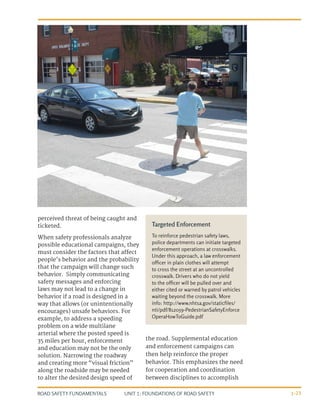
  • 11.
    UNIT 1: FOUNDATIONSOF ROAD SAFETY ROAD SAFETY FUNDAMENTALS 1-3 Nominal safety An absolute statement about the safety of a location based only on its adherence to a particular set of design standards and related criteria. Substantive safety Historical and long-term objective safety of a location based on crash data. conflicts (near misses), avoidance maneuvers, and the time to collision if no evasive action is taken, to determine the level of safety risk and identify specific problems. Safety problems may exist even in locations that do not have a demonstrated history of crashes, just as someone who smokes is at higher risk for lung cancer even if no cancer has yet been detected. This can be especially true for non-motorized road user safety, such as pedestrians and bicyclists, since crashes involving these road users may be infrequent and appear random at first sight. In such locations where crashes are sparse or distributed across the system, safety professionals can use surrogate measures to fill the gaps and assess the road’s level of risk. Observing traffic at an intersection, for example, may reveal a pattern of near misses and other conflicts between vehicles and pedestrians. This pattern may not appear in crash data, but can be a valuable source of information to highlight the potential for safety risk. Safety perception is also an important consideration for travel choices. There are a number of reasons why someone may or may not choose a particular route to drive, walk or bike. Pedestrians who perceive an intersection to be unsafe may cross in a midblock location, where they are more easily able to find a gap in traffic. Motorists may feel uneasy about making a left turn across multiple lanes of traffic, so they may choose to turn right and travel out of their way to perform a U-turn instead. Safety perception impacts road user decisions but is not easily understood by looking at crash data. Safety professionals can use surveys, driving simulators, and other modern technologies to understand the safety perception of road users. Evaluating the safety of a particular network, corridor or intersection requires an understanding of both nominal and substantive safety. Originally introduced by Dr. Ezra Hauer,3 these terms offer a helpful framework for assessing the safety of a particular location. Decades of research and evaluation in the field of road safety have revealed a wealth of knowledge concerning the proper designs and policies that contribute to the safety of a particular location. Roadways constructed according to the best and latest recommended research and design standards are said to be nominally safe. Nominal safety is an absolute statement about the safety of a location based only on its adherence to a particular set of design standards and related criteria. A road that was nominally safe when it was first opened to traffic may become nominally unsafe when the roadway design standards change, even though the road’s crash performance has not changed. While nominal safety considers the design of a road, it does not incorporate any information about the frequency, type and severity of crashes occurring on the facility. The historical and long-term objective safety of a location based on crash data is known as substantive safety. A particular intersection that has experienced fewer than expected crashes over an extended period will be referred to as a substantively safe location, while a corridor with a higher than expected number of crashes is substantively unsafe. Hauer, E. Observational Before/After Studies in Road Safety. Estimating the Effect of Highway and Traffic Engineering Measures on Road Safety. Pergamon Press. 1997. 3
  • 12.
    UNIT 1: FOUNDATIONSOF ROAD SAFETY ROAD SAFETY FUNDAMENTALS 1-4 Unlike nominal safety, substantive safety operates on a continuum and allows for a range of explanations as to why a particular safety problem exists. Another key distinction is the fact that a location can be nominally safe – adhering to all standards and design criteria – while experiencing high rates of crashes, making it substantively unsafe. Similarly, a substantively safe location (one that has a lower than expected crash rate) may be nominally unsafe if it does not meet the applicable design standards. Agencies and safety professionals should strive to prioritize the substantive safety of a facility. Simply building a road that meets all the current design standards will not ensure that the road is substantively safe. Using professional judgement to prioritize safety improvements and select appropriate designs within a range of options, based on observations of road user behavior and other available data, will increase the chance that all factors are considered. The end result will be a road that moves a step closer to the ultimate goal of having a transportation system free of injuries and deaths. Road Safety Decisions and Trade-offs The goal of improving safety exists alongside other goals of the transportation system, such as mobility, efficient movement of people and goods, environmental concerns, public health, and economic goals. In this way, transportation professionals and policy makers often refer to trade-offs – making a decision to favor one goal at the expense of another. While those in the field of road safety continually look for new designs and technologies to advance all goals, there continue to be many instances where public agencies must weigh competing goals for a location or portion of the road network and decide what trade-offs should be made for the goal of increasing road safety. Below are several examples: J J Roundabouts: A city may decide to install a roundabout at an intersection to decrease the potential conflicts between various movements at the intersection. Safety is improved, especially related to left-turns, since all turns are now part of the circle. However, a roundabout does require traffic on the main road to slow their speeds and navigate through the roundabout. During heavy traffic, especially Design Dimensions (LANE WIDTH, RADIUS OF CURVE, STOPPING SIGHT DISTANCE, ETC.) Crash Risk Nominal Safety Substantive Safety FIGURE 1-4: Comparison of nominal and substantive concepts of safety http:// safety.fhwa.dot.gov/geometric/pubs/miti- gationstrategies/chapter1/1_comparnom- inal.cfm (Source: NCHRP Report 480, Transportation Research Board, 2002)
  • 13.
    UNIT 1: FOUNDATIONSOF ROAD SAFETY ROAD SAFETY FUNDAMENTALS 1-5 if it is unbalanced among the intersection legs, this may cause a decrease in the overall throughput of the intersection. However, this is a trade-off to produce fewer crashes. J J Bicycle Helmet Requirements: In order to improve bicyclist safety, some jurisdictions have adopted ordinances that require bicyclists to wear helmets. In practice, this can reduce the risk of head injuries among cyclists, but it may also reduce the number of people who choose to ride a bicycle. Adopting such ordinances would prioritize safety while potentially reducing bicycle ridership. J J Red Light Cameras: Red light camera enforcement monitors signalized intersections and records information about those who violate red light laws, typically resulting in citations through the mail. These cameras have been shown to improve safety by decreasing the types of crashes that result in serious injury,4 but installing the cameras can be met with significant public opposition. J J Protected Left Turns: To minimize the risk of severe left-turn crashes at signalized intersections, engineers may choose to provide left turning drivers an exclusive protected left turn phase (green arrow). While this minimizes crash risk by separating the left turning vehicles from other movements, it also requires that extra time be added specifically for left Council, et al. Safety Evaluation of Red-Light Cameras. Federal Highway Administration. April 2005. https:// www.fhwa.dot. gov/publications/ research/safety/ 05048/05048.pdf 4
  • 14.
    UNIT 1: FOUNDATIONSOF ROAD SAFETY ROAD SAFETY FUNDAMENTALS 1-6 turns, which can increase delay for the rest of the traffic at the intersection. J J Rumble Strips: In rural locations, rumble strips can be installed as a measure to alert drivers when they are running off the road. However, these rumble strips are usually installed on the edge of the road or the paved shoulder where bicyclists can safely and comfortably ride separated from traffic. This may result in bicyclists riding in the road where they are more vulnerable to crashes with motor vehicles. J J Trees and Landscaping: Street trees, shrubs, and other vegetation can serve a valuable purpose in roadside environments – particularly creating shade for the sidewalk, serving as a buffer between the road and sidewalk area, and even creating “visual friction” that can keep vehicle speeds down. However, trees can also pose a safety risk for vehicles that run off the road and collide with them. Vegetation that is too close to an intersection can restrict sight distance, contributing to crashes. Selected tree and vegetation removal is an excellent example of a trade-off between safety and other beneficial features of trees. J J Traffic Signal Installation: A high-speed, high-volume road with multiple traffic lanes may separate housing developments from an elementary school. In order for children living in the housing development to safely travel to and from school, a traffic signal and crosswalk may be installed along the busy road. Motorists will be delayed since they are required to stop for a period of time while the students cross, but the crossing is safer for those students. J J Access Management: Left turns in and out of shopping centers, especially along multilane roads, can result in severe injuries to motorists when crashes occur. Eliminating these left turns by building raised median islands and consolidating driveways
  • 15.
    UNIT 1: FOUNDATIONSOF ROAD SAFETY ROAD SAFETY FUNDAMENTALS 1-7 J J LIST various ways to measure the safety of a road and describe the advantages and disadvantages of each. Consider fac- tors such as the type of information each safety measure provides as well as other issues such as how it can be collected. J J DESCRIBE a change that could be made to a road or intersection that would improve one transportation goal (e.g., traffic operations, public health, mobili- ty and access, environmental quality, or economic growth) at the expense of the safety of road users. J J DESCRIBE a change that could be made to a road or intersection that would improve road safety at the expense of another transportation goal (e.g., traffic operations, public health, mobility and access, environmental quality, or eco- nomic growth). J J DESCRIBE a change that could be made to a road or intersection that would improve safety for a road user but not at the expense of other users, or other goals. EXERCISES can eliminate these risky movements; however, this prevents direct access to the stores by potential customers. Sometimes improving safety for one group of road users may negatively impact the safety of another group. It can also be the case that improving mobility for a group of road users may negatively affect the safety of that same group. There is no absolutely correct answer to many of these trade-offs, as they are all context-specific. Transportation professionals need to discuss the various trade-offs in the context of a particular community’s transportation goals. These types of trade-offs are made every day, and require the cooperation of numerous agencies and stakeholders, all of whom have a role to play in transportation decision-making. Despite the temptation to study road safety as a self-contained system, there are a multitude of factors influencing and being influenced by road safety and travel behavior. In order to make informed decisions about the transportation system, transportation professionals must understand the impacts – both positive and negative – that design, operations, and policy decisions have on the safety of the transportation network as well as the impacts on other areas such as public health, mobility, environmental quality, and economic growth.
  • 16.
    UNIT 1: FOUNDATIONSOF ROAD SAFETY ROAD SAFETY FUNDAMENTALS 1-8 Road Safety Through the Years CHAPTER 2 FOUNDATIONS OF ROAD SAFETY When examining current efforts to address road safety, it is useful to view them in the context of American transportation history. Recent decades have witnessed numerous advances in the field of road safety. This growing national consciousness about the need for safer roads provides a stark contrast to the first half of the twentieth century when the focus was on highway expansion. The following chapter will provide an overview of the major milestones and achievements that led to the transportation system we have today, as well as the policies and practices that were implemented to address a growing safety problem. Late Nineteenth Century and the Popularity of Bicycling An exploration of the history of road safety in the U.S. can begin at many different points – some of our roads were developed as pre- colonial routes and others were trails blazed by Native Americans. In terms of lasting influence on the modern transportation network, however, it is most useful to begin the discussion in the late nineteenth century. In the 1880s and 1890s, bicycles were the dominant vehicle on our nation’s roads. With the introduction of the “safety” bicycle, with two wheels of the same size, and the pneumatic tire in the late 1880s, the bicycling craze became an economic, political, and social force in the U.S. By 1890, the U.S. was manufacturing more than 1 million bicycles each year. At that time, bicyclist behavior— particularly careless or risk-taking behavior—was a contributing factor to bicycle crashes. However, the biggest contributor to crashes existed outside the cities; the poor condition of the nation’s roads made cycling a laborious and dangerous process. Bicycle groups worked at the Federal, State, and local levels to secure road improvement legislation. The work of these advocacy groups became known as the Good Roads Movement. Three men with bicycles on bridge near Pierce Mill, Washington, D.C., 1885. (Source: Brady-Handy Collection, U.S. Library of Congress)
  • 17.
    UNIT 1: FOUNDATIONSOF ROAD SAFETY ROAD SAFETY FUNDAMENTALS 1-9 To build support, advocates tailored their message to farmers with the argument that bad roads, by increasing transportation expenditures, cost more than good roads. While engineers, writers, and politicians joined the movement, bicyclists dominated the Good Roads Movement until cars arrived in the early twentieth century.5 By the close of century, automobiles had slowly begun to share the roads with bicyclists and pedestrians, benefitting from many of the road improvement efforts spearheaded by cycling groups. In 1899, a motor vehicle struck and killed a New York City pedestrian. This event marked the first time in the U.S. that a person was killed in a crash involving a motor vehicle.6 Rise of Motor Vehicles in the Early Twentieth Century In 1905, only 78,000 automobiles, most of which were confined to the cities, traveled the U.S. Ten years later, 2.33 million automobiles were traveling the country’s roads, and by 1918, this number had increased to 5.55 million. Mass production made this increase possible as it lowered vehicle manufacturing costs, putting vehicles within the reach of the middle class. As more vehicles became available at a lower price, the pattern of daily travel in the U.S. began to shift. Longer vehicle trips replaced shorter trips by foot or bicycle, and development patterns began to follow suit. The motor age had arrived, and with it a new kind of highway would evolve, designed specifically for motor vehicles. Expansion of automobile use had immediate positive effects on the national economy and quality of life around the country. Yet proliferation of motor vehicles also had a negative side. As millions of new drivers took to the roads, traffic crashes increased rapidly—tripling from 10,723 in 1918 to 31,215 in 1929.7 Consequences of Speeding As in modern times, in the early days of the automobile, posted speed limits were set far below the speed of which most motor vehicles were capable. With faster and heavier traffic, it became dangerous to drive in the middle of the road and the States began painting centerlines on the pavements to channel traffic in lanes. At 40 miles per hour, these lanes appeared uncomfortably narrow to most motorists, especially when passing trucks. The lane lines also caused trucks to run closer to the shoulder, causing the slab edges and corners of the road to break. To provide greater safety and reduce edge damage, State highway departments built wider pavements and made new roads straighter. These improvements along with mechanical advances in vehicles, such as more powerful engines and four-wheel brakes, in turn encouraged even faster speeds. Thus, after 1918, highway design followed a spiral of cause and effect, resulting in faster and faster speeds and wider and wider pavements. The motivating force behind this spiral was the driving speed preferences of the great mass of vehicle operators. The public authorities were never able to impose or enforce speed limits for very long if the majority of drivers considered the limits unreasonably low. Now, many current engineering practices use the 85th percentile speed – or the speed at which the majority of drivers travel – as the method of setting speed limits. Source: Richard F. Weingroff, “A Peaceful Campaign of Progress and Reform: The Federal Highway Administration at 100,” Public Roads 57, no. 2 (Autumn, 1993),http://www. fhwa.dot.gov/ publications/ publicroads/93fall/ p93au1.cfm Soniak, Matt. When and Where Was the First Car Accident? Mental Floss. 2 December 2012. http://mentalfloss. com/article/31807/ when-and-where- was-first-car- accident Source: America’s Highways, 1776-1976: A History of the Federal-Aid Program. Federal Highway Administration (U.S. Government Printing Office, Washington D.C., 1976). 5 6 7
  • 18.
    UNIT 1: FOUNDATIONSOF ROAD SAFETY ROAD SAFETY FUNDAMENTALS 1-10 Shifting Attention to Safety Recognizing the rise in crashes and resulting injuries and fatalities, Secretary of Commerce Herbert Hoover convened the First National Conference on Street and Highway Safety in Washington, D.C., in December 1924. Here, for the first time, representatives of State highway and motor vehicle commissions, law enforcement, insurance companies, automobile associations and a multitude of other stakeholders and interest groups met in one place to discuss how to address the growing number of fatalities and serious injuries. Prior to the conference, committees were established to perform research into areas such as planning and zoning, traffic control, motor vehicles, statistics, and other areas related to road safety. These committees reported wide differences in traffic regulations from State to State and city to city. For instance, twenty States did not attempt to collect crash statistics, only eight States required reporting crashes that resulted in personal injury, and 38 required railroads and common carriers to report highway crashes. Other committees devoted their attention to issues like traffic control and vehicle speeds, infrastructure and maintenance concerns, and issues impacting vehicles and their drivers. Conference participants supported a wide range of measures to reduce the rate of crashes and recommended that legislative, administrative, technical, and educational bodies adopt them. Conference participants also recommended that the States take the lead by passing adequate motor vehicle laws and setting up suitable agencies for administering the laws, policing the highways, registering vehicles, and licensing drivers. To the Federal Government, the conference assigned the role of encouragement, assembly and distribution of information, and the development of recommended practices. Adoption and implementation of these recommended practices would be left to the individual States. Secretary of Commerce Herbert Hoover, center, with President Calvin Coolidge, right, in February 1924. (Source: Harris & Ewing Collection, U.S. Library of Congress)
  • 19.
    UNIT 1: FOUNDATIONSOF ROAD SAFETY ROAD SAFETY FUNDAMENTALS 1-11 Secretary Hoover called a second conference for March 1926. During the interim between the two conferences, a special committee drew up a model “Uniform Vehicle Code” covering registration and titling of vehicles, licensing of drivers, and operation of vehicles on the highways. The code incorporated the best features of the numerous and varied State laws then on the statute books. The second conference approved this code and recommended it to the State legislatures as the basis for uniform motor vehicle legislation. Studies following this 1926 conference concluded that determining the causes of crashes was far more difficult than they had presumed. The problem warranted a sustained program of research by a national organization. The Conference agreed, and the Highway Research Board (HRB) organized the Committee on Causes and Prevention of Highway Accidents to coordinate crash research nationwide. The HRB played a major part in subsequent efforts to reduce the consequences of crashes.8 Federal Government Role in Highway Development The growing use of motor vehicles during the 1920s was mirrored by the expansion of the Federal Government’s role in funding and building roads. In its early form, the Office of Public Roads was organized under the U.S. Department of Agriculture, playing a large role in funding roadways within national parks and forests. Following the Federal Aid Road Act of 1916, this office would become the Bureau of Public Roads (BPR), charged with working cooperatively with State highway departments on road projects. Work continued on the expansion of highways across the country, and between 1921 and 1939, the distance of paved roads Balanced Design for Safety In the 1920s and 1930s, it was good engineering practice to design new highways as much as possible in long straight lines or “tangents.” When it became necessary to change direction, the engineer laid out a circular curve, the radius of which he selected to fit the ground with the least construction cost, but which could not be less than a certain minimum fixed by department policy. In practice, engineers made the curves sharper than this minimum when it was cheaper to do so, but with little consistency. Engineers expected motorists driving these roads to adjust their speeds to the varying radii, and on the sharper curves safe design speed might be considerably lower than the posted speed limit. Increasing concern for road safety led many highway engineers to worry about this inconsistency between posted speed limits and safe design speed on curves. In 1935, highway engineer Joseph Barnett of the BPR proposed that all new rural roads conform to an “assumed design speed,” a comfortable top speed for drivers outside of urban areas. With its adoption by American Association of State Highway Officials in 1938, Barnett’s “balanced design” concept became a permanent feature of U.S. roadway design. Today, standards for designing curves, such as design speed, curve radius and superelevation (the tilt of the road through a curve) are provided in A Policy on Geometric Design of Highways and Streets, produced by the American Association for State Highway Transportation Officials. Source: America’s Highways, 1776-1976: A History of the Federal-Aid Program. Federal Highway Administration (U.S. Government Printing Office, Washington D.C., 1976). 8 Uniform Vehicle Code A code covering registration and titling of vehicles, licensing of drivers, and operation of vehicles on the highways.
  • 20.
    UNIT 1: FOUNDATIONSOF ROAD SAFETY ROAD SAFETY FUNDAMENTALS 1-12 increased from 387,000 miles to nearly 1.4 million miles.9 The BPR recognized that the antiquated highway system was one of the contributing causes of the high crash toll, but did not go so far as to identify primary crash causes or recommend potential solutions. During this time, an emphasis was placed on expanding the Federal role in the process of highway design and development. This effort culminated in 1944 when Congress approved the development of a National System of Interstate Highways along with that year’s Federal Aid Highway Act. Though expansive in scope, calling for a 40,000 mile network, the legislation was not accompanied by any funds to support the development of these highways. Without funding, the legislation did not significantly expand the highway system. Road safety continued to present a national concern. In May 1946, President Harry S. Truman spoke at the Highway Safety Conference to rally public support to improve State motor vehicle laws, driver licensing, and education. After summarizing his unsuccessful efforts as a U.S. senator to enact Federal legislation on motor vehicle registration and driver licensing, the President said Congress was not yet ready to interfere with what many perceived as State prerogatives. However, he noted that the Federal Government would not stand aside if the rates of highway fatalities continued to rise.10 Source: Weingroff, Richard. A Peaceful Campaign Of Progress And Reform: The Federal Highway Administration at 100. Public Roads Magazine. Vol. 57 No. 2. July 1993. http://www. fhwa.dot.gov/ publications/ publicroads/93fall/ p93au1.cfm Source: Richard F. Weingroff and the assistance of Sonquela Seabron, President Dwight D. Eisenhower and the Federal Role in Highway Safety, accessed May 23, 2013, http://www. fhwa.dot.gov/ infrastructure/ safetyin.cfm 9 10 Safety Signs Before World War I, most States were using signs to warn road users of danger ahead, particularly at railroad crossings; railroad companies themselves were required to post warning signs at all public road crossings. However, there was little agreement between States about the specific design of these warning devices, and the signs were a variety of shapes, sizes, and colors. In 1929, the American Engineering Council surveyed sign practices in all U.S. cities with a population of more than 50,000 and created a document that was, in effect, a manual of the best practices of the time. Recognizing the need for standard practices for signs in rural and urban areas, the American Association of State Highway Officials and the National Conference on Street and Highway Safety organized a Joint Committee on Uniform Traffic Control Devices in 1931 and introduced a new manual for national use in 1935. The manual of best practices changed over time to become the Manual on Uniform Traffic Control Devices. President Harry S. Truman, 1945. (Source: U.S. Library of Congress)
  • 21.
    UNIT 1: FOUNDATIONSOF ROAD SAFETY ROAD SAFETY FUNDAMENTALS 1-13 Post War Development and Growth Economic conditions following World War II led to even higher levels of driving and automobile ownership. Personal savings of almost $44 billion created a market for housing and other types of goods, chief among them new automobiles. Automobile production jumped from a nearly 70,000 in 1945 to 3.9 million in 1948. Because of this increase in vehicle production, motor vehicle registrations spiked and the number of drivers on the nation’s roads and highways reached unprecedented levels. Under wartime rationing of rubber, and specifically tires, States had implemented speed controls to reduce wear and tear and improve tire longevity. With the end of rationing and emergency speed controls at the conclusion of the war, highway travel returned to pre-war levels and began a steady climb of about 6 percent per year, which would continue for nearly three decades. While the increasing popularity of low density housing development (i.e., the suburbs) and the availability of motor vehicles created perfect conditions for more driving, the nation’s roads and highways were unprepared for the increase in traffic. Under wartime restrictions, States were unable to adequately maintain their highways. With widespread operation of overloaded trucks and reduced maintenance, the State highway systems were in worse structural shape post-war than before the war. Development of the Interstate Highway System Though the National System of Interstate Highways had been established by legislation in 1944, little progress was made over the next decade. Without funding, established routes were slow to develop. That changed in 1956, when President Dwight D. Eisenhower signed the Federal- Aid Highway Act of 1956. This legislation linked the development of the interstate highway system to the interest of national defense and assigned funding that would rapidly expand the highway network.11 The act established a dedicated funding stream and a plan for highway development that launched the nation into an unprecedented era of expansion in which new interstate corridors linked cities and towns to one another. http://www. fhwa.dot.gov/ publications/ publicroads/ 06jan/01.cfm 11 President Dwight D. Eisenhower speaks to the White House Conference on Highway Safety, 1954. (Source: Eisenhower Presidential Library)
  • 22.
    UNIT 1: FOUNDATIONSOF ROAD SAFETY ROAD SAFETY FUNDAMENTALS 1-14 Despite the enthusiasm of political and business leaders, the growth of this system was not without its critics. These critics primarily denounced the destruction of homes and separation of communities that sometimes resulted from new highways bisecting established neighborhoods. Though this opposition halted projects in some locations, it did not stop the expansion of the interstate highway system. Highway Safety Act of 1966 In 1964, the U.S. faced a sharp rise in the number of traffic fatalities. An increased number of vehicles on the roadways combined with a public culture that did not prioritize roadway safety consciousness led to 47,700 deaths on the nation’s highways, an increase of 10 percent over the number of fatalities that occurred in 1963. These deaths prompted the nation to take a hard look at road safety efforts and resulted in Congressional hearings in March 1965 to raise public awareness of the growing national crisis.12 To respond to these trends, the nation needed a change of direction in the design and operation of its roads and vehicles. This change began with reviewing safety standards in these areas and conducting research to identify effective measures to improve safety. The 1960s was a pivotal decade for road safety due to the passage of laws that provided funding and new policies. On September 9, 1966, President Lyndon B. Johnson signed the National Traffic and Motor Vehicle Safety Act of 1966 and the Highway Safety Act of 1966. The signing ceremony in the Rose Garden of the White House marked a transformation in the role of the Federal Government in road safety. This role had been growing during the Eisenhower administration, but became a larger area of emphasis as fatalities on the nation’s highways climbed toward 50,000. Those in the federal government observed that the steps taken during the previous two decades to reverse the climbing number of fatalities had failed, and they believed that road safety should no longer be left solely to the responsibility of the States, the automobile industry, and the individual drivers.13 This legislation established the U.S. Department of Transportation (USDOT) and transformed the Bureau of Public Roads into the Federal Highway Administration (FHWA). New bureaus were added to address safety in areas of growing concern, such as the Bureau of Motor Carrier Safety and National Highway Safety Bureau (these would later become the Federal Motor Carrier Safety Administration and the National Highway Traffic Safety Administration, respectively). The USDOT proceeded to develop programs and initiatives and pave the way for activities still in place today.14 Advances in vehicle design and policy were also an area of emphasis during the 1960s. In 1968, federal legislation required vehicles to provide seat belts. 15 Federal law also required States to begin implementing motorcycle helmet laws in order to qualify for particular sources of funding.16 These requirements led to more widespread implementation of safety policies through the late Source: Richard F. Weingroff and the assistance of Sonquela Seabron, President Dwight D. Eisenhower and the Federal Role in Highway Safety, accessed May 23, 2013, http://www. fhwa.dot.gov/ infrastructure/ safetyin.cfm 12 13 http://www. fhwa.dot.gov/ infrastructure/ 50interstate.cfm Federal Motor Vehicle Safety Standard (FMVSS) No. 218, https://www.federal register.gov/ documents/2015/05/ 21/2015-11756/ federal-motor- vehicle-safety- standards- motorcycle-helmets Title 49 of the United States Code, Chapter 301, Motor Vehicle Safety, https://www.gpo. gov/fdsys/pkg/ USCODE-2009- title49/html/ USCODE-2009- title49-subtitleVI. htm 14 16 15
  • 23.
    UNIT 1: FOUNDATIONSOF ROAD SAFETY ROAD SAFETY FUNDAMENTALS 1-15 1960s and 1970s. Section 402 of the Highway Safety Act established a revenue stream for funding to directly support State programs aimed at improving road safety. Known as the State and Community Highway Safety Grant Program, the funds originally supported a variety of program areas, including many many behavioral safety programs that are still in existence today. 17 Energy Crises and Safety Legislation in the 1970s and 1980s The 1970s and 1980s were characterized by energy crises in 1973 and 1979 that had immediate and lasting impacts on travel trends. Vehicle Miles Traveled (VMT) decreased following each of these events, as Americans drove less due to rising fuel costs. Strategic legislative action by Congress, such as the National Maximum Speed Law of 1974 which prohibited speeds higher than 55 miles per hour also helped by decreasing fuel costs. The law would later be repealed in 1995, allowing States to set their own maximum speed limits. Between 1970 and 2007, there were two periods of time when VMT decreased from the previous year. These years include 1974 and 1979, each of which saw a roughly 18 billion mile decrease in VMT from the previous year.18 As driving decreased, so did traffic fatalities. From 1973 to 1974, for example, traffic fatalities went down 16 percent – the largest single year decline since 1941-1942.19 Driving levels began to increase again once fuel costs normalized, so the reductions were not sustained beyond the period of economic stagnation. The Highway Safety Act of 1973 established a specific methodology for improving roadway safety from an engineering perspective. It required the States to first survey all hazardous locations and examine http://www. fhwa.dot.gov/ policyinformation/ travel_monitoring/ tvt.cfm Governors Highway Safety Association. Section 402 State and Community Highway Safety Grant Program. http://www.ghsa. org/about/federal- grant-programs/402 18 17 https://crashstats. nhtsa.dot.gov/Api/ Public/ViewPub lication/811346 19 President Lyndon B. Johnson signs the National Traffic and Motor Vehicle Safety Act of 1966 and the Highway Safety Act of 1966. (Source: LBJ Presidential Library)
  • 24.
    UNIT 1: FOUNDATIONSOF ROAD SAFETY ROAD SAFETY FUNDAMENTALS 1-16 the causes of crashes at these sites. A benefit/cost analysis was then performed to prioritize needed improvements. This process set the stage for the current safety management processes and would be refined and improved over the years. The Highway Safety Act of 1973 also clarified the relationship between the Federal Government and the States. The Federal Government was to direct policy and program components, while the States were responsible for implementing those policies and programs.20 During the 1970s, Congress also established the Motor Carrier Safety Assistance Program (MCSAP). This program provides financial assistance to States to reduce the number and severity of crashes and hazardous materials incidents involving commercial motor vehicles (CMV) through inspection and enforcement programs focused on trucks, carriers, and driver regulations. 21 Vehicle safety continued to be a priority in the 1970s and 1980s, as more States began to implement laws requiring the use of seat belts and motorcycle helmets. New York became the first State to adopt a mandatory seat belt law in 1984, and other States soon followed suit.22 The Federal Motor Vehicle Safety Standard 213 brought attention to child passenger safety. This standard was the first to outline specific requirements for restraint systems designed for children. Multimodal Shift in the 1990s The 1990s saw a shift from transportation policies that focused on motor vehicle safety and efficiency to an acknowledgement of alternate modes of transportation, such as bicycling, walking and use of public transit. The Intermodal Surface Transportation Efficiency Act of 1991 (ISTEA) added a multimodal perspective to the Federal-aid highway program. While ISTEA was not specifically focused on transportation safety, it created some programs to promote safer travel. For example, ISTEA enhanced road safety with new programs that encouraged the use of safety belts and motorcycle helmets.23 The legislation also required the installation of airbags for drivers and front passengers in all cars and trucks.24 In 1998, the Transportation Equity Act for the 21st Century (TEA-21) provided more focus for roadway safety planning by establishing safety and security as planning http://www.iihs.org/ iihs/topics/laws/ safetybeltuse 22 Source: “What is the Motor Carrier Safety Assistance Program (MCSAP)?” accessed May 23, 2013, https://www. federalregister.gov/ documents/2000/03/ 21/00-6819/motor- carrier-safety- assistance-program 21 Source: “HSIP History,” accessed October 22, 2013, http://safety.fhwa. dot.gov/hsip/gen_ info/hsip_history.cfm and “Subchapter J— Highway Safety: Part 924—Highway Safety ImprovementProgram,” accessed October 21, 2013, http://www. gpo.gov/fdsys/pkg/CFR- 2003-title23-vol1/pdf/ CFR-2003-title23-vol1- chapI-subchapJ.pdf. 20 Source: “Intermodal Surface Transportation Efficiency Act of 1991 Information,” last updatedMay16,2013, accessedJuly05,2013, http://www.fhwa. dot.gov/planning/ public_involvement/ archive/legislation/ istea.cfm. 23 1893 Office of Road Inquiry is created, which would eventually become the Federal Highway Administration 1908 Ford Model T is released as the first automobile available to most of the middle class 1916 Bureau of Public Roads is created 1924 First national conference on highway safety held in Washington, DC 1926 Uniform Vehicle Code is developed during the second highway safety conference 1932 Revenue Act of 1932 establishes first national gas tax at 1 cent per gallon ROAD SAFETY TIMELINE See next page. 24
  • 25.
    UNIT 1: FOUNDATIONSOF ROAD SAFETY ROAD SAFETY FUNDAMENTALS 1-17 http://www.history. com/this-day-in- history/federal- legislation-makes- airbags-mandatory 24 priorities. Prior to TEA-21, a State or Metropolitan Planning Organization (MPO) may have incorporated safety in its goals or long-range transportation plan, but specific strategies to increase safety were seldom included in statewide and metropolitan planning processes or documents. TEA-21 established the Highway Safety Infrastructure program (not to be confused with the Highway Safety Improvement Program, which would be developed several years later), which funded safety improvement projects to eliminate safety problems. The TEA-21 legislation also encouraged States to adopt and implement effective programs to improve the quality (e.g. timeliness, accuracy, completeness, uniformity and accessibility) of State data needed to identify safety priorities for national, State and local road safety programs.25 Not to be lost among the TEA-21 legislation, another pivotal moment in transportation legislation came in 2000 when an important provision related to alcohol was included in the USDOT appropriation act. The appropriation carried a requirement that all States must enact laws to limit the legal blood alcohol content (BAC) of drivers to 0.08 percent.26 This limit was in line with similar limits imposed on drivers in other countries, though some European countries limit the legal BAC to 0.05 percent. While 19 States and Washington, D.C., had already enacted this law, the Federal mandate provided a further incentive for other States to do so: States that did not pass the law by 2004 would forego a portion of their transportation funding. Though specific laws vary, each State now recognizes the legal limit of 0.08 percent blood alcohol content.27 http://www.ghsa.org/ html/stateinfo/laws/ impaired_laws.html 27 Rodriguez-Iglesias, C.; Wiliszowski, ClH.; Lacey, J.H. Legislative History of .08 Per Se Laws, National Highway Traffic Safety Administration, Report No. DOT HS 809 286, June 2001 26 Source: “TEA-21 – Transportation Equity Act for the 21st Century Fact Sheets,” last modified April 5, 2011, accessed June 2, 2013, http://www. fhwa.dot.gov/tea21/ factsheets/index.htm 25 Blood alcohol content The percentage of alcohol in a person’s blood, used to measure driver intoxication. 1944 Congress approves the development of the National System of Interstate Highways 1956 Federal-Aid Highway Act provides dedicated funding stream to support the interstate highway system 1966 Highway Safety Act and National Traffic and Motor Vehicle Safety Acts are signed, creating the U.S. Department of Transportation 1968 First Federal Motor Vehicle Safety Standard requiring seat belts is passed 1971 First Federal safety standard requiring child passenger restraints Officers use specialized devices to measure drivers’ blood alcohol content.
  • 26.
    UNIT 1: FOUNDATIONSOF ROAD SAFETY ROAD SAFETY FUNDAMENTALS 1-18 Legislation in the 21st Century Twenty-first century legislation continued to move Federal transportation funding and policy in the direction of focusing on multimodal, data-driven approaches to improving the transportation system. One specific area of focus was a move toward safety planning. Transportation safety planning shifts the focus of traditional planning efforts to a more comprehensive process that integrates safety into transportation decision-making. Safety planning encompasses corridors and entire transportation networks at the local, regional, and State levels, as well as specific sites.28 In 2005, Congress passed the Safe, Accountable, Flexible, and Efficient Transportation Equity Act—A Legacy for Users (SAFETEA-LU). SAFETEA-LU raised the stature of Federal road safety programs by establishing the Highway Safety Improvement Program (HSIP) as a core Federal-aid program tied to strategic safety planning and performance. HSIP is one of six core Federal-aid programs under which funds are apportioned directly to the States. One of the major elements of the HSIP was Source: “Transportation Safety Planning (TSP),” accessed August 13, 2013, http://safety.fhwa. dot.gov/hsip/tsp/ and “Transportation Safety Planning Fact Sheet,” accessed August 13, 2013, http://safety.fhwa. dot.gov/hsip/tsp/ fact_sheet.cfm. Title 23 United States Code § 148 28 29 1973 Oil embargo leads to energy crisis Highway Safety Act of 1973, introduction of National Maximum Speed Law 1979 Oil crisis in the wake of the Iranian Revolution 1974 Safety standard requiring motorcycle helmets is passed 1998 TEA-21 is passed, along with a call for all States to adopt a 0.08 percent blood alcohol content limit for drivers 2012 MAP-21 is passed 1984 New York becomes first State to pass mandatory seat belt law 1993 Gas tax increased to 18.4 cents per gallon 1995 National Maximum Speed Law is repealed 2005 SAFETEA- LU is passed 1991 ISTEA is passed the requirement for each State to develop and implement a Strategic Highway Safety Plan (SHSP).29 The plans sought to establish data-driven approaches that were coordinated with a broad range of stakeholders and utilized a diverse set of disciplines (e.g., engineering, enforcement, education and emergency response). These data- driven plans had to include clear methods for measuring progress toward safety goals. The Moving Ahead for Progress in the 21st Century Act (MAP-21) was signed into law in 2012. The 2012 legislation transformed the policy and programmatic framework for investments in the country’s transportation infrastructure, enhancing the programs and policies established in 1991. MAP-21 doubled funding for road safety improvement projects, strengthened the linkage among modal safety programs and created a positive agenda to make significant progress in reducing highway fatalities and serious injuries. It provided increased focus on the importance of high quality data, transportation infrastructure and the safety of local streets.
  • 27.
    UNIT 1: FOUNDATIONSOF ROAD SAFETY ROAD SAFETY FUNDAMENTALS 1-19 U.S. Department of Transportation. Strategic Plans. November 2015. https://www. transportation.gov/ mission/budget/ dot-budget-and- performance- documents# StrategicPlans 30 J J RESEARCH a federal transportation law addressed in this chapter and write a summary about the law, emphasizing the safety aspects. J J FIND a recent news article that involves road safety (more than just a local news article on a recent crash) and write a summary describing the effort under- taken by the public agency, how it was received by the public, and whether it was shown to be effective in increasing road safety. J J USE https://www.govtrack.us to find a transportation bill currently proposed or under review by Congress. Describe how the legislation would be expected to affect road safety. J J RESEARCH the legal driving Blood Alcohol Content (BAC) by state in the U.S. and create a table showing the comparison. Select one state where the legal BAC is lower than the federal requirement, locate a paper or news article describing how that BAC level was decided, and write a summary. EXERCISES Conclusion Exploring the history of travel trends and safety in the U.S. helps illustrate how past decisions have led to the transportation system seen today. Safety has not always been a deciding factor in how roads are built. However, today, safety is a top priority of the USDOT.30 Most State and local transportation agencies share USDOT’s goal; some have even set goals to reduce total traffic fatalities to zero. These “vision zero” and “toward zero deaths” goals are guiding transportation projects by requiring safety to be incorporated into every step of project planning, design, construction and operation. Future safety issues will certainly arise as technological advancements lead to changes in the vehicle fleet. Autonomous and potentially driverless vehicles are being developed and tested across the world. Though safety improvements are touted as a benefit of these advanced vehicles, safety will continue to be a priority as they begin to share the roads with older vehicles, bicyclists, and pedestrians. As can be learned from the history of road safety in the U.S., complex problems must be met with safety advancements, legislative action, and collaboration.
  • 28.
    UNIT 1: FOUNDATIONSOF ROAD SAFETY ROAD SAFETY FUNDAMENTALS 1-20 Road safety is a complex issue, and any efforts to improve safety must address not only the roadway but also road user behavior, vehicle design, interaction between road users, and the effect of the roadway on all road users. Road safety partners include anyone who influences road user safety, including those in infrastructure safety, behavioral roadway safety, transportation planning, public health, public safety and many other disciplines. Each of these disciplines is able to provide a unique perspective and each has specific methods for addressing road safety. It is becoming increasingly common for these various disciplines to work in collaboration with one another to address road safety through comprehensive programs. Instead of focusing on traditional “silos” of activity, agencies hope that this interaction and collaboration among various disciplines will lead to continued safety improvements. This chapter will discuss road safety efforts from the disciplines of roadway design and engineering, public education, and enforcement campaigns. Working in collaboration with one another, as described above, these groups can share the burden of road safety responsibilities and create comprehensive programs to address the various factors that may contribute to crashes. Multidisciplinary Approaches CHAPTER 3 FOUNDATIONS OF ROAD SAFETY The E’s A popular multidisciplinary approach to road safety is sometimes referred to as the “four E’s”: Engineering, Education, Enforcement, and Emergency response. These E’s broadly represent the various disciplines that bring together stakeholders who care about making the road safe for all users. Sometimes a fifth “E” for evaluation is added to this list to represent the important role of evaluating what works and what doesn’t. This emphasizes the fact that good data is crucial to the improvement of road safety.
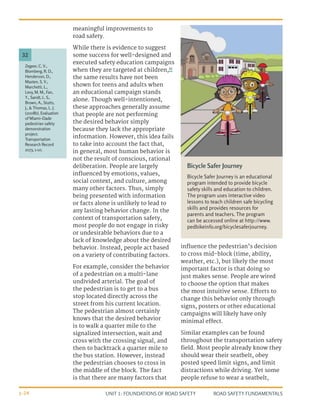
  • 29.
    UNIT 1: FOUNDATIONSOF ROAD SAFETY ROAD SAFETY FUNDAMENTALS 1-21 Roadway Design and Engineering Several types of transportation professionals are responsible for roadway safety engineering. Broadly speaking, the roadway safety engineering community includes transportation planners and engineers. Transportation planning plays a critical role in determining the shape of the transportation system and provides an early opportunity for professionals to address safety needs. Before a road project is designed or built, it is influenced by any number of comprehensive and strategic transportation plans that are coordinated to ensure that the system being developed is one that matches the vision of the local community. Planners work with stakeholders such as the general public, business owners, policy makers, and advocates to establish plans for how the transportation system can best serve every group’s needs. In the past, the traditional planning process focused on economic development, environmental quality, and mobility as the three primary concerns. Most States consider infrastructure safety improvements as part of preservation or improvements projects or within operational changes undertaken by traffic offices. States are now able to use the Highway Safety Improvement Program (HSIP) to fund safety projects in at high priority locations. This program allows development of targeted solutions and approaches that address the contributing factors to collisions, thereby seeking to achieve a higher return on safety investments. Roadway engineers work on the design, construction and system preservation of the roadways. In particular, engineers are charged with designing roads that minimize the chance that crashes will occur while balancing the needs for efficiency and mobility. Engineers also work to design roads and intersection in such a way that minimizes crash severity and injury risk when crashes do occur. Engineers affect the safety of the built environment by incorporating safety in to the planning process at the beginning of a project; selecting design alternatives that prioritize safety considerations; using design elements that maximize the safety of each part of the road or intersection; ensuring quality and safe construction, operation, and maintenance of the roads; and addressing safety problems at existing locations. Infrastructure improvements such as paved shoulders, rumble strips, and improved nighttime visibility may prevent drivers from veering off the roadway, and still other opportunities exist for improving the roadside and road user behavior. For example, when a driver veers off the roadway, it is important to provide a roadside environment that reduces the potential for crashes and injury. Roadside slopes and objects such as drainage structures, trees, and utility poles are examples of roadside elements that engineers can target for improvements to road safety performance. One engineering method to increase roadside safety is to create a clear zone—an unobstructed, traversable roadside area that allows a driver to stop safely or regain control of the vehicle that has left the roadway.
  • 30.
    UNIT 1: FOUNDATIONSOF ROAD SAFETY ROAD SAFETY FUNDAMENTALS 1-22 Engineering solutions must incorporate the different needs and preferences of a variety of user groups. As mentioned previously, this often means that tough decisions and trade-offs must be made to arrive at infrastructure solutions that balance the needs of different users. This trade-off can be illustrated with an example of a signalized intersection. Improving intersection safety for pedestrians may involve adding pedestrian crossing time to the signal or separating turn movements to eliminate high risk conflicts. Protected left-turn phases can also improve safety for vehicles, as shown previously. But these new or longer signal phases either add time to the cycle length or keep the same length while reducing time for the through movements. Regardless, the result is more delay to both pedestrians and motorists. In such situations, it is necessary to consider all of these needs and select the appropriate signal timing that meets the needs of all users. Adhering to design standards – creating nominally safe conditions – is only one aspect of the complex roadway design and engineering field. Addressing substantive safety through design strategies requires an understanding of multiple perspectives, trade-offs and user needs. Public Education and Enforcement Campaigns Public education and communications campaigns are commonly used to improve road user attitudes and awareness. The structure and delivery methods of these campaigns can take many forms. However, they generally involve materials (media advertisements, informational brochures, posters, presentations, etc.) to inform people of a desired behavior and the benefits of such behavior (or conversely, the risks of an unwanted behavior). While standalone informational or educational campaigns can improve awareness or perceptions about road safety issues, they are unlikely to change road user behavior. Rather, campaigns that educate the public about increased law enforcement efforts aimed at a particular behavior have been shown to be effective. Generally referred to as “high-visibility enforcement” these campaigns increase the perceived enforcement of a particular law. When people believe there is a high probability of being caught, they are more likely to follow the law. The Click it or Ticket campaign is one of the most widely known examples of high-visibility enforcement. In this case, simply enforcing the seatbelt law was not sufficient. The key to this program’s success was the media coverage and other informational campaigns telling the public that law enforcement officers are looking for people who are not wearing a seatbelt. In other words, for those people who do not typically wear a seatbelt, the law itself was not sufficient motivation to change. The motivation came from a Countermeasures That Work Countermeasures That Work31 is a comprehensive guidance document providing details of different programs and interventions that are effective in improving safety. The guide is published regularly by NHTSA. Countermeasures that Work: A Highway safety Countermeasures Guide for State Highway Safety Offices, 7th edition, 2013 DOT HS 811 727 31
  • 31.
    UNIT 1: FOUNDATIONSOF ROAD SAFETY ROAD SAFETY FUNDAMENTALS 1-23 perceived threat of being caught and ticketed. When safety professionals analyze possible educational campaigns, they must consider the factors that affect people’s behavior and the probability that the campaign will change such behavior. Simply communicating safety messages and enforcing laws may not lead to a change in behavior if a road is designed in a way that allows (or unintentionally encourages) unsafe behaviors. For example, to address a speeding problem on a wide multilane arterial where the posted speed is 35 miles per hour, enforcement and education may not be the only solution. Narrowing the roadway and creating more “visual friction” along the roadside may be needed to alter the desired design speed of the road. Supplemental education and enforcement campaigns can then help reinforce the proper behavior. This emphasizes the need for cooperation and coordination between disciplines to accomplish Targeted Enforcement To reinforce pedestrian safety laws, police departments can initiate targeted enforcement operations at crosswalks. Under this approach, a law enforcement officer in plain clothes will attempt to cross the street at an uncontrolled crosswalk. Drivers who do not yield to the officer will be pulled over and either cited or warned by patrol vehicles waiting beyond the crosswalk. More info: http://www.nhtsa.gov/staticfiles/ nti/pdf/812059-PedestrianSafetyEnforce OperaHowToGuide.pdf
  • 32.
    UNIT 1: FOUNDATIONSOF ROAD SAFETY ROAD SAFETY FUNDAMENTALS 1-24 meaningful improvements to road safety. While there is evidence to suggest some success for well-designed and executed safety education campaigns when they are targeted at children,32 the same results have not been shown for teens and adults when an educational campaign stands alone. Though well-intentioned, these approaches generally assume that people are not performing the desired behavior simply because they lack the appropriate information. However, this idea fails to take into account the fact that, in general, most human behavior is not the result of conscious, rational deliberation. People are largely influenced by emotions, values, social context, and culture, among many other factors. Thus, simply being presented with information or facts alone is unlikely to lead to any lasting behavior change. In the context of transportation safety, most people do not engage in risky or undesirable behaviors due to a lack of knowledge about the desired behavior. Instead, people act based on a variety of contributing factors. For example, consider the behavior of a pedestrian on a multi-lane undivided arterial. The goal of the pedestrian is to get to a bus stop located directly across the street from his current location. The pedestrian almost certainly knows that the desired behavior is to walk a quarter mile to the signalized intersection, wait and cross with the crossing signal, and then to backtrack a quarter mile to the bus station. However, instead the pedestrian chooses to cross in the middle of the block. The fact is that there are many factors that influence the pedestrian’s decision to cross mid-block (time, ability, weather, etc.), but likely the most important factor is that doing so just makes sense. People are wired to choose the option that makes the most intuitive sense. Efforts to change this behavior only through signs, posters or other educational campaigns will likely have only minimal effect. Similar examples can be found throughout the transportation safety field. Most people already know they should wear their seatbelt, obey posted speed limit signs, and limit distractions while driving. Yet some people refuse to wear a seatbelt, Bicycle Safer Journey Bicycle Safer Journey is an educational program intended to provide bicycle safety skills and education to children. The program uses interactive video lessons to teach children safe bicycling skills and provides resources for parents and teachers. The program can be accessed online at http://www. pedbikeinfo.org/bicyclesaferjourney. Zegeer, C. V., Blomberg, R. D., Henderson, D., Masten, S. V., Marchetti, L., Levy, M. M., Fan, Y., Sandt, L. S., Brown, A., Stutts, J., & Thomas, L. J. (2008b). Evaluation of Miami–Dade pedestrian safety demonstration project. Transportation Research Record 2073, 1-10. 32
  • 33.
    UNIT 1: FOUNDATIONSOF ROAD SAFETY ROAD SAFETY FUNDAMENTALS 1-25 some people speed, and some people text while driving. Knowledge alone is not enough. Successful education and enforcement campaigns recognize the reality of people’s behaviors and apply this knowledge to the safety efforts. For example, social norms and cultural influences can provide some explanation for why certain behaviors are common - even those behaviors known to be unsafe. Marketing interventions based on social norms have been applied to the areas of distracted driving and driving under the influence of alcohol. Such methods provide a way to examine safety problems and Media Campaign Effectiveness Well planned and executed media campaigns centered on reducing alcohol-impaired driving can be effective in reducing the occurrence of alcohol related crashes. A study in 2004 pointed to a 13 percent decrease in alcohol related crashes following these types of campaigns.33 Click It or Ticket Click It or Ticket is a successful seat belt enforcement campaign that has helped to increase the national seat belt usage rate. The program uses public education to communicate the law and risks of not using seat belts in a variety of settings. The campaigns provide waves of education and enforcement along with high visibility media coverage to publicize and sustain the campaign. NHTSA manages this campaign annually with assistance from the State Highway Safety offices, law enforcement agencies, and national- and local-paid advertising. Elder, R.W., et al. Effectiveness of mass media campaigns for reducing drinking and driving and alcohol-involved crashes: a systematic review. July 2004. http:// www.sciencedirect. com/science/ article/pii/ S0749379704000467 33
  • 34.
    UNIT 1: FOUNDATIONSOF ROAD SAFETY ROAD SAFETY FUNDAMENTALS 1-26 what might be done to address them through education and enforcement. Comprehensive Safety Programs While each discipline has its own strengths, significant improvements in roadway safety are more likely when a program encompasses many disciplines rather than just one. Interdisciplinary team efforts can take on safety problems using multiple approaches and are therefore greater in scope than individual disciplines working in isolation. The need for this “multiple approach” solution requires collaboration among many parties. This type of collaboration is most clearly seen when agencies seek to create a comprehensive safety plan. Creating a comprehensive safety plan for a city, county, or state must be a data driven process. In doing so, agencies first begin by analyzing their safety data to identify emphasis areas where concentrated efforts are likely to yield the largest reduction in fatalities and serious injuries. A State’s Strategic Highway Safety Plan (SHSP) is an example of a comprehensive safety plan, and one of the best examples of a multi- disciplinary, data driven planning effort. A State SHSP provides a framework for developing a coordinated and comprehensive approach to addressing road safety across a State. In the development of a State’s SHSP, safety stakeholders from across the State and across disciplines will consider all the data available (i.e., crash, injury surveillance, roadway and traffic, vehicle, enforcement, and driver data) that will help an agency understand where more safety emphasis is needed.34 Beyond crash records, an agency may choose to rely on alternate data sources like roadway characteristics and its own knowledge of crash risk to pursue systemic safety strategies. A systemic approach proactively identifies locations that may have a high risk of crashes but where the risk has not yet resulted in actual crashes.35 Strategic Highway Safety Plan Provides a framework for developing a coordinated and comprehensive approach to addressing road safety across a State. https://safety. fhwa.dot.gov/shsp/ guidebook/ 34 http://safety.fhwa. dot.gov/systemic 35
  • 35.
    UNIT 1: FOUNDATIONSOF ROAD SAFETY ROAD SAFETY FUNDAMENTALS 1-27 Demographic data showing where population growth has occurred, or where it is expected, can also influence an agency’s safety plans. One of the most critical components of the SHSP is an evaluation of past efforts, so that the agency can know what strategies are working and so that progress toward goals can be measured and tracked over time. Road safety planning, like the field of safety itself, is multidisciplinary in nature and relies upon the expertise and involvement of numerous perspectives. Once developed, these safety plans influence activities ranging from roadway design and engineering to law enforcement and safety education. Each of the agencies and organizations involved in transportation safety brings a unique and valuable perspective to bear on the roadway safety problem. Their competing philosophies, worldviews and problem solving approaches, however, can make collaboration difficult. Creating a foundation for effective collaboration and establishing a process to support collaborative efforts are two ways to overcome these barriers. One way to create a foundation for collaboration is to ensure that each agency understands the impact that its actions have on road safety and that each makes safety its top priority. The example of a State Strategic Highway Safety Plan shows this type of collaboration. The SHSP process brings together all potential areas of safety emphasis, including intersections, non-motorized users, rural crashes, and others, and uses a data driven approach to identify priorities and areas of need. This foundation can be further strengthened by identifying which agencies or organizations are responsible for implementing each of the strategies identified in the SHSP. In the U.S., no single player manages all programs and disciplines that impact road safety. Therefore, collaboration among all players is fundamental to consistently reduce serious injuries and fatalities. J J FIND the website for your State or local road safety program. Identify initiatives that your State or local agency is implementing in the areas of planning, engineering, education, and enforcement. J J CONSIDER a hypothetical situation where it is your job to convene a team of professionals to visit a high crash intersection and explore possible solutions to the safety problem. Create a list of the people who should be included on that team and briefly describe each person’s role. Be sure to consider the many different types of programs and strategies that can be used to improve road safety. J J SELECT an area of concern, either a specific type of road user or an unsafe behavior, and discuss how road safety in this topic area could be addressed or improved through multiple disciplines. Possible topics include: J J Older drivers J J Underage drinking J J Fatigued or drowsy driving J J Pedestrians EXERCISES
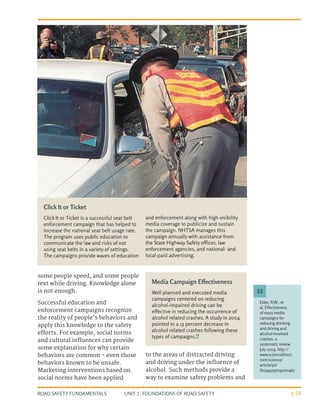
  • 36.
    UNIT 1: FOUNDATIONSOF ROAD SAFETY ROAD SAFETY FUNDAMENTALS 1-28 Drivers of motor vehicles are far from the only users of the road, despite accounting for the majority of trips taken in the U.S. The public right-of-way on most roads is usually shared by a number of different users, traveling by a variety of modes for any number of different reasons. Transportation professionals must understand the mobility and safety needs of different user groups and how they interact with one another to gain a better understanding of safety problems and their potential solutions. Road user groups include: J J Passenger vehicle drivers and occupants J J Drivers of trucks and other large vehicles J J Motorcyclists J J Pedestrians J J Bicyclists Passenger Vehicle Drivers and Occupants Passenger vehicles are typically defined as sedans, pickup trucks, minivans, and sport utility vehicles and represent the primary mode of transportation for the majority of Americans. Since these vehicles account for the vast majority of registered vehicles and vehicle miles traveled, it is not surprising that much of the transportation infrastructure prioritizes the needs of these drivers. However, despite the priority given to drivers of passenger vehicle, there remain many unresolved safety issues for these drivers. At the core of most of these issues are the driver’s actions while navigating the road network. Engineers may work to make a road nominally safe by ensuring it follows the latest recommendations and design standards. However, drivers do not always interact with the road system as road designers expect them to. Thus, a nominally safe road may be much less safe in a substantive sense. While the common reaction has been to assume that some fault or “driver error” led to the crash, this approach fails to take into account a common behavioral principle known as behavioral adaptation. Simply put, behavioral adaptation refers to the unconscious process by which people react to their environment -- people cannot be considered to be a constant in the system. Consider a town that wants to resurface and widen a two-lane collector roadway through an older neighborhood with mature street trees. The existing road has 9.5 foot wide lanes, a 30 mi/h (48 ki/h) speed limit, and street trees between the roadway and sidewalk. Design guidance may suggest a typical lane width of 12 feet and a wider roadside clear zone. It is easy to assume that the safest choice would be to design a road with the widest lanes possible and removal Road Users CHAPTER 4 FOUNDATIONS OF ROAD SAFETY
  • 37.
    UNIT 1: FOUNDATIONSOF ROAD SAFETY ROAD SAFETY FUNDAMENTALS 1-29 of the roadside hazards. However, after this resurfacing and widening project was completed, both traffic speeds and crash severity along this roadway may increase considerably. On the surface, this may seem counterintuitive. In essence, most people drive at a speed that feels safe to them. To reach this “safe speed,” people unconsciously assess the roadway and its characteristics. Navigating a narrow, curvy road with significant roadside hazards is more challenging than navigating a straight, wide road with large clear zones, so people unconsciously drive slower and more cautiously on the narrow road. When the driving task is made easier by widening the lanes and removing roadside hazards, people will not maintain their original behavior. In fact, the assumption should be that people will adapt to this change and unconsciously change their behavior accordingly, in this case by increasing their speed. Behavioral adaptation is not specific to passenger vehicles. When designing the transportation infrastructure, engineers must consider how human behavior plays affects all roadway users. Roadway designers must design roads not for the way in which they would like users to behave, but for the way in which users actually behave. Behavior of drivers and other road users will be covered in a greater detail in Unit 2. The intended speed of this road is 35 miles per hour, but the wide design of the road and the number of lanes leads drivers to drive much faster.
  • 38.
    UNIT 1: FOUNDATIONSOF ROAD SAFETY ROAD SAFETY FUNDAMENTALS 1-30 Drivers of Trucks and Other Large Vehicles Much of the transportation network across the country serves an important commercial need. Truck drivers, in particular, play a significant role in the national economy and are responsible for moving goods between and within cities and States. Large trucks account for only 4 percent of registered vehicles in the U.S., but they make up 9 percent of total vehicle miles traveled and accounted for 12 percent of total traffic fatalities in 2013.36 These large trucks share space on the roads with passenger vehicles, and have their own safety needs. Nationally in 2013, there were just under 4,000 people killed in crashes involving large trucks, and 71 percent of them were occupants of the other vehicle involved in the crash. However, large truck safety has improved over time. Between 2004 and 2013, the miles covered by large trucks increased by roughly 25 percent, while fatalities involving large trucks decreased by about 20 percent (from 4,902 to 3,906).37 Commercial trucks are not the only large vehicles on the roads. Transit vehicles occupy space on our roadways as well, though they typically serve pedestrians and bicyclists. Transit vehicles that share space with passenger vehicles also have unique needs and challenges. Many of the safety issues associated with transit vehicles are similar to those of large trucks. Bus operators have to consider how stopping in traffic impacts the flow and operation of the transportation system, and must also consider the safety of their passengers boarding and disembarking the vehicle. Road designs that accommodate large vehicles can sometimes be directly at odds with designs that favor pedestrians and bicyclists. For example, a pedestrian is more comfortable crossing an intersection if the turns are very tight, where the distance between corners in minimized to shorten the walking distance and decrease the time in the roadway. Large trucks and buses, however, require a larger turning radius (when compared to passenger vehicles) in order to turn safely. When designing intersections for large trucks, designers are tempted to increase the amount of space in an intersection and widen the corners. This change will make the turn easier, but it will also be more uncomfortable (and possibly less safe) for pedestrians. As described previously, these trade-offs need to be assessed and discussed when planning road projects. Motorcyclists In recent years, motorcycling has become increasingly popular throughout the U.S. Since 2000 the number of registered motorcycles in the U.S. has nearly doubled. 38 39 The result was a 71% increase in the number of motorcyclist fatalities (from 2,897 in 2000 to 4,957 in 2012). Motorcyclists represented 15 percent of all traffic fatalities in 2012, compared to just 7 percent of fatalities in 2000. 40 Motorcyclists are significantly overrepresented in traffic fatalities since they account for only 3 percent of registered vehicles and 0.7 percent of total vehicle miles traveled in 2012.41 http://www-nrd. nhtsa.dot.gov/ Pubs/812150.pdf http://www. fhwa.dot.gov/ policyinformation/ statistics/2013/pdf/ mv1.pdf https://www.fhwa. dot.gov/ohim/hs00/ pdf/mv1.pdf http://www-fars. nhtsa.dot.gov/ Main/index.aspx http://www-nrd. nhtsa.dot.gov/ Pubs/812035.pdf 36 38 39 40 41 37
  • 39.
    UNIT 1: FOUNDATIONSOF ROAD SAFETY ROAD SAFETY FUNDAMENTALS 1-31 In general, many of the roadway modifications done to improve safety for passenger vehicles can pose a challenge for motorcyclists. Rumble strips can be difficult to traverse, especially at low speeds. Guard rails, in particular cable barriers, can present a serious hazard to a motorcyclist impacting one at a high speed. Within the driving environment, motorcyclists are small compared to larger vehicles and can be difficult to see, especially early or late in the day when lighting levels are lower. Pedestrians Walking is the most basic form of transportation. At some point during a typical day, nearly every person is a pedestrian. People walk to get to a bus station, to go from home to school, or to get from a parked vehicle to the front door of a business. Some walking trips are taken out of necessity – not all households own a vehicle, 42 and children and individuals with disabilities may not have the option to drive. Many more walking trips are taken by choice, especially for exercise or health. A 2012 survey found that 39 percent of trips taken by foot are done for exercise or personal health purposes. 43 Walking is also more common in densely populated urban areas, due to the close proximity of destinations and other services like transit stations. Regardless of the reasons for walking, this mode accounts for nearly 11 percent of all trips taken in the U.S., according to the 2009 National Household Travel Survey (NHTS). 44 The NHTS shows that about a third of all trips taken in the U.S. are shorter than one mile, and 35 percent of these trips are taken by foot. In the 2005 Traveler Opinion and Perception Survey (TOP), conducted by FHWA, data showed that about 107.4 million Americans (51 percent of the traveling public) use walking as a regular mode of travel. 45 Pedestrians (along with bicyclists) are among the most vulnerable road users, and this is reflected in crash data. The 4,743 pedestrians killed in 2012 represented 14.1 percent of total traffic fatalities in the U.S. that year. Between 2008 and 2012, motor vehicle fatalities decreased 13 percent, while pedestrian fatalities increased 8 percent. Within the population of pedestrians, there are certain groups which are especially vulnerable. These include young children, older adults, and individuals with disabilities. https://info.ornl.gov/ sites/publications/ Files/Pub50854.pdf http://www. pedbikeinfo.org/ data/factsheet_ general.cfm http://www. pedbikeinfo.org/ cms/downloads/15- year_report.pdf http://www.fhwa. dot.gov/reports/ traveleropinions/ 1.htm 42 43 44 45
  • 40.
    UNIT 1: FOUNDATIONSOF ROAD SAFETY ROAD SAFETY FUNDAMENTALS 1-32 Road Diet In 2008, Seattle Department of Transportation implemented a road diet on a 1.2-mile (1.9-kilometer) section of Stone Way North from N 34th Street to N 50th Street. In addition to serving motor vehicles, this segment of Stone Way North helps connect a bicycle path with a park. Within five blocks are eight schools, two libraries, and five parks. The modified segment was originally a four-lane roadway carrying 13,000 vehicles per day. For this corridor, the city’s 2007 bicycle master plan recommended climbing lanes and shared lane markings (previously known as “sharrows”). The cross section reduced the number of travel lanes to add bicycle lanes and parking on both sides. The resulting corridor saw a decrease in the 85th percentile speed, while the overall capacity remained relatively unchanged despite the reduction in the number of lanes. The number of bicyclists on the corridor increased by 35 percent, but crashes involving bicyclists did not increase. Pedestrian crashes declined by 80 percent following the project. Summarized from a 2011 Public Roads article: http://www.fhwa.dot.gov/publications/ publicroads/11septoct/05.cfm Before (left) and after (right) pictures of Stone Way North. (Source: Seattle DOT) Young children are a vulnerable road user group, and may be more likely than adults to rely on walking as a primary transportation mode – especially before they are old enough to drive. One area of concern is creating a safe environment for young children when they walk to school. Safety professionals need to ensure that sidewalks and street crossings have the appropriate measures to assist children in traveling safely, and educate children about safe walking. Another vulnerable portion of the pedestrian population includes those who are blind or visually impaired. These pedestrians have increased challenges in navigating the road safely, particularly at street crossings. Challenges faced by a blind or visually impaired pedestrian include finding the appropriate crossing point at an intersection corner or midblock location, determining the appropriate time to cross, and crossing quickly and accurately. Both crossing and traversing a sloped sidewalk can be equally difficult for an individual in a wheelchair, where even slight cracks or bumps in the sidewalk can present major obstacles. The difficulties of these challenges increase at locations
  • 41.
    UNIT 1: FOUNDATIONSOF ROAD SAFETY ROAD SAFETY FUNDAMENTALS 1-33 with unusual geometry, irregularly timed signals, or non-stop vehicle flow such as roundabouts and channelized turn lanes. Older adults face many challenges as well. There are a number of age-related changes that affect the functional ability of older adults to safely walk and cross the street. These changes include diminished physical capability, sensory perception, cognitive skills and lag in reflexive responses. Eyesight deterioration can diminish an older person’s ability to see and read guide signs, slow their reaction time and decrease their ability to gauge a vehicle’s approaching speed or proximity. 46 Drivers and pedestrians share responsibility for many pedestrian fatalities, as both parties attempt to navigate through the same space at the same time. Though we know that certain factors are likely to result in more severe pedestrian crashes, such as speed 47 , no single cause stands out as the major contributor to pedestrian crashes. For this reason, no single countermeasure alone would likely make a substantial impact on the number of pedestrian crashes. A successful countermeasure program should use a mix of engineering, environmental, educational and enforcement measures to improve pedestrian safety. 48 Source: “Identifying Countermeasure Strategies to Increase Safetyto Older Pedestrians,” National Highway Traffic Safety Administration, 1. https://www. aaafoundation.org/ sites/default/files/ 2011Pedestrian RiskVsSpeed.pdf Source: “Identifying Countermeasure Strategies to Increase Safetyto Older Pedestrians,” National Highway Traffic Safety Administration, 36 46 47 48
  • 42.
    UNIT 1: FOUNDATIONSOF ROAD SAFETY ROAD SAFETY FUNDAMENTALS 1-34 Bicyclists Bicyclists were some of the first users of U.S. roads, and the group that made the earliest push to improve road conditions. In recent years, bicycling has seen a rise in popularity for both recreation and transportation. Data from the 2009 NHTS showed that while only 1 percent of all trips are taken by bicycle, the number of bicycle trips doubled between 1990 and 2009.49 While bicyclists account for only 1 percent of all trips, the 726 bicyclist fatalities in 2012 represented 2 percent of all traffic fatalities that year.50 While the number of bicyclists killed has risen only slightly since 2008, the decline in motor vehicle deaths means that bicyclists account for an increasing share of total traffic fatalities. Bicyclists face unique challenges as road users. More often than not, bicyclists share space with motor vehicles and are considered legal users of the road in most locations. Many potential bicycle riders are not comfortable sharing the road with heavy vehicular traffic and may be deterred from riding their bicycles. Intersections can also pose a challenge to bicycle riders when they include high volumes of turning traffic and a large number of lanes. These barriers to bicycling, busy street segments and intersections, often discourage potential riders even when the rest of a bicycle network is comfortable. Many bicyclists are willing to go out of their way to use a route that has lower vehicle volumes and speeds, or bicycle facilities that are separated from traffic. Safe bicycle facilities can also improve connections to shopping, transit, jobs, schools, and essential services. Conclusion Successful road safety programs will consider the needs of all users when planning and developing transportation projects. Each user group plays an important role in the transportation system, and each has unique safety needs that safety professionals must consider. Road user decisions are influenced by a variety of factors, and the combinations of factors that result in particular travel behavior cannot easily be categorized or understood in simple terms. J J PROVIDE an example of a road project where the changes resulted in improvements for one user group, but negatively impacted another group. This example could be hypothetical or based on a real world experience. J J VISIT the Fatality Analysis Reporting System (FARS) Encyclopedia home page (http://www-fars.nhtsa.dot.gov/Main/ index.aspx). Use the data available for the most recent year to document fatality numbers for the different road user groups discussed in this chapter (e.g. motorists, pedestrians, bicyclists). What other information on road user safety can you find with the tools available in FARS, and what data is not included? EXERCISES http://www-nrd. nhtsa.dot.gov/ Pubs/812018.pdf 50 http://www. pedbikeinfo.org/ cms/downloads/ 15-year_report.pdf 49
  • 43.
    UNIT 1: FOUNDATIONSOF ROAD SAFETY ROAD SAFETY FUNDAMENTALS 1-35 THIS PAGE INTENTIONALLY LEFT BLANK
  • 44.
    After reading thechapters and completing exercises in Unit 1, the reader will be able to: J J EXPLAIN the systems that drive human behavior and give examples of each J J EXPLAIN why it is important to consider the nature of human behavior when designing and implementing systems or programs LEARNING OBJECTIVES Human Behavior and Road Safety UNIT 2
  • 45.
    UNIT 2: HUMANBEHAVIOR AND ROAD SAFETY ROAD SAFETY FUNDAMENTALS 2-1 Understanding Human Behavior Introduction Guinea worm disease is a parasitic infection that occurs in remote parts of Africa. Symptoms of Guinea worm disease can be debilitating and lead to secondary infections, both of which can affect an infected person’s ability to perform everyday tasks including working, harvesting food and caring for children. The disease is caused by drinking water contaminated with Guinea worm larvae. When a worm is mature, it creates a painful blister on the infected person’s skin. If the person immerses the affected body part in water, it can temporarily relieve the pain from the blister. However, this also allows the worm to release eggs into the water, continuing the infection cycle by spreading the disease to others1 . There were 3.5 million cases of Guinea worm disease throughout the world in 1986. By 2015, there were only 22 cases. In 30 years the disease has been nearly eradicated — the only human disease to be eradicated besides smallpox2,3 . How were such large advances made in only 30 years, and what does this have to do with road safety? Unlike smallpox, there are no known medicines or vaccines that prevent Guinea worm disease. Eradication, therefore, required a different approach: changing human behavior. The Human Factor A report from the National Cooperative Highway Research Program (NCHRP) defines “human factors” as follows: Human factors is an applied, scientific discipline that tries to enhance the relationship between devices and systems, and the people who are meant to use them. As a discipline, human factors approaches system design with the “user” as its focal point. Human factors practitioners bring expert CHAPTER 5 HUMAN BEHAVIOR AND ROAD SAFETY Cairncross, S., Muller, R., and Zagaria, N. (2002). Dracunculiasis (Guinea Worm Disease) and the Eradication Initiative. Clinical Microbiology Reviews, 223-246. World Health Organization and the Carter Center, Eradication of Guinea Worm Disease: Case Statement, 2016. Available at: https:// www.cartercenter. org/resources/pdfs/ health/guinea_ worm/2016-gw-case- statement.pdf WHO, Dracunculiasis Fact Sheet. May 2016. Available at: http://www.who. int/mediacentre/ factsheets/fs359/en/ 1 2 3
  • 46.
    UNIT 2: HUMANBEHAVIOR AND ROAD SAFETY ROAD SAFETY FUNDAMENTALS 2-2 John L. Campbell, Monica G. Lichty; et al. (2012). National Cooperative Highway Research Program Report 600: Human Factors Guidelines for Road Systems (Second Edition). Washington, D.C.: Transportation Research Board. Kahneman, D. (2011) Thinking, Fast and Slow. Farrar, Straus and Giroux 4 5 knowledge concerning the capabilities and limitations of human beings that are important for the design of devices and systems of many kinds.4 In road safety, the term human factors is typically used to describe how people respond to the roadway environment. However, people are not simply users of the transportation system. Humans also design, engineer, build and maintain the roadway environment, the vehicles using it and the laws governing behavior of roadway users and vehicle manufacturers. In that sense, the entire transportation system is a product of human factors. The term human factors conveys an oversimplified notion of the role of human behavior in transportation safety. The human part of the equation is more complex than simply a list of discrete factors. Key Principles of Human Behavior To understand human behavior, it is important to bear in mind four key principles. J J Human behavior is guided by two different systems (deliberative and intuitive). J J Humans are not exclusively logical, rational beings. J J Human behavior is heavily influenced by the environment. J J Humans make mistakes. Let’s discuss these concepts as they relate to road safety. Human behavior is guided by two different systems Human behavior is largely guided by two different systems – a deliberate, rational system (deliberative) and an implicit, unconscious system (intuitive)5 . The deliberative system is a conscious system wherein a person considers information using rational thought, logic and reasoning in deciding on an action. For example: When driving home after work, a driver decides to change routes to avoid an area that is usually congested at this time of day. In this example, the driver considered the available information (time of day and previous experience with that location) and made a conscious decision to take another route. The intuitive system is an implicit, unconscious process by which a person makes nearly instantaneous decisions and takes a resulting action. For example: As a driver approaches a signalized intersection, the light turns yellow. Without conscious thought, the driver either proceeds through the intersection or comes to a stop. In this example, the driver receives information from the environment (the yellow light), combines it with an understanding of the specific circumstance based on the driver’s previous experiences, and takes an action almost immediately. It is important to realize the intuitive system acts nearly instantaneously without the driver’s awareness of the process.
  • 47.
    UNIT 2: HUMANBEHAVIOR AND ROAD SAFETY ROAD SAFETY FUNDAMENTALS 2-3 We often incorrectly assume that human behavior is largely controlled by the deliberative system when, in fact, most behaviors are a result of the intuitive system. In other words, most human behavior is not the result of conscious, rational deliberation. For most actions, we don’t have enough time or available information to do a logical analysis before acting. The intuitive system allows us to act without this time- consuming conscious decision- making process. To think of this another way, consider the deliberative system as similar to the decision making process of a computer. Computers function exclusively using a deliberative system. They take in information, process it using explicit algorithms and deliver a result. However, humans do not function this way. They generally make decisions that appear to reflect instinctual processes rather than systematic rational considerations. Humans are not exclusively logical, rational beings Although people take in and interpret information, they do so in the context of a number of factors, such as prior experience, emotions, cultural norms, moral beliefs, social pressures, convenience, habits and financial considerations, among many others. Rational calculations based on objective evidence are often not even possible, and when they are, they must compete with these other influences. This is why people often make decisions that are not necessarily the most appropriate choice for their health and well- being. We know that cooking dinner at home may be healthier, but sometimes it is easier and more convenient to have a pizza delivered instead. We know we should exercise more and get the recommended amount of sleep each night, but work, family and other obligations Flossing and human behavior At some point in your life, you have probably been told that regular flossing is good for your dental health. Through the years, you’ve likely had conversations about flossing with your dentist or dental hygienist who encouraged you to floss more. Perhaps they showed you the proper way to floss and sent you home with your own floss in an effort to encourage you to start. For a few days or weeks after the appointment, you may have deliberately flossed more regularly. But if you’re like most people, you soon reverted to old habits, and the floss sat unused in a cabinet. Why do we do this? Typically, programs aimed at influencing human behavior take an educational or informational approach on the assumption that people act a certain way because they lack knowledge about the potential consequences, benefits or alternatives. Surely, if people simply were aware of the benefits of flossing or the consequences of not flossing, they would change their behavior and become regular flossers. This approach appeals to the belief that human behavior is rational. Although commonly used, this approach fails to take into account the complexities of human behavior. Other factors influence our behaviors – flossing is inconvenient, takes time and can be uncomfortable. The negative consequences of not flossing (e.g., gum disease) are not immediately visible. Although people repeatedly hear messages explaining why flossing is important, rates of flossing among the general population remain low.
  • 48.
    UNIT 2: HUMANBEHAVIOR AND ROAD SAFETY ROAD SAFETY FUNDAMENTALS 2-4 can make this difficult. We know we should get a flu shot, but a fear of needles may keep us away. Humans are largely intuitive beings which means their actions are rarely the result of a systematic, rational decision making process. For years, many people did not brush their teeth daily, even though the benefits of brushing were widely known. It was not until mint flavoring was added to toothpaste that daily brushing became the norm. That is, information about the benefits of brushing did little to change behavior; what convinced people to brush was a desire for the clean feeling they associated with the mint.6 Because the factors that affect human behavior are complex and interrelated, behavior is not easily changed. When attempting to change the behavior of others, we tend to assume that people are entirely logical and rational beings. However, experience repeatedly shows this is not the case. This situation is not unique to dental hygiene. We regularly do things that we generally realize are not in our best interest. We don’t eat the recommended amounts of fruits and vegetables. We don’t get enough sleep. We don’t exercise as much as we should. Think about examples from your own life. Human behavior is heavily influenced by the environment Often the environment has a much stronger influence on a person’s behavior than internal conditions (e.g., attitudes and personality) commonly assumed to be influential. The environment includes the physical environment, as well as social and organizational contexts, such as policies and social norms. Given that most behavior is intuitive, people generally do not know the true reasons for their actions, nor can they validly articulate what might influence their actions. People can usually provide explanations for their behavior after the fact, but research shows people are often not aware of the strong influence of environmental factors on their behavior. An example in Unit 1 of this book describes a town that aims to resurface and widen a Duhigg, Charles. The Power of Habit: Why We Do What We Do in Life and Business Gates TJ, Qin X, Noyce DA. Effectiveness of Experimental Transverse-Bar Pavement Marking as Speed-Reduction Treatment on Freeway Curves. In Transportation Research Record: Journal of the Transportation Research Board, No. 2056, Transportation Research Board of the National Academies, Washington, D.C., 2008, pp. 95–103. Federal Highway Administration. Engineering Countermeasures for Reducing Speeds: A Desktop Reference of Potential Effectiveness. http://safety.fhwa. dot.gov/roadway_ dept/horicurves/ fhwasa07002/ch7. cfm. 6 7 8 Optical Speed Bars Optical Speed Bars (OSBs) have shown promise in reducing vehicle speeds in advance of hazardous locations7 . OSBs are a series of white rectangular markings, placed just inside both edges of the travel lane and spaced progressively closer, to create the illusion of increasing speed when traveling at a constant rate as well as the impression of a narrower lane8 . A compelling characteristic of optical speed bars is that they operate on intuitive, rather than conscious, decisions made by drivers/riders. By creating a sense of increasing speed as riders approach a dangerous curve, they should induce riders to slow down – as an instinctive reaction rather than a conscious decision.
  • 49.
    UNIT 2: HUMANBEHAVIOR AND ROAD SAFETY ROAD SAFETY FUNDAMENTALS 2-5 two-lane collector roadway through a neighborhood with mature trees. However, after completing the project, both speeds and crash severity increased. Behavioral adaptation refers to the unconscious process by which people react to their environment. While driving, people unconsciously assess the roadway and its characteristics and modify their behaviors accordingly. This may seem counterintuitive, but as discussed, human behavior is an intuitive process that is heavily influenced by the environment. A wider road with limited roadside hazards feels safer and people unconsciously adapt their behavior accordingly. You should assume people would not maintain their original behavior when the driving environment is changed. Roadway designers must design roads not for the way in which they would like users to behave, but for the way in which users actually will behave. In general, people don’t just do what they are told to do — by a sign, a law or another person. Instead, they integrate information from many parts of their environment along with their own historical experience as they determine (usually non-consciously) what they should do in a given situation12 . Humans make mistakes Both our deliberative and intuitive systems can lead us to make mistakes. Actions reached by a deliberative process can be mistaken if we fail to consider all relevant information or if we process it incorrectly. Similarly, our intuitive system can lead to errors in situations with which we have little or no experience. Experience helps to refine the intuitive processes, so the likelihood of mistakes declines with exposure to situations. However, mistakes are inevitable and the transportation infrastructure needs to be designed with the recognition that road users will make mistakes and that they will often make them in predictable ways. Have you ever looked down at your speedometer and realized that you were driving substantially over the speed limit? You probably didn’t make a conscious (deliberative) decision to exceed the speed limit. Instead, you reached that speed by taking cues about the proper speed from your environment (intuitive). Characteristics of the road, such as wide lanes, multiple travel lanes, Cialdini. R.B. (20005). Basic Social Influence Is Underestimated. Psychological Inquiry, 16: 158-161 Cialdini, R.B., Demaine, L.J., Sagarin, B.J., Barrett, D.W., Rhoads, K., & Winter, P.L. (2006). Managing social norms for persuasive impact. Social Influence, 1: 3-15 Cialdini, R.B. (2007). Descriptive social norms as underappreciated sources of social control. Psychometrika, 72: 263-268 9 10 11 Etzioni, Amitai. Human Beings Are Not Very Easy To Change After All, Saturday Review, June, 1972. 12 Environment affects behavior Research has shown that people are more likely to help another person (in a non- emergency situation) if they see someone else helping first. Social psychologist Robert Cialdini demonstrated this by counting donations given to a street musician with and without a colleague first modeling the behavior by donating money. He found that many more people gave the musician money when the behavior was modeled than in the control condition with no behavior modeling (eight donations in the modeled condition versus one donation in the control condition). Further, when people in the modeled condition were asked why they donated, no one realized that they had been influenced by the behavior of another person. Instead, they attributed their donations to something else, such as enjoyment of the song or how they felt about the person playing the music9,10,11 .
  • 50.
    UNIT 2: HUMANBEHAVIOR AND ROAD SAFETY ROAD SAFETY FUNDAMENTALS 2-6 presence of a median and long gentle curves, convey the message that the road can accommodate high speeds. Additionally, the speed of other vehicles is a particularly salient indicator of the right speed. Recall this example from Unit 1 (Figure 1-1). Although the posted speed limit is 35 mph, many people drive much faster than that. This is not because they all have a blatant disregard for safety. Instead, they are unconsciously taking cues from their environment, which is telling them it is safe to travel at a higher speed. Add to this the fact that modern vehicles have been engineered for occupant comfort, so many of the auditory and haptic cues (e.g., wind noise, bumps, road noise, etc.) that previously gave drivers feedback about their speed have been eliminated. On a road with very few other vehicles, the only clear clue to one’s speed is the speedometer. Roads constructed according to the recommended design standards may be considered safe, but in reality, they may only be nominally safe. The fact that some road designs encourage higher speeds can make it substantively unsafe. The transportation system is designed, built, maintained, governed and used by humans. It is often cited that human error contributes to more than 90% of traffic crashes, most often referring to a road user error. However, it is important to remember that errors by road users are not the only human errors that can occur. For example: On a rural two-lane road, an SUV FIGURE 2-1: Example of unconscious clues leading to higher speed
  • 51.
    UNIT 2: HUMANBEHAVIOR AND ROAD SAFETY ROAD SAFETY FUNDAMENTALS 2-7 J J MAKE a list of your own driving behaviors. What behaviors involve the deliberative system? What behaviors are intuitive? J J WORK with your state department of transportation to identify a crash cluster in your area. It’s highly unlikely that many drivers have independently made the same mistake at the same location. What characteristics of the roadway — as designed or built — may have contributed to this cluster of crashes? What modifications might be made that would not be offset by behavioral adaptation? EXERCISES driver over-compensates when a tire slips off the roadway causing the vehicle to roll over and strike a tree on the opposite side of the road. Where was the human error in this example? Was it in the driver who didn’t stay on the road and overcompensated with steering? Was the road maintained improperly or inadequately? Could the crash have been prevented if edgeline rumble strips had been installed, or if the road had a paved shoulder instead of a soft gravel shoulder? Should the tree next to the roadway have been removed? Could SUVs be designed so they are less susceptible to roll over? The answer is that a combination of several of these caused the crash, not simply the driver’s error. Just as in airplane crashes, it is quite rare that any single factor in a motor vehicle crash was the sole reason for the crash or for its severity. Meeting nominal safety does not guarantee that a crash will never occur, nor does it guarantee that users will behave in the intended way. Those in charge of the road should use professional judgement to prioritize safety improvements and select appropriate designs within a range of options based on consideration of road user behavior. Unit 3 discusses how many kinds of data, such as crash data and behavioral observation, can be used to evaluate the substantive safety of the road.
  • 52.
    UNIT 2: HUMANBEHAVIOR AND ROAD SAFETY ROAD SAFETY FUNDAMENTALS 2-8 Changing Human Behavior CHAPTER 6 HUMAN BEHAVIOR AND ROAD SAFETY Let’s return to the Guinea worm disease example. You may be wondering why something so seemingly unrelated to improving safety in a modern transportation system was used to introduce this unit. The fact that Guinea worm disease is nearly extinct in only 30 years is a tremendous achievement. The fact that it was done through behavior change alone, without the use of vaccines or medication, is unprecedented. Road safety professionals would be wise to consider the successful approach to eradicate Guinea worm disease. Although the desired behaviors may be different, the general strategies for influencing human behavior are the same. Even though changing human behavior is exceedingly difficult, it is possible to achieve behavior change. However, this requires that we take into account the nature of human behavior instead of assuming that simply providing information is sufficient. Understanding factors that influence human behavior To change human behavior, it is important to identify and understand not only the target behavior but also any other factors that influence the behavior. Attempting to change a behavior without a full understanding of the many contributing factors will almost certainly fail. FIGURE 2-2: Guinea worm disease hotspots in Africa
  • 53.
    UNIT 2: HUMANBEHAVIOR AND ROAD SAFETY ROAD SAFETY FUNDAMENTALS 2-9 Doctors knew that Guinea worm disease spreads by people drinking contaminated water, and contamination of the water supply occurred when an infected person used the water supply to temporarily relieve the symptoms of infection. Hence, the eradication campaign focused on two main behaviors: J J Drinking contaminated water J J Using drinking water sources to temporarily relieve the pain caused by the infection Simply identifying these behaviors was not sufficient. In order to be successful, public health officials considered many other factors influencing these behaviors. Why were people drinking contaminated water? J J Availability - Uncontaminated drinking water may not have been available in the community. J J Money – People and communities lacked financial resources to obtain clean drinking water. J J Understanding – People did not know that the water was contaminated and/or how the disease was transmitted. J J Lack of immediate consequences – Guinea worm disease symptoms did not appear until one year post-infection. Why were people using drinking water to relieve the pain caused by the infection? J J Immediate benefit – Water submersion resulted in immediate pain relief. J J Limited availability of water – Because water is scarce, most water sources were used for drinking. J J Unavailability of alternative treatments – The lack of medical infrastructure meant limited access to treatment options. J J Money – People lacked financial resources to obtain medical treatment even when available. J J Understanding – People lacked knowledge about how the disease is transmitted. A thorough understanding of the factors that influence behavior is necessary to develop a plan for behavior change. Other Factors Behaviors Outcome Limited water availability Money Lack of understanding Lack of immediate consequences Drinking contaminated water Using drinking water sources to relieve pain Guinea worm disease spreads Immediate benefit Unavailability of other treatment FIGURE 2-3: Guinea worm disease factors, behaviors and outcomes
  • 54.
    UNIT 2: HUMANBEHAVIOR AND ROAD SAFETY ROAD SAFETY FUNDAMENTALS 2-10 To develop a plan, we cannot merely look for the cause of the outcome, instead we need to look for the weak links in the causal chain and intervene at these links. In the case of Guinea worm disease, the limited availability of water and lack of understanding about the disease and its transmission were factors influencing both behaviors. Thus, these factors were targeted in the intervention. Public health officials informed the people about the dangers of drinking contaminated water and how the water was becoming contaminated. However, they knew that simply providing this information would not be sufficient. In order to make the right behavior the easy choice, officials combined education with environmental change – they educated people on guinea worm disease and made clean water more accessible. Water sources known to be contaminated were treated to prevent transmission, and new clean water sources were created. When water sources could not be treated, villagers were given cloth filters to decontaminate their water before drinking. When people had access to clean water, they were less likely to drink contaminated water, thus significantly reducing the chance of infection13 . This change to the environment (i.e., making clean water available) proved to be key in eliminating the disease. While this is an oversimplified description of the complex and multifaceted approach that occurred over 30 years, it highlights what can be accomplished when principles of behavior change are at the core of a comprehensive approach. Approaches to Changing Behavior We are constantly exposed to attempts to influence our behavior. Consider the following things that you may encounter in everyday life: J J A brochure in your doctor’s office about the benefits of getting a flu shot J J A requirement that restaurants include nutritional information in their menu J J Stores that charge for plastic shopping bags J J Public service announcements (PSAs) about bullying J J Cities that provide large recycling bins and small garbage bins J J A law requiring that everyone wear seatbelts Most of these attempts either provide information (e.g., a brochure with information about flu shots or a PSA detailing the negative impact of bullying), or they change the environment in such a way to encourage a different behavior (e.g., stores that charge for plastic shopping bags or cities that provide large recycling bins and small garbage bins). Understanding the nature of the problem is important in determining which approach has the best chance of success. Education, safety messages and raising awareness Education and awareness-raising campaigns are often the first and only tools tried when attempting to influence behavior. In general, Cairncross, S., Muller, R., and Zagaria, N. (2002). Dracunculiasis (Guinea Worm Disease) and the Eradication Initiative. Clinical Microbiology Reviews, 223-246. 13
  • 55.
    UNIT 2: HUMANBEHAVIOR AND ROAD SAFETY ROAD SAFETY FUNDAMENTALS 2-11 the goal of such campaigns is to communicate information with the assumption that once the audience is aware of the information, they will then act in the desired manner. In other words, educational campaigns appeal to the deliberative system and assume that human behavior is usually a product of rational thought. Because of this, information alone almost never works. However, information can be helpful as part of a more comprehensive program. Far too often information-based approaches are used in isolation, without careful consideration of whether the problem can be effectively addressed through raising awareness alone. Is the information new to the audience? Is it likely that knowing this information will produce the desired outcome? To draw from a previous example: does simply knowing that you should floss convince you to floss regularly? Consider the effect of an educational campaign on Guinea worm disease. Would an educational or awareness raising campaign be enough to produce lasting and consistent behavior change? On the one hand, there was a lack of knowledge about the disease among those affected, especially about how the disease was transmitted. However, this education cannot influence the additional — and likely more important — factors contributing to the problem. For example, education will not improve the availability of clean drinking water or access to alternative medical resources, nor will it provide the financial resources necessary to increase access to either. Thus, an education campaign, on its own, would not This tip card from the early 1900s was likely ineffective in changing the crossing habits of people since it relied solely on providing information.
  • 56.
    UNIT 2: HUMANBEHAVIOR AND ROAD SAFETY ROAD SAFETY FUNDAMENTALS 2-12 have been a successful tactic. Instead, health officials needed a more comprehensive approach. The same considerations can be applied to road safety problems. Consider the following example: Your city manager notices an increase in pedestrian crashes following the placement of a new bus stop on Elm Street, a busy multi-lane road without a median. The bus stop is located in the middle of the block across from a large shopping center (Figure 2-4). The nearby intersections on either side are signalized and have street lights, crosswalks and pedestrian signals. The intersection and crosswalks meet all applicable design standards and are therefore nominally safe. Although city engineers intended that people would cross the street at the intersections, observations show that many people are crossing mid-block from the shopping center to the bus stop, resulting in frequent conflicts with vehicles. The city wants to improve safety in this area and has decided to undertake a media campaign encouraging people to cross only at crosswalks. What behavior is being targeted? Crossing Elm Street midblock. What are the other factors influencing this behavior? J J Convenience – Crossing mid- block provides a more direct route to the bus stop. People coming from the shopping center are likely carrying shopping bags, which could be difficult to carry long distances. J J Previous experience – It is likely that people have successfully crossed similar streets (or even the same street) in this manner many other times, so their limited previous experience suggests this is a safe option. (we say limited experience because people not likely to be aware of the location’s crash history). J J Time pressure – Buses run on a schedule, and people may want to cross as quickly as possible to be sure they catch the next bus. Is an educational or awareness raising campaign targeting this behavior likely to be effective? No. In all likelihood, people who are Bus Stop Shopping Center FIGURE 2-4: Example of shopping center and bus stop
  • 57.
    UNIT 2: HUMANBEHAVIOR AND ROAD SAFETY ROAD SAFETY FUNDAMENTALS 2-13 crossing the street in this spot know there are crosswalks at the nearby intersections. They are crossing the street here because it is easier and more convenient, and their previous experiences tell them they will be successful. Additional information is unlikely to alter these factors; therefore an informational or awareness-raising campaign alone will not be effective. However, that does not mean that all hope is lost. Improving the safety of pedestrians crossing Elm Street is still possible with the right approach. Changing the environment A preferred alternative to education is changing the environment. We know that people act based on information gleaned from the world around them, and that most of our behavior is unconscious and driven by the intuitive system. By changing the environment, people can be moved towards the behavior of interest. In other words – if you can’t change the person, change the world so that the person will follow. We know that people are crossing Elm Street mid-block because it is quicker, easier and more convenient than using the crosswalks at the nearby intersections. Information or awareness campaigns are unlikely to influence this behavior because the behavior is not due to a lack of awareness or information. Instead, we need to change the environment so that the pedestrians are no longer crossing somewhere other than a marked crosswalk. Possible changes to the environment include building a wall or putting up a fence to deter people from crossing at the mid-block, or building a pedestrian bridge to keep people out of the flow of traffic. These solutions might be cost prohibitive, and research shows that most pedestrians will still cross a street at ground level even when a pedestrian bridge is available.14,15 Moore, R.L., Older, S.J., Pedestrians and Motors are Compatible in Today’s World. Traffic Engineering, Institute of Transportation Engineers, Washington, DC, September, 1965. Rasanen, M, T. Lajunen, F. Alticafarbay, and C. Aydin, Pedestrian Self Reports of Factors Influencing theUseofPedestrian Bridges, Accident Analysis and Prevention, 39, pp. 969-973, 2007. 14 15 FIGURE 2-5: Pedestrian hybrid beacon (Source: pedbikeimages.org/Mike Cynecki)
  • 58.
    UNIT 2: HUMANBEHAVIOR AND ROAD SAFETY ROAD SAFETY FUNDAMENTALS 2-14 Another approach would be to move the bus stop closer to the existing crosswalks, assuming people will choose to cross at the crosswalk since it is now more convenient. Finally, another alternative would be to install a marked crosswalk with a pedestrian hybrid beacon close to the area where people are crossing (Figure 2-5). This solution recognizes the factors influencing people’s behavior and provides an alternative that would improve safety and be acceptable to pedestrians. We know that people respond in predictable ways to their environments — far more than to internal conditions like attitudes and personality. Environment can include both the physical (built) environment and things like policies, laws and social norms. Let’s revisit the speeding example from earlier in the unit (Figure 2-1). Although the posted speed limit is 35 mph, in reality many people drive much faster than that. What might we do to get drivers to slow down on this road? One option is to post additional speed limit signs or run local PSAs about the dangers of speeding. However, consider whether informational signs would result in lower speeds. Are drivers speeding because they are not aware of the speed limit? Are drivers unaware of the potential dangers of high speeds? The answer to both of these questions is “not likely.” One example of environmental change to reduce driver speed is the use of traffic calming measures. Features such as speed humps and mini roundabouts are examples of physical alterations to the driving environment that influence how road users respond. In the previous speeding example, the overall design of the road has already been established, but the lanes could be narrowed or even reduced to one in each direction to communicate, “This is a road where you should drive slower.” Traffic calming addresses the intuitive system in that it results in drivers slowing down Pickrell, T. M., & Li, R. (2016, February). Seat Belt Use in 2015—OverallResults (Traffic Safety Facts Research Note. Report No. DOT HS 812 243). Washington, DC: National Highway Traffic Safety Administration. Tison, J. & Williams, A.F. (2012). Analyzing the First YearsoftheClickItor Ticket Mobilizations (DOT HS 811 232). Washington, D.C.: National Highway Traffic Safety Administration. 17 16 Seat belt usage in the United States Seat belt use in the United States has a remarkably similar, though opposite trajectory to that of Guinea worm disease. Though seatbelts were required in U.S. vehicles starting in the late 1960s, use of this equipment was low. Observational surveys from the early to mid-1980s found use of 5-14 percent.16 By 2015, however, observed seatbelt use had climbed to 88.5 percent.17 As with Guinea worm disease, no single effort was responsible for increasing seat belt use in the United States. Instead, efforts that focused on changing the environment (e.g., enactment of seat belt and child passenger safety laws) were coupled with high visibility enforcement (e.g., Click-it-or-Ticket). Education played a role in these efforts, but not in raising awareness for the dangers of not wearing seat belts. Rather, education was needed to inform people that belt use is required and, especially, to create the perception among the driving public that police were actively enforcing seat belt laws.
  • 59.
    UNIT 2: HUMANBEHAVIOR AND ROAD SAFETY ROAD SAFETY FUNDAMENTALS 2-15 without being aware of doing so.18 Consider behavior in addressing travel safety Making strides in road safety is possible. However, as with the near eradication of Guinea worm disease, significant achievements will not happen overnight. When implementing a program or intervention aimed at changing behavior, it is important to remember that any road safety issue is likely the result of a combination of factors. Consequently, it is unlikely that any one program or intervention will completely solve the problem. However, combining behavioral science principles with engineering design can help to produce significant advances. See Unit 4 for a discussion of how to identify and address road safety problems. Conclusion In short, human behavior is extraordinarily complex. Consequently, it is difficult to influence. Simple, common sense approaches like merely raising awareness or otherwise providing information about an issue virtually never succeed. Humans are not exclusively logical, rational beings. We often assume human behavior is controlled by a logical deliberative process when, in fact, most behaviors are a result of an intuitive process. Many factors influence behavior including education, emotions, cultural norms, religious beliefs, social pressures, convenience, habits and finances. Understanding human behavior and the many factors that influence behavior is crucial to solving safety problems. People generally don’t simply do what they are told to do. Information and awareness-raising campaigns are often the first tools used in efforts to influence behavior. However, these approaches are too often adopted without careful consideration of whether the behavior is likely to be changed merely with information (which the public often already has). The environment heavily influences human behaviors. We are constantly processing information and adjusting our behaviors accordingly. Most of this behavior is unconscious and driven by the intuitive system. Changing behavior requires an understanding of all influencing factors. Before attempting to influence behavior, it is essential to identify and understand the important factors influencing a behavior. Targeting a behavior without a full understanding of these factors will almost certainly be unsuccessful. Because so much of what we do is intuitive and heavily influenced by our environment, we sometimes respond to the transportation infrastructure in ways not anticipated by the engineers who designed it. By changing the environment, people can be nudged towards the behavior of interest.19 In other words, if you can’t change the person (and you usually can’t!), change the world so that the person will follow. Thaler, R.H., and Sunstein, C.R. Nudge: Improving Decisions About Health, Wealth, and Happiness. 19 Lewis-Evans, B. & Charlton, S.G. (2006), Explicit and implicit processes in behavioural adaptation to road width. Accident Analysis & Prevention, 38, 610-617. 18
  • 60.
    UNIT 2: HUMANBEHAVIOR AND ROAD SAFETY ROAD SAFETY FUNDAMENTALS 2-16 The transportation system is designed, built, maintained, governed and used by humans. Using the term human factors to refer exclusively to the user perspective (i.e., drivers, pedestrians, etc.) can easily convey an oversimplified notion of the role of humans in the transportation system. From design to use, humans play a role in every step of the transportation system. In that sense, the entire transportation system is a product of human factors. For that reason, safety professionals must consider both the role of the environment (e.g., transportation infrastructure) and the user when trying to understand behavior and develop solutions to safety problems. In sum, significant advances in road safety are possible, but changes will not happen overnight. Human behavior is not easy to change. With thoughtful, comprehensive approaches that take into account an understanding of human behavior and the environment in which people live, we can develop programs, policies and countermeasures that have a better chance of significantly improving road safety. J J CREATE a causal diagram to model the behavior(s) and environmental factor(s) that contribute to the following. J J The flu J J Unhelmeted motorcyclist fatalities J J Using the causal diagrams from exercise 1, IDENTIFY the weak links in the causal chain and describe an intervention aimed at changing the target behavior(s). EXERCISES Bus stop with crossing pedestrians in Portland, Ore. (Source:pedbikeimages.org/LauraSandt)
  • 61.
    UNIT 2: HUMANBEHAVIOR AND ROAD SAFETY ROAD SAFETY FUNDAMENTALS 2-17 THIS PAGE INTENTIONALLY LEFT BLANK
  • 62.
    UNIT 3: MEASURINGSAFETY ROAD SAFETY FUNDAMENTALS 3-b After reading the chapters and completing exercises in Unit 3, the reader will be able to: J J DESCRIBE why measuring safety is important J J IDENTIFY the different types of available data J J UNDERSTAND the challenges and accuracy of data J J SELECT data for different road safety objectives LEARNING OBJECTIVES Measuring Safety UNIT 3
  • 63.
    UNIT 3: MEASURINGSAFETY ROAD SAFETY FUNDAMENTALS 3-1 Importance of Safety Data Good quality safety data are the core of any successful effort to improve road safety. Local, State, and Federal agencies use crash data as well as roadway, vehicle, driver history, emergency response, hospital, and enforcement data to improve road safety. All of these data sources can be used, in isolation or jointly, to produce projects, programs, and guide policies that reduce injuries and save lives. These types of data are collectively categorized as safety data in this book. Safety professionals in many disciplines – highway design, transportation planning, operations, road maintenance, law enforcement, education, emergency response services, policy makers, infrastructure program management, road safety management, and public health – use safety data to identify problem areas, select countermeasures, and monitor countermeasure impact. Road safety management and project development has become increasingly data-driven and evidence-based. This approach to road safety emphasizes safety performance (i.e., number of crashes), rather than solely adhering to engineering standards, personal experience, beliefs, and intuition. For example, in the past, road improvements were considered “safe” if the improvements met the standards contained in the Manual on Uniform Traffic Control Devices (MUTCD) and A Policy on Geometric Design of Highway and Streets, also known as the Green Book1,2 . However, most of these standards are engineering based (i.e., nominal safety as discussed in Unit 1), and were not necessarily based on an evaluation of actual road safety performance. Presently, transportation professionals use safety data (such as crash data, road characteristics, and traffic volume) to evaluate road safety performance and inform their decisions. This substantive approach challenges professionals to quantify the expected consequences and outcomes of safety strategies in real measurements, such as the expected number of crashes, injuries, and fatalities. The selection of road safety measures and treatments can benefit from an understanding of the intricacies and limitations of safety data. This unit presents many kinds of safety data, explores the current process used to collect data, and discusses the impact that these processes have on data quality (i.e., accuracy and reliability). The unit also discusses ways to improve data quality and analysis. Relating Nominal and Substantive Safety to Data The concepts of nominal and substantive safety were first introduced in Unit 1 of this textbook. Nominal safety refers to whether CHAPTER 7 MEASURING SAFETY Manual on Uniform Traffic Control Devices (MUTCD), Federal Highway Administration, 2009. A Policy on Geometric Design of Highways and Streets, American Associations of State Highway Transportation Officials, 6th edition, 2011. 1 2
  • 64.
    UNIT 3: MEASURINGSAFETY ROAD SAFETY FUNDAMENTALS 3-2 or not a design (or design element) meets minimum design criteria based on national or State standards and guidance documents, such as the AASHTO Green Book or the MUTCD. Substantive safety refers to the actual safety performance, such as expected number of collisions by type and severity on a road. The contrast of these concepts is directly linked to this discussion of safety data. To determine if a road is nominally safe we do not need safety data; we only need to know if all design standards were followed. However, we need high quality safety data and data analysis to determine if a road is substantively safe. Typically, the analysis includes estimating the expected number of crashes and comparing it against the road’s actual safety performance. More information on safety analysis is presented in Unit 4, Solving Safety Problems. Use of Safety Data in Road Safety Management Data are integral to safety decision making, both in prioritizing investments and in identifying analyzing the most effective techniques and interventions. The more comprehensive and accurate the data, the better the resulting decisions. Understanding contributing factors to crashes and how best to implement potential countermeasures is complex, and it may involve a variety of agencies and historical data challenges. Because of this complexity, both accurate data and high quality data analysis is necessary for road safety management. A great database is only as useful as the analysis and application of that data. Table 3-1 explores the relationship between data quality and data analysis quality and shows why agencies should strive to improve both of these areas.
  • 65.
    UNIT 3: MEASURINGSAFETY ROAD SAFETY FUNDAMENTALS 3-3 Crash data analysis using quantifiable metrics and scientifically defensible methods can help decision makers improve road safety by reducing more injuries and saving more lives at a lower cost. Accurate crash data help determine crash and severity trends, such as increases or decreases in certain types of crashes. Data also help safety professionals pinpoint high crash locations and identify high- risk users, such as younger drivers, older drivers, impaired drivers, and motorcyclists. Examining the characteristics of crashes allows road safety professionals to identify contributing crash factors related to roadway environment, design, or behavioral adaptations. This type of analysis will lead to a more effective selection of countermeasures that will reduce future crash occurrences or crash severity. Planners and engineers can use crash data to show quantitative information to decision makers on how specific planning guidance, design proposals, or engineering countermeasures can save lives. Safety professionals could seek to improve safety by relying merely on their gut judgment. The results of such an approach, however, would be quite unreliable. As shown in Table 3-1, safety professionals can improve their decision making process by using high quality data together with robust analysis processes. This unit will focus on the data itself. The use of the data in safety management is presented and discussed in Unit 4. Good quality safety data and analysis are the keys to identifying real safety issues on roads and evaluating the best methods for improving safety. The following chapters provide an overview of different types of safety data and of ways in which agencies can improve the quality of their data. TABLE 3-1: Data and Analysis Quality Comparison HIGH QUALITY ANALYSIS LOW QUALITY ANALYSIS HIGH QUALITY DATA BEST CASE The agency is likely to reach the best safety decisions. Analysts are aware of data capabilities and limitations. This is the most expensive to achieve, due to the need for good data and training on how to conduct analyses. MISSED OPPORTUNITY The agency needs to invest in high quality analysis. Otherwise, the agency has wasted money in databases that are not being utilized to their potential. Good data with poor analysis will lead to poor decisions. LOW QUALITY DATA PROMISING A robust analysis that recognizes the limitations of the data can still produce useful results. The agency should focus on improving data quality. WORST CASE Poor data and poor analysis will lead to bad decisions. The agency may be better off relying on judgment.
  • 66.
    UNIT 3: MEASURINGSAFETY ROAD SAFETY FUNDAMENTALS 3-4 As highway safety analysis methods continue to evolve, it is equally important to focus on quality data to conduct these safety analyses. Transportation agencies can and should incorporate road characteristics, traffic volume, and enforcement and citation data, and other information into their safety analysis processes. This will enable them to better identify safety problems and prescribe solutions that improve safety and make more efficient use of safety funds. Single sources of safety data also do not give a complete picture of the safety risks on our roads. For example, using crash data by itself leaves safety practitioners with purely reactive approaches— identifying locations where crashes have already happened. By combining crash data with other types of data, more details begin to emerge. For example, by combining crash data and detailed road inventory information, safety practitioners can develop a more in-depth understanding of the road attributes that contribute to crash risk. This will allow them to adopt a proactive approach, seeking out those factors associated with a high risk of crashes and addressing sites that share those “elements” before a crash occurs. Crash, roadway, and traffic data should be integrated or combined using common or “linking” reference systems, such as mileposts or geospatial position. These data should also have the ability to be linked to the State’s other road safety databases, including citation data or injury surveillance systems. Additionally, commercial motor vehicle data could also be linked based upon common data elements involved in crashes and inspections. Not all types of safety data are available or used by all practitioners. Safety data exist in distinct databases that are maintained by different agencies and often are accessible only to those agencies. One role for safety professionals is to bring together safety databases Types of Safety Data CHAPTER 8 MEASURING SAFETY Roadway elements Physical features of the road such as travel lanes, shoulder width, pavement condition, and roadside characteristics Chicago’s Use of Injury Data to Benchmark Safety Goals and Progress Chicago DOT completed a comprehensive pedestrian crash analysis in 2011 to inform the citywide Chicago Pedestrian Plan. This analysis evaluated various crash types, contributing environmental factors, and different age groups using the Illinois Department of Transportation crash data files. The findings present crash density citywide, by ward, and around schools. The data also highlighted key crash conditions and served as a benchmark for measuring the City of Chicago’s road safety goals. Reference:CityofChicago2011Pedestrian Crash Analysis, Summary Report, Chicago Department of Transportation, AccessedSeptember2016athttps://www. cityofchicago.org/city/en/depts/cdot/supp_ info/2011_pedestrian_crashanalysis.html
  • 67.
    UNIT 3: MEASURINGSAFETY ROAD SAFETY FUNDAMENTALS 3-5 and analyze them using logical and statistically robust processes. Safety data can be categorized into two groups based on criteria of core data needs for safety evaluations, data availability, accuracy, and usefulness to safety practitioners and researchers. Some safety data are used often and are critical to safety analysis for many agencies. Other safety data are used less often but can be supplemental to specific safety analyses. This chapter provides general information on safety data in these two groups: Critical data J J Crashes J J Traffic volume J J Road characteristics Supplemental data J J Conflicts and avoidance maneuvers J J Injury surveillance and emergency medical systems J J Driver history J J Vehicle registrations J J Citations and enforcement J J Naturalistic J J Driving simulator J J Public opinion J J Behavioral observation Crash Data Description Crash data is the most widely used type of safety data, and it is essential in road safety analysis. Crashes are currently viewed as the most objective and reliable measurements of road safety. However, there are challenges with crash data, such as human error in reporting, unreported crashes, and the length of time it often takes for crashes to be entered into a database. Crash data is also the primary measure of effectiveness for safety efforts, since the goal is to decrease crash occurrences and lower the severity of crashes that do occur. Crash records typically provide details on events leading to the crash, vehicles, and people involved in crashes, as well as the consequences of crashes, such as fatalities, injuries, property damage, and citations. Data collection process Crash data collection begins when a State highway patrol trooper or local police officer arrives at the crash scene. The officer completes a crash report, documenting the specifics of the crash. While the specifics and level of detail of the crash data vary from State to State, in general, the most basic crash data consist of where and when the crash occurred, what type of crash it was, and who was involved. The specific data collected on crashes is determined by State agencies, local government agencies, and often a coalition of law enforcement agencies. The exact data fields and coding differ from State to State. The level of detail in a crash report may also differ by the severity of a crash. For instance, in some States property damage only crashes (PDO) are self-reported and, thus, often have less information than injury crashes, which are reported by law enforcement officers. States also differ in the threshold of what is required for a crash to be reported. Reporting of crashes can vary by threshold requirements, such as “only injury crashes” or “PDO crashes over an estimated $2,000 in damage.” These thresholds are
  • 68.
    UNIT 3: MEASURINGSAFETY ROAD SAFETY FUNDAMENTALS 3-6 Case identifier: The unique identifier within a given year that identifies a specific crash within a State. Crash county: The county or equivalent entitywhere the crash physically occurred. A Contributing circumstances, road: Apparent condition of the road that may have contributed to the crash. Light conditions: The type/level of light that existed at the time of the motor vehicle crash. Relation to junction: The coding of this data element is based on the location of the first harmful event of the crash. It identifies the crash’s location with respect to presence in a junction or proximity to components typically associated with junction or interchange areas. Roadway surface conditions: The roadwaysurface condition at the time and place of a crash. Type of intersection: An intersection consists of two or more roadways that intersect at the same level. Contributing circumstances, environment: Apparent environmental conditions which mayhave contributed to the crash. Weather conditions: The prevailing atmospheric conditions that existed at the time of the crash. Crash location: The exact location on the road where the first harmful event of the crash occurred. It is best if this information includes a geolocation based on a Geographic Information System (GIS) or Linear Referencing System (LRS) location coordinates. Crash city/place: City/place (political jurisdiction) in which the crash occurred. Crash date and time: The date (year, month, and day) and time (00:00-23:59) when the crash occurred. Crash classification: Used to identify ownership of the land where the crash occurred and identify the characteristics of the crash with respect to its location on or off a trafficway. D A D,E,F,G,H Driver information Vehicle information E F G H C B B,C I,J K,L,M I K M L J
  • 69.
    UNIT 3: MEASURINGSAFETY ROAD SAFETY FUNDAMENTALS 3-7 FIGURE 3-1 (above, left): Data elements on a crash report form. (Source: North Carolina DOT) First harmful event: The first injury or damage-producing event that characterizes the crash type. Location of first harmful event relative to the trafficway: The location of the first harmful event as it relates to its position within or outside the trafficway. Manner of crash/collision impact: The identification of the manner in which two motor vehicles in transport initiallycame together without regard to the direction of force. This data element refers only to crashes where the first harmful event involves a collision between two motor vehicles in transport. Work zone- related: A crash that occurs in or related to a construction, maintenance, or utility workzone, whether or not workers were actually present at the time of the crash. Work zone-related crashes mayalso include those involving motor vehicles slowed or stopped because of the workzone, even if the first harmful event occurred before the first warning sign. School bus-related: Indicates whether a school bus or motor vehicle functioning as a school bus for a school-related purpose is involved in the crash. The school bus, with or without a passenger on board, must be directly involved as a contact motor vehicle or indirectly involved as a non-contact motor vehicle (children struckwhen boarding or alighting from the school bus, two vehicles colliding as the result of the stopped school bus, etc.). Source of information: Affiliation of the person completing the crash report. O Q Q R R S S N P Crash sketch/ diagram Crash narrative N,O,P
  • 70.
    UNIT 3: MEASURINGSAFETY ROAD SAFETY FUNDAMENTALS 3-8 unrelated to the number of crashes that are actually occurring on a road, but the reported numbers could look quite different. Changes to the crash reporting thresholds can happen abruptly and may significantly affect the crash data. Consider how the safety of a road, based on reported crashes, would appear in the years before and after a crash reporting threshold change from $1,000 to $4,000. You would expect to see fewer reported crashes after the change, since crashes with damage below $4,000 would no longer be reported, even though there may be no real change in the number of crashes occurring. After the crash investigation is completed by the officer for the investigating agency, it usually undergoes an internal quality review. Passing the internal review, the crash report is sent to the State crash database. In some cases, the data is transmitted electronically, while in other cases the State agency receives a paper copy of the crash report. The agency that maintains crash data for the State may be the State department of transportation (DOT), the department of motor vehicles (DMV), or a State law enforcement agency. This agency will in turn make the data available to various other agencies. Federal, State, and local governments, as well as metropolitan planning organizations, advocacy groups, auto and insurance industries, and private consultants request crash data to conduct various transportation planning activities and analysis. The agency maintaining the data may provide raw or filtered datasets to local agencies and to national databases, such as the National Highway Traffic Safety Administration’s (NHTSA’s) Fatality Analysis Reporting Systems (FARS). The time between the crash occurrence and the availability of the crash data from the State crash database varies and typically depends on the type of crash reporting system and the State and local government capabilities. This time period between crash occurrence and the report’s availability for analysis defines the timeliness of the crash data. While some agencies can provide complete data with a very short turnaround (i.e., less than a month), others take significantly longer (i.e., up to two years) due to backlogs and personnel shortages. Agencies who have the majority of their crashes reported electronically from law enforcement typically have shorter turnarounds on the crash data. Common data elements Common data elements for crash data include information on date, location, injury severity, types of vehicles, and characteristics of persons involved. Crash narratives and diagrams are typically found in the original crash reports, though generally not in the crash database. Narratives and diagrams are most useful when the safety professional desires to know the exact location of the crash, such as the particular approach of an intersection. NHTSA developed the Model Minimum Uniform Crash Criteria (MMUCC) in 1998 as a model set of data elements that should be collected to enable safety professionals to conduct data-driven analyses. States are encouraged to adopt MMUCC standards,
  • 71.
    UNIT 3: MEASURINGSAFETY ROAD SAFETY FUNDAMENTALS 3-9 though they are not required to match these recommendations. MMUCC, currently in its fourth edition, recommends the crash data elements listed below. Chapter 9 presents further information on MMUCC on page 3-30. Data sources and custodians Crash details may be available from different sources or systems. State agencies and institutions typically maintain the State crash database. These include State departments of transportation, departments of motor vehicles, departments of public safety, or in some cases, State universities under contract to a specific department. Local agencies, such as cities or metropolitan planning organizations, may also maintain their own crash databases within local record management systems. These local systems are most frequently housed by the local police, public works, or transportation departments. Transportation safety applications Crash data serve as the primary observable measure of safety (or lack thereof) on the road. Transportation professionals can use crash data to analyze a single crash, a specific site, an entire corridor, or a large area, such as in regional or Statewide planning. Crash data can be used to provide guidance to transportation decision makers and to guide the formation of safety legislation. Coordination or integration with other data sets In transportation departments, other data elements frequently used along with crash data include road characteristics and traffic volume data. For example, by combining road characteristics with crash data, safety professionals are able to identify road elements that may lead to higher frequency or injury severity of crashes, and therefore develop a systemic approach to reduce that crash risk at many of the locations that have those risk elements. Using traffic volume, agencies can calculate crash rates (e.g., crashes per road vehicle) to better identify locations requiring safety improvements. Data challenges and gaps Some of the most common issues found in crash reporting include incomplete data (for example a driver’s blood alcohol content is often missing), delays in entering the data into databases, inaccurate crash locations, and wrongly assigned fault and wrong choice of crash type. Some of these issues can be fixed by training police officers and those who enter the data into the database, as well as by using technology checks in data collection. Agencies should periodically conduct independent quality checks on the accuracy and reliability of their data. Caution on the use of crash rates Crash rate calculation (crashes per amount of traffic) is a simplistic measure that may be useful when comparing sites with similar characteristics and traffic volumes. However, the relationship between crashes and volume is not linear and can therefore lead to wrong conclusions if that assumption is made when considering volume increases on a road or comparing roads of different types. Unit 4 discusses how an analyst can use safety performance functions to avoid this error.
  • 72.
    UNIT 3: MEASURINGSAFETY ROAD SAFETY FUNDAMENTALS 3-10 Traffic Volume Data Description Traffic volume data indicates how many road users travel on a road or through an intersection. The most prevalent type of volume data is a count of daily use by motorized vehicle traffic. This type of traffic volume data can be measured in many ways depending on the intended use. Volume measurements include: J J Annual average daily traffic (AADT) J J Average daily traffic (ADT) J J Total entering vehicles (TEV) for intersections J J Turning movement counts J J Vehicle miles traveled (VMT) J J Pedestrian counts J J Bicyclist counts J J Percentage of traffic for specific vehicle types (e.g., heavy trucks or motorcycles) AADT is the average number of vehicles passing through a segment from both directions of the mainline route for all days of a specified year. As AADT requires continuous year-round counting, these data are often unavailable for many road segments. In these cases, ADT is used to estimate AADT by using shorter duration counts of that road and then adjusting those volumes by daily and seasonal factors. Other data used for crash analysis include turning movement counts and TEV at intersections and VMT on a road segment, which is a measure of segment length and traffic volume. VMT are useful for highway planning and management, and a common measure of road use. Along with other data, VMT is often used to estimate congestion, air quality, and expected gas tax revenues, and can serve as a proxy for the level of a region’s economic activity. Volume data is also occasionally collected for bicyclists and pedestrians at road segments and crossing locations. The Oregon DOT identified pedestrian and bicycle crashes as one of its primary focus areas for infrastructure funding. While pedestrians and bicyclists account for more than 15% of all traffic fatalities statewide, the locations of serious injuries and fatalities appear to be random. Therefore, in 2013, ODOT set out to develop a program that focuses the limited available funding for infrastructure countermeasures on locations with the greatest crash potential. In order to identify these higher- risk locations, ODOT is working to discover behavioral patterns and road conditions that lead to pedestrian and bicycle crashes. While a promising approach, this analysis is constrained by the limited availability of road information (e.g., bicyclist and pedestrian volumes, the presence of crosswalks, turn lanes, driveway activity, and sight distances). While the lack of these data does not preclude such an analysis, it does reduce the certainty of the findings. An additional benefit from this effort is that it has helped ODOT identify current data deficiencies which ODOT is currently working to fix. Reference: Pedestrian and Bicycle Safety Implementation Plan, Oregon Department of Transportation, February 2014. Accessed September2016athttps://www.oregon.gov/ ODOT/HWY/TRAFFIC-ROADWAY/docs/ pdf/13452_report_final_partsA+B.pdf ChallengeswiththeUseofCrashDatatoSystemicallyIdentifyHighRiskLocations
  • 73.
    UNIT 3: MEASURINGSAFETY ROAD SAFETY FUNDAMENTALS 3-11 Data collection process Volume data can be collected automatically or manually. Vehicle volume data is typically collected using automated counters, such as magnetic induction loops, pneumatic tube counters, microwave, radar, or video detection. These automated counters can also be configured to classify vehicles and produce counts by vehicle type (e.g., trucks, single passenger vehicles, etc.). For shorter durations or occasional counts, transportation agencies use manual traffic counts performed by observers, either in the field or through video cameras. Manual counting is also used often for bicyclist or pedestrian counts, although there are a number of additional technologies, such as infrared beams, that can be used to collect non-motorized volume data. These manual counts can range in length from one-hour counts to full-day counts, depending on the agency’s needs and practices. Fitness tracking apps may also provide additional information to jurisdictions regarding where bicyclist and pedestrian activity is occurring. Some care is needed when using these data due to the self- selection bias present from users having to opt-in to the tracking and only using for specific types of activities (e.g., fitness cycling rather than commuting). Each State has its own traffic data collection needs, priorities, budget, and geographic and organizational constraints. These differences cause agencies to select different equipment for data collection, use different data collection plans, and emphasize different data reporting outputs. The FHWA Traffic Monitoring Guide (TMG) highlights best practices and provides guidance to highway agencies in traffic volume data collection, analysis, and reporting3 . The TMG presents recommendations to improve and advance current programs with a view towards the future of traffic monitoring. Traffic data is used to assess current and past performance and to predict future performance. Some States are utilizing traffic data from intelligent transportation systems (ITS) to support coordination of planning and operations functions at the Federal and State levels. Common data elements Volume data must include the counted volume, location, date, and duration of the count. Depending on the method used, the volume data may also contain information on vehicle classification, speed, or weight; lane position; weather; and directional factors. From these data, transportation professionals can calculate the average number of Traffic Monitoring Guide, Federal Highway Administration, Office of Highway Policy Information, September 2013. 3 What’s the difference between ADT and AADT? Short term traffic counts are typically collected at a location for a 12-, 18-, or 24-hour period. Average Daily Traffic (ADT) is the count of traffic calculated to reflect the 24-hour (daily) volume of the date it was collected. The Annual Average Daily Traffic (AADT) is calculated for an entire year from the ADT by adjusting that simple average traffic volume to take into account the different travel patterns that occur during short duration count periods. For example, a summer traffic count taken in a beach vacation town would need to be adjusted downward to reflect the average traffic volume for the year, since traffic would be much higher in the summertime.
  • 74.
    UNIT 3: MEASURINGSAFETY ROAD SAFETY FUNDAMENTALS 3-12 vehicles that traveled each segment of road and daily vehicle miles traveled for specific groups of facilities, vehicle types, and vehicle speeds. Data sources and custodians State highway agencies collect and maintain traffic volume data for State-controlled roads. These data are shared with the U.S. Department of Transportation in order to monitor road usage and safety trends. Local jurisdictions also collect and maintain traffic volume data; the scope, consistency, and quality of these data varies by jurisdiction. Transportation safety applications Agencies use volume data to support activities in design, maintenance, operations, safety, environmental analysis, finance, engineering, economics, and performance management. For instance, total traffic volume estimates or forecasts on a section of road are used to generate State and nationwide estimates of total distance traveled. Annual traffic volumes are also essential in network screening, diagnosis, and the selection of countermeasures (see further presentation of these processes in Unit 4). When selecting appropriate crash modification factors (CMFs) to estimate the benefit of potential countermeasures, a safety practitioner must use traffic volumes to confirm that the CMFs are suitable for the site in consideration. Coordination or integration with other data sets Other data elements frequently used with traffic volume data in safety applications include road characteristic inventories and crash data. For example, an agency that uses traffic volume and crashes together can identify sites with highest potential for safety improvements and target specific crash types. This allows them to better identify and prioritize locations for safety improvements. Spatial Data and Road Safety Many of the types of data presented in this chapter can be stored in a spatial format and displayed in a GIS. GIS is a particularly powerful tool designed to store, manipulate, analyze, and visualize data that is linked to a location. This makes it valuable to highway safety practitioners who can use a common referencing system for much of their highway data and link it together in GIS. For example, a single GIS database can contain road attributes, such as number of lanes, pavement condition, and lighting; crash information; and traffic volumes. This information can then be used to analyze crash hotspots and trends, such as multi-vehicle crashes in the vicinity of signalized intersections. This GIS map displays signalized intersections as squares and crashes as dots and allows the analyst to easily identify crashes occurring within 150 feet of a signalized intersection (denoted by circular areas around each intersection).
  • 75.
    UNIT 3: MEASURINGSAFETY ROAD SAFETY FUNDAMENTALS 3-13 Data challenges and gaps One of the biggest challenges in collecting accurate volume data is implementing a quality assurance process to ensure that counts are accurately recorded. Traffic volume for most roads is also based on sampling, which leads to estimates of volume on much of the road. As technology continues to develop and become more prevalent on our roads and in our vehicles, the accuracy will improve considerably. Additionally, pedestrian and bicyclist counts are more susceptible to higher variability due to their lower volumes; thus, longer count durations and additional locations are required for accurate data applications. Road Characteristics Data Description Road characteristics data is also referred to as road inventory data. The most basic road characteristics data typically includes road name or route number, road classification, location coordinates, number of lanes, lane width, shoulder width, and median type. Intersection characteristics typically include road names, area type, location coordinates, traffic control, and lane configurations. The collection of these data elements supports an enhanced safety analysis and investment decision making when combined with other datasets, such as crash information. Data collection process Road characteristics data can be collected through several methods including photo or video logs, field surveys, aerial surveys, integrated GIS and global positioning systems (GPS) mapping, and vehicle- mounted Light Detection and Ranging (LIDAR) technology. Some States find it more cost effective to purchase these data from third party providers. Common data elements Transportation agencies typically collect those road characteristics that they need or can be collected based on the available funds. Road characteristics are collected for many different purposes, such as road maintenance and improvement projects. Given that States have different priorities and funding structures, the elements of road characteristics data is not the same from State to State or among local agencies. To provide guidance on road characteristics that are the most needed for safety analysis, the FHWA developed the Model Inventory of Roadway Elements (MIRE). MIRE provides a recommended (but not required) list of road characteristics elements specifically for safety analysis. The elements are divided into the categories shown in Table 3-2. Chapter 9 presents further FIGURE 3-2: This image from the FHWA Model Inventory of Roadway Elements (v. 1.0) illustrates roadway elements.
  • 76.
    UNIT 3: MEASURINGSAFETY ROAD SAFETY FUNDAMENTALS 3-14 information on MIRE on page 3-32. Data sources and custodians Road characteristics data are collected at both the local and Statewide levels. At the local level, having data on details, such as traffic control devices, sidewalks, or the number of travel lanes, can be beneficial for safety evaluations and safety project prioritization. These data are maintained by the city or by a higher level agency such as a MPO. State road characteristics data include physical road attributes, traffic control devices, rail grade crossings, and structures, such as bridges and tunnels. Each State highway agency, some local transportation and public works departments, and regional planning agencies collect and maintain road characteristics data. In addition, most States also have supplemental inventory data for bridges as part of the National Bridge Inventory and railroad grade crossings as part of the Federal Railroad Administration’s Railroad Grade Crossing Inventory. These databases usually can be linked to the Statewide road inventory. Transportation safety applications Road safety professionals can use road characteristics data to access data about the physical characteristics of crash sites or other priority sites. Road characteristics data is essential for network screening, development or calibration of crash prediction models, and related applications. These data are also valuable on the large scale level to estimate where crashes are expected to occur on the system. Coordination with other data sets Road characteristics data can be linked with crash and volume data to improve safety analysis and problem identification. Combining datasets in this way allows safety professionals to identify areas with a high TABLE 3-2: Categories of MIRE Elements CATEGORY EXAMPLES OF MIRE DATA ELEMENTS Roadway Segment Roadway classification Paved surface characteristics Number and type of travel lanes Shoulder, median, and roadside descriptors Pedestrian and bicyclist facilities Traffic volumes Roadway Alignment Curve and grade information Roadway Junction Traffic control devices Intersection features Interchange and ramp descriptors
  • 77.
    UNIT 3: MEASURINGSAFETY ROAD SAFETY FUNDAMENTALS 3-15 potential for safety improvements (by means of a network screening process) and identify appropriate countermeasures. However, the road characteristics data must share a common reference system with the crash and volume data in order to link them together. The most common methods of linking road data with crash or volume data use a linear referencing system, such as routes and mileposts, or a spatial referencing system, where all files share the same coordinate system. Data challenges and gaps Collecting accurate road characteristics data can be a time- consuming and expensive process. Data collection that is done only for part of a road network results in gaps in inventories of road features such as the location of guardrails, shoulder widths, and rumble strips. Transportation agencies are continually looking for newer technologies to streamline the collection of this detailed data. Also, it is more common for road characteristics data to be fuller and more detailed for State system roads compared to local roads, since local agencies typically have less funding, fewer staff, and less general prioritization for collecting road characteristics data. CRASH DATA Determine proportional issues from specific vehicle types Calculate crash rates Calculate predicted crashes from safety performance functions Prioritize maintenance activities Prioritize systemic improvements Determine risk factors Develop safety performance functions for predicting crashes ROAD DATA VOLUME DATA FIGURE 3-3: Using Safety Data Together
  • 78.
    UNIT 3: MEASURINGSAFETY ROAD SAFETY FUNDAMENTALS 3-16 Supplemental Safety Data In addition to the critical transportation safety datasets (crashes, road characteristics, and traffic volume), there are many other datasets that can be used and combined to conduct additional types of evaluations on the effectiveness of programs, human behaviors and safe decision making, and public opinions. Conflicts, Avoidance Maneuvers, and Other Interactions Observing conflicts between road users, avoidance maneuvers, such as swerving or hard braking, and other interactions, such as failures to yield can provide valuable information on road safety. These other measures of safety are referred to as surrogate measures. They occur more frequently than actual crashes and therefore enable agencies to identify safety risks more quickly and in a proactive manner (i.e., before the crash occurs). However, by their nature of being surrogates, there is potential for inaccuracy in determining which types of conflicts are good indicators of crashes. Surrogate safety data is collected by in-field observers or through recordings that capture the behaviors and interactions of road users. These recordings can be made through stationary cameras or dashboard-mounted video cameras. Observing interactions between road users, like these drivers and crossing pedestrians, can be a good way to gain supplemental data about safety effects.
  • 79.
    UNIT 3: MEASURINGSAFETY ROAD SAFETY FUNDAMENTALS 3-17 Increasingly, researchers are using programs to automatically identify potential events. This eliminates the need to scan visually through the entire video. Observing interactions between road users can provide valuable information on the safety effect of certain road elements, such as signals or signs, and help identify the probability of crashes under different conditions. If a reliable relationship between the observations and crashes is known, such studies may also provide insights into the potential for safety issues between road users, such as between vehicle drivers and pedestrians. However, one of the biggest challenges for using observations of road user interactions is that they are surrogate measures of safety. To date, we lack good research that would quantitatively equate surrogate measures of safety to crash data. If such relationships were known, safety professionals could conduct evaluations with a large number of surrogate measures in a relatively short period of time. This contrasts with the need to wait for years for sufficient crash data to support a good analysis. Injury Surveillance and Emergency Medical Systems Data Injury surveillance systems (ISS) typically provide data on emergency medical systems (EMS), hospital emergency departments, hospital admissions/discharges, trauma registry, and long-term rehabilitation. This information is used to track injury causes, severity, costs, and outcomes. Although an injury associated with a traffic crash is only one type of injury in these medical systems, traffic crash injuries can be a useful source of data in bridging the gap between traditional traffic safety and public health issues. Hospital records are also often the only source of information on bicycle and pedestrian crashes that are not recorded by the police, such as those that occur in non-roadway locations like parking lots and driveways. Evaluation of Children Involved in Off-Roadway Crashes Using Trauma Center Records Many off-roadway crashes are not reported by law enforcement and are thus missed when conducting safety evaluations using police crash reports. One group that is particularly affected by this lack of data is young children injured by passenger vehicles in driveways and parking lots. This lack of information provides safety professionals with little knowledge about crash risk factors and actual incident rates that could be used to allocate resources and promote safety interventions and good design and behaviors. A 2010 study (Rice et al.) in California used records from eight trauma centers to identify the frequency and characteristics of these crashes. This study highlighted the inconsistencies with external cause- of-injury codes used by emergency departments, but suggests that there is value to surveillance of off-roadway pedestrian injuries at trauma centers as a way of identifying incidents that are not captured by other data sources. Reference: Rice TM, Trent RB, Bernacki K, Rice JK, Lovette B, Hoover E, Fennell J, Aistrich, AZ, Wiltsek D, Corman E, Anderson CL, Sherck J. (2012). Trauma center-based surveillance of nontraffic pedestrian injury among California children. Western Journal of Emergency Medicine; 13.2.
  • 80.
    UNIT 3: MEASURINGSAFETY ROAD SAFETY FUNDAMENTALS 3-18 Hospitals often use the external cause of injury classifications to code causes of patient injuries, including those from traffic crashes. These data can provide a description of injury severity, type of crash (e.g., motor vehicle passenger, bicyclist), and, in some cases, the location of incident. However, the data is often incomplete or non-specific. In order to provide a more comprehensive understanding of motor vehicle crash outcomes, NHTSA developed the Crash Outcome Data Evaluation System (CODES), which links crash, vehicle, and behavior characteristics to their specific medical and financial outcomes. Hospital injury data most often includes date, injury severity, cause, and demographic information. Personal identifying information is not included. Hospital data can be used by a variety of governmental and non-governmental agencies to investigate the causes of injuries. Based on this analysis, the agencies can develop a safety campaign to reduce injuries to particular demographics. It can also be used to identify the full magnitude of crashes for a specific user group or demographic that is not recorded or reported by law enforcement. For example, hospital data can help safety professionals better understand the number of bicyclist crashes, since many bicycle-related crashes are not reported to law enforcement. Hospital data are often difficult to use for those who administer roads, primarily the State DOT. The data is time consuming to acquire and may not contain complete data. Additionally, since there are no personal identifiers relating hospital injury data to specific crash records, the linkage is difficult and is seldom done. For these reasons, State DOTs rarely use these data; it is most often employed by public health researchers. However, there continues to be efforts at both Federal and State levels to develop better ways to integrate injury surveillance and emergency medical systems data with crash data. Hospital data can be used to investigate causes of injuries, and is often the only source of information on some bicycle and pedestrian crashes.
  • 81.
    UNIT 3: MEASURINGSAFETY ROAD SAFETY FUNDAMENTALS 3-19 Driver History Data Departments of Motor Vehicles (DMVs) maintain driver history data on all licensed drivers in the State. DMVs typically create a driver record when a person enters the State licensing system to obtain a driver’s license or when an unlicensed driver commits a violation or is involved in a crash. State driver history databases interact with the National Driver Register (NDR) and the Commercial Driver License Information Systems (CDLIS) to prevent drivers with a history of at- fault crashes or inordinate number of citations from obtaining multiple or subsequent licenses. The driver history data contain information such as: J J Basic identifiers (e.g., name, address, driver license number) J J Demographics (e.g., age, birth date, gender) J J Information relevant to license and driver improvement actions (e.g., license issue, expiration and renewal dates, license class, violation dates, suspension periods) One challenge with using these data is that they are almost never shared outside a DMV. State or local DOTs do not have access to these data while developing their HSIPs (or conducting location specific safety studies). Sharing driver history data nationally is limited and could be improved by creating inter-agency data sharing partnerships that address privacy concerns and allow State DOTs to work with the data. Vehicle Registration Data Vehicle registration data includes information about registered vehicles in a State and is also typically maintained by the DMV. Vehicle registration systems may also contain information regarding commercial vehicles and carriers registered in a particular State and licensed to travel in other States. These data can provide information on the vehicle population within a State or county to be used in large scale safety analysis. These data can also help identify owners in the event of a crash or traffic violation. Typical vehicle registration data may include owner information, license plate number, vehicle make, model, and year of manufacture, body type, vehicle identification number, and miles traveled. Common data for commercial vehicles may include U.S. Department of Transportation (DOT) number, carrier information, and inspection or out-of-service information. Citations and Enforcement Citation data refers to data on individual drivers that records any illegal actions that were cited by a law enforcement officer. It includes traffic violations, such as reckless driving, driving under the influence, and not carrying adequate car insurance; traffic crashes; driver’s license suspensions, revocations, and cancellations; and failures to appear in court. The data can also include the traffic infractions that have been adjudicated by the courts. These data are helpful in identifying and tracking those individuals with a higher potential for unsafe driving behaviors. In an attempt to control crash occurrences, States may monitor high-risk drivers by reviewing their driver history
  • 82.
    UNIT 3: MEASURINGSAFETY ROAD SAFETY FUNDAMENTALS 3-20 records, paying particular attention to driver citations. Ideally, States track a citation from the time it is issued by a law enforcement officer through its disposition in a court of law. Citation information tracked and linked to driver history files enable States to screen drivers with a history of frequent citations for actions known to increase crash risk. States have found citation tracking systems useful in detecting repeat traffic offenders prior to conviction. It can also be used to track the behavior of particular law enforcement agencies and the courts with respect to dismissals and plea bargains. Many law enforcement agencies use citations as a method of tracking and measuring the effectiveness of enforcement efforts. Some constraints exist with the use of citation and enforcement data to help prevent crashes. Some States have difficulty in maintaining accurate citation information because local jurisdictions may collect different data elements from varying citation forms. Obtaining and managing judicial information is also a challenge because of the various levels of court administration and jurisdiction. Unfortunately, in some States judges do not have access to the offender’s driver history at the time of sentencing, so many offenders escape the stricter penalties sanctioned for repeat offenses. In addition, the traffic safety community often lacks access to adjudication information due to privacy concerns. Naturalistic Driving Data Naturalistic driving data are driver behavior data collected during actual driving trips through technology placed in the vehicle. This technology typically includes video camera views of the driver, speed and vehicle motion sensors, and location tracking equipment. Data such as video might be collected on a continuous basis, or only after certain events like hard braking. Using data collected by this equipment, researchers are able to gather information on the underlying causes of crashes by observing drivers in a natural driving situation. Frequently collected data include road environment information, such as weather; driver information, such as eye movements; and information on vehicle movement including location on the road, acceleration, deceleration, and speed. These data are used to evaluate how drivers interact with and react to the road, other road users, and other environmental features. Driver observation is used to understand fundamental issues of driver behavior and to develop improved safety countermeasures. The data are primarily used in research studies on a variety of topics. The data from the SHRP2 program have been used to study safety Strategic Highway Research Program 2 The largest naturalistic study in the United States to date is the second Strategic Highway Research Program (SHRP2), which included over 3,400 drivers participating in the study. SHRP2 data includes over 5,400,000 individual trips and over 36,000 crash, near crash, and baseline driving events. FHWA provides more information on SHRP2 at https://www.fhwa.dot.gov/ goshrp2.
  • 83.
    UNIT 3: MEASURINGSAFETY ROAD SAFETY FUNDAMENTALS 3-21 issues including prevention of road departures, driver reaction to posted speed limits, and driver response to curves in the road, in addition to many non-safety-related topics. A challenge with collecting a large amount of naturalistic data is the high cost of recruiting participants, instrumenting vehicles, and reducing and analyzing the data. The process of coding (observing) the behaviors of the driver while driving is time-consuming and is typically conducted on a frame-by- frame basis, leading to expensive data collection and lengthy study periods. The data are highly private (i.e., contains videos of driver faces), and therefore are typically difficult to access or distribute. Despite these challenges, naturalistic driving data provides a unique and extremely insightful look at fundamental issues of road safety. Driving Simulator Data Due to the high cost of naturalistic driving studies and the rarity of traffic crashes, driving simulators are often used to efficiently and safely evaluate driver behavior under different conditions. Researchers are able to study many different conditions and complex environments without exposing drivers to danger through replicating a wide range of road, traffic, and environmental conditions, as well as driver behaviors such as distractions, impairment, and fatigue. New types of road designs can be guided by the use of simulators, particularly complex features, such as urban highway interchanges. Driving simulators like this one are often used to evaluate driver behavior under specific conditions and in a cost-effective way.
  • 84.
    UNIT 3: MEASURINGSAFETY ROAD SAFETY FUNDAMENTALS 3-22 Simulators can also be used for driver education to teach people about the effects of driver distractions or to prepare young drivers for different conditions before they encounter them on the road. Truck simulators are used to replicate the driving environment for different types of commercial trucks and used to safely train new drivers. Public Opinion Data Feedback from the general public can be a useful source of information for safety professionals. Safety professionals can use information on road safety issues and concerns from the public to identify specific locations or types of conditions where people have real or perceived traffic safety concerns. There are many different ways to collect this information, such as a phone-based survey, web-based tools (pins on maps or online forms), meetings, or intercept surveys. Common data collected are the type of concern, location, and type of mode (i.e., walking, bicycling, transit user, or driving). These data are typically collected at the local level, frequently as part of a transportation planning process or as a collaborative effort with law enforcement. Bringing residents and police officers to join the road safety audit teams or diagnosis teams during their field visits is also a beneficial way to learn about the experiences of the road users in the study area. These data may provide valuable insights about what the travelling public perceives as dangerous; however, it may be a biased sample based on those who self-select to provide the information to the researching agencies. Findings will be subjective as each person perceives a condition based on their individual experiences only. Different persons perceive different issues and recommend different “best” solutions for the same condition. Conclusions based on survey findings should be used with care. Behavioral Observation Observational surveys of road user behaviors are an effective method of data collection on information that may otherwise be inaccurately recorded due to self-reporting bias or are difficult to capture through other means. Several examples of data typically recorded using direct observation are the use of mobile devices (texting or calling), right turn on red, safety belt use, motorcycle or bicycle helmet use, and traffic control violations, such as rolling through stop signs. 0 20 40 60 64.3% 60.7% 2014 DOT-Compliant Helmets Noncompliant Helmets No Helmet 2015 4.8% 10.6% 30.9% 28.7% FIGURE 3-4: Observations of motorcyclists showed how many were wearing DOT-compliant helmets (Source: National Occupant Protection Use Survey)
  • 85.
    UNIT 3: MEASURINGSAFETY ROAD SAFETY FUNDAMENTALS 3-23 These data are collected through observing road users on the road. Large scale surveys collecting a high number of observations will provide the most accurate sample of the road user population in the study area. Additionally, robust observation data will cover differing road types and land use characteristics and contain observations at different times of day, week, and season. An example of a large-scale data collection effort is the National Occupant Protection Use Survey conducted annually by NHTSA. In 2013, over 52,000 occupants were observed in nearly 40,000 vehicles. The data, summaries, and evaluations from this program may be viewed on the NHTSA website4 . Data Users While many agencies use safety data, most of them have different goals. For example, a city traffic engineer may have a specific scope for identifying and treating specific high priority sites, whereas a safety analysist with a State may be focused on safety at the system level. Moreover, safety researchers and graduate students may be focused on a whole range of safety evaluations that are not intended to be action plans to improve safety at a specific site or system. Each type of data user may have different levels of access to these various types of safety data. The following tables provide common uses and data needs for these different types of data users. https://crashstats. nhtsa.dot.gov 4 TABLE 3-3 (above/next page): Data Use bySafety Professionals, Academics and Researchers ACADEMICS AND RESEARCHERS DATA TYPE USEFULNESS ACCESSIBILITY OFTEN PAIRED Crash Essential High Road characteristics, Traffic volumes Road characteristics Essential High Crash, Traffic volumes Traffic volumes Essential High Crash, Road characteristics Naturalistic driving Supplemental Moderate Conflicts/avoidance maneuvers Supplemental Low Road characteristics, Traffic volumes Citations Supplemental Low Crash,Traffic volumes, Road characteristics Driving simulator Supplemental Low Road characteristics Behavior observation Supplemental Low Crash, Road characteristics Injury surveillance Supplemental Very low Driver history Supplemental Very low Vehicle registration Supplemental Very low Public opinion Supplemental Very low
  • 86.
    UNIT 3: MEASURINGSAFETY ROAD SAFETY FUNDAMENTALS 3-24 SAFETY PROFESSIONALS FOR SPECIFIC SITES DATA TYPE USEFULNESS ACCESSIBILITY OFTEN PAIRED Crash Essential High Road characteristics, Traffic volumes Road characteristics Essential High Crash, Traffic volumes Traffic volumes Essential High Crash, Road characteristics Public opinion Supplemental High Crash, Road characteristics Conflicts/avoidance maneuvers Supplemental Low Road characteristics, Traffic volumes Citations Supplemental Low Crash,Traffic volumes, Road characteristics Behavior observation Supplemental Low Crash, Road characteristics Injury surveillance Non-essential Very low Driver history Non-essential Very low Vehicle registration Non-essential Very low Naturalistic driving Non-essential Very low Driving simulator Non-essential Very low SAFETY PROFESSIONALS FOR SYSTEM LEVEL ANALYSIS DATA TYPE USEFULNESS ACCESSIBILITY OFTEN PAIRED Crash Essential High Road characteristics, Traffic volumes Road characteristics Essential High Crash, Traffic volumes Traffic volumes Essential High Crash, Road characteristics Public opinion Supplemental High Crash, Road characteristics Conflicts/avoidance maneuvers Non-essential Low Road characteristics, Traffic volumes Citations Non-essential Low Behavior observation Non-essential Low Injury surveillance Non-essential Very low Driver history Non-essential Very low Vehicle registration Non-essential Very low Naturalistic driving Non-essential Very low Driving simulator Non-essential Very low
  • 87.
    UNIT 3: MEASURINGSAFETY ROAD SAFETY FUNDAMENTALS 3-25 Insurance data (e.g., carrier, policy number, expiration date, claims cost) These data can provide insights into associations between insurance status and safety. Demographic data (e.g., population by gender, age, rural/ urban, residence, and ethnicity) These data can be used for normalizing crash data to a state’s general population. Safety program evaluation data (e.g., surveys, assessments, inspections) These data can provide feedback on the effectiveness of a new safety program. Maintenance data (e.g., guardrail replacement) These data may indicate where unreported crashes are occurring. J J IDENTIFY possible relationships between the safety data presented in this chapter and census data (e.g., traffic safety vs. population density). J J CONSIDER if, in the future, vehicles store pre-crash data in a “black box” type of event recording device. What types of data would you like it to store and how would you use this data (i.e., what types of analysis would you recommend conducting)? J J EXPLORE what type of safety analysis could be made possible using communication between vehicles (V2V) and also between vehicles and infrastructure (V2I - i.e., roads, intersections, etc.). J J DETERMINE how safety professionals can incorporate operational data, such as those from dynamic tolling lanes and speed sensors, into a safety analysis program. EXERCISES Other Types of Road Safety Data Additional types of data can also be useful to road safety professionals. These types of data may include:
  • 88.
    UNIT 3: MEASURINGSAFETY ROAD SAFETY FUNDAMENTALS 3-26 Quality Measures Of Data The previous chapters in this unit have made the case that data are critical when seeking to improve road safety. However, simply having data is not enough. Good decisions require good data. When collecting, recording, maintaining, and analyzing safety data, road safety professionals must focus on the quality of data. Data-driven analysis tools are continually advancing and can help set priorities and select appropriate safety strategies, but the need for quality data to drive these tools is clear. Professionals commonly recognize that data quality can be measured on six criteria – timeliness, accuracy, completeness, uniformity, integration, and accessibility. Each of these criteria are presented in this chapter. Timeliness Timeliness is a measure of how quickly an event is available within a data system. State and local agencies can use technologies to automate crash data collection and quickly process police crash reports for analytic use. However, some agencies still rely on traditional methods, such as paper form data collection and manual data entry; these data collection methods can result in significant time lags. Many States, however, are moving closer to real-time data collection methods by using electronic reporting to improve the timeliness of data collection and submission. Accuracy Accuracy is a measure of how reliable the data are and whether they correctly represent reality. For example, exact crash location is an important detail for accuracy. A crash occurring at the intersection of First Street and Main Street should be recorded as occurring at that intersection. Accurate data are crucial during the analysis phase to generate road safety statistics and to pinpoint safety problems. Errors may occur at any stage of the data collection process. Common data accuracy errors include: J J Typographic errors (for data entered manually ) J J Inaccurate and vague descriptions of the crash location J J Incorrect descriptions or entry of road names, road surface, level of accident severity, vehicle types, etc. J J Subjectivity on details that rely on the opinion of the reporting officer (e.g., property damage thresholds, excessive speed for conditions) Technology can and is currently being used to improve accuracy and reduce errors. Automatic internal data quality checks are important for this purpose. These types of checks would determine if two data fields contain possibly conflicting data, and if so, bring it to the attention of the data analyst. An example of Improving Safety Data Quality CHAPTER 9 MEASURING SAFETY
  • 89.
    UNIT 3: MEASURINGSAFETY ROAD SAFETY FUNDAMENTALS 3-27 conflicting data fields would be a crash type recorded as “rear end” but the crash report says that one car was hit on the “side”. Completeness Completeness is a measure of missing information. It may range from missing data on the individual crash forms to missing information due to unreported crashes. Unreported crashes, particularly non-injury crashes, present a drawback to crash data analysis. Without knowing about these crashes, we cannot recognize the full magnitude of certain types of crashes (e.g., pedestrian involved crashes). Non-injury crashes, or property damage only (PDO) crashes, involve damage less than a specified threshold (e.g., $1,000); these thresholds vary from State to State. The parties involved in PDO crashes Many police officers now use in-car computers to complete and submit electronic crash reports, increasing the timeliness of data availability. (Source: Town of Hanover, NH) are typically not required to report the crash and often agree to work out the financial damages personally or through their automobile insurance policies. In some States, even when PDOs are reported, they are not always added into the crash database. In addition to the limitations from absent data due to unreported crashes, fluctuations in the thresholds (i.e., dollar amounts) can make it difficult to compare data from previous years. Unreported PDO crashes are one of many measures of “completeness” that road safety professionals must consider when collecting and analyzing data. A lack of complete data hinders the ability to measure the effectiveness of safety countermeasures (e.g., safety belts, helmets, and red light cameras) or change in crash severity.
  • 90.
    UNIT 3: MEASURINGSAFETY ROAD SAFETY FUNDAMENTALS 3-28 Crash Data Improvement Program The Federal government established the Crash Data Improvement Program (CDIP) to provide states with a means to measure the quality of the information within their crash database. It is intended to provide the states with metrics that can be used to establish measures of where their crash data stand in terms of its timeliness, the accuracy and completeness of the data, the consistency of all reporting agencies reporting the information in the same way, the ability to integrate crash data with other safety databases, and how the state makes the crash data accessible to users. Additionally, CDIP was established to help familiarize the collectors, processors, maintainers, and users with the concepts of data quality and how quality data help to improve safety decisions. CDIP also included a guide that presents information on each data quality characteristic and how to measure them. Reference: Crash Data Improvement Program, National Highway Traffic Safety Administration, https://safety.fhwa.dot. gov/cdip/summary.cfm Uniformity Uniformity is a measure of how consistent information is coded in the data system or how well it meets accepted data standards. Numerous law enforcement agencies within each State, some of which are not the primary users of the crash data, are responsible for crash data collection. The challenge for States is ensuring there is consistency among the various agencies when collecting and reporting crash data. One example of inconsistent or non- uniform data can be the location of a crash. If one agency, for example the State highway patrol, uses GPS to document a crash at one of several entrances (driveways) to a shopping center, but the city police use a linear reference system (e.g., distance from an intersection), there is a potential for inconsistent crash location data. The Model Minimum Uniform Crash Criteria (MMUCC) is used by States to ensure uniform crash data. MMUCC is an optional guideline that presents a model minimum set of uniform variables or data elements for describing a motor vehicle crash. This uniformity assists transportation safety professionals and governments in making decisions that lead to safety improvements. Similarly, MIRE provides a recommended list of elements to use when reporting road and traffic characteristics, thereby increasing uniformity of road network data. More information on MMUCC and MIRE is presented at the end of this chapter. Integration Data integration is a measure of whether different databases can be linked together to merge the information in each database into a combined database. Each State maintains its own crash database. However, crash data alone do not typically provide sufficient details on issues like environmental risk factors, driver experience, or medical consequences. Linking crash data to other databases, such as road characteristics, driver licensing, vehicle registration, and hospital outcome data assists analysts and planners in evaluating the relationship of the circumstances of the crash and other factors (e.g., human, road, medical treatment) at the time of the crash. In addition, integrated databases promote collaboration among agencies, which
  • 91.
    UNIT 3: MEASURINGSAFETY ROAD SAFETY FUNDAMENTALS 3-29 Moving Ahead for Progress in the 21st Century Act, Section 1112, §148(f)(2) 5 can lead to improvements in the data and the data collection process. Some data are more challenging to integrate with other data sets. For example, hospital data are difficult to integrate with crash data due to the lack of a common identification system (as well as medical privacy laws). This is different from crash, road characteristics, and volume data, which can share a common referencing system on the road and thus be integrated and linked more easily for analysis. Spatially-located data in a GIS system can be integrated simply based on spatial position. This geographic integration can assist agencies in bringing together data that were gathered by various departments or agencies that may use different data storage standards and reference systems. Accessibility Accessibility is a measure of how easy it is to retrieve and manipulate safety data in a system, in particular by those entities that are not the data system owners. Complete, accurate, and timely data easily made available to localities, MPOs, and other safety partners can greatly enhance transportation planning and safety investments. Agencies or departments who house safety data, especially crash data, should consider how accessible the data are to external parties and how the process of obtaining data could be streamlined. Data Improvement Strategies Local, State, and Federal agencies, as well as non-governmental organizations, require accurate data to be available for analysis and problem solving. Thus, programs to improve data should be in the work programs of all agencies invested in road safety. Data could be improved by changes in policy, technology, assessments, and training. Policy With so many agencies and organizations involved in the data collection process, published policy is a necessity. A standard set of procedures can provide a clear expectation of each agency’s roles and responsibilities in data collection. Federal guidance and State legislation or administrative policy and regulations generally form a basis for policy. An example of Federal guidance comes from the provision in the MAP-21 transportation legislation that requires States to collect a comprehensive set of roadway and traffic fundamental data elements (FDEs) on all public roads5 . Technology Technology plays an important role in data collection improvement. Federal legislation provides funds that allow States to improve their data collection systems with the latest technology for quality data collection and integration. Technology is not static and is always changing. Some technology examples that help facilitate data collection include electronic crash reporting systems, GPS location devices, barcode or magnetic strip technologies, wireless communications, error checking, and conflicting fields. Assessments Assessments are official evaluations that government agencies conduct
  • 92.
    UNIT 3: MEASURINGSAFETY ROAD SAFETY FUNDAMENTALS 3-30 Federal Highway Administration Roadway Safety Data Program, http://safety.fhwa. dot.gov/rsdp/ technical.aspx 6 to determine the effectiveness of a traffic safety process or program. A team of outside experts conducts a comprehensive assessment of the highway safety program using an organized, objective approach and well-defined procedures that: J J Provide an overview of the program’s current status in comparison to pre-established standards J J Note the program’s strengths and weaknesses J J Provide recommendations for improvement Both FHWA and NHTSA provide these types of assessments, such as the Roadway Data Improvement Program (RDIP), which can improve the quality of an agency’s data through expert technical assistance and fresh perspectives. When State agencies request an RDIP assessment, an FHWA team reviews and assesses a State’s roadway data system for the content of the data collected; for the ability to use, manage and share the data; and to offer recommendations for improving the road data. The RDIP also examines the State’s ability to coordinate and exchange road data with local agencies, such as those in cities, counties, and MPOs6 . Training Education and training of transportation professionals play a vital role in improving data and data collection. For example, law enforcement officers create the crash data that is used by safety professionals to conduct studies and evaluate road safety. Thus, law enforcement need to understand how crash data are used in policy development and investment decisions, infrastructure improvements, and safety planning. Through proper education and training programs, law enforcement can have a broader perspective of their contribution to reducing crashes through improved data reporting. Other examples include training transportation professionals on the latest data collection tools and technology, advising court officials and adjudicators on important changes to safety legislation and penalties, and training personnel on how to handle crash reports with inaccurate or missing information. Federal Guidance The following two sections present examples of Federal guidance that leads State agencies into improving the quality of their safety data. Model Minimum Uniform Crash Criteria Statewide motor vehicle traffic crash data systems provide the basic information necessary for effective road safety efforts at any level of government—local, State, or Federal. Unfortunately, the use of State crash data is often hindered by the lack of uniformity between and within States. Data definitions, the number and type of data elements, and the threshold for collecting data varies from jurisdiction to jurisdiction. The Model Minimum Uniform Crash Criteria (MMUCC) was developed to help bring greater uniformity to crash data collection and provide national guidance to data collectors. MMUCC represents a voluntary and collaborative effort to generate uniform, accurate, reliable, and credible crash data to
  • 93.
    UNIT 3: MEASURINGSAFETY ROAD SAFETY FUNDAMENTALS 3-31 MMUCC Example Element The following is the MMUCC format for “Person Data Element Derived from Collected Data.” PD1. Age Definition: The age in years of the person involved in the crash Source:This data element is derived from Date of Birth (P2) and Crash Date and Time (C3). Attribute: • Age in years Rationale: Age is necessary to determine the effectiveness of safety countermeasures appropriate for various age groups. support data-driven highway safety decisions at a State and a national level. MMUCC serves as a foundation for State crash data systems. Since MMUCC is a minimum set of recommended crash data, States and localities may choose to collect additional motor vehicle crash- related data elements if they feel the data are necessary to enhance decision-making. Implementation of MMUCC is a collaborative effort involving the Governors Highway Safety Association, FHWA, NHTSA, and the Federal Motor Carrier Safety Administration (FMCSA). The MMUCC Guideline is updated every four or five years to address emerging highway safety issues, simplify the list of recommended data elements, and clarify definitions of each data element. MMUCC Data Elements MMUCC consists of data elements recommended to be collected by investigators at the crash scene. From the crash scene information, additional data elements can be derived to assist law enforcement. Additional data elements are available through linkage to driver history, hospital and other health/ injury data, and road inventory data. Each group of data elements has a unique identifier that describes the type of data element and whether it is derived or linked data. MMUCC data elements are divided into four major groups that describe various aspects of a crash: crash, vehicle, person, and roadway. Each data element includes a definition, a set of specific attributes, and a rationale for the specific attribute. For the entire list of MMUCC data elements, refer to the latest edition of the MMUCC Guideline located at www.mmucc.us. The MMUCC data elements represent a core set of data elements. The fourth edition (2012) of the MMUCC Guideline contains 110 data elements and recommends that States collect all 110 data elements. To reduce the data collection burden, MMUCC recommends that law enforcement at the scene should collect 77 of the 110 data elements. From crash scene information, 10 data elements can be derived, while the remaining 23 data elements should be obtained after linkage to other State data files. States unable to link to other State data to obtain the MMUCC linked data elements should collect, at a minimum, those linked data elements feasible for collecting on the crash report. At the same time, States should work to develop data linkage capabilities so they eventually are able to obtain, via linkage, all of the information to be generated by the MMUCC linked data elements.
  • 94.
    UNIT 3: MEASURINGSAFETY ROAD SAFETY FUNDAMENTALS 3-32 FIGURE 3-5: MIRE Data Elements Category Descriptors (Source: MIRE version 1.0) ROADWAY SEGMENT ROADWAY ALIGNMENT Segment location/linkage elements Segment classification Segment cross section Segment roadside descriptors Other segment descriptors Segment traffic flow data Segment traffic operations/control data Other supplemental segment descriptors Horizontal curve data Vertical curve data ROADWAY JUNCTION At-grade intersection/junctions Interchange and ramp descriptors Model Inventory of Roadway Elements Critical safety data include not only crash data, but also road inventory data, traffic data, and other information. State DOTs need accurate and detailed data on road characteristics as they develop and implement strategic highway safety plan (SHSPs) and look toward making more data driven safety investments. With the need for and availability of so many types of data, the question becomes “How can transportation agencies be sure that they are collecting the necessary roadway data to make effective road safety decisions?” MIRE is a vitally important resource that defines the data needed to help transportation agencies build a road characteristics database that will lead to good safety analysis. MIRE defines 202 individual characteristics of the road system that should be collected. These characteristics are referred to as data elements. The elements fall into three broad categories: J J Roadway segment descriptors J J Roadway alignment descriptors J J Roadway junction descriptors Most State and local transportation agencies do not have all the data needed to use analysis tools such as SafetyAnalyst, the Interactive Highway Safety Design Model, and other tools and procedures identified in the Highway Safety Manual. MIRE provides a structure for road inventory data that allows State and local transportation agencies to use these analysis tools with their own data rather than relying on default values that may not reflect local conditions. As the need for road inventory information has increased, new and more efficient technologies to collect road characteristics have emerged. However, the collected data need a framework for common information sharing. Just as MMUCC provides guidance for consistent crash data elements, MIRE provides a structure for roadway inventory data elements using consistent definitions and attributes. It defines each element, provides a list of attributes for coding, and assigns a priority status rating of “critical” or “value added” based on the element’s importance for use in analytic tools, such as
  • 95.
    UNIT 3: MEASURINGSAFETY ROAD SAFETY FUNDAMENTALS 3-33 SafetyAnalyst. The latest version of MIRE can be viewed and downloaded from the FHWA Office of Safety site, http:// safety.fhwa.dot.gov/tools/data_tools/ mirereport/. Figure 3-5 displays a breakdown of the major data element categories and subcategories contained in MIRE. MIRE further breaks down each subcategory into individual data elements. For a complete listing of MIRE data elements, refer to the MIRE publication. While the complete list of MIRE elements is rather extensive, there are a basic set of elements within MIRE called the Fundamental Data Elements (FDE) that an agency needs to conduct safety analyses regardless of the specific analysis tools used or methods applied. As discussed, the need for improved and more robust safety data is increasing due to the development of a new generation of safety data analysis tools and methods. Linking Data Through A Referencing System The types of road safety data presented in this unit are only useful as much as they are capable of being linked through a common geospatial relational location referencing system. States recognize that they must have a common relational location referencing system (i.e., geographic information system or linear referencing system) for all public roads if they are going to integrate different types of safety data. If all safety data are referenced to the same system, the road characteristics data can be linked with the crash data, which would permit the State to identify locations on all public roads where crash patterns are occurring that can be reduced through known countermeasures. In most States, development of a common referencing system for all public roads will require significant effort and cooperation with local agencies. The Federal Highway Performance Monitoring System requires GIS-based referencing for all roads in the Federal-aid highway system, interstate highways, and public roads not classified as local roads or rural minor collectors.7 However, significant travel occurs on local roads and rural minor collectors. Some local agencies have or are developing, their own GIS-based referencing systems for roads in their inventory data. Light detection and ranging (LIDAR) systems are often used to accurately survey the road network. The State should work with local agencies to incorporate these referencing systems into the State base map. Once the referencing systems are combined, attribute data for additional mileage can be added when either State or local agencies develop or expand inventories. Moreover, as stated above, this will lead to the ability to link crashes with inventory and traffic data, enabling the State to use the more advanced problem identification methods on more and more miles of public roads. Memorandum on Geospatial Network for All Public Roads, Office of Highway Policy Information, August 7, 2012. Accessed October 2017 at https:// www.fhwa.dot.gov/ policyinformation/ hpms/arnold.pdf 7
  • 96.
    UNIT 3: MEASURINGSAFETY ROAD SAFETY FUNDAMENTALS 3-34 J J SELECT a scenario below. Assume that you are using crash data as your primary data to inform your decisions. Explain how each of the six quality criteria discussed in this chapter could affect your evaluation of the current safety situation and your recommendations. J J You are prioritizing intersections in a city to be treated with enhanced visibility treatments, such as larger signs, wider markings, and additional signal heads. J J You are developing a public outreach effort to communicate the need to yield to pedestrians at crosswalks. You wish to focus your efforts to the areas of the city where failing to yield to pedestrians is the most rampant. J J You are recommending safety improvements to an interchange that was identified based on having a higher number of expected crashes than other interchanges of the same type. Given the scenario you selected above, how do you think the availability of other types of data could affect your recommendations? Such data may include any of the data types covered in Chapter 3.2. (e.g., EMS and hospital injury data, enforcement citations, public complaints, or other data). What additional information could this reveal? J J IDENTIFY programs or policies that exist in your state or local agency to improve data. This may include any of the types of safety data covered in Chapter 3.2. EXERCISES Conclusion Data are crucial to improving road safety. Safety data consist of various kinds of data that can be used to identify safety problems and priorities so that safety partners in many agencies can address important issues. Data such as crash data, traffic volume data, and road characteristics data are often used and are critical for safety analysis by many agencies. Other data, such as conflict observations, emergency medical data, and citation data, can be useful in a supplemental role for specific studies. Regardless of the type of safety data, the quality of the data is vitally important. Agencies that collect safety data should strive to improve their timeliness, accuracy, completeness, uniformity, integration, and accessibility to maximize their potential to drive good decisions.
  • 97.
    UNIT 3: MEASURINGSAFETY ROAD SAFETY FUNDAMENTALS 3-35 THIS PAGE INTENTIONALLY LEFT BLANK
  • 98.
    UNIT 4: SOLVINGSAFETY PROBLEMS ROAD SAFETY FUNDAMENTALS 4-b After reading the chapters and completing exercises in Unit 4, the reader will be able to: J J IDENTIFY three major components of road safety management J J DEFINE the process of conducting site-level and system-level safety management J J USE safety data to identify safety issues and develop strategies to solving those issues LEARNING OBJECTIVES Solving Safety Problems UNIT 4
  • 99.
    UNIT 4: SOLVINGSAFETY PROBLEMS ROAD SAFETY FUNDAMENTALS 4-1 Road Safety Management Road safety management refers to the process of identifying safety problems, devising potential strategies to combat those safety problems, and selecting and implementing the strategies. Effective safety management is also proactive and looks for ways to prevent safety problems before they arise. High quality safety data should be used to determine the nature of the road safety problems and how best to solve them. As discussed in Unit 3, the clearest and most readily available indicators of road safety problems are crash data. These data can be used to identify safety problems on a large or a small scale. Other data, such as roadway characteristics, traffic volume, citations, and driver history, can be integrated with crash data to assist in identifying safety trends and high priority locations. Data quality issues should not prevent a data-driven process Every transportation agency will acknowledge that it does not have perfect data. All data have issues related to accuracy, coverage, timeliness, and other factors. One agency’s crash data may have an incomplete record of low severity crashes. Another agency may have very little data on the traffic volume on low volume rural roads. However, data quality issues should not prevent a transportation agency from using the data to drive its safety management efforts. Even while the agency strives to improve its data, the data on hand should be used in the process of identifying safety problems and devising solutions to those problems. Data needs for safety analysis High quality safety analysis demands high quality data. Unfortunately, poor data availability and low quality limit the types of analyses that can be conducted. The data requirements depend on the type of analysis and what safety questions are being asked. Table 4-1 provides examples of various categories of safety analysis and lists the data that would be needed to conduct them.1 CHAPTER 10 UNIT 4: SOLVING SAFETY PROBLEMS Applying Safety Data and Analysis to Performance-Based Transportation Planning, e-Guidebook, FHWA, http://safety. fhwa.dot.gov/tsp/ fhwasa15089/ appb.cfm 1
  • 100.
    UNIT 4: SOLVINGSAFETY PROBLEMS ROAD SAFETY FUNDAMENTALS 4-2 TABLE 4-1: Safety analysis categories, questions, tools and data needs. SAFETY ANALYSIS QUESTION DATA NEEDS BENCHMARKING How many fatalities and serious injuries are occurring in my area? How does this compare to other areas of my State? Total crashes Total fatalities and serious injuries High-level roadway data — roadway ownership, functional classification Agency geographic boundary information CRASH TRENDS AND CONTRIBUTING FACTORS What type of road users are involved in crashes? When are the crashes occurring? What are the major contributing factors to crashes? Crash severity — fatality, injury type, property damage only Crash incidence data — time of day, day, month, weather, etc. Crash type — road departure, intersection, head-on, angle, etc. Contributing factors — age, impairment, seatbelt usage, speed, etc. SITES FOR SAFETY IMPROVEMENT What locations (intersections or segments) show the most potential for safety improvements? Crash severity Crash location Roadway and roadside characteristics — intersection control, number of lanes, presence and type of shoulder, presence and type of median, posted speed, horizontal and vertical alignment, etc. Traffic volume data — intersection total entering traffic volume, roadway segment volume per million vehicle miles. Calibrated safety performance functions, if predictive methods are used SAFETY RISK FACTORS What are the common characteristics of locations with crashes? What are the countermeasures to address these characteristics? How should we prioritize system-wide implementation? Crash severity Crash location Roadway and roadside characteristics — intersection control, number of lanes, presence and type of shoulder, presence and type of median, posted speed, horizontal and vertical alignment, etc. Traffic volume data — intersection total entering traffic volume, roadway segment volume per million vehicle miles.
  • 101.
    UNIT 4: SOLVINGSAFETY PROBLEMS ROAD SAFETY FUNDAMENTALS 4-3 Safety data as performance measures A transportation agency has many types of data at its disposal for identifying safety problems, but the agency must select which type(s) of data will be the performance measures used to identify the road safety emphasis areas. Federal legislation has focused increasingly on fatal crashes and serious injury crashes as performance measures for road safety. Table 4-2 provides examples of performance measures developed by the National Highway Traffic Safety Administration (NHTSA) and the Governors Highway Safety Association (GHSA) that could be used to identify safety priorities.2 The sources of the data could be State crash data files, the Fatality Analysis Reporting System (FARS), surveys conducted by the State, or grant applications from law enforcement and other departments. The section on Network Screening in Chapter 11 presents a more detailed discussion of crash-based performance measures and how they can be used to identify sites that are high priority for safety treatment. TABLE 4-2: Safety performance measures and data sources (Source: NHTSA 2007) DESCRIPTION SOURCES Number of traffic fatalities (three-year or five-year moving averages) FARS Number of serious injuries in traffic crashes State crash data files Fatalities/VMT (including rural, urban, and total fatalities) FARS, FHWA Number of unrestrained passenger vehicle occupant fatalities,seat positions FARS Number of fatalities in crashes involving a driver or motorcycle operator with a blood alcohol concentration of .08 g/dL or higher FARS Number of speeding-related fatalities FARS Number of motorcyclist fatalities FARS Number of unhelmeted motorcyclist fatalities FARS Number of drivers 20 or younger involved in fatal crashes FARS Number of pedestrian fatalities FARS Observed seat belt use for passenger vehicles,front seat outboard occupants Survey Number of seat belt citations issued during grant-funded enforcement activities Grant activity reporting Number of impaired-driving arrests made during grant-funded enforcement activities Grant activity reporting Number of speed citations issued during grant-funded activities Grant activity reporting National Highway Traffic Safety Administration (NHTSA). 2007. Performance Measures Discussion. 408 Team Document #005, October 29, 2007. National Highway Traffic Safety Administration. 2 Performance measure A numerical metric used to monitor changes in system condition and performance against established visions, goals, and objectives.
  • 102.
    UNIT 4: SOLVINGSAFETY PROBLEMS ROAD SAFETY FUNDAMENTALS 4-4 Components of safety management The safety management process can be viewed in three general components. These components are carried out by the agency (or agencies) responsible for managing the safety of the road system: J J Identifying safety problems – The agency uses crash data and other safety data to identify road safety problems or problem locations. J J Developing potential safety strategies – The agency develops potential strategies to address the identified safety problems. These strategies might also be referred to as countermeasures or treatments. J J Selecting and implementing strategies – The agency weighs the potential strategies and decides which ones to implement. Levels of safety management Although all road safety management follows the same three general components listed above, the specific steps of the safety management process will be different depending on the scope. The process might be intended to address specific site-level issues, such as crash patterns at high priority intersections, curves, or corridors. On a larger scale, the process might be intended to address system-level issues, such as problems that can be addressed by policies, design standards, or broad ranging campaigns of education or enforcement. The following chapters will discuss safety management for these two levels: Chapter 11 presents site-level safety management; Chapter 12 presents system-level safety management.
  • 103.
    UNIT 4: SOLVINGSAFETY PROBLEMS ROAD SAFETY FUNDAMENTALS 4-5 Site-level safety management is the process of identifying and addressing safety issues at high priority sites. This contrasts with safety issues that are addressed for an entire transportation system (i.e., all roads in a city, county, or State). System-level safety management is covered in Chapter 12. Agencies responsible for road safety often conduct some form of site-level safety management. They identify particular sites of concern and determine how best to address the safety problems at these priority sites. The methods of identifying priority sites and the safety strategies used to treat the sites differ according to the type of agency. A department of transportation (DOT) may install a sign or pavement marking; a law enforcement agency might increase enforcement in the area of the site. Regardless of the type of agency, it is important to conduct site-level safety management in a manner that uses good analysis methods driven by safety data. Chapter 10 presented road safety management in terms of three general components: J J Identifying safety problems J J Developing potential safety strategies J J Selecting and implementing strategies When discussing site-level safety management, these three components can be further divided into six distinct steps. This six- step process is common to the engineering discipline and is presented in Part B of the first edition of the Highway Safety Manual3 (HSM). The process, shown in Figure 4-1, will be the framework for the discussion of site-level safety management in this chapter. The material presented in this chapter is based on the guidance presented in the HSM and material from a series of documents entitled “Reliability of Safety Management Methods” published by FHWA. These FHWA Site A narrowly defined location of interest for safety analysis, such as an intersection, road section, interchange, or midblock crossing. Highway Safety Manual, First edition, American Association of State Highway Transportation Officials, 2010. 3 Site-Level Safety Management CHAPTER 11 UNIT 4: SOLVING SAFETY PROBLEMS 1. NETWORK SCREENING 2. DIAGNOSIS 3. COUNTERMEASURE SELECTION 4. ECONOMIC APPRAISAL 5. PROJECT PRIORITIZATION 6. SAFETY EFFECTIVENESS EVALUATION FIGURE 4-1: Schematic Illustrating the Steps of Site-level Safety Management
  • 104.
    UNIT 4: SOLVINGSAFETY PROBLEMS ROAD SAFETY FUNDAMENTALS 4-6 documents provide in-depth guidance and examples on the following topics: J J Network screening – The network screening guide describes various methods and the latest tools to support network screening.4 J J Diagnosis - The diagnosis information guide describes various methods and the latest tools to support diagnosis.5 J J Countermeasure selection - The countermeasure selection information guide describes various methods and the latest tools to support countermeasure selection.6 J J Safety effectiveness evaluation - The safety effectiveness evaluation guide describes various methods and the latest tools to support safety effectiveness evaluation.7 J J Systemic safety programs - The systemic safety programs guide describes the state-of-the-practice and the latest tools to support systemic safety analysis.8 The six steps of the site-level safety management process relate to the three general components of safety management as shown in Table 4-3. Each step is presented in more detail through the following sections in this chapter. SAFETY MANAGEMENT COMPONENTS STEPS OF SITE-LEVEL SAFETY MANAGEMENT IDENTIFY SAFETY PROBLEMS Step 1. Network screening: Identify locations that could benefit from treatments to reduce crash frequency and severity. Step 2. Diagnosis: Identify crash trends and patterns based on reported crashes, assess the crash types and severity levels, and study other elements that characterize the crashes. DEVELOP POTENTIAL SAFETY SOLUTIONS Step 3. Countermeasure selection: Identify appropriate countermeasures to target crash contributing factors and reduce crash frequency and severity at identified locations. Step 4. Economic appraisal: Estimate the economic benefit and cost associated with implementing a particular countermeasure or set of countermeasures. SELECT AND IMPLEMENT STRATEGIES Step 5. Project prioritization: Develop a prioritized list of safety improvement projects, considering available resources. Step 6. Safety effectiveness evaluation: Evaluate how a particular countermeasure (or group of countermeasures) has affected crash frequency and severity where it was installed. TABLE 4-3: Steps of the Site-level Safety Management Process Srinivasan, R., F. Gross, G. Bahar (2016), Reliability of Safety ManagementMethods: Safety Effectiveness Evaluation, Report No. FHWA-SA-16-040, Federal Highway Administration, Washington, D.C. Srinivasan, R., G. Bahar, F. Gross (2016), Reliability of Safety ManagementMethods: Diagnosis, Report No. FHWA-SA-16-038, Federal Highway Administration, Washington, D.C. See next page. Bahar, G. R. Srinivasan, F. Gross, (2016), Reliability of Safety ManagementMethods: Countermeasure Selection, Report No. FHWA-SA-16-039, Federal Highway Administration, Washington, D.C. Srinivasan, R., F. Gross, B. Lan, G. Bahar (2016), Reliability of Safety Management Methods: Network Screening, Report No. FHWA-SA-16-037, Federal Highway Administration, Washington, D.C. 7 5 8 6 4
  • 105.
    UNIT 4: SOLVINGSAFETY PROBLEMS ROAD SAFETY FUNDAMENTALS 4-7 Step 1. Network screening Network screening refers to the process of selecting high priority sites that need safety treatment, often through an analysis of crash data. There are many ways in which an agency can use crash data to prioritize sites, ranging from simplistic methods, which are easy to understand and implement but can be inaccurate or ineffective, to more advanced methods, which require statistical expertise and more data but provide a better prioritization of sites. For many years, the most prevalent methods for ranking specific sites for safety improvements were based on historical crash data alone. Many agencies still use these methods to allocate their road safety funds. Agencies that prioritize sites by historical crash frequency identify those sites that have the highest number of crashes in a certain time period (typically three to five years). This serves to assist agencies in addressing the magnitude of the problem, that is, attempting to address the highest number of crashes. By its nature, this method typically identifies sites that have high amounts of traffic (either vehicles, pedestrians, or other road users). However, this method may miss abnormally hazardous sites that do not present a relatively large number of crashes. Another variation of the crash frequency method uses crash severity, in which agencies weight the crash frequency by giving greater weight to higher severity crashes. This method counteracts some of the bias in the crash frequency method. For example, a general high crash frequency may prioritize a busy intersection that has many crashes, but a closer examination reveals that most crashes are low speed, low severity rear-end crashes. The crash severity method would lower the priority of this intersection in favor of other sites where more serious crashes occur. Some agencies prioritize sites by the historical crash rate. This method incorporates traffic volume to augment the crash data. The crash frequency at a site is divided by the traffic volume – either the annual average daily traffic (for road segments), total entering volume (for vehicle traffic at intersections), or other volumes, such as pedestrian crossing volume. The typical unit for this method is crashes per 100 million vehicle miles traveled for road segments or crashes per 100 million entering vehicles for intersections. Crash rate in these units is calculated as: (from previous page) Gross, F., T. Harmon, G. Bahar, K. Peach (2016), Reliability of Safety Management Methods: Systemic Safety Programs, Report No. FHWA-SA-16-041, Federal Highway Administration, Washington, D.C. 8 Crash frequency The number of observed crashes per year. Crash severity The level of injury severity of the crash as an event, typically determined by the highest severity injury of any person involved in the crash. Crash rate The number of observed crashes per unit of traffic volume passing through the location. Crash rate per 100 million vehicle miles traveled = (C×100,000,000) (V×365×N×L) C = Number of crashes in the study period V = Traffic volumes using average annual daily traffic (AADT) volumes N = Number of years of data L = Length of the roadway segment in miles This approach of prioritizing sites by crash rate serves to counteract the bias of crash frequency that overly prioritizes sites with high volume, since higher volume decreases the crash rate. However, it may inefficiently prioritize sites with very low volumes.
  • 106.
    UNIT 4: SOLVINGSAFETY PROBLEMS ROAD SAFETY FUNDAMENTALS 4-8 Agencies might use a combination of these two methods. They may set a minimum crash rate to generate an initial list of priority sites and then prioritize that group by crash frequency or severity. Regardless, these simplistic methods are known to have potential biases. One of the most prevalent biases is that the crash history used to prioritize sites with these methods usually reflects only the short-term trend of crashes. Given that the year- to-year occurrence of crashes at a location is random, it can be the case that a short-term crash history (one to three years) may be relatively high, but in the long run (ten years), the crashes would return to a lower amount, even if no safety improvements were done. This effect creates selection bias or regression-to-the-mean (RTM) bias in the safety analysis of this location. As the years progressed, many transportation safety professionals recognized that while these simplistic methods did identify sites that benefited from safety improvement, they were not the locations where safety funds could be spent the most effectively. The selection of high crash sites was subject to RTM bias. Also, sites with high numbers of crashes were typically complex and required expensive reconstruction in order to reduce crashes appreciably. The question became, “How could road safety funds be spent in a way that provided the biggest bang for the buck?” As the science of road safety advanced, researchers developed more advanced approaches for prioritizing sites for safety improvements. Dr. Ezra Hauer pushed forward a movement to identify “sites with promise.”9 The main idea was to identify sites that experienced more crashes than would be expected from a site with that particular set of characteristics. In many cases, these abnormally performing sites could be addressed with low cost safety treatments, such as larger signs or pavement markings with greater visibility. This approach uses statistical regression models that predict crashes for a given set of characteristics. These models demonstrate the advantage of bringing together different types of safety data, which in this case could include crash data, roadway characteristics, and traffic volume. Regression- to-the-mean The fact that a short term examination of crash history at a location is likely inaccurate (e.g., lower or higher than its true safety performance). When a longer time period of crash history is examined, the crash frequency will “regress” to its “mean” and provide a better picture of the long term average crash frequency. Comparing road segments by crash frequency and rate Road Segment A: A three-mile section of road that has had four crashes over five years and has a traffic volume of 4,000 vehicles per day. Road Segment B: A three-mile section of road that has had 10 crashes over five years and has a traffic volume of 12,000 vehicles per day. If an agency is comparing these segments based on crash frequency, they would prioritize road segment B for having 10 crashes compared to road segment A which had four crashes. If comparing these segments based on crash rate, the agency would calculate the crash rate of road segment A as (4 crashes x 100,000,000) / (4,000 vehicles per day x 365 x 5 years x 3 miles) = 18.2 crashes per 100 million vehicle miles traveled. Following the same calculation, road segment B has a rate of 15.2 crashes per 100 million vehicle miles traveled. According to crash rate, the agency would prioritize road segment A. The prioritization of these two segments changes when traffic volume is taken into account. Hauer, E. (1997), Observational Before After Studies in Road Safety, Elsevier Science, New York. 9
  • 107.
    UNIT 4: SOLVINGSAFETY PROBLEMS ROAD SAFETY FUNDAMENTALS 4-9 The most basic of these regression methods calculates predicted crashes. This method requires information about certain geometric and operational characteristics, such as traffic volume, number of lanes, and type of road. An SPF is developed or calibrated using data from an entire jurisdiction or State, so it is independent of the crash history of the specific site. This means that the predicted crash value is unaffected by the bias caused by RTM. Using SPFs, transportation agencies can predict crash values for many sites and prioritize the sites according to the highest predicted values. Another use of the predictive method is in systemic safety treatments, presented in Chapter 12 under Risk Based Prioritization. Predicted crashes The frequency of crashes per year that would be predicted for a site based on the result of a crash prediction model, called a safety performance function (SPF). TABLE 4-4:PerformanceMeasuresforNetworkScreening(Source: Highway Safety Manual, 1st ed.) PERFORMANCE MEASURE ACCOUNTS FORTRAFFIC VOLUME ACCOUNTS FOR RTM BIAS ACCOUNTS FOR CRASH SEVERITY 1.Average crash frequency No No Not explicitly* 2. Crash rate Yes No Not explicitly* 3. Equivalent property damage only (EPDO) average crash frequency No No Yes 4. Relative severity index No No Yes 5. Critical rate Yes No Not explicitly* 6. Excess predicted average crash frequency using method of moments No No Not explicitly* 7. Level of service of safety Yes No Not explicitly* 8. Excess predicted average crash frequency using SPFs Yes No Not explicitly* 9. Probability of specific crash types exceeding threshold proportion No Not affected by RTM bias** Not explicitly* 10. Excess proportion of specific crash types No Not affected by RTM bias** Not explicitly* 11. Expected average crash frequency with empirical Bayes adjustments Yes Yes Not explicitly* 12. EPDO average crash frequency with EB adjustment Yes Yes Yes 13. Excess expected average crash frequency with EB adjustment Yes Yes Not explicitly* * While these measures do not explicitly mention severity, analysts can adapt any of the measures to consider any severity level. ** These two measures will not be affected by RTM only if they are based on data from a long time period.
  • 108.
    UNIT 4: SOLVINGSAFETY PROBLEMS ROAD SAFETY FUNDAMENTALS 4-10 The first edition of the HSM lists several benefits of the predictive method, including: J J RTM bias is addressed as the method concentrates on long- term expected average crash frequency rather than short- term observed crash frequency. J J Reliance on availability of limited crash data for any one site is reduced by incorporating predictive relationships based on data from many similar sites. J J The method accounts for the fundamentally nonlinear relationship between crash frequency and traffic volume. Agencies can also use the predicted crashes in combination with actual crash history at the site of interest to calculate expected crashes. A method called empirical Bayes (EB) brings these two values together to reflect a crash frequency that incorporates the general crash prediction from the SPF with the real world experience of crash history at the site to provide an accurate estimation of how many crashes should be expected at the site (see more detailed discussion of the EB method later in this step). Some agencies may also calculate excess crashes as a measure for site prioritization. This is the difference between the expected crashes and the observed crash frequency at the site. Performance measures in network screening The key to effective network screening is selecting an appropriate performance measure. Network screening methods should appropriately account for three major factors that can affect the screening outcome: J J Differences in traffic volumes J J Possible bias due to RTM J J Crash severity Table 4-4 lists the thirteen performance measures discussed in the HSM with an indication of their ability to account for these major factors. While some measures directly account for crash severity (e.g., relative severity index), analysts can adapt any of the measures to account for crash severity. SPFs can be obtained in two ways: 1) SPFs can be developed from scratch using crash, roadway, and traffic volume data from roads and intersections in the State. This requires significant data to be collected on hundreds of sites. A statistical expert must use these data to develop SPFs that are tailor made for that State. 2) SPFs can be obtained from national resources, such as the HSM; then calibrated for the particular State of interest. This requires data to be collected on a smaller number of sites than is required for developing a new SPF. The crashes predicted by the SPF are compared to the crashes observed on the State’s roads, and an analyst calculates a calibration factor to adjust the SPF prediction appropriately for the State. SPF development or calibration is typically handled by the State DOT. FHWA provides guidance on deciding between developing a new SPF or calibrating an existing one.10 States that decide to develop new SPFs can refer to guidance in a related FHWA publication.11 NCRHP provides guidance for those who decide to calibrate existing SPFs.12 Where can I get safety performance functions for my State? Bahar, G (2014), User’s Guide to Develop Highway Safety Manual Safety Performance Function Calibration Factors, HR 20- 7(332), National Cooperative Highway Research Program, American Association of State Highway and Transportation Officials, Standing Committee on Traffic Safety, Washington, DC. R. Srinivasan and K. Bauer (2013), Safety Performance Development Guide: Developing Jurisdiction-Specific SPFs, Report FHWA-SA-14-005, Federal Highway Administration, Washington, DC Srinivasan, R., D. Carter, and K.Bauer (2013), Safety Performance Function Decision Guide: SPF Calibration vs SPF Development, Report No. FHWA-SA-14-004, Federal Highway Administration, Washington, DC. 12 11 10 Expected crashes, excess crashes See next page.
  • 109.
    UNIT 4: SOLVINGSAFETY PROBLEMS ROAD SAFETY FUNDAMENTALS 4-11 Accounting for differences in traffic volumes As discussed earlier, analysts have traditionally used crash rates to account for differences in traffic volume among sites. Crash rate is the ratio of crash frequency to exposure, which is typically the traffic volume. Crash rates implicitly assume a linear relationship between crash frequency and traffic volume; however, many studies have shown that the relationship between crashes and traffic volume is nonlinear, and the shape of this relationship depends on the type of facility. Nonlinear relationships, such as SPFs, are more appropriate than linear relationships, such as crash rates to account for differences in traffic volume among sites. SPFs are a more reliable method to account for differences in traffic volume among sites because they reflect the nonlinear relationship between crash frequency and traffic volume. The SPF is an equation that represents a best-fit model that relates annual observed crashes to the site characteristics including annual traffic volume and other site characteristics. Typically, SPFs are estimated for a particular crash type for a type of facility (e.g., run-off-road crashes on rural two Predicted Crash Frequency 10 5 0 100,000 Traffic Volume (AADT) Predicted Crash Frequency 40 30 20 10 0 100,000 Traffic Volume (AADT) Excess crashes The difference between the expected crashes and the observed crash frequency at the site. Expected crashes The frequency of crashes per year that represents the combination of the predicted crashes and the observed crashes that actually occurred at the site. FIGURE 4-3: Example of SPF for single-vehicle crashes on rural, 4-lane freeways FIGURE 4-2: Example of SPF for multi-vehicle crashes on rural, 4-lane freeways
  • 110.
    UNIT 4: SOLVINGSAFETY PROBLEMS ROAD SAFETY FUNDAMENTALS 4-12 lane roads) using data from an entire jurisdiction or State. Figure 4-2 and Figure 4-3 show example SPFs where the points represent observed crashes at specific traffic volumes for individual sites, and the solid line represents the best- fit model (i.e., the SPF). If the relationship between exposure and crash frequency were linear, then the solid line would be a straight line instead of a curve. These two figures also demonstrate the nature of SPFs – each curve is different. For the rural, four lane freeways used in this example, multi-vehicle crashes rise exponentially with more traffic volume (Figure 4-2) but single- vehicle crashes behave differently; they level off with increasing levels of traffic volume (Figure 4-3). An SPF produces the average number of crashes that would be predicted for sites with a particular set of characteristics. By comparing a site’s observed number of crashes with the predicted number of crashes from an SPF, it may be possible to identify sites that experience more crashes than one would expect from a site with that particular set of characteristics. Sites where the observed number of crashes is larger than the predicted number of crashes from an SPF warrant further review and diagnosis. Two measures in Table 4-4, level of service of safety (LOSS) and the excess predicted average crash frequency using SPFs, use the observed crash frequency and predicted frequency from an SPF to identify sites with promise. Ideally, SPFs should be estimated using data from the same jurisdiction as the site(s) being studied.13 However, that may not always be possible due to the availability of data or lack of statistical expertise. In that case, the SPFs developed from another jurisdiction could be calibrated using data from the jurisdiction with the study sites.15 Avoiding bias due to regression-to-the-mean As previously discussed, RTM describes the situation when periods with relatively high crash frequencies are followed by periods with relatively low crash frequencies simply due to the random nature of crashes. Figure 4-4 illustrates RTM, comparing the difference between short-term average and long-term average crash history.16 Due to RTM, the short-term average is not a reliable estimate of the long-term crash propensity of a particular site. If an agency selects sites based SPF Example 1 Some States use Safety Analyst, a software tool from AASHTO, to identify sites that may benefit from a safety treatment.14 The following is an SPF from Safety Analyst that predicts the total number of crashes on rural multilane divided roads: P = L × e-5.05 × (AADT)0.66 P is the total number of crashes in one year on a segment of length L. This is a relatively simple SPF where the predicted number of crashes per mile is a function of just AADT. For example, if the AADT is 45,000, then the predicted number of crashes for a one mile segment based on the SPF will be the following: P = 1 × e-5.05 × 450000.66 =7.55 crashes per year R. Srinivasan and K. Bauer (2013), Safety Performance Development Guide: Developing Jurisdiction-Specific SPFs, Report FHWA-SA-14-005, Federal Highway Administration, Washington, DC. G. Bahar and E. Hauer (2014), Users Guide to Develop HSM SPF Calibration Factors, NCHRP Project 20-7(332). Susan Herbel, Lorrie Laing, Colleen McGovern (2010), Highway Safety Improvement Program (HSIP) Manual, FHWA- SA-09-029, Federal Highway Administration, Washington, DC. http://www. safetyanalyst.org/ 13 15 16 14
  • 111.
    UNIT 4: SOLVINGSAFETY PROBLEMS ROAD SAFETY FUNDAMENTALS 4-13 on high short-term average crash history, crashes at those sites may be lower in the following years due to RTM, even if the agency does not install countermeasures at those sites. If RTM is not properly accounted for, sites with a randomly high count of crashes in the short term could be incorrectly identified as having a high potential for improvement, and vice versa. In this case, scarce resources may be inefficiently used on such sites while sites with a truly high potential for cost effective safety improvement remain unidentified. One approach to address RTM bias is to use the EB method. The EB method is a statistical method that combines the observed crash frequency (obtained from crash reports) with the predicted crash frequency (derived from the appropriate SPF) to calculate the expected crash frequency for a site of interest. This method pulls the crash count towards the mean, accounting for the RTM bias. The EB method is illustrated in Figure 4-5, which illustrates how the observed crash frequency is combined with the predicted crash frequency based on the SPF.18 The Bauer and Harwood17 provide a more complex SPF for fatal and injury crashes on rural two lane roads. This model provides a crash prediction that is more tailored to characteristics of the site, such as curve radius and vertical grade of the road: NFI = fatal-and-injury crashes per mile per year AADT = annual average daily traffic (vehicles/day) G = absolute value of percent grade; 0% for level tangents; ≥ 1% otherwise R = curveradius(ft);missingfortangents IHC = horizontal curve indicator: 1 for horizontal curves; 0 otherwise LC = horizontal curve length (mi); not applicable for tangents ln = natural logarithm function Bauer, K. and Harwood, D., Safety Effects of Horizontal Curve and Grade Combinations on Two-Lane Highways, Federal Highway Administration, Report No. FHWA- HRT-13-077, January 2014. Susan Herbel, Lorrie Laing, Colleen McGovern (2010), Highway Safety Improvement Program (HSIP) Manual, FHWA- SA-09-029, Federal Highway Administration, Washington, DC. 17 18 SPF Example 2 Observed Crash Frequency Years Short Term average Short Term average Long Term average FIGURE 4-4: Chart to illustrate RTM phenomenon (Source: HSIP Manual, 2010) NFI = exp [-8.76+1.00×ln(AADT)+0.044×G+0.19×ln(2×5730/R)×IHC +4.52×(1/R)(1/Lc )×IHC ]
  • 112.
    UNIT 4: SOLVINGSAFETY PROBLEMS ROAD SAFETY FUNDAMENTALS 4-14 EB method is applied to calculate an expected crash frequency or corrected value, which lies somewhere between the observed value and the predicted value from the SPF. Mathematically, the expected number of crashes can be written as a function of the predicted value from the SPF and the observed crashes in the following manner: average crash frequency are provided in Part B of the HSM. For example, if the observed crash frequency in a particular site was nine crashes per year, the predicted crash frequency from the SPF was 6.4 crashes per year, and the w was 0.3, then Nexpected will be as follows: Crash Frequency aaDT Predicted number from SPF Expected number using Eb Observed number SPF Nexpected = expected average crash frequency for a certain study period w = weighted adjustment to be placed on the SPF prediction (0 < w < 1) Npredicted = predicted average crash frequency predictedusingan SPFfor thestudy period under the given conditions Nobserved = observed crash frequency at the site over the study period The weight w is a function of the predicted crash frequency (Npredicted ) and a statistical parameter called the overdispersion parameter of the SPF. Procedures to estimate the expected = = w × Npredicted + (1 - w) × Nobserved 0.3 × 6.4 + (1 - 0.3) × 9 Nexpected Nexpected Equation 1 We can prioritize sites by calculating the difference between the EB expected crashes at a particular site and the predicted crashes from an SPF. By comparing EB expected crashes at a particular site instead of observed crashes, we account for possible bias due to RTM. The first eight measures presented in Table 4-4 do not account for possible bias due to RTM. Measure 9 (probability of specific crash types exceeding threshold proportion) and measure 10 (excess proportion of specific crash types) are not affected by RTM unless they are based on short-term crash history. Measure 11 (expected average crash frequency with EB adjustments), measure 12 (EPDO average crash frequency = 8.22 crashes per year FIGURE 4-5: Schematic to illustrate the empirical Bayes method (Source: HSIP Manual, 2010)
  • 113.
    UNIT 4: SOLVINGSAFETY PROBLEMS ROAD SAFETY FUNDAMENTALS 4-15 with EB adjustment), and measure 13 (excess expected average crash frequency with EB adjustment) account for possible bias due to RTM using the EB adjustments. Accounting for crash severity The severity of crashes at a location can (and should) have a bearing on the priority of the site for safety treatment. Three of the measures in Table 4-4, measure 3 (EPDO average crash frequency), measure 4 (relative severity index), and measure 12 (EPDO average crash frequency with EB adjustment), directly account for crash severity. Measures 3 and 12 use the EPDO method, which converts all crashes to a common unit, namely property damage only (PDO) crashes. Using these measures, the analyst assigns points to each crash based on its crash severity level. A PDO crash typically receives one point and the points increase as the severity of the crash increases. While other measures do not explicitly mention severity, analysts can adapt any of the measures to consider any severity level. For example, an analyst could use crash frequency and focus on the frequency of fatal and severe injury crashes to priority rank sites. It is important to note that the severity distribution of crashes may be a function of site characteristics including AADT. For example, sections with higher AADT values may be associated with lower speeds and consequently fewer severe crashes. Step 2. Diagnosis Diagnosis is the second step in the roadway safety management process, following network screening. Diagnosis is the process of further investigating the sites and issues identified from network screening. The intent of diagnosis is to identify crash patterns and the factors that contribute to crashes at the identified sites. Thorough diagnosis can also identify potential safety issues that have not yet manifested in crashes. Diagnosis often involves a review of the crash history, traffic operations, and general site conditions. While safety professionals could review these data from the office, a field visit provides the opportunity to observe road user behavior and site characteristics that are not available in the data. Sometimes, safety professionals may also conduct a field review at night or at other times that crash history has indicated to be of concern. It is important to diagnose the cause of the problem before developing potential countermeasures, just as a doctor examines symptoms to diagnose an underlying disease before formulating a prescription. Otherwise, resources may be misallocated if a countermeasure that does not target the underlying issues is selected and implemented. The Haddon Matrix is a framework to identify possible contributing factors (e.g., driver, vehicle, and roadway/ environment) which are cross- referenced against possible crash conditions before, during, and after a crash to identify possible reasons for events. This comprehensive understanding of crash contributing factors is important for the diagnosis of safety problems. An example of the Haddon Matrix is presented later under Countermeasure Selection on page 4-20.
  • 114.
    UNIT 4: SOLVINGSAFETY PROBLEMS ROAD SAFETY FUNDAMENTALS 4-16 The HSM recommends that diagnosis include the following parts: J J A review of safety data J J An assessment of supporting documentation J J An assessment of field conditions Safety data review An analyst can conduct a detailed review of the crash data from police reports to identify patterns. This could involve reviewing the crash type, severity, sequence of events, and contributing circumstances. Different visualization tools, such pie charts, bar charts, or tabular summaries, can be used to display various crash statistics. In addition to reviewing descriptive statistics, analysts can use various methods to identify underlying safety issues based on the recognition of crash patterns. One method would be to identify locations that have a proportion of a specific collision type relative to the total collisions that is higher than some average or threshold proportion value for similar road types. Kononov found that looking at the percentage distribution of collisions by collision type can reveal the “existence of collision patterns susceptible to correction” that may or may not be accompanied by the overrepresentation in expected or expected excess collisions.19 Heydecker and Wu originally proposed this method.20 The method is identical for different location types. However, only similar location types should be analyzed together because collision patterns will naturally differ. For example, the collision patterns are different for stop-controlled intersections, signalized intersections, and two- lane roads, so the method would be applied separately to the three types of facilities and separately for urban and rural environments. Another method would be to investigate sites that experience a gradual or sudden increase in mean collision frequency.21 Following the detailed review of the crash data, the analyst can create collision diagrams, condition diagrams, and crash maps to summarize the crash information by location. A collision diagram is a tool to identify and display crash patterns. Many resources, including the HSM, provide guidance on developing collision diagrams. Examples of collision diagrams are shown in Figure 4-6 and Figure 4-7. Each crash at the site is displayed according to where it occurred, what type of crash it was, how severe it was, and various other characteristics. An analyst uses symbols to visually represent many of these characteristics. Condition diagrams include a drawing with information about the site characteristics including information about the roadway (e.g., number of lanes, presence of medians, pedestrian and bicycle facilities, shoulder information), surrounding land uses, and pavement conditions. Condition diagrams can be overlaid on top of collisions diagrams to gain further insight to the crash patterns. Crash mapping involves the use of geographic information systems (GIS) to integrate information from the roadway network with information from geocoded crash data. If the geocoded crash data are Heydecker, B. J., and J. Wu (1991), Using the Information in Road Accident Records Proc., 19th PTRC Summer Annual Meeting, London. Hauer, E. (1996), Detection of Safety Deterioration in a Series of Accident Counts. Transportation Research Record 1542, 38-43. Hauer, E. (1996), Statistical Test of the Difference between Expected Accident Frequencies, Transportation Research Record 1542, 24-29. Kononov, J. (2002), Identifying Locations with Potential for Collision Reductions: Use of Direct Diagnostics and Pattern Recognition Methodologies, Transportation Research Record 1784, pp. 153-158. 20 21 19
  • 115.
    UNIT 4: SOLVINGSAFETY PROBLEMS ROAD SAFETY FUNDAMENTALS 4-17 accurate, then crash mapping can provide valuable insights into crash locations and crash patterns. Assess supporting documentation This step involves a review of documented information about the site along with interviews of local transportation professionals to obtain additional perspectives on the safety data review from the previous step. Examples of supporting documentation include traffic volumes, construction plans and design criteria, photos and maintenance logs, weather patterns, and recent traffic studies in the area. Assess field conditions Field observations are useful for supplementing crash data and can help the analyst understand the behavior of drivers, pedestrians, and bicyclists. The first stage of the field investigation should be an on-site examination of a road user’s experience. Those conducting the assessment should travel through the site at different times of the day using different modes of transportation (e.g., driving, walking, and bicycling). Assessors should observe the mix of vehicle traffic and other road users. They should also observe traffic movements, conflicts, and FIGURE 4-7: Example Collision Diagram at a Ramp FIGURE 4-6: Example Collision Diagram at an Intersection
  • 116.
    UNIT 4: SOLVINGSAFETY PROBLEMS ROAD SAFETY FUNDAMENTALS 4-18 operating speeds. Those conducting the field review could determine whether the road and intersection characteristics are consistent with driver expectation and if roadside recovery zones are clear and traversable. Road safety audits One method to assess field conditions is a road safety audit (RSA). This is the formal safety performance examination of an existing or future road or intersection by an independent, multidisciplinary team. An RSA qualitatively estimates and reports on existing and potential road safety issues and identifies opportunities for safety improvements for all road users. FHWA encourages States, local jurisdictions and tribal governments to integrate RSAs into the project development process for new roads and intersections and to conduct RSAs on existing ones. The purpose of an RSA is to answer the following questions: J J What elements of the road may present a safety concern, and to what extent, to which road users, and under what circumstances? J J What opportunities exist to eliminate or mitigate identified safety concerns? The multidisciplinary audit team consists of people who represent different areas of expertise, such as engineering (e.g., design, traffic, and maintenance), law enforcement, safety educators, public officials, community traffic safety advocates, and others. Any phase of project development (planning, preliminary engineering, design, construction) and any sized project from minor intersection and roadway retrofits to mega-projects are eligible for an RSA. Most State DOTs have established safety review processes. However, RSAs and a traditional safety reviews are different. Table 4-5 shows the difference between an RSA and a traditional safety review.22 “Road Safety Audits (RSA),” accessed August 7, 2013, http://safety.fhwa. dot.gov/rsa/ 22 TABLE 4-5: Differences between Road Safety Audit and Traditional Road Safety Review (Source: FHWA) ROAD SAFETY AUDIT TRADITIONAL SAFETY REVIEW Independent, multi-disciplinary team Safety review team within the project team with only safety and/or design experience Considers all potential road users (pedestrians, bicyclists, motor vehicles, transit users) Often concentrates only on motor vehicles Accounts for road user capabilities and limitations Safety reviews do not normally consider human factor issues Always generates a formal report Often does not generate a formal report Always generates a formal response report Often does not generate a formal response report
  • 117.
    UNIT 4: SOLVINGSAFETY PROBLEMS ROAD SAFETY FUNDAMENTALS 4-19 Step 3. Countermeasure selection After diagnosing the safety issues at the site, analysts select countermeasures to address the contributing factors for observed crashes. The first part of countermeasure selection is to identify countermeasures to target the underlying safety issues. Analysts can use tools like the Haddon Matrix and resources like the NCHRP Report 500 series to identify targeted countermeasures to address or mitigate underlying contributing factors. Identifying contributing factors The Haddon Matrix is a tool originally developed for injury prevention, but it is directly applicable to highway safety in both diagnosis and countermeasure selection.24 The Haddon Matrix is useful to gain a comprehensive understanding of crash contributing factors. Analysts can use the Haddon Matrix to identify human, vehicle, and roadway factors contributing to the frequency and severity of crashes prior to, during, and after the crash event. Then, analysts can identify targeted reactive and proactive countermeasures to address or mitigate the underlying contributing factors for the given site. Chapter 6 of the 1st edition of the HSM provides further discussion of the Haddon Matrix. The Haddon Matrix is comprised of nine cells to identify human, vehicle, and roadway factors contributing to the target crash type or severity outcome before, during, and after the crash. Pre- crash factors speak to the factors or actions prior to the crash that contributed to the occurrence of the crash. Crash factors speak to those factors or actions that occurred at the moment of the crash. Post-crash factors speak to factors that come into play after the crash that affect the severity of the injuries or speed of response. Examples of human factors include fatigue, inattention, age, and failure to wear a seat belt. Vehicle factors include bald tires, airbag operations, and worn brakes. Examples of roadway factors include pavement friction, weather, grade, and limited sight distance. Table 4-6 is an example application of the Haddon Matrix from the Highway Safety Improvement Program (HSIP) Manual for crashes in an urban area.25 The top-left cell identifies driver behaviors or characteristics that may contribute to the likelihood or the severity of a collision, such as poor vision or reaction time, alcohol consumption, speeding, and risk taking. These http://www.irap.net/ http://toolkit.irap. org/ Susan Herbel, Lorrie Laing, Colleen McGovern (2010), Highway Safety Improvement Program (HSIP) Manual, FHWA- SA-09-029, Federal Highway Administration, Washington, DC. Haddon, W., Jr. (1972). A logical framework for categorizing highway safety phenomena and activity. Journal of Trauma 12: 193–207. 23 25 24 International Road Assessment Programme The International Road Assessment Programme (iRAP) conducts safety inspections on high-risk roads in more than 70 countries. The iRAP inspectors perform a detailed road survey, focusing on road attributes that are known to be associated with crash risk. These include intersection design, number of lanes, roadside hazards, and provisions for pedestrian crossings. The inspectors use these data to develop a star rating, which reflects the level of safety of the road, and provide detailed feedback to the government agency in the form of an assessment report. iRAP also provides a Road Safety Toolkit, which helps engineers, planners, and policy makers develop safety plans for all road users.23
  • 118.
    UNIT 4: SOLVINGSAFETY PROBLEMS ROAD SAFETY FUNDAMENTALS 4-20 factors should be considered when selecting countermeasures. For example, based on these human factors, successful countermeasures may be those that improve visibility or reduce speeding. The matrix in its entirety provides a range of potential issues that can be addressed through a variety of countermeasures including education, enforcement, engineering, and emergency response solutions. Countermeasure resources and tools Diagnosing a roadway safety problem and identifying effective countermeasures is a skill developed through education, training, research, and experience. Many resources are available to help transportation professionals analyze and develop countermeasures. Since the transportation field continuously generates new knowledge and countermeasure approaches, it is important to stay informed of the available resources and tools.26 Some of the most useful resources and tools for countermeasure guidance and selection are listed below (alphabetically): J J Bicycle Safety Guide and Countermeasure Selection System (BIKESAFE, www.pedbikesafe. org/bikesafe) – This resource provides practitioners with the latest information available for improving the safety and mobility of those who bike. The online tools provide the user with a list of possible engineering, education, or enforcement treatments to improve bicycle safety and/or mobility based on user input about a specific location. J J Countermeasures That Work: A Highway Safety Countermeasure Guide for State Highway Safety Offices – This document serves as a basic reference to help state Highway Safety Improvement Program Manual. Federal Highway Administration, Washington, D.C., 2010, Chapter 3 26 TABLE 4-6: Haddon Matrix for crashes in an urban area (Source: HSIP Manual) PERIOD HUMAN VEHICLE/ EQUIPMENT PHYSICAL ENVIRONMENT SOCIO- ECONOMIC PRE- CRASH Poor vision or reaction time, alcohol,speeding, risk taking Failed brakes, missing lights, lack of warning systems Narrow shoulders, ill-timed signals Cultural norms permitting speeding, red light running,DUI CRASH Failure to use occupant restraints Malfunctioning safety belts, poorly engineered air bags Poorly designed guardrails Lack of vehicle design regulations POST- CRASH High susceptibility, alcohol Poorly designed fuel tanks Poor emergency communication systems Lack of support for EMS and trauma systems
  • 119.
    UNIT 4: SOLVINGSAFETY PROBLEMS ROAD SAFETY FUNDAMENTALS 4-21 highway safety offices (SHSOs) select effective, evidence-based countermeasures for traffic safety problem areas related to user behaviors, such as alcohol-impaired and drugged driving, seat belts and child restraints, and aggressive driving and speeding.27 J J Crash Modification Factors Clearinghouse (www. cmfclearinghouse.org) – This website offers transportation professionals a central, online repository of crash modification factors (CMFs) that indicate the safety effect on crashes due to infrastructure improvements. The website also provides additional information and resources related to CMFs. This site is funded by FHWA. J J FHWA Proven Countermeasures (safety.fhwa.dot.gov/ provencountermeasures) – FHWA regularly compiles a list of countermeasures that have been shown to be effective in reducing crashes but have yet to be widely applied on a national basis. J J Handbook for Designing Roadways for the Aging Population (safety. fhwa.dot.gov/older_users/ handbook) – This FHWA guide provides practitioners with a practical information source that links aging road user performance to highway design, operational, and traffic engineering features. This handbook supplements existing standards and guidelines in the areas of highway geometry, operations, and traffic control devices.28 J J Highway Safety Manual (www. highwaysafetymanual.org) – This document provides science-based knowledge and tools to conduct safety analyses, allowing for safety to be quantitatively evaluated alongside other transportation performance measures, such as traffic operations, environmental impacts, and construction costs. J J National Cooperative Highway Research Program (NCHRP) Report 500 Series (safety. transportation.org/guides.aspx) – This resource is a collection of 23 reports in which relevant information is assembled into single concise volumes, each pertaining to specific types of highway crashes (e.g., run-off-the-road, head-on) or contributing factors (e.g., aggressive driving) related to behaviors, vehicles, and roadways. Countermeasures are categorized as proven, tried, and experimental. J J Pedestrian Safety Guide and Countermeasure Selection System (PEDSAFE, www.pedbikesafe. org/pedsafe) – This resource provides practitioners with the latest information available for improving the safety and mobility of those who walk. The online tools provide the user with a list of possible engineering, education, or enforcement treatments to improve pedestrian safety and/ or mobility based on user input about a specific location. Goodwin, A., Thomas, L., Kirley, B., Hall, W., O’Brien, N., & Hill, K. (2015). Countermeasures that work: A highway safety countermeasure guide for State highway safety offices, Eighth edition. (Report No. DOT HS 812 202). Washington, DC: National Highway Traffic Safety Administration. Accessed February 2017 at www.nhtsa. gov/staticfiles/ nti/pdf/812202- Countermeasures ThatWork8th.pdf Brewer, M., D. Murillo, A. Pate (2014). Handbook for Designing Roadways for the Aging Population, Report No. FHWA-SA-14-015, Federal Highway Administration, Washington, D.C. 27 28
  • 120.
    UNIT 4: SOLVINGSAFETY PROBLEMS ROAD SAFETY FUNDAMENTALS 4-22 Identifying and selecting countermeasures After identifying potential countermeasures to target the underlying issues, safety professionals must estimate the safety impact of countermeasures, individually and in combination. It is important to consider positive and negative safety impacts. Subsequent steps of the roadway safety management process (i.e., economic appraisal and project prioritization) include the consideration of other parameters, such as constructability, environmental impacts, and cost. The agency that will be making the final decision on countermeasure selection should make sure to coordinate with other safety partners to ensure that the countermeasure is appropriate for all parties. For example, a DOT should coordinate with law enforcement and emergency response to make sure that a proposed engineering installation will interfere with enforcement activities or impede emergency responders. For infrastructure improvements, CMFs associated with different countermeasures provide a mechanism for determining the safety effect of different countermeasures. A CMF is a multiplicative factor used to compute the expected number of crashes after implementing a given countermeasure at a specific site. J J If the CMF for a particular treatment is less than 1.0, then that countermeasure is expected to reduce crashes. J J If the CMF for a particular treatment is greater than 1.0, then that countermeasure is expected to increase crashes. J J A CMF of 1.0 implies that a countermeasure will not have any effect on safety. For example, if the expected number of crashes without a countermeasure is 5.6 crashes per year, and the CMF for the particular countermeasure is 0.8, then the expected number of crashes with the countermeasure is: 5.6 crashes per year x 0.8 = 4.48 crashes per year It is important to recognize that some countermeasures may decrease some types of crashes but increase other types. For example, installing a traffic signal would be expected to decrease severe collisions, such as right angle and left turn crashes, but it would be expected to increase less severe crashes, such as rear ends. The CMF Clearinghouse and the first edition of the HSM provide CMFs for a variety of countermeasures.29 Only those CMFs that passed a set of inclusion criteria based on quality and reliability were included in the HSM. The CMFs in the clearinghouse Guidance on CMF application FHWA provides an extensive selection of guidance on selecting and applying CMFs through the CMF Clearinghouse (www.cmfclearinghouse.org). They present answers to frequently asked questions, such as “How can I apply multiple CMFs?” and “How do I choose between CMFs in my search results that have the same star rating but different CMF values?” The website also houses an archive of annual webinars in which experienced CMF users talk about issues related to applying CMFs in real world situations. www. cmfclearinghouse. org 29
  • 121.
    UNIT 4: SOLVINGSAFETY PROBLEMS ROAD SAFETY FUNDAMENTALS 4-23 are provided for any published study, regardless of quality, and are continuously updated based on the latest research. The CMFs in the clearinghouse are reviewed and given a star quality rating ranging from one to five stars, based on the quality of the study. Higher stars imply a better quality CMF. CMFs should be applied to situations that closely match those from which the CMF was developed. Several variables can be used to match a CMF to a given scenario including roadway type, area type, segment or intersection geometry, intersection traffic control, and traffic volume. However, it is critical for practitioners to use engineering judgment when a CMF is not available for the situations encountered as there are some cases for which a CMF that was developed for different conditions might be the best available. Step 4. Economic appraisal An economic appraisal of alternative countermeasures should be conducted to ensure that safety funds are being used as efficiently as possible. This appraisal helps transportation agencies achieve their desired safety performance the fastest and at the lowest possible cost. An agency can compare Rodegerdts et al., “NCHRP Report 572: Applying Roundabouts in the United States.” Washington, D.C., Transportation Research Board, National Research Council, (2007) 30 A city has a stop-controlled intersection with an expected crash frequency of 10 crashes per year, consisting of one A-injury crash, one B-injury crash, two C-injury crashes, and six PDO crashes. The city is considering installing a roundabout at the intersection. Based on a search of the FHWA CMF Clearinghouse, they decide that they will use a CMF of 0.19 in the calculation of the crash reduction benefit.30 This CMF applies only to serious and minor injury crashes, so they do not use it to estimate any reduction to fatal or PDO crashes (see note). They multiply the CMF by the expected crashes before roundabout installation to determine the expected crashes after installation: Thus, the benefit of a roundabout installation is expected to be a reduction of 0.81 A-injury crashes, 0.81 B-injury crashes, and 1.62 C-injury crashes per year. NOTE: A roundabout would also likely bring a reduction to fatal and PDO crashes (i.e., additional CMFs could be incorporated), but the example has been simplified to a single CMF for illustration purposes. Calculating benefits due to crash reduction CRASH SEVERITY FATAL A- INJURY B- INJURY C- INJURY PDO I Expected Crashes per Year before Roundabout 0 1 1 2 6 II CMF N/A 0.19 0.19 0.19 N/A III Expected Crashes per Year after Roundabout (I x II) 0 0.19 0.19 0.38 6 IV Crash reduction benefit (I minus III) 0 0.81 0.81 1.62 0
  • 122.
    UNIT 4: SOLVINGSAFETY PROBLEMS ROAD SAFETY FUNDAMENTALS 4-24 the benefits expected from the countermeasure to the estimated costs of the countermeasure. Some safety countermeasures have a higher-cost value than others. Geometric improvements to the road, such as straightening a tight curve to reduce run-off-road crashes, tend to be very expensive. Installing a curve warning sign and in curve delineation may address the same problem, but at a much lower cost. Although both countermeasures address the same problem, the actual safety benefit may not be the same. Safety professionals take the relative costs and benefits into consideration when prioritizing among countermeasures. Part of calculating the cost of a countermeasure is considering how those costs vary over time, while taking into consideration any maintenance costs and long term effectiveness. Estimating benefits The primary benefit of a countermeasure is a reduction in crash frequency or severity. To estimate the safety benefits, a safety professional should use CMFs, such as those discussed in the countermeasure selection step. CMFs can be applied to the actual crashes or expected crashes based on the EB method. Expected crashes are preferred because they account for possible bias due to RTM. The estimated change in crashes represents the expected benefit from the countermeasure. For each proposed countermeasure, the change in crash frequency and/ or severity needs to be converted to monetary value, based on the monetary value of the type of crashes reduced. This monetary value is also called the crash cost. Crash costs are based on costs to society, such as lost productivity, medical costs, legal and court costs, emergency service costs, insurance administration costs, congestion costs, property damage, and workplace losses.31 The benefit from the countermeasure is the sum of the crash costs for crashes prevented by the countermeasure. Assigning costs to crashes is a topic that is under constant discussion and revision nationwide. States differ widely in the dollar amount that they assign to crashes, though all States apply higher values to more severe crashes. The CMF Clearinghouse provides a synthesis of crash costs that are used by various States.32 Additionally, the first edition of the HSM provided a list of crash costs by severity level (Table 4-7). However, since the publication of the first HSM in 2010, the USDOT has issued periodic recommendations that dramatically raised the values. For instance, the monetary value of a TABLE 4-7: Crash Costs by Severity Level in the Highway Safety Manual, 1st ed. INJURY SEVERITY LEVEL COMPREHENSIVE CRASH COST Fatality (K) $4,008,900 Disabling Injury (A) $216,000 Evident Injury (B) $79,000 Fatal/Injury (K/A/B) $158,200 Possible Injury (C) $44,900 PDO (O) $7,400 Blincoe, L. J., Miller, T. R., Zaloshnja, E., and Lawrence, B. A. The economic and societal impact of motor vehicle crashes, 2010. (Revised), National Highway Traffic Safety Administration, Report No. DOT HS 812 013, Washington, DC, May 2015. 31 http://www. cmfclearinghouse. org/resources_ servlifecrash costguide.cfm 32
  • 123.
    UNIT 4: SOLVINGSAFETY PROBLEMS ROAD SAFETY FUNDAMENTALS 4-25 fatal crash was listed as $4 million in the HSM, but recommended as over $9 million in a 2013 policy memo from USDOT.33 Although countermeasures are primarily expected to reduce crashes, there might be other benefits, including reduced travel times or lower fuel consumption. For example, a roundabout can decrease total delay at an intersection if applied and configured properly. An AASHTO publication provides guidance on estimating these other non-safety benefits.34 Estimating costs The costs of the proposed countermeasure include the startup cost and the ongoing operational and maintenance costs. These costs can usually be estimated based on costs of materials, labor cost per person- hour, cost of additional right-of- way, and past experience with similar countermeasures. Table 4-8 illustrates the types of startup and ongoing costs that would be incurred for various countermeasures. Service life Another important consideration when calculating the benefits and costs of a countermeasure is the length of time that the countermeasure will last. This is referred to as the service life. Countermeasures, such as road edgelines or pavement reflectors, will have a much shorter service life (e.g., three to five years) than countermeasures, such as traffic signal installation or sidewalk construction (e.g., 20 years or more). Many States have a standard list of the service life values used for common countermeasures. The CMF Clearinghouse provides a survey of service life values used by various States for many different countermeasures.35 Trottenberg, Polly, and Robert Rivkin, “Revised Departmental Guidance 2013: Treatment of the Value of Preventing Fatalities and Injuries,” USDOT Office of the Secretary of Transportation, 2013. User and Non-User Benefit Analysis for Highways, American Association of State Highway Transportation Officials, September 2010 http://www. cmfclearinghouse. org/resources_ servlifecrash costguide.cfm 33 34 35 The previous example showed that a city calculated a crash savings of 0.81 A-injury crashes, 0.81 B-injury crashes, and 1.62 C-injury crashes per year by installing a roundabout. The city has examined guidance from the HSM, guidance from USDOT, and experiences of other cities and States and determined a standard set of crash costs they will use for all benefit/ cost calculations. They apply these costs to determine the monetary benefit of the expected crash reductions: Thus, the city expects a total monetary benefit of $324,000+$81,000+$97,200 = $502,000 per year due to reduction in crashes. Calculating monetary benefit of crash reduction CRASH SEVERITY FATAL A- INJURY B- INJURY C- INJURY PDO IV Crash Reduction Benefit 0 0.81 0.81 1.62 0 V This City’s Standard Crash Cost $5 mil $400,000 $100,000 $60,000 $10,000 VI Monetary benefit of crash reduction (IV x V) 0 $324,000 $81,000 $97,200 0
  • 124.
    UNIT 4: SOLVINGSAFETY PROBLEMS ROAD SAFETY FUNDAMENTALS 4-26 i×(1+i)y The service life is used in the calculation of the present value of the benefits and costs of the proposed countermeasure. The calculation of present value includes a discount rate that reflects the time value of money (i.e., present dollars are worth more than future dollars). Present value of countermeasure benefits is calculated as follows: costs, the final present value must also include the startup cost in the year of installation (see examples in Table 4-8). Methods for economic appraisal There are several methods for using the values of estimated benefits and costs to evaluate the economic effectiveness of safety improvement projects at a particular site. In particular, these methods TABLE 4-8: Examples of Countermeasure Costs COUNTERMEASURE STARTUP COST ONGOING COST DURING SERVICE LIFE Install curve warning sign Low – sign material, minimal labor for installation None Install roundabout High – Design plan, purchase of additional right-of-way, material, labor, traffic control during construction Low – maintenance of grass and decorative vegetation Install traffic signal High – Timing plan, material, labor for installation, traffic control during construction Moderate – electricity, bulb replacements, repairs, modifications to timing PV = present value of benefits A = annual benefit (i.e., monetary value of crashes prevented) i = discount rate y = service life of countermeasure Calculating present value in this way assumes a uniform annual benefit. The HSIP Manual demonstrates how to calculate present value if the benefits or costs each year are not the same.36 The present value of annual costs (i.e., operational and maintenance costs) can be calculated in the same manner as for benefits. However, for (1+i)y -1 PV = A × Herbel, Susan, Lorrie Laing, Colleen McGovern, Highway Safety Improvement Program (HSIP) Manual, Federal Highway Administration, FHWA-SA-09-029, January 2010 36 Calculating the present value of a crash reduction benefit From the previous example, the city plans to install a roundabout and expects to see a benefit from crash reductions resulting in savings of $502,000 per year. They estimate that the roundabout will have a service life of 20 years and they determine that a discount rate of 5% is appropriate. They calculate the present value of benefits as: 0.05×(1+0.05)20 (1+0.05)20 -1 PV = $502,000 × = $6,256,030
  • 125.
    UNIT 4: SOLVINGSAFETY PROBLEMS ROAD SAFETY FUNDAMENTALS 4-27 are useful in situations where a safety professional is considering several alternatives and desires to choose the countermeasure with the greatest benefit for the cost. The HSIP Manual contains guidance on three methods - net present value, benefit/cost ratio, and cost effectiveness index.37 Net present value (NPV) is generally regarded as the most economically appropriate method, though the other two methods have certain advantages, as discussed below. The following sections provide quoted guidance from the HSIP Manual on economic appraisal. Net Present Value The NPV method, also called the net present worth (NPW) method, expresses the difference between the present values of benefits and costs of a safety improvement project. The NPV method has two basic functions: 1) determining which countermeasure(s) is/are most cost efficient based on the highest NPV and 2) determining whether a countermeasure’s benefits are greater than its costs (i.e., the project has a NPV greater than zero). The formula for NPV is: NPV = PVB − PVC PVB = Present value of benefits PVC = Present value of costs A countermeasure will result in a net benefit if the NPV is greater than zero. Table 4-9 summarizes the NPV calculations of four alternative countermeasures. For Alternative A, the NPV can be calculated as follows: NPV = $1,800,268 − $500,000 = $1,300,268 The same calculation is performed for the other three countermeasure alternatives, and rank each countermeasure based on its NPV. As shown, all four alternatives are economically justified with a NPV greater than zero. However, Alternative B has the greatest NPV for this site based on this method. Benefit/Cost Ratio and Analysis The benefit/cost ratio (BCR) is the ratio of the present value of a project’s benefits to the present value of a project’s costs. Herbel, Susan, Lorrie Laing, Colleen McGovern, Highway Safety Improvement Program (HSIP) Manual, Federal Highway Administration, FHWA-SA-09-029, January 2010. 37 ALTERNATIVE COUNTERMEASURE PRESENT VALUE OF BENEFITS (I) PRESENT VALUE OF COSTS (II) NET PRESENT VALUE (I-II) ALTERNATIVE RANK A $1,800,268 $500,000 $1,300,268 3 B $3,255,892 $1,200,000 $2,055,892 1 C $3,958,768 $2,100,000 $1,858,768 2 D $2,566,476 $1,270,000 $1,296,476 4 TABLE 4-9: Net Present Value (Source: HSIP Manual, Chapter 4)
  • 126.
    UNIT 4: SOLVINGSAFETY PROBLEMS ROAD SAFETY FUNDAMENTALS 4-28 The formula for BCR is: BCR = PVB / PVC PVB = Present value of benefits PVC = Present value of costs Table 4-10 shows an example of using BCR to prioritize four alternatives. A project with a BCR greater than 1.0 indicates that the benefits outweigh the costs. However, the BCR is not applicable for comparing various countermeasures or multiple projects at various sites; this requires an incremental benefit/cost analysis. An incremental benefit/cost analysis provides a basis of comparison of the benefits of a project for the dollars invested. It allows the analyst to compare the economic effectiveness of one project against another; however, it does not consider budget constraints. Optimization methods are best for prioritizing projects based on monetary constraints. An in-depth explanation of incremental benefit/cost analysis and an example is provided in Chapter 4 of the HSIP Manual. When conducting a benefit/ cost analysis, transportation professionals compare all of the benefits associated with a countermeasure (e.g., crash reduction), expressed in monetary terms, to the cost of implementing the countermeasure. A benefit/cost analysis provides a quantitative measure to help safety professionals prioritize countermeasures or projects and optimize the return on investment. Cost-Effectiveness Index In situations where it is not possible or practical to monetize countermeasure benefits, transportation professionals can use the cost-effectiveness index method in lieu of the NPV or BCR. Cost-effectiveness is simply the amount of money invested divided by the crashes reduced. The result is a number that represents the cost of the avoided crashes of a certain countermeasure. The countermeasure with the lowest value is the most cost-effective and therefore ranked first. Cost-Effectiveness Index = PVC/CR PVC = Present value of project cost ALTERNATIVE COUNTERMEASURE PRESENT VALUE OF BENEFITS (I) PRESENT VALUE OF COSTS (II) BENEFIT/ COST RATIO (I/II) ALTERNATIVE RANK A $1,800,268 $500,000 3.6 1 B $3,255,892 $1,200,000 2.7 2 C $3,958,768 $2,100,000 1.9 4 D $2,566,476 $1,270,000 2.0 3 TABLE 4-10: Example of Benefit/Cost Ratio Prioritization (Source: HSIP Manual, Chapter 4)
  • 127.
    UNIT 4: SOLVINGSAFETY PROBLEMS ROAD SAFETY FUNDAMENTALS 4-29 CR = Total crash reduction The Cost-Effectiveness Index is a simple and quick method that provides an indication of a project’s value. Transportation professionals can use this formula and compare its results with other safety improvement projects. The Cost-Effectiveness Index method, however, does not account for value differences between reductions in fatal crashes compared to injury crashes, and whether a project is economically justified.38 Table 4-11 summarizes the calculations using the cost- effectiveness index method to rank alternative countermeasures, given the present value of the costs and the total crash reduction. For Alternative A, calculate the cost- effectiveness index as follows: Cost-effectiveness index = 500,000/43 = 11,628 Calculate the Cost-Effectiveness Index for the remaining alternatives and rank each countermeasure based on its Cost-Effectiveness Index value. With this method, the lowest index is the highest priority and therefore ranked first. Alternative A is ranked first, since it has the lowest cost associated with each crash reduction. The above example uses the number of crashes to determine the cost- effectiveness index. Transportation professionals can use this same method using EPDO crash numbers, which has the advantage of considering severity. Step 5. Project prioritization If a transportation agency is considering installing countermeasures at one or more sites out of a group of potential sites, they will need to prioritize which projects they will implement. Ideally, the agency would implement all projects that bring a safety benefit (e.g., all those with a NPV greater than zero or a BCR greater than one). However, all agencies work within a limited budget and must prioritize where safety funds are spent. The agency can use steps 1 through 4 of this process to determine which countermeasure(s) would be used at each potential treatment ALTERNATIVE COUNTERMEASURE PRESENT VALUE OF COSTS TOTAL CRASH REDUCTION COST- EFFECTIVE- NESS INDEX ALTERNATIVE RANK A $500,000 43 $11,628 1 B $1,200,000 63 $19,048 3 C $2,100,000 70 $30,000 4 D $1,270,000 73 $17,397 2 TABLE 4-11: Cost-Effectiveness Index (Source: HSIP Manual, Chapter 4) Highway Safety Improvement Program Manual. Federal Highway Administration (Washington D.C., 2010), Chapter 4 38
  • 128.
    UNIT 4: SOLVINGSAFETY PROBLEMS ROAD SAFETY FUNDAMENTALS 4-30 site and to conduct an economic appraisal of the expected effect of the countermeasure. The next step is to determine project priorities. The HSM discusses how projects can be prioritized by economic effectiveness, incremental benefit/cost analysis, or various optimization methods. Prioritizing by economic effectiveness Projects can be prioritized by ranking projects or project alternatives by the economic appraisal values produced in step 4. An agency might select those projects with the highest NPV, the highest BCR, or the highest cost effectiveness index. When using NPV the goal of a safety professional should be to implement all projects that have an NPV greater than zero, since each one brings a safety benefit. However, this is not possible since funds are limited, thus the goal should be to implement the group of projects that have the greatest combined NPV when added together (NPV is an additive property). Maximizing the NPV of a group of projects is different from prioritizing projects with high NPV. In other words, it may be best to implement numerous low cost projects with low NPV than one high cost project with a high NPV – but not higher than the NPV of all the low cost projects added up. Prioritizing by incremental benefit/cost analysis This method involves ranking all projects with benefit cost ratio greater than 1.0 in increasing order of their estimated cost. An analyst calculates an incremental BCR as such: If the incremental BCR is greater than 1.0, the project with the higher cost is compared to the next project on this list; however, if the incremental BCR is less than 1.0, the project with the lower cost is compared to the next project on the list. This process is repeated and the project selected in the last pairing is the considered the best economic investment. Prioritizing by optimization methods Optimization methods take into account certain constraints when prioritizing projects. Linear programming, integer programming, and dynamic programming (refer to Chapter 8, Appendix A, HSM, 2010) are optimization methods consistent with an incremental benefit/cost analysis, but they also account for budget constraints in the development of the project list. These optimization methods are more likely to be incorporated into a software package, rather than manually calculated. Multi- objective resource allocation is another optimization method. It incorporates nonmonetary elements (including decision factors not related to safety) into the prioritization process. Safety professionals may use software applications to select and rank countermeasures. The SafetyAnalyst tool from AASHTO includes economic appraisal and priority ranking tools.39 The economic appraisal tool calculates (Cost of Project A − Cost of Project B) (Benefit of Project A − Benefit of Project B) Incremental BCR = http://www. safetyanalyst.org/ 39
  • 129.
    UNIT 4: SOLVINGSAFETY PROBLEMS ROAD SAFETY FUNDAMENTALS 4-31 the BCR and other metrics for a set of countermeasures. The priority- ranking tool ranks proposed improvement projects based on the benefit and cost estimates from the economic appraisal tool. The priority-ranking tool can also determine an optimal set of projects to maximize safety benefits. Step 6. Safety effectiveness evaluation Once a countermeasure has been implemented at a site, or group of sites, it is important to determine whether it was effective in addressing the safety problem. For a safety professional to evaluate the countermeasure, he or she must determine how the countermeasure affected the frequency, type, and severity of crashes. For example, did the installation of a roundabout reduce the frequency of angle crashes? If so, by how much? Did it cause an increase to any other types of crashes? A countermeasure evaluation can result in a CMF for the countermeasure, which quantifies the effect on crashes (see CMF discussion in Step 4). Two documents entitled A Guide to Developing Quality Crash Modification Factors40 (from FHWA) and Recommended Protocols for Developing Crash Modification Factors41 (from NCHRP) provide guidance on the different methods for conducting evaluations. The following is an overview of study designs and methods for conducting evaluations. Categories of Study Designs Study designs fall into two broad categories - experimental and observational. Experimental studies are conducted when sites are selected at random for treatment. There is general consensus that experimental studies are the most rigorous way to establish causality.42 In contrast, observational studies are conducted when sites are not selected as part of an experiment but selected for other reasons including Carter, D., R. Srinivasan, F. Gross, and F. Council (2012), Recommended Protocols for Developing Crash Modification Factors, Prepared as part of NCHRP Project 20-07 (Task 314), Washington, D.C. Available at http://www. cmfclearinghouse. org/resources_ develop.cfm. Accessed July 2016. Elvik, R. (2011a), Assessing Causality in Multivariate Accident Models, Accident Analysis and Prevention, Vol. 43, pp. 253-264. Gross, F., B. Persaud, and C. Lyon (2010), A Guide for Developing Quality Crash Modification Factors, Report FHWA-SA-10-032, Federal Highway Administration, Washington, D.C. Available at http://www. cmfclearinghouse. org/resources_ develop.cfm. Accessed July 2016. 41 42 40
  • 130.
    UNIT 4: SOLVINGSAFETY PROBLEMS ROAD SAFETY FUNDAMENTALS 4-32 safety. Truly experimental studies are not common in road safety partly because of potential liability considerations (i.e., a random selection may result in an agency being held liable for failing to treat some sites that have demonstrated high crash history). Observational studies are more common in countermeasure evaluations because most transportation agencies prioritize installation sites based on some kind of past safety performance (see Step 1, Network Screening). Observational studies of countermeasures can be broadly classified into cross-sectional studies and before-after studies. In cross-sectional studies, an analyst compares a group of sites with a certain feature to a group of sites without that feature. For example, an analyst might compare the safety performance of a group of stop-controlled intersections to that of a group of yield-controlled intersections to determine the effect of the type of traffic control on crashes. Cross-sectional studies can also be thought of as “with/without” studies. In before-after studies, an analyst takes a group of sites and compares the safety performance in the period before a countermeasure is implemented to the period after the countermeasure is implemented. For example, in a before-after study, an analyst could evaluate the effect of converting a stop-controlled intersection to a roundabout by comparing safety data before the roundabout conversion to the safety data afterwards. CMFs that result from cross- sectional studies are not considered to be as robust as those resulting from a before-after study. In a typical before-after study, an analyst deals with same roadway unit located in a particular place, most likely used by the same road users during the before and after period. Since most of these factors can be assumed to be constant or almost constant in the before and after periods, they are less likely to cause significant biases. On the other hand, “cross-sectional studies compare different roads, used by different road users, located at different places and subject to different weather conditions. Besides, these roads will differ in very many other ways that are not measured.”43 However, there are issues in both types of studies that need to be addressed, and they are briefly discussed below. Cross sectional studies Analysts use cross-sectional studies to compare the safety of a group of sites with a feature with the safety of a group of sites without that feature. The resulting CMF can be derived by taking the ratio of the average crash frequency of sites with the feature to the average crash frequency of sites without the feature. For this method to work, the two groups of sites should be similar in their characteristics except for the feature. In practice, this is difficult to accomplish and multiple variable regression models are used. These cross-sectional models are also called SPFs. The coefficients of the variables from these equations are used to estimate the CMF associated with a treatment. Guidance from FHWA on developing CMFs says that “the basic issue with the cross-sectional design is Elvik, R. (2011a), Assessing Causality in Multivariate Accident Models, Accident Analysis and Prevention, Vol. 43, pp. 253-264. 43
  • 131.
    UNIT 4: SOLVINGSAFETY PROBLEMS ROAD SAFETY FUNDAMENTALS 4-33 that the comparison is between two distinct groups of sites. As such, the observed difference in crash experience can be due to known or unknown factors, other than the feature of interest. Known factors, such as traffic volume or geometric characteristics, can be controlled for in principle by estimating a multiple variable regression model and inferring the CMF for a feature from its coefficient. However, the issue is not completely resolved since it is difficult to properly account for unknown, or known but unmeasured, factors. For these reasons, caution needs to be exercised in making inferences about CMFs derived from cross- sectional designs. Where there are sufficient applications of a specific countermeasure, the before-after design is clearly preferred.”45 Gross, F., B. Persaud, and C. Lyon (2010), A Guide for Developing Quality Crash Modification Factors, Report FHWA-SA-10-032, Federal Highway Administration, Washington, D.C. Available at http://www. cmfclearinghouse. org/resources_ develop.cfm. Accessed July 2016. 45 A CMF can be obtained from a cross sectional model. Suppose the intent is to estimate the CMF for shoulder width based on the following SPF, which was estimated to predict the number of crashes per mile per year on rural two-lane roads in mountainous roads with paved shoulders (Appendix B of Srinivasan and Carter, 201144 ): Where, AADT is the annual average daily traffic and SW is the width of the paved shoulder in feet. If the intent is to estimate the CMF of changing the shoulder width from three to six feet, then the CMF can be estimated as the ratio of the predicted number of crashes when the shoulder width is six feet to the predicted number of crashes when the shoulder width is three feet: This ratio simplifies to: CMF = exp [-0.0164 × (6-3) ] = 0.952 This CMF of 0.952 indicates that changing the shoulder width from three to six feet would be expected to reduce crashes (since the CMF is less than 1.0). Specifically, the expected change in crashes would be a 4.8% reduction (1.0 – 0.952 x 100 = 4.8). However, it is important to recognize that this CMF of 0.952 is the midpoint in a range of possible values (i.e., the confidence interval). This range can be calculated by using the standard deviation of the CMF. In order to estimate the standard deviation, the standard error of the coefficient of SW is needed, which was reported to be 0.0015 in the original study. The high and low ends of the confidence interval are calculated using -0.0164+0.0015, and then using -0.0165-0.0015, and the difference between the two is divided by two. The equation is given below: The approximate 95% confidence interval for the CMF is (0.952-1.96×0.004, 0.952+1.96×0.004), which translates to a range of 0.944 to 0.960. Since the entire 95% confidence interval is below 1.0, the CMF is statistically significant, thereby indicating that widening the shoulder from three to six feet is very likely to reduce crashes. Srinivasan, R. and D. Carter (2011), Development of Safety Performance Functions for North Carolina, Report FHWA/NC/2010- 09, Submitted to NCDOT, December 2011. 44 Using cross-sectional modeling to calculate a CMF for widening shoulders Y = exp [ 0.8727 + 0.4414 × ln( ) + 0.4293 × ( ) -0.0164 × SW ] StDev(CMF) = = 0.004 CMF= exp [ 0.8727 + 0.4414 × ln( ) + 0.4293 × ( ) -0.0164 × 6 ] exp [ 0.8727 + 0.4414 × ln( ) + 0.4293 × ( ) -0.0164 × 3 ] AADT 10000 AADT 10000 AADT 10000 AADT 10000 AADT 10000 AADT 10000 exp [-0.0164+0.0015 × (6-3) ] - exp [-0.0164-0.0015 × (6-3) ] 2
  • 132.
    UNIT 4: SOLVINGSAFETY PROBLEMS ROAD SAFETY FUNDAMENTALS 4-34 Holmes, W.M., (2013). UsingPropensityScores in Quasi-Experimental Designs. SAGE Publications. Wood, J., Porter, R., (2013). Safetyimpacts of design exceptions on non-freeway segments. Transport. Res. Rec.: J. Transport. Res.Board2358,29–37. Gooch, J.P., Gayah, V.V.,andDonnell,E.T. (2016), Quantifying the Safety Effects of Horizontal Curves on Two-Way, Two- Lane Rural Roads, Accident Analysis and Prevention, Vol. 92, pp. 71-81. 47 48 46 One way to account for some of the limitations of cross-sectional regression models is to use the propensity scores-potential outcome method. This method uses the “individual traits of a site to calculate its propensity score, defined as a measure of the likelihood of that site receiving a specific treatment. Sites with and without the treatment are then matched based on their propensity scores.”46 The matched data are then used to estimate a cross sectional regression model. The propensity score method has been shown to reduce selection bias by accounting for the non-random assignment of treatment sites.47 Recently, the propensity score method is starting to be used in place of traditional cross-sectional methods to conduct evaluations.48 Other types of cross-sectional methods include case control and cohort methods. “Case-control studies select sites based on outcome status (e.g., crash or no crash) and then determine the prior treatment (or risk factor) status within each outcome group.”49 Another critical component of many case-control studies is the matching of cases with controls in order to control for the effect of confounding factors. In cohort studies, sites are assigned to a particular cohort based on current treatment status and followed over time to observe exposure and event frequency. One cohort may include the treatment and the other may be a control group without the treatment. The time to a crash in these groups is used to determine a relative risk, which is the percentage change in the probability of a crash given the treatment.50 See next page. Gross, F., B. Persaud, and C. Lyon (2010), A Guide for Developing Quality Crash Modification Factors, Report FHWA-SA-10-032, Federal Highway Administration, Washington, D.C. Available at http:// www.cmfclearing house.org/ resources_ develop. cfm. Accessed July 2016. 50 49
  • 133.
    UNIT 4: SOLVINGSAFETY PROBLEMS ROAD SAFETY FUNDAMENTALS 4-35 Before after studies An analyst can use a before-after study to evaluate a countermeasure by comparing the crashes before the countermeasure was installed to the crashes after installation. This study design is advantageous because the only change that has occurred at the site is the countermeasure installation (assuming the analyst has researched the site histories to discard any sites at which other significant changes occurred). There are issues for consideration with this study design as well. The analyst must know when the countermeasure was installed and must have data, such as crash and traffic volume, available in the before and after periods. For high-cost, high-profile countermeasures, such as road widening or traffic signal installation, the installation records will be readily available. However, for low-cost countermeasures, such as sign installations, there may be little to no documentation on when they were installed. The analyst might simply compare the number of crashes per year before the countermeasure to the number of crashes per year after the countermeasure, known as a simple or naïve before-after evaluation. Although a simple before-after evaluation can be done easily using only crash data, it is prone to significant bias. One of the most influential biases for this method is the possible bias due to RTM. As discussed earlier, RTM describes a situation in which crash rates are artificially high during the before period and would have been reduced even without an improvement to the site. Programs focused on high- hazard locations are vulnerable to the RTM bias. This potential bias is greatest when sites are chosen because of their extreme value (e.g., high number of crashes or crash rate) in a given time period. A simple before-after evaluation has a high likelihood of showing a much greater benefit from the safety treatment than actually occurred. As discussed earlier under the network screening section, the EB method is one of the methods that has been found to be effective in dealing with the possible bias due to RTM. The following steps are needed to conduct an EB before-after evaluation: 1. IDENTIFY a reference group of sites without the treatment, but similar to the treatment sites in terms of the major factors that affect crash risk including traffic volume and other site characteristics. One way to identify a reference group that is similar to the treatment is to use the propensity score method discussed earlier under cross- sectional studies. 2. Using data from the reference site, ESTIMATE SPFs using data from the reference sites relating crashes to independent variables, such as traffic volume and other site characteristics. As discussed in the following steps, SPFs are used in the EB method to predict the average number of crashes based on AADT and site characteristics. By selecting the reference group to be similar to the treatment group in terms of the major risk factors, we can reduce the possible bias due to confounding on these predictions. Carter, D., R. Srinivasan, F. Gross, and F. Council (2012), Recommended Protocols for Developing Crash Modification Factors, Prepared as part of NCHRP Project 20-07 (Task 314), Washington, D.C. Available at http://www. cmfclearinghouse. org/resources_ develop.cfm. Accessed July 2016. 50
  • 134.
    UNIT 4: SOLVINGSAFETY PROBLEMS ROAD SAFETY FUNDAMENTALS 4-36 This example is an illustration of an EB before-after evaluation that was conducted as part of NCHRP Project 17-35.51 The countermeasure was a change from permissive to protected-permissive left turn phasing at signalized intersections in North Carolina. Data from twelve locations were used in this evaluation. A reference group of 49 signalized intersections was identified for the development of SPFs. The analysis looked at total intersection crashes, injury and fatal crashes, rear end crashes, and left turn opposing through (LTOT) crashes. In this example, only the data for LTOT crashes will be used. The SPF for LTOT crashes based on the data from the reference group was: LTOT crashes/intersection/year = e-0.3696 (MajAADT/10000)0.5564 e0.6585×(MinAADT / 10000) Where, MajAADT is the major road AADT and the MinAADT is the minor road AADT. The overdispersion parameter (k) for this SPF was 0.5641. In the first site of this study, there were 10 observed crashes in the before period (Xb ), and the predicted number of crashes from the SPF in the before period was 5.535 (Pb ). The formula for obtaining the EB estimate of the expected crashes in the before period (EBb ) is as follows: EBb = w × Pb + ( 1 - w ) × Xb Where, Xb is the observed crashes in the before period, and w is the EB weight that is calculated as follows: Where, k is the overdispersion parameter for the estimated SPF. In this example: The EB estimate of the crashes in the before period (EBb ) = 5.535*0.243 + 10*(1-0.243) = 8.917 crashes. The predicted number of crashes from the SPF in the after period was 11.391 (Pa ). The formula for the EB expected number of crashes that would have occurred in the after period had there been no countermeasure is given by: π = EBb × ( Pa / Pb ) In this example, the EB expected number of crashes in the after period had the countermeasure not been implemented (π) is equal to: 8.917 × ( 11.391 / 5.535 ) = 18.350 crashes The variance of this expected number of crashes is also estimated in this step: Var( π ) = π × ( Pa / Pb ) × ( 1 - w ) Where, Pa is the SPF predictions in the after period. In this example, the variance of ππ is estimated as follows: Var( π ) = 18.350 × ( 11.391 / 5.535 ) × ( 1 - 0.243 ) = 28.603 This process was repeated for all 12 sites. Based on the data for all the 12 sites that were used in the evaluation, the actual crashes in the after period were 115, the EB expected crashes had the countermeasure not been implemented was 131.933 with a variance of 140.080. (continued on next page) Srinivasan, R. et al., Evaluation of Safety Strategies at Signalized Intersections, NCHRP Report 705, Washington, DC. 51 Using an EB before-after evaluation to develop a CMF for signal phasing changes 1 ( 1 + k × Pb ) w = 1 ( 1 + 0.5641 × 5.535 ) w = = 0.243
  • 135.
    UNIT 4: SOLVINGSAFETY PROBLEMS ROAD SAFETY FUNDAMENTALS 4-37 The formula for the CMF and its standard deviation (StDev) are as follows: Where, λsum is the total number of crashes that occurred in the after period, for all the treated sites in the sample, πsum is the total number of expected crashes in the after period had the countermeasure not been implemented, and Var represents the variance. Since crashes are assumed to be Poisson distributed, Var(λsum ) is usually assumed to be equal to λsum . So, (Var(λsum ))/ (λsum 2 ) will be equal to 1/λsum . In this example, the overall CMF was calculated as: This CMF of 0.865 indicates that the countermeasure (changing from permissive to protected-permissive left turn phasing) would decrease crashes, since the CMF is less than 1.0. It would be expected to decrease crashes by 13.5% (1.0 – 0.865 x 100 = 13.5). Again, it is important to recognize that the CMF is the midpoint of a range of possible values (i.e., the confidence interval). The standard deviation of the CMF can be estimated as follows: Based on this standard deviation of the CMF, the approximate 95% confidence interval is (0.865-1.96×0.111, 0.865+1.96×0.111), which translates to a range of 0.647 to 1.083. Since this confidence interval includes values greater than 1.0, the CMF is not statistically different from 1.0 at the 95% confidence level. This indicates that there is less confidence that this countermeasure will reduce crashes compared to a countermeasure whose CMF is significantly different from 1.0. λsum πsum Var ( πsum ) 2 π2 sum CMF = 1 + 115 131.933 140.080 131.9332 CMF = = 0.865 = 0.111 1 + StDev( CMF ) = StDev( CMF ) = Var ( λsum ) λ2 sum Var ( πsum ) π2 sum Var ( πsum ) π2 sum CMF2 + ( 1 + ) 2 1 115 140.080 131.9332 140.080 131.9332 0.8652 + ( 1 + ( ) 2 )
  • 136.
    UNIT 4: SOLVINGSAFETY PROBLEMS ROAD SAFETY FUNDAMENTALS 4-38 3. In estimating SPFs, CALIBRATE annual SPF multipliers to account for the temporal effects (e.g., variation in weather, demography, and crash reporting) on safety. The annual SPF multiplier is the ratio of the observed crashes to the predicted crashes from the SPF. In using the annual SPF multipliers from the SPFs to account for temporal effects, it is assumed that the trends in the crash counts are similar in the treatment and reference groups. 4. USE the SPFs, annual SPF multipliers, and data on traffic volumes for each year in the before period for each treatment site to estimate the number of crashes that would be predicted for the before period in each site. 5. CALCULATE the EB estimate of the expected crashes in the before period at each treatment site as the weighted sum of the actual crashes in the before period and predicted crashes from Step 4. 6. For each treatment site, ESTIMATE the product of the EB estimate of the expected crashes in the before period and the SPF predictions for the after period divided by these predictions for the before period. This is the EB expected number of crashes that would have occurred had there been no treatment. The variance of this expected number of crashes is also estimated in this step. The expected number of crashes without the treatment along with the variance of this parameter and the number of reported crashes after the treatment is used to calculate the CMF and the standard deviation of the CMF. This procedure is repeated for each treated site. Once CMFs have been calculated for each individual site in a group of treated sites, the CMFs can be combined to calculate the overall effectiveness of the countermeasure. More details on this procedure are provided in the previously mentioned guidance documents.52,53 In some cases, treatments may be installed system-wide for a particular type of facility. For example, a jurisdiction may decide to increase the retroreflectivity of all their stop signs. Since sites are not specifically selected based on their crash history, the bias due to RTM is minimal. However, it is still necessary to account for changes in traffic volume and other trends. To evaluate the safety of such installations, an EB method could still be used, and while a reference group is not necessary, a comparison group is necessary in order to account for trends. SPFs can be estimated using the before-data from the treatment sites and these SPFs can be used to account for changes in traffic volumes. In addition, SPFs could be estimated for a group of comparison sites and the annual factors from these SPFs can be used to account for trends. Further details about such evaluations can be found elsewhere.54 Carter, D., R. Srinivasan, F. Gross, and F. Council (2012), Recommended Protocols for Developing Crash Modification Factors, Prepared as part of NCHRP Project 20-07 (Task 314), Washington, D.C. Available at http://www. cmfclearinghouse. org/resources_ develop.cfm. Accessed July 2016. B. Persaud and C. Lyon (2007), Empirical Bayes Before After Studies: Lessons Learned from Two Decades of Experience and Future Directions, Accident Analysis and Prevention, 39(3):546-55. Gross, F., B. Persaud, and C. Lyon (2010), A Guide for Developing Quality Crash Modification Factors, Report FHWA-SA-10-032, Federal Highway Administration, Washington, D.C. Available at http://www. cmfclearinghouse. org/resources_ develop.cfm. Accessed July 2016. 53 54 52
  • 137.
    UNIT 4: SOLVINGSAFETY PROBLEMS ROAD SAFETY FUNDAMENTALS 4-39 System-level safety management involves addressing road safety issues that affect the broad transportation system, as opposed to treating specific high priority sites. The size and scope of the transportation system depends on the agency or jurisdiction. For a State DOT, the transportation system would consist of all State- owned roads, signals, bridges, and other features across the entire State, whereas the transportation system for a town would consist of a much smaller area and roadway network. Road safety at a system- level often has to do with policies, whether design policies for the construction and operation of roads and intersections, driver policies for licensing, or vehicle policies that require certain safety technologies. Other system-level efforts would include broad media or enforcement campaigns. Recall that Chapter 10 presented road safety management in terms of three general components: J J Identifying safety problems J J Developing potential safety strategies J J Selecting and implementing strategies This chapter will discuss how each of these components can be addressed at a system-level. Identifying safety problems To identify safety problems on a system-level, safety professionals analyze safety data that apply to the entire jurisdiction. They examine crash data and link crashes to other safety data to determine the nature and locations of safety problems. Problem identification on a system-level involves identifying crash trends and using risk-based methods to prioritize safety efforts. Identifying crash type trends Safety professionals can examine crash types and contributing factors to determine the nature of crashes within their agency’s jurisdiction. This type of examination may reveal crash trends, such as those related to alcohol involvement, seat belt use, driver age, or vulnerable road users. For example, crash data might show that crashes involving unbelted occupants have been increasing over the past several System-Level Safety Management CHAPTER 12 UNIT 4: SOLVING SAFETY PROBLEMS System-wide vs. systemic? System-wide is a general term that refers to treating safety issues across an entire transportation system using policies or campaigns. Systemic is a more specific term that refers to identifying a subset of a transportation system based on risk factors and implementing safety efforts that address the particular characteristics of that subset. See page 4-41 for more discussion on the systemic approach.
  • 138.
    UNIT 4: SOLVINGSAFETY PROBLEMS ROAD SAFETY FUNDAMENTALS 4-40 years, or it might show that the number of crashes involving unbelted occupants is significantly higher than other nearby agencies, such as adjacent counties or States. This would lead an agency to consider how to increase seat belt use, perhaps through media campaigns, increased enforcement, or educational campaigns in schools. This type of agency-wide analysis of crash data can demonstrate broad scale trends that need to be addressed through broad scale efforts. It is important that safety professionals are specific when identifying safety problems in crash trends. For example, “crashes involving teen drivers” is not defined well enough, because the causes of crashes for 16 year-olds is markedly different from those of older, more experienced teens. Crashes in which teens are victims of other drivers’ errors require different solutions from those where the teen was at fault. Similarly, the cause of crashes depends greatly on the specific time, place and driving environment. A better target crash type would be “crashes occurring between 7-9 a.m. involving 16-year old drivers.” Example of safety problem identification in State Highway Safety Plans A good example of identifying safety problems from crash type trends can be seen in how States develop strategic highway safety plans (SHSPs). The development of a SHSP involves the identification of safety problems on the State and local roads. A State analyzes safety data to determine the priorities, referred to as emphasis areas. The analysis can involve an examination of crash proportions between categories of crashes, crash trends, crash severity (e.g., fatal and serious injury), or more advanced crash modeling techniques. As presented in the call-out boxes, Ohio and Florida conducted analyses of their crash data and identified areas of concern. Strategic highway safety plan A statewide- coordinated safety plan that provides a comprehensive framework for reducing highway fatalities and serious injuries on all public roads. Florida’s emphasis on motorcyclist safety The State of Florida examined its crash data to identify emphasis areas in the development of their SHSP in 2012. One area that continued to be a focus was motorcyclist safety. The data indicated that crashes involving motorcycles had decreased somewhat during the time period analyzed (2006 to 1010) but remained a significant portion of the crashes on Florida roads. Florida’s safety professionals recognized that since Florida hosts numerous national motorcycle events, the state’s SHSP should have motorcycle safety as an emphasis area. 2010 2009 2008 2007 2006 2,324 2,548 Serious Injuries Fatalities 2,813 2,758 2,850 383 402 532 550 550 FIGURE 4-8. Florida motorcycle crash trend 2006-2010
  • 139.
    UNIT 4: SOLVINGSAFETY PROBLEMS ROAD SAFETY FUNDAMENTALS 4-41 Risk based prioritization – the systemic approach Chapter 11 presented various methods of selecting high priority sites through a process of network screening based on crash data. Many safety professionals recognize that this process of identifying specific locations using past crash data does not adequately address the fact that there may be locations that pose a safety threat but have not yet experienced many (or any) crashes. This recognition led to an increased use of risk-based prioritization, also called the systemic approach.55 In this approach, a transportation agency identifies priority locations based on the presence of risk factors rather than crashes. In the medical field, doctors pay attention to factors that may elevate a person’s risk for disease. A history of smoking, poor eating habits, and a lack of exercise may indicate a higher-than-average risk for heart disease, even if the person has not yet experienced heart problems. Similarly, a section of road with certain characteristics, such as sharp curvature, old pavement, or lack of visibility, may be at risk for run-off-road crashes, even if none have occurred yet. Agencies can be proactive in their approach to safety management by identifying and treating these sites before crashes occur. These treatments are often low cost, such as signs and markings, so many systemic-identified locations can be treated within an agency’s limited budget. An agency using the systemic approach selects the focus crash type(s) and identifies risk factors associated with the focus crashes. Risk factors are site characteristics (e.g., design and operational features) that are common across Systemic The process of identifying road or intersection characteristics that increase the risk of crashes and selecting locations for safety treatment based on the presence of these risk factors. Ohio’s emphasis on older driver safety Ohio developed a SHSP in 2014 in which they identified fifteen emphasis areas. One of the emphasis areas was the safety of older drivers (65 and older). The crash data showed that older driver-related crashes accounted for 18% of highway deaths and 16% of serious injuries. They recognized that these numbers would likely increase with an aging population. The crash trends over the time period examined (2003 to 2013) showed a slight upward trend to older driver serious injuries and a slight downward trend to older driver fatalities. This contrasted to other types of crashes that experienced significant declines. These reasons motivated Ohio to make older driver safety an emphasis area in their 2014 SHSP. http://safety.fhwa. dot.gov/systemic/ 55
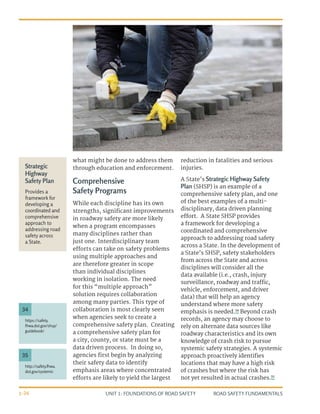
  • 140.
    UNIT 4: SOLVINGSAFETY PROBLEMS ROAD SAFETY FUNDAMENTALS 4-42 locations with the focus crash type(s). The agency can identify risk factors by analyzing crash data from their jurisdiction or by reviewing previous research studies. Using the list of risk factors as a guide, the agency identifies a list of sites with those specific characteristics, and then develops targeted treatments to address or mitigate the specific risk factors. The agency can apply crash history and other thresholds to reduce the list of sites based on available resources and program objectives. The systemic approach has two attractive features. First, an agency can employ the systemic approach even for roads or intersections where crash data are not fully available (e.g., where location accuracy is questionable or underreporting is a problem). For instance, locating crashes accurately and precisely in rural areas or on non-State owned urban roads can be difficult. Second, the systemic approach is useful for treating safety issues where crashes are highly dispersed, such as on rural or low volume roads. Specifically, agencies can use the systemic approach to address existing and potential safety issues across a large portion of the network (e.g., shoulder rumble strips on all rural, two-lane roads with a certain shoulder width and traffic volume level). Developing potential safety strategies After safety professionals analyze data and identify safety problems, they must develop potential strategies to address the problems. It is important to engage safety stakeholders and other partners when selecting potential strategies as they may provide unique perspectives. Safety professionals should seek to involve local officials, citizens, and safety partners to produce effective multidisciplinary strategies. For example, addressing a particular safety problem with law enforcement and education can be far more economical than implementing a multimillion- dollar engineering fix. On the other hand, law enforcement tends to be effective only during the time in which it is active, so a more permanent engineering measure may be needed in some cases. It is often the case that a combination of strategies is necessary to effectively address the multitude of contributing factors. On a system level, agencies must think broadly across the many disciplines represented by those who have a stake in road safety. Potential strategies might address infrastructure policies and practices (e.g., design standards, speed limits, etc.) or they may be directed at specific population focused efforts (e.g., seat belt laws, helmet laws, young driver restrictions, etc.). Just as the identification of problems was based on safety data, so too must the development and selection of strategies be driven by the data. If an agency identified concerning trends in certain types of crashes, then they should further examine the crash data to determine how best to address the safety problem. For example, Figure 4-9 shows an example of alcohol-related crashes where an agency identified a spike in frequency (or high pole) of crashes occurring near 2:00 AM. Further examination revealed that bars in
  • 141.
    UNIT 4: SOLVINGSAFETY PROBLEMS ROAD SAFETY FUNDAMENTALS 4-43 The Thurston County Public Works Department in Washington conducted a systemic safety analysis for their road network. Based on a review of severe crashes, Thurston County decided to focus on roadway departure crashes in horizontal curves on arterial and collector roadways when it found that: 1. Most of the severe crashes occurred due to roadway departures, and that 2. 81% of the severe curve /roadway departure crashes occurred on arterial and collector roads. Because this effort coincided with ongoing efforts to identify and upgrade warning signs for horizontal curves on their County road system, Thurston County chose to focus on currently signed horizontal curves. Thurston County accessed an inventory of their roads and intersections through a database maintained by the Statewide County Road Advisory Board. In addition, Thurston County assembled crash data for the 2006-to-2010 timeframe from the Washington State DOT crash database. They linked the road, intersection, and curve data with crash data and used these data to identify risk factors. Thurston County assembled a list of 19 potential risk factors and then performed a descriptive statistics analysis to identify 9 risk factors for use in screening and prioritizing candidate locations. The identified risk factors were: J J Roadway class of major rural collector J J Presence of an intersection J J Traffic volume of 3,000 to 7,500 annual average daily traffic J J Edge clearance rating of 3 J J Paved shoulders equal to or greater than 4 feet in width J J Presence of a vertical curve J J Consecutive horizontal curves (windy roads) J J Speed differential between posted approach speed and curve advisory speed of 0, 5, and 10 miles per hour J J Presence of a visual trap (a minor road on the tangent extended) Thurston County decided that a risk factor could be worth one point or a one-half point. Those factors present in at least 30% of the severe (fatal and injury) crashes and overrepresented by at least 10% (when comparing the proportion of all locations with the proportion of severe crash locations) were used as a guideline to have a high confidence and assigned one point in the risk assessment process. The risk factors that had a lower confidence in their relative data were assigned one-half point. Thurston County then tallied the number of risk factors present for each of the curves. The risk factor totals for the ten curves with the highest scores ranged from 4.5 to 6.0. All 270 signed curves were prioritized for potential low cost safety investments. They identified the following low-cost, low-maintenance countermeasures with documented crash reductions to implement at the selected locations: J J Traffic signs – enhanced curve delineation with the addition of chevrons and larger advance warning signs J J Pavement markings – dotted extension lines at intersections and recessed raised pavement markers J J Shoulder rumble strips J J Roadside improvements – object removal, guardrail, and slope flattening Systemic analysis provided Thurston County a proactive, data-driven, and defensible approach to identifying curves for improvement prior to a severe crash occurring, rather than reacting after an incident has occurred.56 “Thurston County, Washington, Public Works Department Applies Systemic Safety Project Selection Tool” FHWA-SA-13-026, June 2013. http:// safety.fhwa.dot.gov/ systemic/ 56 Case Study: Systemic Analysis in Thurston County, Washington
  • 142.
    UNIT 4: SOLVINGSAFETY PROBLEMS ROAD SAFETY FUNDAMENTALS 4-44 that jurisdiction closed at 2:00 AM. This could lead to potential strategies, such as increased enforcement of impaired driving at that time of night and in the vicinity of bars. It is also important to use the data to determine the necessary scope of the intervention. If the data show that the problem exists year-round, then the solution needs to match that. For example, a “safe ride program” for drinkers to get home on New Year’s Eve is not going to significantly impact the problem of impaired driving overall. Critical thinking is needed to develop effective solutions to the safety problems at hand. Analysts should look for characteristics of crash trends that could be addressed by practical strategies. An NCHRP report on an integrated safety management process states that safety professionals should use safety data to perform “further analyses of those characteristics that are found to be significantly or practically over-represented on a percentage or rate basis.”57 The report gives a set of guidelines to be considered in analyzing crash data to identify trends and develop potential safety strategies: 1. ASK the questions, “Is this information sufficient for action item development? If not, what further information is needed to act on this finding?” 2. CONSIDER cross tabulations of two variables within the subset of data that pertains to the activities under consideration if one or more of the following types of conditions hold: J J If the activities are time critical (e.g., all selective 0 5 10 15 20 22:00 20:00 18:00 16:00 14:00 12:00 10:00 8:00 6:00 4:00 2:00 0:00 Example of a high pole in a jurisdiction where bars close at 2:00 a.m. NUMBER OF COLLISIONS TIME OF DAY FIGURE 4-9. Example of “high pole” in crash data (Source: NCHRP Report 501) Consider How Specific Behaviors Influence the Safety Problem Safety professionals must identify and target road user behaviors that contribute to the identified safety problem. The target behavior should be specific. For example, “safe driving” is not a specific behavior that can be changed because it involves a number of different behaviors. However, “speeding on Main Street” is a specific behavior that can be targeted. It is also important to consider the factors influencing this behavior. Why are people speeding on Main Street? Which social, cultural, or environmental factors are influencing this behavior? Does it vary by time of day or week, perhaps reflecting the kind of drivers who are speeding? Bahar, G., M. Masliah, C. Mollett, and B. Persaud, Integrated Safety Management Process, National Cooperative Highway Research Program, Report 501, Transportation Research Board of the National Academies, Washington, D.C., 2003 57
  • 143.
    UNIT 4: SOLVINGSAFETY PROBLEMS ROAD SAFETY FUNDAMENTALS 4-45 enforcement strategies), perform a time-of-day by day-of-the-week analysis. As an example, alcohol- related crashes will likely be over-represented in the early morning and on weekend days. A logical approach is to perform a cross tabulation of time-of day by day-of-the- week to determine the best times and days for driving under the influence (DUI) selective enforcement. The goal of the procedure at this point is to determine additional details (who, what, where, when, and how) for those crash types identified by the analyses performed to this point. J J If the over-represented variable is not constant over all crash severities, cross tabulate the variable by severity (e.g., nighttime, rural, and older-driver crashes tend to be more severe). J J If the activities can be targeted to geographic location, age group, gender, race, or any other demographic factor within the crash records, consider these variables for cross tabulation with other over- represented variables. 3. CONSIDER creating subsets of the data for additional comparisons where activities are to be targeted to a particular subgroup of the population. For example, insight into a graduated driver’s license strategy can be obtained by comparing 16-year- old causal driver crashes against 17- to 20-year-old causal driver crashes. As another example, insight into youth alcohol enforcement activities can be attained by comparing alcohol-related crashes of 16- to 20-year-old causal drivers against alcohol-related crashes of their 21-year-old and older counterparts. Each of these types of comparisons can show differences between the respective subpopulations. 4. USE the results of each analysis to determine what further information is needed before the best decision can be made, and repeat the analysis with the additional information. 5. PERSIST and maintain a thread of evidence until the information available has been exhausted. If the information generated indicates a significant factor, create further subsets of the data (e.g., youth-pedestrian crashes), and repeat the entire analysis. 6. REJECT any strategies and activities at this point that the data clearly show to be counterproductive (i.e., activities that will consume resources that could be better applied elsewhere). Maintain a list of all potential strategies and corresponding activities that will be subjected to further analysis in the optimization procedure.58 Many system-level safety strategies focus on behaviors of drivers and other road users. Resources like Countermeasures That Work provide a useful listing of potential safety strategies for system-level safety management.59 The excerpt from Countermeasures That Work in Goodwin, A., Thomas, L., Kirley, B., Hall, W., O’Brien, N., & Hill, K. Countermeasures That Work: A Highway Safety Countermeasure Guide for State Highway Safety Offices, Eighth edition, National Highway Traffic Safety Administration, Report No. DOT HS 812 202, Washington, DC, 2015. Bahar, G., M. Masliah, C. Mollett, and B. Persaud, Integrated Safety Management Process, National Cooperative Highway Research Program, Report 501, Transportation Research Board of the National Academies, Washington, D.C., 2003 59 58
  • 144.
    UNIT 4: SOLVINGSAFETY PROBLEMS ROAD SAFETY FUNDAMENTALS 4-46 1. Laws † When enforced and obeyed 2. Enforcement † Can be covered by income from citations †† For aggressive driving, but use of short-term, high-visibility enforcement campaigns for speeding is more widespread 3. Penalties and Adjudication 4. Communications and Outreach Effectiveness:  Demonstrated to be effective by several high-quality evaluations with consistent results  Demonstrated to be effective in certain situations  Likely to be effective based on balance of evidence from high-quality evaluations or other sources  Effectiveness still undetermined; different methods of implementing this countermeasure produce different results  Limited or no high-quality evaluation evidence COUNTERMEASURE EFFECTIVENESS COST USE TIME 1.1 Speed limits    $ High Short 1.2 Aggressive driving laws    $ Low Short COUNTERMEASURE EFFECTIVENESS COST USE TIME 3.1 Penalty types and levels    Varies High Low 3.2 Diversion and plea agreements    Varies Unknown Varies COUNTERMEASURE EFFECTIVENESS COST USE TIME 4.1 Public Information supporting enforcement    Varies Medium Medium COUNTERMEASURE EFFECTIVENESS COST USE TIME 2.1 Automated enforcement    $$$ Medium Medium 2.2 High-visibility enforcement    $$$ Low Medium 2.3 Other enforcement methods    Varies Unknown Varies † † †† FIGURE 4-10. Potential Safety Strategies to Address Speeding and Aggressive Driving
  • 145.
    UNIT 4: SOLVINGSAFETY PROBLEMS ROAD SAFETY FUNDAMENTALS 4-47 Figure 4-10 gives a list of potential strategies for addressing speeding- related crashes, from either laws, enforcement, penalties and adjudication, or communications and outreach. The list also includes an indication of the effectiveness, cost, current usage, and time of each strategy, which are all important considerations when selecting safety strategies to implement. If the agency identifies safety problems from a systemic analysis, the potential safety strategies should address the types of crashes that were related to the roadway characteristic risk factors. These strategies may often be engineering improvements related to the risk factors. For example, if an examination of crash trends may highlight run-off-road crashes, and a systemic analysis would identify the type(s) of road on which run-off-road crashes are likely to occur. Table 4-12 shows a list of potential safety strategies that could be implemented for engineering treatments for a run-off-road crash problem. In a systemic approach, these engineering treatments would be implemented across some or all roads meeting the risk factors that increase the likelihood of run-off- road crashes. Example of system-level safety strategies in state highway safety plans SHSPs provide many good examples of system-level strategies that address safety problems identified through analysis of crash and other safety data. The previous section showed how Ohio and Florida had identified safety priorities on older drivers and motorcyclists, respectively. The SHSPs from these States also demonstrated the types of safety strategies each State intended to pursue to combat the safety problems in these areas. Selecting and implementing strategies A transportation agency must determine which of the potential strategies they will implement to address the identified safety problems. Since system-level safety solutions can involve broad changes to policies, design practices, or jurisdiction-wide road user behavior, there are different issues to consider compared to implementing a safety countermeasure at a specific Florida’s strategies for motorcyclist safety After identifying motorcyclist safety as an emphasis area in their 2012 SHSP, Florida identified a list of strategies to address motorcyclist safety. Example strategies include: J J Promote personal protective gear and its value in reducing motorcyclist injury levels and increasing rider conspicuity J J Promote adequate rider training and preparation to new and experienced motorcycle riders by qualified instructors at State- approved training centers J J Incorporate motorcycle-friendly policies and practices into roadway design, traffic control, construction, operation, and maintenance J J Develop and implement communications strategies that target high-risk populations and improve public awareness of motorcycle crash problems and programs.
  • 146.
    UNIT 4: SOLVINGSAFETY PROBLEMS ROAD SAFETY FUNDAMENTALS 4-48 OBJECTIVES COUNTERMEASURES RELATIVE COST TO IMPLEMENT AND OPERATE EFFECTIVE- NESS 15.1 A: KEEP VEHICLES FROM ENCROACHING ON THE ROADSIDE 15.1A1: Install shoulder rumble strips Low Tried 15.1 A2: Install edgelines “profile marking”, edgeline rumble strips or modified shoulder rumble strips on section with narrow or no paved shoulders Low Experimental 15.1 A5: Provide improved highway geometry for horizontal curves High Proven 15.1 A6: Provide enhanced pavement markings Low Tried 15.1 A7: Provide skid- resistance pavement surfaces Moderate Proven 15.1 B: MINIMIZE THE LIKELIHOOD OF CRASHING INTO AN OBJECT OR OVERTURNING IF THE VEHICLE TRAVELS OFF THE SHOULDER 15.1 B1: Design safer slopes and ditches to prevent rollovers Moderate Proven 15.1 B2: Remove/relocate objects in hazardous locations Moderate to High Proven 15.1 C: REDUCE THE SEVERITY OF THE CRASH 15.1 C1: Improve design of roadside hardware Moderate to High Tried 15.1 C2: Improve design and application of barrier and attenuation systems Moderate to High Tried TABLE4-12.Potential SafetyStrategiesforRun-Off-RoadCrashes(Source: NCHRP 500, Volume 6)
  • 147.
    UNIT 4: SOLVINGSAFETY PROBLEMS ROAD SAFETY FUNDAMENTALS 4-49 location. Many more people will be affected by the system-level changes. This carries great promise in that safety might be improved across an entire system, but it also carries unique challenges. Agencies will need to consider the following questions when selecting strategies to implement: J J Safety effectiveness – How likely will it address the safety problem? J J Public acceptance – How will the strategy be accepted by the public? What kind of marketing will be needed to communicate the intent and benefit of the strategy? J J Stakeholders and partners – Which parties will need to be involved in implementing the strategy? J J Cost efficiency – What kind of return on the dollar would be expected? J J Time – How long will it take to implement the strategy? Communication is critically important for system-level safety strategies. Both the general public and road users affected by the strategy must understand the benefits. Other public agencies may need to integrate their efforts with the proposed safety strategy. Administrators, lawmakers, and other key decision-making personnel must understand how the strategy will improve road safety for their constituency and bring an overall financial benefit. Unit 5 provides more discussion on communication, marketing, and outreach for agencies who seek to implement system-level safety strategies. Evaluating a system-level strategy (e.g., program or intervention) to determine its effectiveness is a critical but often overlooked step. The transportation agency in charge should evaluate the effect of the safety strategy using good quality data; ideally the same type of data that was used to identify the safety problem initially. If a program or intervention is not effective, the overseeing agency should consider why this might be the case. Can the program be improved, or should other approaches be considered instead? If successful, how can the intervention be institutionalized to ensure long term support (and therefore lasting change)? Finally, it is important to remember that success or failure in one location does not guarantee the same results at a different location. Ohio’s strategies for older driver safety Ohio identified three strategies to address the older driver emphasis area in their 2014 SHSP: J J Coordinate older driver messages developed by multi-agency communication committee. J J Create a comprehensive and coordinated outreach effort that educates older drivers and their caregivers on driving risks and remedies. J J Encourage roadway design and engineering measures that reduce the risks of traffic crashes for older drivers.
  • 148.
    UNIT 4: SOLVINGSAFETY PROBLEMS ROAD SAFETY FUNDAMENTALS 4-50 Example of System-Level Safety Management The following provides an example of using system-level safety management to address a specific problem. This example demonstrates the three general components of safety management presented in this unit. 1. Identify the safety problem. County A noticed a large number of crashes involving 16-17 year old drivers occurring weekdays between 11:00am and 1:00pm. Neighboring counties have not experienced this problem. County officials coordinate with school district staff to tackle this issue. In exploring the problem, the officials discover that County A is the only jurisdiction that has an open campus lunch policy allowing students to leave school during their lunch period. Allowing teens to leave campus during lunch means there are many young, inexperienced drivers on the roads at the same time. They may be carrying additional passengers which research has established leads to an increased risk of a fatal crash.60,61 The brief lunch period also results in pressure to get back in time for the next class. Combined, these factors lead to a risky driving situation and an increased risk of crashing. 2. Develop potential safety strategies. In this situation, an informational approach that simply tells teenagers about the problem would likely not make a difference. Teens are not crashing because they lack information about the importance of safe driving or the consequences of unsafe driving. Teens are crashing largely because they lack the driving experience that equips most drivers to intuitively/near instantaneously do the things necessary to avoid crashing. Because of this, changing the environment is more likely to be effective. The officials recognize that eliminating the policy that allows students to leave campus during lunch would lead to a reduction in crashes during this time. This policy would eliminate exposure to the risky driving situation and reduce the potential for crashes. 3. Select and implement strategies. The school districts accordingly eliminate the policy allowing students to leave campus during lunch. They recognize that this policy change should be evaluated to determine its safety effect. Crash data would be needed to examine whether the closed school lunch policy has an effect on weekday crashes between 11:00am and 1:00pm. However, it will take many years to accumulate enough data for this evaluation. In this example, there is a proxy measure that can be used in the interim. A before and after observational survey with an appropriate control could quantify the number of students leaving campus during lunch before and after the change. In this case the officials know that the proxy measure (reduced driving from 11:00am to 1:00 pm) is a guaranteed indicator of crash reduction for this specific problem. However, it is not often the case that proxy measures are so closely aligned to the outcome of interest. Chen, L., Baker, S.P., Braver, E.R., & Li, G. (2000). Carrying Passengers as a Risk Factor for Crashes Fatal to 16- and 17-Year-Old Drivers. Journal of the American Medical Association, 283, 1578-1582. 61 Tefft B.C., Williams A.F., & Grabowski J.G. (2013). Teen driver risk in relation to age and number of passengers, United States, 2007-2010. Traffic Injury Prevention, 14, 283-292. 60
  • 149.
    UNIT 4: SOLVINGSAFETY PROBLEMS ROAD SAFETY FUNDAMENTALS 4-51 Unit Summary Solving road safety problems requires a comprehensive process to identify safety problems, develop potential safety strategies, and select and implement those strategies. To get the most effective results, this process must be based on solid safety data, particularly good quality crash data. The methods of undertaking the safety management process will depend on the scope of the effort. Safety management of individual sites involves a six-step process of screening the network for high- priority sites, diagnosing the safety issues at those sites, selecting appropriate countermeasures, conducting an economic appraisal for all options, prioritizing the countermeasure projects based on estimated costs and benefits, and evaluating the countermeasure performance afterwards. Safety management at a system-level involves identifying safety problems by examining crash trends or using a systemic approach to identifying high-risk road characteristics. State agencies who are developing system-wide safety strategies must examine the data trends and the road users involved. They must consider factors, such as how system-wide policies and programs will be accepted by the public and who will be the partners to involve in implementing the safety strategy.
  • 150.
    UNIT 4: SOLVINGSAFETY PROBLEMS ROAD SAFETY FUNDAMENTALS 4-52 J J PRESENT an example road safety problem and compare and contrast the ways in which the problem could be addressed at a system-level vs. site-level. J J Your state has a small, rural, mountainous county where a large number of motorcycle crashes are happening. The crash rate per registered motorcycle in this county is nearly 10 times the state average. Upon further investigation you learn that this county is a popular motorcycling tourist destination. People come from all over the country to ride the curvy mountain roads. In fact, the majority of people involved in crashes are not from that area at all. Clusters of crashes occur on certain curves. What are some approaches that could be used to reduce crashes in this county? How could these approaches be evaluated? In particular, DETAIL how you would apply the three major components described in this unit: J J Identify the safety problem J J Develop potential safety strategies J J Selecting and implement strategies When you work through this process, recall the discussion of human behavior from Unit 2. What are possible behaviors leading to the safety problem? What other factors could be influencing this behavior? How does this affect your identification and selection of potential safety strategies? J J If possible, OBTAIN three to five years of crash data for an intersection or section of road in your area. You will likely need to contact the controlling agency – the State DOT, county, or city. Describe how you would apply the steps in Chapter 11 on site-level safety management to this location (the network screening step would not apply since this location is already identified). Consider safety strategies across a range of disciplines (e.g., engineering, law enforcement, public communication and education, etc.). J J This exercise should be conducting using the Excel spreadsheet that accompanies this book. The goal of this exercise is to USE selected performance metrics to create a ranked list of sites for further investigation as part of a network screening effort. The Excel spreadsheet includes nearly 1,400 intersections, or sites. Each site has a unique ID number, traffic volume data, and other information about its location and characteristics. Three performance metrics have been calculated for each site. These have been calculated using five years of data (2010-2014) and one year of data (2014), resulting in a total of six performance metrics per site. Your assignment is to rank the sites using these various performance metrics and document the results. Document the twenty highest priority sites based on each method. Use the results to answer the following questions: J J What were some of the sites that routinely ranked in the top twenty? What were some of their characteristics (volumes, number of lanes, stop/signal control)? J J Were there any sites that were only occasionally present in the top twenty? What were some characteristics of these sites? EXERCISES
  • 151.
    UNIT 4: SOLVINGSAFETY PROBLEMS ROAD SAFETY FUNDAMENTALS 4-53 THIS PAGE INTENTIONALLY LEFT BLANK
  • 152.
    UNIT 5: IMPLEMENTINGROAD SAFETY EFFORTS ROAD SAFETY FUNDAMENTALS 5-b After reading the chapters and completing exercises in Unit 5, the reader will be able to: J J IDENTIFY the current road safety partner agencies and define their role in addressing safety problems J J DEFINE three areas of road safety research J J DEFINE the characteristics of strategic communications J J RECOGNIZE potential avenues for advancing road safety efforts LEARNING OBJECTIVES Implementing Road Safety Efforts UNIT 5
  • 153.
    UNIT 5: IMPLEMENTINGROAD SAFETY EFFORTS ROAD SAFETY FUNDAMENTALS 5-1 Who Does What The greatest gains in road safety occur when transportation agencies work together rather than tackling problems alone. This can be challenging given the fragmented nature of transportation governance in the U.S. There are numerous agencies operating in different focus areas and at different levels. This chapter presents an overview of the various agencies and organizations that have a direct hand in advancing road safety and the initiatives that they undertake. U.S. transportation agencies are typically structured around particular focus areas, such as roadway, vehicles, or road users. This approach is also seen on the international scale – the United Nations (U.N.) used a generalization called the “Five Pillar” structure as part of the Decade of Action for Road Safety. 1 The U.N. recognized that efforts to improve road safety must address various pillars including road safety management, safer roads and mobility, safer vehicles, safer road users, and better post-crash response. 2 Likewise, U.S. transportation agencies are organized to address focus areas that are similar in theme to the U.N. five pillars, though not the same. Table 5-1 shows how agencies at all levels (Federal, State, and local) address five focus areas in road safety. CHAPTER 13 IMPLEMENTING ROAD SAFETY EFFORTS United Nations, A/RES/64/255, Geneva, 2010 Global Status Report on Road Safety 2013: Supporting a Decade of Action, World Health Organization, ISBN 978 92 4 156456 4, 2013. 1 2 TABLE 5-1: Transportation Agencies by Focus Area FOCUS AREA FEDERAL STATE LOCAL Road Design / Environment Federal Highway Administration Departments of transportation City public works Metropolitan/rural planning organizations Road User Behavior National Highway Traffic Safety Administration Federal Motor Carrier Safety Administration Highway safety offices Departments of motor vehicles Health departments No specific agency Vehicle Design / Technology Departments of motor vehicles No specific agency Law Enforcement No specific agency State police / highway patrol Police departments Transit Safety Federal Transit Administration No specific agency Metropolitan planning organizations Municipal transit agencies
  • 154.
    UNIT 5: IMPLEMENTINGROAD SAFETY EFFORTS ROAD SAFETY FUNDAMENTALS 5-2 Federal Agencies The Federal role in implementing road safety initiative is carried out largely through the U.S. Department of Transportation (USDOT) and the many agencies under that department. These agencies are each tasked with a specific focus area as the Federal Government seeks to address safety issues for various modes of travel. These agencies include: J J Federal Highway Administration J J National Highway Traffic Safety Administration J J Federal Motor Carrier Safety Administration J J Federal Transit Administration J J Federal Railroad Administration Federal Highway Administration www.fhwa.dot.gov Focus Area: Road Design and Environment The Federal Highway Administration (FHWA) works to reduce highway fatalities through partnerships with State and local agencies, community groups, and private industry. The FHWA Office of Safety advocates designs and technologies that improve road safety and administers safety programs, such as the Highway Safety Improvement Program (HSIP). FHWA’s Resource Center also provides technical assistance, technology deployment, and training. FHWA has a significant role in safety research through the Office of Safety Research and Development, which develops and implements safety innovations through teams of research engineers, scientists, and psychologists. In addition, FHWA oversees the Local and Tribal Technical Assistance Program (LTAP/TTAP), which provides information and training programs to local agencies and Native American Indian tribes to improve road safety.3 Further, FHWA maintains division offices in each state to deliver assistance to partners and customers in highway transportation and safety services at the State level. National Highway Traffic Safety Administration www.nhtsa.gov Focus Areas: Road User Behavior and Vehicle Design and Technology The National Highway Traffic Safety Administration (NHTSA) focuses on the safety of the vehicle, driver, and road user. NHTSA investigates safety defects in motor vehicles, establishes and enforces safety performance standards for motor vehicles and motor vehicle equipment, sets and enforces fuel economy standards, collects data, and conducts research on driver behavior and traffic safety, and helps states and local communities reduce the threat of impaired driving and other dangerous road user behaviors. NHTSA carries out research and demonstration programs in many behavioral areas including impaired driving, occupant protection, speed management (shared with FHWA), pedestrian, motorcycle and bicycle safety, older and younger road users, drowsy, and distracted driving. NHTSA is also the lead Federal agency for emergency medical services (EMS) and 9-1-1 systems. “About the National Program,” last updated June 20, 2013, accessed June 20, 2013, http:// www.ltap.org/about/ . “Who We Are and What We Do,” accessed June 20, 2013, https://www. nhtsa.gov/about- nhtsa. 3 4
  • 155.
    UNIT 5: IMPLEMENTINGROAD SAFETY EFFORTS ROAD SAFETY FUNDAMENTALS 5-3 Federal Motor Carrier Safety Administration www.fmcsa.dot.gov Focus Areas: Road User Behavior and Vehicle Design and Technology The Federal Motor Carrier Safety Administration (FMCSA) focuses on reducing crashes, injuries, and fatalities involving commercial use of large trucks and buses. FMCSA develops and enforces research- based regulations that balance safety and efficiency. The agency manages safety information systems to enforce safety regulations with regards to drivers who have high risk in factors, such as health, age, experience, and education. FMCSA also targets educational messages to carriers, commercial drivers, and the public.5 Some key programs administered by the agency include: J J Commercial Driver’s License Program: FMCSA develops, monitors, and ensures compliance with the commercial driving licensing standards for drivers, carriers, and States. J J Motor Carrier Safety Identification and Information Systems: FMCSA provides safety data, State and national crash statistics, current analysis results, and detailed motor carrier safety performance data to industry and the public. This data allows Federal and State enforcement officials to target inspections and investigations on higher risk carriers, vehicles, and drivers. J J Safety education and outreach: FMCSA implements educational strategies to increase motor carrier compliance with the safety regulations and reduce the likelihood of a commercial vehicle crash. Messages are aimed at all highway users including passenger car drivers, truck drivers, pedestrians, and bicyclists.6 The Federal Motor Carrier Safety Administration develops, monitors, and ensures compliance with commercial driving licensing standards. “About FMCSA,” accessed June 20, 2013, https://www. fmcsa.dot.gov/ mission/about-us. “Key FMCSA Programs,” accessed October 15, 2013, https:// www.fmcsa.dot.gov/ mission/we-are- fmcsa-brochure. 5 6
  • 156.
    UNIT 5: IMPLEMENTINGROAD SAFETY EFFORTS ROAD SAFETY FUNDAMENTALS 5-4 Federal Transit Administration www.transit.dot.gov Focus Area: Transit Safety The Federal Transit Administration (FTA) seeks to improve public transportation by assisting State and local governments with planning, implementation, and financing of public transportation projects.7 FTA manages many transit-oriented safety programs including: J J Bus and Bus Facilities: This program provides capital funding to replace, rehabilitate, and purchase buses and related equipment and to construct bus- related facilities. J J Public Transportation Emergency Relief Program: This program helps States and public transportation systems pay for protecting, repairing, and/ or replacing equipment and facilities that may suffer or have suffered serious damage because of an emergency including natural disasters. J J Research, Development, Demonstration, and Deployment Projects: This program supports research activities that improve the safety, reliability, efficiency, and sustainability of public transportation. J J Transit Safety and Oversight: FTA has the authority to establish and enforce a new comprehensive framework to oversee the safety of public transportation throughout the United States as it pertains to heavy rail, light rail, buses, ferries, and streetcars.8 The Federal Transit Administration seeks to improve public transportation, such as buses. “Federal Transit Administration,” last updated September 6, 2013, https:// www.usa.gov/ federal-agencies/ federal-transit- administration. “MAP-21 Programs,” accessed October 16, 2013, https:// www.transit.dot. gov/regulations- and-guidance/ legislation/map-21/ map-21-program- fact-sheets. 7 8
  • 157.
    UNIT 5: IMPLEMENTINGROAD SAFETY EFFORTS ROAD SAFETY FUNDAMENTALS 5-5 Federal Safety Programs Federal agencies advance road safety through numerous programs and initiatives. Federal programs can be very influential due to large funding sources provided by Federal legislation. These funds are often distributed to State and local levels to implement various improvements to roads and intersections. Specific funding programs can change with each new piece of transportation legislation. However, it may be useful to look at an overview of some of the types of current and past funding programs. Below are listed a few programs that have been widely used through the years to develop and implement improvements to road safety: J J Highway Safety Improvement Program (FHWA) J J Traffic Records Improvement Grants (NHTSA) J J Safety Data Improvement Program Grant (FMCSA) Highway Safety Improvement Program (FHWA) HSIP is a Federal program focused on infrastructure improvements that will lead to significant reduction in traffic fatalities and serious injuries on all public roads. HSIP is Federally funded and administered by FHWA, but it is implemented by the State departments of transportation per the strategies laid out in the State’s Strategic Highway Safety Plan (SHSP). Funding is provided for safety-related infrastructure improvements, such as sidewalks, traffic calming, or signing upgrades. The States are required to develop a data-driven, strategic approach for improving highway safety through the implementation of such infrastructure improvements.9 States are also required to report to the U.S. Secretary of Transportation on progress made implementing highway safety improvements and the extent to which fatalities and serious injuries on all public roads have been reduced. Traffic Records Improvement Grants (NHTSA) NHTSA administers Federal funding to encourage States to implement programs that will improve the timeliness, accuracy, completeness, uniformity, integration, and accessibility of State data used in traffic safety programs. The Federal SAFETEA-LU legislation established this program of incentive grants, and the funding continued under subsequent legislation. The funds were to be used to evaluate the effectiveness of efforts to make safety data improvements, to link safety data systems within the State, and to improve the compatibility of the State data system with national data systems and data systems of other States. A State may use these grant funds only to implement such data improvement programs. To qualify, a State must meet certain requirements including a functioning Traffic Records Coordinating Committee (TRCC), a strategic plan to address data deficiencies, and a regular traffic records assessment.10 Safety Data Improvement Program Grant (FMCSA) The Safety Data Improvement Program (SaDIP), administered by FMCSA, provides financial and Data-driven An approach of which the priorities are determined by examination of crash data or other objective and reliable safety data, rather than priorities set by preferences of a few parties, current “hot” topics, or high profile rare events. Source: “Highway Safety Improvement Program (HSIP),” accessed August 12, 2013, http://safety. fhwa.dot.gov/hsip/ and “HSIP History,” accessed August 12, 2013, http:// safety.fhwa.dot. gov/hsip/gen_info/ hsip_history.cfm. NHTSA, Section 408 SAFETEA-LU Fact Sheet, https://one. nhtsa.gov/Laws- &-Regulations/ Section-408- SAFETEA% E2%80%93 LU-Fact-Sheet 9 10
  • 158.
    UNIT 5: IMPLEMENTINGROAD SAFETY EFFORTS ROAD SAFETY FUNDAMENTALS 5-6 technical assistance to States to improve data collected on truck and bus crashes that result in injuries or fatalities. The assistance is provided to State departments of public safety, departments of transportation, or State law enforcement agencies. SaDIP funds have been used to hire staff to code safety performance data, purchase software for field data collection, and revise outdated crash forms. FMCSA maintains the Motor Carrier Management Information System (MCMIS) and supplies access to the system for designated employees in each State through SAFETYNET, an online network of safety data. States use MCMIS and SAFETYNET to enter data on motor carriers, drivers, compliance reviews, inspections, and crashes. At the national level, FMCSA uses the data to characterize the safety experience of commercial motor vehicles, and to help States with the task of identifying high risk carriers and drivers. The data are also used by motor carrier companies, safety researchers, advocacy groups, insurance companies, the public, and a variety of other entities. State Agencies All fifty States, the District of Columbia, and Puerto Rico administer road safety programs. State agencies administer roadway systems, driver licensing, injury prevention programs, traffic law enforcement, and other road safety activities. However, assignment of these responsibilities varies widely from State to State. In many cases, two or three government agencies are responsible for most or all of these activities. Other States distribute these responsibilities to numerous agencies and offices. Regardless of how these responsibilities are distributed, States share a vital role in improving road safety for all citizens. In general, State agencies that address road safety issues include: J J State departments of transportation J J State highway safety offices J J State departments of motor vehicles J J State highway patrols J J State health departments State departments of transportation oversee design, construction, maintenance, and operation of roads.
  • 159.
    UNIT 5: IMPLEMENTINGROAD SAFETY EFFORTS ROAD SAFETY FUNDAMENTALS 5-7 State Departments of Transportation Focus Area: Road Design and Environment Each State has a department of transportation (DOT), which oversees the design, construction, maintenance, and operation of the State’s roads. This agency may also be called the State Highway Administration or Department of Roads. State DOTs have many official responsibilities. For highway safety issues, State DOTs have official transportation planning, programming, and project implementation responsibility. These agencies typically oversee all Interstate highways and most primary highways (State highways). State DOTs focus on roadway safety, and thus work in direct partnership with FHWA. They serve as liaisons between the Federal and local transportation agencies and provide resources and technical assistance to local agencies. State DOTs coordinate the use of Federal HSIP funds to improve roads and intersections on the local level. In some States, the DOT administers, maintains, and operates county and city streets or secondary roads. State DOTs also work cooperatively with tolling authorities, ports, local agencies, and special districts that own, operate, or maintain portions of the transportation network. The State DOT typically leads the development of the SHSP, a statewide-coordinated safety plan that provides a comprehensive framework for reducing highway fatalities and serious injuries on all public roads. The State DOT also develops long-range (20 to 30 year) transportation plans and short range (five to 10 year) plans that outline the vision of the transportation network and which projects will be constructed to fulfill that vision. State Highway Safety Offices Focus Area: Road User Behavior State Highway Safety Offices (SHSOs) administer a variety of national highway safety grant programs authorized and funded through Federal legislation.11 The governor of each State appoints a highway safety representative to administer the Federal Highway Safety Grant Program and numerous other highway safety programs designated by Congress. The governor’s representative promotes safety initiatives in the State, such as high visibility enforcement campaigns like Click It or Ticket. The State Highway Safety Office focuses on behavioral aspects of roadway users, and thus works in direct partnership with NHTSA. Safety programs implemented by the SHSO include: J J Encouraging safety belt, child car seat, and helmet use J J Discouraging impaired driving J J Promoting motorcycle safety J J Improving the skills of younger and older drivers State Departments of Motor Vehicles Focus Area: Vehicle Design and Technology State Departments of Motor Vehicles “SHSO Programs & Funding,” accessed June 20, 2013, http://www.ghsa. org/about/federal- grant-programs. 11
  • 160.
    UNIT 5: IMPLEMENTINGROAD SAFETY EFFORTS ROAD SAFETY FUNDAMENTALS 5-8 (DMVs) administer State programs for driver licensing, and automobile inspection and registration. Generally, DMVs reside either within the State DOT or a department of public safety. A few States have a cabinet-level DMV. The DMV is responsible for identifying at-risk drivers and maintaining driver records. The agency also implements driver license standards, monitors graduated licensing programs, and establishes requirements for driver education. Some State DMVs also serve as the primary owners of the statewide crash data. State Highway Patrols Focus Area: Law Enforcement State highway patrols (also known as State police and State patrols) operate in every State except Hawaii. State police patrol highways and enforce motor vehicle laws and regulations. State law enforcement agencies play an important role in reducing the frequency and severity of crashes. At the scene of crashes, State police direct traffic, administer first aid, call for emergency equipment, write traffic citations, and complete crash reports. State highway patrols also investigate motor vehicle crashes, which are important sources of State and Federal crash data. They work closely with State highway safety representatives to identify enforcement needs. They play a vital role in implementing impaired driving laws, safety belt use, and other safety programs. Certain troopers in the State highway patrol are tasked with inspecting large trucks to ensure the driver and the vehicle comply with safety regulations, such as vehicle size and weight, driver hours of service, and medical fitness. State Health Departments Focus Area: Road User Behavior State health departments also play an important role in reducing crash severity. These agencies are typically responsible for statewide trauma center planning. State health departments provide training, certification, and technical assistance for EMS providers, administer injury prevention programs, and maintain trauma and injury databases. Some State health departments coordinate with other public agencies and community groups to promote young driver safety, older driver safety, child passenger safety, and pedestrian and bicycle safety. State highway patrols enforce motor vehicle laws and regulations, investigate crashes, and work to identify enforcement needs. Comprehensive Using all types of strategies to improve road safety, such as infrastructure improvements, lawenforcement, and campaigns to change driver behavior. This is seen in the types of crashes which serve as the focus areas of an SHSP, such as speeding related crashes, which are most effectively addressed through a combination of speed enforcement, engineering modifications, and behavioral campaigns. Coordinated People from many agencies come together to develop an SHSP, including those from the department of transportation, department of motor vehicles, state highway patrol, public health, universities, and others.
  • 161.
    UNIT 5: IMPLEMENTINGROAD SAFETY EFFORTS ROAD SAFETY FUNDAMENTALS 5-9 State Safety Plans and Programs State agencies use numerous approaches to improve road safety within their State. Often, they seek to identify State-specific safety issues and direct Federal or State funding to solve those issues. State agencies take the lead in developing statewide safety plans or programs, many of which are encouraged or required by the Federal Government. Although States differ in their specific safety improvement efforts, the following plans or programs are developed in every State: J J Strategic Highway Safety Plan J J Long Range Transportation Plan J J Statewide Transportation Improvement Program J J Railway-Highway Crossing Program J J Highway Safety Program Although the HSIP was previously covered under Federal safety programs, it should be noted that the State plays the major role in selecting locations that need safety improvement, designing, and implementing the safety improvement, and reporting annually on all the HSIP funded projects that were constructed that year. Strategic Highway Safety Plan A State’s SHSP is a statewide- coordinated safety plan that provides a comprehensive framework for reducing highway fatalities and serious injuries on all public roads. An SHSP identifies a State’s key safety needs and guides investment decisions toward strategies with the highest potential to save lives and prevent injuries. Since 2005, Federal legislation has required States to develop, implement,evaluate, and update their SHSP.12,13 The State DOT develops an SHSP in a cooperative process with local, State, Federal, tribal, and private sector safety stakeholders. It is a data-driven, multi-year plan that establishes statewide goals, objectives, and key emphasis areas. The development of an SHSP provides a venue for highway safety partners in the State to align goals, leverage resources (i.e., combine Federal and State resources), and collectively address the State’s safety challenges.14 An ideal SHSP meets several criteria: J J It addresses engineering, management, operation, education, enforcement, and emergency service elements of highway safety as key factors in evaluating highway projects. J J It considers safety needs of, and high-fatality segments of, all public roads. J J It considers the results of State, regional, or local transportation and highway safety planning processes. J J It describes strategies to reduce or eliminate safety hazards. J J It gains approval of the governor of the State or a responsible State agency.15 As mentioned on page 5-5, in order to spend HSIP funds, a State must have a current SHSP, produce a program of projects or strategies to reduce safety problems, and evaluate the SHSP on a regular basis.16 Coordinated, Comprehensive See previous page. “Strategic Highway Safety Plans: A Champion’s Guidebookto Saving Lives 2nd ed.,” Federal Highway Administration (Washington, D.C., October 2012), History and Background, http:// safety.fhwa.dot. gov/hsip/shsp/ guidebook/ovrvw. cfm “Map-21,” Title 23 U.S.C. (2012), accessed August 19, 2013, http://www. gpo.gov/fdsys/pkg/ PLAW-112publ141/ pdf/PLAW- 112publ141.pdf “Highway Safety Improvement Plan (HSIP),” accessed August 14, 2013, http://www.fhwa. dot.gov/map21/hsip. cfm. “Strategic Highway Safety Plan (SHSP),” accessed August 13, 2013, http://safety. fhwa.dot.gov/hsip/ shsp/ . 12 15 16 13 14
  • 162.
    UNIT 5: IMPLEMENTINGROAD SAFETY EFFORTS ROAD SAFETY FUNDAMENTALS 5-10 Long-Range Transportation Plans Long-range transportation plans (LRTPs) identify transportation goals, objectives, needs, and performance measures over a 20- to 25-year horizon and provide policy and strategy recommendations for accommodating those needs. LRTPs are prepared at both the State and MPO level. LRTPs are fiscally-unconstrained and typically present a systems-level approach that considers roadways, transit, pedestrian, and bicycle facilities. LRTP’s have wide scopes; the components of the plan may be policy-oriented and strategic or focused on specific projects. The types of improvements range widely, as well. Safety-focused improvements in a LRTP may be directed at infrastructure, such as building new interchanges or bringing certain highways up to current design standards, or behavioral efforts, such as addressing seat belt use or aggressive driving. Statewide Transportation Improvement Programs The Statewide Transportation Improvement Program (STIP) identifies the funding and scheduling of transportation projects throughout the State that support the goals identified in the LRTP. STIPs are short-range (typically an outlook of five to ten years) and fiscally constrained, meaning that the projects must have designated funding. While many STIP projects are constructed for capacity or mobility reasons (i.e., build a bypass or widen a road), there are also STIP projects that are focused on improving safety, such as widening shoulders or installing rumble strips. Projects included in STIPs must have identified funding sources (e.g., HSIP, State, or local funding). The State DOT identifies projects in areas outside MPOs, such as rural areas and smaller urban jurisdictions, for inclusion in the STIP.17 Railway-Highway Crossings Program The Railway-Highway Crossings Program funds safety improvements to reduce the number of fatalities, injuries, and crashes at public grade crossings.18 A grade crossing is a location where a public highway, road, street, or private roadway (including associated sidewalks and pathways) crosses a railroad track at the same level as the street. These locations are high-risk spots for road users. The United States has more than 200,000 grade crossings.19 Types of crossing improvements that the Railway-Highway Crossings Program implements include: J J Crossing approach improvements: projects such as channelization, new or upgraded signals on the approach, guardrail, pedestrian/ bicycle path improvements near the crossing, and illumination J J Crossing warning sign and pavement marking Improvements: projects such as signs, pavement markings, and/or delineation where these project activities are the predominant safety improvements J J Active grade crossing equipment installation/upgrade: projects such as new or upgraded flashing lights and gates, track circuitry, “Railway-Highway Crossings Program,” accessed August 9, 2013, http:// www.fhwa.dot.gov/ map21/rhc.cfm. Title 49, United States Code, § 5304 Railroad-Highway Grade Crossing Handbook 2nd ed. Federal Highway Administration (Washington D.C., August 2007) 18 17 19
  • 163.
    UNIT 5: IMPLEMENTINGROAD SAFETY EFFORTS ROAD SAFETY FUNDAMENTALS 5-11 wayside horns, and signal improvements such as railway- highway signal interconnection and pre-emption.20 Highway Safety Program Each State administers a Highway Safety Program, approved by the U.S. Secretary of Transportation. The program is designed to reduce deaths and injuries on the road by targeting user behavior through education and enforcement campaigns.21 The State conducts this program through the State highway safety office. A State is eligible for SHSP grants by having and implementing an approved Highway Safety Plan (HSP). The HSP establishes goals, performance measures, targets, strategies, and projects to improve highway safety in the State. It also documents the State’s efforts to coordinate with the goals and strategies in the SHSP. However, the Highway Safety Program is distinct from an SHSP. SHSPs target improvements to infrastructure and road users, and are broad in content and context, while highway safety programs focus more on road user behavior.22 An HSP might address issues such as excess speeds, proper use of occupant protection devices, driving while impaired, and quality of traffic records data.23 The Railway-Highway Crossings Program funds safety improvements at crossings. “MAP-21,” Title 23, U.S.C. (2012), accessed August 16, 2013, http:// www.fhwa.dot. gov/map21/docs/ title23usc.pdf, Sec. 148. “MAP-21,” Title 23, U.S.C. (2012), accessed August 16, 2013, http:// www.fhwa.dot. gov/map21/docs/ title23usc.pdf, Sec. 402. “Railway-Highway Crossings Program Reporting Guidance,” accessed August 9, 2013, http:// www.fhwa.dot.gov/ map21/guidance/ guiderhcp.cfm. 22 21 23 20
  • 164.
    UNIT 5: IMPLEMENTINGROAD SAFETY EFFORTS ROAD SAFETY FUNDAMENTALS 5-12 Local Agencies Local agencies, such as city and county governments, play an important role in improving road safety and identifying and selecting transportation projects. These agencies that administer roads at the local level may be called by various names: public road agency, department of public works, departments of transportation, or road commissions. Due to their smaller size, many local agencies may not have a staff member who is specifically focused on road safety. The urban nature of their jurisdiction naturally causes their efforts to be focused on different types of road safety topics than a State DOT. For example, a city transportation department would typically focus on urban elements such as sidewalks, transit accommodations, and high density access management, where as a State DOT would typically be focused on more rural elements, such as high speed curves and isolated intersections. Most safety issues for local streets, intersections, or corridors are the responsibility of the city or county government. These agencies supplement State laws, establish traffic laws in their jurisdictions, and determine penalties for noncompliance. Local law enforcement agencies investigate crashes and submit crash data to State and Federal agencies. City and county planning and engineering staff help plan and design roads, bike lanes, and sidewalks. Many local police departments partner with State police to implement impaired driving, work zone safety, motorcycle safety, heavy truck, and safety belt education and enforcement programs. In some States, the State DOT owns many of the major roads in the city and may coordinate with the local agency to identify potential safety improvements and get them installed. Many local agencies also collaborate with the State DOT to develop a Local Road Safety Plan. At the regional level, metropolitan planning organizations (MPOs) plan, program, and coordinate Federal highway and transit investments. When an urban area meets certain minimum characteristics (e.g., population), Federal law requires the creation of an MPO for the region to qualify for Federal highway or transit funds in urbanized areas. MPOs do not typically own or operate the transportation systems in their jurisdiction. MPOs play a coordination and consensus-building role in planning and programming funds for capital improvements, maintenance, and operations. MPOs involve local transportation providers in the planning process by coordinating with transit agencies, State and local highway departments, airport authorities, maritime operators, rail-freight operators, Amtrak, port operators, private providers of public transportation, and others within the MPO region.26 Charlotte Pedestrian Safety The City of Charlotte developed its Transportation Action Plan (TAP) in 2011 to describe how to reach its safety and mobility transportation goals. The plan emphasized the safety of all road users and included objectives such as constructing 375 miles of new sidewalk by 2035.24 To support the goal of pedestrian safety, Charlotte developed Charlotte WALKS, the city’s first comprehensive Pedestrian Plan. This plan identified new strategies to meet the pedestrian safety and walkability goals in Charlotte’s TAP.25 The City of Charlotte Transportation Action Plan Policy Document, 5 Year Update, August 22, 2011. http://charlottenc. gov/Transportation/ Programs/Pages/ default.aspx The Transportation Planning Process Briefing Book, Federal Highway Administration and Federal Transit Administration, 2015 Update, http://www.fhwa. dot.gov/planning/ publications/ briefing_book/ fhwahep15048.pdf 24 25 26
  • 165.
    UNIT 5: IMPLEMENTINGROAD SAFETY EFFORTS ROAD SAFETY FUNDAMENTALS 5-13 Other Safety Partners Although government agencies have the support of large budgets and institutional authority to implement improvements to road safety, they are not the only entities working to improve road safety. Government agencies work with partners from a variety of fields to improve the nation’s roadways including those in private industry, special interest groups, and professional organizations. Private industry Automobile Manufacturers Auto manufacturers have a critical effect on road safety by designing vehicles that assist the driver in avoiding crashes and that absorb energy in crashes that do occur. Federal standards stipulate that vehicles must have certain safety improvements, such as seat belts, air bags, and electronic stability control.27 However, auto manufacturers have also implemented various non-required safety improvements. These improvements typically make use of emerging technologies or materials. For instance, in the early 2000’s, auto manufacturers began manufacturing vehicles that had “smart” technologies to improve safety, such as collision warnings and assisted braking. These technologies, which were not required by the government, addressed some of the most common crash types, such as rear end crashes. These improvements also set the stage for more advanced automated vehicle designs and technologies. Insurance Companies Insurance companies often assist in identifying ways to improve safety on the nation’s roads. The most notable organization in this respect is the Insurance Institute for Highway Safety (IIHS) and its sister organization, the Highway Loss Data Institute (HLDI). These are organizations that study road safety issues and use insurance data to provide data-based evidence of safety by vehicle make and model. These organizations are funded by a pooled group of insurance companies and associations. IIHS runs the Vehicle Research Center, which conducts crash tests of many vehicle types to encourage auto manufacturers to produce safer vehicles and inform the consumer on vehicle safety ratings. Title 49 of the United States Code, Chapter 301, Motor Vehicle Safety; and Federal Motor Vehicle Safety Standard (FMVSS) No. 218 27
  • 166.
    UNIT 5: IMPLEMENTINGROAD SAFETY EFFORTS ROAD SAFETY FUNDAMENTALS 5-14 Special interest groups Special interest groups are associations of individuals or organizations that promote their common interests by influencing the legislative process at the local, State, and/or Federal levels of government. Many interest groups also serve other functions, such as providing services and information to their members. Interest groups fill a vital role in advancing the cause of safety-related legislation. A few examples of road safety- focused interest groups include the AAA Foundation for Traffic Safety, National Safety Council, Mothers Against Drunk Driving (MADD), the American Council of the Blind, and the National Federation of the Blind. There are many other interest groups involved in influencing transportation and safety legislation. These groups engage in a variety of activities, such as sponsoring independent research and evaluation, mobilizing citizens to contact their legislators in support of or against certain pieces of legislation, and disseminating policy reports in support of or against legislation affecting the safety of the road users they represent. Professional organizations Professional organizations bring together road safety professionals from common backgrounds or spheres of influence to foster discussion and advancement of safety issues. Members of these organizations who recognize emerging road safety issues can use the power of the group to advocate legislation or sponsor research to address these issues. These organizations often hold regular conferences that allow safety professionals to network, share ideas, and gain knowledge from others in their field. The organizations also provide training opportunities that help advance and disseminate road safety knowledge. There are many professional organizations covering many disciplines that relate to road safety. While this textbook is not intended to provide an encyclopedic listing, a few examples are listed below. American Association of State Highway Transportation Officials (AASHTO) AASHTO members consist of representatives from highway American Council of the Blind (ACB) and National Federation of the Blind (NFB) The ACB and NFB represent the interests of people who are blind or visually impaired. These organizations work to inform legislators, city and State agencies, and the public about road safety issues that are unique to individuals with visual impairment. They promote policies and practices that assist visually impaired individuals in traveling safety and independently. These include enhancements, such as auditory stop announcements on buses and accessible pushbuttons that provide information about street crossing signals.
  • 167.
    UNIT 5: IMPLEMENTINGROAD SAFETY EFFORTS ROAD SAFETY FUNDAMENTALS 5-15 and transportation departments in the 50 States, the District of Columbia, and Puerto Rico. AASHTO provides tools such as Safety Analyst, an analytical software package, and publishes the Highway Safety Manual, which provides an analytical and quantitative framework for analyzing a road’s safety performance. AASHTO focuses on emerging safety issues through its Standing Committee on Highway Traffic Safety. AASHTO inspired the development of a national safety plan called Toward Zero Deaths, committed to reducing the number of highway fatalities to zero. Institute of Transportation Engineers (ITE) ITE is an association of transportation professionals who are responsible for meeting mobility and safety needs. ITE promotes professional development of its members and facilitates the application of technology and scientific principles to the safety of ground transportation. ITE’s Transportation Safety Council covers issues, such as roadside safety, pedestrian and bicyclist safety, and work zone safety. Association of Transportation Safety Information Professionals (ATSIP) ATSIP focuses on data and is the leading advocate for improving the quality and use of transportation safety information. ATSIP furthers the development and sharing of traffic records system procedures, tools, and professionalism. Its goal is to improve the quality of safety data and encourage their use in safety programs and policies. Governors Highway Safety Association (GHSA) GHSA represents the State and territorial highway safety offices that implement programs to address behavioral highway safety issues including occupant protection, impaired driving, and speeding. GHSA provides leadership and advocacy for the States and territories to improve traffic safety, influence national policy, enhance program management, and promote best practices. International Organizations As of 2017, there is no U.S. organization that combines the narrow focus of improving road safety and a broad multidisciplinary approach. The current inventory of U.S. professional organizations is usually specific to a type of discipline, such as engineering or behavioral science. Looking beyond the U.S. borders shows that other countries have formed organizations that bring together many different disciplines to address road safety including the following: J J World Road Association (PIARC, after its former name Permanent International Association of Road Congresses), www.piarc.org/en/ J J La Prévention Routière Internationale (PRI), www.lapri.org J J United Nations Road Safety Collaboration, www.who.int/roadsafety/en/ J J Global Road Safety Partnership, www.grsproadsafety.org J J International Road Federation, www.irf.global
  • 168.
    UNIT 5: IMPLEMENTINGROAD SAFETY EFFORTS ROAD SAFETY FUNDAMENTALS 5-16 J J RESEARCH a recent road safety project in your city, county, State, or region. Identify the roles and responsibilities of the Federal, State, and/or local governmental agencies in the project. Prepare a brief report for a class presentation. J J USE your local, State, or regional highway department’s website to determine its most pressing road safety concerns. Prepare a brief report that explains the concerns, how the agency identified them, the proposed remedies, and the agency’s next steps. J J PREPARE a brief presentation that summarizes how your local government administers roadway programs. Identify the form of government (city, county, municipality, parish, etc.), the local agencies, and their responsibilities to roadway safety programs. J J RESEARCH a private or nonprofit interest group that works to improve road safety. Prepare a class presentation that includes a brief historyof the interest group, a synopsis of important and successful campaigns, and a summary of its current work. Some examples of private or nonprofit interest groups include the Automobile Association of America (AAA), Mothers against Drunk Driving (MADD), the Insurance Institute for Highway Safety (IIHS), and the American Bikers Aimed Toward Education (ABATE), and many others. J J RESEARCH your local, State, or regional transportation safety planning group. Prepare a brief report that identifies the group’s current safety goal(s), explains how the group plans to alleviate the safety challenge(s), and describes the group’s strategic communications plan. J J RESEARCH a private sector or industry association that works to improve road safety. Prepare a class presentation that includes a brief history of the interest group, a synopsis of important and successful campaigns, and a summary of its current work. Some examples of private sector or industry associations include the American Insurance Association (AIA), the American Traffic Safety Services Association (ATSSA), the American Road and Transportation Builders Association (ARTBA), the National Association of CountyEngineers (NACE), the American Public Works Association (APWA), and many others. J J FIND OUT how professional associations like the National League of Cities, the American Association of State Highway Transportation Officials (AASHTO), the Governor’s Highway Safety Association (GHSA), and the Standing Committee on Highway Traffic Safety (SCOHTS) influence road safety policy. What are some examples of past successful campaigns? J J Using the State DOT website, RESEARCH your home State’s Highway Safety Program. Prepare a brief presentation that identifies the State and describes how it is working to improve roadway safety. You may want to focus on the State’s efforts with a particular road user or road safety provider. Be sure to include details about how the State identified the safety challenge(s), how the State chose its countermeasure(s), and how its efforts measure against national performance criteria. EXERCISES
  • 169.
    UNIT 5: IMPLEMENTINGROAD SAFETY EFFORTS ROAD SAFETY FUNDAMENTALS 5-17 Road safety practitioners are constantly seeking the most effective means for preventing injuries and fatalities on the road. To accomplish this, they need to understand the nature of the road safety problems and which behavioral or infrastructure countermeasures are the best at addressing these problems. When weighing two possible safety treatments, they need to know which one is more effective (would prevent more crashes) and more efficient (preventing crashes at a lower cost). Additionally, safety practitioners work with a limited budget, so they need to know which safety treatment is more cost effective, that is, how many crashes can be prevented for the same dollar spent. These goals lead to many questions, such as: J J What age range should be targeted in a young driver safety program? J J What is an effective strategy for preventing run-off-road crashes? J J How many crashes would be expected on one type of road versus another type? J J How many serious injuries could be prevented by installing additional safety measures at a signalized intersection? Research is the key to answering these questions and providing quality information to the safety practitioner. Unit 3 of this textbook provides a look at the various types of safety data and how they can be used together. Good research analyzes one or more kinds of safety data to gain knowledge on ways to prevent crashes or decrease injuries when crashes do occur. General Types of Road Safety Research The intention of this chapter is not to summarize the entire field of road safety research, but rather to provide an overview that will show what types of research have been conducted within the topic of road safety. Road Safety Research CHAPTER 14 IMPLEMENTING ROAD SAFETY EFFORTS
  • 170.
    UNIT 5: IMPLEMENTINGROAD SAFETY EFFORTS ROAD SAFETY FUNDAMENTALS 5-18 One way that these road safety research projects can be generally categorized is by grouping them by the safety factor they address: the person, the vehicle, or the roadway. For each of these categories, safety research typically focuses either on identifying safety problems or on evaluating solutions to safety problems. Table 5-2 demonstrates this classification of safety research areas and provides example questions that would drive research studies in each area. While this chapter presents road safety research in terms of identifying problems or evaluating solutions, researchers also play key roles in developing new solutions to road safety problems. For example, the Florida Department of Transportation (FDOT) was experiencing thousands of crashes, including many fatalities, in construction work zones and sought an alternative to the traditional work-zone barrier. University of Florida civil engineering researchers hired by FDOT developed a new type of portable temporary low- profile barrier that can redirect cars and small trucks, preventing them from crashing into the work zone and protecting the passengers in the vehicle. The barrier was advantageous in that it could be broken down into small inexpensive segments that are easy to install and move around.26 Additional research was carried out to evaluate this new type of barrier in terms of criteria like crash performance and durability. TABLE 5-2: Safety Research Categorization RESEARCH QUESTION EXAMPLES PROBLEM IDENTIFICATION EVALUATION PERSON What are characteristics of crashes involving teen drivers? What type of driver is overrepresented in alcohol-related crashes? What is the safety effect of instituting a graduated driver license law? Has the arrival of ride-sharing apps in cities reduced alcohol-related crashes? VEHICLE What models of vehicle are more prone to run-off-road crashes? What factors are associated with large truck-related crashes? What is the effect of an antilock braking system on run-off-road crashes? What is the effect of airbags on injury severity? ROAD ENVIRONMENT What road features are associated with run-off-road crashes? How does lane width influence driver speed? Are some land development patterns riskier from a safety standpoint? What is the safety effect of installing rumble strips? What is the safety effect of narrowing lanes on urban roads? What is the safety effect of controlling road access in dense urban areas? University of Florida, Office of Technology Licensing, “Portable Temporary Low- Profile Barrier (PTB) for Roadside Safety”, UF #11052, US Patent 6,767,158 26
  • 171.
    UNIT 5: IMPLEMENTINGROAD SAFETY EFFORTS ROAD SAFETY FUNDAMENTALS 5-19 Examples of Road Safety Research The following sections provide descriptions and examples of research studies. These examples will give the reader a look at the types of studies that are conducted within each of the six categories shown in Table 5-2. Research on the Person Problem Identification The IIHS sponsored a study to examine the characteristics of crashes involving 16-year old drivers. The researchers used crash data from NHTSA’s General Estimates System (a national crash database built on sampling from police agencies around the U.S.). They compared crash involvement of sixteen-year-olds to that of other age categories of drivers and found that sixteen-year-olds were more likely to be involved in single-vehicle crashes and night time crashes (6:00pm to 11:59pm). Sixteen-year-olds were also more likely to have received a moving violation and been at fault for a crash. They were also more likely to be accompanied by other teenage passengers. Researchers also found some indications that drivers with less on-the-road experience (females in this study) were proportionately more involved in crashes.28 Evaluation of Solutions In 1997, Michigan instituted its Graduated Driver Licensing (GDL) program to address the high rate of fatal crashes involving teen drivers. This program required teen drivers to gain driving experience under relatively low risk conditions before obtaining full driving privileges. A new driver would progress through Level 1 (a learner’s stage requiring extensive supervised practice), Level 2 (an intermediate stage which prohibited teenage passengers and driving at night), and Level 3 (full licensure with no restrictions). NHTSA funded a group of researchers to evaluate the effect of the GDL program on the crash risk of 16-year-old drivers. The researchers examined Michigan statewide crash data from 1996 (pre-GDL) and 1998 and 1999 (post- GDL). They analyzed the pre-GDL and post-GDL rates of 16-year- old drivers involved in crashes by unit of the statewide population. Researchers also compared to crash rates of drivers over age 25 to control for any other trends. They found that the overall crash risk for 16-year-old drivers decreased 25% by the year 1999 (two years after GDL was implemented). They also found significant reductions in many specific crash types, such as night crashes and single vehicle crashes. These findings showed a significant benefit to the GDL program and served to support GDL implementation in other States.29 Research on the Vehicle Problem Identification The design of a vehicle, particularly how well it protects the occupants in the event of a crash, can have a significant effect on injuries sustained in the crash. A group of researchers from the IIHS investigated the relation of vehicle roof strength to occupant injury during crashes. They examined crash data from fourteen States Shope, J., L. Molnar, M. Elliott, P. Waller. Graduated Driver Licensing in Michigan: Early Impact on Motor Vehicle Crashes Among 16-Year- Old Drivers. Journal of the American Medical Association, Vol. 286, No. 13, October, 2001. http://jama. jamanetwork. com/article.aspx? articleid=194251 Ulmer, Robert G., Allan F. Williams, and David F. Preusser, Crash Involvements of 16-Year-Old Drivers, Journal of Safety Research, Vol. 28, No. 2, pp 97-103, 1997. http://www. sciencedirect.com/ science/article/pii/ S0022437596000412 29 28
  • 172.
    UNIT 5: IMPLEMENTINGROAD SAFETY EFFORTS ROAD SAFETY FUNDAMENTALS 5-20 for single-vehicle rollover crashes involving midsize SUVs. They also used a rating of roof strength for each vehicle type in the crash data. Their findings showed that the crush resistance of a vehicle’s roof was strongly related to the risk of fatal or incapacitating injury to the occupants. This research identified one statistically significant factor (roof strength) in the severity of rollover crashes. The researchers also recommended the study of other vehicle factors to determine their effect on the severity of rollover crashes.30 Evaluation of Solutions Anti lock braking system (ABS) is a technology that was developed to combat the problem of drivers losing control of their vehicle during hard braking due to locked wheels. ABS modulates braking power to prevent a vehicle’s wheels from locking up. Since this technology requires drivers to employ it correctly (i.e., step and hold on the brake rather than pumping), the Federal Government conducted a public information campaign in 1995 to inform drivers how to use ABS correctly. The NHTSA sponsored a study that took a long term look at the effect of ABS from 1995 to 2007. The researchers used crash data from two Federal databases (the Fatality Analysis Reporting System and the General Estimates System of the National Automotive Sampling System) to estimate the long-term effectiveness of ABS for passenger cars, light trucks, and vans. They found that ABS reduced fatal crashes with pedestrians but increased fatal run-off-road crashes. ABS proved to be quite effective in reducing nonfatal crashes in all types of vehicles. This result is for the ABS alone; the authors recognized that electronic stability control (a technology which automatically applies brakes to individual wheels to keep the driver on the road) would soon be paired with ABS for potentially greater crash reductions.31 Research on the Road Environment Problem Identification Curves on the road, both horizontal and vertical, are known to be problem spots for road safety. They are particularly concerning when they occur together, such as a horizontal curve at the peak of a hill. FHWA sponsored a study to identify and quantify the road and curve characteristics that are associated with higher instances of crashes. The researchers examined curves in Washington State using crash data and roadway characteristics contained in the Highway Safety Information System (HSIS). They analyzed locations where horizontal and vertical curves occurred independently, as well as locations where both occurred in the same place. The researchers developed equations that predicted the effect on crash frequency for each type of curve combination. These predictive equations included road and curve characteristics found to affect the frequency of crashes. These characteristics included the sharpness of the vertical curve and the radius of the horizontal curve.32 Evaluation of Solutions Rumble strips are expected to decrease crashes by generating noise to alert sleepy or inattentive drivers that they are about to leave Kahane, C., and J. Dang. The Long- Term Effect of ABS in Passenger Cars and LTVs. National Highway Traffic Safety Administration, Report DOT HS 811 182, August 2009. Bauer, K.M. and Harwood, D.W. Safety Effects of Horizontal Curve and Grade Combinations on Rural Two-Lane Highways, Report No. FHWA- HRT-13-077, Federal Highway Administration, Washington, DC, 2013. Brumbelow, M., E. Teoh, D. Zuby, and A. McCartt. Roof Strength and Injury Risk in Rollover Crashes. Traffic Injury Prevention, 10:252-265, 2009. DOI: 10.1080/ 15389580902781343 31 32 30
  • 173.
    UNIT 5: IMPLEMENTINGROAD SAFETY EFFORTS ROAD SAFETY FUNDAMENTALS 5-21 the travel lane. Rumble strips on both the centerline and shoulder ensure that drivers are alerted no matter which side of the lane they depart. FHWA, through a pooled fund from 38 States, conducted a study to determine the safety effect of installing centerline and shoulder rumble strips on rural two-lane roads. The researchers gathered data on roads in three States and compared crash performance for roads where the rumble strips were installed versus roads without rumble strips. The analysis showed that the combined rumble strip strategy was effective at reducing crashes. As expected, the greatest crash reductions were for crash types that were related to lane departure including head- on crashes (37% decrease), run- off-road crashes (26% decrease), and sideswipe-opposite-direction crashes (24% decrease).35 Major Road Safety Research Sponsors and Research Programs Most road safety research is funded by the government, through state or federal agencies. However, some research is also funded by privately run companies or foundations. The organizations that sponsor research projects are often focused on one category of research. The list below presents a look at some of the major research sponsors and their area of focus in road safety research. Federal Research Sponsors Federal Highway Administration FHWA sponsors research studies on a variety of road safety topics, and their primary focus is on the roadway or the built environment. This research investigates the impact of road characteristics on Lyon, Craig; Bhagwant Persaud; and Kimberly Eccles. “Safety Evaluation of Centerline Plus Shoulder Rumble Strips.” Federal Highway Administration, Report FHWA- HRT-15-048, 2015. Maartens, N., A. Wills, and C. Adams. Lawrence of Arabia, Sir Hugh Cairns, and the Origin of Motorcycle Helmets. Neurosurgery, Vol. 50, No. 1, January 2002. Liu, B., R. Ivers, R. Norton, S. Blows, S.K. Lo. Helmets for preventing injury in motorcycle riders (review). The Cochrane Collaboration, John Wiley and Sons, Ltd. January 2008. DOI: 10.1002/14651858. CD004333.pub3 35 33 34 Motorcycle helmets are now a common road safety element to reduce serious head injuries, but they were not always so. The original interest in motorcycle helmets began when Colonel T.E. Lawrence (better known as Lawrence of Arabia) died after suffering a head injury in a motorcycle crash. One of the physicians who attended him, Hugh Cairns, was moved by the incident and began studying the prevalence of head injuries among motorcyclists in the British Army. His work ultimately led to helmets becoming mandatory in the British Army and the U.K. Early motorcycle helmets were leather caps that did little to protect riders. Then in the 1950s, Roth and Lombard came up with the idea of using a crushable, energy absorbing material (Styrofoam) inside the helmet. A study in 1957 by a physician named George Snively helped this new type of helmet take hold through unusual means – testing six popular motorcycle helmets on human cadavers. The Roth and Lombard helmet with the protective lining was by far the most effective in preventing head injuries. Many more studies have documented the effectiveness of motorcycle helmets. This eventually led to standards for motorcycle helmets and universal helmet laws.33,34 How Research Affects Implementation: Motorcycle Helmets
  • 174.
    UNIT 5: IMPLEMENTINGROAD SAFETY EFFORTS ROAD SAFETY FUNDAMENTALS 5-22 road safety and seeks solutions to known safety problems. The FHWA Offices of Safety and Safety Research and Development conduct research to address issues including driver interaction with the roadway, intersection safety, pedestrian and bicycle safety, and keeping vehicles on the roadway.36 The FHWA Turner- Fairbank Research Center houses more than 20 laboratories, data centers, and support facilities, and conducts applied and exploratory advanced research in road safety, among other topics. Additionally, FHWA staff participates and provides input to many other venues of research around the nation. National Highway Traffic Safety Administration NHTSA studies behaviors and attitudes in road safety, focusing on drivers, passengers, pedestrians, and motorcyclists. Research sponsored by NHTSA identifies and measures behaviors involved in crashes or associated with injuries, and develops and refines countermeasures to deter unsafe behaviors and promote safe alternatives. The research topics include occupant protection, distracted driving, motorcycle safety, speeding, and young drivers.37 Transportation Research Board The Transportation Research Board (TRB) is part of the National Academies of Sciences and provides advice to the nation and informs public policy decisions. TRB plays a major role in road safety research. It hosts an annual meeting where transportation professionals https://www.fhwa. dot.gov/research/ tfhrc/programs/ safety/index.cfm https://www.nhtsa. gov/research-data Graham, J.L., Richard, K.R. , O’Laughlin, M.K., Harwood, D.W., “Safety Evaluation of the Safety Edge Treatment” Report No. FHWA-HRT-11-024, Federal Highway Administration, Washington, DC. (2011) http://www. fhwa.dot.gov/ publications/ research/ safety/11024/11024. pdf 36 37 38 The ultimate intent of safety research is to provide solid data to affect the way that safety measures are carried out in the real world. The development of Safety EdgeSM is a good example of this. Drivers who run off the road and then try to regain control often go too far and over-steer, leading to veering into the opposite lane or running off the road on the other side. This problem is made worse when the soil is eroded away from the pavement edge, creating a drop off. This safety concern was recognized in the 1980s, and the 1989 AASHTO Roadside Design Guide included a recommendation for adding a sloped edge to the pavement to assist drivers in regaining control onto the roadway. A few States attempted this treatment, but it was not widely implemented. Through the following years, other research showed a correlation between drop off crashes and fatalities. In the early 2000s, several States (Georgia, New York, Colorado, and Indiana) decided to install several miles of the sloped edge as demonstration project. The FHWA sponsored a research study to evaluate the effect of the sloped edge, now called Safety EdgeSM , on run-off-road crashes. The results showed a positive effect, and this finding swayed many safety offices in favor of the treatment. Those now in favor of Safety EdgeSM worked to get other offices, such as pavement offices, on board with the idea. Eventually it became a widespread practice, and by 2015, forty States required Safety EdgeSM to some degree in their design policies.38 How Research Affects Implementation: Safety EdgeSM
  • 175.
    UNIT 5: IMPLEMENTINGROAD SAFETY EFFORTS ROAD SAFETY FUNDAMENTALS 5-23 from around the world present new research on many different transportation topics. The papers presented at the annual meeting are peer-reviewed, and a portion of them are published in the Transportation Research Record. TRB also maintains standing committees that provide direction to the research field and assist in disseminating research findings. Committees such as Transportation Safety Management, Highway Safety Performance, Pedestrians, Occupant Protection, and many others specifically address topics related to road safety. TRB manages the National Cooperative Highway Research Program (NCHRP), described below. State Research Sponsors American Association of State Highway Transportation Officials (AASHTO) AASHTO is the organization behind NCHRP. The NCHRP funds many road safety research projects each year on a variety of topics that are integral to the State departments of transportation (DOTs) and transportation professionals at all levels of government and the private sector. The NCHRP is administered by the Transportation Research Board (TRB) and sponsored by individual State departments of transportation. The research projects are conducted in cooperation with FHWA (FHWA). Individual projects are conducted by contractors with oversight provided by volunteer panels of expert stakeholders. NCHRP projects cover a wide range of highway topics, but there is a specific focus area for safety.39 AASHTO also maintains several committees that oversee road safety topics including the Standing Committee on Highway Traffic Safety and the Subcommittee on Safety Management. These groups decide which research topics should be prioritized for funding under NCHRP. State Research Programs In addition to participating in large scale research efforts, such as NCHRP, State departments of transportation often fund road safety research projects on topics that are of particular interest to their State. They use portions from Federal funds that are specially designated for research projects. Every State has a different process for how the research projects are conceived and conducted, but a common arrangement is that the State DOT contracts with universities in the State to conduct the research. The research topics typically pertain to current road safety issues that are high priority within the State or issues related to geography, terrain, weather, driver population, or other such factors that may be particular to that State. For example, a State in a snowy climate may sponsor a research project on how snowplowing affects the visibility and durability of in- pavement reflective markers. http://www.trb.org/ NCHRP/NCHRP. aspx 39 Other Research Sponsors Although the majority of road safety research is funded by government sources, private companies and organizations also participate in funding road safety research. Prominent examples of these are the IIHS and the American Automobile Association Foundation for Traffic Safety.
  • 176.
    UNIT 5: IMPLEMENTINGROAD SAFETY EFFORTS ROAD SAFETY FUNDAMENTALS 5-24 A key part of many efforts to improve road safety is sharing safety messages through strategic communications. This chapter provides an outline of the most basic elements of strategic communications that transportation safety professionals should use when working with their communications teams to craft and disseminate messages that seek to improve traffic safety culture. As mentioned in Unit 1, strategic communications programs like public education campaigns are commonly used to improve road user attitudes and awareness. A strategic communications program involves elements of communications, marketing, and public outreach. These components often overlap and are not easily separated into distinct categories with unique functions. Strategic communications is more than the sum of its parts. Rather, it is a structured methodology that fuses messaging with marketing while garnering public support. Several examples demonstrate that strategic communications can result in behavioral changes. An effort in the late 1980s to stop impaired driving resulted in substantial decreases in Driving Under the Influence (DUI) citations. NHTSA saw successful results from the implementation of the “Buckle Up America Campaign” and the National Safety Council’s “Airbag and Seat Belt Safety Campaign” and the high- visibility public information program “Click It or Ticket” safety belt enforcement campaign. Strategic communications was a key element of all of these efforts. Other examples of communications efforts include: J J Campaigns with careful pre-testing and delineation of a target group that receives the messages. J J Longer-term programs that deliver a message in sufficient intensity over time. Strategic Communications CHAPTER 15 IMPLEMENTING ROAD SAFETY EFFORTS Public education campaigns like this one are commonly used to improve road user attitudes and awareness. (Source: NHTSA)
  • 177.
    UNIT 5: IMPLEMENTINGROAD SAFETY EFFORTS ROAD SAFETY FUNDAMENTALS 5-25 J J Education programs built around behavioral change models, using interactive methods to teach skills to resist social influences through role playing. J J Public information campaigns that accompany other ongoing prevention activities. J J Programs conducted as part of a broader community effort or in support of law enforcement. An effective strategic communications program, like any effective endeavor, needs a plan. The following are key steps in developing a strategic communications plan that every road safety professional should know: 1. Develop objectives 2. Identify target audience 3. Design messaging 4. Select communications channels 5. Determine budget and resources 6. Measure results Each step of this communications plan outline is discussed in the sections below. 1. Develop Objectives The first phase in creating a strategic communications plan is to determine objectives. A well- designed communications strategy may achieve multiple goals, such as informing the public about transportation safety issues, educating key political leaders on their roles in saving lives, and encouraging active participation from safety partners. To develop objectives, safety professionals must start by defining what “success” should look like. Important questions include: J J What are we trying to achieve? J J Do we want people to take a new action, or do we want people to modify an old behavior? J J How do we know when we have achieved our goal (i.e., what are our target metrics)? Establishing measurable goals is an important piece that should be not be overlooked. Having a target or measurable goal (metric) makes it simpler to gauge the success of a campaign. 2. Identify Target Audience After developing communications objectives, the next step is deciding what populations to target. For example, safety professionals must decide if the program should be aimed at the general public or a specific sub-set of the population, such as young drivers, pedestrians, or people who drive aggressively. A message could also be aimed at road safety professionals and government officials. In addition to a target audience or audiences, secondary audiences may be included. For instance, if the program targets young drivers, a secondary audience may include the parents of these novice drivers. 3. Design Messaging Once safety professionals identify the target audience, they must determine what the message will be. A key step is to define the problem that needs to be solved in order to craft the message. Messaging should be designed so that it encourages specific actions, and draws upon established
  • 178.
    UNIT 5: IMPLEMENTINGROAD SAFETY EFFORTS ROAD SAFETY FUNDAMENTALS 5-26 objectives to determine what those actions should be. Designing the message will bring about questions like these: “Is the intended action a change in safety funding or policies? Or is the goal a change in user behavior?” Focusing efforts on strategies that connect with the target audience is particularly important in today’s environment of tight budgets and scarce resources. After message development, safety professionals should consider pre- testing the message with the target audience. A pre-test can identify points of view of the target audience, provide unexpected insights or reactions that can help further refine messaging, and help determine if the communications plan will improve the chance of accomplishing the stated objectives. 4. Select Communications Channels Carefully crafted messages need to be conveyed through appropriate channels in order to be effective. Communications channels include the personal and the non-personal. Personal channels include the advocate channel (advocates championing the objectives of a campaign), expert channel (independent experts making statements to the target audience), and social channel (word of mouth communications). Non-personal channels include media, events, and public outreach – examples of common non-personal dissemination techniques include, but are not limited to, the following: J J Brochures Watch for Me NC is a comprehensive program run by the North Carolina Department of Transportation (NCDOT) in partnership with local communities. It is aimed at reducing the number of pedestrians and bicyclists crashes. The Watch for Me NC program involves two key elements: 1) safety and educational messages directed toward drivers, pedestrians, and bicyclists, and 2) enforcement efforts by area police to crack down on some of the violations of traffic safety laws. Local programs are typicallyled bymunicipal, county, or regional government staff with the involvement of many others including pedestrian and bicycle advocates, city planners, law enforcement agencies, engineers, public health professionals, elected officials, school administrators and others. All North Carolina communities are encouraged to use Watch for Me NC campaign materials to improve pedestrian and bicyclist safety in their communities. Watch for Me NC WatchForMeNC.org Make room for bikes. 1,400 copies of this public document were printed at a cost of $410.20, or $0.293 per copy. (07/13) WatchForMeNC.org Yield to people in crosswalks. It’s the law. 2,000 copies of this public document were printed at a cost of $586, or $0.293 per copy. (07/13) (Source: Watch for Me NC)
  • 179.
    UNIT 5: IMPLEMENTINGROAD SAFETY EFFORTS ROAD SAFETY FUNDAMENTALS 5-27 J J Conferences/workshops J J Dynamic message signs J J Media advisories J J New media (e.g., blogs, podcasts, Facebook pages) J J News media events J J Newsletters and press releases J J Public service announcements J J Print, radio, and television advertising J J Social media J J Websites Safety professionals must work with the communications team to determine the right media mix, which is the combination of communication channels needed to meet communications objectives. Together they must figure out which channels -- personal and/ or non-personnel – and which tactics will help meet the stated road safety goals. For example, personal channels may work well with government officials, while non-personnel channels may work best with reaching out to the public. Also, a detailed timeline of channels and tactics to employ, is crucial for implementing a strategic communications plan. 5. Determine Budget and Resources Implementing a comprehensive communications program requires resources like money, staff, and time. Therefore, developing a budget for the program is an integral part of carrying out the plan. Safety professionals should consider every element of the proposed plan, and make sure there are resources to cover them all. For instance, it may be necessary to hire an outside firm to help develop and refine messages and tactics, and that should be factored into the budget. All program expenses should be tracked to determine how well the budget has been met when measuring results. 6. Measure Results Evaluation of a strategic communications program is essential. Without evaluation, current programs may waste resources and fail to contribute to a road safety program’s goals. Evaluations help safety professionals learn from outcomes and help them allocate funds in the most efficient manner. If a program does not meet expected metrics, they should re-examine the program and/or move the resources to other efforts. To measure the results of the program, safety professionals must go back to the objectives and pre- determined measurable goals and targets. The original questions in Step 1 will guide the evaluation of the success of the program. Surveys, focus groups, and/or one-on-one interviews are often good ways of measuring the performance of a strategic communications program. As far as data allow, safety professionals should also attempt to compare the effectiveness of communication campaigns in the same way that they compare the performance of traditional infrastructure countermeasures. The comparison will help identify campaigns that are both effective and efficient.
  • 180.
    UNIT 5: IMPLEMENTINGROAD SAFETY EFFORTS ROAD SAFETY FUNDAMENTALS 5-28 This chapter covers the crucial role that safety leaders, champions, and coalitions play in road safety management. While the various agencies and organizations involved in road safety bring unique and valuable perspectives to the problem of road safety, they also bring competing philosophies and problem-solving approaches. Bringing these various entities together to develop and implement an effective road safety program is a challenge. The major topics include: J J Leaders J J Champions J J Coalitions Leaders Leadership is essential in any field, but it is particularly important in road safety for three major reasons: J J The safety field is diverse. It draws on the skills of educators, politicians, advocates, bureaucrats, public servants, and others. These groups sometimes work in harmony, but too often, they work in isolation. Leaders are necessary for cohesion in a complex, multi-stakeholder environment. J J A great deal of technical knowledge is available in the safety field regarding the most effective means of addressing the contributing factors to crashes. However, technical knowledge is not sufficient for change to occur. Leadership is necessary to ensure technical knowledge is used. J J Road safety programs and projects compete with other public sector priorities. Without strong leaders to support the safety cause, public sector decision makers might not consider or prioritize safety. Leadership Activities Leaders are an instrumental part of any planning process, and road safety programs are no exception. Leaders bring people together, provide essential direction, and motivate people to participate in and implement the program. Leaders should be engaged and actively involved in the process. Consider a few examples of leadership in safety: J J State DOT leaders decide that reducing fatal and serious crashes should be the first priority of the department. They garner staff support to make funding and structural changes to the organization to support the shift in priorities. J J Law enforcement officers develop new incentive programs to encourage officers to identify and arrest impaired drivers. They successfully sell the program to their managers. Advancing Road Safety CHAPTER 16 IMPLEMENTING ROAD SAFETY EFFORTS
  • 181.
    UNIT 5: IMPLEMENTINGROAD SAFETY EFFORTS ROAD SAFETY FUNDAMENTALS 5-29 J J A trauma nurse initiates a “teachable moments” campaign in which nurses teach patients about the risks associated with drinking and driving. J J A mayor recognizes that many streets in her city are not suitable for safe travel by pedestrians and garners support and funding from the city council to build sidewalks and improve the safety of transit stops. In each of these examples, the leaders recognized a need for change, acted on the need, and inspired others to follow. Anyone with drive, dedication, and a good idea can lead. Leadership Traits and Skills Good leaders influence policy direction, set priorities, and define performance expectations. They energize the road safety process and see to it that a plan is developed, and once developed, is implemented. They are risk takers, problems solvers, and creative thinkers committed to doing what is necessary to advance the cause, which sometimes means breaking traditional institutional barriers and balancing competing agency priorities. Leaders are often known as program managers, and their activities keep the implementation process on track. They manage the process and attend to the day-to-day tasks of arranging, facilitating, and documenting meetings, tracking progress, and moving discrete activities through to completion. Leaders are needed throughout all stages of road safety development, implementation, and evaluation. They communicate the safety vision and support a collaborative framework that enables safety stakeholders to participate actively in implementation. Leaders bring people together, provide essential direction, and motivate people.
  • 182.
    UNIT 5: IMPLEMENTINGROAD SAFETY EFFORTS ROAD SAFETY FUNDAMENTALS 5-30 Leadership Development To expand leadership support, begin with the safety partners already committed to the safety concept and process. Encourage the leadership of those partners to contact their peers, explain the significance of their efforts, and marshal support. Their endorsement of the safety vision should include encouraging staff to stay engaged and building relationships across organizational boundaries and traditional areas of responsibility. Leadership support affects agencies or organizations internally by granting permission to dedicate time and resources to the safety effort. It also holds those responsible for safety accountable. Leadership should recognize that this is an ongoing process and institutionalize the change in the safety decision- making culture. The safety program manager may perform either as a part- or full- time permanent role; experience demonstrates a dedicated role is preferable. Champions Successful road safety programs call for at least one champion to assist in gathering all critical safety partners into a collaborative group. Champions provide enthusiasm and support for the safety programs.
  • 183.
    UNIT 5: IMPLEMENTINGROAD SAFETY EFFORTS ROAD SAFETY FUNDAMENTALS 5-31 http://safety.fhwa. dot.gov/hsip/shsp/ 39 Like leaders, champions must be credible and accountable, have excellent interpersonal and organizational skills, and be skilled expediters. Champion Activities Safety champions help secure the necessary leadership, resources, visibility, support, and commitment of all partners. Sometimes the DOT leadership, or the leadership of the primary sponsoring agency, appoints the champion. A safety champion can reside at any level within the organizational structure and can perform various functions. For example, a safety champion may lead the executive committee that meets periodically to solve problems, remove barriers, track progress, and recommend further action. The role of the executive committee is to decide which projects or strategies are funded based on input from the emphasis area teams, and to prioritize them based on benefit/cost analysis, expected fatality reductions, and the extent to which they address the project’s goals and objectives. Where relationships are not fully developed, the champion may have to put in additional effort to keep the full range of safety partners committed and actively participating. Champion Traits and Skills FHWA published the “Strategic Highway Safety Plan Implementation Process Model” that identifies two types of transportation safety champions.39 The first have access to resources and the ability to implement change. In other words, they may not be involved in the day-to- day management responsibility for program development and implementation, but they are able to “move mountains” in terms of resource allocation and policy support. The second are leaders who inspire others to follow their direction. These champions are people who provide enthusiasm and support to transportation project implementation. They tend to be subject matter experts and highly respected within their own agencies and in the safety community. Succession Planning All agencies and organizations undergo staff changes, and it is essential to train the leaders of tomorrow to ensure that the focus on safety continues into the future. This can be accomplished by assigning leadership responsibilities for program implementation to newer staff and by ensuring that all staff have opportunities to engage and lead during meetings and other activities. To ensure continuity when an individual champion or leader retires, takes a position in another organization, or moves out of State, a systematic approach to identifying their replacement is necessary. The selection process should be based on individual skills, leadership traits, and the position held within a stakeholder organization. One way to institutionalize the selection of safety committee members is to link their selection to the position they hold within the stakeholder organization. For example, whoever assumes the previous safety champion or committee member’s position should also become the new committee member.
  • 184.
    UNIT 5: IMPLEMENTINGROAD SAFETY EFFORTS ROAD SAFETY FUNDAMENTALS 5-32 Coalitions Safety partners and organizations bring unique and valuable perspectives to bear on the transportation safety problem. However, differing philosophies, competing priorities, and varying business cultures may make collaboration a challenge. Coalitions are an opportunity for road safety leaders and champions to bring together the various disciplines and agencies and focus on the shared goal of reducing crashes. Whether coalitions are short-term, long- term, or permanent, they offer road safety collaborators the prospect of solving complex issues through partnerships. Safety Partners The organizational structure of agencies and interagency working relationships are important factors to consider when bringing safety partners together. Rather than create entirely new committees, a champion should build upon existing relationships, interagency working groups, and committees. Many States have functioning transportation safety committees, such as a TRCC, an Executive Committee for Highway Safety, or a Towards Zero Deaths (TZD) coalition. Regardless of how safety partners are brought together and organized to contribute to the safety process, champions should look for ways to expand membership to include a broad range of partners, such as insurance, trucking and motor coach companies, fire and rescue, local businesses, and others. When States implement the Federally required SHSPs, their safety partners typically include those that are Federally required, such as EMS providers, health and education departments, Motor Carrier Safety Assistance Program (MCSAP) managers, local agencies, tribal governments, special interest groups (e.g., MADD), and others. With an emphasis on wide-ranging collaboration that includes many external partners, it can be easy to overlook the importance of broad DOT involvement, as well. Early involvement of planning, design, operations, and maintenance will enhance the implementation of safety strategies, especially if they are new or experimental. Some champions bring partners together by convening a safety summit or meeting. This could be a large initial kickoff meeting or a meeting of the safety working group or steering committee. It provides an opportunity to learn about each of the safety partner priorities and understand what they contribute. Coalitions should give participants the opportunity to describe their safety concerns and current programs. This may advance the discussion of critical safety issues, identify opportunities, and forge an agreement on how to proceed. Benefits of Collaboration Engineering, planning, emergency response, and behavioral approaches all have roles to play in addressing road safety. Professionals in these various disciplines have different skill sets, and they approach solutions using different methods. Dramatic improvements in roadway safety are more likely to result through a combination of techniques than from techniques from a single discipline. This need
  • 185.
    UNIT 5: IMPLEMENTINGROAD SAFETY EFFORTS ROAD SAFETY FUNDAMENTALS 5-33 for multidisciplinary solutions necessitates collaboration. Unit Summary Improving road safety is a complex endeavor requiring the knowledge and expertise of a wide range of professionals. Road safety improvement is a joint effort across many Federal, State, and local agencies, each with their own particular focus area. Federal agencies often play a role in providing funding and national cooperation for focused road safety efforts. State and local agencies implement road safety improvements, either for roads and intersections in their jurisdiction, or on the road users themselves. The efforts of these government agencies is supported by a broad base of road safety research, which provides knowledge on identifying safety problems or evaluating potential solutions. Strategic communications allow all road safety partners to be effective in their efforts to improve road safety, either in communicating to the public or to transportation professionals. Leadership is essential in the road safety field. The diversity of the field, the importance of coordination among disciplines, and the need to defend safety programs among a host of competing public sector priorities all contribute to the need for strong leadership. Successfully implementing road safety efforts relies on safety champions and coalitions that bring together safety partners from all agencies and disciplines. J J IDENTIFY a road safety leader in your community, State, or region. Determine the leader’s area(s) of concern, observe how the leader engages with the transportation safety community, and assess the leader’s success. Write a brief report summarizing your research. Include an explanation for why or why not the leader was successful. J J FHWA has explicitly stated that a “safety champion” should lead safety efforts, specifically development of State SHSPs. Using your home State’s DOT website, RESEARCH past or present safety champions. Prepare a brief class presentation that identifies the champion, explains why he or she was chosen for the role, what the requirements of the position were, and what projects the State implemented under the champion’s guidance. Be sure to include an assessment of the champion’s tenure. J J Coalition building requires a thoughtful, reasoned approach. CHOOSE an important road safety issue that the transportation community is still studying. Propose a list of coalition members that could best approach the issue from all available disciplines and interests. Be sure to keep the list reasonable. In a report, summarize the safety issue and introduce the coalition members. Explain why each member is critical to the coalition and the expectations for each member’s contributions. EXERCISES
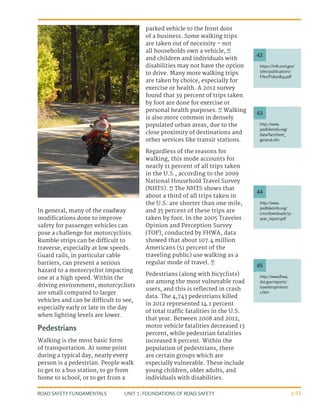
  • 186.
  • 188.
    FHWA, Office ofSafety Felix H. Delgado, P.E. Felix.Delgado@dot.gov FHWA-SA-18-003 Road Safety Fundamentals is available for free at: https://rspcb.safety.fhwa.dot.gov/rsf/