Semester : BE - 5th Civil-A
Subject : Highway Engineering
Code : 2150601
Presentation On : Traffic Engineering
Prepared by : Eddy Ankit Gangani
eddygangani@gmail.com
 What isTraffic Engineering ?
 Scope of traffic Engineering
 Traffic System Components
 Traffic Characteristics – Road User Characteristics
Vehicular Characteristics
Road Characteristics
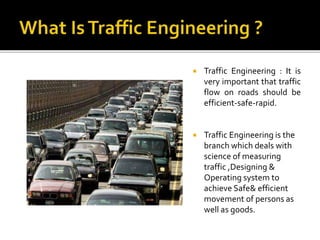
 Traffic Engineering : It is
very important that traffic
flow on roads should be
efficient-safe-rapid.
 Traffic Engineering is the
branch which deals with
science of measuring
traffic ,Designing &
Operating system to
achieve Safe& efficient
movement of persons as
well as goods.
 TrafficCharacteristics
 Traffic studies & analysis
 Traffic operation – control
 Planning & Analysis
 Geometric Design
 Administration & Management
 Road users-drivers, pedestrians, bicyclists, and
passengers
 Vehicles
 Streets and highways
 Traffic control devices
 The general environment
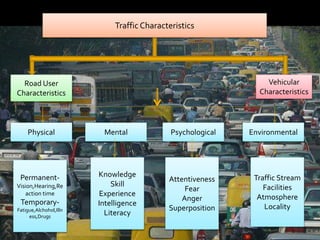
Traffic Characteristics
Road User
Characteristics
Vehicular
Characteristics
Permanent-
Vision,Hearing,Re
action time
Temporary-
Fatigue,Alchohol,Illn
ess,Drugs
Traffic Stream
Facilities
Atmosphere
Locality
Physical Mental Psychological Environmental
Attentiveness
Fear
Anger
Superposition
Knowledge
Skill
Experience
Intelligence
Literacy
 Physiological–Measurable and UsuallyQuantifiable
 Psychological–Much more difficult to measure and quantify
 • Psychological : Desired speeds
Desired safety distances
 • Physiological : Perception-Reaction time
Visual factors
Hearing
 The traffic engineer must deal with elderly drivers as well as 18-year-olds, aggressive drivers
and timid drivers, and drivers subject to myriad distractions both inside and outside their
vehicles.
 Field ofVision :The most
important characteristic of
drivers is their ability to see!
 Traffic Signs: Location,
Height, Shapes, Colors
 The peripheral vision field
narrows, as speed increases,
to as little as 100° at 20 mi/h
and to 40° at 60 mi/h.
 Perception-ReactionTime : The second critical driver characteristic is
perception-reaction time (PRT).
 Detection. In this phase, an object or condition of concern enters the
driver’s field of vision, and the driver becomes consciously aware that
something requiring a response is present.(Perception=VisionAwareness)
 Identification. In this phase, the driver acquires sufficient information
concerning the object or condition to allow the consideration of an
appropriate response.(Intellection- Interpretation)
 Decision.Once identification of the object or condition is sufficiently
completed, the driver must analyze the information and make a decision
about how to respond.
 Response. After a decision has been reached, the response is now
physically implemented by the driver.(Volition= physical response)
 d = 0.278 S.t
Traffic Characteristics
Road User
Characteristics
Vehicular
Characteristics
Dimensions
Weight
Maximum
Turning
Radius
Speed
Acceleration
Braking System
Lighting System
Vehicle Design
Tyre
Static Dynamic
 VehicleCategories : AASHTO - Four main
categories
 Passenger type-all passenger cars, SUVs, minivans,
vans, and pickup trucks.
 Buses-intercity motor coaches, transit buses, school
buses, and articulated buses
 Trucks-single-unit trucks, tractor-trailer, and
tractorsemi-trailer combination vehicles
 ▫ Recreational vehicles-motor homes, cars with various
types of trailers (boat, campers, motorcycles, etc.)
 Braking and deceleration
 Acceleration
 Low-speed turning characteristics
 High-speed turning characteristics
 Size = Height*Width*Length
 Weight
 Sight Distance
 Super Elevation
 Curves
 Capacity
 • High-speed turning characteristics
 S : Speed km/h
 R : Curve Radius m
 e : Super elevation rate %
 f : Coefficient of side friction
 Braking and deceleration
 Acceleration
 Low-speed turning characteristics
 High-speed turning characteristics
 Size = Height*Width*Length
 Weight
 Sight Distance
 Super Elevation
 Curves
 Capacity
 Friction – Skid + Slip
 Unevenness
 Light Reflecting Characteristics
 Skid : vehicle slide without revolving
 Slip : wheel revolves more than longitudinal
distance along the road.(acceleration)
 Factors affecting :
Type of Pavement
Roughness of surface
Dry-wet-smooth pavement conditions
Conditions of tyres
Speed of vehicles
Brake efficiency
traffic engineering
traffic engineering

traffic engineering

  • 2.
    Semester : BE- 5th Civil-A Subject : Highway Engineering Code : 2150601 Presentation On : Traffic Engineering Prepared by : Eddy Ankit Gangani eddygangani@gmail.com
  • 3.
     What isTrafficEngineering ?  Scope of traffic Engineering  Traffic System Components  Traffic Characteristics – Road User Characteristics Vehicular Characteristics Road Characteristics
  • 4.
     Traffic Engineering: It is very important that traffic flow on roads should be efficient-safe-rapid.  Traffic Engineering is the branch which deals with science of measuring traffic ,Designing & Operating system to achieve Safe& efficient movement of persons as well as goods.
  • 5.
     TrafficCharacteristics  Trafficstudies & analysis  Traffic operation – control  Planning & Analysis  Geometric Design  Administration & Management
  • 6.
     Road users-drivers,pedestrians, bicyclists, and passengers  Vehicles  Streets and highways  Traffic control devices  The general environment
  • 7.
    Traffic Characteristics Road User Characteristics Vehicular Characteristics Permanent- Vision,Hearing,Re actiontime Temporary- Fatigue,Alchohol,Illn ess,Drugs Traffic Stream Facilities Atmosphere Locality Physical Mental Psychological Environmental Attentiveness Fear Anger Superposition Knowledge Skill Experience Intelligence Literacy
  • 8.
     Physiological–Measurable andUsuallyQuantifiable  Psychological–Much more difficult to measure and quantify  • Psychological : Desired speeds Desired safety distances  • Physiological : Perception-Reaction time Visual factors Hearing  The traffic engineer must deal with elderly drivers as well as 18-year-olds, aggressive drivers and timid drivers, and drivers subject to myriad distractions both inside and outside their vehicles.
  • 9.
     Field ofVision:The most important characteristic of drivers is their ability to see!  Traffic Signs: Location, Height, Shapes, Colors  The peripheral vision field narrows, as speed increases, to as little as 100° at 20 mi/h and to 40° at 60 mi/h.
  • 10.
     Perception-ReactionTime :The second critical driver characteristic is perception-reaction time (PRT).  Detection. In this phase, an object or condition of concern enters the driver’s field of vision, and the driver becomes consciously aware that something requiring a response is present.(Perception=VisionAwareness)  Identification. In this phase, the driver acquires sufficient information concerning the object or condition to allow the consideration of an appropriate response.(Intellection- Interpretation)  Decision.Once identification of the object or condition is sufficiently completed, the driver must analyze the information and make a decision about how to respond.  Response. After a decision has been reached, the response is now physically implemented by the driver.(Volition= physical response)  d = 0.278 S.t
  • 11.
  • 12.
     VehicleCategories :AASHTO - Four main categories  Passenger type-all passenger cars, SUVs, minivans, vans, and pickup trucks.  Buses-intercity motor coaches, transit buses, school buses, and articulated buses  Trucks-single-unit trucks, tractor-trailer, and tractorsemi-trailer combination vehicles  ▫ Recreational vehicles-motor homes, cars with various types of trailers (boat, campers, motorcycles, etc.)
  • 13.
     Braking anddeceleration  Acceleration  Low-speed turning characteristics  High-speed turning characteristics  Size = Height*Width*Length  Weight  Sight Distance  Super Elevation  Curves  Capacity
  • 14.
     • High-speedturning characteristics  S : Speed km/h  R : Curve Radius m  e : Super elevation rate %  f : Coefficient of side friction
  • 15.
     Braking anddeceleration  Acceleration  Low-speed turning characteristics  High-speed turning characteristics  Size = Height*Width*Length  Weight  Sight Distance  Super Elevation  Curves  Capacity
  • 16.
     Friction –Skid + Slip  Unevenness  Light Reflecting Characteristics
  • 17.
     Skid :vehicle slide without revolving  Slip : wheel revolves more than longitudinal distance along the road.(acceleration)  Factors affecting : Type of Pavement Roughness of surface Dry-wet-smooth pavement conditions Conditions of tyres Speed of vehicles Brake efficiency

Editor's Notes

  • #13 American associ of state highwa transpo official