IJRET: International Journal of Research in Engineering and Technology eISSN: 2319-1163 | pISSN: 2321-7308
_______________________________________________________________________________________
Volume: 04 Issue: 03 | Mar-2015, Available @ http://www.ijret.org 84
AN EFFICIENT FPGA BASED SPACE VECTOR PULSE WIDTH
MODULATION IMPLEMENTATION FOR SERVO CONTROL
APPLICATION
M. Kalpana1
, G. Arumugam2
1
P.G. Student, Department of ECE, Seshachala Institute of Technology, Puttur, AP, India
2
Assistant Professor, Department of ECE, Seshachala Institute of Technology, Puttur, AP, India
Abstract
This paper focuses on the design of a low power and high performance FPGA based Space Vector Pulse Width Modulation
(SVPWM) controller for three phase implementation for Servo control Application. A new method is proposed to realize easy,
accurate and high performance SVPWM technique based on FPGA with low resource consumption and reduced execution time
than conventional methods. The FPGA based SVPWM generation involves a digital controller implementation to execute the
algorithm and DQ reference generator gives reference vector signal to the controller. The controller in turn controls the PLL
generator to generate pulse width modulated clock for three phases. The PLL generator is sourced by clock generator.
Experimental results are presented for SVPWM architecture synthesized on standard low-cost FPGA chips, showing very good
linearity and resolutions up to 1ns.
Keywords: FPGA, PLL Generator, Space Vector Pulse Width Modulation (SVPWM)
-------------------------------------------------------------------***-------------------------------------------------------------------
1. INTRODUCTION
An analog signal has a continuously varying value, with
infinite resolution in both time and magnitude. By controlling
analog circuits digitally, system costs and power
consumption can be drastically reduced. What is more, many
microcontrollers and DSPs already include on-chip PWM
controllers, making implementation easy. PWM is a way of
digitally encoding analog signal levels. Digital control has
obtained great research attention due to their advantages,
such as low sensitivity, advanced control algorithms, reduced
component count, ease of design and prototyping, etc. The
advantage of these DPWMs is that they are very simple and
obtain high linearity. However, their resolution cannot be
very high, as the minimum time step is equal to the clock
period of the counter. Furthermore, their power consumption
is proportional to the clock frequency; so, trying to obtain a
relatively high resolution results in high power consumption.
In order to increase DPWMs’ resolution, delay lines can be
used.
This paper describes FPGA base SVPWM architecture, this
involves digital controller implementation which will execute
the algorithm. The SVPWM technique is very popular in
three phase systems due to its performance benefits. There
are many ways of Pulse width modulation schemes to obtain
variable voltage and frequency supply. The widely used
Pulse Width Modulation is Space Vector Pulse Width
Modulation due to its due to its wide range of applications.
SVPWM has low harmonic distortion, less hardware and low
power consumption.
In this paper low cost Field Programmable Gate Array
(FPGA) based design of SVPWM generation involves a
digital controller implementation to execute the algorithm
and DQ reference generator gives reference vector signal to
the controller. The controller in turn controls the PLL
generator to generate pulse width modulated clock for three
phases. The PLL generator is sourced by clock generator.
2. EXISTING SYSTEM
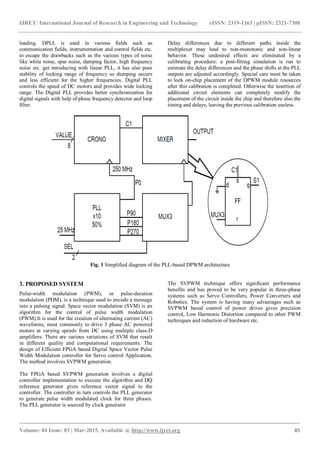
The architecture of PLL-based DPWM is shown in Fig. 1.
The PLL-based DPWM will generate fixed delays and it will
avoid post fitting delay adjustments. The Digital controller in
turns control the generator to generate pulse width modulated
clock for phases. The Digital Pulse Width Modulation can
manage the clock signals given by the PLLs. We can change
the phases of clock signals and we can manage the
frequencies and we can control them in a specified manner.
The PLL can multiply the generated clock frequency from
25MHz to 250MHz. We can generate additional outputs P90,
P180 and P270 with main output P0. The signals will
generate high resolution of the DPWM, adding the other
input bits provides adjustment of the duty cycle will reach
1ns resolution.
The variations in delay due to different paths inside the
multiplex or may lead to non monotonic non linear behavior.
To eliminate these effects calibration process will be used.
The post-fitting simulation has to run for estimating the delay
differences and the phase shifts at the PLL outputs are
adjusted accordingly. The digital phase-locked loop (DPLL)
has better controlling over the analog PLL, PID, fuzzy logic
controller etc. and so it provides accurate speed control on
IJRET: International Journal of Research in Engineering and Technology eISSN: 2319-1163 | pISSN: 2321-7308
_______________________________________________________________________________________
Volume: 04 Issue: 03 | Mar-2015, Available @ http://www.ijret.org 85
loading. DPLL is used in various fields such as
communication fields, instrumentation and control fields etc.
to escape the drawbacks such as the various types of noise
like white noise, spur noise, damping factor, high frequency
noise etc. get introducing with linear PLL, it has also poor
stability of locking range of frequency so dumping occurs
and less efficient for the higher frequencies. Digital PLL
controls the speed of DC motors and provides wide locking
range. The Digital PLL provides better synchronization for
digital signals with help of phase frequency detector and loop
filter.
Delay differences due to different paths inside the
multiplexer may lead to non-monotonic and non-linear
behavior. These undesired effects are eliminated by a
calibrating procedure: a post-fitting simulation is run to
estimate the delay differences and the phase shifts at the PLL
outputs are adjusted accordingly. Special care must be taken
to lock on-chip placement of the DPWM module resources
after this calibration is completed. Otherwise the insertion of
additional circuit elements can completely modify the
placement of the circuit inside the chip and therefore also the
timing and delays, leaving the previous calibration useless.
Fig. 1 Simplified diagram of the PLL-based DPWM architecture
3. PROPOSED SYSTEM
Pulse-width modulation (PWM), or pulse-duration
modulation (PDM), is a technique used to encode a message
into a pulsing signal. Space vector modulation (SVM) is an
algorithm for the control of pulse width modulation
(PWM).It is used for the creation of alternating current (AC)
waveforms, most commonly to drive 3 phase AC powered
motors at varying speeds from DC using multiple class-D
amplifiers. There are various variations of SVM that result
in different quality and computational requirements. The
design of Efficient FPGA based Digital Space Vector Pulse
Width Modulation controller for Servo control Application.
The method involves SVPWM generation.
The FPGA based SVPWM generation involves a digital
controller implementation to execute the algorithm and DQ
reference generator gives reference vector signal to the
controller. The controller in turn controls the PLL generator
to generate pulse width modulated clock for three phases.
The PLL generator is sourced by clock generator
The SVPWM technique offers significant performance
benefits and has proved to be very popular in three-phase
systems such as Servo Controllers, Power Converters and
Robotics. The system is having many advantages such as
SVPWM based control of power drives gives precision
control, Low Harmonic Distortion compared to other PWM
techniques and reduction of hardware etc.
IJRET: International Journal of Research in Engineering and Technology eISSN: 2319-1163 | pISSN: 2321-7308
_______________________________________________________________________________________
Volume: 04 Issue: 03 | Mar-2015, Available @ http://www.ijret.org 86
Fig 2: Block diagram for Efficient FPGA based Space vector pulse width modulation implementation for Servo control
Application
The FPGA based SVPWM generation involves a digital
controller implementation to execute the algorithm and DQ
reference generator gives reference vector signal to the
controller. The controller in turn controls the PLL generator
to generate pulse width modulated clock for three phases.
The PLL generator is sourced by clock generator. The based
SVPWM generation having following advantages
 SVPWM based control of power drives gives
precision control.
 Low Harmonic Distortion compared to other PWM
techniques.
 FPGA based SVPWM generation implies reduction
of Hardware and can be implemented to generate
dynamic control algorithm with less power
consumption.
4. SIMULATION RESULTS
(a)
IJRET: International Journal of Research in Engineering and Technology eISSN: 2319-1163 | pISSN: 2321-7308
_______________________________________________________________________________________
Volume: 04 Issue: 03 | Mar-2015, Available @ http://www.ijret.org 87
(b)
Fig 2 Simulation results (a) Simulation output (b) Space Vector Pulse Width Modulation
Above Figures shows the results of FPGA based Space
Vector Pulse Width Modulation Simulation results as well as
top module of Space Vector Pulse Width Modulation.
Timing Analysis Report
Data Sheet report:
-----------------
All values displayed in nanoseconds (ns)
Setup/Hold to clock clk
------------+------------+------------+------------------+--------+
|Max Setup to|Max Hold to | | Clock |
Source | clk (edge) | clk (edge) |Internal Clock(s) | Phase |
------------+------------+------------+------------------+--------+
asymstate | 0.283(R)| 0.405(R)|clk_BUFGP |
0.000|
en | 0.280(R)| 0.545(R)|clk_BUFGP | 0.000|
reset | 1.579(R)| 0.545(R)|clk_BUFGP | 0.000|
------------+------------+------------+------------------+--------+
Clock clk to Pad
------------+------------+------------------+--------+
| clk (edge) | | Clock |
Destination | to PAD |Internal Clock(s) | Phase |
------------+------------+------------------+--------+
u_bot | 6.216(R)|clk_BUFGP | 0.000|
u_top | 6.216(R)|clk_BUFGP | 0.000|
v_bot | 6.227(R)|clk_BUFGP | 0.000|
v_top | 6.227(R)|clk_BUFGP | 0.000|
vec_out<0> | 6.216(R)|clk_BUFGP | 0.000|
vec_out<1> | 6.227(R)|clk_BUFGP | 0.000|
vec_out<2> | 6.216(R)|clk_BUFGP | 0.000|
w_bot | 6.216(R)|clk_BUFGP | 0.000|
w_top | 6.216(R)|clk_BUFGP | 0.000|
------------+------------+------------------+--------+
Clock to Setup on destination clock clk
---------------+---------+---------+---------+---------+
| Src:Rise| Src:Fall| Src:Rise| Src:Fall|
Source Clock |Dest:Rise|Dest:Rise|Dest:Fall|Dest:Fall|
---------------+---------+---------+---------+---------+
clk | 9.097| | | |
---------------+---------+---------+---------+---------+
Analysis completed Thu Feb 05 01:42:49 2015
--------------------------------------------------------------------------
------
Trace Settings:
-------------------------
Trace Settings
Peak Memory Usage: 119 MB
IJRET: International Journal of Research in Engineering and Technology eISSN: 2319-1163 | pISSN: 2321-7308
_______________________________________________________________________________________
Volume: 04 Issue: 03 | Mar-2015, Available @ http://www.ijret.org 88
5. CONCLUSION
FPGA based Space vector PWM implemented, which
involves digital controller implementation. The digital
controller executed the algorithm for reference vector signal
to the controller. The PLL generator generated pulse width
modulation clock for three phases. The SVPWM based
method achieves a resolution of 1ns in the low-cost FPGA It
is concluded that solution have good linearity and
monotonicity properties.
REFERENCES
[1] Prodic, D. Maksimovic, and R. W. Erickson, “Design
and Implementation of a DigitalPWM Controller for
a High-Frequency Switching DC-DC Power
Converter,” The 27th
Annual Conference of the IEEE
Industrial Electronics Society, IECON 2001, Vol.
[2] R.F. Foley, R.C. Kavanagh, W.P. Marnane and M.G.
Egan, "A versatile digital pulsewidth modulation
architecture with area-efficient FPGA
implementation." Power Electronics Specialists
Conference, PESC 2005.
[3] V. Yousefzadeh, T. Takayama, D. Maksimovic.
"Hybrid DPWM with digital delay-locked loop."
IEEE Computer in Power Electronics Workshop,
COMPEL 2006.
[4] S.C. Huerta, A. de Castro, O. García, J.A. Cobos.
“FPGA based digital pulse width modulator with time
resolution under 2 ns.” IEEE Tran. on Power
Electronics, Vol. 23, No. 6, November 2008.
[5] Óscar López, Jacobo Álvarez, Jesús Doval-Gandoy,
and Francisco D. Freijedo, “Multilevel Multiphase
Space Vector PWM Algorithm”, IEEE
TRANSACTIONS ON INDUSTRIAL
ELECTRONICS, VOL. 55, NO. 5, pp. 1933-1942,
MAY 2008.

An efficient fpga based space vector pulse width modulation implementation for servo control application

  • 1.
    IJRET: International Journalof Research in Engineering and Technology eISSN: 2319-1163 | pISSN: 2321-7308 _______________________________________________________________________________________ Volume: 04 Issue: 03 | Mar-2015, Available @ http://www.ijret.org 84 AN EFFICIENT FPGA BASED SPACE VECTOR PULSE WIDTH MODULATION IMPLEMENTATION FOR SERVO CONTROL APPLICATION M. Kalpana1 , G. Arumugam2 1 P.G. Student, Department of ECE, Seshachala Institute of Technology, Puttur, AP, India 2 Assistant Professor, Department of ECE, Seshachala Institute of Technology, Puttur, AP, India Abstract This paper focuses on the design of a low power and high performance FPGA based Space Vector Pulse Width Modulation (SVPWM) controller for three phase implementation for Servo control Application. A new method is proposed to realize easy, accurate and high performance SVPWM technique based on FPGA with low resource consumption and reduced execution time than conventional methods. The FPGA based SVPWM generation involves a digital controller implementation to execute the algorithm and DQ reference generator gives reference vector signal to the controller. The controller in turn controls the PLL generator to generate pulse width modulated clock for three phases. The PLL generator is sourced by clock generator. Experimental results are presented for SVPWM architecture synthesized on standard low-cost FPGA chips, showing very good linearity and resolutions up to 1ns. Keywords: FPGA, PLL Generator, Space Vector Pulse Width Modulation (SVPWM) -------------------------------------------------------------------***------------------------------------------------------------------- 1. INTRODUCTION An analog signal has a continuously varying value, with infinite resolution in both time and magnitude. By controlling analog circuits digitally, system costs and power consumption can be drastically reduced. What is more, many microcontrollers and DSPs already include on-chip PWM controllers, making implementation easy. PWM is a way of digitally encoding analog signal levels. Digital control has obtained great research attention due to their advantages, such as low sensitivity, advanced control algorithms, reduced component count, ease of design and prototyping, etc. The advantage of these DPWMs is that they are very simple and obtain high linearity. However, their resolution cannot be very high, as the minimum time step is equal to the clock period of the counter. Furthermore, their power consumption is proportional to the clock frequency; so, trying to obtain a relatively high resolution results in high power consumption. In order to increase DPWMs’ resolution, delay lines can be used. This paper describes FPGA base SVPWM architecture, this involves digital controller implementation which will execute the algorithm. The SVPWM technique is very popular in three phase systems due to its performance benefits. There are many ways of Pulse width modulation schemes to obtain variable voltage and frequency supply. The widely used Pulse Width Modulation is Space Vector Pulse Width Modulation due to its due to its wide range of applications. SVPWM has low harmonic distortion, less hardware and low power consumption. In this paper low cost Field Programmable Gate Array (FPGA) based design of SVPWM generation involves a digital controller implementation to execute the algorithm and DQ reference generator gives reference vector signal to the controller. The controller in turn controls the PLL generator to generate pulse width modulated clock for three phases. The PLL generator is sourced by clock generator. 2. EXISTING SYSTEM The architecture of PLL-based DPWM is shown in Fig. 1. The PLL-based DPWM will generate fixed delays and it will avoid post fitting delay adjustments. The Digital controller in turns control the generator to generate pulse width modulated clock for phases. The Digital Pulse Width Modulation can manage the clock signals given by the PLLs. We can change the phases of clock signals and we can manage the frequencies and we can control them in a specified manner. The PLL can multiply the generated clock frequency from 25MHz to 250MHz. We can generate additional outputs P90, P180 and P270 with main output P0. The signals will generate high resolution of the DPWM, adding the other input bits provides adjustment of the duty cycle will reach 1ns resolution. The variations in delay due to different paths inside the multiplex or may lead to non monotonic non linear behavior. To eliminate these effects calibration process will be used. The post-fitting simulation has to run for estimating the delay differences and the phase shifts at the PLL outputs are adjusted accordingly. The digital phase-locked loop (DPLL) has better controlling over the analog PLL, PID, fuzzy logic controller etc. and so it provides accurate speed control on
  • 2.
    IJRET: International Journalof Research in Engineering and Technology eISSN: 2319-1163 | pISSN: 2321-7308 _______________________________________________________________________________________ Volume: 04 Issue: 03 | Mar-2015, Available @ http://www.ijret.org 85 loading. DPLL is used in various fields such as communication fields, instrumentation and control fields etc. to escape the drawbacks such as the various types of noise like white noise, spur noise, damping factor, high frequency noise etc. get introducing with linear PLL, it has also poor stability of locking range of frequency so dumping occurs and less efficient for the higher frequencies. Digital PLL controls the speed of DC motors and provides wide locking range. The Digital PLL provides better synchronization for digital signals with help of phase frequency detector and loop filter. Delay differences due to different paths inside the multiplexer may lead to non-monotonic and non-linear behavior. These undesired effects are eliminated by a calibrating procedure: a post-fitting simulation is run to estimate the delay differences and the phase shifts at the PLL outputs are adjusted accordingly. Special care must be taken to lock on-chip placement of the DPWM module resources after this calibration is completed. Otherwise the insertion of additional circuit elements can completely modify the placement of the circuit inside the chip and therefore also the timing and delays, leaving the previous calibration useless. Fig. 1 Simplified diagram of the PLL-based DPWM architecture 3. PROPOSED SYSTEM Pulse-width modulation (PWM), or pulse-duration modulation (PDM), is a technique used to encode a message into a pulsing signal. Space vector modulation (SVM) is an algorithm for the control of pulse width modulation (PWM).It is used for the creation of alternating current (AC) waveforms, most commonly to drive 3 phase AC powered motors at varying speeds from DC using multiple class-D amplifiers. There are various variations of SVM that result in different quality and computational requirements. The design of Efficient FPGA based Digital Space Vector Pulse Width Modulation controller for Servo control Application. The method involves SVPWM generation. The FPGA based SVPWM generation involves a digital controller implementation to execute the algorithm and DQ reference generator gives reference vector signal to the controller. The controller in turn controls the PLL generator to generate pulse width modulated clock for three phases. The PLL generator is sourced by clock generator The SVPWM technique offers significant performance benefits and has proved to be very popular in three-phase systems such as Servo Controllers, Power Converters and Robotics. The system is having many advantages such as SVPWM based control of power drives gives precision control, Low Harmonic Distortion compared to other PWM techniques and reduction of hardware etc.
  • 3.
    IJRET: International Journalof Research in Engineering and Technology eISSN: 2319-1163 | pISSN: 2321-7308 _______________________________________________________________________________________ Volume: 04 Issue: 03 | Mar-2015, Available @ http://www.ijret.org 86 Fig 2: Block diagram for Efficient FPGA based Space vector pulse width modulation implementation for Servo control Application The FPGA based SVPWM generation involves a digital controller implementation to execute the algorithm and DQ reference generator gives reference vector signal to the controller. The controller in turn controls the PLL generator to generate pulse width modulated clock for three phases. The PLL generator is sourced by clock generator. The based SVPWM generation having following advantages  SVPWM based control of power drives gives precision control.  Low Harmonic Distortion compared to other PWM techniques.  FPGA based SVPWM generation implies reduction of Hardware and can be implemented to generate dynamic control algorithm with less power consumption. 4. SIMULATION RESULTS (a)
  • 4.
    IJRET: International Journalof Research in Engineering and Technology eISSN: 2319-1163 | pISSN: 2321-7308 _______________________________________________________________________________________ Volume: 04 Issue: 03 | Mar-2015, Available @ http://www.ijret.org 87 (b) Fig 2 Simulation results (a) Simulation output (b) Space Vector Pulse Width Modulation Above Figures shows the results of FPGA based Space Vector Pulse Width Modulation Simulation results as well as top module of Space Vector Pulse Width Modulation. Timing Analysis Report Data Sheet report: ----------------- All values displayed in nanoseconds (ns) Setup/Hold to clock clk ------------+------------+------------+------------------+--------+ |Max Setup to|Max Hold to | | Clock | Source | clk (edge) | clk (edge) |Internal Clock(s) | Phase | ------------+------------+------------+------------------+--------+ asymstate | 0.283(R)| 0.405(R)|clk_BUFGP | 0.000| en | 0.280(R)| 0.545(R)|clk_BUFGP | 0.000| reset | 1.579(R)| 0.545(R)|clk_BUFGP | 0.000| ------------+------------+------------+------------------+--------+ Clock clk to Pad ------------+------------+------------------+--------+ | clk (edge) | | Clock | Destination | to PAD |Internal Clock(s) | Phase | ------------+------------+------------------+--------+ u_bot | 6.216(R)|clk_BUFGP | 0.000| u_top | 6.216(R)|clk_BUFGP | 0.000| v_bot | 6.227(R)|clk_BUFGP | 0.000| v_top | 6.227(R)|clk_BUFGP | 0.000| vec_out<0> | 6.216(R)|clk_BUFGP | 0.000| vec_out<1> | 6.227(R)|clk_BUFGP | 0.000| vec_out<2> | 6.216(R)|clk_BUFGP | 0.000| w_bot | 6.216(R)|clk_BUFGP | 0.000| w_top | 6.216(R)|clk_BUFGP | 0.000| ------------+------------+------------------+--------+ Clock to Setup on destination clock clk ---------------+---------+---------+---------+---------+ | Src:Rise| Src:Fall| Src:Rise| Src:Fall| Source Clock |Dest:Rise|Dest:Rise|Dest:Fall|Dest:Fall| ---------------+---------+---------+---------+---------+ clk | 9.097| | | | ---------------+---------+---------+---------+---------+ Analysis completed Thu Feb 05 01:42:49 2015 -------------------------------------------------------------------------- ------ Trace Settings: ------------------------- Trace Settings Peak Memory Usage: 119 MB
  • 5.
    IJRET: International Journalof Research in Engineering and Technology eISSN: 2319-1163 | pISSN: 2321-7308 _______________________________________________________________________________________ Volume: 04 Issue: 03 | Mar-2015, Available @ http://www.ijret.org 88 5. CONCLUSION FPGA based Space vector PWM implemented, which involves digital controller implementation. The digital controller executed the algorithm for reference vector signal to the controller. The PLL generator generated pulse width modulation clock for three phases. The SVPWM based method achieves a resolution of 1ns in the low-cost FPGA It is concluded that solution have good linearity and monotonicity properties. REFERENCES [1] Prodic, D. Maksimovic, and R. W. Erickson, “Design and Implementation of a DigitalPWM Controller for a High-Frequency Switching DC-DC Power Converter,” The 27th Annual Conference of the IEEE Industrial Electronics Society, IECON 2001, Vol. [2] R.F. Foley, R.C. Kavanagh, W.P. Marnane and M.G. Egan, "A versatile digital pulsewidth modulation architecture with area-efficient FPGA implementation." Power Electronics Specialists Conference, PESC 2005. [3] V. Yousefzadeh, T. Takayama, D. Maksimovic. "Hybrid DPWM with digital delay-locked loop." IEEE Computer in Power Electronics Workshop, COMPEL 2006. [4] S.C. Huerta, A. de Castro, O. García, J.A. Cobos. “FPGA based digital pulse width modulator with time resolution under 2 ns.” IEEE Tran. on Power Electronics, Vol. 23, No. 6, November 2008. [5] Óscar López, Jacobo Álvarez, Jesús Doval-Gandoy, and Francisco D. Freijedo, “Multilevel Multiphase Space Vector PWM Algorithm”, IEEE TRANSACTIONS ON INDUSTRIAL ELECTRONICS, VOL. 55, NO. 5, pp. 1933-1942, MAY 2008.