International Journal of Engineering Inventions
e-ISSN: 2278-7461, p-ISSN: 2319-6491
Volume 2, Issue 7 (May2013) PP: 68-73
www.ijeijournal.com Page | 68
Tuning of PID, SVFB and LQ Controllers Using Genetic
Algorithms
P. Kumar1
, O. N. Mehrotra2
, J. Mahto3
Abstract: The Inverted Pendulum is a very popular plant for testing dynamics and control of highly non-linear
plants. In the Inverted Pendulum Control problem, the aim is to move the cart to the desired position and to
balance a pendulum at desired location. This paper represents stabilization of pendulum using PID, SVFB and
LQR. An advantage of Quadratic Control method over the pole-placement techniques is that the former
provides a systematic way of computing the state feedback control gain matrix.LQR In the mathematical model
proposed here, a PID, SVFB and LQR controller is designed and all the controllers are tuned using Genetic
algorithms. The simulation results of all the controllers are shown. This paper exhibits the capability of genetic
algorithm to solve complex and constrained optimization problems and as a general purpose optimization tool
to solve control system design problems.
Keyword: Inverted pendulum (IP), Mathematical modeling, PID controller, State variable feedback controller
(SVFB), LQR, Genetic algorithm (GA).
I. INTRODUCTION
The inverted pendulum is unstable [8,9,10] in the sense that it may fall any time in any direction unless a
suitable control force is applied. If the designer works it right, he can get the advantages of several effects[11].
The control objective of the inverted pendulum is to swing up[4] the pendulum hinged on the moving cart by a
linear motor[11] from stable position (vertically down state) to the zero state (vertically upward state) and to
keep the pendulum in vertically upward state in spite of the disturbance[6,7]. They make it easy to check whether
a particular algorithm [5] yields the requisite results. Several works has been reported on the inverted pendulum
for its stabilization. Attempts have been made in the past to control it using classical control [3]. The purpose of
the present research is to tune[1,2] the entire controller by soft computing tools. The work was made under
MATLAB simulation.
II. MATHEMATICAL MODEL OF THE PLANT
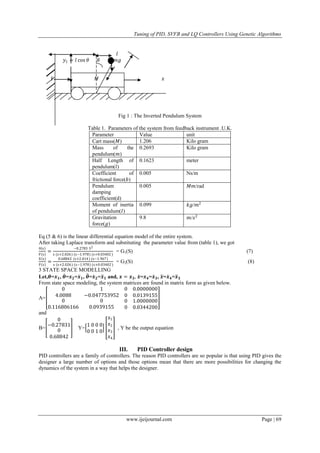
Defining displacement of the cart as 𝑥, the angle of the rod from the vertical (reference) line as 𝜃 , the
force applied to the system as F , centre of gravity of the pendulum rod at its geometric centre and 𝑙 the half
length of the pendulum rod, the physical model of the system is shown in fig (1).
The Lagrangian of the entire system is given as,
L=
1
2
(𝑚𝑥2
+2𝑚𝑙𝑥 cos𝜃+𝑚𝑙2
𝜃2
+𝑀𝑥2
)+
1
2
𝐼𝜃2
]-𝑚𝑔𝑙cos𝜃
The Euler-Lagrange’s equation for the system is
𝑑
𝑑𝑡
𝛿𝐿
𝛿𝑥
−
𝛿𝐿
𝛿𝑥
+ 𝑏𝑥 = 𝐹 (1)
𝑑
𝑑𝑡
𝛿𝐿
𝛿𝜃
−
𝛿𝐿
𝛿𝜃
+ 𝑑𝜃 = 0 (2)
The dynamics of the entire system using above equation is
𝐼 + 𝑚𝑙2
𝜃 + 𝑚𝑙 cos 𝜃 𝑥 − 𝑚𝑔𝑙 sin 𝜃 + 𝑑𝜃 = 0 (3)
𝑀 + 𝑚 𝑥 + 𝑚𝑙 cos 𝜃 𝜃 − 𝑚𝑙 sin 𝜃 𝜃2
+ 𝑏𝑥 = 𝐹 (4)
In order to derive the linear differential equation model, the non linear differential equation obtained need to be
linearized. For small angle deviation around the upright equilibrium (fig.2) point, assumption made sin 𝜃 =
𝜃, cos 𝜃 = 1, 𝜃2
= 0
Using above relation, equation (5) and (6) are derived.
r𝜃+q𝑥-k𝜃+d =0 (5)
𝑝𝑥 + 𝑞𝜃 + 𝑏𝑥 = 𝐹 (6) Where, (𝑀
+ 𝑚)= p, 𝑚𝑔𝑙=k, 𝑚𝑙=q, 𝐼 + 𝑚𝑙2
= r
𝑥1 = 𝑥 + 𝑙 sin 𝜃
Tuning of PID, SVFB and LQ Controllers Using Genetic Algorithms
www.ijeijournal.com Page | 69
𝑙
𝑦1 = 𝑙 cos 𝜃 𝜃 𝑚𝑔
F 𝑀 𝑥
Fig 1 : The Inverted Pendulum System
Table 1. Parameters of the system from feedback instrument .U.K.
Parameter Value unit
Cart mass(𝑀) 1.206 Kilo gram
Mass of the
pendulum(𝑚)
0.2693 Kilo gram
Half Length of
pendulum(𝑙)
0.1623 meter
Coefficient of
frictional force(𝑏)
0.005 Ns/m
Pendulum
damping
coefficient(d)
0.005 𝑀𝑚/rad
Moment of inertia
of pendulum(𝐼)
0.099 𝑘𝑔/𝑚2
Gravitation
force(𝑔)
9.8 𝑚/𝑠2
Eq (5 & 6) is the linear differential equation model of the entire system.
After taking Laplace transform and substituting the parameter value from (table 1), we got
θ s
F s
=
−0.2783 S2
s (s+2.026) (s−1.978) (s+0.03402 )
= G1(S) (7)
X s
F s
=
0.68843 (s+2.014) (s−1.967)
s (s+2.026) (s−1.978) (s+0.03402 )
= G2(S) (8)
3 STATE SPACE MODELLING
Let,𝜽=𝒙 𝟏, 𝜽=𝒙 𝟐=𝒙 𝟏, 𝜽=𝒙 𝟐=𝒙 𝟏 and, 𝒙 = 𝒙 𝟑, 𝒙=𝒙 𝟒=𝒙 𝟑, 𝒙=𝒙 𝟒=𝒙 𝟑
From state space modeling, the system matrices are found in matrix form as given below.
A=
0
4.0088
1
−0.047753952
0 0.0000000
0 0.0139155
0 0 0 1.0000000
0.116806166 0.0939155 0 0.0344200
and
B=
0
−0.27831
0
0.68842
Y=
1 0 0 0
0 0 1 0
𝑥1
𝑥2
𝑥3
𝑥4
, Y be the output equation
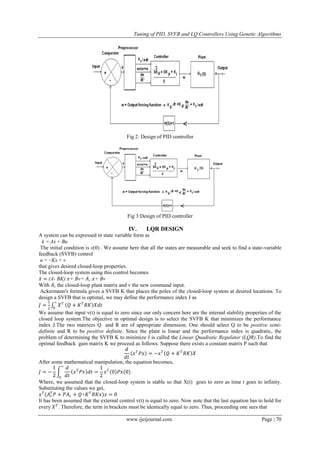
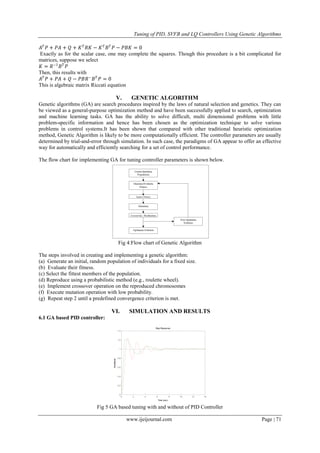
III. PID Controller design
PID controllers are a family of controllers. The reason PID controllers are so popular is that using PID gives the
designer a large number of options and those options mean that there are more possibilities for changing the
dynamics of the system in a way that helps the designer.
Tuning of PID, SVFB and LQ Controllers Using Genetic Algorithms
www.ijeijournal.com Page | 70
Fig 2: Design of PID controller
Fig 3:Design of PID controller
IV. LQR DESIGN
A system can be expressed in state variable form as
𝑥 = Ax + Bu
The initial condition is x(0) . We assume here that all the states are measurable and seek to find a state-variable
feedback (SVFB) control
u = −Kx + v
that gives desired closed-loop properties.
The closed-loop system using this control becomes
𝑥 = (A- BK) 𝑥+ Bv= 𝐴c 𝑥+ Bv
With 𝐴c the closed-loop plant matrix and v the new command input.
Ackermann's formula gives a SVFB K that places the poles of the closed-loop system at desired locations. To
design a SVFB that is optimal, we may define the performance index J as
𝐽 =
1
2
𝑋 𝑇∞
0
𝑄 + 𝐾 𝑇
𝑅𝐾 𝑋𝑑𝑡
We assume that input v(t) is equal to zero since our only concern here are the internal stability properties of the
closed loop system.The objective in optimal design is to select the SVFB K that minimizes the performance
index J.The two matrices Q and R are of appropriate dimension. One should select Q to be positive semi-
definite and R to be positive definite. Since the plant is linear and the performance index is quadratic, the
problem of determining the SVFB K to minimize J is called the Linear Quadratic Regulator (LQR).To find the
optimal feedback gain matrix K we proceed as follows. Suppose there exists a constant matrix P such that
𝑑
𝑑𝑡
𝑥 𝑇
𝑃𝑥 = −𝑥 𝑇
𝑄 + 𝐾 𝑇
𝑅𝐾 𝑋
After some mathematical manipulation, the equation becomes,
𝐽 = −
1
2
𝑑
𝑑𝑡
𝑥 𝑇
𝑃𝑥 𝑑𝑡 =
1
2
∞
0
𝑥 𝑇
0 𝑃𝑥(0)
Where, we assumed that the closed-loop system is stable so that X(t) goes to zero as time t goes to infinity.
Substituting the values we get,
𝑥 𝑇
(𝐴 𝑐
𝑇
𝑃 + 𝑃𝐴 𝑐 + 𝑄+𝐾 𝑇
𝑅𝐾𝑥)𝑥 = 0
It has been assumed that the external control v(t) is equal to zero. Now note that the last equation has to hold for
every 𝑋 𝑇
. Therefore, the term in brackets must be identically equal to zero. Thus, proceeding one sees that
Tuning of PID, SVFB and LQ Controllers Using Genetic Algorithms
www.ijeijournal.com Page | 71
𝐴 𝑇
𝑃 + 𝑃𝐴 + 𝑄 + 𝐾 𝑇
𝑅𝐾 − 𝐾 𝑇
𝐵 𝑇
𝑃 − 𝑃𝐵𝐾 = 0
Exactly as for the scalar case, one may complete the squares. Though this procedure is a bit complicated for
matrices, suppose we select
𝐾 = 𝑅−1
𝐵 𝑇
𝑃
Then, this results with
𝐴 𝑇
𝑃 + 𝑃𝐴 + 𝑄 − 𝑃𝐵𝑅−
𝐵 𝑇
𝑃 = 0
This is algebraic matrix Riccati equation
V. GENETIC ALGORITHM
Genetic algorithms (GA) are search procedures inspired by the laws of natural selection and genetics. They can
be viewed as a general-purpose optimization method and have been successfully applied to search, optimization
and machine learning tasks. GA has the ability to solve difficult, multi dimensional problems with little
problem-specific information and hence has been chosen as the optimization technique to solve various
problems in control systems.It has been shown that compared with other traditional heuristic optimization
method, Genetic Algorithm is likely to be more computationally efficient. The controller parameters are usually
determined by trial-and-error through simulation. In such case, the paradigms of GA appear to offer an effective
way for automatically and efficiently searching for a set of control performance.
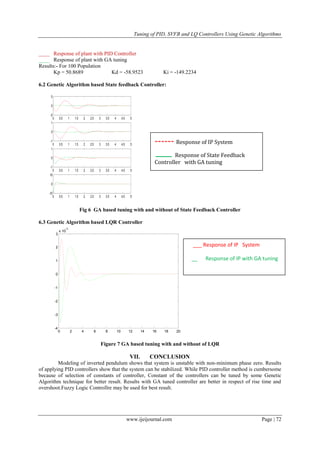
The flow chart for implementing GA for tuning controller parameters is shown below.
Fig 4:Flow chart of Genetic Algorithm
The steps involved in creating and implementing a genetic algorithm:
(a) Generate an initial, random population of individuals for a fixed size.
(b) Evaluate their fitness.
(c) Select the fittest members of the population.
(d) Reproduce using a probabilistic method (e.g., roulette wheel).
(e) Implement crossover operation on the reproduced chromosomes
(f) Execute mutation operation with low probability.
(g) Repeat step 2 until a predefined convergence criterion is met.
VI. SIMULATION AND RESULTS
6.1 GA based PID controller:
Fig 5 GA based tuning with and without of PID Controller
0 2 4 6 8 10 12 14
0
0.2
0.4
0.6
0.8
1
1.2
1.4
Step Response
Time (sec)
Amplitude
Tuning of PID, SVFB and LQ Controllers Using Genetic Algorithms
www.ijeijournal.com Page | 72
____ Response of plant with PID Controller
____ Response of plant with GA tuning
Results:- For 100 Population
Kp = 50.8689 Kd = -58.9523 Ki = -149.2234
6.2 Genetic Algorithm based State feedback Controller:
Fig 6 GA based tuning with and without of State Feedback Controller
6.3 Genetic Algorithm based LQR Controller
Figure 7 GA based tuning with and without of LQR
VII. CONCLUSION
Modeling of inverted pendulum shows that system is unstable with non-minimum phase zero. Results
of applying PID controllers show that the system can be stabilized. While PID controller method is cumbersome
because of selection of constants of controller, Constant of the controllers can be tuned by some Genetic
Algorithm technique for better result. Results with GA tuned controller are better in respect of rise time and
overshoot.Fuzzy Logic Controllre may be used for best result.
0 0.5 1 1.5 2 2.5 3 3.5 4 4.5 5
-5
0
5
0 0.5 1 1.5 2 2.5 3 3.5 4 4.5 5
-1
0
1
0 0.5 1 1.5 2 2.5 3 3.5 4 4.5 5
-1
0
1
0 0.5 1 1.5 2 2.5 3 3.5 4 4.5 5
-10
0
10
0 2 4 6 8 10 12 14 16 18 20
-4
-3
-2
-1
0
1
2
3
x 10
-3
___ Response of IP System
__ Response of IP with GA tuning
------ Response of IP System
Response of State Feedback
Controller with GA tuning
Tuning of PID, SVFB and LQ Controllers Using Genetic Algorithms
www.ijeijournal.com Page | 73
References
[1] P.Kumar,O.N.Mehrotra,J.Mahto,’’Tuning of PID Controller Of Inverted Pendulum using Genetic algorithm”pp 359-363.IJRET,Voi
1,Issue 3,Dec 2012
[2] P.Kumar,O.N.Mehrotra,J.Mahto,’’ Controller design Of Inverted Pendulum using Pole placement and LQR”pp 532-538..IJRET,Voi
1,Issue 4,Dec 2012
[3] Kumar,P, Mehrotra , O.N, Mahto.J, Mukherjee, Rabi Ranjan,”Modelling and Controller Design of Inverted Pendulum”, National
Conference on Communication, Measurement and Control, Vol-I, 14th August, 2012
[4] S.Vivek Kumar Radha Mohan,Mona Subramaniam, “A clustering technique for digital communications channel equalization using
radial basis function networks,” IEEE Transactions Neural Networks, vol. 4, pp. 570-578, July 1993.
[5] Elmer P. Dadias, Patrick S. Fererandez, and David J,”Genetic Algorithm on Line Controller For The Flexible Inverted
Pendulum Problem”, Journal Of Advanced Computational Intelligence and Intelligent Informatics
[6] W. Wang, “Adaptive fuzzy sliding mode control for inverted pendulum,” in Proceedings of the Second Symposium International
Computer Science and Computational Technology(ISCSCT ’09) uangshan, P. R. China, 26-28, Dec. pp. 231-234, 2009
[7] Kumar.P, Mehrotra.O.N, Mahto.J, Mukherjee, Rabi Ranjan,”Stabilization of Inverted Pendulum using LQR”, National Conference
on Communication, Measurement and Control, Vol-I, 14th August, 2012.
[8] Stefani, Shahian, Savant, Hostetter :Design Of Feedback Control Systems,4th
edition, New York, Oxford University Press 2002
,Page (675 – 732)
[9] Behra Laxmidhar & Kar Indrani; Intelligent Systems and Control Principals and Applications; Oxford University Press
[10] Ogata, K.; System Dynamics, 4th
Edition Englewood Cliffs, NJ: Prentice-Hall, 2003
[11] Feedback instruments,U.K
Prof. Mehrotra, a Gold Medalist at B.Sc. Engineering(B.U), M.E.(Hons)(U.O.R) and Ph.D. (R.U) all in Electrical
Engineering, has the industrial exposure at SAIL as Testing & Commissioning Engineer. Served Department of Science
& Technology, Govt. of Bihar & Govt. of Jharkhand for 35 years and retired as Professor in Electrical Engineering.
Served as coordinator of various projects sanctioned through MHRD and AICTE, including TEQIP, a World Bank
Project. His research interests include control and utilization of renewable energies, power quality and power
system.Presently he is Director of Shivalik college of engineering Dehradun,Uttrakhand,India
Dr. Jagdeo Mahto was born in Madhubani, Bihar, India, in 1943. He obtained the B.Sc (Engg) degree in Electrical
Engineering from Bhagalpur University in 1964, M.Tech. in Control System from IIT Kharagpur, India in 1970 and
Ph.D in Control System in 1984 from IIT Delhi, India. He served MIT Muzaffarpur from 1964 to 1971 in the capacity of
Lecturer and Assistant Professor. From 1971 to 1980 he served as Asst. Professor, from 1980 to 1985 as Associate
Professor and from 1985 to 1988 as Professor in the Department of Electrical Engineering at BIT Sindri, India. He
taught at Bright Star University, Brega (Libya) from 1988 to 1989. From 1989 to 2003 he was again at BIT Sindri. From
2004 till date he is Professor at Asansol Engg. College
Pankaj Kumar was born in Muzaffarpur, India, in 1970 and received the B.Sc and M.Sc. degree in Electronics Honours
and Electronic Science respectively from Magadh University and Gauhati University Assam. He received M.Sc
Engineering in Control System Engineering from Patna University in 2004. He began his career as Lecturer in Bihar
University Muzaffarpur. Currently he is an Assistant Professor in the Department of Electrical Engineering, Asansol
Engineering College, Asansol, India.

Tuning of PID, SVFB and LQ Controllers Using Genetic Algorithms

  • 1.
    International Journal ofEngineering Inventions e-ISSN: 2278-7461, p-ISSN: 2319-6491 Volume 2, Issue 7 (May2013) PP: 68-73 www.ijeijournal.com Page | 68 Tuning of PID, SVFB and LQ Controllers Using Genetic Algorithms P. Kumar1 , O. N. Mehrotra2 , J. Mahto3 Abstract: The Inverted Pendulum is a very popular plant for testing dynamics and control of highly non-linear plants. In the Inverted Pendulum Control problem, the aim is to move the cart to the desired position and to balance a pendulum at desired location. This paper represents stabilization of pendulum using PID, SVFB and LQR. An advantage of Quadratic Control method over the pole-placement techniques is that the former provides a systematic way of computing the state feedback control gain matrix.LQR In the mathematical model proposed here, a PID, SVFB and LQR controller is designed and all the controllers are tuned using Genetic algorithms. The simulation results of all the controllers are shown. This paper exhibits the capability of genetic algorithm to solve complex and constrained optimization problems and as a general purpose optimization tool to solve control system design problems. Keyword: Inverted pendulum (IP), Mathematical modeling, PID controller, State variable feedback controller (SVFB), LQR, Genetic algorithm (GA). I. INTRODUCTION The inverted pendulum is unstable [8,9,10] in the sense that it may fall any time in any direction unless a suitable control force is applied. If the designer works it right, he can get the advantages of several effects[11]. The control objective of the inverted pendulum is to swing up[4] the pendulum hinged on the moving cart by a linear motor[11] from stable position (vertically down state) to the zero state (vertically upward state) and to keep the pendulum in vertically upward state in spite of the disturbance[6,7]. They make it easy to check whether a particular algorithm [5] yields the requisite results. Several works has been reported on the inverted pendulum for its stabilization. Attempts have been made in the past to control it using classical control [3]. The purpose of the present research is to tune[1,2] the entire controller by soft computing tools. The work was made under MATLAB simulation. II. MATHEMATICAL MODEL OF THE PLANT Defining displacement of the cart as 𝑥, the angle of the rod from the vertical (reference) line as 𝜃 , the force applied to the system as F , centre of gravity of the pendulum rod at its geometric centre and 𝑙 the half length of the pendulum rod, the physical model of the system is shown in fig (1). The Lagrangian of the entire system is given as, L= 1 2 (𝑚𝑥2 +2𝑚𝑙𝑥 cos𝜃+𝑚𝑙2 𝜃2 +𝑀𝑥2 )+ 1 2 𝐼𝜃2 ]-𝑚𝑔𝑙cos𝜃 The Euler-Lagrange’s equation for the system is 𝑑 𝑑𝑡 𝛿𝐿 𝛿𝑥 − 𝛿𝐿 𝛿𝑥 + 𝑏𝑥 = 𝐹 (1) 𝑑 𝑑𝑡 𝛿𝐿 𝛿𝜃 − 𝛿𝐿 𝛿𝜃 + 𝑑𝜃 = 0 (2) The dynamics of the entire system using above equation is 𝐼 + 𝑚𝑙2 𝜃 + 𝑚𝑙 cos 𝜃 𝑥 − 𝑚𝑔𝑙 sin 𝜃 + 𝑑𝜃 = 0 (3) 𝑀 + 𝑚 𝑥 + 𝑚𝑙 cos 𝜃 𝜃 − 𝑚𝑙 sin 𝜃 𝜃2 + 𝑏𝑥 = 𝐹 (4) In order to derive the linear differential equation model, the non linear differential equation obtained need to be linearized. For small angle deviation around the upright equilibrium (fig.2) point, assumption made sin 𝜃 = 𝜃, cos 𝜃 = 1, 𝜃2 = 0 Using above relation, equation (5) and (6) are derived. r𝜃+q𝑥-k𝜃+d =0 (5) 𝑝𝑥 + 𝑞𝜃 + 𝑏𝑥 = 𝐹 (6) Where, (𝑀 + 𝑚)= p, 𝑚𝑔𝑙=k, 𝑚𝑙=q, 𝐼 + 𝑚𝑙2 = r 𝑥1 = 𝑥 + 𝑙 sin 𝜃
  • 2.
    Tuning of PID,SVFB and LQ Controllers Using Genetic Algorithms www.ijeijournal.com Page | 69 𝑙 𝑦1 = 𝑙 cos 𝜃 𝜃 𝑚𝑔 F 𝑀 𝑥 Fig 1 : The Inverted Pendulum System Table 1. Parameters of the system from feedback instrument .U.K. Parameter Value unit Cart mass(𝑀) 1.206 Kilo gram Mass of the pendulum(𝑚) 0.2693 Kilo gram Half Length of pendulum(𝑙) 0.1623 meter Coefficient of frictional force(𝑏) 0.005 Ns/m Pendulum damping coefficient(d) 0.005 𝑀𝑚/rad Moment of inertia of pendulum(𝐼) 0.099 𝑘𝑔/𝑚2 Gravitation force(𝑔) 9.8 𝑚/𝑠2 Eq (5 & 6) is the linear differential equation model of the entire system. After taking Laplace transform and substituting the parameter value from (table 1), we got θ s F s = −0.2783 S2 s (s+2.026) (s−1.978) (s+0.03402 ) = G1(S) (7) X s F s = 0.68843 (s+2.014) (s−1.967) s (s+2.026) (s−1.978) (s+0.03402 ) = G2(S) (8) 3 STATE SPACE MODELLING Let,𝜽=𝒙 𝟏, 𝜽=𝒙 𝟐=𝒙 𝟏, 𝜽=𝒙 𝟐=𝒙 𝟏 and, 𝒙 = 𝒙 𝟑, 𝒙=𝒙 𝟒=𝒙 𝟑, 𝒙=𝒙 𝟒=𝒙 𝟑 From state space modeling, the system matrices are found in matrix form as given below. A= 0 4.0088 1 −0.047753952 0 0.0000000 0 0.0139155 0 0 0 1.0000000 0.116806166 0.0939155 0 0.0344200 and B= 0 −0.27831 0 0.68842 Y= 1 0 0 0 0 0 1 0 𝑥1 𝑥2 𝑥3 𝑥4 , Y be the output equation III. PID Controller design PID controllers are a family of controllers. The reason PID controllers are so popular is that using PID gives the designer a large number of options and those options mean that there are more possibilities for changing the dynamics of the system in a way that helps the designer.
  • 3.
    Tuning of PID,SVFB and LQ Controllers Using Genetic Algorithms www.ijeijournal.com Page | 70 Fig 2: Design of PID controller Fig 3:Design of PID controller IV. LQR DESIGN A system can be expressed in state variable form as 𝑥 = Ax + Bu The initial condition is x(0) . We assume here that all the states are measurable and seek to find a state-variable feedback (SVFB) control u = −Kx + v that gives desired closed-loop properties. The closed-loop system using this control becomes 𝑥 = (A- BK) 𝑥+ Bv= 𝐴c 𝑥+ Bv With 𝐴c the closed-loop plant matrix and v the new command input. Ackermann's formula gives a SVFB K that places the poles of the closed-loop system at desired locations. To design a SVFB that is optimal, we may define the performance index J as 𝐽 = 1 2 𝑋 𝑇∞ 0 𝑄 + 𝐾 𝑇 𝑅𝐾 𝑋𝑑𝑡 We assume that input v(t) is equal to zero since our only concern here are the internal stability properties of the closed loop system.The objective in optimal design is to select the SVFB K that minimizes the performance index J.The two matrices Q and R are of appropriate dimension. One should select Q to be positive semi- definite and R to be positive definite. Since the plant is linear and the performance index is quadratic, the problem of determining the SVFB K to minimize J is called the Linear Quadratic Regulator (LQR).To find the optimal feedback gain matrix K we proceed as follows. Suppose there exists a constant matrix P such that 𝑑 𝑑𝑡 𝑥 𝑇 𝑃𝑥 = −𝑥 𝑇 𝑄 + 𝐾 𝑇 𝑅𝐾 𝑋 After some mathematical manipulation, the equation becomes, 𝐽 = − 1 2 𝑑 𝑑𝑡 𝑥 𝑇 𝑃𝑥 𝑑𝑡 = 1 2 ∞ 0 𝑥 𝑇 0 𝑃𝑥(0) Where, we assumed that the closed-loop system is stable so that X(t) goes to zero as time t goes to infinity. Substituting the values we get, 𝑥 𝑇 (𝐴 𝑐 𝑇 𝑃 + 𝑃𝐴 𝑐 + 𝑄+𝐾 𝑇 𝑅𝐾𝑥)𝑥 = 0 It has been assumed that the external control v(t) is equal to zero. Now note that the last equation has to hold for every 𝑋 𝑇 . Therefore, the term in brackets must be identically equal to zero. Thus, proceeding one sees that
  • 4.
    Tuning of PID,SVFB and LQ Controllers Using Genetic Algorithms www.ijeijournal.com Page | 71 𝐴 𝑇 𝑃 + 𝑃𝐴 + 𝑄 + 𝐾 𝑇 𝑅𝐾 − 𝐾 𝑇 𝐵 𝑇 𝑃 − 𝑃𝐵𝐾 = 0 Exactly as for the scalar case, one may complete the squares. Though this procedure is a bit complicated for matrices, suppose we select 𝐾 = 𝑅−1 𝐵 𝑇 𝑃 Then, this results with 𝐴 𝑇 𝑃 + 𝑃𝐴 + 𝑄 − 𝑃𝐵𝑅− 𝐵 𝑇 𝑃 = 0 This is algebraic matrix Riccati equation V. GENETIC ALGORITHM Genetic algorithms (GA) are search procedures inspired by the laws of natural selection and genetics. They can be viewed as a general-purpose optimization method and have been successfully applied to search, optimization and machine learning tasks. GA has the ability to solve difficult, multi dimensional problems with little problem-specific information and hence has been chosen as the optimization technique to solve various problems in control systems.It has been shown that compared with other traditional heuristic optimization method, Genetic Algorithm is likely to be more computationally efficient. The controller parameters are usually determined by trial-and-error through simulation. In such case, the paradigms of GA appear to offer an effective way for automatically and efficiently searching for a set of control performance. The flow chart for implementing GA for tuning controller parameters is shown below. Fig 4:Flow chart of Genetic Algorithm The steps involved in creating and implementing a genetic algorithm: (a) Generate an initial, random population of individuals for a fixed size. (b) Evaluate their fitness. (c) Select the fittest members of the population. (d) Reproduce using a probabilistic method (e.g., roulette wheel). (e) Implement crossover operation on the reproduced chromosomes (f) Execute mutation operation with low probability. (g) Repeat step 2 until a predefined convergence criterion is met. VI. SIMULATION AND RESULTS 6.1 GA based PID controller: Fig 5 GA based tuning with and without of PID Controller 0 2 4 6 8 10 12 14 0 0.2 0.4 0.6 0.8 1 1.2 1.4 Step Response Time (sec) Amplitude
  • 5.
    Tuning of PID,SVFB and LQ Controllers Using Genetic Algorithms www.ijeijournal.com Page | 72 ____ Response of plant with PID Controller ____ Response of plant with GA tuning Results:- For 100 Population Kp = 50.8689 Kd = -58.9523 Ki = -149.2234 6.2 Genetic Algorithm based State feedback Controller: Fig 6 GA based tuning with and without of State Feedback Controller 6.3 Genetic Algorithm based LQR Controller Figure 7 GA based tuning with and without of LQR VII. CONCLUSION Modeling of inverted pendulum shows that system is unstable with non-minimum phase zero. Results of applying PID controllers show that the system can be stabilized. While PID controller method is cumbersome because of selection of constants of controller, Constant of the controllers can be tuned by some Genetic Algorithm technique for better result. Results with GA tuned controller are better in respect of rise time and overshoot.Fuzzy Logic Controllre may be used for best result. 0 0.5 1 1.5 2 2.5 3 3.5 4 4.5 5 -5 0 5 0 0.5 1 1.5 2 2.5 3 3.5 4 4.5 5 -1 0 1 0 0.5 1 1.5 2 2.5 3 3.5 4 4.5 5 -1 0 1 0 0.5 1 1.5 2 2.5 3 3.5 4 4.5 5 -10 0 10 0 2 4 6 8 10 12 14 16 18 20 -4 -3 -2 -1 0 1 2 3 x 10 -3 ___ Response of IP System __ Response of IP with GA tuning ------ Response of IP System Response of State Feedback Controller with GA tuning
  • 6.
    Tuning of PID,SVFB and LQ Controllers Using Genetic Algorithms www.ijeijournal.com Page | 73 References [1] P.Kumar,O.N.Mehrotra,J.Mahto,’’Tuning of PID Controller Of Inverted Pendulum using Genetic algorithm”pp 359-363.IJRET,Voi 1,Issue 3,Dec 2012 [2] P.Kumar,O.N.Mehrotra,J.Mahto,’’ Controller design Of Inverted Pendulum using Pole placement and LQR”pp 532-538..IJRET,Voi 1,Issue 4,Dec 2012 [3] Kumar,P, Mehrotra , O.N, Mahto.J, Mukherjee, Rabi Ranjan,”Modelling and Controller Design of Inverted Pendulum”, National Conference on Communication, Measurement and Control, Vol-I, 14th August, 2012 [4] S.Vivek Kumar Radha Mohan,Mona Subramaniam, “A clustering technique for digital communications channel equalization using radial basis function networks,” IEEE Transactions Neural Networks, vol. 4, pp. 570-578, July 1993. [5] Elmer P. Dadias, Patrick S. Fererandez, and David J,”Genetic Algorithm on Line Controller For The Flexible Inverted Pendulum Problem”, Journal Of Advanced Computational Intelligence and Intelligent Informatics [6] W. Wang, “Adaptive fuzzy sliding mode control for inverted pendulum,” in Proceedings of the Second Symposium International Computer Science and Computational Technology(ISCSCT ’09) uangshan, P. R. China, 26-28, Dec. pp. 231-234, 2009 [7] Kumar.P, Mehrotra.O.N, Mahto.J, Mukherjee, Rabi Ranjan,”Stabilization of Inverted Pendulum using LQR”, National Conference on Communication, Measurement and Control, Vol-I, 14th August, 2012. [8] Stefani, Shahian, Savant, Hostetter :Design Of Feedback Control Systems,4th edition, New York, Oxford University Press 2002 ,Page (675 – 732) [9] Behra Laxmidhar & Kar Indrani; Intelligent Systems and Control Principals and Applications; Oxford University Press [10] Ogata, K.; System Dynamics, 4th Edition Englewood Cliffs, NJ: Prentice-Hall, 2003 [11] Feedback instruments,U.K Prof. Mehrotra, a Gold Medalist at B.Sc. Engineering(B.U), M.E.(Hons)(U.O.R) and Ph.D. (R.U) all in Electrical Engineering, has the industrial exposure at SAIL as Testing & Commissioning Engineer. Served Department of Science & Technology, Govt. of Bihar & Govt. of Jharkhand for 35 years and retired as Professor in Electrical Engineering. Served as coordinator of various projects sanctioned through MHRD and AICTE, including TEQIP, a World Bank Project. His research interests include control and utilization of renewable energies, power quality and power system.Presently he is Director of Shivalik college of engineering Dehradun,Uttrakhand,India Dr. Jagdeo Mahto was born in Madhubani, Bihar, India, in 1943. He obtained the B.Sc (Engg) degree in Electrical Engineering from Bhagalpur University in 1964, M.Tech. in Control System from IIT Kharagpur, India in 1970 and Ph.D in Control System in 1984 from IIT Delhi, India. He served MIT Muzaffarpur from 1964 to 1971 in the capacity of Lecturer and Assistant Professor. From 1971 to 1980 he served as Asst. Professor, from 1980 to 1985 as Associate Professor and from 1985 to 1988 as Professor in the Department of Electrical Engineering at BIT Sindri, India. He taught at Bright Star University, Brega (Libya) from 1988 to 1989. From 1989 to 2003 he was again at BIT Sindri. From 2004 till date he is Professor at Asansol Engg. College Pankaj Kumar was born in Muzaffarpur, India, in 1970 and received the B.Sc and M.Sc. degree in Electronics Honours and Electronic Science respectively from Magadh University and Gauhati University Assam. He received M.Sc Engineering in Control System Engineering from Patna University in 2004. He began his career as Lecturer in Bihar University Muzaffarpur. Currently he is an Assistant Professor in the Department of Electrical Engineering, Asansol Engineering College, Asansol, India.