By:
Presenter
Supervisor
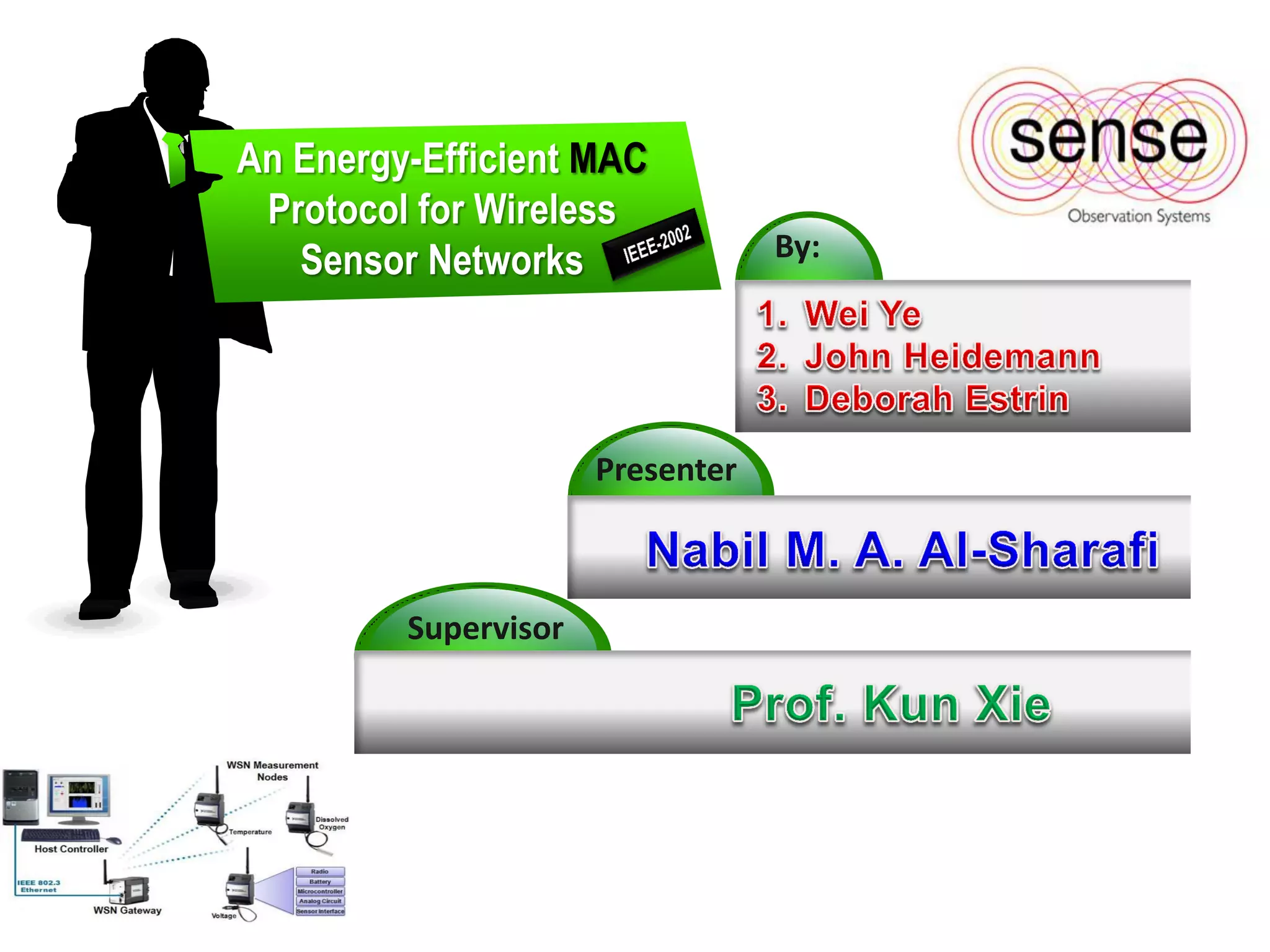
An Energy-Efficient MAC
Protocol for Wireless
Sensor Networks
Topics
• Introduction
• S-MAC
• Experiment
• Conclusion
• Discussion
• Questions
2-25
• Wireless
Sensor
NetworksWSN
• MACProtocol
Overview
Topics
3-25
• PresentMAC
Design
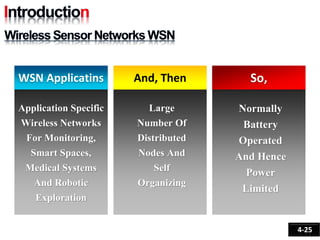
WSN Applicatins
Application Specific
Wireless Networks
For Monitoring,
Smart Spaces,
Medical Systems
And Robotic
Exploration
And, Then
Large
Number Of
Distributed
Nodes And
Self
Organizing
So,
Normally
Battery
Operated
And Hence
Power
Limited
4-25
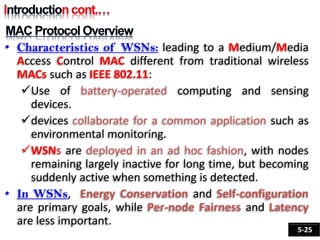
• Characteristics of WSNs: leading to a Medium/Media
Access Control MAC different from traditional wireless
MACs such as IEEE 802.11:
Use of battery-operated computing and sensing
devices.
devices collaborate for a common application such as
environmental monitoring.
WSNs are deployed in an ad hoc fashion, with nodes
remaining largely inactive for long time, but becoming
suddenly active when something is detected.
• In WSNs, Energy Conservation and Self-configuration
are primary goals, while Per-node Fairness and Latency
are less important.
5-25
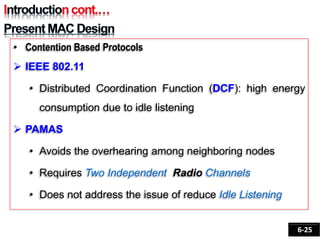
• Contention Based Protocols
 IEEE 802.11
• Distributed Coordination Function (DCF): high energy
consumption due to idle listening
 PAMAS
• Avoids the overhearing among neighboring nodes
• Requires Two Independent Radio Channels
• Does not address the issue of reduce Idle Listening
6-25
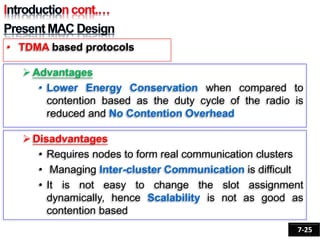
Advantages
• Lower Energy Conservation when compared to
contention based as the duty cycle of the radio is
reduced and No Contention Overhead
Disadvantages
• Requires nodes to form real communication clusters
• Managing Inter-cluster Communication is difficult
• It is not easy to change the slot assignment
dynamically, hence Scalability is not as good as
contention based
• TDMA based protocols
7-25
• Paper
Proposes
• S-MAC Goals
• Design
Considerations
Topics
8-25
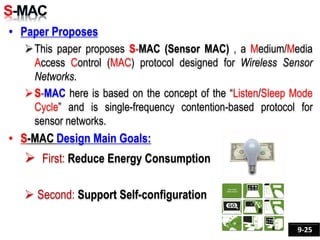
• Paper Proposes
This paper proposes S-MAC (Sensor MAC) , a Medium/Media
Access Control (MAC) protocol designed for Wireless Sensor
Networks.
S-MAC here is based on the concept of the “Listen/Sleep Mode
Cycle” and is single-frequency contention-based protocol for
sensor networks.
• S-MAC Design Main Goals:
 First: Reduce Energy Consumption
 Second: Support Self-configuration
9-25
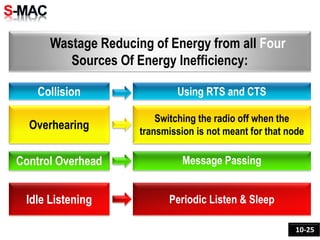
Wastage Reducing of Energy from all Four
Sources Of Energy Inefficiency:
Collision
Overhearing
Control Overhead
Idle Listening
Using RTS and CTS
Switching the radio off when the
transmission is not meant for that node
Message Passing
Periodic Listen & Sleep
10-25
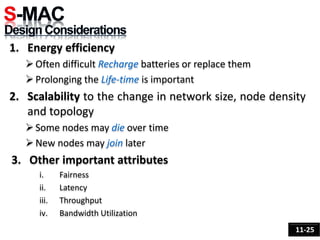
1. Energy efficiency
Often difficult Recharge batteries or replace them
Prolonging the Life-time is important
2. Scalability to the change in network size, node density
and topology
Some nodes may die over time
New nodes may join later
3. Other important attributes
i. Fairness
ii. Latency
iii. Throughput
iv. Bandwidth Utilization
11-25
•PART : A
•PART : B
•PART : C
Topics
12-25
• Test-bed
 Used Rene Motes as the development platform
and test-bed
 TinyOS
 3 working modes: Receiving, Transmitting And
Sleep
• Topology Used In The Experiment
 3 MAC modules on the mote and TinyOS platform
1. Simplified IEEE 802.11 (DCF)
2. Message Passing with Overhearing Avoidance (OA)
3. The complete (S-MAC)
13-25
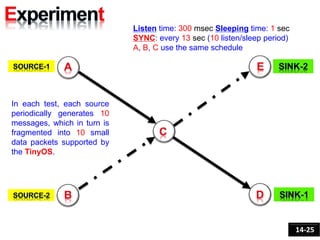
Listen time: 300 msec Sleeping time: 1 sec
SYNC: every 13 sec (10 listen/sleep period)
A, B, C use the same schedule
In each test, each source
periodically generates 10
messages, which in turn is
fragmented into 10 small
data packets supported by
the TinyOS.
14-25
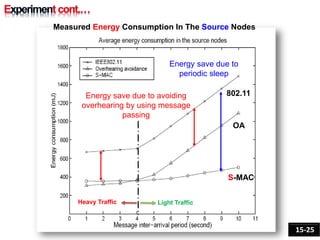
Heavy Traffic Light Traffic
Energy save due to avoiding
overhearing by using message
passing
Energy save due to
periodic sleep
802.11
OA
S-MAC
15-25
Measured Energy Consumption In The Source Nodes
 If the message inter-arrival period is 5 seconds, a
message is generated every 5 seconds by each
source node, the S-MAC duty cycle does not impact a
lot when the inter-arrival time is less than 4 seconds.
 The traffic is heavy when the message inter-arrival
time is less than 4 seconds. In this case, 802.11 MAC
uses more than twice the energy used by S-MAC.
 One possible reason the problem of transfer SYNC
message.
16-25
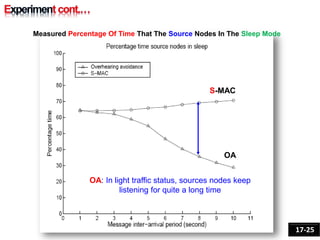
OA: In light traffic status, sources nodes keep
listening for quite a long time
OA
S-MAC
17-25
Measured Percentage Of Time That The Source Nodes In The Sleep Mode
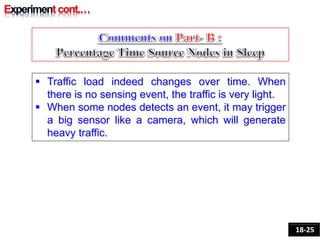
 Traffic load indeed changes over time. When
there is no sensing event, the traffic is very light.
 When some nodes detects an event, it may trigger
a big sensor like a camera, which will generate
heavy traffic.
18-25
SYNC Overhead
Overhearing Avoidance still benefit
802.11
OA
S-MAC
Heavy Traffic Light Traffic
19-25
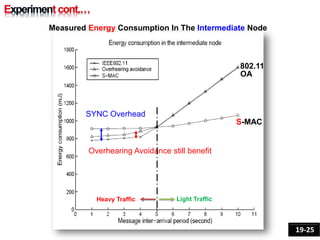
Measured Energy Consumption In The Intermediate Node
 In node C:
• One reason is that S-MAC has synchronization
overhead of sending and receiving SYNC
packets.
• Another reason is that S-MAC introduces more
latency and actually uses more time to pass the
same amount of data.
 If the traffic is heavy: S-MAC does not perform
better than Overhearing Avoidance ( OA ).
20-25
Topics
21-25
Is
this Protocol
convincing?
And, how
much so?
2
1
3 Experiments show that the aimed results are SATİSFİED
 
This new MAC protocol has very good energy
conserving (~98%) compared with IEEE802.11.
S-MAC is an energy efficient mac protocol compared
to IEEE802.11
This new MAC protocol has the ability to make trade-offs
between energy and latency according to the traffic
conditions.
 S-MAC Trade-off between energy consumption and
latency can be easily tuned
22-25
• What is the
tradeoff by using
duty cycles?
• How can we make
the schedule
more intelligent?
23-25
Topics
• What is the tradeoff by using duty cycles?
 Channel utilization and throughput reduces/Latency increase
• How can we make the schedule more intelligent?
 Randomly select schedule is not enough. If a node “know” that there is a lot
of contention. It may extent the schedule when SYNC next time.
24-25
• What are the disadvantages of S-MAC?
 Although S-MAC achieves low power operation, it doesn’t meet simple
implementation, scalability, and tolerance to changing network conditions.
As the size of the network increases, S-MAC must maintain an increasing
number of neighbors’ schedules or incur additional overhead through
repeated rounds of resynchronization.
 S-MAC suffers from the complexity and scaling problems.
Topics
1. Professional questionsdir
ectedtoDr.KunXie
2. Easy questions directed to
Me
25-25

An energy efficient mac protocol for wireless

  • 1.
  • 2.
    Topics • Introduction • S-MAC •Experiment • Conclusion • Discussion • Questions 2-25
  • 3.
  • 4.
    WSN Applicatins Application Specific WirelessNetworks For Monitoring, Smart Spaces, Medical Systems And Robotic Exploration And, Then Large Number Of Distributed Nodes And Self Organizing So, Normally Battery Operated And Hence Power Limited 4-25
  • 5.
    • Characteristics ofWSNs: leading to a Medium/Media Access Control MAC different from traditional wireless MACs such as IEEE 802.11: Use of battery-operated computing and sensing devices. devices collaborate for a common application such as environmental monitoring. WSNs are deployed in an ad hoc fashion, with nodes remaining largely inactive for long time, but becoming suddenly active when something is detected. • In WSNs, Energy Conservation and Self-configuration are primary goals, while Per-node Fairness and Latency are less important. 5-25
  • 6.
    • Contention BasedProtocols  IEEE 802.11 • Distributed Coordination Function (DCF): high energy consumption due to idle listening  PAMAS • Avoids the overhearing among neighboring nodes • Requires Two Independent Radio Channels • Does not address the issue of reduce Idle Listening 6-25
  • 7.
    Advantages • Lower EnergyConservation when compared to contention based as the duty cycle of the radio is reduced and No Contention Overhead Disadvantages • Requires nodes to form real communication clusters • Managing Inter-cluster Communication is difficult • It is not easy to change the slot assignment dynamically, hence Scalability is not as good as contention based • TDMA based protocols 7-25
  • 8.
    • Paper Proposes • S-MACGoals • Design Considerations Topics 8-25
  • 9.
    • Paper Proposes Thispaper proposes S-MAC (Sensor MAC) , a Medium/Media Access Control (MAC) protocol designed for Wireless Sensor Networks. S-MAC here is based on the concept of the “Listen/Sleep Mode Cycle” and is single-frequency contention-based protocol for sensor networks. • S-MAC Design Main Goals:  First: Reduce Energy Consumption  Second: Support Self-configuration 9-25
  • 10.
    Wastage Reducing ofEnergy from all Four Sources Of Energy Inefficiency: Collision Overhearing Control Overhead Idle Listening Using RTS and CTS Switching the radio off when the transmission is not meant for that node Message Passing Periodic Listen & Sleep 10-25
  • 11.
    1. Energy efficiency Oftendifficult Recharge batteries or replace them Prolonging the Life-time is important 2. Scalability to the change in network size, node density and topology Some nodes may die over time New nodes may join later 3. Other important attributes i. Fairness ii. Latency iii. Throughput iv. Bandwidth Utilization 11-25
  • 12.
    •PART : A •PART: B •PART : C Topics 12-25
  • 13.
    • Test-bed  UsedRene Motes as the development platform and test-bed  TinyOS  3 working modes: Receiving, Transmitting And Sleep • Topology Used In The Experiment  3 MAC modules on the mote and TinyOS platform 1. Simplified IEEE 802.11 (DCF) 2. Message Passing with Overhearing Avoidance (OA) 3. The complete (S-MAC) 13-25
  • 14.
    Listen time: 300msec Sleeping time: 1 sec SYNC: every 13 sec (10 listen/sleep period) A, B, C use the same schedule In each test, each source periodically generates 10 messages, which in turn is fragmented into 10 small data packets supported by the TinyOS. 14-25
  • 15.
    Heavy Traffic LightTraffic Energy save due to avoiding overhearing by using message passing Energy save due to periodic sleep 802.11 OA S-MAC 15-25 Measured Energy Consumption In The Source Nodes
  • 16.
     If themessage inter-arrival period is 5 seconds, a message is generated every 5 seconds by each source node, the S-MAC duty cycle does not impact a lot when the inter-arrival time is less than 4 seconds.  The traffic is heavy when the message inter-arrival time is less than 4 seconds. In this case, 802.11 MAC uses more than twice the energy used by S-MAC.  One possible reason the problem of transfer SYNC message. 16-25
  • 17.
    OA: In lighttraffic status, sources nodes keep listening for quite a long time OA S-MAC 17-25 Measured Percentage Of Time That The Source Nodes In The Sleep Mode
  • 18.
     Traffic loadindeed changes over time. When there is no sensing event, the traffic is very light.  When some nodes detects an event, it may trigger a big sensor like a camera, which will generate heavy traffic. 18-25
  • 19.
    SYNC Overhead Overhearing Avoidancestill benefit 802.11 OA S-MAC Heavy Traffic Light Traffic 19-25 Measured Energy Consumption In The Intermediate Node
  • 20.
     In nodeC: • One reason is that S-MAC has synchronization overhead of sending and receiving SYNC packets. • Another reason is that S-MAC introduces more latency and actually uses more time to pass the same amount of data.  If the traffic is heavy: S-MAC does not perform better than Overhearing Avoidance ( OA ). 20-25
  • 21.
  • 22.
    2 1 3 Experiments showthat the aimed results are SATİSFİED   This new MAC protocol has very good energy conserving (~98%) compared with IEEE802.11. S-MAC is an energy efficient mac protocol compared to IEEE802.11 This new MAC protocol has the ability to make trade-offs between energy and latency according to the traffic conditions.  S-MAC Trade-off between energy consumption and latency can be easily tuned 22-25
  • 23.
    • What isthe tradeoff by using duty cycles? • How can we make the schedule more intelligent? 23-25 Topics
  • 24.
    • What isthe tradeoff by using duty cycles?  Channel utilization and throughput reduces/Latency increase • How can we make the schedule more intelligent?  Randomly select schedule is not enough. If a node “know” that there is a lot of contention. It may extent the schedule when SYNC next time. 24-25 • What are the disadvantages of S-MAC?  Although S-MAC achieves low power operation, it doesn’t meet simple implementation, scalability, and tolerance to changing network conditions. As the size of the network increases, S-MAC must maintain an increasing number of neighbors’ schedules or incur additional overhead through repeated rounds of resynchronization.  S-MAC suffers from the complexity and scaling problems.
  • 25.