Computer Networks Group
Universität Paderborn
Ad hoc and Sensor Networks
Chapter 5: Medium access
control protocols
Holger Karl
SS 05 Ad hoc & sensor networs - Ch 5: MAC protocols2
Goals of this chapter
• Controlling when to send a packet and when to listen for a
packet are perhaps the two most important operations in a
wireless network
• Especially, idly waiting wastes huge amounts of energy
• This chapter discusses schemes for this medium access
control that are
• Suitable to mobile and wireless networks
• Emphasize energy-efficient operation
SS 05 Ad hoc & sensor networs - Ch 5: MAC protocols3
Overview
• Principal options and difficulties
• Contention-based protocols
• Schedule-based protocols
• IEEE 802.15.4
SS 05 Ad hoc & sensor networs - Ch 5: MAC protocols4
Principal options and difficulties
• Medium access in wireless networks is difficult mainly
because of
• Impossible (or very difficult) to sende and receive at the same time
• Interference situation at receiver is what counts for transmission
success, but can be very different from what sender can observe
• High error rates (for signaling packets) compound the issues
• Requirement
• As usual: high throughput, low overhead, low error rates, …
• Additionally: energy-efficient, handle switched off devices!
SS 05 Ad hoc & sensor networs - Ch 5: MAC protocols5
Requirements for energy-efficient MAC protocols
• Recall
• Transmissions are costly
• Receiving about as expensive as transmitting
• Idling can be cheaper but is still expensive
• Energy problems
• Collisions – wasted effort when two packets collide
• Overhearing – waste effort in receiving a packet destined for
another node
• Idle listening – sitting idly and trying to receive when nobody is
sending
• Protocol overhead
• Always nice: Low complexity solution
SS 05 Ad hoc & sensor networs - Ch 5: MAC protocols6
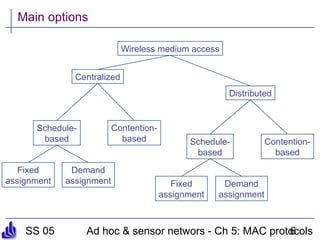
Main options
Wireless medium access
Centralized
Distributed
Contention-
based
Schedule-
based
Fixed
assignment
Demand
assignment
Contention-
based
Schedule-
based
Fixed
assignment
Demand
assignment
SS 05 Ad hoc & sensor networs - Ch 5: MAC protocols7
Centralized medium access
• Idea: Have a central station control when a node may
access the medium
• Example: Polling, centralized computation of TDMA schedules
• Advantage: Simple, quite efficient (e.g., no collisions), burdens the
central station
• Not directly feasible for non-trivial wireless network sizes
• But: Can be quite useful when network is somehow divided
into smaller groups
• Clusters, in each cluster medium access can be controlled
centrally – compare Bluetooth piconets, for example
! Usually, distributed medium access is considered
SS 05 Ad hoc & sensor networs - Ch 5: MAC protocols8
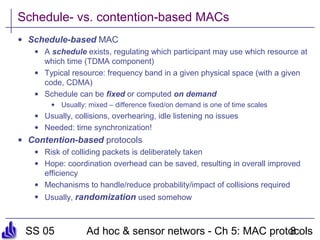
Schedule- vs. contention-based MACs
• Schedule-based MAC
• A schedule exists, regulating which participant may use which resource at
which time (TDMA component)
• Typical resource: frequency band in a given physical space (with a given
code, CDMA)
• Schedule can be fixed or computed on demand
• Usually: mixed – difference fixed/on demand is one of time scales
• Usually, collisions, overhearing, idle listening no issues
• Needed: time synchronization!
• Contention-based protocols
• Risk of colliding packets is deliberately taken
• Hope: coordination overhead can be saved, resulting in overall improved
efficiency
• Mechanisms to handle/reduce probability/impact of collisions required
• Usually, randomization used somehow
SS 05 Ad hoc & sensor networs - Ch 5: MAC protocols9
Overview
• Principal options and difficulties
• Contention-based protocols
• MACA
• S-MAC, T-MAC
• Preamble sampling, B-MAC
• PAMAS
• Schedule-based protocols
• IEEE 802.15.4
SS 05 Ad hoc & sensor networs - Ch 5: MAC protocols10
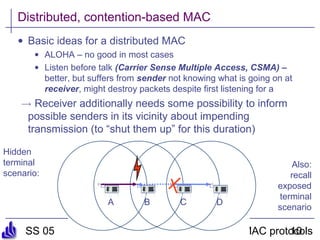
A
Distributed, contention-based MAC
• Basic ideas for a distributed MAC
• ALOHA – no good in most cases
• Listen before talk (Carrier Sense Multiple Access, CSMA) –
better, but suffers from sender not knowing what is going on at
receiver, might destroy packets despite first listening for a
! Receiver additionally needs some possibility to inform
possible senders in its vicinity about impending
transmission (to “shut them up” for this duration)
B C D
Hidden
terminal
scenario:
Also:
recall
exposed
terminal
scenario
SS 05 Ad hoc & sensor networs - Ch 5: MAC protocols11
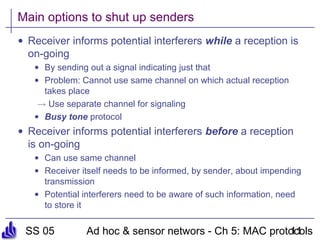
Main options to shut up senders
• Receiver informs potential interferers while a reception is
on-going
• By sending out a signal indicating just that
• Problem: Cannot use same channel on which actual reception
takes place
! Use separate channel for signaling
• Busy tone protocol
• Receiver informs potential interferers before a reception
is on-going
• Can use same channel
• Receiver itself needs to be informed, by sender, about impending
transmission
• Potential interferers need to be aware of such information, need
to store it
SS 05 Ad hoc & sensor networs - Ch 5: MAC protocols12
Receiver informs interferers before transmission – MACA
• Sender B asks receiver C
whether C is able to receive a
transmission
Request to Send (RTS)
• Receiver C agrees, sends out
a Clear to Send (CTS)
• Potential interferers overhear
either RTS or CTS and know
about impending transmission
and for how long it will last
• Store this information in a
Network Allocation Vector
• B sends, C acks
! MACA protocol (used e.g. in
IEEE 802.11)
SS 05 Ad hoc & sensor networs - Ch 5: MAC protocols13
RTS/CTS
• RTS/CTS ameliorate, but do not solve hidden/exposed
terminal problems
• Example problem cases:
SS 05 Ad hoc & sensor networs - Ch 5: MAC protocols14
MACA Problem: Idle listening
• Need to sense carrier for RTS or CTS packets
• In some form shared by many CSMA variants; but e.g. not by busy
tones
• Simple sleeping will break the protocol
• IEEE 802.11 solution: ATIM windows & sleeping
• Basic idea: Nodes that have data buffered for receivers send
traffic indicators at pre-arranged points in time
• Receivers need to wake up at these points, but can sleep
otherwise
• Parameters to adjust in MACA
• Random delays – how long to wait between listen/transmission
attempts?
• Number of RTS/CTS/ACK re-trials?
• …
SS 05 Ad hoc & sensor networs - Ch 5: MAC protocols15
Sensor-MAC (S-MAC)
• MACA’s idle listening is particularly unsuitable if average data rate is
low
• Most of the time, nothing happens
• Idea: Switch nodes off, ensure that neighboring nodes turn on
simultaneously to allow packet exchange (rendez-vous)
• Only in these active periods,
packet exchanges happen
• Need to also exchange
wakeup schedule between
neighbors
• When awake, essentially
perform RTS/CTS
• Use SYNCH, RTS, CTS
phases
SS 05 Ad hoc & sensor networs - Ch 5: MAC protocols16
S-MAC synchronized islands
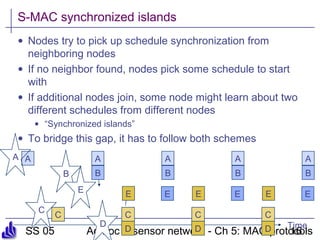
• Nodes try to pick up schedule synchronization from
neighboring nodes
• If no neighbor found, nodes pick some schedule to start
with
• If additional nodes join, some node might learn about two
different schedules from different nodes
• “Synchronized islands”
• To bridge this gap, it has to follow both schemes
Time
A A A A
C C C C
A
B B B B
D D D
A
C
B
D
E E E EE E E
SS 05 Ad hoc & sensor networs - Ch 5: MAC protocols17
Timeout-MAC (T-MAC)
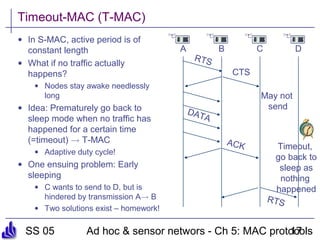
• In S-MAC, active period is of
constant length
• What if no traffic actually
happens?
• Nodes stay awake needlessly
long
• Idea: Prematurely go back to
sleep mode when no traffic has
happened for a certain time
(=timeout) ! T-MAC
• Adaptive duty cycle!
• One ensuing problem: Early
sleeping
• C wants to send to D, but is
hindered by transmission A! B
• Two solutions exist – homework!
A B C D
RTS
CTS
DATA
May not
send
Timeout,
go back to
sleep as
nothing
happened
ACK
RTS
SS 05 Ad hoc & sensor networs - Ch 5: MAC protocols18
Preamble Sampling
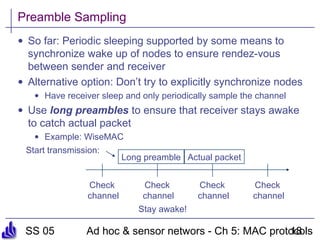
• So far: Periodic sleeping supported by some means to
synchronize wake up of nodes to ensure rendez-vous
between sender and receiver
• Alternative option: Don’t try to explicitly synchronize nodes
• Have receiver sleep and only periodically sample the channel
• Use long preambles to ensure that receiver stays awake
to catch actual packet
• Example: WiseMAC
Check
channel
Check
channel
Check
channel
Check
channel
Start transmission:
Long preamble Actual packet
Stay awake!
SS 05 Ad hoc & sensor networs - Ch 5: MAC protocols19
B-MAC
• Combines several of the above discussed ideas
• Takes care to provide practically relevant solutions
• Clear Channel Assessment
• Adapts to noise floor by sampling channel when it is assumed to
be free
• Samples are exponentially averaged, result used in gain control
• For actual assessment when sending a packet, look at five
channel samples – channel is free if even a single one of them is
significantly below noise
• Optional: random backoff if channel is found busy
• Optional: Immediate link layer acknowledgements for
received packets
SS 05 Ad hoc & sensor networs - Ch 5: MAC protocols20
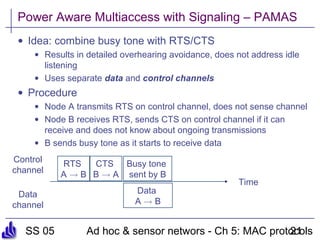
B-MAC II
• Low Power Listening (= preamble sampling)
• Uses the clear channel assessment techniques to decide whether
there is a packet arriving when node wakes up
• Timeout puts node back to sleep if no packet arrived
• B-MAC does not have
• Synchronization
• RTS/CTS
• Results in simpler, leaner implementation
• Clean and simple interface
• Currently: Often considered as the default WSN MAC
protocol
SS 05 Ad hoc & sensor networs - Ch 5: MAC protocols21
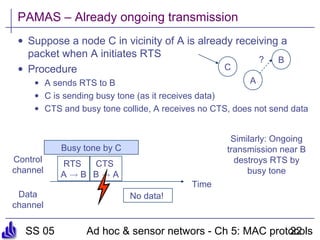
Power Aware Multiaccess with Signaling – PAMAS
• Idea: combine busy tone with RTS/CTS
• Results in detailed overhearing avoidance, does not address idle
listening
• Uses separate data and control channels
• Procedure
• Node A transmits RTS on control channel, does not sense channel
• Node B receives RTS, sends CTS on control channel if it can
receive and does not know about ongoing transmissions
• B sends busy tone as it starts to receive data
Time
Control
channel
Data
channel
RTS
A ! B
CTS
B ! A
Data
A ! B
Busy tone
sent by B
SS 05 Ad hoc & sensor networs - Ch 5: MAC protocols22
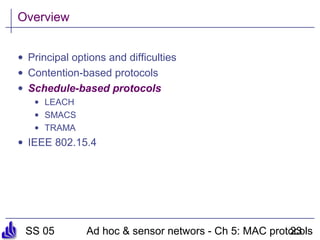
PAMAS – Already ongoing transmission
• Suppose a node C in vicinity of A is already receiving a
packet when A initiates RTS
• Procedure
• A sends RTS to B
• C is sending busy tone (as it receives data)
• CTS and busy tone collide, A receives no CTS, does not send data
A
B
C
?
Time
Control
channel
Data
channel
RTS
A ! B
CTS
B ! A
No data!
Busy tone by C
Similarly: Ongoing
transmission near B
destroys RTS by
busy tone
SS 05 Ad hoc & sensor networs - Ch 5: MAC protocols23
Overview
• Principal options and difficulties
• Contention-based protocols
• Schedule-based protocols
• LEACH
• SMACS
• TRAMA
• IEEE 802.15.4
SS 05 Ad hoc & sensor networs - Ch 5: MAC protocols24
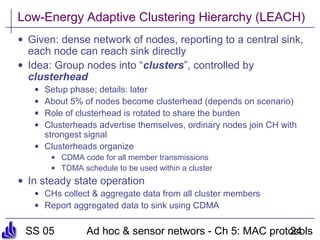
Low-Energy Adaptive Clustering Hierarchy (LEACH)
• Given: dense network of nodes, reporting to a central sink,
each node can reach sink directly
• Idea: Group nodes into “clusters”, controlled by
clusterhead
• Setup phase; details: later
• About 5% of nodes become clusterhead (depends on scenario)
• Role of clusterhead is rotated to share the burden
• Clusterheads advertise themselves, ordinary nodes join CH with
strongest signal
• Clusterheads organize
• CDMA code for all member transmissions
• TDMA schedule to be used within a cluster
• In steady state operation
• CHs collect & aggregate data from all cluster members
• Report aggregated data to sink using CDMA
SS 05 Ad hoc & sensor networs - Ch 5: MAC protocols25
LEACH rounds
SS 05 Ad hoc & sensor networs - Ch 5: MAC protocols26
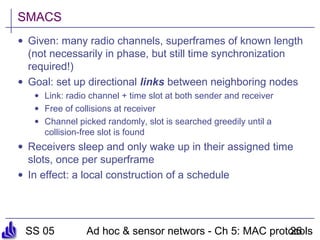
SMACS
• Given: many radio channels, superframes of known length
(not necessarily in phase, but still time synchronization
required!)
• Goal: set up directional links between neighboring nodes
• Link: radio channel + time slot at both sender and receiver
• Free of collisions at receiver
• Channel picked randomly, slot is searched greedily until a
collision-free slot is found
• Receivers sleep and only wake up in their assigned time
slots, once per superframe
• In effect: a local construction of a schedule
SS 05 Ad hoc & sensor networs - Ch 5: MAC protocols27
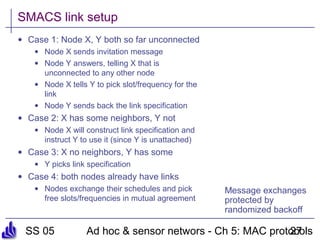
SMACS link setup
• Case 1: Node X, Y both so far unconnected
• Node X sends invitation message
• Node Y answers, telling X that is
unconnected to any other node
• Node X tells Y to pick slot/frequency for the
link
• Node Y sends back the link specification
• Case 2: X has some neighbors, Y not
• Node X will construct link specification and
instruct Y to use it (since Y is unattached)
• Case 3: X no neighbors, Y has some
• Y picks link specification
• Case 4: both nodes already have links
• Nodes exchange their schedules and pick
free slots/frequencies in mutual agreement
Message exchanges
protected by
randomized backoff
SS 05 Ad hoc & sensor networs - Ch 5: MAC protocols28
TRAMA
• Nodes are synchronized
• Time divided into cycles, divided into
• Random access periods
• Scheduled access periods
• Nodes exchange neighborhood information
• Learning about their two-hop neighborhood
• Using neighborhood exchange protocol: In random access
period, send small, incremental neighborhood update information
in randomly selected time slots
• Nodes exchange schedules
• Using schedule exchange protocol
• Similar to neighborhood exchange
SS 05 Ad hoc & sensor networs - Ch 5: MAC protocols29
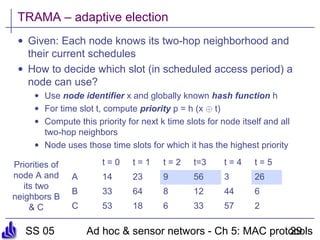
TRAMA – adaptive election
• Given: Each node knows its two-hop neighborhood and
their current schedules
• How to decide which slot (in scheduled access period) a
node can use?
• Use node identifier x and globally known hash function h
• For time slot t, compute priority p = h (x © t)
• Compute this priority for next k time slots for node itself and all
two-hop neighbors
• Node uses those time slots for which it has the highest priority
t = 0 t = 1 t = 2 t=3 t = 4 t = 5
A 14 23 9 56 3 26
B 33 64 8 12 44 6
C 53 18 6 33 57 2
Priorities of
node A and
its two
neighbors B
& C
SS 05 Ad hoc & sensor networs - Ch 5: MAC protocols30
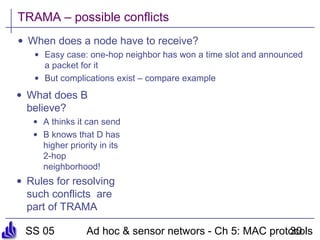
TRAMA – possible conflicts
• When does a node have to receive?
• Easy case: one-hop neighbor has won a time slot and announced
a packet for it
• But complications exist – compare example
• What does B
believe?
• A thinks it can send
• B knows that D has
higher priority in its
2-hop
neighborhood!
• Rules for resolving
such conflicts are
part of TRAMA
SS 05 Ad hoc & sensor networs - Ch 5: MAC protocols31
Comparison: TRAMA, S-MAC
• Comparison between TRAMA & S-MAC
• Energy savings in TRAMA depend on load situation
• Energy savings in S-MAC depend on duty cycle
• TRAMA (as typical for a TDMA scheme) has higher delay but
higher maximum throughput than contention-based S-MAC
• TRAMA disadvantage: substantial memory/CPU
requirements for schedule computation
SS 05 Ad hoc & sensor networs - Ch 5: MAC protocols32
Overview
• Principal options and difficulties
• Contention-based protocols
• Schedule-based protocols
• IEEE 802.15.4
SS 05 Ad hoc & sensor networs - Ch 5: MAC protocols33
IEEE 802.15.4
• IEEE standard for low-rate WPAN applications
• Goals: low-to-medium bit rates, moderate delays without
too stringent guarantee requirements, low energy
consumption
• Physical layer
• 20 kbps over 1 channel @ 868-868.6 MHz
• 40 kbps over 10 channels @ 905 – 928 MHz
• 250 kbps over 16 channels @ 2.4 GHz
• MAC protocol
• Single channel at any one time
• Combines contention-based and schedule-based schemes
• Asymmetric: nodes can assume different roles
SS 05 Ad hoc & sensor networs - Ch 5: MAC protocols34
IEEE 802.15.4 MAC overview
• Star networks: devices are associated with coordinators
• Forming a PAN, identified by a PAN identifier
• Coordinator
• Bookkeeping of devices, address assignment, generate beacons
• Talks to devices and peer coordinators
• Beacon-mode superframe structure
• GTS assigned to devices upon request
SS 05 Ad hoc & sensor networs - Ch 5: MAC protocols35
Wakeup radio MAC protocols
• Simplest scheme: Send a wakeup “burst”, waking up all
neighbors ! Significant overhearing
• Possible option: First send a short filter packet that includes the
actual destination address to allow nodes to power off quickly
• Not quite so simple scheme: Send a wakeup burst
including the receiver address
• Wakeup radio needs to support this option
• Additionally: Send information about a (randomly chosen)
data channel, CDMA code, … in the wakeup burst
• Various variations on these schemes in the literature,
various further problems
• One problem: 2-hop neighborhood on wakeup channel might be
different from 2-hop neighborhood on data channel
• Not trivial to guarantee unique addresses on both channels
SS 05 Ad hoc & sensor networs - Ch 5: MAC protocols36
Further protocols
• MAC protocols for ad hoc/sensor networks is one the most
active research fields
• Tons of additional protocols in the literature
• Examples: STEM, mediation device protocol, many CSMA variants
with different timing optimizations, protocols for multi-hop
reservations (QoS for MANET), protocols for multiple radio
channels, …
• Additional problems, e.g., reliable multicast
• This chapter has barely scratched the surface…
SS 05 Ad hoc & sensor networs - Ch 5: MAC protocols37
Summary
• Many different ideas exist for medium access control in
MANET/WSN
• Comparing their performance and suitability is difficult
• Especially: clearly identifying interdependencies between
MAC protocol and other layers/applications is difficult
• Which is the best MAC for which application?
• Nonetheless, certain “common use cases” exist
• IEEE 802.11 DCF for MANET
• IEEE 802.15.4 for some early “commerical” WSN variants
• B-MAC for WSN research not focusing on MAC

Sensys ch5-mac

  • 1.
    Computer Networks Group UniversitätPaderborn Ad hoc and Sensor Networks Chapter 5: Medium access control protocols Holger Karl
  • 2.
    SS 05 Adhoc & sensor networs - Ch 5: MAC protocols2 Goals of this chapter • Controlling when to send a packet and when to listen for a packet are perhaps the two most important operations in a wireless network • Especially, idly waiting wastes huge amounts of energy • This chapter discusses schemes for this medium access control that are • Suitable to mobile and wireless networks • Emphasize energy-efficient operation
  • 3.
    SS 05 Adhoc & sensor networs - Ch 5: MAC protocols3 Overview • Principal options and difficulties • Contention-based protocols • Schedule-based protocols • IEEE 802.15.4
  • 4.
    SS 05 Adhoc & sensor networs - Ch 5: MAC protocols4 Principal options and difficulties • Medium access in wireless networks is difficult mainly because of • Impossible (or very difficult) to sende and receive at the same time • Interference situation at receiver is what counts for transmission success, but can be very different from what sender can observe • High error rates (for signaling packets) compound the issues • Requirement • As usual: high throughput, low overhead, low error rates, … • Additionally: energy-efficient, handle switched off devices!
  • 5.
    SS 05 Adhoc & sensor networs - Ch 5: MAC protocols5 Requirements for energy-efficient MAC protocols • Recall • Transmissions are costly • Receiving about as expensive as transmitting • Idling can be cheaper but is still expensive • Energy problems • Collisions – wasted effort when two packets collide • Overhearing – waste effort in receiving a packet destined for another node • Idle listening – sitting idly and trying to receive when nobody is sending • Protocol overhead • Always nice: Low complexity solution
  • 6.
    SS 05 Adhoc & sensor networs - Ch 5: MAC protocols6 Main options Wireless medium access Centralized Distributed Contention- based Schedule- based Fixed assignment Demand assignment Contention- based Schedule- based Fixed assignment Demand assignment
  • 7.
    SS 05 Adhoc & sensor networs - Ch 5: MAC protocols7 Centralized medium access • Idea: Have a central station control when a node may access the medium • Example: Polling, centralized computation of TDMA schedules • Advantage: Simple, quite efficient (e.g., no collisions), burdens the central station • Not directly feasible for non-trivial wireless network sizes • But: Can be quite useful when network is somehow divided into smaller groups • Clusters, in each cluster medium access can be controlled centrally – compare Bluetooth piconets, for example ! Usually, distributed medium access is considered
  • 8.
    SS 05 Adhoc & sensor networs - Ch 5: MAC protocols8 Schedule- vs. contention-based MACs • Schedule-based MAC • A schedule exists, regulating which participant may use which resource at which time (TDMA component) • Typical resource: frequency band in a given physical space (with a given code, CDMA) • Schedule can be fixed or computed on demand • Usually: mixed – difference fixed/on demand is one of time scales • Usually, collisions, overhearing, idle listening no issues • Needed: time synchronization! • Contention-based protocols • Risk of colliding packets is deliberately taken • Hope: coordination overhead can be saved, resulting in overall improved efficiency • Mechanisms to handle/reduce probability/impact of collisions required • Usually, randomization used somehow
  • 9.
    SS 05 Adhoc & sensor networs - Ch 5: MAC protocols9 Overview • Principal options and difficulties • Contention-based protocols • MACA • S-MAC, T-MAC • Preamble sampling, B-MAC • PAMAS • Schedule-based protocols • IEEE 802.15.4
  • 10.
    SS 05 Adhoc & sensor networs - Ch 5: MAC protocols10 A Distributed, contention-based MAC • Basic ideas for a distributed MAC • ALOHA – no good in most cases • Listen before talk (Carrier Sense Multiple Access, CSMA) – better, but suffers from sender not knowing what is going on at receiver, might destroy packets despite first listening for a ! Receiver additionally needs some possibility to inform possible senders in its vicinity about impending transmission (to “shut them up” for this duration) B C D Hidden terminal scenario: Also: recall exposed terminal scenario
  • 11.
    SS 05 Adhoc & sensor networs - Ch 5: MAC protocols11 Main options to shut up senders • Receiver informs potential interferers while a reception is on-going • By sending out a signal indicating just that • Problem: Cannot use same channel on which actual reception takes place ! Use separate channel for signaling • Busy tone protocol • Receiver informs potential interferers before a reception is on-going • Can use same channel • Receiver itself needs to be informed, by sender, about impending transmission • Potential interferers need to be aware of such information, need to store it
  • 12.
    SS 05 Adhoc & sensor networs - Ch 5: MAC protocols12 Receiver informs interferers before transmission – MACA • Sender B asks receiver C whether C is able to receive a transmission Request to Send (RTS) • Receiver C agrees, sends out a Clear to Send (CTS) • Potential interferers overhear either RTS or CTS and know about impending transmission and for how long it will last • Store this information in a Network Allocation Vector • B sends, C acks ! MACA protocol (used e.g. in IEEE 802.11)
  • 13.
    SS 05 Adhoc & sensor networs - Ch 5: MAC protocols13 RTS/CTS • RTS/CTS ameliorate, but do not solve hidden/exposed terminal problems • Example problem cases:
  • 14.
    SS 05 Adhoc & sensor networs - Ch 5: MAC protocols14 MACA Problem: Idle listening • Need to sense carrier for RTS or CTS packets • In some form shared by many CSMA variants; but e.g. not by busy tones • Simple sleeping will break the protocol • IEEE 802.11 solution: ATIM windows & sleeping • Basic idea: Nodes that have data buffered for receivers send traffic indicators at pre-arranged points in time • Receivers need to wake up at these points, but can sleep otherwise • Parameters to adjust in MACA • Random delays – how long to wait between listen/transmission attempts? • Number of RTS/CTS/ACK re-trials? • …
  • 15.
    SS 05 Adhoc & sensor networs - Ch 5: MAC protocols15 Sensor-MAC (S-MAC) • MACA’s idle listening is particularly unsuitable if average data rate is low • Most of the time, nothing happens • Idea: Switch nodes off, ensure that neighboring nodes turn on simultaneously to allow packet exchange (rendez-vous) • Only in these active periods, packet exchanges happen • Need to also exchange wakeup schedule between neighbors • When awake, essentially perform RTS/CTS • Use SYNCH, RTS, CTS phases
  • 16.
    SS 05 Adhoc & sensor networs - Ch 5: MAC protocols16 S-MAC synchronized islands • Nodes try to pick up schedule synchronization from neighboring nodes • If no neighbor found, nodes pick some schedule to start with • If additional nodes join, some node might learn about two different schedules from different nodes • “Synchronized islands” • To bridge this gap, it has to follow both schemes Time A A A A C C C C A B B B B D D D A C B D E E E EE E E
  • 17.
    SS 05 Adhoc & sensor networs - Ch 5: MAC protocols17 Timeout-MAC (T-MAC) • In S-MAC, active period is of constant length • What if no traffic actually happens? • Nodes stay awake needlessly long • Idea: Prematurely go back to sleep mode when no traffic has happened for a certain time (=timeout) ! T-MAC • Adaptive duty cycle! • One ensuing problem: Early sleeping • C wants to send to D, but is hindered by transmission A! B • Two solutions exist – homework! A B C D RTS CTS DATA May not send Timeout, go back to sleep as nothing happened ACK RTS
  • 18.
    SS 05 Adhoc & sensor networs - Ch 5: MAC protocols18 Preamble Sampling • So far: Periodic sleeping supported by some means to synchronize wake up of nodes to ensure rendez-vous between sender and receiver • Alternative option: Don’t try to explicitly synchronize nodes • Have receiver sleep and only periodically sample the channel • Use long preambles to ensure that receiver stays awake to catch actual packet • Example: WiseMAC Check channel Check channel Check channel Check channel Start transmission: Long preamble Actual packet Stay awake!
  • 19.
    SS 05 Adhoc & sensor networs - Ch 5: MAC protocols19 B-MAC • Combines several of the above discussed ideas • Takes care to provide practically relevant solutions • Clear Channel Assessment • Adapts to noise floor by sampling channel when it is assumed to be free • Samples are exponentially averaged, result used in gain control • For actual assessment when sending a packet, look at five channel samples – channel is free if even a single one of them is significantly below noise • Optional: random backoff if channel is found busy • Optional: Immediate link layer acknowledgements for received packets
  • 20.
    SS 05 Adhoc & sensor networs - Ch 5: MAC protocols20 B-MAC II • Low Power Listening (= preamble sampling) • Uses the clear channel assessment techniques to decide whether there is a packet arriving when node wakes up • Timeout puts node back to sleep if no packet arrived • B-MAC does not have • Synchronization • RTS/CTS • Results in simpler, leaner implementation • Clean and simple interface • Currently: Often considered as the default WSN MAC protocol
  • 21.
    SS 05 Adhoc & sensor networs - Ch 5: MAC protocols21 Power Aware Multiaccess with Signaling – PAMAS • Idea: combine busy tone with RTS/CTS • Results in detailed overhearing avoidance, does not address idle listening • Uses separate data and control channels • Procedure • Node A transmits RTS on control channel, does not sense channel • Node B receives RTS, sends CTS on control channel if it can receive and does not know about ongoing transmissions • B sends busy tone as it starts to receive data Time Control channel Data channel RTS A ! B CTS B ! A Data A ! B Busy tone sent by B
  • 22.
    SS 05 Adhoc & sensor networs - Ch 5: MAC protocols22 PAMAS – Already ongoing transmission • Suppose a node C in vicinity of A is already receiving a packet when A initiates RTS • Procedure • A sends RTS to B • C is sending busy tone (as it receives data) • CTS and busy tone collide, A receives no CTS, does not send data A B C ? Time Control channel Data channel RTS A ! B CTS B ! A No data! Busy tone by C Similarly: Ongoing transmission near B destroys RTS by busy tone
  • 23.
    SS 05 Adhoc & sensor networs - Ch 5: MAC protocols23 Overview • Principal options and difficulties • Contention-based protocols • Schedule-based protocols • LEACH • SMACS • TRAMA • IEEE 802.15.4
  • 24.
    SS 05 Adhoc & sensor networs - Ch 5: MAC protocols24 Low-Energy Adaptive Clustering Hierarchy (LEACH) • Given: dense network of nodes, reporting to a central sink, each node can reach sink directly • Idea: Group nodes into “clusters”, controlled by clusterhead • Setup phase; details: later • About 5% of nodes become clusterhead (depends on scenario) • Role of clusterhead is rotated to share the burden • Clusterheads advertise themselves, ordinary nodes join CH with strongest signal • Clusterheads organize • CDMA code for all member transmissions • TDMA schedule to be used within a cluster • In steady state operation • CHs collect & aggregate data from all cluster members • Report aggregated data to sink using CDMA
  • 25.
    SS 05 Adhoc & sensor networs - Ch 5: MAC protocols25 LEACH rounds
  • 26.
    SS 05 Adhoc & sensor networs - Ch 5: MAC protocols26 SMACS • Given: many radio channels, superframes of known length (not necessarily in phase, but still time synchronization required!) • Goal: set up directional links between neighboring nodes • Link: radio channel + time slot at both sender and receiver • Free of collisions at receiver • Channel picked randomly, slot is searched greedily until a collision-free slot is found • Receivers sleep and only wake up in their assigned time slots, once per superframe • In effect: a local construction of a schedule
  • 27.
    SS 05 Adhoc & sensor networs - Ch 5: MAC protocols27 SMACS link setup • Case 1: Node X, Y both so far unconnected • Node X sends invitation message • Node Y answers, telling X that is unconnected to any other node • Node X tells Y to pick slot/frequency for the link • Node Y sends back the link specification • Case 2: X has some neighbors, Y not • Node X will construct link specification and instruct Y to use it (since Y is unattached) • Case 3: X no neighbors, Y has some • Y picks link specification • Case 4: both nodes already have links • Nodes exchange their schedules and pick free slots/frequencies in mutual agreement Message exchanges protected by randomized backoff
  • 28.
    SS 05 Adhoc & sensor networs - Ch 5: MAC protocols28 TRAMA • Nodes are synchronized • Time divided into cycles, divided into • Random access periods • Scheduled access periods • Nodes exchange neighborhood information • Learning about their two-hop neighborhood • Using neighborhood exchange protocol: In random access period, send small, incremental neighborhood update information in randomly selected time slots • Nodes exchange schedules • Using schedule exchange protocol • Similar to neighborhood exchange
  • 29.
    SS 05 Adhoc & sensor networs - Ch 5: MAC protocols29 TRAMA – adaptive election • Given: Each node knows its two-hop neighborhood and their current schedules • How to decide which slot (in scheduled access period) a node can use? • Use node identifier x and globally known hash function h • For time slot t, compute priority p = h (x © t) • Compute this priority for next k time slots for node itself and all two-hop neighbors • Node uses those time slots for which it has the highest priority t = 0 t = 1 t = 2 t=3 t = 4 t = 5 A 14 23 9 56 3 26 B 33 64 8 12 44 6 C 53 18 6 33 57 2 Priorities of node A and its two neighbors B & C
  • 30.
    SS 05 Adhoc & sensor networs - Ch 5: MAC protocols30 TRAMA – possible conflicts • When does a node have to receive? • Easy case: one-hop neighbor has won a time slot and announced a packet for it • But complications exist – compare example • What does B believe? • A thinks it can send • B knows that D has higher priority in its 2-hop neighborhood! • Rules for resolving such conflicts are part of TRAMA
  • 31.
    SS 05 Adhoc & sensor networs - Ch 5: MAC protocols31 Comparison: TRAMA, S-MAC • Comparison between TRAMA & S-MAC • Energy savings in TRAMA depend on load situation • Energy savings in S-MAC depend on duty cycle • TRAMA (as typical for a TDMA scheme) has higher delay but higher maximum throughput than contention-based S-MAC • TRAMA disadvantage: substantial memory/CPU requirements for schedule computation
  • 32.
    SS 05 Adhoc & sensor networs - Ch 5: MAC protocols32 Overview • Principal options and difficulties • Contention-based protocols • Schedule-based protocols • IEEE 802.15.4
  • 33.
    SS 05 Adhoc & sensor networs - Ch 5: MAC protocols33 IEEE 802.15.4 • IEEE standard for low-rate WPAN applications • Goals: low-to-medium bit rates, moderate delays without too stringent guarantee requirements, low energy consumption • Physical layer • 20 kbps over 1 channel @ 868-868.6 MHz • 40 kbps over 10 channels @ 905 – 928 MHz • 250 kbps over 16 channels @ 2.4 GHz • MAC protocol • Single channel at any one time • Combines contention-based and schedule-based schemes • Asymmetric: nodes can assume different roles
  • 34.
    SS 05 Adhoc & sensor networs - Ch 5: MAC protocols34 IEEE 802.15.4 MAC overview • Star networks: devices are associated with coordinators • Forming a PAN, identified by a PAN identifier • Coordinator • Bookkeeping of devices, address assignment, generate beacons • Talks to devices and peer coordinators • Beacon-mode superframe structure • GTS assigned to devices upon request
  • 35.
    SS 05 Adhoc & sensor networs - Ch 5: MAC protocols35 Wakeup radio MAC protocols • Simplest scheme: Send a wakeup “burst”, waking up all neighbors ! Significant overhearing • Possible option: First send a short filter packet that includes the actual destination address to allow nodes to power off quickly • Not quite so simple scheme: Send a wakeup burst including the receiver address • Wakeup radio needs to support this option • Additionally: Send information about a (randomly chosen) data channel, CDMA code, … in the wakeup burst • Various variations on these schemes in the literature, various further problems • One problem: 2-hop neighborhood on wakeup channel might be different from 2-hop neighborhood on data channel • Not trivial to guarantee unique addresses on both channels
  • 36.
    SS 05 Adhoc & sensor networs - Ch 5: MAC protocols36 Further protocols • MAC protocols for ad hoc/sensor networks is one the most active research fields • Tons of additional protocols in the literature • Examples: STEM, mediation device protocol, many CSMA variants with different timing optimizations, protocols for multi-hop reservations (QoS for MANET), protocols for multiple radio channels, … • Additional problems, e.g., reliable multicast • This chapter has barely scratched the surface…
  • 37.
    SS 05 Adhoc & sensor networs - Ch 5: MAC protocols37 Summary • Many different ideas exist for medium access control in MANET/WSN • Comparing their performance and suitability is difficult • Especially: clearly identifying interdependencies between MAC protocol and other layers/applications is difficult • Which is the best MAC for which application? • Nonetheless, certain “common use cases” exist • IEEE 802.11 DCF for MANET • IEEE 802.15.4 for some early “commerical” WSN variants • B-MAC for WSN research not focusing on MAC

Editor's Notes

  • #18 Solutions to early sleeping as homework?
  • #19 Das gibt eine SEHR schöne Übungsaufgabe!
  • #23 Probing protocol of PAMAS as exercise?