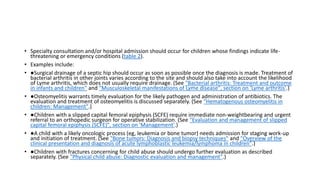
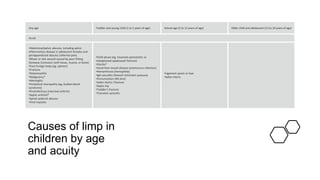
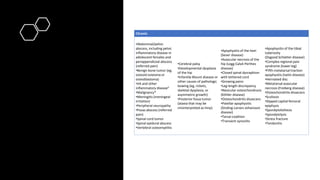
The document discusses the evaluation and causes of a limping child. It defines a limp and describes different types of gaits that can help narrow the differential diagnosis. Common causes of limp are then outlined based on age and acuity. The evaluation involves a thorough history, physical exam focusing on general appearance, vital signs, gait, musculoskeletal exam, and examining the abdomen, genitalia, spine and lower extremities. Based on history and exam findings, appropriate diagnostic tests or imaging may be pursued. For most children, treatment is conservative but specialty referral is needed for emergency conditions like septic hip or slipped capital femoral epiphysis.
![Defintion
• Limp is defined as an abnormality in gait that is caused by pain,
weakness, or deformity [1,2,5,6]. In toddlers and young children,
conditions that cause limp may present as a refusal to walk or stand.
At times, ataxia may masquerade as a limp, but a careful examination
usually distinguishes this condition based on the absence of
tenderness, weakness, or deformity, and the presence of movements,
often involving the trunk or upper extremities as well as the lower
extremities, characteristic of cerebellar dysfunction fthyyy
gtffgtfxgrfrxddfr](https://image.slidesharecdn.com/limpingchild-220729235754-d2bca31d/85/limping-child-pptx-2-320.jpg)
![Limp can be further described by gait pathology,
which can help narrow the differential diagnosis
• ●Antalgic gait – Antalgic gait is the most common type of limp encountered in children; it is characterized by a short stance phase
on the affected extremity due to pain. An antalgic gait is associated with bone and soft tissue trauma, infection, inflammation, and
bony lesions.
• ●Toe-walking gait – A child will toe-walk due to heel pain, calf pain, or neurologic abnormality with increased flexor muscle tone in
the lower leg. Examples of conditions that may present with toe-walking include cerebral palsy, peripheral neuropathy, hereditary
spastic paraparesis, or spinal cord disorder [7]. Influenza A may cause acute calf myositis with self-limited toe-walking.
• ●Stooping gait – A stooping gait with hips flexed throughout the gait cycle suggests psoas muscle or obturator nerve irritation
associated with appendicitis, psoas muscle abscess, pelvic inflammatory disease, ovarian torsion, or testicular torsion.
• ●Trendelenburg gait – Trendelenburg gait describes a downward pelvic tilt or shift toward the unaffected limb as it swings through
caused by gluteus medius muscle weakness or spasm in the affected leg when it is in stance phase (picture 1). This gait frequently
accompanies slipped capital femoral epiphysis, Legg-Calvé-Perthes disease, and developmental dysplasia of the hip.
• ●Steppage gait – Patients with a foot drop due to neurologic disease display exaggerated hip and knee flexion as the affected leg
swings through to keep the foot from dragging on the floor. It is often accompanied by a slap of the foot during heel strike.
• ●Vaulting gait – Patients with limb length discrepancy or abnormal knee mobility maintain the knee hyperextended and locked at
the end of stance phase and "vault" over the affected leg.](https://image.slidesharecdn.com/limpingchild-220729235754-d2bca31d/85/limping-child-pptx-3-320.jpg)
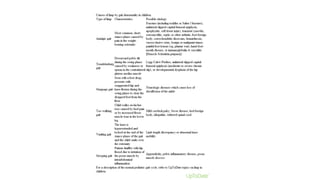
![Antalgic gait Most common; short-stance phase caused by pain in the weight-bearing extremity
Fracture (including toddler or Salter I fracture), unilateral slipped capital femoral
epiphysis, apophysitis, soft tissue injury, transient synovitis, osteomyelitis, septic or
other arthritis, foot foreign body, osteochondritis dissecans, hemarthrosis,
vasoocclusive crisis, benign or malignant tumor, painful foot lesions (eg, plantar
wart, hand-foot-mouth disease, or immunoglobulin A vasculitis [Henoch-Schönlein
purpura])
Trendelenburg gait
Downward pelvic tilt during the swing phase caused by weakness or spasm in the
contralateral gluteus medius muscle
Legg-Calvé-Perthes, unilateral slipped capital femoral epiphysis (moderate to severe
chronic slip), or developmental dysplasia of the hip
Steppage gait
Seen with a foot drop; presents with exaggerated hip and knee flexion during the
swing phase to clear the dropped foot from the floor
Neurologic diseases which cause loss of dorsiflexion of the ankle
Toe-walking gait
Child walks on his/her toes caused by heel pain or by increased flexor muscle tone in
the lower leg
Mild cerebral palsy, Sever disease, heel foreign body, idiopathic, tethered spinal cord
Vaulting gait
The knee is hyperextended and locked at the end of the stance phase of the gait and
the child vaults over the extremity
Limb length discrepancy or abnormal knee mobility
Stooping gait
Patient shuffles with hip flexed due to irritation of the psoas muscle by
intraabdominal inflammation
Appendicitis, pelvic inflammatory disease, psoas muscle abscess](https://image.slidesharecdn.com/limpingchild-220729235754-d2bca31d/85/limping-child-pptx-5-320.jpg)
![• The location of pain does not always reflect the location of pathology
[2,3]:
• ●Hip conditions can cause pain in the knee or thigh
• ●Abdominal conditions may cause hip or thigh pain
• ●Back conditions may have referred pain down the back of the leg or
to the lateral thigh](https://image.slidesharecdn.com/limpingchild-220729235754-d2bca31d/85/limping-child-pptx-8-320.jpg)
![• f the source of the limp cannot be localized clearly by the history and
simple observation (which is often the case in the young or nonverbal
child), the examiner must proceed systematically through
examination of the spine, central and peripheral nervous system,
hips, knees, ankles, and feet [6]. In addition, the abdomen and
external genitalia should be examined to identify unusual causes of
limp (eg, psoas abscess, pelvic inflammatory disease, or testicular
torsion).
• Obvious traumatic injury on examination in the absence of a credible
history suggests child abuse.](https://image.slidesharecdn.com/limpingchild-220729235754-d2bca31d/85/limping-child-pptx-13-320.jpg)

![• further evaluation is warranted in the limping child, especially in
patients with the following features [1,2,10,18]:
• ●Three years of age and younger
• ●Signs of infection (eg, fever; exquisite joint tenderness with marked
limitation of motion; or localized redness, warmth, or swelling)
• ●Limitation of joint movement on examination, especially at the hip
• ●Inability to walk
• ●History of chronic or intermittent limp](https://image.slidesharecdn.com/limpingchild-220729235754-d2bca31d/85/limping-child-pptx-18-320.jpg)

![• Afebrile children with normal radiographs and pain managed by a nonsteroidal
antiinflammatory medication (eg, ibuprofen) may be discharged to home with
follow-up by the primary care provider to ensure that symptoms resolve.
• ●Patients in whom a toddler's fracture is suspected but not apparent on plain
radiograph should undergo immobilization of the affected leg (eg, short leg splint,
controlled ankle movement [CAM] walker boot, or short leg cast) and, if pain and
limp persist, outpatient follow-up in 7 to 10 days with reimaging (typically a
repeat plain radiograph) and evaluation by an orthopedic surgeon for casting
(image 1). Patients who are asymptomatic out of immobilization can discontinue
immobilization without further imaging or follow-up.
• ●Febrile children without joint effusion and with normal radiographic and blood
studies may also be followed as an outpatient if clinical findings are most
suggestive of myositis or transient synovitis [21].](https://image.slidesharecdn.com/limpingchild-220729235754-d2bca31d/85/limping-child-pptx-23-320.jpg)
![• Children in whom a provisional diagnosis that does not require
emergency management is apparent or being considered (eg, juvenile
idiopathic arthritis [JIA], Legg-Calvé-Perthes disease, or tarsal
coalition) should have follow-up arranged with an appropriate
specialist.](https://image.slidesharecdn.com/limpingchild-220729235754-d2bca31d/85/limping-child-pptx-24-320.jpg)