PEDIATRIC ORTHOPAEDIC
BONE AND JOINTS DISORDERS
FEMIE GOTERA-DATO,MD, DPPS
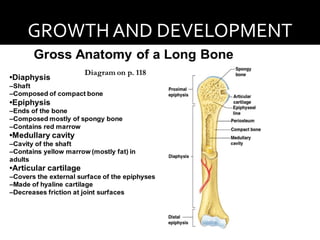
GROWTH AND DEVELOPMENT
-
-
I
*
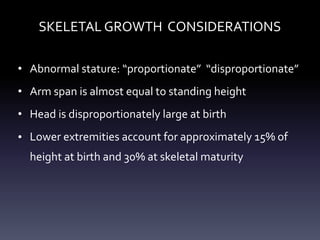
SKELETAL GROWTH CONSIDERATIONS
• Abnormal stature: “proportionate” “disproportionate”
• Arm span is almost equal to standing height
• Head is disproportionately large at birth
• Lower extremities account for approximately 15% of
height at birth and 30% at skeletal maturity
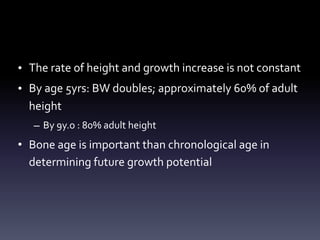
• The rate of height and growth increase is not constant
• By age 5yrs: BW doubles; approximately 60% of adult
height
– By 9y.o : 80% adult height
• Bone age is important than chronological age in
determining future growth potential
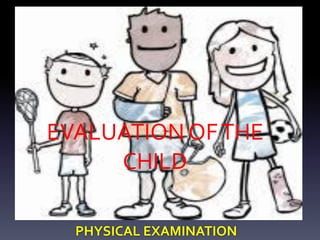
EVALUATION OFTHE
CHILD
PHYSICAL EXAMINATION
99
- - -
& 3
--
-
E 3
PALS
- look
-
Pedia
Gait
PALPATION
Assessment of local
temperature and
tenderness; swelling or
mass, spasticity or
contracture, bone or joint
deformity, evaluation of
anatomic axis of limb and
limb lengths
spasticity]
Contracture
↳ Congenital
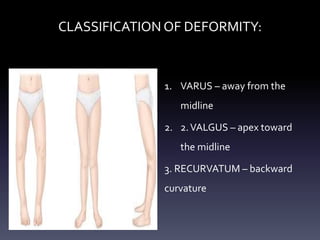
CLASSIFICATION OF DEFORMITY:
1. VARUS – away from the
midline
2. 2.VALGUS – apex toward
the midline
3. RECURVATUM – backward
curvature
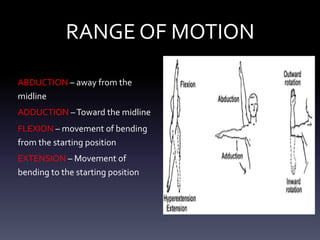
RANGE OF MOTION
ABDUCTION – away from the
midline
ADDUCTION –Toward the midline
FLEXION – movement of bending
from the starting position
EXTENSION – Movement of
bending to the starting position
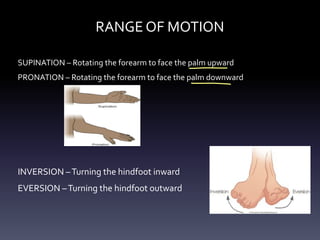
RANGE OF MOTION
SUPINATION – Rotating the forearm to face the palm upward
PRONATION – Rotating the forearm to face the palm downward
INVERSION –Turning the hindfoot inward
EVERSION –Turning the hindfoot outward
-
-
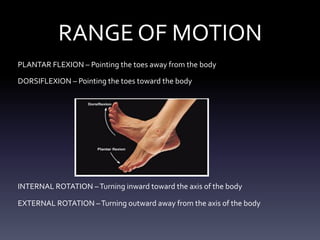
RANGE OF MOTION
PLANTAR FLEXION – Pointing the toes away from the body
DORSIFLEXION – Pointing the toes toward the body
INTERNAL ROTATION –Turning inward toward the axis of the body
EXTERNAL ROTATION –Turning outward away from the axis of the body
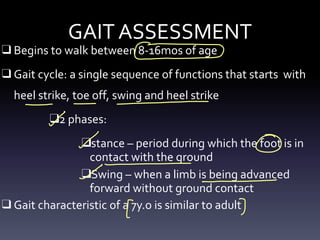
GAIT ASSESSMENT
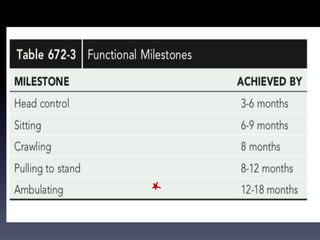
❑ Begins to walk between 8-16mos of age
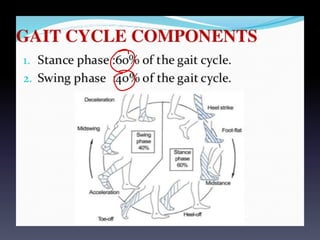
❑ Gait cycle: a single sequence of functions that starts with
heel strike, toe off, swing and heel strike
❑2 phases:
❑stance – period during which the foot is in
contact with the ground
❑Swing – when a limb is being advanced
forward without ground contact
❑ Gait characteristic of a 7y.o is similar to adult
↳
-
-
- -
-
- O
-- - -
[ &
⑧
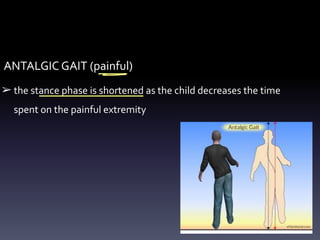
ANTALGIC GAIT (painful)
➢ the stance phase is shortened as the child decreases the time
spent on the painful extremity
- x
-
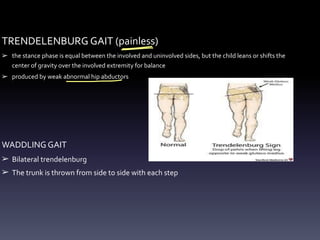
TRENDELENBURG GAIT (painless)
➢ the stance phase is equal between the involved and uninvolved sides, but the child leans or shifts the
center of gravity over the involved extremity for balance
➢ produced by weak abnormal hip abductors
WADDLING GAIT
➢ Bilateral trendelenburg
➢ The trunk is thrown from side to side with each step
-
=
RADIOGRAPHIC ASSESSMENT
• PLAIN RADIOGRAPH
❑First step in evaluation of most musculoskeletal disorders
• NUCLEAR MEDICINE IMAGING
❑Bone scan: early septic arthritis, osteomyelitis, avascular necrosis,
tumors, metastatic lesions, occult and stress fractures
ULTRASONOGRAPHY
❑ Evaluate suspected fluid-filled lesions
MAGNETIC RESONANCE IMAGING
❑ Imaging modality of choice
❑ Defines the exact anatomic extent of most musculoskeletal
lesions (soft tissue, bone marrow cavity, spinal cord, brain)
MAGNETIC RESONANCE ANGIOGRAPHY
❑Provides good visualization of peripheral vascular branches and tumor
neovascularity
COMPUTEDTOMOGRAPHY
❑ Allows visualization of the detailed bone anatomy and the relationship
of bones to contiguous structures
❑ this is superior to MRI for assessing bone involvement and cortical
destruction, including calcification or ossification and fractures
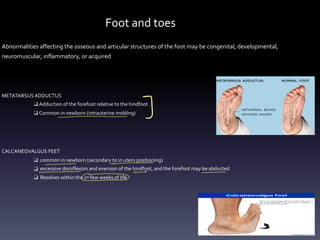
Foot and toes
Abnormalities affecting the osseous and articular structures of the foot may be congenital, developmental,
neuromuscular, inflammatory, or acquired
METATARSUS ADDUCTUS
❑ Adduction of the forefoot relative to the hindfoot
❑ Common in newborn (intrauterine molding)
CALCANEOVALGUS FEET
❑ common in newborn (secondary to in utero positioning)
❑ excessive dorsiflexion and eversion of the hindfoot, and the forefoot may be abducted
❑ Resolves within the 1st few weeks of life
-
I
-
- -
-
---
-
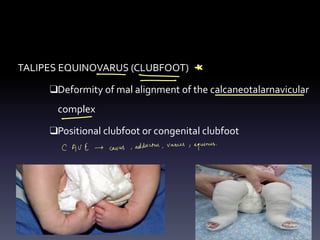
TALIPES EQUINOVARUS (CLUBFOOT)
❑Deformity of mal alignment of the calcaneotalarnavicular
complex
❑Positional clubfoot or congenital clubfoot
Al
-
-
- -
-
CAVE + cavus ,
adductus ,
varus ,
equinus
.
FOOT ANDTOES
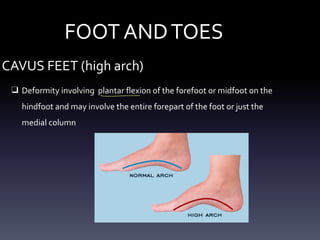
CAVUS FEET (high arch)
❑ Deformity involving plantar flexion of the forefoot or midfoot on the
hindfoot and may involve the entire forepart of the foot or just the
medial column
- -
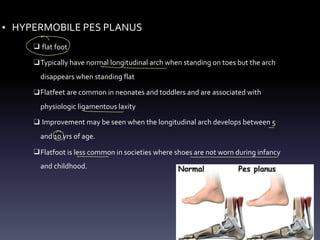
• HYPERMOBILE PES PLANUS
❑ flat foot
❑Typically have normal longitudinal arch when standing on toes but the arch
disappears when standing flat
❑Flatfeet are common in neonates and toddlers and are associated with
physiologic ligamentous laxity
❑ Improvement may be seen when the longitudinal arch develops between 5
and 10 yrs of age.
❑Flatfoot is less common in societies where shoes are not worn during infancy
and childhood.
②
-
-
-
O
- -
TOE DEFORMITIES
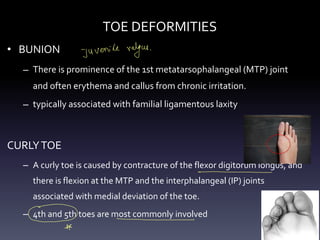
• BUNION
– There is prominence of the 1st metatarsophalangeal (MTP) joint
and often erythema and callus from chronic irritation.
– typically associated with familial ligamentous laxity
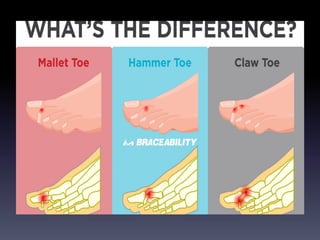
CURLYTOE
– A curly toe is caused by contracture of the flexor digitorum longus, and
there is flexion at the MTP and the interphalangeal (IP) joints
associated with medial deviation of the toe.
– 4th and 5th toes are most commonly involved
juvenile valgus .
- -
- -
*
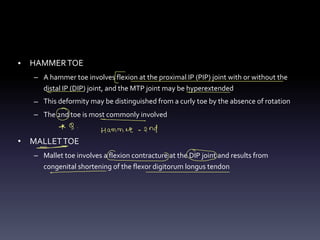
• HAMMERTOE
– A hammer toe involves flexion at the proximal IP (PIP) joint with or without the
distal IP (DIP) joint, and the MTP joint may be hyperextended
– This deformity may be distinguished from a curly toe by the absence of rotation
– The 2nd toe is most commonly involved
• MALLETTOE
– Mallet toe involves a flexion contracture at the DIP joint and results from
congenital shortening of the flexor digitorum longus tendon
E
- -
O
* 9 -
Hammer-and
-
-
- ②
-
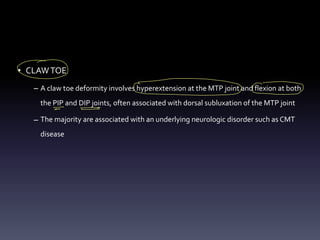
• CLAWTOE
– A claw toe deformity involves hyperextension at the MTP joint and flexion at both
the PIP and DIP joints, often associated with dorsal subluxation of the MTP joint
– The majority are associated with an underlying neurologic disorder such as CMT
disease
①
-0
E -
- -
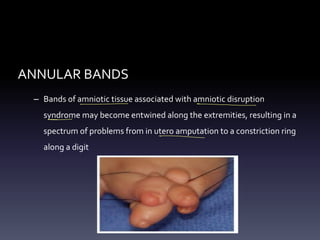
ANNULAR BANDS
– Bands of amniotic tissue associated with amniotic disruption
syndrome may become entwined along the extremities, resulting in a
spectrum of problems from in utero amputation to a constriction ring
along a digit
-
-
-
- -
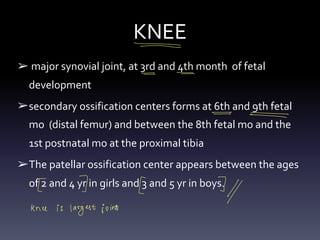
KNEE
➢ major synovial joint, at 3rd and 4th month of fetal
development
➢secondary ossification centers forms at 6th and 9th fetal
mo (distal femur) and between the 8th fetal mo and the
1st postnatal mo at the proximal tibia
➢The patellar ossification center appears between the ages
of 2 and 4 yr in girls and 3 and 5 yr in boys.
-
- -
-
°
- x
-
-
-
- - -
-
[ I [
7
Kne iS
largest joint
KNEE DEFORMITIES
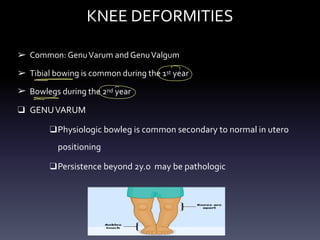
➢ Common: GenuVarum and GenuValgum
➢ Tibial bowing is common during the 1st year
➢ Bowlegs during the 2nd year
❑ GENUVARUM
❑Physiologic bowleg is common secondary to normal in utero
positioning
❑Persistence beyond 2y.o may be pathologic
-
O
O
-
>
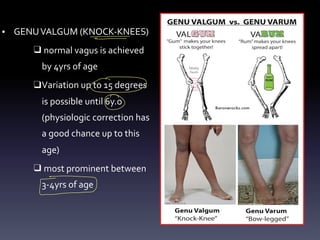
• GENUVALGUM (KNOCK-KNEES)
❑ normal vagus is achieved
by 4yrs of age
❑Variation up to 15 degrees
is possible until 6y.o
(physiologic correction has
a good chance up to this
age)
❑ most prominent between
3-4yrs of age
-
-
O
O
E
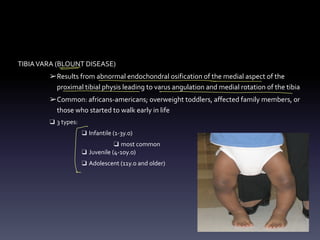
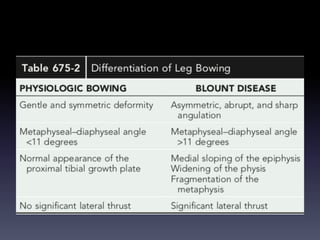
TIBIAVARA (BLOUNT DISEASE)
➢Results from abnormal endochondral osification of the medial aspect of the
proximal tibial physis leading to varus angulation and medial rotation of the tibia
➢Common: africans-americans; overweight toddlers, affected family members, or
those who started to walk early in life
❑ 3 types:
❑ Infantile (1-3y.o)
❑ most common
❑ Juvenile (4-10y.o)
❑ Adolescent (11y.o and older)
- -
-
- - - -
---
[
KNEE
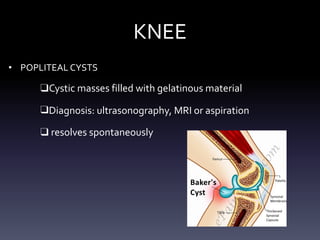
• POPLITEAL CYSTS
❑Cystic masses filled with gelatinous material
❑Diagnosis: ultrasonography, MRI or aspiration
❑ resolves spontaneously
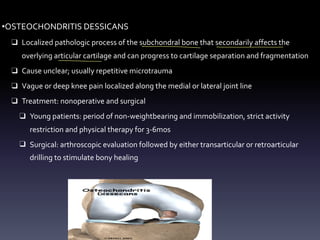
•OSTEOCHONDRITIS DESSICANS
❑ Localized pathologic process of the subchondral bone that secondarily affects the
overlying articular cartilage and can progress to cartilage separation and fragmentation
❑ Cause unclear; usually repetitive microtrauma
❑ Vague or deep knee pain localized along the medial or lateral joint line
❑ Treatment: nonoperative and surgical
❑ Young patients: period of non-weightbearing and immobilization, strict activity
restriction and physical therapy for 3-6mos
❑ Surgical: arthroscopic evaluation followed by either transarticular or retroarticular
drilling to stimulate bony healing
- - -
- -
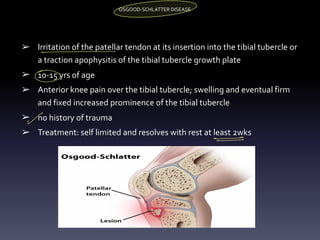
OSGOOD-SCHLATTER DISEASE
➢ Irritation of the patellar tendon at its insertion into the tibial tubercle or
a traction apophysitis of the tibial tubercle growth plate
➢ 10-15 yrs of age
➢ Anterior knee pain over the tibial tubercle; swelling and eventual firm
and fixed increased prominence of the tibial tubercle
➢ no history of trauma
➢ Treatment: self limited and resolves with rest at least 2wks
- -
D
-
- -
-
HIP
• The hip joint begins to develop at about the 7th wk of
gestation
O
- -
-
HIP
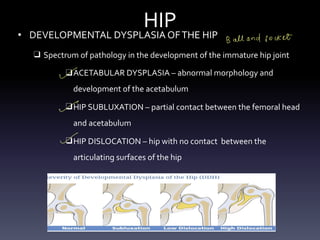
• DEVELOPMENTAL DYSPLASIA OFTHE HIP
❑ Spectrum of pathology in the development of the immature hip joint
❑ACETABULAR DYSPLASIA – abnormal morphology and
development of the acetabulum
❑HIP SUBLUXATION – partial contact between the femoral head
and acetabulum
❑HIP DISLOCATION – hip with no contact between the
articulating surfaces of the hip
Ball and socket
-
1
-
2 MAJOR GROUPS:
❑TYPICAL : without defines syndromes / normal patients
❑TERATOLOGICAL: with genetic syndromes or with arthrogryposis
❑ Unknown etiology
❑ Increased laxity of the joint
❑ Common in females, breech presentation, any condition that leads to a tighter intrauterine
space
↑ -
= _
- -
-
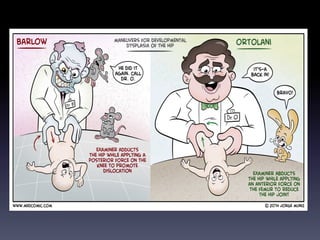
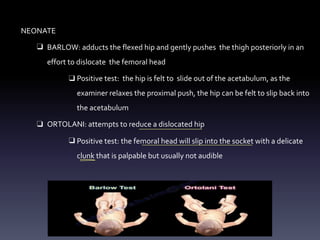
NEONATE
❑ BARLOW: adducts the flexed hip and gently pushes the thigh posteriorly in an
effort to dislocate the femoral head
❑ Positive test: the hip is felt to slide out of the acetabulum, as the
examiner relaxes the proximal push, the hip can be felt to slip back into
the acetabulum
❑ ORTOLANI: attempts to reduce a dislocated hip
❑ Positive test: the femoral head will slip into the socket with a delicate
clunk that is palpable but usually not audible
-
INFANT
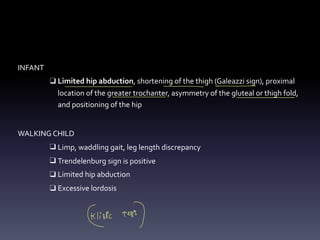
❑ Limited hip abduction, shortening of the thigh (Galeazzi sign), proximal
location of the greater trochanter, asymmetry of the gluteal or thigh fold,
and positioning of the hip
WALKING CHILD
❑ Limp, waddling gait, leg length discrepancy
❑ Trendelenburg sign is positive
❑ Limited hip abduction
❑ Excessive lordosis
- - -
Celisic test)
• DIAGNOSTIC:
❑ULTRASONOGRAPHY –evaluates cartilaginous structures
❑RADIOGRAPHY – in infants 4-6mos old wherein the proximal
femoral epiphysis ossifies
TREATMENT:
❑Goal: maintain a concentric reduction of the femoral head within
the acetabulum in order to provide an optimal environment for the
normal development of the femoral head and acetabulum
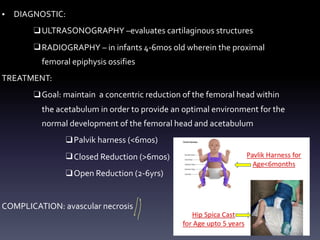
❑Palvik harness (<6m0s)
❑Closed Reduction (>6mos)
❑Open Reduction (2-6yrs)
COMPLICATION: avascular necrosis
D
TRANSIENT MONOARTICULAR SYNOVITIS
❑ A reactive arthritis and is one of the common cause of hip pain in young
children
❑ “irritable hip”
❑ Unknown etiology (post viral); benign and self limited
❑ Common in 3-8y.o
❑ transient inflammation of the synovium of the hip
❑ walk with a painful, limping gait; associated with low grade fever
gll
*
- -
C ( - -
-
- -
- - -
-
TRANSIENT MONOARTICULAR SYNOVITIS
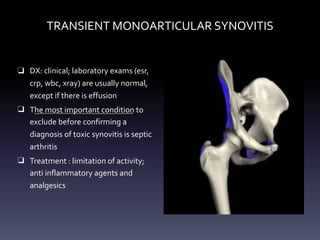
❑ DX: clinical; laboratory exams (esr,
crp, wbc, xray) are usually normal,
except if there is effusion
❑ The most important condition to
exclude before confirming a
diagnosis of toxic synovitis is septic
arthritis
❑ Treatment : limitation of activity;
anti inflammatory agents and
analgesics
- -
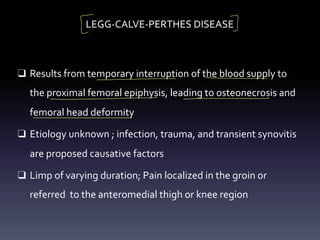
LEGG-CALVE-PERTHES DISEASE
❑ Results from temporary interruption of the blood supply to
the proximal femoral epiphysis, leading to osteonecrosis and
femoral head deformity
❑ Etiology unknown ; infection, trauma, and transient synovitis
are proposed causative factors
❑ Limp of varying duration; Pain localized in the groin or
referred to the anteromedial thigh or knee region
[ I
- - -
- -
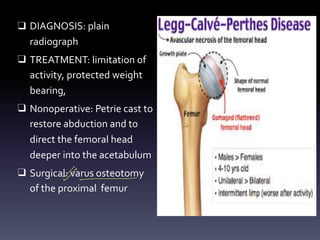
❑ DIAGNOSIS: plain
radiograph
❑ TREATMENT: limitation of
activity, protected weight
bearing,
❑ Nonoperative: Petrie cast to
restore abduction and to
direct the femoral head
deeper into the acetabulum
❑ Surgical: varus osteotomy
of the proximal femur
X
-
SLIPPED CAPITAL FEMORAL EPIPHYSIS
❑ Affects adolescents (10-16y.o)
❑ Failure of the physis and displacement of the femoral head
relative to the neck
❑ Caused by mechanical and endocrine factors (hypothyroidism,
hypopituitarism, and renal osteodystrophy)
❑ Obese
❑ Limping, externally rotated lower extremity
❑ Groin symptoms, isolated thigh pain or knee pain
-
-
-
-
-
- -
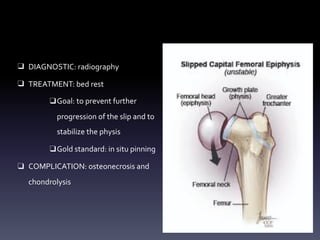
❑ DIAGNOSTIC: radiography
❑ TREATMENT: bed rest
❑Goal: to prevent further
progression of the slip and to
stabilize the physis
❑Gold standard: in situ pinning
❑ COMPLICATION: osteonecrosis and
chondrolysis
SPINE
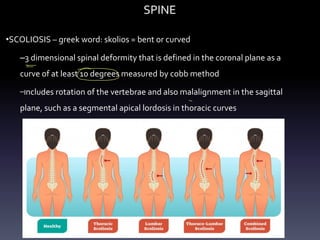
•SCOLIOSIS – greek word: skolios = bent or curved
–3 dimensional spinal deformity that is defined in the coronal plane as a
curve of at least 10 degrees measured by cobb method
–Includes rotation of the vertebrae and also malalignment in the sagittal
plane, such as a segmental apical lordosis in thoracic curves
-
-
&
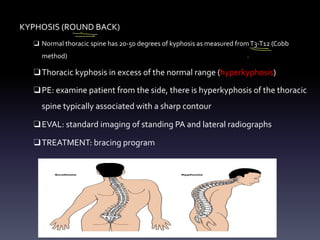
KYPHOSIS (ROUND BACK)
❑ Normal thoracic spine has 20-50 degrees of kyphosis as measured fromT3-T12 (Cobb
method)
❑Thoracic kyphosis in excess of the normal range (hyperkyphosis)
❑PE: examine patient from the side, there is hyperkyphosis of the thoracic
spine typically associated with a sharp contour
❑EVAL: standard imaging of standing PA and lateral radiographs
❑TREATMENT: bracing program
&
-
>
°
⑦
°
-
↑
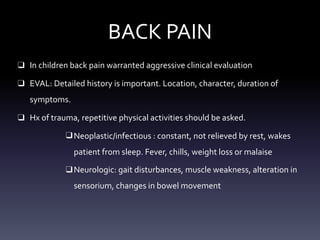
BACK PAIN
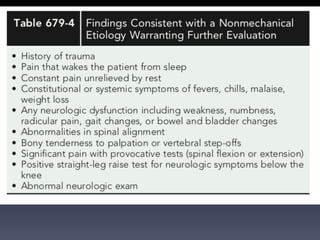
❑ In children back pain warranted aggressive clinical evaluation
❑ EVAL: Detailed history is important. Location, character, duration of
symptoms.
❑ Hx of trauma, repetitive physical activities should be asked.
❑Neoplastic/infectious : constant, not relieved by rest, wakes
patient from sleep. Fever, chills, weight loss or malaise
❑Neurologic: gait disturbances, muscle weakness, alteration in
sensorium, changes in bowel movement
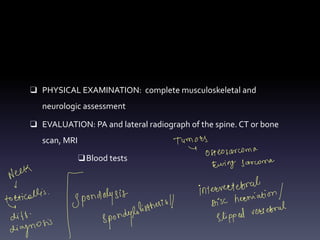
❑ PHYSICAL EXAMINATION: complete musculoskeletal and
neurologic assessment
❑ EVALUATION: PA and lateral radiograph of the spine. CT or bone
scan, MRI
❑Blood tests
Tymoes
↑
Osteosarcoma
Euring Jacoma
Neck
d
intervertebral
toeticalis .
Spondolysis Disc
herniation/
↳
diffe
[ spondylolisthesis// slipped
vertebral
diagnosis
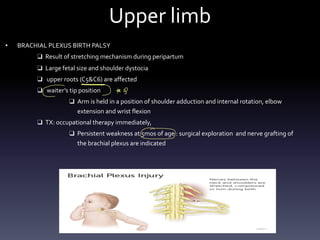
Upper limb
• BRACHIAL PLEXUS BIRTH PALSY
❑ Result of stretching mechanism during peripartum
❑ Large fetal size and shoulder dystocia
❑ upper roots (C5&C6) are affected
❑ waiter’s tip position
❑ Arm is held in a position of shoulder adduction and internal rotation, elbow
extension and wrist flexion
❑ TX: occupational therapy immediately,
❑ Persistent weakness at 5mos of age : surgical exploration and nerve grafting of
the brachial plexus are indicated
c -ng
O
HAND
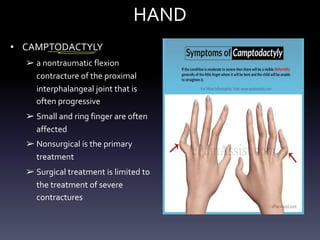
• CAMPTODACTYLY
➢ a nontraumatic flexion
contracture of the proximal
interphalangeal joint that is
often progressive
➢ Small and ring finger are often
affected
➢ Nonsurgical is the primary
treatment
➢ Surgical treatment is limited to
the treatment of severe
contractures
- -
- -
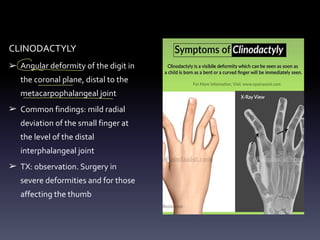
CLINODACTYLY
➢ Angular deformity of the digit in
the coronal plane, distal to the
metacarpophalangeal joint
➢ Common findings: mild radial
deviation of the small finger at
the level of the distal
interphalangeal joint
➢ TX: observation. Surgery in
severe deformities and for those
affecting the thumb
-
- -
-
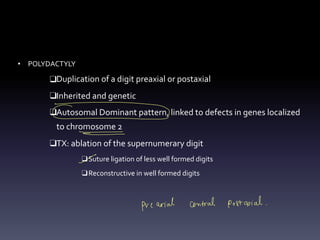
• POLYDACTYLY
❑Duplication of a digit preaxial or postaxial
❑Inherited and genetic
❑Autosomal Dominant pattern, linked to defects in genes localized
to chromosome 2
❑TX: ablation of the supernumerary digit
❑Suture ligation of less well formed digits
❑Reconstructive in well formed digits
-
- -
-
-
Preacial central postaxial
.
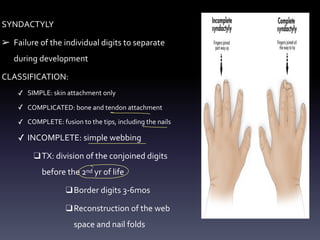
SYNDACTYLY
➢ Failure of the individual digits to separate
during development
CLASSIFICATION:
✓ SIMPLE: skin attachment only
✓ COMPLICATED: bone and tendon attachment
✓ COMPLETE: fusion to the tips, including the nails
✓ INCOMPLETE: simple webbing
❑TX: division of the conjoined digits
before the 2nd yr of life
❑Border digits 3-6mos
❑Reconstruction of the web
space and nail folds
- -
- -
-
-
ARTHROGRYPOSIS
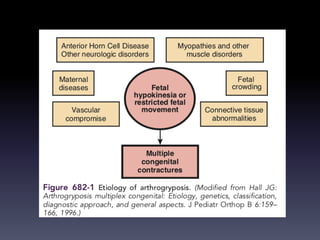
• ARTHROGRYPOSIS MULTIPLEX CONGENITA
❑ Heterogeneous group of muscular, neurologic, and connective
tissue anomalies that present with 2 or more joint contractures at
birth as well as muscle weakness
❑ Not a specific diagnosis
❑ associated with abnormal contraction of muscle fibers, causing
reduced mobility with a decreased active and passive arc of
motion
- - - -
- -
CLASSIFICATION
AMYOPLASIA (CLASSIC ARTHROGRYPOSIS)
➢ Sporadic symmetric disorder that causes fibrotic replacement of
the muscles
➢ Internally rotated and adducted shoulders, extended elbows,
pronated forearms, flexed fingers and wrists, dislocated hips, feet
with severe equinovarus contractures and extended knees
➢ Normal intelligence
- -
- -
-
- -
-
[
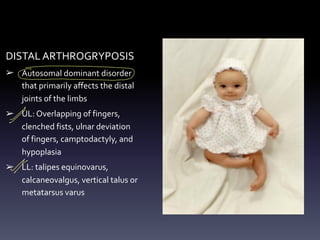
DISTAL ARTHROGRYPOSIS
➢ Autosomal dominant disorder
that primarily affects the distal
joints of the limbs
➢ UL: Overlapping of fingers,
clenched fists, ulnar deviation
of fingers, camptodactyly, and
hypoplasia
➢ LL: talipes equinovarus,
calcaneovalgus, vertical talus or
metatarsus varus
-
X
I
COMMON FRACTURES
❑ Trauma is a leading cause of death and disability in
children >1y.o
❑ Skeletal maturity : 13-15y.o (G) and 14-17y.o (B)
❑ Children’s fracture heal more quickly than adults
❑ children’s growth potential and thicker,
more active periosteum
-
O
-
> - -
-
-
-
UNIQUE CHARACTERISTICS OF PEDIATRIC
FRACTURES
• FRACTURE REMODELING
– A combination of appositional bone deposition on the
concavity of deformity, resorption on the convexity, and
asymmetric physeal growth
– Remodeling is best when the fracture occurs close to the
physis, the child has more growth remaining, has less
deformity to remodel, and is adjacent to a rapidly growing
physis
- -
- x
>
• OVERGROWTH
– Physeal stimulation from the hyperemia associated with
fracture healing causes overgrowth
– It is usually prominent in long bones such as the femur
– The growth acceleration is usually present for 6 mo to 1 yr
following the injury
• PROGRESSIVE DEFORMITY
– Injuries to the physis
– Common in fractures of the distal, ulna, distal femur and
proximal tibia
• RAPID HEALING
– Children’s fractures heal more quickly than adults as a result
of children’s growth potential and thicker, more active
periosteum
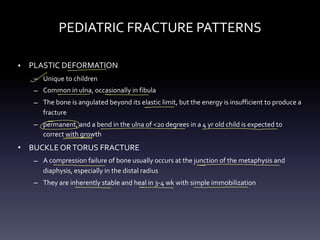
PEDIATRIC FRACTURE PATTERNS
• PLASTIC DEFORMATION
– Unique to children
– Common in ulna, occasionally in fibula
– The bone is angulated beyond its elastic limit, but the energy is insufficient to produce a
fracture
– permanent, and a bend in the ulna of <20 degrees in a 4 yr old child is expected to
correct with growth
• BUCKLE ORTORUS FRACTURE
– A compression failure of bone usually occurs at the junction of the metaphysis and
diaphysis, especially in the distal radius
– They are inherently stable and heal in 3-4 wk with simple immobilization
--
- -
- -
- - -
-
- - -
- - - - - m o
• GREENSTICK FRACTURE
– These fractures occur when the bone is bent, and there is failure on the tensile (convex) side
of the bone
– The fracture line does not propagate to the concave side of the bone
• LONGITUDINAL FRACTURE
– Line parallel to the bony axis
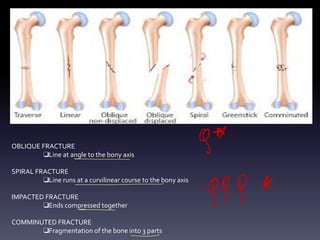
• TRANSVERSE FRACTURE
– Line perpendicular to the bony axis
OBLIQUE FRACTURE
❑Line at angle to the bony axis
SPIRAL FRACTURE
❑Line runs at a curvilinear course to the bony axis
IMPACTED FRACTURE
❑Ends compressed together
COMMINUTED FRACTURE
❑Fragmentation of the bone into 3 parts
g
*
=
999
A
-
- -
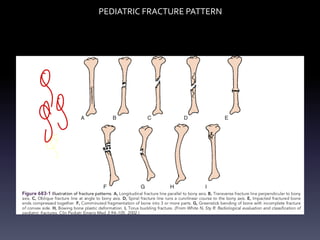
PEDIATRIC FRACTURE PATTERN
&
g
• TREATMENT
❑ SURGERY is required for 4-5%
❑Aim: to obtain anatomic alignment and relative stability
❑Indication:
❑Displaced physeal fracture
❑Displaced intra-articular fractures
❑Unstable fractures
❑Multiple injuries
❑Open fractures
❑Failure to achieve adequate reduction/ failure to
maintain an adequate reduction
❑Certain pathologic fractures
COMPLICATIONS OF FRACTURES IN CHILDREN
➢Growth arrest
➢Avascular necrosis
➢Premature physeal closure
➢Loss of motion or limb malalignment
➢Cosmetically unappealing bumps or curves
- -
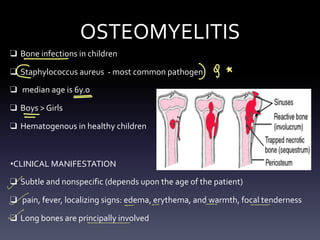
OSTEOMYELITIS
❑ Bone infections in children
❑ Staphylococcus aureus - most common pathogen
❑ median age is 6y.o
❑ Boys > Girls
❑ Hematogenous in healthy children
•CLINICAL MANIFESTATION
❑ Subtle and nonspecific (depends upon the age of the patient)
❑ pain, fever, localizing signs: edema, erythema, and warmth, focal tenderness
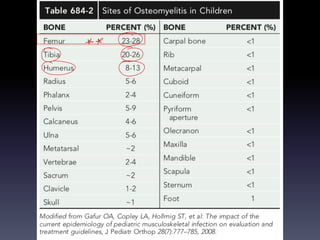
❑ Long bones are principally involved
-
C (g *
-
-
-
-
-
- -
- - -
-
-
- -
* O
⑥ ⑨
• DIAGNOSIS:
❑ Blood cultures should be performed in all suspected cases
❑ WBC, ESR, CRP are all elevated but non specific
❑ Conventional radiograph, MRI, Ultrasonography, CT and radionuclide studies
•TREATMENT:
❑ Antibioitc therapy (gram stain)
❑ Neonates: oxacillin and broad spectrum cephalosporin
❑ MRSA:Vancomycin
❑ Clindamycin , Cefazolin, Penicillin
❑ Duration of treatment depends upon organism isolated and clinical course
- - -
- - - - - -
- -
- -
- -
-
- -
x 4 weeks//
SEPTIC ARTHITIS
❑ Damage to the synovium, adjacent cartilage, and bone
•ETIOLOGY
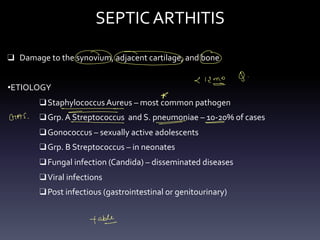
❑Staphylococcus Aureus – most common pathogen
❑Grp. A Streptococcus and S. pneumoniae – 10-20% of cases
❑Gonococcus – sexually active adolescents
❑Grp. B Streptococcus – in neonates
❑Fungal infection (Candida) – disseminated diseases
❑Viral infections
❑Post infectious (gastrointestinal or genitourinary)
000
C 19
o 9 .
-
*
- -
-
GAS ,
- - -
- - - - -
table
-
°
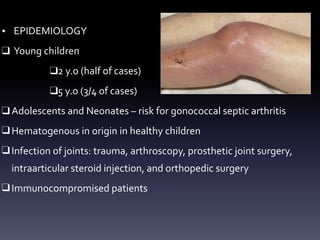
• EPIDEMIOLOGY
❑ Young children
❑2 y.o (half of cases)
❑5 y.o (3/4 of cases)
❑ Adolescents and Neonates – risk for gonococcal septic arthritis
❑ Hematogenous in origin in healthy children
❑ Infection of joints: trauma, arthroscopy, prosthetic joint surgery,
intraarticular steroid injection, and orthopedic surgery
❑ Immunocompromised patients
• PATHOGENESIS
❑ Hematogenous seeding in the synovial space (rich in vascular
supply and lacks a basement membrane)
❑ Organism enter the joint space by direct inoculation or extension
from a focus
• CLINICAL MANIFESTATION
❑ Monoarticular
❑ S/Sx depends upon the age of the patient
❑ Subtle in neonates
❑ Associated with adjacent osteomyelitis caused by transphyseal spread of
infection (neonates and young infants)
❑ Older infants and Children: fever, pain, localizing signs (erythema,
swelling, warmth, refusal to walk)
❑ Erythema and edema of the skin and soft tissue overlying the site of
infection (septic arthritis > osteomyelitis)
❑ Joints of the lower extremities – 75% of all cases
• DIAGNOSIS
❑ Blood Cultures
❑ Aspiration of joint fluid/ pus for Gram Stain and culture
❑ Synovial fluid analysis – limited usefulness
❑ WBC, ESR, CRP – elevated but nonspecific
❑ Radiographic Evaluation (widening of joint capsule, soft tissue edema,
obliteration of normal fat lines)
❑ Ultrasonography (joint effusion)
❑ Ct scan (joint fluid)
❑ MRI (joint fluid; exclude adjacent osteomyelitis)
❑ Radionuclide Imaging – more sensitive than radiographs
• TREATMENT
❑ Joint cooperation of pediatrician, orthopedic surgeon and radiologist
❑ ANTIBIOTICTHERAPY
❑ Knowledge of likely bacterial pathogen
❑ Neonates: nafcillin or oxacillin (staph), cephalosphorins (S. aureus, Grp B
Strep, gram neg bacilli)
❑ MRSA: vancomycin
❑ Older infants and children: cafazolin or nafcillin
❑ Identified pathogen àchange of antibiotic
❑ Duration of antibiotics depends upon the type of organism
❑ 10-14 days
❑ Oral antibiotics can be used to complete the therapy once patient is afebrile
for 48-72hrs
❑ SURGICALTHERAPY
❑ Infection of the hip is generally considered as a surgical emergency (vulnerability of
the blood supply to the head of the femur)
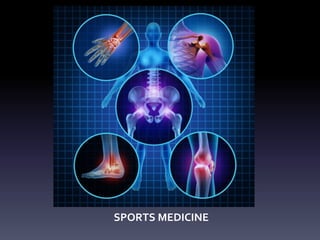
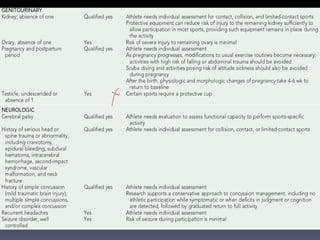
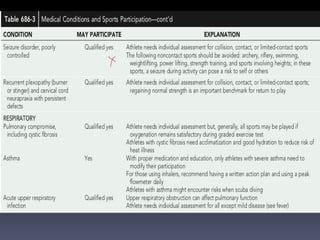
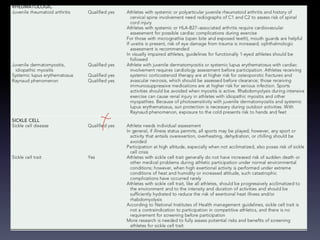
SPORTS MEDICINE
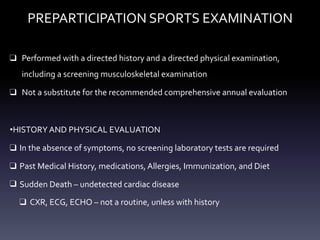
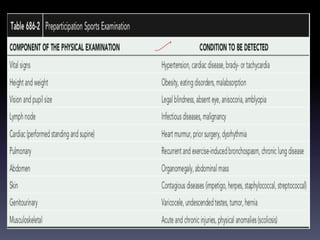
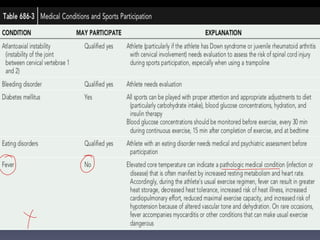
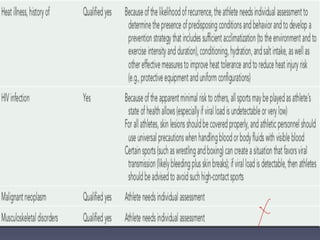
PREPARTICIPATION SPORTS EXAMINATION
❑ Performed with a directed history and a directed physical examination,
including a screening musculoskeletal examination
❑ Not a substitute for the recommended comprehensive annual evaluation
•HISTORY AND PHYSICAL EVALUATION
❑ In the absence of symptoms, no screening laboratory tests are required
❑ Past Medical History, medications, Allergies, Immunization, and Diet
❑ Sudden Death – undetected cardiac disease
❑ CXR, ECG, ECHO – not a routine, unless with history
-
E O -
+
y
y
↓
T
-
y
4
+
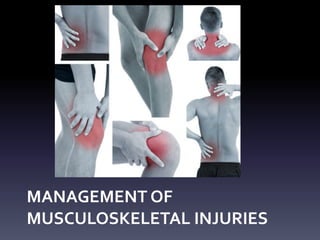
MANAGEMENT OF
MUSCULOSKELETAL INJURIES
MECHANISM OF INJURY
• ACUTE INJURIES
❑ SPRAIN – an injury to the ligament or joint capsule
❑ GRADE I: mild damage to a ligament or ligaments without instability of
the affected joint
❑ GRADE II: partial tear to the ligament
❑ GRADE III: complete tear with instability to the affected joint
❑ STRAIN – injury to the muscle or tendon
❑ GRADE I: disruption of only a few muscle fibers, pain is mild to moderate,
range of motion and strength are or at near normal
❑ GRADE II: partial tear of the muscle, loss of range of motion and strength
❑ GRADE III: complete rupture of the musculotendinous unit
-
-
- -
-
ef -
- -
-
- -
[ - - -
CONTUSION
➢ crush injury to any soft tissue
SEVERE INJURIES
➢ immediate swelling, deformity, numbness or “give-way” weakness, loud painful pop,
mechanical locking, instability
OVERUSE INJURIES
➢ Repetitive microtrauma that exceeds the body’s rate of repair
➢ Muscles, tendons, bone, bursae, cartilage, and nerves
➢ Sports emphasizing repetitive motion (swimming, running, tennis, and gymnastics)
❑ Extrinsic –training errors, equipments
❑ Intrinsic – medical conditions
-
&
- -
-
• TREATMENT
❑ Reduction of training load
❑ Rehabilitation
❑ Goals: control pain and spasm, to rehabilitate flexibility,
strength, endurance and proprioceptive deficits
-
-
- -
-
• INITIAL EVALUATION OFTHE INJURED EXTREMITY
❑ Determine the quality of the peripheral pulses and capillary refill rate
❑ Gross motor and sensory function
❑ First priority: maintain vascular and skeletal stability
•CRITERIA FOR IMMEDIATE ATTENTION AND RAPID ORTHOPEDIC
CONSULTATION
❑Vascular compromise, nerve compromise, and open fracture
❑ Wound: covered with sterile gauze
❑ Padded and splinted
❑ Pressure should be applied to bleeding site
❑Deep laceration over a joint, unreducible dislocation, grade III tear of a muscle-
tendon unit, displaced, angulated fractures
SKELETAL DYSPLASIAS
• The skeletal dysplasias, bone dysplasias, and
osteochondrodysplasias are a genetically and clinically
heterogeneous group of disorders of skeletal development and
growth
• prevalence of 1 in 4,000 births
• They can be divided into the osteodysplasias typified by
osteogenesis imperfecta and the chondrodysplasias
-
-
1
- -
- - m
ACHONDROPLASIA GROUP
➢Represents chondroplasias
➢Thanatophoric dyplasia – most lethal
➢Achondroplasia – most common non lethal
➢Hypochondroplasia
➢Common mutation in a small number of location in
the FGFR3 gene
- -
- °
⑦
°
- - -
↳ 9.
- -
09
THANATOPHORIC DYSPLASIA (TD)
➢ manifests before or at birth
➢ ultrasonographic examination in midgestation or later reveals a large head
and very short limbs; the pregnancy is often accompanied by
polyhydramnios and premature delivery
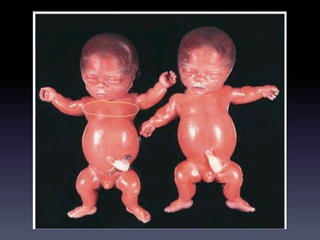
➢ Very short limbs, short neck, long narrow thorax, and large head with
midfacial hypoplasia dominate the clinical phenotype at birth
➢ Newborns have severe respiratory distress because of their small thorax
➢ Although this distress can be treated by intense respiratory care, the long-
term prognosis is poor
-
°
-
-
- - - - -
-
E
ACHONDROPLASIA
➢ is the prototype chondrodysplasia
➢ It typically manifests at birth with short limbs, a long narrow trunk, and a
large head with midfacial hypoplasia and prominent forehead
➢ Most joints are hyper- extensible, but extension is restricted at the elbow
➢ A thoracolumbar gibbus is often found
➢ birth length is slightly less than normal but occasionally plots within the
low-normal range
-
-
- -
-
- - - - -
-
-
- - -
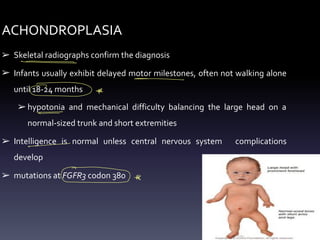
ACHONDROPLASIA
➢ Skeletal radiographs confirm the diagnosis
➢ Infants usually exhibit delayed motor milestones, often not walking alone
until 18-24 months
➢ hypotonia and mechanical difficulty balancing the large head on a
normal-sized trunk and short extremities
➢ Intelligence is normal unless central nervous system complications
develop
➢ mutations at FGFR3 codon 380
-
- -
- -
- *
-
-
-
- a
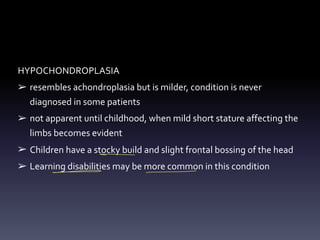
HYPOCHONDROPLASIA
➢ resembles achondroplasia but is milder, condition is never
diagnosed in some patients
➢ not apparent until childhood, when mild short stature affecting the
limbs becomes evident
➢ Children have a stocky build and slight frontal bossing of the head
➢ Learning disabilities may be more common in this condition
- -
- - -
HYPOCHODROPLASIA
➢Radiographic changes are mild and consistent with the mild
achondroplastic phenotype
➢Rare complications
➢An FGFR3 mutation at codon 540
➢Recombinant growth hormone therapy may enhance growth and improve
body disproportion
-
O
DIASTROPHIC DYSPLASIA
➢ a well-characterized disorder recognized at birth by the presence of very
short extremities, clubfoot, and short hands, with proximal displacement
of the thumb producing a hitchhiker appearance
➢ Complications are primarily orthopedic and tend to be severe and
progressive
➢ Despite the orthopedic problems, patients typically have a normal life
span and reach adult heights in the 105-130 cm range, depending on the
severity of scoliosis
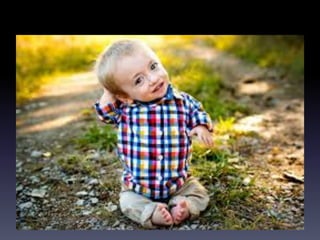
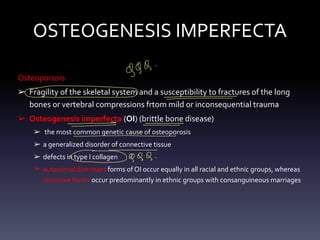
OSTEOGENESIS IMPERFECTA
Osteoporosis
➢ Fragility of the skeletal system and a susceptibility to fractures of the long
bones or vertebral compressions frtom mild or inconsequential trauma
➢ Osteogenesis imperfecta (OI) (brittle bone disease)
➢ the most common genetic cause of osteoporosis
➢ a generalized disorder of connective tissue
➢ defects in type I collagen
➢ autosomal dominant forms of OI occur equally in all racial and ethnic groups, whereas
recessive forms occur predominantly in ethnic groups with consanguineous marriages
999
-
⑥
° -
- -
- - - -
- -
-
-
-g 99
-
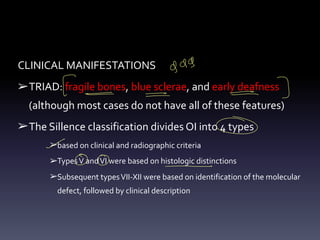
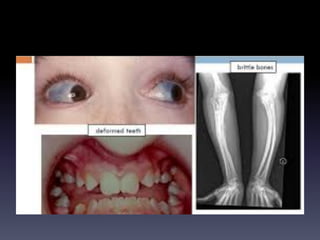
CLINICAL MANIFESTATIONS
➢TRIAD: fragile bones, blue sclerae, and early deafness
(although most cases do not have all of these features)
➢The Sillence classification divides OI into 4 types
➢based on clinical and radiographic criteria
➢TypesV andVI were based on histologic distinctions
➢Subsequent typesVII-XII were based on identification of the molecular
defect, followed by clinical description
gag
E -
° -
-
>
3
- -
-
⑥
-
oo -
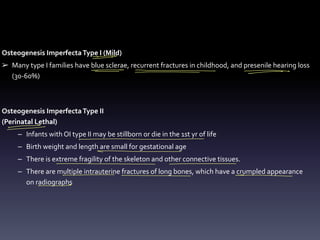
Osteogenesis ImperfectaType I (Mild)
➢ Many type I families have blue sclerae, recurrent fractures in childhood, and presenile hearing loss
(30-60%)
Osteogenesis ImperfectaType II
(Perinatal Lethal)
– Infants with OI type II may be stillborn or die in the 1st yr of life
– Birth weight and length are small for gestational age
– There is extreme fragility of the skeleton and other connective tissues.
– There are multiple intrauterine fractures of long bones, which have a crumpled appearance
on radiographs
- -
-
⑦
= °
- - -
-
- >
-
-
--
--
- -
- -
- - - -
- -
- - - -
- -
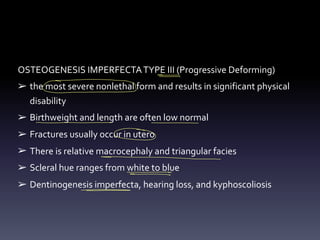
OSTEOGENESIS IMPERFECTATYPE III (Progressive Deforming)
➢ the most severe nonlethal form and results in significant physical
disability
➢ Birthweight and length are often low normal
➢ Fractures usually occur in utero
➢ There is relative macrocephaly and triangular facies
➢ Scleral hue ranges from white to blue
➢ Dentinogenesis imperfecta, hearing loss, and kyphoscoliosis
- -
-
>
- -
E
-
-
- -
=
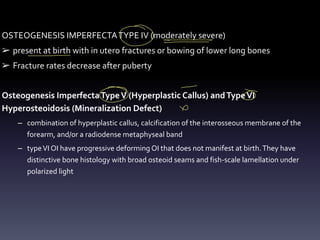
OSTEOGENESIS IMPERFECTATYPE IV (moderately severe)
➢ present at birth with in utero fractures or bowing of lower long bones
➢ Fracture rates decrease after puberty
Osteogenesis ImperfectaTypeV (Hyperplastic Callus) andTypeVI
Hyperosteoidosis (Mineralization Defect)
– combination of hyperplastic callus, calcification of the interosseous membrane of the
forearm, and/or a radiodense metaphyseal band
– typeVI OI have progressive deforming OI that does not manifest at birth.They have
distinctive bone histology with broad osteoid seams and fish-scale lamellation under
polarized light
O -
-
- -
-
O O
&
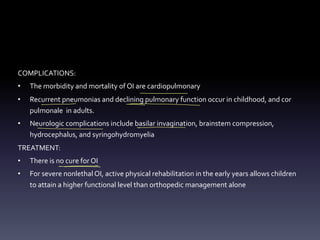
COMPLICATIONS:
• The morbidity and mortality of OI are cardiopulmonary
• Recurrent pneumonias and declining pulmonary function occur in childhood, and cor
pulmonale in adults.
• Neurologic complications include basilar invagination, brainstem compression,
hydrocephalus, and syringohydromyelia
TREATMENT:
• There is no cure for OI
• For severe nonlethal OI, active physical rehabilitation in the early years allows children
to attain a higher functional level than orthopedic management alone
-
- - -
- -
- - -
- -
-
MARFAN SYNDROME
• Marfan syndrome (MFS) is an inherited, systemic, connective tissue disorder
• caused by mutations in the gene encoding the extracellular matrix (ECM) protein
fibrillin-1
• It is primarily associated with skeletal, cardiovascular, and ocular pathology
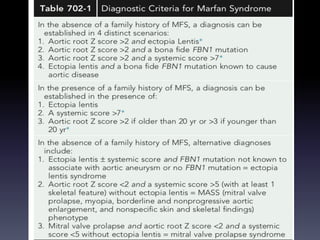
• The diagnosis is based on clinical findings, some of which are age dependent
• Autosomal dominant inheritance
• Both interfamilial and intrafamilial clinical variation is common
• There is no racial or gender preference
-
9
-
- -
-
-
- = -
>
- -
- -
-
C > *
- -
- - -
②
-
CLINICAL MANIFESTATIONS
SKELATAL SYSTEM
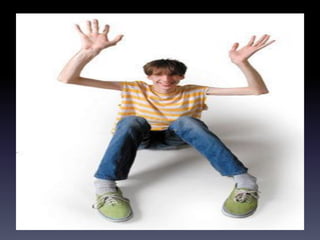
• Overgrowth of the long bones (dolichostenomelia)
• a reduced upper segment: lower segment ratio (US:LS) or an
arm span to height ratio >1.05 times
• Anterior chest
• Abnormal curvatures of the spine (most commonly
thoracolumbar scoliosis)
Al
- -
-
-
- -
- -
- -
-
- - -
- -
SKELETAL SYSTEM
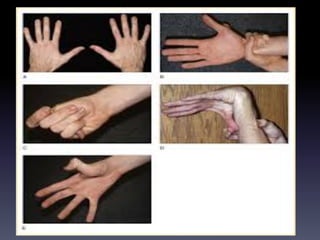
• Long and slender fingers in relation to the palm of the hand
(arachnodactyly)
• The combination of arachnodactyly and hypermobile joints is
examined by theWalker-Murdoch or wrist sign
• Steinberg or thumb sign, which is present when the distal
phalanx of the thumb fully extends beyond the ulnar border of
the hand when folded across the palm
long stende finger
- -
84
-
-
-
-
9 - -
- -
-
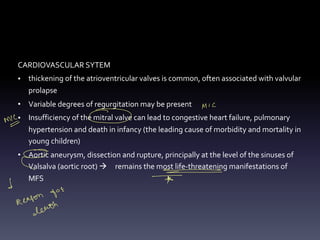
CARDIOVASCULAR SYTEM
• thickening of the atrioventricular valves is common, often associated with valvular
prolapse
• Variable degrees of regurgitation may be present
• Insufficiency of the mitral valve can lead to congestive heart failure, pulmonary
hypertension and death in infancy (the leading cause of morbidity and mortality in
young children)
• Aortic aneurysm, dissection and rupture, principally at the level of the sinuses of
Valsalva (aortic root) à remains the most life-threatening manifestations of
MFS
MIC
m ⑥
·
E - -
-
- -
d *
for
Reason
death
OCULAR SYSTEM
• Dislocation of the ocular lens (ectopia lentis)
occurs in approximately 60-70% of patients,
• Patients are also predisposed to retinal
detachment and early cataracts or glaucoma
36. BONES AND JOINTS DISORDER pediatrics

36. BONES AND JOINTS DISORDER pediatrics

  • 1.
    PEDIATRIC ORTHOPAEDIC BONE ANDJOINTS DISORDERS FEMIE GOTERA-DATO,MD, DPPS
  • 2.
  • 3.
  • 4.
  • 6.
    SKELETAL GROWTH CONSIDERATIONS •Abnormal stature: “proportionate” “disproportionate” • Arm span is almost equal to standing height • Head is disproportionately large at birth • Lower extremities account for approximately 15% of height at birth and 30% at skeletal maturity
  • 7.
    • The rateof height and growth increase is not constant • By age 5yrs: BW doubles; approximately 60% of adult height – By 9y.o : 80% adult height • Bone age is important than chronological age in determining future growth potential
  • 8.
  • 9.
    99 - - - &3 -- - E 3
  • 10.
  • 12.
    PALPATION Assessment of local temperatureand tenderness; swelling or mass, spasticity or contracture, bone or joint deformity, evaluation of anatomic axis of limb and limb lengths spasticity] Contracture ↳ Congenital
  • 13.
    CLASSIFICATION OF DEFORMITY: 1.VARUS – away from the midline 2. 2.VALGUS – apex toward the midline 3. RECURVATUM – backward curvature
  • 14.
    RANGE OF MOTION ABDUCTION– away from the midline ADDUCTION –Toward the midline FLEXION – movement of bending from the starting position EXTENSION – Movement of bending to the starting position
  • 15.
    RANGE OF MOTION SUPINATION– Rotating the forearm to face the palm upward PRONATION – Rotating the forearm to face the palm downward INVERSION –Turning the hindfoot inward EVERSION –Turning the hindfoot outward - -
  • 16.
    RANGE OF MOTION PLANTARFLEXION – Pointing the toes away from the body DORSIFLEXION – Pointing the toes toward the body INTERNAL ROTATION –Turning inward toward the axis of the body EXTERNAL ROTATION –Turning outward away from the axis of the body
  • 17.
    GAIT ASSESSMENT ❑ Beginsto walk between 8-16mos of age ❑ Gait cycle: a single sequence of functions that starts with heel strike, toe off, swing and heel strike ❑2 phases: ❑stance – period during which the foot is in contact with the ground ❑Swing – when a limb is being advanced forward without ground contact ❑ Gait characteristic of a 7y.o is similar to adult ↳ - - - - - - O -- - - [ &
  • 18.
  • 19.
    ANTALGIC GAIT (painful) ➢the stance phase is shortened as the child decreases the time spent on the painful extremity - x -
  • 20.
    TRENDELENBURG GAIT (painless) ➢the stance phase is equal between the involved and uninvolved sides, but the child leans or shifts the center of gravity over the involved extremity for balance ➢ produced by weak abnormal hip abductors WADDLING GAIT ➢ Bilateral trendelenburg ➢ The trunk is thrown from side to side with each step - =
  • 21.
    RADIOGRAPHIC ASSESSMENT • PLAINRADIOGRAPH ❑First step in evaluation of most musculoskeletal disorders • NUCLEAR MEDICINE IMAGING ❑Bone scan: early septic arthritis, osteomyelitis, avascular necrosis, tumors, metastatic lesions, occult and stress fractures
  • 22.
    ULTRASONOGRAPHY ❑ Evaluate suspectedfluid-filled lesions MAGNETIC RESONANCE IMAGING ❑ Imaging modality of choice ❑ Defines the exact anatomic extent of most musculoskeletal lesions (soft tissue, bone marrow cavity, spinal cord, brain)
  • 23.
    MAGNETIC RESONANCE ANGIOGRAPHY ❑Providesgood visualization of peripheral vascular branches and tumor neovascularity COMPUTEDTOMOGRAPHY ❑ Allows visualization of the detailed bone anatomy and the relationship of bones to contiguous structures ❑ this is superior to MRI for assessing bone involvement and cortical destruction, including calcification or ossification and fractures
  • 24.
    Foot and toes Abnormalitiesaffecting the osseous and articular structures of the foot may be congenital, developmental, neuromuscular, inflammatory, or acquired METATARSUS ADDUCTUS ❑ Adduction of the forefoot relative to the hindfoot ❑ Common in newborn (intrauterine molding) CALCANEOVALGUS FEET ❑ common in newborn (secondary to in utero positioning) ❑ excessive dorsiflexion and eversion of the hindfoot, and the forefoot may be abducted ❑ Resolves within the 1st few weeks of life - I - - - - --- -
  • 25.
    TALIPES EQUINOVARUS (CLUBFOOT) ❑Deformityof mal alignment of the calcaneotalarnavicular complex ❑Positional clubfoot or congenital clubfoot Al - - - - - CAVE + cavus , adductus , varus , equinus .
  • 26.
    FOOT ANDTOES CAVUS FEET(high arch) ❑ Deformity involving plantar flexion of the forefoot or midfoot on the hindfoot and may involve the entire forepart of the foot or just the medial column - -
  • 27.
    • HYPERMOBILE PESPLANUS ❑ flat foot ❑Typically have normal longitudinal arch when standing on toes but the arch disappears when standing flat ❑Flatfeet are common in neonates and toddlers and are associated with physiologic ligamentous laxity ❑ Improvement may be seen when the longitudinal arch develops between 5 and 10 yrs of age. ❑Flatfoot is less common in societies where shoes are not worn during infancy and childhood. ② - - - O - -
  • 28.
    TOE DEFORMITIES • BUNION –There is prominence of the 1st metatarsophalangeal (MTP) joint and often erythema and callus from chronic irritation. – typically associated with familial ligamentous laxity CURLYTOE – A curly toe is caused by contracture of the flexor digitorum longus, and there is flexion at the MTP and the interphalangeal (IP) joints associated with medial deviation of the toe. – 4th and 5th toes are most commonly involved juvenile valgus . - - - - *
  • 29.
    • HAMMERTOE – Ahammer toe involves flexion at the proximal IP (PIP) joint with or without the distal IP (DIP) joint, and the MTP joint may be hyperextended – This deformity may be distinguished from a curly toe by the absence of rotation – The 2nd toe is most commonly involved • MALLETTOE – Mallet toe involves a flexion contracture at the DIP joint and results from congenital shortening of the flexor digitorum longus tendon E - - O * 9 - Hammer-and - - - ② -
  • 30.
    • CLAWTOE – Aclaw toe deformity involves hyperextension at the MTP joint and flexion at both the PIP and DIP joints, often associated with dorsal subluxation of the MTP joint – The majority are associated with an underlying neurologic disorder such as CMT disease ① -0 E - - -
  • 32.
    ANNULAR BANDS – Bandsof amniotic tissue associated with amniotic disruption syndrome may become entwined along the extremities, resulting in a spectrum of problems from in utero amputation to a constriction ring along a digit - - - - -
  • 33.
    KNEE ➢ major synovialjoint, at 3rd and 4th month of fetal development ➢secondary ossification centers forms at 6th and 9th fetal mo (distal femur) and between the 8th fetal mo and the 1st postnatal mo at the proximal tibia ➢The patellar ossification center appears between the ages of 2 and 4 yr in girls and 3 and 5 yr in boys. - - - - ° - x - - - - - - - [ I [ 7 Kne iS largest joint
  • 34.
    KNEE DEFORMITIES ➢ Common:GenuVarum and GenuValgum ➢ Tibial bowing is common during the 1st year ➢ Bowlegs during the 2nd year ❑ GENUVARUM ❑Physiologic bowleg is common secondary to normal in utero positioning ❑Persistence beyond 2y.o may be pathologic - O O - >
  • 35.
    • GENUVALGUM (KNOCK-KNEES) ❑normal vagus is achieved by 4yrs of age ❑Variation up to 15 degrees is possible until 6y.o (physiologic correction has a good chance up to this age) ❑ most prominent between 3-4yrs of age - - O O E
  • 36.
    TIBIAVARA (BLOUNT DISEASE) ➢Resultsfrom abnormal endochondral osification of the medial aspect of the proximal tibial physis leading to varus angulation and medial rotation of the tibia ➢Common: africans-americans; overweight toddlers, affected family members, or those who started to walk early in life ❑ 3 types: ❑ Infantile (1-3y.o) ❑ most common ❑ Juvenile (4-10y.o) ❑ Adolescent (11y.o and older) - - - - - - - --- [
  • 38.
    KNEE • POPLITEAL CYSTS ❑Cysticmasses filled with gelatinous material ❑Diagnosis: ultrasonography, MRI or aspiration ❑ resolves spontaneously
  • 39.
    •OSTEOCHONDRITIS DESSICANS ❑ Localizedpathologic process of the subchondral bone that secondarily affects the overlying articular cartilage and can progress to cartilage separation and fragmentation ❑ Cause unclear; usually repetitive microtrauma ❑ Vague or deep knee pain localized along the medial or lateral joint line ❑ Treatment: nonoperative and surgical ❑ Young patients: period of non-weightbearing and immobilization, strict activity restriction and physical therapy for 3-6mos ❑ Surgical: arthroscopic evaluation followed by either transarticular or retroarticular drilling to stimulate bony healing - - - - -
  • 40.
    OSGOOD-SCHLATTER DISEASE ➢ Irritationof the patellar tendon at its insertion into the tibial tubercle or a traction apophysitis of the tibial tubercle growth plate ➢ 10-15 yrs of age ➢ Anterior knee pain over the tibial tubercle; swelling and eventual firm and fixed increased prominence of the tibial tubercle ➢ no history of trauma ➢ Treatment: self limited and resolves with rest at least 2wks - - D - - - -
  • 41.
    HIP • The hipjoint begins to develop at about the 7th wk of gestation O - - -
  • 42.
    HIP • DEVELOPMENTAL DYSPLASIAOFTHE HIP ❑ Spectrum of pathology in the development of the immature hip joint ❑ACETABULAR DYSPLASIA – abnormal morphology and development of the acetabulum ❑HIP SUBLUXATION – partial contact between the femoral head and acetabulum ❑HIP DISLOCATION – hip with no contact between the articulating surfaces of the hip Ball and socket - 1 -
  • 43.
    2 MAJOR GROUPS: ❑TYPICAL: without defines syndromes / normal patients ❑TERATOLOGICAL: with genetic syndromes or with arthrogryposis ❑ Unknown etiology ❑ Increased laxity of the joint ❑ Common in females, breech presentation, any condition that leads to a tighter intrauterine space ↑ - = _ - - -
  • 45.
    NEONATE ❑ BARLOW: adductsthe flexed hip and gently pushes the thigh posteriorly in an effort to dislocate the femoral head ❑ Positive test: the hip is felt to slide out of the acetabulum, as the examiner relaxes the proximal push, the hip can be felt to slip back into the acetabulum ❑ ORTOLANI: attempts to reduce a dislocated hip ❑ Positive test: the femoral head will slip into the socket with a delicate clunk that is palpable but usually not audible -
  • 46.
    INFANT ❑ Limited hipabduction, shortening of the thigh (Galeazzi sign), proximal location of the greater trochanter, asymmetry of the gluteal or thigh fold, and positioning of the hip WALKING CHILD ❑ Limp, waddling gait, leg length discrepancy ❑ Trendelenburg sign is positive ❑ Limited hip abduction ❑ Excessive lordosis - - - Celisic test)
  • 47.
    • DIAGNOSTIC: ❑ULTRASONOGRAPHY –evaluatescartilaginous structures ❑RADIOGRAPHY – in infants 4-6mos old wherein the proximal femoral epiphysis ossifies TREATMENT: ❑Goal: maintain a concentric reduction of the femoral head within the acetabulum in order to provide an optimal environment for the normal development of the femoral head and acetabulum ❑Palvik harness (<6m0s) ❑Closed Reduction (>6mos) ❑Open Reduction (2-6yrs) COMPLICATION: avascular necrosis D
  • 48.
    TRANSIENT MONOARTICULAR SYNOVITIS ❑A reactive arthritis and is one of the common cause of hip pain in young children ❑ “irritable hip” ❑ Unknown etiology (post viral); benign and self limited ❑ Common in 3-8y.o ❑ transient inflammation of the synovium of the hip ❑ walk with a painful, limping gait; associated with low grade fever gll * - - C ( - - - - - - - - -
  • 49.
    TRANSIENT MONOARTICULAR SYNOVITIS ❑DX: clinical; laboratory exams (esr, crp, wbc, xray) are usually normal, except if there is effusion ❑ The most important condition to exclude before confirming a diagnosis of toxic synovitis is septic arthritis ❑ Treatment : limitation of activity; anti inflammatory agents and analgesics - -
  • 50.
    LEGG-CALVE-PERTHES DISEASE ❑ Resultsfrom temporary interruption of the blood supply to the proximal femoral epiphysis, leading to osteonecrosis and femoral head deformity ❑ Etiology unknown ; infection, trauma, and transient synovitis are proposed causative factors ❑ Limp of varying duration; Pain localized in the groin or referred to the anteromedial thigh or knee region [ I - - - - -
  • 51.
    ❑ DIAGNOSIS: plain radiograph ❑TREATMENT: limitation of activity, protected weight bearing, ❑ Nonoperative: Petrie cast to restore abduction and to direct the femoral head deeper into the acetabulum ❑ Surgical: varus osteotomy of the proximal femur X -
  • 52.
    SLIPPED CAPITAL FEMORALEPIPHYSIS ❑ Affects adolescents (10-16y.o) ❑ Failure of the physis and displacement of the femoral head relative to the neck ❑ Caused by mechanical and endocrine factors (hypothyroidism, hypopituitarism, and renal osteodystrophy) ❑ Obese ❑ Limping, externally rotated lower extremity ❑ Groin symptoms, isolated thigh pain or knee pain - - - - - - -
  • 53.
    ❑ DIAGNOSTIC: radiography ❑TREATMENT: bed rest ❑Goal: to prevent further progression of the slip and to stabilize the physis ❑Gold standard: in situ pinning ❑ COMPLICATION: osteonecrosis and chondrolysis
  • 54.
    SPINE •SCOLIOSIS – greekword: skolios = bent or curved –3 dimensional spinal deformity that is defined in the coronal plane as a curve of at least 10 degrees measured by cobb method –Includes rotation of the vertebrae and also malalignment in the sagittal plane, such as a segmental apical lordosis in thoracic curves - - &
  • 55.
    KYPHOSIS (ROUND BACK) ❑Normal thoracic spine has 20-50 degrees of kyphosis as measured fromT3-T12 (Cobb method) ❑Thoracic kyphosis in excess of the normal range (hyperkyphosis) ❑PE: examine patient from the side, there is hyperkyphosis of the thoracic spine typically associated with a sharp contour ❑EVAL: standard imaging of standing PA and lateral radiographs ❑TREATMENT: bracing program & - > ° ⑦ ° - ↑
  • 56.
    BACK PAIN ❑ Inchildren back pain warranted aggressive clinical evaluation ❑ EVAL: Detailed history is important. Location, character, duration of symptoms. ❑ Hx of trauma, repetitive physical activities should be asked. ❑Neoplastic/infectious : constant, not relieved by rest, wakes patient from sleep. Fever, chills, weight loss or malaise ❑Neurologic: gait disturbances, muscle weakness, alteration in sensorium, changes in bowel movement
  • 57.
    ❑ PHYSICAL EXAMINATION:complete musculoskeletal and neurologic assessment ❑ EVALUATION: PA and lateral radiograph of the spine. CT or bone scan, MRI ❑Blood tests Tymoes ↑ Osteosarcoma Euring Jacoma Neck d intervertebral toeticalis . Spondolysis Disc herniation/ ↳ diffe [ spondylolisthesis// slipped vertebral diagnosis
  • 59.
    Upper limb • BRACHIALPLEXUS BIRTH PALSY ❑ Result of stretching mechanism during peripartum ❑ Large fetal size and shoulder dystocia ❑ upper roots (C5&C6) are affected ❑ waiter’s tip position ❑ Arm is held in a position of shoulder adduction and internal rotation, elbow extension and wrist flexion ❑ TX: occupational therapy immediately, ❑ Persistent weakness at 5mos of age : surgical exploration and nerve grafting of the brachial plexus are indicated c -ng O
  • 60.
    HAND • CAMPTODACTYLY ➢ anontraumatic flexion contracture of the proximal interphalangeal joint that is often progressive ➢ Small and ring finger are often affected ➢ Nonsurgical is the primary treatment ➢ Surgical treatment is limited to the treatment of severe contractures - - - -
  • 61.
    CLINODACTYLY ➢ Angular deformityof the digit in the coronal plane, distal to the metacarpophalangeal joint ➢ Common findings: mild radial deviation of the small finger at the level of the distal interphalangeal joint ➢ TX: observation. Surgery in severe deformities and for those affecting the thumb - - - -
  • 62.
    • POLYDACTYLY ❑Duplication ofa digit preaxial or postaxial ❑Inherited and genetic ❑Autosomal Dominant pattern, linked to defects in genes localized to chromosome 2 ❑TX: ablation of the supernumerary digit ❑Suture ligation of less well formed digits ❑Reconstructive in well formed digits - - - - - Preacial central postaxial .
  • 63.
    SYNDACTYLY ➢ Failure ofthe individual digits to separate during development CLASSIFICATION: ✓ SIMPLE: skin attachment only ✓ COMPLICATED: bone and tendon attachment ✓ COMPLETE: fusion to the tips, including the nails ✓ INCOMPLETE: simple webbing ❑TX: division of the conjoined digits before the 2nd yr of life ❑Border digits 3-6mos ❑Reconstruction of the web space and nail folds - - - - - -
  • 64.
    ARTHROGRYPOSIS • ARTHROGRYPOSIS MULTIPLEXCONGENITA ❑ Heterogeneous group of muscular, neurologic, and connective tissue anomalies that present with 2 or more joint contractures at birth as well as muscle weakness ❑ Not a specific diagnosis ❑ associated with abnormal contraction of muscle fibers, causing reduced mobility with a decreased active and passive arc of motion - - - - - -
  • 66.
    CLASSIFICATION AMYOPLASIA (CLASSIC ARTHROGRYPOSIS) ➢Sporadic symmetric disorder that causes fibrotic replacement of the muscles ➢ Internally rotated and adducted shoulders, extended elbows, pronated forearms, flexed fingers and wrists, dislocated hips, feet with severe equinovarus contractures and extended knees ➢ Normal intelligence - - - - - - - - [
  • 67.
    DISTAL ARTHROGRYPOSIS ➢ Autosomaldominant disorder that primarily affects the distal joints of the limbs ➢ UL: Overlapping of fingers, clenched fists, ulnar deviation of fingers, camptodactyly, and hypoplasia ➢ LL: talipes equinovarus, calcaneovalgus, vertical talus or metatarsus varus - X I
  • 68.
    COMMON FRACTURES ❑ Traumais a leading cause of death and disability in children >1y.o ❑ Skeletal maturity : 13-15y.o (G) and 14-17y.o (B) ❑ Children’s fracture heal more quickly than adults ❑ children’s growth potential and thicker, more active periosteum - O - > - - - - -
  • 69.
    UNIQUE CHARACTERISTICS OFPEDIATRIC FRACTURES • FRACTURE REMODELING – A combination of appositional bone deposition on the concavity of deformity, resorption on the convexity, and asymmetric physeal growth – Remodeling is best when the fracture occurs close to the physis, the child has more growth remaining, has less deformity to remodel, and is adjacent to a rapidly growing physis - - - x >
  • 70.
    • OVERGROWTH – Physealstimulation from the hyperemia associated with fracture healing causes overgrowth – It is usually prominent in long bones such as the femur – The growth acceleration is usually present for 6 mo to 1 yr following the injury
  • 71.
    • PROGRESSIVE DEFORMITY –Injuries to the physis – Common in fractures of the distal, ulna, distal femur and proximal tibia • RAPID HEALING – Children’s fractures heal more quickly than adults as a result of children’s growth potential and thicker, more active periosteum
  • 72.
    PEDIATRIC FRACTURE PATTERNS •PLASTIC DEFORMATION – Unique to children – Common in ulna, occasionally in fibula – The bone is angulated beyond its elastic limit, but the energy is insufficient to produce a fracture – permanent, and a bend in the ulna of <20 degrees in a 4 yr old child is expected to correct with growth • BUCKLE ORTORUS FRACTURE – A compression failure of bone usually occurs at the junction of the metaphysis and diaphysis, especially in the distal radius – They are inherently stable and heal in 3-4 wk with simple immobilization -- - - - - - - - - - - - - - - - - m o
  • 73.
    • GREENSTICK FRACTURE –These fractures occur when the bone is bent, and there is failure on the tensile (convex) side of the bone – The fracture line does not propagate to the concave side of the bone • LONGITUDINAL FRACTURE – Line parallel to the bony axis • TRANSVERSE FRACTURE – Line perpendicular to the bony axis
  • 74.
    OBLIQUE FRACTURE ❑Line atangle to the bony axis SPIRAL FRACTURE ❑Line runs at a curvilinear course to the bony axis IMPACTED FRACTURE ❑Ends compressed together COMMINUTED FRACTURE ❑Fragmentation of the bone into 3 parts g * = 999 A - - -
  • 75.
  • 76.
    • TREATMENT ❑ SURGERYis required for 4-5% ❑Aim: to obtain anatomic alignment and relative stability ❑Indication: ❑Displaced physeal fracture ❑Displaced intra-articular fractures ❑Unstable fractures ❑Multiple injuries ❑Open fractures ❑Failure to achieve adequate reduction/ failure to maintain an adequate reduction ❑Certain pathologic fractures
  • 77.
    COMPLICATIONS OF FRACTURESIN CHILDREN ➢Growth arrest ➢Avascular necrosis ➢Premature physeal closure ➢Loss of motion or limb malalignment ➢Cosmetically unappealing bumps or curves - -
  • 78.
    OSTEOMYELITIS ❑ Bone infectionsin children ❑ Staphylococcus aureus - most common pathogen ❑ median age is 6y.o ❑ Boys > Girls ❑ Hematogenous in healthy children •CLINICAL MANIFESTATION ❑ Subtle and nonspecific (depends upon the age of the patient) ❑ pain, fever, localizing signs: edema, erythema, and warmth, focal tenderness ❑ Long bones are principally involved - C (g * - - - - - - - - - - - - - -
  • 79.
  • 80.
    • DIAGNOSIS: ❑ Bloodcultures should be performed in all suspected cases ❑ WBC, ESR, CRP are all elevated but non specific ❑ Conventional radiograph, MRI, Ultrasonography, CT and radionuclide studies •TREATMENT: ❑ Antibioitc therapy (gram stain) ❑ Neonates: oxacillin and broad spectrum cephalosporin ❑ MRSA:Vancomycin ❑ Clindamycin , Cefazolin, Penicillin ❑ Duration of treatment depends upon organism isolated and clinical course - - - - - - - - - - - - - - - - - - x 4 weeks//
  • 81.
    SEPTIC ARTHITIS ❑ Damageto the synovium, adjacent cartilage, and bone •ETIOLOGY ❑Staphylococcus Aureus – most common pathogen ❑Grp. A Streptococcus and S. pneumoniae – 10-20% of cases ❑Gonococcus – sexually active adolescents ❑Grp. B Streptococcus – in neonates ❑Fungal infection (Candida) – disseminated diseases ❑Viral infections ❑Post infectious (gastrointestinal or genitourinary) 000 C 19 o 9 . - * - - - GAS , - - - - - - - - table - °
  • 82.
    • EPIDEMIOLOGY ❑ Youngchildren ❑2 y.o (half of cases) ❑5 y.o (3/4 of cases) ❑ Adolescents and Neonates – risk for gonococcal septic arthritis ❑ Hematogenous in origin in healthy children ❑ Infection of joints: trauma, arthroscopy, prosthetic joint surgery, intraarticular steroid injection, and orthopedic surgery ❑ Immunocompromised patients
  • 83.
    • PATHOGENESIS ❑ Hematogenousseeding in the synovial space (rich in vascular supply and lacks a basement membrane) ❑ Organism enter the joint space by direct inoculation or extension from a focus
  • 84.
    • CLINICAL MANIFESTATION ❑Monoarticular ❑ S/Sx depends upon the age of the patient ❑ Subtle in neonates ❑ Associated with adjacent osteomyelitis caused by transphyseal spread of infection (neonates and young infants) ❑ Older infants and Children: fever, pain, localizing signs (erythema, swelling, warmth, refusal to walk) ❑ Erythema and edema of the skin and soft tissue overlying the site of infection (septic arthritis > osteomyelitis) ❑ Joints of the lower extremities – 75% of all cases
  • 85.
    • DIAGNOSIS ❑ BloodCultures ❑ Aspiration of joint fluid/ pus for Gram Stain and culture ❑ Synovial fluid analysis – limited usefulness ❑ WBC, ESR, CRP – elevated but nonspecific ❑ Radiographic Evaluation (widening of joint capsule, soft tissue edema, obliteration of normal fat lines) ❑ Ultrasonography (joint effusion) ❑ Ct scan (joint fluid) ❑ MRI (joint fluid; exclude adjacent osteomyelitis) ❑ Radionuclide Imaging – more sensitive than radiographs
  • 86.
    • TREATMENT ❑ Jointcooperation of pediatrician, orthopedic surgeon and radiologist ❑ ANTIBIOTICTHERAPY ❑ Knowledge of likely bacterial pathogen ❑ Neonates: nafcillin or oxacillin (staph), cephalosphorins (S. aureus, Grp B Strep, gram neg bacilli) ❑ MRSA: vancomycin ❑ Older infants and children: cafazolin or nafcillin ❑ Identified pathogen àchange of antibiotic ❑ Duration of antibiotics depends upon the type of organism ❑ 10-14 days ❑ Oral antibiotics can be used to complete the therapy once patient is afebrile for 48-72hrs ❑ SURGICALTHERAPY ❑ Infection of the hip is generally considered as a surgical emergency (vulnerability of the blood supply to the head of the femur)
  • 87.
  • 88.
    PREPARTICIPATION SPORTS EXAMINATION ❑Performed with a directed history and a directed physical examination, including a screening musculoskeletal examination ❑ Not a substitute for the recommended comprehensive annual evaluation •HISTORY AND PHYSICAL EVALUATION ❑ In the absence of symptoms, no screening laboratory tests are required ❑ Past Medical History, medications, Allergies, Immunization, and Diet ❑ Sudden Death – undetected cardiac disease ❑ CXR, ECG, ECHO – not a routine, unless with history
  • 89.
  • 90.
  • 91.
  • 92.
  • 93.
  • 94.
  • 95.
  • 96.
  • 97.
  • 98.
  • 99.
  • 100.
    MECHANISM OF INJURY •ACUTE INJURIES ❑ SPRAIN – an injury to the ligament or joint capsule ❑ GRADE I: mild damage to a ligament or ligaments without instability of the affected joint ❑ GRADE II: partial tear to the ligament ❑ GRADE III: complete tear with instability to the affected joint ❑ STRAIN – injury to the muscle or tendon ❑ GRADE I: disruption of only a few muscle fibers, pain is mild to moderate, range of motion and strength are or at near normal ❑ GRADE II: partial tear of the muscle, loss of range of motion and strength ❑ GRADE III: complete rupture of the musculotendinous unit - - - - - ef - - - - - - [ - - -
  • 101.
    CONTUSION ➢ crush injuryto any soft tissue SEVERE INJURIES ➢ immediate swelling, deformity, numbness or “give-way” weakness, loud painful pop, mechanical locking, instability OVERUSE INJURIES ➢ Repetitive microtrauma that exceeds the body’s rate of repair ➢ Muscles, tendons, bone, bursae, cartilage, and nerves ➢ Sports emphasizing repetitive motion (swimming, running, tennis, and gymnastics) ❑ Extrinsic –training errors, equipments ❑ Intrinsic – medical conditions - & - - -
  • 102.
    • TREATMENT ❑ Reductionof training load ❑ Rehabilitation ❑ Goals: control pain and spasm, to rehabilitate flexibility, strength, endurance and proprioceptive deficits - - - - -
  • 103.
    • INITIAL EVALUATIONOFTHE INJURED EXTREMITY ❑ Determine the quality of the peripheral pulses and capillary refill rate ❑ Gross motor and sensory function ❑ First priority: maintain vascular and skeletal stability •CRITERIA FOR IMMEDIATE ATTENTION AND RAPID ORTHOPEDIC CONSULTATION ❑Vascular compromise, nerve compromise, and open fracture ❑ Wound: covered with sterile gauze ❑ Padded and splinted ❑ Pressure should be applied to bleeding site ❑Deep laceration over a joint, unreducible dislocation, grade III tear of a muscle- tendon unit, displaced, angulated fractures
  • 104.
  • 105.
    • The skeletaldysplasias, bone dysplasias, and osteochondrodysplasias are a genetically and clinically heterogeneous group of disorders of skeletal development and growth • prevalence of 1 in 4,000 births • They can be divided into the osteodysplasias typified by osteogenesis imperfecta and the chondrodysplasias - - 1 - - - - m
  • 106.
    ACHONDROPLASIA GROUP ➢Represents chondroplasias ➢Thanatophoricdyplasia – most lethal ➢Achondroplasia – most common non lethal ➢Hypochondroplasia ➢Common mutation in a small number of location in the FGFR3 gene - - - ° ⑦ ° - - - ↳ 9. - - 09
  • 107.
    THANATOPHORIC DYSPLASIA (TD) ➢manifests before or at birth ➢ ultrasonographic examination in midgestation or later reveals a large head and very short limbs; the pregnancy is often accompanied by polyhydramnios and premature delivery ➢ Very short limbs, short neck, long narrow thorax, and large head with midfacial hypoplasia dominate the clinical phenotype at birth ➢ Newborns have severe respiratory distress because of their small thorax ➢ Although this distress can be treated by intense respiratory care, the long- term prognosis is poor - ° - - - - - - - -
  • 108.
  • 109.
    ACHONDROPLASIA ➢ is theprototype chondrodysplasia ➢ It typically manifests at birth with short limbs, a long narrow trunk, and a large head with midfacial hypoplasia and prominent forehead ➢ Most joints are hyper- extensible, but extension is restricted at the elbow ➢ A thoracolumbar gibbus is often found ➢ birth length is slightly less than normal but occasionally plots within the low-normal range - - - - - - - - - - - - - - -
  • 110.
    ACHONDROPLASIA ➢ Skeletal radiographsconfirm the diagnosis ➢ Infants usually exhibit delayed motor milestones, often not walking alone until 18-24 months ➢ hypotonia and mechanical difficulty balancing the large head on a normal-sized trunk and short extremities ➢ Intelligence is normal unless central nervous system complications develop ➢ mutations at FGFR3 codon 380 - - - - - - * - - - - a
  • 111.
    HYPOCHONDROPLASIA ➢ resembles achondroplasiabut is milder, condition is never diagnosed in some patients ➢ not apparent until childhood, when mild short stature affecting the limbs becomes evident ➢ Children have a stocky build and slight frontal bossing of the head ➢ Learning disabilities may be more common in this condition - - - - -
  • 112.
    HYPOCHODROPLASIA ➢Radiographic changes aremild and consistent with the mild achondroplastic phenotype ➢Rare complications ➢An FGFR3 mutation at codon 540 ➢Recombinant growth hormone therapy may enhance growth and improve body disproportion - O
  • 113.
    DIASTROPHIC DYSPLASIA ➢ awell-characterized disorder recognized at birth by the presence of very short extremities, clubfoot, and short hands, with proximal displacement of the thumb producing a hitchhiker appearance ➢ Complications are primarily orthopedic and tend to be severe and progressive ➢ Despite the orthopedic problems, patients typically have a normal life span and reach adult heights in the 105-130 cm range, depending on the severity of scoliosis
  • 115.
    OSTEOGENESIS IMPERFECTA Osteoporosis ➢ Fragilityof the skeletal system and a susceptibility to fractures of the long bones or vertebral compressions frtom mild or inconsequential trauma ➢ Osteogenesis imperfecta (OI) (brittle bone disease) ➢ the most common genetic cause of osteoporosis ➢ a generalized disorder of connective tissue ➢ defects in type I collagen ➢ autosomal dominant forms of OI occur equally in all racial and ethnic groups, whereas recessive forms occur predominantly in ethnic groups with consanguineous marriages 999 - ⑥ ° - - - - - - - - - - - -g 99 -
  • 116.
    CLINICAL MANIFESTATIONS ➢TRIAD: fragilebones, blue sclerae, and early deafness (although most cases do not have all of these features) ➢The Sillence classification divides OI into 4 types ➢based on clinical and radiographic criteria ➢TypesV andVI were based on histologic distinctions ➢Subsequent typesVII-XII were based on identification of the molecular defect, followed by clinical description gag E - ° - - > 3 - - - ⑥ - oo -
  • 117.
    Osteogenesis ImperfectaType I(Mild) ➢ Many type I families have blue sclerae, recurrent fractures in childhood, and presenile hearing loss (30-60%) Osteogenesis ImperfectaType II (Perinatal Lethal) – Infants with OI type II may be stillborn or die in the 1st yr of life – Birth weight and length are small for gestational age – There is extreme fragility of the skeleton and other connective tissues. – There are multiple intrauterine fractures of long bones, which have a crumpled appearance on radiographs - - - ⑦ = ° - - - - - > - - -- -- - - - - - - - - - - - - - - - -
  • 118.
    OSTEOGENESIS IMPERFECTATYPE III(Progressive Deforming) ➢ the most severe nonlethal form and results in significant physical disability ➢ Birthweight and length are often low normal ➢ Fractures usually occur in utero ➢ There is relative macrocephaly and triangular facies ➢ Scleral hue ranges from white to blue ➢ Dentinogenesis imperfecta, hearing loss, and kyphoscoliosis - - - > - - E - - - - =
  • 119.
    OSTEOGENESIS IMPERFECTATYPE IV(moderately severe) ➢ present at birth with in utero fractures or bowing of lower long bones ➢ Fracture rates decrease after puberty Osteogenesis ImperfectaTypeV (Hyperplastic Callus) andTypeVI Hyperosteoidosis (Mineralization Defect) – combination of hyperplastic callus, calcification of the interosseous membrane of the forearm, and/or a radiodense metaphyseal band – typeVI OI have progressive deforming OI that does not manifest at birth.They have distinctive bone histology with broad osteoid seams and fish-scale lamellation under polarized light O - - - - - O O &
  • 120.
    COMPLICATIONS: • The morbidityand mortality of OI are cardiopulmonary • Recurrent pneumonias and declining pulmonary function occur in childhood, and cor pulmonale in adults. • Neurologic complications include basilar invagination, brainstem compression, hydrocephalus, and syringohydromyelia TREATMENT: • There is no cure for OI • For severe nonlethal OI, active physical rehabilitation in the early years allows children to attain a higher functional level than orthopedic management alone - - - - - - - - - - - -
  • 122.
    MARFAN SYNDROME • Marfansyndrome (MFS) is an inherited, systemic, connective tissue disorder • caused by mutations in the gene encoding the extracellular matrix (ECM) protein fibrillin-1 • It is primarily associated with skeletal, cardiovascular, and ocular pathology • The diagnosis is based on clinical findings, some of which are age dependent • Autosomal dominant inheritance • Both interfamilial and intrafamilial clinical variation is common • There is no racial or gender preference - 9 - - - - - - = - > - - - - - C > * - - - - - ② -
  • 123.
    CLINICAL MANIFESTATIONS SKELATAL SYSTEM •Overgrowth of the long bones (dolichostenomelia) • a reduced upper segment: lower segment ratio (US:LS) or an arm span to height ratio >1.05 times • Anterior chest • Abnormal curvatures of the spine (most commonly thoracolumbar scoliosis) Al - - - - - - - - - - - - - - - -
  • 124.
    SKELETAL SYSTEM • Longand slender fingers in relation to the palm of the hand (arachnodactyly) • The combination of arachnodactyly and hypermobile joints is examined by theWalker-Murdoch or wrist sign • Steinberg or thumb sign, which is present when the distal phalanx of the thumb fully extends beyond the ulnar border of the hand when folded across the palm long stende finger - - 84 - - - - 9 - - - - -
  • 126.
    CARDIOVASCULAR SYTEM • thickeningof the atrioventricular valves is common, often associated with valvular prolapse • Variable degrees of regurgitation may be present • Insufficiency of the mitral valve can lead to congestive heart failure, pulmonary hypertension and death in infancy (the leading cause of morbidity and mortality in young children) • Aortic aneurysm, dissection and rupture, principally at the level of the sinuses of Valsalva (aortic root) à remains the most life-threatening manifestations of MFS MIC m ⑥ · E - - - - - d * for Reason death
  • 127.
    OCULAR SYSTEM • Dislocationof the ocular lens (ectopia lentis) occurs in approximately 60-70% of patients, • Patients are also predisposed to retinal detachment and early cataracts or glaucoma