An alternative proof for the chain
rule for multivariable functions
Raymond Jensen
Northern State University
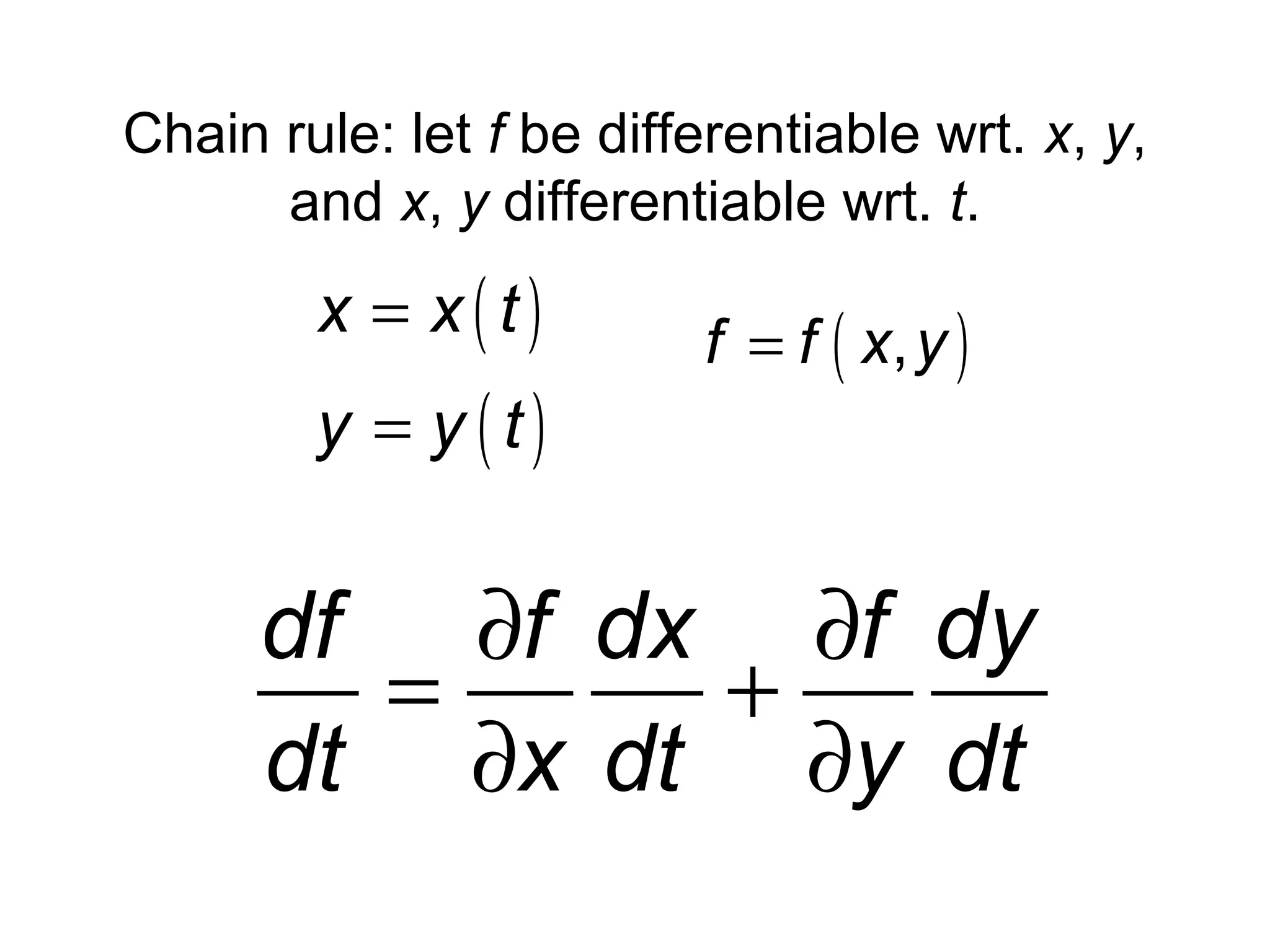
Chain rule: let f be differentiable wrt. x, y,
and x, y differentiable wrt. t.

x = x(t)

y = y (t)

f = f ( x, y )

df ∂f dx ∂f dy
=
+
dt ∂x dt ∂y dt
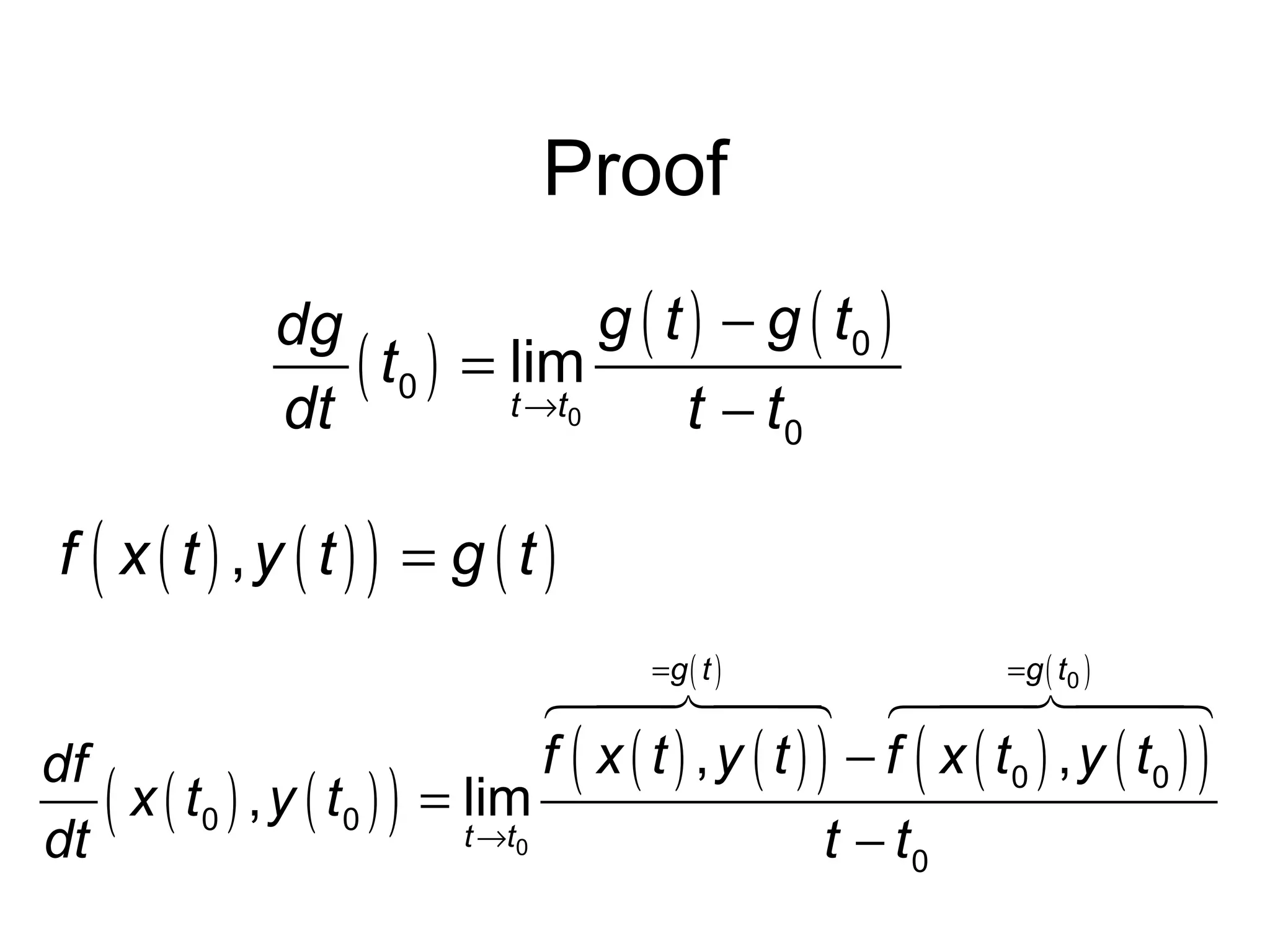
Proof
g ( t ) − g ( t0 )
dg
( t0 ) = lim
t →t0
dt
t − t0

f ( x ( t ) ,y ( t ) ) = g ( t )
=g ( t )

df
( x ( t0 ) , y ( t0 ) ) = lim0
t →t
dt

=g ( t0 )

64 744 64 744
4
8
4
8
f ( x ( t ) , y ( t ) ) − f ( x ( t0 ) , y ( t0 ) )
t − t0
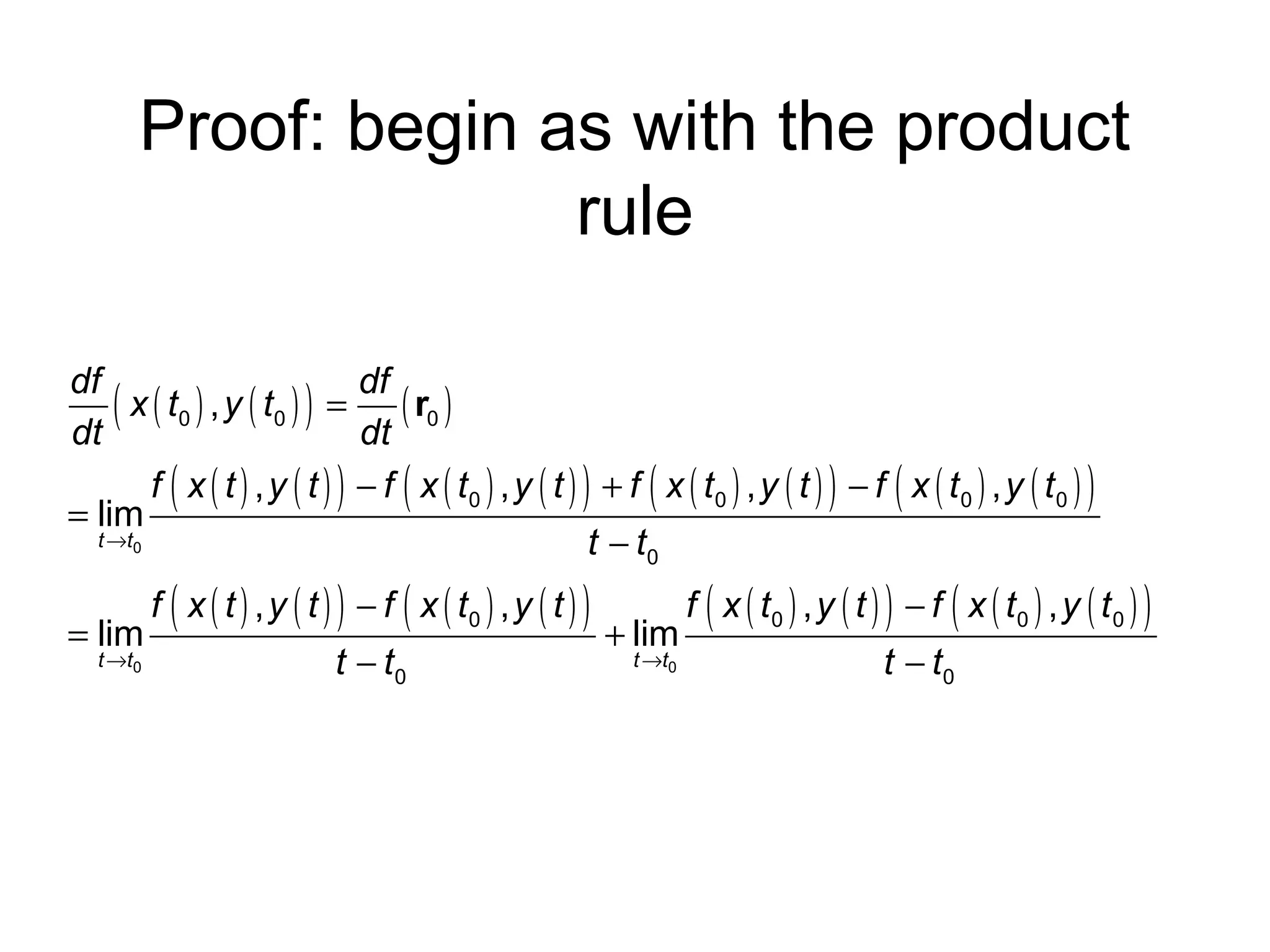
Proof: begin as with the product
rule
df
df
x ( t0 ) , y ( t0 ) ) =
( r0 )
(
dt
dt
f ( x ( t ) , y ( t ) ) − f ( x ( t0 ) , y ( t ) ) + f ( x ( t0 ) , y ( t ) ) − f ( x ( t0 ) , y ( t0 ) )
= lim
t →t0
t − t0
= lim
t →t0

f ( x ( t ) , y ( t ) ) − f ( x ( t0 ) , y ( t ) )
t − t0

+ lim
t →t0

f ( x ( t0 ) , y ( t ) ) − f ( x ( t0 ) , y ( t 0 ) )
t − t0
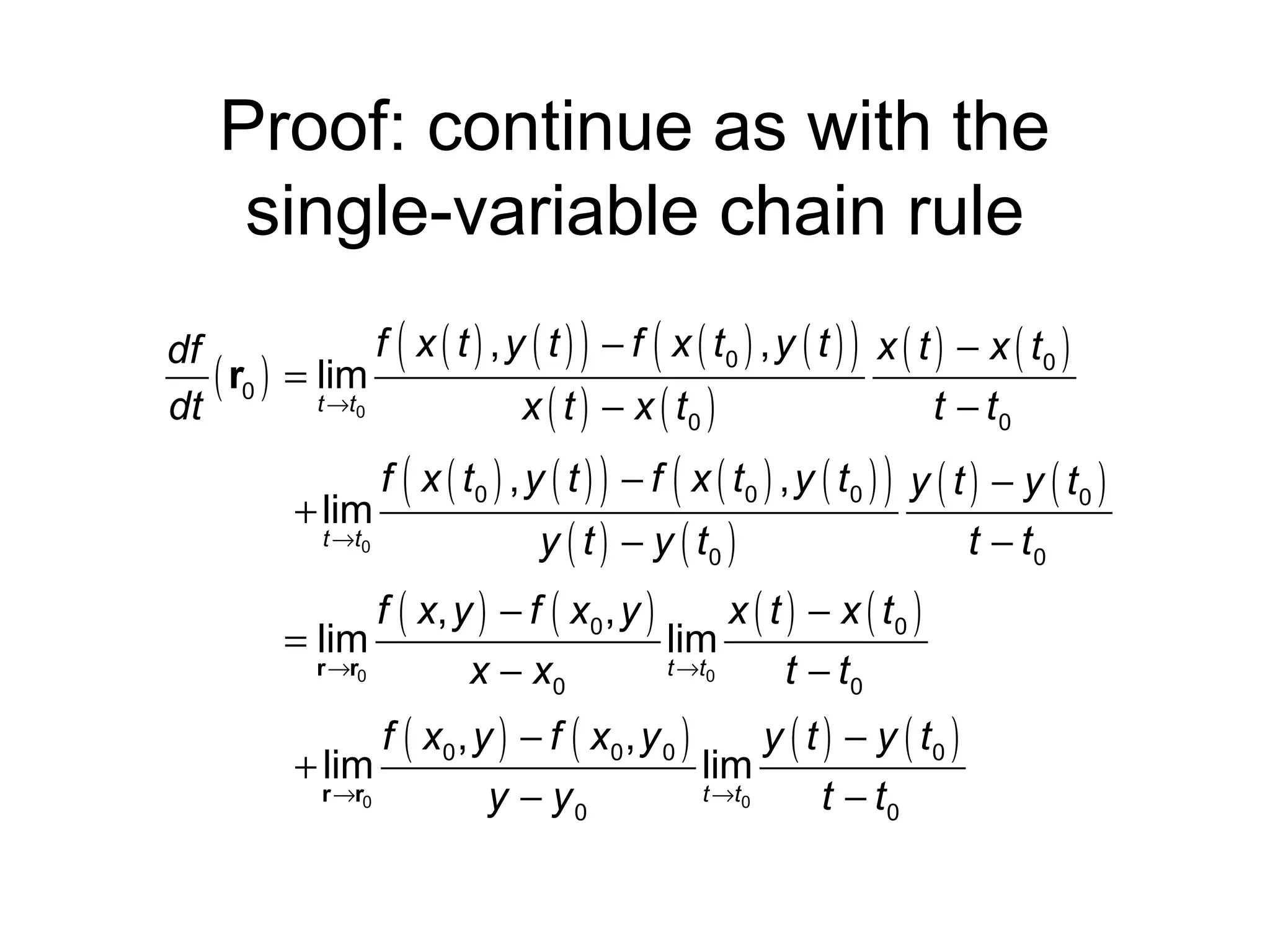
Proof: continue as with the
single-variable chain rule
f ( x ( t ) , y ( t ) ) − f ( x ( t0 ) , y ( t ) ) x ( t ) − x ( t0 )
df
( r0 ) = lim
t →t0
dt
x ( t ) − x ( t0 )
t − t0

f ( x ( t0 ) , y ( t ) ) − f ( x ( t0 ) , y ( t0 ) ) y ( t ) − y ( t0 )
+ lim
t →t0
y ( t ) − y ( t0 )
t − t0

f ( x, y ) − f ( x0 , y )
x ( t ) − x ( t0 )
= lim
lim
r →r0
t →t0
x − x0
t − t0

f ( x0 , y ) − f ( x 0 , y 0 )
y ( t ) − y ( t0 )
+ lim
lim
r →r0
t →t0
y − y0
t − t0
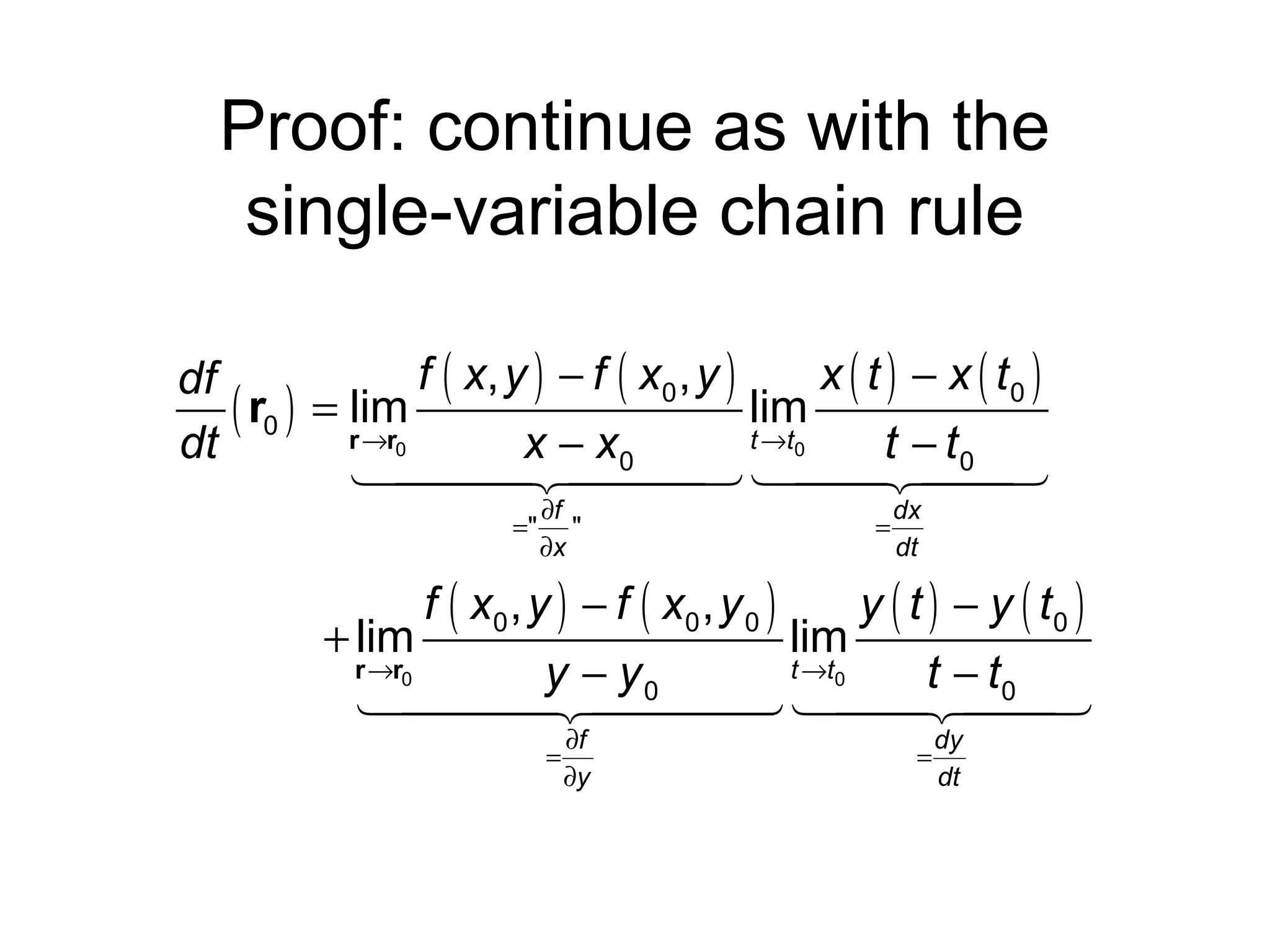
Proof: continue as with the
single-variable chain rule
f ( x, y ) − f ( x 0 , y )
x ( t ) − x ( t0 )
df
lim
( r0 ) = rlim
→r0
t →t0
dt
x − x0
t − t0
144424443 144
244
3
="

∂f
"
∂x

=

dx
dt

f ( x0 , y ) − f ( x0 , y 0 )
y ( t ) − y ( t0 )
+ lim
lim
r →r0
t →t0
y − y0
t − t0
1444 24444 144244
4
3
3
=

∂f
∂y

=

dy
dt
Definition: f is [new] differentiable at r0 if
f ( x, y ) − f ( x0 , y ) ∂f
lim
=
( r0 )
r →r0
x − x0
∂x
and
f ( x, y ) − f ( x, y 0 ) ∂f
lim
=
( r0 )
r →r0
y − y0
∂y
Definition: f is [old] differentiable at r0 if
∆f ( r0 ) = f ( r0 + ∆r ) − f ( r0 )
∂f
∂f
=
( r0 ) ∆x + ( r0 ) ∆y + ε1∆x + ε 2∆y
∂x
∂y

where ε1 = ε 1 ( ∆r ) , ε 2 = ε 2 ( ∆r ) → 0 as ∆r → 0
∆x = x − x0 , ∆y = y − y 0 , ∆r = r − r0
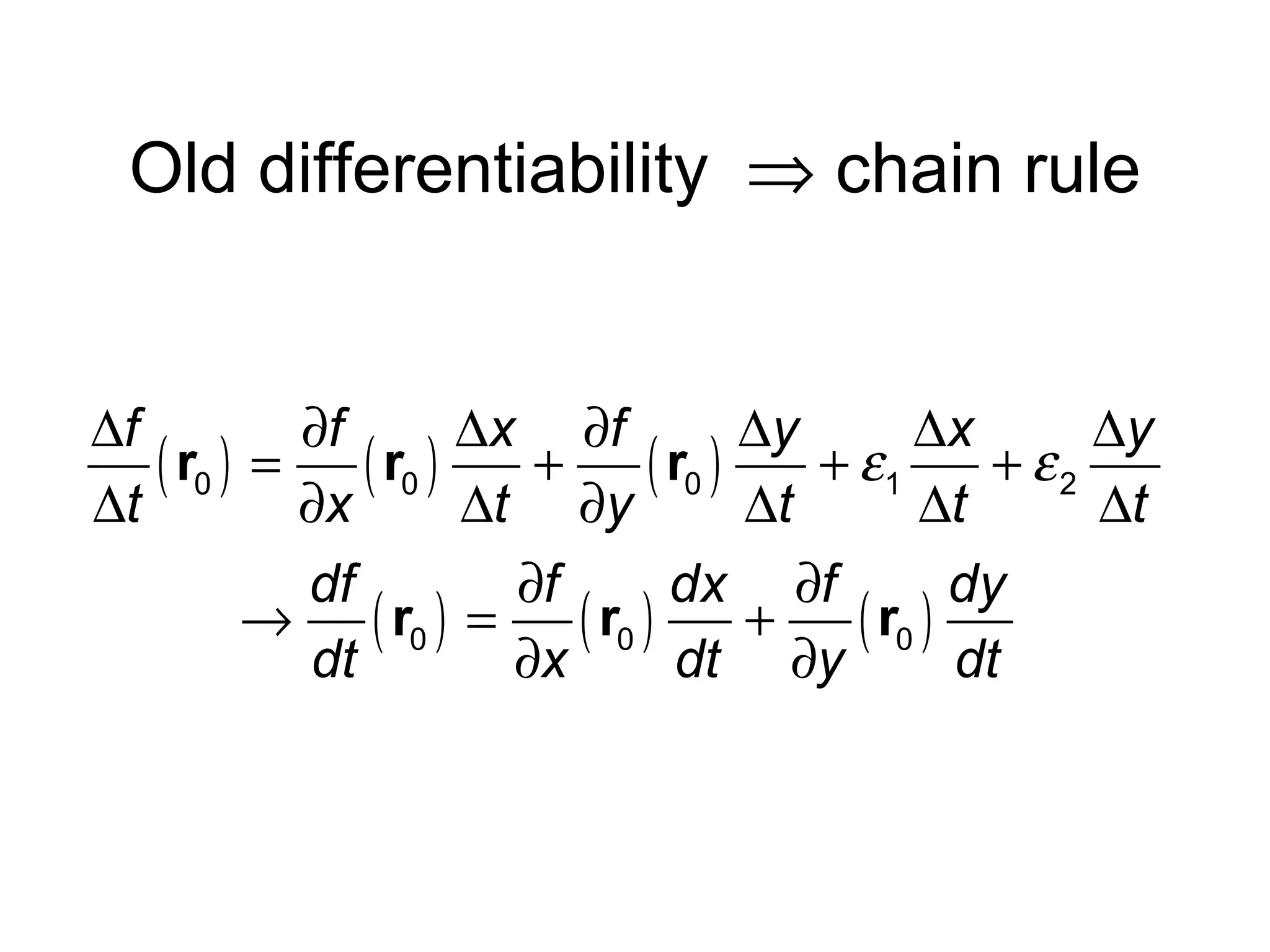
Old differentiability ⇒ chain rule

∆f
∂f
∆x ∂f
∆y
∆x
∆y
( r0 ) = ( r0 ) + ( r0 ) + ε1 + ε 2
∆t
∂x
∆t ∂y
∆t
∆t
∆t
df
∂f
dx ∂f
dy
→ ( r0 ) =
( r0 ) + ( r0 )
dt
∂x
dt ∂y
dt
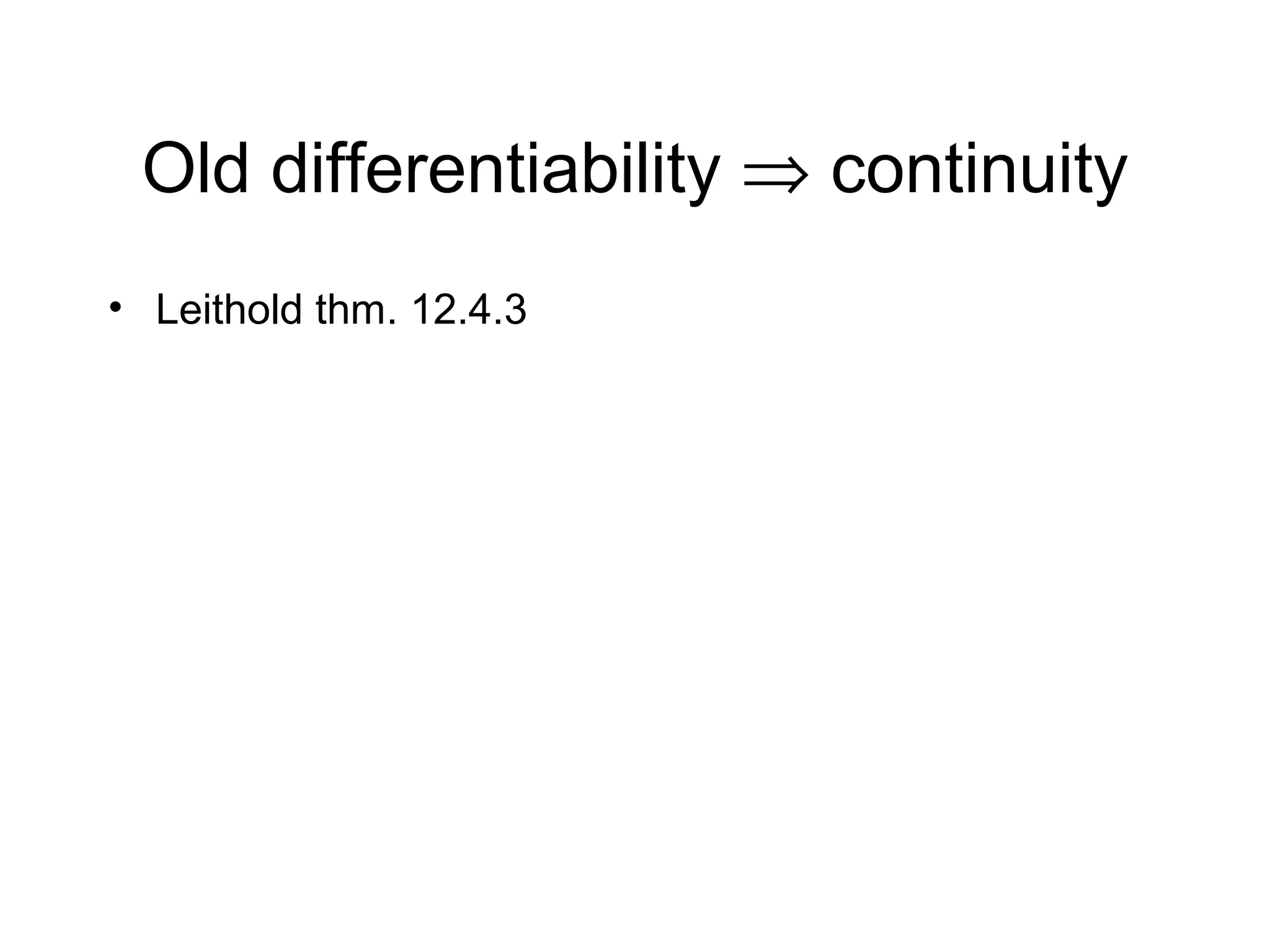
Old differentiability ⇒ continuity
• Leithold thm. 12.4.3
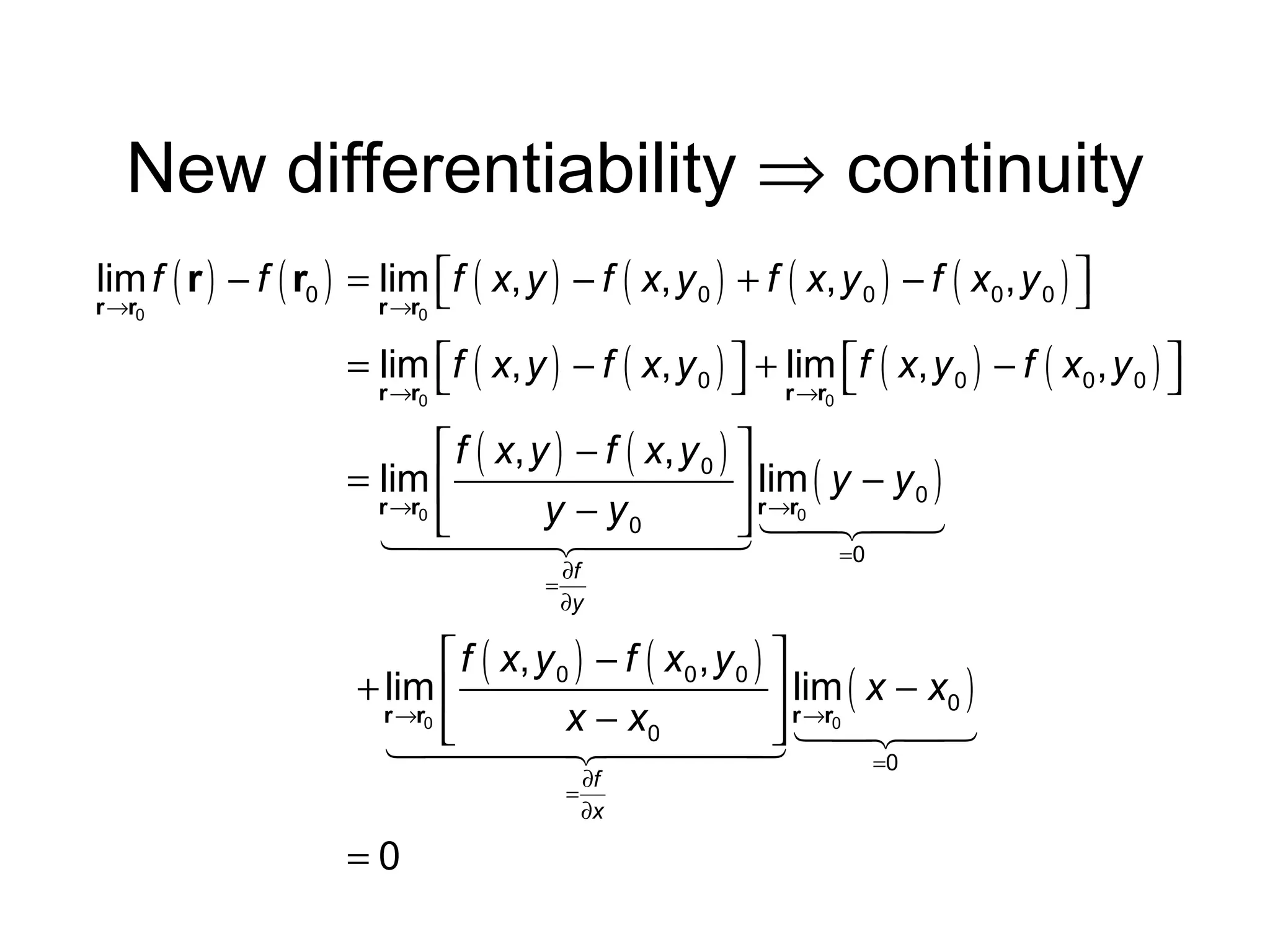
New differentiability ⇒ continuity
lim f ( r ) − f ( r0 ) = lim f ( x, y ) − f ( x, y 0 ) + f ( x, y 0 ) − f ( x0 , y 0 ) 



r →r0

r →r0

= lim f ( x, y ) − f ( x, y 0 )  + lim f ( x, y 0 ) − f ( x0 , y 0 ) 




r →r0

r →r0

 f ( x, y ) − f ( x , y 0 ) 
= lim 
lim
 r →r0 ( y − y 0 )
r →r0
y − y0

1444 24444 14243
4
3
=0
=

∂f
∂y

 f ( x, y 0 ) − f ( x0 , y 0 ) 
+ lim 
lim
 r →r0 ( x − x0 )
r →r0
x − x0

14444
24444  14243
3
=0
=

=0

∂f
∂x
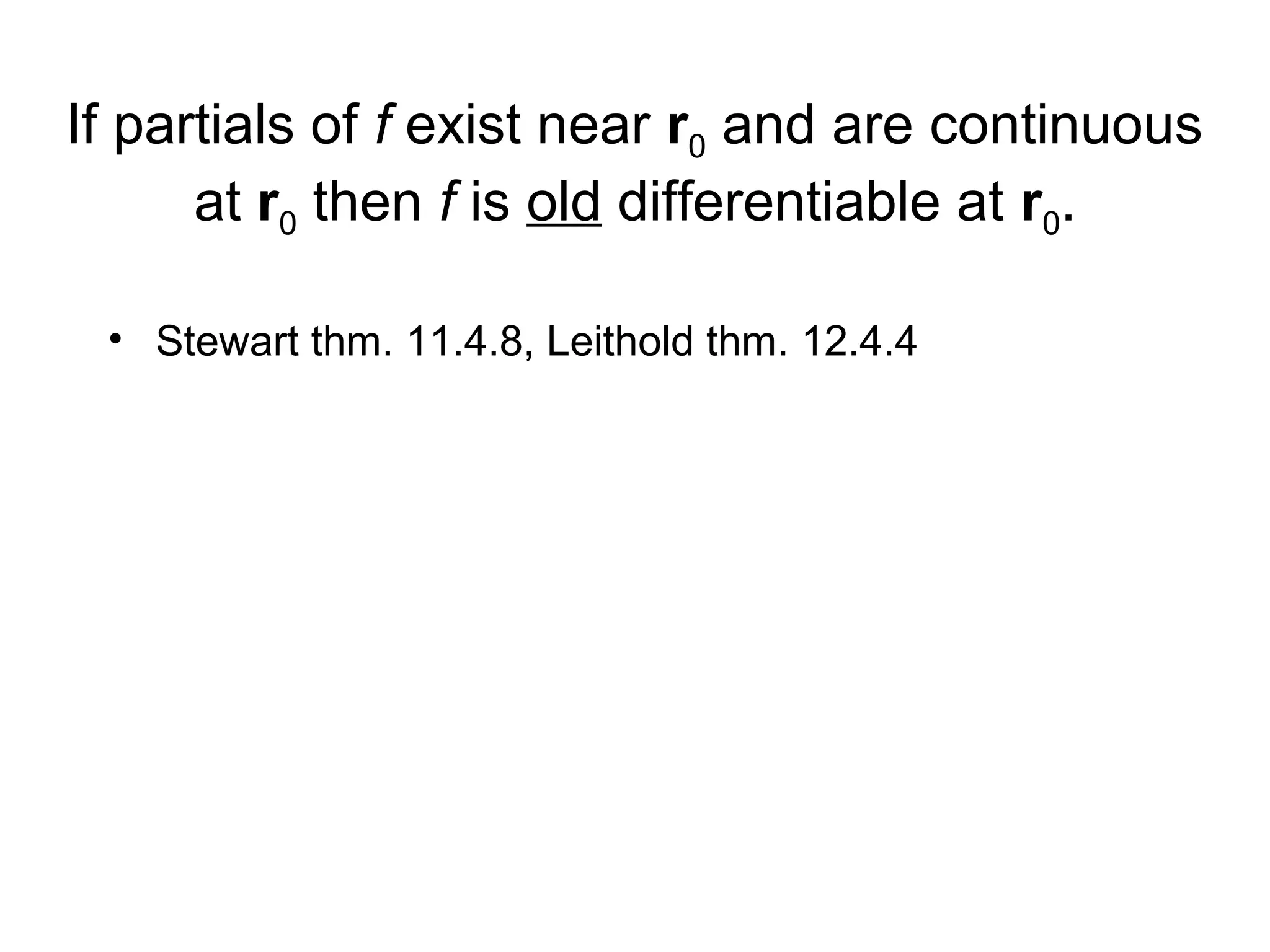
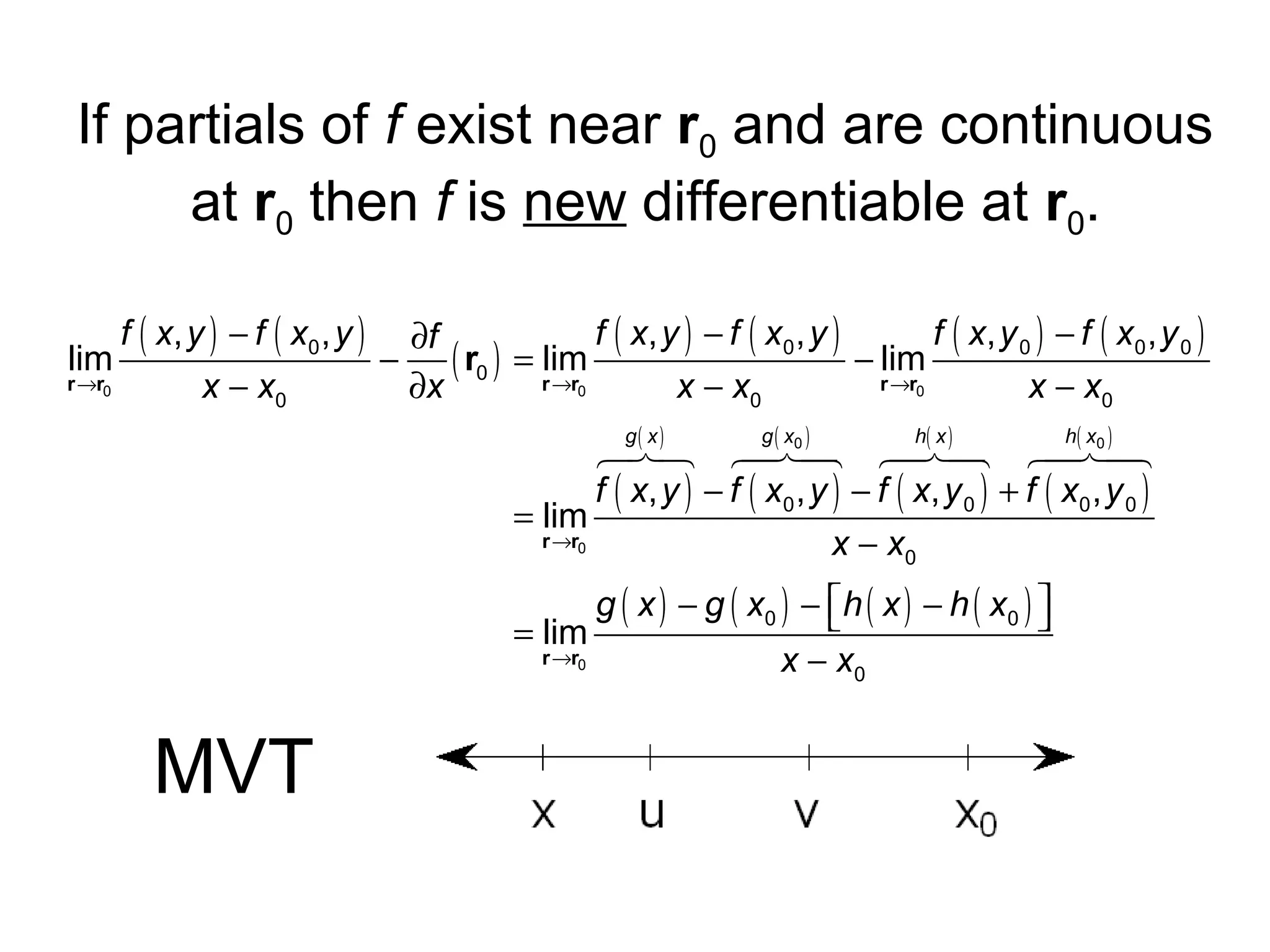
If partials of f exist near r0 and are continuous
at r0 then f is old differentiable at r0.
• Stewart thm. 11.4.8, Leithold thm. 12.4.4
If partials of f exist near r0 and are continuous
at r0 then f is new differentiable at r0.
f ( x, y ) − f ( x0 , y ) ∂f
f ( x, y ) − f ( x 0 , y )
f ( x, y 0 ) − f ( x 0 , y 0 )
lim
−
− lim
( r0 ) = rlim
r →r0
→r0
r →r0
x − x0
∂x
x − x0
x − x0
( )
678 6 74 6 74 6 74
4( 0 )8 4 ( ) 8
4( 0 ) 8
f ( x, y ) − f ( x 0 , y ) − f ( x , y 0 ) + f ( x 0 , y 0 )
= lim
r →r0
x − x0
g x

g x

h x

g ( x ) − g ( x0 ) −  h ( x ) − h ( x 0 ) 


= lim
r →r0
x − x0

MVT

h x
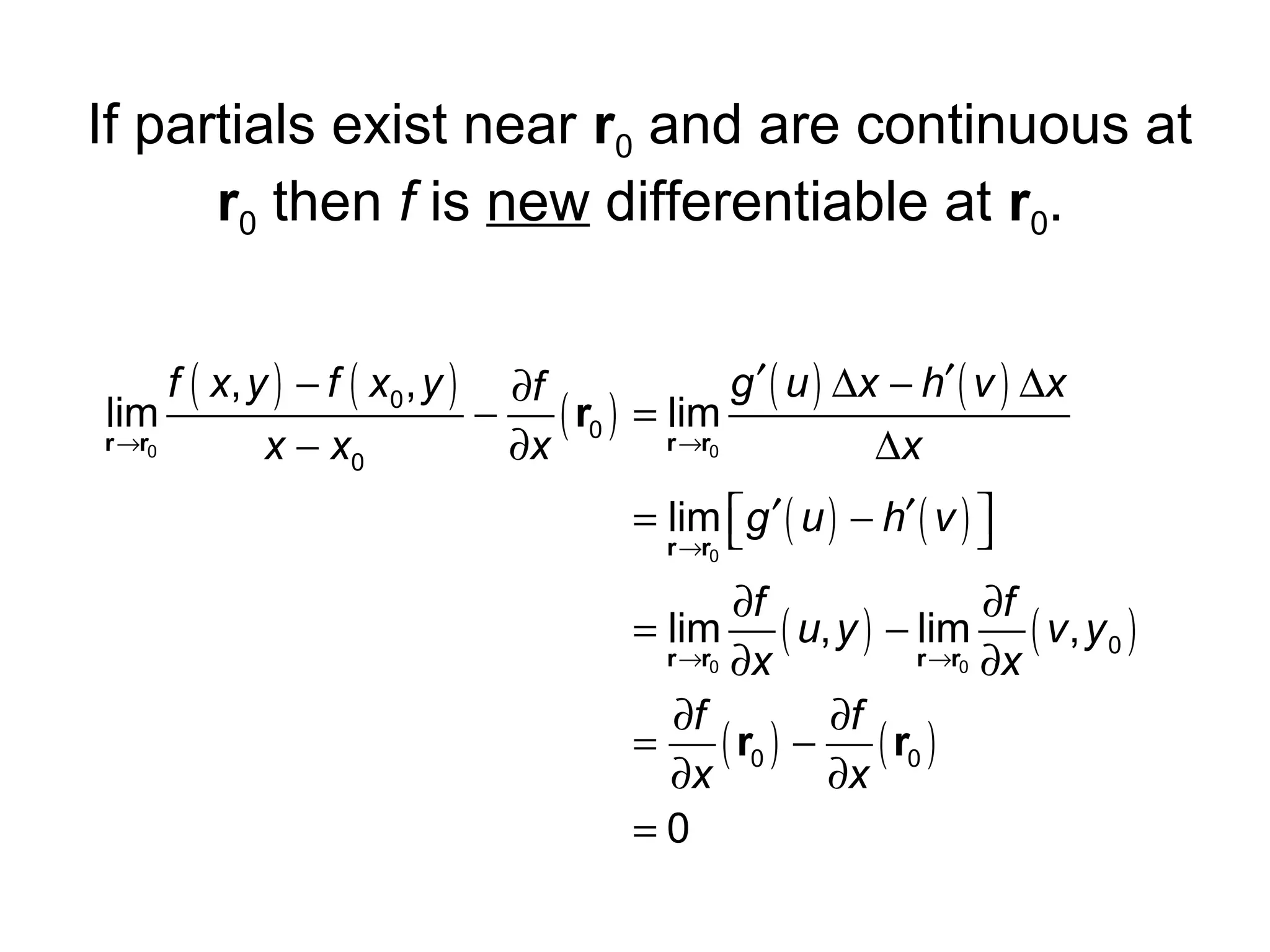
If partials exist near r0 and are continuous at
r0 then f is new differentiable at r0.
f ( x, y ) − f ( x0 , y ) ∂f
g ′ ( u ) ∆x − h′ ( v ) ∆x
lim
−
( r0 ) = rlim
r →r0
→r0
x − x0
∂x
∆x
= lim g ′ ( u ) − h′ ( v ) 


r →r0

∂f
∂f
= lim ( u, y ) − lim ( v , y 0 )
r →r0 ∂x
r →r0 ∂x
∂f
∂f
=
( r0 ) − ( r0 )
∂x
∂x
=0
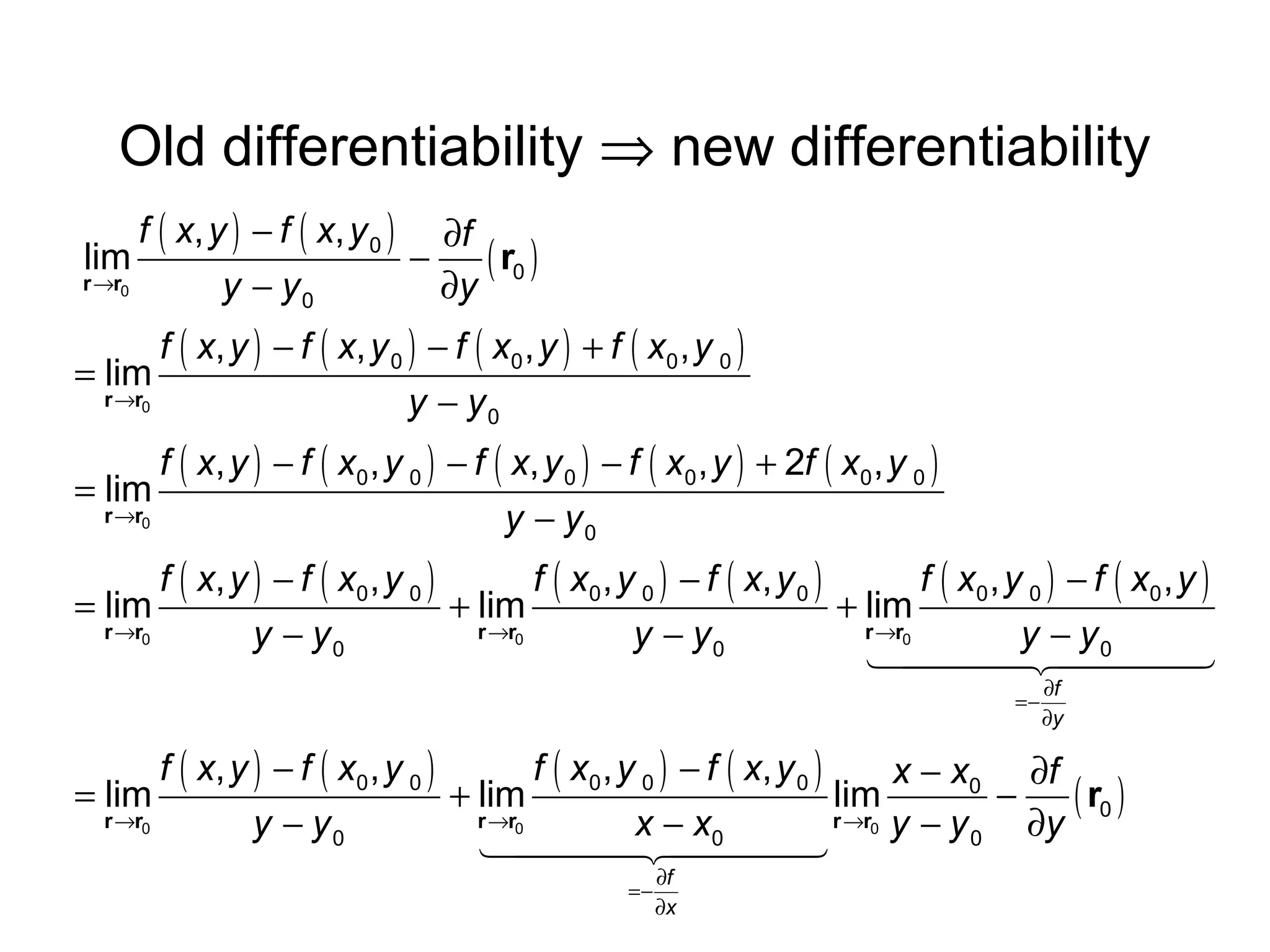
Old differentiability ⇒ new differentiability
f ( x, y ) − f ( x, y 0 ) ∂f
lim
−
( r0 )
r →r0
y − y0
∂y

f ( x, y ) − f ( x, y 0 ) − f ( x0 , y ) + f ( x0 , y 0 )
= lim
r →r0
y − y0

f ( x, y ) − f ( x0 , y 0 ) − f ( x, y 0 ) − f ( x0 , y ) + 2f ( x0 , y 0 )
= lim
r →r0
y − y0

f ( x, y ) − f ( x 0 , y 0 )
f ( x 0 , y 0 ) − f ( x, y 0 )
f ( x0 , y 0 ) − f ( x0 , y )
= lim
+ lim
+ lim
r →r0
r →r0
r →r0
y − y0
y − y0
y − y0
1444 24444
4
3
=−

∂f
∂y

f ( x, y ) − f ( x 0 , y 0 )
f ( x 0 , y 0 ) − f ( x, y 0 )
x − x0 ∂f
= lim
+ lim
lim
−
( r0 )
r →r0
r →r0
r →r0 y − y
y − y0
x − x0
∂y
0
1444 24444
4
3
=−

∂f
∂x
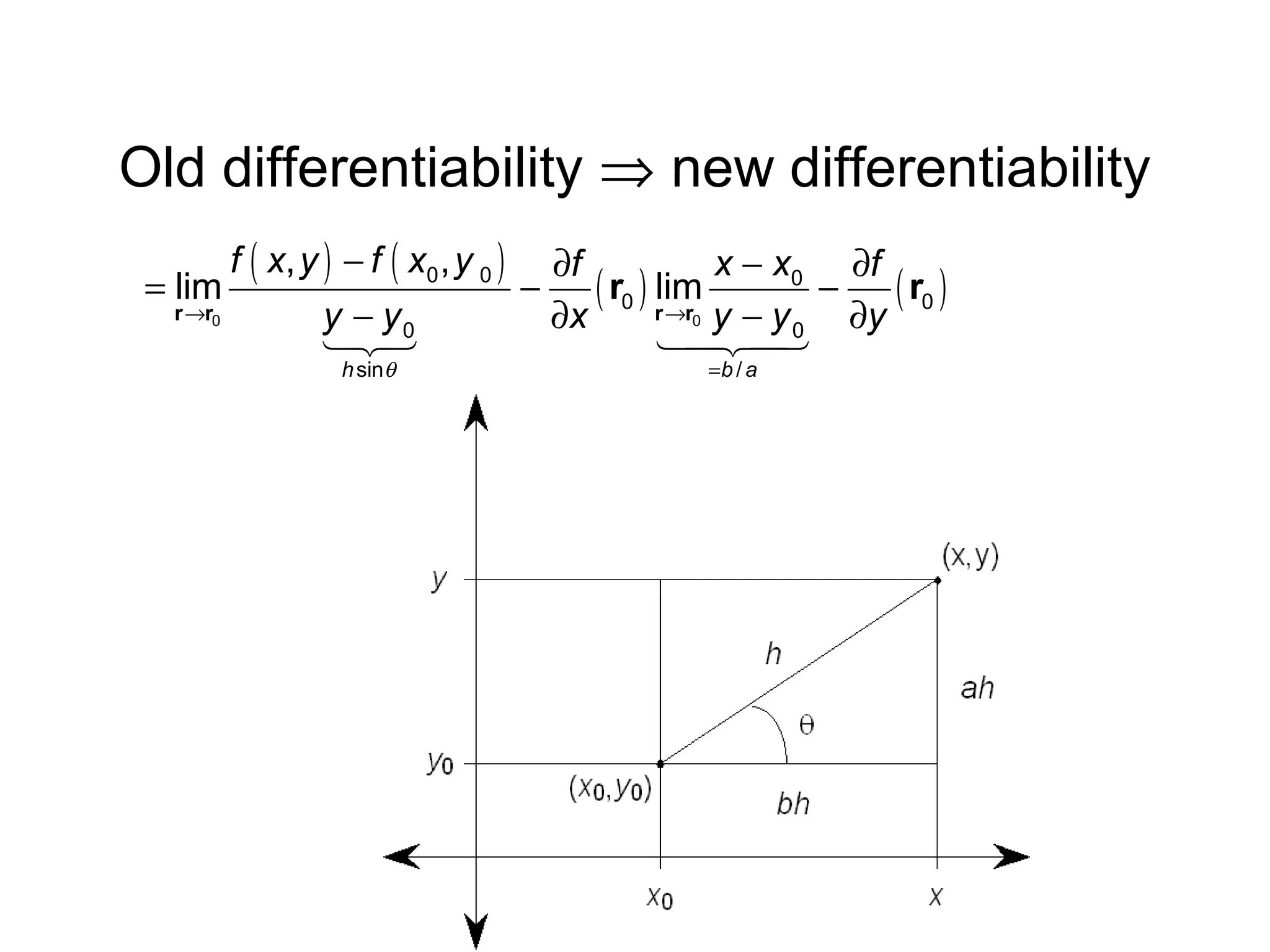
Old differentiability ⇒ new differentiability
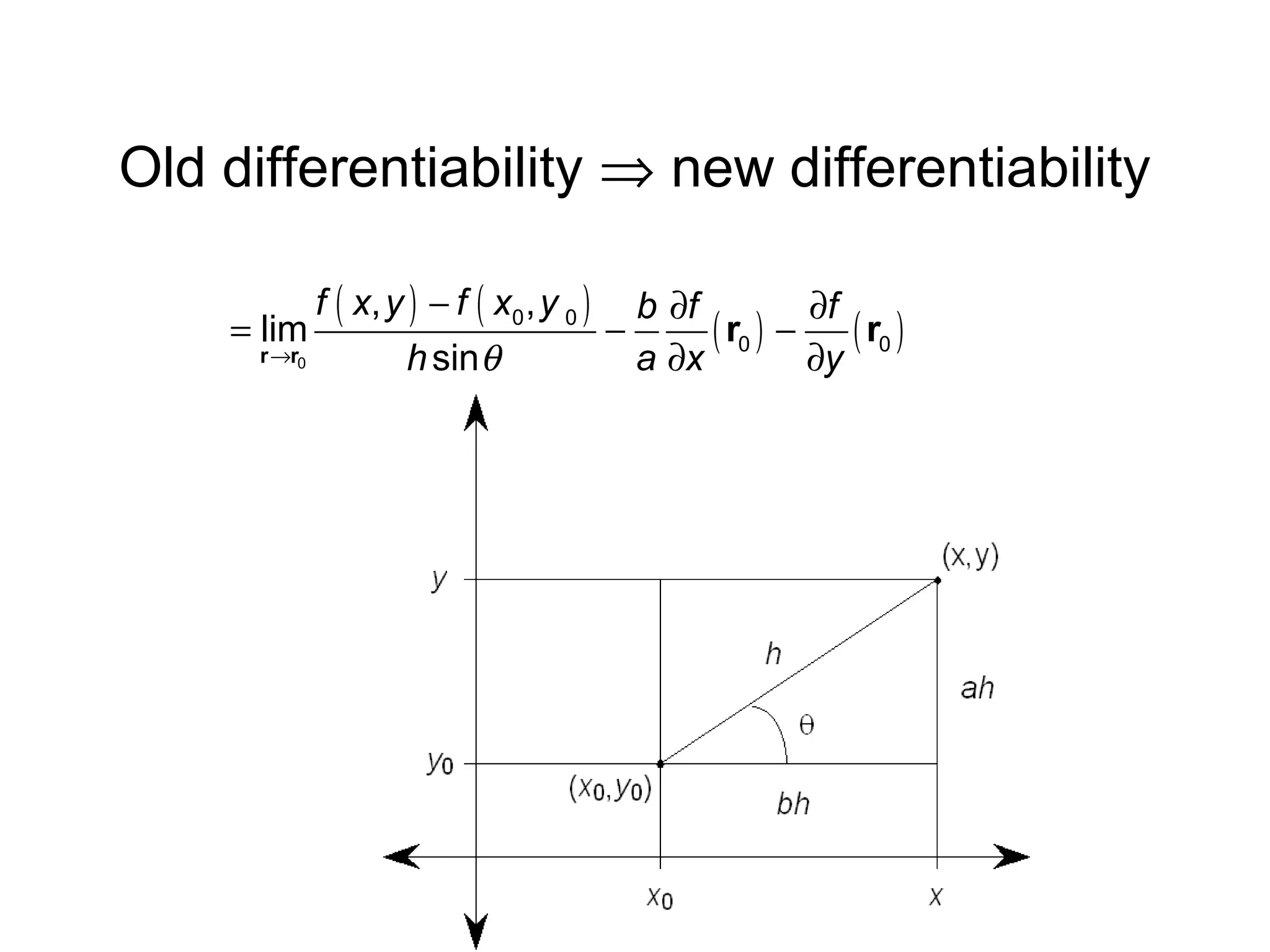
f ( x, y ) − f ( x0 , y 0 ) ∂f
x − x0 ∂f
= lim
−
−
( r0 ) rlim
( r0 )
r →r0
→r0 y − y
y − y0
∂x
∂y
1 3
2
1 24 0
4 3
h sinθ

=b / a
Old differentiability ⇒ new differentiability
f ( x, y ) − f ( x0 , y 0 ) b ∂f
∂f
= lim
−
( r0 ) − ( r0 )
r →r0
h sinθ
a ∂x
∂y
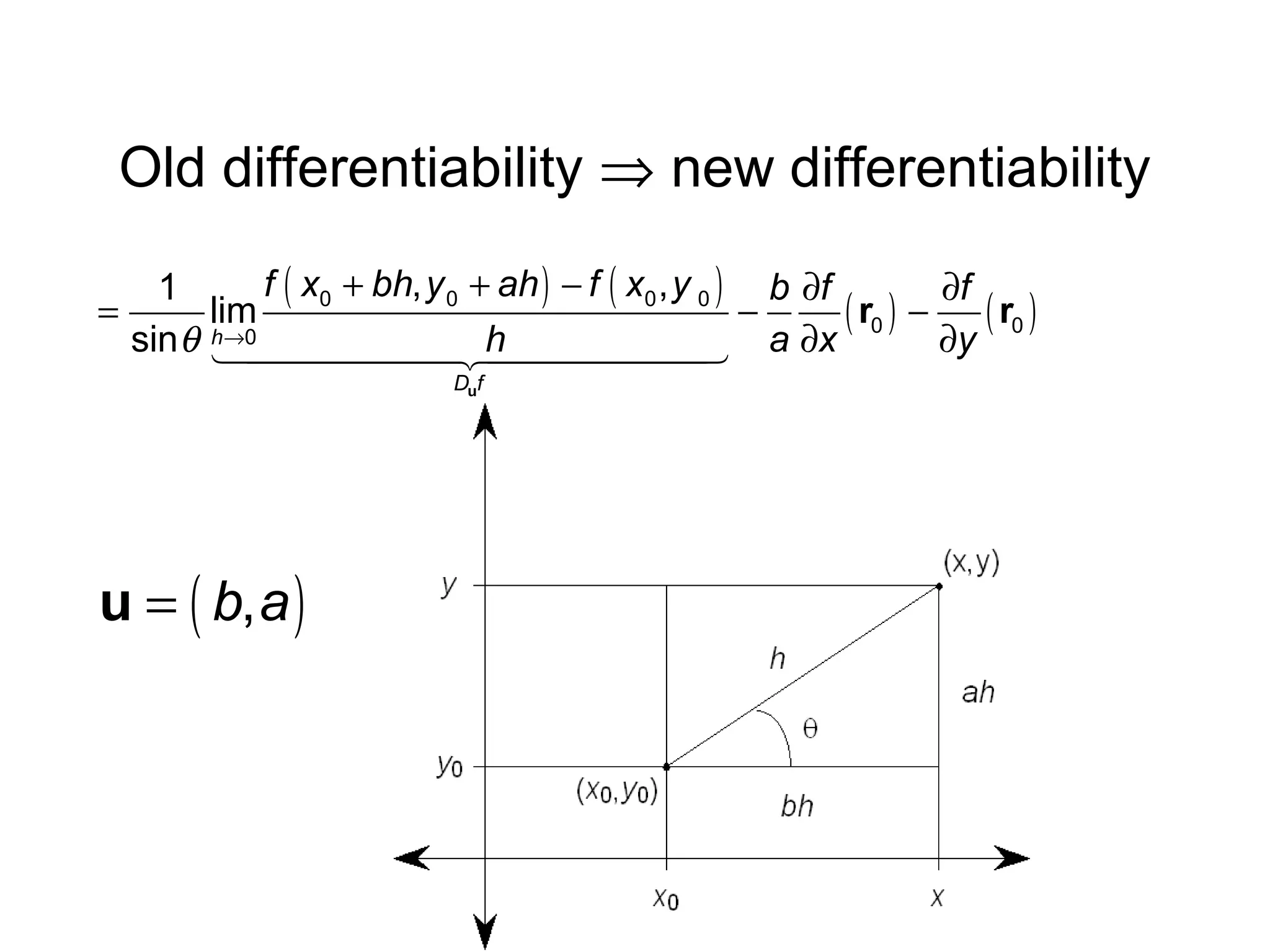
Old differentiability ⇒ new differentiability
=

f ( x0 + bh, y 0 + ah ) − f ( x0 , y 0 ) b ∂f
1
∂f
lim
−
r0 ) −
(
( r0 )
h→0
sinθ 1444444 h
∂y
2444444
3 a ∂x
Duf

u = ( b, a )
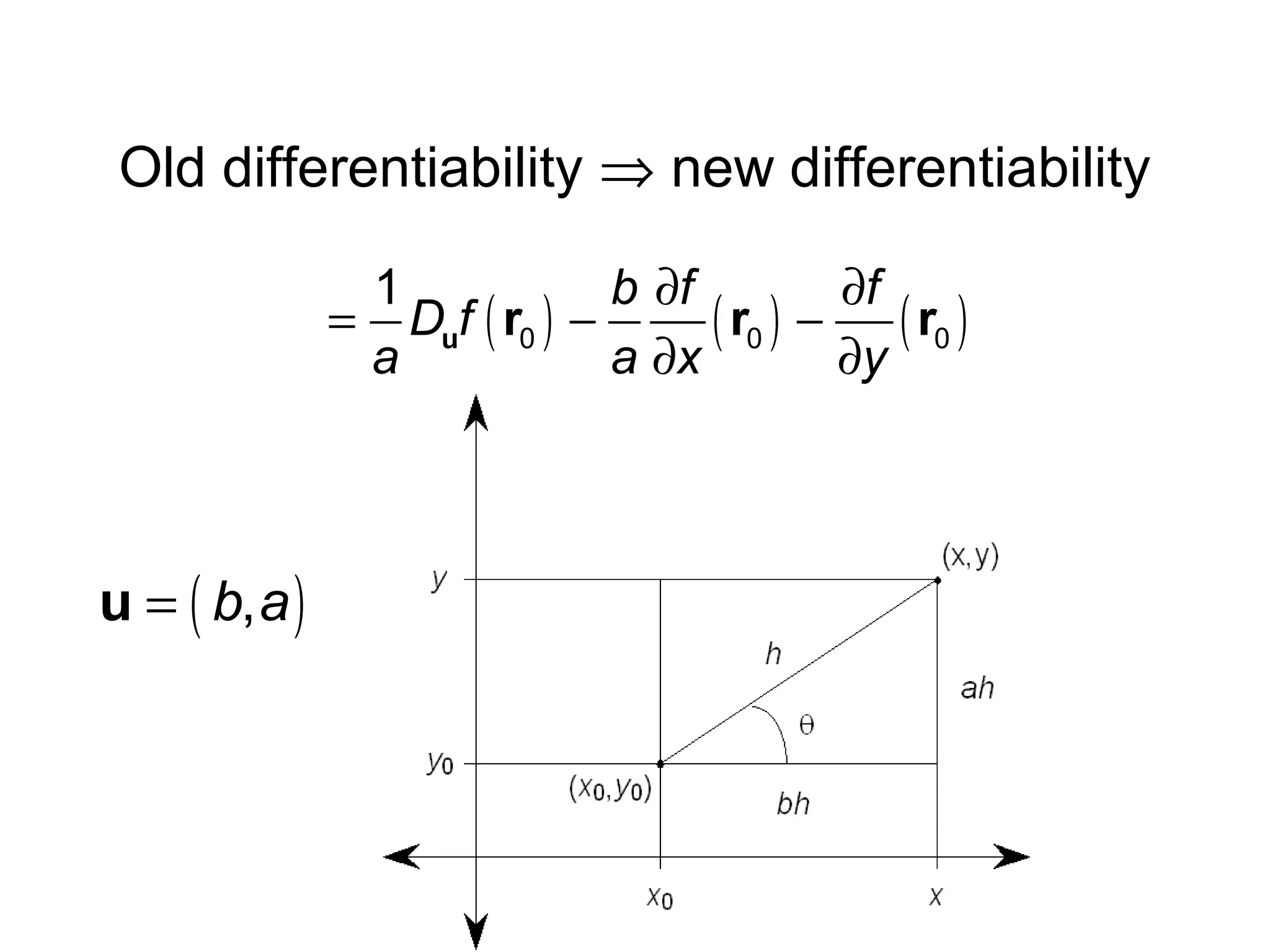
Old differentiability ⇒ new differentiability
1
b ∂f
∂f
= Duf ( r0 ) −
( r0 ) − ( r0 )
a
a ∂x
∂y

u = ( b, a )
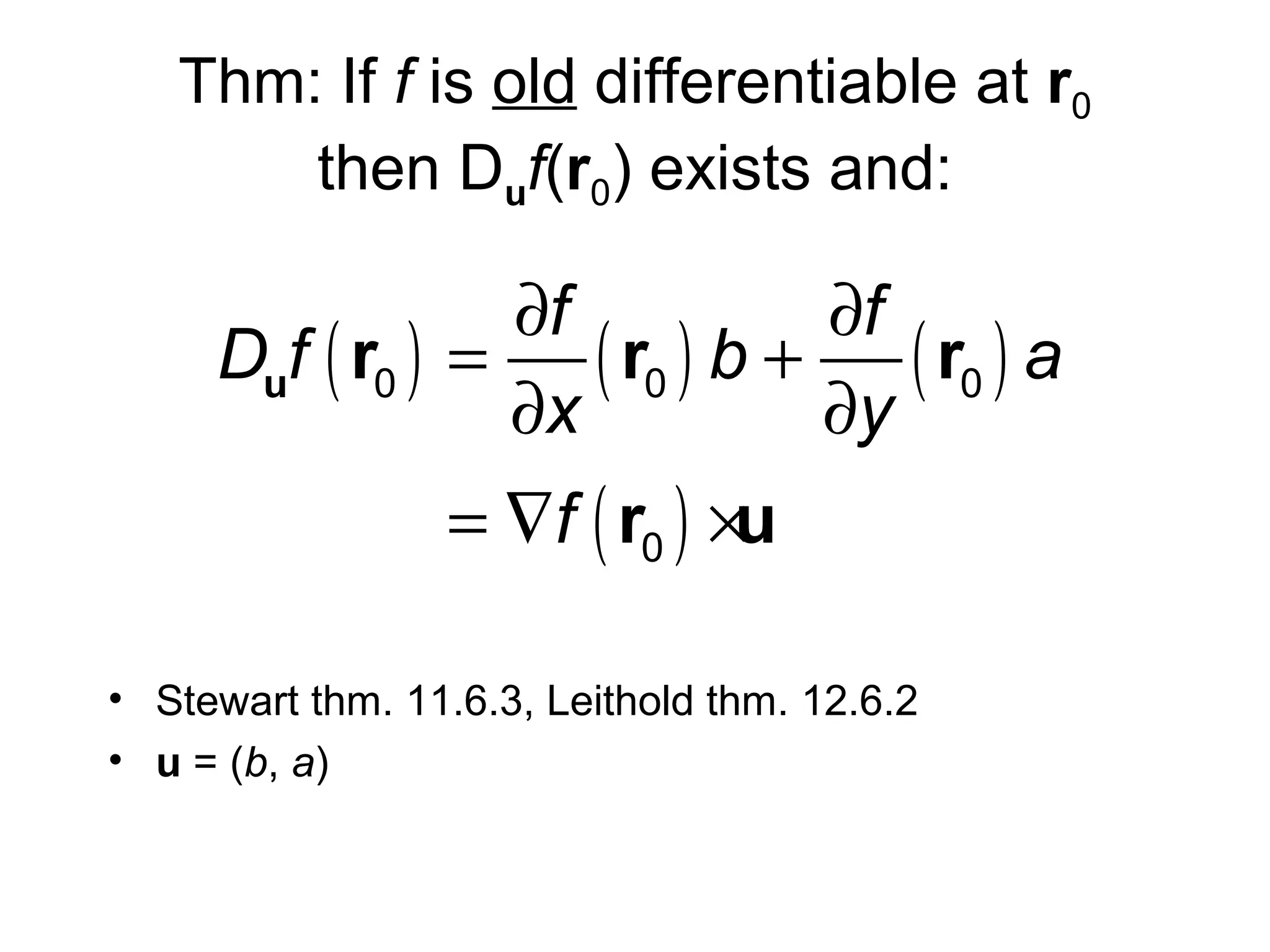
Thm: If f is old differentiable at r0
then Duf(r0) exists and:

Duf ( r0 )

∂f
∂f
=
( r0 ) b + ( r0 ) a
∂x
∂y
= ∇f ( r0 ) ×u

• Stewart thm. 11.6.3, Leithold thm. 12.6.2
• u = (b, a)
Old differentiability ⇒ new differentiability
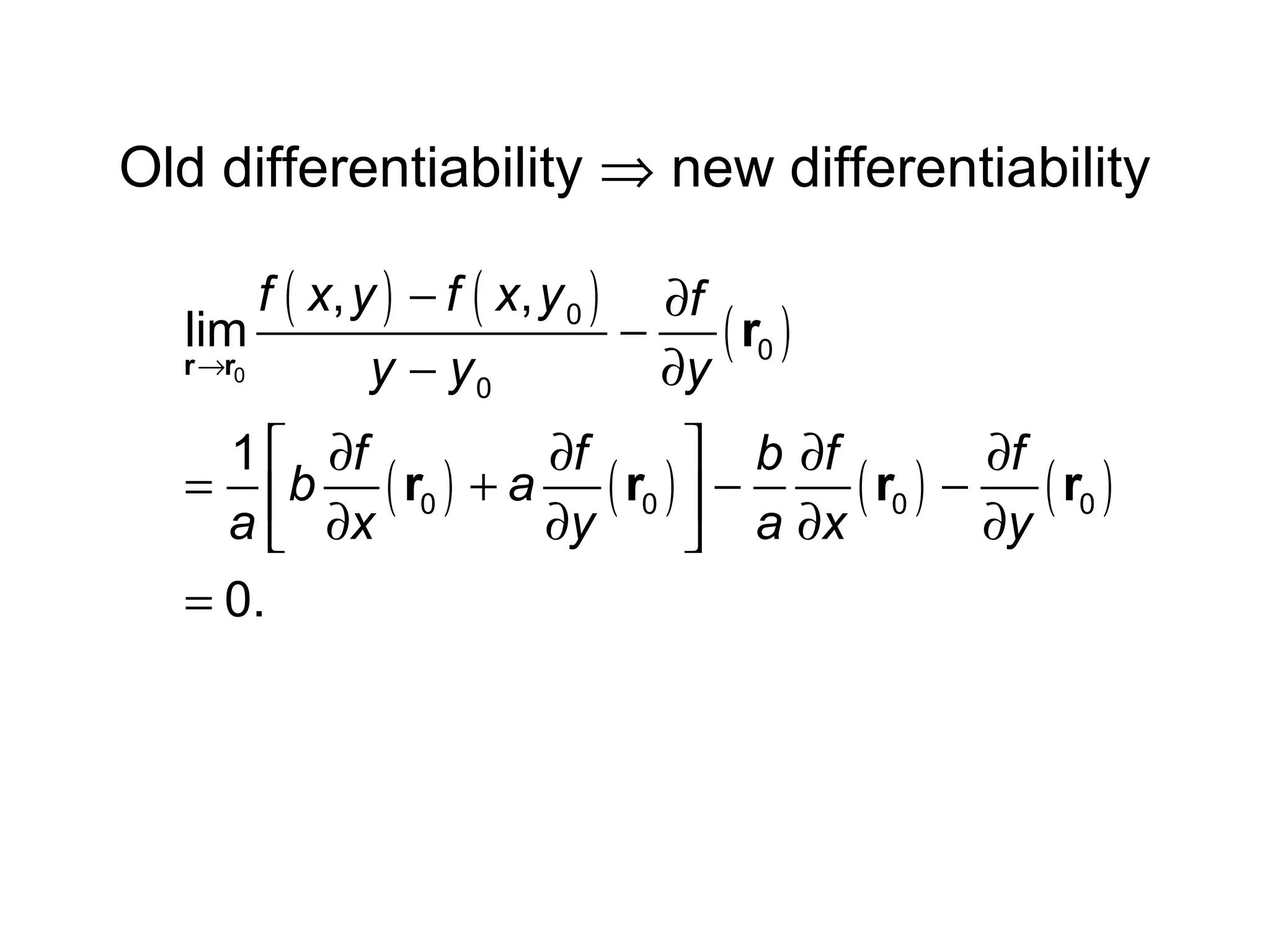
f ( x, y ) − f ( x, y 0 ) ∂f
lim
−
( r0 )
r →r0
y − y0
∂y
 b ∂f
1  ∂f
∂f
∂f
= b ( r0 ) + a ( r0 )  −
( r0 ) − ( r0 )
a  ∂x
∂y
∂y
 a ∂x
= 0.
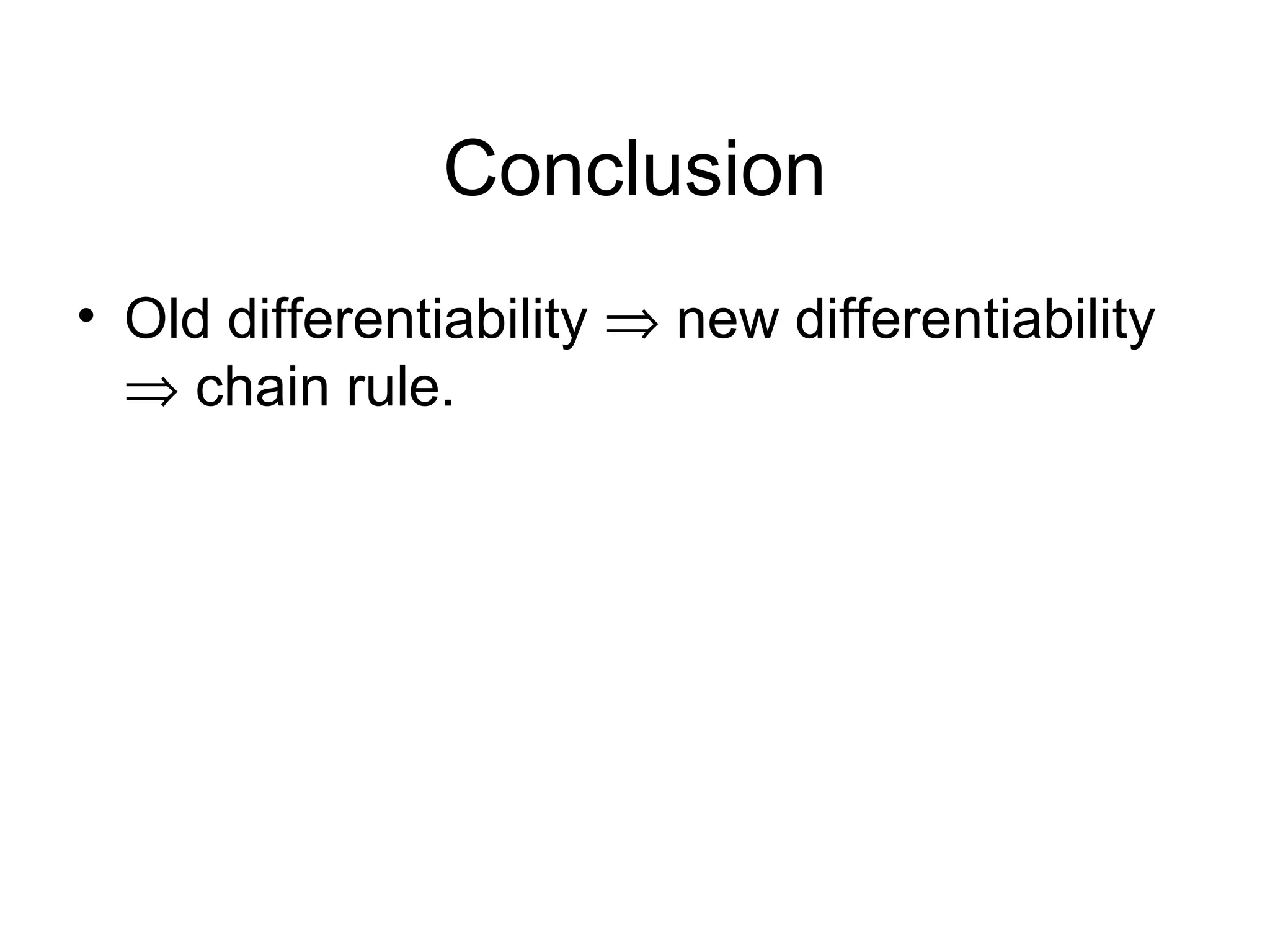
Conclusion
• Old differentiability ⇒ new differentiability
⇒ chain rule.
Question:
• Old differentiability ⇔ new differentiability?
References
• Stewart, Essential Calculus (Thompson, 2007)
• Leithold, The Calculus 7th ed. (Harper, 1996)

An Alternative Proof of the chain rule and definition of differentiability for multivariable functions

  • 1.
    An alternative prooffor the chain rule for multivariable functions Raymond Jensen Northern State University
  • 2.
    Chain rule: letf be differentiable wrt. x, y, and x, y differentiable wrt. t. x = x(t) y = y (t) f = f ( x, y ) df ∂f dx ∂f dy = + dt ∂x dt ∂y dt
  • 3.
    Proof g ( t) − g ( t0 ) dg ( t0 ) = lim t →t0 dt t − t0 f ( x ( t ) ,y ( t ) ) = g ( t ) =g ( t ) df ( x ( t0 ) , y ( t0 ) ) = lim0 t →t dt =g ( t0 ) 64 744 64 744 4 8 4 8 f ( x ( t ) , y ( t ) ) − f ( x ( t0 ) , y ( t0 ) ) t − t0
  • 4.
    Proof: begin aswith the product rule df df x ( t0 ) , y ( t0 ) ) = ( r0 ) ( dt dt f ( x ( t ) , y ( t ) ) − f ( x ( t0 ) , y ( t ) ) + f ( x ( t0 ) , y ( t ) ) − f ( x ( t0 ) , y ( t0 ) ) = lim t →t0 t − t0 = lim t →t0 f ( x ( t ) , y ( t ) ) − f ( x ( t0 ) , y ( t ) ) t − t0 + lim t →t0 f ( x ( t0 ) , y ( t ) ) − f ( x ( t0 ) , y ( t 0 ) ) t − t0
  • 5.
    Proof: continue aswith the single-variable chain rule f ( x ( t ) , y ( t ) ) − f ( x ( t0 ) , y ( t ) ) x ( t ) − x ( t0 ) df ( r0 ) = lim t →t0 dt x ( t ) − x ( t0 ) t − t0 f ( x ( t0 ) , y ( t ) ) − f ( x ( t0 ) , y ( t0 ) ) y ( t ) − y ( t0 ) + lim t →t0 y ( t ) − y ( t0 ) t − t0 f ( x, y ) − f ( x0 , y ) x ( t ) − x ( t0 ) = lim lim r →r0 t →t0 x − x0 t − t0 f ( x0 , y ) − f ( x 0 , y 0 ) y ( t ) − y ( t0 ) + lim lim r →r0 t →t0 y − y0 t − t0
  • 6.
    Proof: continue aswith the single-variable chain rule f ( x, y ) − f ( x 0 , y ) x ( t ) − x ( t0 ) df lim ( r0 ) = rlim →r0 t →t0 dt x − x0 t − t0 144424443 144 244 3 =" ∂f " ∂x = dx dt f ( x0 , y ) − f ( x0 , y 0 ) y ( t ) − y ( t0 ) + lim lim r →r0 t →t0 y − y0 t − t0 1444 24444 144244 4 3 3 = ∂f ∂y = dy dt
  • 7.
    Definition: f is[new] differentiable at r0 if f ( x, y ) − f ( x0 , y ) ∂f lim = ( r0 ) r →r0 x − x0 ∂x and f ( x, y ) − f ( x, y 0 ) ∂f lim = ( r0 ) r →r0 y − y0 ∂y
  • 8.
    Definition: f is[old] differentiable at r0 if ∆f ( r0 ) = f ( r0 + ∆r ) − f ( r0 ) ∂f ∂f = ( r0 ) ∆x + ( r0 ) ∆y + ε1∆x + ε 2∆y ∂x ∂y where ε1 = ε 1 ( ∆r ) , ε 2 = ε 2 ( ∆r ) → 0 as ∆r → 0 ∆x = x − x0 , ∆y = y − y 0 , ∆r = r − r0
  • 9.
    Old differentiability ⇒chain rule ∆f ∂f ∆x ∂f ∆y ∆x ∆y ( r0 ) = ( r0 ) + ( r0 ) + ε1 + ε 2 ∆t ∂x ∆t ∂y ∆t ∆t ∆t df ∂f dx ∂f dy → ( r0 ) = ( r0 ) + ( r0 ) dt ∂x dt ∂y dt
  • 10.
    Old differentiability ⇒continuity • Leithold thm. 12.4.3
  • 11.
    New differentiability ⇒continuity lim f ( r ) − f ( r0 ) = lim f ( x, y ) − f ( x, y 0 ) + f ( x, y 0 ) − f ( x0 , y 0 )    r →r0 r →r0 = lim f ( x, y ) − f ( x, y 0 )  + lim f ( x, y 0 ) − f ( x0 , y 0 )      r →r0 r →r0  f ( x, y ) − f ( x , y 0 )  = lim  lim  r →r0 ( y − y 0 ) r →r0 y − y0  1444 24444 14243 4 3 =0 = ∂f ∂y  f ( x, y 0 ) − f ( x0 , y 0 )  + lim  lim  r →r0 ( x − x0 ) r →r0 x − x0  14444 24444  14243 3 =0 = =0 ∂f ∂x
  • 12.
    If partials off exist near r0 and are continuous at r0 then f is old differentiable at r0. • Stewart thm. 11.4.8, Leithold thm. 12.4.4
  • 13.
    If partials off exist near r0 and are continuous at r0 then f is new differentiable at r0. f ( x, y ) − f ( x0 , y ) ∂f f ( x, y ) − f ( x 0 , y ) f ( x, y 0 ) − f ( x 0 , y 0 ) lim − − lim ( r0 ) = rlim r →r0 →r0 r →r0 x − x0 ∂x x − x0 x − x0 ( ) 678 6 74 6 74 6 74 4( 0 )8 4 ( ) 8 4( 0 ) 8 f ( x, y ) − f ( x 0 , y ) − f ( x , y 0 ) + f ( x 0 , y 0 ) = lim r →r0 x − x0 g x g x h x g ( x ) − g ( x0 ) −  h ( x ) − h ( x 0 )    = lim r →r0 x − x0 MVT h x
  • 14.
    If partials existnear r0 and are continuous at r0 then f is new differentiable at r0. f ( x, y ) − f ( x0 , y ) ∂f g ′ ( u ) ∆x − h′ ( v ) ∆x lim − ( r0 ) = rlim r →r0 →r0 x − x0 ∂x ∆x = lim g ′ ( u ) − h′ ( v )    r →r0 ∂f ∂f = lim ( u, y ) − lim ( v , y 0 ) r →r0 ∂x r →r0 ∂x ∂f ∂f = ( r0 ) − ( r0 ) ∂x ∂x =0
  • 15.
    Old differentiability ⇒new differentiability f ( x, y ) − f ( x, y 0 ) ∂f lim − ( r0 ) r →r0 y − y0 ∂y f ( x, y ) − f ( x, y 0 ) − f ( x0 , y ) + f ( x0 , y 0 ) = lim r →r0 y − y0 f ( x, y ) − f ( x0 , y 0 ) − f ( x, y 0 ) − f ( x0 , y ) + 2f ( x0 , y 0 ) = lim r →r0 y − y0 f ( x, y ) − f ( x 0 , y 0 ) f ( x 0 , y 0 ) − f ( x, y 0 ) f ( x0 , y 0 ) − f ( x0 , y ) = lim + lim + lim r →r0 r →r0 r →r0 y − y0 y − y0 y − y0 1444 24444 4 3 =− ∂f ∂y f ( x, y ) − f ( x 0 , y 0 ) f ( x 0 , y 0 ) − f ( x, y 0 ) x − x0 ∂f = lim + lim lim − ( r0 ) r →r0 r →r0 r →r0 y − y y − y0 x − x0 ∂y 0 1444 24444 4 3 =− ∂f ∂x
  • 16.
    Old differentiability ⇒new differentiability f ( x, y ) − f ( x0 , y 0 ) ∂f x − x0 ∂f = lim − − ( r0 ) rlim ( r0 ) r →r0 →r0 y − y y − y0 ∂x ∂y 1 3 2 1 24 0 4 3 h sinθ =b / a
  • 17.
    Old differentiability ⇒new differentiability f ( x, y ) − f ( x0 , y 0 ) b ∂f ∂f = lim − ( r0 ) − ( r0 ) r →r0 h sinθ a ∂x ∂y
  • 18.
    Old differentiability ⇒new differentiability = f ( x0 + bh, y 0 + ah ) − f ( x0 , y 0 ) b ∂f 1 ∂f lim − r0 ) − ( ( r0 ) h→0 sinθ 1444444 h ∂y 2444444 3 a ∂x Duf u = ( b, a )
  • 19.
    Old differentiability ⇒new differentiability 1 b ∂f ∂f = Duf ( r0 ) − ( r0 ) − ( r0 ) a a ∂x ∂y u = ( b, a )
  • 20.
    Thm: If fis old differentiable at r0 then Duf(r0) exists and: Duf ( r0 ) ∂f ∂f = ( r0 ) b + ( r0 ) a ∂x ∂y = ∇f ( r0 ) ×u • Stewart thm. 11.6.3, Leithold thm. 12.6.2 • u = (b, a)
  • 21.
    Old differentiability ⇒new differentiability f ( x, y ) − f ( x, y 0 ) ∂f lim − ( r0 ) r →r0 y − y0 ∂y  b ∂f 1  ∂f ∂f ∂f = b ( r0 ) + a ( r0 )  − ( r0 ) − ( r0 ) a  ∂x ∂y ∂y  a ∂x = 0.
  • 22.
    Conclusion • Old differentiability⇒ new differentiability ⇒ chain rule.
  • 23.
    Question: • Old differentiability⇔ new differentiability?
  • 24.
    References • Stewart, EssentialCalculus (Thompson, 2007) • Leithold, The Calculus 7th ed. (Harper, 1996)