presented by:-Abhisheik chand
Aditya Dubey
Anupam patel
Garima purwar
Pronoy Deb
• World largest Producer = Volume
13% of world total milk
Largest consumer = Dairy product
7%^ annual growing rate
INDIAN DAIRY INDUSTRY
Distribution
• Lack of Superior Cold-Storage transport
• Distribution wastage due to improper storage
• No enforcement of HACCP principles
Lack of supporting information System
• Database maintained by milk producers
• Organization in developed Countries
Dairy Industry
• Procurement (collection)
The three-tier System of milk collection
• Advent of organized retail channels
Increased availability of branded , Packaged milk
Reduced role of middlemen, mainly the milk vendors
INTRODUCTION
• Amul is an Indian dairy cooperative, based at Anand in the state of
Gujarat, India.
• Formed in 1946, it is a brand managed by a cooperative body, the
Gujarat Co-operative Milk Marketing Federation Ltd. (GCMMF),
which today is jointly owned by 3.6 million milk producers in
Gujarat.
• Amul spurred India's White Revolution, which made the country the
world's largest producer of milk and milk products. In the process
Amul became the largest food brand in India and has ventured into
markets overseas.
• Dr Verghese Kurien, founder-chairman of the GCMMF for more
than 30 years (1973–2006), is credited with the success of Amul
• MISSION STATEMENT
GCMMF Endeavour to satisfy the taste and nutrition requirements of
the customers, of the world through excellence in marketing by their
committed team. Through co-operative networking, they are
committed to offer quality products that provide best value for
money.
VISION STATEMENT
“Amul’s vision is to provide more and more satisfaction to the
farmers, their customers, employees and distributors
Global Presence
Objective of the case study
To understand the strategy, design and practices in
AMUL’s distribution network
Strategical pillars of Amul
• Quality
• Value For Money
• AVAILABILITY
• Service
Operation and Supply Chain Management (Data Analysis)
Key elements
• Coordination of the diverse elements of the network
• Technology <->Products
• BUT HOW ?
“Robust Supply Chain Coordination”
The Mechanism
• Inter-locking control
• Co-ordination Agency: Unique Role of Federation
• Supplier Enhancement and network Servicing
• Amul yatra Programme
Logistics
Logistics in collection
• 6 million ltr.
• 10,600
• 2.8 million
member
Logistics in
coordination of
• Storing the milk
• Processing the
milk
• Distributing the
milk
Supplier Logistics
• Weighing the
milk
• Determining the
fat content
• Calculation of
the purchase
price
Information Technology
• Automation at VCS
• Data Analysis Software
• VATS network (VIRGINIA
ASSISTIVE TECHNOLOGY SYSTEM)
BENEFITS
• 10 million Daily Payment
• Eliminating middle men
• Transparency
• 6 million ltr.
• Reduction in processing time
• 5000 trucks => 200 dairy
• Just in time
• Online order placement
• Distributor => Order => Website
• Exports US$ 25 million
Distribution Process
• COMPANY
• WHOLE SELLER
• RETAILER
• CONSUMER
Dealer Franchisee
Channel Network
• Procurement Channel – Upstream Flow
• Distribution Channel – Downstream Flow
• Cold storage Network
• Reverse Logistics
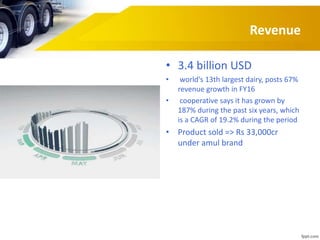
Revenue
• 3.4 billion USD
• world's 13th largest dairy, posts 67%
revenue growth in FY16
• cooperative says it has grown by
187% during the past six years, which
is a CAGR of 19.2% during the period
• Product sold => Rs 33,000cr
under amul brand
Issues and recommendation for amul supply chain
Amul market share
THANK YOU

Amul

  • 1.
    presented by:-Abhisheik chand AdityaDubey Anupam patel Garima purwar Pronoy Deb
  • 2.
    • World largestProducer = Volume 13% of world total milk Largest consumer = Dairy product 7%^ annual growing rate INDIAN DAIRY INDUSTRY
  • 3.
    Distribution • Lack ofSuperior Cold-Storage transport • Distribution wastage due to improper storage • No enforcement of HACCP principles Lack of supporting information System • Database maintained by milk producers • Organization in developed Countries
  • 4.
    Dairy Industry • Procurement(collection) The three-tier System of milk collection • Advent of organized retail channels Increased availability of branded , Packaged milk Reduced role of middlemen, mainly the milk vendors
  • 5.
    INTRODUCTION • Amul isan Indian dairy cooperative, based at Anand in the state of Gujarat, India. • Formed in 1946, it is a brand managed by a cooperative body, the Gujarat Co-operative Milk Marketing Federation Ltd. (GCMMF), which today is jointly owned by 3.6 million milk producers in Gujarat. • Amul spurred India's White Revolution, which made the country the world's largest producer of milk and milk products. In the process Amul became the largest food brand in India and has ventured into markets overseas. • Dr Verghese Kurien, founder-chairman of the GCMMF for more than 30 years (1973–2006), is credited with the success of Amul
  • 6.
    • MISSION STATEMENT GCMMFEndeavour to satisfy the taste and nutrition requirements of the customers, of the world through excellence in marketing by their committed team. Through co-operative networking, they are committed to offer quality products that provide best value for money. VISION STATEMENT “Amul’s vision is to provide more and more satisfaction to the farmers, their customers, employees and distributors
  • 7.
  • 8.
    Objective of thecase study To understand the strategy, design and practices in AMUL’s distribution network
  • 9.
    Strategical pillars ofAmul • Quality • Value For Money • AVAILABILITY • Service
  • 10.
    Operation and SupplyChain Management (Data Analysis) Key elements • Coordination of the diverse elements of the network • Technology <->Products • BUT HOW ? “Robust Supply Chain Coordination”
  • 11.
    The Mechanism • Inter-lockingcontrol • Co-ordination Agency: Unique Role of Federation • Supplier Enhancement and network Servicing • Amul yatra Programme
  • 12.
    Logistics Logistics in collection •6 million ltr. • 10,600 • 2.8 million member Logistics in coordination of • Storing the milk • Processing the milk • Distributing the milk Supplier Logistics • Weighing the milk • Determining the fat content • Calculation of the purchase price
  • 13.
    Information Technology • Automationat VCS • Data Analysis Software • VATS network (VIRGINIA ASSISTIVE TECHNOLOGY SYSTEM) BENEFITS • 10 million Daily Payment • Eliminating middle men • Transparency • 6 million ltr. • Reduction in processing time • 5000 trucks => 200 dairy • Just in time • Online order placement • Distributor => Order => Website • Exports US$ 25 million
  • 14.
    Distribution Process • COMPANY •WHOLE SELLER • RETAILER • CONSUMER Dealer Franchisee
  • 16.
    Channel Network • ProcurementChannel – Upstream Flow • Distribution Channel – Downstream Flow • Cold storage Network • Reverse Logistics
  • 17.
    Revenue • 3.4 billionUSD • world's 13th largest dairy, posts 67% revenue growth in FY16 • cooperative says it has grown by 187% during the past six years, which is a CAGR of 19.2% during the period • Product sold => Rs 33,000cr under amul brand
  • 18.
    Issues and recommendationfor amul supply chain
  • 19.
  • 20.