PRESENTATION ON
DISTRIBUTION NETWORK MANAGEMENT
OF
AMUL
Presented by: Yaswant
Narayan Singh
Presented to:
SCCE Prof.
1
INDIAN DAIRY INDUSTRY
 India is world’s largest producer of dairy
products by volume.
 It is accounting more than 13% of world’s
total milk production.
 Also India is world’s largest consumer of
dairy products, consuming almost all of its
own milk production.
 Indian dairy market is growing at an annual
rate of 7%. 2
CONT…
 Interests from private sector investors have
facilitated construction of larger dairies
through partnering with dairy processors.
 Indian dairy industry is different from other
dairy producing countries as India places its
emphasis on both cattle and buffalo milk.
 India nevertheless faces a milk supply gap
due to increasing demand from a growing
middle class population. 3
CHALLENGES FACED BY INDIAN
DAIRY INDUSTRY
 Procurement (collection)
• The three-tier system of milk collection
 Advent of organized retail channels
• Increased availability of branded, packaged
milk
• Reduced role of middlemen, mainly the milk
vendors
4
 Distribution
• Lack of superior cold-storage transport
• Distribution wastage due to improper storage
• No enforcement of HACCP principles
 Lack of supporting information systems
• Database maintained by Milk Producers
Organizations in developed countries
5
AMUL
 Type - Cooperative
 Industry - Dairy
 Founded - 1946
 Key people - Dr. Verghese Kurien
 Milk Producers 52.8 million
6
KEY FACTS
 AMUL means priceless in Sanskrit “Amoolya”
 Brand name managed by an apex cooperation
organization –GCMMF
 World’s biggest vegetarian cheese brand
 World’s largest pouched milk brand
 Largest food brand in India
 Spurred the white revolution in India
 Accreditation with 9001 and HACCP certification by QAS,
Australia.
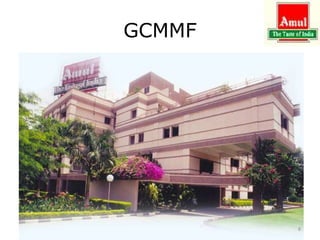
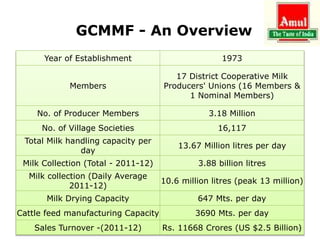
GCMMF
8
Year of Establishment 1973
Members
17 District Cooperative Milk
Producers' Unions (16 Members &
1 Nominal Members)
No. of Producer Members 3.18 Million
No. of Village Societies 16,117
Total Milk handling capacity per
day
13.67 Million litres per day
Milk Collection (Total - 2011-12) 3.88 billion litres
Milk collection (Daily Average
2011-12)
10.6 million litres (peak 13 million)
Milk Drying Capacity 647 Mts. per day
Cattle feed manufacturing Capacity 3690 Mts. per day
Sales Turnover -(2011-12) Rs. 11668 Crores (US $2.5 Billion)
GCMMF - An Overview
9
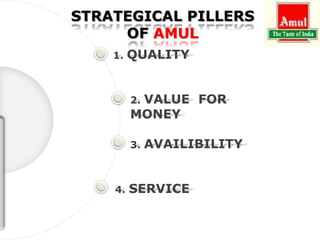
1. QUALITY
2. VALUE FOR
MONEY
3. AVAILIBILITY
4. SERVICE
STRATEGICAL PILLERS
OF AMUL
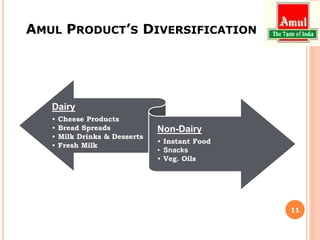
AMUL PRODUCT’S DIVERSIFICATION
Dairy
• Cheese Products
• Bread Spreads
• Milk Drinks & Desserts
• Fresh Milk
Non-Dairy
• Instant Food
• Snacks
• Veg. Oils
11
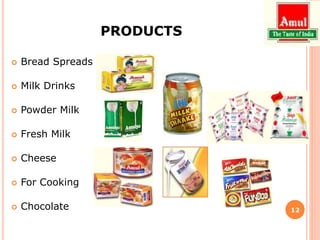
PRODUCTS
 Bread Spreads
 Milk Drinks
 Powder Milk
 Fresh Milk
 Cheese
 For Cooking
 Chocolate 12
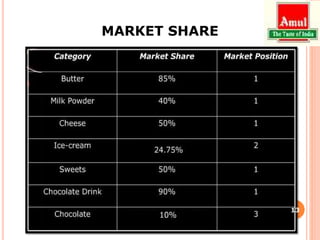
MARKET SHARE
13
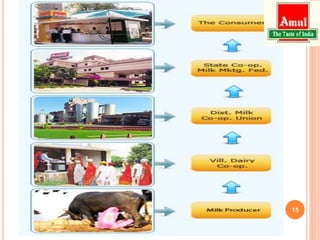
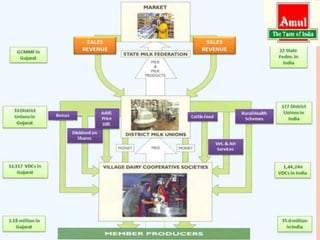
AMUL MODEL
14
15
16
SUPPLY CHAIN
MANAGEMENT
17
18
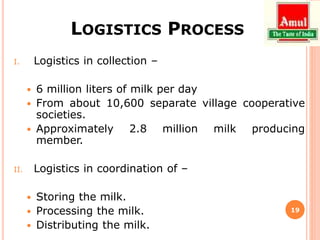
LOGISTICS PROCESS
I. Logistics in collection –
 6 million liters of milk per day
 From about 10,600 separate village cooperative
societies.
 Approximately 2.8 million milk producing
member.
II. Logistics in coordination of –
 Storing the milk.
 Processing the milk.
 Distributing the milk.
19
CONT…
III. Supplier logistics –
 Weighing the milk.
 Determining of fat content.
 Calculation of the purchase price.
20
EVOLUTION OF “IT”
 The evolution of IT in AMUL was took place in
the guidance of DR.B.M Vyas.
 The milk collection center at village
cooperative societies, were first automated.
 Data analysis software utilization for milk
production estimation and increasing
productivity.
 VATS network between all the level of
distribution network and GCMMF.
21
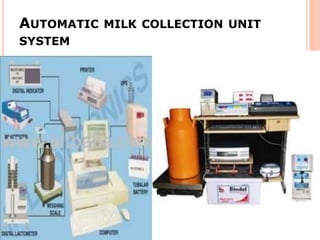
AUTOMATIC MILK COLLECTION UNIT
SYSTEM
BENEFITS OF IT
 Processing of 10 Million payments daily, amounting to
transactions worth USD 3.78 million in cash.
 Radical changes in business processes - eliminating
middlemen.
 Improved delivery mechanisms and transparency of
business operations.
 Due to this process, AMUL is able to collect six million
litres of milk per day.
 Huge reduction in processing time for effecting
payments to the farmers from a week to couple of
minute.
CONT…
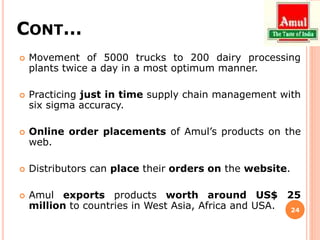
 Movement of 5000 trucks to 200 dairy processing
plants twice a day in a most optimum manner.
 Practicing just in time supply chain management with
six sigma accuracy.
 Online order placements of Amul’s products on the
web.
 Distributors can place their orders on the website.
 Amul exports products worth around US$ 25
million to countries in West Asia, Africa and USA. 24
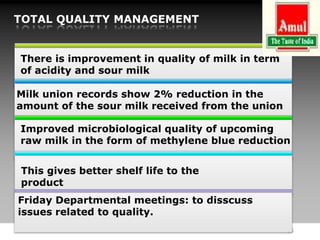
There is improvement in quality of milk in term
of acidity and sour milk
Milk union records show 2% reduction in the
amount of the sour milk received from the union
Improved microbiological quality of upcoming
raw milk in the form of methylene blue reduction
This gives better shelf life to the
product
TOTAL QUALITY MANAGEMENT
25
Friday Departmental meetings: to disscuss
issues related to quality.
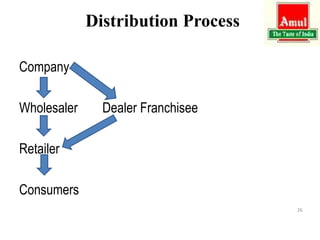
Distribution Process
Company
Wholesaler Dealer Franchisee
Retailer
Consumers
26
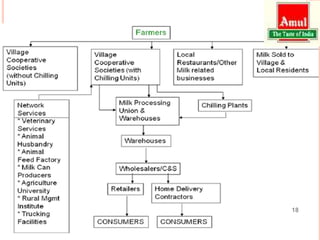
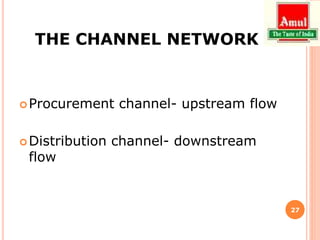
THE CHANNEL NETWORK
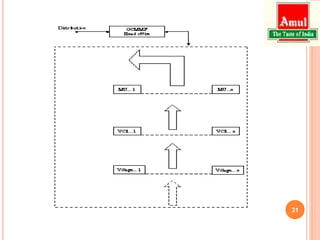
Procurement channel- upstream flow
Distribution channel- downstream
flow
27
PROCUREMENT
 Activities at the village level comprised
developing and servicing the VCSs.
 Increasing milk collection, procuring milk, and
transporting it to the chilling and processing units
twice a day.
 The VCSs provided the farmers with good quality
animal feed, fodder, and other services like
veterinary first aid.
28
PROCUREMENT CHANNEL
(UPSTREAM)
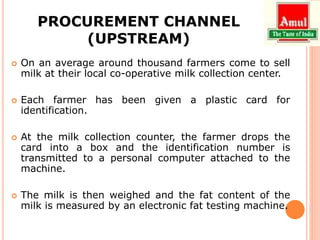
 On an average around thousand farmers come to sell
milk at their local co-operative milk collection center.
 Each farmer has been given a plastic card for
identification.
 At the milk collection counter, the farmer drops the
card into a box and the identification number is
transmitted to a personal computer attached to the
machine.
 The milk is then weighed and the fat content of the
milk is measured by an electronic fat testing machine.
CONT…
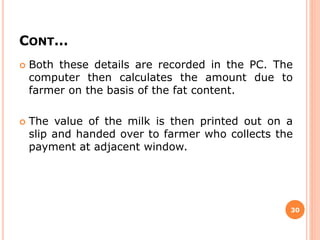
 Both these details are recorded in the PC. The
computer then calculates the amount due to
farmer on the basis of the fat content.
 The value of the milk is then printed out on a
slip and handed over to farmer who collects the
payment at adjacent window.
30
31
COLD STORAGE NETWORK
 Chillers in proximity of villages
 Prompt transport to district facilities for
further dispatch to consumers/ processing
units.
 Chilled trucks to transport processed products
 Delivery to local chillers by insulated rail
tankers and chilled trucks.
 Refrigerators and freezers with retailers and
departmental stores to retain freshness. 32
DISTRIBUTION
 GCMMF coordinated with various unions to get a
regular supply of milk and dairy products.
 The processed milk and dairy products were
procured from district dairy unions and distributed
through third party distributors.
 To ensure quality and timely deliveries, GCMMF and
the district unions had several mechanisms in
place.
 The unions monitored the supplies of milk and the
distribution of finished products.
33
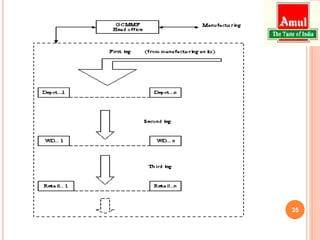
DOWNSTREAM FLOW
 First leg
 Manufacturing units to company depots using 9
and 18 MT trucks
 Frozen food below -18°C
 Dairy wet 0-4°C
 Second leg
 Depots to WDs
 Transport through insulated 3 and 5 MT TATA
407’s
 Third leg
 WDs to retailers
 Transport through rickshaws
34
35
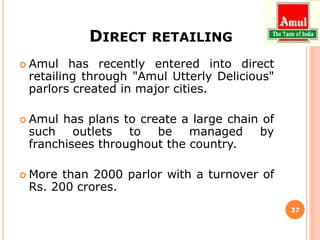
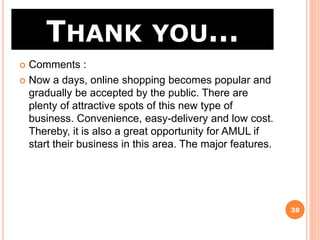
REVERSE LOGISTICS
MILK CHURN
 from dairy to VCS
BOTTLE
from retailer to dairy
DAMAGED PRODUCTS
from customer to retailer then to dairy
36
POUCH MILK TRAY
from retailer to dairy
DIRECT RETAILING
 Amul has recently entered into direct
retailing through "Amul Utterly Delicious"
parlors created in major cities.
 Amul has plans to create a large chain of
such outlets to be managed by
franchisees throughout the country.
 More than 2000 parlor with a turnover of
Rs. 200 crores.
37
THANK YOU…
38
 Comments :
 Now a days, online shopping becomes popular and
gradually be accepted by the public. There are
plenty of attractive spots of this new type of
business. Convenience, easy-delivery and low cost.
Thereby, it is also a great opportunity for AMUL if
start their business in this area. The major features.

Amul distribution network

  • 1.
    PRESENTATION ON DISTRIBUTION NETWORKMANAGEMENT OF AMUL Presented by: Yaswant Narayan Singh Presented to: SCCE Prof. 1
  • 2.
    INDIAN DAIRY INDUSTRY India is world’s largest producer of dairy products by volume.  It is accounting more than 13% of world’s total milk production.  Also India is world’s largest consumer of dairy products, consuming almost all of its own milk production.  Indian dairy market is growing at an annual rate of 7%. 2
  • 3.
    CONT…  Interests fromprivate sector investors have facilitated construction of larger dairies through partnering with dairy processors.  Indian dairy industry is different from other dairy producing countries as India places its emphasis on both cattle and buffalo milk.  India nevertheless faces a milk supply gap due to increasing demand from a growing middle class population. 3
  • 4.
    CHALLENGES FACED BYINDIAN DAIRY INDUSTRY  Procurement (collection) • The three-tier system of milk collection  Advent of organized retail channels • Increased availability of branded, packaged milk • Reduced role of middlemen, mainly the milk vendors 4
  • 5.
     Distribution • Lackof superior cold-storage transport • Distribution wastage due to improper storage • No enforcement of HACCP principles  Lack of supporting information systems • Database maintained by Milk Producers Organizations in developed countries 5
  • 6.
    AMUL  Type -Cooperative  Industry - Dairy  Founded - 1946  Key people - Dr. Verghese Kurien  Milk Producers 52.8 million 6
  • 7.
    KEY FACTS  AMULmeans priceless in Sanskrit “Amoolya”  Brand name managed by an apex cooperation organization –GCMMF  World’s biggest vegetarian cheese brand  World’s largest pouched milk brand  Largest food brand in India  Spurred the white revolution in India  Accreditation with 9001 and HACCP certification by QAS, Australia.
  • 8.
  • 9.
    Year of Establishment1973 Members 17 District Cooperative Milk Producers' Unions (16 Members & 1 Nominal Members) No. of Producer Members 3.18 Million No. of Village Societies 16,117 Total Milk handling capacity per day 13.67 Million litres per day Milk Collection (Total - 2011-12) 3.88 billion litres Milk collection (Daily Average 2011-12) 10.6 million litres (peak 13 million) Milk Drying Capacity 647 Mts. per day Cattle feed manufacturing Capacity 3690 Mts. per day Sales Turnover -(2011-12) Rs. 11668 Crores (US $2.5 Billion) GCMMF - An Overview 9
  • 10.
    1. QUALITY 2. VALUEFOR MONEY 3. AVAILIBILITY 4. SERVICE STRATEGICAL PILLERS OF AMUL
  • 11.
    AMUL PRODUCT’S DIVERSIFICATION Dairy •Cheese Products • Bread Spreads • Milk Drinks & Desserts • Fresh Milk Non-Dairy • Instant Food • Snacks • Veg. Oils 11
  • 12.
    PRODUCTS  Bread Spreads Milk Drinks  Powder Milk  Fresh Milk  Cheese  For Cooking  Chocolate 12
  • 13.
  • 14.
  • 15.
  • 16.
  • 17.
  • 18.
  • 19.
    LOGISTICS PROCESS I. Logisticsin collection –  6 million liters of milk per day  From about 10,600 separate village cooperative societies.  Approximately 2.8 million milk producing member. II. Logistics in coordination of –  Storing the milk.  Processing the milk.  Distributing the milk. 19
  • 20.
    CONT… III. Supplier logistics–  Weighing the milk.  Determining of fat content.  Calculation of the purchase price. 20
  • 21.
    EVOLUTION OF “IT” The evolution of IT in AMUL was took place in the guidance of DR.B.M Vyas.  The milk collection center at village cooperative societies, were first automated.  Data analysis software utilization for milk production estimation and increasing productivity.  VATS network between all the level of distribution network and GCMMF. 21
  • 22.
  • 23.
    BENEFITS OF IT Processing of 10 Million payments daily, amounting to transactions worth USD 3.78 million in cash.  Radical changes in business processes - eliminating middlemen.  Improved delivery mechanisms and transparency of business operations.  Due to this process, AMUL is able to collect six million litres of milk per day.  Huge reduction in processing time for effecting payments to the farmers from a week to couple of minute.
  • 24.
    CONT…  Movement of5000 trucks to 200 dairy processing plants twice a day in a most optimum manner.  Practicing just in time supply chain management with six sigma accuracy.  Online order placements of Amul’s products on the web.  Distributors can place their orders on the website.  Amul exports products worth around US$ 25 million to countries in West Asia, Africa and USA. 24
  • 25.
    There is improvementin quality of milk in term of acidity and sour milk Milk union records show 2% reduction in the amount of the sour milk received from the union Improved microbiological quality of upcoming raw milk in the form of methylene blue reduction This gives better shelf life to the product TOTAL QUALITY MANAGEMENT 25 Friday Departmental meetings: to disscuss issues related to quality.
  • 26.
    Distribution Process Company Wholesaler DealerFranchisee Retailer Consumers 26
  • 27.
    THE CHANNEL NETWORK Procurementchannel- upstream flow Distribution channel- downstream flow 27
  • 28.
    PROCUREMENT  Activities atthe village level comprised developing and servicing the VCSs.  Increasing milk collection, procuring milk, and transporting it to the chilling and processing units twice a day.  The VCSs provided the farmers with good quality animal feed, fodder, and other services like veterinary first aid. 28
  • 29.
    PROCUREMENT CHANNEL (UPSTREAM)  Onan average around thousand farmers come to sell milk at their local co-operative milk collection center.  Each farmer has been given a plastic card for identification.  At the milk collection counter, the farmer drops the card into a box and the identification number is transmitted to a personal computer attached to the machine.  The milk is then weighed and the fat content of the milk is measured by an electronic fat testing machine.
  • 30.
    CONT…  Both thesedetails are recorded in the PC. The computer then calculates the amount due to farmer on the basis of the fat content.  The value of the milk is then printed out on a slip and handed over to farmer who collects the payment at adjacent window. 30
  • 31.
  • 32.
    COLD STORAGE NETWORK Chillers in proximity of villages  Prompt transport to district facilities for further dispatch to consumers/ processing units.  Chilled trucks to transport processed products  Delivery to local chillers by insulated rail tankers and chilled trucks.  Refrigerators and freezers with retailers and departmental stores to retain freshness. 32
  • 33.
    DISTRIBUTION  GCMMF coordinatedwith various unions to get a regular supply of milk and dairy products.  The processed milk and dairy products were procured from district dairy unions and distributed through third party distributors.  To ensure quality and timely deliveries, GCMMF and the district unions had several mechanisms in place.  The unions monitored the supplies of milk and the distribution of finished products. 33
  • 34.
    DOWNSTREAM FLOW  Firstleg  Manufacturing units to company depots using 9 and 18 MT trucks  Frozen food below -18°C  Dairy wet 0-4°C  Second leg  Depots to WDs  Transport through insulated 3 and 5 MT TATA 407’s  Third leg  WDs to retailers  Transport through rickshaws 34
  • 35.
  • 36.
    REVERSE LOGISTICS MILK CHURN from dairy to VCS BOTTLE from retailer to dairy DAMAGED PRODUCTS from customer to retailer then to dairy 36 POUCH MILK TRAY from retailer to dairy
  • 37.
    DIRECT RETAILING  Amulhas recently entered into direct retailing through "Amul Utterly Delicious" parlors created in major cities.  Amul has plans to create a large chain of such outlets to be managed by franchisees throughout the country.  More than 2000 parlor with a turnover of Rs. 200 crores. 37
  • 38.
    THANK YOU… 38  Comments:  Now a days, online shopping becomes popular and gradually be accepted by the public. There are plenty of attractive spots of this new type of business. Convenience, easy-delivery and low cost. Thereby, it is also a great opportunity for AMUL if start their business in this area. The major features.