

AMUL
Presented by
Manoranjan J
Sumanth B.V
THE TASTE OF INDIA.
INTRODUCTION
 The Birth of Amul.
 It all began when milk became a symbol of protest
 Founded in 1946 to stop the exploitation by middlemen
 Inspired by the freedom movement
 Amul grew from strength to strength thanks to the inspired
leadership of Tribhuvandas Patel, the founder Chairman
and the committed professionalism of Dr Verghese
Kurien,who was entrusted the task of running the dairy from
1950.
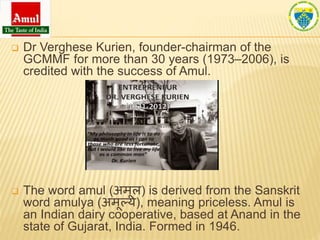
 Dr Verghese Kurien, founder-chairman of the
GCMMF for more than 30 years (1973–2006), is
credited with the success of Amul.
 The word amul (अमूल) is derived from the Sanskrit
word amulya (अमूल्य), meaning priceless. Amul is
an Indian dairy cooperative, based at Anand in the
state of Gujarat, India. Formed in 1946.
HISTORY
 The seeds of this unusual saga were sown more than
65 years back in Anand, a small town in the state of
Gujarat in western India.
 In 1946, the farmers of this area went on a milk strike
refusing to be cowed down by the cartel.
 Under the inspiration of Sardar Patel, and the
guidance of leaders like Morarji Desai and
Tribhuvandas Patel, they formed their own
cooperative in 1946.
 The then Prime Minister of India, Lal
Bahadur Shastri decided that the same
approach should become the basis of a
National Dairy Development policy and it
should be emulated for the entire country.
 At his instance in 1965 the National Dairy
Development Board was set up with the
basic objective of replicating the Amul
model
 Dr. Kurien was chosen to head the
institution as its Chairman and asked to
replicate this model throughout the country.
 Gujarat Cooperative Milk Marketing
Federation Ltd. (GCMMF), is India's largest
food product marketing organisation with
annual turnover (2013-14) US$ 3.0 billion.
 For the year 2009-10, GCMMF has been
awarded "Golden Trophy" for its outstanding
export performance and contribution in dairy
products sector by APEDA.
 In 2013-14, GCMMF took giant strides in
expanding its presence in International
markets.
 Amul’s presence on Global Dairy Trade (GDT)
platform in which only the top six dairy players
of the world sell their products, has earned
respect and recognition across the world.
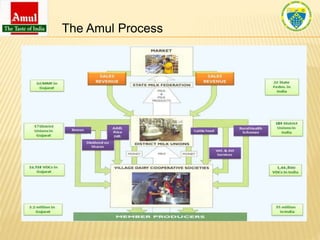
THE AMUL MODEL.
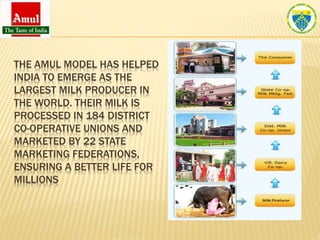
 The Amul Model of dairy development is a three-
tiered structure with the dairy cooperative
societies at the village level federated under a
milk union at the district level and a federation of
member unions at the state level.
 Establishment of a direct linkage between milk producers and
consumers by eliminating middlemen
 Milk Producers (farmers) control procurement, processing and
marketing
 Professional management
THE AMUL MODEL HAS HELPED
INDIA TO EMERGE AS THE
LARGEST MILK PRODUCER IN
THE WORLD. THEIR MILK IS
PROCESSED IN 184 DISTRICT
CO-OPERATIVE UNIONS AND
MARKETED BY 22 STATE
MARKETING FEDERATIONS,
ENSURING A BETTER LIFE FOR
MILLIONS
The Amul Process
ADVERTISING AND MARKETING
STRATEGY.
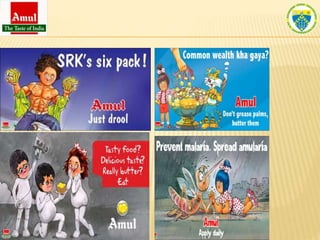
 In 1966, Amul hired Sylvester , then managing
director of the advertising agency AS to design
an ad campaign for Amul Butter. daCunha
designed a campaign as series of hoardings
with topical ads, relating to day-to-day issues.
 It was popular and earned a Guinness world
record for the longest running ad campaign in
the world.
 In the 1980s, cartoon artist Kumar Morey and
script writer Bharat Dabholkar had been
involved with sketching the Amul ads.
 This was enabled by chairman Verghese Kurien
with creating a free atmosphere that fostered the
development of the ads.
 In 2013, Amul tweeted a picture featuring the
Amul butter girl, implying that 'freedom of choice'
died in '2013', in opposition to the Supreme Court
of India overruling the judgment of Delhi High
Court and criminalizing homosexuality again.
MARKETING STRATEGY.
 Low cost-price strategy
 Strong branding
 Effective Segmentation
 Changing the Retail Environment
 Product Repositioning
 Product Overlap
 Product Design Strategy
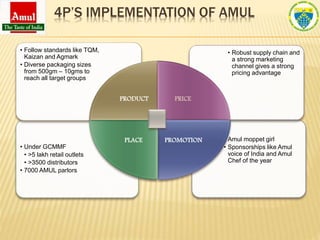
4P’S IMPLEMENTATION OF AMUL
• Amul moppet girl
• Sponsorships like Amul
voice of India and Amul
Chef of the year
• Under GCMMF
• >5 lakh retail outlets
• >3500 distributors
• 7000 AMUL parlors
• Robust supply chain and
a strong marketing
channel gives a strong
pricing advantage
• Follow standards like TQM,
Kaizan and Agmark
• Diverse packaging sizes
from 500gm – 10gms to
reach all target groups
PRODUCT PRICE
PROMOTIONPLACE
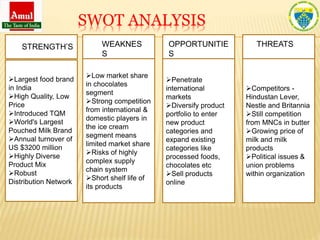
SWOT ANALYSIS
sssssSTRENGTH’S WEAKNES
S
OPPORTUNITIE
S
THREATS
Largest food brand
in India
High Quality, Low
Price
Introduced TQM
World's Largest
Pouched Milk Brand
Annual turnover of
US $3200 million
Highly Diverse
Product Mix
Robust
Distribution Network
Low market share
in chocolates
segment
Strong competition
from international &
domestic players in
the ice cream
segment means
limited market share
Risks of highly
complex supply
chain system
Short shelf life of
its products
Penetrate
international
markets
Diversify product
portfolio to enter
new product
categories and
expand existing
categories like
processed foods,
chocolates etc
Sell products
online
Competitors -
Hindustan Lever,
Nestle and Britannia
Still competition
from MNCs in butter
Growing price of
milk and milk
products
Political issues &
union problems
within organization
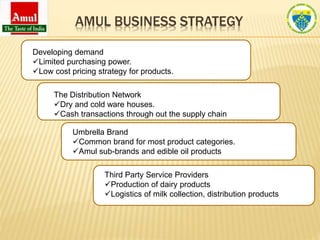
AMUL BUSINESS STRATEGY
Developing demand
Limited purchasing power.
Low cost pricing strategy for products.
The Distribution Network
Dry and cold ware houses.
Cash transactions through out the supply chain
Umbrella Brand
Common brand for most product categories.
Amul sub-brands and edible oil products
Third Party Service Providers
Production of dairy products
Logistics of milk collection, distribution products
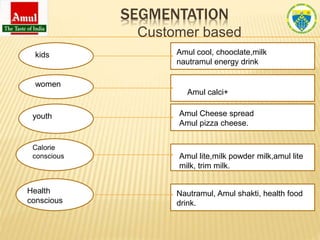
SEGMENTATION
Customer based
kids
women
youth
Calorie
conscious
Health
conscious
Amul cool, chooclate,milk
nautramul energy drink
Amul calci+
Amul Cheese spread
Amul pizza cheese.
Amul lite,milk powder milk,amul lite
milk, trim milk.
Nautramul, Amul shakti, health food
drink.
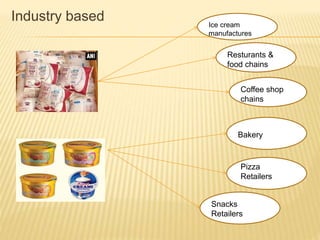
Industry based Ice cream
manufactures
Resturants &
food chains
Coffee shop
chains
Bakery
Pizza
Retailers
Snacks
Retailers
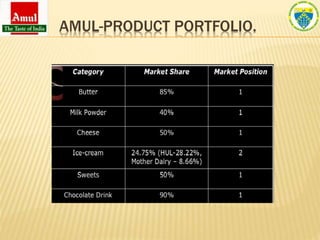
AMUL-PRODUCT PORTFOLIO.
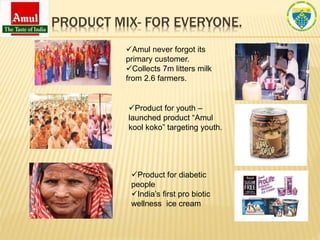
PRODUCT MIX- FOR EVERYONE.
Amul never forgot its
primary customer.
Collects 7m litters milk
from 2.6 farmers.
Product for youth –
launched product “Amul
kool koko” targeting youth.
Product for diabetic
people
India’s first pro biotic
wellness ice cream
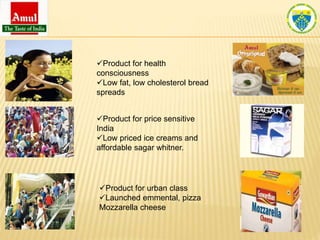
Product for health
consciousness
Low fat, low cholesterol bread
spreads
Product for price sensitive
India
Low priced ice creams and
affordable sagar whitner.
Product for urban class
Launched emmental, pizza
Mozzarella cheese
PRODUCT POSITIONING
 Placing a product in that part of the market where
it will receive a favorable reception compared to
competing products.
 Positioning of amul is “Taste of India” it has
created a value for every one in value chain be it
farmers or consumers.
 USP-quality with affordablity.
PRODUCT REPOSITIONING
 New competition.
 Change in consumer preference.
 Wrong original preference.
PRODUCT OVERLAP
SITUATION WHERE COMPANY DECIDES COMPETE AGAINST ITS OWN BRANDS
 Powdered milk
 Health and price conscious.
“SAGAR VS AMULYA”.
USP: sagar is affordable whitener for health
consciousness.
 Cheese spreads
 Specific vs general.
Amul processed cheese vs cheese spread.
PRODUCT ELIMINATION.
 Elimination
Product reaches the stage where continued
support is no longer justified where
performance is falling short off
expectations, it is desirable to pull the
product out of market place
It eliminated “JALDHARA” a decade ago as
bottled water at that time did not have
potetintal customers.
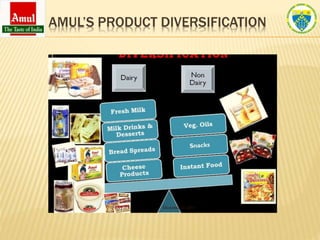
AMUL’S PRODUCT DIVERSIFICATION
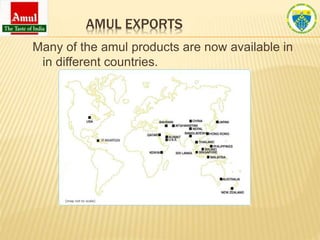
AMUL EXPORTS
Many of the amul products are now available in
in different countries.
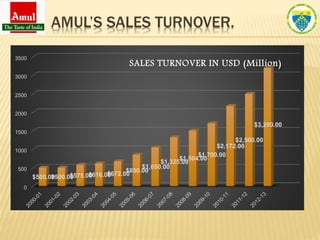
AMUL’S SALES TURNOVER.
0
500
1000
1500
2000
2500
3000
3500
$500.00$500.00$575.00$616.00$672.00
$850.00
$1,050.00
$1,325.00
$1,504.00
$1,700.00
$2,172.00
$2,500.00
$3,200.00
SALES TURNOVER IN USD (Million)
THANK YOU

Amul full presentation

  • 1.
  • 2.
    INTRODUCTION  The Birthof Amul.  It all began when milk became a symbol of protest  Founded in 1946 to stop the exploitation by middlemen  Inspired by the freedom movement  Amul grew from strength to strength thanks to the inspired leadership of Tribhuvandas Patel, the founder Chairman and the committed professionalism of Dr Verghese Kurien,who was entrusted the task of running the dairy from 1950.
  • 3.
     Dr VergheseKurien, founder-chairman of the GCMMF for more than 30 years (1973–2006), is credited with the success of Amul.  The word amul (अमूल) is derived from the Sanskrit word amulya (अमूल्य), meaning priceless. Amul is an Indian dairy cooperative, based at Anand in the state of Gujarat, India. Formed in 1946.
  • 4.
    HISTORY  The seedsof this unusual saga were sown more than 65 years back in Anand, a small town in the state of Gujarat in western India.  In 1946, the farmers of this area went on a milk strike refusing to be cowed down by the cartel.  Under the inspiration of Sardar Patel, and the guidance of leaders like Morarji Desai and Tribhuvandas Patel, they formed their own cooperative in 1946.
  • 5.
     The thenPrime Minister of India, Lal Bahadur Shastri decided that the same approach should become the basis of a National Dairy Development policy and it should be emulated for the entire country.  At his instance in 1965 the National Dairy Development Board was set up with the basic objective of replicating the Amul model
  • 6.
     Dr. Kurienwas chosen to head the institution as its Chairman and asked to replicate this model throughout the country.  Gujarat Cooperative Milk Marketing Federation Ltd. (GCMMF), is India's largest food product marketing organisation with annual turnover (2013-14) US$ 3.0 billion.
  • 7.
     For theyear 2009-10, GCMMF has been awarded "Golden Trophy" for its outstanding export performance and contribution in dairy products sector by APEDA.  In 2013-14, GCMMF took giant strides in expanding its presence in International markets.  Amul’s presence on Global Dairy Trade (GDT) platform in which only the top six dairy players of the world sell their products, has earned respect and recognition across the world.
  • 8.
    THE AMUL MODEL. The Amul Model of dairy development is a three- tiered structure with the dairy cooperative societies at the village level federated under a milk union at the district level and a federation of member unions at the state level.  Establishment of a direct linkage between milk producers and consumers by eliminating middlemen  Milk Producers (farmers) control procurement, processing and marketing  Professional management
  • 9.
    THE AMUL MODELHAS HELPED INDIA TO EMERGE AS THE LARGEST MILK PRODUCER IN THE WORLD. THEIR MILK IS PROCESSED IN 184 DISTRICT CO-OPERATIVE UNIONS AND MARKETED BY 22 STATE MARKETING FEDERATIONS, ENSURING A BETTER LIFE FOR MILLIONS
  • 10.
  • 11.
    ADVERTISING AND MARKETING STRATEGY. In 1966, Amul hired Sylvester , then managing director of the advertising agency AS to design an ad campaign for Amul Butter. daCunha designed a campaign as series of hoardings with topical ads, relating to day-to-day issues.  It was popular and earned a Guinness world record for the longest running ad campaign in the world.  In the 1980s, cartoon artist Kumar Morey and script writer Bharat Dabholkar had been involved with sketching the Amul ads.
  • 12.
     This wasenabled by chairman Verghese Kurien with creating a free atmosphere that fostered the development of the ads.  In 2013, Amul tweeted a picture featuring the Amul butter girl, implying that 'freedom of choice' died in '2013', in opposition to the Supreme Court of India overruling the judgment of Delhi High Court and criminalizing homosexuality again.
  • 14.
    MARKETING STRATEGY.  Lowcost-price strategy  Strong branding  Effective Segmentation  Changing the Retail Environment  Product Repositioning  Product Overlap  Product Design Strategy
  • 16.
    4P’S IMPLEMENTATION OFAMUL • Amul moppet girl • Sponsorships like Amul voice of India and Amul Chef of the year • Under GCMMF • >5 lakh retail outlets • >3500 distributors • 7000 AMUL parlors • Robust supply chain and a strong marketing channel gives a strong pricing advantage • Follow standards like TQM, Kaizan and Agmark • Diverse packaging sizes from 500gm – 10gms to reach all target groups PRODUCT PRICE PROMOTIONPLACE
  • 17.
    SWOT ANALYSIS sssssSTRENGTH’S WEAKNES S OPPORTUNITIE S THREATS Largestfood brand in India High Quality, Low Price Introduced TQM World's Largest Pouched Milk Brand Annual turnover of US $3200 million Highly Diverse Product Mix Robust Distribution Network Low market share in chocolates segment Strong competition from international & domestic players in the ice cream segment means limited market share Risks of highly complex supply chain system Short shelf life of its products Penetrate international markets Diversify product portfolio to enter new product categories and expand existing categories like processed foods, chocolates etc Sell products online Competitors - Hindustan Lever, Nestle and Britannia Still competition from MNCs in butter Growing price of milk and milk products Political issues & union problems within organization
  • 18.
    AMUL BUSINESS STRATEGY Developingdemand Limited purchasing power. Low cost pricing strategy for products. The Distribution Network Dry and cold ware houses. Cash transactions through out the supply chain Umbrella Brand Common brand for most product categories. Amul sub-brands and edible oil products Third Party Service Providers Production of dairy products Logistics of milk collection, distribution products
  • 19.
    SEGMENTATION Customer based kids women youth Calorie conscious Health conscious Amul cool,chooclate,milk nautramul energy drink Amul calci+ Amul Cheese spread Amul pizza cheese. Amul lite,milk powder milk,amul lite milk, trim milk. Nautramul, Amul shakti, health food drink.
  • 20.
    Industry based Icecream manufactures Resturants & food chains Coffee shop chains Bakery Pizza Retailers Snacks Retailers
  • 21.
  • 22.
    PRODUCT MIX- FOREVERYONE. Amul never forgot its primary customer. Collects 7m litters milk from 2.6 farmers. Product for youth – launched product “Amul kool koko” targeting youth. Product for diabetic people India’s first pro biotic wellness ice cream
  • 23.
    Product for health consciousness Lowfat, low cholesterol bread spreads Product for price sensitive India Low priced ice creams and affordable sagar whitner. Product for urban class Launched emmental, pizza Mozzarella cheese
  • 24.
    PRODUCT POSITIONING  Placinga product in that part of the market where it will receive a favorable reception compared to competing products.  Positioning of amul is “Taste of India” it has created a value for every one in value chain be it farmers or consumers.  USP-quality with affordablity.
  • 25.
    PRODUCT REPOSITIONING  Newcompetition.  Change in consumer preference.  Wrong original preference.
  • 26.
    PRODUCT OVERLAP SITUATION WHERECOMPANY DECIDES COMPETE AGAINST ITS OWN BRANDS  Powdered milk  Health and price conscious. “SAGAR VS AMULYA”. USP: sagar is affordable whitener for health consciousness.  Cheese spreads  Specific vs general. Amul processed cheese vs cheese spread.
  • 27.
    PRODUCT ELIMINATION.  Elimination Productreaches the stage where continued support is no longer justified where performance is falling short off expectations, it is desirable to pull the product out of market place It eliminated “JALDHARA” a decade ago as bottled water at that time did not have potetintal customers.
  • 28.
  • 29.
    AMUL EXPORTS Many ofthe amul products are now available in in different countries.
  • 30.
  • 31.