Ajeenkya D Y Patil University
School ofManagement
PROJECT REPORT
ON
AMUL
Proposed to be submitted in
INPARTIALFULFILLMENTTOAWARDTHEDEGREEIN
BACHELOROFBUSINESSADMINISTRATION
BBA-International Business
By
KUMAIL RAZA MUNI
Submitted To
Prof.AtulRKadam
BONAFIDE CERTIFICATE
This is to certify that this project report entitled “Amul The Taste Of
India – Report” submitted to Ajeenkya D Y Patil University, School of
Management, Pune is a bonafide record of work done by “ Kumailraza
Muni ” URN Number 2017-B-06012000 under the supervision of
Subject Teacher from “ 20/08/2018 ” to “30/11/2018” for the Program
Name “Bachelors of Business Administration (International Business)”
Course Name “Business Environment” Course Code “MGT204” .
This is to declare that the work presented in this report falls under the
Innovative Teaching Method used in classroom for the practical exposure
to the knowledge.
All help received to the student from various sources (Primary &
Secondary) have been duly acknowledged.
Ms. Kumailraza Muni Mr. Atul R Kadam
Bachelor of Business Admin. Subject Teacher
International Business Senior Faculty
Mr. / Mrs. /Ms.
External Supervisor
Date:
Day:
Actual Day & Date of Submission of Report:
INDEX
SR.
NO.
TOPICS PAGE
NO.
1) EXECUTIVE SUMMARY 01 – 02
2) OBJECTIVES & SCOPE OF THE PROJECT 03
3) COMPANY PROFILE 04 - 07
4) PRODUCT PROFILE 08 - 13
5) THEREOTICAL BACKGROUND 14
6) INTERNAL FACTORS 15 – 18
7) ORGANIZATIONAL STRUCTURE 19 – 34
8) KEY SUCCESS FACTORS 35
9) PEST ANALYSIS 36 - 43
10) FINANCE STRATEGY 44 – 47
11) HUMAN RESOURCES STRATEGY 48 – 51
12) OPERATIONS STRATEGY 52 – 53
13) MARKETING STRATEGY 54 - 55
14) MANAGEMENT INFORMATION SYSTEM STRATEGY 56 – 58
15) SWOT ANALYSIS 59 – 61
16) DATA ANALYSIS AND INTERPRETATION 62
17) LIMITATION OF THE PROJECT 63
18) FINDINGS AND SUGGESTIONS 64
19) CONCLUSION 65
BIBLIOGRAPHY
ANNEXURE
CHAPTER 1
EXECUTIVE SUMMARY
INTRODUCTION
Amul is the name dairy cooperative in India. Derived from the Sanskrit word "Amulya,"
Amul means invaluable.Formed in 1946, it is a brand name managed by an Indian
cooperative organisation, Gujarat Co-operative Milk Marketing Federation Ltd.
(GCMMF), which today is jointly owned by 3.03 million milk producers in Gujarat,
India.
Amul is based in Anand, Gujarat and has been a successful example of cooperative
organization. Amul spurred the White Revolution in India which in turn made India the
largest producer of milk and milk products in the world.It is also the world's largest
vegetarian cheese brand .
Amul is the largest food brand in India and world's largest pouched milk brand with an
annual turnover of US $2.2 billion (2010-11). Currently Unions making up GCMMF have
3.1 million producer members with milk collection average of 9.10 million litres per day.
Besides India, Amul has entered overseas markets such as Mauritius, UAE, USA, Oman,
Bangladesh, Australia, China, Singapore, Hong Kong and a few South African countries.
Its bid to enter Japanese market in 1994 did not succeed, but it plans to venture again.
Dr Verghese Kurien, former chairman of the GCMMF, is recognised as a key person
behind the success of Amul. On 10 Aug 2006 Parthi Bhatol, chairman of the Banaskantha
Union, was elected chairman of GCMMF
Reason for taking Amul:
The reason behind selecting this specific company is that Amul is a brand which
produces the products which are used in day to day life and it is also a well-
recognized brand across the globe. Moreover, Amul has constantly been innovating –
be it launching new products, creative marketing campaigns or challenging traditional
societal trends to come up with better ones.
Problem analysis:
Analysis is the day to day operation of the company. Finding out
loop holes of the company and then working towards it. The project
will be proving a solution to the lack of inventory management in
the organization.
State of art:
This research is basically done to understand the problems which arise due to internal
factors such as suppliers, customers, employees and competitors & external factors such
as political, economical, social, technological.
For e.g.- There was a problem caused recently regarding plastic bags which were
completely banned for a certain period of time. There was a policy which was made
that if plastic was found in shops they had to pay some amount as penalty amount
and which really affects the sell especially of dairy products
Objectives:
1) To study the current inventory management of the organization.
2) To study how the economic factors affect the
organization such as GST (good and services tax) and lot
more affect the company.
3) To know about technological advancement adopted by them.
2
Description of the research work
Research methodology:
A research method is a systematic plan for conducting research. Sociologists
draw on a variety of both qualitative and quantitative research methods,
including experiments, survey research, participant observation, and secondary
data.
Tools for collecting data is generally of two types
a) Primary data and b) Secondary data.
Primary data:
Those data specially collected from problems in hand. In this study,
data will be collected from primary sources in personal interviews of retailers
and
interactions with the consumers by survey method. This method of data
collection
is quite popular. These are the major methods of data collection in the research
study.
Methods of collecting primary data:
Face to face interaction with the owner, open handed interviews, telephone
survey with the suppliers, consumer panels, experiences, factory visit.
Observation of secondary data:
Those data which is collected other than helping others and solving problems
are known as the secondary data. For example: old reports, company records,
magazines, company website, etc.
Methods of collection secondary data:
Internal sources: Existing reports, Distribution data, shopkeeper's opinions,
Stock
records, Sales reports, accounting records.
External sources: Government statistics, Specialist business organization,
Consumer
database.
Conclusion:
This project report will help the organization to know its current position with
a brief description of all the factors. Further help them to streamline the other
operations of the company.
3
CHAPTER 2
OBJECTIVES AND SCOPE OF
THE PROJECT
OBJECTIVES
1. To study the effectiveness and efficiency of employees.
2. To know the customer preferences in selecting a product.
3. To know the competition involved in line of dairy products.
4. To study the interference of government in working of a company especially which are in production of
dairy products.
5. To know the various roles played by supplier in supplying Raw Materials.
SCOPE
This project will work under several constraints and limitations. Some of the key
limitations are:
1) The survey will be limited to a small area.
2) It is restricted only to the actual business environment of Amul, not
mentioning how it could be modified to make it effective.
4
CHAPTER 3
COMPANY PROFILE
3.1 COMPANY NAME AND ADDRESS
Gujarat Cooperative Milk Marketing Federation,
PO Box 10, Amul Dairy Road,
Anand 388 001, Gujarat, India
3.2 MISSION STATEMENT, VISION, SLOGAN, LOGO
3.2.1 VISION STATEMNT
Giving our customers value for money. This will be through improvement in
technologies used in our Dairy, thus enhancing the quality of our raw material, our
internal processes, and the competency of our people.
Provide our customers with the cleanest and healthiest milk, for which the focus on
nutrition starts from the animals themselves, thus leading to more nutritional milk and
milk products.
Maintain sensitivity to environment.
Be a preferred employer in our field, and provide an environment that challenges our
employees to learn, grow and prosper in an atmosphere of respect and recognition.
Our employees will be proud to be a part of the Amul family.
3.2.2 MISSION STATEMENT
 Inspire sustained growth for our entire workforce and suppliers who have
struck up long term partnerships with us.
 Understanding customer needs and protecting their interests to build lifelong
relationships and brand loyalty.
 Development of indigenous products, constant research,
innovative planning and processes, adaptive technologies
and optimal resource utilization.
 Stay at the forefront of technology and management through
scientific innovation and creative management approaches.
3.2.3 SLOGAN AND LOGO
SLOGAN : The Taste Of India
5
3.3 HISTORICAL DEVELOPMENT
In 1970, initiated White Revolution of India, as it help create, Gujarat Co-operative Milk Marketing
Federation Ltd., which now overlooks Amul, in 1973, and today, it is the second best dairy in India.
3.4 ORGANIZATIONAL CHART
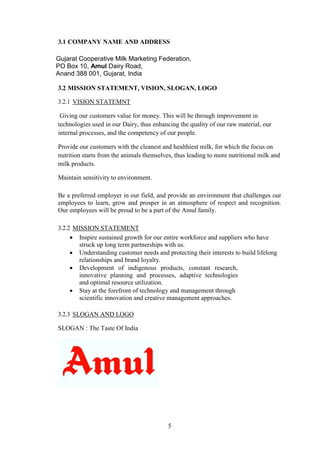
An organizational chart is a diagram that shows the structure of an organization and
the relationships and relative ranks of its parts and positions/jobs.
Board of directors:
A board of directors is a team of people elected by a corporation's shareholders to
represent the shareholders' interests and ensure that the company's management acts
on their behalf. The head of the board of directors is the chairman or chairperson of
the board.
General Manager:
A manager in charge of
running the main day-to-
day business activities of
a company or
department
Financial department:
It’s the part of an
organization that
manages its money. The
business functions of a finance department typically include planning,
organizing, auditing, accounting for and controlling its company's
finances. The finance department also usually produces the company's
financial statements.
System integration department:
System integration is defined in engineering as the process of bringing together the
component sub-systems into one system (an aggregation of subsystems cooperating so
that the system is able to deliver the overarching functionality) and ensuring that the
subsystems function together as a system, and in information.
Personal administration:
Personnel administration is another term for a human resources (HR) job. Duties of a personnel
6
administrator include hiring and training employees, carrying out evaluations.
Sales and marketing department:
Marketing, workplace activities for selling and advertising products, and for
increasing sales by understanding what customers want, how much they will pay, etc.,
or the department of a company that is responsible for these activities.
Technology department:
An IT organization (information technology organization) is the department within a
company that is charged with establishing, monitoring and maintaining information
technology systems and services.
3.5 LIST OF COMPETITORS
1) Kwality Walls:
2) Nestle:
3) Havmor:
7
3.6 BRANCHES AND OFFICES
HEAD OFFICE: - Gujarat Cooperative Milk Marketing Federation, PO Box 10,
Amul Dairy Road, Anand 388 001, Gujarat, India.
BRANCHES: - All over India.
8
CHAPTER 4
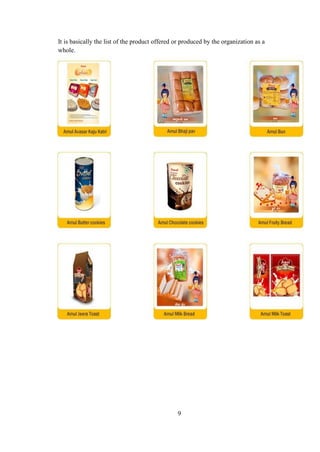
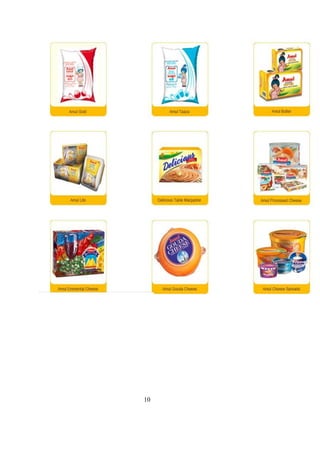
PRODUCT PROFILE
It is basically the list of the product offered or produced by the organization as a
whole.
9
10
CHAPTER 5
THEREOTICAL BACKGROUND
Theoretical Background:
A theoretical framework consists of concepts and, together with their
definitions and reference to relevant scholarly literature, existing theory
that is used for your particular study.
The theoretical framework strengthens the study in the following ways:
 An explicit statement of theoretical assumptions permits the reader
to evaluate them critically.
 The theoretical framework connects the researcher to existing
knowledge. Guided by a relevant theory, you are given a basis for
your hypothesis and choice of research methods.
 Articulating the theoretical assumptions of a research study forces
you to address questions of why and how. It permits you to
intellectually transition from simply describing a phenomenon you
have observed to generalizing about various aspects of that
phenomenon.
 Having a theory helps you identify the limits to those
generalizations. A theoretical framework specifies which key
variables influence a phenomenon of interest and highlights the
need to examine how those key variables might differ and under
what circumstances.
Theoretical Background references taken for this report are:
1) Fifth edition: the business environment, la worthington and
chris britton.
2) Business environment: by A.C. Fernando.
3) Business environment by Shaikh Saleem
4) Business environment by Francis Cherunliam.
11
CHAPTER 6
INTERNAL FACTORS
INTERNAL FACTORS’ ANALYSIS:
Survival of a business depends upon its strength and adaptability to the environment.
The internal strength represents its internal environment. It consists of financial,
physical, human and technological resources. Financial resources represent financial
strength of the company. Funds are allocated over activities that maximize output at
minimum cost, that is, optimum allocation of financial resources. Physical resources
represent physical assets such as plant, machinery, building etc. that convert inputs
into outputs. Human resources represent the manpower with specialized knowledge
by virtue of which they perform the business activities. The operative and managerial
decisions are taken by the human resources. Technological resources represent the
technical know-how used to manufacture goods and services. Internal environment
consists of controllable factors that can be modified according to needs of the external
environment. Our area of concern will be suppliers, employee, competitors and
customers.
Suppliers:
Suppliers supply raw material, machines, equipments and other supplies. The
company has to keep a watch over prices and quality of materials and machines
supplied. It also has to maintain good relations with the suppliers. It is necessary to
have reliable source of supply for the smooth working of the firm. Uncertain supplier
compels the firm to maintain high inventories resulting into increase in the cost. The
business should not only rely on the single supplier but also have relations with
multiple suppliers.
Measures adopted by Amul in order to overcome the consequences in business
related to suppliers:
1) While selecting a supplier for a particular item, analysis of the product from
different suppliers is essential. Analysis can be in terms of quality, cost and other
factors related to the demand in the market should be done. Also selection should be
done on the basis of the other services provided by the suppliers.
2) We never play games with supplier’s cash. A prior call to the suppliers is given to
tell them why and when we will pay.
3) Prior order is usually our priority so that even they get sufficient time to provide
their services. In rarest case urgent orders are given.
4) Our requirement and expectation of the goods that would be supplied by them are
clarified before placing an order, to avoid misunderstanding.
5) A background check of the suppliers is always done to avoid misfortunes in the
future.
12
7) We always keep them aware of what is going in the company. We tell them about
changes in key personnel, new product, special promotions. Many a times, you’ll find
that good suppliers can help you find new customers.
Consumer:
Consumer is the king of the market. They are the centers of the business. They are
one of the most important factors in the external environment. Customer satisfaction
has become more challenging due to globalization. Nowadays, consumer expectations
are high. Therefore, the firm must keep in mind the customer's expectations, their
requirements and accordingly make market decisions. The success of the business
depends upon identifying the needs, wants, likes and dislikes of the customers and
meeting with their satisfaction Businesses have different classes of customers like
wholesale customers, retail customers, industrial customers, foreign customers etc. To
enhance growth, it is necessary for the business firm to identify the needs of these
customers and should undertake research and developmental activities.
Strategies of Amul to tackle their consumers:
1) It sounds obvious, but in today's global economy, it can be easy to forget that
fundamentally people do business with people. And people will only want to do
business with you if they like you (or at least if they don't dislike you!). If people find
you difficult or abrasive they will go elsewhere, simple. When you're wondering how
to retain Customers, the best way is to be open, honest and transparent in everything
you do. It's a powerful method, and it's not difficult to do - Why not put in place a
customer services strategy to make sure everyone who comes into contact with your
customers treats them in the same polite and respectful way!
2) Taking the trustworthiness thing one step further. If we agree a deadline or
deliverable with a customer, make sure we meet it. Obviously, there are times when
things go wrong. But at the first sniff of not being able to meet their expectations, we
let our customer know the situation and make a plan so they know you are doing
everything in your power to get things back on track. We most often find that our
relationship with our client becomes stronger as a result, as they trust us to be honest
with them in the future.
3) There is a saying that "the customer is always right". While, in reality, we don't
always believe this, sometimes it pays to smile, nod politely, bite your tongue and
offer that gesture of good will anyway. Because often the ramifications of not doing
so are a lot more time-consuming and expensive than they are worth. Maintaining
customer relationships by thinking about the bigger picture when you're dealing with
one-off situations is our Motto.
13
4) Whether they're feeding back on recent service, telling us about an issue they've
had or just
offering ideas for improvement, maintain customer relationships by really listening to
what our customers are saying! When we are talking to a customer, we ignore any
distractions and process what they are saying carefully before offering a well thought
out response. 5) People don't care about you, they care about themselves, and so
talking about yourselves all the time can be a huge turn off, so we make sure we keep
the focus on our customers. Let them know how we can meet their specific needs and
make sure we go out of our way to actually do so. Or even better, ask them what
they'd like from us. So, maintaining good relationships with customers and keeping
them feeling special is our primary concern.
Employees:
An individual who works on a part time or full time under a contract of employment,
whether oral or written, express or implied, and has recognized rights and duties.
Ways in which we manage our employees:
1) We boost the engagement levels of the employees by showing them empathy and
involving them in decision making process.
2) We encourage employees to communicate openly and encourage feedback, thus the
employee feel more involved, asks questions, share and discuss new ideas, leading to
two way communication that helps in exploring the problems in-depth and working
on a solution together.
3) We try to create a positive environment, where they are motivated to work
diligently and easily align their goals with that of the organization. This leads to
employees feeling personally connected with the company that extends beyond daily
tasks.
4) We always recognize and reward the employee who has put his tremendous
efforts. It helps in enormous increase in pride, personal satisfaction and recognition of
employee among their co-workers.
5) Our team comprises of individuals with unique preferences, strengths, weaknesses
and ideas. We never use same approach to motivate, encourage or mold all of them.
We focus on individuals, and customize our approach to fit each other.
14
Competitors:
Competition plays a very important role in the establishment of a successful business.
When you start your company, you fight against the established, more experienced
businesses. After you establish yourself, you’ll eventually have to face the newer
firms in the market. Identification of the competitors is an essential activity.
Information must be collected about competitors, in regards to the prices, products,
marketing techniques, etc. To achieve growth and success, you
have to monitor various activities of the competitors. Strategies must be made in order
to compete, with the competitors, in a more efficient manner. Ways in which Amul
competes with competitors:
1) We always try to find out what our competitors are offering and what their unique
selling point is. This help in finding out areas we can complete in, as well as gives us
platform for differentiating our products.
2) Customer expectations can change dramatically when economic conditions are
unstable. We try to find out what matters to our customers now. Is it lower price,
more flexible or premium services? So that we can revise our sales and marketing
strategy accordingly.
3) We always concentrate on our existing products more. Provide the customers a
better service by being more responsive to their needs and expectations. If feasible,
consider offering, low cost extras such as improved credit terms, discounts or loyalty
schemes- remember, it’s cheaper and easier to keep customers than to find new ones.
4) We try to find out what related products or services might your customers be
interested in and work accordingly.
5) Having a clear idea about what we want to be in one, three and five year’s time.
Keeping up with developments in your sectors, being invest in new technology,
follow consumer trends.
Conclusion:
Mastering some of the forces that impact your business is more challenging others.
You can change how internal and external factors affect our firm. Taking above step
will help us learn more about the factors at work will better equip our company.
15
CHAPTER 7
ORGANIZATIONAL STRUCTURE
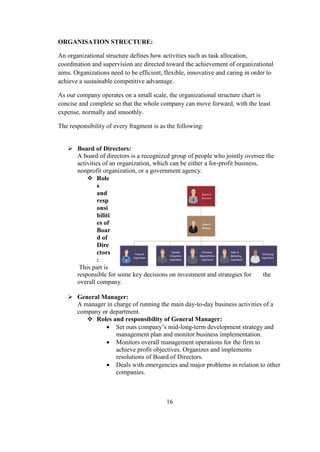
ORGANISATION STRUCTURE:
An organizational structure defines how activities such as task allocation,
coordination and supervision are directed toward the achievement of organizational
aims. Organizations need to be efficient, flexible, innovative and caring in order to
achieve a sustainable competitive advantage.
As our company operates on a small scale, the organizational structure chart is
concise and complete so that the whole company can move forward, with the least
expense, normally and smoothly.
The responsibility of every fragment is as the following:
 Board of Directors:
A board of directors is a recognized group of people who jointly oversee the
activities of an organization, which can be either a for-profit business,
nonprofit organization, or a government agency.
 Role
s
and
resp
onsi
biliti
es of
Boar
d of
Dire
ctors
:
This part is
responsible for some key decisions on investment and strategies for the
overall company.
 General Manager:
A manager in charge of running the main day-to-day business activities of a
company or department.
 Roles and responsibility of General Manager:
 Set outs company’s mid-long-term development strategy and
management plan and monitor business implementation.
 Monitors overall management operations for the firm to
achieve profit objectives. Organizes and implements
resolutions of Board of Directors.
 Deals with emergencies and major problems in relation to other
companies.
16
 Financial Department:
The part of an organization that manages its money. The business functions of
a finance department typically include planning, organizing, auditing,
accounting for and controlling its company's finances. The finance department
also usually produces the company's financial statements.
 Roles and responsibility of financial department:
 Responsible for the company’s daily financial accounting.
 Allocates the funds properly to ensure the company’s
continuous functioning.
 Responsible for the check and issue of wages.
 Chief Financial Officer:
A chief financial officer (CFO) is the senior executive responsible for managing the
financial actions of a company.
 Roles and responsibilities of a Chief Financial Officer:
The CFO's duties include tracking cash flow and financial planning as well as
analyzing the company's financial strengths and weaknesses and proposing corrective
actions.
 ERP management center:
Enterprise resource planning is the integrated management of core business
processes, often in real-time and mediated by software and technology. ERP
provides an integrated and continuously updated view of core business
processes using common databases maintained by a database management
system.
 Benefits of ERP management :
 Having a unified ERP system can greatly lower expenses, including
management/administration staff, support, infrastructure needs, and
application licensing. Using a single system also reduces training
requirements for end-users, since they only need to learn one system
rather than interacting with numerous individual applications.
 Having a unified ERP system can greatly lower IT-related expenses,
including management/administration staff, support, infrastructure
needs, and application licensing. Using a single system also reduces
training requirements for end-users, since they only need to learn one
system rather than interacting with numerous individual applications.
 Implementing an ERP suite across departments means your
organization has a single, unified reporting system for every process.
By having a single source of information, an ERP system can readily
generate useful reports and analytics at any time.
 One of the biggest advantages of ERP software is its modular makeup.
Most ERP vendors offer multiple platforms, and each one contains
several applications that can be implemented according to business
needs. Each application is designed to be able to stand alone or
integrate with the suite, so your company can pick and choose which
components work best.
17
 Properly implemented, an ERP can greatly reduce or eliminate
repetitive manual processes, thus freeing up team members to focus on
revenue-affecting tasks.
 The heart of the ERP concept is data. Sharing data across functional
silos such as Customer Service, Sales, Marketing, and Business
Development enhances collaboration throughout the company.
Subdivision of Financial Department:
1) Captial Management:
An accounting strategy that strives to maintain sufficient and equal levels of
working capital, current assets, and current liabilities. This helps a company to
meet its expense obligations while also maintaining sufficient cash flow and is
primarily related to short term financial decisions.
 Roles and Responsibilities of capital management:
1. Optimization of working capital operating cycle.
2. Balance Working Capital.
3. Minimize cost of capital.
4. Optimal Return on Current Asset Investment.
2) Purchase Department:
Purchasing Department is a vertical focused on functional activity of buying
raw materials, goods and services. It includes supplier identification and
selection from where you will be buying the goods, negotiating and
contracting, supply market research, supplier measurement and improvement
and purchasing system and development.
 Roles and Responsibilities of a purchasing department:
Purchasing Department is a vertical focused on functional activity of buying
raw materials, goods and services. It includes supplier identification and
selection from where you will be buying the goods, negotiating and
contracting, supply market research, supplier measurement and improvement
and purchasing system and development.
i. Support operational requirements.
ii. Supply base management.
iii. Develop strong Relationship with other functional groups.
iv. Support organization goals and objectives that comply with
purchasing management.
v. Evaluate and select suppliers.
vi. Review specifications.
vii. Act as the primary contact with suppliers.
18
3) Product department:
Product department is responsible for guiding the success of a product and leading the
cross-functional team that is responsible for improving it. It is an important
organizational role especially in technology companies that sets the strategy,
roadmap, and feature definition for a product or product line.
 Role of product department :
 The Production Manager is responsible for making sure that raw materials are
provided and made into finished goods effectively.
 He or she must make sure that work is carried out smoothly, and must
supervise procedures for making work more efficient and more enjoyable.
 Is the functional area responsible for turning inputs into finished outputs
through a series of production processes.
a. Sales department:
A sales department is the direct link between a company's product or
service and its customers. However, a well-trained sales department
does more than making sales. Your sales staff builds relationships with
your customers.
 Role of a sales department:
 A sales manager devises strategies and techniques necessary for
achieving the sales targets. He is the one who decides the future
course of action for his team members.
 It is the sales manager’s duty to map potential customers and
generate leads for the organization. He should look forward to
generating new opportunities for the organization.
 A sales manager is also responsible for brand promotion. He
must make the product popular amongst the consumers. A
banner at a wrong place is of no use. Canopies must be placed
at strategic locations; hoardings should be installed at important
places for the best results.
 He is the one who takes major decisions for his team. He
should act as a pillar of support for them and stand by their side
at the hours of crisis.
 A sales manager should set an example for his team members.
He should be a source of inspiration for his team members.
 A sales manager, one should maintain necessary data and
records for future reference.
b. Inventory accounting:
Inventory accounting is the body of accounting that deals with valuing
and accounting for changes in inventoried assets. A company's
inventory typically involves goods in three stages of production: raw
goods, in-progress goods and finished goods that are ready for sale.
 Roles and responsibilities of inventory accounting:
 An inventory accountant develops and determines the inventory
accounting methods and also analyses the inventory related
reports so as
19
to find the possible flaws in inventory storage, transportation,
costing etc.
 It is the job responsibility of an inventory accountant to monitor
all the transactions related to inventory and keep himself
updated about the inventory which has been used or the items
that have to be stocked up for future use.
 An inventory accountant is majorly responsible for maintaining
an inventory ledger and looking into the fact that physical
inventory counts are organized.
 Another job responsibility of an inventory accountant is to
ensure that the entire inventory is stacked properly and
arranged in an organized manner so that minimum wastage
occurs and none of the items is spoilt, destructed or damaged in
any way.
 An inventory or cost accountant is also responsible for
analyzing the overhead costs and variable costs of the company
so as to ensure smooth accountancy.
 One of the most important job responsibility of an inventory
accountant is to check whether or not the reports made related
to the inventory count is correct or
not so that any kind of fraud can be
avoided and timely action can be
taken against the one who has
deliberately made a fraud report.
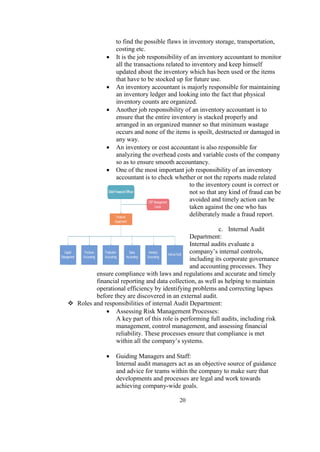
c. Internal Audit
Department:
Internal audits evaluate a
company’s internal controls,
including its corporate governance
and accounting processes. They
ensure compliance with laws and regulations and accurate and timely
financial reporting and data collection, as well as helping to maintain
operational efficiency by identifying problems and correcting lapses
before they are discovered in an external audit.
 Roles and responsibilities of internal Audit Department:
 Assessing Risk Management Processes:
A key part of this role is performing full audits, including risk
management, control management, and assessing financial
reliability. These processes ensure that compliance is met
within all the company’s systems.
 Guiding Managers and Staff:
Internal audit managers act as an objective source of guidance
and advice for teams within the company to make sure that
developments and processes are legal and work towards
achieving company-wide goals.
20
accounting documents, preparing reports that reflect the audit
results and
document the proposed process. These reports are often
presented to key members of the company to ensure all staff
members are working toward the same goals and complying
with regulations.
 Researching Emerging Issues : Internal audit managers
research the latest trends and issues in the industry, determining
the scope of the internal audit accordingly. They develop
annual plans, which are discussed with managers and
stakeholders to agree on systems that will help the business
grow.
 Conduct Follow-up Audits: In order to monitor interventions
from management, internal audit managers conduct follow-up
audits to make sure that regulations and sector rules are still
being met and best practices are being followed.
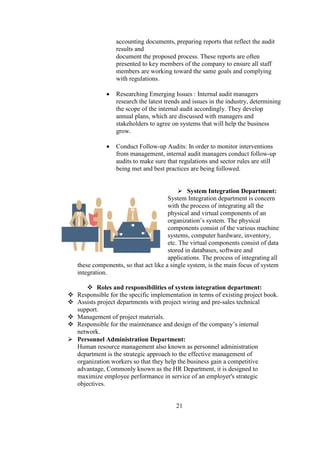
 System Integration Department:
System Integration department is concern
with the process of integrating all the
physical and virtual components of an
organization’s system. The physical
components consist of the various machine
systems, computer hardware, inventory,
etc. The virtual components consist of data
stored in databases, software and
applications. The process of integrating all
these components, so that act like a single system, is the main focus of system
integration.
 Roles and responsibilities of system integration department:
 Responsible for the specific implementation in terms of existing project book.
 Assists project departments with project wiring and pre-sales technical
support.
 Management of project materials.
 Responsible for the maintenance and design of the company’s internal
network.
 Personnel Administration Department:
Human resource management also known as personnel administration
department is the strategic approach to the effective management of
organization workers so that they help the business gain a competitive
advantage, Commonly known as the HR Department, it is designed to
maximize employee performance in service of an employer's strategic
objectives.
21
 Roles and responsibilities of personal administrative department:
 Duties of a personnel administrator include hiring and training
employees, carrying out evaluations and handling employee
grievances.
 Manages the administration activities of the company.
 Responsible for employee rating and recruitment.
 Sales & Marketing Department:
Sales & Marketing department is the department of a commercial organization
that deals with the marketing of products.
It serves as the face of your company, coordinating and producing all
materials representing the business. It is the Marketing Department's job to
reach out to prospects, customers, investors and/or the community, while
creating an overarching image that represents your company in a positive
light.
 Roles and Responsibilities of Sales and Marketing Department:
 Offering professional supports to meet the annual sales targets.
 Enacts marketing strategy according to the development plan.
 Formulates and carry outs the promotion plan.
 Doing research and analysis of the market.
 Develops new business partners and manage clients.
 Defining and managing your brand.
 Conducting campaign management for marketing initiatives.
 Producing marketing and promotional materials.
 Conducting customer and market research.
 Overseeing outside vendors and agencies.
Vice President of marketing Services :
The Vice President of Marketing is responsible for the strategy, tactics and programs
to create interest, demand and recognition for products through the use of PR, Product
Marketing, Creative Services, Advertising, Strategic Relationships, Direct, Event,
Channel and Online Marketing.
ERP Management center:
 ERP management center:
Enterprise resource planning is the integrated management of core business
processes, often in real-time and mediated by software and technology. ERP
provides an integrated and continuously updated view of core business
processes using common databases maintained by a database management
system.
22
 Benefits of ERP management :
 Having a unified ERP system can greatly lower expenses, including
 management/administration staff, support, infrastructure needs, and
application licensing. Using a single system also reduces training requirements
for end-users, since they only need to learn one system rather than interacting
with numerous individual applications.
 Having a unified ERP system can greatly lower IT-related expenses, including
management/administration staff, support, infrastructure needs, and
application licensing. Using a single system also reduces training requirements
for end-users, since they only need to learn one system rather than interacting
with numerous individual applications.
 Implementing an ERP suite across departments means your organization has a
single, unified reporting system for every process. By having a single source
of information, an ERP system can readily generate useful reports and
analytics at any time.
 One of the biggest advantages of ERP software is its modular makeup. Most
ERP vendors offer multiple platforms, and each one contains several
applications that can be implemented according to business needs. Each
application is designed to be able to stand alone or integrate with the suite, so
your company can pick and choose which components work best.
 Properly implemented, an ERP can greatly reduce or eliminate repetitive
manual processes, thus freeing up team members to focus on revenue-
affecting tasks.
 The heart of the ERP concept is data. Sharing data across functional silos such
as Customer Service, Sales, Marketing, and Business Development enhances
collaboration throughout a company.
Customer Services:
Customer service is the process of ensuring customer satisfaction with a product or
service. Often, customer service takes place while performing a transaction for the
customer, such as making a sale or returning an item.
 Roles and responsibilities of customer service:
 Attracts potential customers by answering product and service questions;
suggesting information about other products and services.
 Opens customer accounts by recording account information. Maintains
customer records by updating account information.
Customer service department included the following:
i. Customer complaints management:
ii. Data management.
iii. Technological support.
iv. Customer service training.
The explanation of it is as follows:
Customer complaints management:
A Customer Complaint Is an Opportunity to Improve Customer Loyalty. Receiving a
complaint is a great way to test how effective your complaint management process is
and provides you with a unique opportunity to increase customer loyalty.
23
 Roles and responsibility of customer complaint department:
 Attracts potential customers by answering product and service
questions; suggesting information about other products and services.
 Opens customer accounts by recording account information.
 Maintains customer records by updating account information.
 Resolves product or service problems by clarifying the customer's
complaint; determining the cause of the problem; selecting and
explaining the best solution to solve the problem; expediting correction
or adjustment; following up to ensure resolution.
 Maintains financial accounts by processing customer adjustments.
Recommends potential products or services to management by
collecting customer information and analyzing customer needs.
Prepares product or service reports by collecting and analyzing
customer information. Contributes to team effort by accomplishing
related results as needed.
Data management:
Data management is the practice of organizing and maintaining data processes to meet
ongoing information lifecycle needs.
 Roles and responsibilities and data management department:
 Creating and enforcing policies for effective data management.
 Formulating management techniques for quality data collection to
ensure adequacy, accuracy and legitimacy of data.
 Devising and implementing efficient and secure procedures for data
management and analysis with attention to all technical aspects.
Technology Support System: (technical support)
Technical support refers to services that entities provide to users of technology
products or services. The Internet can also be a good source for freely available tech
support, where experienced users help users find solutions to their problems.
As a technical support/helpdesk employee, you’ll be monitoring and maintaining the
computer systems and networks within an organization in a technical support role. If
there are any issues or changes required, such as forgotten passwords, viruses or email
issues, you’ll be the first person employees will come to.
 Roles and responsibility of technological support system:
 Working with customers/employees to identify computer problems
and advising on the solution.
 Logging and keeping records of customer/employee queries.
 Analyzing call logs so you can spot common trends and underlying
problems.
 Updating self-help documents so customers/employees can try to fix
problems themselves.
 Working with field engineers to visit customers/employees if the
problem is more serious.
24
 Testing and fixing faulty equipment.
Customer Service Training:
Customer service training refers to teaching employees the knowledge, skills, and
competencies required to increase customer satisfaction.
 Roles and responsibilities of customer service training:
 Developing digital and print educational material (e.g. videos and
manuals)
 Organizing classroom-style seminars
 Conducting role-playing activities to develop interpersonal skills (e.g.
negotiation, teamwork and conflict management)
Chain store:
Chain stores are a set of outlets of the same company or brand having the same
ownership and management and selling the same products/merchandise. Chain stores
are often confused with franchises. In franchises, every store will have its own
ownership and will bear sole responsibility for its financial position. However, in a
chain store, the central ownership bears the responsibility of each of the outlets. Chain
stores are able to lower their operating costs by having bulk purchases and other
factors contributing to economies of scale.
Chain store management center:
These stores are generally centralized and follow a single decided course of action.
This may however, limit the flexibility and the innovation exhibited by these stores.
Department stores, grocery stores, read-to-wear apparel stores generally operate as
chain stores. They draw a huge customer base, mainly due to their low prices and not
because of the variety of the products provided.
Retail manager:
A retail manager's role is to run a store successfully. Working on the shop floor, they
are in constant contact with their customers and staff. They are responsible for
ensuring their staff give great customer service as well as monitoring the financial
performance of the store.
 Roles and responsibilities of retail manager:
 Recruiting, training, supervising and appraising staff.
 Managing budgets.
 Maintaining statistical and financial records.
 Dealing with customer queries and complaints.
 Overseeing pricing and stock control.
 Maximizing profitability and setting/meeting sales targets, including
motivating staff to do so ensuring compliance with health and safety
legislation.
 Preparing promotional materials and displays.
 Liaising with head office.
Chain store management center further includes:
1) Flagship store: In retail business the designation of flagship is given to
a retailer’s primary location, a store in a prominent location, a chain’s
largest store, the
25
store that holds or sells the highest
volume of merchandise, a retailer’s
most well-known location, a chain’s
first retail outlet, a store location with
decor or merchandise mix that is
distinctly different from the rest of
the chain, or the store location in a
chain which carries the most high-
priced merchandise catering to the
most upscale customers.
 Benefits of having a flagship store:
 Flagships are often the biggest stores in a brand’s fleet. Their
size is meant to impress the shopper, and it also allows for
extending the merchandise mix beyond what an average store
offers.
 Some flagships include pieces of a brand’s history as an
homage to the past and an invitation into the retailer’s culture.
This could come in the form of museum-like displays of a
brand’s early products or origins or an iconic piece of
merchandise the brand prides itself on.
Chain-store management:
A chain store or retail chain is a retail outlet in which several locations share a brand,
central management, and standardized business practices. They have come to
dominate the retail and dining markets, and many service categories, in many parts of
the world.
Amul being a manufacturing unit is sells there product only in there
personalized outlets.Thus chain management becomes of utmost importance.
 Technology Department:
 Responsible for product’s installation, debugging and maintenance.
 Offer pre and post sales support including consulting and repair.
 Ensure that the company’s internal system runs normally.
 Deal with planning, deployment, and implementation of a new project.
 Collection and communication of new technology.
 Administrative Department : ( administrative division)
Administration department is backbone of an organization. An effective administrator
is an asset to an organization. He or she is the link between an organization's various
departments and ensures the smooth flow of information from one part to the other.
 Roles and responsibilities of Administrative Department:
 To enhance the office staff’s ability to manage and organize office
effectively and professionally
 File in the proper way and filing standard
26
 Develop an appropriate office management strategy
 Develop an appropriate assets management strategy
 Able to develop administrative procedures
 Able to plan and control administrative budget
 Legal department: (legal division)
Legal departments within a business work to maintain and prevent any legal issues
that could arise. They play critical roles in reviewing and drafting contracts, employee
policies, and handling court cases.
 Roles and responsibilities of Legal Department:
 Provide legal assistance to Human resources team for employment
matters and contract drafting for employment and other relating
matters.
 To act as an owner of company’s IP assets such as trademarks,
copyrights, patents, brand names (registrations & renewals)
 Prepare & send legal notices to clients / IP infringers, filing of legal or
civil case against debtors defaulting payments,
 Coordination with Legal consultant / licensing agencies in other
countries for legal cases, disputes resolutions and preparation of
contracts with travel agents as per local laws.
 Provide Counsel and Assistance to IT Department on software
licensing, anti-infringement and anti-piracy compliances
 Coordinate with Management for consultation and strategic direction
with Compliance and IT for Governance, Risk, Audit and Compliance
relating to
 Contractual, legal and regulatory obligations; and
 Information and Privacy Compliance across India and UAE and other
international areas where business exists
 Legal Document Repository – Manage and oversee the Company’s
commercial contracting purposes, including contract forms and legal
contracts repository.
27
 Collaborate with stakeholders and account owners / departments to
educate internal stakeholders on compliance, legal and data protection
requirements and to continuously promote a culture of compliance,
integrity and data protection internally.
 Provide Counsel, Assistance and Support in creation of structures and
environment for ethical and legal compliances and support
enforcement of global compliance policies that are applicable across
multiple business units
 Beside the above mentioned responsibilities, a legal manager also
assists the organizations in compliance with respect to the government
guidelines & norms.
 Finance & Human Resources division:
Financial means relating to or involving money.
The department or support systems responsible for personnel sourcing and hiring,
applicant tracking, skills development and tracking, benefits administration and
compliance with associated government regulations.
 Roles and Responsibilities of Finance Division:
 Money out – making payments and keeping the bills paid.
 Money in – processing incoming payments.
 Payroll – make sure everyone gets paid (including the government).
 Reporting – preparing financial reports, e.g. P&L, Balance sheets and
budgets.
 Financial Controls – to avoid errors, fraud and theft.
 Human Resources Division:
 Roles and Responsibilities Human Resources Division:
 Engage in workforce planning development through your HR strategic
planning activities.
 Recruiting employees: from developing hiring questions to interviewing and
selecting the best people for the job.
 Once you've got the best people, focus on developing the best employee
retention tips and practices for your business.
 Track and manage human resources trends.
 Coach and counsel employees to develop better skills.
28
 Terminating or firing employees when necessary, or laying off staff if required
to 're-size' or redirect the business.
 Define orientation of new employees as a priority for success as you bring on
new staff, and develop a process of continuous new employee orientation.
 Build employee training development programs and link that training with
performance goals through employee development plans.
 Learn how to do effective performance evalutions and build a performance
review program for your employees (and even yourself - a 360 assessment).
Use sample performance evaluations to help write the appraisals.
 When applicable, try to promote from within your organization and post jobs
internally (and externally too) - this helps employees see that there is a future
with the business.
 Develop a structure for employee compensation and benefits programs that are
specific to your business needs and the industry you operate in.
 Ensure that your benefits program, and HR policies, meet the legal
requirements in your area of operation and that they are competitive enough to
attract, and keep, good employees.
 Develop and communicate employee and business policies, in other words
develop an employee handbook. For example, samples of employee handbook
policies may include a conflict of interest policy, an overtime policy, safety
procedures and expectations, and more.
 Develop clearly written and comprehensive job descriptions, as well as
operating and/or job standards.
 Understand the impact of conflict within your organization, and develop
conflict management strategies and conflict resolution methods specifically for
your environment. Coach your employees on how to effectively use those
strategies and methods.
 Keep up-to-date with changing policies and ensure that you work on
continuously improving your HR strategies - it is a lot of work but the people
you employ, train and develop effectively will help your business be a success.
 Marketing division:
A marketing department promotes your business and drives sales of its products or
services. It provides the necessary research to identify your target customers and other
audiences. Depending on the company's hierarchical organization, a marketing
director, manager or vice president of marketing might be at the helm.
 Roles and responsibilities of Marketing Division:
 Defining and managing your brand.
 Conducting campaign management for marketing initiatives.
29
 Producing marketing and promotional materials.
 Monitoring and managing social media.
 Conducting customer and market research.
 Overseeing outside vendors and agencies.
 Research analysis:
A company's research and development department plays an integral role in the life
cycle of a product. While the department usually is separate from sales, production
and other divisions, the functions of these areas are related and often require
collaboration. A thorough understanding of the functions of the research and
development department allows you to maximize those duties at your small business,
even if you don't have a big department.
 Roles and responsibilities of research department:
 New Product Research: Before a new product is developed, a research
and development department conducts a thorough study to support the
project. The research phase includes determining product
specifications, production costs and a production time line. The
research also is likely to include an evaluation of the need for the
product before the design begins to ensure it is a functional product
that customers want to use.
 New Product Development : The research paves the way for the
development phase. This is the time when the new product is actually
developed based on the requirements and ideas created during the
research phase. The developed product must meet the product
guidelines and any regulatory specifications.
 Existing Product Updates :Existing products of the company also fall
under the scope of research and development. The department
regularly evaluates the products offered by the company to ensure they
are still functional. Potential changes or upgrades are considered. In
some cases, the research and development department is asked to
resolve a problem with an existing product that malfunctions or to find
a new solution if the manufacturing process must change.
 Quality Checks: In many companies, the research and development
team handles the quality checks on products created by the company.
The department has an intimate knowledge of the requirements and
specifications of a particular project. This allows team members to
ensure the products meet those standards so the company puts out
quality products. If the company also has a quality assurance team, it
may collaborate with research and development on quality checks.
30
 Innovation: The research and development team aids the company in
staying competitive with others in the industry. The department is able
to research and analyze the products other businesses are creating, as
well as the new trends within the industry. This research aids the
department in developing and updating the products created by the
company. The team helps direct the future of the company based on
the information it provides and products it creates.
 Engineering Department:
The Engineering Department is responsible for planning, analyzing and implementing
system extension projects; planning, design, and construction of major facility
replacements; capital improvement projects; continuing improvements to water
system standards; and technical assistance to other departments and to outside
agencies.
 Roles and Responsibilities of a Engineering Department:
 New business/system extensions.
 Support engineering.
 Design engineering.
 Construction Contract Administration.
 Designing Department:
Design management encompasses the ongoing processes, business decisions, and
strategies that enable innovation and create effectively-designed products, services,
communications, environments, and brands that enhance our quality of life and
provide organizational success
 Roles and responsibilities of the designing department:
 Participate in design meetings and provide continual input to optimize
design and minimize futile work.
 Assist in developing Design Delivery Schedule along with client,
Project Manager, Design Managers and consultants.
 Develop comprehensive scope-of-work and contract document
deliverables list for each related discipline.
 Negotiate scope-of-work, deliverables and price with consulting firms.
 Assist Project Manager in incorporating onto D&C running sheet all
internal and external design and cost issues.
 Manage distribution and production of project workload within team.
 Determine need for use of outside studios or vendors working with
Director DCE.
 Collaborate on new design issues and research projects with team.
31
CHAPTER 8
KEY SUCCESS FACTORS
KEY SUCCESS FACTORS:
Critical success factor is a management term for an element that is necessary for an
organization or project to achieve its mission. Alternative terms are key result area
and key success factor. A CSF is a critical factor or activity required for ensuring the
success of a company or an organization.
Key success factors of Amul are:
1) Developing a new product while maintaining the high quality of existing
products.
2) Find and retain high-value customers.
3) Create and maintain highest level of customer satisfaction.
4) Sell each unit at a profit.
5) Focus on service.
6) Consistency in the market.
7) Quality product and service.
8) Assembling the right team.
9) Developing action habit.
10) Visualize your success.
32
CHAPTER 9
PEST ANALYSIS
Introduction to External Factors:
If a business wants to be successful and sustain, it is necessary for them to fully
understand what factors exert impact on the development of their company. Once they
know the positive and negative effects within and outside the company, they can
produce suitable strategies to handle any situation. External elements are affecting
factors present outside and not under control of the company. Considering the outside
environment, allows businessmen to make suitable adjustment to make it more
adaptable to the external environment. There are numerous criteria considered as
external elements. Among them some of the most important factors need to be listed
are political, social, economical, technological factors. It is common for the manager
to assess each of these factors closely. The aim is to always take better decision for
the firm’s progress.
 Political:
Political environment is the state and central government and its institute and
legislations and the public and private stakeholders who operate and interact with or
influence the system. Government’s actions affect the operation of a company or
business. These actions may be at local, regional, national or international levels.
Business owner and managers pay close attention to the political environment to
gauge now government actions will affect their company.
 Ways in which Amul deals with the political factors:
1) Increase and decrease in tax could be example. Government might increase taxes
for some companies and lower it for others. The decision will have a direct effect on
your business .So we stay up-to-date about such government interventions.
2) The political environment is perhaps among the least predictable elements in the
business environment. A cyclical political environment develops, as demographic
governments have to pursue re-election every few years. It leads to change in
government policies thus we try to be updated with it. We always take up a Nobel
cause of helping the people in need and further developing a good interactive relation
with them.
3) As political systems in different areas vary, the political impact differs. There will
be one party winning in an area where as different party winning in an another area
rules and regulation made by them will further effect the business thus we need to
take decision accordingly.
4) Corruption is a barrier to economic development for India. We are based in Pune
only but it does affect us a lot. Some firms survive and grow by offering bribes to the
government officials. The success and growth of these companies are not based on the
value they offer the consumers.
33
Thus, we work accordingly.
5) As we are a manufacturing unit, there are various other political factors also that
affect our business. Employment law, discrimination law, health and safety law, tax
policies, government involvement in trade unions and agreements, import restrictions
on quality and quantity of the product, intellectual property law (copyright, patents,
trademark), law regulating environment pollution. Our finance team stays in contact
with the lawyer and chartered accountant on week to week basis, so that we don’t
miss any updates.
6) Buying political risk insurance is a way to manage political risk and is a powerful
way to mitigate political risk. Companies that have international operations use such
insurance to reduce their risk exposure. There are some indices that give an idea of the
risk exposure in certain countries.
7) We always look out for the involvement in financial subsidiaries with the help of
local firms, trade unions, financial institutions, and government. As partners in local
business, these groups ensure that political development do not disturb operations.
Localization entails modifying operations, product mix, or such activities suit the
local taste and culture.
8) Influencing local politics through lobbying is another way of managing political
risks. Lobbying is the policy of hiring people to represent a firm’s business interests
also its views on local political matters. Lobbyists meet with local public officials and
try to influence their positions on issues relevant to the firm. Our ultimate goal is
getting favorable legislation passed and unfavorable ones rejected.
 Social:
Social factors are the things that affect lifestyle, such as religion, family, or wealth.
These can change over time. Food developers need to be aware of these changes to
make food that meet the needs of consumers. There is no doubt that the society is
continually changing. The tastes and fashions are a great example in change. Social
media sites like Facebook have become very popular among the younger people. The
young consumers have grown used to mobile phones and computers. The young
generation prefers to use digital technology to shop online. Due to which their likes,
tastes, preferences keep on changing due to the level of exposure. It includes belief
systems and practices customs, traditions and behaviors of all people in given country,
fashion trends and market activities influencing actions and decisions.
 Ways in which we handle social factors:
1) People nowadays are much concerned about their health; we make sure
that our product does not their health.
34
2) Customs and traditions further help us target the customers easily by providing
them a good
quantity and quality at a reasonable price.
3) We usually provide subscription plans for average family size by which we are able
to target ¾ of the population.
4) Milk and milk products are staple sources of protein in diet both in urban as well
as n rural India which makes its consumption level high.
5) At festive season, we always try to be creative with the packaging of our products
which creates a psychological impact on our customers.
6) Almost everyone in the world seeks respect. Thus we make sure that whenever we
have an interaction with them, we treat them with respect.
7) Whenever our salesman or company representative sells the product, we provide
them all the durability details about it
8) Our products usually are necessity goods thus social factor don’t affect the
purchase of it to a large extend.
 Economic:
Economic factors are connected with goods, services, and money. Despite directly
affecting businesses, these variables refer to financial states of the economy on the
greater level whether local or global. The reason for this is that, the state of the
economy cab be decide many of the important details that come up in the operation
company, including topics such as consumer demand, taxes and assets value.
 Ways in which we manage economic factors:
1) Interest rates might appear in a range of difference places, imposed in the range of
different people. Its obvious that the status of interest charge is greater to the banking
institutions. Those we do our financial planning accordingly.
2) Exchange rates are of major importance, but they clearly have to apply to those
who deal with import and export. Changing exchange rates might affect how much a
company has to pay to its international suppliers to satisfy them, which can affect
profit margin, as well as take a lot of resources to stay on top of. Our financial team at
a prior only before taking a decision does all the risk factor analysis for future
precautions.
35
3) An economic recession (of whatever scale) has the potential to change the
purchasing attitude of customers, which might force companies to drop their prices or
clear smaller volumes.
As we deal with durable goods we usually don’t keep a stock of our product. We
produce according to the requirement only.
4) The rise in global development and worldwide increase in GDP (gross domestic
product) means that their target market is gradually growing. We are planning future
strategies accordingly.
5) On the other hand, this global development might increase labor and material costs
in under developed economy where the products are manufactured at a low cost. Our
cost accountant work accordingly taking all the factors into consideration.
 Technological:
Technology trends affect businesses on many levels. When an employee is efficient,
he turns out to be productive. Additionally, when a business is more in touch with its
present and potential customers, the more chance it has to build a strong customer
loyalty base Advancement of technology can make this possible. Strategic leaders are
constantly looking for development and updates within the technological
environment. In this way, they not only improve their operations but, they will also be
well aware of business transformational phase. They will derive groundbreaking
strategies to grow exponentially. The technological environment of business has
changed the way in which businesses function. Advancements in information
technology have almost taken over organization. Now, information is stored in data
servers and cloud technology as against the old way of storing data in registers and
files.
 Ways in which we deal with technological factors:
1) Trust is on research and development for better procurement and storage. It’s
always an ongoing process.
2) Recently every industry has started using RFID (radio frequency identification )
technology to track movement of milk van.
3) Dairy product based company are also focusing on the adoption and
implementation of SAP and ERP across their organization to achieve better supply
chain management.
4) Recently there is a solar plant installation done by our factory which further is
using of non renewable resources sunlight and is further cost affective also.
36
5) We have appointed a digital marketing team in order to take care of our online
presence and activity.
CONCLUSION:
In conclusion, there is a bunch of contribution factors in the success of the company
which comes from both outside and inside a business. Both are of utmost importance
for the development of the company. If a business hopes to perform smoothly and
successfully, they need to take all these elements into consideration before making
any decision.
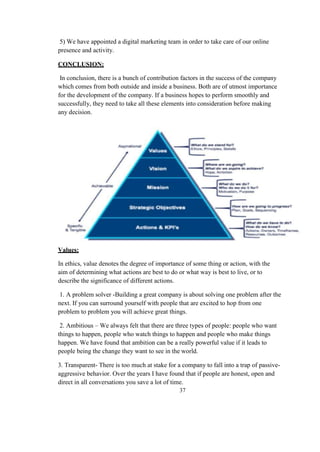
Values:
In ethics, value denotes the degree of importance of some thing or action, with the
aim of determining what actions are best to do or what way is best to live, or to
describe the significance of different actions.
1. A problem solver -Building a great company is about solving one problem after the
next. If you can surround yourself with people that are excited to hop from one
problem to problem you will achieve great things.
2. Ambitious – We always felt that there are three types of people: people who want
things to happen, people who watch things to happen and people who make things
happen. We have found that ambition can be a really powerful value if it leads to
people being the change they want to see in the world.
3. Transparent- There is too much at stake for a company to fall into a trap of passive-
aggressive behavior. Over the years I have found that if people are honest, open and
direct in all conversations you save a lot of time.
37
4. Empathetic- This is probably one of my favorite personal and professional values.
Empathy is not something everyone possesses and for those who do, it is a gift. The
ability to understand the challenges that others deal with, what they care about and
how you can help them thrive to hit their goals and maximize their potential is a
character trait I look for in every hire I make.
5. Adaptable- For us adaptability means one thing: How well does a person handle
ambiguity? We read somewhere once “to improve is to change; to be perfect is to
change often.” While perfection is never possible, how well we adapt to change will
determine how durable our success will be. In a world of ambiguity those who can
roll with the change and still perform are prime time players you want on the team.
6. Accountable- The obligation of an individual to account for his of her activities,
accept responsibility for them and to disclose their results in a transparent manner.
Vision:
A vision statement is a declaration of an organization's objectives, intended to guide
its internal decision-making. A vision statement is not limited to business
organizations and may also be used by non-profit or governmental entities.
Provide our customers with the cleanest and healthiest milk, for which the focus on
nutrition starts from the animals themselves, thus leading to more nutritional milk and
milk products.
Mission:
A sentence describing a company's function, markets and competitive advantages; a
short written statement of your business goals and philosophies. A mission statement
defines what an organization is, why it exists, it’s reason for being.
Understanding customer needs and protecting their interests to build lifelong
relationships and brand loyalty.
Strategic objectives:
A goal is a broad primary outcome. A strategy is the approach you take to achieve a
goal. An objective is a measurable step you take to achieve a strategy. A tactic is a
tool you use in pursuing an objective associated with a strategy.
Strategic objectives taken by Amul:
1) Selling the goods at a minimum cost so that demand of the product increases.
2) Concentrating more on customer satisfaction.
3) Developing customer loyalty programs.
4) Maintain the quantity and quality of the product.
38
Actions & KPI’s:
Actions are mostly the process or the steps in which the operation of the organization
are carried.
Key performance indicators:
Refers to the values used to assess a business ‘success in reaching its goals. In
the long run, tracking relevant KPIs can help you make important decisions
about our company’s growth and development:
1) Cash flow forecast: Cash flow forecasts let our businesses assess whether
their sales and margins are appropriate, and are consequently one of the
most important KPIs for small businesses to track. To make our cash flow
forecast, add the total cash our business has in savings to the projected
cash value for the next four weeks, then subtract the projected cash out for
the next four weeks.
2) Gross profit margin as a percentage of sales: No business can achieve
success if it’s paying out more to suppliers than it’s netting in sales each
month from customers. Gross profit margin as a percentage of sales is an
expression of total profits as they compare to revenue. The benefit of
tracking this KPI over time is that you can easily quantify how much
money you’re keeping against the amount paid out to suppliers. As
businesses retain more money, gross profit margin increases. But a
decrease in gross margin as a percentage of sales could indicate that a
business is overspending on its supplies. Owners would need to reduce
overhead costs or increase prices on goods and services to compensate.
3) Funnel drop-off rate:
Our funnel drop-off rate assesses the number of visitors who abandon a
conversion process—or sales funnel—prior to completion.
To calculate funnel drop-off, start by finding the number of visits of a
particular conversion step, and then subtract the number of visits of the
first step. Divide the new value by visits of the first conversion step.
By identifying when prospective buyers abandon the conversion process,
companies can identify problems and make necessary adjustments to boost
sales. With so many small businesses relying on the internet as a sales tool,
funnel drop-off rate has become one of the most crucial performance
indicators to track.
39
4) Revenue growth rate:
The revenue growth refers to the rate at which a company’s income, or
sales growth, is increasing. To find revenue growth rate, begin with our
business’ total revenue for
the current year. Next, divide current revenue by total revenue from the previous year
to find the rate of growth. By calculating revenue growth rate regularly, you can
assess whether growth is increasing, decreasing.Use it to make any necessary changes
to stay profitable.
5) Inventory turnover:
It measures the number of times inventory is sold or used in a given period
of time, and is valuable because it reveals a business’ ability to move
goods. Inventory turnover can be found by adding up the cost of sold
inventory, then dividing that total by the value of the remaining at year’s
end. Calculating your inventory turnover ratio can help you measure and
plan for adjustments in inventory as needed.
6) Accounts payable turnover: A business can’t keep its door open for long if
it fails to pay suppliers. Accounts payable turnover is a measure of the rate
at which our business pays for goods and services, revealing the amount of
cash spent on suppliers in a given period. To find accounts payable
turnover, add up the cost of total supplier purchases and divide by average
accounts payable. Once we know how much you spend on suppliers, we
can determine if steps need to be taken to reduce spending, which should
boost long-term profits for your business.
40
CHAPTER 10
FINANCIAL STRATEGIES
Financial strategies involve studying the market, collecting, data, forecasting
cash flow and implementing a strategy to meet your objectives. The financial
section further includes the income statement, cash flow statement and balance
sheet which are used to an analysis and make further decisions.
There are various different types of financial plans which we draft to achieve
the goals of the firm.
1) Cash flow planning :
We as a company forecast your short term and long term expenses against
the projected cash flow. But there are times when emergency expenses or
unexpected expenses occurred. Thus we always plan our cash flow
appropriately. Incorrect cash flow planning can lead to bankruptcy.
2) Investment planning:
At times we are fortunate enough to have money left over after paying the
costs of production and distribution, so we in order to expand our business
make that extra money go to work by investing it to earn a financial return.
(such as real estate, or reinvesting the same amount in our own business)
Investment planning involves deciding how best to put your money your
capital to work to achieve your financial goals.
We mostly take advices of our financial department and go forward with
it.
3) Insurance planning:
Insurance is a means of protection from financial loss. It is a form of risk
management, primarily used to hedge against the risk of a contingent or
uncertain loss. We usually take out insurance cover to protect assets and
stocks and to provide financial help if they are facing legal issues.
Thus in order to protect our company we take help of the following
insurance:
 General Liability Insurance: Every business, even if home-based,
needs to have liability insurance. The policy provides us both
defense and damages if our employees, our products or services
cause or are alleged to have caused Bodily Injury or Property
Damage to a third party. Further helping the company to
compensate with the incurred loss easily.
 Property Insurance: being a manufacturing firm we own your
building have including office equipment, computers, inventory or
tools. Thus, we consider purchasing a policy that will protect you
if you have a fire, vandalism, theft, smoke damage etc. Thus
helping the business’ loss of earning insurance as part of the policy
to protect your earnings if the business is unable to operate.
41
 Business owner’s policy (BOP): A business owner policy packages
all required coverage a business owner would need. Often, BOP’s
will include business interruption insurance, property insurance,
vehicle coverage, liability insurance, and crime insurance . Based
on our company’s specific needs, you we alter what is included in a
BOP. Typically, a business owner will save money by choosing a
BOP because the bundle of services often costs less than the total
cost of all the individual coverage’s.
As this firm is not solely own by a single person this helps in case a
separation, solvency or death of an owner.
 Worker’s Compensation: As our workers are the assets of the
organization. Everyone working with us gets a Worker’s
compensation insurance. Helping employees who are injured on
the job. This type of insurance provides wage replacement and
medical benefits to those who are injured while working. In
exchange for these benefits, the employee gives up his rights to sue
his employer for the incident. As a business owner, it is very
important to have worker’s compensation insurance because it
protects ourself and our company from legal complications. State
laws will vary, but all require you to have workers compensation if
you have employees working with us.
4) Tax planning:
The tax requirements mostly depend on our legal structure of our
organisation. We usually utilize book-keeping software and consult with a
finance department about our central and state tax obligations.
5) Defining your short term and long term goals:
It is important for us to distinguish between short term and long term
goals. Short term goal are goals we want to achieve in the near future can
means today, tomorrow, in a week, this month or even this year. Whereas
long term goals are goals we want to achieve 5 years down the line.
We always work keeping the future in plans. In order to achieve a goal we
usually follow certain steps such as:
 Identifying a realistic goal.
 Determining the steps to achieve it.
 Estimating how long you expect each step to take.
 Then distribute the task amongst our team made.
 Supervising is the work properly.
 Execution of the plan.
 Learning for the drawback of the plan.
42
6) Establishing a succession plans:
We always work in accordance with a succession plan which will enable a
smooth transition in leadership and address many tax and financial
matters. Like if the owner sons or daughter comes into picture the rules
and regulation they should work upon are prior decided by the firm.+
The financial strategies used by Amul for their day to day
operation:
1) We usually spend less then we earn to avoid excessive debt: we always
find ways in which our product cost could be reduced maintaining the
quantity and quality of the product in mind. Further we don’t exceed our
debts making best use of our capital to its optimum level.
2) Being future minded: Research indicates that, at every income level,
people who are “planners” are more successful financially and feel better
about their financial situation than those who do not plan ahead. Planners
also experience less financial stress because the act of planning provides
an increased sense of control. Planning for the future includes calculating
the savings required to achieve future financial goals and addressing
potential future challenges such as the cost of long-term care and estate
planning. Thus we work in our present keeping our future in mind.
3) Co-Marketing as a Strategy – We work on a assume that we need money
to launch a strong sales and marketing campaign to grow the company
quickly but organically (i.e., from your own sales).We have to look for a
marketing partner to co-market with. For example, if we are a company
that provides software to a particular industry, we could partner with a
consulting firm that specializes in doing software implementations in that
same industry. That firm could help market and sell your software as part
of its overall industry “solution." Thus, at time we use collaboration
strategies in order to capture the market share.
4) Equity Investment as a Strategy:
If we have created a product or service that will likely lead the company to
explosive growth and we need funding to hire the personnel and install the
necessary infrastructure, then raising equity capital would be the best
financing strategy to use. For example, Craigslist needed capital to grow
but wanted to maintain greater autonomy. It ultimately shunned the
venture capitalists and obtained a sizable investment from eBay.
43
5) Debt as a Strategy:
If we as company generates high cash flow or you estimate that it will
when a new product or service is finalized, a bank or similar loan help us
with a good financing strategy. Our business then repay the loan with the
cash flow. For example, a retailer with strong profit margins needs cash to
purchase larger quantities of fast-selling inventory. The retailer could
pursue a line of credit that would be repaid as the inventory sold.
Conclusion:
Financial planning helps in eliminating the possibility to loss an used all the
resources available to it optimum level keeping the short term and long term
goals in mind.
44
CHAPTER 11
HUMAN RESOURCE STRATEGY
HUMAN RESOURCES STRATEGY
Human Resource Strategy (HR Strategy) is a designation for a long-term plan created
to achieve objectives in the field of human resource and human capital management
and development in the organization. Human Resource strategy is one of the outputs
of strategic management in the field of human resources management.
In our company personnel administrative department takes care for human resource
management of our company.
Further helping the organization to helps to unify and direct the behavior and actions
of all people and their overall development in accordance with the needs of the
organization. It allows a meaningful planning and management of all work with
human resources
Where is human resources management strategies used in a organization:
1) Defines processes, responsibilities and requirements on recruitment and
staff selection.
2) Defines requirements on staff training and qualification development.
3) Defines the way of management of work performance, motivating and
rewarding people, social programs and employee benefits.
4) Defines working conditions, labor relations and influences the way of
organizing.
5) It also includes specific goals in human resources and a schedule for
implementation - through projects or other actions and tasks.
We as a company work on human resource 3 pillars in order to carry out the day to
day operation smoothly and effectively.
1) Legal Requirements: We while on boarding an employee, it’s important
that we follow and fulfill all legal requirements to ensure that you protect
the business and the employee. For instance, every full-time employee
should fill out an IRS (Indian revenue service’s W-4 form and I-9 form.
Another important legal requirement is workers compensation.
The W-4 is used by our employer to determine how much income tax to
withhold based on their marital status and the number of withholding
allowances they claim. There is an allowance worksheet that help them to
calculate the number of allowances. Generally, there claim allowances for
themselves, their spouse if they’re filing jointly, and children under 17 for
whom you can claim the child tax credit.
There are additional withholding allowances that are related to credits and
deductions.
45
2) Maintaining a Image:
Maintaining a strong, positive corporate image is important, helping us
attract top talent to a growing team. The HR department plays a critical
role in upholding an organization’s image by analyzing the following:
 Is the branding revolves around innovation, does our company
culture reflect that?
 Are our branding campaigns focused on technology—and does our
staff have access to the newest and latest equipment?
 How is our company reflected on social media, both formally
through company channels and informally through individual
employees?”
After analyzing above cases a concise report is given by hr
department to the head for further decision making.
3) Employee Engagement:
Employee engagement is critical to a company’s success. After all,
an engaged employee is a productive one. To increase employee
engagement, we try our best to bring the following into your
culture and HR processes:
 Gamification : In human resource management
Gamification is the usage of game-thinking and game
mechanics in non-game scenarios such as business
environment and processes, specifically in recruitment,
training and development, and motivation; in order to
engage users and solve problems. Incorporate gamification
into employee activities, are achievement-tracking and peer
competition.
 Incentives: Financial and non-financial incentives, such as
rewards and recognition, give employees something to
work toward. In addition, they reinforce attitudes and
behaviors that will help the organization succeed. We make
the process of tracking these incentives, and the milestones
that designate them, with an employee recognition and
engagement platform such as Achievers.
Further motivating them to give their best in whatever they
do.
 Employee Surveys: We Conduct surveys on a regular basis
to let employees know that their voice is being heard and
valued
46
 Career Advancement Programs:
We considered our organization’s biggest and most precious
investment is our employees. A career advancement program helps
sustain employee engagement, as employees are given the
opportunity to progress both personally and professionally. It does
included cost for the organization at an initial stage. But it ends up
contributing more to the organization.
To achieve the maximum level of profitability and success, an human
Resource department has to align each employee’s work with the strategic
goals of the firm and also ensure that the staff is well aware of the required
actions and behaviors by setting clear-cut performance expectations in job
descriptions.
Further explaining the human resource management strategies used by Amul
for their day to day operation are as follows:
1) Develop a Competency Model:
The main objective of human resource department is to hire the right
people for the right jobs keeping in mind their skills, expertise, and
education. This objective is achieved in our company by setting clear job
descriptions, establishing job competency models for each department in
our company and benchmarking roles against similar jobs in the industry.
In order to ensure smooth running of the business, HR department takes
into account studies and data related to staffing, transactions, and costs and
then create a competency model accordingly. So that the result can be
achieve the results accordingly.
2) Define Organizational Dimensions:
HR strategies are developed according to the aspects of the organization. It
is also interesting to note that the prevailing culture of the company not
only has a critical impact on the HR strategies devised but also represents
the management style and values of the organization. Defining the
organizational dimensions will give you an idea on how the organization is
going to be more or less – will it be an organization that expects
employees to ‘do more with less’ or will it be overstaffed in order to give
way to innovation and experimentation?
Some other key factors that directly impact the HR strategies devised are the
nature of business done by the organization, the chain of command and the
structure of the organization itself. In order to effectively hire and retain staff
to achieve strategic goals of the organization, human resources systems,
policies, and practices are also taken into account.
47
3) Define Role of Mission, Vision, and Values:
The mission, vision and values of the small business or startup play a
crucial role in shaping the HR strategies and objectives for the future
ahead. The mission of the organization will help you understand why the
business exists and who it serves while
the vision statement basically provides insights on what the organization
hopes to achieve and where it sees itself in the future.
The values of the organization are beliefs that serve as a driving force behind
the operations and actions of the organization. All three – the mission, vision
and values of the organization directly impact the type and number of
employees needed to meet the organizational goals.
4) Perform Workforce Analysis:
A workforce analysis is considered a key part of the human resource
strategy and focuses mainly on the organization, its culture, people, and
the systems that have been implemented. Doing a workforce analysis is
helpful in analyzing the current situation of the company in terms of the
elements discussed above and where they ideally want to be in the years to
come.
Identifying the gaps in these areas will enable the HR professionals to come
up with specific objectives designed especially to bridge these gaps.
5) Evaluate Implemented Strategy:
All HR strategies are guided by evaluation based on specific, measurable
factors. A small business or startup will consider a wide variety of factors
for developing, implementing and evaluating the effectiveness and
performance of its HR strategy. Usually, doing an evaluation will give you
accurate facts and figures on employee turnover, number of vacant
positions, customer complaints, and employee grievances along with the
satisfaction and dissatisfaction levels of both customers and employees.
BUILDING HUMAN RESOURCE STRATEGIES FOR SMALL AND
MEDIUM ENTERPRISES
In order to build a solid HR strategy for small and medium enterprises, you
should follow these three steps.
48
CHAPTER 12
OPERATIONAL STRATEGY
Operational strategies refers to the methods companies use to reach their objectives.
By developing operational strategies, a company can examine and implement
effective and efficient systems for using resources, personnel and the work process.
Service-oriented companies also use basic operational strategies to link long- and
short-term corporate decisions and create an effective management team.
 Operational Strategy used by Amul for day to day operation of the
organization:
So divide the operating section of the business plan into two parts, starting
with the Stage of Development section.
 Stage of Development Section:
When we're writing this section of the operations plan, start by
explaining what we've done "to date" to get the business operational,
followed by an explanation of what still needs to be done. The
following are taken into consideration by us:
 Production Workflow - A high-level, step-by-step description of how
your product or service will be made, identifying the problems that
may occur in the production process. Follow this with a subsection
titled "Risks" that outlines the potential problems that may interfere
with the production process and what you're going to do to negate
these risks. If any part of the production process can expose employees
to hazards describe how employees will be properly trained in dealing
with safety issues. If hazardous materials will be used described how
these will be safely stored, handled, and disposed of.
 Industry Association Memberships – we show our awareness of our
industry's local, regional, or national standards and regulations by
telling which industry organizations we are already a member of and/or
which organizations we are planning to join and telling what steps
we've to take to comply with the laws and regulations that apply to
your industry.
 Supply Chains - An explanation who our suppliers are and their prices,
terms, and conditions. Describing what alternative arrangements we
have made or will make if these suppliers let you down.
49
 Quality Control - An explanation of the quality control measures that
we've set up or are going to establish. For example, if we intend to
pursue some form of quality control certification such as ISO 9000,
describing how we will accomplish this.
 Production Process Section – While we can think of the Stage of
Development part of the operations plan as an overview, the
Production Process section lays out the details of our business’s day to
day operations.
We remember our goal of writing this section of the business plan is to demonstrate
your understanding of the manufacturing or delivery process for your product or
service, so you need to let the readers of your business plan know that.
We make sure that we include all these details of our business’s operation:
 General: We do an outline of our business’s day to day operations, such as the
hours of operation, and the days the business will be open.
 The physical plant: What type of premises are they and what are the size and
location? If it’s applicable, include drawings of the building, copies of lease
agreements, and/or recent real estate appraisals. We need to show how much
the land or buildings required for our business operations are worth and tell
why they’re important to our proposed business.
 Equipment: The same goes for equipment. Besides describing the equipment
necessary and how much of it we need, we also need to include its worth and
cost and explain any financing arrangements.
 Assets: We make a list of our assets, such as land, buildings, inventory,
furniture, equipment, and vehicles. Include legal descriptions and the worth of
each asset.
 Special requirements: If our business has any special requirements, such as
water or power needs, ventilation, drainage. We provide the details in our
operating plan, as well as what you’ve done to secure the necessary
permissions, such as zoning approvals.
 Materials: we note down form where we ‘re going to get the materials we need
to produce our product or service and explain what terms we’ve to negotiated
with suppliers.
 Production: We explain how long it takes to produce a unit and when will we
be able to start producing your product or service. Include factors that may
affect the time frame of production and how will we deal with potential
problems such as rush orders.
 Inventory: Explain how we will keep track of inventory.
 Feasibility: Describe any product testing, price testing, or prototype testing
that we’ve done on your product or service.
50
CHAPTER 13
MARKETING STRATEGY
MARKETING STRATEGY
A marketing department promotes our business and drives sales of its products or
services. It provides the necessary research to identify your target customers and other
audiences. Depending on the company's hierarchical organization, a marketing
director, manager or vice president of marketing might be at the helm.
A marketing strategy is a process that can allow an organization to concentrate its
limited resources on the greatest opportunities to increase sales and achieve a
sustainable competitive advantage. A marketing strategy should be centered around
the key concept that customer satisfaction is the main goal.
Marketing strategies used by Amul till date in order to capture the market share for
further operation:
 Signage: Thriving in The Digital Age.
Signage materials comprise digital photos framed and lighted in the dark.
Digital signage has moved on from boring walls to mobile taxis, reaching a
wider audience than ever before. Adorning buildings, shop-fronts, and malls,
signage is turning out to be more than old wine in a new bottle.
 Billboards: Fitting The Bill:
Billboards using printed or hand-painted images on canvas are still very
commonly in use. From highways to hallways, billboards have come a long
way. This traditional marketing mode uses less text and more images. A
picture is worth a thousand words and compelling images are great for raising
brand awareness. This is a marketing method most are familiar with. Larger
signs will never be overlooked and billboards cannot go obsolete, given their
wide reach across social classes and geographical boundaries.
 Direct Mail: Moving Past Email Marketing:
Direct mail is making a real comeback. Once upon a time, people would tag it
as snail mail and shrink away. But now, direct mail scores on creativity,
personalizing and targeting a particular audience. Direct mail is not just easier
to understand, it also has a greater power to influence readers. Brand recall is
way higher in research studies where direct mail was compared to other
marketing methods like email. Faster response rates, more purchases and
greater ease of retrieval make good old-fashioned direct mail the real deal in
new-age marketing.
 Flyers and Brochures: The Power of Hand-outs:
Brick and mortar establishments, streets, or malls are just some of the places
where flyers and brochures can come in handy. These are still the most widely
preferred methods for special discounts and offers. Consider the value of
business cards that directly introduce a business to the client. Traditional
marketing that is face-to-face is way more connective and interactive.
51
 Face to Face Interaction: Why Reality Beats Virtual Marketing
Traditional marketing has been around for ages. People are used to it.
Traditional methods from signage to networking at events, cold calls and
referrals harness the power of human interaction. This really works well, to
close a sale. Tangible, physical canvas, paper, and traditional marketing
mediums evoke a sensation and a lasting memory. These are also easier to
retrieve than logging onto a visual storefront or a digital calling card online.
 Print Ads: Harnessing Word Power:
Print is not dying; it is merely evolving. Mobile penetration has only made
print media more distinctive. Newspapers and magazines are visible on digital
mediums and the Smartphone could well be a boon for print ads.
 Telemarketing: Cold Calling Is the Right Number to Dial. Outbound and
inbound telemarketing still rules the marketing industry. Marketing Profs, for
instance, listed this has the most critical B2B lead generation strategy which
even beats CRM systems hollow. Focus on core operations by opting for
world-class call answering services.
 Salespeople: The Catalyst in the Marketing Process
Though it is true that over 70 percent of the buyer’s journey is complete before
salespeople come into contact with the customer, marketing is an art which
requires training and experience. That is why Online Marketing Institute and
such top institutions are needed to hone skills. Customer care can also play a
vital role in converting prospects to solid customers or even help in client
retention, courtesy cancellation teams that persuade you to stay with the brand.
 Final Word:
The core value a sale generates is a superlative product or service. Just as no
amount of good marketing can sell a bad product, the reverse holds true as
well. Marketing is an art that derives its value from traditional techniques
because this is the way it has always been done.
52
CHAPTER 14
MANAGEMENT INFORMATION SYSTEMS
STRATEGY
MANAGEMENT INFORMATION SYSTEMS STRATEGIES
A marketing information system is a management information system designed to
support marketing decision making.
Jobber defines it as a "system in which marketing data is formally gathered, stored,
analyzed and distributed to managers in accordance with their informational needs on
a regular basis.
Work of management information system:
 An understanding of the different roles managers play and how marketing
information systems can support them in these roles.
 An appreciation of the different types and levels of marketing decision
making.
 Knowledge of the major components of a marketing information system.
 An awareness of the often under-utilized internal sources of information
available to enterprises.
 An ability to clearly distinguish between marketing research and marketing
intelligence. An understanding of the nature of analytical models within
marketing information system.
Strategies used by human information department are as follows:
Information systems that claim to support managers cannot be built unless one
understands what managers do and how they do it. The classical model
identifies the following 5 functions as the parameters of what managers do:
2) Planning
3) Organizing
4) Coordinating
5) Deciding
6) Controlling
Such a planning emphasizes what managers do, but not how they do it, or
why. More recently, the stress has been placed upon the behavioral aspects of
management decision making. Behavioral part are based on empirical
evidence showing that managers are less systematic, less reflective, more
reactive and less well organised than the previous projects managers to be.
For instance, behavioral part describes 6 managerial characteristics:
 High volume, high speed work
53
 Variety, fragmentation, brevity
 Issue preference current, ad hoc, specific
 Complex web of interactions, contacts
 Strong preference for verbal media.
Such behavioral part stresses that managers work at an unrelenting pace and at
a high level of intensity. The nature of the pressures may be different but there
is no evidence that they are any less intense. The model also emphasizes that
the activities of managers is characterized by variety, fragmentation and
brevity. There is simply not enough time for managers to get deeply involved
in a wide range of issues. The attention of manager increases rapidly from one
issue to another, with very little pattern. A problem occurs and all other
matters must be dropped until it is solved. Research suggests that a manager's
day is characterized by a large number of tasks with only small periods of time
devoted to each individual task.
Managerial Roles
Mintberg suggests that managerial activities fall into 3 categories:
interpersonal, information processing and decision making. An important
interpersonal role is that of figurehead for the organization. Second, a manager
acts as a leader, attempting to motivate subordinates. Lastly, managers act as a
liaison between various levels of the organization and, within each level,
among levels of the management team.
A second set of managerial roles, termed as informational roles, can be
identified. Managers act as the nerve centre for the organization, receiving the
latest, most concrete, most up-to-date information and redistributing it to those
who need to know.
Managers act as entrepreneurs by initiating new kinds of activities; they
handle disturbances arising in the organization; they allocate resources where
they are needed in the organization; and they mediate between groups in
conflict within the organization.
In the area of interpersonal roles, information systems are extremely limited
and make only indirect contributions, acting largely as a communications aid
in some of the newer office automation and communication-oriented
applications. These systems make a much larger contribution in the field of
informational roles; large-scale MIS systems, office systems, and professional
work stations that can enhance a manager's presentation of information are
significant. In the area of decision making, only recently have decision support
systems and microcomputer-based systems begun to make important
contributions.
54
While information systems have made great contributions to organisations,
until recently these contributions have been confined to narrow, transaction
processing areas. Much work needs to be done in broadening the impact of
systems on professional and managerial life.
Decision Making:
Decision making is often seen as the centre of what managers do, something
that engages most of a manager’s time. It is one of the areas that information
systems have sought most of all to affect (with mixed success).
Decision making can be divided into 3 types: strategic, management control
and operations control.
 Strategic decision making: This level of decision making is concerned
with deciding on the objectives, resources and policies of the
organization. A major problem at this level of decision making is
predicting the future of the organization and its environment, and
matching the characteristics of the organization to the environment.
This process generally involves a small group of high-level managers
who deal with very complex, non-routine problems.
 Management control decisions: Such decisions are concerned with
how efficiently and effectively resources are utilized and how well
operational units are performing. Management control involves close
interaction with those who are carrying out the tasks of the
organization; it takes place within the context of broad policies and
objectives set out by strategic planners. An example might be where a
transporter of agricultural products observes that his/her profits are
declining due to a decline in the capacity utilization of his/her two
trucks. The manager (in this case the owner) has to decide between
several alternative courses of action, including: selling of trucks,
increasing promotional activity in an attempt to sell the spare carrying
capacity, increasing unit carrying charges to cover the deficit, or
seeking to switch to carrying products.
55
CHAPTER 15
SWOT ANALYSIS
SWOT analysis is a strategic planning technique used to help a person or organization
identify strengths, weaknesses, opportunities, and threats related to business
competition or project planning.
Strengths analysis:
Strengths:
Strengths describe what an organization excels at and separates it from the
competition: a strong brand, loyal customer base, a strong balance sheet,
unique technology and so on. For example, a hedge fund may have developed
a proprietary trading strategy that returns market-beating results. It must then
decide how to use those results to attract new investors.
1. What advantages does your organization have?
 An advantage of locally known in the market.
2. What do you do better than anyone else?
 Quality and quantity maintains
 Provide replace to our customers since case of a bas experience
of the product.
 Delivery fresh and recently manufactured goods
3. What unique or lowest-cost resources can you draw upon that others
can't?
 We sell the product keeping the minimum margin on the
product so that we can increase the turnover of our
organization.
4. What do people in your market see as your strengths?
 We have never cheated them or missed our goodwill of the
brand.
5. What factors mean that you "get the sale"?
 Our products quality and quantity speak for its own. Once the
customer experiences our product they will definitely vouch for
our product again and again.
6. What is your organization's Unique Selling Proposition (USP)?
 We sell keep the minimal profit margin.
 With a strategy to reduced to overall market price of the
product as sold by our competitors.
7. Do consider your strengths from both an internal perspective, and from
the point of view of your customers and people in your market.
Yes we do consider we are assured them that consuming our product
will never harm them or their health.
There health is our at most priority.
56
Weaknesses:
Weaknesses stop an organization from performing at its optimum
level. They are areas where the business needs to improve to remain
competitive: higher-than-industry-average turnover, high levels of
debt, an inadequate supply chain or lack of capital.
1. What could you improve?
 Developing a inventory system which will help in further
strategy making.
2. What should you avoid?
 Assessing all the factor when it comes expanding our
franchises
3. What are people in your market likely to see as weaknesses?
 What factors lose you sales?
4. Again, consider this from an internal and external perspective: do other
people seem to perceive weaknesses that you don't see? Are your
competitors doing any better than you?
 No its not that other people seem to perceive weaknesses that
you don't see. We know where we lack we are trying our best
to overcome it.
Opportunities:
Opportunities refer to favorable external factors that an organization
can use to give it a competitive advantage. For example, a car
manufacturer can export its cars into a new market, increasing sales
and market share, if a country cuts tariffs.
Opportunities refer to favorable external factors that an organization can use to give it
a competitive advantage. For example, a car manufacturer can export its cars into a
new market, increasing sales and market share, if a country cuts tariffs.
1. What good opportunities can you spot?
 Proper inventory management will help us identifying various
things. Further we can develop strategies with it.
 Moreover we can develop us business online which will be
beneficial for the organization in the long run.
2. What interesting trends are you aware of?
 People now days spend less on sweets where are they are
very interested in dairy and bakery products we are working
towards developing our marketing share in it also.
57
3. Useful opportunities can come from such things as:
 Yes totally agreed.
4. Changes in technology and markets on both a broad and narrow
scale.
 We are working on digital marketing side by side on
traditional marketing also to create our brand awareness.
5. Changes in government policy related to your field;
 We are do keep a watch on government changing policies
very now and then so that we don’t miss out on anything.
6. Changes in social patterns, population profiles, lifestyle
changes, and so on.
 We its does effect us business but we usually work after
taking various factor into consideration.
Threats:
Threats refer to factors that have the potential to harm an organization. For example, a
drought is a threat to a wheat-producing company, as it may destroy or reduce the
crop yield. Other common threats include things like rising costs for inputs, increasing
competition, tight labor supply and so on.
1. What obstacles do you face?
 Lack of inventory management.
2. What are your competitors doing?
 Able to maintain there franchise properly having the same
input and output.
3. Are quality standards or specifications for your job, products or
services changing?
 No, we try our level best that our quality and quantity of the
product paid by the customer is properly justified.
4. Is changing technology threatening your position?
 No we are working on various digital marketing concepts
which will show its results in future.
5. Do you have bad debt or cash-flow problems?
 No we don’t any problem related to it our credit period is
always pre informed to the parties and they work in
accordance to that only.
6. Could any of your weaknesses seriously threaten your business?
 We lack of inventory is and creating a threat to our
organization but we are now working on it effectively.
58
CHAPTER 16
DATA ANALYSIS & INTERPRETATION
DATA ANALYSIS AND INTERPRETATIONS
After doing a detail study on all the factors of Amul I have come across certain
setbacks of it which are as follows:
 A lack of inventory balance makes product shortages and overstocking
unavoidable. Valuable time and human capital is being spent
completing tasks a system could manage. When you lack the fluidity
an inventory management system, introduces your space becomes
cluttered and difficult to effectively work in.
 You’ll spend unnecessary amounts of money on items that will not
profit your business.
 Without access to real time information you won’t know how or where
products move, so theft, obsolete items. Will make tracking inventory
nearly impossible.
 A lack of inventory balance makes product shortages and overstocking
unavoidable.
 Valuable time and human capital is being spent completing tasks a
system could manage.
 When you lack the fluidity an inventory management system,
introduces your space becomes cluttered and difficult to effectively
work in.
 Without having the resources to analyze inventory trends, you will
unknowingly make decisions that don’t provide the greatest return.
 When employees are continuously completing tasks that could be
quickly managed by a system they become inefficient in the
workplace.
 Difficulty in tracking inventory results in shipping and delivery delays
caused by orders not being replenished on time or items being
unavailable when they’re needed.
 Difficulty in tracking inventory results in running out of stock when it
is needed, causing you to increase lead time times, ultimately
disappointing the customer.
 The more energy customers use to make sure you’re filling their orders
correctly, the more unsatisfied they become. Not being able to ship or
deliver on time results in rocky relationships and decreases customer
loyalty.
59
4CHAPTER 17
LIMITATIONS OF THE PROJECT
It is always better to identify and acknowledge shortcomings of your work, rather than
to leave them pointed out to your by your dissertation assessor. While discussing your
research limitations, don’t just provide the list and description of shortcomings of your
work. It is also important for you to explain how these limitations have impacted your
research findings.
This report had to work under several constraints and limitation. Some of the key
limitations are:
1) Time period of the project was approximately 67 days.
2) Moreover the research is on one to one interactions.
3) The psychology of a respondent plays a significant role. Some respondents are
more sensitive as against others who are more tolerant. A change in the
composition of the respondents can affect the answers adversely or favorably.
4) Out of the whole research and analysis, only major brands could be
highlighted, leaving aside the other non-popular brands.
5) The study helps out in having retailers’ view, consumer quality service.
6) The project work done will definitely prove to be a helping hand for the firm
well.
7) This provides suggestion to grow for the business as there is always a room for
improvement in every business.
60
CHAPTER 18
FINDING AND SUGGESTIONS
FINDING AND SUGGESTIONS:
Report analysis shows there is a lack of inventory system in the organization.
For which I have analyses various software providing management services.
It shows a comparative study for the same recommending the best for the
organization.
A) Gofrugal software
I. Fast billing Shoppers (Uninterrupted fast billing)- Today look forward to a
greater exit experience as much as the in-store experience. Unmatched billing
speed aided with integration to all POS accessories.
Advantages of fast billing shoppers:
 Peak hour sales, festival season crowd needs no extra hands & efforts.
 Mobile app SellSmart, can help you bill on the move Take payments
with ease - cash, card, coupon, left voucher, part-cash, part-card
payment & more.
 Card swipe integration to bill faster Design and print barcode labels.
 Print purchase price in barcode as alphanumeric. Issue quotation,
Performa, follow-up & do more sales Exchange old for new, different
prices for same item, customizable tax options i.e. TAX on
MRP/Selling rate - predefine them or manage from bill screen also
Dayone billing - bill instantly from the day installation is complete.
 Billing will not stop even when main computer is down; uninterrupted
'Offline billing' provides peace of mind complete customer history in
click of a button.
 Surprise customers with instant free offers, item discounts with
shortcuts keys in the billing screen itself
II. Inventory- Stock what sells more, get notified on non-moving and expiry
items and take corrective action, reorder basis smart recommendations to
optimize stock and avoid shortage.
Advantages of proper inventory management (Inventory Tracking
Control)
 Use the racks, shelves and the complete shop space to stock
products that are fast moving & clear out the non-moving ones,
wastage and release the blocked working capital Always be
aware of accurate stock position - for all outlets & also
individually.
 Know truth about inventory from the software Follow the
complete transaction history of any product; understand from
which supplier it was purchased, at what rate and to whom it
was sold at what rate.
 Any product can be sold - in bulk, loose quantities, part of a
packaged kit and more.
 Manage different inventory and prices for them.
61
Position and package your products based on customer needs and profit more.
III. Cloud POS (SmartReports)
Operate your business on cloud without installing a Point of sale software,
keep your business market ready, have critical business reports delivered to
you 24x7 with web based POS.
Advantages of SmartReports:
 Use reports and data to make informed decisions on
business
Shop information/Reports can be accessed from laptops and
smartphones as well - WebReporter tool and WhatsNow mobile
app come along as free add-on.
 Sales for any period, sales-returns, product margins,
pending quotations, sales-orders and deliveries,
commission report, top customers and more.
 Inventory analysis reports such as dead stock report,
wastage, fast moving products, slow moving products,
etc helps reordering to be profitable.
 All reports can be given user access and privileges
ensuring security of business information.
IV. Integrations – POS Integrations
Builds an easy & efficient system by extending it. 3rd party integrations like
Accounts, Payments, Loyalty, Mall manager, Credit Card, E-commerce
platforms and more.
Advantages:
 Helps in proper Accounting.
 Helps in creating a Loyalty programs.
 Helps in making Payment easily.
V. CRM & Loyalty Profile customers.-
Pull new and repeated customers. Understand customer preferences through purchase
history and plan creative promotions. Reward loyal customers and increase sales.
Advantages of CRM & Loyalty Profile customers:
 Group customers, understand their purchase frequency and plan personalized
offers.
 Reward them with loyalty points for every purchase made Put creative ideas
into practice
Choose from over 70+ offers and promotion types and keep the store buzzing
with excitement SMS birthday greetings and offers to customers and keep in
regular touch with them.
62
 Release coupons and vouchers and get more customers even outside your
catchment area.
 Direct consistent traffic to the stores during non business/peak hours as well
by configuring hourly offers, day wise offers.
VI. Multi store management –
It includes centralized monitoring of store-wise sales, purchase, inventory, profits &
more. It takes action from anywhere with web access to all stores and feel confident
and expand to more outlets.
Advantages of multi store management:
Bringing our outlets together Headquarter (HQ) business management retail POS
solution is a web-based, easy-to-use software that allows to monitor branch-wise
sales, purchase, Inventory, receivables and profits etc. from a central location.
Completely scalable to meet the growing needs of the retailer, clear visibility &
enhance control on outlet operations.
B) Posist software:
i) Customized Detailed Billing:
Present detailed, itemized bills to your customers that ensure transparency in the
bill. Keep records of all items sold, the rate of items, and other sales data needed
with our POS software.
ii) Cloud Telephony:
In case the first line is busy, the call gets automatically transferred to the next
available line, until the call is accepted. View the call logs and the time spent to
accept each order. Don’t miss out on any order, especially during the rush hours!
iii) Advanced Order Billing:
It views and track different stages of production, from order booking, preparation,
packaging, and delivery. Also, set prior reminders for delivery, so that you don’t miss
any Delivery Orders.
iv) CRM Integration:
Automatically update customer data into the central CRM. Create customized SMS
and email campaigns and run Loyalty Programs to encourage repeat customer visits.
63
v) Mobile Reporting:
View real-time updates of your sweet shop right on your mobile phone. Keeps a track
of the total sales happening at your sweet shop from anywhere. View your outlet level
reports or compare the performance of multiple outlets.
vi) Anti-Theft:
 Get rid of pilferage and thefts with the help of POSist’s Anti-Theft
feature.Keep a water-tight control on your inventory and track variance to
keep your food costs in check.
 Create roles and permissions in the POS for specific tasks such as making any
change in the bill.
 Keep a track of the number of Void Bills generated at your outlet.
vii) Mobile Reporting:
 View real-time reports of your outlet right from your mobile phone.
 Keep a track of your restaurant business from anywhere.
 View daily sales, total bills generated, total discounts offered and more.
 View graphical and tabular representation of data for easy analysis.
Suggestions:
1) They must install inventory management software which will further help
the organization for inventory management.
2) Develop a database of customers.
3) Develop customer loyalty programs.
4) Work on retaining the customers.
5) Developing a specialty of their own.
6) Work on creating brands.
64
CHAPTER 19
CONCLUSION
Conclusion:
It is concluded that Amul will working effectively on various factors of the
organization. It just has to work effectively on inventory management and
develop marketing strategies in accordance to it.
65
From Books –
Bibliography:
1) Business Environment: By A.C Fernando
2) Business Environment: By Sheikh Saleem.
3) The Business Environment : By Chris Brittion and lan Worthington.
Form Research journals:
1) Understanding the Business Environment: Inside and Outside the Organisation
Book by Claire Capon.
2) :Environment, corporate entrepreneurship, and financial performance: A
taxonomic approach SA Zahra - Journal of business venturing, 1993 –
Elsevier.
3) Characteristics of opportunities search of entrepreneurs versus executives:
Sources, interests, general alertness.S Kaish, B Gilad - Journal of business
venturing, 1991 – Elsevier.
4) Business environment, operations strategy, and performance: an empirical
study of Singapore manufacturers.
5) PT Ward, R Duray, GK Leong, CC Sum - Journal of operations management,
1995 – Elsevier. The influence of motivations and environment on business
start-ups: Some hints for public policies. P Dubini - Journal of business
venturing, 1989 - Elsevier
6) Innovation, marketing strategy, environment, and performance -FA Manu, V
Sriram - Journal of business Research, 1996 - Elsevier
7) Environment, strategy, structure, and performance in the context of export
activity: an empirical study of Taiwanese manufacturing firms.E Kaynak, WK
Kuan - Journal of Business Research, 1993 - Elsevier
8) The impact of customer satisfaction on share-of-wallet in a business-to-
business environment. TL Keiningham, T Perkins-Munn of Service Research,
2003 - journals.sagepub.com
9) Cross-cultural reliability and validity of a scale to measure firm
entrepreneurial orientation.GA Knight -
10) Social and environmental disclosure and corporate characteristics: A research
note and extension-R Gray, M Javad, DM Power
11) Social and environmental disclosure and corporate characteristics: A research
note and extension-R Gray, M Javad, DM Power
12) Measurement of business performance in strategy research: A comparison of
approaches- N Venkatraman, V Ramanujam - Academy of management
review, 1986 - journals.aom.org
Wensites : -
1) https://smallbusiness.chron.com/improve-inventory-management-control-
40614.html
2) https://www.google.co.in/amp/s/dotcomdist.com/the-benefits-and-
importance-of-managing-inventory/amp/
3) https://www.posist.com/products/sweet-shop-software/
4) https://www.google.co.in/amp/s/quickbooks.intuit.com/r/financial-
management/the-7-most-important-kpis-to-track-as-a-small-business/amp/
5) https://t.justdial.com/Pune/Vandan-Sweets-Dryfruits-Nr-Durga-Mata-
Temple-Vishrantwadi/020PG001780_BZDET
6) https://searchcio.techtarget.com/definition/IT-organization-information-
technology-organization
7) https://www.gofrugal.com/smartreports.html
8) http://www.thesmallbusinesssite.co.za/2018/05/07/5-success-factors-start-ups/
9) https://www.investopedia.com/terms/s/swot.asp
10) https://www.oreilly.com/library/view/operations-management-
an/9781118122679/ch2-sec004.html
11) https://www.linkedin.com/pulse/20140714095925-34031211-effective-role-
of-administration-in-an-organization
12) https://realityi.com/2014/12/12/hidden-benefits-flagship-store/
13) https://www.visualnext.com/news/what-does-erp-stand-for/
ANNEXURE
Document attached : Approved Synopsis

Project Report on AMUL

  • 1.
    Ajeenkya D YPatil University School ofManagement PROJECT REPORT ON AMUL Proposed to be submitted in INPARTIALFULFILLMENTTOAWARDTHEDEGREEIN BACHELOROFBUSINESSADMINISTRATION BBA-International Business By KUMAIL RAZA MUNI Submitted To Prof.AtulRKadam
  • 2.
    BONAFIDE CERTIFICATE This isto certify that this project report entitled “Amul The Taste Of India – Report” submitted to Ajeenkya D Y Patil University, School of Management, Pune is a bonafide record of work done by “ Kumailraza Muni ” URN Number 2017-B-06012000 under the supervision of Subject Teacher from “ 20/08/2018 ” to “30/11/2018” for the Program Name “Bachelors of Business Administration (International Business)” Course Name “Business Environment” Course Code “MGT204” . This is to declare that the work presented in this report falls under the Innovative Teaching Method used in classroom for the practical exposure to the knowledge. All help received to the student from various sources (Primary & Secondary) have been duly acknowledged. Ms. Kumailraza Muni Mr. Atul R Kadam Bachelor of Business Admin. Subject Teacher International Business Senior Faculty Mr. / Mrs. /Ms. External Supervisor Date: Day: Actual Day & Date of Submission of Report:
  • 3.
    INDEX SR. NO. TOPICS PAGE NO. 1) EXECUTIVESUMMARY 01 – 02 2) OBJECTIVES & SCOPE OF THE PROJECT 03 3) COMPANY PROFILE 04 - 07 4) PRODUCT PROFILE 08 - 13 5) THEREOTICAL BACKGROUND 14 6) INTERNAL FACTORS 15 – 18 7) ORGANIZATIONAL STRUCTURE 19 – 34 8) KEY SUCCESS FACTORS 35 9) PEST ANALYSIS 36 - 43 10) FINANCE STRATEGY 44 – 47 11) HUMAN RESOURCES STRATEGY 48 – 51 12) OPERATIONS STRATEGY 52 – 53 13) MARKETING STRATEGY 54 - 55 14) MANAGEMENT INFORMATION SYSTEM STRATEGY 56 – 58 15) SWOT ANALYSIS 59 – 61 16) DATA ANALYSIS AND INTERPRETATION 62 17) LIMITATION OF THE PROJECT 63 18) FINDINGS AND SUGGESTIONS 64 19) CONCLUSION 65 BIBLIOGRAPHY ANNEXURE
  • 4.
  • 5.
    INTRODUCTION Amul is thename dairy cooperative in India. Derived from the Sanskrit word "Amulya," Amul means invaluable.Formed in 1946, it is a brand name managed by an Indian cooperative organisation, Gujarat Co-operative Milk Marketing Federation Ltd. (GCMMF), which today is jointly owned by 3.03 million milk producers in Gujarat, India. Amul is based in Anand, Gujarat and has been a successful example of cooperative organization. Amul spurred the White Revolution in India which in turn made India the largest producer of milk and milk products in the world.It is also the world's largest vegetarian cheese brand . Amul is the largest food brand in India and world's largest pouched milk brand with an annual turnover of US $2.2 billion (2010-11). Currently Unions making up GCMMF have 3.1 million producer members with milk collection average of 9.10 million litres per day. Besides India, Amul has entered overseas markets such as Mauritius, UAE, USA, Oman, Bangladesh, Australia, China, Singapore, Hong Kong and a few South African countries. Its bid to enter Japanese market in 1994 did not succeed, but it plans to venture again. Dr Verghese Kurien, former chairman of the GCMMF, is recognised as a key person behind the success of Amul. On 10 Aug 2006 Parthi Bhatol, chairman of the Banaskantha Union, was elected chairman of GCMMF Reason for taking Amul: The reason behind selecting this specific company is that Amul is a brand which produces the products which are used in day to day life and it is also a well- recognized brand across the globe. Moreover, Amul has constantly been innovating – be it launching new products, creative marketing campaigns or challenging traditional societal trends to come up with better ones. Problem analysis: Analysis is the day to day operation of the company. Finding out loop holes of the company and then working towards it. The project will be proving a solution to the lack of inventory management in the organization. State of art: This research is basically done to understand the problems which arise due to internal factors such as suppliers, customers, employees and competitors & external factors such as political, economical, social, technological. For e.g.- There was a problem caused recently regarding plastic bags which were completely banned for a certain period of time. There was a policy which was made that if plastic was found in shops they had to pay some amount as penalty amount and which really affects the sell especially of dairy products
  • 6.
    Objectives: 1) To studythe current inventory management of the organization. 2) To study how the economic factors affect the organization such as GST (good and services tax) and lot more affect the company. 3) To know about technological advancement adopted by them. 2
  • 7.
    Description of theresearch work Research methodology: A research method is a systematic plan for conducting research. Sociologists draw on a variety of both qualitative and quantitative research methods, including experiments, survey research, participant observation, and secondary data. Tools for collecting data is generally of two types a) Primary data and b) Secondary data. Primary data: Those data specially collected from problems in hand. In this study, data will be collected from primary sources in personal interviews of retailers and interactions with the consumers by survey method. This method of data collection is quite popular. These are the major methods of data collection in the research study. Methods of collecting primary data: Face to face interaction with the owner, open handed interviews, telephone survey with the suppliers, consumer panels, experiences, factory visit. Observation of secondary data: Those data which is collected other than helping others and solving problems are known as the secondary data. For example: old reports, company records, magazines, company website, etc. Methods of collection secondary data: Internal sources: Existing reports, Distribution data, shopkeeper's opinions, Stock records, Sales reports, accounting records. External sources: Government statistics, Specialist business organization, Consumer database. Conclusion: This project report will help the organization to know its current position with a brief description of all the factors. Further help them to streamline the other operations of the company. 3
  • 8.
    CHAPTER 2 OBJECTIVES ANDSCOPE OF THE PROJECT
  • 9.
    OBJECTIVES 1. To studythe effectiveness and efficiency of employees. 2. To know the customer preferences in selecting a product. 3. To know the competition involved in line of dairy products. 4. To study the interference of government in working of a company especially which are in production of dairy products. 5. To know the various roles played by supplier in supplying Raw Materials. SCOPE This project will work under several constraints and limitations. Some of the key limitations are: 1) The survey will be limited to a small area. 2) It is restricted only to the actual business environment of Amul, not mentioning how it could be modified to make it effective. 4
  • 10.
  • 11.
    3.1 COMPANY NAMEAND ADDRESS Gujarat Cooperative Milk Marketing Federation, PO Box 10, Amul Dairy Road, Anand 388 001, Gujarat, India 3.2 MISSION STATEMENT, VISION, SLOGAN, LOGO 3.2.1 VISION STATEMNT Giving our customers value for money. This will be through improvement in technologies used in our Dairy, thus enhancing the quality of our raw material, our internal processes, and the competency of our people. Provide our customers with the cleanest and healthiest milk, for which the focus on nutrition starts from the animals themselves, thus leading to more nutritional milk and milk products. Maintain sensitivity to environment. Be a preferred employer in our field, and provide an environment that challenges our employees to learn, grow and prosper in an atmosphere of respect and recognition. Our employees will be proud to be a part of the Amul family. 3.2.2 MISSION STATEMENT  Inspire sustained growth for our entire workforce and suppliers who have struck up long term partnerships with us.  Understanding customer needs and protecting their interests to build lifelong relationships and brand loyalty.  Development of indigenous products, constant research, innovative planning and processes, adaptive technologies and optimal resource utilization.  Stay at the forefront of technology and management through scientific innovation and creative management approaches. 3.2.3 SLOGAN AND LOGO SLOGAN : The Taste Of India 5
  • 12.
    3.3 HISTORICAL DEVELOPMENT In1970, initiated White Revolution of India, as it help create, Gujarat Co-operative Milk Marketing Federation Ltd., which now overlooks Amul, in 1973, and today, it is the second best dairy in India. 3.4 ORGANIZATIONAL CHART An organizational chart is a diagram that shows the structure of an organization and the relationships and relative ranks of its parts and positions/jobs. Board of directors: A board of directors is a team of people elected by a corporation's shareholders to represent the shareholders' interests and ensure that the company's management acts on their behalf. The head of the board of directors is the chairman or chairperson of the board. General Manager: A manager in charge of running the main day-to- day business activities of a company or department Financial department: It’s the part of an organization that manages its money. The business functions of a finance department typically include planning, organizing, auditing, accounting for and controlling its company's finances. The finance department also usually produces the company's financial statements. System integration department: System integration is defined in engineering as the process of bringing together the component sub-systems into one system (an aggregation of subsystems cooperating so that the system is able to deliver the overarching functionality) and ensuring that the subsystems function together as a system, and in information. Personal administration: Personnel administration is another term for a human resources (HR) job. Duties of a personnel 6
  • 13.
    administrator include hiringand training employees, carrying out evaluations. Sales and marketing department: Marketing, workplace activities for selling and advertising products, and for increasing sales by understanding what customers want, how much they will pay, etc., or the department of a company that is responsible for these activities. Technology department: An IT organization (information technology organization) is the department within a company that is charged with establishing, monitoring and maintaining information technology systems and services. 3.5 LIST OF COMPETITORS 1) Kwality Walls: 2) Nestle: 3) Havmor: 7
  • 14.
    3.6 BRANCHES ANDOFFICES HEAD OFFICE: - Gujarat Cooperative Milk Marketing Federation, PO Box 10, Amul Dairy Road, Anand 388 001, Gujarat, India. BRANCHES: - All over India. 8
  • 15.
  • 16.
    It is basicallythe list of the product offered or produced by the organization as a whole. 9
  • 17.
  • 18.
  • 19.
    Theoretical Background: A theoreticalframework consists of concepts and, together with their definitions and reference to relevant scholarly literature, existing theory that is used for your particular study. The theoretical framework strengthens the study in the following ways:  An explicit statement of theoretical assumptions permits the reader to evaluate them critically.  The theoretical framework connects the researcher to existing knowledge. Guided by a relevant theory, you are given a basis for your hypothesis and choice of research methods.  Articulating the theoretical assumptions of a research study forces you to address questions of why and how. It permits you to intellectually transition from simply describing a phenomenon you have observed to generalizing about various aspects of that phenomenon.  Having a theory helps you identify the limits to those generalizations. A theoretical framework specifies which key variables influence a phenomenon of interest and highlights the need to examine how those key variables might differ and under what circumstances. Theoretical Background references taken for this report are: 1) Fifth edition: the business environment, la worthington and chris britton. 2) Business environment: by A.C. Fernando. 3) Business environment by Shaikh Saleem 4) Business environment by Francis Cherunliam. 11
  • 20.
  • 21.
    INTERNAL FACTORS’ ANALYSIS: Survivalof a business depends upon its strength and adaptability to the environment. The internal strength represents its internal environment. It consists of financial, physical, human and technological resources. Financial resources represent financial strength of the company. Funds are allocated over activities that maximize output at minimum cost, that is, optimum allocation of financial resources. Physical resources represent physical assets such as plant, machinery, building etc. that convert inputs into outputs. Human resources represent the manpower with specialized knowledge by virtue of which they perform the business activities. The operative and managerial decisions are taken by the human resources. Technological resources represent the technical know-how used to manufacture goods and services. Internal environment consists of controllable factors that can be modified according to needs of the external environment. Our area of concern will be suppliers, employee, competitors and customers. Suppliers: Suppliers supply raw material, machines, equipments and other supplies. The company has to keep a watch over prices and quality of materials and machines supplied. It also has to maintain good relations with the suppliers. It is necessary to have reliable source of supply for the smooth working of the firm. Uncertain supplier compels the firm to maintain high inventories resulting into increase in the cost. The business should not only rely on the single supplier but also have relations with multiple suppliers. Measures adopted by Amul in order to overcome the consequences in business related to suppliers: 1) While selecting a supplier for a particular item, analysis of the product from different suppliers is essential. Analysis can be in terms of quality, cost and other factors related to the demand in the market should be done. Also selection should be done on the basis of the other services provided by the suppliers. 2) We never play games with supplier’s cash. A prior call to the suppliers is given to tell them why and when we will pay. 3) Prior order is usually our priority so that even they get sufficient time to provide their services. In rarest case urgent orders are given. 4) Our requirement and expectation of the goods that would be supplied by them are clarified before placing an order, to avoid misunderstanding. 5) A background check of the suppliers is always done to avoid misfortunes in the future. 12
  • 22.
    7) We alwayskeep them aware of what is going in the company. We tell them about changes in key personnel, new product, special promotions. Many a times, you’ll find that good suppliers can help you find new customers. Consumer: Consumer is the king of the market. They are the centers of the business. They are one of the most important factors in the external environment. Customer satisfaction has become more challenging due to globalization. Nowadays, consumer expectations are high. Therefore, the firm must keep in mind the customer's expectations, their requirements and accordingly make market decisions. The success of the business depends upon identifying the needs, wants, likes and dislikes of the customers and meeting with their satisfaction Businesses have different classes of customers like wholesale customers, retail customers, industrial customers, foreign customers etc. To enhance growth, it is necessary for the business firm to identify the needs of these customers and should undertake research and developmental activities. Strategies of Amul to tackle their consumers: 1) It sounds obvious, but in today's global economy, it can be easy to forget that fundamentally people do business with people. And people will only want to do business with you if they like you (or at least if they don't dislike you!). If people find you difficult or abrasive they will go elsewhere, simple. When you're wondering how to retain Customers, the best way is to be open, honest and transparent in everything you do. It's a powerful method, and it's not difficult to do - Why not put in place a customer services strategy to make sure everyone who comes into contact with your customers treats them in the same polite and respectful way! 2) Taking the trustworthiness thing one step further. If we agree a deadline or deliverable with a customer, make sure we meet it. Obviously, there are times when things go wrong. But at the first sniff of not being able to meet their expectations, we let our customer know the situation and make a plan so they know you are doing everything in your power to get things back on track. We most often find that our relationship with our client becomes stronger as a result, as they trust us to be honest with them in the future. 3) There is a saying that "the customer is always right". While, in reality, we don't always believe this, sometimes it pays to smile, nod politely, bite your tongue and offer that gesture of good will anyway. Because often the ramifications of not doing so are a lot more time-consuming and expensive than they are worth. Maintaining customer relationships by thinking about the bigger picture when you're dealing with one-off situations is our Motto. 13
  • 23.
    4) Whether they'refeeding back on recent service, telling us about an issue they've had or just offering ideas for improvement, maintain customer relationships by really listening to what our customers are saying! When we are talking to a customer, we ignore any distractions and process what they are saying carefully before offering a well thought out response. 5) People don't care about you, they care about themselves, and so talking about yourselves all the time can be a huge turn off, so we make sure we keep the focus on our customers. Let them know how we can meet their specific needs and make sure we go out of our way to actually do so. Or even better, ask them what they'd like from us. So, maintaining good relationships with customers and keeping them feeling special is our primary concern. Employees: An individual who works on a part time or full time under a contract of employment, whether oral or written, express or implied, and has recognized rights and duties. Ways in which we manage our employees: 1) We boost the engagement levels of the employees by showing them empathy and involving them in decision making process. 2) We encourage employees to communicate openly and encourage feedback, thus the employee feel more involved, asks questions, share and discuss new ideas, leading to two way communication that helps in exploring the problems in-depth and working on a solution together. 3) We try to create a positive environment, where they are motivated to work diligently and easily align their goals with that of the organization. This leads to employees feeling personally connected with the company that extends beyond daily tasks. 4) We always recognize and reward the employee who has put his tremendous efforts. It helps in enormous increase in pride, personal satisfaction and recognition of employee among their co-workers. 5) Our team comprises of individuals with unique preferences, strengths, weaknesses and ideas. We never use same approach to motivate, encourage or mold all of them. We focus on individuals, and customize our approach to fit each other. 14
  • 24.
    Competitors: Competition plays avery important role in the establishment of a successful business. When you start your company, you fight against the established, more experienced businesses. After you establish yourself, you’ll eventually have to face the newer firms in the market. Identification of the competitors is an essential activity. Information must be collected about competitors, in regards to the prices, products, marketing techniques, etc. To achieve growth and success, you have to monitor various activities of the competitors. Strategies must be made in order to compete, with the competitors, in a more efficient manner. Ways in which Amul competes with competitors: 1) We always try to find out what our competitors are offering and what their unique selling point is. This help in finding out areas we can complete in, as well as gives us platform for differentiating our products. 2) Customer expectations can change dramatically when economic conditions are unstable. We try to find out what matters to our customers now. Is it lower price, more flexible or premium services? So that we can revise our sales and marketing strategy accordingly. 3) We always concentrate on our existing products more. Provide the customers a better service by being more responsive to their needs and expectations. If feasible, consider offering, low cost extras such as improved credit terms, discounts or loyalty schemes- remember, it’s cheaper and easier to keep customers than to find new ones. 4) We try to find out what related products or services might your customers be interested in and work accordingly. 5) Having a clear idea about what we want to be in one, three and five year’s time. Keeping up with developments in your sectors, being invest in new technology, follow consumer trends. Conclusion: Mastering some of the forces that impact your business is more challenging others. You can change how internal and external factors affect our firm. Taking above step will help us learn more about the factors at work will better equip our company. 15
  • 25.
  • 26.
    ORGANISATION STRUCTURE: An organizationalstructure defines how activities such as task allocation, coordination and supervision are directed toward the achievement of organizational aims. Organizations need to be efficient, flexible, innovative and caring in order to achieve a sustainable competitive advantage. As our company operates on a small scale, the organizational structure chart is concise and complete so that the whole company can move forward, with the least expense, normally and smoothly. The responsibility of every fragment is as the following:  Board of Directors: A board of directors is a recognized group of people who jointly oversee the activities of an organization, which can be either a for-profit business, nonprofit organization, or a government agency.  Role s and resp onsi biliti es of Boar d of Dire ctors : This part is responsible for some key decisions on investment and strategies for the overall company.  General Manager: A manager in charge of running the main day-to-day business activities of a company or department.  Roles and responsibility of General Manager:  Set outs company’s mid-long-term development strategy and management plan and monitor business implementation.  Monitors overall management operations for the firm to achieve profit objectives. Organizes and implements resolutions of Board of Directors.  Deals with emergencies and major problems in relation to other companies. 16
  • 27.
     Financial Department: Thepart of an organization that manages its money. The business functions of a finance department typically include planning, organizing, auditing, accounting for and controlling its company's finances. The finance department also usually produces the company's financial statements.  Roles and responsibility of financial department:  Responsible for the company’s daily financial accounting.  Allocates the funds properly to ensure the company’s continuous functioning.  Responsible for the check and issue of wages.  Chief Financial Officer: A chief financial officer (CFO) is the senior executive responsible for managing the financial actions of a company.  Roles and responsibilities of a Chief Financial Officer: The CFO's duties include tracking cash flow and financial planning as well as analyzing the company's financial strengths and weaknesses and proposing corrective actions.  ERP management center: Enterprise resource planning is the integrated management of core business processes, often in real-time and mediated by software and technology. ERP provides an integrated and continuously updated view of core business processes using common databases maintained by a database management system.  Benefits of ERP management :  Having a unified ERP system can greatly lower expenses, including management/administration staff, support, infrastructure needs, and application licensing. Using a single system also reduces training requirements for end-users, since they only need to learn one system rather than interacting with numerous individual applications.  Having a unified ERP system can greatly lower IT-related expenses, including management/administration staff, support, infrastructure needs, and application licensing. Using a single system also reduces training requirements for end-users, since they only need to learn one system rather than interacting with numerous individual applications.  Implementing an ERP suite across departments means your organization has a single, unified reporting system for every process. By having a single source of information, an ERP system can readily generate useful reports and analytics at any time.  One of the biggest advantages of ERP software is its modular makeup. Most ERP vendors offer multiple platforms, and each one contains several applications that can be implemented according to business needs. Each application is designed to be able to stand alone or integrate with the suite, so your company can pick and choose which components work best. 17
  • 28.
     Properly implemented,an ERP can greatly reduce or eliminate repetitive manual processes, thus freeing up team members to focus on revenue-affecting tasks.  The heart of the ERP concept is data. Sharing data across functional silos such as Customer Service, Sales, Marketing, and Business Development enhances collaboration throughout the company. Subdivision of Financial Department: 1) Captial Management: An accounting strategy that strives to maintain sufficient and equal levels of working capital, current assets, and current liabilities. This helps a company to meet its expense obligations while also maintaining sufficient cash flow and is primarily related to short term financial decisions.  Roles and Responsibilities of capital management: 1. Optimization of working capital operating cycle. 2. Balance Working Capital. 3. Minimize cost of capital. 4. Optimal Return on Current Asset Investment. 2) Purchase Department: Purchasing Department is a vertical focused on functional activity of buying raw materials, goods and services. It includes supplier identification and selection from where you will be buying the goods, negotiating and contracting, supply market research, supplier measurement and improvement and purchasing system and development.  Roles and Responsibilities of a purchasing department: Purchasing Department is a vertical focused on functional activity of buying raw materials, goods and services. It includes supplier identification and selection from where you will be buying the goods, negotiating and contracting, supply market research, supplier measurement and improvement and purchasing system and development. i. Support operational requirements. ii. Supply base management. iii. Develop strong Relationship with other functional groups. iv. Support organization goals and objectives that comply with purchasing management. v. Evaluate and select suppliers. vi. Review specifications. vii. Act as the primary contact with suppliers. 18
  • 29.
    3) Product department: Productdepartment is responsible for guiding the success of a product and leading the cross-functional team that is responsible for improving it. It is an important organizational role especially in technology companies that sets the strategy, roadmap, and feature definition for a product or product line.  Role of product department :  The Production Manager is responsible for making sure that raw materials are provided and made into finished goods effectively.  He or she must make sure that work is carried out smoothly, and must supervise procedures for making work more efficient and more enjoyable.  Is the functional area responsible for turning inputs into finished outputs through a series of production processes. a. Sales department: A sales department is the direct link between a company's product or service and its customers. However, a well-trained sales department does more than making sales. Your sales staff builds relationships with your customers.  Role of a sales department:  A sales manager devises strategies and techniques necessary for achieving the sales targets. He is the one who decides the future course of action for his team members.  It is the sales manager’s duty to map potential customers and generate leads for the organization. He should look forward to generating new opportunities for the organization.  A sales manager is also responsible for brand promotion. He must make the product popular amongst the consumers. A banner at a wrong place is of no use. Canopies must be placed at strategic locations; hoardings should be installed at important places for the best results.  He is the one who takes major decisions for his team. He should act as a pillar of support for them and stand by their side at the hours of crisis.  A sales manager should set an example for his team members. He should be a source of inspiration for his team members.  A sales manager, one should maintain necessary data and records for future reference. b. Inventory accounting: Inventory accounting is the body of accounting that deals with valuing and accounting for changes in inventoried assets. A company's inventory typically involves goods in three stages of production: raw goods, in-progress goods and finished goods that are ready for sale.  Roles and responsibilities of inventory accounting:  An inventory accountant develops and determines the inventory accounting methods and also analyses the inventory related reports so as 19
  • 30.
    to find thepossible flaws in inventory storage, transportation, costing etc.  It is the job responsibility of an inventory accountant to monitor all the transactions related to inventory and keep himself updated about the inventory which has been used or the items that have to be stocked up for future use.  An inventory accountant is majorly responsible for maintaining an inventory ledger and looking into the fact that physical inventory counts are organized.  Another job responsibility of an inventory accountant is to ensure that the entire inventory is stacked properly and arranged in an organized manner so that minimum wastage occurs and none of the items is spoilt, destructed or damaged in any way.  An inventory or cost accountant is also responsible for analyzing the overhead costs and variable costs of the company so as to ensure smooth accountancy.  One of the most important job responsibility of an inventory accountant is to check whether or not the reports made related to the inventory count is correct or not so that any kind of fraud can be avoided and timely action can be taken against the one who has deliberately made a fraud report. c. Internal Audit Department: Internal audits evaluate a company’s internal controls, including its corporate governance and accounting processes. They ensure compliance with laws and regulations and accurate and timely financial reporting and data collection, as well as helping to maintain operational efficiency by identifying problems and correcting lapses before they are discovered in an external audit.  Roles and responsibilities of internal Audit Department:  Assessing Risk Management Processes: A key part of this role is performing full audits, including risk management, control management, and assessing financial reliability. These processes ensure that compliance is met within all the company’s systems.  Guiding Managers and Staff: Internal audit managers act as an objective source of guidance and advice for teams within the company to make sure that developments and processes are legal and work towards achieving company-wide goals. 20
  • 31.
    accounting documents, preparingreports that reflect the audit results and document the proposed process. These reports are often presented to key members of the company to ensure all staff members are working toward the same goals and complying with regulations.  Researching Emerging Issues : Internal audit managers research the latest trends and issues in the industry, determining the scope of the internal audit accordingly. They develop annual plans, which are discussed with managers and stakeholders to agree on systems that will help the business grow.  Conduct Follow-up Audits: In order to monitor interventions from management, internal audit managers conduct follow-up audits to make sure that regulations and sector rules are still being met and best practices are being followed.  System Integration Department: System Integration department is concern with the process of integrating all the physical and virtual components of an organization’s system. The physical components consist of the various machine systems, computer hardware, inventory, etc. The virtual components consist of data stored in databases, software and applications. The process of integrating all these components, so that act like a single system, is the main focus of system integration.  Roles and responsibilities of system integration department:  Responsible for the specific implementation in terms of existing project book.  Assists project departments with project wiring and pre-sales technical support.  Management of project materials.  Responsible for the maintenance and design of the company’s internal network.  Personnel Administration Department: Human resource management also known as personnel administration department is the strategic approach to the effective management of organization workers so that they help the business gain a competitive advantage, Commonly known as the HR Department, it is designed to maximize employee performance in service of an employer's strategic objectives. 21
  • 32.
     Roles andresponsibilities of personal administrative department:  Duties of a personnel administrator include hiring and training employees, carrying out evaluations and handling employee grievances.  Manages the administration activities of the company.  Responsible for employee rating and recruitment.  Sales & Marketing Department: Sales & Marketing department is the department of a commercial organization that deals with the marketing of products. It serves as the face of your company, coordinating and producing all materials representing the business. It is the Marketing Department's job to reach out to prospects, customers, investors and/or the community, while creating an overarching image that represents your company in a positive light.  Roles and Responsibilities of Sales and Marketing Department:  Offering professional supports to meet the annual sales targets.  Enacts marketing strategy according to the development plan.  Formulates and carry outs the promotion plan.  Doing research and analysis of the market.  Develops new business partners and manage clients.  Defining and managing your brand.  Conducting campaign management for marketing initiatives.  Producing marketing and promotional materials.  Conducting customer and market research.  Overseeing outside vendors and agencies. Vice President of marketing Services : The Vice President of Marketing is responsible for the strategy, tactics and programs to create interest, demand and recognition for products through the use of PR, Product Marketing, Creative Services, Advertising, Strategic Relationships, Direct, Event, Channel and Online Marketing. ERP Management center:  ERP management center: Enterprise resource planning is the integrated management of core business processes, often in real-time and mediated by software and technology. ERP provides an integrated and continuously updated view of core business processes using common databases maintained by a database management system. 22
  • 33.
     Benefits ofERP management :  Having a unified ERP system can greatly lower expenses, including  management/administration staff, support, infrastructure needs, and application licensing. Using a single system also reduces training requirements for end-users, since they only need to learn one system rather than interacting with numerous individual applications.  Having a unified ERP system can greatly lower IT-related expenses, including management/administration staff, support, infrastructure needs, and application licensing. Using a single system also reduces training requirements for end-users, since they only need to learn one system rather than interacting with numerous individual applications.  Implementing an ERP suite across departments means your organization has a single, unified reporting system for every process. By having a single source of information, an ERP system can readily generate useful reports and analytics at any time.  One of the biggest advantages of ERP software is its modular makeup. Most ERP vendors offer multiple platforms, and each one contains several applications that can be implemented according to business needs. Each application is designed to be able to stand alone or integrate with the suite, so your company can pick and choose which components work best.  Properly implemented, an ERP can greatly reduce or eliminate repetitive manual processes, thus freeing up team members to focus on revenue- affecting tasks.  The heart of the ERP concept is data. Sharing data across functional silos such as Customer Service, Sales, Marketing, and Business Development enhances collaboration throughout a company. Customer Services: Customer service is the process of ensuring customer satisfaction with a product or service. Often, customer service takes place while performing a transaction for the customer, such as making a sale or returning an item.  Roles and responsibilities of customer service:  Attracts potential customers by answering product and service questions; suggesting information about other products and services.  Opens customer accounts by recording account information. Maintains customer records by updating account information. Customer service department included the following: i. Customer complaints management: ii. Data management. iii. Technological support. iv. Customer service training. The explanation of it is as follows: Customer complaints management: A Customer Complaint Is an Opportunity to Improve Customer Loyalty. Receiving a complaint is a great way to test how effective your complaint management process is and provides you with a unique opportunity to increase customer loyalty. 23
  • 34.
     Roles andresponsibility of customer complaint department:  Attracts potential customers by answering product and service questions; suggesting information about other products and services.  Opens customer accounts by recording account information.  Maintains customer records by updating account information.  Resolves product or service problems by clarifying the customer's complaint; determining the cause of the problem; selecting and explaining the best solution to solve the problem; expediting correction or adjustment; following up to ensure resolution.  Maintains financial accounts by processing customer adjustments. Recommends potential products or services to management by collecting customer information and analyzing customer needs. Prepares product or service reports by collecting and analyzing customer information. Contributes to team effort by accomplishing related results as needed. Data management: Data management is the practice of organizing and maintaining data processes to meet ongoing information lifecycle needs.  Roles and responsibilities and data management department:  Creating and enforcing policies for effective data management.  Formulating management techniques for quality data collection to ensure adequacy, accuracy and legitimacy of data.  Devising and implementing efficient and secure procedures for data management and analysis with attention to all technical aspects. Technology Support System: (technical support) Technical support refers to services that entities provide to users of technology products or services. The Internet can also be a good source for freely available tech support, where experienced users help users find solutions to their problems. As a technical support/helpdesk employee, you’ll be monitoring and maintaining the computer systems and networks within an organization in a technical support role. If there are any issues or changes required, such as forgotten passwords, viruses or email issues, you’ll be the first person employees will come to.  Roles and responsibility of technological support system:  Working with customers/employees to identify computer problems and advising on the solution.  Logging and keeping records of customer/employee queries.  Analyzing call logs so you can spot common trends and underlying problems.  Updating self-help documents so customers/employees can try to fix problems themselves.  Working with field engineers to visit customers/employees if the problem is more serious. 24
  • 35.
     Testing andfixing faulty equipment. Customer Service Training: Customer service training refers to teaching employees the knowledge, skills, and competencies required to increase customer satisfaction.  Roles and responsibilities of customer service training:  Developing digital and print educational material (e.g. videos and manuals)  Organizing classroom-style seminars  Conducting role-playing activities to develop interpersonal skills (e.g. negotiation, teamwork and conflict management) Chain store: Chain stores are a set of outlets of the same company or brand having the same ownership and management and selling the same products/merchandise. Chain stores are often confused with franchises. In franchises, every store will have its own ownership and will bear sole responsibility for its financial position. However, in a chain store, the central ownership bears the responsibility of each of the outlets. Chain stores are able to lower their operating costs by having bulk purchases and other factors contributing to economies of scale. Chain store management center: These stores are generally centralized and follow a single decided course of action. This may however, limit the flexibility and the innovation exhibited by these stores. Department stores, grocery stores, read-to-wear apparel stores generally operate as chain stores. They draw a huge customer base, mainly due to their low prices and not because of the variety of the products provided. Retail manager: A retail manager's role is to run a store successfully. Working on the shop floor, they are in constant contact with their customers and staff. They are responsible for ensuring their staff give great customer service as well as monitoring the financial performance of the store.  Roles and responsibilities of retail manager:  Recruiting, training, supervising and appraising staff.  Managing budgets.  Maintaining statistical and financial records.  Dealing with customer queries and complaints.  Overseeing pricing and stock control.  Maximizing profitability and setting/meeting sales targets, including motivating staff to do so ensuring compliance with health and safety legislation.  Preparing promotional materials and displays.  Liaising with head office. Chain store management center further includes: 1) Flagship store: In retail business the designation of flagship is given to a retailer’s primary location, a store in a prominent location, a chain’s largest store, the 25
  • 36.
    store that holdsor sells the highest volume of merchandise, a retailer’s most well-known location, a chain’s first retail outlet, a store location with decor or merchandise mix that is distinctly different from the rest of the chain, or the store location in a chain which carries the most high- priced merchandise catering to the most upscale customers.  Benefits of having a flagship store:  Flagships are often the biggest stores in a brand’s fleet. Their size is meant to impress the shopper, and it also allows for extending the merchandise mix beyond what an average store offers.  Some flagships include pieces of a brand’s history as an homage to the past and an invitation into the retailer’s culture. This could come in the form of museum-like displays of a brand’s early products or origins or an iconic piece of merchandise the brand prides itself on. Chain-store management: A chain store or retail chain is a retail outlet in which several locations share a brand, central management, and standardized business practices. They have come to dominate the retail and dining markets, and many service categories, in many parts of the world. Amul being a manufacturing unit is sells there product only in there personalized outlets.Thus chain management becomes of utmost importance.  Technology Department:  Responsible for product’s installation, debugging and maintenance.  Offer pre and post sales support including consulting and repair.  Ensure that the company’s internal system runs normally.  Deal with planning, deployment, and implementation of a new project.  Collection and communication of new technology.  Administrative Department : ( administrative division) Administration department is backbone of an organization. An effective administrator is an asset to an organization. He or she is the link between an organization's various departments and ensures the smooth flow of information from one part to the other.  Roles and responsibilities of Administrative Department:  To enhance the office staff’s ability to manage and organize office effectively and professionally  File in the proper way and filing standard 26
  • 37.
     Develop anappropriate office management strategy  Develop an appropriate assets management strategy  Able to develop administrative procedures  Able to plan and control administrative budget  Legal department: (legal division) Legal departments within a business work to maintain and prevent any legal issues that could arise. They play critical roles in reviewing and drafting contracts, employee policies, and handling court cases.  Roles and responsibilities of Legal Department:  Provide legal assistance to Human resources team for employment matters and contract drafting for employment and other relating matters.  To act as an owner of company’s IP assets such as trademarks, copyrights, patents, brand names (registrations & renewals)  Prepare & send legal notices to clients / IP infringers, filing of legal or civil case against debtors defaulting payments,  Coordination with Legal consultant / licensing agencies in other countries for legal cases, disputes resolutions and preparation of contracts with travel agents as per local laws.  Provide Counsel and Assistance to IT Department on software licensing, anti-infringement and anti-piracy compliances  Coordinate with Management for consultation and strategic direction with Compliance and IT for Governance, Risk, Audit and Compliance relating to  Contractual, legal and regulatory obligations; and  Information and Privacy Compliance across India and UAE and other international areas where business exists  Legal Document Repository – Manage and oversee the Company’s commercial contracting purposes, including contract forms and legal contracts repository. 27
  • 38.
     Collaborate withstakeholders and account owners / departments to educate internal stakeholders on compliance, legal and data protection requirements and to continuously promote a culture of compliance, integrity and data protection internally.  Provide Counsel, Assistance and Support in creation of structures and environment for ethical and legal compliances and support enforcement of global compliance policies that are applicable across multiple business units  Beside the above mentioned responsibilities, a legal manager also assists the organizations in compliance with respect to the government guidelines & norms.  Finance & Human Resources division: Financial means relating to or involving money. The department or support systems responsible for personnel sourcing and hiring, applicant tracking, skills development and tracking, benefits administration and compliance with associated government regulations.  Roles and Responsibilities of Finance Division:  Money out – making payments and keeping the bills paid.  Money in – processing incoming payments.  Payroll – make sure everyone gets paid (including the government).  Reporting – preparing financial reports, e.g. P&L, Balance sheets and budgets.  Financial Controls – to avoid errors, fraud and theft.  Human Resources Division:  Roles and Responsibilities Human Resources Division:  Engage in workforce planning development through your HR strategic planning activities.  Recruiting employees: from developing hiring questions to interviewing and selecting the best people for the job.  Once you've got the best people, focus on developing the best employee retention tips and practices for your business.  Track and manage human resources trends.  Coach and counsel employees to develop better skills. 28
  • 39.
     Terminating orfiring employees when necessary, or laying off staff if required to 're-size' or redirect the business.  Define orientation of new employees as a priority for success as you bring on new staff, and develop a process of continuous new employee orientation.  Build employee training development programs and link that training with performance goals through employee development plans.  Learn how to do effective performance evalutions and build a performance review program for your employees (and even yourself - a 360 assessment). Use sample performance evaluations to help write the appraisals.  When applicable, try to promote from within your organization and post jobs internally (and externally too) - this helps employees see that there is a future with the business.  Develop a structure for employee compensation and benefits programs that are specific to your business needs and the industry you operate in.  Ensure that your benefits program, and HR policies, meet the legal requirements in your area of operation and that they are competitive enough to attract, and keep, good employees.  Develop and communicate employee and business policies, in other words develop an employee handbook. For example, samples of employee handbook policies may include a conflict of interest policy, an overtime policy, safety procedures and expectations, and more.  Develop clearly written and comprehensive job descriptions, as well as operating and/or job standards.  Understand the impact of conflict within your organization, and develop conflict management strategies and conflict resolution methods specifically for your environment. Coach your employees on how to effectively use those strategies and methods.  Keep up-to-date with changing policies and ensure that you work on continuously improving your HR strategies - it is a lot of work but the people you employ, train and develop effectively will help your business be a success.  Marketing division: A marketing department promotes your business and drives sales of its products or services. It provides the necessary research to identify your target customers and other audiences. Depending on the company's hierarchical organization, a marketing director, manager or vice president of marketing might be at the helm.  Roles and responsibilities of Marketing Division:  Defining and managing your brand.  Conducting campaign management for marketing initiatives. 29
  • 40.
     Producing marketingand promotional materials.  Monitoring and managing social media.  Conducting customer and market research.  Overseeing outside vendors and agencies.  Research analysis: A company's research and development department plays an integral role in the life cycle of a product. While the department usually is separate from sales, production and other divisions, the functions of these areas are related and often require collaboration. A thorough understanding of the functions of the research and development department allows you to maximize those duties at your small business, even if you don't have a big department.  Roles and responsibilities of research department:  New Product Research: Before a new product is developed, a research and development department conducts a thorough study to support the project. The research phase includes determining product specifications, production costs and a production time line. The research also is likely to include an evaluation of the need for the product before the design begins to ensure it is a functional product that customers want to use.  New Product Development : The research paves the way for the development phase. This is the time when the new product is actually developed based on the requirements and ideas created during the research phase. The developed product must meet the product guidelines and any regulatory specifications.  Existing Product Updates :Existing products of the company also fall under the scope of research and development. The department regularly evaluates the products offered by the company to ensure they are still functional. Potential changes or upgrades are considered. In some cases, the research and development department is asked to resolve a problem with an existing product that malfunctions or to find a new solution if the manufacturing process must change.  Quality Checks: In many companies, the research and development team handles the quality checks on products created by the company. The department has an intimate knowledge of the requirements and specifications of a particular project. This allows team members to ensure the products meet those standards so the company puts out quality products. If the company also has a quality assurance team, it may collaborate with research and development on quality checks. 30
  • 41.
     Innovation: Theresearch and development team aids the company in staying competitive with others in the industry. The department is able to research and analyze the products other businesses are creating, as well as the new trends within the industry. This research aids the department in developing and updating the products created by the company. The team helps direct the future of the company based on the information it provides and products it creates.  Engineering Department: The Engineering Department is responsible for planning, analyzing and implementing system extension projects; planning, design, and construction of major facility replacements; capital improvement projects; continuing improvements to water system standards; and technical assistance to other departments and to outside agencies.  Roles and Responsibilities of a Engineering Department:  New business/system extensions.  Support engineering.  Design engineering.  Construction Contract Administration.  Designing Department: Design management encompasses the ongoing processes, business decisions, and strategies that enable innovation and create effectively-designed products, services, communications, environments, and brands that enhance our quality of life and provide organizational success  Roles and responsibilities of the designing department:  Participate in design meetings and provide continual input to optimize design and minimize futile work.  Assist in developing Design Delivery Schedule along with client, Project Manager, Design Managers and consultants.  Develop comprehensive scope-of-work and contract document deliverables list for each related discipline.  Negotiate scope-of-work, deliverables and price with consulting firms.  Assist Project Manager in incorporating onto D&C running sheet all internal and external design and cost issues.  Manage distribution and production of project workload within team.  Determine need for use of outside studios or vendors working with Director DCE.  Collaborate on new design issues and research projects with team. 31
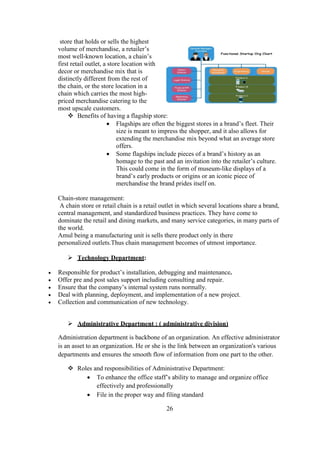
  • 42.
  • 43.
    KEY SUCCESS FACTORS: Criticalsuccess factor is a management term for an element that is necessary for an organization or project to achieve its mission. Alternative terms are key result area and key success factor. A CSF is a critical factor or activity required for ensuring the success of a company or an organization. Key success factors of Amul are: 1) Developing a new product while maintaining the high quality of existing products. 2) Find and retain high-value customers. 3) Create and maintain highest level of customer satisfaction. 4) Sell each unit at a profit. 5) Focus on service. 6) Consistency in the market. 7) Quality product and service. 8) Assembling the right team. 9) Developing action habit. 10) Visualize your success. 32
  • 44.
  • 45.
    Introduction to ExternalFactors: If a business wants to be successful and sustain, it is necessary for them to fully understand what factors exert impact on the development of their company. Once they know the positive and negative effects within and outside the company, they can produce suitable strategies to handle any situation. External elements are affecting factors present outside and not under control of the company. Considering the outside environment, allows businessmen to make suitable adjustment to make it more adaptable to the external environment. There are numerous criteria considered as external elements. Among them some of the most important factors need to be listed are political, social, economical, technological factors. It is common for the manager to assess each of these factors closely. The aim is to always take better decision for the firm’s progress.  Political: Political environment is the state and central government and its institute and legislations and the public and private stakeholders who operate and interact with or influence the system. Government’s actions affect the operation of a company or business. These actions may be at local, regional, national or international levels. Business owner and managers pay close attention to the political environment to gauge now government actions will affect their company.  Ways in which Amul deals with the political factors: 1) Increase and decrease in tax could be example. Government might increase taxes for some companies and lower it for others. The decision will have a direct effect on your business .So we stay up-to-date about such government interventions. 2) The political environment is perhaps among the least predictable elements in the business environment. A cyclical political environment develops, as demographic governments have to pursue re-election every few years. It leads to change in government policies thus we try to be updated with it. We always take up a Nobel cause of helping the people in need and further developing a good interactive relation with them. 3) As political systems in different areas vary, the political impact differs. There will be one party winning in an area where as different party winning in an another area rules and regulation made by them will further effect the business thus we need to take decision accordingly. 4) Corruption is a barrier to economic development for India. We are based in Pune only but it does affect us a lot. Some firms survive and grow by offering bribes to the government officials. The success and growth of these companies are not based on the value they offer the consumers. 33
  • 46.
    Thus, we workaccordingly. 5) As we are a manufacturing unit, there are various other political factors also that affect our business. Employment law, discrimination law, health and safety law, tax policies, government involvement in trade unions and agreements, import restrictions on quality and quantity of the product, intellectual property law (copyright, patents, trademark), law regulating environment pollution. Our finance team stays in contact with the lawyer and chartered accountant on week to week basis, so that we don’t miss any updates. 6) Buying political risk insurance is a way to manage political risk and is a powerful way to mitigate political risk. Companies that have international operations use such insurance to reduce their risk exposure. There are some indices that give an idea of the risk exposure in certain countries. 7) We always look out for the involvement in financial subsidiaries with the help of local firms, trade unions, financial institutions, and government. As partners in local business, these groups ensure that political development do not disturb operations. Localization entails modifying operations, product mix, or such activities suit the local taste and culture. 8) Influencing local politics through lobbying is another way of managing political risks. Lobbying is the policy of hiring people to represent a firm’s business interests also its views on local political matters. Lobbyists meet with local public officials and try to influence their positions on issues relevant to the firm. Our ultimate goal is getting favorable legislation passed and unfavorable ones rejected.  Social: Social factors are the things that affect lifestyle, such as religion, family, or wealth. These can change over time. Food developers need to be aware of these changes to make food that meet the needs of consumers. There is no doubt that the society is continually changing. The tastes and fashions are a great example in change. Social media sites like Facebook have become very popular among the younger people. The young consumers have grown used to mobile phones and computers. The young generation prefers to use digital technology to shop online. Due to which their likes, tastes, preferences keep on changing due to the level of exposure. It includes belief systems and practices customs, traditions and behaviors of all people in given country, fashion trends and market activities influencing actions and decisions.  Ways in which we handle social factors: 1) People nowadays are much concerned about their health; we make sure that our product does not their health. 34
  • 47.
    2) Customs andtraditions further help us target the customers easily by providing them a good quantity and quality at a reasonable price. 3) We usually provide subscription plans for average family size by which we are able to target ¾ of the population. 4) Milk and milk products are staple sources of protein in diet both in urban as well as n rural India which makes its consumption level high. 5) At festive season, we always try to be creative with the packaging of our products which creates a psychological impact on our customers. 6) Almost everyone in the world seeks respect. Thus we make sure that whenever we have an interaction with them, we treat them with respect. 7) Whenever our salesman or company representative sells the product, we provide them all the durability details about it 8) Our products usually are necessity goods thus social factor don’t affect the purchase of it to a large extend.  Economic: Economic factors are connected with goods, services, and money. Despite directly affecting businesses, these variables refer to financial states of the economy on the greater level whether local or global. The reason for this is that, the state of the economy cab be decide many of the important details that come up in the operation company, including topics such as consumer demand, taxes and assets value.  Ways in which we manage economic factors: 1) Interest rates might appear in a range of difference places, imposed in the range of different people. Its obvious that the status of interest charge is greater to the banking institutions. Those we do our financial planning accordingly. 2) Exchange rates are of major importance, but they clearly have to apply to those who deal with import and export. Changing exchange rates might affect how much a company has to pay to its international suppliers to satisfy them, which can affect profit margin, as well as take a lot of resources to stay on top of. Our financial team at a prior only before taking a decision does all the risk factor analysis for future precautions. 35
  • 48.
    3) An economicrecession (of whatever scale) has the potential to change the purchasing attitude of customers, which might force companies to drop their prices or clear smaller volumes. As we deal with durable goods we usually don’t keep a stock of our product. We produce according to the requirement only. 4) The rise in global development and worldwide increase in GDP (gross domestic product) means that their target market is gradually growing. We are planning future strategies accordingly. 5) On the other hand, this global development might increase labor and material costs in under developed economy where the products are manufactured at a low cost. Our cost accountant work accordingly taking all the factors into consideration.  Technological: Technology trends affect businesses on many levels. When an employee is efficient, he turns out to be productive. Additionally, when a business is more in touch with its present and potential customers, the more chance it has to build a strong customer loyalty base Advancement of technology can make this possible. Strategic leaders are constantly looking for development and updates within the technological environment. In this way, they not only improve their operations but, they will also be well aware of business transformational phase. They will derive groundbreaking strategies to grow exponentially. The technological environment of business has changed the way in which businesses function. Advancements in information technology have almost taken over organization. Now, information is stored in data servers and cloud technology as against the old way of storing data in registers and files.  Ways in which we deal with technological factors: 1) Trust is on research and development for better procurement and storage. It’s always an ongoing process. 2) Recently every industry has started using RFID (radio frequency identification ) technology to track movement of milk van. 3) Dairy product based company are also focusing on the adoption and implementation of SAP and ERP across their organization to achieve better supply chain management. 4) Recently there is a solar plant installation done by our factory which further is using of non renewable resources sunlight and is further cost affective also. 36
  • 49.
    5) We haveappointed a digital marketing team in order to take care of our online presence and activity. CONCLUSION: In conclusion, there is a bunch of contribution factors in the success of the company which comes from both outside and inside a business. Both are of utmost importance for the development of the company. If a business hopes to perform smoothly and successfully, they need to take all these elements into consideration before making any decision. Values: In ethics, value denotes the degree of importance of some thing or action, with the aim of determining what actions are best to do or what way is best to live, or to describe the significance of different actions. 1. A problem solver -Building a great company is about solving one problem after the next. If you can surround yourself with people that are excited to hop from one problem to problem you will achieve great things. 2. Ambitious – We always felt that there are three types of people: people who want things to happen, people who watch things to happen and people who make things happen. We have found that ambition can be a really powerful value if it leads to people being the change they want to see in the world. 3. Transparent- There is too much at stake for a company to fall into a trap of passive- aggressive behavior. Over the years I have found that if people are honest, open and direct in all conversations you save a lot of time. 37
  • 50.
    4. Empathetic- Thisis probably one of my favorite personal and professional values. Empathy is not something everyone possesses and for those who do, it is a gift. The ability to understand the challenges that others deal with, what they care about and how you can help them thrive to hit their goals and maximize their potential is a character trait I look for in every hire I make. 5. Adaptable- For us adaptability means one thing: How well does a person handle ambiguity? We read somewhere once “to improve is to change; to be perfect is to change often.” While perfection is never possible, how well we adapt to change will determine how durable our success will be. In a world of ambiguity those who can roll with the change and still perform are prime time players you want on the team. 6. Accountable- The obligation of an individual to account for his of her activities, accept responsibility for them and to disclose their results in a transparent manner. Vision: A vision statement is a declaration of an organization's objectives, intended to guide its internal decision-making. A vision statement is not limited to business organizations and may also be used by non-profit or governmental entities. Provide our customers with the cleanest and healthiest milk, for which the focus on nutrition starts from the animals themselves, thus leading to more nutritional milk and milk products. Mission: A sentence describing a company's function, markets and competitive advantages; a short written statement of your business goals and philosophies. A mission statement defines what an organization is, why it exists, it’s reason for being. Understanding customer needs and protecting their interests to build lifelong relationships and brand loyalty. Strategic objectives: A goal is a broad primary outcome. A strategy is the approach you take to achieve a goal. An objective is a measurable step you take to achieve a strategy. A tactic is a tool you use in pursuing an objective associated with a strategy. Strategic objectives taken by Amul: 1) Selling the goods at a minimum cost so that demand of the product increases. 2) Concentrating more on customer satisfaction. 3) Developing customer loyalty programs. 4) Maintain the quantity and quality of the product. 38
  • 51.
    Actions & KPI’s: Actionsare mostly the process or the steps in which the operation of the organization are carried. Key performance indicators: Refers to the values used to assess a business ‘success in reaching its goals. In the long run, tracking relevant KPIs can help you make important decisions about our company’s growth and development: 1) Cash flow forecast: Cash flow forecasts let our businesses assess whether their sales and margins are appropriate, and are consequently one of the most important KPIs for small businesses to track. To make our cash flow forecast, add the total cash our business has in savings to the projected cash value for the next four weeks, then subtract the projected cash out for the next four weeks. 2) Gross profit margin as a percentage of sales: No business can achieve success if it’s paying out more to suppliers than it’s netting in sales each month from customers. Gross profit margin as a percentage of sales is an expression of total profits as they compare to revenue. The benefit of tracking this KPI over time is that you can easily quantify how much money you’re keeping against the amount paid out to suppliers. As businesses retain more money, gross profit margin increases. But a decrease in gross margin as a percentage of sales could indicate that a business is overspending on its supplies. Owners would need to reduce overhead costs or increase prices on goods and services to compensate. 3) Funnel drop-off rate: Our funnel drop-off rate assesses the number of visitors who abandon a conversion process—or sales funnel—prior to completion. To calculate funnel drop-off, start by finding the number of visits of a particular conversion step, and then subtract the number of visits of the first step. Divide the new value by visits of the first conversion step. By identifying when prospective buyers abandon the conversion process, companies can identify problems and make necessary adjustments to boost sales. With so many small businesses relying on the internet as a sales tool, funnel drop-off rate has become one of the most crucial performance indicators to track. 39
  • 52.
    4) Revenue growthrate: The revenue growth refers to the rate at which a company’s income, or sales growth, is increasing. To find revenue growth rate, begin with our business’ total revenue for the current year. Next, divide current revenue by total revenue from the previous year to find the rate of growth. By calculating revenue growth rate regularly, you can assess whether growth is increasing, decreasing.Use it to make any necessary changes to stay profitable. 5) Inventory turnover: It measures the number of times inventory is sold or used in a given period of time, and is valuable because it reveals a business’ ability to move goods. Inventory turnover can be found by adding up the cost of sold inventory, then dividing that total by the value of the remaining at year’s end. Calculating your inventory turnover ratio can help you measure and plan for adjustments in inventory as needed. 6) Accounts payable turnover: A business can’t keep its door open for long if it fails to pay suppliers. Accounts payable turnover is a measure of the rate at which our business pays for goods and services, revealing the amount of cash spent on suppliers in a given period. To find accounts payable turnover, add up the cost of total supplier purchases and divide by average accounts payable. Once we know how much you spend on suppliers, we can determine if steps need to be taken to reduce spending, which should boost long-term profits for your business. 40
  • 53.
  • 54.
    FINANCIAL STRATEGIES Financial strategiesinvolve studying the market, collecting, data, forecasting cash flow and implementing a strategy to meet your objectives. The financial section further includes the income statement, cash flow statement and balance sheet which are used to an analysis and make further decisions. There are various different types of financial plans which we draft to achieve the goals of the firm. 1) Cash flow planning : We as a company forecast your short term and long term expenses against the projected cash flow. But there are times when emergency expenses or unexpected expenses occurred. Thus we always plan our cash flow appropriately. Incorrect cash flow planning can lead to bankruptcy. 2) Investment planning: At times we are fortunate enough to have money left over after paying the costs of production and distribution, so we in order to expand our business make that extra money go to work by investing it to earn a financial return. (such as real estate, or reinvesting the same amount in our own business) Investment planning involves deciding how best to put your money your capital to work to achieve your financial goals. We mostly take advices of our financial department and go forward with it. 3) Insurance planning: Insurance is a means of protection from financial loss. It is a form of risk management, primarily used to hedge against the risk of a contingent or uncertain loss. We usually take out insurance cover to protect assets and stocks and to provide financial help if they are facing legal issues. Thus in order to protect our company we take help of the following insurance:  General Liability Insurance: Every business, even if home-based, needs to have liability insurance. The policy provides us both defense and damages if our employees, our products or services cause or are alleged to have caused Bodily Injury or Property Damage to a third party. Further helping the company to compensate with the incurred loss easily.  Property Insurance: being a manufacturing firm we own your building have including office equipment, computers, inventory or tools. Thus, we consider purchasing a policy that will protect you if you have a fire, vandalism, theft, smoke damage etc. Thus helping the business’ loss of earning insurance as part of the policy to protect your earnings if the business is unable to operate. 41
  • 55.
     Business owner’spolicy (BOP): A business owner policy packages all required coverage a business owner would need. Often, BOP’s will include business interruption insurance, property insurance, vehicle coverage, liability insurance, and crime insurance . Based on our company’s specific needs, you we alter what is included in a BOP. Typically, a business owner will save money by choosing a BOP because the bundle of services often costs less than the total cost of all the individual coverage’s. As this firm is not solely own by a single person this helps in case a separation, solvency or death of an owner.  Worker’s Compensation: As our workers are the assets of the organization. Everyone working with us gets a Worker’s compensation insurance. Helping employees who are injured on the job. This type of insurance provides wage replacement and medical benefits to those who are injured while working. In exchange for these benefits, the employee gives up his rights to sue his employer for the incident. As a business owner, it is very important to have worker’s compensation insurance because it protects ourself and our company from legal complications. State laws will vary, but all require you to have workers compensation if you have employees working with us. 4) Tax planning: The tax requirements mostly depend on our legal structure of our organisation. We usually utilize book-keeping software and consult with a finance department about our central and state tax obligations. 5) Defining your short term and long term goals: It is important for us to distinguish between short term and long term goals. Short term goal are goals we want to achieve in the near future can means today, tomorrow, in a week, this month or even this year. Whereas long term goals are goals we want to achieve 5 years down the line. We always work keeping the future in plans. In order to achieve a goal we usually follow certain steps such as:  Identifying a realistic goal.  Determining the steps to achieve it.  Estimating how long you expect each step to take.  Then distribute the task amongst our team made.  Supervising is the work properly.  Execution of the plan.  Learning for the drawback of the plan. 42
  • 56.
    6) Establishing asuccession plans: We always work in accordance with a succession plan which will enable a smooth transition in leadership and address many tax and financial matters. Like if the owner sons or daughter comes into picture the rules and regulation they should work upon are prior decided by the firm.+ The financial strategies used by Amul for their day to day operation: 1) We usually spend less then we earn to avoid excessive debt: we always find ways in which our product cost could be reduced maintaining the quantity and quality of the product in mind. Further we don’t exceed our debts making best use of our capital to its optimum level. 2) Being future minded: Research indicates that, at every income level, people who are “planners” are more successful financially and feel better about their financial situation than those who do not plan ahead. Planners also experience less financial stress because the act of planning provides an increased sense of control. Planning for the future includes calculating the savings required to achieve future financial goals and addressing potential future challenges such as the cost of long-term care and estate planning. Thus we work in our present keeping our future in mind. 3) Co-Marketing as a Strategy – We work on a assume that we need money to launch a strong sales and marketing campaign to grow the company quickly but organically (i.e., from your own sales).We have to look for a marketing partner to co-market with. For example, if we are a company that provides software to a particular industry, we could partner with a consulting firm that specializes in doing software implementations in that same industry. That firm could help market and sell your software as part of its overall industry “solution." Thus, at time we use collaboration strategies in order to capture the market share. 4) Equity Investment as a Strategy: If we have created a product or service that will likely lead the company to explosive growth and we need funding to hire the personnel and install the necessary infrastructure, then raising equity capital would be the best financing strategy to use. For example, Craigslist needed capital to grow but wanted to maintain greater autonomy. It ultimately shunned the venture capitalists and obtained a sizable investment from eBay. 43

  • 57.
    5) Debt asa Strategy: If we as company generates high cash flow or you estimate that it will when a new product or service is finalized, a bank or similar loan help us with a good financing strategy. Our business then repay the loan with the cash flow. For example, a retailer with strong profit margins needs cash to purchase larger quantities of fast-selling inventory. The retailer could pursue a line of credit that would be repaid as the inventory sold. Conclusion: Financial planning helps in eliminating the possibility to loss an used all the resources available to it optimum level keeping the short term and long term goals in mind. 44
  • 58.
  • 59.
    HUMAN RESOURCES STRATEGY HumanResource Strategy (HR Strategy) is a designation for a long-term plan created to achieve objectives in the field of human resource and human capital management and development in the organization. Human Resource strategy is one of the outputs of strategic management in the field of human resources management. In our company personnel administrative department takes care for human resource management of our company. Further helping the organization to helps to unify and direct the behavior and actions of all people and their overall development in accordance with the needs of the organization. It allows a meaningful planning and management of all work with human resources Where is human resources management strategies used in a organization: 1) Defines processes, responsibilities and requirements on recruitment and staff selection. 2) Defines requirements on staff training and qualification development. 3) Defines the way of management of work performance, motivating and rewarding people, social programs and employee benefits. 4) Defines working conditions, labor relations and influences the way of organizing. 5) It also includes specific goals in human resources and a schedule for implementation - through projects or other actions and tasks. We as a company work on human resource 3 pillars in order to carry out the day to day operation smoothly and effectively. 1) Legal Requirements: We while on boarding an employee, it’s important that we follow and fulfill all legal requirements to ensure that you protect the business and the employee. For instance, every full-time employee should fill out an IRS (Indian revenue service’s W-4 form and I-9 form. Another important legal requirement is workers compensation. The W-4 is used by our employer to determine how much income tax to withhold based on their marital status and the number of withholding allowances they claim. There is an allowance worksheet that help them to calculate the number of allowances. Generally, there claim allowances for themselves, their spouse if they’re filing jointly, and children under 17 for whom you can claim the child tax credit. There are additional withholding allowances that are related to credits and deductions. 45
  • 60.
    2) Maintaining aImage: Maintaining a strong, positive corporate image is important, helping us attract top talent to a growing team. The HR department plays a critical role in upholding an organization’s image by analyzing the following:  Is the branding revolves around innovation, does our company culture reflect that?  Are our branding campaigns focused on technology—and does our staff have access to the newest and latest equipment?  How is our company reflected on social media, both formally through company channels and informally through individual employees?” After analyzing above cases a concise report is given by hr department to the head for further decision making. 3) Employee Engagement: Employee engagement is critical to a company’s success. After all, an engaged employee is a productive one. To increase employee engagement, we try our best to bring the following into your culture and HR processes:  Gamification : In human resource management Gamification is the usage of game-thinking and game mechanics in non-game scenarios such as business environment and processes, specifically in recruitment, training and development, and motivation; in order to engage users and solve problems. Incorporate gamification into employee activities, are achievement-tracking and peer competition.  Incentives: Financial and non-financial incentives, such as rewards and recognition, give employees something to work toward. In addition, they reinforce attitudes and behaviors that will help the organization succeed. We make the process of tracking these incentives, and the milestones that designate them, with an employee recognition and engagement platform such as Achievers. Further motivating them to give their best in whatever they do.  Employee Surveys: We Conduct surveys on a regular basis to let employees know that their voice is being heard and valued 46
  • 61.
     Career AdvancementPrograms: We considered our organization’s biggest and most precious investment is our employees. A career advancement program helps sustain employee engagement, as employees are given the opportunity to progress both personally and professionally. It does included cost for the organization at an initial stage. But it ends up contributing more to the organization. To achieve the maximum level of profitability and success, an human Resource department has to align each employee’s work with the strategic goals of the firm and also ensure that the staff is well aware of the required actions and behaviors by setting clear-cut performance expectations in job descriptions. Further explaining the human resource management strategies used by Amul for their day to day operation are as follows: 1) Develop a Competency Model: The main objective of human resource department is to hire the right people for the right jobs keeping in mind their skills, expertise, and education. This objective is achieved in our company by setting clear job descriptions, establishing job competency models for each department in our company and benchmarking roles against similar jobs in the industry. In order to ensure smooth running of the business, HR department takes into account studies and data related to staffing, transactions, and costs and then create a competency model accordingly. So that the result can be achieve the results accordingly. 2) Define Organizational Dimensions: HR strategies are developed according to the aspects of the organization. It is also interesting to note that the prevailing culture of the company not only has a critical impact on the HR strategies devised but also represents the management style and values of the organization. Defining the organizational dimensions will give you an idea on how the organization is going to be more or less – will it be an organization that expects employees to ‘do more with less’ or will it be overstaffed in order to give way to innovation and experimentation? Some other key factors that directly impact the HR strategies devised are the nature of business done by the organization, the chain of command and the structure of the organization itself. In order to effectively hire and retain staff to achieve strategic goals of the organization, human resources systems, policies, and practices are also taken into account. 47
  • 62.
    3) Define Roleof Mission, Vision, and Values: The mission, vision and values of the small business or startup play a crucial role in shaping the HR strategies and objectives for the future ahead. The mission of the organization will help you understand why the business exists and who it serves while the vision statement basically provides insights on what the organization hopes to achieve and where it sees itself in the future. The values of the organization are beliefs that serve as a driving force behind the operations and actions of the organization. All three – the mission, vision and values of the organization directly impact the type and number of employees needed to meet the organizational goals. 4) Perform Workforce Analysis: A workforce analysis is considered a key part of the human resource strategy and focuses mainly on the organization, its culture, people, and the systems that have been implemented. Doing a workforce analysis is helpful in analyzing the current situation of the company in terms of the elements discussed above and where they ideally want to be in the years to come. Identifying the gaps in these areas will enable the HR professionals to come up with specific objectives designed especially to bridge these gaps. 5) Evaluate Implemented Strategy: All HR strategies are guided by evaluation based on specific, measurable factors. A small business or startup will consider a wide variety of factors for developing, implementing and evaluating the effectiveness and performance of its HR strategy. Usually, doing an evaluation will give you accurate facts and figures on employee turnover, number of vacant positions, customer complaints, and employee grievances along with the satisfaction and dissatisfaction levels of both customers and employees. BUILDING HUMAN RESOURCE STRATEGIES FOR SMALL AND MEDIUM ENTERPRISES In order to build a solid HR strategy for small and medium enterprises, you should follow these three steps. 48
  • 63.
  • 64.
    OPERATIONAL STRATEGY Operational strategiesrefers to the methods companies use to reach their objectives. By developing operational strategies, a company can examine and implement effective and efficient systems for using resources, personnel and the work process. Service-oriented companies also use basic operational strategies to link long- and short-term corporate decisions and create an effective management team.  Operational Strategy used by Amul for day to day operation of the organization: So divide the operating section of the business plan into two parts, starting with the Stage of Development section.  Stage of Development Section: When we're writing this section of the operations plan, start by explaining what we've done "to date" to get the business operational, followed by an explanation of what still needs to be done. The following are taken into consideration by us:  Production Workflow - A high-level, step-by-step description of how your product or service will be made, identifying the problems that may occur in the production process. Follow this with a subsection titled "Risks" that outlines the potential problems that may interfere with the production process and what you're going to do to negate these risks. If any part of the production process can expose employees to hazards describe how employees will be properly trained in dealing with safety issues. If hazardous materials will be used described how these will be safely stored, handled, and disposed of.  Industry Association Memberships – we show our awareness of our industry's local, regional, or national standards and regulations by telling which industry organizations we are already a member of and/or which organizations we are planning to join and telling what steps we've to take to comply with the laws and regulations that apply to your industry.  Supply Chains - An explanation who our suppliers are and their prices, terms, and conditions. Describing what alternative arrangements we have made or will make if these suppliers let you down. 49
  • 65.
     Quality Control- An explanation of the quality control measures that we've set up or are going to establish. For example, if we intend to pursue some form of quality control certification such as ISO 9000, describing how we will accomplish this.  Production Process Section – While we can think of the Stage of Development part of the operations plan as an overview, the Production Process section lays out the details of our business’s day to day operations. We remember our goal of writing this section of the business plan is to demonstrate your understanding of the manufacturing or delivery process for your product or service, so you need to let the readers of your business plan know that. We make sure that we include all these details of our business’s operation:  General: We do an outline of our business’s day to day operations, such as the hours of operation, and the days the business will be open.  The physical plant: What type of premises are they and what are the size and location? If it’s applicable, include drawings of the building, copies of lease agreements, and/or recent real estate appraisals. We need to show how much the land or buildings required for our business operations are worth and tell why they’re important to our proposed business.  Equipment: The same goes for equipment. Besides describing the equipment necessary and how much of it we need, we also need to include its worth and cost and explain any financing arrangements.  Assets: We make a list of our assets, such as land, buildings, inventory, furniture, equipment, and vehicles. Include legal descriptions and the worth of each asset.  Special requirements: If our business has any special requirements, such as water or power needs, ventilation, drainage. We provide the details in our operating plan, as well as what you’ve done to secure the necessary permissions, such as zoning approvals.  Materials: we note down form where we ‘re going to get the materials we need to produce our product or service and explain what terms we’ve to negotiated with suppliers.  Production: We explain how long it takes to produce a unit and when will we be able to start producing your product or service. Include factors that may affect the time frame of production and how will we deal with potential problems such as rush orders.  Inventory: Explain how we will keep track of inventory.  Feasibility: Describe any product testing, price testing, or prototype testing that we’ve done on your product or service. 50
  • 66.
  • 67.
    MARKETING STRATEGY A marketingdepartment promotes our business and drives sales of its products or services. It provides the necessary research to identify your target customers and other audiences. Depending on the company's hierarchical organization, a marketing director, manager or vice president of marketing might be at the helm. A marketing strategy is a process that can allow an organization to concentrate its limited resources on the greatest opportunities to increase sales and achieve a sustainable competitive advantage. A marketing strategy should be centered around the key concept that customer satisfaction is the main goal. Marketing strategies used by Amul till date in order to capture the market share for further operation:  Signage: Thriving in The Digital Age. Signage materials comprise digital photos framed and lighted in the dark. Digital signage has moved on from boring walls to mobile taxis, reaching a wider audience than ever before. Adorning buildings, shop-fronts, and malls, signage is turning out to be more than old wine in a new bottle.  Billboards: Fitting The Bill: Billboards using printed or hand-painted images on canvas are still very commonly in use. From highways to hallways, billboards have come a long way. This traditional marketing mode uses less text and more images. A picture is worth a thousand words and compelling images are great for raising brand awareness. This is a marketing method most are familiar with. Larger signs will never be overlooked and billboards cannot go obsolete, given their wide reach across social classes and geographical boundaries.  Direct Mail: Moving Past Email Marketing: Direct mail is making a real comeback. Once upon a time, people would tag it as snail mail and shrink away. But now, direct mail scores on creativity, personalizing and targeting a particular audience. Direct mail is not just easier to understand, it also has a greater power to influence readers. Brand recall is way higher in research studies where direct mail was compared to other marketing methods like email. Faster response rates, more purchases and greater ease of retrieval make good old-fashioned direct mail the real deal in new-age marketing.  Flyers and Brochures: The Power of Hand-outs: Brick and mortar establishments, streets, or malls are just some of the places where flyers and brochures can come in handy. These are still the most widely preferred methods for special discounts and offers. Consider the value of business cards that directly introduce a business to the client. Traditional marketing that is face-to-face is way more connective and interactive. 51
  • 68.
     Face toFace Interaction: Why Reality Beats Virtual Marketing Traditional marketing has been around for ages. People are used to it. Traditional methods from signage to networking at events, cold calls and referrals harness the power of human interaction. This really works well, to close a sale. Tangible, physical canvas, paper, and traditional marketing mediums evoke a sensation and a lasting memory. These are also easier to retrieve than logging onto a visual storefront or a digital calling card online.  Print Ads: Harnessing Word Power: Print is not dying; it is merely evolving. Mobile penetration has only made print media more distinctive. Newspapers and magazines are visible on digital mediums and the Smartphone could well be a boon for print ads.  Telemarketing: Cold Calling Is the Right Number to Dial. Outbound and inbound telemarketing still rules the marketing industry. Marketing Profs, for instance, listed this has the most critical B2B lead generation strategy which even beats CRM systems hollow. Focus on core operations by opting for world-class call answering services.  Salespeople: The Catalyst in the Marketing Process Though it is true that over 70 percent of the buyer’s journey is complete before salespeople come into contact with the customer, marketing is an art which requires training and experience. That is why Online Marketing Institute and such top institutions are needed to hone skills. Customer care can also play a vital role in converting prospects to solid customers or even help in client retention, courtesy cancellation teams that persuade you to stay with the brand.  Final Word: The core value a sale generates is a superlative product or service. Just as no amount of good marketing can sell a bad product, the reverse holds true as well. Marketing is an art that derives its value from traditional techniques because this is the way it has always been done. 52
  • 69.
  • 70.
    MANAGEMENT INFORMATION SYSTEMSSTRATEGIES A marketing information system is a management information system designed to support marketing decision making. Jobber defines it as a "system in which marketing data is formally gathered, stored, analyzed and distributed to managers in accordance with their informational needs on a regular basis. Work of management information system:  An understanding of the different roles managers play and how marketing information systems can support them in these roles.  An appreciation of the different types and levels of marketing decision making.  Knowledge of the major components of a marketing information system.  An awareness of the often under-utilized internal sources of information available to enterprises.  An ability to clearly distinguish between marketing research and marketing intelligence. An understanding of the nature of analytical models within marketing information system. Strategies used by human information department are as follows: Information systems that claim to support managers cannot be built unless one understands what managers do and how they do it. The classical model identifies the following 5 functions as the parameters of what managers do: 2) Planning 3) Organizing 4) Coordinating 5) Deciding 6) Controlling Such a planning emphasizes what managers do, but not how they do it, or why. More recently, the stress has been placed upon the behavioral aspects of management decision making. Behavioral part are based on empirical evidence showing that managers are less systematic, less reflective, more reactive and less well organised than the previous projects managers to be. For instance, behavioral part describes 6 managerial characteristics:  High volume, high speed work 53
  • 71.
     Variety, fragmentation,brevity  Issue preference current, ad hoc, specific  Complex web of interactions, contacts  Strong preference for verbal media. Such behavioral part stresses that managers work at an unrelenting pace and at a high level of intensity. The nature of the pressures may be different but there is no evidence that they are any less intense. The model also emphasizes that the activities of managers is characterized by variety, fragmentation and brevity. There is simply not enough time for managers to get deeply involved in a wide range of issues. The attention of manager increases rapidly from one issue to another, with very little pattern. A problem occurs and all other matters must be dropped until it is solved. Research suggests that a manager's day is characterized by a large number of tasks with only small periods of time devoted to each individual task. Managerial Roles Mintberg suggests that managerial activities fall into 3 categories: interpersonal, information processing and decision making. An important interpersonal role is that of figurehead for the organization. Second, a manager acts as a leader, attempting to motivate subordinates. Lastly, managers act as a liaison between various levels of the organization and, within each level, among levels of the management team. A second set of managerial roles, termed as informational roles, can be identified. Managers act as the nerve centre for the organization, receiving the latest, most concrete, most up-to-date information and redistributing it to those who need to know. Managers act as entrepreneurs by initiating new kinds of activities; they handle disturbances arising in the organization; they allocate resources where they are needed in the organization; and they mediate between groups in conflict within the organization. In the area of interpersonal roles, information systems are extremely limited and make only indirect contributions, acting largely as a communications aid in some of the newer office automation and communication-oriented applications. These systems make a much larger contribution in the field of informational roles; large-scale MIS systems, office systems, and professional work stations that can enhance a manager's presentation of information are significant. In the area of decision making, only recently have decision support systems and microcomputer-based systems begun to make important contributions. 54
  • 72.
    While information systemshave made great contributions to organisations, until recently these contributions have been confined to narrow, transaction processing areas. Much work needs to be done in broadening the impact of systems on professional and managerial life. Decision Making: Decision making is often seen as the centre of what managers do, something that engages most of a manager’s time. It is one of the areas that information systems have sought most of all to affect (with mixed success). Decision making can be divided into 3 types: strategic, management control and operations control.  Strategic decision making: This level of decision making is concerned with deciding on the objectives, resources and policies of the organization. A major problem at this level of decision making is predicting the future of the organization and its environment, and matching the characteristics of the organization to the environment. This process generally involves a small group of high-level managers who deal with very complex, non-routine problems.  Management control decisions: Such decisions are concerned with how efficiently and effectively resources are utilized and how well operational units are performing. Management control involves close interaction with those who are carrying out the tasks of the organization; it takes place within the context of broad policies and objectives set out by strategic planners. An example might be where a transporter of agricultural products observes that his/her profits are declining due to a decline in the capacity utilization of his/her two trucks. The manager (in this case the owner) has to decide between several alternative courses of action, including: selling of trucks, increasing promotional activity in an attempt to sell the spare carrying capacity, increasing unit carrying charges to cover the deficit, or seeking to switch to carrying products. 55
  • 73.
  • 74.
    SWOT analysis isa strategic planning technique used to help a person or organization identify strengths, weaknesses, opportunities, and threats related to business competition or project planning. Strengths analysis: Strengths: Strengths describe what an organization excels at and separates it from the competition: a strong brand, loyal customer base, a strong balance sheet, unique technology and so on. For example, a hedge fund may have developed a proprietary trading strategy that returns market-beating results. It must then decide how to use those results to attract new investors. 1. What advantages does your organization have?  An advantage of locally known in the market. 2. What do you do better than anyone else?  Quality and quantity maintains  Provide replace to our customers since case of a bas experience of the product.  Delivery fresh and recently manufactured goods 3. What unique or lowest-cost resources can you draw upon that others can't?  We sell the product keeping the minimum margin on the product so that we can increase the turnover of our organization. 4. What do people in your market see as your strengths?  We have never cheated them or missed our goodwill of the brand. 5. What factors mean that you "get the sale"?  Our products quality and quantity speak for its own. Once the customer experiences our product they will definitely vouch for our product again and again. 6. What is your organization's Unique Selling Proposition (USP)?  We sell keep the minimal profit margin.  With a strategy to reduced to overall market price of the product as sold by our competitors. 7. Do consider your strengths from both an internal perspective, and from the point of view of your customers and people in your market. Yes we do consider we are assured them that consuming our product will never harm them or their health. There health is our at most priority. 56
  • 75.
    Weaknesses: Weaknesses stop anorganization from performing at its optimum level. They are areas where the business needs to improve to remain competitive: higher-than-industry-average turnover, high levels of debt, an inadequate supply chain or lack of capital. 1. What could you improve?  Developing a inventory system which will help in further strategy making. 2. What should you avoid?  Assessing all the factor when it comes expanding our franchises 3. What are people in your market likely to see as weaknesses?  What factors lose you sales? 4. Again, consider this from an internal and external perspective: do other people seem to perceive weaknesses that you don't see? Are your competitors doing any better than you?  No its not that other people seem to perceive weaknesses that you don't see. We know where we lack we are trying our best to overcome it. Opportunities: Opportunities refer to favorable external factors that an organization can use to give it a competitive advantage. For example, a car manufacturer can export its cars into a new market, increasing sales and market share, if a country cuts tariffs. Opportunities refer to favorable external factors that an organization can use to give it a competitive advantage. For example, a car manufacturer can export its cars into a new market, increasing sales and market share, if a country cuts tariffs. 1. What good opportunities can you spot?  Proper inventory management will help us identifying various things. Further we can develop strategies with it.  Moreover we can develop us business online which will be beneficial for the organization in the long run. 2. What interesting trends are you aware of?  People now days spend less on sweets where are they are very interested in dairy and bakery products we are working towards developing our marketing share in it also. 57
  • 76.
    3. Useful opportunitiescan come from such things as:  Yes totally agreed. 4. Changes in technology and markets on both a broad and narrow scale.  We are working on digital marketing side by side on traditional marketing also to create our brand awareness. 5. Changes in government policy related to your field;  We are do keep a watch on government changing policies very now and then so that we don’t miss out on anything. 6. Changes in social patterns, population profiles, lifestyle changes, and so on.  We its does effect us business but we usually work after taking various factor into consideration. Threats: Threats refer to factors that have the potential to harm an organization. For example, a drought is a threat to a wheat-producing company, as it may destroy or reduce the crop yield. Other common threats include things like rising costs for inputs, increasing competition, tight labor supply and so on. 1. What obstacles do you face?  Lack of inventory management. 2. What are your competitors doing?  Able to maintain there franchise properly having the same input and output. 3. Are quality standards or specifications for your job, products or services changing?  No, we try our level best that our quality and quantity of the product paid by the customer is properly justified. 4. Is changing technology threatening your position?  No we are working on various digital marketing concepts which will show its results in future. 5. Do you have bad debt or cash-flow problems?  No we don’t any problem related to it our credit period is always pre informed to the parties and they work in accordance to that only. 6. Could any of your weaknesses seriously threaten your business?  We lack of inventory is and creating a threat to our organization but we are now working on it effectively. 58
  • 77.
    CHAPTER 16 DATA ANALYSIS& INTERPRETATION
  • 78.
    DATA ANALYSIS ANDINTERPRETATIONS After doing a detail study on all the factors of Amul I have come across certain setbacks of it which are as follows:  A lack of inventory balance makes product shortages and overstocking unavoidable. Valuable time and human capital is being spent completing tasks a system could manage. When you lack the fluidity an inventory management system, introduces your space becomes cluttered and difficult to effectively work in.  You’ll spend unnecessary amounts of money on items that will not profit your business.  Without access to real time information you won’t know how or where products move, so theft, obsolete items. Will make tracking inventory nearly impossible.  A lack of inventory balance makes product shortages and overstocking unavoidable.  Valuable time and human capital is being spent completing tasks a system could manage.  When you lack the fluidity an inventory management system, introduces your space becomes cluttered and difficult to effectively work in.  Without having the resources to analyze inventory trends, you will unknowingly make decisions that don’t provide the greatest return.  When employees are continuously completing tasks that could be quickly managed by a system they become inefficient in the workplace.  Difficulty in tracking inventory results in shipping and delivery delays caused by orders not being replenished on time or items being unavailable when they’re needed.  Difficulty in tracking inventory results in running out of stock when it is needed, causing you to increase lead time times, ultimately disappointing the customer.  The more energy customers use to make sure you’re filling their orders correctly, the more unsatisfied they become. Not being able to ship or deliver on time results in rocky relationships and decreases customer loyalty. 59
  • 79.
  • 80.
    LIMITATIONS OF THEPROJECT It is always better to identify and acknowledge shortcomings of your work, rather than to leave them pointed out to your by your dissertation assessor. While discussing your research limitations, don’t just provide the list and description of shortcomings of your work. It is also important for you to explain how these limitations have impacted your research findings. This report had to work under several constraints and limitation. Some of the key limitations are: 1) Time period of the project was approximately 67 days. 2) Moreover the research is on one to one interactions. 3) The psychology of a respondent plays a significant role. Some respondents are more sensitive as against others who are more tolerant. A change in the composition of the respondents can affect the answers adversely or favorably. 4) Out of the whole research and analysis, only major brands could be highlighted, leaving aside the other non-popular brands. 5) The study helps out in having retailers’ view, consumer quality service. 6) The project work done will definitely prove to be a helping hand for the firm well. 7) This provides suggestion to grow for the business as there is always a room for improvement in every business. 60
  • 81.
  • 82.
    FINDING AND SUGGESTIONS: Reportanalysis shows there is a lack of inventory system in the organization. For which I have analyses various software providing management services. It shows a comparative study for the same recommending the best for the organization. A) Gofrugal software I. Fast billing Shoppers (Uninterrupted fast billing)- Today look forward to a greater exit experience as much as the in-store experience. Unmatched billing speed aided with integration to all POS accessories. Advantages of fast billing shoppers:  Peak hour sales, festival season crowd needs no extra hands & efforts.  Mobile app SellSmart, can help you bill on the move Take payments with ease - cash, card, coupon, left voucher, part-cash, part-card payment & more.  Card swipe integration to bill faster Design and print barcode labels.  Print purchase price in barcode as alphanumeric. Issue quotation, Performa, follow-up & do more sales Exchange old for new, different prices for same item, customizable tax options i.e. TAX on MRP/Selling rate - predefine them or manage from bill screen also Dayone billing - bill instantly from the day installation is complete.  Billing will not stop even when main computer is down; uninterrupted 'Offline billing' provides peace of mind complete customer history in click of a button.  Surprise customers with instant free offers, item discounts with shortcuts keys in the billing screen itself II. Inventory- Stock what sells more, get notified on non-moving and expiry items and take corrective action, reorder basis smart recommendations to optimize stock and avoid shortage. Advantages of proper inventory management (Inventory Tracking Control)  Use the racks, shelves and the complete shop space to stock products that are fast moving & clear out the non-moving ones, wastage and release the blocked working capital Always be aware of accurate stock position - for all outlets & also individually.  Know truth about inventory from the software Follow the complete transaction history of any product; understand from which supplier it was purchased, at what rate and to whom it was sold at what rate.  Any product can be sold - in bulk, loose quantities, part of a packaged kit and more.  Manage different inventory and prices for them. 61
  • 83.
    Position and packageyour products based on customer needs and profit more. III. Cloud POS (SmartReports) Operate your business on cloud without installing a Point of sale software, keep your business market ready, have critical business reports delivered to you 24x7 with web based POS. Advantages of SmartReports:  Use reports and data to make informed decisions on business Shop information/Reports can be accessed from laptops and smartphones as well - WebReporter tool and WhatsNow mobile app come along as free add-on.  Sales for any period, sales-returns, product margins, pending quotations, sales-orders and deliveries, commission report, top customers and more.  Inventory analysis reports such as dead stock report, wastage, fast moving products, slow moving products, etc helps reordering to be profitable.  All reports can be given user access and privileges ensuring security of business information. IV. Integrations – POS Integrations Builds an easy & efficient system by extending it. 3rd party integrations like Accounts, Payments, Loyalty, Mall manager, Credit Card, E-commerce platforms and more. Advantages:  Helps in proper Accounting.  Helps in creating a Loyalty programs.  Helps in making Payment easily. V. CRM & Loyalty Profile customers.- Pull new and repeated customers. Understand customer preferences through purchase history and plan creative promotions. Reward loyal customers and increase sales. Advantages of CRM & Loyalty Profile customers:  Group customers, understand their purchase frequency and plan personalized offers.  Reward them with loyalty points for every purchase made Put creative ideas into practice Choose from over 70+ offers and promotion types and keep the store buzzing with excitement SMS birthday greetings and offers to customers and keep in regular touch with them. 62
  • 84.
     Release couponsand vouchers and get more customers even outside your catchment area.  Direct consistent traffic to the stores during non business/peak hours as well by configuring hourly offers, day wise offers. VI. Multi store management – It includes centralized monitoring of store-wise sales, purchase, inventory, profits & more. It takes action from anywhere with web access to all stores and feel confident and expand to more outlets. Advantages of multi store management: Bringing our outlets together Headquarter (HQ) business management retail POS solution is a web-based, easy-to-use software that allows to monitor branch-wise sales, purchase, Inventory, receivables and profits etc. from a central location. Completely scalable to meet the growing needs of the retailer, clear visibility & enhance control on outlet operations. B) Posist software: i) Customized Detailed Billing: Present detailed, itemized bills to your customers that ensure transparency in the bill. Keep records of all items sold, the rate of items, and other sales data needed with our POS software. ii) Cloud Telephony: In case the first line is busy, the call gets automatically transferred to the next available line, until the call is accepted. View the call logs and the time spent to accept each order. Don’t miss out on any order, especially during the rush hours! iii) Advanced Order Billing: It views and track different stages of production, from order booking, preparation, packaging, and delivery. Also, set prior reminders for delivery, so that you don’t miss any Delivery Orders. iv) CRM Integration: Automatically update customer data into the central CRM. Create customized SMS and email campaigns and run Loyalty Programs to encourage repeat customer visits. 63
  • 85.
    v) Mobile Reporting: Viewreal-time updates of your sweet shop right on your mobile phone. Keeps a track of the total sales happening at your sweet shop from anywhere. View your outlet level reports or compare the performance of multiple outlets. vi) Anti-Theft:  Get rid of pilferage and thefts with the help of POSist’s Anti-Theft feature.Keep a water-tight control on your inventory and track variance to keep your food costs in check.  Create roles and permissions in the POS for specific tasks such as making any change in the bill.  Keep a track of the number of Void Bills generated at your outlet. vii) Mobile Reporting:  View real-time reports of your outlet right from your mobile phone.  Keep a track of your restaurant business from anywhere.  View daily sales, total bills generated, total discounts offered and more.  View graphical and tabular representation of data for easy analysis. Suggestions: 1) They must install inventory management software which will further help the organization for inventory management. 2) Develop a database of customers. 3) Develop customer loyalty programs. 4) Work on retaining the customers. 5) Developing a specialty of their own. 6) Work on creating brands. 64
  • 86.
  • 87.
    Conclusion: It is concludedthat Amul will working effectively on various factors of the organization. It just has to work effectively on inventory management and develop marketing strategies in accordance to it. 65
  • 88.
    From Books – Bibliography: 1)Business Environment: By A.C Fernando 2) Business Environment: By Sheikh Saleem. 3) The Business Environment : By Chris Brittion and lan Worthington. Form Research journals: 1) Understanding the Business Environment: Inside and Outside the Organisation Book by Claire Capon. 2) :Environment, corporate entrepreneurship, and financial performance: A taxonomic approach SA Zahra - Journal of business venturing, 1993 – Elsevier. 3) Characteristics of opportunities search of entrepreneurs versus executives: Sources, interests, general alertness.S Kaish, B Gilad - Journal of business venturing, 1991 – Elsevier. 4) Business environment, operations strategy, and performance: an empirical study of Singapore manufacturers. 5) PT Ward, R Duray, GK Leong, CC Sum - Journal of operations management, 1995 – Elsevier. The influence of motivations and environment on business start-ups: Some hints for public policies. P Dubini - Journal of business venturing, 1989 - Elsevier 6) Innovation, marketing strategy, environment, and performance -FA Manu, V Sriram - Journal of business Research, 1996 - Elsevier 7) Environment, strategy, structure, and performance in the context of export activity: an empirical study of Taiwanese manufacturing firms.E Kaynak, WK Kuan - Journal of Business Research, 1993 - Elsevier 8) The impact of customer satisfaction on share-of-wallet in a business-to- business environment. TL Keiningham, T Perkins-Munn of Service Research, 2003 - journals.sagepub.com 9) Cross-cultural reliability and validity of a scale to measure firm entrepreneurial orientation.GA Knight - 10) Social and environmental disclosure and corporate characteristics: A research note and extension-R Gray, M Javad, DM Power 11) Social and environmental disclosure and corporate characteristics: A research note and extension-R Gray, M Javad, DM Power 12) Measurement of business performance in strategy research: A comparison of approaches- N Venkatraman, V Ramanujam - Academy of management review, 1986 - journals.aom.org
  • 89.
    Wensites : - 1)https://smallbusiness.chron.com/improve-inventory-management-control- 40614.html 2) https://www.google.co.in/amp/s/dotcomdist.com/the-benefits-and- importance-of-managing-inventory/amp/ 3) https://www.posist.com/products/sweet-shop-software/ 4) https://www.google.co.in/amp/s/quickbooks.intuit.com/r/financial- management/the-7-most-important-kpis-to-track-as-a-small-business/amp/ 5) https://t.justdial.com/Pune/Vandan-Sweets-Dryfruits-Nr-Durga-Mata- Temple-Vishrantwadi/020PG001780_BZDET 6) https://searchcio.techtarget.com/definition/IT-organization-information- technology-organization 7) https://www.gofrugal.com/smartreports.html 8) http://www.thesmallbusinesssite.co.za/2018/05/07/5-success-factors-start-ups/ 9) https://www.investopedia.com/terms/s/swot.asp 10) https://www.oreilly.com/library/view/operations-management- an/9781118122679/ch2-sec004.html 11) https://www.linkedin.com/pulse/20140714095925-34031211-effective-role- of-administration-in-an-organization 12) https://realityi.com/2014/12/12/hidden-benefits-flagship-store/ 13) https://www.visualnext.com/news/what-does-erp-stand-for/
  • 90.