A SUMMER INTERNSHIP PROJECT REPORT ON
ANALYSIS OF PRODUCT
DEVELOPMENT AND
CUSTOMER FEED BACK
BY
GUJARAT MILKMARKETING FEDERATION
LIMITED
SUBMITTED TO
BY
ROHIT.B.PATHAK
ROLL NO-11-E35
This report is submitted to the University / Institute
in partial fulfillment of the requirement for the
curriculumas prescribed by the University of
Mumbai.
Table of Contents
TOPIC PAGE NO
Executive Summary. 6
Industry Profile. 7
Company Profile. 12
Products. 13
Amul Pro Description. 21
Research Methodology. 25
Questionaire. 30
Comparison With
Bournvita.
31
Findings. 33
Conclusion. 34
DECLARATION
I hereby declare that all the work presented
in the summer internship project report
entitled “ANALYSIS OF
PRODUCTDEVELOPMENT AND CUSTOMER
FEEDBACKBY GUJARAT CO-
OPERATIVE MILK MARKETING
FEDERATION LIMITED.
atVidylankar Institute of Technology ,
Wadala and AMUL is my authentic record
of my own work carried out .
Certificate of Internship
This is to certify that MR ROHIT.B.PATHAK a
student of vidyalankar institute of technology
and pursuing two years full time MASTERS IN
MANAGEMENT STUDIES (MMS), underwent two
months of internship with us from may 2,
2012 to June 5, 2012.
During the internship, MR ROHIT.B.PATHAK
has successfully completed the project titled
“analysis of product development and
customer feedback.
.” Under the guidance of MR.P.S BABRA,
We wish MR ROHIT.B.PATHAK the very best for
his career, and are thankful for the perfect
service he provided to this company.
Executive summary
The project was taken into consideration for the promotion
and the marketing of the amul new product i.e “AMUL
PRO”.
The main task assigned to us by our mentors where to make
the product available in each and every stores.
It also focuses on the competitors product like bournvita
Horlicks, boost etc.
The main aim of the
Summer training was to first analyses the market situation
focus on the need of the consumers what the thing they are
lacking in the competitors product so that the same thing
didn’t happened in our product.
So after the whole promotion and marketing of the
product…we have taken the sample size of 50 retailers
retailers wand wanted to know the feed back which we are
getting for our product.
INDUSTRY PROFILE
FOOD INDUSTRY
The food industry is the complex, global collective of diverse
businesses that togethersupply much of the food energy
consumed by the world population. Only subsistencefarmers,
those who survive on what they grow, can be considered
outside of the scope of the modern food industry.
The food industry includes:
Regulation: local, regional, national and international rules and
regulations forfood production and sale, including food quality and
food safety, and industrylobbying activities.
Education: Academic, vocational, consultancy.
Research and development: food technology.
Financial services:insurance, credit.
Manufacturing: agrichemicals, seed, farm machinery and supplies,
agriculturalconstruction, etc.
Agriculture: raising of crops and livestock, seafood.
Food processing: preparation of fresh products for market,
manufacture of prepared food products.
Marketing: promotion of generic products (e.g. milk board), new
products, publicopinion, through advertising, packaging, public
relations, etc.
Wholesale and distribution: warehousing, transportation,
logistics.
Retail: supermarket chains and independent food stores,
direct-to-consumer,restaurant, food services.
ADVANTAGE OF INDIA UNDER FOOD INDUSTRY:
India is one of the largest food producers in the worldindiahas diverse
agro-climatic conditions and has a large and diverse raw
materialbase suitable for food processing companies
Investment requirement of around US$ 15 billion exists in the food
processingsectorindiais looking for investment in infrastructure,
packaging and marketingindia has huge
scientific and research talent poolalargely untapped domestic
market of 1000 million consumers300 million upper and middle
class consume processed food200 million more consumers
expected to shift to processed food by 2010Well developed
infrastructure and distribution network Rapid urbanization,
increased literacy, changing life style, increased number
of women in workforce, rising per capita income- leading to
rapid growth and newopportunities in food and beverages sector50
per cent of household expenditure by Indians is on
food itemsstrategicgeographic location (proximity of India to
markets in Europe and fareast, South East and West Asia)Under the
food industry, Dairy product is
very important part of food processing. Dairyprocessing is acting
good role in India.
Dairy Processing:
India ranks first in the world in terms of milk
production. Indian production stands at 91million tones
growing at a CAGR of 4 per cent. This is primarily due
to the initiativestaken by the Operation flood
programmes in organizing milk producers into
cooperatives;building infrastructure for milk
procurement, processing and marketing and
providingfinancial, technical and management inputs by the
Ministry of Agriculture and Ministry of Food Processing
Industries to turn the dairy sector into viable self-
sustaining organizedsector. About 35% of milk produced in
India is processed. The organized sector (largescale dairy
plants) processes about 13 million tones annually, while
the unorganized sectorprocesses about 22 million tones per
annum. In the organized sector, there are 676 dairyplants in
the Cooperative, Private and Government sectors
registered with the Governmentof India and the state
Governments.
India has a unique pattern of production,
processing and marketing/consumption of
milk,which is not comparable with any large milk
producing country. Approximately 70
millionrural households (primarily, small and marginal
farmers and landless labourers ) in thecountry are
engaged in milk production. Over 11 million
farmer are organized into about0.1 million village
Dairy Cooperative Societies (DCS)(about 110 farmers
per DCS). Thecumulative milk handled by DCS across
the country is about 18 million kg of milk per
day.These cooperatives form part of a national milk
grid which links the milk producersthrough out India
with consumers in more than 700 towns and cities
bridging the gaps onaccount of seasonal and regional
variations in the availability of milk.The Ministry of
food Processing Industries is promoting organized
Dairy processing sectorto accomplish upcoming
demands of processed dairy products and helping
to identifyvarious areas of research for future product
development and quality improvement torevamp the
Indian dairy export by way of providing financial
assistance to the dairyprocessing units. 32 Units
have been sanctioned financial assistance (Rs.591
lakhs)
underthe plan scheme of the Ministry during the
year 2006-07.
Major Indian Players and overseas in the
Food industry
ITCLimited
Parle Products Pvt. Ltd.
Agro Tech Foods.
Amul India Ltd.
Cadbury India Ltd.
PepsiCo India Holdings.
Nestle India Pvt. Ltd.
Britannia Industries Ltd.
Hindustan uni lever limitedmtr foods limited.
Godrej industries limited.
Dabur India Ltd.
COMPANY PROFILE
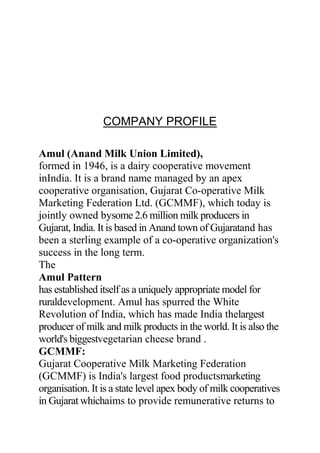
Amul (Anand Milk Union Limited),
formed in 1946, is a dairy cooperative movement
inIndia. It is a brand name managed by an apex
cooperative organisation, Gujarat Co-operative Milk
Marketing Federation Ltd. (GCMMF), which today is
jointly owned bysome 2.6 million milk producers in
Gujarat, India. It is based in Anand town of Gujaratand has
been a sterling example of a co-operative organization's
success in the long term.
The
Amul Pattern
has established itself as a uniquely appropriate model for
ruraldevelopment. Amul has spurred the White
Revolution of India, which has made India thelargest
producer of milk and milk products in the world. It is also the
world's biggestvegetarian cheese brand .
GCMMF:
Gujarat Cooperative Milk Marketing Federation
(GCMMF) is India's largest food productsmarketing
organisation. It is a state level apex body of milk cooperatives
in Gujarat whichaims to provide remunerative returns to
the farmers and also serve the interest of consumers by
providing quality products which are good value for money.
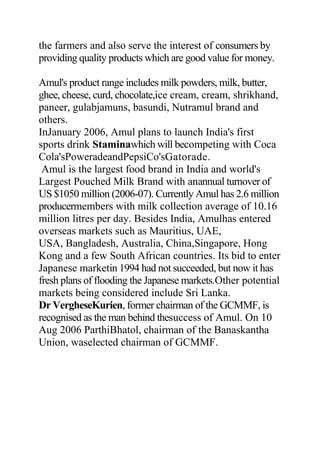
Amul's product range includes milk powders, milk, butter,
ghee, cheese, curd, chocolate,ice cream, cream, shrikhand,
paneer, gulabjamuns, basundi, Nutramul brand and
others.
InJanuary 2006, Amul plans to launch India's first
sports drink Staminawhich will becompeting with Coca
Cola'sPoweradeandPepsiCo'sGatorade.
Amul is the largest food brand in India and world's
Largest Pouched Milk Brand with anannual turnover of
US $1050 million (2006-07). Currently Amul has 2.6 million
producermembers with milk collection average of 10.16
million litres per day. Besides India, Amulhas entered
overseas markets such as Mauritius, UAE,
USA, Bangladesh, Australia, China,Singapore, Hong
Kong and a few South African countries. Its bid to enter
Japanese marketin 1994 had not succeeded, but now it has
fresh plans of flooding the Japanese markets.Other potential
markets being considered include Sri Lanka.
Dr VergheseKurien, former chairman of the GCMMF, is
recognised as the man behind thesuccess of Amul. On 10
Aug 2006 ParthiBhatol, chairman of the Banaskantha
Union, waselected chairman of GCMMF.
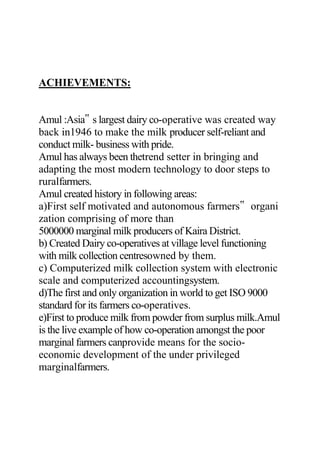
ACHIEVEMENTS:
Amul :Asia‟ s largest dairy co-operative was created way
back in1946 to make the milk producer self-reliant and
conduct milk- business with pride.
Amul has always been thetrend setter in bringing and
adapting the most modern technology to door steps to
ruralfarmers.
Amul created history in following areas:
a)First self motivated and autonomous farmers‟ organi
zation comprising of more than
5000000 marginal milk producers of Kaira District.
b) Created Dairy co-operatives at village level functioning
with milk collection centresowned by them.
c) Computerized milk collection system with electronic
scale and computerized accountingsystem.
d)The first and only organization in world to get ISO 9000
standard for its farmers co-operatives.
e)First to produce milk from powder from surplus milk.Amul
is the live example of how co-operation amongst the poor
marginal farmers canprovide means for the socio-
economic development of the under privileged
marginalfarmers.
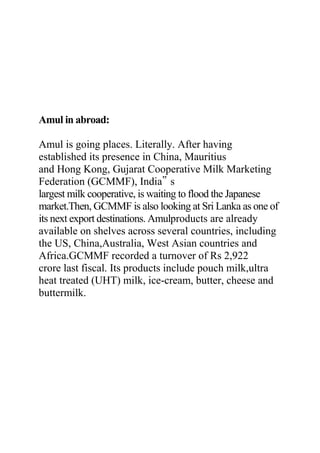
Amul in abroad:
Amul is going places. Literally. After having
established its presence in China, Mauritius
and Hong Kong, Gujarat Cooperative Milk Marketing
Federation (GCMMF), India‟ s
largest milk cooperative, is waiting to flood the Japanese
market.Then, GCMMF is also looking at Sri Lanka as one of
its next export destinations. Amulproducts are already
available on shelves across several countries, including
the US, China,Australia, West Asian countries and
Africa.GCMMF recorded a turnover of Rs 2,922
crore last fiscal. Its products include pouch milk,ultra
heat treated (UHT) milk, ice-cream, butter, cheese and
buttermilk.
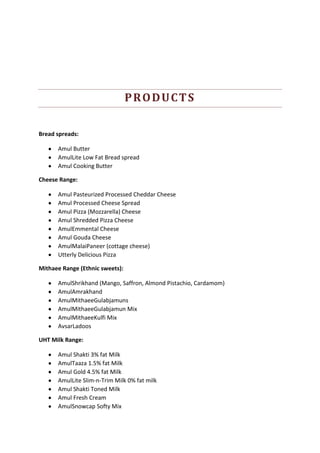
PRODUCTS
Bread spreads:
Amul Butter
AmulLite Low Fat Bread spread
Amul Cooking Butter
Cheese Range:
Amul Pasteurized Processed Cheddar Cheese
Amul Processed Cheese Spread
Amul Pizza (Mozzarella) Cheese
Amul Shredded Pizza Cheese
AmulEmmental Cheese
Amul Gouda Cheese
AmulMalaiPaneer (cottage cheese)
Utterly Delicious Pizza
Mithaee Range (Ethnic sweets):
AmulShrikhand (Mango, Saffron, Almond Pistachio, Cardamom)
AmulAmrakhand
AmulMithaeeGulabjamuns
AmulMithaeeGulabjamun Mix
AmulMithaeeKulfi Mix
AvsarLadoos
UHT Milk Range:
Amul Shakti 3% fat Milk
AmulTaaza 1.5% fat Milk
Amul Gold 4.5% fat Milk
AmulLite Slim-n-Trim Milk 0% fat milk
Amul Shakti Toned Milk
Amul Fresh Cream
AmulSnowcap Softy Mix
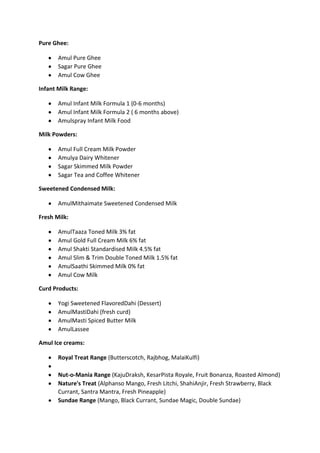
Pure Ghee:
Amul Pure Ghee
Sagar Pure Ghee
Amul Cow Ghee
Infant Milk Range:
Amul Infant Milk Formula 1 (0-6 months)
Amul Infant Milk Formula 2 ( 6 months above)
Amulspray Infant Milk Food
Milk Powders:
Amul Full Cream Milk Powder
Amulya Dairy Whitener
Sagar Skimmed Milk Powder
Sagar Tea and Coffee Whitener
Sweetened Condensed Milk:
AmulMithaimate Sweetened Condensed Milk
Fresh Milk:
AmulTaaza Toned Milk 3% fat
Amul Gold Full Cream Milk 6% fat
Amul Shakti Standardised Milk 4.5% fat
Amul Slim & Trim Double Toned Milk 1.5% fat
AmulSaathi Skimmed Milk 0% fat
Amul Cow Milk
Curd Products:
Yogi Sweetened FlavoredDahi (Dessert)
AmulMastiDahi (fresh curd)
AmulMasti Spiced Butter Milk
AmulLassee
Amul Ice creams:
Royal Treat Range (Butterscotch, Rajbhog, MalaiKulfi)
Nut-o-Mania Range (KajuDraksh, KesarPista Royale, Fruit Bonanza, Roasted Almond)
Nature's Treat (Alphanso Mango, Fresh Litchi, ShahiAnjir, Fresh Strawberry, Black
Currant, Santra Mantra, Fresh Pineapple)
Sundae Range (Mango, Black Currant, Sundae Magic, Double Sundae)
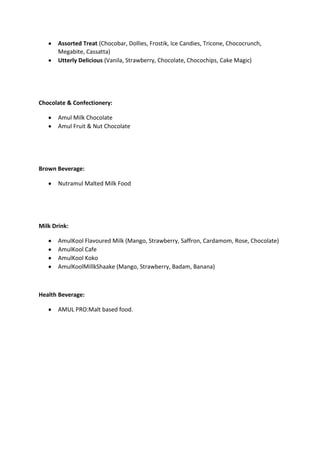
Assorted Treat (Chocobar, Dollies, Frostik, Ice Candies, Tricone, Chococrunch,
Megabite, Cassatta)
Utterly Delicious (Vanila, Strawberry, Chocolate, Chocochips, Cake Magic)
Chocolate & Confectionery:
Amul Milk Chocolate
Amul Fruit & Nut Chocolate
Brown Beverage:
Nutramul Malted Milk Food
Milk Drink:
AmulKool Flavoured Milk (Mango, Strawberry, Saffron, Cardamom, Rose, Chocolate)
AmulKool Cafe
AmulKool Koko
AmulKoolMillkShaake (Mango, Strawberry, Badam, Banana)
Health Beverage:
AMUL PRO:Malt based food.
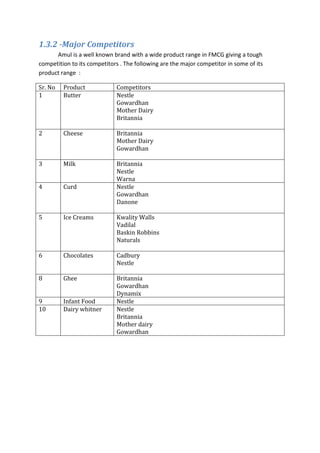
1.3.2 -Major Competitors
Amul is a well known brand with a wide product range in FMCG giving a tough
competition to its competitors . The following are the major competitor in some of its
product range :
Sr. No Product Competitors
1 Butter Nestle
Gowardhan
Mother Dairy
Britannia
2 Cheese Britannia
Mother Dairy
Gowardhan
3 Milk Britannia
Nestle
Warna
4 Curd Nestle
Gowardhan
Danone
5 Ice Creams Kwality Walls
Vadilal
Baskin Robbins
Naturals
6 Chocolates Cadbury
Nestle
8 Ghee Britannia
Gowardhan
Dynamix
9 Infant Food Nestle
10 Dairy whitner Nestle
Britannia
Mother dairy
Gowardhan
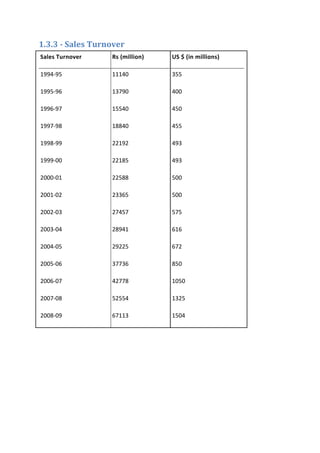
1.3.3 - Sales Turnover
Sales Turnover Rs (million) US $ (in millions)
1994-95 11140 355
1995-96 13790 400
1996-97 15540 450
1997-98 18840 455
1998-99 22192 493
1999-00 22185 493
2000-01 22588 500
2001-02 23365 500
2002-03 27457 575
2003-04 28941 616
2004-05 29225 672
2005-06 37736 850
2006-07 42778 1050
2007-08 52554 1325
2008-09 67113 1504
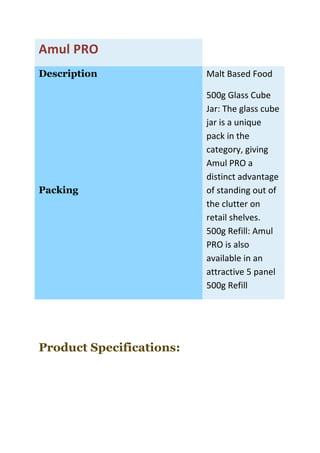
Amul PRO
Description Malt Based Food
Packing
500g Glass Cube
Jar: The glass cube
jar is a unique
pack in the
category, giving
Amul PRO a
distinct advantage
of standing out of
the clutter on
retail shelves.
500g Refill: Amul
PRO is also
available in an
attractive 5 panel
500g Refill
Product Specifications:
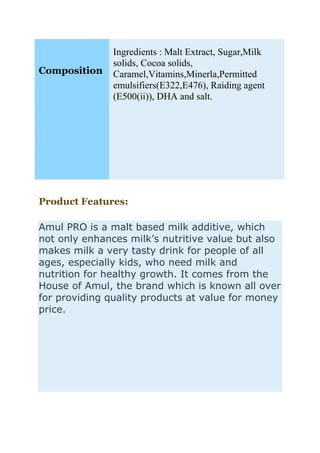
Composition
Ingredients : Malt Extract, Sugar,Milk
solids, Cocoa solids,
Caramel,Vitamins,Minerla,Permitted
emulsifiers(E322,E476), Raiding agent
(E500(ii)), DHA and salt.
Product Features:
Amul PRO is a malt based milk additive, which
not only enhances milk’s nutritive value but also
makes milk a very tasty drink for people of all
ages, especially kids, who need milk and
nutrition for healthy growth. It comes from the
House of Amul, the brand which is known all over
for providing quality products at value for money
price.
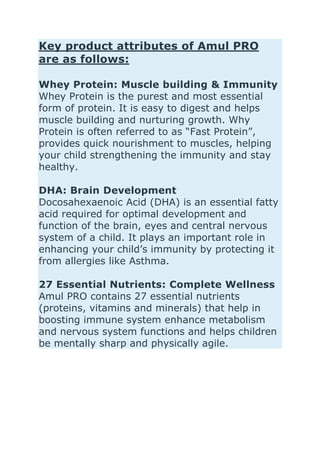
Key product attributes of Amul PRO
are as follows:
Whey Protein: Muscle building & Immunity
Whey Protein is the purest and most essential
form of protein. It is easy to digest and helps
muscle building and nurturing growth. Why
Protein is often referred to as “Fast Protein”,
provides quick nourishment to muscles, helping
your child strengthening the immunity and stay
healthy.
DHA: Brain Development
Docosahexaenoic Acid (DHA) is an essential fatty
acid required for optimal development and
function of the brain, eyes and central nervous
system of a child. It plays an important role in
enhancing your child’s immunity by protecting it
from allergies like Asthma.
27 Essential Nutrients: Complete Wellness
Amul PRO contains 27 essential nutrients
(proteins, vitamins and minerals) that help in
boosting immune system enhance metabolism
and nervous system functions and helps children
be mentally sharp and physically agile.
Product Application:
It's a milk additive, which means it can be
consumed by adding directly to milk. It is easy to
make and tasty to drink and is suitable for
people across age groups, particularly kids who
require adequate nourishment for proper growth
Amul PRO can be consumed with both hot as well
as cold milk.
Available
All Over India in Normal Trade and Modern
Format Stores.
RESEARCH METHODOLOGY
Research methodology is the way to systematically solve the
problem. In it we study the various steps that are generally
adopted by a researcher in studying his research problem
along with the logic behind them. Thus, When we talk about
research methodology we not only talk of the research
methods but also consider the logic behind the methods we
used in the context of our research study and explain why we
are using a particular method or technique and why we are not
using others so that research results are capable of being
evaluated either by the researcher himself or by others.
RESEARCH OBJECTIVE:
To know the actual sales of the product.
To understand the requirement of the product.
To determine the expansion strategies.
RESEARCH DESIGN
A sample size of 40 retailers was taken.
The survey was conducted in the area THANE.
Sampling techniques:
A quota sampling technique was adopted because the sample
audience was made out of potential purchasers of the product.
The sample was carefully drafted. A lot of care was taken
when designing the questionnaire and also when collecting
information
PRIMARY DATA
The primary data consists of information obtained
from the retailers and distributor.
SECONDARY DATA
The secondary data is obtained from the
information already published in newspaper articles , blogs
and books. The websites like Amul. Com ,scribd. Com ,
Wikipedia . cometc were also useful
METHODS OF DATA COLLECTION
The source of the data collected for the research is both primary data and secondary data
Primary Data :
By Observation Method :
This data was collected by visiting the amul outlets in Thane by seeing the displayed
Amul products in that stores.
The data was collected on the following parameters:
Price .
Visibility.
Shelf Life .
Discounts Offered .
By Personal Interviews :
The data was collected by visiting each and every stores where amul products are
available and also check the availability of the Amul products in the shelf . The information
was taken by talking to the purchase mangers of the stores as well as the distributors . The
objective of this was to know the preference of the retailers to stores the Amulproducts ,
know the problems regarding the delivery , the problems between distributors and retailers .
The questions were open – ended as well as close - ended .
LIMITATIONS
The research was carried out for 2 months which proved
to the insufficient to tap the accuracy of the study
Time factor has been a very big limitation in the
research survey like this.
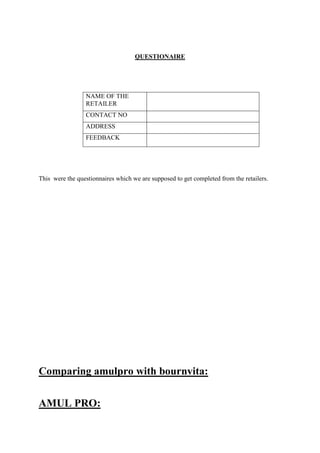
QUESTIONAIRE
NAME OF THE
RETAILER
CONTACT NO
ADDRESS
FEEDBACK
This were the questionnaires which we are supposed to get completed from the retailers.
Comparing amulpro with bournvita:
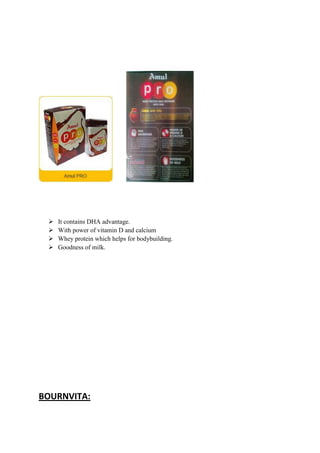
AMUL PRO:
 It contains DHA advantage.
 With power of vitamin D and calcium
 Whey protein which helps for bodybuilding.
 Goodness of milk.
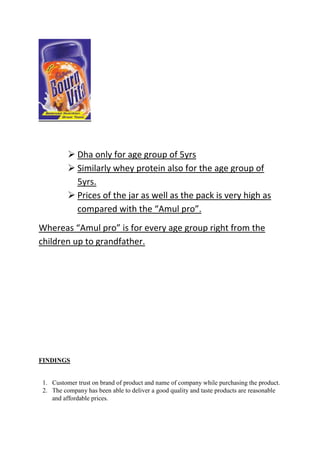
BOURNVITA:
 Dha only for age group of 5yrs
 Similarly whey protein also for the age group of
5yrs.
 Prices of the jar as well as the pack is very high as
compared with the “Amul pro”.
Whereas “Amul pro” is for every age group right from the
children up to grandfather.
FINDINGS
1. Customer trust on brand of product and name of company while purchasing the product.
2. The company has been able to deliver a good quality and taste products are reasonable
and affordable prices.
3. Most of the complaints that we heard from the retailers is that they are not satisfied with
the company’s margin as the margin is very low compared with the competitors product.
4. The Company enjoys a market leadership in products like Butter , Cheese but also lacks
products awareness in product like Basundi , GulabJamun , Chocolates etc .
5. The improper distribution network creates a great hindrance in reaching the product to
the market and customers .
6. At most of the outlets, employees are not satisfied even dealers also.According to them,
Amul only takes action for customer satisfaction,but for the outlets employee’s
satisfaction, Amul tries to avoid it
7. Retailers do not agree to stock Amul ice creams as the company doesn’t not provide the
retailer with deep freezers.
8. The local competitors like Warna ,Chitaleetc are eating the market share of Amul in
product categories of Shrikhand, Milk , Dahi.
9. The retailers are not happy with the damage product treatment given by then company.
The retailers wish for the replacement of the damaged products which the company
refuses to give.
10.The company faces a huge competition from other companies in the market for
Dahi,icecreams,mithaimate and freshcream.
CONCLUSION
I have studied and analyzed the dairy based food product market of amul on different aspects
of the markets,outlets,distribution and consumers.
The 2 months of summer internship with amul actually helped me to learn various thing that
would really be helpful in my life for future growth.
This project shows me the way to work in the market .How to communicate with different
type of people .How to convince one for better job .Learnt how to sell ,how things work in
Fast moving Consumer goods .having perishable nature of these product one need a excellent
distribution network and carefully select market because these product if transferred to far
area then cost attached to the product will make it un competitive .
According to me the growth of any product whether it could be food based product or
anything depends upon how we do proper branding of that product and also the promotion
which plays a very vital role in attracting customers.
The main goal should be to attract customer and to retain them so that the loyalty maintains
in future as well.
Besides thisQuality is the dominating aspect which influences consumer to purchase Amul
product, but prompt availabilityof other brands and aggressive promotional activities by
others influences the consumer towards them and also leads to increase sales
Ultimately I must say that I am privileged to work in the company like Amul and get such a
real time exposure of FMCG company .
Amul

Amul

  • 1.
    A SUMMER INTERNSHIPPROJECT REPORT ON ANALYSIS OF PRODUCT DEVELOPMENT AND CUSTOMER FEED BACK BY GUJARAT MILKMARKETING FEDERATION LIMITED SUBMITTED TO
  • 2.
    BY ROHIT.B.PATHAK ROLL NO-11-E35 This reportis submitted to the University / Institute in partial fulfillment of the requirement for the curriculumas prescribed by the University of Mumbai.
  • 3.
    Table of Contents TOPICPAGE NO Executive Summary. 6 Industry Profile. 7 Company Profile. 12 Products. 13 Amul Pro Description. 21 Research Methodology. 25 Questionaire. 30 Comparison With Bournvita. 31 Findings. 33 Conclusion. 34
  • 4.
    DECLARATION I hereby declarethat all the work presented in the summer internship project report entitled “ANALYSIS OF PRODUCTDEVELOPMENT AND CUSTOMER FEEDBACKBY GUJARAT CO- OPERATIVE MILK MARKETING FEDERATION LIMITED. atVidylankar Institute of Technology , Wadala and AMUL is my authentic record of my own work carried out .
  • 5.
    Certificate of Internship Thisis to certify that MR ROHIT.B.PATHAK a student of vidyalankar institute of technology and pursuing two years full time MASTERS IN MANAGEMENT STUDIES (MMS), underwent two months of internship with us from may 2, 2012 to June 5, 2012. During the internship, MR ROHIT.B.PATHAK has successfully completed the project titled “analysis of product development and customer feedback. .” Under the guidance of MR.P.S BABRA, We wish MR ROHIT.B.PATHAK the very best for his career, and are thankful for the perfect service he provided to this company.
  • 6.
    Executive summary The projectwas taken into consideration for the promotion and the marketing of the amul new product i.e “AMUL PRO”. The main task assigned to us by our mentors where to make the product available in each and every stores. It also focuses on the competitors product like bournvita Horlicks, boost etc. The main aim of the Summer training was to first analyses the market situation focus on the need of the consumers what the thing they are lacking in the competitors product so that the same thing didn’t happened in our product. So after the whole promotion and marketing of the product…we have taken the sample size of 50 retailers retailers wand wanted to know the feed back which we are getting for our product.
  • 7.
    INDUSTRY PROFILE FOOD INDUSTRY Thefood industry is the complex, global collective of diverse businesses that togethersupply much of the food energy consumed by the world population. Only subsistencefarmers, those who survive on what they grow, can be considered outside of the scope of the modern food industry. The food industry includes: Regulation: local, regional, national and international rules and regulations forfood production and sale, including food quality and food safety, and industrylobbying activities. Education: Academic, vocational, consultancy. Research and development: food technology. Financial services:insurance, credit. Manufacturing: agrichemicals, seed, farm machinery and supplies, agriculturalconstruction, etc. Agriculture: raising of crops and livestock, seafood. Food processing: preparation of fresh products for market, manufacture of prepared food products.
  • 8.
    Marketing: promotion ofgeneric products (e.g. milk board), new products, publicopinion, through advertising, packaging, public relations, etc. Wholesale and distribution: warehousing, transportation, logistics. Retail: supermarket chains and independent food stores, direct-to-consumer,restaurant, food services. ADVANTAGE OF INDIA UNDER FOOD INDUSTRY: India is one of the largest food producers in the worldindiahas diverse agro-climatic conditions and has a large and diverse raw materialbase suitable for food processing companies Investment requirement of around US$ 15 billion exists in the food processingsectorindiais looking for investment in infrastructure, packaging and marketingindia has huge scientific and research talent poolalargely untapped domestic market of 1000 million consumers300 million upper and middle class consume processed food200 million more consumers expected to shift to processed food by 2010Well developed infrastructure and distribution network Rapid urbanization, increased literacy, changing life style, increased number of women in workforce, rising per capita income- leading to rapid growth and newopportunities in food and beverages sector50 per cent of household expenditure by Indians is on food itemsstrategicgeographic location (proximity of India to markets in Europe and fareast, South East and West Asia)Under the food industry, Dairy product is very important part of food processing. Dairyprocessing is acting good role in India.
  • 9.
    Dairy Processing: India ranksfirst in the world in terms of milk production. Indian production stands at 91million tones growing at a CAGR of 4 per cent. This is primarily due to the initiativestaken by the Operation flood programmes in organizing milk producers into cooperatives;building infrastructure for milk procurement, processing and marketing and providingfinancial, technical and management inputs by the Ministry of Agriculture and Ministry of Food Processing Industries to turn the dairy sector into viable self- sustaining organizedsector. About 35% of milk produced in India is processed. The organized sector (largescale dairy plants) processes about 13 million tones annually, while the unorganized sectorprocesses about 22 million tones per annum. In the organized sector, there are 676 dairyplants in the Cooperative, Private and Government sectors registered with the Governmentof India and the state Governments. India has a unique pattern of production, processing and marketing/consumption of milk,which is not comparable with any large milk producing country. Approximately 70 millionrural households (primarily, small and marginal
  • 10.
    farmers and landlesslabourers ) in thecountry are engaged in milk production. Over 11 million farmer are organized into about0.1 million village Dairy Cooperative Societies (DCS)(about 110 farmers per DCS). Thecumulative milk handled by DCS across the country is about 18 million kg of milk per day.These cooperatives form part of a national milk grid which links the milk producersthrough out India with consumers in more than 700 towns and cities bridging the gaps onaccount of seasonal and regional variations in the availability of milk.The Ministry of food Processing Industries is promoting organized Dairy processing sectorto accomplish upcoming demands of processed dairy products and helping to identifyvarious areas of research for future product development and quality improvement torevamp the Indian dairy export by way of providing financial assistance to the dairyprocessing units. 32 Units have been sanctioned financial assistance (Rs.591 lakhs) underthe plan scheme of the Ministry during the year 2006-07.
  • 11.
    Major Indian Playersand overseas in the Food industry ITCLimited Parle Products Pvt. Ltd. Agro Tech Foods. Amul India Ltd. Cadbury India Ltd. PepsiCo India Holdings. Nestle India Pvt. Ltd. Britannia Industries Ltd. Hindustan uni lever limitedmtr foods limited. Godrej industries limited. Dabur India Ltd.
  • 12.
    COMPANY PROFILE Amul (AnandMilk Union Limited), formed in 1946, is a dairy cooperative movement inIndia. It is a brand name managed by an apex cooperative organisation, Gujarat Co-operative Milk Marketing Federation Ltd. (GCMMF), which today is jointly owned bysome 2.6 million milk producers in Gujarat, India. It is based in Anand town of Gujaratand has been a sterling example of a co-operative organization's success in the long term. The Amul Pattern has established itself as a uniquely appropriate model for ruraldevelopment. Amul has spurred the White Revolution of India, which has made India thelargest producer of milk and milk products in the world. It is also the world's biggestvegetarian cheese brand . GCMMF: Gujarat Cooperative Milk Marketing Federation (GCMMF) is India's largest food productsmarketing organisation. It is a state level apex body of milk cooperatives in Gujarat whichaims to provide remunerative returns to
  • 13.
    the farmers andalso serve the interest of consumers by providing quality products which are good value for money. Amul's product range includes milk powders, milk, butter, ghee, cheese, curd, chocolate,ice cream, cream, shrikhand, paneer, gulabjamuns, basundi, Nutramul brand and others. InJanuary 2006, Amul plans to launch India's first sports drink Staminawhich will becompeting with Coca Cola'sPoweradeandPepsiCo'sGatorade. Amul is the largest food brand in India and world's Largest Pouched Milk Brand with anannual turnover of US $1050 million (2006-07). Currently Amul has 2.6 million producermembers with milk collection average of 10.16 million litres per day. Besides India, Amulhas entered overseas markets such as Mauritius, UAE, USA, Bangladesh, Australia, China,Singapore, Hong Kong and a few South African countries. Its bid to enter Japanese marketin 1994 had not succeeded, but now it has fresh plans of flooding the Japanese markets.Other potential markets being considered include Sri Lanka. Dr VergheseKurien, former chairman of the GCMMF, is recognised as the man behind thesuccess of Amul. On 10 Aug 2006 ParthiBhatol, chairman of the Banaskantha Union, waselected chairman of GCMMF.
  • 14.
    ACHIEVEMENTS: Amul :Asia‟ slargest dairy co-operative was created way back in1946 to make the milk producer self-reliant and conduct milk- business with pride. Amul has always been thetrend setter in bringing and adapting the most modern technology to door steps to ruralfarmers. Amul created history in following areas: a)First self motivated and autonomous farmers‟ organi zation comprising of more than 5000000 marginal milk producers of Kaira District. b) Created Dairy co-operatives at village level functioning with milk collection centresowned by them. c) Computerized milk collection system with electronic scale and computerized accountingsystem. d)The first and only organization in world to get ISO 9000 standard for its farmers co-operatives. e)First to produce milk from powder from surplus milk.Amul is the live example of how co-operation amongst the poor marginal farmers canprovide means for the socio- economic development of the under privileged marginalfarmers.
  • 15.
    Amul in abroad: Amulis going places. Literally. After having established its presence in China, Mauritius and Hong Kong, Gujarat Cooperative Milk Marketing Federation (GCMMF), India‟ s largest milk cooperative, is waiting to flood the Japanese market.Then, GCMMF is also looking at Sri Lanka as one of its next export destinations. Amulproducts are already available on shelves across several countries, including the US, China,Australia, West Asian countries and Africa.GCMMF recorded a turnover of Rs 2,922 crore last fiscal. Its products include pouch milk,ultra heat treated (UHT) milk, ice-cream, butter, cheese and buttermilk.
  • 16.
    PRODUCTS Bread spreads: Amul Butter AmulLiteLow Fat Bread spread Amul Cooking Butter Cheese Range: Amul Pasteurized Processed Cheddar Cheese Amul Processed Cheese Spread Amul Pizza (Mozzarella) Cheese Amul Shredded Pizza Cheese AmulEmmental Cheese Amul Gouda Cheese AmulMalaiPaneer (cottage cheese) Utterly Delicious Pizza Mithaee Range (Ethnic sweets): AmulShrikhand (Mango, Saffron, Almond Pistachio, Cardamom) AmulAmrakhand AmulMithaeeGulabjamuns AmulMithaeeGulabjamun Mix AmulMithaeeKulfi Mix AvsarLadoos UHT Milk Range: Amul Shakti 3% fat Milk AmulTaaza 1.5% fat Milk Amul Gold 4.5% fat Milk AmulLite Slim-n-Trim Milk 0% fat milk Amul Shakti Toned Milk Amul Fresh Cream AmulSnowcap Softy Mix
  • 17.
    Pure Ghee: Amul PureGhee Sagar Pure Ghee Amul Cow Ghee Infant Milk Range: Amul Infant Milk Formula 1 (0-6 months) Amul Infant Milk Formula 2 ( 6 months above) Amulspray Infant Milk Food Milk Powders: Amul Full Cream Milk Powder Amulya Dairy Whitener Sagar Skimmed Milk Powder Sagar Tea and Coffee Whitener Sweetened Condensed Milk: AmulMithaimate Sweetened Condensed Milk Fresh Milk: AmulTaaza Toned Milk 3% fat Amul Gold Full Cream Milk 6% fat Amul Shakti Standardised Milk 4.5% fat Amul Slim & Trim Double Toned Milk 1.5% fat AmulSaathi Skimmed Milk 0% fat Amul Cow Milk Curd Products: Yogi Sweetened FlavoredDahi (Dessert) AmulMastiDahi (fresh curd) AmulMasti Spiced Butter Milk AmulLassee Amul Ice creams: Royal Treat Range (Butterscotch, Rajbhog, MalaiKulfi) Nut-o-Mania Range (KajuDraksh, KesarPista Royale, Fruit Bonanza, Roasted Almond) Nature's Treat (Alphanso Mango, Fresh Litchi, ShahiAnjir, Fresh Strawberry, Black Currant, Santra Mantra, Fresh Pineapple) Sundae Range (Mango, Black Currant, Sundae Magic, Double Sundae)
  • 18.
    Assorted Treat (Chocobar,Dollies, Frostik, Ice Candies, Tricone, Chococrunch, Megabite, Cassatta) Utterly Delicious (Vanila, Strawberry, Chocolate, Chocochips, Cake Magic) Chocolate & Confectionery: Amul Milk Chocolate Amul Fruit & Nut Chocolate Brown Beverage: Nutramul Malted Milk Food Milk Drink: AmulKool Flavoured Milk (Mango, Strawberry, Saffron, Cardamom, Rose, Chocolate) AmulKool Cafe AmulKool Koko AmulKoolMillkShaake (Mango, Strawberry, Badam, Banana) Health Beverage: AMUL PRO:Malt based food.
  • 19.
    1.3.2 -Major Competitors Amulis a well known brand with a wide product range in FMCG giving a tough competition to its competitors . The following are the major competitor in some of its product range : Sr. No Product Competitors 1 Butter Nestle Gowardhan Mother Dairy Britannia 2 Cheese Britannia Mother Dairy Gowardhan 3 Milk Britannia Nestle Warna 4 Curd Nestle Gowardhan Danone 5 Ice Creams Kwality Walls Vadilal Baskin Robbins Naturals 6 Chocolates Cadbury Nestle 8 Ghee Britannia Gowardhan Dynamix 9 Infant Food Nestle 10 Dairy whitner Nestle Britannia Mother dairy Gowardhan
  • 20.
    1.3.3 - SalesTurnover Sales Turnover Rs (million) US $ (in millions) 1994-95 11140 355 1995-96 13790 400 1996-97 15540 450 1997-98 18840 455 1998-99 22192 493 1999-00 22185 493 2000-01 22588 500 2001-02 23365 500 2002-03 27457 575 2003-04 28941 616 2004-05 29225 672 2005-06 37736 850 2006-07 42778 1050 2007-08 52554 1325 2008-09 67113 1504
  • 21.
    Amul PRO Description MaltBased Food Packing 500g Glass Cube Jar: The glass cube jar is a unique pack in the category, giving Amul PRO a distinct advantage of standing out of the clutter on retail shelves. 500g Refill: Amul PRO is also available in an attractive 5 panel 500g Refill Product Specifications:
  • 22.
    Composition Ingredients : MaltExtract, Sugar,Milk solids, Cocoa solids, Caramel,Vitamins,Minerla,Permitted emulsifiers(E322,E476), Raiding agent (E500(ii)), DHA and salt. Product Features: Amul PRO is a malt based milk additive, which not only enhances milk’s nutritive value but also makes milk a very tasty drink for people of all ages, especially kids, who need milk and nutrition for healthy growth. It comes from the House of Amul, the brand which is known all over for providing quality products at value for money price.
  • 23.
    Key product attributesof Amul PRO are as follows: Whey Protein: Muscle building & Immunity Whey Protein is the purest and most essential form of protein. It is easy to digest and helps muscle building and nurturing growth. Why Protein is often referred to as “Fast Protein”, provides quick nourishment to muscles, helping your child strengthening the immunity and stay healthy. DHA: Brain Development Docosahexaenoic Acid (DHA) is an essential fatty acid required for optimal development and function of the brain, eyes and central nervous system of a child. It plays an important role in enhancing your child’s immunity by protecting it from allergies like Asthma. 27 Essential Nutrients: Complete Wellness Amul PRO contains 27 essential nutrients (proteins, vitamins and minerals) that help in boosting immune system enhance metabolism and nervous system functions and helps children be mentally sharp and physically agile.
  • 24.
    Product Application: It's amilk additive, which means it can be consumed by adding directly to milk. It is easy to make and tasty to drink and is suitable for people across age groups, particularly kids who require adequate nourishment for proper growth Amul PRO can be consumed with both hot as well as cold milk. Available All Over India in Normal Trade and Modern Format Stores.
  • 25.
  • 26.
    Research methodology isthe way to systematically solve the problem. In it we study the various steps that are generally adopted by a researcher in studying his research problem along with the logic behind them. Thus, When we talk about research methodology we not only talk of the research methods but also consider the logic behind the methods we used in the context of our research study and explain why we are using a particular method or technique and why we are not using others so that research results are capable of being evaluated either by the researcher himself or by others. RESEARCH OBJECTIVE: To know the actual sales of the product. To understand the requirement of the product. To determine the expansion strategies. RESEARCH DESIGN A sample size of 40 retailers was taken. The survey was conducted in the area THANE.
  • 27.
    Sampling techniques: A quotasampling technique was adopted because the sample audience was made out of potential purchasers of the product. The sample was carefully drafted. A lot of care was taken when designing the questionnaire and also when collecting information PRIMARY DATA The primary data consists of information obtained from the retailers and distributor. SECONDARY DATA The secondary data is obtained from the information already published in newspaper articles , blogs and books. The websites like Amul. Com ,scribd. Com , Wikipedia . cometc were also useful
  • 28.
    METHODS OF DATACOLLECTION The source of the data collected for the research is both primary data and secondary data Primary Data : By Observation Method : This data was collected by visiting the amul outlets in Thane by seeing the displayed Amul products in that stores. The data was collected on the following parameters: Price . Visibility. Shelf Life . Discounts Offered . By Personal Interviews : The data was collected by visiting each and every stores where amul products are available and also check the availability of the Amul products in the shelf . The information was taken by talking to the purchase mangers of the stores as well as the distributors . The objective of this was to know the preference of the retailers to stores the Amulproducts , know the problems regarding the delivery , the problems between distributors and retailers . The questions were open – ended as well as close - ended .
  • 29.
    LIMITATIONS The research wascarried out for 2 months which proved to the insufficient to tap the accuracy of the study Time factor has been a very big limitation in the research survey like this.
  • 30.
    QUESTIONAIRE NAME OF THE RETAILER CONTACTNO ADDRESS FEEDBACK This were the questionnaires which we are supposed to get completed from the retailers. Comparing amulpro with bournvita: AMUL PRO:
  • 31.
     It containsDHA advantage.  With power of vitamin D and calcium  Whey protein which helps for bodybuilding.  Goodness of milk. BOURNVITA:
  • 32.
     Dha onlyfor age group of 5yrs  Similarly whey protein also for the age group of 5yrs.  Prices of the jar as well as the pack is very high as compared with the “Amul pro”. Whereas “Amul pro” is for every age group right from the children up to grandfather. FINDINGS 1. Customer trust on brand of product and name of company while purchasing the product. 2. The company has been able to deliver a good quality and taste products are reasonable and affordable prices.
  • 33.
    3. Most ofthe complaints that we heard from the retailers is that they are not satisfied with the company’s margin as the margin is very low compared with the competitors product. 4. The Company enjoys a market leadership in products like Butter , Cheese but also lacks products awareness in product like Basundi , GulabJamun , Chocolates etc . 5. The improper distribution network creates a great hindrance in reaching the product to the market and customers . 6. At most of the outlets, employees are not satisfied even dealers also.According to them, Amul only takes action for customer satisfaction,but for the outlets employee’s satisfaction, Amul tries to avoid it 7. Retailers do not agree to stock Amul ice creams as the company doesn’t not provide the retailer with deep freezers. 8. The local competitors like Warna ,Chitaleetc are eating the market share of Amul in product categories of Shrikhand, Milk , Dahi. 9. The retailers are not happy with the damage product treatment given by then company. The retailers wish for the replacement of the damaged products which the company refuses to give. 10.The company faces a huge competition from other companies in the market for Dahi,icecreams,mithaimate and freshcream.
  • 34.
    CONCLUSION I have studiedand analyzed the dairy based food product market of amul on different aspects of the markets,outlets,distribution and consumers. The 2 months of summer internship with amul actually helped me to learn various thing that would really be helpful in my life for future growth. This project shows me the way to work in the market .How to communicate with different type of people .How to convince one for better job .Learnt how to sell ,how things work in Fast moving Consumer goods .having perishable nature of these product one need a excellent distribution network and carefully select market because these product if transferred to far area then cost attached to the product will make it un competitive . According to me the growth of any product whether it could be food based product or anything depends upon how we do proper branding of that product and also the promotion which plays a very vital role in attracting customers. The main goal should be to attract customer and to retain them so that the loyalty maintains in future as well. Besides thisQuality is the dominating aspect which influences consumer to purchase Amul product, but prompt availabilityof other brands and aggressive promotional activities by others influences the consumer towards them and also leads to increase sales Ultimately I must say that I am privileged to work in the company like Amul and get such a real time exposure of FMCG company .