Sardar Patel Institute of Technology
Bhavan’s Campus, Munshi Nagar, Andheri (West), Mumbai: 400058, India
(Autonomous Institute, Affiliated to University of Mumbai)
Amplitude Modulation and Demodulation
Sardar Patel Institute of Technology,
Prof Najib Ghatte,
Prof Shanti Swamy,
Electronics And Telecommunication, Mumbai, India
TABLE OF CONTENTS
SR.NO Topic Name Page Number
1. Introduction 2
2. Amplitude Modulation 2
3. Amplitude Demodulation 3
4. Implementation on MATLAB(Liscenced) 4
5. Conclusion 6
1.
1
2023200021 Atharv Bodake
2023200026 Shivprasad Chougule
2023200029 Parth Deokate
Sardar Patel Institute of Technology
Bhavan’s Campus, Munshi Nagar, Andheri (West), Mumbai: 400058, India
(Autonomous Institute, Affiliated to University of Mumbai)
Introduction to Amplitude Modulation
In modern communication systems, efficient transmission of information over long distances is crucial.
Modulation plays a key role in this process by converting a low-frequency signal, such as audio or data,
into a form that can be transmitted over a communication medium, such as air or cables. One of the
earliest and simplest modulation techniques is Amplitude Modulation (AM), where the amplitude of a
high-frequency carrier signal is varied in proportion to the instantaneous amplitude of the input
message signal.
Amplitude Modulation is widely used in radio broadcasting, two-way radios, and other communication
systems. However, for the transmitted signal to be useful at the receiver’s end, it must be demodulated,
which means recovering the original message signal from the modulated carrier. AM demodulation is
typically performed using envelope detectors or synchronous demodulation techniques, depending on
the complexity of the system.
This article explores the fundamental principles of AM modulation and demodulation, providing insights
into how this technique is applied in real-world communication systems and its relevance today.
Modulation and demodulation are fundamental processes in communication systems, enabling the
efficient transmission and reception of information over vast distances. Their importance can be
understood through the following key points:
1. Efficient Use of the Communication Medium
In its raw form, most message signals, such as audio or data, are low-frequency and cannot be
transmitted effectively over long distances due to attenuation and interference. Modulation
allows the low-frequency message signal to “ride” on a higher-frequency carrier wave, making it
suitable for transmission over communication channels like air, coaxial cables, or optical fibers.
2. Overcoming Signal Loss and Interference
Without modulation, low-frequency signals would be more susceptible to noise, interference,
and attenuation. High-frequency signals, generated through modulation, are more resilient and
can travel longer distances with less degradation, ensuring the message reaches the receiver
with higher fidelity.
3. Multiplexing
By using different carrier frequencies, modulation enables the transmission of multiple signals
over a single communication channel. This process, known as frequency-division multiplexing
(FDM), allows multiple users to communicate simultaneously without interference, significantly
improving the efficiency of communication systems.
4. Bandwidth Optimization
Each communication medium has a specific bandwidth that limits the range of frequencies it
can carry. Modulation helps fit the message signal within the available bandwidth by shifting it
to higher frequencies. This process ensures optimal usage of the medium’s capacity, allowing
more information to be transmitted.
2.
2
Sardar Patel Institute of Technology
Bhavan’s Campus, Munshi Nagar, Andheri (West), Mumbai: 400058, India
(Autonomous Institute, Affiliated to University of Mumbai)
5. Demodulation and Signal Recovery
At the receiver's end, the modulated signal must be decoded or demodulated to retrieve the
original information. The process of demodulation strips away the carrier signal, extracting the
message signal from the modulated wave. Without demodulation, the transmitted message
would remain hidden in the carrier wave and be unusable for the end-user.
6. Enabling Long-Distance Communication
Modulation enables communication over vast distances, making technologies such as radio,
television, satellite communication, and mobile networks possible. By converting information
into a form that can be efficiently transmitted and recovered, modulation and demodulation are
the backbone of global communication infrastructure.
Amplitude Modulation
Amplitude Modulation (AM) is a technique in which the amplitude of a high-frequency carrier wave is
varied in proportion to the instantaneous amplitude of the message signal (such as audio or data). The
carrier’s frequency remains constant, but its amplitude changes based on the information being
transmitted.
In AM, a carrier wave is combined with a message signal to create a modulated signal that can be
transmitted over long distances. The modulated signal consists of the carrier wave and two sidebands
(upper and lower) that carry the information. The sidebands are created by the message signal and
contain the same information as the original signal, allowing the receiver to reconstruct the transmitted
message through demodulation.
Method for Amplitude Modulation:
1. Carrier Wave: Generate a high-frequency sinusoidal carrier wave.
2. Message Signal: Prepare the low-frequency signal (audio, data) that contains the information to
be transmitted.
3. Modulation Process:
o Multiply the carrier wave’s amplitude with the instantaneous amplitude of the message
signal.
o The result is a signal whose amplitude follows the variations of the message signal,
while its frequency remains that of the carrier.
3.
3
Sardar Patel Institute of Technology
Bhavan’s Campus, Munshi Nagar, Andheri (West), Mumbai: 400058, India
(Autonomous Institute, Affiliated to University of Mumbai)
4. Mathematical Expression:
o The AM signal can be represented as: s(t)=[Ac+m(t)]⋅cos⁡
(2πfct)s(t) = [A_c + m(t)] cdot 
cos(2 pi f_c t)s(t)=[Ac+m(t)]⋅cos(2πfct) Where:
 AcA_cAc is the carrier amplitude,
 m(t)m(t)m(t) is the message signal,
 fcf_cfc is the carrier frequency,
 cos⁡
(2πfct)cos(2 pi f_c t)cos(2πfct) is the carrier wave.
5. Transmission: The resulting AM signal is transmitted over a communication medium (such as air
or cables), where it can be received and demodulated to retrieve the original message.
This simple technique is widely used in radio broadcasting, where audio signals are transmitted over
long distances by modulating them onto a high-frequency carrier wave.
Amplitude Demodulation
Amplitude Demodulation is the process used to recover the original message signal from an amplitude-
modulated (AM) carrier wave. The modulated signal carries the information in its varying amplitude,
and demodulation is necessary to retrieve this information for practical use, such as audio or data
communication.
Common Methods for Amplitude Demodulation:
1. Envelope Detection:
o Method: The envelope detector follows the amplitude variations of the AM signal.
o Components: A simple circuit with a diode (for rectifying the signal) and a capacitor (for
smoothing the waveform).
o Process: The diode rectifies the AM signal, allowing only the positive (or negative) half
of the signal. The capacitor then smooths out the waveform, tracing the signal’s
amplitude, which corresponds to the original message.
o Application: Commonly used in simple radio receivers.
4.
4
Sardar Patel Institute of Technology
Bhavan’s Campus, Munshi Nagar, Andheri (West), Mumbai: 400058, India
(Autonomous Institute, Affiliated to University of Mumbai)
2. Synchronous Detection (Coherent Detection):
o Method: The received AM signal is multiplied by a locally generated carrier that is
synchronized with the transmitted carrier.
o Process: The synchronized carrier helps in recovering the exact amplitude variations of
the original message signal. This method is more accurate and less prone to errors
caused by noise.
o Application: Used in more advanced communication systems where higher signal
quality is required.
Both methods extract the original information from the modulated carrier, with envelope detection
being simple and widely used, while synchronous detection offers better performance in noisy
environments.
Implementation on MATLAB(Liscenced)
Amplitude Modulation
% Parameters
fs = 10000; % Sampling frequency
t = 0:1/fs:0.05; % Time vector
f_msg = 100; % Frequency of message signal (Hz)
f_carrier = 1000; % Frequency of carrier signal (Hz)
A_carrier = 1; % Amplitude of carrier signal
A_msg = 0.5; % Amplitude of message signal
% Message signal (sine wave)
m_t = A_msg * cos(2 * pi * f_msg * t);
% Carrier signal
c_t = A_carrier * cos(2 * pi * f_carrier * t);
% AM Modulation
AM_signal = (1 + m_t) .* c_t;
5.
5
Sardar Patel Institute of Technology
Bhavan’s Campus, Munshi Nagar, Andheri (West), Mumbai: 400058, India
(Autonomous Institute, Affiliated to University of Mumbai)
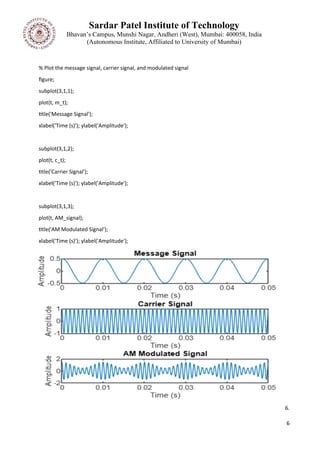
% Plot the message signal, carrier signal, and modulated signal
figure;
subplot(3,1,1);
plot(t, m_t);
title('Message Signal');
xlabel('Time (s)'); ylabel('Amplitude');
subplot(3,1,2);
plot(t, c_t);
title('Carrier Signal');
xlabel('Time (s)'); ylabel('Amplitude');
subplot(3,1,3);
plot(t, AM_signal);
title('AM Modulated Signal');
xlabel('Time (s)'); ylabel('Amplitude');
6.
6
Sardar Patel Institute of Technology
Bhavan’s Campus, Munshi Nagar, Andheri (West), Mumbai: 400058, India
(Autonomous Institute, Affiliated to University of Mumbai)
Amplitude Demodulation
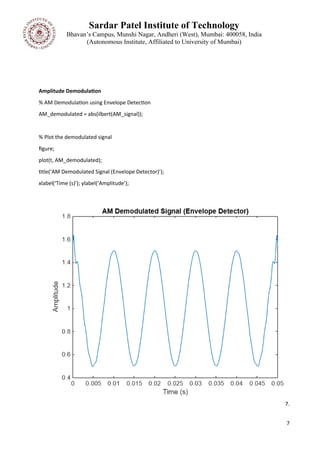
% AM Demodulation using Envelope Detection
AM_demodulated = abs(ilbert(AM_signal));
% Plot the demodulated signal
figure;
plot(t, AM_demodulated);
title(‘AM Demodulated Signal (Envelope Detector)’);
xlabel(‘Time (s)’); ylabel(‘Amplitude’);
7.
7
Sardar Patel Institute of Technology
Bhavan’s Campus, Munshi Nagar, Andheri (West), Mumbai: 400058, India
(Autonomous Institute, Affiliated to University of Mumbai)
Conclusion
Amplitude Modulation (AM) and demodulation are fundamental concepts in the field of communication
systems. AM, one of the earliest modulation techniques, involves varying the amplitude of a high-
frequency carrier wave in proportion to the message signal. It is simple to implement and has
historically been used in radio broadcasting, making it a cornerstone of early wireless communication.
The process of demodulation, particularly through envelope detection, is equally essential for extracting
the original message signal from the modulated carrier at the receiver. While AM is relatively easy to
implement, it is more susceptible to noise and interference compared to more modern modulation
techniques. However, its simplicity and effectiveness in applications like long-distance communication
make it an important topic in signal processing.
The example demonstrated how AM modulation and envelope detection can be easily simulated using
MATLAB, providing a practical understanding of the process. Although newer techniques like Frequency
Modulation (FM) and digital modulation have largely replaced AM in modern systems, its role in the
evolution of communication technologies remains significant.
In summary, AM and demodulation are foundational techniques that help us understand the principles
of signal transmission and recovery, paving the way for more advanced communication methods.
8.
8

AM Modulation and Demodulation Using MATLAB.docx

  • 1.
    Sardar Patel Instituteof Technology Bhavan’s Campus, Munshi Nagar, Andheri (West), Mumbai: 400058, India (Autonomous Institute, Affiliated to University of Mumbai) Amplitude Modulation and Demodulation Sardar Patel Institute of Technology, Prof Najib Ghatte, Prof Shanti Swamy, Electronics And Telecommunication, Mumbai, India TABLE OF CONTENTS SR.NO Topic Name Page Number 1. Introduction 2 2. Amplitude Modulation 2 3. Amplitude Demodulation 3 4. Implementation on MATLAB(Liscenced) 4 5. Conclusion 6 1. 1 2023200021 Atharv Bodake 2023200026 Shivprasad Chougule 2023200029 Parth Deokate
  • 2.
    Sardar Patel Instituteof Technology Bhavan’s Campus, Munshi Nagar, Andheri (West), Mumbai: 400058, India (Autonomous Institute, Affiliated to University of Mumbai) Introduction to Amplitude Modulation In modern communication systems, efficient transmission of information over long distances is crucial. Modulation plays a key role in this process by converting a low-frequency signal, such as audio or data, into a form that can be transmitted over a communication medium, such as air or cables. One of the earliest and simplest modulation techniques is Amplitude Modulation (AM), where the amplitude of a high-frequency carrier signal is varied in proportion to the instantaneous amplitude of the input message signal. Amplitude Modulation is widely used in radio broadcasting, two-way radios, and other communication systems. However, for the transmitted signal to be useful at the receiver’s end, it must be demodulated, which means recovering the original message signal from the modulated carrier. AM demodulation is typically performed using envelope detectors or synchronous demodulation techniques, depending on the complexity of the system. This article explores the fundamental principles of AM modulation and demodulation, providing insights into how this technique is applied in real-world communication systems and its relevance today. Modulation and demodulation are fundamental processes in communication systems, enabling the efficient transmission and reception of information over vast distances. Their importance can be understood through the following key points: 1. Efficient Use of the Communication Medium In its raw form, most message signals, such as audio or data, are low-frequency and cannot be transmitted effectively over long distances due to attenuation and interference. Modulation allows the low-frequency message signal to “ride” on a higher-frequency carrier wave, making it suitable for transmission over communication channels like air, coaxial cables, or optical fibers. 2. Overcoming Signal Loss and Interference Without modulation, low-frequency signals would be more susceptible to noise, interference, and attenuation. High-frequency signals, generated through modulation, are more resilient and can travel longer distances with less degradation, ensuring the message reaches the receiver with higher fidelity. 3. Multiplexing By using different carrier frequencies, modulation enables the transmission of multiple signals over a single communication channel. This process, known as frequency-division multiplexing (FDM), allows multiple users to communicate simultaneously without interference, significantly improving the efficiency of communication systems. 4. Bandwidth Optimization Each communication medium has a specific bandwidth that limits the range of frequencies it can carry. Modulation helps fit the message signal within the available bandwidth by shifting it to higher frequencies. This process ensures optimal usage of the medium’s capacity, allowing more information to be transmitted. 2. 2
  • 3.
    Sardar Patel Instituteof Technology Bhavan’s Campus, Munshi Nagar, Andheri (West), Mumbai: 400058, India (Autonomous Institute, Affiliated to University of Mumbai) 5. Demodulation and Signal Recovery At the receiver's end, the modulated signal must be decoded or demodulated to retrieve the original information. The process of demodulation strips away the carrier signal, extracting the message signal from the modulated wave. Without demodulation, the transmitted message would remain hidden in the carrier wave and be unusable for the end-user. 6. Enabling Long-Distance Communication Modulation enables communication over vast distances, making technologies such as radio, television, satellite communication, and mobile networks possible. By converting information into a form that can be efficiently transmitted and recovered, modulation and demodulation are the backbone of global communication infrastructure. Amplitude Modulation Amplitude Modulation (AM) is a technique in which the amplitude of a high-frequency carrier wave is varied in proportion to the instantaneous amplitude of the message signal (such as audio or data). The carrier’s frequency remains constant, but its amplitude changes based on the information being transmitted. In AM, a carrier wave is combined with a message signal to create a modulated signal that can be transmitted over long distances. The modulated signal consists of the carrier wave and two sidebands (upper and lower) that carry the information. The sidebands are created by the message signal and contain the same information as the original signal, allowing the receiver to reconstruct the transmitted message through demodulation. Method for Amplitude Modulation: 1. Carrier Wave: Generate a high-frequency sinusoidal carrier wave. 2. Message Signal: Prepare the low-frequency signal (audio, data) that contains the information to be transmitted. 3. Modulation Process: o Multiply the carrier wave’s amplitude with the instantaneous amplitude of the message signal. o The result is a signal whose amplitude follows the variations of the message signal, while its frequency remains that of the carrier. 3. 3
  • 4.
    Sardar Patel Instituteof Technology Bhavan’s Campus, Munshi Nagar, Andheri (West), Mumbai: 400058, India (Autonomous Institute, Affiliated to University of Mumbai) 4. Mathematical Expression: o The AM signal can be represented as: s(t)=[Ac+m(t)]⋅cos⁡ (2πfct)s(t) = [A_c + m(t)] cdot cos(2 pi f_c t)s(t)=[Ac+m(t)]⋅cos(2πfct) Where:  AcA_cAc is the carrier amplitude,  m(t)m(t)m(t) is the message signal,  fcf_cfc is the carrier frequency,  cos⁡ (2πfct)cos(2 pi f_c t)cos(2πfct) is the carrier wave. 5. Transmission: The resulting AM signal is transmitted over a communication medium (such as air or cables), where it can be received and demodulated to retrieve the original message. This simple technique is widely used in radio broadcasting, where audio signals are transmitted over long distances by modulating them onto a high-frequency carrier wave. Amplitude Demodulation Amplitude Demodulation is the process used to recover the original message signal from an amplitude- modulated (AM) carrier wave. The modulated signal carries the information in its varying amplitude, and demodulation is necessary to retrieve this information for practical use, such as audio or data communication. Common Methods for Amplitude Demodulation: 1. Envelope Detection: o Method: The envelope detector follows the amplitude variations of the AM signal. o Components: A simple circuit with a diode (for rectifying the signal) and a capacitor (for smoothing the waveform). o Process: The diode rectifies the AM signal, allowing only the positive (or negative) half of the signal. The capacitor then smooths out the waveform, tracing the signal’s amplitude, which corresponds to the original message. o Application: Commonly used in simple radio receivers. 4. 4
  • 5.
    Sardar Patel Instituteof Technology Bhavan’s Campus, Munshi Nagar, Andheri (West), Mumbai: 400058, India (Autonomous Institute, Affiliated to University of Mumbai) 2. Synchronous Detection (Coherent Detection): o Method: The received AM signal is multiplied by a locally generated carrier that is synchronized with the transmitted carrier. o Process: The synchronized carrier helps in recovering the exact amplitude variations of the original message signal. This method is more accurate and less prone to errors caused by noise. o Application: Used in more advanced communication systems where higher signal quality is required. Both methods extract the original information from the modulated carrier, with envelope detection being simple and widely used, while synchronous detection offers better performance in noisy environments. Implementation on MATLAB(Liscenced) Amplitude Modulation % Parameters fs = 10000; % Sampling frequency t = 0:1/fs:0.05; % Time vector f_msg = 100; % Frequency of message signal (Hz) f_carrier = 1000; % Frequency of carrier signal (Hz) A_carrier = 1; % Amplitude of carrier signal A_msg = 0.5; % Amplitude of message signal % Message signal (sine wave) m_t = A_msg * cos(2 * pi * f_msg * t); % Carrier signal c_t = A_carrier * cos(2 * pi * f_carrier * t); % AM Modulation AM_signal = (1 + m_t) .* c_t; 5. 5
  • 6.
    Sardar Patel Instituteof Technology Bhavan’s Campus, Munshi Nagar, Andheri (West), Mumbai: 400058, India (Autonomous Institute, Affiliated to University of Mumbai) % Plot the message signal, carrier signal, and modulated signal figure; subplot(3,1,1); plot(t, m_t); title('Message Signal'); xlabel('Time (s)'); ylabel('Amplitude'); subplot(3,1,2); plot(t, c_t); title('Carrier Signal'); xlabel('Time (s)'); ylabel('Amplitude'); subplot(3,1,3); plot(t, AM_signal); title('AM Modulated Signal'); xlabel('Time (s)'); ylabel('Amplitude'); 6. 6
  • 7.
    Sardar Patel Instituteof Technology Bhavan’s Campus, Munshi Nagar, Andheri (West), Mumbai: 400058, India (Autonomous Institute, Affiliated to University of Mumbai) Amplitude Demodulation % AM Demodulation using Envelope Detection AM_demodulated = abs(ilbert(AM_signal)); % Plot the demodulated signal figure; plot(t, AM_demodulated); title(‘AM Demodulated Signal (Envelope Detector)’); xlabel(‘Time (s)’); ylabel(‘Amplitude’); 7. 7
  • 8.
    Sardar Patel Instituteof Technology Bhavan’s Campus, Munshi Nagar, Andheri (West), Mumbai: 400058, India (Autonomous Institute, Affiliated to University of Mumbai) Conclusion Amplitude Modulation (AM) and demodulation are fundamental concepts in the field of communication systems. AM, one of the earliest modulation techniques, involves varying the amplitude of a high- frequency carrier wave in proportion to the message signal. It is simple to implement and has historically been used in radio broadcasting, making it a cornerstone of early wireless communication. The process of demodulation, particularly through envelope detection, is equally essential for extracting the original message signal from the modulated carrier at the receiver. While AM is relatively easy to implement, it is more susceptible to noise and interference compared to more modern modulation techniques. However, its simplicity and effectiveness in applications like long-distance communication make it an important topic in signal processing. The example demonstrated how AM modulation and envelope detection can be easily simulated using MATLAB, providing a practical understanding of the process. Although newer techniques like Frequency Modulation (FM) and digital modulation have largely replaced AM in modern systems, its role in the evolution of communication technologies remains significant. In summary, AM and demodulation are foundational techniques that help us understand the principles of signal transmission and recovery, paving the way for more advanced communication methods. 8. 8