
Amiodarone
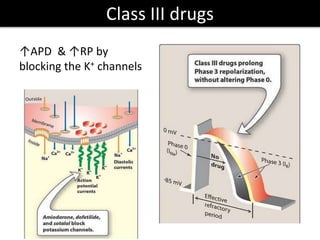
Class III drugs
↑APD & ↑RP by
blocking the K+ channels
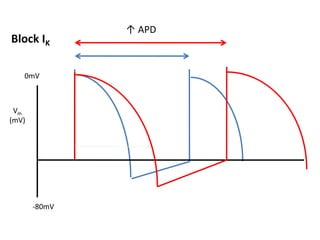
Vm
(mV)
-80mV
0mV
↑ APD
Block IK
Amiodarone (Cordarone) is a unique “wide-
spectrum” antiarrhythmic agent, chiefly class III
but also with powerful class I activity and
ancillary class II and class IV activity. Thus it
blocks Na+,Ca++, and repolarizing K+ channels
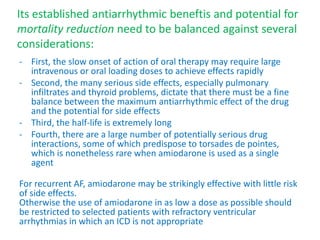
Its established antiarrhythmic beneftis and potential for
mortality reduction need to be balanced against several
considerations:
- First, the slow onset of action of oral therapy may require large
intravenous or oral loading doses to achieve effects rapidly
- Second, the many serious side effects, especially pulmonary
infiltrates and thyroid problems, dictate that there must be a fine
balance between the maximum antiarrhythmic effect of the drug
and the potential for side effects
- Third, the half-life is extremely long
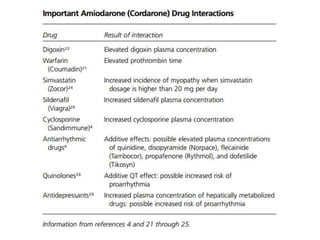
- Fourth, there are a large number of potentially serious drug
interactions, some of which predispose to torsades de pointes,
which is nonetheless rare when amiodarone is used as a single
agent
For recurrent AF, amiodarone may be strikingly effective with little risk
of side effects.
Otherwise the use of amiodarone in as low a dose as possible should
be restricted to selected patients with refractory ventricular
arrhythmias in which an ICD is not appropriate
Electrophysiologic characteristics
Predominantly class III, that shares at least some of the properties of each of
the other three EP classes of antiarrhythmics
- The class III activity means that amiodarone lengthens the effective
refractory period by prolonging the APD in all cardiac tissues, including bypass
tracts
- It also has a powerful class I antiarrhythmic effect inhibiting inactivated
sodium channels at high stimulation frequencies
- Its benefits in AF may be explained at least in part by prolongation of the
refractory periods of both the left and right superior pulmonary veins, and
inhibition of the AV node
- it is “uniquely effective” against AF in experimental atrial remodeling
- Amiodarone noncompetitively blocks a- and b-adrenergic receptors (class
II effect), and this effect is additive to competitive receptor inhibition by b-
blockers
- The weak calcium antagonist (class IV) effect might explain bradycardia
and AV nodal inhibition and the relatively low incidence of torsades de
pointes
- Furthermore, there are relatively weak coronary and peripheral
vasodilator actions
Pharmacokinetics
• highly lipid soluble drug differ markedly from other
cardiovascular agents : After variable (30% to 50%) and
slow gastrointestinal (GI) absorption, amiodarone
distributes slowly but very extensive into adipose
tissues
 amiodarone must fill an enormous peripheral-tissue
depot to achieve adequate blood and cardiac
concentrations, accounting for its slow onset of action .
 In addition, when oral administration is stopped, most
of the drug is in peripheral stores unavailable to
elimination systems, causing very slow elimination with
a very long half-life, up to 6 months
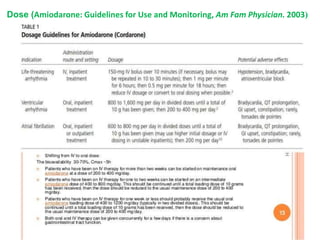
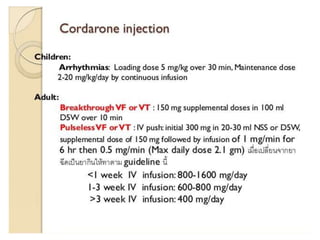
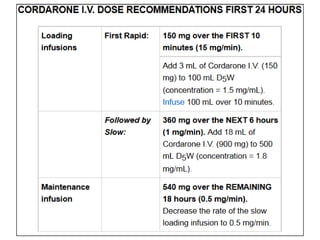
Dose (Amiodarone: Guidelines for Use and Monitoring, Am Fam Physician. 2003)
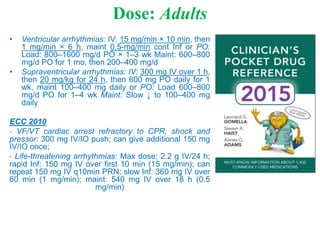
Dose: Adults
• Ventricular arrhythmias: IV: 15 mg/min × 10 min, then
1 mg/min × 6 h, maint 0.5-mg/min cont Inf or PO:
Load: 800–1600 mg/d PO × 1–3 wk Maint: 600–800
mg/d PO for 1 mo, then 200–400 mg/d
• Supraventricular arrhythmias: IV: 300 mg IV over 1 h,
then 20 mg/kg for 24 h, then 600 mg PO daily for 1
wk, maint 100–400 mg daily or PO: Load 600–800
mg/d PO for 1–4 wk Maint: Slow ↓ to 100–400 mg
daily
ECC 2010
- VF/VT cardiac arrest refractory to CPR, shock and
pressor: 300 mg IV/IO push; can give additional 150 mg
IV/IO once;
- Life-threatening arrhythmias: Max dose: 2.2 g IV/24 h;
rapid Inf: 150 mg IV over first 10 min (15 mg/min); can
repeat 150 mg IV q10min PRN; slow Inf: 360 mg IV over
60 min (1 mg/min); maint: 540 mg IV over 18 h (0.5
mg/min)
ESC 2016 - atrial fibrillation
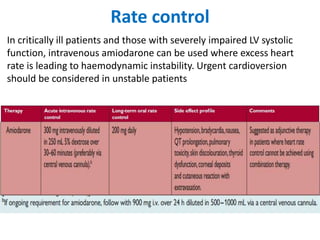
Rate control
In critically ill patients and those with severely impaired LV systolic
function, intravenous amiodarone can be used where excess heart
rate is leading to haemodynamic instability. Urgent cardioversion
should be considered in unstable patients
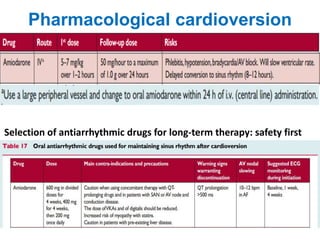
Pharmacological cardioversion
Selection of antiarrhythmic drugs for long-term therapy: safety first
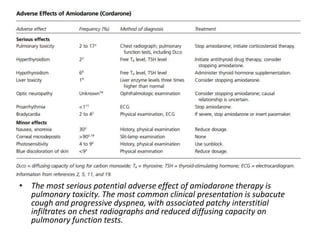
• The most serious potential adverse effect of amiodarone therapy is
pulmonary toxicity. The most common clinical presentation is subacute
cough and progressive dyspnea, with associated patchy interstitial
infiltrates on chest radiographs and reduced diffusing capacity on
pulmonary function tests.
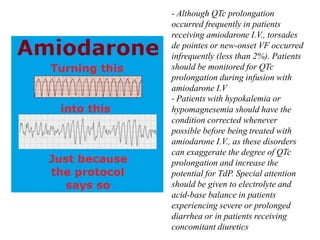
- Although QTc prolongation
occurred frequently in patients
receiving amiodarone I.V., torsades
de pointes or new-onset VF occurred
infrequently (less than 2%). Patients
should be monitored for QTc
prolongation during infusion with
amiodarone I.V
- Patients with hypokalemia or
hypomagnesemia should have the
condition corrected whenever
possible before being treated with
amiodarone I.V., as these disorders
can exaggerate the degree of QTc
prolongation and increase the
potential for TdP. Special attention
should be given to electrolyte and
acid-base balance in patients
experiencing severe or prolonged
diarrhea or in patients receiving
concomitant diuretics
Amiodarone
Amiodarone

Amiodarone

  • 1.
  • 2.
    Class III drugs ↑APD& ↑RP by blocking the K+ channels
  • 3.
  • 4.
    Amiodarone (Cordarone) isa unique “wide- spectrum” antiarrhythmic agent, chiefly class III but also with powerful class I activity and ancillary class II and class IV activity. Thus it blocks Na+,Ca++, and repolarizing K+ channels
  • 5.
    Its established antiarrhythmicbeneftis and potential for mortality reduction need to be balanced against several considerations: - First, the slow onset of action of oral therapy may require large intravenous or oral loading doses to achieve effects rapidly - Second, the many serious side effects, especially pulmonary infiltrates and thyroid problems, dictate that there must be a fine balance between the maximum antiarrhythmic effect of the drug and the potential for side effects - Third, the half-life is extremely long - Fourth, there are a large number of potentially serious drug interactions, some of which predispose to torsades de pointes, which is nonetheless rare when amiodarone is used as a single agent For recurrent AF, amiodarone may be strikingly effective with little risk of side effects. Otherwise the use of amiodarone in as low a dose as possible should be restricted to selected patients with refractory ventricular arrhythmias in which an ICD is not appropriate
  • 6.
    Electrophysiologic characteristics Predominantly classIII, that shares at least some of the properties of each of the other three EP classes of antiarrhythmics - The class III activity means that amiodarone lengthens the effective refractory period by prolonging the APD in all cardiac tissues, including bypass tracts - It also has a powerful class I antiarrhythmic effect inhibiting inactivated sodium channels at high stimulation frequencies - Its benefits in AF may be explained at least in part by prolongation of the refractory periods of both the left and right superior pulmonary veins, and inhibition of the AV node - it is “uniquely effective” against AF in experimental atrial remodeling - Amiodarone noncompetitively blocks a- and b-adrenergic receptors (class II effect), and this effect is additive to competitive receptor inhibition by b- blockers - The weak calcium antagonist (class IV) effect might explain bradycardia and AV nodal inhibition and the relatively low incidence of torsades de pointes - Furthermore, there are relatively weak coronary and peripheral vasodilator actions
  • 7.
    Pharmacokinetics • highly lipidsoluble drug differ markedly from other cardiovascular agents : After variable (30% to 50%) and slow gastrointestinal (GI) absorption, amiodarone distributes slowly but very extensive into adipose tissues  amiodarone must fill an enormous peripheral-tissue depot to achieve adequate blood and cardiac concentrations, accounting for its slow onset of action .  In addition, when oral administration is stopped, most of the drug is in peripheral stores unavailable to elimination systems, causing very slow elimination with a very long half-life, up to 6 months
  • 8.
    Dose (Amiodarone: Guidelinesfor Use and Monitoring, Am Fam Physician. 2003)
  • 11.
    Dose: Adults • Ventriculararrhythmias: IV: 15 mg/min × 10 min, then 1 mg/min × 6 h, maint 0.5-mg/min cont Inf or PO: Load: 800–1600 mg/d PO × 1–3 wk Maint: 600–800 mg/d PO for 1 mo, then 200–400 mg/d • Supraventricular arrhythmias: IV: 300 mg IV over 1 h, then 20 mg/kg for 24 h, then 600 mg PO daily for 1 wk, maint 100–400 mg daily or PO: Load 600–800 mg/d PO for 1–4 wk Maint: Slow ↓ to 100–400 mg daily ECC 2010 - VF/VT cardiac arrest refractory to CPR, shock and pressor: 300 mg IV/IO push; can give additional 150 mg IV/IO once; - Life-threatening arrhythmias: Max dose: 2.2 g IV/24 h; rapid Inf: 150 mg IV over first 10 min (15 mg/min); can repeat 150 mg IV q10min PRN; slow Inf: 360 mg IV over 60 min (1 mg/min); maint: 540 mg IV over 18 h (0.5 mg/min)
  • 12.
    ESC 2016 -atrial fibrillation
  • 13.
    Rate control In criticallyill patients and those with severely impaired LV systolic function, intravenous amiodarone can be used where excess heart rate is leading to haemodynamic instability. Urgent cardioversion should be considered in unstable patients
  • 14.
    Pharmacological cardioversion Selection ofantiarrhythmic drugs for long-term therapy: safety first
  • 15.
    • The mostserious potential adverse effect of amiodarone therapy is pulmonary toxicity. The most common clinical presentation is subacute cough and progressive dyspnea, with associated patchy interstitial infiltrates on chest radiographs and reduced diffusing capacity on pulmonary function tests.
  • 16.
    - Although QTcprolongation occurred frequently in patients receiving amiodarone I.V., torsades de pointes or new-onset VF occurred infrequently (less than 2%). Patients should be monitored for QTc prolongation during infusion with amiodarone I.V - Patients with hypokalemia or hypomagnesemia should have the condition corrected whenever possible before being treated with amiodarone I.V., as these disorders can exaggerate the degree of QTc prolongation and increase the potential for TdP. Special attention should be given to electrolyte and acid-base balance in patients experiencing severe or prolonged diarrhea or in patients receiving concomitant diuretics

Editor's Notes

  • #3 Class III drugs block outward K+ channels during phase III of action potential These drugs prolong the duration of action potential without without affecting phase 0 of action potential or resting membrane potential they instead prolong ERP
  • #5 Ancillary: secondary, accessary
  • #6 Infiltrates: thâm nhiễm; Dictate: ra lệnh; nonetheless: dù sao, tuy nhiên; strikingly: nổi bật; Otherwise: khác hơn, nếu không thì
  • #7 Competitive: cạnh tranh
  • #8 depot : kho chứa
  • #9 From: LYLE A. SIDDOWAY, Amiodarone: Guidelines for Use and Monitoring, Am Fam Physician. 2003 Dec 1;68(11):2189-2197 2. Physicians’ desk reference. 56th ed. Montvale, N.J.: Medical Economics, 2002. 10. Fuster V, Rydén LE, Asinger RW, Cannom DS, Crijns HJ, Frye RL, et al. ACC/AHA/ESC guidelines for the management of patients with atrial fibrillation: executive summary. Circulation 2001;104:2118-50.