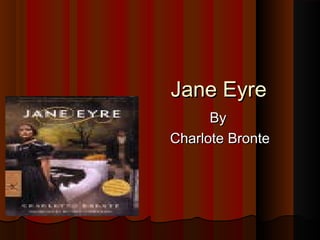
Jane EyreJane Eyre
ByBy
Charlote BronteCharlote Bronte
Charlotte BronteCharlotte Bronte
 Was born of IrishWas born of Irish
ancestry in 1816ancestry in 1816
•Lived at Haworth, a
parsonage
•Mother died of cancer when Charlotte was 5 years old.
C harlotte’s R eligious V iewsC harlotte’s R eligious V iews
 Father, Patrick Bronte,Father, Patrick Bronte,
was an Anglicanwas an Anglican
clergymanclergyman
 Due to her upbringing,Due to her upbringing,
she often wrote aboutshe often wrote about
religious hypocrisyreligious hypocrisy
——those who preachthose who preach
one doctrine but live byone doctrine but live by
anotheranother
T he B ronte S istersT he B ronte S isters
 Charlotte had four sistersCharlotte had four sisters
and one brother.and one brother.
 After their mother’s death,
Brontë and her sisters were
sent to the Clergy
Daughters’ School.
 The food was badThe food was bad
 Discipline was harshDiscipline was harsh
 Disease was rampantDisease was rampant
 Bronte’s two older sistersBronte’s two older sisters
(Maria & Elizabeth) died of(Maria & Elizabeth) died of
tuberculosis.tuberculosis.
TuberculosisTuberculosis
• Tuberculosis was a common killer
during the Victorian era.
• Tuberculosis often destroys its
victims’ lungs, resulting in a
bloody cough.
• If untreated, sufferers may die of
tuberculosis because their lungs
are so badly damaged.
A ll in the F amilyA ll in the F amily
 The Clergy Daughter’s School at Cowan BridgeThe Clergy Daughter’s School at Cowan Bridge
would became the model for Lowood, the fictitiouswould became the model for Lowood, the fictitious
girls’ school ingirls’ school in Jane Eyre.Jane Eyre.
 Charlote’s sisters Anne and Emily Bronte bothCharlote’s sisters Anne and Emily Bronte both
became successful writers.became successful writers.
 In 1846, Charlotte & her sisters started publishingIn 1846, Charlotte & her sisters started publishing
poems and began writing novels:poems and began writing novels:
 The ProfessorThe Professor was Charlotte’s attempt towas Charlotte’s attempt to
fictionalize her love for a college professor shefictionalize her love for a college professor she
had met at Brussels.had met at Brussels.
 In 1847In 1847 Wuthering HeightsWuthering Heights was sister Emily’swas sister Emily’s
first success. Charlotte followed withfirst success. Charlotte followed with JaneJane
Eyre.Eyre.
 Charlotte’s brother, Branwell, was a gifted painter.Charlotte’s brother, Branwell, was a gifted painter.
Emily Bronte
Anne Bronte
Branwell Bronte
Charlotte Bronte
A ll 3 B ronte S isters…A ll 3 B ronte S isters…
 Used a masculine pen name becauseUsed a masculine pen name because
women writers were not taken seriously atwomen writers were not taken seriously at
that time in Victorian England.that time in Victorian England.
 Charlotte used the name Currer Bell.Charlotte used the name Currer Bell.
Marriage B ellsMarriage B ells
 In 1854 CharlotteIn 1854 Charlotte
married her father'smarried her father's
curate, Arthur Bellcurate, Arthur Bell
Nichols.Nichols.
 The next year, sheThe next year, she
became pregnant, thenbecame pregnant, then
ill.ill.
 She died a monthShe died a month
before her 39before her 39thth
birthday.birthday.
T H E N OV E LT H E N OV E L
Jane EyreJane Eyre was published in London in 1847.was published in London in 1847.
Key FactsKey Facts
 All events are told inAll events are told in
the past from Jane’sthe past from Jane’s
point of view.point of view.
 The setting is earlyThe setting is early
1919thth
Century England.Century England.
 Jane EyreJane Eyre isis
classified as both aclassified as both a
Gothic and aGothic and a
Romantic novel.Romantic novel.
Jane EyreJane Eyre
 Our protagonistOur protagonist
 Orphaned as a childOrphaned as a child
 Becomes governess atBecomes governess at
ThornfieldThornfield
 A feisty young child, whoA feisty young child, who
grows into a strong woman.grows into a strong woman.
 Embodies the EnglishEmbodies the English
working-class woman.working-class woman.
 Will marry . . . . ?Will marry . . . . ?
Edward RochesterEdward Rochester
Jane’s boss at ThornfieldJane’s boss at Thornfield
Gruff and rudeGruff and rude
Made wealthy by familyMade wealthy by family
moneymoney
Benefactor to AdBenefactor to Adèèlele
VarensVarens
Very secretive andVery secretive and
sometimes deceitfulsometimes deceitful
Reed FamilyReed Family
 Jane’s family on her father’sJane’s family on her father’s
sideside
 Mrs. Reed is Jane’s cruelMrs. Reed is Jane’s cruel
aunt who sends Jane toaunt who sends Jane to
Lowood; she locks Jane inLowood; she locks Jane in
the “Red Room” forthe “Red Room” for
punishmentpunishment
 John, Eliza, and GeorgianaJohn, Eliza, and Georgiana
are Jane’s spoiled cousins;are Jane’s spoiled cousins;
they are rude and selfish;they are rude and selfish;
they either torment Jane orthey either torment Jane or
ignore herignore her
Rivers FamilyRivers Family
 Jane’s caretakers when sheJane’s caretakers when she
leaves Thornfield – are herleaves Thornfield – are her
cousins on her mother’s side.cousins on her mother’s side.
 St. John – Minister at Morton,St. John – Minister at Morton,
tries to get Jane to be histries to get Jane to be his
missionary wifemissionary wife
 Diana and Mary – kind andDiana and Mary – kind and
independent women, serve asindependent women, serve as
role models for Jane (we onlyrole models for Jane (we only
see one of the sisters [Mary] insee one of the sisters [Mary] in
the movie)the movie)
St. John Rivers
Mrs. FairfaxMrs. Fairfax
 Housekeeper at ThornfieldHousekeeper at Thornfield
 Serves as a mother figure/roleServes as a mother figure/role
model for Janemodel for Jane
 Tells Jane about secrets ofTells Jane about secrets of
Thornfield and the Rochesters.Thornfield and the Rochesters.
Thornfield Manor
Charlotte’s Gothic InfluenceCharlotte’s Gothic Influence
Jane EyreJane Eyre displaysdisplays
some characteristics ofsome characteristics of
thethe gothic novelgothic novel::
Imprisoned womenImprisoned women
A heroine who facesA heroine who faces
dangerdanger
SupernaturalSupernatural
interventions at crucialinterventions at crucial
moments in the plotmoments in the plot
A romantic reconciliationA romantic reconciliation
Jane Eyre’s RomanticJane Eyre’s Romantic
HeritageHeritage
 The RomanticThe Romantic
MovementMovement
 Came into play in at theCame into play in at the
end of the 18end of the 18thth
Century.Century.
 Championed for theChampioned for the
rights of the individualrights of the individual
over the demands ofover the demands of
society.society.
 Believed that humansBelieved that humans
were inherently goodwere inherently good
 Valued imaginationValued imagination
over reasonover reason
 Inspired by natureInspired by nature
IntroductionIntroduction
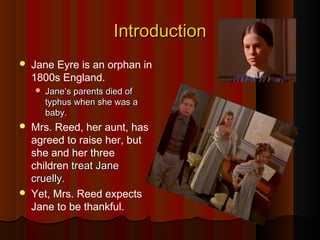
 Jane Eyre is an orphan in
1800s England.
 Jane’s parents died ofJane’s parents died of
typhus when she was atyphus when she was a
baby.baby.
 Mrs. Reed, her aunt, has
agreed to raise her, but
she and her three
children treat Janetreat Jane
cruelcruellly.y.
 Yet, Mrs. Reed expects
Jane to be thankful.
Jane Eyre: IntroductionJane Eyre: Introduction
When Jane tries to
stand up for herself,
her aunt is furious.
She calls Jane an
ungrateful child and
sends her away to a
boarding school
called Lowood.
Jane Eyre: IntroductionJane Eyre: Introduction
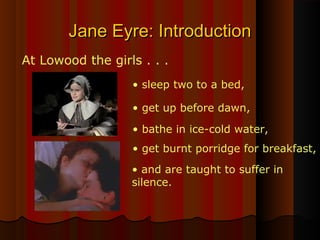
At Lowood the girls . . .
• sleep two to a bed,
• get up before dawn,
• bathe in ice-cold water,
• get burnt porridge for breakfast,
• and are taught to suffer in
silence.
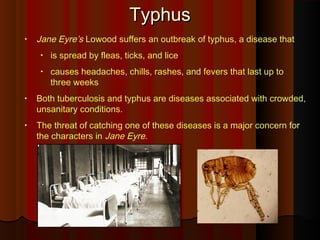
TyphusTyphus
• Jane Eyre’s Lowood suffers an outbreak of typhus, a disease that
• is spread by fleas, ticks, and lice
• causes headaches, chills, rashes, and fevers that last up to
three weeks
• Both tuberculosis and typhus are diseases associated with crowded,
unsanitary conditions.
• The threat of catching one of these diseases is a major concern for
the characters in Jane Eyre.
Life at LowoodLife at Lowood
 The superintendent ofThe superintendent of
Lowood School is Mr.Lowood School is Mr.
Brocklehurst.Brocklehurst.
• Jane immediately makes friendJane immediately makes friend
with a girl called Helen Burns.with a girl called Helen Burns.
• She also admires herShe also admires her headhead
teacher Miss. Templeteacher Miss. Temple..
• As a consequence of badAs a consequence of bad
conditions, typhus breaks out.conditions, typhus breaks out.
Many girls die, including Helen,Many girls die, including Helen,
Jane’s best friendJane’s best friend
• Jane stays at Lowood eightJane stays at Lowood eight
years as a pupil and then twoyears as a pupil and then two
years as a teacher.years as a teacher.
Thornfield HallThornfield Hall
 After posting anAfter posting an
advertisement in a localadvertisement in a local
paper, Jane becomes thepaper, Jane becomes the
private governess atprivate governess at
Thornfield Hall.Thornfield Hall.
 Her pupil is a young FrenchHer pupil is a young French
girl named Adele.girl named Adele.
 Thornfield Hall belongs to aThornfield Hall belongs to a
Mr. RochesterMr. Rochester
 Jane does not meet him forJane does not meet him for
months.months.
 Finally, Mr. RochesterFinally, Mr. Rochester
returns home and staysreturns home and stays
longer than usual atlonger than usual at
Thornfield HallThornfield Hall
R ole of the GovernessR ole of the Governess
o With the new stress on femaleWith the new stress on female
education, governesses wereeducation, governesses were
in demand.in demand.
o Pay was poor, but it was onePay was poor, but it was one
of the only jobs available toof the only jobs available to
educated, yet impoverishededucated, yet impoverished
young women.young women.
o Employers & other servantsEmployers & other servants
often shunned the governessoften shunned the governess
because they felt they werebecause they felt they were
“putting on airs.”“putting on airs.”
o Their employers would oftenTheir employers would often
ignore them, too, because theyignore them, too, because they
had a superior education,had a superior education,
which intimidated many peoplewhich intimidated many people
– especially men.– especially men.
Mysteries . . .Mysteries . . .
 One night at Thornfield, JaneOne night at Thornfield, Jane wakes up and hears evil laughterwakes up and hears evil laughter......
 Who could this be?Who could this be?
 What is going on in Mr. Rochester’s bedroom?What is going on in Mr. Rochester’s bedroom?
 One day Mr. Rochester gives a party for some fine guestsOne day Mr. Rochester gives a party for some fine guests.. InIn
attendance is a Miss. Ingram, a beautiful woman, who adores Mr.attendance is a Miss. Ingram, a beautiful woman, who adores Mr.
RochesterRochester.. During the party a Mr. Mason arrives.During the party a Mr. Mason arrives.
 Who is this mysterious man?Who is this mysterious man?
 What is he doing at Thornfield?What is he doing at Thornfield?
 What will happen to him?What will happen to him?
 One day Jane receives a letter regarding Mrs. Reed, her wicked aunt.One day Jane receives a letter regarding Mrs. Reed, her wicked aunt.
Mrs. Reed is dying and wants to see Jane againMrs. Reed is dying and wants to see Jane again..
 Why would she want to see Jane again?Why would she want to see Jane again?
 What secret does she possess?What secret does she possess?
 When Jane comes back to Thornfield Hall, Mr. Rochester is very happyWhen Jane comes back to Thornfield Hall, Mr. Rochester is very happy
to see her again. He gives Jane the news that he has decided to marry.to see her again. He gives Jane the news that he has decided to marry.
 Who will he marry?Who will he marry?
 Will the wedding actually take place?Will the wedding actually take place?
J ane E yre:J ane E yre:
A Ground B reaking N ovelA Ground B reaking N ovel
• The heroine is small,The heroine is small,
plain, & poorplain, & poor
• The heroine is the firstThe heroine is the first
female character to claimfemale character to claim
the right to feel stronglythe right to feel strongly
about her emotions andabout her emotions and
act on her convictionsact on her convictions
• This romantic ground hadThis romantic ground had
previously been reservedpreviously been reserved
for malesfor males
• Such a psychologicallySuch a psychologically
complex heroine hadcomplex heroine had
never been creatednever been created
beforebefore
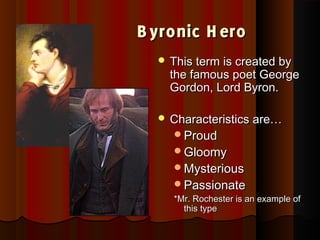
B yronic H eroB yronic H ero
 This term is created byThis term is created by
the famous poet Georgethe famous poet George
Gordon, Lord Byron.Gordon, Lord Byron.
 Characteristics are…Characteristics are…
ProudProud
GloomyGloomy
MysteriousMysterious
PassionatePassionate
*Mr. Rochester is an example of*Mr. Rochester is an example of
this typethis type
LoveLove
Jane is constantly in a search for love.Jane is constantly in a search for love.
She is searches for romantic love inShe is searches for romantic love in
Rochester, motherly love through MissRochester, motherly love through Miss
Temple and Mrs. Fairfax, and friendshipTemple and Mrs. Fairfax, and friendship
through the Rivers siblings, Helen Burns,through the Rivers siblings, Helen Burns,
and Rochester.and Rochester.
Jane’s search for love might stem from theJane’s search for love might stem from the
scorn she felt as a childscorn she felt as a child
Social ClassSocial Class
Jane often feels inadequate compared to many ofJane often feels inadequate compared to many of
the other main characters in the novel.the other main characters in the novel.
Jane feels that her love for Rochester is wrongJane feels that her love for Rochester is wrong
because she isn’t from the same class.because she isn’t from the same class.
Class segregates Jane from her cousins on bothClass segregates Jane from her cousins on both
sides, although it is more obvious on the Reedsides, although it is more obvious on the Reed
side.side.
Blanche Ingram is the class opposite of Jane.Blanche Ingram is the class opposite of Jane.
ReligionReligion
Religion plays a huge role in this novel.Religion plays a huge role in this novel.
Helen Burns taught Jane a view of faith andHelen Burns taught Jane a view of faith and
God that she could understand.God that she could understand.
Mr. Brocklehurst’s Evangelical view hadMr. Brocklehurst’s Evangelical view had
negative effects on Jane, as did St. Johnnegative effects on Jane, as did St. John
River’s Empirical view.River’s Empirical view.
Even the once cruel Eliza Reed joins aEven the once cruel Eliza Reed joins a
French convent.French convent.
Mother FiguresMother Figures
In her search for love, Jane also looks forIn her search for love, Jane also looks for
the mother figure that she missed as athe mother figure that she missed as a
child.child.
Jane finds the characteristics she is lookingJane finds the characteristics she is looking
for in:for in:
• Miss TempleMiss Temple
• Mrs. FairfaxMrs. Fairfax
• Rivers sistersRivers sisters
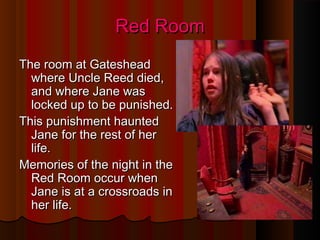
Red RoomRed Room
The room at GatesheadThe room at Gateshead
where Uncle Reed died,where Uncle Reed died,
and where Jane wasand where Jane was
locked up to be punished.locked up to be punished.
This punishment hauntedThis punishment haunted
Jane for the rest of herJane for the rest of her
life.life.
Memories of the night in theMemories of the night in the
Red Room occur whenRed Room occur when
Jane is at a crossroads inJane is at a crossroads in
her life.her life.
This powerpoint was kindly donated to
www.worldofteaching.com
http://www.worldofteaching.com is home to over a
thousand powerpoints submitted by teachers. This is a
completely free site and requires no registration. Please
visit and I hope it will help in your teaching.

Jane Eyre

  • 1.
    Jane EyreJane Eyre ByBy CharloteBronteCharlote Bronte
  • 2.
    Charlotte BronteCharlotte Bronte Was born of IrishWas born of Irish ancestry in 1816ancestry in 1816 •Lived at Haworth, a parsonage •Mother died of cancer when Charlotte was 5 years old.
  • 3.
    C harlotte’s Religious V iewsC harlotte’s R eligious V iews  Father, Patrick Bronte,Father, Patrick Bronte, was an Anglicanwas an Anglican clergymanclergyman  Due to her upbringing,Due to her upbringing, she often wrote aboutshe often wrote about religious hypocrisyreligious hypocrisy ——those who preachthose who preach one doctrine but live byone doctrine but live by anotheranother
  • 4.
    T he Bronte S istersT he B ronte S isters  Charlotte had four sistersCharlotte had four sisters and one brother.and one brother.  After their mother’s death, Brontë and her sisters were sent to the Clergy Daughters’ School.  The food was badThe food was bad  Discipline was harshDiscipline was harsh  Disease was rampantDisease was rampant  Bronte’s two older sistersBronte’s two older sisters (Maria & Elizabeth) died of(Maria & Elizabeth) died of tuberculosis.tuberculosis.
  • 5.
    TuberculosisTuberculosis • Tuberculosis wasa common killer during the Victorian era. • Tuberculosis often destroys its victims’ lungs, resulting in a bloody cough. • If untreated, sufferers may die of tuberculosis because their lungs are so badly damaged.
  • 6.
    A ll inthe F amilyA ll in the F amily  The Clergy Daughter’s School at Cowan BridgeThe Clergy Daughter’s School at Cowan Bridge would became the model for Lowood, the fictitiouswould became the model for Lowood, the fictitious girls’ school ingirls’ school in Jane Eyre.Jane Eyre.  Charlote’s sisters Anne and Emily Bronte bothCharlote’s sisters Anne and Emily Bronte both became successful writers.became successful writers.  In 1846, Charlotte & her sisters started publishingIn 1846, Charlotte & her sisters started publishing poems and began writing novels:poems and began writing novels:  The ProfessorThe Professor was Charlotte’s attempt towas Charlotte’s attempt to fictionalize her love for a college professor shefictionalize her love for a college professor she had met at Brussels.had met at Brussels.  In 1847In 1847 Wuthering HeightsWuthering Heights was sister Emily’swas sister Emily’s first success. Charlotte followed withfirst success. Charlotte followed with JaneJane Eyre.Eyre.  Charlotte’s brother, Branwell, was a gifted painter.Charlotte’s brother, Branwell, was a gifted painter. Emily Bronte Anne Bronte Branwell Bronte Charlotte Bronte
  • 7.
    A ll 3B ronte S isters…A ll 3 B ronte S isters…  Used a masculine pen name becauseUsed a masculine pen name because women writers were not taken seriously atwomen writers were not taken seriously at that time in Victorian England.that time in Victorian England.  Charlotte used the name Currer Bell.Charlotte used the name Currer Bell.
  • 8.
    Marriage B ellsMarriageB ells  In 1854 CharlotteIn 1854 Charlotte married her father'smarried her father's curate, Arthur Bellcurate, Arthur Bell Nichols.Nichols.  The next year, sheThe next year, she became pregnant, thenbecame pregnant, then ill.ill.  She died a monthShe died a month before her 39before her 39thth birthday.birthday.
  • 9.
    T H EN OV E LT H E N OV E L Jane EyreJane Eyre was published in London in 1847.was published in London in 1847.
  • 10.
    Key FactsKey Facts All events are told inAll events are told in the past from Jane’sthe past from Jane’s point of view.point of view.  The setting is earlyThe setting is early 1919thth Century England.Century England.  Jane EyreJane Eyre isis classified as both aclassified as both a Gothic and aGothic and a Romantic novel.Romantic novel.
  • 11.
    Jane EyreJane Eyre Our protagonistOur protagonist  Orphaned as a childOrphaned as a child  Becomes governess atBecomes governess at ThornfieldThornfield  A feisty young child, whoA feisty young child, who grows into a strong woman.grows into a strong woman.  Embodies the EnglishEmbodies the English working-class woman.working-class woman.  Will marry . . . . ?Will marry . . . . ?
  • 12.
    Edward RochesterEdward Rochester Jane’sboss at ThornfieldJane’s boss at Thornfield Gruff and rudeGruff and rude Made wealthy by familyMade wealthy by family moneymoney Benefactor to AdBenefactor to Adèèlele VarensVarens Very secretive andVery secretive and sometimes deceitfulsometimes deceitful
  • 13.
    Reed FamilyReed Family Jane’s family on her father’sJane’s family on her father’s sideside  Mrs. Reed is Jane’s cruelMrs. Reed is Jane’s cruel aunt who sends Jane toaunt who sends Jane to Lowood; she locks Jane inLowood; she locks Jane in the “Red Room” forthe “Red Room” for punishmentpunishment  John, Eliza, and GeorgianaJohn, Eliza, and Georgiana are Jane’s spoiled cousins;are Jane’s spoiled cousins; they are rude and selfish;they are rude and selfish; they either torment Jane orthey either torment Jane or ignore herignore her
  • 14.
    Rivers FamilyRivers Family Jane’s caretakers when sheJane’s caretakers when she leaves Thornfield – are herleaves Thornfield – are her cousins on her mother’s side.cousins on her mother’s side.  St. John – Minister at Morton,St. John – Minister at Morton, tries to get Jane to be histries to get Jane to be his missionary wifemissionary wife  Diana and Mary – kind andDiana and Mary – kind and independent women, serve asindependent women, serve as role models for Jane (we onlyrole models for Jane (we only see one of the sisters [Mary] insee one of the sisters [Mary] in the movie)the movie) St. John Rivers
  • 15.
    Mrs. FairfaxMrs. Fairfax Housekeeper at ThornfieldHousekeeper at Thornfield  Serves as a mother figure/roleServes as a mother figure/role model for Janemodel for Jane  Tells Jane about secrets ofTells Jane about secrets of Thornfield and the Rochesters.Thornfield and the Rochesters. Thornfield Manor
  • 16.
    Charlotte’s Gothic InfluenceCharlotte’sGothic Influence Jane EyreJane Eyre displaysdisplays some characteristics ofsome characteristics of thethe gothic novelgothic novel:: Imprisoned womenImprisoned women A heroine who facesA heroine who faces dangerdanger SupernaturalSupernatural interventions at crucialinterventions at crucial moments in the plotmoments in the plot A romantic reconciliationA romantic reconciliation
  • 17.
    Jane Eyre’s RomanticJaneEyre’s Romantic HeritageHeritage  The RomanticThe Romantic MovementMovement  Came into play in at theCame into play in at the end of the 18end of the 18thth Century.Century.  Championed for theChampioned for the rights of the individualrights of the individual over the demands ofover the demands of society.society.  Believed that humansBelieved that humans were inherently goodwere inherently good  Valued imaginationValued imagination over reasonover reason  Inspired by natureInspired by nature
  • 18.
    IntroductionIntroduction  Jane Eyreis an orphan in 1800s England.  Jane’s parents died ofJane’s parents died of typhus when she was atyphus when she was a baby.baby.  Mrs. Reed, her aunt, has agreed to raise her, but she and her three children treat Janetreat Jane cruelcruellly.y.  Yet, Mrs. Reed expects Jane to be thankful.
  • 19.
    Jane Eyre: IntroductionJaneEyre: Introduction When Jane tries to stand up for herself, her aunt is furious. She calls Jane an ungrateful child and sends her away to a boarding school called Lowood.
  • 20.
    Jane Eyre: IntroductionJaneEyre: Introduction At Lowood the girls . . . • sleep two to a bed, • get up before dawn, • bathe in ice-cold water, • get burnt porridge for breakfast, • and are taught to suffer in silence.
  • 21.
    TyphusTyphus • Jane Eyre’sLowood suffers an outbreak of typhus, a disease that • is spread by fleas, ticks, and lice • causes headaches, chills, rashes, and fevers that last up to three weeks • Both tuberculosis and typhus are diseases associated with crowded, unsanitary conditions. • The threat of catching one of these diseases is a major concern for the characters in Jane Eyre.
  • 22.
    Life at LowoodLifeat Lowood  The superintendent ofThe superintendent of Lowood School is Mr.Lowood School is Mr. Brocklehurst.Brocklehurst. • Jane immediately makes friendJane immediately makes friend with a girl called Helen Burns.with a girl called Helen Burns. • She also admires herShe also admires her headhead teacher Miss. Templeteacher Miss. Temple.. • As a consequence of badAs a consequence of bad conditions, typhus breaks out.conditions, typhus breaks out. Many girls die, including Helen,Many girls die, including Helen, Jane’s best friendJane’s best friend • Jane stays at Lowood eightJane stays at Lowood eight years as a pupil and then twoyears as a pupil and then two years as a teacher.years as a teacher.
  • 23.
    Thornfield HallThornfield Hall After posting anAfter posting an advertisement in a localadvertisement in a local paper, Jane becomes thepaper, Jane becomes the private governess atprivate governess at Thornfield Hall.Thornfield Hall.  Her pupil is a young FrenchHer pupil is a young French girl named Adele.girl named Adele.  Thornfield Hall belongs to aThornfield Hall belongs to a Mr. RochesterMr. Rochester  Jane does not meet him forJane does not meet him for months.months.  Finally, Mr. RochesterFinally, Mr. Rochester returns home and staysreturns home and stays longer than usual atlonger than usual at Thornfield HallThornfield Hall
  • 24.
    R ole ofthe GovernessR ole of the Governess o With the new stress on femaleWith the new stress on female education, governesses wereeducation, governesses were in demand.in demand. o Pay was poor, but it was onePay was poor, but it was one of the only jobs available toof the only jobs available to educated, yet impoverishededucated, yet impoverished young women.young women. o Employers & other servantsEmployers & other servants often shunned the governessoften shunned the governess because they felt they werebecause they felt they were “putting on airs.”“putting on airs.” o Their employers would oftenTheir employers would often ignore them, too, because theyignore them, too, because they had a superior education,had a superior education, which intimidated many peoplewhich intimidated many people – especially men.– especially men.
  • 25.
    Mysteries . ..Mysteries . . .  One night at Thornfield, JaneOne night at Thornfield, Jane wakes up and hears evil laughterwakes up and hears evil laughter......  Who could this be?Who could this be?  What is going on in Mr. Rochester’s bedroom?What is going on in Mr. Rochester’s bedroom?  One day Mr. Rochester gives a party for some fine guestsOne day Mr. Rochester gives a party for some fine guests.. InIn attendance is a Miss. Ingram, a beautiful woman, who adores Mr.attendance is a Miss. Ingram, a beautiful woman, who adores Mr. RochesterRochester.. During the party a Mr. Mason arrives.During the party a Mr. Mason arrives.  Who is this mysterious man?Who is this mysterious man?  What is he doing at Thornfield?What is he doing at Thornfield?  What will happen to him?What will happen to him?  One day Jane receives a letter regarding Mrs. Reed, her wicked aunt.One day Jane receives a letter regarding Mrs. Reed, her wicked aunt. Mrs. Reed is dying and wants to see Jane againMrs. Reed is dying and wants to see Jane again..  Why would she want to see Jane again?Why would she want to see Jane again?  What secret does she possess?What secret does she possess?  When Jane comes back to Thornfield Hall, Mr. Rochester is very happyWhen Jane comes back to Thornfield Hall, Mr. Rochester is very happy to see her again. He gives Jane the news that he has decided to marry.to see her again. He gives Jane the news that he has decided to marry.  Who will he marry?Who will he marry?  Will the wedding actually take place?Will the wedding actually take place?
  • 26.
    J ane Eyre:J ane E yre: A Ground B reaking N ovelA Ground B reaking N ovel • The heroine is small,The heroine is small, plain, & poorplain, & poor • The heroine is the firstThe heroine is the first female character to claimfemale character to claim the right to feel stronglythe right to feel strongly about her emotions andabout her emotions and act on her convictionsact on her convictions • This romantic ground hadThis romantic ground had previously been reservedpreviously been reserved for malesfor males • Such a psychologicallySuch a psychologically complex heroine hadcomplex heroine had never been creatednever been created beforebefore
  • 27.
    B yronic HeroB yronic H ero  This term is created byThis term is created by the famous poet Georgethe famous poet George Gordon, Lord Byron.Gordon, Lord Byron.  Characteristics are…Characteristics are… ProudProud GloomyGloomy MysteriousMysterious PassionatePassionate *Mr. Rochester is an example of*Mr. Rochester is an example of this typethis type
  • 28.
    LoveLove Jane is constantlyin a search for love.Jane is constantly in a search for love. She is searches for romantic love inShe is searches for romantic love in Rochester, motherly love through MissRochester, motherly love through Miss Temple and Mrs. Fairfax, and friendshipTemple and Mrs. Fairfax, and friendship through the Rivers siblings, Helen Burns,through the Rivers siblings, Helen Burns, and Rochester.and Rochester. Jane’s search for love might stem from theJane’s search for love might stem from the scorn she felt as a childscorn she felt as a child
  • 29.
    Social ClassSocial Class Janeoften feels inadequate compared to many ofJane often feels inadequate compared to many of the other main characters in the novel.the other main characters in the novel. Jane feels that her love for Rochester is wrongJane feels that her love for Rochester is wrong because she isn’t from the same class.because she isn’t from the same class. Class segregates Jane from her cousins on bothClass segregates Jane from her cousins on both sides, although it is more obvious on the Reedsides, although it is more obvious on the Reed side.side. Blanche Ingram is the class opposite of Jane.Blanche Ingram is the class opposite of Jane.
  • 30.
    ReligionReligion Religion plays ahuge role in this novel.Religion plays a huge role in this novel. Helen Burns taught Jane a view of faith andHelen Burns taught Jane a view of faith and God that she could understand.God that she could understand. Mr. Brocklehurst’s Evangelical view hadMr. Brocklehurst’s Evangelical view had negative effects on Jane, as did St. Johnnegative effects on Jane, as did St. John River’s Empirical view.River’s Empirical view. Even the once cruel Eliza Reed joins aEven the once cruel Eliza Reed joins a French convent.French convent.
  • 31.
    Mother FiguresMother Figures Inher search for love, Jane also looks forIn her search for love, Jane also looks for the mother figure that she missed as athe mother figure that she missed as a child.child. Jane finds the characteristics she is lookingJane finds the characteristics she is looking for in:for in: • Miss TempleMiss Temple • Mrs. FairfaxMrs. Fairfax • Rivers sistersRivers sisters
  • 32.
    Red RoomRed Room Theroom at GatesheadThe room at Gateshead where Uncle Reed died,where Uncle Reed died, and where Jane wasand where Jane was locked up to be punished.locked up to be punished. This punishment hauntedThis punishment haunted Jane for the rest of herJane for the rest of her life.life. Memories of the night in theMemories of the night in the Red Room occur whenRed Room occur when Jane is at a crossroads inJane is at a crossroads in her life.her life.
  • 33.
    This powerpoint waskindly donated to www.worldofteaching.com http://www.worldofteaching.com is home to over a thousand powerpoints submitted by teachers. This is a completely free site and requires no registration. Please visit and I hope it will help in your teaching.