Eras in
American Literature
Before We Start
  • Fold your paper into 2 columns
  • Topic: Eras in American Literature
  • Label – left column: Q’s, right column:
    Notes
  • Summary box at the bottom
The Puritans, the Rationalists, and the Revolution

     •Captain John Smith, charter member of the Jamestown
     colony, chronicled his new world in a volume known as
     True Relation
        –Typical of the style of writing during the early period of
        America
        –Concerned more with facts than literary style
        –Mostly historical

     •Puritans, band of religious zealots who braved the
     Atlantic to establish a new order in America
        –Believed that each person should seek a direct personal
        relationship with God
        –Strive to live without sin to ensure a path to salvation in the
        afterlife
        –Much of their reading focused on the Bible
        –Writings tend to be nonfiction historical accounts or diaries
        that focused on religious observation
            •Poet Anne Bradstreet
            •Minister Jonathan Edwards
The Puritans, the Rationalists, and the Revolution

     •Captivity stories
        –Tales of settlers being abducted and tortured by native
        Americans
        –Wildly exaggerated, if not completely fabricated
        –Fed the colonists’ desire for exciting tales of an exotic new
        land and their perception of Native Americans as a people to be
        feared.

     •The Age Of Reason
        –Pamphlets and essays influenced popular opinion
        –Complete faith in human intellect
        –Valued reason above all
        –Believed that people were essentially good and capable of
        creating an ideal society
            •The Rationalists
                –Benjamin Franklin
                –Thomas Paine
                –Thomas Jefferson
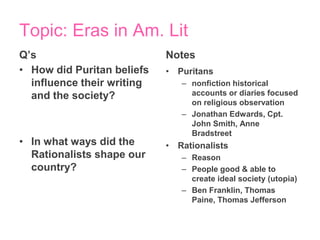
Topic: Eras in Am. Lit
Q’s                         Notes
• How did Puritan beliefs   • Puritans
  influence their writing      – nonfiction historical
  and the society?               accounts or diaries focused
                                 on religious observation
                               – Jonathan Edwards, Cpt.
                                 John Smith, Anne
                                 Bradstreet
• In what ways did the      • Rationalists
  Rationalists shape our       – Reason
  country?                     – People good & able to
                                 create ideal society (utopia)
                               – Ben Franklin, Thomas
                                 Paine, Thomas Jefferson
American Romanticism
 • Rebelled against the ideas of the Age of
   Reason
 • Valued emotion, imagination, and
   intuition
 • Found inspiration in nature
 • The Fireside Poets
   – Henry Wadsworth Longfellow
   – Oliver Wendell Holmes
   – James Russell Lowell
   – John Greenleaf Whittier
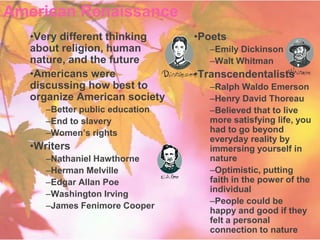
American Renaissance
   •Very different thinking      •Poets
   about religion, human            –Emily Dickinson
   nature, and the future           –Walt Whitman
   •Americans were               •Transcendentalists
   discussing how best to           –Ralph Waldo Emerson
   organize American society        –Henry David Thoreau
      –Better public education      –Believed that to live
      –End to slavery               more satisfying life, you
      –Women’s rights               had to go beyond
                                    everyday reality by
   •Writers                         immersing yourself in
      –Nathaniel Hawthorne          nature
      –Herman Melville              –Optimistic, putting
      –Edgar Allan Poe              faith in the power of the
                                    individual
      –Washington Irving
                                    –People could be
      –James Fenimore Cooper
                                    happy and good if they
                                    felt a personal
                                    connection to nature
Topic: Eras in Am. Lit
Q’s                       Notes
• Why was nature such     •   Romanticism
  an important part of         – Rebelled against
                                 Rationalists
  Romanticism and
                               – Imagination, creativity
  Transcendentalism?
                               – Nature
                               – Longfellow, Holmes,
• Compare Romanticism            Whittier
                          •   Renaissance
  to Transcendentalism.
                               – How to organize society
                               – Hawthorne, Melville, Poe
                          •   Transcendentalists
                               – People could be happy and
                                 good if they felt a personal
                                 connection to nature
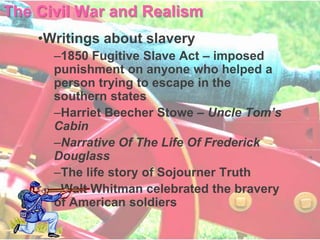
The Civil War and Realism
    •Writings about slavery
      –1850 Fugitive Slave Act – imposed
      punishment on anyone who helped a
      person trying to escape in the
      southern states
      –Harriet Beecher Stowe – Uncle Tom’s
      Cabin
      –Narrative Of The Life Of Frederick
      Douglass
      –The life story of Sojourner Truth
      –Walt Whitman celebrated the bravery
      of American soldiers
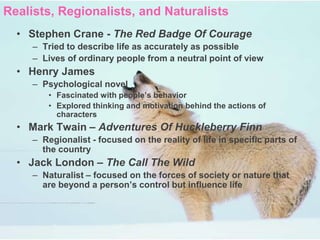
Realists, Regionalists, and Naturalists
  • Stephen Crane - The Red Badge Of Courage
     – Tried to describe life as accurately as possible
     – Lives of ordinary people from a neutral point of view
  • Henry James
     – Psychological novel
         • Fascinated with people’s behavior
         • Explored thinking and motivation behind the actions of
           characters
  • Mark Twain – Adventures Of Huckleberry Finn
     – Regionalist - focused on the reality of life in specific parts of
       the country
  • Jack London – The Call The Wild
     – Naturalist – focused on the forces of society or nature that
       are beyond a person’s control but influence life
Topic: Eras in Am. Lit
Q’s                         Notes
• How did the Civil War     • Civil War
  affect writing?              – Not much significant
                                 literature
                            • Realists, Regionalists,
• Compare and contrasts       and Naturalists
  Realists, Regionalists,      – Focus on reality,
  and Naturalists.               forces of nature, and
                                 people’s behavior.
                               – Jack London
                               – Mark Twain
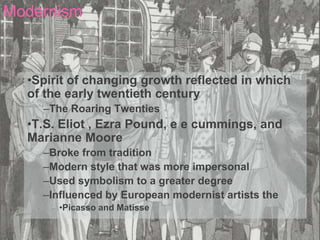
Modernism


  •Spirit of changing growth reflected in which
  of the early twentieth century
    –The Roaring Twenties
  •T.S. Eliot , Ezra Pound, e e cummings, and
  Marianne Moore
    –Broke from tradition
    –Modern style that was more impersonal
    –Used symbolism to a greater degree
    –Influenced by European modernist artists the
       •Picasso and Matisse
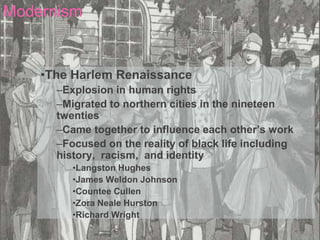
Modernism


    •The Harlem Renaissance
      –Explosion in human rights
      –Migrated to northern cities in the nineteen
      twenties
      –Came together to influence each other’s work
      –Focused on the reality of black life including
      history, racism, and identity
         •Langston Hughes
         •James Weldon Johnson
         •Countee Cullen
         •Zora Neale Hurston
         •Richard Wright
Modernism
•Following the Great                  •Stream of consciousness
Depression, Americans                 writers
                                         –William Faulkner
core beliefs about
                                         –Katherine Anne Porter
themselves in the world                     •Influenced by Freud
began to change                             •Psychology
  –The American Dream                 •Reality of American life
  changed                                –Sinclair Lewis – small town
     •Americans were cynical but         –Ernest Hemingway –
     the government                      disillusionment with
     •Began to question traditional      American ideas
     ways of thinking about              –F. Scott Fitzgerald –
     politics and culture                consequences of living the
                                         American Dream,
                                         questioning societies
                                         definition of success and
                                         progress
                                            •The Great Gatsby
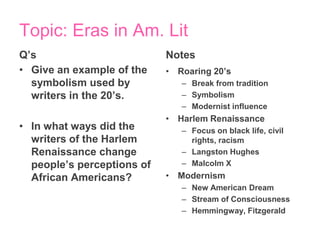
Topic: Eras in Am. Lit
Q’s                         Notes
• Give an example of the    • Roaring 20’s
  symbolism used by            – Break from tradition
  writers in the 20’s.         – Symbolism
                               – Modernist influence
                            • Harlem Renaissance
• In what ways did the         – Focus on black life, civil
  writers of the Harlem          rights, racism
  Renaissance change           – Langston Hughes
  people’s perceptions of      – Malcolm X
  African Americans?        • Modernism
                               – New American Dream
                               – Stream of Consciousness
                               – Hemmingway, Fitzgerald
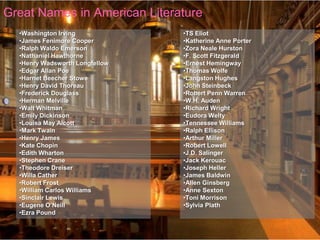
Great Names in American Literature
  •Washington Irving            •TS Eliot
  •James Fenimore Cooper        •Katherine Anne Porter
  •Ralph Waldo Emerson          •Zora Neale Hurston
  •Nathaniel Hawthorne          •F. Scott Fitzgerald
  •Henry Wadsworth Longfellow   •Ernest Hemingway
  •Edgar Allan Poe              •Thomas Wolfe
  •Harriet Beecher Stowe        •Langston Hughes
  •Henry David Thoreau          •John Steinbeck
  •Frederick Douglass           •Robert Penn Warren
  •Herman Melville              •W.H. Auden
  •Walt Whitman                 •Richard Wright
  •Emily Dickinson              •Eudora Welty
  •Louisa May Alcott            •Tennessee Williams
  •Mark Twain                   •Ralph Ellison
  •Henry James                  •Arthur Miller
  •Kate Chopin                  •Robert Lowell
  •Edith Wharton                •J.D. Salinger
  •Stephen Crane                •Jack Kerouac
  •Theodore Dreiser             •Joseph Heller
  •Willa Cather                 •James Baldwin
  •Robert Frost                 •Allen Ginsberg
  •William Carlos Williams      •Anne Sexton
  •Sinclair Lewis               •Toni Morrison
  •Eugene O’Neill               •Sylvia Plath
  •Ezra Pound

Erasinamericanliterature 091116193420-phpapp01

  • 1.
  • 2.
    Before We Start • Fold your paper into 2 columns • Topic: Eras in American Literature • Label – left column: Q’s, right column: Notes • Summary box at the bottom
  • 3.
    The Puritans, theRationalists, and the Revolution •Captain John Smith, charter member of the Jamestown colony, chronicled his new world in a volume known as True Relation –Typical of the style of writing during the early period of America –Concerned more with facts than literary style –Mostly historical •Puritans, band of religious zealots who braved the Atlantic to establish a new order in America –Believed that each person should seek a direct personal relationship with God –Strive to live without sin to ensure a path to salvation in the afterlife –Much of their reading focused on the Bible –Writings tend to be nonfiction historical accounts or diaries that focused on religious observation •Poet Anne Bradstreet •Minister Jonathan Edwards
  • 4.
    The Puritans, theRationalists, and the Revolution •Captivity stories –Tales of settlers being abducted and tortured by native Americans –Wildly exaggerated, if not completely fabricated –Fed the colonists’ desire for exciting tales of an exotic new land and their perception of Native Americans as a people to be feared. •The Age Of Reason –Pamphlets and essays influenced popular opinion –Complete faith in human intellect –Valued reason above all –Believed that people were essentially good and capable of creating an ideal society •The Rationalists –Benjamin Franklin –Thomas Paine –Thomas Jefferson
  • 5.
    Topic: Eras inAm. Lit Q’s Notes • How did Puritan beliefs • Puritans influence their writing – nonfiction historical and the society? accounts or diaries focused on religious observation – Jonathan Edwards, Cpt. John Smith, Anne Bradstreet • In what ways did the • Rationalists Rationalists shape our – Reason country? – People good & able to create ideal society (utopia) – Ben Franklin, Thomas Paine, Thomas Jefferson
  • 6.
    American Romanticism •Rebelled against the ideas of the Age of Reason • Valued emotion, imagination, and intuition • Found inspiration in nature • The Fireside Poets – Henry Wadsworth Longfellow – Oliver Wendell Holmes – James Russell Lowell – John Greenleaf Whittier
  • 7.
    American Renaissance •Very different thinking •Poets about religion, human –Emily Dickinson nature, and the future –Walt Whitman •Americans were •Transcendentalists discussing how best to –Ralph Waldo Emerson organize American society –Henry David Thoreau –Better public education –Believed that to live –End to slavery more satisfying life, you –Women’s rights had to go beyond everyday reality by •Writers immersing yourself in –Nathaniel Hawthorne nature –Herman Melville –Optimistic, putting –Edgar Allan Poe faith in the power of the individual –Washington Irving –People could be –James Fenimore Cooper happy and good if they felt a personal connection to nature
  • 8.
    Topic: Eras inAm. Lit Q’s Notes • Why was nature such • Romanticism an important part of – Rebelled against Rationalists Romanticism and – Imagination, creativity Transcendentalism? – Nature – Longfellow, Holmes, • Compare Romanticism Whittier • Renaissance to Transcendentalism. – How to organize society – Hawthorne, Melville, Poe • Transcendentalists – People could be happy and good if they felt a personal connection to nature
  • 9.
    The Civil Warand Realism •Writings about slavery –1850 Fugitive Slave Act – imposed punishment on anyone who helped a person trying to escape in the southern states –Harriet Beecher Stowe – Uncle Tom’s Cabin –Narrative Of The Life Of Frederick Douglass –The life story of Sojourner Truth –Walt Whitman celebrated the bravery of American soldiers
  • 10.
    Realists, Regionalists, andNaturalists • Stephen Crane - The Red Badge Of Courage – Tried to describe life as accurately as possible – Lives of ordinary people from a neutral point of view • Henry James – Psychological novel • Fascinated with people’s behavior • Explored thinking and motivation behind the actions of characters • Mark Twain – Adventures Of Huckleberry Finn – Regionalist - focused on the reality of life in specific parts of the country • Jack London – The Call The Wild – Naturalist – focused on the forces of society or nature that are beyond a person’s control but influence life
  • 11.
    Topic: Eras inAm. Lit Q’s Notes • How did the Civil War • Civil War affect writing? – Not much significant literature • Realists, Regionalists, • Compare and contrasts and Naturalists Realists, Regionalists, – Focus on reality, and Naturalists. forces of nature, and people’s behavior. – Jack London – Mark Twain
  • 12.
    Modernism •Spiritof changing growth reflected in which of the early twentieth century –The Roaring Twenties •T.S. Eliot , Ezra Pound, e e cummings, and Marianne Moore –Broke from tradition –Modern style that was more impersonal –Used symbolism to a greater degree –Influenced by European modernist artists the •Picasso and Matisse
  • 13.
    Modernism •The Harlem Renaissance –Explosion in human rights –Migrated to northern cities in the nineteen twenties –Came together to influence each other’s work –Focused on the reality of black life including history, racism, and identity •Langston Hughes •James Weldon Johnson •Countee Cullen •Zora Neale Hurston •Richard Wright
  • 14.
    Modernism •Following the Great •Stream of consciousness Depression, Americans writers –William Faulkner core beliefs about –Katherine Anne Porter themselves in the world •Influenced by Freud began to change •Psychology –The American Dream •Reality of American life changed –Sinclair Lewis – small town •Americans were cynical but –Ernest Hemingway – the government disillusionment with •Began to question traditional American ideas ways of thinking about –F. Scott Fitzgerald – politics and culture consequences of living the American Dream, questioning societies definition of success and progress •The Great Gatsby
  • 15.
    Topic: Eras inAm. Lit Q’s Notes • Give an example of the • Roaring 20’s symbolism used by – Break from tradition writers in the 20’s. – Symbolism – Modernist influence • Harlem Renaissance • In what ways did the – Focus on black life, civil writers of the Harlem rights, racism Renaissance change – Langston Hughes people’s perceptions of – Malcolm X African Americans? • Modernism – New American Dream – Stream of Consciousness – Hemmingway, Fitzgerald
  • 16.
    Great Names inAmerican Literature •Washington Irving •TS Eliot •James Fenimore Cooper •Katherine Anne Porter •Ralph Waldo Emerson •Zora Neale Hurston •Nathaniel Hawthorne •F. Scott Fitzgerald •Henry Wadsworth Longfellow •Ernest Hemingway •Edgar Allan Poe •Thomas Wolfe •Harriet Beecher Stowe •Langston Hughes •Henry David Thoreau •John Steinbeck •Frederick Douglass •Robert Penn Warren •Herman Melville •W.H. Auden •Walt Whitman •Richard Wright •Emily Dickinson •Eudora Welty •Louisa May Alcott •Tennessee Williams •Mark Twain •Ralph Ellison •Henry James •Arthur Miller •Kate Chopin •Robert Lowell •Edith Wharton •J.D. Salinger •Stephen Crane •Jack Kerouac •Theodore Dreiser •Joseph Heller •Willa Cather •James Baldwin •Robert Frost •Allen Ginsberg •William Carlos Williams •Anne Sexton •Sinclair Lewis •Toni Morrison •Eugene O’Neill •Sylvia Plath •Ezra Pound