Solar Water
 Heating
  System

        Presented By:
       BHANU PRATAP
     CIVIL ENGINEERING
           3rd Year
INTRODUCTION
• India is blessed with solar energy in abundance at no
  cost.

• India is having high solar insolation of 46.5
  KWh/sq.m/day for an average of 280 sunny days and
  most of that resource has been left untapped.

• One of the popular cost-effective devices that harness
  the solar energy is Solar Water Heating System (SWHS).

• SWHS heating system is a commercially viable and
  technologically mature product, is existing in country for
  many years with enormous potential.
HISTORY
• There are records of solar collectors in the United States
  dating back to before 1900, comprising a black-painted
  tank mounted on a roof.

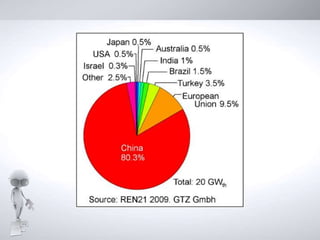
• SWHS has been widely used in
  Greece, Turkey, Israel, Australia, Japan, Austria and
  China.

• Israel is a country, where solar water heaters are being
  used since 1950s.

• There was a fuel crisis and restrictions were imposed on
  heating water using fossil fuel.

• Since then the Israelis are accustomed with heating
  water using SWHS. In 1980, the Parliament of Israel
  introduced a law on mandatory solar heating for new
  residential buildings
Scope in India

•   India has a varying climate extending from extreme to moderate
    due to its unique geographical features.

•   Normally in the countryside, wood or biomass is used for
    heating and in urban areas electricity or fossil fuels are used for
    this purpose. This practice is either expensive or degrades the
    environment.

•   Therefore, solar water heating system can be a suitable
    alternative to meet the growing demand of hot water in the
    country without exerting further pressure on electricity or cutting
    of forest trees from the forest areas. The SWHS has the
    potential to save millions in energy costs in our country.
Steps Taken By Indian Government
    •   Ministry of New and Renewable Energy
        (MNRE), government of India and some state-level agencies
        have formulated many schemes for promotion of SWHS.

    •   There are also provisions of providing soft loans under the
        interest subsidy scheme through a network of financial
        institutions and tax benefits on all investments in solar
        energy technologies.

    •   The Bureau of Energy Efficiency (BEE) as per provision of
        the Energy conservation Act 2001 has prescribed guidelines
        for Energy Conservation Buildings Code (ECBC), which sets
        minimum energy standards for design and construction of
        buildings. SWHS is one of the components covered under
        ECBC to enhance energy performance of the buildings.

    •   With the objective of contributing to India’s Energy security
        and sustainable development, the Prime Minister has
        launched Jawaharlal Nehru National Solar Mission (JNNSM)
        in January 2010. The objective of the mission is to establish
        India as a global leader in solar energy.
Uses of Solar Water Heating System


   • Bathing.

   • Laundry application in hotels, hospitals, hostels.

   • Cooking (Pre-Heating of water helps in
     reduction of use of fuel).

   • Various industrial applications.
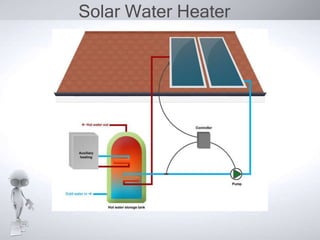
Solar Water Heater
Contd.,


     • A solar water heater consists of a collector to
     collect solar energy and an insulated storage tank
     to store hot water. The total system with solar
     collector, storage tank and pipelines is called
     solar hot water system.

     • The solar water heating systems are of two
     categories:
       1) Closed loop system.
       2) Open loop system.
Contd.,


          • In the closed loop system, heat exchangers
          are installed to protect the system from hard
          water obtained from bore wells or freezing
          temperatures in the cold regions. The open
          loop system has two categories –

          1) Thermosyphon.

          2) Forced circulation system.
Contd.,


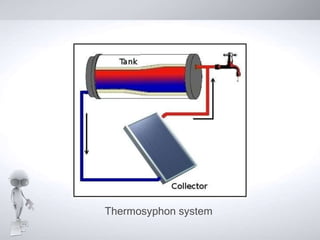
          •Thermosyphon systems are simple and relatively
          inexpensive.

          •The forced circulation systems employ electrical
          pumps to circulate the water through collectors
          and storage tanks.

          •The choice of system depends on heat
          requirement weather conditions, heat transfer fluid
          quality, space availability, annual solar radiation
          etc.
Thermosyphon system
Conclusion
• There is a serious need to sensitize policy makers and
users in the residential and commercial sectors on the
efficacy of SWHS.

• There is a perception that SWHS is more suited for
independent houses rather than apartment buildings. But
the later would ideally have more roof space for an ideal
and attractive SWHS.

•The manufacturer and supplier base of the system has
to be strengthened, so that, they can also create
awareness among potential users of SWHS.
Questions And Quarries
Thank you~!!

Solar Water Heating System

  • 1.
    Solar Water Heating System Presented By: BHANU PRATAP CIVIL ENGINEERING 3rd Year
  • 2.
    INTRODUCTION • India isblessed with solar energy in abundance at no cost. • India is having high solar insolation of 46.5 KWh/sq.m/day for an average of 280 sunny days and most of that resource has been left untapped. • One of the popular cost-effective devices that harness the solar energy is Solar Water Heating System (SWHS). • SWHS heating system is a commercially viable and technologically mature product, is existing in country for many years with enormous potential.
  • 3.
    HISTORY • There arerecords of solar collectors in the United States dating back to before 1900, comprising a black-painted tank mounted on a roof. • SWHS has been widely used in Greece, Turkey, Israel, Australia, Japan, Austria and China. • Israel is a country, where solar water heaters are being used since 1950s. • There was a fuel crisis and restrictions were imposed on heating water using fossil fuel. • Since then the Israelis are accustomed with heating water using SWHS. In 1980, the Parliament of Israel introduced a law on mandatory solar heating for new residential buildings
  • 5.
    Scope in India • India has a varying climate extending from extreme to moderate due to its unique geographical features. • Normally in the countryside, wood or biomass is used for heating and in urban areas electricity or fossil fuels are used for this purpose. This practice is either expensive or degrades the environment. • Therefore, solar water heating system can be a suitable alternative to meet the growing demand of hot water in the country without exerting further pressure on electricity or cutting of forest trees from the forest areas. The SWHS has the potential to save millions in energy costs in our country.
  • 6.
    Steps Taken ByIndian Government • Ministry of New and Renewable Energy (MNRE), government of India and some state-level agencies have formulated many schemes for promotion of SWHS. • There are also provisions of providing soft loans under the interest subsidy scheme through a network of financial institutions and tax benefits on all investments in solar energy technologies. • The Bureau of Energy Efficiency (BEE) as per provision of the Energy conservation Act 2001 has prescribed guidelines for Energy Conservation Buildings Code (ECBC), which sets minimum energy standards for design and construction of buildings. SWHS is one of the components covered under ECBC to enhance energy performance of the buildings. • With the objective of contributing to India’s Energy security and sustainable development, the Prime Minister has launched Jawaharlal Nehru National Solar Mission (JNNSM) in January 2010. The objective of the mission is to establish India as a global leader in solar energy.
  • 7.
    Uses of SolarWater Heating System • Bathing. • Laundry application in hotels, hospitals, hostels. • Cooking (Pre-Heating of water helps in reduction of use of fuel). • Various industrial applications.
  • 8.
  • 9.
    Contd., • A solar water heater consists of a collector to collect solar energy and an insulated storage tank to store hot water. The total system with solar collector, storage tank and pipelines is called solar hot water system. • The solar water heating systems are of two categories: 1) Closed loop system. 2) Open loop system.
  • 10.
    Contd., • In the closed loop system, heat exchangers are installed to protect the system from hard water obtained from bore wells or freezing temperatures in the cold regions. The open loop system has two categories – 1) Thermosyphon. 2) Forced circulation system.
  • 11.
    Contd., •Thermosyphon systems are simple and relatively inexpensive. •The forced circulation systems employ electrical pumps to circulate the water through collectors and storage tanks. •The choice of system depends on heat requirement weather conditions, heat transfer fluid quality, space availability, annual solar radiation etc.
  • 12.
  • 13.
    Conclusion • There isa serious need to sensitize policy makers and users in the residential and commercial sectors on the efficacy of SWHS. • There is a perception that SWHS is more suited for independent houses rather than apartment buildings. But the later would ideally have more roof space for an ideal and attractive SWHS. •The manufacturer and supplier base of the system has to be strengthened, so that, they can also create awareness among potential users of SWHS.
  • 14.
  • 15.