Bilateral Inferior Altitudinal
Visual Field Defect in Recurrent
Intracranial Meningioma
A Case Study:
FLOW OF
PRESENTATION
Introduction
Case presentation
Discussion
Conclusion
1
2
3
4
Altitudinal field defect : Loss of all or part of the superior or inferior half of
the visual field; does not cross the horizontal
Introduction
 More common: Ischemic optic neuropathy, hemicentral retinal artery occlusion, retinal detachment
 Less common: Glaucoma, optic nerve lesion
Altitudinal visual field defect is a rare presentation of retro chiasmal lesion especially
when bilateral visual fields were affected. In fact, Bilateral inferior altitudinal visual
field defect (BIAVFD) usually occurs in patients who survived a gunshot injury to the
occipital lobe or as a direct trauma to the brain.
We report a rare case of BIAVFD secondary to occipital meningioma.
Meningioma is a primary intracranial neoplasm that arises from the meningothelial cells of the
arachnoid layer which surrounds the spinal cord and the brain . The most common location for meningioma to
arise is within the cerebellar meninges that accounts for almost 90% of the cases. Patients with meningioma
usually demonstrate symptoms of generalized headache, dizziness, seizure, deterioration of cognitive and motor
function, and visual disturbances .
Bilateral inferior altitudinal visual field defect (BIAVFD)
or inferior hemianopsia is a rare presentation of a retro chiasmal pathology. It is mainly
associated with retinal lesion (choroiditis and coloboma) or optic nerve lesion (glaucoma, optic disc drusen
and optic nerve hypoplasia) in which all of these mainly affect structures anterior to the optic chiasm.
Nonetheless, the current report involved a case in which we observed a patient with
occipital meningioma presenting with bilateral inferior altitudinal hemianopsia.
Case presentation
A 52-year-old gentleman presented with generalized headache, and blurring of vision manners for
one-year duration. He described his headache was throbbing in nature and progressed to be
persistent throughout the day. There was no aura and no preceding history of seizure. He also
started to have unsteady walking patterns, followed by blurring of vision especially at downgaze.
He had no known underlying medical illness. He denied of any history of head trauma or fall. There
was no memory loss or personality changes. He was recently diagnosed to have ischemic heart
disease via stress test.
At presentation, he was alert and conscious with stable vital signs. Visual acuity was 6/6 on both
eyes. Optic nerve function tests were normal with no relative apparent pupillary defect. The anterior
and posterior segment examination was unremarkable. Surprisingly, both optic disc appeared
normal with cup-disc ratio of 0.3, and no signs of papilloedema or optic nerve atrophy seen.
Extraocular muscles movement were full in all directions. The only positive finding was the
confrontational test revealed a left lower homonymous quadrantanopia. Which is a visual
loss that is restricted to one quadrant of the visual field. Other than that, the systemic review
and neurological examination were normal.
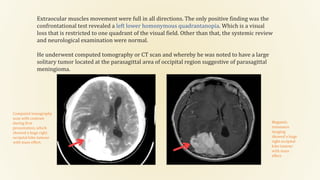
He underwent computed tomography or CT scan and whereby he was noted to have a large
solitary tumor located at the parasagittal area of occipital region suggestive of parasagittal
meningioma.
Computed tomography
scan with contrast
during first
presentation, which
showed a huge right
occipital lobe tumour
with mass effect.
Magnetic
resonance
imaging
showed a huge
right occipital
lobe tumour
with mass
effect.
Surveillance MRI after one year of post-surgery revealed a
residual tumour at the right occipital area with another new
tumour growth at the left occipital area. He was then
subjected to radiotherapy treatment. However, a second
craniotomy with excision of tumour surgery was performed
at the second year of follow-up after radiotherapy failed to
shrink the tumour. Prior to his second surgery, his visual
field started to deteriorate whereby he was unable to gauge
the down going staircases.
During his ophthalmological follow-up, his visual acuity was
still good with 6/7.5 on both eyes.
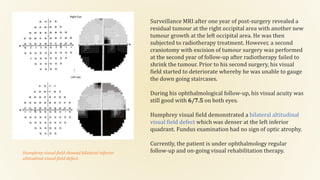
Humphrey visual field demonstrated a bilateral altitudinal
visual field defect which was denser at the left inferior
quadrant. Fundus examination had no sign of optic atrophy.
Currently, the patient is under ophthalmology regular
follow-up and on-going visual rehabilitation therapy.
Humphrey visual field showed bilateral inferior
altitudinal visual field defect.
Discussion
Meningioma presents with an incidence rate of 8.33 per 100,000 populations in the United
States, which is four times higher than the incidence rate of all the brain and other nervous
systems tumors in Malaysia. Meningioma is commonly seen in female by the ratio of 2:1 and it
mainly affects the elderly. Majority of meningioma are benign solitary tumour, but vary in
location and size, which determine the surgical options and post-operative complications.
Furthermore, these factors also have led to the diversity of clinical manifestations and masked
the disease's severity until the presentation was late, similar to our case report.
Even though meningioma has a high survival rate (81.5% survival rate in 10 years), patients may
develop an aftereffect either due to its mass effect or as a manifestation of post-operative surgical
complications. In a study, intracranial meningioma may also exert neurocognitive deterioration in
which many of their subjects developed a reduction in scores in cognitive function such as memory,
attention, visuospatial function and fine motor performance. However, the most debilitating
aftereffects that can occur is when the visual function is impaired. In such condition, not only the
patients’ quality of life is affected, but they may also succumb to major depressive disorder and
suicidal ideation.
Bilateral inferior altitudinal visual field defect or BIAVFD is one of the presentations of
occipital lobe lesion, which can be due to penetrating injury such as a bullet or as direct trauma to
this area. Such presentation occurs when there is a direct insult towards bilateral occipital lobe
which lies above the calcarine fissure. This type of visual field defect may also be caused
by cerebrovascular accidents of the posterior circulation, which supplies the inferior portion of the
occipital lobe. Contrary to this, BIAVFD in our patient occurred due to the recurrent meningioma
that involved bilateral occipital lobe superior to the calcarine fissure.
In our patient, the progression of the diseases was slow but severe, and due to this, his quality of
life was affected even though he has 6/6 vision at both eyes.
In patients with BIAVFD, this is an expected situation faced by those bearing this disease as they
will have difficulty in reading, climbing stairs or even estimating distance while walking. Frequent
stumbling and falling in elderly patients will be dangerous and this can lead to fractures and
morbidity.
Previously, the management of BIAVFD was mainly conservative and the patient has
to bear the visual field defect and limit his daily life activities. With the advent of
visual rehabilitation, there has been two approaches for management of visual field
defect in patients. First is by implementing compensatory strategies such as
prisms or saccadic training which can improve the ability to scan object within a
visual field defect. Even though this strategy was believed to improve reading speed,
it has little benefit in patients with BIAVFD and might be dangerous especially when
implementing prism.
While the second strategy is by restitution therapy in which such techniques can
enlarge the visual field by using a home-based vision restoration therapy (VRT).
This VRT stimulates the border zone between the seeing and the blind field
repetitively on a daily basis over many months. By stimulating the retina, this
rehabilitation therapy has improved up to 5 degrees in central vision for retro-
chiasmal pathology. Such excellent improvement can definitely improve patients’
daily life activities and avoidance of injury due to visual field defects.
Conclusion
In retro-chiasmal lesion, Bilateral inferior altitudinal visual field defect or
BIAVFD can be atypical manifestation of occipital meningioma when both of the
occipital lobes were affected.
“ High index of suspicion with timely diagnosis and prompt treatment ” is
the best management for better survival outcome. It is necessary for all team that
facilitates the management of this patient to offer rehabilitative measures to
patients that have any form of visual field defect.
Reference:
Ghanimi Zamli, A. K., Chew-Ean, T., & Wan Hitam, W. H. (2019). Bilateral Inferior Altitudinal Visual Field Defect
in Recurrent Intracranial Meningioma: A Case Report. Cureus, 11(4), e4436. https://doi.org/10.7759/cureus.4436
Thank you for listening! 
Thank you
Thank you

Altitudinal Visual Field Defect.pptx

  • 1.
    Bilateral Inferior Altitudinal VisualField Defect in Recurrent Intracranial Meningioma A Case Study:
  • 2.
  • 3.
    Altitudinal field defect: Loss of all or part of the superior or inferior half of the visual field; does not cross the horizontal Introduction  More common: Ischemic optic neuropathy, hemicentral retinal artery occlusion, retinal detachment  Less common: Glaucoma, optic nerve lesion Altitudinal visual field defect is a rare presentation of retro chiasmal lesion especially when bilateral visual fields were affected. In fact, Bilateral inferior altitudinal visual field defect (BIAVFD) usually occurs in patients who survived a gunshot injury to the occipital lobe or as a direct trauma to the brain. We report a rare case of BIAVFD secondary to occipital meningioma.
  • 4.
    Meningioma is aprimary intracranial neoplasm that arises from the meningothelial cells of the arachnoid layer which surrounds the spinal cord and the brain . The most common location for meningioma to arise is within the cerebellar meninges that accounts for almost 90% of the cases. Patients with meningioma usually demonstrate symptoms of generalized headache, dizziness, seizure, deterioration of cognitive and motor function, and visual disturbances . Bilateral inferior altitudinal visual field defect (BIAVFD) or inferior hemianopsia is a rare presentation of a retro chiasmal pathology. It is mainly associated with retinal lesion (choroiditis and coloboma) or optic nerve lesion (glaucoma, optic disc drusen and optic nerve hypoplasia) in which all of these mainly affect structures anterior to the optic chiasm. Nonetheless, the current report involved a case in which we observed a patient with occipital meningioma presenting with bilateral inferior altitudinal hemianopsia.
  • 5.
    Case presentation A 52-year-oldgentleman presented with generalized headache, and blurring of vision manners for one-year duration. He described his headache was throbbing in nature and progressed to be persistent throughout the day. There was no aura and no preceding history of seizure. He also started to have unsteady walking patterns, followed by blurring of vision especially at downgaze. He had no known underlying medical illness. He denied of any history of head trauma or fall. There was no memory loss or personality changes. He was recently diagnosed to have ischemic heart disease via stress test. At presentation, he was alert and conscious with stable vital signs. Visual acuity was 6/6 on both eyes. Optic nerve function tests were normal with no relative apparent pupillary defect. The anterior and posterior segment examination was unremarkable. Surprisingly, both optic disc appeared normal with cup-disc ratio of 0.3, and no signs of papilloedema or optic nerve atrophy seen.
  • 6.
    Extraocular muscles movementwere full in all directions. The only positive finding was the confrontational test revealed a left lower homonymous quadrantanopia. Which is a visual loss that is restricted to one quadrant of the visual field. Other than that, the systemic review and neurological examination were normal. He underwent computed tomography or CT scan and whereby he was noted to have a large solitary tumor located at the parasagittal area of occipital region suggestive of parasagittal meningioma. Computed tomography scan with contrast during first presentation, which showed a huge right occipital lobe tumour with mass effect. Magnetic resonance imaging showed a huge right occipital lobe tumour with mass effect.
  • 7.
    Surveillance MRI afterone year of post-surgery revealed a residual tumour at the right occipital area with another new tumour growth at the left occipital area. He was then subjected to radiotherapy treatment. However, a second craniotomy with excision of tumour surgery was performed at the second year of follow-up after radiotherapy failed to shrink the tumour. Prior to his second surgery, his visual field started to deteriorate whereby he was unable to gauge the down going staircases. During his ophthalmological follow-up, his visual acuity was still good with 6/7.5 on both eyes. Humphrey visual field demonstrated a bilateral altitudinal visual field defect which was denser at the left inferior quadrant. Fundus examination had no sign of optic atrophy. Currently, the patient is under ophthalmology regular follow-up and on-going visual rehabilitation therapy. Humphrey visual field showed bilateral inferior altitudinal visual field defect.
  • 8.
    Discussion Meningioma presents withan incidence rate of 8.33 per 100,000 populations in the United States, which is four times higher than the incidence rate of all the brain and other nervous systems tumors in Malaysia. Meningioma is commonly seen in female by the ratio of 2:1 and it mainly affects the elderly. Majority of meningioma are benign solitary tumour, but vary in location and size, which determine the surgical options and post-operative complications. Furthermore, these factors also have led to the diversity of clinical manifestations and masked the disease's severity until the presentation was late, similar to our case report. Even though meningioma has a high survival rate (81.5% survival rate in 10 years), patients may develop an aftereffect either due to its mass effect or as a manifestation of post-operative surgical complications. In a study, intracranial meningioma may also exert neurocognitive deterioration in which many of their subjects developed a reduction in scores in cognitive function such as memory, attention, visuospatial function and fine motor performance. However, the most debilitating aftereffects that can occur is when the visual function is impaired. In such condition, not only the patients’ quality of life is affected, but they may also succumb to major depressive disorder and suicidal ideation.
  • 9.
    Bilateral inferior altitudinalvisual field defect or BIAVFD is one of the presentations of occipital lobe lesion, which can be due to penetrating injury such as a bullet or as direct trauma to this area. Such presentation occurs when there is a direct insult towards bilateral occipital lobe which lies above the calcarine fissure. This type of visual field defect may also be caused by cerebrovascular accidents of the posterior circulation, which supplies the inferior portion of the occipital lobe. Contrary to this, BIAVFD in our patient occurred due to the recurrent meningioma that involved bilateral occipital lobe superior to the calcarine fissure. In our patient, the progression of the diseases was slow but severe, and due to this, his quality of life was affected even though he has 6/6 vision at both eyes. In patients with BIAVFD, this is an expected situation faced by those bearing this disease as they will have difficulty in reading, climbing stairs or even estimating distance while walking. Frequent stumbling and falling in elderly patients will be dangerous and this can lead to fractures and morbidity.
  • 10.
    Previously, the managementof BIAVFD was mainly conservative and the patient has to bear the visual field defect and limit his daily life activities. With the advent of visual rehabilitation, there has been two approaches for management of visual field defect in patients. First is by implementing compensatory strategies such as prisms or saccadic training which can improve the ability to scan object within a visual field defect. Even though this strategy was believed to improve reading speed, it has little benefit in patients with BIAVFD and might be dangerous especially when implementing prism. While the second strategy is by restitution therapy in which such techniques can enlarge the visual field by using a home-based vision restoration therapy (VRT). This VRT stimulates the border zone between the seeing and the blind field repetitively on a daily basis over many months. By stimulating the retina, this rehabilitation therapy has improved up to 5 degrees in central vision for retro- chiasmal pathology. Such excellent improvement can definitely improve patients’ daily life activities and avoidance of injury due to visual field defects.
  • 11.
    Conclusion In retro-chiasmal lesion,Bilateral inferior altitudinal visual field defect or BIAVFD can be atypical manifestation of occipital meningioma when both of the occipital lobes were affected. “ High index of suspicion with timely diagnosis and prompt treatment ” is the best management for better survival outcome. It is necessary for all team that facilitates the management of this patient to offer rehabilitative measures to patients that have any form of visual field defect.
  • 12.
    Reference: Ghanimi Zamli, A.K., Chew-Ean, T., & Wan Hitam, W. H. (2019). Bilateral Inferior Altitudinal Visual Field Defect in Recurrent Intracranial Meningioma: A Case Report. Cureus, 11(4), e4436. https://doi.org/10.7759/cureus.4436 Thank you for listening!  Thank you Thank you