Connect People Everywhere
Presented by-
Amir Sidik(1554510014)
Asma(1554510005)
Daniya Khan(1554510006)
Saleha Mariyam(1554510029)
Under the guidance of-
Mr. Ankur Srivastava
Content
 Introduction
 What is project loon?
 How it works?
 Technology used
 Components
 Architecture
 Advantages and disadvantages
 Scope
 Conclusion
Balloons??
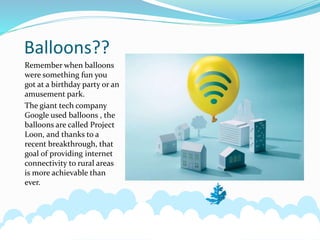
Remember when balloons
were something fun you
got at a birthday party or an
amusement park.
The giant tech company
Google used balloons , the
balloons are called Project
Loon, and thanks to a
recent breakthrough, that
goal of providing internet
connectivity to rural areas
is more achievable than
ever.
Introduction
 Project Loon is a research and development project being
developed by Google with the mission of providing Internet
access to rural and remote areas.
 The company uses high-altitude balloons placed in the
stratosphere at an altitude of about 18 km (11 mi) to create
an aerial wireless network with up to 4G-LTE speeds
 Balloon is a flexible bag filled with air or gas.
 Balloon is also considerably used to gather weather
information such as atmospheric pressure, temperature,
humidity and wind speed.
 It allows people to communicate with others as well.
Balloon Launching in New Zealand
What is project Loon?
 History
In 2008, Google had considered contracting with or
acquiring Space Data Corp., a company that sends balloons
carrying small base stations about 20 miles (32 km) up in
the air for providing connectivity to truckers and oil
companies in the southern United States, but didn't do so.
Unofficial development on the project began in 2011 under
incubation in Google X with a series of trial runs in
California's Central Valley. The project was officially
announced as a Google project on 14 June 2013.
Continue
 On 16 June 2013,google began a pilot experiment in the New
Zealand where about 30 balloons were launched in
coordination with the civil aviation Authority from the
Tekapo area in the south island.
 About 50 local users in around Christchurch and the
Canterbury Region tested connections to aerial network
using special antennas.
How it works?
 Each super-pressure balloon is massive with a whopping 15-
meter diameter.
 It is made of very thin, very light polyethylene plastic
though, so it lifts up the sky easily.
 It is strong enough to lift the flight computer and other
electronics. All these are powered by a solar power panel.
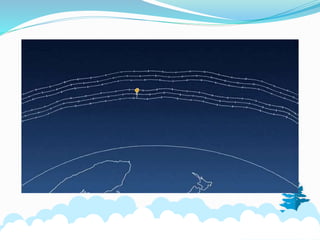
 The balloons are maneuvered by adjusting their altitude to
float to a wind layer after identifying the wind layer with the
desired speed and direction.
How Loon moves?
Technology used
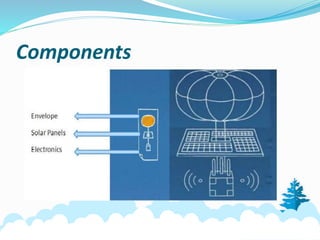
 Balloons envelope are composed of polyethylene plastic
about 0.076 mm (0.0030 in) thick.
 The small box (payload) hangs below the envelope, and
looks very similar to the basket in a hot air balloon.
 They carry a custom air pump system that pumps in or
releases air to ballast the balloon and control its elevation.
 It holds electronic devices, such as circuit boards, radio
antenaas,solar panels,battries,GPS and devices to monitor
weather conditions.
 The circuit boards control the overall balloon system and
radio antennas are for communications.
Components
Architecture
Advantages of project Loon
 Lower Cost
 Availability of Information
 Education
 Health and Medicine
 Use of Renewable Energy
 Weather Surveillance
 Collaboration
Disadvantages of project Loon
 Hardware Failure
 Internet privacy
 Not a replacement of satellite communication
 International politics
Scope
 The technology designed in the project could allow
countries to avoid using expensive fiber cable that
would have to be installed underground to allow users
to connect to the Internet.
 While Loon looks and sounds a bit like alien
technology, it will likely become a very real part of our
future.
Conclusion
 Project Loon is an ambitious project and the world
will highly benefit from it.
 Project Loon, an initiative to help fill in those
internet gaps through the use of networked
balloons.
 The goal is to provide broadband-like internet for
the two-thirds of the world that does not have
access to a reliable internet connection by balloon.
 It is still in experimental phase.
Bibliography
 https://uk.norton.com/norton-
blog/2015/10/is_google_s_project.html
 https://en.wikipedia.org/wiki/Loon_(company)#Tech
nology
 https://loon.co/
 https://www.wired.com/2013/08/googlex-project-
loon/
Thank you

Seminaar project loon

  • 1.
    Connect People Everywhere Presentedby- Amir Sidik(1554510014) Asma(1554510005) Daniya Khan(1554510006) Saleha Mariyam(1554510029) Under the guidance of- Mr. Ankur Srivastava
  • 2.
    Content  Introduction  Whatis project loon?  How it works?  Technology used  Components  Architecture  Advantages and disadvantages  Scope  Conclusion
  • 3.
    Balloons?? Remember when balloons weresomething fun you got at a birthday party or an amusement park. The giant tech company Google used balloons , the balloons are called Project Loon, and thanks to a recent breakthrough, that goal of providing internet connectivity to rural areas is more achievable than ever.
  • 5.
    Introduction  Project Loonis a research and development project being developed by Google with the mission of providing Internet access to rural and remote areas.  The company uses high-altitude balloons placed in the stratosphere at an altitude of about 18 km (11 mi) to create an aerial wireless network with up to 4G-LTE speeds  Balloon is a flexible bag filled with air or gas.  Balloon is also considerably used to gather weather information such as atmospheric pressure, temperature, humidity and wind speed.  It allows people to communicate with others as well.
  • 6.
  • 7.
    What is projectLoon?  History In 2008, Google had considered contracting with or acquiring Space Data Corp., a company that sends balloons carrying small base stations about 20 miles (32 km) up in the air for providing connectivity to truckers and oil companies in the southern United States, but didn't do so. Unofficial development on the project began in 2011 under incubation in Google X with a series of trial runs in California's Central Valley. The project was officially announced as a Google project on 14 June 2013.
  • 8.
    Continue  On 16June 2013,google began a pilot experiment in the New Zealand where about 30 balloons were launched in coordination with the civil aviation Authority from the Tekapo area in the south island.  About 50 local users in around Christchurch and the Canterbury Region tested connections to aerial network using special antennas.
  • 9.
    How it works? Each super-pressure balloon is massive with a whopping 15- meter diameter.  It is made of very thin, very light polyethylene plastic though, so it lifts up the sky easily.  It is strong enough to lift the flight computer and other electronics. All these are powered by a solar power panel.  The balloons are maneuvered by adjusting their altitude to float to a wind layer after identifying the wind layer with the desired speed and direction.
  • 10.
  • 12.
    Technology used  Balloonsenvelope are composed of polyethylene plastic about 0.076 mm (0.0030 in) thick.  The small box (payload) hangs below the envelope, and looks very similar to the basket in a hot air balloon.  They carry a custom air pump system that pumps in or releases air to ballast the balloon and control its elevation.  It holds electronic devices, such as circuit boards, radio antenaas,solar panels,battries,GPS and devices to monitor weather conditions.  The circuit boards control the overall balloon system and radio antennas are for communications.
  • 13.
  • 14.
  • 15.
    Advantages of projectLoon  Lower Cost  Availability of Information  Education  Health and Medicine  Use of Renewable Energy  Weather Surveillance  Collaboration
  • 16.
    Disadvantages of projectLoon  Hardware Failure  Internet privacy  Not a replacement of satellite communication  International politics
  • 17.
    Scope  The technologydesigned in the project could allow countries to avoid using expensive fiber cable that would have to be installed underground to allow users to connect to the Internet.  While Loon looks and sounds a bit like alien technology, it will likely become a very real part of our future.
  • 18.
    Conclusion  Project Loonis an ambitious project and the world will highly benefit from it.  Project Loon, an initiative to help fill in those internet gaps through the use of networked balloons.  The goal is to provide broadband-like internet for the two-thirds of the world that does not have access to a reliable internet connection by balloon.  It is still in experimental phase.
  • 19.
  • 20.