INTRODUCTION
Hairs are keratinized elongated
structures derived from invaginations of
epidermis and project out from most of
the body surface.
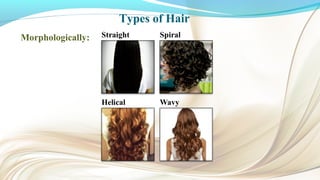
Types of Hair
Morphologically:
LENGTH, WIDTH AND GROWTH RATE
Length : range from <1mm to > 1 meter.
Average uncut scalp hair : 25 – 100 cm.
Width : from 0.005 to 0.06mm.
Growth rate: about 1 cm/ month (terminal hair).
FUNCTIONS
1. Protects body surface from external injury.
2. Helps in sensory function.
3. Psycho – social importance.
4. Forensic importance:-
i. Identification of race, sex, age and religion.
ii. Cause of death can be determined.
iii. Time of death can be determined.
5. Assist thermo regulation mainly in lower animals.
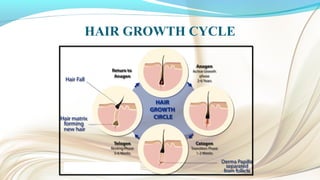
HAIR GROWTH CYCLE
ANAGEN (GROWING PHASE)
Lasts for about 1000 days.
Follicular cells grow, divide and become
keratinized.
Darkly pigmented portion is evident just above
the hair bulb.
CATAGEN (INVOLUTING PHASE)
Lasts for about 10 days.
Gradual thinning and decrease of the pigment.
Melanocytes stop producing melanin.
Matrix keratinocytes abruptly cease proliferating.
TELOGEN (RESTING PHASE)
Lasts for about 100 days.
Club-shaped proximal end shed from the follicle during
telogen.
Growth of a new anagen hair leads to shedding of any
remaining telogen hair.
 New hair does not “push out” the hair from the previous
cycle.
EXOGEN (HAIR SHEDDING PHASE)
Recently added phase.
Describes relationship between hair shaft and base of
telogen follicle.
Hairs can be retained for more than one cycle.
Shedding phase is most likely independent of anagen and
telogen.
HAIR LOSS
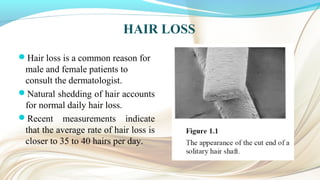
Hair loss is a common reason for
male and female patients to
consult the dermatologist.
Natural shedding of hair accounts
for normal daily hair loss.
Recent measurements indicate
that the average rate of hair loss is
closer to 35 to 40 hairs per day.
MEDICAL CAUSES OF ALOPECIA
• Physical stress: surgery, illness, anemia, lack of sleep.
• Emotional stress: psychiatric illness, death of family member,
job loss, anxiety etc.
• Diet considerations: rapid weight loss or gain, unusual dieting
habits, protein intake failure, prolonged fasting.
• Hormonal causes: postpartum, oral contraceptives, menopause,
ingestion of testosterone containing hormone supplements.
• Endocrinopathy: hypothyroidism, hyperthyroidism.
CLASSIFICATION OF ALOPECIA
• Alopecia areata.
• Androgenetic alopecia.
• Postpartum Alopecia
• Trichotillomania.
• Traction alopecia.
• Syphilitic alopecia.
• Triangular alopecia.
ALOPECIA AREATA
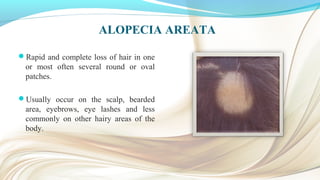
Rapid and complete loss of hair in one
or most often several round or oval
patches.
Usually occur on the scalp, bearded
area, eyebrows, eye lashes and less
commonly on other hairy areas of the
body.
MEDICATIONS
Corticosteroids.
Cyclosporine.
Sulfasalazine.
 Methotrexate.
Azathioprine.
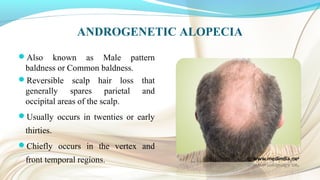
ANDROGENETIC ALOPECIA
Also known as Male pattern
baldness or Common baldness.
Reversible scalp hair loss that
generally spares parietal and
occipital areas of the scalp.
Usually occurs in twenties or early
thirties.
Chiefly occurs in the vertex and
front temporal regions.
MEDICATIONS
Topical minoxidil (below 2% ).
Finasteride (2.5 mg/daily).
Spironolactone.
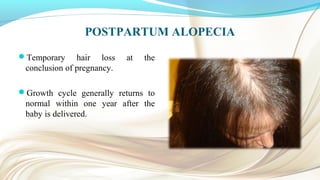
POSTPARTUM ALOPECIA
Temporary hair loss at the
conclusion of pregnancy.
Growth cycle generally returns to
normal within one year after the
baby is delivered.
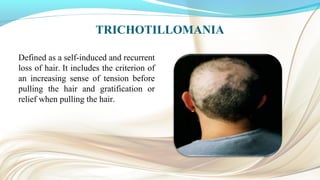
TRICHOTILLOMANIA
Defined as a self-induced and recurrent
loss of hair. It includes the criterion of
an increasing sense of tension before
pulling the hair and gratification or
relief when pulling the hair.
MEDICATIONS
Clomipramine.
Fluoxetine and other selective
serotonin reuptake inhibitors.
Non-pharmacological interventions,
including behavior
modification programs, may be
considered.
Dual treatment (behavioral therapy
and medication) may provide an
advantage in some cases.
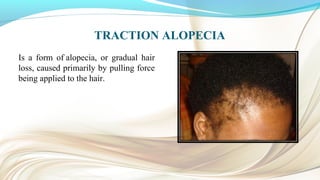
TRACTION ALOPECIA
Is a form of alopecia, or gradual hair
loss, caused primarily by pulling force
being applied to the hair.
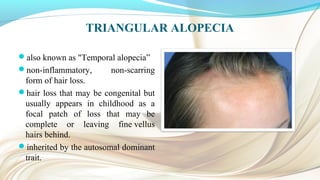
TRIANGULAR ALOPECIA
also known as "Temporal alopecia”
non-inflammatory, non-scarring
form of hair loss.
hair loss that may be congenital but
usually appears in childhood as a
focal patch of loss that may be
complete or leaving fine vellus
hairs behind.
inherited by the autosomal dominant
trait.
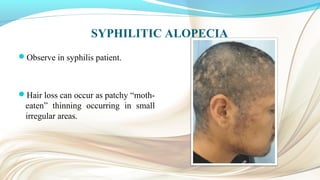
SYPHILITIC ALOPECIA
Observe in syphilis patient.
Hair loss can occur as patchy “moth-
eaten” thinning occurring in small
irregular areas.
CONCLUSION
Alopecia cannot be cured totally.
Treatment is a very lengthy.
Researches are going on to invent a way to cure alopecia totally.
Some peoples implant false hair nowadays for their mental satisfaction.
REFERENCES
• Walker SA, Rothman S. Alopecia areata: a statistical study
and consideration of endocrine influences. J Invest
Dermatol 1950; 14:403–13.
• Ikeda T. A new classification of alopecia areata.
Dermatologica 1965; 131: 421–45.
• Hamilton, J.B. (1951) Patterned loss of hair in man: types
and incidence. Annal NY Acad Sci 53, 708-728.
• Norwood, O.T. and Lehr, B. (2000) Female androgenetic
alopecia: a separate entity. Dermatol Surg 26, 679-682,
PubMed Label: 20345216.
Alopecia

Alopecia

  • 2.
    INTRODUCTION Hairs are keratinizedelongated structures derived from invaginations of epidermis and project out from most of the body surface.
  • 3.
  • 4.
    LENGTH, WIDTH ANDGROWTH RATE Length : range from <1mm to > 1 meter. Average uncut scalp hair : 25 – 100 cm. Width : from 0.005 to 0.06mm. Growth rate: about 1 cm/ month (terminal hair).
  • 5.
    FUNCTIONS 1. Protects bodysurface from external injury. 2. Helps in sensory function. 3. Psycho – social importance. 4. Forensic importance:- i. Identification of race, sex, age and religion. ii. Cause of death can be determined. iii. Time of death can be determined. 5. Assist thermo regulation mainly in lower animals.
  • 6.
  • 7.
    ANAGEN (GROWING PHASE) Lastsfor about 1000 days. Follicular cells grow, divide and become keratinized. Darkly pigmented portion is evident just above the hair bulb.
  • 8.
    CATAGEN (INVOLUTING PHASE) Lastsfor about 10 days. Gradual thinning and decrease of the pigment. Melanocytes stop producing melanin. Matrix keratinocytes abruptly cease proliferating.
  • 9.
    TELOGEN (RESTING PHASE) Lastsfor about 100 days. Club-shaped proximal end shed from the follicle during telogen. Growth of a new anagen hair leads to shedding of any remaining telogen hair.  New hair does not “push out” the hair from the previous cycle.
  • 10.
    EXOGEN (HAIR SHEDDINGPHASE) Recently added phase. Describes relationship between hair shaft and base of telogen follicle. Hairs can be retained for more than one cycle. Shedding phase is most likely independent of anagen and telogen.
  • 11.
    HAIR LOSS Hair lossis a common reason for male and female patients to consult the dermatologist. Natural shedding of hair accounts for normal daily hair loss. Recent measurements indicate that the average rate of hair loss is closer to 35 to 40 hairs per day.
  • 12.
    MEDICAL CAUSES OFALOPECIA • Physical stress: surgery, illness, anemia, lack of sleep. • Emotional stress: psychiatric illness, death of family member, job loss, anxiety etc. • Diet considerations: rapid weight loss or gain, unusual dieting habits, protein intake failure, prolonged fasting. • Hormonal causes: postpartum, oral contraceptives, menopause, ingestion of testosterone containing hormone supplements. • Endocrinopathy: hypothyroidism, hyperthyroidism.
  • 13.
    CLASSIFICATION OF ALOPECIA •Alopecia areata. • Androgenetic alopecia. • Postpartum Alopecia • Trichotillomania. • Traction alopecia. • Syphilitic alopecia. • Triangular alopecia.
  • 14.
    ALOPECIA AREATA Rapid andcomplete loss of hair in one or most often several round or oval patches. Usually occur on the scalp, bearded area, eyebrows, eye lashes and less commonly on other hairy areas of the body.
  • 15.
  • 16.
    ANDROGENETIC ALOPECIA Also knownas Male pattern baldness or Common baldness. Reversible scalp hair loss that generally spares parietal and occipital areas of the scalp. Usually occurs in twenties or early thirties. Chiefly occurs in the vertex and front temporal regions.
  • 17.
    MEDICATIONS Topical minoxidil (below2% ). Finasteride (2.5 mg/daily). Spironolactone.
  • 18.
    POSTPARTUM ALOPECIA Temporary hairloss at the conclusion of pregnancy. Growth cycle generally returns to normal within one year after the baby is delivered.
  • 19.
    TRICHOTILLOMANIA Defined as aself-induced and recurrent loss of hair. It includes the criterion of an increasing sense of tension before pulling the hair and gratification or relief when pulling the hair.
  • 20.
    MEDICATIONS Clomipramine. Fluoxetine and otherselective serotonin reuptake inhibitors. Non-pharmacological interventions, including behavior modification programs, may be considered. Dual treatment (behavioral therapy and medication) may provide an advantage in some cases.
  • 21.
    TRACTION ALOPECIA Is aform of alopecia, or gradual hair loss, caused primarily by pulling force being applied to the hair.
  • 22.
    TRIANGULAR ALOPECIA also knownas "Temporal alopecia” non-inflammatory, non-scarring form of hair loss. hair loss that may be congenital but usually appears in childhood as a focal patch of loss that may be complete or leaving fine vellus hairs behind. inherited by the autosomal dominant trait.
  • 23.
    SYPHILITIC ALOPECIA Observe insyphilis patient. Hair loss can occur as patchy “moth- eaten” thinning occurring in small irregular areas.
  • 24.
    CONCLUSION Alopecia cannot becured totally. Treatment is a very lengthy. Researches are going on to invent a way to cure alopecia totally. Some peoples implant false hair nowadays for their mental satisfaction.
  • 25.
    REFERENCES • Walker SA,Rothman S. Alopecia areata: a statistical study and consideration of endocrine influences. J Invest Dermatol 1950; 14:403–13. • Ikeda T. A new classification of alopecia areata. Dermatologica 1965; 131: 421–45. • Hamilton, J.B. (1951) Patterned loss of hair in man: types and incidence. Annal NY Acad Sci 53, 708-728. • Norwood, O.T. and Lehr, B. (2000) Female androgenetic alopecia: a separate entity. Dermatol Surg 26, 679-682, PubMed Label: 20345216.