Artificial Intelligence (AI)
Made by Gursheen Kaur Chawla
Contoso
S u i t e s
• Definition of AI
• History of AI
• Types of AI
• 3 Most Advanced AI Systems
• Future of AI
Contents
Contoso
S u i t e s
Section Divider
Option 2
Lorem ipsum dolor sit ame
adipiscing elit
3
• AI, or Artificial intelligence is the simulation of human intelligence processes by machines,
especially computer systems. It involves creating intelligent machines that can reason, learn,
perceive, and interact with the environment in a way that imitates or replicates human
cognitive abilities.
• Artificial intelligence was founded as an academic discipline in 1956, and in the years since it
has experienced several waves of optimism, followed by disappointment and the loss of
funding (known as an "AI winter"), followed by new approaches, success, and renewed
funding.
• John McCarthy is known as the "father of artificial intelligence" because of his fantastic work
in Computer Science and AI. McCarthy coined the term "artificial intelligence" in the 1950s.
• AI applications include advanced web search engines, recommendation systems,
understanding human speech, self-driving cars, generative or creative tools, automated
decision-making, and competing at the highest level in strategic game systems.
What is A.I.?
Contoso
S u i t e s
Section Divider
Option 2
Lorem ipsum dolor sit ame
adipiscing elit
4
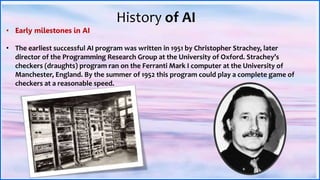
History of AI
• Early milestones in AI
• The earliest successful AI program was written in 1951 by Christopher Strachey, later
director of the Programming Research Group at the University of Oxford. Strachey’s
checkers (draughts) program ran on the Ferranti Mark I computer at the University of
Manchester, England. By the summer of 1952 this program could play a complete game of
checkers at a reasonable speed.
Contoso
S u i t e s
Section Divider
Option 2
Lorem ipsum dolor sit ame
adipiscing elit
5
• Another successful demonstration of machine learning was published in 1952. Shopper, written by
Anthony Oettinger at the University of Cambridge, ran on the EDSAC computer. Shopper’s
simulated world was a mall of eight shops. When instructed to purchase an item, Shopper would
search for it, visiting shops at random until the item was found. While searching, Shopper would
memorize a few of the items stocked in each shop visited (just as a human shopper might). The next
time Shopper was sent out for the same item, or for some other item that it had already located, it
would go to the right shop straight away.
Contoso
S u i t e s
Section Divider
Option 2
Lorem ipsum dolor sit ame
adipiscing elit
6
• AI type-1: Based on Capabilities
 Narrow AI
 Narrow AI is a type of AI which is designed to perform
specific tasks or functions. They are focused on specific tasks
and lack general intelligence.
 Narrow AI cannot perform beyond its field or limitations, as it
is only trained for one specific task. Hence it is also termed as
weak AI. Narrow AI can fail in unpredictable ways if it goes
beyond its limits.
 Narrow AI systems are trained to excel in a particular
domain, such as image recognition, natural language
processing, or voice assistants like Siri, Google Assistant or
Alexa.
Types of AI
Contoso
S u i t e s
Section Divider
Option 2
Lorem ipsum dolor sit ame
adipiscing elit
7
 General AI
 General AI is a type of intelligence which refers to AI
systems that possess the ability to understand, learn, and
apply knowledge across various domains.
 It could exhibit human-like intelligence and can perform
intellectual tasks at or beyond the level of human
capability.
 The idea behind the general AI is to make such a system
which could be smarter and think like a human by its own.
That's why it is also termed as Strong AI or Human-level AI
 Currently, there is no such system exist which could come
under general AI and can perform any task as perfect as a
human.
Contoso
S u i t e s
Section Divider
Option 2
Lorem ipsum dolor sit ame
adipiscing elit
8
 Super AI
 Super AI refers to an advanced form of artificial
intelligence that could possess intelligence and cognitive
abilities far beyond human-level intelligence and would
potentially exhibit superior performance across a wide
range of tasks and domains.
 Some key characteristics of strong AI include capability
include the ability to think, to reason, solve the puzzle,
make judgments, plan, learn, and communicate by its own.
 It's important to note that "super AI" is a speculative
concept that falls into the realm of science fiction and
hypothetical speculation rather than a concrete and
established area of AI research or development.
Contoso
S u i t e s
Section Divider
Option 2
Lorem ipsum dolor sit ame
adipiscing elit
9
• AI type-2: Based on functionality
• Reactive Machines
 Reactive machines are AI systems that have no memory and are task specific, meaning that an
always delivers the same output. Machine learning models tend to be reactive machines because
take customer data, such as purchase or search history, and use it to deliver recommendations to
same customers.
 IBM's Deep Blue system and Google's AlphaGo are examples of reactive machines.
• Limited Memory
 The next most sophisticated AI is called limited memory AI. It’s characterized by the ability
to absorb learning data and improve over time based on its experience similar to the way
the human brain’s neurons connect. This is the AI that is widely used and being perfected
today.
 Self-driving cars are one of the best examples of Limited Memory systems. These cars can
store recent speed of nearby cars, the distance of other cars, speed limit, and other
information to navigate the road.
Contoso
S u i t e s
Section Divider
Option 2
Lorem ipsum dolor sit ame
adipiscing elit
10
Reactive Machines Limited Memory
Contoso
S u i t e s
Section Divider
Option 2
Lorem ipsum dolor sit ame
adipiscing elit
11
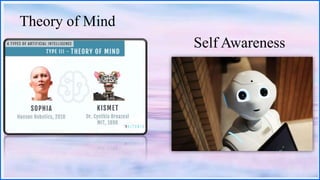
• Theory of mind
 This is the next frontier for AI. An important aspect of this AI is that machines would have the
capability to understand and remember emotions and adjust behavior based on those emotions
humans can in social interactions.
 Although theory of mind AI has not been fully achieved, the robots Kismet (introduced in 2000)
Sophia (2016) showed some aspects of this type of AI. Kismet recognized emotions and could
replicate them through its facial features such as eyes, eyebrows, lips and ears. Sophia, a
robot, along with her human-like likeness was also able to “see” emotions and respond
• Self Awareness
 The final type of AI is self-awareness AI. This type of AI will be when machines are not only
aware of emotions and mental states of others, but also their own. When self-awareness AI
is achieved we would have AI that has human-level consciousness and equals human
intelligence with the same needs, desires and emotions.
Contoso
S u i t e s
Section Divider
Option 2
Lorem ipsum dolor sit ame
adipiscing elit
12
Theory of Mind
Self Awareness
Contoso
S u i t e s
Section Divider
Option 2
Lorem ipsum dolor sit ame
adipiscing elit
13
• Open AI — ChatGPT AI tools
 GPT-3 and GPT-4 are two of the most advanced artificial intelligence
software developed by OpenAI. They are part of a family of AI models
known as Generative Pre-trained Transformers (GPTs), which are
designed to generate human-like language and complete a wide range of
language tasks.
• IBM — Watson AI tools
 Watson is an advanced artificial intelligence software developed by IBM
that combines natural language processing, machine learning, and other
AI technologies to analyze and understand large amounts of unstructured
data.
• Google DeepMind — AlphaGo artificial intelligence systems
 AlphaGo is the most advanced artificial intelligence software developed
by Google DeepMind that was designed to play the board game Go. The
technology gained widespread attention in 2016 when it defeated the
world champion, Lee Sedol, in a best-of-five match.
3 Most Advanced AI Systems
Contoso
S u i t e s
Section Divider
Option 2
Lorem ipsum dolor sit ame
adipiscing elit
14
 The future of artificial intelligence (AI) holds immense potential for further advancements and
transformative impacts across various industries and aspects of our lives. With ongoing
research and development, it’s clear that the world of AI is set to become even more advanced
and sophisticated. With new breakthroughs and innovations on the horizon, the coming years
promise to be an exciting time for anyone interested.
 AI systems are at the forefront, and their capabilities and potential are truly awe-inspiring. In
the coming years, we can expect to witness advancements in areas such as natural language
processing, computer vision, robotics, reinforcement learning, and deep learning. AI systems
will become more capable of understanding and generating complex human language,
interpreting visual data with greater accuracy, and interacting seamlessly with the physical
world.
Future of AI
AI.pptx

AI.pptx

  • 1.
    Artificial Intelligence (AI) Madeby Gursheen Kaur Chawla
  • 2.
    Contoso S u it e s • Definition of AI • History of AI • Types of AI • 3 Most Advanced AI Systems • Future of AI Contents
  • 3.
    Contoso S u it e s Section Divider Option 2 Lorem ipsum dolor sit ame adipiscing elit 3 • AI, or Artificial intelligence is the simulation of human intelligence processes by machines, especially computer systems. It involves creating intelligent machines that can reason, learn, perceive, and interact with the environment in a way that imitates or replicates human cognitive abilities. • Artificial intelligence was founded as an academic discipline in 1956, and in the years since it has experienced several waves of optimism, followed by disappointment and the loss of funding (known as an "AI winter"), followed by new approaches, success, and renewed funding. • John McCarthy is known as the "father of artificial intelligence" because of his fantastic work in Computer Science and AI. McCarthy coined the term "artificial intelligence" in the 1950s. • AI applications include advanced web search engines, recommendation systems, understanding human speech, self-driving cars, generative or creative tools, automated decision-making, and competing at the highest level in strategic game systems. What is A.I.?
  • 4.
    Contoso S u it e s Section Divider Option 2 Lorem ipsum dolor sit ame adipiscing elit 4 History of AI • Early milestones in AI • The earliest successful AI program was written in 1951 by Christopher Strachey, later director of the Programming Research Group at the University of Oxford. Strachey’s checkers (draughts) program ran on the Ferranti Mark I computer at the University of Manchester, England. By the summer of 1952 this program could play a complete game of checkers at a reasonable speed.
  • 5.
    Contoso S u it e s Section Divider Option 2 Lorem ipsum dolor sit ame adipiscing elit 5 • Another successful demonstration of machine learning was published in 1952. Shopper, written by Anthony Oettinger at the University of Cambridge, ran on the EDSAC computer. Shopper’s simulated world was a mall of eight shops. When instructed to purchase an item, Shopper would search for it, visiting shops at random until the item was found. While searching, Shopper would memorize a few of the items stocked in each shop visited (just as a human shopper might). The next time Shopper was sent out for the same item, or for some other item that it had already located, it would go to the right shop straight away.
  • 6.
    Contoso S u it e s Section Divider Option 2 Lorem ipsum dolor sit ame adipiscing elit 6 • AI type-1: Based on Capabilities  Narrow AI  Narrow AI is a type of AI which is designed to perform specific tasks or functions. They are focused on specific tasks and lack general intelligence.  Narrow AI cannot perform beyond its field or limitations, as it is only trained for one specific task. Hence it is also termed as weak AI. Narrow AI can fail in unpredictable ways if it goes beyond its limits.  Narrow AI systems are trained to excel in a particular domain, such as image recognition, natural language processing, or voice assistants like Siri, Google Assistant or Alexa. Types of AI
  • 7.
    Contoso S u it e s Section Divider Option 2 Lorem ipsum dolor sit ame adipiscing elit 7  General AI  General AI is a type of intelligence which refers to AI systems that possess the ability to understand, learn, and apply knowledge across various domains.  It could exhibit human-like intelligence and can perform intellectual tasks at or beyond the level of human capability.  The idea behind the general AI is to make such a system which could be smarter and think like a human by its own. That's why it is also termed as Strong AI or Human-level AI  Currently, there is no such system exist which could come under general AI and can perform any task as perfect as a human.
  • 8.
    Contoso S u it e s Section Divider Option 2 Lorem ipsum dolor sit ame adipiscing elit 8  Super AI  Super AI refers to an advanced form of artificial intelligence that could possess intelligence and cognitive abilities far beyond human-level intelligence and would potentially exhibit superior performance across a wide range of tasks and domains.  Some key characteristics of strong AI include capability include the ability to think, to reason, solve the puzzle, make judgments, plan, learn, and communicate by its own.  It's important to note that "super AI" is a speculative concept that falls into the realm of science fiction and hypothetical speculation rather than a concrete and established area of AI research or development.
  • 9.
    Contoso S u it e s Section Divider Option 2 Lorem ipsum dolor sit ame adipiscing elit 9 • AI type-2: Based on functionality • Reactive Machines  Reactive machines are AI systems that have no memory and are task specific, meaning that an always delivers the same output. Machine learning models tend to be reactive machines because take customer data, such as purchase or search history, and use it to deliver recommendations to same customers.  IBM's Deep Blue system and Google's AlphaGo are examples of reactive machines. • Limited Memory  The next most sophisticated AI is called limited memory AI. It’s characterized by the ability to absorb learning data and improve over time based on its experience similar to the way the human brain’s neurons connect. This is the AI that is widely used and being perfected today.  Self-driving cars are one of the best examples of Limited Memory systems. These cars can store recent speed of nearby cars, the distance of other cars, speed limit, and other information to navigate the road.
  • 10.
    Contoso S u it e s Section Divider Option 2 Lorem ipsum dolor sit ame adipiscing elit 10 Reactive Machines Limited Memory
  • 11.
    Contoso S u it e s Section Divider Option 2 Lorem ipsum dolor sit ame adipiscing elit 11 • Theory of mind  This is the next frontier for AI. An important aspect of this AI is that machines would have the capability to understand and remember emotions and adjust behavior based on those emotions humans can in social interactions.  Although theory of mind AI has not been fully achieved, the robots Kismet (introduced in 2000) Sophia (2016) showed some aspects of this type of AI. Kismet recognized emotions and could replicate them through its facial features such as eyes, eyebrows, lips and ears. Sophia, a robot, along with her human-like likeness was also able to “see” emotions and respond • Self Awareness  The final type of AI is self-awareness AI. This type of AI will be when machines are not only aware of emotions and mental states of others, but also their own. When self-awareness AI is achieved we would have AI that has human-level consciousness and equals human intelligence with the same needs, desires and emotions.
  • 12.
    Contoso S u it e s Section Divider Option 2 Lorem ipsum dolor sit ame adipiscing elit 12 Theory of Mind Self Awareness
  • 13.
    Contoso S u it e s Section Divider Option 2 Lorem ipsum dolor sit ame adipiscing elit 13 • Open AI — ChatGPT AI tools  GPT-3 and GPT-4 are two of the most advanced artificial intelligence software developed by OpenAI. They are part of a family of AI models known as Generative Pre-trained Transformers (GPTs), which are designed to generate human-like language and complete a wide range of language tasks. • IBM — Watson AI tools  Watson is an advanced artificial intelligence software developed by IBM that combines natural language processing, machine learning, and other AI technologies to analyze and understand large amounts of unstructured data. • Google DeepMind — AlphaGo artificial intelligence systems  AlphaGo is the most advanced artificial intelligence software developed by Google DeepMind that was designed to play the board game Go. The technology gained widespread attention in 2016 when it defeated the world champion, Lee Sedol, in a best-of-five match. 3 Most Advanced AI Systems
  • 14.
    Contoso S u it e s Section Divider Option 2 Lorem ipsum dolor sit ame adipiscing elit 14  The future of artificial intelligence (AI) holds immense potential for further advancements and transformative impacts across various industries and aspects of our lives. With ongoing research and development, it’s clear that the world of AI is set to become even more advanced and sophisticated. With new breakthroughs and innovations on the horizon, the coming years promise to be an exciting time for anyone interested.  AI systems are at the forefront, and their capabilities and potential are truly awe-inspiring. In the coming years, we can expect to witness advancements in areas such as natural language processing, computer vision, robotics, reinforcement learning, and deep learning. AI systems will become more capable of understanding and generating complex human language, interpreting visual data with greater accuracy, and interacting seamlessly with the physical world. Future of AI