Sunlight
and space travel
2
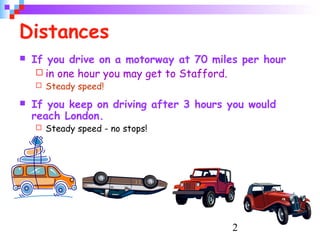
Distances
 If you drive on a motorway at 70 miles per hour
 in one hour you may get to Stafford.
 Steady speed!
 If you keep on driving after 3 hours you would
reach London.
 Steady speed - no stops!
3
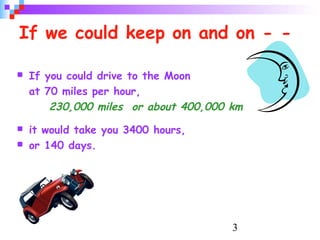
If we could keep on and on - -
 If you could drive to the Moon
at 70 miles per hour,
230,000 miles or about 400,000 km
 it would take you 3400 hours,
 or 140 days.
4
Light and heat
comes from the Sun
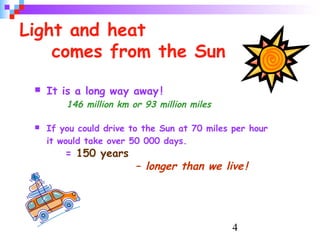
 It is a long way away !
146 million km or 93 million miles
 If you could drive to the Sun at 70 miles per hour
it would take over 50 000 days.
= 150 years
– longer than we live!
5
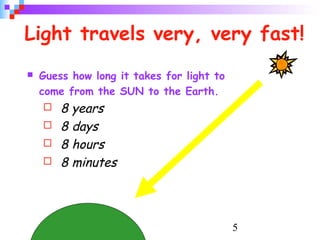
Light travels very, very fast!
 Guess how long it takes for light to
come from the SUN to the Earth.
 8 years
 8 days
 8 hours
 8 minutes
6
It takes
8 minutes
for light to reach us from the Sun!
Light travels 300 000 kilometres through space every second!
7
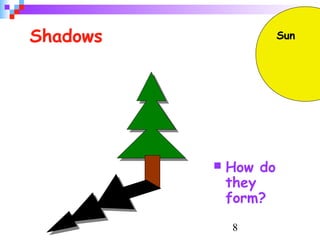
Shadows
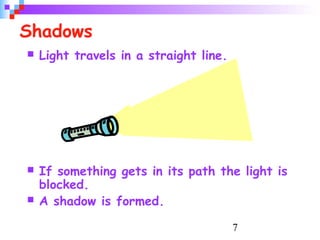
 Light travels in a straight line.
 If something gets in its path the light is
blocked.
 A shadow is formed.
8
Shadows
 How do
they
form?
Sun
9
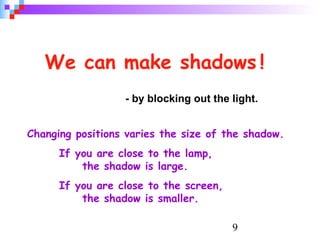
We can make shadows !
- by blocking out the light.
Changing positions varies the size of the shadow.
If you are close to the lamp,
the shadow is large.
If you are close to the screen,
the shadow is smaller.
10
Day and Night
A day + a night = 24 hours
365 of these makes 1 year.
The Earth takes 1 year to orbit the Sun.
(What does ‘orbit’ mean?)
11
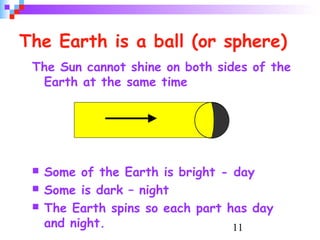
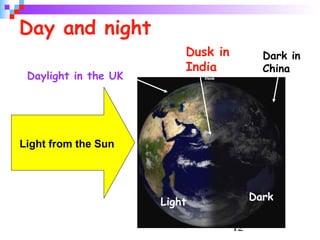
The Earth is a ball (or sphere)
The Sun cannot shine on both sides of the
Earth at the same time
 Some of the Earth is bright - day
 Some is dark – night
 The Earth spins so each part has day
and night.
12
Day and night
Daylight in the UK
Light from the Sun
Dark in
China
Dusk in
India
Light Dark
13
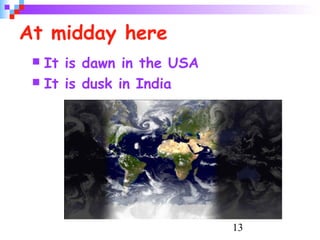
At midday here
 It is dawn in the USA
 It is dusk in India
14
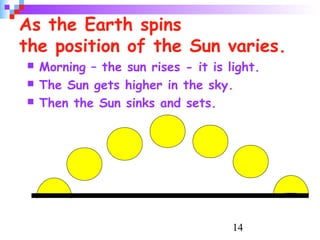
As the Earth spins
the position of the Sun varies.
 Morning – the sun rises - it is light.
 The Sun gets higher in the sky.
 Then the Sun sinks and sets.
15
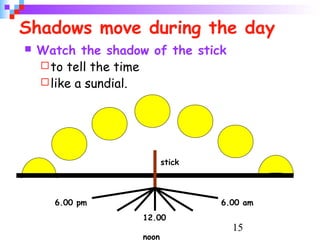
Shadows move during the day
 Watch the shadow of the stick
to tell the time
like a sundial.
stick
6.00 pm
12.00
noon
6.00 am
16
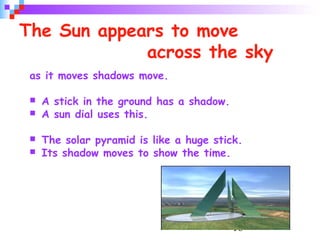
The Sun appears to move
across the sky
as it moves shadows move.
 A stick in the ground has a shadow.
 A sun dial uses this.
 The solar pyramid is like a huge stick.
 Its shadow moves to show the time.
17
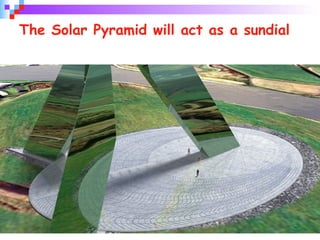
The Solar Pyramid will act as a sundial
18
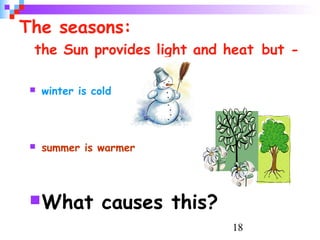
The seasons:
the Sun provides light and heat but -
 winter is cold
 summer is warmer
What causes this?
19
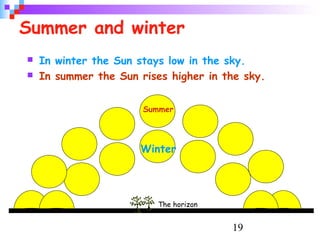
Summer and winter
 In winter the Sun stays low in the sky.
 In summer the Sun rises higher in the sky.
Winter
Summer
The horizon
20
Summer and winter
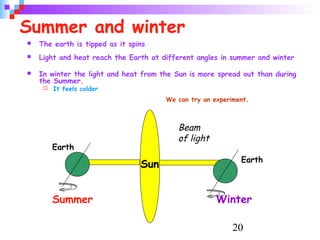
 The earth is tipped as it spins
 Light and heat reach the Earth at different angles in summer and winter
 In winter the light and heat from the Sun is more spread out than during
the Summer.
 It feels colder
We can try an experiment.
Sun
Summer Winter
Beam
of light
Earth
Earth
21
The Moon
22
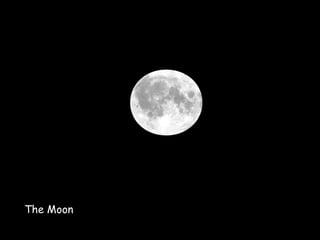
The Moon
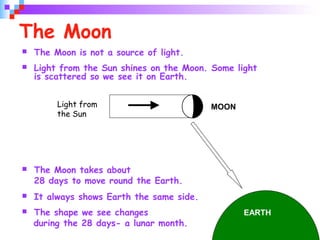
 The Moon is not a source of light.
 Light from the Sun shines on the Moon. Some light
is scattered so we see it on Earth.
 The Moon takes about
28 days to move round the Earth.
 It always shows Earth the same side.
 The shape we see changes
during the 28 days- a lunar month.
EARTH
Light from
the Sun
MOON
23
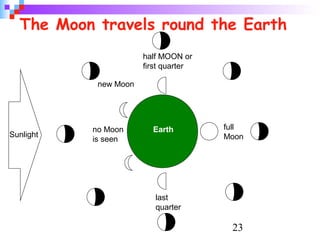
The Moon travels round the Earth
Sunlight
Earthno Moon
is seen
new Moon
half MOON or
first quarter
full
Moon
last
quarter
24
Bad astronomy in films
What is wrong with –
 the Moon looking the same for 3 or 4 nights?
 lots of stars visible at full Moon?
 showing lots of stars out of the window of a
brightly lit room?
 the shadow line at Sun-rise looking sharp?
25
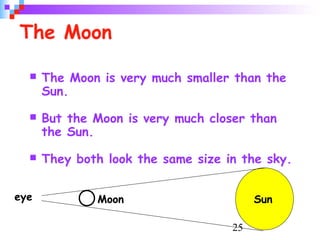
The Moon
 The Moon is very much smaller than the
Sun.
 But the Moon is very much closer than
the Sun.
 They both look the same size in the sky.
eye SunMoon
26
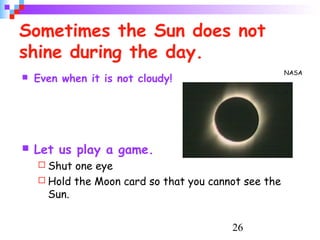
Sometimes the Sun does not
shine during the day.
 Even when it is not cloudy!
 Let us play a game.
 Shut one eye
 Hold the Moon card so that you cannot see the
Sun.
NASA
27
Sun
28
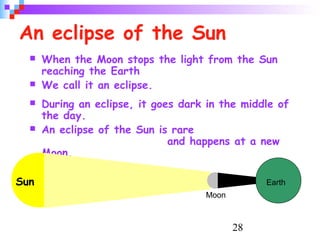
An eclipse of the Sun
 When the Moon stops the light from the Sun
reaching the Earth
 We call it an eclipse.
 During an eclipse, it goes dark in the middle of
the day.
 An eclipse of the Sun is rare
and happens at a new
Moon.
Sun Moon Earth
Moon
29
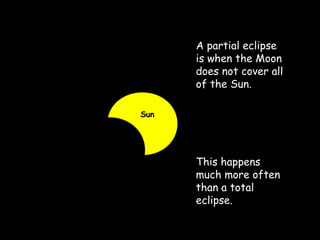
A partial eclipse
is when the Moon
does not cover all
of the Sun.
This happens
much more often
than a total
eclipse.
Sun
30
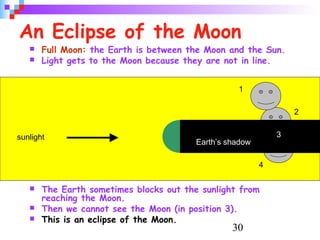
An Eclipse of the Moon
 Full Moon: the Earth is between the Moon and the Sun.
 Light gets to the Moon because they are not in line.
 The Earth sometimes blocks out the sunlight from
reaching the Moon.
 Then we cannot see the Moon (in position 3).
 This is an eclipse of the Moon.
sunlight
Earth’s shadow
1
2
3
4
31
What have we learned?
(Sunlight takes 8 minutes to reach the Earth.)
 Shadows form when light is blocked out.
 Night is when no sunlight reaches us.
 We can tell the time by shadows.
 In winter the Sun is low in the sky.
 The moon reflects light to the Earth.
 Its shape changes because of shadows.
 Eclipses happen when light is blocked out.
- all shadows!
32
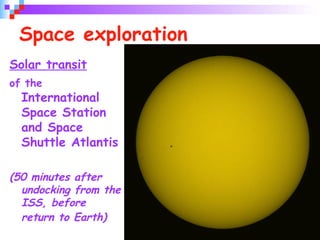
Space exploration
Solar transit
of the
International
Space Station
and Space
Shuttle Atlantis
(50 minutes after
undocking from the
ISS, before
return to Earth)
33
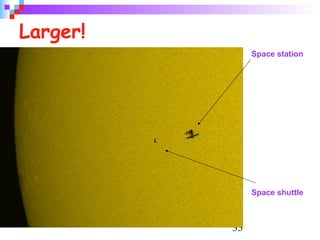
Larger!
Space shuttle
Space station
34
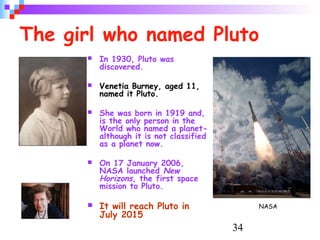
The girl who named Pluto
 In 1930, Pluto was
discovered.
 Venetia Burney, aged 11,
named it Pluto.
 She was born in 1919 and,
is the only person in the
World who named a planet-
although it is not classified
as a planet now.
 On 17 January 2006,
NASA launched New
Horizons, the first space
mission to Pluto.
 It will reach Pluto in
July 2015
NASA
35
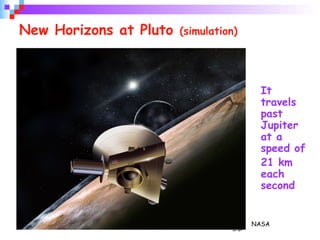
New Horizons at Pluto (simulation)
It
travels
past
Jupiter
at a
speed of
21 km
each
second
NASA
36
Keep asking
questions!
There is lots to find out!

Space sunlight

  • 1.
  • 2.
    2 Distances  If youdrive on a motorway at 70 miles per hour  in one hour you may get to Stafford.  Steady speed!  If you keep on driving after 3 hours you would reach London.  Steady speed - no stops!
  • 3.
    3 If we couldkeep on and on - -  If you could drive to the Moon at 70 miles per hour, 230,000 miles or about 400,000 km  it would take you 3400 hours,  or 140 days.
  • 4.
    4 Light and heat comesfrom the Sun  It is a long way away ! 146 million km or 93 million miles  If you could drive to the Sun at 70 miles per hour it would take over 50 000 days. = 150 years – longer than we live!
  • 5.
    5 Light travels very,very fast!  Guess how long it takes for light to come from the SUN to the Earth.  8 years  8 days  8 hours  8 minutes
  • 6.
    6 It takes 8 minutes forlight to reach us from the Sun! Light travels 300 000 kilometres through space every second!
  • 7.
    7 Shadows  Light travelsin a straight line.  If something gets in its path the light is blocked.  A shadow is formed.
  • 8.
  • 9.
    9 We can makeshadows ! - by blocking out the light. Changing positions varies the size of the shadow. If you are close to the lamp, the shadow is large. If you are close to the screen, the shadow is smaller.
  • 10.
    10 Day and Night Aday + a night = 24 hours 365 of these makes 1 year. The Earth takes 1 year to orbit the Sun. (What does ‘orbit’ mean?)
  • 11.
    11 The Earth isa ball (or sphere) The Sun cannot shine on both sides of the Earth at the same time  Some of the Earth is bright - day  Some is dark – night  The Earth spins so each part has day and night.
  • 12.
    12 Day and night Daylightin the UK Light from the Sun Dark in China Dusk in India Light Dark
  • 13.
    13 At midday here It is dawn in the USA  It is dusk in India
  • 14.
    14 As the Earthspins the position of the Sun varies.  Morning – the sun rises - it is light.  The Sun gets higher in the sky.  Then the Sun sinks and sets.
  • 15.
    15 Shadows move duringthe day  Watch the shadow of the stick to tell the time like a sundial. stick 6.00 pm 12.00 noon 6.00 am
  • 16.
    16 The Sun appearsto move across the sky as it moves shadows move.  A stick in the ground has a shadow.  A sun dial uses this.  The solar pyramid is like a huge stick.  Its shadow moves to show the time.
  • 17.
    17 The Solar Pyramidwill act as a sundial
  • 18.
    18 The seasons: the Sunprovides light and heat but -  winter is cold  summer is warmer What causes this?
  • 19.
    19 Summer and winter In winter the Sun stays low in the sky.  In summer the Sun rises higher in the sky. Winter Summer The horizon
  • 20.
    20 Summer and winter The earth is tipped as it spins  Light and heat reach the Earth at different angles in summer and winter  In winter the light and heat from the Sun is more spread out than during the Summer.  It feels colder We can try an experiment. Sun Summer Winter Beam of light Earth Earth
  • 21.
  • 22.
    22 The Moon  TheMoon is not a source of light.  Light from the Sun shines on the Moon. Some light is scattered so we see it on Earth.  The Moon takes about 28 days to move round the Earth.  It always shows Earth the same side.  The shape we see changes during the 28 days- a lunar month. EARTH Light from the Sun MOON
  • 23.
    23 The Moon travelsround the Earth Sunlight Earthno Moon is seen new Moon half MOON or first quarter full Moon last quarter
  • 24.
    24 Bad astronomy infilms What is wrong with –  the Moon looking the same for 3 or 4 nights?  lots of stars visible at full Moon?  showing lots of stars out of the window of a brightly lit room?  the shadow line at Sun-rise looking sharp?
  • 25.
    25 The Moon  TheMoon is very much smaller than the Sun.  But the Moon is very much closer than the Sun.  They both look the same size in the sky. eye SunMoon
  • 26.
    26 Sometimes the Sundoes not shine during the day.  Even when it is not cloudy!  Let us play a game.  Shut one eye  Hold the Moon card so that you cannot see the Sun. NASA
  • 27.
  • 28.
    28 An eclipse ofthe Sun  When the Moon stops the light from the Sun reaching the Earth  We call it an eclipse.  During an eclipse, it goes dark in the middle of the day.  An eclipse of the Sun is rare and happens at a new Moon. Sun Moon Earth Moon
  • 29.
    29 A partial eclipse iswhen the Moon does not cover all of the Sun. This happens much more often than a total eclipse. Sun
  • 30.
    30 An Eclipse ofthe Moon  Full Moon: the Earth is between the Moon and the Sun.  Light gets to the Moon because they are not in line.  The Earth sometimes blocks out the sunlight from reaching the Moon.  Then we cannot see the Moon (in position 3).  This is an eclipse of the Moon. sunlight Earth’s shadow 1 2 3 4
  • 31.
    31 What have welearned? (Sunlight takes 8 minutes to reach the Earth.)  Shadows form when light is blocked out.  Night is when no sunlight reaches us.  We can tell the time by shadows.  In winter the Sun is low in the sky.  The moon reflects light to the Earth.  Its shape changes because of shadows.  Eclipses happen when light is blocked out. - all shadows!
  • 32.
    32 Space exploration Solar transit ofthe International Space Station and Space Shuttle Atlantis (50 minutes after undocking from the ISS, before return to Earth)
  • 33.
  • 34.
    34 The girl whonamed Pluto  In 1930, Pluto was discovered.  Venetia Burney, aged 11, named it Pluto.  She was born in 1919 and, is the only person in the World who named a planet- although it is not classified as a planet now.  On 17 January 2006, NASA launched New Horizons, the first space mission to Pluto.  It will reach Pluto in July 2015 NASA
  • 35.
    35 New Horizons atPluto (simulation) It travels past Jupiter at a speed of 21 km each second NASA
  • 36.