
Knowing about ..


  EARS
              © 2012 Charie Camilo. All rights
                       reserved.
What are “ears”?
• The ears are the
  anatomical organ that
  detects sound. It not
  only acts as a receiver
  for sound, but also
  plays a major role in the
  sense of balance and
  body position. The ear
  is part of the auditory
  system.

     © 2012 Charie Camilo. All rights
              reserved.
So, what are the
parts of the ear ?


  © 2012 Charie Camilo. All rights
           reserved.
Parts of Ear
The three major parts of the human ear are the outer ear, the middle ear and
the inner ear. The working of human ear is in such a way that the sound
waves travel from the outer ear to the middle ear, which are then transmitted
to the inner ear in the form of compressional waves. In the inner ear, the
compressional waves are converted into electric impulses that are
perceived by the brain. Charie Camilo. in brief about the different parts of the
                  © 2012 Let's discuss All rights
human ear and their role in hearing .
                            reserved.
How does your ear work ?


        © 2012 Charie Camilo. All rights
                 reserved.
3 Major Sections of ear
• There are three major sections
  of an ear:
  • Outer Ear
  • Middle Ear
  • Inner Ear


            © 2012 Charie Camilo. All rights
                     reserved.
Outer Ear
• Sounds from the outside
  world are picked up by the
  outer ear, which is made
  up of the pinna and the ear
  canal. As the sound waves
  enter the ear, the ear canal
  (1) serves to increase the
  loudness of those pitches
  that make it easier to
  understand speech. At the
  same time the ear canal
  protects another important
  part of the ear: the
  eardrum (2) - a flexible,
  circular membrane which
  vibrates when touched by
  sound waves.            © 2012 Charie Camilo. All rights
                                         reserved.
Middle Ear
• The sound vibrations
  continue their journey into
  the middle ear, which
  contains three tiny bones
  called the ossicles(3-5),
  which are also known as
  the hammer, anvil and
  stirrup. These bones form
  the bridge from the
  eardrum into the inner ear.
  They increase and amplify
  the sound vibrations even
  more, before safely
  transmitting them on to the
  inner ear via the oval
  window.
                        © 2012 Charie Camilo. All rights
                                 reserved.
Inner Ear
•   The Inner Ear, or cochlea
    (8), resembles the circular
    shell of a snail, and houses a
    system of tubes which are
    filled with a watery fluid. As
    the sound waves pass
    through the oval window (6)
    the fluid begins to move,
    setting tiny hair cells in
    motion. In turn, these hairs
    transform the vibrations into
    electrical impulses that
    travel along the auditory
    nerve (9) to the brain itself.
    Exactly how the brain
    actually translates these
    nerve impulses remains a
    mystery.                   © 2012 Charie Camilo. All rights
                                            reserved.
© 2012 Charie Camilo. All Video:
                          rights   “How your ear work ?”
         reserved.
Some common..

EAR CONDITIONS THAT YOU
SHOULD KNOW
                © 2012 Charie Camilo. All rights
                         reserved.
Ear Wax
•   Earwax is a bit of a problem for millions of
    British people. Everybody produces a bit
    of wax, but a lot of us have a genetically
    determined tendency to make lots of
    it. Result: you can't hear anything!
•   Fortunately, earwax is easily treated. The
    excellent drops which you can buy from
    any chemist (such as Waxsol, Cerumol or
    Otex) will soften and dissolve it. But if it
    has got very hard, then the only way to
    get rid of the wax is to get a doctor or
    nurse to syringe it for you.
•   Incidentally, please DON'T try and dig the
    wax out with hairpins or other
    objects. Contrary to what many people
    think, it is not a good idea to stick things
    into the 'lughole'. That is likely to damage
    the delicate tissues of the ear.
                             © 2012 Charie Camilo. All rights
BACK                                  reserved.
Earache
•   Fortunately, this gets less
    common as you grow
    older. It is usually caused by
    a germ - which gets into the
    interior of the ear after
    working its way up the tube
    which leads up from the
    throat to the cavity of the
    middle-ear region.
•   Initial treatment is with
    aspirin, Paracetamol or
    Nurofen, plus warmth to the
    ear. Many doctors give
    penicillin or other anti-biotics,
    but there is controversy
    about how soon they should
    be used.               © 2012 Charie Camilo. All rights
                                        reserved.
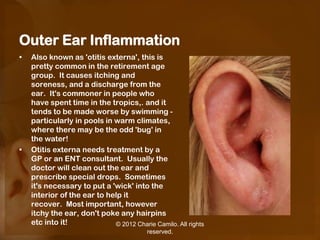
Outer Ear Inflammation
•   Also known as 'otitis externa', this is
    pretty common in the retirement age
    group. It causes itching and
    soreness, and a discharge from the
    ear. It's commoner in people who
    have spent time in the tropics,. and it
    tends to be made worse by swimming -
    particularly in pools in warm climates,
    where there may be the odd 'bug' in
    the water!
•   Otitis externa needs treatment by a
    GP or an ENT consultant. Usually the
    doctor will clean out the ear and
    prescribe special drops. Sometimes
    it's necessary to put a 'wick' into the
    interior of the ear to help it
    recover. Most important, however
    itchy the ear, don't poke any hairpins
    etc into it!             © 2012 Charie Camilo. All rights
                                          reserved.
Sore Places in The Ear
• Lumps and raw spots on the
  ear are common,
  particularly in the over-50s -
  especially in those who
  have been exposed to a lot
  of sun during their lives. If
  you get any unexplained
  lump or sore place on your
  ear and it doesn't clear up
  within a week, please do
  have it checked out by your
  doctor - because (to be
  frank) there is a risk that it
  could be a skin tumour.

                       © 2012 Charie Camilo. All rights
                                reserved.
Tinnitus
• The word 'tinnitus' just
  means 'noises in the
  ear'. It's NOT a disease
  - just a symptom of
  something
  wrong. Incidentally, m
  any people think it's
  called 'tinnitis' - but it
  isn't; the spelling is
  'tinnitus'. You can see
  that the important thing
  with tinnitus is to find
  out what's causing it.
                      © 2012 Charie Camilo. All rights
                                     reserved.
Possible causes include:
• An insect in the ear - very RARE in the UK!
• Aspirin and similiar drugs
• Presbyacusis (see below) - this is the form of
  deafness often seen in the over-50s; it is often
  associated with tinnitus
• Wax
• Fluid in the middle part of the ear
• Damage by noise
• Damage from diving
• Meniere's disease
• Labyrinthitis - a common inflammation of the inner
  part of the ear © 2012 Charie Camilo. All rights
                        reserved.
Vertigo
•   The word 'vertigo' means the kind of
    giddiness in which things actually
    seem to spin round you. It is often
    due to problems in the balance
    mechanisms of the inner part of the
    ear. Possible causes include
    labyrinthitis and Meniere's disease.
•   There is also something called
    'Benign Positional Vertigo', which
    often develops in the second half of
    life. What happens is that you move
    your head - and then you suddenly
    feel awfully giddy. The cause is
    believed to be tiny 'stones' in the
    fluid of the inner part of your
    ear. Fortunately, ENT surgeons
    have developed a way of curing the
    condition by carrying out a
    manipulation called 'Particle
    Reposition Manoeuvre'. © 2012 Charie Camilo. All rights
                                        reserved.
Meniere’s Disease
•   People with Meniere's disease suffer
    recurrent attacks of deafness,
    tinnitus and vertigo. These attacks
    are very upsetting - but (thank
    heavens) patients feel OK in the
    intervals between bouts. The cause
    of Meniere's seems to be a
    disturbance in the fluids which
    circulate in the inner part of the ear.
•   Initial treatment is with anti-vertigo
    drugs and (usually) salt restriction. If
    these measures fail, there are
    surgical operations which can be
    tried - but alas the results are
    variable.

•   BACK
                               © 2012 Charie Camilo. All rights
                                        reserved.
Labyrinthitis
•   This is a common condition, in
    which a person suddenly
    becomes very giddy, and may
    feel sick as well. Sometimes
    they go a bit deaf for a
    while. This disorder (which is
    also knows as 'vestibulitis') is
    thought o be due to a virus. So
    not surprisingly, there are
    sometimes little outbreaks, in
    which several people develop
    the same symptoms.
•   Antibiotics will not help, but
    fortunately labyrinthitis usually
    gets better of it's own accord,
    over a few weeks.

•   BACK                   © 2012 Charie Camilo. All rights
                                    reserved.
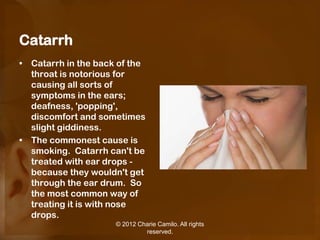
Catarrh
• Catarrh in the back of the
  throat is notorious for
  causing all sorts of
  symptoms in the ears;
  deafness, 'popping',
  discomfort and sometimes
  slight giddiness.
• The commonest cause is
  smoking. Catarrh can't be
  treated with ear drops -
  because they wouldn't get
  through the ear drum. So
  the most common way of
  treating it is with nose
  drops.
                     © 2012 Charie Camilo. All rights
                              reserved.
Deafness
•   Deafness in the second half of
    life is very
    common. Frequently, it's due
    to one of the causes mentioned
    above - like catarrh or ear
    wax. Fortunately, these are
    easily cured.
•   The effect of this degeneration
    is that high-pitched sounds are
    lost, to begin with. One result
    of this is that you can't hear
    consonants clearly - just
    vowels. This is
    irritating! People who suffer
    from it are always
    saying: 'Don't mumble - speak
    up!'
                         © 2012 Charie Camilo. All rights
                                  reserved.
How to …

 TAKE CARE OF YOUR EARS

           © 2012 Charie Camilo. All rights
                    reserved.
• Avoid blows to the outer ear. If you wrestle, box or
  participate in a contact sport such as rugby, wear
  headgear that includes protection for your ears.
  Repeated blows to the outer ear can result in a
  condition called cauliflower ear, in which the
  cartilage of the ear is damaged and the ear
  becomes deformed.


                   © 2012 Charie Camilo. All rights
                            reserved.
• Pierce carefully, particularly if piercing cartilage.
  An infected piercing can cause permanent damage
  to the outer ear, something that will ruin the look of
  any earring.


                   © 2012 Charie Camilo. All rights
                            reserved.
• Clean your ears with a washcloth-covered finger
  only. Never put anything inside your ear canal,
  including cotton swabs. Your ear canal is very
  narrow, and a swab or finger can damage it; they
  can also cause ear wax to get pushed against the
  ear drum, which can cause hearing problems.


                  © 2012 Charie Camilo. All rights
                           reserved.
• Leave ear wax alone. Wax is your ear's way of
  trapping and eliminating anything foreign that gets
  into the ear canal. Most people don't need to clean
  wax out of their ears. If you find you have too much
  ear wax (it's visible in the ear or it's affecting your
  hearing), use a few drops of ear wax remover or
  hydrogen peroxide in the canal. After a few minutes,
  flush the ear with a rubber bulb and tepid water.

                   © 2012 Charie Camilo. All rights
                            reserved.
How to …

 PROTECT YOUR EARS

           © 2012 Charie Camilo. All rights
                    reserved.
• Avoid noisy places. NASCAR racetracks, firing
  ranges, rock concerts and construction sites are
  just a few places that frequently have noise levels
  that can damage hearing. Any place where you
  have to shout to be heard should be avoided. If you
  choose to go anyway, wear earplugs.


                  © 2012 Charie Camilo. All rights
                           reserved.
• Turn the volume down. Be careful not to play
  personal stereos and televisions too loud,
  especially if using headphones or earbuds.


                  © 2012 Charie Camilo. All rights
                           reserved.
• See your doctor if you have an earache. Ear
  infections can damage the ear drum or the bones of
  the middle ear, causing hearing loss. Your doctor
  may prescribe medication or order a minor surgical
  procedure to help you if you suffer from frequent
  infections.


                  © 2012 Charie Camilo. All rights
                           reserved.
• Be careful with illness and medications. Respiratory
  illnesses should be treated to avoid their spread to
  the ears. Certain medications can damage hearing;
  take only what's prescribed for you and follow the
  directions carefully. Avoid others who are ill; some
  illnesses can only be treated with antibiotics that
  can damage hearing.


                  © 2012 Charie Camilo. All rights
                           reserved.
• Stop smoking. Smokers are more likely to lose their
  hearing than non-smokers.


                  © 2012 Charie Camilo. All rights
                           reserved.
• See your doctor if you suffer from sudden hearing
  loss or hear noises in your head (tinnitus). These
  can be symptoms of a serious illness which needs to
  be treated.


                  © 2012 Charie Camilo. All rights
                           reserved.
Sources


•   http://www.retirement-matters.co.uk/gparchive/ears.htm
•   http://www.ahschicago.com/how-does-your-ear-work/
•   http://en.wikipedia.org/wiki/Ear
•   www.youtube.com
•   www.google.com/images


                     © 2012 Charie Camilo. All rights
                              reserved.
All about “EARS”
• Almodiel, Gilesa A.
• Camilo, Charmaine S.
• Dequilla, Yvonne Precious E.


                      ACS-2A
                  © 2012 Charie Camilo. All rights
                           reserved.
END
© 2012 Charie Camilo. All rights
         reserved.

All About Ears

  • 1.
    Knowing about .. EARS © 2012 Charie Camilo. All rights reserved.
  • 2.
    What are “ears”? •The ears are the anatomical organ that detects sound. It not only acts as a receiver for sound, but also plays a major role in the sense of balance and body position. The ear is part of the auditory system. © 2012 Charie Camilo. All rights reserved.
  • 3.
    So, what arethe parts of the ear ? © 2012 Charie Camilo. All rights reserved.
  • 4.
    Parts of Ear Thethree major parts of the human ear are the outer ear, the middle ear and the inner ear. The working of human ear is in such a way that the sound waves travel from the outer ear to the middle ear, which are then transmitted to the inner ear in the form of compressional waves. In the inner ear, the compressional waves are converted into electric impulses that are perceived by the brain. Charie Camilo. in brief about the different parts of the © 2012 Let's discuss All rights human ear and their role in hearing . reserved.
  • 5.
    How does yourear work ? © 2012 Charie Camilo. All rights reserved.
  • 6.
    3 Major Sectionsof ear • There are three major sections of an ear: • Outer Ear • Middle Ear • Inner Ear © 2012 Charie Camilo. All rights reserved.
  • 7.
    Outer Ear • Soundsfrom the outside world are picked up by the outer ear, which is made up of the pinna and the ear canal. As the sound waves enter the ear, the ear canal (1) serves to increase the loudness of those pitches that make it easier to understand speech. At the same time the ear canal protects another important part of the ear: the eardrum (2) - a flexible, circular membrane which vibrates when touched by sound waves. © 2012 Charie Camilo. All rights reserved.
  • 8.
    Middle Ear • Thesound vibrations continue their journey into the middle ear, which contains three tiny bones called the ossicles(3-5), which are also known as the hammer, anvil and stirrup. These bones form the bridge from the eardrum into the inner ear. They increase and amplify the sound vibrations even more, before safely transmitting them on to the inner ear via the oval window. © 2012 Charie Camilo. All rights reserved.
  • 9.
    Inner Ear • The Inner Ear, or cochlea (8), resembles the circular shell of a snail, and houses a system of tubes which are filled with a watery fluid. As the sound waves pass through the oval window (6) the fluid begins to move, setting tiny hair cells in motion. In turn, these hairs transform the vibrations into electrical impulses that travel along the auditory nerve (9) to the brain itself. Exactly how the brain actually translates these nerve impulses remains a mystery. © 2012 Charie Camilo. All rights reserved.
  • 10.
    © 2012 CharieCamilo. All Video: rights “How your ear work ?” reserved.
  • 11.
    Some common.. EAR CONDITIONSTHAT YOU SHOULD KNOW © 2012 Charie Camilo. All rights reserved.
  • 12.
    Ear Wax • Earwax is a bit of a problem for millions of British people. Everybody produces a bit of wax, but a lot of us have a genetically determined tendency to make lots of it. Result: you can't hear anything! • Fortunately, earwax is easily treated. The excellent drops which you can buy from any chemist (such as Waxsol, Cerumol or Otex) will soften and dissolve it. But if it has got very hard, then the only way to get rid of the wax is to get a doctor or nurse to syringe it for you. • Incidentally, please DON'T try and dig the wax out with hairpins or other objects. Contrary to what many people think, it is not a good idea to stick things into the 'lughole'. That is likely to damage the delicate tissues of the ear. © 2012 Charie Camilo. All rights BACK reserved.
  • 13.
    Earache • Fortunately, this gets less common as you grow older. It is usually caused by a germ - which gets into the interior of the ear after working its way up the tube which leads up from the throat to the cavity of the middle-ear region. • Initial treatment is with aspirin, Paracetamol or Nurofen, plus warmth to the ear. Many doctors give penicillin or other anti-biotics, but there is controversy about how soon they should be used. © 2012 Charie Camilo. All rights reserved.
  • 14.
    Outer Ear Inflammation • Also known as 'otitis externa', this is pretty common in the retirement age group. It causes itching and soreness, and a discharge from the ear. It's commoner in people who have spent time in the tropics,. and it tends to be made worse by swimming - particularly in pools in warm climates, where there may be the odd 'bug' in the water! • Otitis externa needs treatment by a GP or an ENT consultant. Usually the doctor will clean out the ear and prescribe special drops. Sometimes it's necessary to put a 'wick' into the interior of the ear to help it recover. Most important, however itchy the ear, don't poke any hairpins etc into it! © 2012 Charie Camilo. All rights reserved.
  • 15.
    Sore Places inThe Ear • Lumps and raw spots on the ear are common, particularly in the over-50s - especially in those who have been exposed to a lot of sun during their lives. If you get any unexplained lump or sore place on your ear and it doesn't clear up within a week, please do have it checked out by your doctor - because (to be frank) there is a risk that it could be a skin tumour. © 2012 Charie Camilo. All rights reserved.
  • 16.
    Tinnitus • The word'tinnitus' just means 'noises in the ear'. It's NOT a disease - just a symptom of something wrong. Incidentally, m any people think it's called 'tinnitis' - but it isn't; the spelling is 'tinnitus'. You can see that the important thing with tinnitus is to find out what's causing it. © 2012 Charie Camilo. All rights reserved.
  • 17.
    Possible causes include: •An insect in the ear - very RARE in the UK! • Aspirin and similiar drugs • Presbyacusis (see below) - this is the form of deafness often seen in the over-50s; it is often associated with tinnitus • Wax • Fluid in the middle part of the ear • Damage by noise • Damage from diving • Meniere's disease • Labyrinthitis - a common inflammation of the inner part of the ear © 2012 Charie Camilo. All rights reserved.
  • 18.
    Vertigo • The word 'vertigo' means the kind of giddiness in which things actually seem to spin round you. It is often due to problems in the balance mechanisms of the inner part of the ear. Possible causes include labyrinthitis and Meniere's disease. • There is also something called 'Benign Positional Vertigo', which often develops in the second half of life. What happens is that you move your head - and then you suddenly feel awfully giddy. The cause is believed to be tiny 'stones' in the fluid of the inner part of your ear. Fortunately, ENT surgeons have developed a way of curing the condition by carrying out a manipulation called 'Particle Reposition Manoeuvre'. © 2012 Charie Camilo. All rights reserved.
  • 19.
    Meniere’s Disease • People with Meniere's disease suffer recurrent attacks of deafness, tinnitus and vertigo. These attacks are very upsetting - but (thank heavens) patients feel OK in the intervals between bouts. The cause of Meniere's seems to be a disturbance in the fluids which circulate in the inner part of the ear. • Initial treatment is with anti-vertigo drugs and (usually) salt restriction. If these measures fail, there are surgical operations which can be tried - but alas the results are variable. • BACK © 2012 Charie Camilo. All rights reserved.
  • 20.
    Labyrinthitis • This is a common condition, in which a person suddenly becomes very giddy, and may feel sick as well. Sometimes they go a bit deaf for a while. This disorder (which is also knows as 'vestibulitis') is thought o be due to a virus. So not surprisingly, there are sometimes little outbreaks, in which several people develop the same symptoms. • Antibiotics will not help, but fortunately labyrinthitis usually gets better of it's own accord, over a few weeks. • BACK © 2012 Charie Camilo. All rights reserved.
  • 21.
    Catarrh • Catarrh inthe back of the throat is notorious for causing all sorts of symptoms in the ears; deafness, 'popping', discomfort and sometimes slight giddiness. • The commonest cause is smoking. Catarrh can't be treated with ear drops - because they wouldn't get through the ear drum. So the most common way of treating it is with nose drops. © 2012 Charie Camilo. All rights reserved.
  • 22.
    Deafness • Deafness in the second half of life is very common. Frequently, it's due to one of the causes mentioned above - like catarrh or ear wax. Fortunately, these are easily cured. • The effect of this degeneration is that high-pitched sounds are lost, to begin with. One result of this is that you can't hear consonants clearly - just vowels. This is irritating! People who suffer from it are always saying: 'Don't mumble - speak up!' © 2012 Charie Camilo. All rights reserved.
  • 23.
    How to … TAKE CARE OF YOUR EARS © 2012 Charie Camilo. All rights reserved.
  • 24.
    • Avoid blowsto the outer ear. If you wrestle, box or participate in a contact sport such as rugby, wear headgear that includes protection for your ears. Repeated blows to the outer ear can result in a condition called cauliflower ear, in which the cartilage of the ear is damaged and the ear becomes deformed. © 2012 Charie Camilo. All rights reserved.
  • 25.
    • Pierce carefully,particularly if piercing cartilage. An infected piercing can cause permanent damage to the outer ear, something that will ruin the look of any earring. © 2012 Charie Camilo. All rights reserved.
  • 26.
    • Clean yourears with a washcloth-covered finger only. Never put anything inside your ear canal, including cotton swabs. Your ear canal is very narrow, and a swab or finger can damage it; they can also cause ear wax to get pushed against the ear drum, which can cause hearing problems. © 2012 Charie Camilo. All rights reserved.
  • 27.
    • Leave earwax alone. Wax is your ear's way of trapping and eliminating anything foreign that gets into the ear canal. Most people don't need to clean wax out of their ears. If you find you have too much ear wax (it's visible in the ear or it's affecting your hearing), use a few drops of ear wax remover or hydrogen peroxide in the canal. After a few minutes, flush the ear with a rubber bulb and tepid water. © 2012 Charie Camilo. All rights reserved.
  • 28.
    How to … PROTECT YOUR EARS © 2012 Charie Camilo. All rights reserved.
  • 29.
    • Avoid noisyplaces. NASCAR racetracks, firing ranges, rock concerts and construction sites are just a few places that frequently have noise levels that can damage hearing. Any place where you have to shout to be heard should be avoided. If you choose to go anyway, wear earplugs. © 2012 Charie Camilo. All rights reserved.
  • 30.
    • Turn thevolume down. Be careful not to play personal stereos and televisions too loud, especially if using headphones or earbuds. © 2012 Charie Camilo. All rights reserved.
  • 31.
    • See yourdoctor if you have an earache. Ear infections can damage the ear drum or the bones of the middle ear, causing hearing loss. Your doctor may prescribe medication or order a minor surgical procedure to help you if you suffer from frequent infections. © 2012 Charie Camilo. All rights reserved.
  • 32.
    • Be carefulwith illness and medications. Respiratory illnesses should be treated to avoid their spread to the ears. Certain medications can damage hearing; take only what's prescribed for you and follow the directions carefully. Avoid others who are ill; some illnesses can only be treated with antibiotics that can damage hearing. © 2012 Charie Camilo. All rights reserved.
  • 33.
    • Stop smoking.Smokers are more likely to lose their hearing than non-smokers. © 2012 Charie Camilo. All rights reserved.
  • 34.
    • See yourdoctor if you suffer from sudden hearing loss or hear noises in your head (tinnitus). These can be symptoms of a serious illness which needs to be treated. © 2012 Charie Camilo. All rights reserved.
  • 35.
    Sources • http://www.retirement-matters.co.uk/gparchive/ears.htm • http://www.ahschicago.com/how-does-your-ear-work/ • http://en.wikipedia.org/wiki/Ear • www.youtube.com • www.google.com/images © 2012 Charie Camilo. All rights reserved.
  • 36.
    All about “EARS” •Almodiel, Gilesa A. • Camilo, Charmaine S. • Dequilla, Yvonne Precious E. ACS-2A © 2012 Charie Camilo. All rights reserved.
  • 37.
    END © 2012 CharieCamilo. All rights reserved.