Article III
                                             BILL OF RIGHTS


© 2012 Charie Camilo. All rights reserved.
Section 1

        No person shall be deprived of life, liberty, or
property without due process of law, nor shall any
person be denied the equal protection of the laws.


         © 2012 Charie Camilo. All rights reserved.
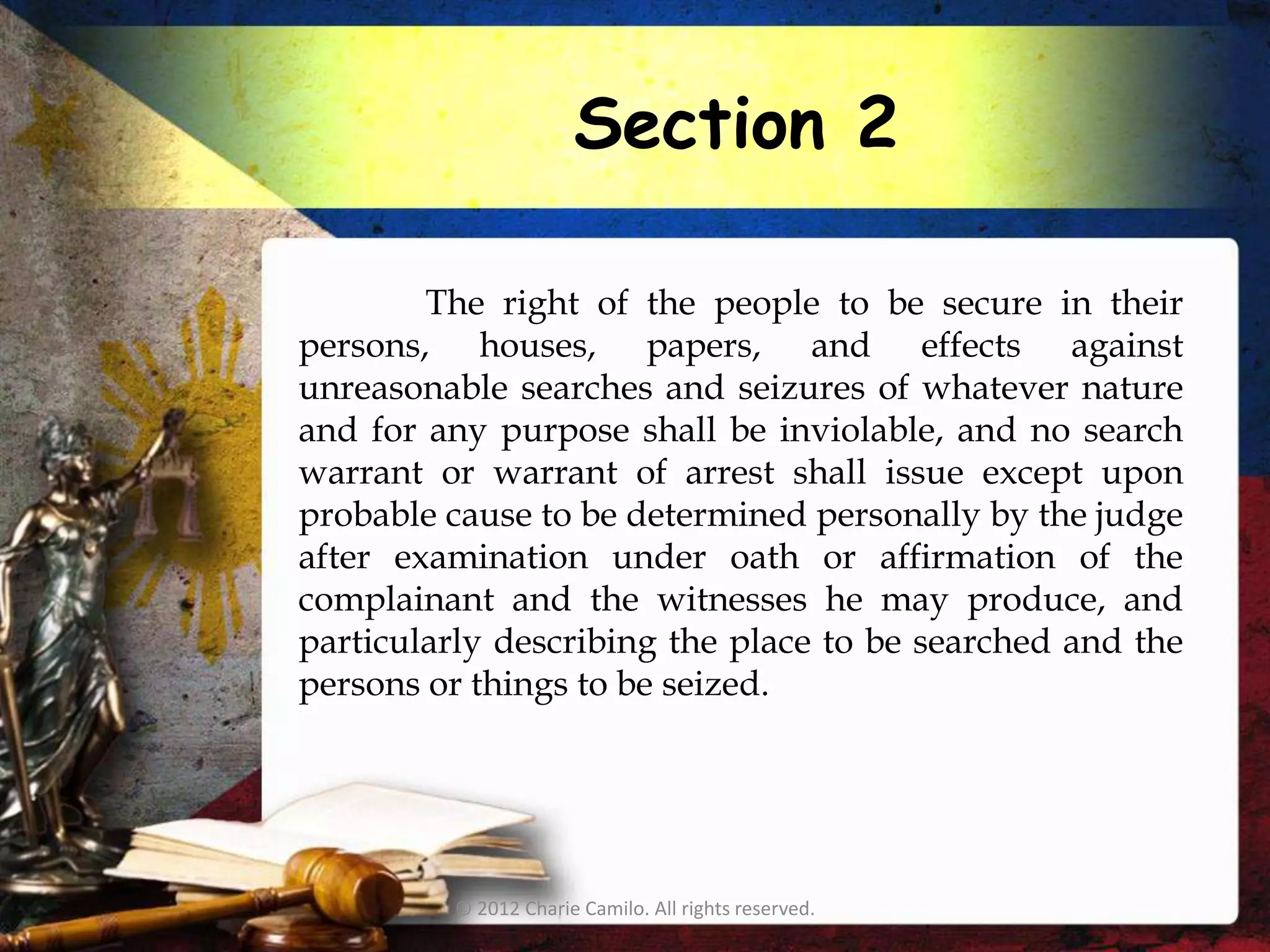
Section 2

        The right of the people to be secure in their
persons, houses, papers, and effects against
unreasonable searches and seizures of whatever nature
and for any purpose shall be inviolable, and no search
warrant or warrant of arrest shall issue except upon
probable cause to be determined personally by the judge
after examination under oath or affirmation of the
complainant and the witnesses he may produce, and
particularly describing the place to be searched and the
persons or things to be seized.


         © 2012 Charie Camilo. All rights reserved.
Section 3

        (1) The privacy of communication and
correspondence shall be inviolable except upon lawful
order of the court, or when public safety or order
requires   otherwise,   as    prescribed    by   law.

       (2) Any evidence obtained in violation of this or
the preceding section shall be inadmissible for any
purpose          in          any           proceeding.


         © 2012 Charie Camilo. All rights reserved.
Section 4

        No law shall be passed abridging the freedom
of speech, of expression, or of the press, or the right of
the people peaceably to assemble and petition the
government for redress of grievances.


          © 2012 Charie Camilo. All rights reserved.
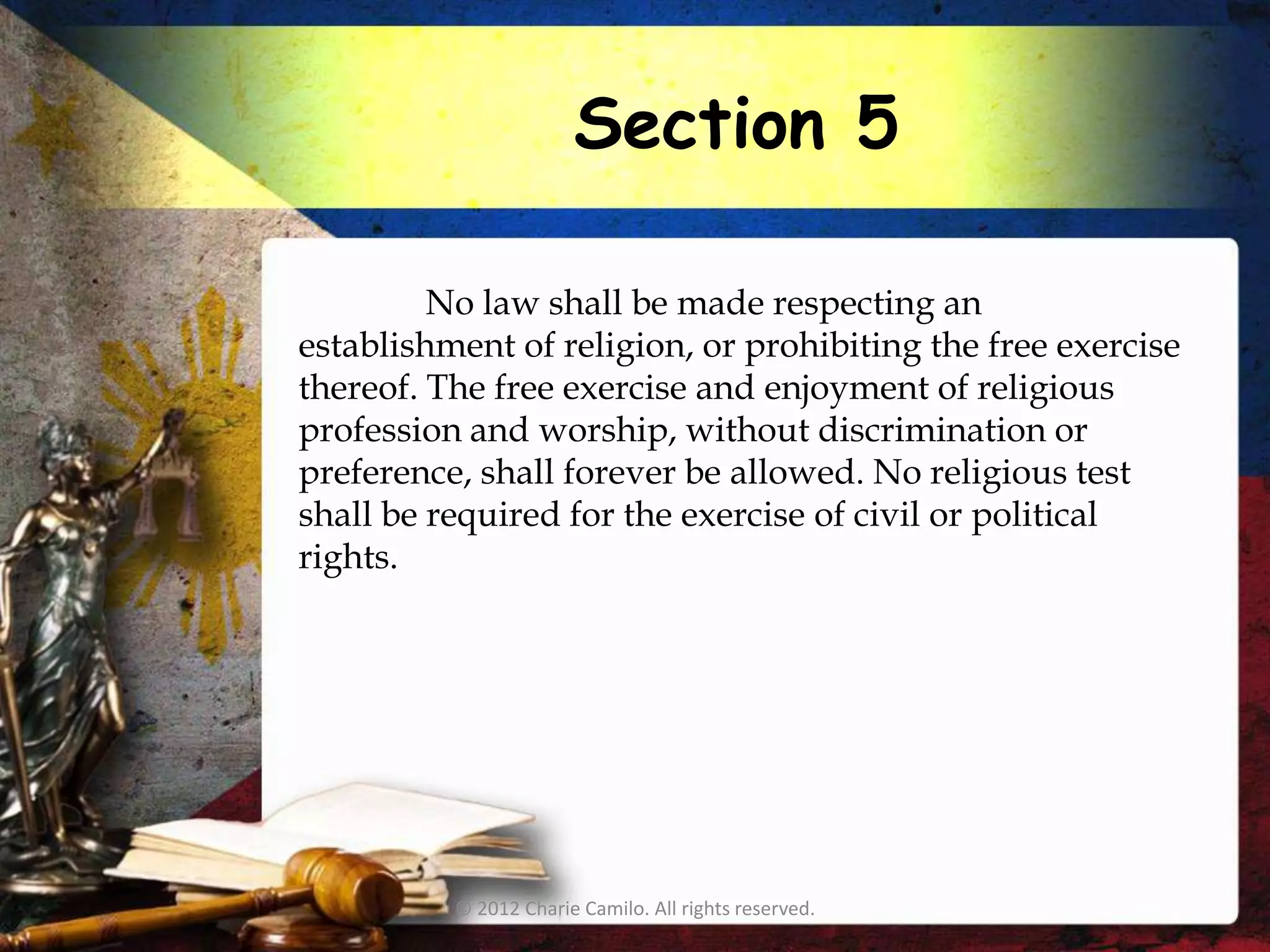
Section 5

         No law shall be made respecting an
establishment of religion, or prohibiting the free exercise
thereof. The free exercise and enjoyment of religious
profession and worship, without discrimination or
preference, shall forever be allowed. No religious test
shall be required for the exercise of civil or political
rights.


          © 2012 Charie Camilo. All rights reserved.
Section 6

         The liberty of abode and of changing the same
within the limits prescribed by law shall not be
impaired except upon lawful order of the court. Neither
shall the right to travel be impaired except in the interest
of national security, public safety, or public health, as
may           be          provided         by          law.


          © 2012 Charie Camilo. All rights reserved.
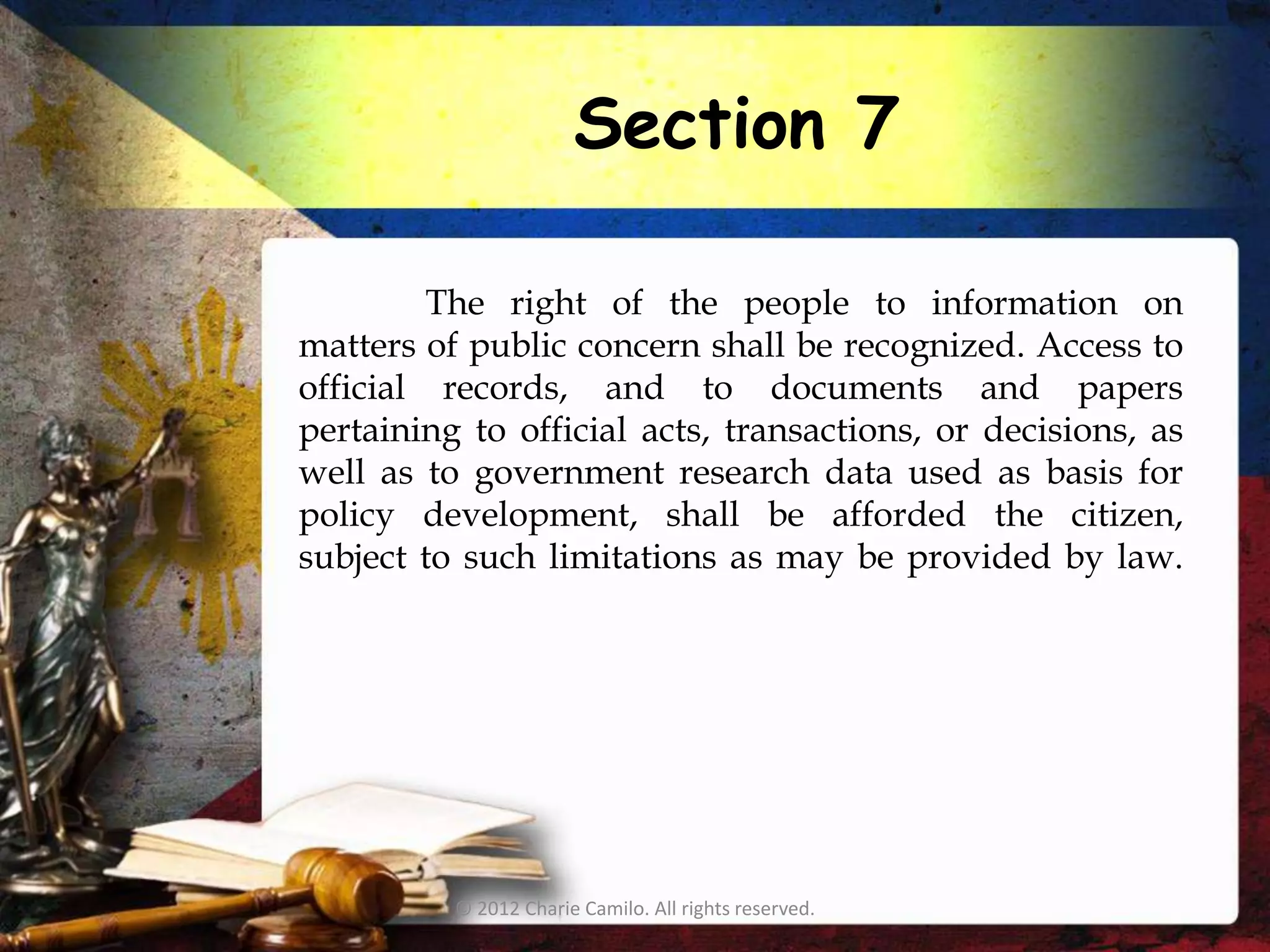
Section 7

         The right of the people to information on
matters of public concern shall be recognized. Access to
official records, and to documents and papers
pertaining to official acts, transactions, or decisions, as
well as to government research data used as basis for
policy development, shall be afforded the citizen,
subject to such limitations as may be provided by law.


          © 2012 Charie Camilo. All rights reserved.
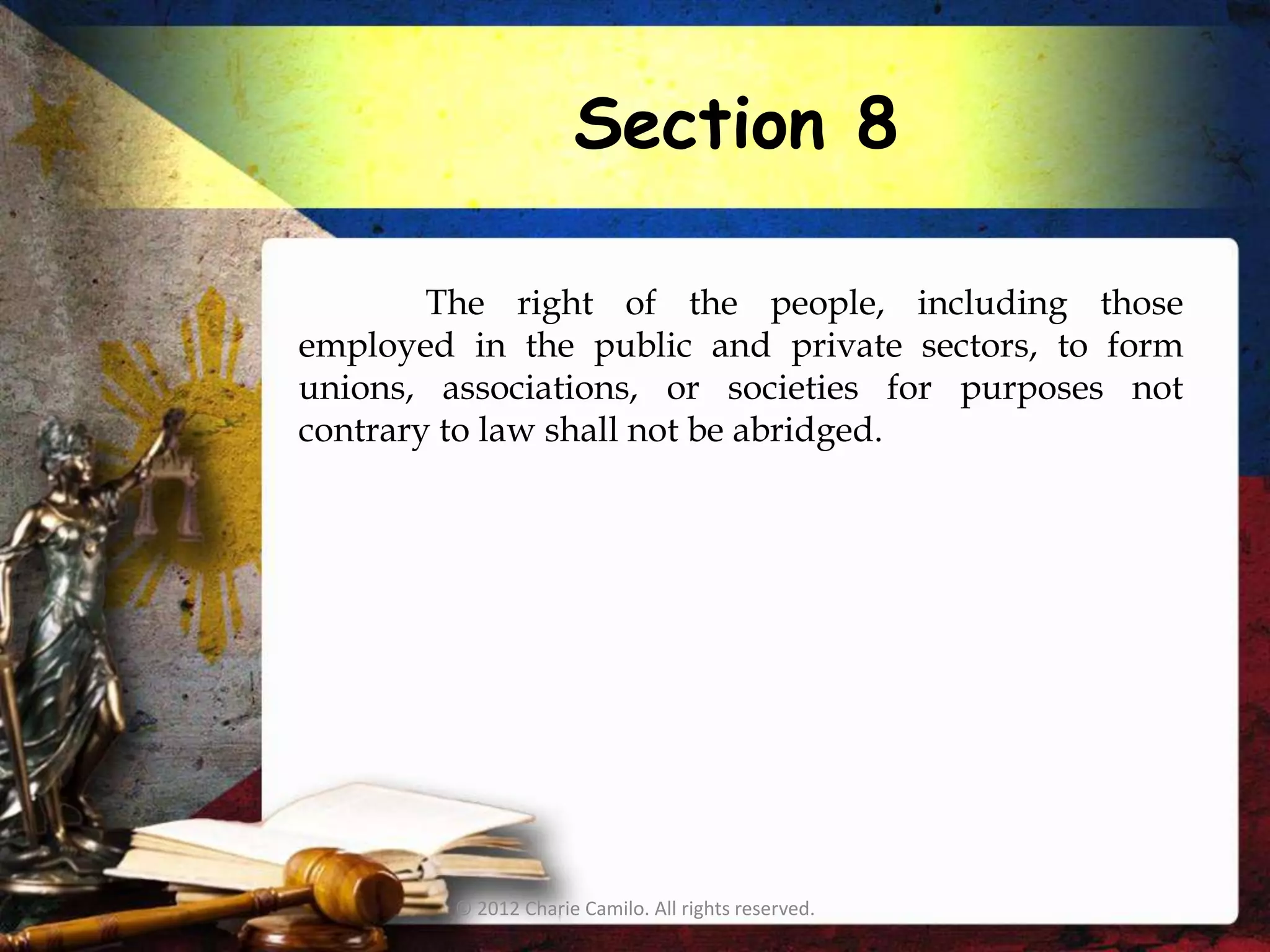
Section 8

        The right of the people, including those
employed in the public and private sectors, to form
unions, associations, or societies for purposes not
contrary to law shall not be abridged.


         © 2012 Charie Camilo. All rights reserved.
Section 9

        Private property shall not be taken for public
use without just compensation.


         © 2012 Charie Camilo. All rights reserved.
Section 10

         No law impairing the obligation of contracts
shall be passed.


          © 2012 Charie Camilo. All rights reserved.
Section 11

        Free access to the courts and quasi-judicial
bodies and adequate legal assistance shall not be denied
to   any     person    by      reason     of    poverty.


         © 2012 Charie Camilo. All rights reserved.
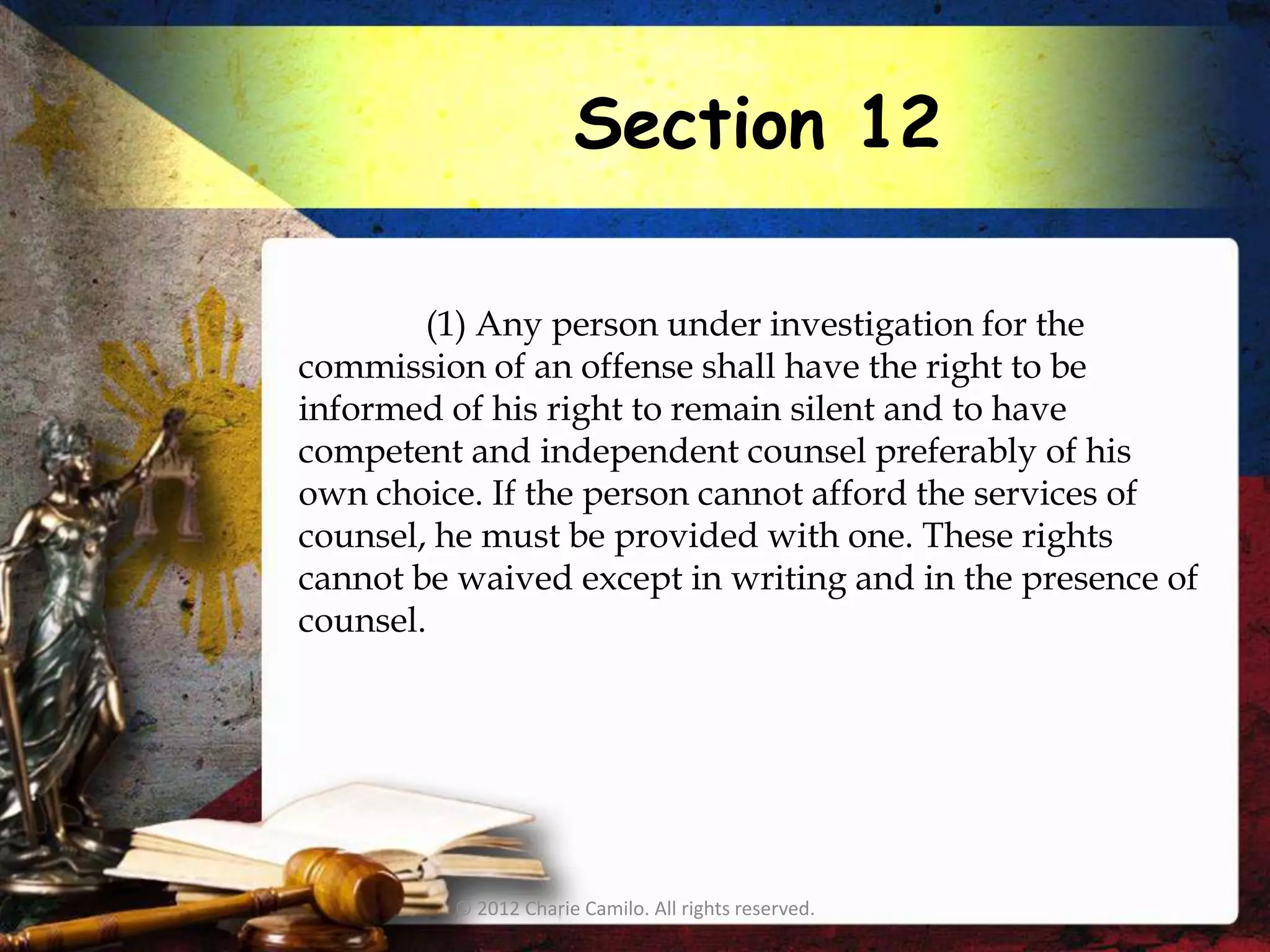
Section 12

        (1) Any person under investigation for the
commission of an offense shall have the right to be
informed of his right to remain silent and to have
competent and independent counsel preferably of his
own choice. If the person cannot afford the services of
counsel, he must be provided with one. These rights
cannot be waived except in writing and in the presence of
counsel.


         © 2012 Charie Camilo. All rights reserved.
(2) No torture, force, violence, threat,
intimidation, or any other means which vitiate the free
will shall be used against him. Secret detention places,
solitary, incommunicado, or other similar forms of
detention are prohibited.

        (3) Any confession or admission obtained in
violation of this or Section 17 hereof shall be
inadmissible    in     evidence    against     him.

        (4) The law shall provide for penal and civil
sanctions for violations of this section as well as
compensation to the rehabilitation of victims of torture
or similar practices, and their families.


         © 2012 Charie Camilo. All rights reserved.
Section 13

          All persons, except those charged with offenses
punishable by reclusion perpetua when evidence of
guilt is strong, shall, before conviction, be bailable by
sufficient sureties, or be released on recognizance as
may be provided by law. The right to bail shall not be
impaired even when the privilege of the writ of habeas
corpus is suspended. Excessive bail shall not be
required.


          © 2012 Charie Camilo. All rights reserved.
Section 14

        (1) No person shall be held to answer for a
criminal offense without due process of law.

         (2) In all criminal prosecutions, the accused
shall be presumed innocent until the contrary is proved,
and shall enjoy the right to be heard by himself and
counsel, to be informed of the nature and cause of the
accusation against him, to have a speedy, impartial, and
public trial, to meet the witnesses face to face, and to
have compulsory process to secure the attendance of
witnesses and the production of evidence in his behalf.
However,        after    arraignment,      trial    may


         © 2012 Charie Camilo. All rights reserved.
proceed notwithstanding the absence of the accused:
Provided, that he has been duly notified and his failure
to appear is unjustifiable.


         © 2012 Charie Camilo. All rights reserved.
Section 15

        The privilege of the writ of habeas corpus shall
not be suspended except in cases of invasion or
rebellion, when the public safety requires it.


         © 2012 Charie Camilo. All rights reserved.
Section 16

All persons shall have the right to a speedy disposition
of their cases before all judicial, quasi-judicial, or
administrative bodies.


          © 2012 Charie Camilo. All rights reserved.
Section 17

        No person shall be compelled to be a witness
against himself.


         © 2012 Charie Camilo. All rights reserved.
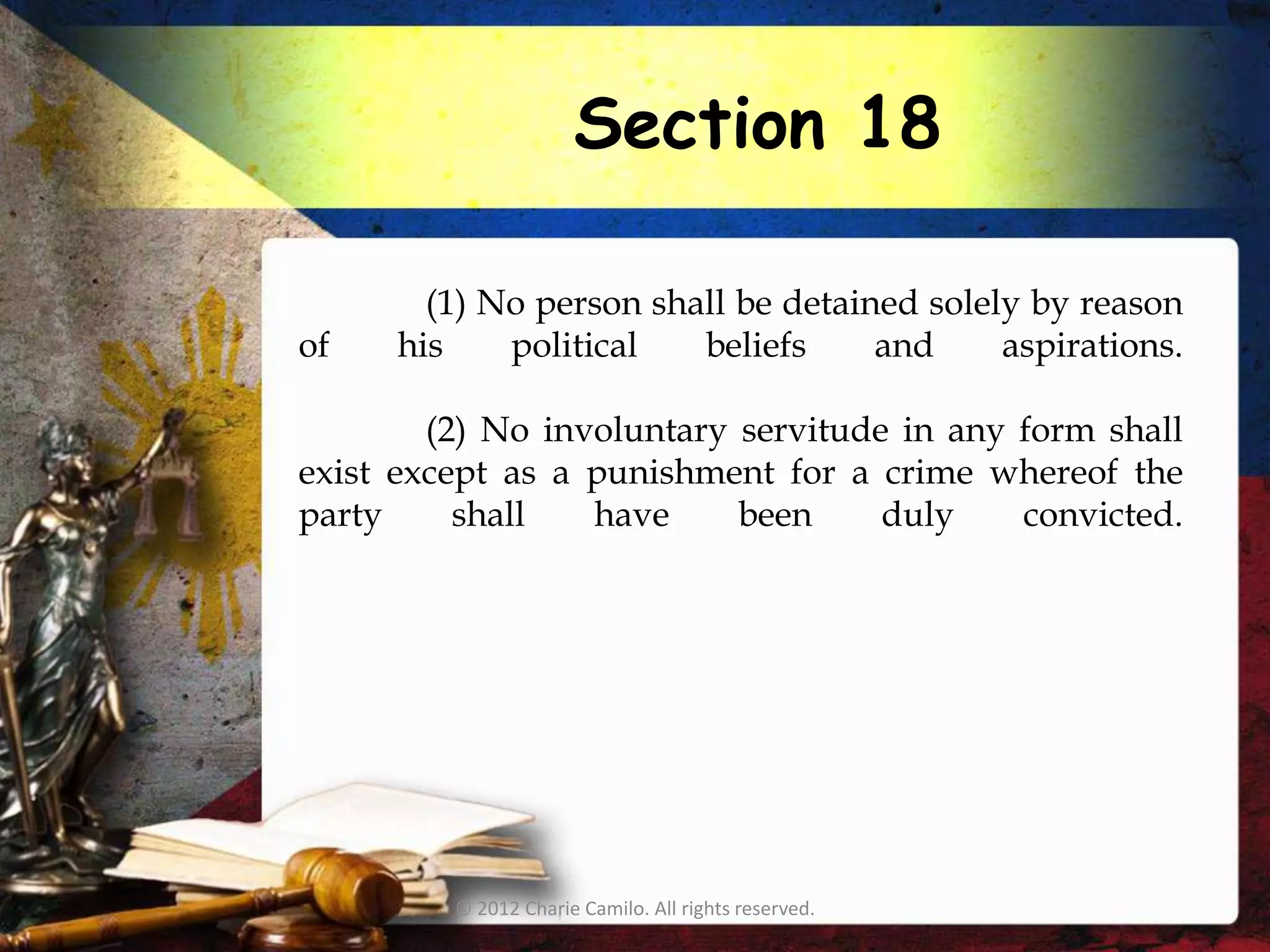
Section 18

        (1) No person shall be detained solely by reason
of    his    political   beliefs     and     aspirations.

        (2) No involuntary servitude in any form shall
exist except as a punishment for a crime whereof the
party     shall   have     been     duly    convicted.


         © 2012 Charie Camilo. All rights reserved.
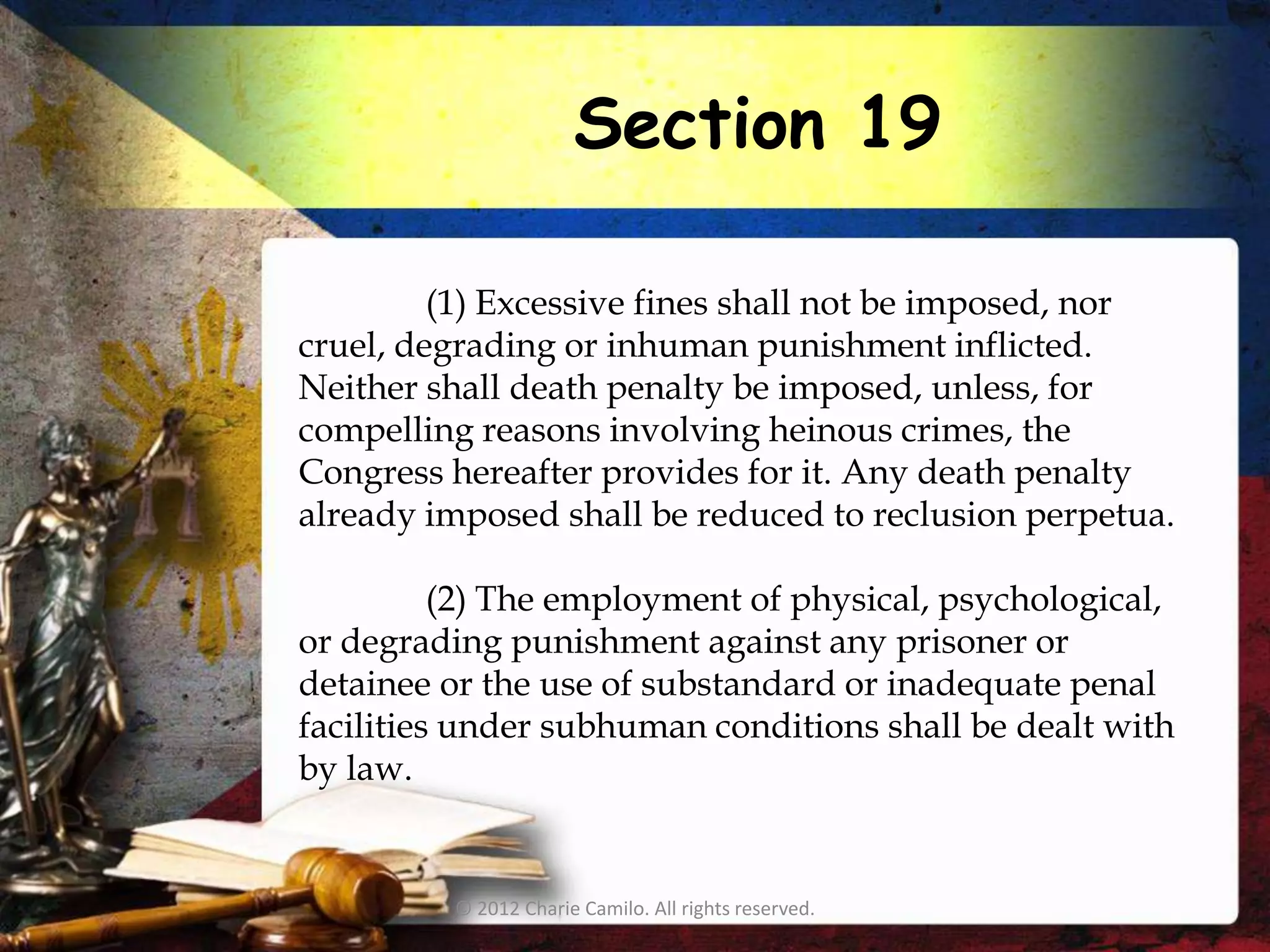
Section 19

         (1) Excessive fines shall not be imposed, nor
cruel, degrading or inhuman punishment inflicted.
Neither shall death penalty be imposed, unless, for
compelling reasons involving heinous crimes, the
Congress hereafter provides for it. Any death penalty
already imposed shall be reduced to reclusion perpetua.

          (2) The employment of physical, psychological,
or degrading punishment against any prisoner or
detainee or the use of substandard or inadequate penal
facilities under subhuman conditions shall be dealt with
by law.


         © 2012 Charie Camilo. All rights reserved.
Section 20

      No person shall be imprisoned for debt or non-
payment of a poll tax.


         © 2012 Charie Camilo. All rights reserved.
Section 21

         No person shall be twice put in jeopardy of
punishment for the same offense. If an act is punished
by a law and an ordinance, conviction or acquittal under
either shall constitute a bar to another prosecution for
the same act.


         © 2012 Charie Camilo. All rights reserved.
Section 22

        No ex post facto law or bill of attainder shall be
enacted.


          © 2012 Charie Camilo. All rights reserved.

Philippine Constitution 1987 (Article 3 - Bill of Rights)

  • 1.
    Article III BILL OF RIGHTS © 2012 Charie Camilo. All rights reserved.
  • 2.
    Section 1 No person shall be deprived of life, liberty, or property without due process of law, nor shall any person be denied the equal protection of the laws. © 2012 Charie Camilo. All rights reserved.
  • 3.
    Section 2 The right of the people to be secure in their persons, houses, papers, and effects against unreasonable searches and seizures of whatever nature and for any purpose shall be inviolable, and no search warrant or warrant of arrest shall issue except upon probable cause to be determined personally by the judge after examination under oath or affirmation of the complainant and the witnesses he may produce, and particularly describing the place to be searched and the persons or things to be seized. © 2012 Charie Camilo. All rights reserved.
  • 4.
    Section 3 (1) The privacy of communication and correspondence shall be inviolable except upon lawful order of the court, or when public safety or order requires otherwise, as prescribed by law. (2) Any evidence obtained in violation of this or the preceding section shall be inadmissible for any purpose in any proceeding. © 2012 Charie Camilo. All rights reserved.
  • 5.
    Section 4 No law shall be passed abridging the freedom of speech, of expression, or of the press, or the right of the people peaceably to assemble and petition the government for redress of grievances. © 2012 Charie Camilo. All rights reserved.
  • 6.
    Section 5 No law shall be made respecting an establishment of religion, or prohibiting the free exercise thereof. The free exercise and enjoyment of religious profession and worship, without discrimination or preference, shall forever be allowed. No religious test shall be required for the exercise of civil or political rights. © 2012 Charie Camilo. All rights reserved.
  • 7.
    Section 6 The liberty of abode and of changing the same within the limits prescribed by law shall not be impaired except upon lawful order of the court. Neither shall the right to travel be impaired except in the interest of national security, public safety, or public health, as may be provided by law. © 2012 Charie Camilo. All rights reserved.
  • 8.
    Section 7 The right of the people to information on matters of public concern shall be recognized. Access to official records, and to documents and papers pertaining to official acts, transactions, or decisions, as well as to government research data used as basis for policy development, shall be afforded the citizen, subject to such limitations as may be provided by law. © 2012 Charie Camilo. All rights reserved.
  • 9.
    Section 8 The right of the people, including those employed in the public and private sectors, to form unions, associations, or societies for purposes not contrary to law shall not be abridged. © 2012 Charie Camilo. All rights reserved.
  • 10.
    Section 9 Private property shall not be taken for public use without just compensation. © 2012 Charie Camilo. All rights reserved.
  • 11.
    Section 10 No law impairing the obligation of contracts shall be passed. © 2012 Charie Camilo. All rights reserved.
  • 12.
    Section 11 Free access to the courts and quasi-judicial bodies and adequate legal assistance shall not be denied to any person by reason of poverty. © 2012 Charie Camilo. All rights reserved.
  • 13.
    Section 12 (1) Any person under investigation for the commission of an offense shall have the right to be informed of his right to remain silent and to have competent and independent counsel preferably of his own choice. If the person cannot afford the services of counsel, he must be provided with one. These rights cannot be waived except in writing and in the presence of counsel. © 2012 Charie Camilo. All rights reserved.
  • 14.
    (2) No torture,force, violence, threat, intimidation, or any other means which vitiate the free will shall be used against him. Secret detention places, solitary, incommunicado, or other similar forms of detention are prohibited. (3) Any confession or admission obtained in violation of this or Section 17 hereof shall be inadmissible in evidence against him. (4) The law shall provide for penal and civil sanctions for violations of this section as well as compensation to the rehabilitation of victims of torture or similar practices, and their families. © 2012 Charie Camilo. All rights reserved.
  • 15.
    Section 13 All persons, except those charged with offenses punishable by reclusion perpetua when evidence of guilt is strong, shall, before conviction, be bailable by sufficient sureties, or be released on recognizance as may be provided by law. The right to bail shall not be impaired even when the privilege of the writ of habeas corpus is suspended. Excessive bail shall not be required. © 2012 Charie Camilo. All rights reserved.
  • 16.
    Section 14 (1) No person shall be held to answer for a criminal offense without due process of law. (2) In all criminal prosecutions, the accused shall be presumed innocent until the contrary is proved, and shall enjoy the right to be heard by himself and counsel, to be informed of the nature and cause of the accusation against him, to have a speedy, impartial, and public trial, to meet the witnesses face to face, and to have compulsory process to secure the attendance of witnesses and the production of evidence in his behalf. However, after arraignment, trial may © 2012 Charie Camilo. All rights reserved.
  • 17.
    proceed notwithstanding theabsence of the accused: Provided, that he has been duly notified and his failure to appear is unjustifiable. © 2012 Charie Camilo. All rights reserved.
  • 18.
    Section 15 The privilege of the writ of habeas corpus shall not be suspended except in cases of invasion or rebellion, when the public safety requires it. © 2012 Charie Camilo. All rights reserved.
  • 19.
    Section 16 All personsshall have the right to a speedy disposition of their cases before all judicial, quasi-judicial, or administrative bodies. © 2012 Charie Camilo. All rights reserved.
  • 20.
    Section 17 No person shall be compelled to be a witness against himself. © 2012 Charie Camilo. All rights reserved.
  • 21.
    Section 18 (1) No person shall be detained solely by reason of his political beliefs and aspirations. (2) No involuntary servitude in any form shall exist except as a punishment for a crime whereof the party shall have been duly convicted. © 2012 Charie Camilo. All rights reserved.
  • 22.
    Section 19 (1) Excessive fines shall not be imposed, nor cruel, degrading or inhuman punishment inflicted. Neither shall death penalty be imposed, unless, for compelling reasons involving heinous crimes, the Congress hereafter provides for it. Any death penalty already imposed shall be reduced to reclusion perpetua. (2) The employment of physical, psychological, or degrading punishment against any prisoner or detainee or the use of substandard or inadequate penal facilities under subhuman conditions shall be dealt with by law. © 2012 Charie Camilo. All rights reserved.
  • 23.
    Section 20 No person shall be imprisoned for debt or non- payment of a poll tax. © 2012 Charie Camilo. All rights reserved.
  • 24.
    Section 21 No person shall be twice put in jeopardy of punishment for the same offense. If an act is punished by a law and an ordinance, conviction or acquittal under either shall constitute a bar to another prosecution for the same act. © 2012 Charie Camilo. All rights reserved.
  • 25.
    Section 22 No ex post facto law or bill of attainder shall be enacted. © 2012 Charie Camilo. All rights reserved.