   It is often said that the Filipino has been
    “naturally communal” and has lost this
    because of “Western individualism”. Allegedly
    in order to create a strong democratic
    foundation, we must go back to our
    indigenous culture. Also, the solution, may be
    not just going back to our indigenous
    culture, but likewise re-
    interpreting, transforming, broadening it in
    terms of concerns of a contemporary 20th
    century nation-state.
   The major source of wealth in 16th century
    Luzon and the Visayas was indeed not
    land, for the population density was low.
    Rather it was manpower which could be
    bought and sold, in other words, slavery in
    the strict sense of the term.
   Concerning land: in both ecological and
    Marxist approaches, there is appreciation for
    the fact that property relations are influenced
    by the nature of the of production.

   Three forms of technology thus
    emerged, each of which has implications for
    property relations.
   Swidden Cultivation – Usufruct rather than
    ownership of land.
   Non-mechanized wet rice cultivation – Private
    ownership of riceland.
   Mechanized wet rice cultivation – Private
    ownership of riceland. May favor cooperative
    ventures leading to communal ownership.
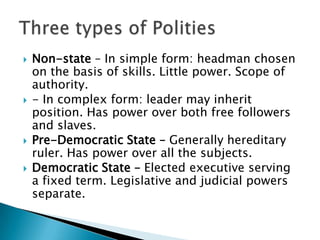
   Non-state – In simple form: headman chosen
    on the basis of skills. Little power. Scope of
    authority.
   - In complex form: leader may inherit
    position. Has power over both free followers
    and slaves.
   Pre-Democratic State – Generally hereditary
    ruler. Has power over all the subjects.
   Democratic State – Elected executive serving
    a fixed term. Legislative and judicial powers
    separate.
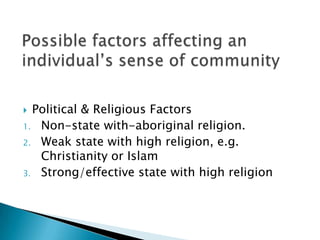
 Political & Religious Factors
1. Non-state with-aboriginal religion.
2. Weak state with high religion, e.g.
   Christianity or Islam
3. Strong/effective state with high religion
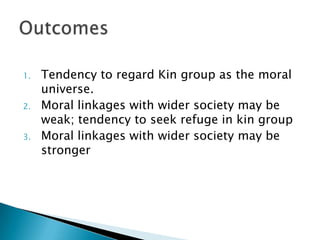
1.   Tendency to regard Kin group as the moral
     universe.
2.   Moral linkages with wider society may be
     weak; tendency to seek refuge in kin group
3.   Moral linkages with wider society may be
     stronger

Socioanthro report cellona

  • 2.
    It is often said that the Filipino has been “naturally communal” and has lost this because of “Western individualism”. Allegedly in order to create a strong democratic foundation, we must go back to our indigenous culture. Also, the solution, may be not just going back to our indigenous culture, but likewise re- interpreting, transforming, broadening it in terms of concerns of a contemporary 20th century nation-state.
  • 3.
    The major source of wealth in 16th century Luzon and the Visayas was indeed not land, for the population density was low. Rather it was manpower which could be bought and sold, in other words, slavery in the strict sense of the term.
  • 4.
    Concerning land: in both ecological and Marxist approaches, there is appreciation for the fact that property relations are influenced by the nature of the of production.  Three forms of technology thus emerged, each of which has implications for property relations.
  • 5.
    Swidden Cultivation – Usufruct rather than ownership of land.  Non-mechanized wet rice cultivation – Private ownership of riceland.  Mechanized wet rice cultivation – Private ownership of riceland. May favor cooperative ventures leading to communal ownership.
  • 6.
    Non-state – In simple form: headman chosen on the basis of skills. Little power. Scope of authority.  - In complex form: leader may inherit position. Has power over both free followers and slaves.  Pre-Democratic State – Generally hereditary ruler. Has power over all the subjects.  Democratic State – Elected executive serving a fixed term. Legislative and judicial powers separate.
  • 7.
     Political &Religious Factors 1. Non-state with-aboriginal religion. 2. Weak state with high religion, e.g. Christianity or Islam 3. Strong/effective state with high religion
  • 8.
    1. Tendency to regard Kin group as the moral universe. 2. Moral linkages with wider society may be weak; tendency to seek refuge in kin group 3. Moral linkages with wider society may be stronger