The Use of zeolite base SOLID ACID
CATALYST FOR ALKYLATION OF
ISOBUTANE/BUTENE
INDIAN INSTITUTE OF PETROLEUM
DEHRADUN
Table of Contents

Introduction

Importance of Alkylation solid acid catalyst
process

Use of Catalysts in Alkylation process

Available solid technology

Future of solid acid catalyzed alkylation
Table of Contents

Introduction

Importance of Alkylation solid acid catalyst
process

Use of Catalysts in Alkylation process

Available solid technology

Future of solid acid catalyzed alkylation
Introduction
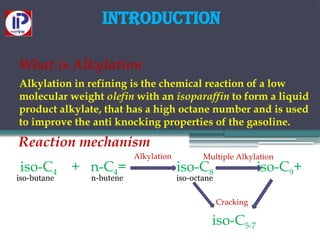
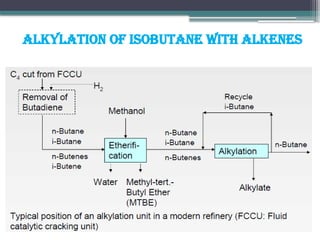
What is Alkylation
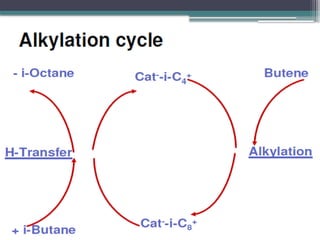
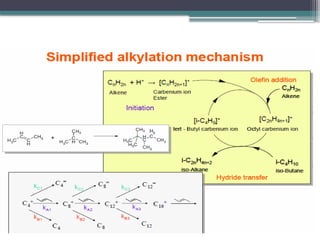
Alkylation in refining is the chemical reaction of a low
molecular weight olefin with an isoparaffin to form a liquid
product alkylate, that has a high octane number and is used
to improve the anti knocking properties of the gasoline.
iso-C4 + n-C4= iso-C8 iso-C9+
iso-C5-7
iso-butane n-butene iso-octane
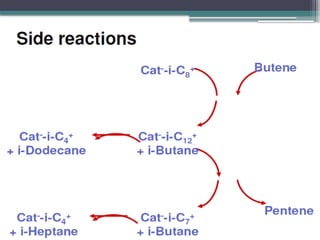
Alkylation Multiple Alkylation
Cracking
Reaction mechanism
Introduction
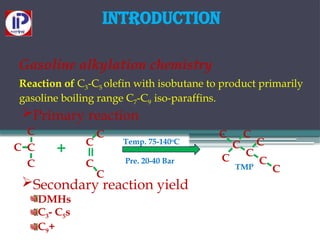
Gasoline alkylation chemistry
Reaction of C3-C5 olefin with isobutane to product primarily
gasoline boiling range C7-C9 iso-paraffins.
Primary reaction
C
C
C
C
C
C
C
C
C
C
C
C C
C
C
C
+
=
-
-
-
-
-
-
- -
-
-
-
-
Temp. 75-140o
C
Pre. 20-40 Bar
TMP
Secondary reaction yield
DMHs
C3- C5s
C9+
Introduction
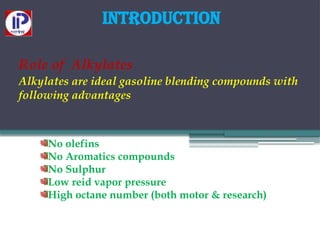
Role of Alkylates
Alkylates are ideal gasoline blending compounds with
following advantages
No olefins
No Aromatics compounds
No Sulphur
Low reid vapor pressure
High octane number (both motor & research)
Table of Contents

Introduction

Importance of Alkylation solid acid catalyst
process

Use of Catalysts in Alkylation process

Available solid technology

Future of solid acid catalyzed alkylation
Importance of Alkylation solid
acid catalyst process
Environmental friendly process
High octane number of obtain product
Feed easily obtain
Low catalyst consumption
Reactors used in Alkylation
process
Continuous flow stirred tank reactor
Up flow fixed reactor with controlled pressure,
Temperature &WHSV
Multiple fixed bad reactor
High pressure fixed bad reactor
Supercritical fluid reactor
Low & High pressure reactor
Slurry reactor
Conclusion of solid acid catalyst
alkylation reaction
Conversion of olefin 80-100%
High percentage of TMP in alkylates
Alkylates yield obtain 35-57%
High octane number
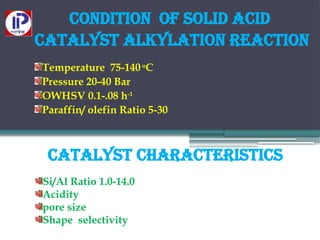
catalyst characteristics
Si/Al Ratio 1.0-14.0
Acidity
pore size
Shape selectivity
Condition of solid acid
catalyst alkylation reaction
Temperature 75-140o
C
Pressure 20-40 Bar
OWHSV 0.1-.08 h-1
Paraffin/ olefin Ratio 5-30
Table of Contents

Introduction

Importance of Alkylation solid acid catalyst
process

Use of Catalysts in Alkylation process

Available solid technology

Future of solid acid catalyzed alkylation
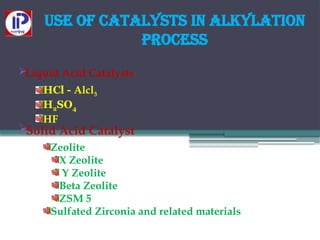
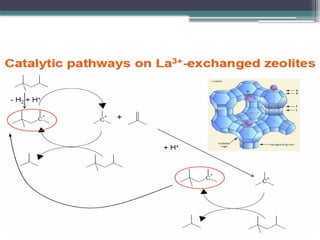
Use of Catalysts in Alkylation
process
Liquid Acid Catalysts
Solid Acid Catalyst
HCl - Alcl3
H2SO4
HF
Zeolite
X Zeolite
Y Zeolite
Beta Zeolite
ZSM 5
Sulfated Zirconia and related materials
Table of Contents

Introduction

Importance of Alkylation solid acid catalyst
process

Use of Catalysts in Alkylation process

Available solid technology

Future of solid acid catalyzed alkylation
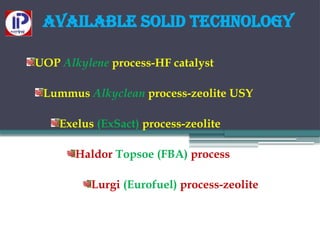
Available solid technology
UOP Alkylene process-HF catalyst
Lummus Alkyclean process-zeolite USY
Exelus (ExSact) process-zeolite
Haldor Topsoe (FBA) process
Lurgi (Eurofuel) process-zeolite
Available solid technology
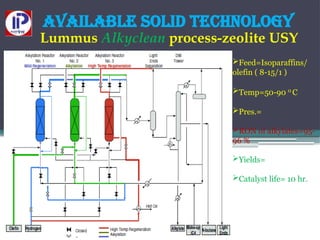
Lummus Alkyclean process-zeolite USY
Feed=Isoparaffins/
olefin ( 8-15/1 )
Temp=50-90 0
C
Pres.=
RON of alkylates=95-
96 %
Yields=
Catalyst life= 10 hr.
Available solid technology
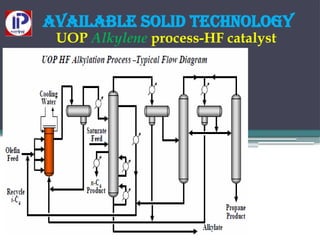
UOP Alkylene process-HF catalyst
Alkylation of isobutane with alkenes
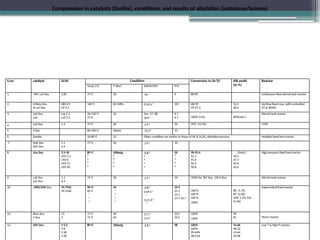
S.no catalyst Si/Al Condition Conversion in (in %) Alk.yeald
(in %)
Reactor
Temp (o
C) P (Bar) WSHV/OSV P/O
1. .4Pt. LaY Zeo. 2.82 75o
C 20 .5h-1 9 80-85 continuous flow stirred tank reactor
2. H Beta Zeo.
H LaY Zeo.
HB13.9
HY 4.1
140o
C 8.0 MPa 0.33 h-1 107 HB 95
HY 97.3
53.3
48.3
Up flow fixed reac. with controlled
P,T & WHSV
3. LaX Zeo.
LaX
Lax 1.2
LaY 2.5
40-130oC
75o
C
32 Osv .17-.80
18 h-1
6.7
6.7 100% (11h) 60%(selc.)
Stirred tank reactor
4. LaX Zeo. 1.2 75o
C 20 .2 h-1 10 99% (12.9h) CSTR
5. Y Zeo. 80-100o
C 20atm .75 h-1 12
6. Zeolite 50-80o
C 21 Other condition are similar to those of HF & H2SO4 alkylation process Multiple fixed bad reactor
7. NaX Zeo.
NaY Zeo.
1.1
2.4
75o
C 20 .2 h-1 10
8. Usy Zeo. 2.5-30
USY-2.5
USY-6
USY-15
USY-30
80o
C
“
“
“
“
300psig
“
“
“
“
.5 h-1
“
“
“
“
20
“
“
“
“
90-92.4
91.5
91.6
92.4
90.8
(5min.)
49.5
47.7
45.0
42.0
High pressure fixed bad reactor
9. LaX Zeo.
LaY Zeo.
1.1
2.4
75o
C 20 .2 h-1 10 100% for 7hY Zeo. 13h X Zeo. Stirred tank reactor
10 .25Pt/USY Zeo. 59.7%Si
39.5%Al
90o
C
60o
C
“
“
“
42
“
“
“
“
.1 h-1
0.09 h-1
“
0.21 h-1
“
25.4
25.1
25.1
24.7 24.7
100 %
100 %
100 %
100%
88 (1.7h)
89 (2.4h)
109( 1.7h) 102
(2.4h)
Supercritical fluid reactor
11. Beta Zeo.
Y Zeo.
13
3
75o
C
75o
C
40
40
11 h-1
11 h-1
20,5
20,5
100%
100%
90
81 Slurry reactor
12. USY Zeo. Y-2.5
Y-6
Y-30
Y-40
80oC 300psig .1 h-1 98 100%
100%
99.44%
98.51%
54.66
48.32
43.64
39.98
Low T & high P reactor
Compression in catalysts (Zeolite), conditions, and results of alkylation (isobutene/butene)

Alkylation power presentation for student

  • 1.
    The Use ofzeolite base SOLID ACID CATALYST FOR ALKYLATION OF ISOBUTANE/BUTENE INDIAN INSTITUTE OF PETROLEUM DEHRADUN
  • 2.
    Table of Contents  Introduction  Importanceof Alkylation solid acid catalyst process  Use of Catalysts in Alkylation process  Available solid technology  Future of solid acid catalyzed alkylation
  • 3.
    Table of Contents  Introduction  Importanceof Alkylation solid acid catalyst process  Use of Catalysts in Alkylation process  Available solid technology  Future of solid acid catalyzed alkylation
  • 4.
    Introduction What is Alkylation Alkylationin refining is the chemical reaction of a low molecular weight olefin with an isoparaffin to form a liquid product alkylate, that has a high octane number and is used to improve the anti knocking properties of the gasoline. iso-C4 + n-C4= iso-C8 iso-C9+ iso-C5-7 iso-butane n-butene iso-octane Alkylation Multiple Alkylation Cracking Reaction mechanism
  • 7.
    Introduction Gasoline alkylation chemistry Reactionof C3-C5 olefin with isobutane to product primarily gasoline boiling range C7-C9 iso-paraffins. Primary reaction C C C C C C C C C C C C C C C C + = - - - - - - - - - - - - Temp. 75-140o C Pre. 20-40 Bar TMP Secondary reaction yield DMHs C3- C5s C9+
  • 8.
    Introduction Role of Alkylates Alkylatesare ideal gasoline blending compounds with following advantages No olefins No Aromatics compounds No Sulphur Low reid vapor pressure High octane number (both motor & research)
  • 9.
    Table of Contents  Introduction  Importanceof Alkylation solid acid catalyst process  Use of Catalysts in Alkylation process  Available solid technology  Future of solid acid catalyzed alkylation
  • 10.
    Importance of Alkylationsolid acid catalyst process Environmental friendly process High octane number of obtain product Feed easily obtain Low catalyst consumption
  • 11.
    Reactors used inAlkylation process Continuous flow stirred tank reactor Up flow fixed reactor with controlled pressure, Temperature &WHSV Multiple fixed bad reactor High pressure fixed bad reactor Supercritical fluid reactor Low & High pressure reactor Slurry reactor
  • 12.
    Conclusion of solidacid catalyst alkylation reaction Conversion of olefin 80-100% High percentage of TMP in alkylates Alkylates yield obtain 35-57% High octane number
  • 13.
    catalyst characteristics Si/Al Ratio1.0-14.0 Acidity pore size Shape selectivity Condition of solid acid catalyst alkylation reaction Temperature 75-140o C Pressure 20-40 Bar OWHSV 0.1-.08 h-1 Paraffin/ olefin Ratio 5-30
  • 14.
    Table of Contents  Introduction  Importanceof Alkylation solid acid catalyst process  Use of Catalysts in Alkylation process  Available solid technology  Future of solid acid catalyzed alkylation
  • 15.
    Use of Catalystsin Alkylation process Liquid Acid Catalysts Solid Acid Catalyst HCl - Alcl3 H2SO4 HF Zeolite X Zeolite Y Zeolite Beta Zeolite ZSM 5 Sulfated Zirconia and related materials
  • 16.
    Table of Contents  Introduction  Importanceof Alkylation solid acid catalyst process  Use of Catalysts in Alkylation process  Available solid technology  Future of solid acid catalyzed alkylation
  • 17.
    Available solid technology UOPAlkylene process-HF catalyst Lummus Alkyclean process-zeolite USY Exelus (ExSact) process-zeolite Haldor Topsoe (FBA) process Lurgi (Eurofuel) process-zeolite
  • 18.
    Available solid technology LummusAlkyclean process-zeolite USY Feed=Isoparaffins/ olefin ( 8-15/1 ) Temp=50-90 0 C Pres.= RON of alkylates=95- 96 % Yields= Catalyst life= 10 hr.
  • 19.
    Available solid technology UOPAlkylene process-HF catalyst
  • 20.
  • 23.
    S.no catalyst Si/AlCondition Conversion in (in %) Alk.yeald (in %) Reactor Temp (o C) P (Bar) WSHV/OSV P/O 1. .4Pt. LaY Zeo. 2.82 75o C 20 .5h-1 9 80-85 continuous flow stirred tank reactor 2. H Beta Zeo. H LaY Zeo. HB13.9 HY 4.1 140o C 8.0 MPa 0.33 h-1 107 HB 95 HY 97.3 53.3 48.3 Up flow fixed reac. with controlled P,T & WHSV 3. LaX Zeo. LaX Lax 1.2 LaY 2.5 40-130oC 75o C 32 Osv .17-.80 18 h-1 6.7 6.7 100% (11h) 60%(selc.) Stirred tank reactor 4. LaX Zeo. 1.2 75o C 20 .2 h-1 10 99% (12.9h) CSTR 5. Y Zeo. 80-100o C 20atm .75 h-1 12 6. Zeolite 50-80o C 21 Other condition are similar to those of HF & H2SO4 alkylation process Multiple fixed bad reactor 7. NaX Zeo. NaY Zeo. 1.1 2.4 75o C 20 .2 h-1 10 8. Usy Zeo. 2.5-30 USY-2.5 USY-6 USY-15 USY-30 80o C “ “ “ “ 300psig “ “ “ “ .5 h-1 “ “ “ “ 20 “ “ “ “ 90-92.4 91.5 91.6 92.4 90.8 (5min.) 49.5 47.7 45.0 42.0 High pressure fixed bad reactor 9. LaX Zeo. LaY Zeo. 1.1 2.4 75o C 20 .2 h-1 10 100% for 7hY Zeo. 13h X Zeo. Stirred tank reactor 10 .25Pt/USY Zeo. 59.7%Si 39.5%Al 90o C 60o C “ “ “ 42 “ “ “ “ .1 h-1 0.09 h-1 “ 0.21 h-1 “ 25.4 25.1 25.1 24.7 24.7 100 % 100 % 100 % 100% 88 (1.7h) 89 (2.4h) 109( 1.7h) 102 (2.4h) Supercritical fluid reactor 11. Beta Zeo. Y Zeo. 13 3 75o C 75o C 40 40 11 h-1 11 h-1 20,5 20,5 100% 100% 90 81 Slurry reactor 12. USY Zeo. Y-2.5 Y-6 Y-30 Y-40 80oC 300psig .1 h-1 98 100% 100% 99.44% 98.51% 54.66 48.32 43.64 39.98 Low T & high P reactor Compression in catalysts (Zeolite), conditions, and results of alkylation (isobutene/butene)