Mediating Open Education:  popular discourses,  situated policies & institutional practices for  participatory learning MeCCSA 2010:  Media, Communication, Policy  and Practice 6-8 Jan, London School of Economics  Dr Panagiota Alevizou [email_address] IET, olnet.org
Overview
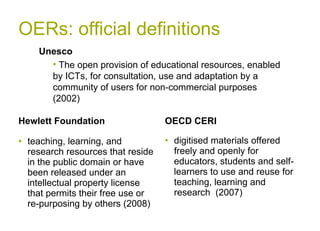
OERs: official definitions Hewlett Foundation teaching, learning, and research resources that reside in the public domain or have been released under an intellectual property license that permits their free use or re-purposing by others (2008) OECD CERI digitised materials offered freely and openly for educators, students and self-learners to use and reuse for teaching, learning and research  (2007) Unesco  The open provision of educational resources, enabled by ICTs, for consultation, use and adaptation by a community of users for non-commercial purposes (2002)
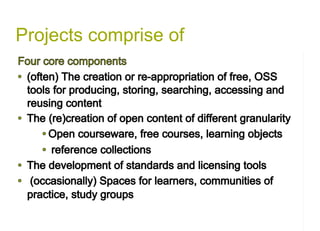
Projects comprise of
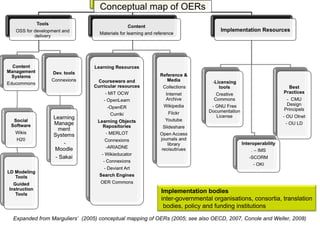
Expanded from Marguliers’  (2005) conceptual mapping of OERs (2005; see also OECD, 2007, Conole and Weller, 2008)  Implementation bodies inter-governmental organisations, consortia, translation bodies, policy and funding institutions
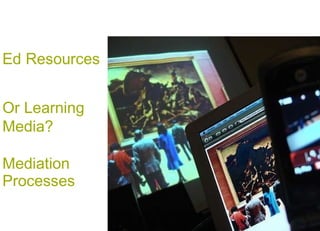
Mediation Processes Or Learning Media?
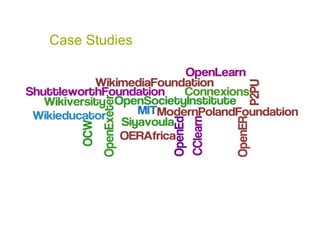
Case Studies
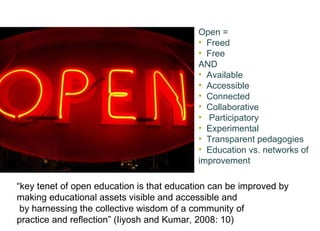
Open = Freed Free AND Available Accessible Connected Collaborative  Participatory Experimental Transparent pedagogies Education vs. networks of improvement  “ key tenet of open education is that education can be improved by  making educational assets visible and accessible and by harnessing the collective wisdom of a community of  practice and reflection” (Iiyosh and Kumar, 2008: 10)
Mediation of pedagogical knowledge Mediatised learning Institutional mediation of pedagogical knowledge as a continuous process (from broadcasting to dialogue?  Dalsgaard, 2008  ) Doubly articulated  Objects, contents  Mediation of pedagogical flows & processes  Resources & learning media Further resources in ‘the field’ beyond the realm of ed. institutions Shifting perceptions of knowledge and pedagogy  Networks of improvement & self-expression beyond formal education  historically educational resources part of a wider publishing field that has been located within central processes of mediation (Silverstone, 2005): a space of social positions, resources and power within its own forms of competition and reward (Thompson, 2005); more emphasis on educational outputs part of the educational institutional habitus, alongside scholarly material
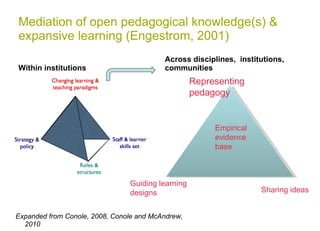
Mediation of open pedagogical knowledge(s) & expansive learning (Engestrom, 2001)  Within institutions  Expanded from Conole, 2008, Conole and McAndrew, 2010 Across disciplines,  institutions, communities Representing pedagogy Guiding learning designs Sharing ideas Empirical  evidence  base
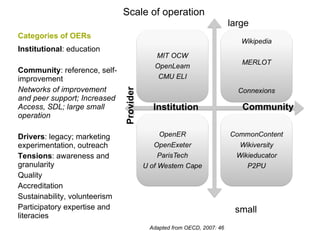
Categories of OERs Institutional : education Community : reference, self-improvement Networks of improvement and peer support; Increased Access, SDL; large small operation Drivers : legacy; marketing experimentation, outreach Tensions : awareness and granularity Quality Accreditation Sustainability, volunteerism  Participatory expertise and literacies Scale of operation large small Provider Community Institution Adapted from OECD, 2007: 46
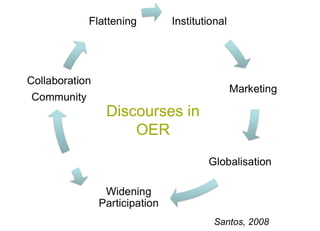
Discourses in OER Santos, 2008
The Institutional Discourse OpenLearn is consistent with the  University’s commitment  to social justice and widening participation in higher education (OpenLearn Website (UK) We wanted to see what offering the OUNL content to a community of learners would mean for higher education: it meant lowering thresholds for entering higher education further  (RS: OpenER/OUNL, Netherlands ) MIT OCW now stands as a new model for disseminating knowledge, serving as a sort of “ shared intellectual commons ” available to educators and learners around the globe (MIT OCW website)
The marketing discourse OpenLearn  […]  Could be a way of building markets, synergies and reputation  (AL: OL) OpenER  modules have worked well as course tasters  (RS:  OPENER) MIT department heads believe that  MIT OCW  is a tool that indirectly aids in recruitment  (SC: MIT OCW)
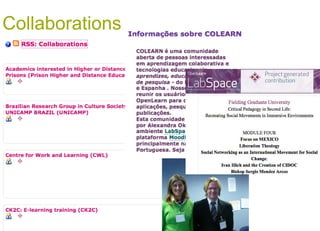
Collaboration, cultural exchange, community  [We are] targeting existing communities and we show them some value in terms of adopting or doing some things here. The value might be different for different discipline groups, for different audiences  …  whether it’s …Union Learning, the University of the Third Age, or a local community here, or another university there it’s very much say…. here’s the resource, you make use of …we show what it is to do it, you can try experimenting with it  and feed back  (AL: OpenLearn) Cultural bias is addressed when different types of knowledge(s) are exchanged and transparently mediated the platform  (CN; OER Africa talking about the Health OER Inter-Institutional Project)
Collaborations
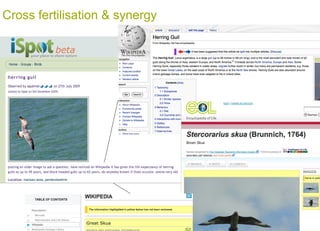
Cross fertilisation & synergy
Faculty Incentives: credit, recognition Some educators are interested in contributing their work in Connexions, because it’s a way of gaining notoriety.  So they’ll publish something there because it’s an opportunity for an outlet where they can get  recognised globally . (JT: Connexions) When people invest time and resources, they can see a tangible benefit; these could relate to students feeling that they are better educated; […] it depends on the institution having created a policy environment that is supporting of faculty having dedicated their time and energy; there’s renumeration, promotion, credit in some way or the other…  (CN: OER Africa)  
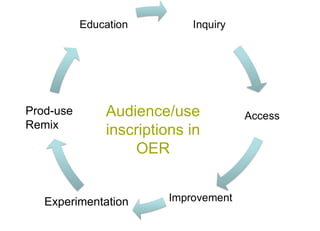
Audience/use inscriptions in OER Experimentation Prod-use Remix
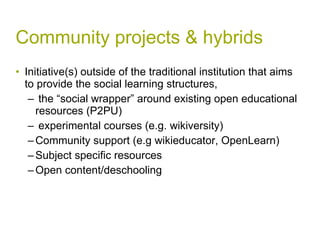
Community projects & hybrids Initiative(s) outside of the traditional institution that aims to provide the social learning structures, the “social wrapper” around existing open educational resources (P2PU) experimental courses (e.g. wikiversity) Community support (e.g wikieducator, OpenLearn) Subject specific resources Open content/deschooling
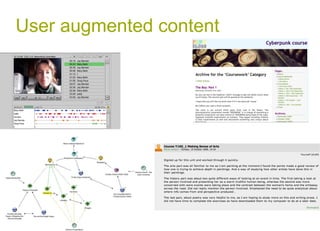
User augmented content
E ducation,  E ngagement,  I mprovement OER is the dictionary of our time (DC, OpenEd Community) Reference  self-education: autodidactism from immersion with content Improve content  reflect on pedagogy (formal & informal; linking teaching with research and scholarship in OER) Engagement in learning  tensions: institutional affiliation / legacy / mentoring / the interface and structures of participation
conclusions Distinctions between ‘mainstream’ and ‘alternative’ OER genres point to  both  definitions of openness  and  public value remit Drivers for sustainability and marketability are connected Open and contextual, yet accessible definitions around learning designs, purpose & relevance are considered core for enhancing user feedback on use  Trust, validation, purposefulness or accreditation also important indicators for engagement alongside casual browsing  Teachers’ incentivisation to be aligned with a more open sharing culture and national OER strategies  Connection with national policy makers on education/culture/IP, key for increasing awareness on/legitimacy of OERs
credits Education/collaboration: @psd  http://www.flickr.com/photos/psd/1805374441/   Open Sign:@ rightee  http://www.flickr.com/photos/rightee/4356950   Mediation: : Flickr @ hyperscholar  Many thanks to Patrick McAndrew, Grainne Connole, Andreia Santos
Thank you! p.alevizou@open.ac.uk

Alevizou MeCCSA 2010_presentation

  • 1.
    Mediating Open Education: popular discourses, situated policies & institutional practices for participatory learning MeCCSA 2010: Media, Communication, Policy and Practice 6-8 Jan, London School of Economics Dr Panagiota Alevizou [email_address] IET, olnet.org
  • 2.
  • 3.
    OERs: official definitionsHewlett Foundation teaching, learning, and research resources that reside in the public domain or have been released under an intellectual property license that permits their free use or re-purposing by others (2008) OECD CERI digitised materials offered freely and openly for educators, students and self-learners to use and reuse for teaching, learning and research (2007) Unesco The open provision of educational resources, enabled by ICTs, for consultation, use and adaptation by a community of users for non-commercial purposes (2002)
  • 4.
  • 5.
    Expanded from Marguliers’ (2005) conceptual mapping of OERs (2005; see also OECD, 2007, Conole and Weller, 2008) Implementation bodies inter-governmental organisations, consortia, translation bodies, policy and funding institutions
  • 6.
    Mediation Processes OrLearning Media?
  • 7.
  • 8.
    Open = FreedFree AND Available Accessible Connected Collaborative Participatory Experimental Transparent pedagogies Education vs. networks of improvement “ key tenet of open education is that education can be improved by making educational assets visible and accessible and by harnessing the collective wisdom of a community of practice and reflection” (Iiyosh and Kumar, 2008: 10)
  • 9.
    Mediation of pedagogicalknowledge Mediatised learning Institutional mediation of pedagogical knowledge as a continuous process (from broadcasting to dialogue? Dalsgaard, 2008 ) Doubly articulated Objects, contents Mediation of pedagogical flows & processes Resources & learning media Further resources in ‘the field’ beyond the realm of ed. institutions Shifting perceptions of knowledge and pedagogy Networks of improvement & self-expression beyond formal education historically educational resources part of a wider publishing field that has been located within central processes of mediation (Silverstone, 2005): a space of social positions, resources and power within its own forms of competition and reward (Thompson, 2005); more emphasis on educational outputs part of the educational institutional habitus, alongside scholarly material
  • 10.
    Mediation of openpedagogical knowledge(s) & expansive learning (Engestrom, 2001) Within institutions Expanded from Conole, 2008, Conole and McAndrew, 2010 Across disciplines, institutions, communities Representing pedagogy Guiding learning designs Sharing ideas Empirical evidence base
  • 11.
    Categories of OERsInstitutional : education Community : reference, self-improvement Networks of improvement and peer support; Increased Access, SDL; large small operation Drivers : legacy; marketing experimentation, outreach Tensions : awareness and granularity Quality Accreditation Sustainability, volunteerism Participatory expertise and literacies Scale of operation large small Provider Community Institution Adapted from OECD, 2007: 46
  • 12.
    Discourses in OERSantos, 2008
  • 13.
    The Institutional DiscourseOpenLearn is consistent with the University’s commitment to social justice and widening participation in higher education (OpenLearn Website (UK) We wanted to see what offering the OUNL content to a community of learners would mean for higher education: it meant lowering thresholds for entering higher education further (RS: OpenER/OUNL, Netherlands ) MIT OCW now stands as a new model for disseminating knowledge, serving as a sort of “ shared intellectual commons ” available to educators and learners around the globe (MIT OCW website)
  • 14.
    The marketing discourseOpenLearn […] Could be a way of building markets, synergies and reputation (AL: OL) OpenER modules have worked well as course tasters (RS: OPENER) MIT department heads believe that MIT OCW is a tool that indirectly aids in recruitment (SC: MIT OCW)
  • 15.
    Collaboration, cultural exchange,community [We are] targeting existing communities and we show them some value in terms of adopting or doing some things here. The value might be different for different discipline groups, for different audiences … whether it’s …Union Learning, the University of the Third Age, or a local community here, or another university there it’s very much say…. here’s the resource, you make use of …we show what it is to do it, you can try experimenting with it and feed back (AL: OpenLearn) Cultural bias is addressed when different types of knowledge(s) are exchanged and transparently mediated the platform (CN; OER Africa talking about the Health OER Inter-Institutional Project)
  • 16.
  • 17.
  • 18.
    Faculty Incentives: credit,recognition Some educators are interested in contributing their work in Connexions, because it’s a way of gaining notoriety. So they’ll publish something there because it’s an opportunity for an outlet where they can get recognised globally . (JT: Connexions) When people invest time and resources, they can see a tangible benefit; these could relate to students feeling that they are better educated; […] it depends on the institution having created a policy environment that is supporting of faculty having dedicated their time and energy; there’s renumeration, promotion, credit in some way or the other… (CN: OER Africa)  
  • 19.
    Audience/use inscriptions inOER Experimentation Prod-use Remix
  • 20.
    Community projects &hybrids Initiative(s) outside of the traditional institution that aims to provide the social learning structures, the “social wrapper” around existing open educational resources (P2PU) experimental courses (e.g. wikiversity) Community support (e.g wikieducator, OpenLearn) Subject specific resources Open content/deschooling
  • 21.
  • 22.
    E ducation, E ngagement, I mprovement OER is the dictionary of our time (DC, OpenEd Community) Reference self-education: autodidactism from immersion with content Improve content reflect on pedagogy (formal & informal; linking teaching with research and scholarship in OER) Engagement in learning tensions: institutional affiliation / legacy / mentoring / the interface and structures of participation
  • 23.
    conclusions Distinctions between‘mainstream’ and ‘alternative’ OER genres point to both definitions of openness and public value remit Drivers for sustainability and marketability are connected Open and contextual, yet accessible definitions around learning designs, purpose & relevance are considered core for enhancing user feedback on use Trust, validation, purposefulness or accreditation also important indicators for engagement alongside casual browsing Teachers’ incentivisation to be aligned with a more open sharing culture and national OER strategies Connection with national policy makers on education/culture/IP, key for increasing awareness on/legitimacy of OERs
  • 24.
    credits Education/collaboration: @psd http://www.flickr.com/photos/psd/1805374441/ Open Sign:@ rightee http://www.flickr.com/photos/rightee/4356950 Mediation: : Flickr @ hyperscholar Many thanks to Patrick McAndrew, Grainne Connole, Andreia Santos
  • 25.

Editor's Notes

  • #7 Mediation: Flickr @ hyperscholar
  • #16 Institiuional discourse: Open content is consistent with the University’s commitment to social justice and widening participation in higher education MIT’s legacy prove good driver for collaboration and outreach – interdiscoursive relationshipships about globalisation and widening participation …