Open Educational Resources  and FLOSS OER Definition OER and FLOSS – lessons learned Key points in OER  OER and Web 2.0 Advantages of using OER Important OER projects A pilot program for Romanian teachers Carmen Holotescu Director Timsoft  -  http://www.timsoft.ro Lecturer University of Politehnica, Timisoara  - http://www.cs.utt.ro Online Instructor UMUC  -  http://www.umuc.edu
OER Definition Open Educational Resources – OER :  “the open provision of educational resources, enabled by information and communication technologies, for consultation, use and adaptation by a community of users for non-commercial purposes.”  The term: has been introduced and promoted in the context of  UNESCO ’s aim to provide free access to educational resources on a global scale,  was first adopted by UNESCO in 2002 in the final report of the Forum on the Impact of Open Courseware for Higher Education in developing countries
OER definition William and Flora Hewlett Foundation :  “ At the heart of the movement toward Open Educational Resources is the simple and powerful idea that the world’s knowledge is a public good and that technology in general and the Worldwide Web in particular provide an extraordinary opportunity for everyone to share, use, and re-use knowledge. ”
OER Definition OER  comprise three major areas  of activity: the creation of  open source software and development tools  - needed to produce, store, share, search, access content; spaces for learning  communities / communities  of practice , the creation and provision of  open content  ( different granularity ) – open courseware / open content projects, free courses, Learning Objects repositories the development of  standards and licensing tools .
OER  and  FLOSS  are complementary OER  development can mirror and take advantage of the FLOSS collaborative model FLOSS  can promote creation of  OER  content in developing countries OER  developers should commit to open licenses more inclusive formats for document exchange should be used FLOSS  can support technical demands of  OER  development / better searching of  OER UNESCO International Institute for Educational Planning's Open Educational Resources Community  http://oerwiki.iiep-unesco.org   OER and FLOSS. Lessons learned
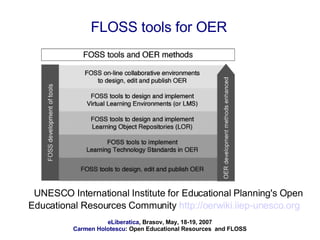
UNESCO International Institute for Educational Planning's Open Educational Resources Community  http://oerwiki.iiep-unesco.org   FLOSS tools for OER
Key Points in OER to foster the  acquisition of specific competences  needed by teachers and learners to adopt  open educational practices  within and across educational institutions - such practices follow a competency-focused, collaborative paradigm of learning and knowledge acquisition priority  should be given: to  learning communities  instead of teacher-centred education,  to development of  knowledge and skills required for  solving problems  instead of subject-centred knowledge transfer.
OER and Web 2.0 collaboration: blogs, wikis, social networks content: syndicated using RSS feeds, categories created with social bookmarking systems licence: Creative Commons  Openness  is the core paradigm of content, tools and services in Web 2.0 digital environments
OER advantages for educational networks and institutions sharing development costs among institutions or professional communities => a  higher return on investment  of public funds promote digital competence  for the knowledge society -  tools and content that allow learners to develop their critical thinking and creativity increase educational quality of content  - quality control, feedback and improvements within content alliances, communities and networks who share content foster lifelong learning and social inclusion  - easy access to resources that may otherwise not be accessible by potential user groups.
OER advantages for teachers, students, learners offer  flexibility  in choosing from a broader range of subjects and topics for teaching and learning  save time and effort  through reusing resources for which IPR/copyright issues have already been resolved easy-to-use tools  to set up collaborative environments: blogs, wikis, social networks, RSS feeds syndication  promote  user-centred approaches  in education and lifelong learning; participants not only consume educational content but develop their own ePortfolios, and share study results and experiences with peers.
Open Educational Resources Projects - worldwide UNESCO International Institute for Educational Planning's Open Educational Resources Community -  http://www.unesco.org/iiep   OpenCourseWare Consortium  -  http://ocwconsortium.org/ OER Commons Open Educational Resources  -  http://www.oercommons.org
Open Educational Resources Projects - Europe Open eLearning Content Observatory Services  -  http://www.olcos.org  - Roadmap 2012 EUN – European Schoolnet   -  http://www.eun.org   Learning Resource Exchange
Romanian Open Access Projects Educational Portals :   http://portal.edu.ro ,  http://www.didactic.ro   Online materials – universities websites  Educational Blogs, Wikis:  http://www.timsoft.ro/resurse.shtml
A pilot program for Romanian teachers Project “ Development of Education Policy Concerning the Integration of the Information and Communication Technology and Communications in the Pre-University Romanian Education System ” -  Finnish Consulting Group Activity 1 – pilot program for using  OER and new technologies in teaching and learning  - implemented by Seppo Tella, University of Helsinki, Carmen Holotescu, Timsoft
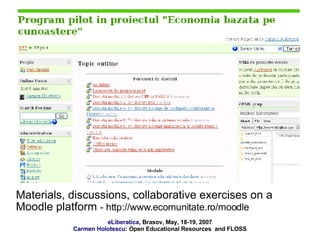
Materials, discussions, collaborative exercises on a Moodle platform  - http://www.ecomunitate.ro/moodle
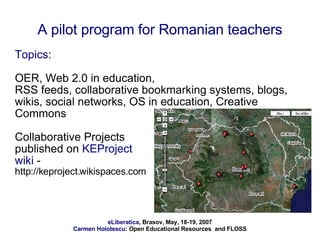
A pilot program for Romanian teachers Topics :  OER, Web 2.0 in education, RSS feeds, collaborative bookmarking systems, blogs, wikis, social networks, OS in education, Creative Commons Collaborative Projects  published on  KEProject  wiki  -  http://keproject.wikispaces.com
Using OER means: open access / use / re-use / create / share / validate OER specific competences,  open educational practices, learning communities  Thank you!

Open Educational Resources and FLOSS

  • 1.
    Open Educational Resources and FLOSS OER Definition OER and FLOSS – lessons learned Key points in OER OER and Web 2.0 Advantages of using OER Important OER projects A pilot program for Romanian teachers Carmen Holotescu Director Timsoft - http://www.timsoft.ro Lecturer University of Politehnica, Timisoara - http://www.cs.utt.ro Online Instructor UMUC - http://www.umuc.edu
  • 2.
    OER Definition OpenEducational Resources – OER : “the open provision of educational resources, enabled by information and communication technologies, for consultation, use and adaptation by a community of users for non-commercial purposes.” The term: has been introduced and promoted in the context of UNESCO ’s aim to provide free access to educational resources on a global scale, was first adopted by UNESCO in 2002 in the final report of the Forum on the Impact of Open Courseware for Higher Education in developing countries
  • 3.
    OER definition Williamand Flora Hewlett Foundation : “ At the heart of the movement toward Open Educational Resources is the simple and powerful idea that the world’s knowledge is a public good and that technology in general and the Worldwide Web in particular provide an extraordinary opportunity for everyone to share, use, and re-use knowledge. ”
  • 4.
    OER Definition OER comprise three major areas of activity: the creation of open source software and development tools - needed to produce, store, share, search, access content; spaces for learning communities / communities of practice , the creation and provision of open content ( different granularity ) – open courseware / open content projects, free courses, Learning Objects repositories the development of standards and licensing tools .
  • 5.
    OER and FLOSS are complementary OER development can mirror and take advantage of the FLOSS collaborative model FLOSS can promote creation of OER content in developing countries OER developers should commit to open licenses more inclusive formats for document exchange should be used FLOSS can support technical demands of OER development / better searching of OER UNESCO International Institute for Educational Planning's Open Educational Resources Community http://oerwiki.iiep-unesco.org OER and FLOSS. Lessons learned
  • 6.
    UNESCO International Institutefor Educational Planning's Open Educational Resources Community http://oerwiki.iiep-unesco.org FLOSS tools for OER
  • 7.
    Key Points inOER to foster the acquisition of specific competences needed by teachers and learners to adopt open educational practices within and across educational institutions - such practices follow a competency-focused, collaborative paradigm of learning and knowledge acquisition priority should be given: to learning communities instead of teacher-centred education, to development of knowledge and skills required for solving problems instead of subject-centred knowledge transfer.
  • 8.
    OER and Web2.0 collaboration: blogs, wikis, social networks content: syndicated using RSS feeds, categories created with social bookmarking systems licence: Creative Commons Openness is the core paradigm of content, tools and services in Web 2.0 digital environments
  • 9.
    OER advantages foreducational networks and institutions sharing development costs among institutions or professional communities => a higher return on investment of public funds promote digital competence for the knowledge society - tools and content that allow learners to develop their critical thinking and creativity increase educational quality of content - quality control, feedback and improvements within content alliances, communities and networks who share content foster lifelong learning and social inclusion - easy access to resources that may otherwise not be accessible by potential user groups.
  • 10.
    OER advantages forteachers, students, learners offer flexibility in choosing from a broader range of subjects and topics for teaching and learning save time and effort through reusing resources for which IPR/copyright issues have already been resolved easy-to-use tools to set up collaborative environments: blogs, wikis, social networks, RSS feeds syndication promote user-centred approaches in education and lifelong learning; participants not only consume educational content but develop their own ePortfolios, and share study results and experiences with peers.
  • 11.
    Open Educational ResourcesProjects - worldwide UNESCO International Institute for Educational Planning's Open Educational Resources Community - http://www.unesco.org/iiep OpenCourseWare Consortium - http://ocwconsortium.org/ OER Commons Open Educational Resources - http://www.oercommons.org
  • 12.
    Open Educational ResourcesProjects - Europe Open eLearning Content Observatory Services - http://www.olcos.org - Roadmap 2012 EUN – European Schoolnet - http://www.eun.org Learning Resource Exchange
  • 13.
    Romanian Open AccessProjects Educational Portals : http://portal.edu.ro , http://www.didactic.ro Online materials – universities websites Educational Blogs, Wikis: http://www.timsoft.ro/resurse.shtml
  • 14.
    A pilot programfor Romanian teachers Project “ Development of Education Policy Concerning the Integration of the Information and Communication Technology and Communications in the Pre-University Romanian Education System ” - Finnish Consulting Group Activity 1 – pilot program for using OER and new technologies in teaching and learning - implemented by Seppo Tella, University of Helsinki, Carmen Holotescu, Timsoft
  • 15.
    Materials, discussions, collaborativeexercises on a Moodle platform - http://www.ecomunitate.ro/moodle
  • 16.
    A pilot programfor Romanian teachers Topics : OER, Web 2.0 in education, RSS feeds, collaborative bookmarking systems, blogs, wikis, social networks, OS in education, Creative Commons Collaborative Projects published on KEProject wiki - http://keproject.wikispaces.com
  • 17.
    Using OER means:open access / use / re-use / create / share / validate OER specific competences, open educational practices, learning communities Thank you!