Open Educational Resources (OER):
Tomorrow’s Main Educational Provider?

     IAU 14th General Conference,San Juan
               Puerto Rico, USA
              27-30 November 2012
               Gard Titlestad
              Secretary General
                    ICDE
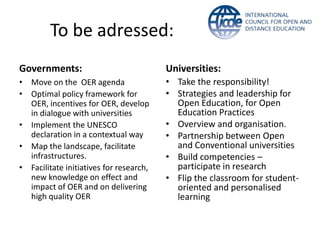
To be adressed:
Governments:                             Universities:
• Move on the OER agenda                 • Take the responsibility!
• Optimal policy framework for           • Strategies and leadership for
  OER, incentives for OER, develop         Open Education, for Open
  in dialogue with universities            Education Practices
• Implement the UNESCO                   • Overview and organisation.
  declaration in a contextual way        • Partnership between Open
• Map the landscape, facilitate            and Conventional universities
  infrastructures.                       • Build competencies –
• Facilitate initiatives for research,     participate in research
  new knowledge on effect and            • Flip the classroom for student-
  impact of OER and on delivering          oriented and personalised
  high quality OER                         learning
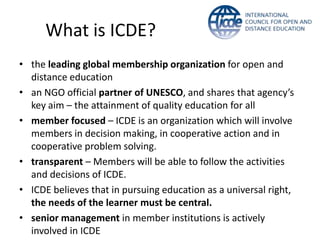
What is ICDE?
• the leading global membership organization for open and
  distance education
• an NGO official partner of UNESCO, and shares that agency’s
  key aim – the attainment of quality education for all
• member focused – ICDE is an organization which will involve
  members in decision making, in cooperative action and in
  cooperative problem solving.
• transparent – Members will be able to follow the activities
  and decisions of ICDE.
• ICDE believes that in pursuing education as a universal right,
  the needs of the learner must be central.
• senior management in member institutions is actively
  involved in ICDE
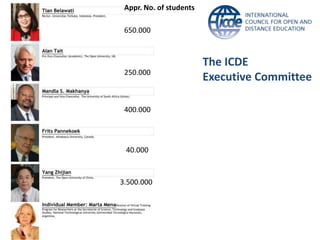
Appr. No. of students

 650.000


                         The ICDE
 250.000
                         Executive Committee

 400.000


 40.000


3.500.000
Open Educational Resources - OER and
  Open Educational Practices - OEP

          Heard about OER?
         Know what OER is?
      Familiar with OER and OEP?
Open Educational
       Resources
“... are digital learning resources offered online freely and
  openly to teachers, educators, students and independent
  learners in order to be used, shared, combined, adapted,
      and expanded in teaching, learning and research.”
                         (OECD 2011)
“... are teaching, learning and research materials in any
  medium that reside in the public domain and have been
released under an open licence that permits access, use,
  repurposing, reuse and redistribution by others with no
                    or limited restrictions.”
                      (UNESCO 2011)
The vision
… At the heart of the movement toward Open
  Educational Resources is the simple and
  powerful idea that the world's knowledge is a
  public good
… and that technology in general and the
  Worldwide Web in particular provide an
  extraordinary opportunity for everyone to
  share, use, and reuse it.

                           Hewlett Foundation
”For the first time in human history we
 have the tools to enable everyone to
 attain all the education they desire.”
             (Wiley, Green, & Soares, 2012)

  Dramatically bringing down the cost of education with
  OER: How open education resources unlock the door
                     to free learning.
Expectations to OER
  “OERs have the potential to solve
 the global education crisis and
 contribute to sustainable economic
 growth”
  Sir John Daniel, former CEO for Commonwealth
  of Learning and David Killion, US ambassador to
  UNESCO said in Guardian in July 2012
Why should universities bother?
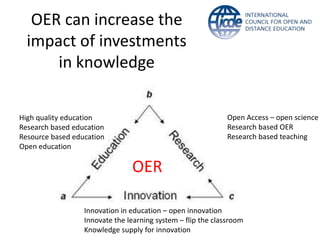
OER can increase the
  impact of investments
      in knowledge

High quality education                                        Open Access – open science
Research based education                                      Research based OER
Resource based education                                      Research based teaching
Open education

                                OER

                  Innovation in education – open innovation
                  Innovate the learning system – flip the classroom
                  Knowledge supply for innovation
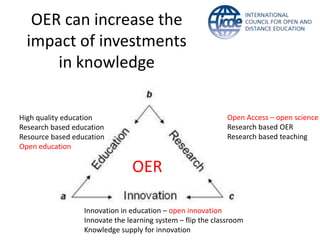
OER can increase the
  impact of investments
      in knowledge

High quality education                                        Open Access – open science
Research based education                                      Research based OER
Resource based education                                      Research based teaching
Open education

                                OER

                  Innovation in education – open innovation
                  Innovate the learning system – flip the classroom
                  Knowledge supply for innovation
Drivers for OER
• The benefits from Higher Education – a gold mine
• Demand for access to Higher Education
• Financial problems, costs
• Failure of the current educational system, drop
  outs/push outs
• The need for innovation in HEI – innovation in
  education
• Students
Reinventing education: OER an
important building block
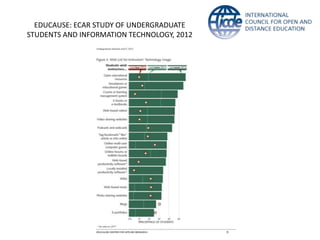
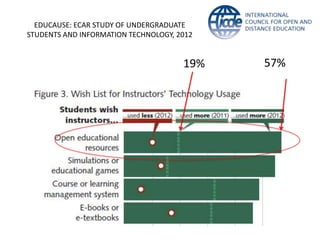
EDUCAUSE: ECAR STUDY OF UNDERGRADUATE
STUDENTS AND INFORMATION TECHNOLOGY, 2012
EDUCAUSE: ECAR STUDY OF UNDERGRADUATE
STUDENTS AND INFORMATION TECHNOLOGY, 2012


                                      19%   57%
Governments (OECD) on OER
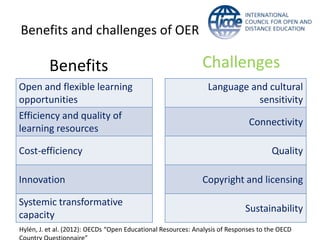
Benefits and challenges of OER

          Benefits                                            Challenges
Open and flexible learning                                      Language and cultural
opportunities                                                              sensitivity
Efficiency and quality of
                                                                              Connectivity
learning resources

Cost-efficiency                                                                       Quality

Innovation                                                    Copyright and licensing

Systemic transformative
                                                                             Sustainability
capacity
Hylén, J. et al. (2012): OECDs “Open Educational Resources: Analysis of Responses to the OECD
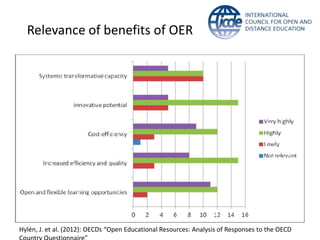
Relevance of benefits of OER


Hylén, J. et al. (2012): OECDs “Open Educational Resources: Analysis of Responses to the OECD
ICDE SCOP 2012 – a workings group´s
         reflections on OER
o Quality assurance concerns – how do DE institutions which
are already scrutinized for being DE institutions ensure that
OER they adopt does not undermine their existing QA systems
(the answer is to ensure that they go through the same QA
mechanisms as other course materials)
o Cost recovery
o Locating OER - it is difficult for institutions to locate OER
that is appropriate for their needs (call for more work on
facilitating use of search facilities for OER).
From the UNESCO OER
     Declaration


• Foster awareness and use of OER
• Encourage the development and adaptation of
  OER in a variety of languages and cultural
  contexts
• Encourage the open licensing of educational
  materials produced with public funds.
MOOCs
”A massive open online course (MOOC) is a type
of online course aimed at large-scale
participation and open access via the web.
MOOCs are a recent development in the area of
distance education, and a progression of the
kind of open education ideals suggested by
open educational resources.”

http://en.wikipedia.org/wiki/MOOC
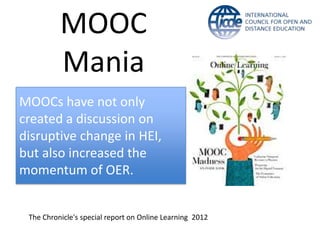
MOOC
          Mania
MOOCs have not only
created a discussion on
disruptive change in HEI,
but also increased the
momentum of OER.


 The Chronicle's special report on Online Learning 2012
Coursera


and more!
So, why bother?

A wake up call is needed
  for governments, for
       universities
To be adressed:
Governments:                             Universities:
• Move on the OER agenda                 • Take the responsibility!
• Optimal policy framework for           • Strategies and leadership for
  OER, incentives for OER, develop         Open Education, for Open
  in dialogue with universities            Education Practices
• Implement the UNESCO                   • Overview and organisation.
  declaration in a contextual way        • Partnership between Open
• Map the landscape, facilitate            and Conventional universities
  infrastructures.                       • Build competencies –
• Facilitate initiatives for research,     participate in research
  new knowledge on effect and            • Flip the classroom for student-
  impact of OER and on delivering          oriented and personalised
  high quality OER                         learning
Thank you!
 titlestad@icde.org

   www.icde.org

Open Educational Resources (OER): Tomorrow’s Main Educational Provider?

  • 1.
    Open Educational Resources(OER): Tomorrow’s Main Educational Provider? IAU 14th General Conference,San Juan Puerto Rico, USA 27-30 November 2012 Gard Titlestad Secretary General ICDE
  • 2.
    To be adressed: Governments: Universities: • Move on the OER agenda • Take the responsibility! • Optimal policy framework for • Strategies and leadership for OER, incentives for OER, develop Open Education, for Open in dialogue with universities Education Practices • Implement the UNESCO • Overview and organisation. declaration in a contextual way • Partnership between Open • Map the landscape, facilitate and Conventional universities infrastructures. • Build competencies – • Facilitate initiatives for research, participate in research new knowledge on effect and • Flip the classroom for student- impact of OER and on delivering oriented and personalised high quality OER learning
  • 3.
    What is ICDE? •the leading global membership organization for open and distance education • an NGO official partner of UNESCO, and shares that agency’s key aim – the attainment of quality education for all • member focused – ICDE is an organization which will involve members in decision making, in cooperative action and in cooperative problem solving. • transparent – Members will be able to follow the activities and decisions of ICDE. • ICDE believes that in pursuing education as a universal right, the needs of the learner must be central. • senior management in member institutions is actively involved in ICDE
  • 4.
    Appr. No. ofstudents 650.000 The ICDE 250.000 Executive Committee 400.000 40.000 3.500.000
  • 5.
    Open Educational Resources- OER and Open Educational Practices - OEP Heard about OER? Know what OER is? Familiar with OER and OEP?
  • 7.
    Open Educational Resources “... are digital learning resources offered online freely and openly to teachers, educators, students and independent learners in order to be used, shared, combined, adapted, and expanded in teaching, learning and research.” (OECD 2011) “... are teaching, learning and research materials in any medium that reside in the public domain and have been released under an open licence that permits access, use, repurposing, reuse and redistribution by others with no or limited restrictions.” (UNESCO 2011)
  • 8.
    The vision … Atthe heart of the movement toward Open Educational Resources is the simple and powerful idea that the world's knowledge is a public good … and that technology in general and the Worldwide Web in particular provide an extraordinary opportunity for everyone to share, use, and reuse it. Hewlett Foundation
  • 9.
    ”For the firsttime in human history we have the tools to enable everyone to attain all the education they desire.” (Wiley, Green, & Soares, 2012) Dramatically bringing down the cost of education with OER: How open education resources unlock the door to free learning.
  • 10.
    Expectations to OER “OERs have the potential to solve the global education crisis and contribute to sustainable economic growth” Sir John Daniel, former CEO for Commonwealth of Learning and David Killion, US ambassador to UNESCO said in Guardian in July 2012
  • 11.
  • 12.
    OER can increasethe impact of investments in knowledge High quality education Open Access – open science Research based education Research based OER Resource based education Research based teaching Open education OER Innovation in education – open innovation Innovate the learning system – flip the classroom Knowledge supply for innovation
  • 13.
    OER can increasethe impact of investments in knowledge High quality education Open Access – open science Research based education Research based OER Resource based education Research based teaching Open education OER Innovation in education – open innovation Innovate the learning system – flip the classroom Knowledge supply for innovation
  • 14.
    Drivers for OER •The benefits from Higher Education – a gold mine • Demand for access to Higher Education • Financial problems, costs • Failure of the current educational system, drop outs/push outs • The need for innovation in HEI – innovation in education • Students Reinventing education: OER an important building block
  • 15.
    EDUCAUSE: ECAR STUDYOF UNDERGRADUATE STUDENTS AND INFORMATION TECHNOLOGY, 2012
  • 16.
    EDUCAUSE: ECAR STUDYOF UNDERGRADUATE STUDENTS AND INFORMATION TECHNOLOGY, 2012 19% 57%
  • 17.
  • 18.
    Benefits and challengesof OER Benefits Challenges Open and flexible learning Language and cultural opportunities sensitivity Efficiency and quality of Connectivity learning resources Cost-efficiency Quality Innovation Copyright and licensing Systemic transformative Sustainability capacity Hylén, J. et al. (2012): OECDs “Open Educational Resources: Analysis of Responses to the OECD
  • 19.
    Relevance of benefitsof OER Hylén, J. et al. (2012): OECDs “Open Educational Resources: Analysis of Responses to the OECD
  • 20.
    ICDE SCOP 2012– a workings group´s reflections on OER o Quality assurance concerns – how do DE institutions which are already scrutinized for being DE institutions ensure that OER they adopt does not undermine their existing QA systems (the answer is to ensure that they go through the same QA mechanisms as other course materials) o Cost recovery o Locating OER - it is difficult for institutions to locate OER that is appropriate for their needs (call for more work on facilitating use of search facilities for OER).
  • 21.
    From the UNESCOOER Declaration • Foster awareness and use of OER • Encourage the development and adaptation of OER in a variety of languages and cultural contexts • Encourage the open licensing of educational materials produced with public funds.
  • 22.
    MOOCs ”A massive openonline course (MOOC) is a type of online course aimed at large-scale participation and open access via the web. MOOCs are a recent development in the area of distance education, and a progression of the kind of open education ideals suggested by open educational resources.” http://en.wikipedia.org/wiki/MOOC
  • 23.
    MOOC Mania MOOCs have not only created a discussion on disruptive change in HEI, but also increased the momentum of OER. The Chronicle's special report on Online Learning 2012
  • 24.
  • 25.
    So, why bother? Awake up call is needed for governments, for universities
  • 26.
    To be adressed: Governments: Universities: • Move on the OER agenda • Take the responsibility! • Optimal policy framework for • Strategies and leadership for OER, incentives for OER, develop Open Education, for Open in dialogue with universities Education Practices • Implement the UNESCO • Overview and organisation. declaration in a contextual way • Partnership between Open • Map the landscape, facilitate and Conventional universities infrastructures. • Build competencies – • Facilitate initiatives for research, participate in research new knowledge on effect and • Flip the classroom for student- impact of OER and on delivering oriented and personalised high quality OER learning
  • 27.