OER Research on Open 
Textbook adoption and Librarians 
CCCOER Webinar 
December 2014 
Beck Pitt 
The Open University (UK)
Background
CC-BY 4.0 Bea de los Arcos 
oerresearchhub.org 
#oerrhub @OER_Hub 
• 2-year open research project funded by William & Flora Hewlett Foundation 
• Aiming to build the most comprehensive picture of OER impact 
• Open collaboration model across different educational sectors 
• Global reach but with a USA focus 
• Fellowship Scheme 
• Researching openness in the open
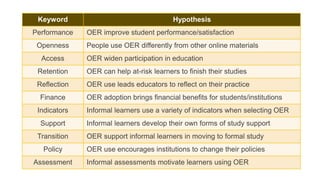
Keyword Hypothesis 
Performance OER improve student performance/satisfaction 
Openness People use OER differently from other online materials 
Access OER widen participation in education 
Retention OER can help at-risk learners to finish their studies 
Reflection OER use leads educators to reflect on their practice 
Finance OER adoption brings financial benefits for students/institutions 
Indicators Informal learners use a variety of indicators when selecting OER 
Support Informal learners develop their own forms of study support 
Transition OER support informal learners in moving to formal study 
Policy OER use encourages institutions to change their policies 
Assessment Informal assessments motivate learners using OER
OER Impact Map 
http://oermap.org
Project Co-PILOT
Open Textbooks: OpenStax College 
Questionnaire
OpenStax College Overview 
http://openstaxcollege.org/faculty 
Saved students over $30 
million since June 2012 
From 40 adoptions in 2012 to 
1061 by 2014 
1 million downloads of 
OpenStax materials 
Image and information from OpenStax College’s 2014 Progress Report: 
http://openstaxcollege.org/news/our-textbooks-have-saved-students-30-million 
CC-BY 
First textbook published June 2012 
9 open textbooks published to date 
iBooks available in 32 countries
Open Textbook Overview 
• On average total textbook costs are around $1200 each year in the United 
States 
• In the United States “…Textbook wholesale prices have risen more than four 
times the rate of inflation over the last two decades (1990-2009)” 
(Student PIRGs research) 
• “…the textbooks actually cost more than 
the tuition for most students.” 
(Barbara Illowsky, author of Collaborative Statistics) 
• 63% of respondents to the 2012 Florida 
Student Textbook Survey “…reported not 
having purchased the required textbook 
because of the high cost…” 
Picture credit: Huffington Post 
(http://www.huffingtonpost.com/2013/01/04/college-textbook- 
prices-increase_n_2409153.html)
Educator Sample: OpenStax College 
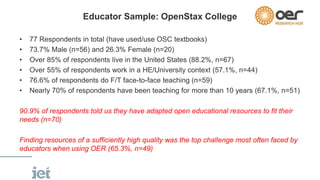
• 77 Respondents in total (have used/use OSC textbooks) 
• 73.7% Male (n=56) and 26.3% Female (n=20) 
• Over 85% of respondents live in the United States (88.2%, n=67) 
• Over 55% of respondents work in a HE/University context (57.1%, n=44) 
• 76.6% of respondents do F/T face-to-face teaching (n=59) 
• Nearly 70% of respondents have been teaching for more than 10 years (67.1%, n=51) 
90.9% of respondents told us they have adapted open educational resources to fit their 
needs (n=70) 
Finding resources of a sufficiently high quality was the top challenge most often faced by 
educators when using OER (65.3%, n=49)
Impact on Educators and Students
“In what ways, if any, has using OpenStax College textbooks 
impacted on your own teaching practice?”
Based on your experiences as a teacher, to what extent do 
you agree with the following statements? 
% of educators who strongly agree or agree with the following statements: 
"Use of Open Educational Resources (e.g. OpenStax College textbooks) in the 
classroom...” 
Allows me to better accommodate diverse learners’ needs (67.1%, n=49) 
Increases learners’ satisfaction with the learning experience (66.2%, n=49) 
Increases learners’ experimentation with new ways of learning (64.4%, n=47) 
Increases learners’ engagement with lesson content (61.6%, n=45) 
Develops learners’ increased independence and self-reliance (58.1%, n=43) 
Increases learners’ interest in the subjects taught (54.1%, n=40) 
Leads to improved students’ grades (50.7%, n=37) 
Increases learners’ participation in class discussions (47.3%, n=35) 
Increases learners’ enthusiasm for future study (47.3%, n=35) 
Builds learners’ confidence (45.8%, n=33) 
Increases collaboration and/or peer-support among learners (45.8%, n=33) 
Leads to learners becoming interested in a wider range of subjects than before 
they used OER (42.5%, n=31)
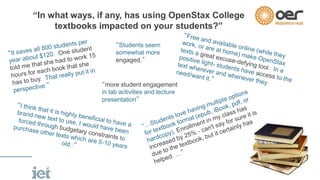
“In what ways, if any, has using OpenStax College 
textbooks impacted on your students?” 
“Students seem 
somewhat more 
engaged.” 
“more student engagement 
in lab activities and lecture 
presentation”
In what ways, if any, has using OpenStax College 
textbooks impacted on your studies? 
“Saved my back, I already have so many 
other books in my backpack and using my 
computer for more info saved additional 
stress that would have been on my back.” 
(College student)
“As a result of using OpenStax College (OSC) textbooks, are 
you more or less likely to do any of the following?” 
96.1% of educators who use OSC textbooks are more likely to 
recommend OpenStax College textbooks to fellow educators/teachers 
(n=73) 
92% of respondents are more likely to make an OSC textbook the 
required text for their students (n=69) 
80% of respondents are more likely to discuss using OSC materials with 
their institution’s administrators (n=60) 
Nearly 80% of respondents who use OSC textbooks are more likely to 
use other OER for teaching (79.5%, n=58)
Librarian Questionnaire
Project Co-PILOT 
“Project Co-PILOT (Community of Practice for Information Literacy Online Teaching) 
seeks to promote internationally the sharing of over 50 UK OERs on digital and 
information literacy which were developed as part of the DELILA project.” 
(http://delilaopen.wordpress.com/project-co-pilot/) 
Photo credit: CC-BY 4.0 Beck Pitt 
Special areas of interest (CoPILOT): 
• Encourage creation and sharing of OER 
• Curating & sustaining OER 
• Closing training gaps
Librarian Overview 
• Nearly 40% of respondents have adapted OER to fit their needs 
(39.4%, n=85) 
• 31.9% of respondents have created OER for study or teaching 
(n=69) 
Top three challenges faced when using OER: 
Knowing where to find resources (60.6%, n=120) 
Finding resources of a sufficiently high quality 
(60.1%, n=119) 
Finding suitable resources in my subject area 
(56.1%, n=111) 
Over 85% of respondents said that 
they would be more likely to select a 
particular resource when searching for 
OER if it had been created/uploaded 
by a reputable/trusted institution or 
person (87.4%, n=180)
Use and Creation of OER 
14.8% of respondents have created resources themselves and published them 
on an open license (n=32) 
78.1% of respondents who have created 
resources and published them on an open 
license say open licensing is “very 
important” or “important” to them when 
using resources in their teaching (n=25) 
87.5% of respondents who have created 
resources and published them on an open 
license told us they have seen the CC 
license and know what it means (n=28).
Librarian Overview 
Main purposes for using OER in the context of Librarian role: 
To help find available content for learning, teaching or training 
(72.5%, n=124) and/or to get new ideas and inspiration (72.5%, 
n=124) 
As a result of using OER as a respondents strongly agreed or agreed that … 
• Nearly 70% make use of a wider range of multimedia (13.1%, n=19 & 
56.6%, n=82 respectively) 
• Almost 60% have a more up-to-date knowledge of their subject area (16.8%, 
n=24 & 42.7%, n=61) 
• 47.3% have improved ICT skills (10.8%, n=16 & 36.5%, n=54)
Creating OER and measuring its 
impact
Do you measure the impact of the open educational 
resources you create? 
Of the respondents who create OER for study or teaching 
and/or create OER and publish them on an open license, 
nearly 30% told us they measure the impact of the OER 
they create (29.7%, n=22) 
• 60.8% of respondents who create OER do not measure 
the impact of the OER they create (n=45) 
• Nearly 10% of respondents who create OER don’t know 
if they measure the impact of the OER they create 
(9.5%, n=7) 
Image credit: Public Domain 
https://openclipart.org/detail/38527/-by-rejon-38527
Please tell us more about how you share the open educational 
resources you create 
“Upload to 
YouTube” 
“Via the NHS e-learning 
repository and from our 
organisational website.”
Please tell us more about how you measure the impact of the 
open educational resources you create 
Respondents who told us 
how they currently 
measure impact: 
60.9% look at 
statistics/usage/analytics 
(n=14) 
13.0% Feedback (n=3) 
26.1% Both analytics and 
feedback (n=6) 
“At a rather trivial level, I check 
how many times resources are 
accessed.”
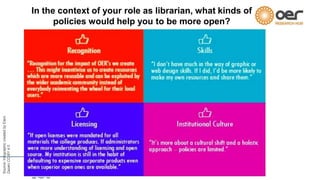
Institutional Policies and Openness
Source: Infographic created by Eleni 
Zazani CC-BY 4.0 
In the context of your role as librarian, what kinds of 
policies would help you to be more open?
Concluding Remarks
Conclusion 
• What do we mean by “measuring impact”? 
• How is quality currently understood? (Changing perceptions) 
• Finding resources remains a pertinent issue across the board: visibility 
• Librarians working in “silos”… educators too 
• Further work with OpenStax College, surveyed Siyavula educators in South Africa, working 
with BCcampus Open Textbooks project in Canada 
What do you think? 
Do these findings resonate 
with you? 
We need you! Looking for YOUR best examples of impact... 
http://oermap.org 
Read our overall findings in our OER Evidence report 2013-2014: 
http://oerresearchhub.org/2014/11/19/oer-evidence-report-2013- 
2014/
Bibliography and Acknowledgements 
Bueno-de-la-Fuente, G. (2012). The roles of libraries and information professionals in open educational resources (OER) 
initiatives.. Available from: http://publications.cetis.ac.uk/2012/492. [Accessed 23 November 2013]. 
De Beer, T. (2012). SCORE library survey report. Available from: http://www.open.ac.uk/score/news/score-library-survey-report. 
[Accessed 23 November 2013]. 
De Los Arcos, B. Farrow, R. Perryman, L-A, Pitt, R & Weller, M OER Research Hub: OER Evidence Report 2013-2014. 
Available from: http://oerresearchhub.org/2014/11/19/oer-evidence-report-2013-2014/ (accessed 8 December 2014) 
Graham, N., and Secker, J. (2012). Librarians, information literacy and open educational resources: report of a survey. Available 
from: http://delilaopen.files.wordpress.com/2012/04/findingsharingoers_reportfinal1.pdf. [Accessed 23 November 2013]. 
Harris, S. (2012). Moving towards an open access future: the role of academic libraries. London. Available from: 
http://www.uk.sagepub.com/repository/binaries/pdf/Library-OAReport.pdf. [Accessed 23 November 2013]. 
Taylor & Francis. (2013). Facilitating access to free online resources: challenges and opportunities for the library community. 
Available from: http://www.tandf.co.uk/libsite/pdf/TF-whitepaper-free-resources.pdf. [Accessed 23 November 2013]. 
TBI Communications on behalf of InTech. (2012). Assessing the role of librarians in an Open Access world. Croatia. Available 
from: http://www.intechopen.com/js/ckeditor/kcfinder/upload/files/Role of the Librarian_Survey_Findings_Jun12.pdf. [Accessed 
23 November 2013]. 
Zazani, Eleni. The Emerging Information Professional: 21st Century attitudes, technologies and practices. Chandos publishing 
(forthcoming) 
Creative Commons logo: http://mirrors.creativecommons.org/presskit/icons/cc.large.png 
These slides were created by reversioning two previous presentations: Librarians Perceptions of OER and Open Access Week 
2014: Open Textbook Research Overview. Both slidedecks are available from: http://www.slideshare.net/OER_Hub
Thanks for listening! 
oerresearchhub.org 
http://oermap.org 
Twitter: @OER_Hub @BeckPitt
in service of The Open University

CCCOER Webinar: OER Research on Open Textbook adoption and Librarians

  • 1.
    OER Research onOpen Textbook adoption and Librarians CCCOER Webinar December 2014 Beck Pitt The Open University (UK)
  • 2.
  • 3.
    CC-BY 4.0 Beade los Arcos oerresearchhub.org #oerrhub @OER_Hub • 2-year open research project funded by William & Flora Hewlett Foundation • Aiming to build the most comprehensive picture of OER impact • Open collaboration model across different educational sectors • Global reach but with a USA focus • Fellowship Scheme • Researching openness in the open
  • 4.
    Keyword Hypothesis PerformanceOER improve student performance/satisfaction Openness People use OER differently from other online materials Access OER widen participation in education Retention OER can help at-risk learners to finish their studies Reflection OER use leads educators to reflect on their practice Finance OER adoption brings financial benefits for students/institutions Indicators Informal learners use a variety of indicators when selecting OER Support Informal learners develop their own forms of study support Transition OER support informal learners in moving to formal study Policy OER use encourages institutions to change their policies Assessment Informal assessments motivate learners using OER
  • 5.
    OER Impact Map http://oermap.org
  • 6.
  • 7.
    Open Textbooks: OpenStaxCollege Questionnaire
  • 8.
    OpenStax College Overview http://openstaxcollege.org/faculty Saved students over $30 million since June 2012 From 40 adoptions in 2012 to 1061 by 2014 1 million downloads of OpenStax materials Image and information from OpenStax College’s 2014 Progress Report: http://openstaxcollege.org/news/our-textbooks-have-saved-students-30-million CC-BY First textbook published June 2012 9 open textbooks published to date iBooks available in 32 countries
  • 9.
    Open Textbook Overview • On average total textbook costs are around $1200 each year in the United States • In the United States “…Textbook wholesale prices have risen more than four times the rate of inflation over the last two decades (1990-2009)” (Student PIRGs research) • “…the textbooks actually cost more than the tuition for most students.” (Barbara Illowsky, author of Collaborative Statistics) • 63% of respondents to the 2012 Florida Student Textbook Survey “…reported not having purchased the required textbook because of the high cost…” Picture credit: Huffington Post (http://www.huffingtonpost.com/2013/01/04/college-textbook- prices-increase_n_2409153.html)
  • 10.
    Educator Sample: OpenStaxCollege • 77 Respondents in total (have used/use OSC textbooks) • 73.7% Male (n=56) and 26.3% Female (n=20) • Over 85% of respondents live in the United States (88.2%, n=67) • Over 55% of respondents work in a HE/University context (57.1%, n=44) • 76.6% of respondents do F/T face-to-face teaching (n=59) • Nearly 70% of respondents have been teaching for more than 10 years (67.1%, n=51) 90.9% of respondents told us they have adapted open educational resources to fit their needs (n=70) Finding resources of a sufficiently high quality was the top challenge most often faced by educators when using OER (65.3%, n=49)
  • 11.
    Impact on Educatorsand Students
  • 12.
    “In what ways,if any, has using OpenStax College textbooks impacted on your own teaching practice?”
  • 13.
    Based on yourexperiences as a teacher, to what extent do you agree with the following statements? % of educators who strongly agree or agree with the following statements: "Use of Open Educational Resources (e.g. OpenStax College textbooks) in the classroom...” Allows me to better accommodate diverse learners’ needs (67.1%, n=49) Increases learners’ satisfaction with the learning experience (66.2%, n=49) Increases learners’ experimentation with new ways of learning (64.4%, n=47) Increases learners’ engagement with lesson content (61.6%, n=45) Develops learners’ increased independence and self-reliance (58.1%, n=43) Increases learners’ interest in the subjects taught (54.1%, n=40) Leads to improved students’ grades (50.7%, n=37) Increases learners’ participation in class discussions (47.3%, n=35) Increases learners’ enthusiasm for future study (47.3%, n=35) Builds learners’ confidence (45.8%, n=33) Increases collaboration and/or peer-support among learners (45.8%, n=33) Leads to learners becoming interested in a wider range of subjects than before they used OER (42.5%, n=31)
  • 14.
    “In what ways,if any, has using OpenStax College textbooks impacted on your students?” “Students seem somewhat more engaged.” “more student engagement in lab activities and lecture presentation”
  • 15.
    In what ways,if any, has using OpenStax College textbooks impacted on your studies? “Saved my back, I already have so many other books in my backpack and using my computer for more info saved additional stress that would have been on my back.” (College student)
  • 16.
    “As a resultof using OpenStax College (OSC) textbooks, are you more or less likely to do any of the following?” 96.1% of educators who use OSC textbooks are more likely to recommend OpenStax College textbooks to fellow educators/teachers (n=73) 92% of respondents are more likely to make an OSC textbook the required text for their students (n=69) 80% of respondents are more likely to discuss using OSC materials with their institution’s administrators (n=60) Nearly 80% of respondents who use OSC textbooks are more likely to use other OER for teaching (79.5%, n=58)
  • 17.
  • 18.
    Project Co-PILOT “ProjectCo-PILOT (Community of Practice for Information Literacy Online Teaching) seeks to promote internationally the sharing of over 50 UK OERs on digital and information literacy which were developed as part of the DELILA project.” (http://delilaopen.wordpress.com/project-co-pilot/) Photo credit: CC-BY 4.0 Beck Pitt Special areas of interest (CoPILOT): • Encourage creation and sharing of OER • Curating & sustaining OER • Closing training gaps
  • 19.
    Librarian Overview •Nearly 40% of respondents have adapted OER to fit their needs (39.4%, n=85) • 31.9% of respondents have created OER for study or teaching (n=69) Top three challenges faced when using OER: Knowing where to find resources (60.6%, n=120) Finding resources of a sufficiently high quality (60.1%, n=119) Finding suitable resources in my subject area (56.1%, n=111) Over 85% of respondents said that they would be more likely to select a particular resource when searching for OER if it had been created/uploaded by a reputable/trusted institution or person (87.4%, n=180)
  • 20.
    Use and Creationof OER 14.8% of respondents have created resources themselves and published them on an open license (n=32) 78.1% of respondents who have created resources and published them on an open license say open licensing is “very important” or “important” to them when using resources in their teaching (n=25) 87.5% of respondents who have created resources and published them on an open license told us they have seen the CC license and know what it means (n=28).
  • 21.
    Librarian Overview Mainpurposes for using OER in the context of Librarian role: To help find available content for learning, teaching or training (72.5%, n=124) and/or to get new ideas and inspiration (72.5%, n=124) As a result of using OER as a respondents strongly agreed or agreed that … • Nearly 70% make use of a wider range of multimedia (13.1%, n=19 & 56.6%, n=82 respectively) • Almost 60% have a more up-to-date knowledge of their subject area (16.8%, n=24 & 42.7%, n=61) • 47.3% have improved ICT skills (10.8%, n=16 & 36.5%, n=54)
  • 22.
    Creating OER andmeasuring its impact
  • 23.
    Do you measurethe impact of the open educational resources you create? Of the respondents who create OER for study or teaching and/or create OER and publish them on an open license, nearly 30% told us they measure the impact of the OER they create (29.7%, n=22) • 60.8% of respondents who create OER do not measure the impact of the OER they create (n=45) • Nearly 10% of respondents who create OER don’t know if they measure the impact of the OER they create (9.5%, n=7) Image credit: Public Domain https://openclipart.org/detail/38527/-by-rejon-38527
  • 24.
    Please tell usmore about how you share the open educational resources you create “Upload to YouTube” “Via the NHS e-learning repository and from our organisational website.”
  • 25.
    Please tell usmore about how you measure the impact of the open educational resources you create Respondents who told us how they currently measure impact: 60.9% look at statistics/usage/analytics (n=14) 13.0% Feedback (n=3) 26.1% Both analytics and feedback (n=6) “At a rather trivial level, I check how many times resources are accessed.”
  • 26.
  • 27.
    Source: Infographic createdby Eleni Zazani CC-BY 4.0 In the context of your role as librarian, what kinds of policies would help you to be more open?
  • 28.
  • 29.
    Conclusion • Whatdo we mean by “measuring impact”? • How is quality currently understood? (Changing perceptions) • Finding resources remains a pertinent issue across the board: visibility • Librarians working in “silos”… educators too • Further work with OpenStax College, surveyed Siyavula educators in South Africa, working with BCcampus Open Textbooks project in Canada What do you think? Do these findings resonate with you? We need you! Looking for YOUR best examples of impact... http://oermap.org Read our overall findings in our OER Evidence report 2013-2014: http://oerresearchhub.org/2014/11/19/oer-evidence-report-2013- 2014/
  • 30.
    Bibliography and Acknowledgements Bueno-de-la-Fuente, G. (2012). The roles of libraries and information professionals in open educational resources (OER) initiatives.. Available from: http://publications.cetis.ac.uk/2012/492. [Accessed 23 November 2013]. De Beer, T. (2012). SCORE library survey report. Available from: http://www.open.ac.uk/score/news/score-library-survey-report. [Accessed 23 November 2013]. De Los Arcos, B. Farrow, R. Perryman, L-A, Pitt, R & Weller, M OER Research Hub: OER Evidence Report 2013-2014. Available from: http://oerresearchhub.org/2014/11/19/oer-evidence-report-2013-2014/ (accessed 8 December 2014) Graham, N., and Secker, J. (2012). Librarians, information literacy and open educational resources: report of a survey. Available from: http://delilaopen.files.wordpress.com/2012/04/findingsharingoers_reportfinal1.pdf. [Accessed 23 November 2013]. Harris, S. (2012). Moving towards an open access future: the role of academic libraries. London. Available from: http://www.uk.sagepub.com/repository/binaries/pdf/Library-OAReport.pdf. [Accessed 23 November 2013]. Taylor & Francis. (2013). Facilitating access to free online resources: challenges and opportunities for the library community. Available from: http://www.tandf.co.uk/libsite/pdf/TF-whitepaper-free-resources.pdf. [Accessed 23 November 2013]. TBI Communications on behalf of InTech. (2012). Assessing the role of librarians in an Open Access world. Croatia. Available from: http://www.intechopen.com/js/ckeditor/kcfinder/upload/files/Role of the Librarian_Survey_Findings_Jun12.pdf. [Accessed 23 November 2013]. Zazani, Eleni. The Emerging Information Professional: 21st Century attitudes, technologies and practices. Chandos publishing (forthcoming) Creative Commons logo: http://mirrors.creativecommons.org/presskit/icons/cc.large.png These slides were created by reversioning two previous presentations: Librarians Perceptions of OER and Open Access Week 2014: Open Textbook Research Overview. Both slidedecks are available from: http://www.slideshare.net/OER_Hub
  • 31.
    Thanks for listening! oerresearchhub.org http://oermap.org Twitter: @OER_Hub @BeckPitt
  • 32.
    in service ofThe Open University