Assembler Design Options
One and Multi-Pass Assembler
• So far, we have presented the design and
  implementation of a two-pass assembler.
• Here, we will present the design and
  implementation of
  – One-pass assembler
     • If avoiding a second pass over the source program is
       necessary or desirable.
  – Multi-pass assembler
     • Allow forward references during symbol definition.
One-Pass Assembler
• The main problem is about forward reference.
• Eliminating forward reference to data items can be
  easily done.
   – Simply ask the programmer to define variables before
     using them.
• However, eliminating forward reference to
  instruction cannot be easily done.
   – Sometimes your program needs a forward jump.
   – Asking your program to use only backward jumps is
     too restrictive.
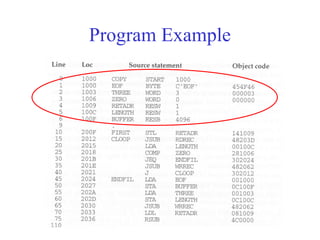
Program Example
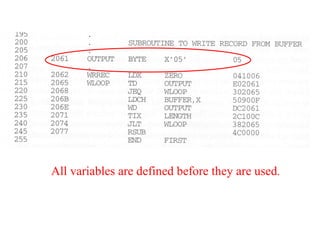
All variables are defined before they are used.
Two Types
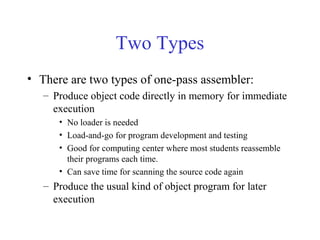
• There are two types of one-pass assembler:
   – Produce object code directly in memory for immediate
     execution
      • No loader is needed
      • Load-and-go for program development and testing
      • Good for computing center where most students reassemble
        their programs each time.
      • Can save time for scanning the source code again
   – Produce the usual kind of object program for later
     execution
Internal Implementation
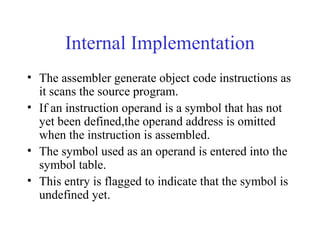
• The assembler generate object code instructions as
  it scans the source program.
• If an instruction operand is a symbol that has not
  yet been defined,the operand address is omitted
  when the instruction is assembled.
• The symbol used as an operand is entered into the
  symbol table.
• This entry is flagged to indicate that the symbol is
  undefined yet.
Internal Implementation (cont’d)
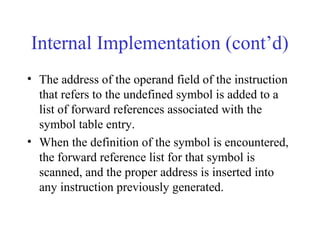
• The address of the operand field of the instruction
  that refers to the undefined symbol is added to a
  list of forward references associated with the
  symbol table entry.
• When the definition of the symbol is encountered,
  the forward reference list for that symbol is
  scanned, and the proper address is inserted into
  any instruction previously generated.
Processing Example


After scanning line 40
Processing Example (cont’d)


After scanning line 160
Processing Example (cont’d)
• Between scanning line 40 and 160:
   – On line 45, when the symbol ENDFIL is defined, the
     assembler places its value in the SYMTAB entry.
   – The assembler then inserts this value into the
     instruction operand field (at address 201C).
   – From this point on, any references to ENDFIL would
     not be forward references and would not be entered into
     a list.
• At the end of the processing of the program, any
  SYMTAB entries that are still marked with *
  indicate undefined symbols.
   – These should be flagged by the assembler as errors.
Multi-Pass Assembler
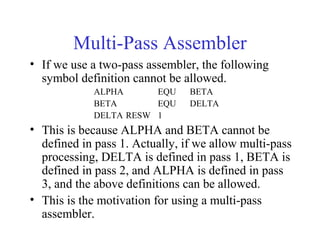
• If we use a two-pass assembler, the following
  symbol definition cannot be allowed.
            ALPHA      EQU      BETA
            BETA       EQU      DELTA
            DELTA RESW 1
• This is because ALPHA and BETA cannot be
  defined in pass 1. Actually, if we allow multi-pass
  processing, DELTA is defined in pass 1, BETA is
  defined in pass 2, and ALPHA is defined in pass
  3, and the above definitions can be allowed.
• This is the motivation for using a multi-pass
  assembler.
Multi-Pass Assembler(cont’d)
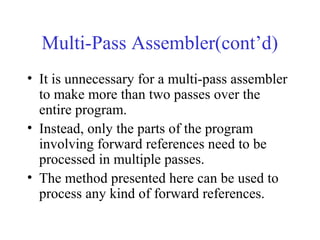
• It is unnecessary for a multi-pass assembler
  to make more than two passes over the
  entire program.
• Instead, only the parts of the program
  involving forward references need to be
  processed in multiple passes.
• The method presented here can be used to
  process any kind of forward references.
Multi-Pass Assembler
            Implementation
• Use a symbol table to store symbols that are not
  totally defined yet.
• For a undefined symbol, in its entry,
   – We store the names and the number of undefined
     symbols which contribute to the calculation of its value.
   – We also keep a list of symbols whose values depend on
      the defined value of this symbol.
• When a symbol becomes defined, we use its value
  to reevaluate the values of all of the symbols that
  are kept in this list.
• The above step is performed recursively.
Forward Reference Example
Forward Reference Processing

        But one symbol is unknown yet


        Defined


       Not defined yet
                                  After first line
After second line


But two symbols are unknown yet


   Now defined
After third line
After 4’th line


Start knowing values


                       After 5’th line


                       All symbols are
                       defined and their
                       values are known
                       now.

Assembler design options

  • 1.
  • 2.
    One and Multi-PassAssembler • So far, we have presented the design and implementation of a two-pass assembler. • Here, we will present the design and implementation of – One-pass assembler • If avoiding a second pass over the source program is necessary or desirable. – Multi-pass assembler • Allow forward references during symbol definition.
  • 3.
    One-Pass Assembler • Themain problem is about forward reference. • Eliminating forward reference to data items can be easily done. – Simply ask the programmer to define variables before using them. • However, eliminating forward reference to instruction cannot be easily done. – Sometimes your program needs a forward jump. – Asking your program to use only backward jumps is too restrictive.
  • 4.
  • 6.
    All variables aredefined before they are used.
  • 7.
    Two Types • Thereare two types of one-pass assembler: – Produce object code directly in memory for immediate execution • No loader is needed • Load-and-go for program development and testing • Good for computing center where most students reassemble their programs each time. • Can save time for scanning the source code again – Produce the usual kind of object program for later execution
  • 8.
    Internal Implementation • Theassembler generate object code instructions as it scans the source program. • If an instruction operand is a symbol that has not yet been defined,the operand address is omitted when the instruction is assembled. • The symbol used as an operand is entered into the symbol table. • This entry is flagged to indicate that the symbol is undefined yet.
  • 9.
    Internal Implementation (cont’d) •The address of the operand field of the instruction that refers to the undefined symbol is added to a list of forward references associated with the symbol table entry. • When the definition of the symbol is encountered, the forward reference list for that symbol is scanned, and the proper address is inserted into any instruction previously generated.
  • 10.
  • 11.
  • 12.
    Processing Example (cont’d) •Between scanning line 40 and 160: – On line 45, when the symbol ENDFIL is defined, the assembler places its value in the SYMTAB entry. – The assembler then inserts this value into the instruction operand field (at address 201C). – From this point on, any references to ENDFIL would not be forward references and would not be entered into a list. • At the end of the processing of the program, any SYMTAB entries that are still marked with * indicate undefined symbols. – These should be flagged by the assembler as errors.
  • 13.
    Multi-Pass Assembler • Ifwe use a two-pass assembler, the following symbol definition cannot be allowed. ALPHA EQU BETA BETA EQU DELTA DELTA RESW 1 • This is because ALPHA and BETA cannot be defined in pass 1. Actually, if we allow multi-pass processing, DELTA is defined in pass 1, BETA is defined in pass 2, and ALPHA is defined in pass 3, and the above definitions can be allowed. • This is the motivation for using a multi-pass assembler.
  • 14.
    Multi-Pass Assembler(cont’d) • Itis unnecessary for a multi-pass assembler to make more than two passes over the entire program. • Instead, only the parts of the program involving forward references need to be processed in multiple passes. • The method presented here can be used to process any kind of forward references.
  • 15.
    Multi-Pass Assembler Implementation • Use a symbol table to store symbols that are not totally defined yet. • For a undefined symbol, in its entry, – We store the names and the number of undefined symbols which contribute to the calculation of its value. – We also keep a list of symbols whose values depend on the defined value of this symbol. • When a symbol becomes defined, we use its value to reevaluate the values of all of the symbols that are kept in this list. • The above step is performed recursively.
  • 16.
  • 17.
    Forward Reference Processing But one symbol is unknown yet Defined Not defined yet After first line
  • 18.
    After second line Buttwo symbols are unknown yet Now defined
  • 19.
  • 20.
  • 21.
    Start knowing values After 5’th line All symbols are defined and their values are known now.