
BOOK REVIEW
ON
FUNDAMENTALS OF
TOWN PLANNING - G.K.HIRASKAR
By:
K.L.E.Ajit,
I D S
Univesity of Mysore
CONTENTS
1. ABOUT THE BOOK
2. ABOUT THE AUTHOR
3. WHY THIS BOOK HAS BE WRITTEN
4. TABLE OF CONTENTS
5. COMMENTS
2Ajit Katari
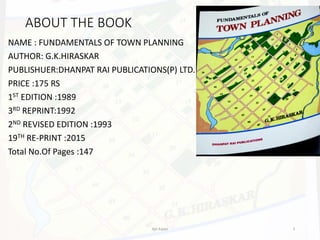
ABOUT THE BOOK
NAME : FUNDAMENTALS OF TOWN PLANNING
AUTHOR: G.K.HIRASKAR
PUBLISHUER:DHANPAT RAI PUBLICATIONS(P) LTD.
PRICE :175 RS
1ST EDITION :1989
3RD REPRINT:1992
2ND REVISED EDITION :1993
19TH RE-PRINT :2015
Total No.Of Pages :147
Ajit Katari 3
ABOUT THE AUTHOR
G.K.HIRASKAR
B.E.(CIVIL) , M.I.E.,M.I.S.T.E.
Formerly , prof . of civil engineering
College of Engineering and technology
BIJAPUR
Ajit Katari 4
WHY THIS BOOK HAS BE WRITTEN?
• The main aim of this book is to create knowledge for students , the
true concepts of town planning and its fundamentals in bold relief
and at the same time to contain the full aspects of the syllabi of
various Indian Universities .
• Author has made an attempt to enlarge its scope so as to make it
useful to the Councilors, Local Bodies , Legislators , Civic Officials and
Community Development Authorities.
Ajit Katari 5
TABLE OF CONTENTS
Total number of Chapters -16
1. Introduction
2. Growth of Towns
3. History of town planning in India
4. Elements of City Plan
5. Surveys
6. Zoning
7. Housing
8. Slums
9. Parks & Playgrounds
10. Public Buildings & Town Centres
11. Industries
12. Communication& Traffic Control
13. Urban renewal and Re planning the Existing towns
14. Master Plan
15. Planning Law and Legislation
16. Village Planning
Bibliography
Index
Ajit Katari 6
CHAPTER-1 INTRODUCTION
• In this chapter author gave introduction about Planning and its origin
with these aspects
• Planning Age , Concept of Planning , Concept of Town & Town Planning.
• Aims and Objectives of Town Planning.
• Principals and Necessity of Town Planning .
• Author also discussed about
• Duties and Powers of Town Planning Officer.
• The Great Town Planners of Modern Age and their Principals
a) Sir Patrick Geddes
b) Sir Ebenezer Howard
c) Clarence Stein
• Brief explanation on
• Individuality of Town
• Forms of Planning
Ajit Katari 7
CHAPTER 2- GROWTH OF TOWNS
• In this chapter author discussed about
• Origin of Towns
• Types of towns
• Stages in the growth of towns
• Methods of External Growth
• Based on the growth of the towns author has defined growth
according to Origin & Direction .
• Growth according to origin is divided into two types
• Natural and Planned Growth
• Growth according to Direction is divided into two types
• Horizontal and Vertical Growth
Ajit Katari 8
CHAPTER 3 –HISTORY OF TOWN PLANNING IN
INDIA
• This chapter discusses about or says that Town planning is not a new
idea in India . It is as old as its rich Culture and Tradition.
• Brief history of town planning at different periods in India.(3000b.c-
Post Independence (After 1947))
CHAPTER 4 –Elements of City Plan
• This chapter discusses what a town generally consists of
• Town Centre , Suburbs ,Industrial areas ,Network of Roads ,Open Spaces.
• Elements of City Plan
• Distribution of Land
• Method of Financing a Town Planning Scheme
• Aesthetics of Town Planning
Ajit Katari 9
CHAPTER- 5 SURVEYS
• This chapter discusses about
• Necessity of surveys
• Collection of Data for Surveys
• Types of Surveys are given with Samples
• Methods Employed To Collect data
• Preparation of Maps and Drawings
• Standard scales and Data representation by using colors and Symbols.
• Finally preparation of Report
CHAPTER- 6 Zoning
• This chapter discusses about
• Importance of zoning
• Classification of zoning
• Use Zoning
• Height Zoning
• Density Zoning
• Zoning powers
Ajit Katari 10
CHAPTER- 7 HOUSING
• In this chapter Author described about the necessity of housing for
Human .
• Main aspects of this chapter are
• lay out of residential units are to be considered principals of Neighborhood
Planning and how a neighborhood Unit Planning should be done and given
examples of Reilly Plan and Radburn Plan.
• Types of Layouts , Classification of housing , Housing Problems in India ,
Agencies for Housing Schemes are mentioned .
CHAPTER-8 SLUMS
• This chapter starts with Meaning of Slum and Discusses about Causes
, Effects on Town Life .
• Precautions to be taken against formation of Slums and Slum
Clearance
• How financial assistance for Slum Clearance schemes
Ajit Katari 11
CHAPTER-9 PARKS AND PLAY GROUNDS
• This chapter starts with necessity of Recreational facilities , Types
Forms , Designs ,Park systems , Standards of Open Spaces and gives a
brief explanation why Urban areas need Open spaces.
CHAPTER-10 Public Buildings & Town Centres
• Author describes how Public Buildings & Town Centres are important , grouping
of public buildings their locations and types of Public Buildings
• He also explained about what are the Major Buildings should be at town Centre
• Main administrative , business n entertainment , and cultural center of town .
CHAPTER-11 INDUSTRIES
• This chapter starts with general scenario of industries in India and how rapidly
they are growing , where Industrial sites should be located , planning for
industrial areas , industrial waste , effects and treatment of industrial wastes
are discussed.
Ajit Katari 12
CHAPTER-12 COMMUNICATON AND TRAFFIC
CONTROL
• This chapter deals with need for communication and transport facilities
and Functions of roads
• Important Aspects Mentioned
• Requirements of Ideal City Road
• Aesthetics and Design Considerations of town roads their classifications , Types
,Traffic Management , Surveys , Congestion in Cities , Remedies for Traffic Control
and congestion and road elements etc.. Are explained in this chapter
CHAPTER-13 Urban renewal and Re planning the
Existing towns
• This chapter discusses about necessity of re-planning andobject of
re-planning , what data to be collected .
• Author discussed about URBAN RENEWAL and its advantages.
Ajit Katari 13
CHAPTER-14 MASTER PLAN
• This chapter starts with definition of master plan , its objectives ,
Necessity , how data to be collected , preparation maps , stages and
implementation of master plan are clearly explained with legal status
of master plan in India
CHAPTER-15 PLANNING LAW AND LEGISLATION
• Necessity and evolution of planning and Legislation are discussed in
this chapter .
• Brief Explanations :
• Development Control
• Building Bye-Laws
• Functions of Local Authority
• Provisions of Building Regulations , Acts
Ajit Katari 14
• This chapter gives a brief about
• Social concept of a village
• Difference between rural and urban , village types
• Principals of village Planning
• Village re development projects , Preparation of Development plan (Master
plan) and general principals , problems , schemes of rural housing are
discussed .
CHAPTER-15VILLAGE PLANNING
Ajit Katari 15
COMMENTS
• The contents in the book have been well discussed, elaborated where ever
necessary & adequate explanation has been given with reference to pictures &
maps which made an easier way to read and understand and language is in basic
level so that any student can easily understand concepts .
• So , I would recommend this book to students of planning, planners and for
public.
• It is an extensive resource book for gaining knowledge in town planning in India.
Ajit Katari 16
THANK YOU
Ajit Katari 17

Ajit katari book review

  • 1.
    BOOK REVIEW ON FUNDAMENTALS OF TOWNPLANNING - G.K.HIRASKAR By: K.L.E.Ajit, I D S Univesity of Mysore
  • 2.
    CONTENTS 1. ABOUT THEBOOK 2. ABOUT THE AUTHOR 3. WHY THIS BOOK HAS BE WRITTEN 4. TABLE OF CONTENTS 5. COMMENTS 2Ajit Katari
  • 3.
    ABOUT THE BOOK NAME: FUNDAMENTALS OF TOWN PLANNING AUTHOR: G.K.HIRASKAR PUBLISHUER:DHANPAT RAI PUBLICATIONS(P) LTD. PRICE :175 RS 1ST EDITION :1989 3RD REPRINT:1992 2ND REVISED EDITION :1993 19TH RE-PRINT :2015 Total No.Of Pages :147 Ajit Katari 3
  • 4.
    ABOUT THE AUTHOR G.K.HIRASKAR B.E.(CIVIL), M.I.E.,M.I.S.T.E. Formerly , prof . of civil engineering College of Engineering and technology BIJAPUR Ajit Katari 4
  • 5.
    WHY THIS BOOKHAS BE WRITTEN? • The main aim of this book is to create knowledge for students , the true concepts of town planning and its fundamentals in bold relief and at the same time to contain the full aspects of the syllabi of various Indian Universities . • Author has made an attempt to enlarge its scope so as to make it useful to the Councilors, Local Bodies , Legislators , Civic Officials and Community Development Authorities. Ajit Katari 5
  • 6.
    TABLE OF CONTENTS Totalnumber of Chapters -16 1. Introduction 2. Growth of Towns 3. History of town planning in India 4. Elements of City Plan 5. Surveys 6. Zoning 7. Housing 8. Slums 9. Parks & Playgrounds 10. Public Buildings & Town Centres 11. Industries 12. Communication& Traffic Control 13. Urban renewal and Re planning the Existing towns 14. Master Plan 15. Planning Law and Legislation 16. Village Planning Bibliography Index Ajit Katari 6
  • 7.
    CHAPTER-1 INTRODUCTION • Inthis chapter author gave introduction about Planning and its origin with these aspects • Planning Age , Concept of Planning , Concept of Town & Town Planning. • Aims and Objectives of Town Planning. • Principals and Necessity of Town Planning . • Author also discussed about • Duties and Powers of Town Planning Officer. • The Great Town Planners of Modern Age and their Principals a) Sir Patrick Geddes b) Sir Ebenezer Howard c) Clarence Stein • Brief explanation on • Individuality of Town • Forms of Planning Ajit Katari 7
  • 8.
    CHAPTER 2- GROWTHOF TOWNS • In this chapter author discussed about • Origin of Towns • Types of towns • Stages in the growth of towns • Methods of External Growth • Based on the growth of the towns author has defined growth according to Origin & Direction . • Growth according to origin is divided into two types • Natural and Planned Growth • Growth according to Direction is divided into two types • Horizontal and Vertical Growth Ajit Katari 8
  • 9.
    CHAPTER 3 –HISTORYOF TOWN PLANNING IN INDIA • This chapter discusses about or says that Town planning is not a new idea in India . It is as old as its rich Culture and Tradition. • Brief history of town planning at different periods in India.(3000b.c- Post Independence (After 1947)) CHAPTER 4 –Elements of City Plan • This chapter discusses what a town generally consists of • Town Centre , Suburbs ,Industrial areas ,Network of Roads ,Open Spaces. • Elements of City Plan • Distribution of Land • Method of Financing a Town Planning Scheme • Aesthetics of Town Planning Ajit Katari 9
  • 10.
    CHAPTER- 5 SURVEYS •This chapter discusses about • Necessity of surveys • Collection of Data for Surveys • Types of Surveys are given with Samples • Methods Employed To Collect data • Preparation of Maps and Drawings • Standard scales and Data representation by using colors and Symbols. • Finally preparation of Report CHAPTER- 6 Zoning • This chapter discusses about • Importance of zoning • Classification of zoning • Use Zoning • Height Zoning • Density Zoning • Zoning powers Ajit Katari 10
  • 11.
    CHAPTER- 7 HOUSING •In this chapter Author described about the necessity of housing for Human . • Main aspects of this chapter are • lay out of residential units are to be considered principals of Neighborhood Planning and how a neighborhood Unit Planning should be done and given examples of Reilly Plan and Radburn Plan. • Types of Layouts , Classification of housing , Housing Problems in India , Agencies for Housing Schemes are mentioned . CHAPTER-8 SLUMS • This chapter starts with Meaning of Slum and Discusses about Causes , Effects on Town Life . • Precautions to be taken against formation of Slums and Slum Clearance • How financial assistance for Slum Clearance schemes Ajit Katari 11
  • 12.
    CHAPTER-9 PARKS ANDPLAY GROUNDS • This chapter starts with necessity of Recreational facilities , Types Forms , Designs ,Park systems , Standards of Open Spaces and gives a brief explanation why Urban areas need Open spaces. CHAPTER-10 Public Buildings & Town Centres • Author describes how Public Buildings & Town Centres are important , grouping of public buildings their locations and types of Public Buildings • He also explained about what are the Major Buildings should be at town Centre • Main administrative , business n entertainment , and cultural center of town . CHAPTER-11 INDUSTRIES • This chapter starts with general scenario of industries in India and how rapidly they are growing , where Industrial sites should be located , planning for industrial areas , industrial waste , effects and treatment of industrial wastes are discussed. Ajit Katari 12
  • 13.
    CHAPTER-12 COMMUNICATON ANDTRAFFIC CONTROL • This chapter deals with need for communication and transport facilities and Functions of roads • Important Aspects Mentioned • Requirements of Ideal City Road • Aesthetics and Design Considerations of town roads their classifications , Types ,Traffic Management , Surveys , Congestion in Cities , Remedies for Traffic Control and congestion and road elements etc.. Are explained in this chapter CHAPTER-13 Urban renewal and Re planning the Existing towns • This chapter discusses about necessity of re-planning andobject of re-planning , what data to be collected . • Author discussed about URBAN RENEWAL and its advantages. Ajit Katari 13
  • 14.
    CHAPTER-14 MASTER PLAN •This chapter starts with definition of master plan , its objectives , Necessity , how data to be collected , preparation maps , stages and implementation of master plan are clearly explained with legal status of master plan in India CHAPTER-15 PLANNING LAW AND LEGISLATION • Necessity and evolution of planning and Legislation are discussed in this chapter . • Brief Explanations : • Development Control • Building Bye-Laws • Functions of Local Authority • Provisions of Building Regulations , Acts Ajit Katari 14
  • 15.
    • This chaptergives a brief about • Social concept of a village • Difference between rural and urban , village types • Principals of village Planning • Village re development projects , Preparation of Development plan (Master plan) and general principals , problems , schemes of rural housing are discussed . CHAPTER-15VILLAGE PLANNING Ajit Katari 15
  • 16.
    COMMENTS • The contentsin the book have been well discussed, elaborated where ever necessary & adequate explanation has been given with reference to pictures & maps which made an easier way to read and understand and language is in basic level so that any student can easily understand concepts . • So , I would recommend this book to students of planning, planners and for public. • It is an extensive resource book for gaining knowledge in town planning in India. Ajit Katari 16
  • 17.