Ali Nefzaoui, Mohamed El Mourid, Youssef Saadani,
         Hanene Jallouli, Nasr Raggad, and Grigory Lazarev


November 2007


             30


International Center for         International         The Arab Fund for        International
Agricultural Research in            Fund for          Economic and Social   Development Research
     the Dry Areas         Agricultural Development      Development               Centre
Developing Sustainable Livelihoods of Agro-pastoral
About ICARDA and the CGIAR                                                                      Communities of West Asia and North Africa (M&M III Project)


            Established in 1977, the International Center for Agricultural Research in
            the Dry Areas (ICARDA) is one of 15 centers supported by CGIAR.
            ICARDA’s mission is to improve the welfare of poor people through research
            and training in dry areas of the developing world, by increasing the pro-
            duction, productivity and nutritional quality of food, while preserving and
            enhancing the natural resource base.
            ICARDA serves the entire developing world for the improvement of lentil,
barley and faba bean; all dy-area developing countries for the improvement of on-farm
water-use efficiency, rangeland and small-ruminant production; and the West and Cen-
                                                                                            A FIELD MANUAL FOR THE PREPARATION
tral Asia and North Africa (CWANA) region for improvement of bread and durum                   OF A PARTICIPATORY COMMUNITY
wheats, chickpea, pasture and forage legumes, and farming systems. ICARDA’s re-
search provides global benefits of poverty alleviation through productivity improvements             DEVELOPMENT PLAN
integrated with sustainable natural-resource management practices. ICARDA meets this
challenge through research, training, and dissemination of information in partnership
with the national, regional and international agricultural research and development
systems.


                                                                                                                          Ali Nefzaoui,
                                                                                                                       Mohamed El Mourid,
            The Consultative Group on International Agricultural Research (CGIAR) is
                                                                                                                        Youssef Saadani,
            a strategic alliance of countries, international and regional organizations,                                 Hanene Jallouli,
            and private foundations supporting 15 international agricultural Centers
                                                                                                                         Nasr Raggad,
            that work with national agricultural research systems and civil society orga-
                                                                                                                               and
            nizations including the private sector. The alliance mobilizes agricultural
                                                                                                                        Grigory Lazarev
            science to reduce poverty, foster human well being, promote agricultural
growth and protect environment.
The CGIAR generates global public goods that are available to all.
The World Bank, the Food and Agriculture Organization of the United Nations (FAO),
the United Nations Development Programme (UNDP) are cosponsors of the CGIAR.
The World Bank provides the CGIAR with a System Office in Washington, DC. A
Science Council, with its Secretariat at FAO in Rome, Assists the System in the Deve-
lopment of its research program.

                                                                                                      International Center for Agricultural research in the Dry Areas
© 2007 International Center for Agricultural Research in the Dry Areas (ICARDA)
                                                                                            Forword
                                                                                                  Despite considerable efforts by governments and other stakeholders in dry areas in many
All right reserved
                                                                                            countries in West Asia and North Africa (WANA), poverty alleviation remains an unfinished
ICARDA encourages fair uses of this material. Proper citation is requested.
                                                                                            task. In the mid-1990s, ICARDA and IFPRI, working in close collaboration with national programs
                                                                                            of eight countries (Algeria, Iraq, Jordan, Lebanon, Libya, Morocco, Syria and Tunisia), initiated
                                                                                            the Mashreq/Maghreb Project, a research and development program targeting poor farmers and
                                                                                            pastoralists. Using a novel participatory approach, the Project initially addressed the “develop-
                                                                                            ment of integrated crop-livestock production in low-rainfall areas of WANA,” and successfully de-
                                                                                            veloped technical, institutional, and policy options that were adopted by the target beneficiaries.
Recommended Citation                                                                        Incomes increased, reversing the trend of increasing rural poverty in those areas. The Project now
Nefzaoui, A., El Mourid, M., Saadani, Y., Jallouli, H., Raggad, N., and Lazarev, G. 2007.   focuses on “developing sustainable livelihoods of agro-pastoral communities of WANA”. The
A Field Manual for the Preparation of a Participatory Community Development Plan.           different phases of the Mashreq/Maghreb Projects were financially supported mainly by IFAD
ICARDA Aleppo, Syria, 116pp.                                                                and the Arab Fund (AFESD) as well as other donors including OPEC Fund for International De-
                                                                                            velopment (OFID) and IDRC of Canada.
                                                                                                 The Project was successful because it ensured the active participation of communities, start-
                                                                                            ing with project planning, through implementation, monitoring and evaluation. Multidisciplinary
                                                                                            teams of agricultural specialists worked with communities, as well as extension services, local ad-
                                                                                            ministration, state representatives, and other stakeholders in each area to develop ‘best-bet’ tech-
                                                                                            nical, institutional, and policy options.
                                                                                                  As the community-based participatory approach is being adopted by national policy mak-
                                                                                            ers, it became necessary to put together the necessary information in a manual that will serve
                                                                                            as a reference or training guide for a range of users and potential stakeholders: community mem-
                                                                                            bers, extension staff, researchers, local and central administrators, NGO staff, policy makers, pri-
                                                                                            vate institutions/associations, donors and others. This manual is the result of those efforts.
                                                                                                  The manual is easy to follow, with clear definitions of terminology, and is well structured to
                                                                                            show the different steps of the community-based participatory approach. The main steps involved
                                                                                            in elaborating the participatory community development plan are presented as a sequence of
                                                                                            steps, with all necessary details for the various users and stakeholders.

ISBN: 978-9973-9992-0-7
                                                                                                 The manual is the outcome of many years of experience involving many stakeholders in dif-
                                                                                            ferent countries and settings. We are indebted to all our partners for their highly-valued contri-
Key words: Agropastoral system, local development, participatory approach, empowerment of   butions.
pastoral communities, community-based organization.                                               I would like to congratulate the authors of this manual. I would like to express ICARDA’s ap-
                                                                                            preciation to donors—IFAD, Arab Fund, OFID and IDRC—that supported different projects that
                                                                                            contributed to better understanding and further development of community-based participatory
                                                                                            approaches for technology development and transfer. We hope the manual will contribute to
ICARDA
P.O. Box 5466, Aleppo, Syria.                                                               further adoption of the community-based participatory approaches for the benefit of rural com-
Tel: (+973) (21) 2213433, 2213477, 2225112, 2225012                                         munities in dry areas.
Fax: (+963) (21) 2213490, 2225105, 5744622
Email: ICARDA@cgiar.org                                                                                                                                                       Mahmoud Solh
Website: www.icarda.org                                                                                                                                                      Director General
Acknowledgements                                                                       Table Of Content
This manual builds on a collective action of many scientists, development agents,      • Empowering agro-pastoral communities for better management of
communities, NGOs, donors, and decision-makers, who have been associated with            natural resources
the Mashreq/Maghreb Project in West Asia and North Africa. Everyone of them has
                                                                                              1 ALTERNATIVE DEVELOPMENT APPROACH FOR RANGELANDS IN ARID ZONES                     6
brought a stone to building the participatory community development plan foundation.
                                                                                              2 THE PARTICIPATORY COMMUNITY APPROACH: THE ICARDA AND IFPRI EXPERIENCE             8
The authors have gathered all these experiences and tried to put them together in an
easily readable manual.                                                                       3 FROM CONCEPTS TO IMPLEMENTATION                                                  14

                                                                                              4 CONCLUSIONS                                                                      24
We would like to express our appreciation to the many stakeholders who have been
involved with Mashreq/Maghreb Project (M&M), and mainly:                               • Presentation of the field manual
M&M teams, NARS, Communities, Local Authorities, and NGOs in Algeria, Iraq,                   WHY A FIELD MANUAL?                                                                26

Jordan, Lebanon, Libya, Morocco, Syria, and Tunisia.                                          HOW THE FIELD MANUAL WAS DEVELOPED?                                                26

Donors for their support and continued trust, and particularly IFAD, AFESD, IDRC,             HOW SHOULD THE FIELD MANUAL BE APPLIED?                                            26

FEMISE, CAPRi, and NARS.                                                                      STRUCTURE OF THE FIELD MANUAL                                                      27

Special thanks are extended to IFAD NENA Division and particularly to Mr. Khalid El           THE FACILITATOR: ROLE, ATTITUDE, AND BEHAVIOR                                      27

Harizi for his trust in ICARDA and Tunisia M&M team for their input into IFAD-funded          SUBJECT MATTER SPECIALISTS (SMSS) AND MULTIDISCIPLINARY TEAMS                      30
PRODESUD project (Programme de Développement Agropastoral et Promotion des Ini-               PRACTICAL RECOMMENDATIONS FOR THE PREPARATION OF THE COMMUNITY DEVELOPMENT PLAN    31
tiatives Locales dans le Sud-Est Tunisien), from its inception through planning and
                                                                                              NECESSARY EQUIPMENT AND SUPPLIES FOR FACILITATION SESSIONS                         33
implementation. This joint venture went beyond the M&M community approach to build
up community development plans (CDP) that are adopted and institutionalized into       • Description of the steps and methodological sequences for the
wider development projects.                                                              community development plan
PRODESUD Director, Coordinator, team members, and Ouled Chehida and Guermassa                 STEP I:    COMMUNITY CHARACTERIZATION (LEARNING PHASE)                             38

communities have been instrumental in the adoption and outscaling of the CDP                  STEP II.   PARTICIPATORY PLANNING                                                  63
approach by sharing their successful experience with many other IFAD-funded projects          STEP III . PROMOTION OF LOCAL INSTITUTIONS/COMMUNITY-BASED ORGANIZATIONS           80
in the region. Their unwavering efforts and contributions are much appreciated and
                                                                                              STEP IV.   PARTICIPATORY PROGRAMMING                                               89
gratefully acknowledged.
                                                                                              STEP V.    IMPLEMENTATION OF THE CDP AND MONITORING AND EVALUATION                102
We are most thankful to management and colleagues from ICARDA and IFPRI for their
                                                                                       • LIST OF ACRONYMS                                                                       110
support and valuable input into the concept and development of the community
                                                                                       • REFERENCES                                                                             111
approach.
                                                                                       • ANNEX 1: SOCIO-ECONOMIC AND LAND TENURE HOUSEHOLD QUESTIONNAIRE                        112

                                                                                       • ANNEX 2: DETAILED DESCRIPTION OF THE TOPONYMIC DISTRICTS (EXAMPLE OF BOUIRET LAHDAB    115
                                                                        The authors                 COMMUNITY, ALGERIA)
1
                                                                                                                       ment’s fragmentary understanding of pastoral traditions. Watering facilities used
                   Empowering agro-pastoral
    CHAPTER

                                                                                                                       to be managed according to customary rules and arrangements between tribes.
                                                                                                                       Government watering facilities are now public and open to all users and thus
                                                                                                                       contribute to the open access to rangelands.
                   communities for better                                                                              - Increasing the productivity of livestock and natural pastures through techniques
                                                                                                                         developed for favorable areas (genetic improvement of livestock, disease control,

                   management of natural resources                                                                       mass vaccination, etc.).
                                                                                                                       - Improving services and cooperative arrangements.
                                                                                                                In the 1980s an ambitious formula was introduced in Algeria and Syria aimed at orga-
                                                                                                                nizing herders into production cooperatives. Planned from top to bottom, these previous
               1     ALTERNATIVE DEVELOPMENT APPROACH                                                           experiments failed because they were dependent on government subsidies.
                     FOR RANGELANDS IN ARID ZONES                                                               For a long time the International Community has recognized that desertification is a major
                                                                                                                threat for human beings. But it is only since 1992 (at a United Nations Conference on
              During the past few decades, a score of development projects were conducted for the be-           Environment and Development - UNCED, Rio de Janeiro) that a new, integrated ap-
              nefit of dry environments, with the objectives of reducing poverty, preserving the remai-         proach, emphasizing action to promote sustainable development at the community level
              ning resources, and generating development. Though little was achieved in spite of                has been supported.
              investment and a wealth of technical procedures, it was unanimously concluded that cen-
                                                                                                                       In 1996, the Convention to Combat Desertification (CCD) placed emphasis on
              trally planned development does not work. The lessons learned from past efforts revealed
                                                                                                                       partnership and participation, which resulted in “the first international, legally bin-
              that in Low Rainfall Areas (LRA) prevailing land use patterns are not sustainable and the
                                                                                                                       ding instrument”, that explicitly requires application of the principles of “partner-
              resource base is vanishing rapidly. Both facts threaten the very fragile livelihood of the
                                                                                                                       ship” and “participation”.
              rural poor.
                                                                                                                The Convention urges the parties to ensure that all relevant actors - the population affected
              The sustainability of pastoral and agro-pastoral systems is threatened by the dramatic ef-
                                                                                                                by desertification and their associations, NGOs, national governments, donor organiza-
              fects of desertification and by the degrading environment. There is a direct link between
                                                                                                                tions, and research institutions - work together to establish joint priorities and devise and
              the numbers and type of livestock and overall resource base sustainable management.
                                                                                                                implement long-term programs.
              The expertise accumulated over centuries by the local population is crucial in defining stra-
                                                                                                                Two concepts need to be defined: “participation” and “community approach”. A lot of
              tegies to cope with desertification. New technologies, integrated with traditional local
                                                                                                                literature has been published on the subject. We suggest the following.
              knowledge, require careful assessment of their impacts, limits of their application, and the
              possible damage caused by them. In this respect, the local population plays a key role.           (i) Participation: Restore to populations the right of initiative and the decision making pro-
                                                                                                                cess to define, plan and implement activities and programs related to their own future and
              Also, combating desertification in the field is a local effort and site specific. Only the
                                                                                                                the management of the resources available in their territories. This definition implies that:
              local people are in a position to know what can be done that is socially and economically
              acceptable to them and that will be continued after the project’s end. Usually, people are               - External agents and States recognize the populations as development actors, as
              more interested in short term benefits than in saving for the future.                                      partners and not simply as project targets.
                                                                                                                       - The action program relies on a good knowledge of the environment that allows
              Most of the policy responses to the sustainable development challenges of arid and semi-
                                                                                                                         a concerted diagnosis, taking into consideration the “wishes”, the objectives and
              arid areas, and to rangeland problems in particular, were sectoral and top-down. The
                                                                                                                         the constraints of all parties (stakeholders). Action can be considered participa-
              major measures are:
                                                                                                                         tory only if it results from an explicit compromise between all stakeholders.
                     - Urgent action during and after drought to reconstitute flocks – particularly bene-
                                                                                                                However, participatory approaches are not the results of an expressed local demand;
                       ficial to large herders (through subsidies or credits/head). This policy of crisis ma-
                                                                                                                they are often a requirement of donors. Although the notion of participation is widely ac-
                       nagement has a negative impact on natural resources, favoring overgrazing and
                                                                                                                cepted and is officially included in most of the development projects’ documents and in
                       land degradation.
                                                                                                                Government policies, in current practice it is often not successfully implemented. It requires
                     - Improving watering facilities. Such an action is a typical example of a govern-
                                                                                                                a full and effective participation by the affected population groups in the decision-making
6                                                                                                                                                                                                                7
1
                                                                                                                                           Empowering agro-pastoral communities for better management of natural resources

    CHAPTER


              process, and in planning, implementing, and evaluating national action programs. It calls                  - Stimulating farmers’ and communities’ participation in steering their own deve-
              also for the participation of women and the involvement of NGOs.                                             lopment processes.
              (ii) Community approach: Many references describe at length the advantages of the com-                     - Facilitating technology transfer through participatory technology development.
              munity approach. One of them (Ngaido et al., 2002) suggests the following principles                       - Promoting collective action on the basis of a shared consensus.
              and highlights as the main advantages:                                                                     - Using experiences gained in different regions for the benefit of the target com-
                                                                                                                           munities.
                     - Efficiently and rapidly improving living standards through the mobilization of
                       unused human and material resources.                                                       The M&M project followed an integrative approach using the natural, biological, and so-
                     - Providing the missing readiness of social actors, their spirit, their initiatives, their   cial sciences to support the development strategies of the selected communities. This ap-
                       attitudes, and their will to partake in the program preparation and implementa-            proach started stepwise during the first phase of the project (1995-1998) and gained
                       tion.                                                                                      momentum and reached its required level of activity during the second phase (1999-
                     - Integrating the populations into their country's social, political, and economic           2002).
                       life.                                                                                      During the latter phase, the project, which adopted a wealth of valuable technologies that
              The community approach deals with the whole community, which is far from being a mo-                were developed during the first phase by the National Agricultural Research System
              nolithic block. Generally, it is characterized by its flexible, dynamic dimension, adapted          (NARS), adopted the community approach in order to foster the integrative efforts of the
              to local circumstances, which can be used as a catalyst for development. Moreover, the              national teams.
              approach focuses on the initiation of comprehensive development schemes in selected
              communities or villages on the basis of what community members perceive to be their                    2.1        THE CONCEPT OF THE COMMUNITY APPROACH IN THE
              needs. These activities are initiated by specially trained staff who, by living in the com-                       MASHREQ/MAGHREB PROJECT
              munity and working with its members, gains the confidence of the community. They serve
                                                                                                                           2.1.1      The Mashreq/Maghreb community approach
              as facilitators for the thinking and discussion processes and guide members to identify and
              translate actions into a community development plan (CDP).                                          Community-based approaches for natural resource management have been introduced
                                                                                                                  in many countries since the early 1980s. In the West Asia and North Africa (WANA) re-
              The community approach is mostly suitable for, and directly relevant in, natural resource
                                                                                                                  gion, however, the use of the community approach to transfer technologies was an im-
              management projects. However, important principles for its success are that it:
                                                                                                                  portant institutional innovation that transformed the relationships between farming and
                     - Is demand-driven – based on needs and priorities defined by the people them-               herding communities, national agricultural researchers, and other stakeholders. The ove-
                       selves.                                                                                    rall framework of the project is presented in Figure 1. A four-step process was used in the
                     - Is socially inclusive – ensuring that all community sub-groups have a voice and            eight countries (Algeria, Iraq, Jordan, Lebanon, Libya, Morocco, Syria, and Tunisia) in-
                       benefit from these actions.                                                                volved in the project to implement the approach in each of the selected communities (Tho-
                     - Creates an enabling policy and institutional environment.                                  mas et al., 2003), as follows.
                                                                                                                  Step 1: Following initial surveys, each country team selected two communities that were
               2     THE PARTICIPATORY COMMUNITY APPROACH:                                                                considered representative of the main production systems and conducted parti-
                                                                                                                          cipatory rural appraisal (PRA) surveys or rapid rural appraisals (RRA) to assess
                     THE ICARDA AND IFPRI EXPERIENCE                                                                      the opportunities and constraints of each community.
              Problems faced by rural populations living in resource-poor areas cannot be solved by               Step 2: Each team organized a workshop for each community to present the results of
              technology alone. They will likely worsen with increasing population demands unless si-                     the surveys and identified options to address community problems. Technologies
              gnificant policy and institutional changes occur. The Mashreq/Maghreb (M&M) project                         that could mitigate some of their production constraints were also presented and
              (Figure 1), the activities of which sought to foster the integration of crop–livestock produc-
                                                                                                                           discussed. Some of the technologies were dropped during the meeting and never
              tion systems in low rainfall areas, applied an "innovative" community development ap-
                                                                                                                           made it into the community-negotiated plan because farmers had some prior
              proach in the late 1990s, which evolved from on-farm demonstrations in the mid 1990s.
                                                                                                                           knowledge of the proposed technologies or they did not fit in with their produc-
              This approach included (Haddad and Eltom, 2002; Ngaido et al., 2002):
                                                                                                                           tion strategies. Technologies which were retained for each production system
                     - Fostering integration between different disciplines, actors, etc.                                   were included in the negotiated action plan (Figure 2). Following the discussion
8                                                                                                                                                                                                                            9
1
                                                                                                                                     Empowering agro-pastoral communities for better management of natural resources

     CHAPTER


               of the proposed technologies and identification of options that would be implemented in
               the community, a negotiated community action plan was drafted. The plan outlined agree-
               dupon activities and options to be tested at the community level and the responsibilities
               of each of the parties. This was the forum where other stakeholders, especially govern-
               ment officials, identified the activities that they could support.


                                                                                                                                         Figure 2. Technology selection process


                                                                                                           Step 3: This step represents the implementation of the negotiated action plan. Each net-
                                                                                                                   work of researchers worked individually in implementing their activities, but the
                                                                                                                   teams met periodically to review the progress achieved. Research activities in-
                                                                                                                   cluded 1) policy, institutional, and monitoring surveys, 2) adaptive research tes-
                                                                                                                   ting and evaluation of the technological options, 3) agro-ecological
                                                                                                                   characterization, 4) community modeling and econometric analysis of the hou-
                                                                                                                   sehold and community surveys, and 5) adoption and impact studies. In addition
                                                                                                                   to team meetings, the networks met in different technical meetings that were
                                                                                                                   open to other disciplines, to refine their methodologies and analyses, and share
                                                                                                                   results. The final objectives of this step were to identify 1) “best-bet” institutional
                                                                                                                   and policy options, 2) “best-bet” technological and policy options, and 3) com-
                                                                                                                   munity land suitability maps. These different outputs served to develop packages
                                                                                                                   of technological, institutional, and policy options that would be replicated in
                                                                                                                   other similar production systems.
                                                                                                           Step 4: Conceptualization of the community development plan, which included the re-
                                                                                                                   sults of all the constraints and opportunities that were identified at the beginning
                                                                                                                   and during the implementation of project activities. The options that had been
                                                                                                                   tested in the community as well as community model simulations and survey re-
                                                                                                                   sults were presented. The plan included the priorities (education, health, infra-
                                                                                                                   structure, etc.) that were identified and the progress made in addressing these
                            Figure 1. The Mashreq and Maghreb (M&M) project’s community approach                   issues to help the communities mobilize the funding identified for the project.
                                                                                                                   These plans would be the basic framework for any future intervention in the
                                                                                                                   community.

                                                                                                               2.2        MECHANISMS FOR IMPLEMENTING THE COMMUNITY
                                                                                                                          APPROACH
                                                                                                           The principles considered in the application of the community development approach
                                                                                                           should not be seen as elements of a standardized recipe. Communities, as social orga-
                                                                                                           nizations, are not the same everywhere, even though they can present some similarities.
10                                                                                                                                                                                                                     11
1
                                                                                                                                       Empowering agro-pastoral communities for better management of natural resources

     CHAPTER


               Generally, the mechanisms for implementing the community approach include:                     the interaction between community members and researchers and monitor the implemen-
                      -   Setting-up a multidisciplinary, action-research-oriented team.                      tation of the agreed research agenda with the community. The committees were directly
                      -   Clearly defining the community.                                                     involved in the drafting and implementation of the work plans and deliverables.
                      -   Adopting participatory methods.                                                     In addition, each community had a facilitator who was responsible for monitoring the
                      -   Enrolling facilitators instead of conventional extension workers.                   implementation of the negotiated action plan, organizing visits of team members, and or-
                      -   Getting community members organized.                                                ganizing community workshops. The facilitator was an important interface between the
                      -   Adopting a holistic approach for the community constraints analysis.                national steering committee, the community steering committee, and the other stakehol-
                      -   Facilitating the elaboration of a community development plan.                       ders. He also reinforced the trust between the project team and farmers. The selection of
                                                                                                              the facilitator was left to the discretion of the team. The CSC convened meetings to discuss
                  2.3          BUILDING MULTIDISCIPLINARY TEAMS                                               the objectives and implementation of project activities. The interaction and involvement
                                                                                                              of all stakeholders in the decision-making was critical for gaining the support of local po-
               Integrating all these different disciplines and creating multidisciplinary teams were essen-
                                                                                                              licymakers and administrative institutions.
               tial requirements for working at the community level. The objective was to develop teams
               that would understand production niches as well as strategies in order to determine the
               best technical, institutional, and policy options (TIPOs). To reach such an understanding
               and to develop partnerships among team members, the teams convened many meetings
               to discuss the approach and the roles and expectations of each team member. The pro-
               cess was also expected to transform the scientists’ perceptions of their roles, extending
               them beyond the traditional role of providing improved technological packages and prac-
               tices to farmers, to include community development priorities. This does not mean that
               members were required to address all community priorities, but they were expected to fa-
               cilitate the involvement of other stakeholders responsible for implementing the priorities
               that were identified by the communities, but outside the scope of the project.
                          2.3.1      Defining and identifying communities
               In the past, tribal-based organizations were the common feature in all communities of the
               dry areas of WANA. However, administrative reform policies have transformed traditio-
               nal tribal systems and introduced new institutions. As a result, the notion of a “community”
               differed from country to country. But in agro-pastoral areas, traditional local institutions
               have survived and the “spirit” of community is still there, even though administrative di-                       Figure 3. Mashreq/Maghreb Project (M&M II) institutional set-up
               visions do not fit with the community’s border. Nevertheless, within the Mashreq/Maghreb
               project the following definitions of community were used (Ngaido et al. 2002):                          2.3.3      Difficulties encountered
                      - A social organization composed of households that are organized into sub-struc-       The methodologies and approaches developed within the M&M program were not ap-
                        tures.                                                                                plied at the same level in all eight countries or all 16 communities. Many difficulties and
                      - A settlement – its territory, and its pastures.                                       constraints slowed the whole process. The following are some of the difficulties encoun-
                      - A socially cohesive unit with its resources.                                          tered:
                      - A structure with a regulatory body and sets of agreed rules and practices.                   - Centralized decision-making processes in some countries.
                      - Users of a specific area (space).                                                            - Land tenure and secure ownership for rangeland differ between countries.
                                                                                                                     - Different stakeholders may have divergent interests: weakest versus strongest.
                          2.3.2      Partner institutions
                                                                                                                     - Civil organizations are not yet developed in all countries and/or regions of each
               At the level of each community, each country team created a Community Steering Com-                     country.
               mittee (CSC) composed of selected community members, agricultural/extension agents                    - The community approach is time-consuming (and requires a long time span).
               working in the area, and team members (Figure 3). The role of the CSC was to facilitate
12                                                                                                                                                                                                                       13
1
                                                                                                                                           Empowering agro-pastoral communities for better management of natural resources

     CHAPTER


                      - National teams did not achieve the same level of progress (shortage of human              3.2           STAKEHOLDERS’ READINESS TO IMPLEMENT A
                        capacity in some fields).                                                                               PARTICIPATORY APPROACH
                      - In general, extension services are weak.
                      - Low rainfall areas face high risk and uncertainty that make the generation and         The main stakeholders interacting with rural communities in development are internatio-
                        transfer of technology a very slow process.                                            nal/national donors, NGOs, the population through its formal and informal local institu-
                                                                                                               tions, the central and regional government bodies, including local and regional councils,
                                                                                                               political parties, and the administration, which is often the implementing agency for rural
                3     FROM CONCEPTS TO IMPLEMENTATION                                                          development programs (Figure 5). The strengths and weaknesses of these stakeholders are
                                                                                                               summarized in Table 1.
                  3.1        WHERE WE STAND TODAY?
               Participation is perceived in different ways by governments, development agencies, do-
               nors, NGOs, and communities. Three decades ago, when a population was not against
               a development program, it was viewed as participation. Since the early 1970s the
               concept has gradually evolved (Figure 4) to mean the status of self-governance. But in
               most of WANA region countries, with the exception of a few pilot projects, participation
               is in “the middle of the road” between the “population is contributing in kind” and “ne-
               gotiation”.
               Adoption of participatory approaches by national governments and their translation into                          Figure 5. Main stakeholders involved in a rural community’s development
               actual implementation appears not only partial, but also particularly slow. The progress
               achieved in changing government agencies’ attitudes and practices towards participation              Table 1. Strengths and weaknesses of main stakeholders involved in rural community development

               over the last 30 years stands in contrast to the impressive sequence of events that have                Stakeholders      Strength                          Weaknesses
               changed the face of the world during the same period: the wave of liberal economic re-
                                                                                                                                                                            - Project duration (too short to fully
               forms of the 1980s, the subsequent transition of former socialist countries to a market                                   - Participation is a pre-requisite
                                                                                                                                                                              implement participatory approach)
                                                                                                                                           to the loan agreement
               economy during the 1990s, the unsustainable evolution of external debts, the repeated                   Donors
                                                                                                                                         - Relatively good experience
                                                                                                                                                                            - Project formulation (too much detail)
                                                                                                                                                                            - Poor backstopping (needed especially
               occurrence of major natural and man-made disasters (droughts, famines, epidemics and                                        with participation
                                                                                                                                                                              at the beginning)
               wars, in Africa particularly), the information revolution, fast urbanization, the fall of nu-
                                                                                                                                         - Working in proximity to         - Isolated intervention (no strategy for
               merous military and authoritarian regimes, the development of regional economic and po-                                     community                         wider dissemination)
               litically integrated blocks; all of these processes and events have culminated in the                   NGOs              - Relative autonomy in decision   - Poor interaction with administration
                                                                                                                                           making and in funds               (substitute for the administration rather
               phenomenon of globalization (El Harizi 2003).                                                                               management                        than taking over the administration)
                                                                                                                                         - Good know-how                   - Assisted “behavior”
                                                                                                                       Population        - Reliable partner if organized   - Weakness of informal local institutions
                                                                                                                                         - Social solidarity               - Poverty
                                                                                                                                                                           - Tendency to generalize
                                                                                                                                         - Presence and ability to mobi-
                                                                                                                                                                           - Centralized decision making
                                                                                                                       Government          lize actors
                                                                                                                                                                           - Relation with actors based on
                                                                                                                                         - Ability to raise funds
                                                                                                                                                                             consultation and not on dialogue
                                                                                                                                                                           - Centralized decision making
                                                                                                                                                                           - Cumbersome and inappropriate proce-
                                                                                                                                                                             dures for participatory development
                           Figure 4. Different levels of participation (CBO: community-based organization)             Administration    - Decentralization
                                                                                                                                                                           - Staff not prepared (skilled) for partici-
                                                                                                                       (development      - Cumulative technical
                                                                                                                                                                             patory development
                                                                                                                       agencies)           experience
                                                                                                                                                                           - Funds allocated for human capacity
                                                                                                                                                                             building and technical innovations are
                                                                                                                                                                             low and underused


14                                                                                                                                                                                                                           15
1
                                                                                                                                       Empowering agro-pastoral communities for better management of natural resources

     CHAPTER


                  3.1        FROM PARTICIPATION TO EMPOWERMENT:                                                        3.3.3.      Participatory methods for natural resource manage-
                             PUTTING ICARDA’S EXPERIENCE INTO ACTION WITH                                                          ment. Who is empowered?
                             DEVELOPMENT PROJECTS                                                             Participatory methods for natural resource management (NRM) have often been presented
                                                                                                              as a solution to NRM issues. Several authors, such as Chambers (1997), note that parti-
                        3.1.1      From participation to empowerment                                          cipatory NRM can be instrumental in institutionalizing participatory approaches. In both
               In order to understand the current emergence of the concept of empowerment, it is useful       democratic and non-democratic settings, these approaches foster inclusiveness, transpa-
               to sketch out the emergence and adoption patterns of a related and older concept, par-         rency, and accountability of public services and policymaking processes. Through the in-
               ticipation. During the 1970s, the ideas and methods of“participatory development” emer-        troduction and generalization of participatory programmatic tools, participatory NRM
               ged within the international development arena in response to a perceived failure of           plays an essential educational role in changing bureaucrats’ and local people’s mindsets
               earlier state-driven development policies to ensure sustainable and equitable distribution     and communication patterns. In short, it is a school of local democracy.
               of benefits. Starting with the very modest objective of cost sharing between the state and     Experience also shows that greater participation, sought through development projects,
               the beneficiaries (financial participation), the idea and methods of participatory develop-    in the absence of representative organizations, often provides additional opportunities to
               ment have diversified extensively in scope, theoretical foundations, and intensity over the    rural elites to capture the bulk of the expected benefits of NRM. Devolution of NRM ge-
               past two to three decades, building very much on the pilot initiatives of NGOs. In the pro-    nerally implies that a sub-set of stakeholders is given exclusive rights of use at the expense
               cess, participation has also been incorporated into new initiatives, such as policy making     of other stakeholders without formal agreement or compensation. Apart from the weak
               and research. Today, participatory approaches form part of the national development po-        legal basis of such solutions, it is rarely the case that the really poor get their fair share
               licies in a majority of developing countries.                                                  from these arrangements. Devolution of NRM is carried out in the name of empowering
               Nevertheless, it would be an error to view participation as radically departing from pre-      people through increased access to resources, but the question is who is empowered in
               vious state-driven approaches. Participatory approaches, even in their diversity, have in      practice, the rural poor or the elite? (El Harizi, 2005).
               common that the people directly concerned do not have the initiative and control of the        The challenge of the equitable and sustainable use of natural resources is not primarily
               development process. The people, typically designated as beneficiaries or target groups,       a question of technical management, but a matter of governance. This is not to say that
               are expected, urged, or encouraged to participate in others’ endeavors – on the grounds        management considerations are irrelevant, but that appropriate managerial solutions and
               that participation gives them some influence on decisions that affect them while improving     their related institutional arrangements must be identified and negotiated under the rules
               the overall effectiveness and sustainability of development interventions (El Harizi, 2003).   of an appropriate governance structure. A number of conditions should be part of any
                                                                                                              such governance structure, including:
                        3.3.2.     Principles on which the community development
                                                                                                                     - A demonstrated political commitment to democratic representation of the local
                                   plan (CDP) is based
                                                                                                                       population and to downward public accountability.
               The principles of the sustainable livelihoods approach apply to participatory community               - The application of the principle of subsidiarity in defining the distribution of dis-
               development plans. Some of the key principles include:                                                  cretionary powers between various government levels.
                      - The need to ensure that all categories of communities and especially the poor                - Secure property rights.
                        take part in the planning process.                                                           - Long-term financial support for the development of adequate local administration
                      - The planning process must be linked to an existing project or legitimate structure             capacities.
                        to guarantee total or partial funding of the CDP.
                      - The CDP must be people-focused and empower communities.                                        3.3.4.      IFAD and ICARDA working together to empower
                      - Planning should reconcile local needs and national strategies.                                             agro-pastoral communities
                      - The CDP must be holistic and cover all sectors.                                       In many countries around the world many different approaches to the management of
                      - The CDP should be a learning tool that is flexible, simple, and dynamic.              common rangelands have been developed and implemented and most, if not all, have
                                                                                                              failed. One of the main reasons for this failure is that while technical solutions may pos-
                                                                                                              sibly have been available to solve the problems, local knowledge, differentiated produc-
                                                                                                              tion systems, the effective participation of local populations, and the establishment of
                                                                                                              self-regulating institutions or partnerships were either ignored or wrongly used to satisfy
16                                                                                                                                                                                                                       17
1
                                                                                                                                         Empowering agro-pastoral communities for better management of natural resources

     CHAPTER


               donors’ requirements.                                                                                  - Developing guidelines to implement a participatory approach by the project
               The sustainable development of pastoral and agro-pastoral systems, dominated by the col-                 team and by other IFAD projects.
               lective or tribal ownership of rangelands, is a key issue for the WANA. These two systems              - Training project staff in the methodology.
               are located in arid areas with low rainfall and are increasingly threatened by the deser-              - Methodological backstopping of the project during its start-up phase.
               tification process. Many people see local participation and local development concepts          Identifying and characterizing the agro-pastoral communities of the project area
               as promising tools for sustainable development. In using the phrases “local participation”      The task of identifying and characterizing the agro-pastoral communities was obviously
               and “local development” we are referring to sustainable development as defined by the           the most sensitive to implement, and the most difficult condition imposed by the donor in
               Johannesburg Summit (2002). This definition includes economic growth and equity, the            approving the loan. Indeed, the administrative structure of the region does not fit the bor-
               protection of natural resources and the environment, and social development.                    ders of the community and natural resources. The right of use of rangelands is traditionally
               In this environment, participation means restoring to the local population the right to fully   allocated according to a tribe’s distribution in the region. In addition, Tunisia since its in-
               and effectively participates in the decision-making process, and in planning and imple-         dependence has abolished the tribal concept. With the concurrence of the Tunisian au-
               menting research and development actions.                                                       thorities, the definition of the project target communities was conducted according to a
               Practically, governments and “external actors” must recognize that:                             tribal map. The first task was the development of this map. For practical reasons, the term
                                                                                                               “Social Territorial Unit” (STU) was used instead of “tribe”, but both terms have the same
                      - Farmers and pastoralists are the partners and not the “target populations” of a        meaning. Thus, the research team implemented the following tasks:
                        development project.
                      - The development action plan is based on a “comprehensive diagnosis” which                     - An inventory of agro-pastoral spaces and their users.
                        takes into account the constraints, objectives, and expectations of all stakehol-             - Identification and mapping of STUs (STUs/tribes or sub-tribes); 24 communities
                        ders.                                                                                           were identified.
                                                                                                                      - A survey of all households of the project area; 9000 households were surveyed.
               With the full support of the Tunisian Ministry of Agriculture, ICARDA (through the Mash-               - A typology of production systems in the project area; five production systems
               req/Maghreb project) and the International Fund for Agricultural Development (IFAD)                      were identified.
               combined their experiences and investigated the “Development of Tools and Methodolo-                   - Selection of “Pilot Communities” in which to investigate, tests, and validate the
               gies for the Collective Participatory Management of Rangelands”, using new tools based                   participatory tools and methodologies developed in the M&M project. Two pilot
               on the concepts briefly described above (Nefzaoui et al., 2003). The IFAD-funded project,                communities were selected: Ouled Chéhida, as representative of steppe range-
               “Program of agro-pastoral development and promotion of local initiatives in South Eastern                land, and Guermessa, as representative of the mountainous rangeland areas.
               Tunisia” (PRODESUD) was used as a pilot study to develop and validate tools and me-
               thodologies on a macro scale. The project covered an area of 4.7 million ha, correspon-         Developing and validating participatory methodology and tools
               ding to about one-fifth of the country’s area, involved about 10,000 households and was         Three paradigms were formulated:
               conducted in areas where 90% of the country’s collective rangelands exist. The agroe-                  - Inter-dependence between productivity improvement and sustainable natural re-
               cology of the project area is hyper-arid with an average rainfall of just 80 mm/year. The                sources management.
               project budget is US$44 million over 7 years. The expected output of this research is the              - The comprehensive management of “collective rangeland” is possible only when
               development of guidelines to implement a participatory approach for agro-pastoral areas                  the space users are known and fully involved in decision-making.
               and to train project staff on the methodologies and tools developed.                                   - Modalities for use are not to be confused with management responsibilities.
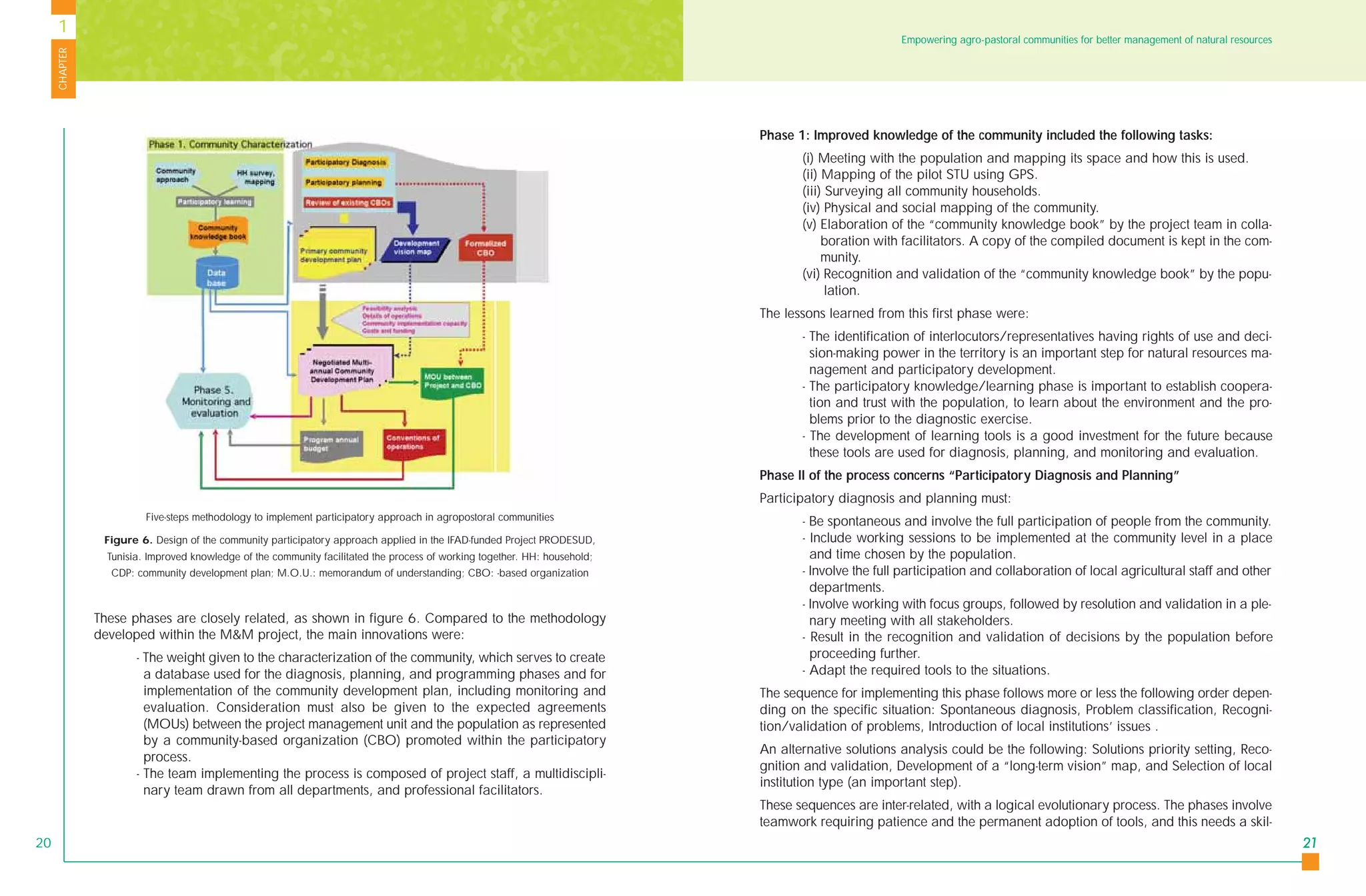
               This was the first occasion where IFAD invested in developing the methodologies and             The methodology included five steps/phases (figure 6):
               tools needed by the project prior to the appraisal. At the request of IFAD, the Tunisian
               M&M team started working after the inception of the project, and the results were used                 - Step/Phase 1. Characterization of the community (knowledge/learning phase).
               for the appraisal and the formulation of the development project.                                      - Step/Phase 2. Participatory diagnosis and planning.
                                                                                                                      - Step/Phase 3. Participatory programming.
               The work consisted of:                                                                                 - Step/Phase 4. Organization of the population.
                      - Identifying and characterizing agro-pastoral communities in the project area.                 - Step/Phase 5. Implementation of a community development plan and monitoring
                      - Developing and validating a participatory methodology and tools using two pilot                 and evaluation plan.
                        communities.
18                                                                                                                                                                                                                         19
1
                                                                                                                                                     Empowering agro-pastoral communities for better management of natural resources

     CHAPTER


                                                                                                                            Phase 1: Improved knowledge of the community included the following tasks:
                                                                                                                                   (i) Meeting with the population and mapping its space and how this is used.
                                                                                                                                   (ii) Mapping of the pilot STU using GPS.
                                                                                                                                   (iii) Surveying all community households.
                                                                                                                                   (iv) Physical and social mapping of the community.
                                                                                                                                   (v) Elaboration of the “community knowledge book” by the project team in colla-
                                                                                                                                        boration with facilitators. A copy of the compiled document is kept in the com-
                                                                                                                                        munity.
                                                                                                                                   (vi) Recognition and validation of the “community knowledge book” by the popu-
                                                                                                                                         lation.
                                                                                                                            The lessons learned from this first phase were:
                                                                                                                                   - The identification of interlocutors/representatives having rights of use and deci-
                                                                                                                                     sion-making power in the territory is an important step for natural resources ma-
                                                                                                                                     nagement and participatory development.
                                                                                                                                   - The participatory knowledge/learning phase is important to establish coopera-
                                                                                                                                     tion and trust with the population, to learn about the environment and the pro-
                                                                                                                                     blems prior to the diagnostic exercise.
                                                                                                                                   - The development of learning tools is a good investment for the future because
                                                                                                                                     these tools are used for diagnosis, planning, and monitoring and evaluation.
                                                                                                                            Phase II of the process concerns “Participatory Diagnosis and Planning”
                                                                                                                            Participatory diagnosis and planning must:
                         Five-steps methodology to implement participatory approach in agropostoral communities                    - Be spontaneous and involve the full participation of people from the community.
                Figure 6. Design of the community participatory approach applied in the IFAD-funded Project PRODESUD,              - Include working sessions to be implemented at the community level in a place
                 Tunisia. Improved knowledge of the community facilitated the process of working together. HH: household;            and time chosen by the population.
                 CDP: community development plan; M.O.U.: memorandum of understanding; CBO: -based organization                    - Involve the full participation and collaboration of local agricultural staff and other
                                                                                                                                     departments.
                                                                                                                                   - Involve working with focus groups, followed by resolution and validation in a ple-
               These phases are closely related, as shown in figure 6. Compared to the methodology                                   nary meeting with all stakeholders.
               developed within the M&M project, the main innovations were:                                                        - Result in the recognition and validation of decisions by the population before
                       - The weight given to the characterization of the community, which serves to create                           proceeding further.
                         a database used for the diagnosis, planning, and programming phases and for                               - Adapt the required tools to the situations.
                         implementation of the community development plan, including monitoring and                         The sequence for implementing this phase follows more or less the following order depen-
                         evaluation. Consideration must also be given to the expected agreements                            ding on the specific situation: Spontaneous diagnosis, Problem classification, Recogni-
                         (MOUs) between the project management unit and the population as represented                       tion/validation of problems, Introduction of local institutions’ issues .
                         by a community-based organization (CBO) promoted within the participatory
                                                                                                                            An alternative solutions analysis could be the following: Solutions priority setting, Reco-
                         process.
                                                                                                                            gnition and validation, Development of a “long-term vision” map, and Selection of local
                       - The team implementing the process is composed of project staff, a multidiscipli-
                                                                                                                            institution type (an important step).
                         nary team drawn from all departments, and professional facilitators.
                                                                                                                            These sequences are inter-related, with a logical evolutionary process. The phases involve
                                                                                                                            teamwork requiring patience and the permanent adoption of tools, and this needs a skil-
20                                                                                                                                                                                                                                     21
1
                                                                                                                                          Empowering agro-pastoral communities for better management of natural resources

     CHAPTER


               led facilitator working closely within a multidisciplinary team.                                  Phase IV. Organization of the population and promotion of the community-based
               The lessons learned from the implementation of the second phase are:                                        organization

                      i. Recognition of the knowledge acquired is an important step prior to diagnosis.          There is no one precise moment at which to introduce and discuss with the population the
                      ii. ”Resource persons” play an important role in analyzing problems and sear-              issue of the community-based organization that will represent the population, because op-
                          ching for solutions.                                                                   portunities and conditions change from one community to another, especially the social
                      iii. The importance of a long term “development vision map” of space manage-               composition of the community. The exercise always starts by screening the current insti-
                           ment, approved by its users (population).                                             tutions acting at the community level, their mandates and attributes. It ends up by identi-
                      iv. How to scale up the activities from pilot activities to cover the total project area   fying the need to establish a democratically elected committee that will be the
                          (Coherence).                                                                           representative of the community. As soon as the population has agreed on the type of ins-
                      v. The planning process is time-consuming, but difficult to avoid (necessary for the       titution it wishes to create and who the members of this unit should be, an official request
                          maturation of sequences).                                                              is submitted to the Governorate for clearance to create “a development association” - a
                      vi. A Development Plan is different from a Plan of Action:                                 GDA (Groupement de Développement Agricole). Once the association is considered of-
                           - A Development Plan is a strategy for a relatively long period of time.              ficial it can start working with the development project and raise funds for the benefit of
                           - A Plan of Action (annual, multi-annual) is a precise tool to mobilize finances      the community from other sources.
                             and implementation facilities (means).                                              Impact examples of the approach of PRODESUD, Tunisia pilot-case
                      vii. Do not underestimate:                                                                 i. Budget allocation
                           - The ability of populations to identify appropriate technical solutions.             In the PRODESUD project in Tunisia, the total project budget has been allocated to two
                           - The ability of populations to emerge with good agreements identified inter-         major components. The first (55% of the total) is dedicated to general infrastructure and
                             nally (issues of property rights and land use).                                     capacity building of the whole region, while the second (45%) is allocated for the local
                           - The ability of the population to negotiate grazing arrangements with neigh-         development of the communities. The activities to be paid for from the first budget com-
                             bors.                                                                               ponent are negotiated with the decision makers (Governor, delegates, Omdas) and tech-
                           - The importance of promoting income-generating activities. Rangeland activi-         nical departments, while the budget of the second component is determined by the
                             ties related to the needs of women and young people are not perceived as            community development plan and is under the control of the elected body (and thus, in-
                             important.                                                                          directly, the end users), which is representative of the community. This is obviously inno-
               Phase III. Participatory programming                                                              vative, because the population, through the participatory process, will determine the
               The primary community development plan includes all the “dreams” of the community, i.e.           activities to be implemented, the amount to be spent, the locations, the beneficiaries, and
               all activities that the community wants to implement over the medium term and long term.          the executing agents. In addition, GDAs are involved in the monitoring and endorsement
               Some of these activities are not realistic, and need to be discussed by the multidisciplinary     of the work implemented. This power given to the community is part of the MOU signed
               team to assess their technical and economic feasibility. Following the feasibility studies,       between the community and the Project Management Unit. An added outcome is that
               and the negotiations with the community, some activities are dropped and the remaining            small businesses are now emerging from with the community. These are the elements of
               ones, together with the development vision map drawn by the community members, consti-            the community charged with implementing some of the activities (soil and water conser-
               tute the multi-annual development plan of the community. The community multi-annual               vation, planting, nurseries, etc.) within their community. The President of the GDA has an
               plan comprises a set of tables indicating the activities to be implemented, their locations,      equal standing with the project director and approves and co-signs with him/her any
               their costs, the source of funding, and the responsibilities of the project and the popula-       agreements related to his community.
               tion. It will represent the appendix of the MOU to be signed by the project management            ii. Local institutions: emergence of GDA (Groupement de Développement Agricole),
               unit, the representatives of the community, and the Governor. This official document gives            community-based organization
               the population the power to monitor the implementation and to become the executing                Three years after the start of the project, the following had been identified:
               agency when it is asked to do so. The other important document produced from the multi-                  - The success of the new participatory methods and local development initiatives
               annual development plan is the program annual budget, which is officially signed by the                    strongly depend on the promotion of grass roots organizations that will take charge
               project management, the population representative, and regional authorities.                               local of development activities. The new process, which has been accepted, is a
                                                                                                                          bottom-up one which brings the priority local needs to the attention of the decision
22                                                                                                                        makers at all levels.                                                                             23
1
                                                                                                                                      Empowering agro-pastoral communities for better management of natural resources

     CHAPTER


                      - For the first time IFAD invested in developing the methodologies and tools needed    the other national teams in the project
                        by a development project prior to the appraisal process. The tools were used for     The impacts of the Mashreq/Maghreb project and the ICARDA collaboration with IFPRI
                        the appraisal and the formulation of the development project.                        and IFAD have been outstanding and there are some areas that merit special mention:
                      - For the first time in an IFAD Development Project a large part (45%) of the total
                        budget was allocated directly to the communities and spent under the control of             1. Institutionalizing these types of research at the NARS level (up-scaling and out-
                        its GDA to implement activities identified within a community development plan.                scaling); the project contributed to furthering the development of this type of re-
                        This is obviously innovative, as the population is identifying the priorities and              search among NARS. Some of the countries have initiated a pilot phase for
                        participating effectively in the implementation and the monitoring.                            institutionalizing the community approach. Algeria is using the approach as
                      - After 3 years, the community development plans of 23 communities have been                     the framework for its land reclamation program and its National Program for
                        established, and their local institutions formalized.                                          Agricultural Development (PNDA). In Jordan, the community approach is being
                      - The GDA of Guermassa has developed partnerships with several stakeholders,                     integrated into the government agricultural strategies for the dry areas. In Tu-
                        donors, and NGOs and, in particular, with GEF/UNDP who granted them                            nisia, the community approach is being used for the development of the IFAD-
                        US$50,000 for their capacity-building activities.                                              funded rangeland project in southeastern Tunisia, and in Morocco, the process
                      - The authority taken by the community is written into the MOU signed between                    of decentralization and the recognition of communities’ rights over their re-
                        the community and the Ministry of Agriculture/Project Management Unit.                         sources provides opportunities for mainstreaming the approach in the dry
                      - The GDA of Guermassa succeeded in developing an agreement with the Ministry                    areas.
                        of Agriculture/PRODESUD Project to rehabilitate 20,000 ha of rangeland.                     2. By contributing to the establishment of an integrated framework for the deve-
                                                                                                                       lopment of the dry areas, the community approach and its different components
                4     CONCLUSIONS                                                                                      brought about changes in the research and development paradigm for the dry
                                                                                                                       areas.
               The aims and advantages of the participatory approach may be summarized as follows:
                                                                                                                    3. Policymakers at the local and national level have come to realize that policy,
                      - Community “awareness development” and the initiation of a democracy exercise.                  technical, and institutional options are not and cannot be dissociated from each
                      - Mutual information and learning, valuing local know-how and enhancing local                    other if they seek to foster successful rural development.
                        initiatives.
                                                                                                                    4. Improved networking and regional integration. The project served as a bridge
                      - Development of a team spirit is vital for the implementation of the process.
                                                                                                                       between communities, government services, and NGOs to promote the deve-
                      - Development of a moral and formal obligation (formal agreement).
                                                                                                                       lopment of the selected communities. National teams worked with their commu-
                      - Reinstatement of decision-making powers to local communities (empowerment).
                                                                                                                       nities to develop proposals and get funding for priority actions. The linkages
               The situation in the WANA region can be briefly characterized by:                                       with new partners provided important social capital that facilitated the imple-
                      -  Little consideration for local know-how.                                                      mentation of the negotiated action plans and the elaboration of community de-
                      -  Various levels of participation, but slow adoption of the processes.                          velopment plans.
                      -  Attention needs to be paid to the risk of “a populist drift”.                       Prospects:
                      -  Difficulties in mastering participatory approach tools, and the need for training
                                                                                                                    - By capitalizing on the experiences of the region, community and participatory
                         and backstopping of national teams.
                                                                                                                      approaches will be better institutionalized.
                       - Poor contribution of social science research.
                                                                                                                    - The need to ease management procedures (budget, human resources develop-
               The community approach is bringing hope as it empowers communities, provides tools
                                                                                                                      ment), and regulation (access to resources), will be understood.
               for addressing household and community livelihood strategies, and promotes the coordi-
                                                                                                                    - Better institutional engagement with local institutions, by embedding representa-
               nation of investment efforts by different stakeholders. A substantial amount of knowledge
                                                                                                                      tives in local and regional organizations, will be achieved.
               has been accumulated from the different communities in the region that will assist in gui-
                                                                                                                    - Decentralization and devolution will be promoted.
               ding future research and development efforts. The coordinated regional approach of the
               project has facilitated an exchange of knowledge and experiences between national
               teams. Individual countries have taken the lead in the development of specific methodo-
               logies, technologies, or institutional options that have then been rapidly transferred to
24                                                                                                                                                                                                                      25
2
                                                                                                               some practical recommendations. The guide contains illustrations of some of the metho-
     CHAPTER

                                                                                                               dological procedures for facilitating the activities.

                    Presentation of the                                                                        The organization of the guide, the description of the outputs expected from the various
                                                                                                               steps, and the illustrations that it contains permit users to easily complete each step or se-
                                                                                                               quence of the process.
                    field manual                                                                               The field manual is built around the results of tests conducted under the actual conditions
                                                                                                               of the project. It is not a compilation of methodological texts developed under different
                                                                                                               conditions. However, it does take into account the accumulated experiences of projects
                                                                                                               undertaken elsewhere. The guide is continuously updated using the field experiences gai-
                                                                                                               ned.
               WHY A FIELD MANUAL?
               A field manual should be simple, flexible, and adaptable. It should have the information
               that clearly explains the methodology to users. For others to replicate the principles of the   STRUCTURE OF THE FIELD MANUAL
               approach, the field manual should do the following:                                             The main steps involved in elaborating the participatory community development plan are
                      - It should describe the methodology, the work sequences, and the tools that will        presented in practical, applied, interdependent steps and sequences. The distribution of
                        be used.                                                                               the steps in the operational sequences is decided on the basis of the importance of the
                      - It should explain how the description can be adapted to a diversity of actors          deployed efforts in each sequence, thus avoiding unnecessary repetition.
                        and environments. The handbook is not a collection of recipes; it should be re-        Based on field experience, the five main steps that could be distinguished in the partici-
                        gularly updated and adapted.                                                           patory process were:
                      - It should be founded on field experiences and tests which are placed within the
                                                                                                                      -   Step   I. Community characterization (learning phase).
                        context of the project. It should not be a compilation of methodological texts de-
                                                                                                                      -   Step   II. Participatory planning.
                        veloped in other environments. The field manual should, however, capitalize on
                                                                                                                      -   Step   III. Promotion of local institutions/community-based organizations.
                        experiences gained elsewhere and adapted to local conditions.
                                                                                                                      -   Step   IV. Participatory programming.
               A field manual is not a static manuscript. It needs regular revision and updating based                -   Step   V. Implementation of the CDP and monitoring and evaluation (M&E).
               on the experiences gained. It is a general, consistent log frame of guiding principles, but
                                                                                                               The progress from one step to another follows a logical sequence, except for the promo-
               it is flexible enough to accommodate creativity.
                                                                                                               tion of local institutions. This can be undertaken according to the local situation. However,
                                                                                                               this should happen before the last step (Step VI: Implementation of the CDP and monito-
                                                                                                               ring and evaluation (M&E)).
               HOW THE FIELD MANUAL WAS DEVELOPED?
               This field manual describes the logic of the various steps that need to be implemented to       The importance of, and the time required for, each step will depend on field conditions
               achieve the goals of community participatory planning. It gives the operational team a          and the team’s experiences.
               high level of flexibility to adapt the procedures to specific local conditions.
               The methodology has been developed by the Tunisian ICARDA/M&M team and targets
               the agro-pastoral communities of arid areas. It has been tested and validated in an IFAD-
               funded project in Tunisia (the PRODESUD project).


               HOW SHOULD THE FIELD MANUAL BE APPLIED?
               The guide is organized in separate methodological sequences for each step of the parti-
               cipatory process. These interdependent sequences specify objectives and identify the im-
               plied principal actors, the methodological description of the sequence, the outputs, and
26                                                                                                                                                                                                              27
2
                                                                                                                                                                                 Presentation of the field manual

     CHAPTER


               THE FACILITATOR: ROLE, ATTITUDE, AND BEHAVIOR                                                  Qualities of a good facilitator
                                                                                                              He/she must be:
               Definition
               A facilitator is someone who stimulates participation in and the interaction of a group and          -   Well prepared and organized.
               skillfully helps it to achieve its objectives. During facilitation working sessions, he/she          -   Careful and patient.
               orients the negotiations toward the task and encourages collaboration.                               -   Realistic, but creative and imaginative.
                                                                                                                    -   Modest without complexes.
               The role of the facilitator                                                                          -   Tolerant, but frank and honest.
               The facilitator’s role is important in facilitating, stimulating, suggesting, and informing.
               More precisely, the facilitator should favor a working environment and conditions that
                                                                                                              Characteristics of the facilitator
                                                                                                                    -   Capable of listening and observing.
               allow the community to:
                                                                                                                    -   Curious and seeking to understand.
                      -   Analyze its economic, cultural, and social situations.                                    -   Open-minded, avoiding judgments or sanctions.
                      -   Think about its own problems.                                                             -   Having self control, being calm and not impulsive.
                      -   Seek information and resources.                                                           -   Willing to spend the time needed and be readily available.
                      -   Manage this information and resources in the right way.                                   -   Willing to live in the working area.
                      -   Take the initiative.                                                                      -   Not arrogant towards community members and stakeholders.
               The facilitator’s work should help the community to find its way towards favorable deve-             -   Avoids imposing his/her opinion.
               lopment transformations.                                                                       How to manage difficult situations?
               How to set good working conditions?                                                                  - The facilitator should not allow more vocal participants to monopolize the discus-
               The facilitator should always keep in mind the following:                                              sions. He/she should thank them for their interventions and explain to them that
                                                                                                                      other participants should be given the opportunity to express their opinions.
                      -   How to approach the target group.
                                                                                                                    - It is necessary to value influential people in the group. Generally, older people
                      -   The content of the discussion.
                                                                                                                      are highly respected by the population, thus the facilitator should involve them
                      -   How to adapt tools and techniques to efficiently reach results.
                                                                                                                      in the discussions and the decision-making and he/she should never undervalue
                      -   Identifying means and methods to assess the achievements.
                                                                                                                      them. Their contributions can be very important for the organization of the wor-
               For a successful facilitation the following aspects should be considered:                              king sessions and for setting discipline within the group. Discussing certain issues
                      - It is easy for a well-prepared facilitator, who knows the target population/com-              with them will help to overcome some difficult situations.
                        munity, understands their concerns, and adopts a simple and serious attitude, to            - The facilitator has to avoid making enemies in the group. People under stress al-
                        facilitate the contact and to approach the target group.                                      ways try to divert the discussion into different channels. The facilitator should lis-
                      - The facilitator should prepare the contents of the discussion in advance. These               ten to them and tactfully bring them back to the subject under discussion.
                        contents include the elements of the participatory process, the objectives of the           - Officials, policy makers, and farmers-union representatives should be treated like
                        development plan, and the steps reached in earlier meetings. He should keep in                other participants. When they redirect the discussion they should be brought
                        mind the time constraints and the working calendar in which to achieve results.               back politely and discreetly to the subject.
                      - The techniques and tools to be used should be always accompanied with visua-                - Working place. The participants should choose a congenial place in which to
                        lizations. A flexible and participatory approach, which makes the group respon-               work. The place should not be exposed to the elements. It must be spacious and
                        sible and encourages them to contribute, is essential for success.                            allow for all to see and be seen. It should not be a place which excludes or limits
                      - The evaluation of the impact of the work implemented could be made through di-                the participation of some groups or individuals.
                        rect or indirect welltargeted questions directed to the participants. These ques-           - Respecting time. Good time management is required, but some flexibility is ne-
                        tions should be prepared in advance according to the subjects being debated.                  cessary when the participants become involved in some unforeseen discussion.
                        Two to three questions are sufficient. However, other questions related to the sa-          - Ask the group’s permission before taking photographs. Be pleasant, respect local
                        tisfaction, comprehension, usefulness, and enthusiasm of the group can be ad-                 traditions, and avoid upsetting the participants. Use the opportunity to learn more
                        dressed during the process.                                                                   about the community.
28                                                                                                                                                                                                                  29
2
                                                                                                                                                                                    Presentation of the field manual

     CHAPTER


               Facilitator skills cannot be learned from books or theoretical training courses only, they       Team size
               need to be acquired through practice.                                                            The size of the team will depend on the importance of the target community and the plan-
                                                                                                                ned methodological sequences. There is no general rule, and the number usually varies
                                                                                                                as the different principal actors involved at each level of each step and methodological
               SUBJECT MATTER SPECIALISTS (SMSs) AND                                                            sequence join and leave the group.
               MULTIDISCIPLINARY TEAMS
               The participatory process necessitates the intervention of the facilitator, project team, sub-
                                                                                                                Team composition
               ject matter specialists (SMSs) of the development agency (DA), and other concerned ope-
                                                                                                                The composition of the team depends on the competences and experiences of the spe-
               rators. This is particularly true for development projects. The success of the participatory
                                                                                                                cialists in charge of the task, and their availability. These specialists can belong to the
               process requires that teamwork evolves from multidisciplinary to interdisciplinary.
                                                                                                                local administration or be local consultants. The ideal team member would have the fol-
               Learning the participatory process implies that the subject matter specialists should not        lowing qualifications:
               focus on their own specialties, but have open minds and consider the other disciplines
                                                                                                                       - Know well the appropriate techniques for mobilizing the community, working in
               brought into the group. The integration of the team of subject matter specialists in a net-
                                                                                                                         groups, conducting participatory rural appraisal (PRA), gender analysis, poverty
               work is another prerequisite for the success of the participatory process.
                                                                                                                         analysis, means of subsistence analysis, and research methods.
               The subject matter specialists’ teamwork leads to a substantial change in the identification            - Be skilful in agricultural issues (e.g. extension, loans, marketing), sociology, com-
               of the technical solutions to the community’s needs and the development issues in both the                munity development, sustainable natural resource management in harsh areas,
               short and medium terms. Traditional technical solutions imposed on farmers are substituted                and in monitoring and evaluation.
               by solutions resulting from a dialogue and negotiation, where farmers are considered as                 - Have a good knowledge of local languages and be able to deal easily with the
               full partners. The participatory process, on the one hand, allows the team of subject                     community.
               matter specialists and the multidisciplinary team to observe/understand the technical
                                                                                                                The team should include both men and women.
               creativity of the community and, on the other hand, to create the appropriate space for
               negotiation and for conflict resolution. The objective is to achieve understanding between
               the technicians’ rationality and the community’s local knowledge in order to identify rea-
               listic and sustainable technical solutions.
                                                                                                                PRACTICAL RECOMMENDATIONS FOR THE PREPARATION
               Facilitation and negotiation are essential tasks that the subject matter specialists should      OF THE COMMUNITY DEVELOPMENT PLAN
               instigate and practice to ensure the success of the participatory process. Moreover, use         The stimulation of adults is a delicate task that requires technical, psychological, and ma-
               of the technical tools that maximize interaction and communication with the community            terial preparation. The facilitator should be prepared in advance and develop some rules
               is absolutely necessary for accomplishing this task. There are at least three key matters        in order to succeed in his/her work.
               that facilitate the management of the participatory process:                                     Establishment of field activities time frame
                       - The subject matter specialists and the multidisciplinary team should work with the     The choice of the time for implementing field activities, whether these are related to a sea-
                         community and its representatives, during community characterization, data ga-         son, hour, or day, is very important for the success of such activities. Although rural com-
                         thering, analysis, problem identification, prioritization, and the development of      munities are very busy throughout the year, there are periods when they are less occupied
                         possible solutions.                                                                    (for example after harvest). Also, access to the community is influenced by the regularity
                       - Subject matter specialists should never work in isolation, but for and with the        of the agricultural work and the domestic activities. For example, farmers are busy early
                         multidisciplinary team.                                                                in the morning; herders take out their animals to graze later in the morning, while women
                       - Interaction, sharing and validating the results of each sequence with and by the       are usually busy preparing meals. Thus, the participation of a specific group from the com-
                         community are prerequisites                                                            munity in a meeting will depend on the time selected for the meeting.
               for a successful preparation of the participatory development plan, and its implementation.      Events such as market days, public holidays, public festivals, and election campaigns
                                                                                                                should be taken into consideration when setting field work schedules.


30                                                                                                                                                                                                                     31
2
                                                                                                                                                                                  Presentation of the field manual

     CHAPTER


               Organization of the teamwork                                                                    The project team should do the following after each facilitation
               Prior to the fieldwork, the team leader needs to allocate activities to each team member.       session:
               Examples include:                                                                                      - Have the participants complete a self-evaluation for each session which points
                       -   The team leader and facilitator.                                                             out its strengths and weaknesses.
                       -   Team members in charge of developing contacts with the community.                          - Check if meeting objectives were achieved and identify any gaps.
                       -   The coordinator of data collection and analysis.                                           - If necessary, organize the information collected (data, problems, solutions, etc.)
                       -   The meeting coordinator.                                                                     with regard to the tools and check that it is complete.
                       -   Team members in charge of reporting.                                                       - Format the collected data and information.
                                                                                                                      - Adapt, according to the results achieved, the agenda of the next session.
               Preparing fieldwork                                                                                    - Decide on the division of the tasks for the next step.
               At least one day before starting fieldwork, the team needs to review the program, the ob-              - Start preparing the necessary materials for the coming session.
               jectives of the day, the task distribution between the project team and the other partners,
               and ensure that the team members understand their roles.                                        The preparation and the organization of the facilitation task, and the coordination bet-
                                                                                                               ween the members of the multidisciplinary team, are two fundamental elements. Expe-
               Facilitation support materials, prepared by the project team in collaboration with the sub-     rience from the field has shown that good preparation and the effective distribution of
               ject matter specialists for the development project and possibly other partners, will be re-    tasks among the team members has a great impact on the quality of outputs and the
               examined and modified before validation for use. It is very important to review the             timely implementation of the program of work.
               contents and the objectives of the support materials that will be used before the meeting.
               These facilitation support materials and tools are subject to continuous improvement,
               based on experience and evaluation.
                                                                                                               NECESSARY EQUIPMENT AND SUPPL IES FOR
               The facilitator remains the principal actor who controls this process with the support of the
               other project team members.
                                                                                                               FACILITATION SESSIONS
                                                                                                               For the facilitator to achieve successful facilitation sessions with the community, he/she
               During the facilitation, the facilitator has to:                                                should have the necessary materials and equipment ready for each session.
                       - Introduce team members.                                                               Basic materials and supplies needed
                       - Present the objectives and the agenda of the day.                                            - Display boards. Sufficient numbers should be available. They should be easy to
                       - Precisely describe the objectives of the sequence.                                             handle and to transport. The use of these boards is known as the “Meta plan”
                       - Explain the steps and tools.                                                                   method. The boards must be firmly fixed to resist winds. They are generally co-
                       - Follow the agreed agenda.                                                                      vered with Kraft paper to facilitate sticking hard-bound cards to them.
                       - Assign a member of the community to make a summary at the end of the day.                    - Hard-bound cards. Cards of various colors, dimensions, and shapes (20 cm/10
                       - Agree on the date and the place of the next meeting where appropriate.                         cm). Should be available in sufficient numbers, with around 100 cards per color.
               Practical remarks                                                                                        Try to assign a color to a topic and the shape to the topic structure.
                       - Pay attention to the participation of the different societal groups (men, women,             - Felt pens. Used to write on cards or flip charts, these should be of various colors,
                         young people).                                                                                 with different sized tips to permit various widths of writing.
                       - After the use of each tool or instrument, review it with the participants to ensure          - Pins. Used to fix items to display boards. They are of various types so choose the
                         they understand it and make adjustments if necessary.                                          most practical ones
                       - Allow the local institutions an active role.                                                 - those which can be most easily fixed. If pins are not available, they can be re-
                       - When working with mixed groups (men and women) do not forget to regularly                      placed by sticky tape (Scotch tape).
                         stimulate and guide the participation of the women. If men and women are wor-                - Flip-charts board. The board is small (1.80 m) with a tripod stand. Large sheets
                         king in separate groups, make a common synthesis when the two groups meet                      of paper (A0) are attached to the board and used to take notes or to present
                         together.                                                                                      work prepared in advance. The board is adjustable in height and slope. When
                       - When work is conducted in separate focus groups, the results of each group                     working outdoors, it is necessary to think of ways to firmly fix the paper to the
                         should be presented and discussed with the other groups.                                       board, especially on windy days.
32                                                                                                                                                                                                                   33
2
                                                                                                                 Presentation of the field manual

     CHAPTER


                      - Facilitation support tools. It is good educational practice to use figures, photo-
                        graphs, images, and illustrations to represent an object, an activity, an animal,
                        or an unspecified situation to help participants fix the concept in their memories.
                        They are particularly necessary when working with people who are illiterate.
                        The use of topographic charts, aerial photographs or charts produced by the
                        community, facilitate the comprehension, localization, and orientation of the par-
                        ticipants.
                      - Small supplies for the facilitator. It is necessary to have a diary, supporting do-
                        cuments, a memo pad, personal notes, known proverbs, a small lexicon of the
                        words in Arabic and their local use, sticky tape, adhesive, scissors, pencils, gum,
                        ruler, flip-charts, and a stapler. With experience the facilitator will accumulate the
                        necessary materials to run effective working sessions.
               Other optional materials and supplies
                      -   Camera, preferably digital.
                      -   Video camera.
                      -   Photo album of the community.
                      -   Slide projector.
                      -   Overhead projector/Data show.
                      -   Examples of the tables required for data collection and organization.
               Tool box for participatory diagnosis
               The tool box contains all the tools that are used for the collection or/and analysis of in-
               formation, which are generally similar to the tools used in the rapid participatory research
               method. For example, cards for the semi-structured meetings, diagrams, and base maps.
               Other tools produced by one community can be selected and used in other communities.


34                                                                                                                                                  35
3                                                                                                                        Table 2. Methodological sequences of Step I: Community characterization

                   Description of the steps and
     CHAPTER


                                                                                                             Prerequisite/Input               Methodological sequence               Products/output
                                                                                                                                                                                    - Basic maps with a scale 1:50,000

                   methodological sequences for the                                                          -
                                                                                                             -
                                                                                                             -
                                                                                                                 Facilitator
                                                                                                                 Development agency (DA)
                                                                                                                 Available literature
                                                                                                                                              Preliminary tasks
                                                                                                                                                                                    - List of households, based on former
                                                                                                                                                                                      surveys
                                                                                                                                                                                    - Identification of the surveyors
                                                                                                             -   Former surveys                                                     - Other available information

                   community development plan                                                                - Facilitator
                                                                                                             - Resource persons
                                                                                                                                                                                      sources


                                                                                                                                                                                    - Important landmarks in the com-
                                                                                                             - Technicians who know the
                                                                                                                                              Exploratory visit                       munity
                                                                                                               area (Staff of DA)
                                                                                                                                                                                    - Local toponymic districts (TD)
                                                                                                             - Basic map of the site, com-
               During Step I, we collect and organize data that will establish a good knowledge base           pass, GPS
               to help the community to identify appropriate solutions to their problems. These data can     - Facilitator
                                                                                                             - Coordinator of the Develop-
               also be used to create a permanent database (on village base maps, of households, agri-         ment Project                                                         - Agreement with the community on
               culture, and community diagnosis data), that will serve as a baseline during the project      - Subject matter specialists     Introduction of the project to          working principles
                                                                                                               (SMS)                          the community                         - Organization of the following ses-
               period for monitoring and evaluation purposes.                                                - Resource persons                                                       sions
                                                                                                             - Local authorities
               This step, which deals with local knowledge, will provide an opportunity for the project      - Community members
               team to become known by the community and to build their confidence in the team. The
                                                                                                             - Community members,
               community members will have full participation in the local knowledge process; in fact                                         Development of community map by - Community map with boundaries
                                                                                                             - Facilitator
                                                                                                                                              population                        and toponymic districts
               they should feel that they are teaching the team.                                             - Basic maps
                                                                                                             - Field visit                    GPS plotting of community and         - Geo-referenced boundaries of the
               The implementation of this step requires careful preparation and organization with an im-     - Resource persons/Facilitator   toponymic districts boundaries        community and toponymic districts
               portant investment in analysis, synthesis, and fine-tuning of the collected data.
                                                                                                             - Field visit
                                                                                                                                              Informal surveys and description of   - Description and typology of topo-
                                                                                                             - Facilitator
                                                                                                                                              the production systems                  nymic districts
                                                                                                             - Community members
               OUTPUTS OF THE FIRST STEP                                                                     -   Survey questionnaire
                                                                                                             -   Surveyors                    Survey of social, land tenure
                      - For the population: The population understands and becomes aware of the              -   Development agency           systems and uses
                                                                                                                                                                                    - Number of surveyed households
                        content of the first step.                                                           -   Facilitator

               The community participants understand and are prepared for the field visit.                   -   Access, MapInfo (software)
                                                                                                                                                                                    - Social and land tenure systems
                                                                                                             -   Data entry persons
                                                                                                                                              Entry of survey and GPS data            database
                      - For the project management: The "Community Knowledge Book” that will be de-          -   Facilitator
                                                                                                                                                                                    - Maps database
                                                                                                             -   Resource persons
                        veloped in this step will serve as the basis for both the diagnosis and the parti-
                                                                                                             - Structured database                                                  - Tables of results
                        cipatory programming steps. The knowledge book constitutes the baseline              - Facilitator                    Data analysis                         - Thematic maps
                        reference for the community before the project interventions.                        - Resource persons                                                     - Community identity file
                      - For the multidisciplinary team: The team becomes known by the local population,      - Database                       Development of the community
                                                                                                                                                                                    - Knowledge book
                        has a good knowledge about the community from the information provided by            - Facilitator                    “knowledge book”
                        the community members, and mutual confidence is built between the project team       -   Thematic maps and tables
                                                                                                             -   DA                           Validation of the knowledge book
                        and the community. As a result, the team is ready to start the diagnosis and the     -   Community members            by the community
                                                                                                                                                                                    - Validated knowledge book
                        participatory programming steps.                                                     -   Facilitator

               The methodological sequence of Step I, with the required inputs and expected outputs, is
               presented in table 2.


36                                                                                                                                                                                                                          37
3
                                                                                                                                       Description of the steps and methodological sequences for the community development plan

     CHAPTER
                                                                                                                                                                 STEP I: COMMUNITY CHARACTERIZATION (LEARNING PHASE)


               STEP I: COMMUNITY CHARACTERIZATION (LEARNING PHASE)                                               STEP I: COMMUNITY CHARACTERIZATION (LEARNING PHASE)
                        Sequence 1. Preparatory tasks                                                                     Sequence 2. Exploratory visit to the community
               Objective                                                                                         Objective
               The objective of this sequence is to allow the project team to acquire an overall know-           The exploratory visit is the first contact with the community environment. Its aim is to fa-
               ledge of the community and to set appropriate conditions for launching the participatory          miliarize the project team with community characteristics.
               process.                                                                                          Actors
               Actors                                                                                                     - Project team.
                        -   Development agencies (DAs).                                                                   - Technicians and resource persons who know the area, including the head of
                        -   Facilitator.                                                                                    local extension services (ES) in the area, SMS, and technical staff having good
                        -   Project coordinator.                                                                            knowledge of the community.
                        -   Subject matter specialists (SMSs).                                                            - Small number of key community members, such as the Mukhtar/Sheikh/Omda,
                        -   Local authorities.                                                                              and the head of the farmers’ union in the area, who are respected by the com-
               Tools                                                                                                        munity members.

                        - Available literature.                                                                  Tools
                        - Available formal surveys.                                                                       -   Official base map of the community.
                        - Community maps.                                                                                 -   Aerial photos if available.
               Description                                                                                                -   Measuring instruments, compass, GPS.
                                                                                                                          -   Camera.
                        - The project team (coordinators, facilitator, and SMSs) collects available informa-              -   Four-wheel drive vehicle.
                          tion related to the community. Then the team organizes and synthesizes this in-
                          formation in order to familiarize themselves with the community. This preliminary      Description
                          knowledge will facilitate the introduction of the project team to the community                 - The facilitator starts by sharing with the group the official base map and identi-
                          and should ease the team’s contact with the population and help the start of the                  fying locations and landmarks known by the people. He/she makes sure that all
                          participatory process.                                                                            the participants in the group understand the map and recognize the key informa-
                        - The project team should make an exploratory visit that will give them an overview                 tion regarding the community.
                          of the community.                                                                               - Then the group crosses the community area following a transect and stops whe-
                        - The project coordinator establishes the necessary contacts with local actors (tribal              never important changes occur. The changes include those in topography or
                          heads, community leaders, local authorities, and resource persons) to inform                      when encountering important landmarks, such as rivers, water points, mosques,
                          them about the project and prepare them for the participatory process.                            etc. At each stop, the group collects information on the site’s main characteristics,
               Outputs                                                                                                      history, and use. Whenever possible a photograph is taken for illustration.
                                                                                                                          - The exercise will allow the team to become familiar with the names of local dis-
                        - Synthesis documents, including maps, aerial photos, etc., reporting crucial infor-                tricts (toponymic districts), have an idea about the land use, and generates a
                          mation on the area and the community.                                                             first set of photos illustrating the community area that will be used during the de-
                        - Agreement with the community on the date and location of the first meeting.                       livery of the knowledge book to the community. It will also facilitate the develop-
               Comments & tips                                                                                              ment of the mental map.
               The introductory role played by the coordinator of the project at the start of the process        Outputs
               is vital. His/her early intervention in the process will allow him to realize the importance               - First contact with the site and identification of some important landmarks of the
               and the volume of work needed to be achieved, which will help him/her in planning and                        community map.
               facilitating the work of the team.

38                                                                                                                                                                                                                                39
3
                                                                                                                        Description of the steps and methodological sequences for the community development plan

     CHAPTER
                                                                                                                                                  STEP I: COMMUNITY CHARACTERIZATION (LEARNING PHASE)


               Comments & tips                                                                   STEP I: COMMUNITY CHARACTERIZATION (LEARNING PHASE)
                     - Avoid making this first visit a formal one.                                        Sequence 3. Introducing the project to the community
                     - Limit the number of participants to a small group.                        Objective of the sequence
                     - Let knowledgeable persons express themselves and show how they know the   The objectives of this sequence are to reach mutual agreement with the population regar-
                       community.                                                                ding their commitment toward the project objectives and results, as well as its implemen-
                                                                                                 tation through a participatory process.
                                                                                                 Actors
                                                                                                          -   Development agency(ies) (DA).
                                                                                                          -   Project coordinator.
                                                                                                          -   Facilitator.
                                                                                                          -   Subject matter specialists (SMSs).
                                                                                                          -   Resource persons.
                                                                                                          -   Local authorities.
                                                                                                          -   Community members.
                                                                                                 Tools
                                                                                                 The success of this introductory meeting depends on the attention paid to its preparation:
                                                                                                          - The meeting date, hour, and place should be agreed upon in advance with the
                                                                                                            community.
                                                                                                          - A comprehensive description of the project prepared in the local language on a
                                                                                                            flipchart (A0).
                                                                                                          - A clear presentation showing the different sequences of the work to be done.
                                                                                                          - A base map of the community, A0 size, showing the boundaries of the commu-
                                                                                                            nity with adjacent communities.
                                                                                                          - Knowledgeable persons who have participated in the process.
                                                                                                 Description
                                                                                                          - This is the first contact with the community. The first objective is to explain to them
                                                                                                            the philosophy of the project and the methodology of work, while stressing the
                                                                                                            importance of their active and voluntary involvement. The second objective of this
                                                                                                            sequence is to establish a favorable working environment based on mutual confi-
                                                                                                            dence between the population and the project team. This sequence is very im-
                                                                                                            portant for the progress that needs to be made in the following steps. During this
                                                                                                            session, the participants will validate the external boundaries of the community
                                                                                                            and agree on the social, economic, and land tenure survey (figure 7).
                                                                                                          - The session starts with a welcome statement by a member of the community (lea-
                                                                                                            der). Then the coordinator of the project presents his team and subject matter spe-
                                                                                                            cialists, and outlines the project using the flipcharts prepared for this purpose
                                                                                                            (figure 8).


40                                                                                                                                                                                                                 41
3
                                                                                                                                 Description of the steps and methodological sequences for the community development plan

     CHAPTER
                                                                                                                                                           STEP I: COMMUNITY CHARACTERIZATION (LEARNING PHASE)


                     - The facilitator will take over and present the working methodology and the dif-
                       ferent sequences of the participatory process. He emphasizes the importance of
                       the contribution of the community during the whole process. In this regard, the
                       community should be prepared to work in groups, including women and youths.
                     - After reaching an agreement with the community on their cooperation and col-
                       laboration, the project coordinator announces the launching of the process and,
                       with the population, establishes the date, hour, and place of the next meeting.
               Outputs
                     - Moral agreement with the community to collaborate with the project to build up
                       a community development plan.
                     - Work agenda set with the community.
                                                                                                           Figure 8. Example of flip charts presenting the project objectives, components and eventually funds available.
               Comments & tips
                     - Prepare for this meeting extremely carefully and make sure to have representa-
                       tives of the different localities and suburbs of the community.
                     - Do not be in a hurry, be patient and listen to the population, answer their ques-
                       tions, and provide clarifications.
                     - Give the population a reasonable time to understand the project and its app-
                       roaches.


                                                          The meeting date, hour, and place
                                                          should be agreed upon in advance
                                                          with the community.
                                                          This is a rule for all meetings
                                                          with the community.


                                                          Raising awareness among the
                                                          people and introduction of the
                                                          project by its coordinator.
                                                          Subject matter specialists,
                                                          facilitators, decision makers and
                                                          other stakeholders, and the
                                                          largest number of community
                                                          members are encouraged to
                                                          attend this first meeting.

                                 Figure 7. Sequence 1/ Introducing the project to the community
42                                                                                                                                                                                                                          43
3
                                                                                                                             Description of the steps and methodological sequences for the community development plan

     CHAPTER
                                                                                                                                                       STEP I: COMMUNITY CHARACTERIZATION (LEARNING PHASE)


               STEP I: COMMUNITY CHARACTERIZATION (LEARNING PHASE)                                               the toponymic districts. It is also appropriate to specify the necessary level of spa-
                        Sequence 4. Development of community map by                                              tial analysis of the community in order to avoid overloading the map with a large
                                                                                                                 number of unnecessary names. It is also possible to cluster small adjacent zones
                                    population (mental map)
                                                                                                                 with similar features in one toponymic district. Once the comprehensive list of the
               Objective of the sequence
                                                                                                                 toponymic districts is established, the subdivisions will be drawn on the community
               The objective of this sequence is the validation of the external boundaries of the commu-         map.
               nity and the drawing of the toponymic districts.                                                  - It is essential that the resource persons understand the community map. Often,
               Actors                                                                                              the conventional nomenclature of cartography (North, South, East and West) is
                                                                                                                   not understood by local people, rather people are inspired by their daily prac-
                        - Facilitator.                                                                             tices to identify areas, such as the prayer direction, "Guebla" (South East), which
                        - Resource persons.                                                                        is the opposite of the "Guarb" or (North West). Thus, the facilitator should use
                        - Population.                                                                              these local spatial terminologies instead of the formal ones.
               Tools                                                                                             - The boundaries of the toponymic districts should be based on geo-morphologic
                        - Community base map with reference points (hydraulic network, water points,               references, such as rivers, hills, mountains, water sharing lines, etc. The facilitator
                          roads, etc.).                                                                            should have good knowledge of the community area (acquired during the explo-
                        - Official map at a scale relevant to the size of the community (1:50,000).                ratory visit, see first sequence) before starting this exercise.
                        - Felt pens of different colors and large-format paper.                                  - Finally, the toponymic districts are reported on the community map. This descrip-
                                                                                                                   tive sheet of toponymic districts contains the following columns:
               Description                                                                                       - Number of the toponymic district.
                        - Mental map showing toponymic districts is perceived by the population as the           - Name of toponymic district.
                          community area. This map is an important tool in the participatory process. It per-    - Type of land use, cereals, collective rangeland, fruit trees, irrigated vegetables,
                          mits a common understanding of the area, constitutes an interface of communi-            and so on.
                          cation and information support, and helps to draft the long-term development           - Tribes and families using the toponymic districts.
                          vision map.                                                                            - Main soil types, with indication of their relative importance and locations if there
                        - The map of the toponymic districts is developed by a small group (maximum 10             are several dominant soil types. This information is completed by observations
                          people), having a good knowledge of the community area (figures 9 to 12).                made during the field survey.
                        - The work starts with the presentation of the different community maps, which           - Main vegetation types of the toponymic districts; with indication of their relative
                          were established by the support team. A local resource person will present these         importance and locations if there are several dominant types of vegetation. This
                          to the community. The team should try to use an official map at a scale relevant         information is completed using observations made during the transect survey.
                          to the size of the community so that participants can easily identify their area       - Environmental condition of the toponymic district: Establish a scale for the envi-
                          based on salient landmarks, such as villages, water points, mountains, roads             ronmental condition, starting from the best condition (sustainable and balanced
                          and rivers/wadis. The facilitator invites a resource                                     ecosystem) to the worst (degraded with a tendency to desertification).
                        person to help draw the boundaries of the community on the base map. In case
                        of conflicts, the facilitator has to review these boundaries with the resource persons
                        from neighboring communities.
                        - After the validation of the community boundaries, the participants start the spatial
                          analysis inside the community. The facilitator starts an informal investigation re-
                          lated to the types of resources and the overall characterization of the area (ran-
                          geland, cereal crops, fruit trees, collective rangeland zones, etc). This task
                          stimulates the resource persons to cite local names for the micro-zones as seen
                          by people, the so-called toponymic districts.
                        - At this level, it is important to have a common understanding of the concept of
44                                                                                                                                                                                                                      45
3
                                                                                                               Description of the steps and methodological sequences for the community development plan

     CHAPTER
                                                                                                                                         STEP I: COMMUNITY CHARACTERIZATION (LEARNING PHASE)


                     - The results of this community area mapping work should be put into shape and
                       then presented to the community for validation. After adjustments suggested by
                       the people, the mental map of the community is validated. The list of toponymic                                   Figure 11. Validation of the
                       districts will then serve as a key element for the survey questionnaire related to                                mental map by communit members is
                       social and economic conditions and land tenure.                                                                   an important step prior to launch the
               Outputs                                                                                                                   GPS work (Tataouine community,
                                                                                                                                         Tunisia)
                     - A validated manuscript of the community mental map, clearly indicating the
                       boundaries of the community and the toponymic districts.
                     - Validated list of the toponymic districts.
               Comments & tips
                     - The facilitator should listen carefully to local resource persons during the recogni-
                       tion of the mental map, and if necessary he has to help them, sketching on the
                       ground a model in order to assist them to convey their message.                                                   Figure 12. Modern tools may
                     - The people will try to predict the activities of the project and tend to mention as                               help to better visualize the
                       many micro-zones (toponymic districts) as possible. The facilitator should be                                     mental map and toponymic
                       aware of this and avoid such a possible shift.                                                                    districts (El Eais community,
                     - During this session, the project team conducts an informal survey that will provide                               Jordan)
                       information on the land status and social structure of the community. During the
                       discussions some community members could monopolize the discussion; it is im-
                       portant that the facilitator find ways to involve other participants.


                                                       Figure 9. Participatory drawing of
                                                       the community map as perceived by
                                                       the people (mental map)- Elders play
                                                       an important role during this exercise
                                                       (Ouled Chéhida community,
                                                       Tataouine, Tunisia)


                                                       Figure 10. Farmers and herders
                                                       discussing the location of toponymic
                                                       districts (TD) of El Eas community in
                                                       Jordan.


46                                                                                                                                                                                                        47
3
                                                                                                                                    Description of the steps and methodological sequences for the community development plan

     CHAPTER
                                                                                                                                                              STEP I: COMMUNITY CHARACTERIZATION (LEARNING PHASE)


               STEP I: COMMUNITY CHARACTERIZATION (LEARNING PHASE)                                                Outputs
                        Sequence 5. Delineation of the community and                                                    - List of recorded GPS points with their metric coordinates. These points will be
                                    toponymic districts boundaries using GPS                                              used to draw the boundaries of the community area and the toponymic districts
               Objectives of the sequence                                                                                 through the use of MapInfo or other geographic information system (GIS) soft-
                                                                                                                          ware.
               Draw community boundaries and toponymic districts and collect the necessary informa-
               tion to characterize the area using GPS.                                                           Comments & tips
               Actors                                                                                                   - The coordinates of inaccessible points can be read from the official geo-referen-
                        - Resource persons (2 or 3).                                                                      ced maps. Finding the coordinates of the required point can be obtained by the
                        - Facilitator.                                                                                    use of both the official maps and the nearest points recorded by the GPS (dis-
                                                                                                                          tance and orientation).
               Tools                                                                                                    - It is easier to record GPS points in UTM (Universal Transverse Mercator) rather
                        -   Global positioning system (GPS).                                                              than in degrees since these coordinates will be recorded in MapInfo in metric
                        -   Compass.                                                                                      units.
                        -   Block notes, pens.                                                                          - Do not forget to adjust the GPS for the UTM projection which is relevant to the
                        -   Mental map (result of the previous sequence).                                                 country you are in.
                        -   Official maps (with a scale appropriate to the size of the community area).                 - In case of prolonged delays, it is recommended that the GPS is turned off to save
                        -   Four-wheel drive vehicle.                                                                     its batteries. It is strongly recommended that the batteries be checked before star-
                        -   PC with appropriate software (Excel, MapInfo, etc.).                                          ting any fieldwork.
               Description
                        - Based on the mental map, which was drawn during the previous sequence, the
                        itinerary of the field visit is prepared.
                        - To improve work efficiency, it is recommended to start recording the accessible
                          points. Then, with the help of the navigation functions of the GPS (distance and
                          orientation in relation to an earlier recorded point), other points can be recorded.
                        - The minimum required number of points for drawing the boundaries of a district
                          is a function of its geometric shape; however, it is necessary to record a point
                          whenever there is a change of direction. The subdivision of the community area
                          into toponymic districts is often accompanied with a change in soil structure,
                          plant cover, composition, and/or ground geomorphology. This local zoning
                          shows the relationship between the population and its territory. The natural boun-
                          daries, such as hills and water courses, often constitute the limits of the toponymic
                          districts.
                        - The recoding of any point is based on the indicators provided by the local re-
                          source persons. It is recommended that a local resource person is trained on
                          how to read the GPS and understands how it works (a Global Positioning System
                          (GPS) is a tool that permits locating the position of any point through a triangu-
                          lation using at least three satellites).
                        - Each GPS point should be recorded on paper with a chronological number and
                          metric coordinates (x,y) as well as indications of soil, native vegetation, and any
                          other useful information that can be used to characterize the toponymic district.
                        - The transect line permits evaluation of the progress of the work being conducted
                          and enables a program of field visits for the coming days to be set.
48                                                                                                                                                                                                                             49
3
                                                                                                                                     Description of the steps and methodological sequences for the community development plan

     CHAPTER
                                                                                                                                                               STEP I: COMMUNITY CHARACTERIZATION (LEARNING PHASE)


               STEP I: COMMUNITY CHARACTERIZATION (LEARNING PHASE)                                                       - Each investigator should have a copy of the validated documents which will per-
                        Sequence 6. Informal survey and description of the                                                 mit him/her to check the answers of the individuals surveyed. In normal situa-
                                                                                                                           tions, the survey takes between 20 and 30 minutes, making it possible for each
                                    production system
                                                                                                                           surveyor to conduct an average of 20 interviews per day. The group of surveyors
               Objectives of the sequence
                                                                                                                           will be under the supervision of a responsible facilitator who organizes their dis-
               Implement an extensive survey of social and economic conditions and land tenure systems                     tribution to different locations and verifies their progress. The facilitator will mo-
               of the community households, and verify the reliability of the collected information.                       nitor the work and progress and make suggestions for improving the
               Actors                                                                                                      performance of the surveyors.
                        - Community and resource persons.                                                          Outputs
                        - Surveyors and facilitator.                                                                     - Survey questionnaire filled out for all households of the community.
               Tools                                                                                               Comments & tips
                        - Survey questionnaire (annex 1).                                                                - The survey must start after the validation of the toponymic districts’ map by the
                        - List of the community households, corrected and validated by the local authori-                  community.
                          ties.                                                                                          - The survey will not take place unless the population has understood the objectives
                        - List of the community villages (main and secondary residences).                                  of the project and the importance of the survey.
                        - List of the toponymic districts (code, name, and area).                                        - The support of local authorities and other population leaders for mobilizing the
                        - Map of the toponymic districts.                                                                  population is very important to the success of the survey.
                        - List of the tribes, sub-tribes, and families in the community.                                 - All surveyors should use the same local terms when translating the survey ques-
                        - List of the wells.                                                                               tionnaire. It is recommended a translation into the local language/dialect be
               Description                                                                                                 made.
                        - It is important to note that the social conditions and land status survey is different
                          from the “classical surveys” of the statistics department. It is an integral part of
                          the participatory process. The results of this survey will serve the population in
                          the planning and programming steps. This detail, which must be explained to the
                          population during the test of the survey questionnaire, can help improve their
                          active and voluntary involvement in the process.
                        - Survey files (the amended version of the survey which incorporates the sugges-
                          tions of the people and the community specifications).
                        - It is during this sequence that the starting of the social and land tenure/property
                          right systems survey is announced to the population. The investigation starts with
                          those households that are present in the meeting. This test of the questionnaire
                          will bring to light any necessary modifications and recommendations required to
                          improve its utility. During this session, the following information will be presented
                          to the community for validation:
                              - List of households to survey.
                              - List of the villages of the community (Lists of main and secondary residences).
                              - List of the toponymic districts (code, name, and area).
                              - Map of the toponymic districts.
                              - List of the tribes and the families of the community.
                              - List of wells.
50                                                                                                                                                                                                                              51
3
                                                                                                                                 Description of the steps and methodological sequences for the community development plan

     CHAPTER
                                                                                                                                                           STEP I: COMMUNITY CHARACTERIZATION (LEARNING PHASE)


               STEP I: COMMUNITY CHARACTERIZATION (LEARNING PHASE)                                            Once the data from the questionnaires has been completed, then verification of the data
                        Sequence 7. Survey and GPS data entry                                                 is undertaken using request tests. Retrieving a survey file using the questionnaire code is
               Objectives of the sequence                                                                     also straightforward. Data verification and correction is an important and unavoidable
                                                                                                              stage before starting data analysis and treatment.
               To develop a digital database on the local community related to social status and land
               tenure systems for the development of the thematic maps.                                                 GPS data entry

               Actors                                                                                         The list of recorded GPS points permits the boundaries of the toponymic districts to be
                                                                                                              drawn. These points will be entered into an Excel spreadsheet. The Excel table contains
                        - Data entry person.                                                                  in the first column the code number and in the two other columns, the metric coordinates
                        - Facilitator.                                                                        (X,Y). The table is opened using MapInfo, while specifying the data zone. Then go to the
                        - Programmer.                                                                         menu "Table"; "create points" and specify the UTM WGS (Universal Transverse Mercator
               Tools                                                                                          [WGS 84]) projection and in the following window enter the precise country zone (figure
                                                                                                              13).
                        - Completed survey questionnaires.
                        - GPS coordinates.                                                                    After the projection of the GPS points, the cloud of points can be visualized (Illustration
                        - Computer equipped with the software packages MapInfo and Access.                    1) that gives the general shape of the community boundaries and the toponymic districts.
                                                                                                              An abnormal point can be recognized if it appears outside of the boundaries. Then,
               Description
                                                                                                              based on the information collected in the field and the mental map, the boundaries of the
                            Survey data entry                                                                 toponymic districts will be drawn.
               Data entry is not a simple digitalization of the data; it is a very important operation be-    Outputs
               cause it permits the control of mistakes committed by the surveyors. This is the stage where
                                                                                                                     - Social status and land tenure systems database.
               consistent measurement units and the spellings of names are achieved. The information
                                                                                                                     - Thematic maps database.
               on the community includes:
                                                                                                              Comments & tips
               - Code and administrative division of the community.
                                                                                                                     - The time required could be shortened if several persons enter data, and then
                        -   List of toponymic districts with specific codes, names, and area.
                                                                                                                       combine the data in one database.
                        -   List of tribes.
                                                                                                                     - Applying the methodological approach in a second community with new social
                        -   List of the sub-tribes and families.
                                                                                                                       and ecological conditions might require an ad hoc adjustment of the survey struc-
                        -   List of main residences.
                                                                                                                       ture and the database. Some other practical adjustments can be introduced at a
                        -   List of secondary residences.
                                                                                                                       later stage with the permission of the methodology support team.
                        -   Different land tenure status.
                        -   List of wells.
                        -   List of main activities of heads of households
                        -   Types of drinking water sources.
                        -   Types of electricity sources.
               These data should be entered in separate tables so that they can be easily used by the
               data entry person using a drop down menu which minimizes data entry mistakes (the data
               entry person has only to select a word from the list and not re-enter the information each
               time).
               Once data entry is completed, the survey questionnaire data entry is started. It is a
               straightforward operation, provided the Microsoft Access data entry filter is organized
               according to the survey file. This way, the data entry person simply moves from one field
               to another according to the reading order of the questionnaire.
52                                                                                                                                                                                                                          53
3
                                                                                                                                                Description of the steps and methodological sequences for the community development plan

     CHAPTER
                                                                                                                                                                          STEP I: COMMUNITY CHARACTERIZATION (LEARNING PHASE)


                                                                                                                            STEP I: COMMUNITY CHARACTERIZATION (LEARNING PHASE)
                                                                                                                                     Sequence 8. Data analysis
                                                                                                                            Objectives of the sequence
                                                                                                                            To manage, arrange and analyze the collected data related to social status and land te-
                                                                                                                            nure systems and thematic maps.
                                                                                                                            Actors
                                                                                                                                     - Programmer.
                                                                                                                                     - Facilitator.
                                                                                                                                     - Subject matter specialists.
                                                                                                                            Tools
                                                                                                                                     - Computers equipped with MapInfo and Access.
                                                                                                                                     - The database.
                                                                                                                                     - Database of the thematic maps.
                                                                                                                            Description
                                                                                                                                     - The main characteristics of the database are its structure and its ability to place
                                                                                                                                       the data in a simplified, readable, exploitable, and particularly interpretable
                                                                                                                                       form. It can be readily updated, and permits the information to be queried and
                                                                                                                                       analyzed.
                                                                                                                                     - The database is reported according to a conceptual model adapted to the col-
                                                                                                                                       lected data that allows well structured, categorized final tables (figure 14) to be
                                                                                                                                       obtained.
               Figure 13. Materialization of GPS points and toponymic districts, and comparison between the final product            - The system has been developed to be user-friendly. The user needs only to intro-
                                               (georeferenced map) and the mental map                                                  duce the data and the preprogrammed spreadsheet and he/she will be able to
                                                                                                                                       generate the appropriate tables and diagrams. If needed, it is possible to make
                                                                                                                                       improve or any desired modifications. It is also possible to create other tables
                                                                                                                                       while generating parallel requests. These modifications should not affect the struc-
                                                                                                                                       ture or the links in the database. The output tables are organized by category
                                                                                                                                       (figures 15a to 15h). The database also allows a regrouping of the data into one
                                                                                                                                       synthesis page called the “community identity card” to be produced.
                                                                                                                            Outputs
                                                                                                                                     - Synthesis tables of the survey outputs.
                                                                                                                                     - Thematic maps (figure 16).40


54                                                                                                                                                                                                                                         55
3
                                                                                                  Description of the steps and methodological sequences for the community development plan

     CHAPTER
                                                                                                                             STEP I: COMMUNITY CHARACTERIZATION (LEARNING PHASE)


                                                                            Figure 15b. The menu analysis may be              Figure 15c. The menu search may be done
                                                                           implemented for one community or a group                 by household or by residence
                                                                                        of communities


                                                                           Figure 15d. The introduction of new data            Figure 15e. The menu analysis start by
                                                                           may be done for a community by toponymic             specifying the objective, and the target
                                                                              district, ethnic origin (tribe), subtribe or                    community
                                                                           fraction, main residence, land tenure status,
               Figure 14. General structure of the data base                                   and wells.


                                                                                                                                        Figure 15f. The analysis includes five
                                                                                                                                        levels of analysis: demography and
                                Figure 15a. The menu of the database                                                                    economic situation, land uses for
                                includes the introduction of new data,                                                                  agricultural activities or for rangelands,
                                search and consulting, data control, and                                                                livestock, and sheepherders. It includes
                                analysis                                                                                                also a set of thematic maps.


56                                                                                                                                                                                           57
3
                                                                                                                                            Description of the steps and methodological sequences for the community development plan

     CHAPTER
                                                                                                                                                                      STEP I: COMMUNITY CHARACTERIZATION (LEARNING PHASE)


                                                                        Figure 15g. Under each of these five
                                                                        layers of analysis, a series of analysis may
                                                                        be achieved, as for demography and
                                                                        economic situation given here as
                                                                        example.


                                                                                                                       Example 3 of thematic map: Land tenure map     Example 4 of thematic map: Rangeland health
                                                                                                                             of Zorgane Community, Tunisia                 status by toponymic district, Chénini
                                                                                                                                                                                    Community, Tunisia
                                                                        Figure 15h. The control menu of the
                                                                        data base offers different entries that
                                                                        include the ethnic origin, the toponymic                                       Figure 16. Examples of thempatic maps
                                                                        district, land tenure, land uses, and
                                                                        household’s activities.


               Example of thematic map: Livestock pressure on      Example 2 of thematic map: Land use and
               wells in tropical livestock units (TLU) Community   livestock pressure by toponymic district at
                     Ouled Chéhida, Tataouine, Tunisia.               Bouiret Lehdeb Community, Algeria


58                                                                                                                                                                                                                                     59
3
                                                                                                                                   Description of the steps and methodological sequences for the community development plan

     CHAPTER
                                                                                                                                                             STEP I: COMMUNITY CHARACTERIZATION (LEARNING PHASE)


               STEP I: COMMUNITY CHARACTERIZATION (LEARNING PHASE)                                          STEP I: COMMUNITY CHARACTERIZATION (LEARNING PHASE)
                        Sequence 9. Putting together the “community                                                  Sequence 10. Validation of the “knowledge book” by
                                    knowledge book”                                                                               the community
               Objectives of the sequence                                                                   Objectives of the sequence
               To complete and develop a well-structured document that assembles all collected informa-     Validate the collected data, the survey results, and share with the population a coherent
               tion (external data, synthesis tables of the survey results, thematic maps, etc.).           vision of the current situation of the community.
               Actors                                                                                       Actors
                        - Facilitator.                                                                               -   Community.
                        - Project team.                                                                              -   Facilitator.
                        - Subject matter specialists.                                                                -   Subject matter specialists.
                                                                                                                     -   Project coordinator.
               Tools
                                                                                                            Tools
                        -   Tables of the database results.
                        -   Maps of the community with toponymic districts.                                          - The community identity card, translated into the local language, summarizes the
                        -   Characterization tables of toponymic districts.                                            general information that has been collected.
                        -   Thematic maps.                                                                           - The map of the toponymic districts drawn on a flipchart and labeled using the
                        -   Tables and diagnostic diagrams extracted from the community database.                      local language.
                                                                                                                     - Survey outputs presented in simple graphs using the local language.
               Description
                                                                                                                     - Thematic maps are drawn on a flipchart using signs and illustrations understan-
               The document provides four types of information:
                                                                                                                       dable by the local population.
                        - Thematic and descriptive files that are completed following a pre-defined model
                                                                                                                     - Display board and other tools needed.
                          in order to facilitate the writing process.
                        - Print outs of pre-programmed output tables.                                       Description
                        - Digital maps.                                                                              - The presentation and validation of the knowledge book is a very important se-
                        - Photos showing tables presented at different meetings as well as the photos of               quence because it helps to establish a good working environment between the
                          the community and its characteristics.                                                       team and the population, which will help in implementing the next sequences. Du-
               Outputs                                                                                                 ring this session, the population should feel satisfied with sharing the knowledge
                                                                                                                       related to their community problems. This common understanding of the initial si-
                        - Several copies of the community knowledge book need to be produced, one of
                                                                                                                       tuation will enable the population to create a sustainable development vision
                          which is handed to the community and another to the project management unit.
                                                                                                                       and to set a program of action in motion to alleviate the major constraints.
                        - The constituent data of the knowledge book is stored in the database. This data            - The project team starts the session by presenting what has been done during the
                          is necessary for the implementation and the monitoring, and future evaluations               previous period, and stresses that the team is coming to complete the agreed-
                          and assessments of the project results and impact.                                           upon agenda with the community. The team should make it clear that all collected
               Comments & tips                                                                                         information is the property of the community.
                       - The information in the knowledge book should be carefully selected.                         - During the presentation of the tables and maps, this should be clearly and simply
                                                                                                                       presented, the team records suggestions, adjustments, and corrections. The team
               Establish tables and diagrams in large formats using enlarged characters.45
                                                                                                                       should remind the community that the decisions will not be appropriate unless
                                                                                                                       they are based on actual, precise, and complete information (figure 17).
                                                                                                            Outputs
                                                                                                                     - Boundaries of the community and the toponymic districts known and well defined.
60                                                                                                                                                                                                                            61
3
                                                                                                                                             Description of the steps and methodological sequences for the community development plan

     CHAPTER
                                                                                                                                                                                                 STEP II. PARTICIPATORY PLANNING


                      - Synthesized tables and graphs of the data collected and analyzed.                                 STEP II. PARTICIPATORY PLANNING
               Comments & tips                                                                                            Step II includes a participatory diagnosis, an initial development plan, and a long-term
                                                                                                                          development vision map. The main sequences are the following:
                      - The data that will be returned to the community should be carefully selected,
                        based on a good synthesis and thorough crosschecking.                                                    i. Presentation of the “knowledge book” to the community for validation.
                      - The poster content needs to be simple and clear, so symbols, and figures should                          ii. Participatory diagnosis. Assessment of the present situation and participatory
                        often be used to convey the information.                                                                     identification of the problems and corresponding solutions. Conduct participa-
                                                                                                                                     tory diagnosis with focus groups and with women and youths in those situations
                                                                                                                                     where social constraints do not allow women and men to attend the same mee-
                                                                                                                                     tings.
                                                                                                                                 iii. Presentation of the results of the problem analysis and its validation by com-
                                                                                                                                       munity members.
                                                                                                                                 iv. Based on local knowledge and available improved technologies, conduct a
                                                                                                                                      participatory identification of potential solutions for improving the current situa-
                                                                                                                                      tion.
                                                                                                                                 v. Participatory priority setting for the identified solutions.
                                                                                                                                 vi. Discussion of modalities to promote the creation of local institutions.
                                                            Example 1: Poster used for the restitution                           vii. Development of the long-term development vision map.
                                                            of the knowledge book showing the result
                                                            of the statistical analysis of the survey
                                                                                                                          In this advanced stage of the process, a sound handling of the techniques and the facili-
                                                            data.                                                         tation tools for working with groups is an essential basic requirement for success. Simi-
                                                                                                                          larly, the involvement of a multidisciplinary team working in an "interdisciplinary" way
                                                                                                                          is crucial, starting from the analysis of the community problems through to the identifica-
                                                                                                                          tion of the solutions. This interaction between the population and the project "team" (sup-
                                                                                                                          port team and subject matter specialists in addition to other resource persons) generates
                                                                                                                          information, assures mutual training, and utilizes and values the local knowledge.
                                                                                                                          From social considerations, the work of this step should often be done in three parallel
                                                                                                                          groups. The first group consists of agro-pastoral men who can be subdivided in thematic
                                                                                                                          subgroups. The second group consists of the women while the third group comprises the
                                                                                                                          youth. Recognition of the results of the latter two groups is done by the first group in order
                                                                                                                          for it to be integrated into the formulation of the final outputs of each sequence.
                                                                                                                          The methodological sequences of Step II with the required inputs and expected outputs
                                                                                                                          are presented in Table 3.

                                                                           Example 2: Survey results presented as
                                                                           map with symbols.


                Figure 17. Examples of posters used during the sequence of restitution/validation of the knowledge book


62                                                                                                                                                                                                                                      63
3
                                                                                                                                               Description of the steps and methodological sequences for the community development plan

     CHAPTER
                                                                                                                                                                                                   STEP II. PARTICIPATORY PLANNING


                                     Table 3. Methodological sequences of Step II: Participatory planning                STEP II. PARTICIPATORY PLANNING
                      Prerequisite/Input              Methodological sequence          Products/output                            Sequence 1. Validation of the “Knowledge book”
                      -   Thematic maps and tables
                                                                                                                         Objectives of the sequence
                      -   DPMU/DA                     Validation of the “knowledge
                      -   Community members           book”
                                                                                        - Validated knowledge book       The objectives of this sequence are to achieve a common level of information and know-
                      -   Facilitator                                                                                    ledge on the community among the stakeholders, to strengthen the relationships, and
                      -   Synthesis of secondary data                                                                    build the confidence of the community in the outputs of the previous working sessions.
                      -   DPMU/DA
                                                      Participatory diagnosis           - Problem analysis tables        Actors
                      -   Community members
                      -   Facilitator
                                                                                                                                  -   Community.
                      - DPMU/DA
                      - Community members             Classification of problems        - Problems classified                     -   Project coordinator.
                      - Facilitator                                                                                               -   SMSs and other responsible agents of the development project (DP).
                      - DPMU/DA                                                                                                   -   Resource persons.
                                                      Recognition/Validation of
                      - Community members                                               - Problems validated                      -   Facilitator.
                                                      problems
                      - Facilitator
                      - DPMU/DA, SMS and other                                                                           Tools
                        resource persons
                      - Focus groups                  Identification of solutions      - Table of identified solutions            - Base maps, diagrams, thematic tables, and simplified maps and graphs presen-
                      - Community members                                                                                           ted in the local language in the form of posters and flipcharts.
                      - Facilitator
                      - DPMU/DA, SMS and other
                                                                                                                         Description
                        resource persons                                                                                          - This sequence finalizes the collected information and presents it to the population
                                                                                       - Table of priorities for
                      - Focus groups                  Setting priorities
                                                                                         identified solutions                       along thematic axes. It starts with Step II of the process “Participatory planning”.
                      - Community members
                      - Facilitator                                                                                                 This sequence will provide the local population with a clear and precise picture
                      - DPMU/DA, SMS and other                                                                                      of their community. The sequence of presenting/sharing the collected information
                        resource persons              Preparation of the initial
                      - Community members             development plan
                                                                                       - Initial development plan                   and validation of the results of the participatory diagnosis by the population is
                      - Facilitator                                                                                                 an important one because it will guarantee the success or the failure of the co-
                      - DPMU/DA, SMS and other                                                                                      ming tasks. In fact, at this stage the degree of confidence between the popula-
                        resource persons              Drawing the development vi-      - Development vision map of
                      - Community members             sion map                           the community
                                                                                                                                    tions and the project team is going to be strengthened (figure
                      - Facilitator                                                                                               - The sequence should end with the population being reminded about the coming
                                                                                                                                    steps of the process and the way the work is organized so they will be prepared
               DPMU/DA: Development project management unit/Development agency; SMS: Subject matter specialist                      for these tasks. The team should inform the population about the outputs of every
                                                                                                                                    sequence and record their opinions and remarks regarding place of work, pre-
                                                                                                                                    ferred time, time schedule, composition of the working groups, and other related
                                                                                                                                    issues.
                                                                                                                         Outputs
                                                                                                                                  - Community knowledge book is validated.
                                                                                                                         Comments & tips
                                                                                                                                  - Provide the community with the output of this sequence (knowledge book) in an
                                                                                                                                    easily understood and convenient form.
                                                                                                                                  - Encourage local people to react and comment on the information presented.
                                                                                                                                  - Record all complementary information suggested by the population to be inclu-
                                                                                                                                    ded in the knowledge book.
64                                                                                                                                                                                                                                        65
3
                                                                                                                                     Description of the steps and methodological sequences for the community development plan

     CHAPTER
                                                                                                                                                                                         STEP II. PARTICIPATORY PLANNING


                                                                                                               STEP II. PARTICIPATORY PLANNING
                                                                                                                        Sequence 2. Participatory diagnosis
                                                                                                               Objectives of the sequence
                                                                                                               The objective of this sequence is to enable the different actors, particularly the local po-
                                                                                                               pulation, to identify the constraints and problems that impede the development of the
                                                                                                               community.
                                                                                                               Actors
                                                                                                                        -   Community.
                                                                                                                        -   Facilitator.
               Figure 18. Restitution of the knowledge book done by the project team with the support of the
                                                                                                                        -   SMSs and other responsible agents of the Development Agency.
                                                 subject matter specialist
                                                                                                                        -   Resource persons.
                                                                                                                        -   Development project coordinator.
                                                                                                               Tools
                                                                                                               This stage is based on conventional facilitation techniques and the tools of rapid rural ap-
                                                                                                               praisals (RRA) or participatory rural appraisals (PRA), especially problem analysis and
                                                                                                               "brain storming".
                                                                                                               Description
                                                                                                                            Session 1: General participatory diagnosis
                                                                                                                        - Before leaving for the field, the project team should be prepared and each mem-
                                                                                                                          ber allocated specific tasks. Other partners and actors should be encouraged to
                                                                                                                          attend the preparation meeting and to participate actively in this sequence.
                                                                                                                        - Local people generally have a good understanding of the community's working
                                                                                                                          dynamics. Therefore, the team needs to focus more on real problems, especially
                                                                                                                          those related to natural resources management and community livelihoods.
                                                                                                                        - The analysis of the community’s main problems is realized by the use of the
                                                                                                                          “brain storming" technique that requires very precise questions to be addressed
                                                                                                                          to the population. This technique comprises writing down on cards of a readable
                                                                                                                          size, without discussion, free-flowing ideas and suggestions. Then the cards are
                                                                                                                          displayed on a board and the facilitator regularly prompts the participants about
                                                                                                                          the content of the displayed cards. This stage of the participatory process is the
                                                                                                                          most delicate and the most important for the continuation of the work (figure 19).
                                                                                                                        - Since the people may not be familiar with this exercise, the analysis of the pro-
                                                                                                                          blems starts by raising questions that help them develop an understanding of the
                                                                                                                          process. Frequently, people have a tendency to list demands and constraints ins-
                                                                                                                          tead of citing problems impeding community development. The presentation of
                                                                                                                          real examples of the daily problems faced by the community and their causes will
                                                                                                                          be very useful in achieving a common understanding. Often there is a need to
                                                                                                                          repeat the following main questions:
                                                                                                                             a. What are the problems that impede the development of the community ? Or,
66                                                                                                                                                                                                                              67
3
                                                                                                                                       Description of the steps and methodological sequence for the community development plan

     CHAPTER
                                                                                                                                                                                               STEP II. PARTICIPATORY PLANNING


                         b. What are the problems which when solved will result in the situation of the
                             community being better ?
                     - The analysis must clearly define the causality relationship. What are the real
                       causes of the identified problems? When causes are well defined, the community
                       will be able to suggest solutions that are likely to be adopted.
                     - The results of this session will allow the facilitator to organize and structure the                                                        Figure 19. Problems identification is a difficult step.
                       identified problems according to problem themes.                                                                                            The facilitator helps the participants to formulate the
                                                                                                                                                                   problems, keeping in mind to have always only one
                                                                                                                                                                   problem in one card. A problem is not « the absence
                         Session. 2: Detailed diagnosis with focus groups                                                                                          of a solution » but « existing negative state ».
                     - Following the first working session, which is devoted to the analysis of the main                                                           Example: Lack of incentives to purchase livestock vac-
                                                                                                                                                                   cines is not a problem. The livestock is threaten by pa-
                       problems, it is often necessary to work in focus groups to gain an in-depth ana-                                                            rasites is the problem.
                       lysis of the different development themes. The same methodology of work and the
                       same tools will be used with the focus groups (figure 20).
                     - The synthesis of the working groups’ results is displayed on posters and discussed
                       in a plenary session involving all groups.
                     - This participatory diagnosis sequence is not only used to identify the problems,
                       but also to raise awareness and to train the community members on the whole
                       participatory development process. It is clear that the sequence of problem ana-                                   Table 4. Example of an output table of problem analysis
                       lysis is a very important sequence. If it is properly implemented it will establish
                       a favorable climate of mutual confidence between the community and the project          Problems                  Causes                         Solutions                                           Priority
                       team.                                                                                                                                            1.1.1.1. Investigation of the possibility to
                                                                                                                                                                                                                               1
               Outputs                                                                                                                   1.1.1. Elevated gypsum         transport water from Groua Larta
                                                                                                               1.1. Low water quality
                                                                                                                                         rate
                                                                                                                                                                        1.1.1.2. Improvement of the water quality              2
                     - Flipcharts displaying the analyses of problems that are classified and prioritized
                       according to the different community development themes (table 4).                                                                          1.2.1.1. A study to reconsider current organi-
                                                                                                                                                                   sation of the drinking water supplying net-                 1
               Comments & tips                                                                                                           1.2.1. High pressure over work
                                                                                                                                         the network
                     - It is difficult to conduct the complete diagnosis process with the whole community.                                                         1.2.1.2. Creation of a reservoir in the area
                                                                                                                                                                                                                               1
                                                                                                                                                                   of Ras El Oued
                       Therefore, working in focus groups is always recommended, because it allows
                       the tackling of specific issues in depth.                                                                                                        1.4.2.1. Nomination of a permanent doctor
                                                                                                                                                                                                                               1
                                                                                                                                         1.4.2. Inexistence of a        for the area of Beni Mhira
                     - Some difficulties can emerge (internal conflicts, formulation of lists of complaints,                             permanent doctor               1.4.2.2. Upgrading of the health services in
                       etc.) which can discourage the team from working with the community. Patience                                                                    Beni Mhira to the category
                                                                                                                                                                                                                               2
                       and transparency will build mutual confidence that is essential for the work to
                                                                                                               1.2. Frequent cuts of     1.4.3. Absence of an           1.4.3.1. Consider the possibility to assign an
                       continue.                                                                               drinking water supply     ambulance                      ambulance for the health unit of Beni Mhira
                                                                                                                                                                                                                               1
                     - The analysis must be done at different levels. Understanding a local event, most                                  1.4.4. Reduced capaloca-
                       often, requires observations from outside of the community on a regional and a                                                               1.4.4.1. Extension of the health unit of Ras El
                                                                                                                                         lity of the health unit of                                                            1
                                                                                                                                                                    Oued
                       national scale. Extension agents should provide the populations with the neces-                                   Ras El Oued

                       sary information that can broaden their vision of development.                                                    1..4.5. Absence of a        1.4.5.1. Creation of a health unit in Gasr
                                                                                                                                                                                                                               1
                                                                                                                                         health unit in Beni Yekhzer Beni Yekhzer
                                                                                                                                         1.5.2. Absence of a col-
                                                                                                                                                                        1.5.2.1. Creation of a college at Hachana              2
                                                                                                                                         lege at Hachana
                                                                                                                                                                        1.7.1.2. Study of the possibility to rehabilitate
                                                                                                                                                                                                                               2
                                                                                                                                                                        agricultural tracks
68                                                                                                                                                                                                                                     69
3
                                                                                                                                                      Description of the steps and methodological sequences for the community development plan

     CHAPTER
                                                                                                                                                                                                          STEP II. PARTICIPATORY PLANNING


                                                                                                                                STEP II. PARTICIPATORY PLANNING
                                                                                                                                         Sequence 3. Problem classification
                                                                                                                                Objectives of the sequence
                                                                                                                                The objective of this sequence is to help the community develop a logical framework of
                                                                                                                                problems and their causes and effects
                                                                                                                                Actors
                                                                                                                                         -   Community.
                                                                                                                                         -   Project Coordinator.
                                                                                                                                         -   Facilitator.
                                                                                                                                         -   SMSs and responsible agents of the DA.
                                                                                                                                         -   Resource persons.
                                                                                                                                Tools
                   Figure 20. All stages of the process are driven simultaneously with the groups of women and girls as
               well as the young. The results of the process achieved with the groups of women and young are discussed to the            - Flipcharts displaying the problem analysis.
                                              community in a plenary session and vice-versa.                                             - Sound prioritization techniques.
                                                                                                                                Description
                                                                                                                                         - The process of analyzing the problems leads to a set of varied and unclassified
                                                                                                                                           problems (a cloud of problems) addressing different aspects and themes of de-
                                                                                                                                           velopment. This sequence needs good organization and structuring of the iden-
                                                                                                                                           tified problems in respect to their causes and effects relationships. The identified
                                                                                                                                           problems can be structured according to the following development
                                                                                                                                           themes/axes.
                                                                                                                                               - Basic infrastructure.
                                                                                                                                               - Rangeland and livestock.
                                                                                                                                               - Plant production.
                                                                                                                                               - Soil and water conservation.
                                                                                                                                               - Income-generating activities.
                                                                                                                                               - Promotion of women’s activities.
                                                                                                                                               - Youth support activities.
                                                                                                                                         - Synoptic tables listing the problems, distributed by development theme, are draf-
                                                                                                                                           ted and presented to the community for discussion and validation. Subject matter
                                                                                                                                           specialists and other stakeholders are invited to contribute actively in this exercise
                                                                                                                                           (table 5).
                                                                                                                                Outputs
                                                                                                                                         - Tables listing the problems arranged according to the development themes and
                                                                                                                                           in a hierarchy of priorities.
                                                                                                                                Comments & tips
                                                                                                                                         - Do not list the problems according to their priorities when this might create
                                                                                                                                           conflicts.
70                                                                                                                                                                                                                                               71
3
                                                                                                                                                       Description of the steps and methodological sequences for the community development plan

     CHAPTER
                                                                                                                                                                                                           STEP II. PARTICIPATORY PLANNING


                       - Always make sure that no problem is omitted or discarded unless the majority of                         STEP II. PARTICIPATORY PLANNING
                         the participants agree to this.                                                                                  Sequence 4. Validation of problems by the community
                    Table 5. Example of output tables resulting from problem classification sequence. In this example            Objectives of the sequence
                                                 it was agreed on 5 categories (first row).                                      The objective of this sequence is to present and validate the results of the diagnosis by
                                      2. Agricultural pro-                                                 5. Promotion of       the different actors and mainly by the community. This sequence will also consolidate
               1. Basic infrastruc-                          3. Livestock produc-   4. Promotion of the
                                      duction and soil and                                                 women and the         what has been achieved in the previous steps.
               ture                                          tion and rangeland     young people
                                      water conservation                                                   rural girls
               1.1. Inexistent                                                                                                   Actors
                                                             3.1. Degradation of 4.1. Insufficient job 5.1. Difficulty of
               drinking water pro-
                                      2.1. Water erosion     the state of some   opportunities for the commercialisation                  -   Community.
               visioning
                                                             private rangelands young population       of craft products
               (Chenini Guedima)                                                                                                          -   Project Coordinator.
               1.3. Difficult access                         3.3. Insufficient sha-
                                                                                                         5.3 No drinking                  -   Facilitator.
                                                                                    4.3. High unem-      water supply in
               to Chenini Guedima 2.3. Lack of jobs          ded
                                                                                    ployment rate of the some houses (7                   -   SMSs and other responsible agents of the DA.
               (lack of accessible   opportunities           areas in the range-
               tracks)                                       lands
                                                                                    young people         families in City                 -   Resource persons.
                                                                                                         26/26)
               1.4. Degraded state 2.4. Insufficient         3.4. Under exploita-                          5.4. No electricity   Tools
                                                                                  4.4. Insufficient
               of the agricultural development of pri-       tion of some range-                           supply for some
               tracks              vate land plots           lands
                                                                                  distraction facilities
                                                                                                           houses (10 )                   - Thematic maps, tables, and posters, simply written in local language and orga-
                                                                                                                                            nized according to the development themes.
                                                                                                                                 Description
                                                                                                                                          - The sharing of the diagnostic data with the population and its validation by them
                                                                                                                                            constitutes one of the most important sequences in the participatory planning
                                                                                                                                            step. It is obvious that the validation of the diagnosis results by all stakeholders,
                                                                                                                                            and the community in particular, is an important task for the progress of the pro-
                                                                                                                                            cess. From this moment, each partner should think about his/her future role and
                                                                                                                                            the type of commitments he/she could carry out. The level of confidence between
                                                                                                                                            the community and the project team will be strengthened.
                                                                                                                                 Outputs
                                                                                                                                          - Tables of the hierarchy of problems validated.
                                                                                                                                 Comments & tips
                                                                                                                                          - Make sure that all problems have been addressed.
                                                                                                                                          - Make certain that the majority of the population is involved in the process.


72                                                                                                                                                                                                                                                73
3
                                                                                                                 Description of the steps and methodological sequences for the community development plan

     CHAPTER
                                                                                                                                                                      STEP II. PARTICIPATORY PLANNING


               STEP II. PARTICIPATORY PLANNING
                        Sequence 5. Identification of solutions                                                                            Figure 21. Planning/Restitution and
               Objectives of the sequence                                                                                                  validation of the work of the basic
                                                                                                                                           infrastructure group . The implication of
               The objective of this sequence is to identify with the community and other stakeholders the                                 the population goes until the hold in
               appropriate solutions to solve the problems identified in sequences 3 and 4.                                                charge of the stimulation exercise (here a
                                                                                                                                           young of the population of Guermessa is
               Actors                                                                                                                      presenting the results on the behalf of the
                        -   Population.                                                                                                    basic infrastructure group).
                        -   Project Coordinator.
                        -   Facilitator.
                        -   Multidisciplinary team and other responsible agents of the DA.
                        -   Resource persons.
               Tools                                                                                                                       Figure 22. Planning / Restitution
                        - A matrix prepared by development axes is included. In the first column the pro-                                  and validation of the work of the
                                                                                                                                           plant production and soil and
                          blems are reported and the causes distributed accordingly, while the second co-
                                                                                                                                           water conservation group.
                          lumn lists the suggested solutions or actions to be taken according to the specific                              Subject matter specialists, when it
                          conditions of the target area.                                                                                   is necessary, become facilitators
               Description
                        - The outputs and results of the participatory diagnosis, which were validated in
                          the plenary session, are displayed on posters. The participants are distributed in
                          thematic groups according to the development axis. Each group will proceed as
                          follows: The identified problems and their causes are expressed as constraints,
                          and solving them will result in a more favorable and better situation. How can
                          the causes be addressed? The responses to the question constitute the activities
                          and should be listed under activities (figures 21 and 22).
                        - It is always necessary to check that the proposed activities will contribute to al-
                          leviating the constraints and that the solutions are in harmony with the people’s
                          socioeconomic conditions and will not have a negative impact on the environ-
                          ment
                        - The multidisciplinary team should make sure that the suggested solutions/actions
                          are technically feasible. Where they are not, alternative solutions may be sug-
                          gested and debated with the participants in a mutual learning process.
               Outputs
                        - Set of tables listing problems and their causes, and the potential solutions/actions
                          to be implemented in order to enhance community livelihoods.
               Comments & tips
                        - Do not always stop at one solution/action, since most causes can have several
                          solutions/actions that are convenient and feasible.

74                                                                                                                                                                                                          75
3
                                                                                                                                         Description of the steps and methodological sequence for the community development plan

     CHAPTER
                                                                                                                                                                                            STEP II. PARTICIPATORY PLANNING


               STEP II. PARTICIPATORY PLANNING                                                                    STEP II. PARTICIPATORY PLANNING
                        Sequence 6. Setting priorities                                                                     Sequence 7. Preparation of the initial development plan
               Objectives of the sequence                                                                         Objectives of the sequence
               The objective of this sequence is to identify the most urgent development activities to be         The objective of this sequence is to produce the first handout synthesizing what has been
               implemented and thus, through negotiation, lead to a classification of solutions according         achieved up to this stage. This handout reveals the community’s medium to long-term de-
               to their priority.                                                                                 velopment plan.
               Actors                                                                                             Actors
                        -   DPMU/AD, SMSs.                                                                                 -   DPMU/AD, SMSs.
                        -   Project coordinator.                                                                           -   Project coordinator.
                        -   Resource persons.                                                                              -   Resource persons.
                        -   Facilitator.                                                                                   -   Facilitator.
                        -   Community.                                                                                     -   Community.
               Tools                                                                                              Tools
                        - Usually we use the conventional ranking and priority setting tool of the MARP                    - Tables, maps, posters, and photos, which served as tools to facilitate dialogue
                          (Méthodes Actives de Recherche Participative) known also as RRA (Rapid Rural                       and negotiation between all stakeholders.
                          Appraisal) or PRA (Participatory Rural Appraisal). This involves preparing a table
                          with possible solutions classified in one column and their priority order in the se-    Description
                          cond column. The order of priority should be established according to a consen-         The document that will be produced should be prepared according to a format that illus-
                          sus of the community members, but it could also be determined based on criteria         trates the participatory process and presents useful information that will contribute to the
                          previously identified (degree of emergency, number of beneficiaries, relationship       production of the final community development program. It should include all necessary
                          with environmental protection, and others).                                             information, and particularly the following:
               Description                                                                                                 -   The “knowledge book”.
                        - Priority setting is needed because it is often impossible to satisfy all the needs at            -   Results of the problem analysis.
                          one time. It is obvious that, even with a homogeneous community, conflicts of in-                -   Agreed upon solutions/actions.
                          terest between individuals and focus groups may emerge. Priority should be                       -   Activities to be implemented, along with their cost and location (see example
                          given to solutions/activities that concern the majority of the households and don’t                  below).
                          have negative impacts on natural resources and/or the environment. Such                 Maps, tables, and photos of the diagnosis results and of the agreed-upon solutions will
                          consensus is reached through negotiation. Different techniques for priority setting     be included as an appendix.
                          can be used, such as voting or allocating scores according to agreedupon criteria.
                                                                                                                  Outputs
               Outputs
                                                                                                                           - A full report, in the local language that the community members can understand,
                        - A list of activities and sub-activities that are socially acceptable and technically               containing all the information described above.
                        feasible, classified according to an agreed-upon priority order.
                                                                                                                  Comments & tips
               Comments & tips
                                                                                                                           - The team should pay attention to the integration aspects of the program and es-
                        - Predict conflicts and be prepared to solve them. The presence of the multidisci-                   tablish a balance between the development components.
                          plinary team during this sequence is crucial to assist the facilitator and make the              - In the event that the available budget is not known, the community development
                          work easier.                                                                                       program can be prepared based on scenarios where all or part of the activities
                        - Manage group discussions properly and always think about alternative solutions.
                                                                                                                             will be implemented.
                        - Encourage dialogue and negotiation between community members and provide
                          additional information whenever needed to overcome potential conflicts.
76                                                                                                                                                                                                                                 77
3
                                                                                                                 Description of the steps and methodological sequences for the community development plan

     CHAPTER
                                                                                                                                                                     STEP II. PARTICIPATORY PLANNING


               STEP II. PARTICIPATORY PLANNING
                        Sequence 8. Drawing the development vision map
               Objectives of the sequence
               To map the content of the negotiated long- and mid-term development programs, including
               the management of the space as conceptualized by the community.
               Actors
                        -   DPMU/DA, SMSs.
                        -   Project coordinator.
                        -   Resource persons.                                                                                        Figure 23. Long-term vision development
                                                                                                                                     map of Ouled Chéhida Community,
                        -   Facilitator.                                                                                             Tataouine, Tunisia (example 1)
                        -   Community.
               Tools
                        - Community map with toponymic districts resulting from Step I (community charac-
                          terization)
                        - Felt pens, pencils, colored pencils, colored paper, symbols, etc.
               Description
                        - This sequence consists of reporting (drawing) the negotiated solutions on the
                          community map using a suitable scale. With the help of the resource persons, the
                          facilitator reports, using the map, the future development plan of the area using
                          comprehensible symbols. This map reflects the development vision as concep-
                          tualized by the community. It constitutes an important tool to record the negotia-                          Figure 24. Long-term vision development
                          ted solutions and show how the community will be in the future.                                             map of Zorgane Community, Tataouine,
                                                                                                                                      Tunisia (example 2)
               Outputs
                        - Vision map of the future development of the community territory (figures 23 and 24).
               Comments & tips
                        - The tools (maps, symbols, etc.) used must be easily understood by the population.


78                                                                                                                                                                                                          79
3
                                                                                                                                                         Description of the steps and methodological sequences for the community development plan

     CHAPTER
                                                                                                                                                         STEP III . PROMOTION OF LOCAL INSTITUTIONS/COMMUNITY-BASED ORGANIZATIONS


               STEP III . PROMOTION OF LOCAL INSTITUTIONS/COMMUNITY-                                                                STEP III . PROMOTION OF LOCAL INSTITUTIONS/COMMUNITY-
                          BASED ORGANIZATIONS                                                                                                  BASED ORGANIZATIONS
               This is an important step in the participatory process, because it will lead to the emer-                                      Sequence 1. Inventory of existing local institutions/
               gence of a community-based organization (CBO) that will take charge of the holistic de-                                                    community-based organizations
               velopment of the community. This CBO, because it includes the roles of community                                     Objectives of the sequence
               representative and is the interface between the community and other stakeholders/actors
               (particularly the Administration and donors), has an important role to play. The appro-                              List the existing local institutions at the community level, classifying them according to
               priate moment to raise the issue of the CBO is unpredictable and the facilitator should                              their main interests – economic resources, management, and political administration.
               slowly and progressively introduce the subject whenever work progress allows it. Ultima-                             Actor
               tely, broaching the issue with the community will depend on the “maturity” of the process.
                                                                                                                                            -   Community.
               The methodological sequences of Step III, with their required inputs and expected outputs,                                   -   Facilitator, DPMU.
               are presented in table 6.                                                                                                    -   Project team, institution in charge of community-based organizations (CBOs).
                               Table 6. Methodological sequences of Step III: Promotion of local institutions                               -   Resource persons.
                                                                                                                                            -   Other development agencies and projects, NGO, etc.
                Preconditions/inputs                Methodological sequence                Products/output
                                                                                                                                    Tools
                - Facilitator, DPMU
                                                    Inventory of existing local institu-
                - Community members                                                        - List of existing local institutions            - Brain storming and reporting of information and ideas on cards to display on a
                                                    tions
                - Legal laws and regulations
                                                                                                                                              “metaplan” board.
                - Facilitator, DPMU
                                                    Analysis of the mandate and roles      - List of local institutions and their
                - Community members                                                                                                 Description
                                                    of each institution                      mandate
                - Legal laws and regulations
                                                                                           - Description of the issues of com-              - The facilitator introduces the topic by asking the following question: What are
                - Facilitator, DPMU             Analysis of the decision-making
                                                                                             mon interest and the process of                  the existing community-level local institutions and their structures? Answers are lis-
                - Community members and leaders process
                                                                                             decision-making
                                                                                                                                              ted and displayed with remarks on the number, their date of creation, and their
                                                    Identification of improvements nee-
                - Facilitator, DPMU                                                     - Decision-making processes of                        representativeness, in order to highlight their importance.
                                                    ded to the current decision making
                - Community members                                                       local institutions assessed
                                                    process                                                                                 - Then the institutions/community-based organizations are classified by category,
                - Facilitator, DPMU                                                        - Local institutions and their esta-               for example, formal and informal local institutions, political institutions, adminis-
                                                    Development of methodologies to
                - Community members                                                          blishment methodologies descri-
                                                    formalize local institutions                                                              trative, natural resources management, socio-cultural, etc (figure 25).
                - Legal laws and regulations                                                 bed.
                                                                                                                                    Outputs
               DPMU: Development project management unit
                                                                                                                                            - List of existing local institutions/CBOs and their respective roles presented in a
                                                                                                                                              Venn diagram.
                                                                                                                                    Comments & tips
                                                                                                                                            - The facilitator helps the population to identify the local institutions/CBOs. He/she
                                                                                                                                              should try to encourage the community to assess the representativeness and im-
                                                                                                                                              portance of the existing local institutions.


80                                                                                                                                                                                                                                                  81
3
                                                                                                                                            Description of the steps and methodological sequences for the community development plan

     CHAPTER
                                                                                                                                            STEP III . PROMOTION OF LOCAL INSTITUTIONS/COMMUNITY-BASED ORGANIZATIONS


                                                                                                                      STEP III . PROMOTION OF LOCAL INSTITUTIONS/COMMUNITY-
                                                                                                                                 BASED ORGANIZATIONS
                                                                                                                                Sequence 2. Analysis of the mandate and functioning of
                                                                                                                                            local institutions.
                                                                                                                      Objectives of the sequence
                                                                                                                      Find out the perceptions of the community regarding the mandates, roles, and functioning
                                                                                                                      of the existing local institutions and assess their strengths and limitations.
                                                                                                                      Actors
                                                                                                                               -   Community.
                                                                                                                               -   Facilitator, DPMU.
                                                                                                                               -   Project team, institution in charge of community-based organizations (CBOs).
                                                                                                                               -   Resource persons.
                                                                                                                               -   Other development agencies and projects, NGOs, etc.
                                                                                                                      Tools
                                                                                                                               - Posters with the results of Sequence 1, Step III (inventory of institutions).
                                                                                                                      Description
                                                                                                                               - The facilitator discusses the role and the mandate of each local institution. As the
               Figure 25. View of the flipshart illustrating the main local institutions and their mandates working
                                                                                                                                 discussion progresses, the facilitator clarifies the topic and reports the main in-
                                        at Ouled Chehida community, Tataouine, Tunisia
                                                                                                                                 formation about each institution. We should avoid overloading the initial dia-
                                                                                                                                 gram.
                                                                                                                      Outputs
                                                                                                                               - Poster providing information relating to the local institutions operating at the com-
                                                                                                                                 munity level with their number, main functions, and mandates and possibly their
                                                                                                                                 spatial distribution, for example, according to the villages in which they are lo-
                                                                                                                                 cated.
                                                                                                                      Comments & tips
                                                                                                                               - The facilitator should be well prepared. He/she is required to gather necessary
                                                                                                                                 information on regulations and laws related to the creation and the mandates of
                                                                                                                                 each type of community-based organization/local institution. Providing the com-
                                                                                                                                 munity with brochures and text files detailing the legal frameworks of local insti-
                                                                                                                                 tutions/CBOs will help the people to better grasp the need for these basic
                                                                                                                                 organizations.


82                                                                                                                                                                                                                                     83
3
                                                                                                                                        Description of the steps and methodological sequences for the community development plan

     CHAPTER
                                                                                                                                        STEP III . PROMOTION OF LOCAL INSTITUTIONS/COMMUNITY-BASED ORGANIZATIONS


               STEP III . PROMOTION OF LOCAL INSTITUTIONS/COMMUNITY-                                               STEP III . PROMOTION OF LOCAL INSTITUTIONS/COMMUNITY-
                          BASED ORGANIZATIONS                                                                                 BASED ORGANIZATIONS
                         Sequence 3. Analysis of the decision-making process at                                              Sequence 4. Identification of means of improving the
                                     the community level                                                                                 decision-making process
               Objectives of the sequence                                                                          Objectives of the sequence
               Understand the decision-making processes, formal and informal, of local institutions go-            To reach a consensus on the community-based organization/local institution type that is
               verning community resources management.                                                             best able to address the needs of the community and ensure an appropriate decision-ma-
               Actors                                                                                              king process for the better management of natural resources.

                        -   Community.                                                                             Actor
                        -   Facilitator, DPMU.                                                                             -   Community.
                        -   Project team, institution in charge of community-based organizations (CBOs).                   -   Facilitator, DPMU.
                        -   Resource persons.                                                                              -   Project team.
                        -   Other development agencies and projects, NGOs, etc.                                            -   Resource persons.
               Tools                                                                                               Tools
                        - Display boards with results of Sequences 1 & 2, Step III.                                        - Tables and posters describing local institutions, their main mandates, and the
               Description                                                                                                   types of activities for which decisions are taken formally or informally.

                        - Based on the outputs of previous sequences, the facilitator helps the people to ex-      Description
                          press their views and opinions on the role of the community-based organizations                  - The facilitator, while referring to each of the listed local institutions, reviews their
                          and local institutions (i) in the decision making process regarding the use and the                characteristics and mandates as perceived by the population and helps to iden-
                          management of resources and (ii) on their handling of internal conflicts.                          tify their deficiencies.
                        - The facilitator will help the population to develop the current links between exis-              - The facilitator brings any necessary additional information and distributes to the
                          ting local institutions and to assess their contribution to community development,                 community booklets and handouts describing the methods of creation and func-
                          and in addressing resource management problems in particular.                                      tions of formal institutions.
                        - Following these reviews, the facilitator will suggest two key questions for discus-              - Then the facilitator addresses the people’s perceptions of the representativeness,
                          sion: (i) Are there decisions that are taken outside of the listed local institutions?             the performance, and the advantages of these institutions, especially their invol-
                          (ii) When and how? Who participated in these? Answers are recorded, dis-                           vement in natural resources management.
                          played, and discussed. This leads to the main purpose of the sequence that is the                - This debate should normally lead to an assessment of the contribution of these
                          need to have a local institution representative of the community who will take                     institutions to the decisionmaking process at the community level. It should also
                          charge of the holistic development of the area.                                                    reveal the role and the importance of other forms of CBOs in natural resources
               Outputs                                                                                                       management and conflict resolution.
                                                                                                                           - At this point, the facilitator summarizes the content of all the discussions and sug-
                        - Information poster on the local, community-level institutions including their num-                 gests to the community the type of local institution to be formalized which best
                          ber, main functions, and mandates and possibly their spatial distribution; for                     corresponds to the major concerns of the community.
                          example, according to the villages in which they are located.                                    - At the end of the session, the facilitator reminds the people that they should take
               Comments & tips                                                                                               the time needed before deciding on the type of institution they want to choose.
                                                                                                                             He/she should also inform them that he/she is ready to provide them with any
                        - The facilitator should ask how the local institutions, their structure, and mandates
                                                                                                                             additional information and support necessary to help them to make their decision.
                          are established. He/she should make booklets, manuals, and handouts available
                          to interested members.

84                                                                                                                                                                                                                                 85
3
                                                                                                                                     Description of the steps and methodological sequences for the community development plan

     CHAPTER
                                                                                                                                     STEP III . PROMOTION OF LOCAL INSTITUTIONS/COMMUNITY-BASED ORGANIZATIONS


               Outputs                                                                                         STEP III . PROMOTION OF LOCAL INSTITUTIONS/COMMUNITY-
                     - Synoptic tables of the formal and informal CBOs specifying their performances,                     BASED ORGANIZATIONS
                       limitations, advantages, roles, and decision-making processes governing the use                   Sequence 5. Sketching procedures to formalize local
                       of the community’s natural resources.                                                                         institutions
               Comments & tips                                                                                 Objectives of the sequence
                     - The facilitator must prepare this sequence carefully. He should be aware of exis-       To develop and implement an action plan to formalize local institutions/community-based
                       ting informal and formal local institutions/CBOs, their functioning, and their re-      organizations.
                       lative weight at community level. It is strongly recommended that the staff of the      Actors
                       development agency in charge of CBOs be involved and work closely with the
                                                                                                                        -   Community.
                       facilitator.
                                                                                                                        -   Eventually, the temporary local committee designated by the community.
                     - It is necessary to avoid taking quick decisions. Give the community enough time
                                                                                                                        -   Facilitator, DPMU.
                       to discuss the issues so that they make the right decision. The facilitator can pro-             -   Staff of DA in charge of the promotion of local institutions.
                       vide the community with some additional information that will help them to better
                       understand some issues, such as representativeness, how to formalize proce-             Tools
                       dures, evolution, advantages of one type of institution over another, etc. It is most            - Supporting material prepared in advance by the facilitator concerning the pro-
                       important that the final decision comes from the community.                                        cedures for formalizing the creation of a CBO and for defining its functions, role,
                                                                                                                          and advantages.
                                                                                                                        - Guidelines for formalizing CBOs.
                                                                                                                        - Laws and regulations related to CBOs and professional associations.
                                                                                                               Description
                                                                                                                        - The facilitator reviews the stages that people went through to reach the agreed
                                                                                                                          final decision about the type of institution to be formalized, and the support nee-
                                                                                                                          ded in order for it to assume its mandate.
                                                                                                                        - The facilitator starts by congratulating the people on their decision and thanking
                                                                                                                          them for their commitment to the project procedure. He uses supporting material
                                                                                                                          to remind them about the role, the responsibilities, and the functioning of the ins-
                                                                                                                          titution, and then presents the official procedures needed for formalization.
                                                                                                                        - The facilitator reassures the community of his/her support in developing the pro-
                                                                                                                          cedures (preparation of files, contacts to make, etc.).
                                                                                                                        - Then, the facilitator agrees with the community on the different steps to be follo-
                                                                                                                          wed in the formalization of the institution. He/she explains the different respon-
                                                                                                                          sibilities and the deadlines to be met for the organization to be established.
                                                                                                                        - Eventually, the facilitator will help the community to designate a temporary com-
                                                                                                                          mittee that will start the formal process and actions to be taken.
                                                                                                                        - Finally the facilitator asks if there are issues that need further clarification. He/she
                                                                                                                          then thanks the community for their commitment, and wishes them a successful
                                                                                                                          future for their CBO.
                                                                                                               Outputs
                                                                                                                        - Plan of action of the procedures required to formalize the CBO.
                                                                                                                        - Eventual identification of a temporary committee that will be in charge of and fol-
                                                                                                                          low up on the process of institutionalizing the CBO.
86                                                                                                                                                                                                                              87
3
                                                                                                                                Description of the steps and methodological sequences for the community development plan

     CHAPTER
                                                                                                                                                                              STEP IV. PARTICIPATORY PROGRAMMING


               Comments & tips                                                                             STEP IV. PARTICIPATORY PROGRAMMING
                     - If needed, the facilitator could suggest the community visit an existing institu-   Step IV is often underestimated by most of the existing participatory methodologies. It can
                       tion/CBO, preferably in the region, to exchange experiences.                        be implemented properly only if the available funds are known and if the donors’ repre-
                                                                                                           sentatives are able to take prompt and immediate decisions during the facilitation ses-
                                                                                                           sions. Therefore, one of the most difficult tasks is determining the match between the funds
                                                                                                           available and the set of negotiated activities which represent the multi-annual development
                                                                                                           plan (MADP).
                                                                                                           This step will allow a list of activities/actions, resulting from the negotiation process and
                                                                                                           which the community wishes to implement and for which it will mobilize some support,
                                                                                                           to be set. It is understandable that not all activities can be executed immediately. There-
                                                                                                           fore, based on the available financial resource, the most important and highest priority
                                                                                                           activities, which are already budgeted for in the program, will be identified. However, it
                                                                                                           is necessary to develop a program according to the priorities of all parties which also
                                                                                                           takes into account any factors limiting implementation.
                                                                                                           The multi-annual development program (MADP) is usually developed to cover a period
                                                                                                           of three to five years. This program will be presented in a document approved by the com-
                                                                                                           munity through its local institution or CBO. This document should be simple and precise
                                                                                                           and specify the nature, dimensions, and costs of the activities, and the potential actors.
                                                                                                           The development of the MADP is expected to include a technical feasibility analysis of
                                                                                                           each activity. The technical feasibility analysis is an interactive operation that takes place
                                                                                                           with the community or its representatives. It will require field visits by the multidisciplinary
                                                                                                           team. The team tries to locate the proposed activities within the community area, and will
                                                                                                           make use of local knowledge to place the activity in the context of the whole development
                                                                                                           framework.
                                                                                                           The technical feasibility study will allow the multidisciplinary team to envisage some al-
                                                                                                           ternatives to the solutions proposed by the community, and to consider other solutions to
                                                                                                           be discussed with the representatives of the community.
                                                                                                           This exchange of information and experience is an important learning process both for
                                                                                                           community members and the technical staff. The methodological sequence of Step IV,
                                                                                                           with its required inputs and expected outputs, is presented in table 7.
                                                                                                           Outputs of Step IV
                                                                                                                  - For the community: The population is aware of its problems and understands
                                                                                                                    that a long-term development strategy based on their commitments (with the help
                                                                                                                    of the project and other stakeholders) could improve their welfare. The population
                                                                                                                    has identified a multi-annual development plan (MADP). The first year should be
                                                                                                                    technically feasible and a plan of action is developed and ready for funding.
                                                                                                                  - For the project management unit and multidisciplinary team: The multidisciplinary
                                                                                                                    team has finalized a long-term development plan for the community which is ex-
                                                                                                                    pressed in a MADP and an annual budget plan (ABP).

88                                                                                                                                                                                                                         89
3
                                                                                                                                                               Description of the steps and methodological sequences for the community development plan

     CHAPTER
                                                                                                                                                                                                             STEP IV. PARTICIPATORY PROGRAMMING


                                      Table 7. Methodological sequences of Step IV: Participatory programming                             STEP IV. PARTICIPATORY PROGRAMMING
                Prerequisites/Input                      Methodological sequence                  Products/output                                  Sequence 1. Technical feasibility of the initial
                - SMS team                               Feasibility studies for activities re-
                                                                                                  - Tables of proposed activities vali-
                                                                                                                                                               development plan
                - DPMU/DA                                corded in the                                                                    Objectives of the sequence
                                                                                                    dated by SMS
                - Initial development plan               initial development plan
                - Facilitator                                                                                                             The objective of this sequence is to assess the technical feasibility of the activities recorded
                - Community members and local                                                                                             in the initial development plan.
                  institution                            Presentation, validation, and adop-
                                                                                                - Multi-annual development plan
                - SMS team                               tion of the adjusted activities of the                                           Actors
                                                                                                  (MADP)
                - DPMU/DA                                initial development plan
                - Initial development plan                                                                                                         - SMS team.
                - Development vision map
                                                                                                                                                   - DPMU/DA.
                - Facilitator
                - Community members and local            Participatory programming of                                                              - Facilitator.
                  institution                            agreed upon                              - Agreed-upon activities described
                - SMS team                               activities                                                                       Tools
                - DPMU/DA
                                                                                                                                                   - Community’s initial development plan.
                - Facilitator
                - Community members and local
                                                                                                                                                   - Community development vision map.
                                                         Negotiation of the annual work           - Tables of the annual work plan                 - Technical sheets for each activity.
                  institution
                                                         plan                                       (AWP)
                - SMS team
                - DPMU/DA                                                                                                                 Description
                - Facilitator                            Synthesizing and formatting the                                                  The initial community development plan results from the participatory planning step. The
                                                                                                  - Annual budget plan (ABP)
                - DPMU/DA                                annual work plan
                                                                                                                                          plan includes the activities with their priorities and quantities as negotiated by all stake-
                - Facilitator                            Discussion of the implementation
                - Local institution                      procedures for the annual work           - Implementation agreement signed       holders. The subject matter specialists, in close collaboration with the facilitator and other
                - DPMU/DA                                plan                                                                             resource persons from all departments (agriculture, health, tourism, etc.) are asked to
                                                                                                                                          make any necessary adjustments to this initial community development plan. Such ad-
               DPMU/DA: Development project management unit/Development agency; SMS: Subject matter specialist
                                                                                                                                          justments might include the following:
                                                                                                                                                   - Verification of any plans for developing the basic community infrastructure toge-
                                                                                                                                                     ther with their allocation, spatial distribution, and costs. This process is crucial in
                                                                                                                                                     determining those interventions needed for specific, basic infrastructure improve-
                                                                                                                                                     ment and those needed for the general infrastructure.
                                                                                                                                                   - Verification of the coherence and the technical feasibility of the proposed com-
                                                                                                                                                     munity development plan.
                                                                                                                                                   - Review and adjustment of the work to be achieved.
                                                                                                                                                   - Develop the technical sheets for each activity.
                                                                                                                                                   - Set up the working conditions.
                                                                                                                                                   - Establish the distribution of costs.
                                                                                                                                          This intermediate work will be accompanied by a re-formatting of the tables of the adjus-
                                                                                                                                          ted development plan. This (see the example) will include a set of columns for every ope-
                                                                                                                                          ration/activity. These columns are in order: Title of the activity, Site, Priority, Unit, Quantity,
                                                                                                                                          Unit cost, Total cost, Funding sources, Participation of the community.
                                                                                                                                          Outputs
                                                                                                                                                   - Tables of activities readjusted and validated by SMSs.
                                                                                                                                                   - Technical itinerary for each activity/operation.
90                                                                                                                                                                                                                                                        91
3
                                                                                                                              Description of the steps and methodological sequences for the community development plan

     CHAPTER
                                                                                                                                                                            STEP IV. PARTICIPATORY PROGRAMMING


               Comments & tips                                                                         STEP IV. PARTICIPATORY PROGRAMMING
                     - This sequence requires real teamwork, and a high level of integration between            Sequence 2. Presentation and validation by the
                       the different disciplines (subject matter specialists) and the facilitator.                          community of the initial development plan
                                                                                                       Objectives of the sequence
                                                                                                       The objective of this sequence is the validation of the community development plan by the
                                                                                                       community following its revision and readjustments by subject matter specialists, and the
                                                                                                       development of the details needed for its implementation (timetable, contribution of the
                                                                                                       community, etc.).
                                                                                                       Actors
                                                                                                                -   Facilitator.
                                                                                                                -   CBO and community.
                                                                                                                -   Team of subject matter specialists.
                                                                                                                -   DPMU/DA.
                                                                                                                -   Other stakeholders (health, education, tourism departments, etc.).
                                                                                                       Tools
                                                                                                                -   Initial development plan (result of the participatory planning step).
                                                                                                                -   Readjusted community development plan.
                                                                                                                -   Community development vision map.
                                                                                                                -   Technical itineraries of each activity/operation.
                                                                                                       Description
                                                                                                       This negotiation session requires the full participation of the SMSs from all departments
                                                                                                       who are asked, whenever it is necessary, to justify the reasons behind any change made
                                                                                                       to the initial development plan.
                                                                                                       Chronologically, the session(s) will proceed as follows:
                                                                                                                - Presenting to the community the objective of the meeting and the type of work to
                                                                                                                  be done, starting with the tables of the initial development plan through to the
                                                                                                                  readjusted development plan.
                                                                                                                - The facilitator reviews the activities by component and highlights the modifica-
                                                                                                                  tions to the initial development plan, referring to the development vision map as
                                                                                                                  required.
                                                                                                                - The facilitator calls on subject matter specialists to explain and justify any
                                                                                                                  changes that were introduced to the initial development plan.
                                                                                                       Outputs
                                                                                                                - Community multi-annual development plan summarizing the operations/activities
                                                                                                                  resulting from the participatory planning/programming process and containing
                                                                                                                  additional information as described above (table 8, figure 26).


92                                                                                                                                                                                                                       93
3
                                                                                                                                                                                                                                              Description of the steps and methodological sequences for the community development plan

     CHAPTER
                                                                                                                                                                                                                                                                                            STEP IV. PARTICIPATORY PROGRAMMING


               Comments & tips                                                                                                                                                                                         STEP IV. PARTICIPATORY PROGRAMMING
                        - Encourage the interaction between the community, the subject matter specialists,                                                                                                                      Sequence 3 . Participatory programming of
                          and all other actors. Keep in mind that this exercise should provide an important                                                                                                                                  activities/operations
                          opportunity for mutual learning and exchange of information.                                                                                                                                 Objectives of the sequence
                                                                                                                                                                                                                       Establish a timeframe and budget for activities/operations as developed in the previous
                                                                                                                                                                                                                       sequence.
                                                                                                                                                                                                                       Actors
                                                                                                                                                                                                                                -   Facilitator.
                                                                                                                                                                                                                                -   SMS.
                                                                                                                                                                                                                                -   DPMU/DA.
                                                                                                                                                                                                                                -   Community and CBO.
                                                                                                                                                                                                                       Tools
                                                                                                                                                                                                                                -   Multi-annual development plan.
                                                                                                                                                                                                                                -   Community development vision map.
                                                                                                                                                                                                                                -   Technical itinerary sheets for the different operations/activities.
                                                                                                                                                                                                                                -   Tables of the participatory programming/planning outputs.
                  Figure 26. Example of multi-annual development plan, Basic infrastructure component Ouled Chehida,                                                                                                   Description
                                                                                   Tataouine, Tunisia
                                                                                                                                                                                                                                - In this sequence the community development plan is drafted. The implementation
                    Table 8. Example of multi-annual development plan, Basic infrastructure component Ouled Chehida,                                                                                                              timetable is negotiated and this will constitute the framework for the agreement
                                                                                   Tataouine, Tunisia                                                                                                                             between the community and the development agency. The normal duration of im-
                                                                                                                                                                                                                                  plementation is 3 to 5 years.
                                                                                                                                                    Years of
                                                                                                 Total cost (x000)


                                                                                                                                                                                                                                 - The programming is done according to (i) the community priorities, and (ii) any
                                                                              Unit cost (x000)


                Activities                                                                                             Financing
                                                                                                                                                                                   Contribution of
                                                                                                                                                                                   the community

                                                                                                                                                 implementation
                                                                                                                                                                                                                                   factors limiting implementation. These factors could include means and available
                                                                                                                                                                                                                                   resources.
                                                                                                                            National
                                                                                                                            program
                                                                   Quantity


                                                                                                                                                                                                           Remarks
                                      Location

                                                 Priority


                                                                                                                                               Year 1

                                                                                                                                                        Year 2

                                                                                                                                                                 Year 3

                                                                                                                                                                          Year 4
                                                                                                                                       Other


                                                                                                                                                                                                                                - For each activity, negotiation will focus on the locations where the work will be
                                                                                                                     IFAD
                                                            Unit


                                                                                                                                                                                                                                  conducted, the beneficiaries, the cost, the contribution of the community, the mo-
                                                                                                                                                                                                     On-going,                    nitoring and evaluation indicators and procedures, and the implementation mo-
                                                                                                                                                                                                     result will
                1.1.4.1. (ctd.)     Guirias        1                                             75                          75                                                                      depend of                    dalities.
                                                                                                                                                                                                     water availabi-
                                                                                                                                                                                                     lity              Outputs
               1.2.4.1            Bir
               Deepening of wells Lathla
                                                   1 Meter           5            1                  5                5                                 xxx                                                                     - Multi-annual development plan (MADP).
                                                                                                                                                                                                                                - Revised map of the community development vision.
                1.3.4.1.
                                    Mguitla,                                                                                                                                                         Traditional
                Deepening and                                                                                                                                                                                          Comments & tips
                                    Ouled    1 Meter 20                           1              20 20                                                  xxx                                          equipment
                equipement of
                                    Salem                                                                                                                                                            only
                surface wells                                                                                                                                                                                                   - The development program must be realistic. Therefore, the capabilities of the
                                                                                                                                                                                                     Water tank of                community, the development project, the development agency, and all other de-
                1.4.4.1.            Fatnas-                                                                                                                                                          20 cubic meter
                Installation of     sia
                                                   1        Nbr.     1        40 40 20                                       20                         xx       xx
                                                                                                                                                                                                     (to negotiate
                                                                                                                                                                                                                                  partments need to be seriously considered when negotiating the MADP.
                small solar units                                                                                                                                                                    with IFAD)                 - Encourage the community to endorse its own activities.
                to desalinize
                water               Graa
                                            1               Nbr.     1        40 40 20                                       20                         xx       xx
                                    Tarroum

94                                                                                                                                                                                                                                                                                                                                       95
3
                                                                                                                               Description of the steps and methodological sequences for the community development plan

     CHAPTER
                                                                                                                                                                             STEP IV. PARTICIPATORY PROGRAMMING


               STEP IV. PARTICIPATORY PROGRAMMING                                                                  - Specify the quantities and the time periods of each based on the capacity of the
                        Sequence 4. Negotiating the annual budget program                                            technical services and the community to achieve the plan.
               Objectives of the sequence                                                                          - Based on the technical itineraries, negotiate the involvement of the community
                                                                                                                     and the possible practical modalities of implementation.
               Obtain from the multi-annual community development plan the activities to be implemen-
               ted each year and negotiate with the community and other stakeholders the content of the      Outputs
               first year’s plan of work and budget.                                                               - Annual budget plan (ABP).
               Actors                                                                                              - Community contribution to the implementation of the annual work plan.

                        -   SMSs and DA.                                                                     Comments & tips
                        -   Coordinator of the project/DA.                                                         - While trying to specify the community’s contributions, it is important to convince
                        -   Community and CBO.                                                                       the community that all forms of contribution are welcomed. Encourage the com-
                        -   Facilitator.                                                                             munity to include responsibilities for monitoring and evaluation of the implemen-
                        -   Other development agencies.                                                              tation activities.
                        -   Representatives of concerned departments.                                              - Take note of the information and corrections considered necessary and include
               Tools                                                                                                 these in the participatory community development plan.

                        - Community multi-annual development plan.
                        - Technical and economical feasibility sheets for the different operations/activi-
                          ties.
                        - The allocated budget for the relevant year.
                        - Community development vision map.
                        - Tables of the participatory programming (model below).
               Description
               This sequence addresses the financial aspects and negotiations with concerned stakehol-
               ders which will lead to the development of an annual budget. This requires a cost analysis
               of each activity and identification of the sources of funding. The estimated cost must in-
               clude the in-kind contribution provided by the community. The financing scheme should
               be as precise as possible and make use of all the sources contributing towards the imple-
               mentation of the activities, such as:
                        -   Cash financial contributions of the beneficiaries.
                        -   Loans provided by the beneficiaries.
                        -   Labor force provided by the beneficiaries.
                        -   Financial contributions of other sponsors/partners.
               The preparation of a financing scheme detailing contributions by all donors and the com-
               munity will help in negotiations between parties and result in a realistic annual plan of
               work. This financial scheme states the real contribution of the all partners and presents
               an important indicator of their commitment. In summary, the facilitator is asked to use the
               community multi-annual development plan to:
                        - Select the activities that will be conducted during each specific year according
                          to the people’s list of priorities.
                        - Identify the exact sites and the beneficiaries for each action.
96                                                                                                                                                                                                                        97
3
                                                                                                                                         Description of the steps and methodological sequences for the community development plan

     CHAPTER
                                                                                                                                                                                       STEP IV. PARTICIPATORY PROGRAMMING


               STEP IV. PARTICIPATORY PROGRAMMING                                                                            - Multi-annual development plan and annual budget plan signed by the CBO, the
                        Sequence 5. Synthesizing and formatting the annual                                                     development agency, and local authorities.
                                                                                                                             - Implementation agreements are formally approved. Agreements between the
                                    work plan
                                                                                                                               CBO and NGOs, private sector, development agencies, research institutions,
               Objectives of the sequence
                                                                                                                               etc., are concluded.
               Finalize the implementation program for the agreed activities for each specific year, dis-
                                                                                                                       Comments & tips
               play the modalities of implementation of each activity/action, and obtain the formal ap-
               proval of the CBO for the program.                                                                            - Do not proceed to the signing of the ABP unless the budget is allocated.
                                                                                                                             - It is worthwhile to attach the community maps and the long-term development vi-
               Actors
                                                                                                                               sion as prefaces to the MADP and the ABP.
                        -   Facilitator.
                        -   DPMU/DA.
                        -   Local authorities.
                        -   Concerned partners.
                        -   CBO.
               Tools
                        - Annual budget program (ABP).
                        - Multi-annual community development plan (MADP).
                        - Community development vision map.
               Description
                        - This sequence starts once the multi-annual development plan and the annual bud-
                          get program (ABP) have been approved by all stakeholders. The available fun-
                          ding sources and the activities to be implemented during the specific year are
                          known. Thus, the information needed to develop the implementation agreement
                          is available.
                        - In order to develop the implementation agreement the project team prepares, in
                          collaboration with the facilitator, a file for each development component contai-
                          ning the activities to be undertaken during the specific year. This information is
                          usually presented in the form of tables.
                        - Each table includes a set of columns for each activity. These columns are in the
                          following order: Title of the activity with its code, Site, Priority, Unit, Quantity, Unit
                          cost, Total cost, Timetable of implementation, Funding scheme including the
                          contribution of the community, and finally a column for Remarks.
                        - After finalizing and verifying the coherence of the MADP and ABP, a ceremony
                          will be organized to sign the two formal documents that are the outcome of the
                          participatory process involving the community.
                        - Signing the implementation agreements formalizes the partnership between all
                          stakeholders. For the CBO, it represents its responsibility towards the community
                          and the development agency, and at the same time, its involvement in the deci-
                          sion making process for the development of its community.
               Outputs
98                                                                                                                                                                                                                                  99
3
                                                                                                                                  Description of the steps and methodological sequences for the community development plan

      CHAPTER
                                                                                                                                                                                STEP IV. PARTICIPATORY PROGRAMMING


                STEP IV. PARTICIPATORY PROGRAMMING                                                                        - Partners.
                         Sequence 6. Negotiating the implementation procedures                                            - Location(s) where the activities will be implemented.
                                                                                                                          - Description of the activities included in the operation.
                                     of the annual development program (ADP)
                                                                                                                          - Implementation modalities for each activity, responsibilities, need for contract.
                Objectives of the sequence
                                                                                                                          - Timeframe and deadlines (expected dates and actual starting dates and com-
                Develop the different implementation agreements for the ADP.                                              pletion dates).
                Actors                                                                                                    - Costs, budget plan and type of financing (self-financing, credit, subsidy, ne-
                                                                                                                          cessary cash, etc.).
                         - Facilitator.                                                                                   - Contribution of partners.
                         - CBO and resource persons.                                                                      - Actual costs (post implementation).
                         - Development agency, development project management unit.                                   - Possible types of agreement that may be implemented include:
                Tools                                                                                                     - Type 1. Direct execution – to be implemented by the beneficiaries. The be-
                         - Annual budget plan.                                                                              neficiaries or the community receive the funds allocated for the activities and
                         - Files of the technical itineraries for the different activities agreed to.                       they are fully in charge of the implementation of the work.
                         - Project document (modalities of implementation).                                               - Type 2. To be implemented through a contractor/service provider selected by
                                                                                                                            competitive bidding. The contract should include the contract number, names
                Description                                                                                                 and references of the signatories, the objectives of the contract, description
                         - This sequence consists of the approval of the implementation agreement(s) (there                 of the services, the agreed-upon costs, conditions of payment, timetable for
                           should be an agreement for each component). The implementation agreements                        implementation, penalties, and legal remedies.
                           result from a negotiation process between all stakeholders and describe all im-                - Type 3. To be implemented by a governmental technical department, a pro-
                           plementation procedures.                                                                         ject or an NGO. The requirements are quite similar to Type 2.
                         - Once the annual budget is assigned and the ADP signed, the facilitator, in                     - Type 4. Some agreements may involve all three of the types described above.
                           conjunction with the DPMU, arranges a meeting with the CBO and key persons                       For example, if the operation is “building a drinking water network”, the
                           from the community to discuss and identify the appropriate modalities for imple-                 community can provide the labor force, a private enterprise may contract for
                           menting the different activities included in the ADP.                                            the setting up of the pipelines, while the administration might implement the
                         - The facilitator starts by reminding the participants about the work that led up to               feasibility studies.
                           the development of the ABP and the responsibility of the CBO and the community       Outputs
                           for the success of the agreed development plan. He reminds them of their and
                           their community’s commitment to the project and the entire CDP process, and the            - Implementation agreements for operations (IAO).
                           need now for all parties to respect and to fulfill their obligations.                Comments & tips
                         - The DPMU and the facilitator explain to the participants possible modalities that          - Avoid taking rapid decisions and insist on the quality of implementation and the
                           the project will follow in the implementation of the activities and emphasize that           role of the CBO in monitoring and evaluation and in the selection of the opera-
                           it is up to the community to choose and adopt the appropriate methods.                       tors/contractors.
                         - The facilitator will present any explanation needed by the community and reite-            - Encourage the involvement of women and young people in the implementation
                           rate the project‘s readiness to provide the required support for any local initia-           of some activities that they are able to conduct (sometimes this may have to be
                           tives, such as basic infrastructure development or the development of small                  facilitated by providing initial training or support).
                           enterprises, which are part of the ADP.
                         - Content of the implementation agreement:
                               - Type of agreement (collective, individual, mixed).
                               - Target social group (young, women, old people, collective interest groups,
                                 etc.).
                               - Objective of the operation.
100                                                                                                                                                                                                                          101
3
                                                                                                                                       Description of the steps and methodological sequences for the community development plan

      CHAPTER
                                                                                                                                                   STEP V. IMPLEMENTATION OF THE CDP AND MONITORING AND EVALUATION


                STEP V. IMPLEMENTATION OF THE CDP AND MONITORING AND                                                Table 9. Methodological sequences of Step V: Implementation of CDP and monitoring and evaluation
                        EVALUATION
                                                                                                              Preconditions/Inputs                             Methodological sequence        Products/output
                This step involves dealing with the implementation task. The sequence of steps is as fol-
                lows:                                                                                         - MADP
                                                                                                                                                               Program implementation
                                                                                                              - ABP                                                                           - Stakeholders’ tasks identified
                                                                                                                                                               meetings
                       - Programming the implementation of the annual work plan based on the imple-           - CBO
                         mentation agreements for operations (IAO) through the development of program-        - Copies of Implementation agreements
                                                                                                                                                               Monitoring the implementa-     - Monitoring report on achieve-
                                                                                                              - Technical itinerary sheets
                         ming and monitoring tools.                                                                                                            tion agreement                   ments
                                                                                                              - Monitoring sheets
                       - Monitoring the IAO while focusing on the quality of the work done and the bud-
                                                                                                              - Monitoring sheets                              Monitoring the community-
                         get allocated to the community.                                                                                                                                      - Monitoring report with
                                                                                                              - CBO, resource persons, and beneficiaries       based organization’s perfor-
                                                                                                                                                                                                recommendations
                       - Monitoring the performances of the CBO in respect of its autonomy and empo-          - Facilitator and SMS                            mance
                         werment.                                                                             - Log frame                                      Assessment of impact
                                                                                                                                                                                              - Impact indicators assessed
                       - Assessing the performance and impact indicators of the community development         - Facilitator, project team and CBO              indicators
                         program.                                                                             -   MADP
                       - Based on the monitoring and evaluation results of the ABP and the performance        -   ABP                                                                         - Adjusted and approved
                                                                                                                                                               Adjustment of the MADP and
                                                                                                              -   Last year’s monitoring results                                                MADP
                         of the CBO, providing readjustments to the multi-annual development plan                                                              preparation of the next ABP
                                                                                                              -   Facilitator, SMS                                                            - ABP for the following year
                         (MADP) and the annual budget plan (ABP).                                             -   CBO and community

                We will use the same working procedures during this step by continuing with the invol-       MADP: Multi-annual development plan; ABP: Annual budget plan; CBO: community-based organization; SMS:
                vement of the facilitator, the subject matter specialists, and other resource persons.       Subject matter specialist
                The work will be often conducted in focus groups based on the impact and effect indica-
                tors already developed. These indicators are developed in a participatory manner using
                a logical framework that includes objectives, expected results, and main assumptions.
                The project/development agency, the department in charge of monitoring and evaluation,
                and the SMSs have responsibility for developing monitoring and evaluation sheets, inclu-
                ding identifying the participants in the process and the frequency of monitoring. The re-
                sults of monitoring and evaluation are very useful for refining the tools and the products
                of the participatory process. These results create awareness at the community level of its
                role, commitments and responsibilities.
                The methodological sequences of Step V with the required inputs and expected outputs
                are presented in table 9.


102                                                                                                                                                                                                                               103
3
                                                                                                                                        Description of the steps and methodological sequences for the community development plan

      CHAPTER
                                                                                                                                                  STEP V. IMPLEMENTATION OF THE CDP AND MONITORING AND EVALUATION


                STEP V. IMPLEMENTATION OF THE CDP AND MONITORING AND                                              STEP V. IMPLEMENTATION OF THE CDP AND MONITORING AND
                        EVALUATION                                                                                        EVALUATION
                         Sequence 1. Meeting to plan the CDP implementation                                                Sequence 2. Monitoring the implementation agreements
                Objectives of the sequence                                                                                             for operations (contracts)
                The objectives of this sequence are to meet with the community/CBO and discuss the ac-            Objectives of the sequence
                tivities that will be implemented based on the ABP and the implementation agreements              The objective of this sequence is to monitor the implementation of the operations agree-
                for operations (IAO), and to prepare the work plans and responsibilities for all stakehol-        ments in order to assess the quality of the achievements and the degree of involvement
                ders.                                                                                             of the community/CBO.
                Actors                                                                                            Actors
                         -   Project coordinator.                                                                          -   Project coordinator/development agency.
                         -   Facilitator, DPMU.                                                                            -   Facilitator, DPMU, SMSs.
                         -   SMSs and other responsible persons in the DA.                                                 -   CBO, community, focus groups.
                         -   Monitoring and evaluation staff.                                                              -   Monitoring and evaluation department/staff.
                Tools                                                                                             Tools
                         - ABP.                                                                                            - Copies of the implementation agreements for the operations (IAO).
                         - IAO.                                                                                            - Technical itinerary sheets.
                         - MADP.                                                                                           - Reports of the intermediate monitoring (field monitoring schedule, meeting mi-
                Description                                                                                                  nutes and comments/recommendations of focus groups).
                                                                                                                           - Monitoring and evaluation (M&E) sheets/forms.
                         - Based on the ABP and IAO, the project coordinator/development agency will re-
                           view the arrangements and provisions needed for each operation.                        Description
                         - Responsibilities for the monitoring of achievements should be specified as well                 - While referring to the IAO, the facilitator schedules a field visit. Subject matter
                           as the frequency and means needed to collect the information.                                     specialists, the operators in charge of the implementation of the tasks, and the
                         - Minutes will be developed summarizing the decisions taken during the meeting                      CBO will be invited to join the facilitator during this visit. From its side, the CBO
                           and documenting the responsibilities of all partners. These will be sent to all sta-              informs the beneficiaries about the visit.
                           keholders including the CBO, operators, and service providers.                                  - Once the group arrives in the community, a meeting is held with the CBO com-
                Outputs                                                                                                      mittee to collect its comments and recommendations on the level of achievement
                                                                                                                             of the operations.
                         - Minutes of the planning meeting for the ABP implementation                                      - The monitoring of fieldwork will be according to the IAO terms of reference, ta-
                         - Monitoring tools                                                                                  king into consideration the gaps, the quality of implementation, and to what ex-
                Comments & tips                                                                                              tent the different parties and the beneficiaries respect the agreement. Special
                                                                                                                             attention should be paid to the contribution and the participation of the commu-
                         - Make sure that all who are involved in the implementation of the ABP participate
                                                                                                                             nity and the level to which people own the activities.
                           in the meeting.
                                                                                                                           - The results of the monitoring exercise are integrated into the M&E reporting sys-
                                                                                                                             tem in order to update the project database and to assess the pertinence of the
                                                                                                                             M&E indicators.
                                                                                                                  Outputs
                                                                                                                           - Monitoring report.


104                                                                                                                                                                                                                                105
3
                                                                                                                                Description of the steps and methodological sequences for the community development plan

      CHAPTER
                                                                                                                                          STEP V. IMPLEMENTATION OF THE CDP AND MONITORING AND EVALUATION


                Comments & tips                                                                             STEP V. IMPLEMENTATION OF THE CDP AND MONITORING AND
                      - The monitoring exercise might address one or more items of the IAO.                         EVALUATION
                      - Encourage discussions with the beneficiaries on the status of implementation, the            Sequence 3. Monitoring of the community-based
                        quality of the work, and their level of contribution.                                                    organization’s performance
                                                                                                            Objectives of the sequence
                                                                                                            The objective of this sequence is to monitor the performance of the CBO in order to im-
                                                                                                            prove its working capability and efficiency.
                                                                                                            Actors
                                                                                                                     - Facilitator and the person in charge of CBOs.
                                                                                                                     - Development groups.
                                                                                                                     - Some representatives of the population.
                                                                                                            Tools
                                                                                                                     - Monitoring sheets.
                                                                                                            Description
                                                                                                                     - The preparation of an interview guide is recommended for such an exercise.
                                                                                                                       The guide aims to address the different CBO issues in terms of its capability and
                                                                                                                       competence to mobilize people and exchange information, manage the commu-
                                                                                                                       nity development program, relate to other stakeholders, and comply with the
                                                                                                                       agreements. How the role of the CBO is appreciated by the community members
                                                                                                                       also needs to be addressed.
                                                                                                                     - The facilitator will address these issues with the CBO committee and community
                                                                                                                       representatives. Key elements that need to be considered in the performance
                                                                                                                       evaluation include (i) availability of information, (ii) compliance with the regula-
                                                                                                                       tions related to CBOs, (iii) timely organization of general and regular community
                                                                                                                       meetings, (iv) having an accurate, audited and up-to-date set of accounts, and
                                                                                                                       (v) the availability of important reports, such as the minutes of all meetings.
                                                                                                                     - Attention should be paid to the initiatives taken by the CBO to solve conflicts, and
                                                                                                                     to raise any additional funds needed for the implementation of the CDP.
                                                                                                            Outputs
                                                                                                                     - Monitoring report.
                                                                                                                     - Training and back-up support program.
                                                                                                            Comments & tips
                                                                                                                     - This exercise can take place simultaneously with the monitoring of the ABP.
                                                                                                                     - The organization of a workshop with the CBO and other stakeholders to validate
                                                                                                                       the monitoring report is strongly recommended.


106                                                                                                                                                                                                                        107
3
                                                                                                                                       Description of the steps and methodological sequences for the community development plan

      CHAPTER
                                                                                                                                                 STEP V. IMPLEMENTATION OF THE CDP AND MONITORING AND EVALUATION


                STEP V. IMPLEMENTATION OF THE CDP AND MONITORING AND                                               STEP V. IMPLEMENTATION OF THE CDP AND MONITORING AND
                        EVALUATION                                                                                         EVALUATION
                         Sequence 4. Assessment of impact indicators                                                        Sequence 5. Adjustment of the multi-annual development
                Objectives of the sequence                                                                                              plan (MADP) and preparation of the next
                The objectives of this sequence are to assess project performance and to take any neces-                                annual budget program (ABP)
                sary actions to improve the implementation efficiency at a various stages of the project           Objectives of the sequence
                lifetime.                                                                                          The objectives of this sequence are the development of the next annual budget plan on
                Actors                                                                                             the basis of the monitoring and evaluation results for the previous budget plan and to
                         -   Project team and project manager/development agency.                                  make any necessary adjustments to the multi-annual development plan (MADP).
                         -   Facilitator.                                                                          Actors
                         -   Staff responsible for M&E.                                                                     - Facilitator and those responsible for the planning and programming service of
                         -   CBO committee.                                                                                   the development agency.
                Tools                                                                                                       - Monitoring and evaluation staff.
                         - Project log frame.                                                                               - SMSs of the DA and other concerned stakeholders.
                         - Monitoring and evaluation documents.                                                             - Community and CBO.

                Description                                                                                        Tools

                         - While referring to the project log frame, assess and value the monitoring indica-                - MADP and ABP.
                           tors in order to measure the degree of achievement of the project objectives, out-               - Last year’s monitoring and evaluation reports.
                           puts, and main activities.                                                              Description
                         - Collect the information from the sources listed in the log frame for each indicator,             - The facilitator organizes a meeting with the CBO and the community to discuss
                           and crosscheck with other sources to confirm the reliability of the data.                          the achievements realized during the year, using as source materials the partici-
                         - For practical reasons, start first by collecting and analyzing the data related to                 patory monitoring and evaluation results of the ABP, the performance of the CBO,
                           the activities, then the results and finally the indicators of achievement of the ob-              and the reports on project achievements.
                           jectives.                                                                                        - Any identified gaps relating to the activities performed by each operator will be
                         - The minutes of these periodic monitoring visits remain the main source of data                     discussed, and suggestions for improving and strengthening the level of imple-
                           as well as the specific reports provided by the SMSs.                                              mentation performance presented. All suggestions will be recorded and conside-
                         - Once the monitoring and impact assessments reports are developed, copies                           red in the programming for the next ABP.
                           should be sent to the members of the project team, the SMS, DA, and the other                    - Following this meeting, and using the tables of the MADP, the facilitator develops
                           stakeholders for their comments.                                                                   the ABP for the next year. Any unused funds from the previous year will be car-
                Outputs                                                                                                       ried forward to the coming year. During this exercise some adjustments to the
                         - Monitoring reports (maximum two reports per year) on the status of project im-                     MADP may be made.
                           plementation.                                                                           Outputs
                                                                                                                            - ABP for the following year.
                                                                                                                            - MADP eventually revised and adjusted.
                                                                                                                   Comments & tips
                                                                                                                            - This sequence can extend over several sessions and is probably best tackled by
                                                                                                                              working with focus groups and ending with a plenary session that includes all
                                                                                                                              stakeholders.
108                                                                                                                                                                                                                               109
LIST OF ACRONYMS                                                                               References

           ABP           Annual budget plan
           ADP           Annual development program                                                  Chambers, R.G. 1994. The origins and practice of participatory rural appraisal.
           CBO           Community-based organization                                                      World Development 22(7): 953-969.
           CCD           Convention to Combat Desertification                                        Chambers, R.G. 1997. Whose reality counts? Putting the first last. London:
           CDC           Community development committee                                                   Intermediate Technology Publications.
           CDP           Community development plan
           COSOP         Results-based Country Strategic Opportunities Programme                     Haddad, N. and Eltom, A., 2002. Program for the development of integrated crop-livestock
           CSC           Community steering committee                                                      production in low rainfall areas of Mashreq and Maghreb Phase II:
           DA            Development agency                                                                Participatory validation of Integrated Systems Technology Packages to improve
           DC            District council                                                                  adaptability under favorable policy environments.
           DPMU/DA       Development Project Management Unit/ Development Agency
                                                                                                           Review Mission Report to IFAD, June 23, 2002.
           DPMU          Development project management unit
           ES            Extension services                                                          El Harizi, K. 2003. L’autonomisation du rural pauvre dans un environnement politique volatile.
           GDA           Groupement de Développement Agricole                                                Un modèle théorique d’autonomisation, Rapport d’étude, 1, IFPRI.
           GPS           Global Positioning System
           IAO           Implementation agreement for operations                                     Nefzaoui, A., Saadani, Y., Jallouli, H., Raggad, N. and Lazarev, G. 2003.
           ICARDA        International Center for Agricultural Research in the Dry Areas                    Guide opérationnel pour l’élaboration et la mise en oeuvre de plan de développement
           IDP           Initial development program                                                        participatif avec les communautés agro-pastorales. Projet de développement
           IFAD          International Fund of Agricultural Development                                     agro-pastoral et de promotion des initiatives locales dans le Sud Est (PRODESUD).
           IFPRI         International Food Policy Research Institute
           LI            Local institution                                                           Ngaido, T., El-Mourid, M., Awawdeh, F., Chriyaa, A., Hassan, S. Hajj, Malki, M., Nefzaoui,
           LRA           Low rainfall areas                                                                 A., Sbeita, A., Shideed, K., Sweidan, Y. 2002. Partnership with local communities:
           M&E           Monitoring & evaluation                                                            The Mashreq and Maghreb Community Approach for the Dry Areas. Abstract,
           M&M           Mashreq & Maghreb                                                                  ASA, 2002, USA.
           MADP          Multi-annual development plan
                                                                                                     Ribot, J.C. 2003. Democratic decentralization of natural resources: Institutional choice and
           MARP
           MEPA          Monitoring and evaluation of planned activities                                      discretionary power transfers in sub-Saharan Africa.
           MOU           Memorandum of Understanding                                                          Public Administration and Development 23: 53-65.
           NARS          National Agricultural Research System                                       Sanders, J.H. and Serghini, H. 2002. The impacts of IFPRI on the M & M project
           NGO           Non governmental organization
                                                                                                            in North Africa and the Middle East, Review Mission report for IFPRI, October, 2002.
           NRM           Natural resources management
           PME           Participatory monitoring and evaluation                                     Thomas, R.J., El Mourid, M., Ngaido, T., Halila, H., Bailey, E., Shideed, K., Malki, IPA M.,
           PMU           Project management unit                                                            Nefzaoui, A. Chriyaa, A., Awawdeh, F., Hassan, S.H., Sweidan, Y., Sbeita, A. 2004.
           PRA           Participatory rural appraisal                                                      The development of integrated crop–livestock production systems in the low rainfall areas
           PRODESUD      Projet de développement agro-pastoral et de promotion des initiatives lo-          of Mashreq and Maghreb. CGIAR/INRM Panel, Case 5. 2004.
                         cales dans le Sud Est
           RDSU          Rural development support unit
           RPRM          Rapid participatory research method
           RRA           Rapid rural appraisal
           SMS           Subject matter specialist
           STU           Social territorial unit
           TD            Toponymic district
           TIPO          Technical, institutional and policy options
           UNCED         United Nations Conference on Environment and Development (Rio de Ja-
                         neiro, June 1992)
           UNDP          United Nations Development Program
           UTM           Universal Transverse Mercator
           WANA          West Asia and North Africa
110                                                                                                                                                                                                     111
ANNEX


              ANNEX 1. SOCIO-ECONOMIC AND LAND TENURE
                       HOUSEHOLD QUESTIONNAIRE                                                                                                                                                              5- Livestock (number of heads) :
                                                                                                                                                                                                            ewes      goats       camels     cattle      rabbits     hens           horses

              1- Identification
              Num                                                        Date                                                      Code nbr.
                                                                                                                                                                            Community
              questionnaire                                              (month/year)                                              surveyor

              Name of
              household                                                  Age                                                       Main activity                                                            6- Number of sheepherds : Member of the family : ………
              chief
                                                                                                                                                                                                            Mixed : …….. hired : ……..
                                                                         Duration
                                                                                                                                   Other
              Principal                                                  in main
                                                                                                                                   residence
              residence                                                  residence
                                                                                                                                   (location)
                                                                         (months)                                                                                                                           7- Supplements (during current year):
                                                                                                                                                                                                                            Concentrat                                                       Purchased      Autoprodu-
                                                                         Sub-fraction                                                                                                                          barley                           bran           Others         Others                                       Hay
              Fraction                                                                                                                                                                                                        e feed                                                           straw         ced straw              Others
                                                                         (Lahma)                                                                                                                             (bags, kg)                      (bags, Kg)       (precise)      (precise)                                    (bales)
                                                                                                                                                                                                                            (bags, Kg)                                                       (bales, kg)    (bales, kg)


              2- Household composition (Sart asking the number of married children living in the
              household and then the description of the household chief, counting him and his wife)
                                                                                                                                                                                                            8- Number of animals sold (during current year)
                                                                                                                                                                   Nbr of          Nbr of
                                                                                                                                                                                                 Nbr of
                                            Sex         less than            1-5          6-18                      19-25            26-60              61 years  children        people                                                              Goat                                         Young
               No name                                                                                                                                                                           people       ewes        lambs       Goat                     cattle       veals       camels
                                           (M/F          1 years            years         years                     years            years               and +   currently in    alphabeti-                                                           kids                                         camels
                                                                                                                                                                                                 absent
                                                                                                                                                                   school           zed

                                                        M         F        M       F     M            F            M        F       M       F           M       F      M    F     M      F      M       F

                 1
                                                                                                                                                                                                            9- Main sources of income
                 2
                                                                                                                                                                                                             N°            Type of activities                      Number of men                   Number of women
                 3
                                                                                                                                                                                                             1

                                                                                                                                                                                                             2

              3- Household’s equipement (numbers)                                                                                                                                                            3
                                                                                              (for irrigation)
                                                                                              Private cistern
              Vehicles/truc


                                                                                                                                                                       Electric power   Potable water
                                                                                                                                            Sheep pen


                                                                                                                                                                       1- Solar,,       1,
                                                                                  (at home)


                                                                                                                                                                                                            10- Immigration
                                                             Cisterns
                                        Tractors


                                                                                                                 cisterns
                                                                                                                 Shared
                                                   Cistern
                                                   5000 l


                                                                                                                                                                       2- Company       2.
                                                                        Private

                                                                                  Private
                                                                                  cistern
                              lorries


                                                             500 l

                                                                        wells


                                                                                                                            Plow


                                                                                                                                                                barn


                                                                                                                                                                       3- N one         3.
                                                                                                                                     cart


                                                                                                                                                         tent


                                                                                                                                                                                                                                  Nombre of person
              ks


                                                                                                                                                                                                             National
                                                                                                                                                                                                             Abroad


              4- Housing (nunmbers)
                                                                        Hard
                                                                                       mud              tents
                                                                      (stones)

               Number of rooms

112                                                                                                                                                                                                                                                                                                                                          113
ANNEX


              11- Households land use (Ask the number of plots, then the use of each plot and its location within                                 ANNEX 2: DETAILED DESCRIPTION OF THE TOPONYMIC
                    toponymic areas)
                                                            Irrigated crops               Tree cropping            Cereal crops Others
                                                                                                                                                           DISTRICTS (EXAMPLE OF BOUIRET LAHDAB
                   Toponymic
                              Land ownership
                                                                    Supplemental Nbr of
                                                                                                 Nbr of                                                    COMMUNITY, ALGERIA)
                             1- Private,                Intensive                       Nbr of    date
              No      area                                            irrigation  olive                 Others          (ha)
                             2- Collective (family)        (ha)                          figs    palm
                      code                                                (ha)    trees
                                3- Collective (tribe)                                             trees                                                  Name of
               1                                                                                                                                  Code      the                                Description                                 Illustration
               2                                                                                                                                          district
               3                                                                                                                                                     • BICHIA occupies a total surface of 2847 ha (7% of the com-
                                                                                                                                                                       munity), 86% consist of rangelands which 27% are plowed. In
               4                                                                                                                                                       form of glacis and small hills;
                                                                                                                                                                     • Stony soil and existence of calcareous slabe at 80cm. Exis-
                                                                                                                                                                       tence of Alfa in good condition in some private land plot;
                                                                                                                                                                     • This district has the most significant surface in arboriculture,
                                                                                                                                                                       100 ha of olivetree in irrigated, realized by some investors
                                                                                                                                                                       within the framework of the « agricultural land enhacement by
                                                                                                                                                                       concession » program;
              12- Grazing (mention most used grazing areas)                                                                                                          • 23% of the district are devoted to the development of pastoral
                                                                                                                                                                       plantation, carried out by the high authority for the steppe de-
                                                                                                                                                         BICHIA
                         Rangeland’s type                                                                                                                              velopment (HCDS), representing thus, the most significant pas-
                                                                                                                                                                       toral plantation of Bouiret Lahdab (Atriplex canesens
                  1- Private;                                                                                                                                          plantation, and protected rangelands).
                                                                          Private               Winter       Spring      Summer       Autumn
                  2- Collective (family)                  Toponymic                  Nbr of                                                                          • the cultivation of cereals is based on barley,
               No                                                         grazing             (duration,   (duration,   (duration,   (duration,                      • The production system could be describe as diversified Agro-
                  3- Collective (tribe)                      area                    heads                                                                             agro-pastoral type;
                                                                         area (ha)             months)      months)      months)      months)
                  4- Collective (outside                                                                                                                             • The land status is collective belonging to Lahdab Arch with in-
                                                                                                                                                                       dividual landuse. Besides there is some private land property
                     community)(transhumance)                                                                                                                          belonging to investors
                                                                                                                                                                     • Existence of individual and collective water drill
               1                                                                                                                                                     • Interesting for the practice of the hunting.

               2                                                                                                                                                     • Bouira covers of 3162 ha (8% of the administrative district of
                                                                                                                                                                       Bouiret Lahdab), 70% are rangelands of which 41% are plo-
                                                                                                                                                                       wed.
               3                                                                                                                                                     • This district hosts Bouiret Lahdab’s administrative center. There
                                                                                                                                                                       is presence of: primary school, junior high school, mosque,
               4                                                                                                                                   1.2                 coranic school, residences, of stone crushing station, gendar-
                                                                                                                                                                       merie squad, communal guard, squad, registry office,
                                                                                                                                                                     • This district is characterized by the strongest population
                                                                                                                                                                       concentration.
                                                                                                                                                                     • Sand encroachment of 7 % of the district lands
                                                                                                                                                                     • The glacis of quaternary is the dominant geomorphological
                                                                                                                                                                       form, compared to the reliefs of weak slope which are occu-
              13- Watering of livestck :                                                                                                                               pied by forest formations (matorral, containing Alep pine).
                                                                                                                                                                     • The soils are not very deep and generally stony
              Cistern : yes / No well 1 :………..… well 2 : …………….. well3:…………..                                                                                        • The rangelands are very degraded and formed by steppe
                                                                                                                                                                       flora such : Noaea mucronata, Peganum harmala, Thymelea
                                                                                                                                                         BOUIRA        microphylla, Artemisia campestris, and relics of Alfa
                                                                                                                                                                     • The cultivation of cereals is practiced on 50% of the range-
                                                                                                                                                                       lands surface which represents 85 % of the surface of this dis-
                                                                                                                                                                       trict
              14- Membership in local institution                                                                                                                    • Two production systems are identified: agro-pastoral (domi-
                                                                                                                                                                       nant) and agro-sylvopastoral.
                Type of                                                                                                                                              • Presence of Zaouia Ain Aghlal whose social role is not any
                 local        ONG                 …                                                                                                                    more like the past, but continues however to ensure a religious
                                                                                                                                                                       formation after a rupture in the Nineteen’s because of the pre-
               institution                                                                                                                                             valent political situation.
                                                                                                                                                                     • Existence of the main Lahdab cemetery
                                                                                                                                                                     • Presence of a natural water source (Ain Aghlal), and of a
                                                                                                                                                                       water drilling created by the HCDS.
                                                                                                                                                                     • The land status is collective belonging to Lahdab Arch with in-
                                                                                                                                                                       dividual land-use.
                                                                                                                                                                     • The livestock farming is mixed (ovine-bovine-caprine) with the
                                                                                                                                                                       prevailing of the ovine breeding


114                                                                                                                                                                                                                                                       115

A Field Manual for the Preparation of a Participatory Community Development Plan

  • 1.
    Ali Nefzaoui, MohamedEl Mourid, Youssef Saadani, Hanene Jallouli, Nasr Raggad, and Grigory Lazarev November 2007 30 International Center for International The Arab Fund for International Agricultural Research in Fund for Economic and Social Development Research the Dry Areas Agricultural Development Development Centre
  • 2.
    Developing Sustainable Livelihoodsof Agro-pastoral About ICARDA and the CGIAR Communities of West Asia and North Africa (M&M III Project) Established in 1977, the International Center for Agricultural Research in the Dry Areas (ICARDA) is one of 15 centers supported by CGIAR. ICARDA’s mission is to improve the welfare of poor people through research and training in dry areas of the developing world, by increasing the pro- duction, productivity and nutritional quality of food, while preserving and enhancing the natural resource base. ICARDA serves the entire developing world for the improvement of lentil, barley and faba bean; all dy-area developing countries for the improvement of on-farm water-use efficiency, rangeland and small-ruminant production; and the West and Cen- A FIELD MANUAL FOR THE PREPARATION tral Asia and North Africa (CWANA) region for improvement of bread and durum OF A PARTICIPATORY COMMUNITY wheats, chickpea, pasture and forage legumes, and farming systems. ICARDA’s re- search provides global benefits of poverty alleviation through productivity improvements DEVELOPMENT PLAN integrated with sustainable natural-resource management practices. ICARDA meets this challenge through research, training, and dissemination of information in partnership with the national, regional and international agricultural research and development systems. Ali Nefzaoui, Mohamed El Mourid, The Consultative Group on International Agricultural Research (CGIAR) is Youssef Saadani, a strategic alliance of countries, international and regional organizations, Hanene Jallouli, and private foundations supporting 15 international agricultural Centers Nasr Raggad, that work with national agricultural research systems and civil society orga- and nizations including the private sector. The alliance mobilizes agricultural Grigory Lazarev science to reduce poverty, foster human well being, promote agricultural growth and protect environment. The CGIAR generates global public goods that are available to all. The World Bank, the Food and Agriculture Organization of the United Nations (FAO), the United Nations Development Programme (UNDP) are cosponsors of the CGIAR. The World Bank provides the CGIAR with a System Office in Washington, DC. A Science Council, with its Secretariat at FAO in Rome, Assists the System in the Deve- lopment of its research program. International Center for Agricultural research in the Dry Areas
  • 3.
    © 2007 InternationalCenter for Agricultural Research in the Dry Areas (ICARDA) Forword Despite considerable efforts by governments and other stakeholders in dry areas in many All right reserved countries in West Asia and North Africa (WANA), poverty alleviation remains an unfinished ICARDA encourages fair uses of this material. Proper citation is requested. task. In the mid-1990s, ICARDA and IFPRI, working in close collaboration with national programs of eight countries (Algeria, Iraq, Jordan, Lebanon, Libya, Morocco, Syria and Tunisia), initiated the Mashreq/Maghreb Project, a research and development program targeting poor farmers and pastoralists. Using a novel participatory approach, the Project initially addressed the “develop- ment of integrated crop-livestock production in low-rainfall areas of WANA,” and successfully de- veloped technical, institutional, and policy options that were adopted by the target beneficiaries. Recommended Citation Incomes increased, reversing the trend of increasing rural poverty in those areas. The Project now Nefzaoui, A., El Mourid, M., Saadani, Y., Jallouli, H., Raggad, N., and Lazarev, G. 2007. focuses on “developing sustainable livelihoods of agro-pastoral communities of WANA”. The A Field Manual for the Preparation of a Participatory Community Development Plan. different phases of the Mashreq/Maghreb Projects were financially supported mainly by IFAD ICARDA Aleppo, Syria, 116pp. and the Arab Fund (AFESD) as well as other donors including OPEC Fund for International De- velopment (OFID) and IDRC of Canada. The Project was successful because it ensured the active participation of communities, start- ing with project planning, through implementation, monitoring and evaluation. Multidisciplinary teams of agricultural specialists worked with communities, as well as extension services, local ad- ministration, state representatives, and other stakeholders in each area to develop ‘best-bet’ tech- nical, institutional, and policy options. As the community-based participatory approach is being adopted by national policy mak- ers, it became necessary to put together the necessary information in a manual that will serve as a reference or training guide for a range of users and potential stakeholders: community mem- bers, extension staff, researchers, local and central administrators, NGO staff, policy makers, pri- vate institutions/associations, donors and others. This manual is the result of those efforts. The manual is easy to follow, with clear definitions of terminology, and is well structured to show the different steps of the community-based participatory approach. The main steps involved in elaborating the participatory community development plan are presented as a sequence of steps, with all necessary details for the various users and stakeholders. ISBN: 978-9973-9992-0-7 The manual is the outcome of many years of experience involving many stakeholders in dif- ferent countries and settings. We are indebted to all our partners for their highly-valued contri- Key words: Agropastoral system, local development, participatory approach, empowerment of butions. pastoral communities, community-based organization. I would like to congratulate the authors of this manual. I would like to express ICARDA’s ap- preciation to donors—IFAD, Arab Fund, OFID and IDRC—that supported different projects that contributed to better understanding and further development of community-based participatory approaches for technology development and transfer. We hope the manual will contribute to ICARDA P.O. Box 5466, Aleppo, Syria. further adoption of the community-based participatory approaches for the benefit of rural com- Tel: (+973) (21) 2213433, 2213477, 2225112, 2225012 munities in dry areas. Fax: (+963) (21) 2213490, 2225105, 5744622 Email: ICARDA@cgiar.org Mahmoud Solh Website: www.icarda.org Director General
  • 4.
    Acknowledgements Table Of Content This manual builds on a collective action of many scientists, development agents, • Empowering agro-pastoral communities for better management of communities, NGOs, donors, and decision-makers, who have been associated with natural resources the Mashreq/Maghreb Project in West Asia and North Africa. Everyone of them has 1 ALTERNATIVE DEVELOPMENT APPROACH FOR RANGELANDS IN ARID ZONES 6 brought a stone to building the participatory community development plan foundation. 2 THE PARTICIPATORY COMMUNITY APPROACH: THE ICARDA AND IFPRI EXPERIENCE 8 The authors have gathered all these experiences and tried to put them together in an easily readable manual. 3 FROM CONCEPTS TO IMPLEMENTATION 14 4 CONCLUSIONS 24 We would like to express our appreciation to the many stakeholders who have been involved with Mashreq/Maghreb Project (M&M), and mainly: • Presentation of the field manual M&M teams, NARS, Communities, Local Authorities, and NGOs in Algeria, Iraq, WHY A FIELD MANUAL? 26 Jordan, Lebanon, Libya, Morocco, Syria, and Tunisia. HOW THE FIELD MANUAL WAS DEVELOPED? 26 Donors for their support and continued trust, and particularly IFAD, AFESD, IDRC, HOW SHOULD THE FIELD MANUAL BE APPLIED? 26 FEMISE, CAPRi, and NARS. STRUCTURE OF THE FIELD MANUAL 27 Special thanks are extended to IFAD NENA Division and particularly to Mr. Khalid El THE FACILITATOR: ROLE, ATTITUDE, AND BEHAVIOR 27 Harizi for his trust in ICARDA and Tunisia M&M team for their input into IFAD-funded SUBJECT MATTER SPECIALISTS (SMSS) AND MULTIDISCIPLINARY TEAMS 30 PRODESUD project (Programme de Développement Agropastoral et Promotion des Ini- PRACTICAL RECOMMENDATIONS FOR THE PREPARATION OF THE COMMUNITY DEVELOPMENT PLAN 31 tiatives Locales dans le Sud-Est Tunisien), from its inception through planning and NECESSARY EQUIPMENT AND SUPPLIES FOR FACILITATION SESSIONS 33 implementation. This joint venture went beyond the M&M community approach to build up community development plans (CDP) that are adopted and institutionalized into • Description of the steps and methodological sequences for the wider development projects. community development plan PRODESUD Director, Coordinator, team members, and Ouled Chehida and Guermassa STEP I: COMMUNITY CHARACTERIZATION (LEARNING PHASE) 38 communities have been instrumental in the adoption and outscaling of the CDP STEP II. PARTICIPATORY PLANNING 63 approach by sharing their successful experience with many other IFAD-funded projects STEP III . PROMOTION OF LOCAL INSTITUTIONS/COMMUNITY-BASED ORGANIZATIONS 80 in the region. Their unwavering efforts and contributions are much appreciated and STEP IV. PARTICIPATORY PROGRAMMING 89 gratefully acknowledged. STEP V. IMPLEMENTATION OF THE CDP AND MONITORING AND EVALUATION 102 We are most thankful to management and colleagues from ICARDA and IFPRI for their • LIST OF ACRONYMS 110 support and valuable input into the concept and development of the community • REFERENCES 111 approach. • ANNEX 1: SOCIO-ECONOMIC AND LAND TENURE HOUSEHOLD QUESTIONNAIRE 112 • ANNEX 2: DETAILED DESCRIPTION OF THE TOPONYMIC DISTRICTS (EXAMPLE OF BOUIRET LAHDAB 115 The authors COMMUNITY, ALGERIA)
  • 5.
    1 ment’s fragmentary understanding of pastoral traditions. Watering facilities used Empowering agro-pastoral CHAPTER to be managed according to customary rules and arrangements between tribes. Government watering facilities are now public and open to all users and thus contribute to the open access to rangelands. communities for better - Increasing the productivity of livestock and natural pastures through techniques developed for favorable areas (genetic improvement of livestock, disease control, management of natural resources mass vaccination, etc.). - Improving services and cooperative arrangements. In the 1980s an ambitious formula was introduced in Algeria and Syria aimed at orga- nizing herders into production cooperatives. Planned from top to bottom, these previous 1 ALTERNATIVE DEVELOPMENT APPROACH experiments failed because they were dependent on government subsidies. FOR RANGELANDS IN ARID ZONES For a long time the International Community has recognized that desertification is a major threat for human beings. But it is only since 1992 (at a United Nations Conference on During the past few decades, a score of development projects were conducted for the be- Environment and Development - UNCED, Rio de Janeiro) that a new, integrated ap- nefit of dry environments, with the objectives of reducing poverty, preserving the remai- proach, emphasizing action to promote sustainable development at the community level ning resources, and generating development. Though little was achieved in spite of has been supported. investment and a wealth of technical procedures, it was unanimously concluded that cen- In 1996, the Convention to Combat Desertification (CCD) placed emphasis on trally planned development does not work. The lessons learned from past efforts revealed partnership and participation, which resulted in “the first international, legally bin- that in Low Rainfall Areas (LRA) prevailing land use patterns are not sustainable and the ding instrument”, that explicitly requires application of the principles of “partner- resource base is vanishing rapidly. Both facts threaten the very fragile livelihood of the ship” and “participation”. rural poor. The Convention urges the parties to ensure that all relevant actors - the population affected The sustainability of pastoral and agro-pastoral systems is threatened by the dramatic ef- by desertification and their associations, NGOs, national governments, donor organiza- fects of desertification and by the degrading environment. There is a direct link between tions, and research institutions - work together to establish joint priorities and devise and the numbers and type of livestock and overall resource base sustainable management. implement long-term programs. The expertise accumulated over centuries by the local population is crucial in defining stra- Two concepts need to be defined: “participation” and “community approach”. A lot of tegies to cope with desertification. New technologies, integrated with traditional local literature has been published on the subject. We suggest the following. knowledge, require careful assessment of their impacts, limits of their application, and the possible damage caused by them. In this respect, the local population plays a key role. (i) Participation: Restore to populations the right of initiative and the decision making pro- cess to define, plan and implement activities and programs related to their own future and Also, combating desertification in the field is a local effort and site specific. Only the the management of the resources available in their territories. This definition implies that: local people are in a position to know what can be done that is socially and economically acceptable to them and that will be continued after the project’s end. Usually, people are - External agents and States recognize the populations as development actors, as more interested in short term benefits than in saving for the future. partners and not simply as project targets. - The action program relies on a good knowledge of the environment that allows Most of the policy responses to the sustainable development challenges of arid and semi- a concerted diagnosis, taking into consideration the “wishes”, the objectives and arid areas, and to rangeland problems in particular, were sectoral and top-down. The the constraints of all parties (stakeholders). Action can be considered participa- major measures are: tory only if it results from an explicit compromise between all stakeholders. - Urgent action during and after drought to reconstitute flocks – particularly bene- However, participatory approaches are not the results of an expressed local demand; ficial to large herders (through subsidies or credits/head). This policy of crisis ma- they are often a requirement of donors. Although the notion of participation is widely ac- nagement has a negative impact on natural resources, favoring overgrazing and cepted and is officially included in most of the development projects’ documents and in land degradation. Government policies, in current practice it is often not successfully implemented. It requires - Improving watering facilities. Such an action is a typical example of a govern- a full and effective participation by the affected population groups in the decision-making 6 7
  • 6.
    1 Empowering agro-pastoral communities for better management of natural resources CHAPTER process, and in planning, implementing, and evaluating national action programs. It calls - Stimulating farmers’ and communities’ participation in steering their own deve- also for the participation of women and the involvement of NGOs. lopment processes. (ii) Community approach: Many references describe at length the advantages of the com- - Facilitating technology transfer through participatory technology development. munity approach. One of them (Ngaido et al., 2002) suggests the following principles - Promoting collective action on the basis of a shared consensus. and highlights as the main advantages: - Using experiences gained in different regions for the benefit of the target com- munities. - Efficiently and rapidly improving living standards through the mobilization of unused human and material resources. The M&M project followed an integrative approach using the natural, biological, and so- - Providing the missing readiness of social actors, their spirit, their initiatives, their cial sciences to support the development strategies of the selected communities. This ap- attitudes, and their will to partake in the program preparation and implementa- proach started stepwise during the first phase of the project (1995-1998) and gained tion. momentum and reached its required level of activity during the second phase (1999- - Integrating the populations into their country's social, political, and economic 2002). life. During the latter phase, the project, which adopted a wealth of valuable technologies that The community approach deals with the whole community, which is far from being a mo- were developed during the first phase by the National Agricultural Research System nolithic block. Generally, it is characterized by its flexible, dynamic dimension, adapted (NARS), adopted the community approach in order to foster the integrative efforts of the to local circumstances, which can be used as a catalyst for development. Moreover, the national teams. approach focuses on the initiation of comprehensive development schemes in selected communities or villages on the basis of what community members perceive to be their 2.1 THE CONCEPT OF THE COMMUNITY APPROACH IN THE needs. These activities are initiated by specially trained staff who, by living in the com- MASHREQ/MAGHREB PROJECT munity and working with its members, gains the confidence of the community. They serve 2.1.1 The Mashreq/Maghreb community approach as facilitators for the thinking and discussion processes and guide members to identify and translate actions into a community development plan (CDP). Community-based approaches for natural resource management have been introduced in many countries since the early 1980s. In the West Asia and North Africa (WANA) re- The community approach is mostly suitable for, and directly relevant in, natural resource gion, however, the use of the community approach to transfer technologies was an im- management projects. However, important principles for its success are that it: portant institutional innovation that transformed the relationships between farming and - Is demand-driven – based on needs and priorities defined by the people them- herding communities, national agricultural researchers, and other stakeholders. The ove- selves. rall framework of the project is presented in Figure 1. A four-step process was used in the - Is socially inclusive – ensuring that all community sub-groups have a voice and eight countries (Algeria, Iraq, Jordan, Lebanon, Libya, Morocco, Syria, and Tunisia) in- benefit from these actions. volved in the project to implement the approach in each of the selected communities (Tho- - Creates an enabling policy and institutional environment. mas et al., 2003), as follows. Step 1: Following initial surveys, each country team selected two communities that were 2 THE PARTICIPATORY COMMUNITY APPROACH: considered representative of the main production systems and conducted parti- cipatory rural appraisal (PRA) surveys or rapid rural appraisals (RRA) to assess THE ICARDA AND IFPRI EXPERIENCE the opportunities and constraints of each community. Problems faced by rural populations living in resource-poor areas cannot be solved by Step 2: Each team organized a workshop for each community to present the results of technology alone. They will likely worsen with increasing population demands unless si- the surveys and identified options to address community problems. Technologies gnificant policy and institutional changes occur. The Mashreq/Maghreb (M&M) project that could mitigate some of their production constraints were also presented and (Figure 1), the activities of which sought to foster the integration of crop–livestock produc- discussed. Some of the technologies were dropped during the meeting and never tion systems in low rainfall areas, applied an "innovative" community development ap- made it into the community-negotiated plan because farmers had some prior proach in the late 1990s, which evolved from on-farm demonstrations in the mid 1990s. knowledge of the proposed technologies or they did not fit in with their produc- This approach included (Haddad and Eltom, 2002; Ngaido et al., 2002): tion strategies. Technologies which were retained for each production system - Fostering integration between different disciplines, actors, etc. were included in the negotiated action plan (Figure 2). Following the discussion 8 9
  • 7.
    1 Empowering agro-pastoral communities for better management of natural resources CHAPTER of the proposed technologies and identification of options that would be implemented in the community, a negotiated community action plan was drafted. The plan outlined agree- dupon activities and options to be tested at the community level and the responsibilities of each of the parties. This was the forum where other stakeholders, especially govern- ment officials, identified the activities that they could support. Figure 2. Technology selection process Step 3: This step represents the implementation of the negotiated action plan. Each net- work of researchers worked individually in implementing their activities, but the teams met periodically to review the progress achieved. Research activities in- cluded 1) policy, institutional, and monitoring surveys, 2) adaptive research tes- ting and evaluation of the technological options, 3) agro-ecological characterization, 4) community modeling and econometric analysis of the hou- sehold and community surveys, and 5) adoption and impact studies. In addition to team meetings, the networks met in different technical meetings that were open to other disciplines, to refine their methodologies and analyses, and share results. The final objectives of this step were to identify 1) “best-bet” institutional and policy options, 2) “best-bet” technological and policy options, and 3) com- munity land suitability maps. These different outputs served to develop packages of technological, institutional, and policy options that would be replicated in other similar production systems. Step 4: Conceptualization of the community development plan, which included the re- sults of all the constraints and opportunities that were identified at the beginning and during the implementation of project activities. The options that had been tested in the community as well as community model simulations and survey re- sults were presented. The plan included the priorities (education, health, infra- structure, etc.) that were identified and the progress made in addressing these Figure 1. The Mashreq and Maghreb (M&M) project’s community approach issues to help the communities mobilize the funding identified for the project. These plans would be the basic framework for any future intervention in the community. 2.2 MECHANISMS FOR IMPLEMENTING THE COMMUNITY APPROACH The principles considered in the application of the community development approach should not be seen as elements of a standardized recipe. Communities, as social orga- nizations, are not the same everywhere, even though they can present some similarities. 10 11
  • 8.
    1 Empowering agro-pastoral communities for better management of natural resources CHAPTER Generally, the mechanisms for implementing the community approach include: the interaction between community members and researchers and monitor the implemen- - Setting-up a multidisciplinary, action-research-oriented team. tation of the agreed research agenda with the community. The committees were directly - Clearly defining the community. involved in the drafting and implementation of the work plans and deliverables. - Adopting participatory methods. In addition, each community had a facilitator who was responsible for monitoring the - Enrolling facilitators instead of conventional extension workers. implementation of the negotiated action plan, organizing visits of team members, and or- - Getting community members organized. ganizing community workshops. The facilitator was an important interface between the - Adopting a holistic approach for the community constraints analysis. national steering committee, the community steering committee, and the other stakehol- - Facilitating the elaboration of a community development plan. ders. He also reinforced the trust between the project team and farmers. The selection of the facilitator was left to the discretion of the team. The CSC convened meetings to discuss 2.3 BUILDING MULTIDISCIPLINARY TEAMS the objectives and implementation of project activities. The interaction and involvement of all stakeholders in the decision-making was critical for gaining the support of local po- Integrating all these different disciplines and creating multidisciplinary teams were essen- licymakers and administrative institutions. tial requirements for working at the community level. The objective was to develop teams that would understand production niches as well as strategies in order to determine the best technical, institutional, and policy options (TIPOs). To reach such an understanding and to develop partnerships among team members, the teams convened many meetings to discuss the approach and the roles and expectations of each team member. The pro- cess was also expected to transform the scientists’ perceptions of their roles, extending them beyond the traditional role of providing improved technological packages and prac- tices to farmers, to include community development priorities. This does not mean that members were required to address all community priorities, but they were expected to fa- cilitate the involvement of other stakeholders responsible for implementing the priorities that were identified by the communities, but outside the scope of the project. 2.3.1 Defining and identifying communities In the past, tribal-based organizations were the common feature in all communities of the dry areas of WANA. However, administrative reform policies have transformed traditio- nal tribal systems and introduced new institutions. As a result, the notion of a “community” differed from country to country. But in agro-pastoral areas, traditional local institutions have survived and the “spirit” of community is still there, even though administrative di- Figure 3. Mashreq/Maghreb Project (M&M II) institutional set-up visions do not fit with the community’s border. Nevertheless, within the Mashreq/Maghreb project the following definitions of community were used (Ngaido et al. 2002): 2.3.3 Difficulties encountered - A social organization composed of households that are organized into sub-struc- The methodologies and approaches developed within the M&M program were not ap- tures. plied at the same level in all eight countries or all 16 communities. Many difficulties and - A settlement – its territory, and its pastures. constraints slowed the whole process. The following are some of the difficulties encoun- - A socially cohesive unit with its resources. tered: - A structure with a regulatory body and sets of agreed rules and practices. - Centralized decision-making processes in some countries. - Users of a specific area (space). - Land tenure and secure ownership for rangeland differ between countries. - Different stakeholders may have divergent interests: weakest versus strongest. 2.3.2 Partner institutions - Civil organizations are not yet developed in all countries and/or regions of each At the level of each community, each country team created a Community Steering Com- country. mittee (CSC) composed of selected community members, agricultural/extension agents - The community approach is time-consuming (and requires a long time span). working in the area, and team members (Figure 3). The role of the CSC was to facilitate 12 13
  • 9.
    1 Empowering agro-pastoral communities for better management of natural resources CHAPTER - National teams did not achieve the same level of progress (shortage of human 3.2 STAKEHOLDERS’ READINESS TO IMPLEMENT A capacity in some fields). PARTICIPATORY APPROACH - In general, extension services are weak. - Low rainfall areas face high risk and uncertainty that make the generation and The main stakeholders interacting with rural communities in development are internatio- transfer of technology a very slow process. nal/national donors, NGOs, the population through its formal and informal local institu- tions, the central and regional government bodies, including local and regional councils, political parties, and the administration, which is often the implementing agency for rural 3 FROM CONCEPTS TO IMPLEMENTATION development programs (Figure 5). The strengths and weaknesses of these stakeholders are summarized in Table 1. 3.1 WHERE WE STAND TODAY? Participation is perceived in different ways by governments, development agencies, do- nors, NGOs, and communities. Three decades ago, when a population was not against a development program, it was viewed as participation. Since the early 1970s the concept has gradually evolved (Figure 4) to mean the status of self-governance. But in most of WANA region countries, with the exception of a few pilot projects, participation is in “the middle of the road” between the “population is contributing in kind” and “ne- gotiation”. Adoption of participatory approaches by national governments and their translation into Figure 5. Main stakeholders involved in a rural community’s development actual implementation appears not only partial, but also particularly slow. The progress achieved in changing government agencies’ attitudes and practices towards participation Table 1. Strengths and weaknesses of main stakeholders involved in rural community development over the last 30 years stands in contrast to the impressive sequence of events that have Stakeholders Strength Weaknesses changed the face of the world during the same period: the wave of liberal economic re- - Project duration (too short to fully forms of the 1980s, the subsequent transition of former socialist countries to a market - Participation is a pre-requisite implement participatory approach) to the loan agreement economy during the 1990s, the unsustainable evolution of external debts, the repeated Donors - Relatively good experience - Project formulation (too much detail) - Poor backstopping (needed especially occurrence of major natural and man-made disasters (droughts, famines, epidemics and with participation at the beginning) wars, in Africa particularly), the information revolution, fast urbanization, the fall of nu- - Working in proximity to - Isolated intervention (no strategy for merous military and authoritarian regimes, the development of regional economic and po- community wider dissemination) litically integrated blocks; all of these processes and events have culminated in the NGOs - Relative autonomy in decision - Poor interaction with administration making and in funds (substitute for the administration rather phenomenon of globalization (El Harizi 2003). management than taking over the administration) - Good know-how - Assisted “behavior” Population - Reliable partner if organized - Weakness of informal local institutions - Social solidarity - Poverty - Tendency to generalize - Presence and ability to mobi- - Centralized decision making Government lize actors - Relation with actors based on - Ability to raise funds consultation and not on dialogue - Centralized decision making - Cumbersome and inappropriate proce- dures for participatory development Figure 4. Different levels of participation (CBO: community-based organization) Administration - Decentralization - Staff not prepared (skilled) for partici- (development - Cumulative technical patory development agencies) experience - Funds allocated for human capacity building and technical innovations are low and underused 14 15
  • 10.
    1 Empowering agro-pastoral communities for better management of natural resources CHAPTER 3.1 FROM PARTICIPATION TO EMPOWERMENT: 3.3.3. Participatory methods for natural resource manage- PUTTING ICARDA’S EXPERIENCE INTO ACTION WITH ment. Who is empowered? DEVELOPMENT PROJECTS Participatory methods for natural resource management (NRM) have often been presented as a solution to NRM issues. Several authors, such as Chambers (1997), note that parti- 3.1.1 From participation to empowerment cipatory NRM can be instrumental in institutionalizing participatory approaches. In both In order to understand the current emergence of the concept of empowerment, it is useful democratic and non-democratic settings, these approaches foster inclusiveness, transpa- to sketch out the emergence and adoption patterns of a related and older concept, par- rency, and accountability of public services and policymaking processes. Through the in- ticipation. During the 1970s, the ideas and methods of“participatory development” emer- troduction and generalization of participatory programmatic tools, participatory NRM ged within the international development arena in response to a perceived failure of plays an essential educational role in changing bureaucrats’ and local people’s mindsets earlier state-driven development policies to ensure sustainable and equitable distribution and communication patterns. In short, it is a school of local democracy. of benefits. Starting with the very modest objective of cost sharing between the state and Experience also shows that greater participation, sought through development projects, the beneficiaries (financial participation), the idea and methods of participatory develop- in the absence of representative organizations, often provides additional opportunities to ment have diversified extensively in scope, theoretical foundations, and intensity over the rural elites to capture the bulk of the expected benefits of NRM. Devolution of NRM ge- past two to three decades, building very much on the pilot initiatives of NGOs. In the pro- nerally implies that a sub-set of stakeholders is given exclusive rights of use at the expense cess, participation has also been incorporated into new initiatives, such as policy making of other stakeholders without formal agreement or compensation. Apart from the weak and research. Today, participatory approaches form part of the national development po- legal basis of such solutions, it is rarely the case that the really poor get their fair share licies in a majority of developing countries. from these arrangements. Devolution of NRM is carried out in the name of empowering Nevertheless, it would be an error to view participation as radically departing from pre- people through increased access to resources, but the question is who is empowered in vious state-driven approaches. Participatory approaches, even in their diversity, have in practice, the rural poor or the elite? (El Harizi, 2005). common that the people directly concerned do not have the initiative and control of the The challenge of the equitable and sustainable use of natural resources is not primarily development process. The people, typically designated as beneficiaries or target groups, a question of technical management, but a matter of governance. This is not to say that are expected, urged, or encouraged to participate in others’ endeavors – on the grounds management considerations are irrelevant, but that appropriate managerial solutions and that participation gives them some influence on decisions that affect them while improving their related institutional arrangements must be identified and negotiated under the rules the overall effectiveness and sustainability of development interventions (El Harizi, 2003). of an appropriate governance structure. A number of conditions should be part of any such governance structure, including: 3.3.2. Principles on which the community development - A demonstrated political commitment to democratic representation of the local plan (CDP) is based population and to downward public accountability. The principles of the sustainable livelihoods approach apply to participatory community - The application of the principle of subsidiarity in defining the distribution of dis- development plans. Some of the key principles include: cretionary powers between various government levels. - The need to ensure that all categories of communities and especially the poor - Secure property rights. take part in the planning process. - Long-term financial support for the development of adequate local administration - The planning process must be linked to an existing project or legitimate structure capacities. to guarantee total or partial funding of the CDP. - The CDP must be people-focused and empower communities. 3.3.4. IFAD and ICARDA working together to empower - Planning should reconcile local needs and national strategies. agro-pastoral communities - The CDP must be holistic and cover all sectors. In many countries around the world many different approaches to the management of - The CDP should be a learning tool that is flexible, simple, and dynamic. common rangelands have been developed and implemented and most, if not all, have failed. One of the main reasons for this failure is that while technical solutions may pos- sibly have been available to solve the problems, local knowledge, differentiated produc- tion systems, the effective participation of local populations, and the establishment of self-regulating institutions or partnerships were either ignored or wrongly used to satisfy 16 17
  • 11.
    1 Empowering agro-pastoral communities for better management of natural resources CHAPTER donors’ requirements. - Developing guidelines to implement a participatory approach by the project The sustainable development of pastoral and agro-pastoral systems, dominated by the col- team and by other IFAD projects. lective or tribal ownership of rangelands, is a key issue for the WANA. These two systems - Training project staff in the methodology. are located in arid areas with low rainfall and are increasingly threatened by the deser- - Methodological backstopping of the project during its start-up phase. tification process. Many people see local participation and local development concepts Identifying and characterizing the agro-pastoral communities of the project area as promising tools for sustainable development. In using the phrases “local participation” The task of identifying and characterizing the agro-pastoral communities was obviously and “local development” we are referring to sustainable development as defined by the the most sensitive to implement, and the most difficult condition imposed by the donor in Johannesburg Summit (2002). This definition includes economic growth and equity, the approving the loan. Indeed, the administrative structure of the region does not fit the bor- protection of natural resources and the environment, and social development. ders of the community and natural resources. The right of use of rangelands is traditionally In this environment, participation means restoring to the local population the right to fully allocated according to a tribe’s distribution in the region. In addition, Tunisia since its in- and effectively participates in the decision-making process, and in planning and imple- dependence has abolished the tribal concept. With the concurrence of the Tunisian au- menting research and development actions. thorities, the definition of the project target communities was conducted according to a Practically, governments and “external actors” must recognize that: tribal map. The first task was the development of this map. For practical reasons, the term “Social Territorial Unit” (STU) was used instead of “tribe”, but both terms have the same - Farmers and pastoralists are the partners and not the “target populations” of a meaning. Thus, the research team implemented the following tasks: development project. - The development action plan is based on a “comprehensive diagnosis” which - An inventory of agro-pastoral spaces and their users. takes into account the constraints, objectives, and expectations of all stakehol- - Identification and mapping of STUs (STUs/tribes or sub-tribes); 24 communities ders. were identified. - A survey of all households of the project area; 9000 households were surveyed. With the full support of the Tunisian Ministry of Agriculture, ICARDA (through the Mash- - A typology of production systems in the project area; five production systems req/Maghreb project) and the International Fund for Agricultural Development (IFAD) were identified. combined their experiences and investigated the “Development of Tools and Methodolo- - Selection of “Pilot Communities” in which to investigate, tests, and validate the gies for the Collective Participatory Management of Rangelands”, using new tools based participatory tools and methodologies developed in the M&M project. Two pilot on the concepts briefly described above (Nefzaoui et al., 2003). The IFAD-funded project, communities were selected: Ouled Chéhida, as representative of steppe range- “Program of agro-pastoral development and promotion of local initiatives in South Eastern land, and Guermessa, as representative of the mountainous rangeland areas. Tunisia” (PRODESUD) was used as a pilot study to develop and validate tools and me- thodologies on a macro scale. The project covered an area of 4.7 million ha, correspon- Developing and validating participatory methodology and tools ding to about one-fifth of the country’s area, involved about 10,000 households and was Three paradigms were formulated: conducted in areas where 90% of the country’s collective rangelands exist. The agroe- - Inter-dependence between productivity improvement and sustainable natural re- cology of the project area is hyper-arid with an average rainfall of just 80 mm/year. The sources management. project budget is US$44 million over 7 years. The expected output of this research is the - The comprehensive management of “collective rangeland” is possible only when development of guidelines to implement a participatory approach for agro-pastoral areas the space users are known and fully involved in decision-making. and to train project staff on the methodologies and tools developed. - Modalities for use are not to be confused with management responsibilities. This was the first occasion where IFAD invested in developing the methodologies and The methodology included five steps/phases (figure 6): tools needed by the project prior to the appraisal. At the request of IFAD, the Tunisian M&M team started working after the inception of the project, and the results were used - Step/Phase 1. Characterization of the community (knowledge/learning phase). for the appraisal and the formulation of the development project. - Step/Phase 2. Participatory diagnosis and planning. - Step/Phase 3. Participatory programming. The work consisted of: - Step/Phase 4. Organization of the population. - Identifying and characterizing agro-pastoral communities in the project area. - Step/Phase 5. Implementation of a community development plan and monitoring - Developing and validating a participatory methodology and tools using two pilot and evaluation plan. communities. 18 19
  • 12.
    1 Empowering agro-pastoral communities for better management of natural resources CHAPTER Phase 1: Improved knowledge of the community included the following tasks: (i) Meeting with the population and mapping its space and how this is used. (ii) Mapping of the pilot STU using GPS. (iii) Surveying all community households. (iv) Physical and social mapping of the community. (v) Elaboration of the “community knowledge book” by the project team in colla- boration with facilitators. A copy of the compiled document is kept in the com- munity. (vi) Recognition and validation of the “community knowledge book” by the popu- lation. The lessons learned from this first phase were: - The identification of interlocutors/representatives having rights of use and deci- sion-making power in the territory is an important step for natural resources ma- nagement and participatory development. - The participatory knowledge/learning phase is important to establish coopera- tion and trust with the population, to learn about the environment and the pro- blems prior to the diagnostic exercise. - The development of learning tools is a good investment for the future because these tools are used for diagnosis, planning, and monitoring and evaluation. Phase II of the process concerns “Participatory Diagnosis and Planning” Participatory diagnosis and planning must: Five-steps methodology to implement participatory approach in agropostoral communities - Be spontaneous and involve the full participation of people from the community. Figure 6. Design of the community participatory approach applied in the IFAD-funded Project PRODESUD, - Include working sessions to be implemented at the community level in a place Tunisia. Improved knowledge of the community facilitated the process of working together. HH: household; and time chosen by the population. CDP: community development plan; M.O.U.: memorandum of understanding; CBO: -based organization - Involve the full participation and collaboration of local agricultural staff and other departments. - Involve working with focus groups, followed by resolution and validation in a ple- These phases are closely related, as shown in figure 6. Compared to the methodology nary meeting with all stakeholders. developed within the M&M project, the main innovations were: - Result in the recognition and validation of decisions by the population before - The weight given to the characterization of the community, which serves to create proceeding further. a database used for the diagnosis, planning, and programming phases and for - Adapt the required tools to the situations. implementation of the community development plan, including monitoring and The sequence for implementing this phase follows more or less the following order depen- evaluation. Consideration must also be given to the expected agreements ding on the specific situation: Spontaneous diagnosis, Problem classification, Recogni- (MOUs) between the project management unit and the population as represented tion/validation of problems, Introduction of local institutions’ issues . by a community-based organization (CBO) promoted within the participatory An alternative solutions analysis could be the following: Solutions priority setting, Reco- process. gnition and validation, Development of a “long-term vision” map, and Selection of local - The team implementing the process is composed of project staff, a multidiscipli- institution type (an important step). nary team drawn from all departments, and professional facilitators. These sequences are inter-related, with a logical evolutionary process. The phases involve teamwork requiring patience and the permanent adoption of tools, and this needs a skil- 20 21
  • 13.
    1 Empowering agro-pastoral communities for better management of natural resources CHAPTER led facilitator working closely within a multidisciplinary team. Phase IV. Organization of the population and promotion of the community-based The lessons learned from the implementation of the second phase are: organization i. Recognition of the knowledge acquired is an important step prior to diagnosis. There is no one precise moment at which to introduce and discuss with the population the ii. ”Resource persons” play an important role in analyzing problems and sear- issue of the community-based organization that will represent the population, because op- ching for solutions. portunities and conditions change from one community to another, especially the social iii. The importance of a long term “development vision map” of space manage- composition of the community. The exercise always starts by screening the current insti- ment, approved by its users (population). tutions acting at the community level, their mandates and attributes. It ends up by identi- iv. How to scale up the activities from pilot activities to cover the total project area fying the need to establish a democratically elected committee that will be the (Coherence). representative of the community. As soon as the population has agreed on the type of ins- v. The planning process is time-consuming, but difficult to avoid (necessary for the titution it wishes to create and who the members of this unit should be, an official request maturation of sequences). is submitted to the Governorate for clearance to create “a development association” - a vi. A Development Plan is different from a Plan of Action: GDA (Groupement de Développement Agricole). Once the association is considered of- - A Development Plan is a strategy for a relatively long period of time. ficial it can start working with the development project and raise funds for the benefit of - A Plan of Action (annual, multi-annual) is a precise tool to mobilize finances the community from other sources. and implementation facilities (means). Impact examples of the approach of PRODESUD, Tunisia pilot-case vii. Do not underestimate: i. Budget allocation - The ability of populations to identify appropriate technical solutions. In the PRODESUD project in Tunisia, the total project budget has been allocated to two - The ability of populations to emerge with good agreements identified inter- major components. The first (55% of the total) is dedicated to general infrastructure and nally (issues of property rights and land use). capacity building of the whole region, while the second (45%) is allocated for the local - The ability of the population to negotiate grazing arrangements with neigh- development of the communities. The activities to be paid for from the first budget com- bors. ponent are negotiated with the decision makers (Governor, delegates, Omdas) and tech- - The importance of promoting income-generating activities. Rangeland activi- nical departments, while the budget of the second component is determined by the ties related to the needs of women and young people are not perceived as community development plan and is under the control of the elected body (and thus, in- important. directly, the end users), which is representative of the community. This is obviously inno- Phase III. Participatory programming vative, because the population, through the participatory process, will determine the The primary community development plan includes all the “dreams” of the community, i.e. activities to be implemented, the amount to be spent, the locations, the beneficiaries, and all activities that the community wants to implement over the medium term and long term. the executing agents. In addition, GDAs are involved in the monitoring and endorsement Some of these activities are not realistic, and need to be discussed by the multidisciplinary of the work implemented. This power given to the community is part of the MOU signed team to assess their technical and economic feasibility. Following the feasibility studies, between the community and the Project Management Unit. An added outcome is that and the negotiations with the community, some activities are dropped and the remaining small businesses are now emerging from with the community. These are the elements of ones, together with the development vision map drawn by the community members, consti- the community charged with implementing some of the activities (soil and water conser- tute the multi-annual development plan of the community. The community multi-annual vation, planting, nurseries, etc.) within their community. The President of the GDA has an plan comprises a set of tables indicating the activities to be implemented, their locations, equal standing with the project director and approves and co-signs with him/her any their costs, the source of funding, and the responsibilities of the project and the popula- agreements related to his community. tion. It will represent the appendix of the MOU to be signed by the project management ii. Local institutions: emergence of GDA (Groupement de Développement Agricole), unit, the representatives of the community, and the Governor. This official document gives community-based organization the population the power to monitor the implementation and to become the executing Three years after the start of the project, the following had been identified: agency when it is asked to do so. The other important document produced from the multi- - The success of the new participatory methods and local development initiatives annual development plan is the program annual budget, which is officially signed by the strongly depend on the promotion of grass roots organizations that will take charge project management, the population representative, and regional authorities. local of development activities. The new process, which has been accepted, is a bottom-up one which brings the priority local needs to the attention of the decision 22 makers at all levels. 23
  • 14.
    1 Empowering agro-pastoral communities for better management of natural resources CHAPTER - For the first time IFAD invested in developing the methodologies and tools needed the other national teams in the project by a development project prior to the appraisal process. The tools were used for The impacts of the Mashreq/Maghreb project and the ICARDA collaboration with IFPRI the appraisal and the formulation of the development project. and IFAD have been outstanding and there are some areas that merit special mention: - For the first time in an IFAD Development Project a large part (45%) of the total budget was allocated directly to the communities and spent under the control of 1. Institutionalizing these types of research at the NARS level (up-scaling and out- its GDA to implement activities identified within a community development plan. scaling); the project contributed to furthering the development of this type of re- This is obviously innovative, as the population is identifying the priorities and search among NARS. Some of the countries have initiated a pilot phase for participating effectively in the implementation and the monitoring. institutionalizing the community approach. Algeria is using the approach as - After 3 years, the community development plans of 23 communities have been the framework for its land reclamation program and its National Program for established, and their local institutions formalized. Agricultural Development (PNDA). In Jordan, the community approach is being - The GDA of Guermassa has developed partnerships with several stakeholders, integrated into the government agricultural strategies for the dry areas. In Tu- donors, and NGOs and, in particular, with GEF/UNDP who granted them nisia, the community approach is being used for the development of the IFAD- US$50,000 for their capacity-building activities. funded rangeland project in southeastern Tunisia, and in Morocco, the process - The authority taken by the community is written into the MOU signed between of decentralization and the recognition of communities’ rights over their re- the community and the Ministry of Agriculture/Project Management Unit. sources provides opportunities for mainstreaming the approach in the dry - The GDA of Guermassa succeeded in developing an agreement with the Ministry areas. of Agriculture/PRODESUD Project to rehabilitate 20,000 ha of rangeland. 2. By contributing to the establishment of an integrated framework for the deve- lopment of the dry areas, the community approach and its different components 4 CONCLUSIONS brought about changes in the research and development paradigm for the dry areas. The aims and advantages of the participatory approach may be summarized as follows: 3. Policymakers at the local and national level have come to realize that policy, - Community “awareness development” and the initiation of a democracy exercise. technical, and institutional options are not and cannot be dissociated from each - Mutual information and learning, valuing local know-how and enhancing local other if they seek to foster successful rural development. initiatives. 4. Improved networking and regional integration. The project served as a bridge - Development of a team spirit is vital for the implementation of the process. between communities, government services, and NGOs to promote the deve- - Development of a moral and formal obligation (formal agreement). lopment of the selected communities. National teams worked with their commu- - Reinstatement of decision-making powers to local communities (empowerment). nities to develop proposals and get funding for priority actions. The linkages The situation in the WANA region can be briefly characterized by: with new partners provided important social capital that facilitated the imple- - Little consideration for local know-how. mentation of the negotiated action plans and the elaboration of community de- - Various levels of participation, but slow adoption of the processes. velopment plans. - Attention needs to be paid to the risk of “a populist drift”. Prospects: - Difficulties in mastering participatory approach tools, and the need for training - By capitalizing on the experiences of the region, community and participatory and backstopping of national teams. approaches will be better institutionalized. - Poor contribution of social science research. - The need to ease management procedures (budget, human resources develop- The community approach is bringing hope as it empowers communities, provides tools ment), and regulation (access to resources), will be understood. for addressing household and community livelihood strategies, and promotes the coordi- - Better institutional engagement with local institutions, by embedding representa- nation of investment efforts by different stakeholders. A substantial amount of knowledge tives in local and regional organizations, will be achieved. has been accumulated from the different communities in the region that will assist in gui- - Decentralization and devolution will be promoted. ding future research and development efforts. The coordinated regional approach of the project has facilitated an exchange of knowledge and experiences between national teams. Individual countries have taken the lead in the development of specific methodo- logies, technologies, or institutional options that have then been rapidly transferred to 24 25
  • 15.
    2 some practical recommendations. The guide contains illustrations of some of the metho- CHAPTER dological procedures for facilitating the activities. Presentation of the The organization of the guide, the description of the outputs expected from the various steps, and the illustrations that it contains permit users to easily complete each step or se- quence of the process. field manual The field manual is built around the results of tests conducted under the actual conditions of the project. It is not a compilation of methodological texts developed under different conditions. However, it does take into account the accumulated experiences of projects undertaken elsewhere. The guide is continuously updated using the field experiences gai- ned. WHY A FIELD MANUAL? A field manual should be simple, flexible, and adaptable. It should have the information that clearly explains the methodology to users. For others to replicate the principles of the STRUCTURE OF THE FIELD MANUAL approach, the field manual should do the following: The main steps involved in elaborating the participatory community development plan are - It should describe the methodology, the work sequences, and the tools that will presented in practical, applied, interdependent steps and sequences. The distribution of be used. the steps in the operational sequences is decided on the basis of the importance of the - It should explain how the description can be adapted to a diversity of actors deployed efforts in each sequence, thus avoiding unnecessary repetition. and environments. The handbook is not a collection of recipes; it should be re- Based on field experience, the five main steps that could be distinguished in the partici- gularly updated and adapted. patory process were: - It should be founded on field experiences and tests which are placed within the - Step I. Community characterization (learning phase). context of the project. It should not be a compilation of methodological texts de- - Step II. Participatory planning. veloped in other environments. The field manual should, however, capitalize on - Step III. Promotion of local institutions/community-based organizations. experiences gained elsewhere and adapted to local conditions. - Step IV. Participatory programming. A field manual is not a static manuscript. It needs regular revision and updating based - Step V. Implementation of the CDP and monitoring and evaluation (M&E). on the experiences gained. It is a general, consistent log frame of guiding principles, but The progress from one step to another follows a logical sequence, except for the promo- it is flexible enough to accommodate creativity. tion of local institutions. This can be undertaken according to the local situation. However, this should happen before the last step (Step VI: Implementation of the CDP and monito- ring and evaluation (M&E)). HOW THE FIELD MANUAL WAS DEVELOPED? This field manual describes the logic of the various steps that need to be implemented to The importance of, and the time required for, each step will depend on field conditions achieve the goals of community participatory planning. It gives the operational team a and the team’s experiences. high level of flexibility to adapt the procedures to specific local conditions. The methodology has been developed by the Tunisian ICARDA/M&M team and targets the agro-pastoral communities of arid areas. It has been tested and validated in an IFAD- funded project in Tunisia (the PRODESUD project). HOW SHOULD THE FIELD MANUAL BE APPLIED? The guide is organized in separate methodological sequences for each step of the parti- cipatory process. These interdependent sequences specify objectives and identify the im- plied principal actors, the methodological description of the sequence, the outputs, and 26 27
  • 16.
    2 Presentation of the field manual CHAPTER THE FACILITATOR: ROLE, ATTITUDE, AND BEHAVIOR Qualities of a good facilitator He/she must be: Definition A facilitator is someone who stimulates participation in and the interaction of a group and - Well prepared and organized. skillfully helps it to achieve its objectives. During facilitation working sessions, he/she - Careful and patient. orients the negotiations toward the task and encourages collaboration. - Realistic, but creative and imaginative. - Modest without complexes. The role of the facilitator - Tolerant, but frank and honest. The facilitator’s role is important in facilitating, stimulating, suggesting, and informing. More precisely, the facilitator should favor a working environment and conditions that Characteristics of the facilitator - Capable of listening and observing. allow the community to: - Curious and seeking to understand. - Analyze its economic, cultural, and social situations. - Open-minded, avoiding judgments or sanctions. - Think about its own problems. - Having self control, being calm and not impulsive. - Seek information and resources. - Willing to spend the time needed and be readily available. - Manage this information and resources in the right way. - Willing to live in the working area. - Take the initiative. - Not arrogant towards community members and stakeholders. The facilitator’s work should help the community to find its way towards favorable deve- - Avoids imposing his/her opinion. lopment transformations. How to manage difficult situations? How to set good working conditions? - The facilitator should not allow more vocal participants to monopolize the discus- The facilitator should always keep in mind the following: sions. He/she should thank them for their interventions and explain to them that other participants should be given the opportunity to express their opinions. - How to approach the target group. - It is necessary to value influential people in the group. Generally, older people - The content of the discussion. are highly respected by the population, thus the facilitator should involve them - How to adapt tools and techniques to efficiently reach results. in the discussions and the decision-making and he/she should never undervalue - Identifying means and methods to assess the achievements. them. Their contributions can be very important for the organization of the wor- For a successful facilitation the following aspects should be considered: king sessions and for setting discipline within the group. Discussing certain issues - It is easy for a well-prepared facilitator, who knows the target population/com- with them will help to overcome some difficult situations. munity, understands their concerns, and adopts a simple and serious attitude, to - The facilitator has to avoid making enemies in the group. People under stress al- facilitate the contact and to approach the target group. ways try to divert the discussion into different channels. The facilitator should lis- - The facilitator should prepare the contents of the discussion in advance. These ten to them and tactfully bring them back to the subject under discussion. contents include the elements of the participatory process, the objectives of the - Officials, policy makers, and farmers-union representatives should be treated like development plan, and the steps reached in earlier meetings. He should keep in other participants. When they redirect the discussion they should be brought mind the time constraints and the working calendar in which to achieve results. back politely and discreetly to the subject. - The techniques and tools to be used should be always accompanied with visua- - Working place. The participants should choose a congenial place in which to lizations. A flexible and participatory approach, which makes the group respon- work. The place should not be exposed to the elements. It must be spacious and sible and encourages them to contribute, is essential for success. allow for all to see and be seen. It should not be a place which excludes or limits - The evaluation of the impact of the work implemented could be made through di- the participation of some groups or individuals. rect or indirect welltargeted questions directed to the participants. These ques- - Respecting time. Good time management is required, but some flexibility is ne- tions should be prepared in advance according to the subjects being debated. cessary when the participants become involved in some unforeseen discussion. Two to three questions are sufficient. However, other questions related to the sa- - Ask the group’s permission before taking photographs. Be pleasant, respect local tisfaction, comprehension, usefulness, and enthusiasm of the group can be ad- traditions, and avoid upsetting the participants. Use the opportunity to learn more dressed during the process. about the community. 28 29
  • 17.
    2 Presentation of the field manual CHAPTER Facilitator skills cannot be learned from books or theoretical training courses only, they Team size need to be acquired through practice. The size of the team will depend on the importance of the target community and the plan- ned methodological sequences. There is no general rule, and the number usually varies as the different principal actors involved at each level of each step and methodological SUBJECT MATTER SPECIALISTS (SMSs) AND sequence join and leave the group. MULTIDISCIPLINARY TEAMS The participatory process necessitates the intervention of the facilitator, project team, sub- Team composition ject matter specialists (SMSs) of the development agency (DA), and other concerned ope- The composition of the team depends on the competences and experiences of the spe- rators. This is particularly true for development projects. The success of the participatory cialists in charge of the task, and their availability. These specialists can belong to the process requires that teamwork evolves from multidisciplinary to interdisciplinary. local administration or be local consultants. The ideal team member would have the fol- Learning the participatory process implies that the subject matter specialists should not lowing qualifications: focus on their own specialties, but have open minds and consider the other disciplines - Know well the appropriate techniques for mobilizing the community, working in brought into the group. The integration of the team of subject matter specialists in a net- groups, conducting participatory rural appraisal (PRA), gender analysis, poverty work is another prerequisite for the success of the participatory process. analysis, means of subsistence analysis, and research methods. The subject matter specialists’ teamwork leads to a substantial change in the identification - Be skilful in agricultural issues (e.g. extension, loans, marketing), sociology, com- of the technical solutions to the community’s needs and the development issues in both the munity development, sustainable natural resource management in harsh areas, short and medium terms. Traditional technical solutions imposed on farmers are substituted and in monitoring and evaluation. by solutions resulting from a dialogue and negotiation, where farmers are considered as - Have a good knowledge of local languages and be able to deal easily with the full partners. The participatory process, on the one hand, allows the team of subject community. matter specialists and the multidisciplinary team to observe/understand the technical The team should include both men and women. creativity of the community and, on the other hand, to create the appropriate space for negotiation and for conflict resolution. The objective is to achieve understanding between the technicians’ rationality and the community’s local knowledge in order to identify rea- listic and sustainable technical solutions. PRACTICAL RECOMMENDATIONS FOR THE PREPARATION Facilitation and negotiation are essential tasks that the subject matter specialists should OF THE COMMUNITY DEVELOPMENT PLAN instigate and practice to ensure the success of the participatory process. Moreover, use The stimulation of adults is a delicate task that requires technical, psychological, and ma- of the technical tools that maximize interaction and communication with the community terial preparation. The facilitator should be prepared in advance and develop some rules is absolutely necessary for accomplishing this task. There are at least three key matters in order to succeed in his/her work. that facilitate the management of the participatory process: Establishment of field activities time frame - The subject matter specialists and the multidisciplinary team should work with the The choice of the time for implementing field activities, whether these are related to a sea- community and its representatives, during community characterization, data ga- son, hour, or day, is very important for the success of such activities. Although rural com- thering, analysis, problem identification, prioritization, and the development of munities are very busy throughout the year, there are periods when they are less occupied possible solutions. (for example after harvest). Also, access to the community is influenced by the regularity - Subject matter specialists should never work in isolation, but for and with the of the agricultural work and the domestic activities. For example, farmers are busy early multidisciplinary team. in the morning; herders take out their animals to graze later in the morning, while women - Interaction, sharing and validating the results of each sequence with and by the are usually busy preparing meals. Thus, the participation of a specific group from the com- community are prerequisites munity in a meeting will depend on the time selected for the meeting. for a successful preparation of the participatory development plan, and its implementation. Events such as market days, public holidays, public festivals, and election campaigns should be taken into consideration when setting field work schedules. 30 31
  • 18.
    2 Presentation of the field manual CHAPTER Organization of the teamwork The project team should do the following after each facilitation Prior to the fieldwork, the team leader needs to allocate activities to each team member. session: Examples include: - Have the participants complete a self-evaluation for each session which points - The team leader and facilitator. out its strengths and weaknesses. - Team members in charge of developing contacts with the community. - Check if meeting objectives were achieved and identify any gaps. - The coordinator of data collection and analysis. - If necessary, organize the information collected (data, problems, solutions, etc.) - The meeting coordinator. with regard to the tools and check that it is complete. - Team members in charge of reporting. - Format the collected data and information. - Adapt, according to the results achieved, the agenda of the next session. Preparing fieldwork - Decide on the division of the tasks for the next step. At least one day before starting fieldwork, the team needs to review the program, the ob- - Start preparing the necessary materials for the coming session. jectives of the day, the task distribution between the project team and the other partners, and ensure that the team members understand their roles. The preparation and the organization of the facilitation task, and the coordination bet- ween the members of the multidisciplinary team, are two fundamental elements. Expe- Facilitation support materials, prepared by the project team in collaboration with the sub- rience from the field has shown that good preparation and the effective distribution of ject matter specialists for the development project and possibly other partners, will be re- tasks among the team members has a great impact on the quality of outputs and the examined and modified before validation for use. It is very important to review the timely implementation of the program of work. contents and the objectives of the support materials that will be used before the meeting. These facilitation support materials and tools are subject to continuous improvement, based on experience and evaluation. NECESSARY EQUIPMENT AND SUPPL IES FOR The facilitator remains the principal actor who controls this process with the support of the other project team members. FACILITATION SESSIONS For the facilitator to achieve successful facilitation sessions with the community, he/she During the facilitation, the facilitator has to: should have the necessary materials and equipment ready for each session. - Introduce team members. Basic materials and supplies needed - Present the objectives and the agenda of the day. - Display boards. Sufficient numbers should be available. They should be easy to - Precisely describe the objectives of the sequence. handle and to transport. The use of these boards is known as the “Meta plan” - Explain the steps and tools. method. The boards must be firmly fixed to resist winds. They are generally co- - Follow the agreed agenda. vered with Kraft paper to facilitate sticking hard-bound cards to them. - Assign a member of the community to make a summary at the end of the day. - Hard-bound cards. Cards of various colors, dimensions, and shapes (20 cm/10 - Agree on the date and the place of the next meeting where appropriate. cm). Should be available in sufficient numbers, with around 100 cards per color. Practical remarks Try to assign a color to a topic and the shape to the topic structure. - Pay attention to the participation of the different societal groups (men, women, - Felt pens. Used to write on cards or flip charts, these should be of various colors, young people). with different sized tips to permit various widths of writing. - After the use of each tool or instrument, review it with the participants to ensure - Pins. Used to fix items to display boards. They are of various types so choose the they understand it and make adjustments if necessary. most practical ones - Allow the local institutions an active role. - those which can be most easily fixed. If pins are not available, they can be re- - When working with mixed groups (men and women) do not forget to regularly placed by sticky tape (Scotch tape). stimulate and guide the participation of the women. If men and women are wor- - Flip-charts board. The board is small (1.80 m) with a tripod stand. Large sheets king in separate groups, make a common synthesis when the two groups meet of paper (A0) are attached to the board and used to take notes or to present together. work prepared in advance. The board is adjustable in height and slope. When - When work is conducted in separate focus groups, the results of each group working outdoors, it is necessary to think of ways to firmly fix the paper to the should be presented and discussed with the other groups. board, especially on windy days. 32 33
  • 19.
    2 Presentation of the field manual CHAPTER - Facilitation support tools. It is good educational practice to use figures, photo- graphs, images, and illustrations to represent an object, an activity, an animal, or an unspecified situation to help participants fix the concept in their memories. They are particularly necessary when working with people who are illiterate. The use of topographic charts, aerial photographs or charts produced by the community, facilitate the comprehension, localization, and orientation of the par- ticipants. - Small supplies for the facilitator. It is necessary to have a diary, supporting do- cuments, a memo pad, personal notes, known proverbs, a small lexicon of the words in Arabic and their local use, sticky tape, adhesive, scissors, pencils, gum, ruler, flip-charts, and a stapler. With experience the facilitator will accumulate the necessary materials to run effective working sessions. Other optional materials and supplies - Camera, preferably digital. - Video camera. - Photo album of the community. - Slide projector. - Overhead projector/Data show. - Examples of the tables required for data collection and organization. Tool box for participatory diagnosis The tool box contains all the tools that are used for the collection or/and analysis of in- formation, which are generally similar to the tools used in the rapid participatory research method. For example, cards for the semi-structured meetings, diagrams, and base maps. Other tools produced by one community can be selected and used in other communities. 34 35
  • 20.
    3 Table 2. Methodological sequences of Step I: Community characterization Description of the steps and CHAPTER Prerequisite/Input Methodological sequence Products/output - Basic maps with a scale 1:50,000 methodological sequences for the - - - Facilitator Development agency (DA) Available literature Preliminary tasks - List of households, based on former surveys - Identification of the surveyors - Former surveys - Other available information community development plan - Facilitator - Resource persons sources - Important landmarks in the com- - Technicians who know the Exploratory visit munity area (Staff of DA) - Local toponymic districts (TD) - Basic map of the site, com- During Step I, we collect and organize data that will establish a good knowledge base pass, GPS to help the community to identify appropriate solutions to their problems. These data can - Facilitator - Coordinator of the Develop- also be used to create a permanent database (on village base maps, of households, agri- ment Project - Agreement with the community on culture, and community diagnosis data), that will serve as a baseline during the project - Subject matter specialists Introduction of the project to working principles (SMS) the community - Organization of the following ses- period for monitoring and evaluation purposes. - Resource persons sions - Local authorities This step, which deals with local knowledge, will provide an opportunity for the project - Community members team to become known by the community and to build their confidence in the team. The - Community members, community members will have full participation in the local knowledge process; in fact Development of community map by - Community map with boundaries - Facilitator population and toponymic districts they should feel that they are teaching the team. - Basic maps - Field visit GPS plotting of community and - Geo-referenced boundaries of the The implementation of this step requires careful preparation and organization with an im- - Resource persons/Facilitator toponymic districts boundaries community and toponymic districts portant investment in analysis, synthesis, and fine-tuning of the collected data. - Field visit Informal surveys and description of - Description and typology of topo- - Facilitator the production systems nymic districts - Community members OUTPUTS OF THE FIRST STEP - Survey questionnaire - Surveyors Survey of social, land tenure - For the population: The population understands and becomes aware of the - Development agency systems and uses - Number of surveyed households content of the first step. - Facilitator The community participants understand and are prepared for the field visit. - Access, MapInfo (software) - Social and land tenure systems - Data entry persons Entry of survey and GPS data database - For the project management: The "Community Knowledge Book” that will be de- - Facilitator - Maps database - Resource persons veloped in this step will serve as the basis for both the diagnosis and the parti- - Structured database - Tables of results cipatory programming steps. The knowledge book constitutes the baseline - Facilitator Data analysis - Thematic maps reference for the community before the project interventions. - Resource persons - Community identity file - For the multidisciplinary team: The team becomes known by the local population, - Database Development of the community - Knowledge book has a good knowledge about the community from the information provided by - Facilitator “knowledge book” the community members, and mutual confidence is built between the project team - Thematic maps and tables - DA Validation of the knowledge book and the community. As a result, the team is ready to start the diagnosis and the - Community members by the community - Validated knowledge book participatory programming steps. - Facilitator The methodological sequence of Step I, with the required inputs and expected outputs, is presented in table 2. 36 37
  • 21.
    3 Description of the steps and methodological sequences for the community development plan CHAPTER STEP I: COMMUNITY CHARACTERIZATION (LEARNING PHASE) STEP I: COMMUNITY CHARACTERIZATION (LEARNING PHASE) STEP I: COMMUNITY CHARACTERIZATION (LEARNING PHASE) Sequence 1. Preparatory tasks Sequence 2. Exploratory visit to the community Objective Objective The objective of this sequence is to allow the project team to acquire an overall know- The exploratory visit is the first contact with the community environment. Its aim is to fa- ledge of the community and to set appropriate conditions for launching the participatory miliarize the project team with community characteristics. process. Actors Actors - Project team. - Development agencies (DAs). - Technicians and resource persons who know the area, including the head of - Facilitator. local extension services (ES) in the area, SMS, and technical staff having good - Project coordinator. knowledge of the community. - Subject matter specialists (SMSs). - Small number of key community members, such as the Mukhtar/Sheikh/Omda, - Local authorities. and the head of the farmers’ union in the area, who are respected by the com- Tools munity members. - Available literature. Tools - Available formal surveys. - Official base map of the community. - Community maps. - Aerial photos if available. Description - Measuring instruments, compass, GPS. - Camera. - The project team (coordinators, facilitator, and SMSs) collects available informa- - Four-wheel drive vehicle. tion related to the community. Then the team organizes and synthesizes this in- formation in order to familiarize themselves with the community. This preliminary Description knowledge will facilitate the introduction of the project team to the community - The facilitator starts by sharing with the group the official base map and identi- and should ease the team’s contact with the population and help the start of the fying locations and landmarks known by the people. He/she makes sure that all participatory process. the participants in the group understand the map and recognize the key informa- - The project team should make an exploratory visit that will give them an overview tion regarding the community. of the community. - Then the group crosses the community area following a transect and stops whe- - The project coordinator establishes the necessary contacts with local actors (tribal never important changes occur. The changes include those in topography or heads, community leaders, local authorities, and resource persons) to inform when encountering important landmarks, such as rivers, water points, mosques, them about the project and prepare them for the participatory process. etc. At each stop, the group collects information on the site’s main characteristics, Outputs history, and use. Whenever possible a photograph is taken for illustration. - The exercise will allow the team to become familiar with the names of local dis- - Synthesis documents, including maps, aerial photos, etc., reporting crucial infor- tricts (toponymic districts), have an idea about the land use, and generates a mation on the area and the community. first set of photos illustrating the community area that will be used during the de- - Agreement with the community on the date and location of the first meeting. livery of the knowledge book to the community. It will also facilitate the develop- Comments & tips ment of the mental map. The introductory role played by the coordinator of the project at the start of the process Outputs is vital. His/her early intervention in the process will allow him to realize the importance - First contact with the site and identification of some important landmarks of the and the volume of work needed to be achieved, which will help him/her in planning and community map. facilitating the work of the team. 38 39
  • 22.
    3 Description of the steps and methodological sequences for the community development plan CHAPTER STEP I: COMMUNITY CHARACTERIZATION (LEARNING PHASE) Comments & tips STEP I: COMMUNITY CHARACTERIZATION (LEARNING PHASE) - Avoid making this first visit a formal one. Sequence 3. Introducing the project to the community - Limit the number of participants to a small group. Objective of the sequence - Let knowledgeable persons express themselves and show how they know the The objectives of this sequence are to reach mutual agreement with the population regar- community. ding their commitment toward the project objectives and results, as well as its implemen- tation through a participatory process. Actors - Development agency(ies) (DA). - Project coordinator. - Facilitator. - Subject matter specialists (SMSs). - Resource persons. - Local authorities. - Community members. Tools The success of this introductory meeting depends on the attention paid to its preparation: - The meeting date, hour, and place should be agreed upon in advance with the community. - A comprehensive description of the project prepared in the local language on a flipchart (A0). - A clear presentation showing the different sequences of the work to be done. - A base map of the community, A0 size, showing the boundaries of the commu- nity with adjacent communities. - Knowledgeable persons who have participated in the process. Description - This is the first contact with the community. The first objective is to explain to them the philosophy of the project and the methodology of work, while stressing the importance of their active and voluntary involvement. The second objective of this sequence is to establish a favorable working environment based on mutual confi- dence between the population and the project team. This sequence is very im- portant for the progress that needs to be made in the following steps. During this session, the participants will validate the external boundaries of the community and agree on the social, economic, and land tenure survey (figure 7). - The session starts with a welcome statement by a member of the community (lea- der). Then the coordinator of the project presents his team and subject matter spe- cialists, and outlines the project using the flipcharts prepared for this purpose (figure 8). 40 41
  • 23.
    3 Description of the steps and methodological sequences for the community development plan CHAPTER STEP I: COMMUNITY CHARACTERIZATION (LEARNING PHASE) - The facilitator will take over and present the working methodology and the dif- ferent sequences of the participatory process. He emphasizes the importance of the contribution of the community during the whole process. In this regard, the community should be prepared to work in groups, including women and youths. - After reaching an agreement with the community on their cooperation and col- laboration, the project coordinator announces the launching of the process and, with the population, establishes the date, hour, and place of the next meeting. Outputs - Moral agreement with the community to collaborate with the project to build up a community development plan. - Work agenda set with the community. Figure 8. Example of flip charts presenting the project objectives, components and eventually funds available. Comments & tips - Prepare for this meeting extremely carefully and make sure to have representa- tives of the different localities and suburbs of the community. - Do not be in a hurry, be patient and listen to the population, answer their ques- tions, and provide clarifications. - Give the population a reasonable time to understand the project and its app- roaches. The meeting date, hour, and place should be agreed upon in advance with the community. This is a rule for all meetings with the community. Raising awareness among the people and introduction of the project by its coordinator. Subject matter specialists, facilitators, decision makers and other stakeholders, and the largest number of community members are encouraged to attend this first meeting. Figure 7. Sequence 1/ Introducing the project to the community 42 43
  • 24.
    3 Description of the steps and methodological sequences for the community development plan CHAPTER STEP I: COMMUNITY CHARACTERIZATION (LEARNING PHASE) STEP I: COMMUNITY CHARACTERIZATION (LEARNING PHASE) the toponymic districts. It is also appropriate to specify the necessary level of spa- Sequence 4. Development of community map by tial analysis of the community in order to avoid overloading the map with a large number of unnecessary names. It is also possible to cluster small adjacent zones population (mental map) with similar features in one toponymic district. Once the comprehensive list of the Objective of the sequence toponymic districts is established, the subdivisions will be drawn on the community The objective of this sequence is the validation of the external boundaries of the commu- map. nity and the drawing of the toponymic districts. - It is essential that the resource persons understand the community map. Often, Actors the conventional nomenclature of cartography (North, South, East and West) is not understood by local people, rather people are inspired by their daily prac- - Facilitator. tices to identify areas, such as the prayer direction, "Guebla" (South East), which - Resource persons. is the opposite of the "Guarb" or (North West). Thus, the facilitator should use - Population. these local spatial terminologies instead of the formal ones. Tools - The boundaries of the toponymic districts should be based on geo-morphologic - Community base map with reference points (hydraulic network, water points, references, such as rivers, hills, mountains, water sharing lines, etc. The facilitator roads, etc.). should have good knowledge of the community area (acquired during the explo- - Official map at a scale relevant to the size of the community (1:50,000). ratory visit, see first sequence) before starting this exercise. - Felt pens of different colors and large-format paper. - Finally, the toponymic districts are reported on the community map. This descrip- tive sheet of toponymic districts contains the following columns: Description - Number of the toponymic district. - Mental map showing toponymic districts is perceived by the population as the - Name of toponymic district. community area. This map is an important tool in the participatory process. It per- - Type of land use, cereals, collective rangeland, fruit trees, irrigated vegetables, mits a common understanding of the area, constitutes an interface of communi- and so on. cation and information support, and helps to draft the long-term development - Tribes and families using the toponymic districts. vision map. - Main soil types, with indication of their relative importance and locations if there - The map of the toponymic districts is developed by a small group (maximum 10 are several dominant soil types. This information is completed by observations people), having a good knowledge of the community area (figures 9 to 12). made during the field survey. - The work starts with the presentation of the different community maps, which - Main vegetation types of the toponymic districts; with indication of their relative were established by the support team. A local resource person will present these importance and locations if there are several dominant types of vegetation. This to the community. The team should try to use an official map at a scale relevant information is completed using observations made during the transect survey. to the size of the community so that participants can easily identify their area - Environmental condition of the toponymic district: Establish a scale for the envi- based on salient landmarks, such as villages, water points, mountains, roads ronmental condition, starting from the best condition (sustainable and balanced and rivers/wadis. The facilitator invites a resource ecosystem) to the worst (degraded with a tendency to desertification). person to help draw the boundaries of the community on the base map. In case of conflicts, the facilitator has to review these boundaries with the resource persons from neighboring communities. - After the validation of the community boundaries, the participants start the spatial analysis inside the community. The facilitator starts an informal investigation re- lated to the types of resources and the overall characterization of the area (ran- geland, cereal crops, fruit trees, collective rangeland zones, etc). This task stimulates the resource persons to cite local names for the micro-zones as seen by people, the so-called toponymic districts. - At this level, it is important to have a common understanding of the concept of 44 45
  • 25.
    3 Description of the steps and methodological sequences for the community development plan CHAPTER STEP I: COMMUNITY CHARACTERIZATION (LEARNING PHASE) - The results of this community area mapping work should be put into shape and then presented to the community for validation. After adjustments suggested by the people, the mental map of the community is validated. The list of toponymic Figure 11. Validation of the districts will then serve as a key element for the survey questionnaire related to mental map by communit members is social and economic conditions and land tenure. an important step prior to launch the Outputs GPS work (Tataouine community, Tunisia) - A validated manuscript of the community mental map, clearly indicating the boundaries of the community and the toponymic districts. - Validated list of the toponymic districts. Comments & tips - The facilitator should listen carefully to local resource persons during the recogni- tion of the mental map, and if necessary he has to help them, sketching on the ground a model in order to assist them to convey their message. Figure 12. Modern tools may - The people will try to predict the activities of the project and tend to mention as help to better visualize the many micro-zones (toponymic districts) as possible. The facilitator should be mental map and toponymic aware of this and avoid such a possible shift. districts (El Eais community, - During this session, the project team conducts an informal survey that will provide Jordan) information on the land status and social structure of the community. During the discussions some community members could monopolize the discussion; it is im- portant that the facilitator find ways to involve other participants. Figure 9. Participatory drawing of the community map as perceived by the people (mental map)- Elders play an important role during this exercise (Ouled Chéhida community, Tataouine, Tunisia) Figure 10. Farmers and herders discussing the location of toponymic districts (TD) of El Eas community in Jordan. 46 47
  • 26.
    3 Description of the steps and methodological sequences for the community development plan CHAPTER STEP I: COMMUNITY CHARACTERIZATION (LEARNING PHASE) STEP I: COMMUNITY CHARACTERIZATION (LEARNING PHASE) Outputs Sequence 5. Delineation of the community and - List of recorded GPS points with their metric coordinates. These points will be toponymic districts boundaries using GPS used to draw the boundaries of the community area and the toponymic districts Objectives of the sequence through the use of MapInfo or other geographic information system (GIS) soft- ware. Draw community boundaries and toponymic districts and collect the necessary informa- tion to characterize the area using GPS. Comments & tips Actors - The coordinates of inaccessible points can be read from the official geo-referen- - Resource persons (2 or 3). ced maps. Finding the coordinates of the required point can be obtained by the - Facilitator. use of both the official maps and the nearest points recorded by the GPS (dis- tance and orientation). Tools - It is easier to record GPS points in UTM (Universal Transverse Mercator) rather - Global positioning system (GPS). than in degrees since these coordinates will be recorded in MapInfo in metric - Compass. units. - Block notes, pens. - Do not forget to adjust the GPS for the UTM projection which is relevant to the - Mental map (result of the previous sequence). country you are in. - Official maps (with a scale appropriate to the size of the community area). - In case of prolonged delays, it is recommended that the GPS is turned off to save - Four-wheel drive vehicle. its batteries. It is strongly recommended that the batteries be checked before star- - PC with appropriate software (Excel, MapInfo, etc.). ting any fieldwork. Description - Based on the mental map, which was drawn during the previous sequence, the itinerary of the field visit is prepared. - To improve work efficiency, it is recommended to start recording the accessible points. Then, with the help of the navigation functions of the GPS (distance and orientation in relation to an earlier recorded point), other points can be recorded. - The minimum required number of points for drawing the boundaries of a district is a function of its geometric shape; however, it is necessary to record a point whenever there is a change of direction. The subdivision of the community area into toponymic districts is often accompanied with a change in soil structure, plant cover, composition, and/or ground geomorphology. This local zoning shows the relationship between the population and its territory. The natural boun- daries, such as hills and water courses, often constitute the limits of the toponymic districts. - The recoding of any point is based on the indicators provided by the local re- source persons. It is recommended that a local resource person is trained on how to read the GPS and understands how it works (a Global Positioning System (GPS) is a tool that permits locating the position of any point through a triangu- lation using at least three satellites). - Each GPS point should be recorded on paper with a chronological number and metric coordinates (x,y) as well as indications of soil, native vegetation, and any other useful information that can be used to characterize the toponymic district. - The transect line permits evaluation of the progress of the work being conducted and enables a program of field visits for the coming days to be set. 48 49
  • 27.
    3 Description of the steps and methodological sequences for the community development plan CHAPTER STEP I: COMMUNITY CHARACTERIZATION (LEARNING PHASE) STEP I: COMMUNITY CHARACTERIZATION (LEARNING PHASE) - Each investigator should have a copy of the validated documents which will per- Sequence 6. Informal survey and description of the mit him/her to check the answers of the individuals surveyed. In normal situa- tions, the survey takes between 20 and 30 minutes, making it possible for each production system surveyor to conduct an average of 20 interviews per day. The group of surveyors Objectives of the sequence will be under the supervision of a responsible facilitator who organizes their dis- Implement an extensive survey of social and economic conditions and land tenure systems tribution to different locations and verifies their progress. The facilitator will mo- of the community households, and verify the reliability of the collected information. nitor the work and progress and make suggestions for improving the Actors performance of the surveyors. - Community and resource persons. Outputs - Surveyors and facilitator. - Survey questionnaire filled out for all households of the community. Tools Comments & tips - Survey questionnaire (annex 1). - The survey must start after the validation of the toponymic districts’ map by the - List of the community households, corrected and validated by the local authori- community. ties. - The survey will not take place unless the population has understood the objectives - List of the community villages (main and secondary residences). of the project and the importance of the survey. - List of the toponymic districts (code, name, and area). - The support of local authorities and other population leaders for mobilizing the - Map of the toponymic districts. population is very important to the success of the survey. - List of the tribes, sub-tribes, and families in the community. - All surveyors should use the same local terms when translating the survey ques- - List of the wells. tionnaire. It is recommended a translation into the local language/dialect be Description made. - It is important to note that the social conditions and land status survey is different from the “classical surveys” of the statistics department. It is an integral part of the participatory process. The results of this survey will serve the population in the planning and programming steps. This detail, which must be explained to the population during the test of the survey questionnaire, can help improve their active and voluntary involvement in the process. - Survey files (the amended version of the survey which incorporates the sugges- tions of the people and the community specifications). - It is during this sequence that the starting of the social and land tenure/property right systems survey is announced to the population. The investigation starts with those households that are present in the meeting. This test of the questionnaire will bring to light any necessary modifications and recommendations required to improve its utility. During this session, the following information will be presented to the community for validation: - List of households to survey. - List of the villages of the community (Lists of main and secondary residences). - List of the toponymic districts (code, name, and area). - Map of the toponymic districts. - List of the tribes and the families of the community. - List of wells. 50 51
  • 28.
    3 Description of the steps and methodological sequences for the community development plan CHAPTER STEP I: COMMUNITY CHARACTERIZATION (LEARNING PHASE) STEP I: COMMUNITY CHARACTERIZATION (LEARNING PHASE) Once the data from the questionnaires has been completed, then verification of the data Sequence 7. Survey and GPS data entry is undertaken using request tests. Retrieving a survey file using the questionnaire code is Objectives of the sequence also straightforward. Data verification and correction is an important and unavoidable stage before starting data analysis and treatment. To develop a digital database on the local community related to social status and land tenure systems for the development of the thematic maps. GPS data entry Actors The list of recorded GPS points permits the boundaries of the toponymic districts to be drawn. These points will be entered into an Excel spreadsheet. The Excel table contains - Data entry person. in the first column the code number and in the two other columns, the metric coordinates - Facilitator. (X,Y). The table is opened using MapInfo, while specifying the data zone. Then go to the - Programmer. menu "Table"; "create points" and specify the UTM WGS (Universal Transverse Mercator Tools [WGS 84]) projection and in the following window enter the precise country zone (figure 13). - Completed survey questionnaires. - GPS coordinates. After the projection of the GPS points, the cloud of points can be visualized (Illustration - Computer equipped with the software packages MapInfo and Access. 1) that gives the general shape of the community boundaries and the toponymic districts. An abnormal point can be recognized if it appears outside of the boundaries. Then, Description based on the information collected in the field and the mental map, the boundaries of the Survey data entry toponymic districts will be drawn. Data entry is not a simple digitalization of the data; it is a very important operation be- Outputs cause it permits the control of mistakes committed by the surveyors. This is the stage where - Social status and land tenure systems database. consistent measurement units and the spellings of names are achieved. The information - Thematic maps database. on the community includes: Comments & tips - Code and administrative division of the community. - The time required could be shortened if several persons enter data, and then - List of toponymic districts with specific codes, names, and area. combine the data in one database. - List of tribes. - Applying the methodological approach in a second community with new social - List of the sub-tribes and families. and ecological conditions might require an ad hoc adjustment of the survey struc- - List of main residences. ture and the database. Some other practical adjustments can be introduced at a - List of secondary residences. later stage with the permission of the methodology support team. - Different land tenure status. - List of wells. - List of main activities of heads of households - Types of drinking water sources. - Types of electricity sources. These data should be entered in separate tables so that they can be easily used by the data entry person using a drop down menu which minimizes data entry mistakes (the data entry person has only to select a word from the list and not re-enter the information each time). Once data entry is completed, the survey questionnaire data entry is started. It is a straightforward operation, provided the Microsoft Access data entry filter is organized according to the survey file. This way, the data entry person simply moves from one field to another according to the reading order of the questionnaire. 52 53
  • 29.
    3 Description of the steps and methodological sequences for the community development plan CHAPTER STEP I: COMMUNITY CHARACTERIZATION (LEARNING PHASE) STEP I: COMMUNITY CHARACTERIZATION (LEARNING PHASE) Sequence 8. Data analysis Objectives of the sequence To manage, arrange and analyze the collected data related to social status and land te- nure systems and thematic maps. Actors - Programmer. - Facilitator. - Subject matter specialists. Tools - Computers equipped with MapInfo and Access. - The database. - Database of the thematic maps. Description - The main characteristics of the database are its structure and its ability to place the data in a simplified, readable, exploitable, and particularly interpretable form. It can be readily updated, and permits the information to be queried and analyzed. - The database is reported according to a conceptual model adapted to the col- lected data that allows well structured, categorized final tables (figure 14) to be obtained. Figure 13. Materialization of GPS points and toponymic districts, and comparison between the final product - The system has been developed to be user-friendly. The user needs only to intro- (georeferenced map) and the mental map duce the data and the preprogrammed spreadsheet and he/she will be able to generate the appropriate tables and diagrams. If needed, it is possible to make improve or any desired modifications. It is also possible to create other tables while generating parallel requests. These modifications should not affect the struc- ture or the links in the database. The output tables are organized by category (figures 15a to 15h). The database also allows a regrouping of the data into one synthesis page called the “community identity card” to be produced. Outputs - Synthesis tables of the survey outputs. - Thematic maps (figure 16).40 54 55
  • 30.
    3 Description of the steps and methodological sequences for the community development plan CHAPTER STEP I: COMMUNITY CHARACTERIZATION (LEARNING PHASE) Figure 15b. The menu analysis may be Figure 15c. The menu search may be done implemented for one community or a group by household or by residence of communities Figure 15d. The introduction of new data Figure 15e. The menu analysis start by may be done for a community by toponymic specifying the objective, and the target district, ethnic origin (tribe), subtribe or community fraction, main residence, land tenure status, Figure 14. General structure of the data base and wells. Figure 15f. The analysis includes five levels of analysis: demography and Figure 15a. The menu of the database economic situation, land uses for includes the introduction of new data, agricultural activities or for rangelands, search and consulting, data control, and livestock, and sheepherders. It includes analysis also a set of thematic maps. 56 57
  • 31.
    3 Description of the steps and methodological sequences for the community development plan CHAPTER STEP I: COMMUNITY CHARACTERIZATION (LEARNING PHASE) Figure 15g. Under each of these five layers of analysis, a series of analysis may be achieved, as for demography and economic situation given here as example. Example 3 of thematic map: Land tenure map Example 4 of thematic map: Rangeland health of Zorgane Community, Tunisia status by toponymic district, Chénini Community, Tunisia Figure 15h. The control menu of the data base offers different entries that include the ethnic origin, the toponymic Figure 16. Examples of thempatic maps district, land tenure, land uses, and household’s activities. Example of thematic map: Livestock pressure on Example 2 of thematic map: Land use and wells in tropical livestock units (TLU) Community livestock pressure by toponymic district at Ouled Chéhida, Tataouine, Tunisia. Bouiret Lehdeb Community, Algeria 58 59
  • 32.
    3 Description of the steps and methodological sequences for the community development plan CHAPTER STEP I: COMMUNITY CHARACTERIZATION (LEARNING PHASE) STEP I: COMMUNITY CHARACTERIZATION (LEARNING PHASE) STEP I: COMMUNITY CHARACTERIZATION (LEARNING PHASE) Sequence 9. Putting together the “community Sequence 10. Validation of the “knowledge book” by knowledge book” the community Objectives of the sequence Objectives of the sequence To complete and develop a well-structured document that assembles all collected informa- Validate the collected data, the survey results, and share with the population a coherent tion (external data, synthesis tables of the survey results, thematic maps, etc.). vision of the current situation of the community. Actors Actors - Facilitator. - Community. - Project team. - Facilitator. - Subject matter specialists. - Subject matter specialists. - Project coordinator. Tools Tools - Tables of the database results. - Maps of the community with toponymic districts. - The community identity card, translated into the local language, summarizes the - Characterization tables of toponymic districts. general information that has been collected. - Thematic maps. - The map of the toponymic districts drawn on a flipchart and labeled using the - Tables and diagnostic diagrams extracted from the community database. local language. - Survey outputs presented in simple graphs using the local language. Description - Thematic maps are drawn on a flipchart using signs and illustrations understan- The document provides four types of information: dable by the local population. - Thematic and descriptive files that are completed following a pre-defined model - Display board and other tools needed. in order to facilitate the writing process. - Print outs of pre-programmed output tables. Description - Digital maps. - The presentation and validation of the knowledge book is a very important se- - Photos showing tables presented at different meetings as well as the photos of quence because it helps to establish a good working environment between the the community and its characteristics. team and the population, which will help in implementing the next sequences. Du- Outputs ring this session, the population should feel satisfied with sharing the knowledge related to their community problems. This common understanding of the initial si- - Several copies of the community knowledge book need to be produced, one of tuation will enable the population to create a sustainable development vision which is handed to the community and another to the project management unit. and to set a program of action in motion to alleviate the major constraints. - The constituent data of the knowledge book is stored in the database. This data - The project team starts the session by presenting what has been done during the is necessary for the implementation and the monitoring, and future evaluations previous period, and stresses that the team is coming to complete the agreed- and assessments of the project results and impact. upon agenda with the community. The team should make it clear that all collected Comments & tips information is the property of the community. - The information in the knowledge book should be carefully selected. - During the presentation of the tables and maps, this should be clearly and simply presented, the team records suggestions, adjustments, and corrections. The team Establish tables and diagrams in large formats using enlarged characters.45 should remind the community that the decisions will not be appropriate unless they are based on actual, precise, and complete information (figure 17). Outputs - Boundaries of the community and the toponymic districts known and well defined. 60 61
  • 33.
    3 Description of the steps and methodological sequences for the community development plan CHAPTER STEP II. PARTICIPATORY PLANNING - Synthesized tables and graphs of the data collected and analyzed. STEP II. PARTICIPATORY PLANNING Comments & tips Step II includes a participatory diagnosis, an initial development plan, and a long-term development vision map. The main sequences are the following: - The data that will be returned to the community should be carefully selected, based on a good synthesis and thorough crosschecking. i. Presentation of the “knowledge book” to the community for validation. - The poster content needs to be simple and clear, so symbols, and figures should ii. Participatory diagnosis. Assessment of the present situation and participatory often be used to convey the information. identification of the problems and corresponding solutions. Conduct participa- tory diagnosis with focus groups and with women and youths in those situations where social constraints do not allow women and men to attend the same mee- tings. iii. Presentation of the results of the problem analysis and its validation by com- munity members. iv. Based on local knowledge and available improved technologies, conduct a participatory identification of potential solutions for improving the current situa- tion. v. Participatory priority setting for the identified solutions. vi. Discussion of modalities to promote the creation of local institutions. Example 1: Poster used for the restitution vii. Development of the long-term development vision map. of the knowledge book showing the result of the statistical analysis of the survey In this advanced stage of the process, a sound handling of the techniques and the facili- data. tation tools for working with groups is an essential basic requirement for success. Simi- larly, the involvement of a multidisciplinary team working in an "interdisciplinary" way is crucial, starting from the analysis of the community problems through to the identifica- tion of the solutions. This interaction between the population and the project "team" (sup- port team and subject matter specialists in addition to other resource persons) generates information, assures mutual training, and utilizes and values the local knowledge. From social considerations, the work of this step should often be done in three parallel groups. The first group consists of agro-pastoral men who can be subdivided in thematic subgroups. The second group consists of the women while the third group comprises the youth. Recognition of the results of the latter two groups is done by the first group in order for it to be integrated into the formulation of the final outputs of each sequence. The methodological sequences of Step II with the required inputs and expected outputs are presented in Table 3. Example 2: Survey results presented as map with symbols. Figure 17. Examples of posters used during the sequence of restitution/validation of the knowledge book 62 63
  • 34.
    3 Description of the steps and methodological sequences for the community development plan CHAPTER STEP II. PARTICIPATORY PLANNING Table 3. Methodological sequences of Step II: Participatory planning STEP II. PARTICIPATORY PLANNING Prerequisite/Input Methodological sequence Products/output Sequence 1. Validation of the “Knowledge book” - Thematic maps and tables Objectives of the sequence - DPMU/DA Validation of the “knowledge - Community members book” - Validated knowledge book The objectives of this sequence are to achieve a common level of information and know- - Facilitator ledge on the community among the stakeholders, to strengthen the relationships, and - Synthesis of secondary data build the confidence of the community in the outputs of the previous working sessions. - DPMU/DA Participatory diagnosis - Problem analysis tables Actors - Community members - Facilitator - Community. - DPMU/DA - Community members Classification of problems - Problems classified - Project coordinator. - Facilitator - SMSs and other responsible agents of the development project (DP). - DPMU/DA - Resource persons. Recognition/Validation of - Community members - Problems validated - Facilitator. problems - Facilitator - DPMU/DA, SMS and other Tools resource persons - Focus groups Identification of solutions - Table of identified solutions - Base maps, diagrams, thematic tables, and simplified maps and graphs presen- - Community members ted in the local language in the form of posters and flipcharts. - Facilitator - DPMU/DA, SMS and other Description resource persons - This sequence finalizes the collected information and presents it to the population - Table of priorities for - Focus groups Setting priorities identified solutions along thematic axes. It starts with Step II of the process “Participatory planning”. - Community members - Facilitator This sequence will provide the local population with a clear and precise picture - DPMU/DA, SMS and other of their community. The sequence of presenting/sharing the collected information resource persons Preparation of the initial - Community members development plan - Initial development plan and validation of the results of the participatory diagnosis by the population is - Facilitator an important one because it will guarantee the success or the failure of the co- - DPMU/DA, SMS and other ming tasks. In fact, at this stage the degree of confidence between the popula- resource persons Drawing the development vi- - Development vision map of - Community members sion map the community tions and the project team is going to be strengthened (figure - Facilitator - The sequence should end with the population being reminded about the coming steps of the process and the way the work is organized so they will be prepared DPMU/DA: Development project management unit/Development agency; SMS: Subject matter specialist for these tasks. The team should inform the population about the outputs of every sequence and record their opinions and remarks regarding place of work, pre- ferred time, time schedule, composition of the working groups, and other related issues. Outputs - Community knowledge book is validated. Comments & tips - Provide the community with the output of this sequence (knowledge book) in an easily understood and convenient form. - Encourage local people to react and comment on the information presented. - Record all complementary information suggested by the population to be inclu- ded in the knowledge book. 64 65
  • 35.
    3 Description of the steps and methodological sequences for the community development plan CHAPTER STEP II. PARTICIPATORY PLANNING STEP II. PARTICIPATORY PLANNING Sequence 2. Participatory diagnosis Objectives of the sequence The objective of this sequence is to enable the different actors, particularly the local po- pulation, to identify the constraints and problems that impede the development of the community. Actors - Community. - Facilitator. Figure 18. Restitution of the knowledge book done by the project team with the support of the - SMSs and other responsible agents of the Development Agency. subject matter specialist - Resource persons. - Development project coordinator. Tools This stage is based on conventional facilitation techniques and the tools of rapid rural ap- praisals (RRA) or participatory rural appraisals (PRA), especially problem analysis and "brain storming". Description Session 1: General participatory diagnosis - Before leaving for the field, the project team should be prepared and each mem- ber allocated specific tasks. Other partners and actors should be encouraged to attend the preparation meeting and to participate actively in this sequence. - Local people generally have a good understanding of the community's working dynamics. Therefore, the team needs to focus more on real problems, especially those related to natural resources management and community livelihoods. - The analysis of the community’s main problems is realized by the use of the “brain storming" technique that requires very precise questions to be addressed to the population. This technique comprises writing down on cards of a readable size, without discussion, free-flowing ideas and suggestions. Then the cards are displayed on a board and the facilitator regularly prompts the participants about the content of the displayed cards. This stage of the participatory process is the most delicate and the most important for the continuation of the work (figure 19). - Since the people may not be familiar with this exercise, the analysis of the pro- blems starts by raising questions that help them develop an understanding of the process. Frequently, people have a tendency to list demands and constraints ins- tead of citing problems impeding community development. The presentation of real examples of the daily problems faced by the community and their causes will be very useful in achieving a common understanding. Often there is a need to repeat the following main questions: a. What are the problems that impede the development of the community ? Or, 66 67
  • 36.
    3 Description of the steps and methodological sequence for the community development plan CHAPTER STEP II. PARTICIPATORY PLANNING b. What are the problems which when solved will result in the situation of the community being better ? - The analysis must clearly define the causality relationship. What are the real causes of the identified problems? When causes are well defined, the community will be able to suggest solutions that are likely to be adopted. - The results of this session will allow the facilitator to organize and structure the Figure 19. Problems identification is a difficult step. identified problems according to problem themes. The facilitator helps the participants to formulate the problems, keeping in mind to have always only one problem in one card. A problem is not « the absence Session. 2: Detailed diagnosis with focus groups of a solution » but « existing negative state ». - Following the first working session, which is devoted to the analysis of the main Example: Lack of incentives to purchase livestock vac- cines is not a problem. The livestock is threaten by pa- problems, it is often necessary to work in focus groups to gain an in-depth ana- rasites is the problem. lysis of the different development themes. The same methodology of work and the same tools will be used with the focus groups (figure 20). - The synthesis of the working groups’ results is displayed on posters and discussed in a plenary session involving all groups. - This participatory diagnosis sequence is not only used to identify the problems, but also to raise awareness and to train the community members on the whole participatory development process. It is clear that the sequence of problem ana- Table 4. Example of an output table of problem analysis lysis is a very important sequence. If it is properly implemented it will establish a favorable climate of mutual confidence between the community and the project Problems Causes Solutions Priority team. 1.1.1.1. Investigation of the possibility to 1 Outputs 1.1.1. Elevated gypsum transport water from Groua Larta 1.1. Low water quality rate 1.1.1.2. Improvement of the water quality 2 - Flipcharts displaying the analyses of problems that are classified and prioritized according to the different community development themes (table 4). 1.2.1.1. A study to reconsider current organi- sation of the drinking water supplying net- 1 Comments & tips 1.2.1. High pressure over work the network - It is difficult to conduct the complete diagnosis process with the whole community. 1.2.1.2. Creation of a reservoir in the area 1 of Ras El Oued Therefore, working in focus groups is always recommended, because it allows the tackling of specific issues in depth. 1.4.2.1. Nomination of a permanent doctor 1 1.4.2. Inexistence of a for the area of Beni Mhira - Some difficulties can emerge (internal conflicts, formulation of lists of complaints, permanent doctor 1.4.2.2. Upgrading of the health services in etc.) which can discourage the team from working with the community. Patience Beni Mhira to the category 2 and transparency will build mutual confidence that is essential for the work to 1.2. Frequent cuts of 1.4.3. Absence of an 1.4.3.1. Consider the possibility to assign an continue. drinking water supply ambulance ambulance for the health unit of Beni Mhira 1 - The analysis must be done at different levels. Understanding a local event, most 1.4.4. Reduced capaloca- often, requires observations from outside of the community on a regional and a 1.4.4.1. Extension of the health unit of Ras El lity of the health unit of 1 Oued national scale. Extension agents should provide the populations with the neces- Ras El Oued sary information that can broaden their vision of development. 1..4.5. Absence of a 1.4.5.1. Creation of a health unit in Gasr 1 health unit in Beni Yekhzer Beni Yekhzer 1.5.2. Absence of a col- 1.5.2.1. Creation of a college at Hachana 2 lege at Hachana 1.7.1.2. Study of the possibility to rehabilitate 2 agricultural tracks 68 69
  • 37.
    3 Description of the steps and methodological sequences for the community development plan CHAPTER STEP II. PARTICIPATORY PLANNING STEP II. PARTICIPATORY PLANNING Sequence 3. Problem classification Objectives of the sequence The objective of this sequence is to help the community develop a logical framework of problems and their causes and effects Actors - Community. - Project Coordinator. - Facilitator. - SMSs and responsible agents of the DA. - Resource persons. Tools Figure 20. All stages of the process are driven simultaneously with the groups of women and girls as well as the young. The results of the process achieved with the groups of women and young are discussed to the - Flipcharts displaying the problem analysis. community in a plenary session and vice-versa. - Sound prioritization techniques. Description - The process of analyzing the problems leads to a set of varied and unclassified problems (a cloud of problems) addressing different aspects and themes of de- velopment. This sequence needs good organization and structuring of the iden- tified problems in respect to their causes and effects relationships. The identified problems can be structured according to the following development themes/axes. - Basic infrastructure. - Rangeland and livestock. - Plant production. - Soil and water conservation. - Income-generating activities. - Promotion of women’s activities. - Youth support activities. - Synoptic tables listing the problems, distributed by development theme, are draf- ted and presented to the community for discussion and validation. Subject matter specialists and other stakeholders are invited to contribute actively in this exercise (table 5). Outputs - Tables listing the problems arranged according to the development themes and in a hierarchy of priorities. Comments & tips - Do not list the problems according to their priorities when this might create conflicts. 70 71
  • 38.
    3 Description of the steps and methodological sequences for the community development plan CHAPTER STEP II. PARTICIPATORY PLANNING - Always make sure that no problem is omitted or discarded unless the majority of STEP II. PARTICIPATORY PLANNING the participants agree to this. Sequence 4. Validation of problems by the community Table 5. Example of output tables resulting from problem classification sequence. In this example Objectives of the sequence it was agreed on 5 categories (first row). The objective of this sequence is to present and validate the results of the diagnosis by 2. Agricultural pro- 5. Promotion of the different actors and mainly by the community. This sequence will also consolidate 1. Basic infrastruc- 3. Livestock produc- 4. Promotion of the duction and soil and women and the what has been achieved in the previous steps. ture tion and rangeland young people water conservation rural girls 1.1. Inexistent Actors 3.1. Degradation of 4.1. Insufficient job 5.1. Difficulty of drinking water pro- 2.1. Water erosion the state of some opportunities for the commercialisation - Community. visioning private rangelands young population of craft products (Chenini Guedima) - Project Coordinator. 1.3. Difficult access 3.3. Insufficient sha- 5.3 No drinking - Facilitator. 4.3. High unem- water supply in to Chenini Guedima 2.3. Lack of jobs ded ployment rate of the some houses (7 - SMSs and other responsible agents of the DA. (lack of accessible opportunities areas in the range- tracks) lands young people families in City - Resource persons. 26/26) 1.4. Degraded state 2.4. Insufficient 3.4. Under exploita- 5.4. No electricity Tools 4.4. Insufficient of the agricultural development of pri- tion of some range- supply for some tracks vate land plots lands distraction facilities houses (10 ) - Thematic maps, tables, and posters, simply written in local language and orga- nized according to the development themes. Description - The sharing of the diagnostic data with the population and its validation by them constitutes one of the most important sequences in the participatory planning step. It is obvious that the validation of the diagnosis results by all stakeholders, and the community in particular, is an important task for the progress of the pro- cess. From this moment, each partner should think about his/her future role and the type of commitments he/she could carry out. The level of confidence between the community and the project team will be strengthened. Outputs - Tables of the hierarchy of problems validated. Comments & tips - Make sure that all problems have been addressed. - Make certain that the majority of the population is involved in the process. 72 73
  • 39.
    3 Description of the steps and methodological sequences for the community development plan CHAPTER STEP II. PARTICIPATORY PLANNING STEP II. PARTICIPATORY PLANNING Sequence 5. Identification of solutions Figure 21. Planning/Restitution and Objectives of the sequence validation of the work of the basic infrastructure group . The implication of The objective of this sequence is to identify with the community and other stakeholders the the population goes until the hold in appropriate solutions to solve the problems identified in sequences 3 and 4. charge of the stimulation exercise (here a young of the population of Guermessa is Actors presenting the results on the behalf of the - Population. basic infrastructure group). - Project Coordinator. - Facilitator. - Multidisciplinary team and other responsible agents of the DA. - Resource persons. Tools Figure 22. Planning / Restitution - A matrix prepared by development axes is included. In the first column the pro- and validation of the work of the plant production and soil and blems are reported and the causes distributed accordingly, while the second co- water conservation group. lumn lists the suggested solutions or actions to be taken according to the specific Subject matter specialists, when it conditions of the target area. is necessary, become facilitators Description - The outputs and results of the participatory diagnosis, which were validated in the plenary session, are displayed on posters. The participants are distributed in thematic groups according to the development axis. Each group will proceed as follows: The identified problems and their causes are expressed as constraints, and solving them will result in a more favorable and better situation. How can the causes be addressed? The responses to the question constitute the activities and should be listed under activities (figures 21 and 22). - It is always necessary to check that the proposed activities will contribute to al- leviating the constraints and that the solutions are in harmony with the people’s socioeconomic conditions and will not have a negative impact on the environ- ment - The multidisciplinary team should make sure that the suggested solutions/actions are technically feasible. Where they are not, alternative solutions may be sug- gested and debated with the participants in a mutual learning process. Outputs - Set of tables listing problems and their causes, and the potential solutions/actions to be implemented in order to enhance community livelihoods. Comments & tips - Do not always stop at one solution/action, since most causes can have several solutions/actions that are convenient and feasible. 74 75
  • 40.
    3 Description of the steps and methodological sequence for the community development plan CHAPTER STEP II. PARTICIPATORY PLANNING STEP II. PARTICIPATORY PLANNING STEP II. PARTICIPATORY PLANNING Sequence 6. Setting priorities Sequence 7. Preparation of the initial development plan Objectives of the sequence Objectives of the sequence The objective of this sequence is to identify the most urgent development activities to be The objective of this sequence is to produce the first handout synthesizing what has been implemented and thus, through negotiation, lead to a classification of solutions according achieved up to this stage. This handout reveals the community’s medium to long-term de- to their priority. velopment plan. Actors Actors - DPMU/AD, SMSs. - DPMU/AD, SMSs. - Project coordinator. - Project coordinator. - Resource persons. - Resource persons. - Facilitator. - Facilitator. - Community. - Community. Tools Tools - Usually we use the conventional ranking and priority setting tool of the MARP - Tables, maps, posters, and photos, which served as tools to facilitate dialogue (Méthodes Actives de Recherche Participative) known also as RRA (Rapid Rural and negotiation between all stakeholders. Appraisal) or PRA (Participatory Rural Appraisal). This involves preparing a table with possible solutions classified in one column and their priority order in the se- Description cond column. The order of priority should be established according to a consen- The document that will be produced should be prepared according to a format that illus- sus of the community members, but it could also be determined based on criteria trates the participatory process and presents useful information that will contribute to the previously identified (degree of emergency, number of beneficiaries, relationship production of the final community development program. It should include all necessary with environmental protection, and others). information, and particularly the following: Description - The “knowledge book”. - Priority setting is needed because it is often impossible to satisfy all the needs at - Results of the problem analysis. one time. It is obvious that, even with a homogeneous community, conflicts of in- - Agreed upon solutions/actions. terest between individuals and focus groups may emerge. Priority should be - Activities to be implemented, along with their cost and location (see example given to solutions/activities that concern the majority of the households and don’t below). have negative impacts on natural resources and/or the environment. Such Maps, tables, and photos of the diagnosis results and of the agreed-upon solutions will consensus is reached through negotiation. Different techniques for priority setting be included as an appendix. can be used, such as voting or allocating scores according to agreedupon criteria. Outputs Outputs - A full report, in the local language that the community members can understand, - A list of activities and sub-activities that are socially acceptable and technically containing all the information described above. feasible, classified according to an agreed-upon priority order. Comments & tips Comments & tips - The team should pay attention to the integration aspects of the program and es- - Predict conflicts and be prepared to solve them. The presence of the multidisci- tablish a balance between the development components. plinary team during this sequence is crucial to assist the facilitator and make the - In the event that the available budget is not known, the community development work easier. program can be prepared based on scenarios where all or part of the activities - Manage group discussions properly and always think about alternative solutions. will be implemented. - Encourage dialogue and negotiation between community members and provide additional information whenever needed to overcome potential conflicts. 76 77
  • 41.
    3 Description of the steps and methodological sequences for the community development plan CHAPTER STEP II. PARTICIPATORY PLANNING STEP II. PARTICIPATORY PLANNING Sequence 8. Drawing the development vision map Objectives of the sequence To map the content of the negotiated long- and mid-term development programs, including the management of the space as conceptualized by the community. Actors - DPMU/DA, SMSs. - Project coordinator. - Resource persons. Figure 23. Long-term vision development map of Ouled Chéhida Community, - Facilitator. Tataouine, Tunisia (example 1) - Community. Tools - Community map with toponymic districts resulting from Step I (community charac- terization) - Felt pens, pencils, colored pencils, colored paper, symbols, etc. Description - This sequence consists of reporting (drawing) the negotiated solutions on the community map using a suitable scale. With the help of the resource persons, the facilitator reports, using the map, the future development plan of the area using comprehensible symbols. This map reflects the development vision as concep- tualized by the community. It constitutes an important tool to record the negotia- Figure 24. Long-term vision development ted solutions and show how the community will be in the future. map of Zorgane Community, Tataouine, Tunisia (example 2) Outputs - Vision map of the future development of the community territory (figures 23 and 24). Comments & tips - The tools (maps, symbols, etc.) used must be easily understood by the population. 78 79
  • 42.
    3 Description of the steps and methodological sequences for the community development plan CHAPTER STEP III . PROMOTION OF LOCAL INSTITUTIONS/COMMUNITY-BASED ORGANIZATIONS STEP III . PROMOTION OF LOCAL INSTITUTIONS/COMMUNITY- STEP III . PROMOTION OF LOCAL INSTITUTIONS/COMMUNITY- BASED ORGANIZATIONS BASED ORGANIZATIONS This is an important step in the participatory process, because it will lead to the emer- Sequence 1. Inventory of existing local institutions/ gence of a community-based organization (CBO) that will take charge of the holistic de- community-based organizations velopment of the community. This CBO, because it includes the roles of community Objectives of the sequence representative and is the interface between the community and other stakeholders/actors (particularly the Administration and donors), has an important role to play. The appro- List the existing local institutions at the community level, classifying them according to priate moment to raise the issue of the CBO is unpredictable and the facilitator should their main interests – economic resources, management, and political administration. slowly and progressively introduce the subject whenever work progress allows it. Ultima- Actor tely, broaching the issue with the community will depend on the “maturity” of the process. - Community. The methodological sequences of Step III, with their required inputs and expected outputs, - Facilitator, DPMU. are presented in table 6. - Project team, institution in charge of community-based organizations (CBOs). Table 6. Methodological sequences of Step III: Promotion of local institutions - Resource persons. - Other development agencies and projects, NGO, etc. Preconditions/inputs Methodological sequence Products/output Tools - Facilitator, DPMU Inventory of existing local institu- - Community members - List of existing local institutions - Brain storming and reporting of information and ideas on cards to display on a tions - Legal laws and regulations “metaplan” board. - Facilitator, DPMU Analysis of the mandate and roles - List of local institutions and their - Community members Description of each institution mandate - Legal laws and regulations - Description of the issues of com- - The facilitator introduces the topic by asking the following question: What are - Facilitator, DPMU Analysis of the decision-making mon interest and the process of the existing community-level local institutions and their structures? Answers are lis- - Community members and leaders process decision-making ted and displayed with remarks on the number, their date of creation, and their Identification of improvements nee- - Facilitator, DPMU - Decision-making processes of representativeness, in order to highlight their importance. ded to the current decision making - Community members local institutions assessed process - Then the institutions/community-based organizations are classified by category, - Facilitator, DPMU - Local institutions and their esta- for example, formal and informal local institutions, political institutions, adminis- Development of methodologies to - Community members blishment methodologies descri- formalize local institutions trative, natural resources management, socio-cultural, etc (figure 25). - Legal laws and regulations bed. Outputs DPMU: Development project management unit - List of existing local institutions/CBOs and their respective roles presented in a Venn diagram. Comments & tips - The facilitator helps the population to identify the local institutions/CBOs. He/she should try to encourage the community to assess the representativeness and im- portance of the existing local institutions. 80 81
  • 43.
    3 Description of the steps and methodological sequences for the community development plan CHAPTER STEP III . PROMOTION OF LOCAL INSTITUTIONS/COMMUNITY-BASED ORGANIZATIONS STEP III . PROMOTION OF LOCAL INSTITUTIONS/COMMUNITY- BASED ORGANIZATIONS Sequence 2. Analysis of the mandate and functioning of local institutions. Objectives of the sequence Find out the perceptions of the community regarding the mandates, roles, and functioning of the existing local institutions and assess their strengths and limitations. Actors - Community. - Facilitator, DPMU. - Project team, institution in charge of community-based organizations (CBOs). - Resource persons. - Other development agencies and projects, NGOs, etc. Tools - Posters with the results of Sequence 1, Step III (inventory of institutions). Description - The facilitator discusses the role and the mandate of each local institution. As the Figure 25. View of the flipshart illustrating the main local institutions and their mandates working discussion progresses, the facilitator clarifies the topic and reports the main in- at Ouled Chehida community, Tataouine, Tunisia formation about each institution. We should avoid overloading the initial dia- gram. Outputs - Poster providing information relating to the local institutions operating at the com- munity level with their number, main functions, and mandates and possibly their spatial distribution, for example, according to the villages in which they are lo- cated. Comments & tips - The facilitator should be well prepared. He/she is required to gather necessary information on regulations and laws related to the creation and the mandates of each type of community-based organization/local institution. Providing the com- munity with brochures and text files detailing the legal frameworks of local insti- tutions/CBOs will help the people to better grasp the need for these basic organizations. 82 83
  • 44.
    3 Description of the steps and methodological sequences for the community development plan CHAPTER STEP III . PROMOTION OF LOCAL INSTITUTIONS/COMMUNITY-BASED ORGANIZATIONS STEP III . PROMOTION OF LOCAL INSTITUTIONS/COMMUNITY- STEP III . PROMOTION OF LOCAL INSTITUTIONS/COMMUNITY- BASED ORGANIZATIONS BASED ORGANIZATIONS Sequence 3. Analysis of the decision-making process at Sequence 4. Identification of means of improving the the community level decision-making process Objectives of the sequence Objectives of the sequence Understand the decision-making processes, formal and informal, of local institutions go- To reach a consensus on the community-based organization/local institution type that is verning community resources management. best able to address the needs of the community and ensure an appropriate decision-ma- Actors king process for the better management of natural resources. - Community. Actor - Facilitator, DPMU. - Community. - Project team, institution in charge of community-based organizations (CBOs). - Facilitator, DPMU. - Resource persons. - Project team. - Other development agencies and projects, NGOs, etc. - Resource persons. Tools Tools - Display boards with results of Sequences 1 & 2, Step III. - Tables and posters describing local institutions, their main mandates, and the Description types of activities for which decisions are taken formally or informally. - Based on the outputs of previous sequences, the facilitator helps the people to ex- Description press their views and opinions on the role of the community-based organizations - The facilitator, while referring to each of the listed local institutions, reviews their and local institutions (i) in the decision making process regarding the use and the characteristics and mandates as perceived by the population and helps to iden- management of resources and (ii) on their handling of internal conflicts. tify their deficiencies. - The facilitator will help the population to develop the current links between exis- - The facilitator brings any necessary additional information and distributes to the ting local institutions and to assess their contribution to community development, community booklets and handouts describing the methods of creation and func- and in addressing resource management problems in particular. tions of formal institutions. - Following these reviews, the facilitator will suggest two key questions for discus- - Then the facilitator addresses the people’s perceptions of the representativeness, sion: (i) Are there decisions that are taken outside of the listed local institutions? the performance, and the advantages of these institutions, especially their invol- (ii) When and how? Who participated in these? Answers are recorded, dis- vement in natural resources management. played, and discussed. This leads to the main purpose of the sequence that is the - This debate should normally lead to an assessment of the contribution of these need to have a local institution representative of the community who will take institutions to the decisionmaking process at the community level. It should also charge of the holistic development of the area. reveal the role and the importance of other forms of CBOs in natural resources Outputs management and conflict resolution. - At this point, the facilitator summarizes the content of all the discussions and sug- - Information poster on the local, community-level institutions including their num- gests to the community the type of local institution to be formalized which best ber, main functions, and mandates and possibly their spatial distribution; for corresponds to the major concerns of the community. example, according to the villages in which they are located. - At the end of the session, the facilitator reminds the people that they should take Comments & tips the time needed before deciding on the type of institution they want to choose. He/she should also inform them that he/she is ready to provide them with any - The facilitator should ask how the local institutions, their structure, and mandates additional information and support necessary to help them to make their decision. are established. He/she should make booklets, manuals, and handouts available to interested members. 84 85
  • 45.
    3 Description of the steps and methodological sequences for the community development plan CHAPTER STEP III . PROMOTION OF LOCAL INSTITUTIONS/COMMUNITY-BASED ORGANIZATIONS Outputs STEP III . PROMOTION OF LOCAL INSTITUTIONS/COMMUNITY- - Synoptic tables of the formal and informal CBOs specifying their performances, BASED ORGANIZATIONS limitations, advantages, roles, and decision-making processes governing the use Sequence 5. Sketching procedures to formalize local of the community’s natural resources. institutions Comments & tips Objectives of the sequence - The facilitator must prepare this sequence carefully. He should be aware of exis- To develop and implement an action plan to formalize local institutions/community-based ting informal and formal local institutions/CBOs, their functioning, and their re- organizations. lative weight at community level. It is strongly recommended that the staff of the Actors development agency in charge of CBOs be involved and work closely with the - Community. facilitator. - Eventually, the temporary local committee designated by the community. - It is necessary to avoid taking quick decisions. Give the community enough time - Facilitator, DPMU. to discuss the issues so that they make the right decision. The facilitator can pro- - Staff of DA in charge of the promotion of local institutions. vide the community with some additional information that will help them to better understand some issues, such as representativeness, how to formalize proce- Tools dures, evolution, advantages of one type of institution over another, etc. It is most - Supporting material prepared in advance by the facilitator concerning the pro- important that the final decision comes from the community. cedures for formalizing the creation of a CBO and for defining its functions, role, and advantages. - Guidelines for formalizing CBOs. - Laws and regulations related to CBOs and professional associations. Description - The facilitator reviews the stages that people went through to reach the agreed final decision about the type of institution to be formalized, and the support nee- ded in order for it to assume its mandate. - The facilitator starts by congratulating the people on their decision and thanking them for their commitment to the project procedure. He uses supporting material to remind them about the role, the responsibilities, and the functioning of the ins- titution, and then presents the official procedures needed for formalization. - The facilitator reassures the community of his/her support in developing the pro- cedures (preparation of files, contacts to make, etc.). - Then, the facilitator agrees with the community on the different steps to be follo- wed in the formalization of the institution. He/she explains the different respon- sibilities and the deadlines to be met for the organization to be established. - Eventually, the facilitator will help the community to designate a temporary com- mittee that will start the formal process and actions to be taken. - Finally the facilitator asks if there are issues that need further clarification. He/she then thanks the community for their commitment, and wishes them a successful future for their CBO. Outputs - Plan of action of the procedures required to formalize the CBO. - Eventual identification of a temporary committee that will be in charge of and fol- low up on the process of institutionalizing the CBO. 86 87
  • 46.
    3 Description of the steps and methodological sequences for the community development plan CHAPTER STEP IV. PARTICIPATORY PROGRAMMING Comments & tips STEP IV. PARTICIPATORY PROGRAMMING - If needed, the facilitator could suggest the community visit an existing institu- Step IV is often underestimated by most of the existing participatory methodologies. It can tion/CBO, preferably in the region, to exchange experiences. be implemented properly only if the available funds are known and if the donors’ repre- sentatives are able to take prompt and immediate decisions during the facilitation ses- sions. Therefore, one of the most difficult tasks is determining the match between the funds available and the set of negotiated activities which represent the multi-annual development plan (MADP). This step will allow a list of activities/actions, resulting from the negotiation process and which the community wishes to implement and for which it will mobilize some support, to be set. It is understandable that not all activities can be executed immediately. There- fore, based on the available financial resource, the most important and highest priority activities, which are already budgeted for in the program, will be identified. However, it is necessary to develop a program according to the priorities of all parties which also takes into account any factors limiting implementation. The multi-annual development program (MADP) is usually developed to cover a period of three to five years. This program will be presented in a document approved by the com- munity through its local institution or CBO. This document should be simple and precise and specify the nature, dimensions, and costs of the activities, and the potential actors. The development of the MADP is expected to include a technical feasibility analysis of each activity. The technical feasibility analysis is an interactive operation that takes place with the community or its representatives. It will require field visits by the multidisciplinary team. The team tries to locate the proposed activities within the community area, and will make use of local knowledge to place the activity in the context of the whole development framework. The technical feasibility study will allow the multidisciplinary team to envisage some al- ternatives to the solutions proposed by the community, and to consider other solutions to be discussed with the representatives of the community. This exchange of information and experience is an important learning process both for community members and the technical staff. The methodological sequence of Step IV, with its required inputs and expected outputs, is presented in table 7. Outputs of Step IV - For the community: The population is aware of its problems and understands that a long-term development strategy based on their commitments (with the help of the project and other stakeholders) could improve their welfare. The population has identified a multi-annual development plan (MADP). The first year should be technically feasible and a plan of action is developed and ready for funding. - For the project management unit and multidisciplinary team: The multidisciplinary team has finalized a long-term development plan for the community which is ex- pressed in a MADP and an annual budget plan (ABP). 88 89
  • 47.
    3 Description of the steps and methodological sequences for the community development plan CHAPTER STEP IV. PARTICIPATORY PROGRAMMING Table 7. Methodological sequences of Step IV: Participatory programming STEP IV. PARTICIPATORY PROGRAMMING Prerequisites/Input Methodological sequence Products/output Sequence 1. Technical feasibility of the initial - SMS team Feasibility studies for activities re- - Tables of proposed activities vali- development plan - DPMU/DA corded in the Objectives of the sequence dated by SMS - Initial development plan initial development plan - Facilitator The objective of this sequence is to assess the technical feasibility of the activities recorded - Community members and local in the initial development plan. institution Presentation, validation, and adop- - Multi-annual development plan - SMS team tion of the adjusted activities of the Actors (MADP) - DPMU/DA initial development plan - Initial development plan - SMS team. - Development vision map - DPMU/DA. - Facilitator - Community members and local Participatory programming of - Facilitator. institution agreed upon - Agreed-upon activities described - SMS team activities Tools - DPMU/DA - Community’s initial development plan. - Facilitator - Community members and local - Community development vision map. Negotiation of the annual work - Tables of the annual work plan - Technical sheets for each activity. institution plan (AWP) - SMS team - DPMU/DA Description - Facilitator Synthesizing and formatting the The initial community development plan results from the participatory planning step. The - Annual budget plan (ABP) - DPMU/DA annual work plan plan includes the activities with their priorities and quantities as negotiated by all stake- - Facilitator Discussion of the implementation - Local institution procedures for the annual work - Implementation agreement signed holders. The subject matter specialists, in close collaboration with the facilitator and other - DPMU/DA plan resource persons from all departments (agriculture, health, tourism, etc.) are asked to make any necessary adjustments to this initial community development plan. Such ad- DPMU/DA: Development project management unit/Development agency; SMS: Subject matter specialist justments might include the following: - Verification of any plans for developing the basic community infrastructure toge- ther with their allocation, spatial distribution, and costs. This process is crucial in determining those interventions needed for specific, basic infrastructure improve- ment and those needed for the general infrastructure. - Verification of the coherence and the technical feasibility of the proposed com- munity development plan. - Review and adjustment of the work to be achieved. - Develop the technical sheets for each activity. - Set up the working conditions. - Establish the distribution of costs. This intermediate work will be accompanied by a re-formatting of the tables of the adjus- ted development plan. This (see the example) will include a set of columns for every ope- ration/activity. These columns are in order: Title of the activity, Site, Priority, Unit, Quantity, Unit cost, Total cost, Funding sources, Participation of the community. Outputs - Tables of activities readjusted and validated by SMSs. - Technical itinerary for each activity/operation. 90 91
  • 48.
    3 Description of the steps and methodological sequences for the community development plan CHAPTER STEP IV. PARTICIPATORY PROGRAMMING Comments & tips STEP IV. PARTICIPATORY PROGRAMMING - This sequence requires real teamwork, and a high level of integration between Sequence 2. Presentation and validation by the the different disciplines (subject matter specialists) and the facilitator. community of the initial development plan Objectives of the sequence The objective of this sequence is the validation of the community development plan by the community following its revision and readjustments by subject matter specialists, and the development of the details needed for its implementation (timetable, contribution of the community, etc.). Actors - Facilitator. - CBO and community. - Team of subject matter specialists. - DPMU/DA. - Other stakeholders (health, education, tourism departments, etc.). Tools - Initial development plan (result of the participatory planning step). - Readjusted community development plan. - Community development vision map. - Technical itineraries of each activity/operation. Description This negotiation session requires the full participation of the SMSs from all departments who are asked, whenever it is necessary, to justify the reasons behind any change made to the initial development plan. Chronologically, the session(s) will proceed as follows: - Presenting to the community the objective of the meeting and the type of work to be done, starting with the tables of the initial development plan through to the readjusted development plan. - The facilitator reviews the activities by component and highlights the modifica- tions to the initial development plan, referring to the development vision map as required. - The facilitator calls on subject matter specialists to explain and justify any changes that were introduced to the initial development plan. Outputs - Community multi-annual development plan summarizing the operations/activities resulting from the participatory planning/programming process and containing additional information as described above (table 8, figure 26). 92 93
  • 49.
    3 Description of the steps and methodological sequences for the community development plan CHAPTER STEP IV. PARTICIPATORY PROGRAMMING Comments & tips STEP IV. PARTICIPATORY PROGRAMMING - Encourage the interaction between the community, the subject matter specialists, Sequence 3 . Participatory programming of and all other actors. Keep in mind that this exercise should provide an important activities/operations opportunity for mutual learning and exchange of information. Objectives of the sequence Establish a timeframe and budget for activities/operations as developed in the previous sequence. Actors - Facilitator. - SMS. - DPMU/DA. - Community and CBO. Tools - Multi-annual development plan. - Community development vision map. - Technical itinerary sheets for the different operations/activities. - Tables of the participatory programming/planning outputs. Figure 26. Example of multi-annual development plan, Basic infrastructure component Ouled Chehida, Description Tataouine, Tunisia - In this sequence the community development plan is drafted. The implementation Table 8. Example of multi-annual development plan, Basic infrastructure component Ouled Chehida, timetable is negotiated and this will constitute the framework for the agreement Tataouine, Tunisia between the community and the development agency. The normal duration of im- plementation is 3 to 5 years. Years of Total cost (x000) - The programming is done according to (i) the community priorities, and (ii) any Unit cost (x000) Activities Financing Contribution of the community implementation factors limiting implementation. These factors could include means and available resources. National program Quantity Remarks Location Priority Year 1 Year 2 Year 3 Year 4 Other - For each activity, negotiation will focus on the locations where the work will be IFAD Unit conducted, the beneficiaries, the cost, the contribution of the community, the mo- On-going, nitoring and evaluation indicators and procedures, and the implementation mo- result will 1.1.4.1. (ctd.) Guirias 1 75 75 depend of dalities. water availabi- lity Outputs 1.2.4.1 Bir Deepening of wells Lathla 1 Meter 5 1 5 5 xxx - Multi-annual development plan (MADP). - Revised map of the community development vision. 1.3.4.1. Mguitla, Traditional Deepening and Comments & tips Ouled 1 Meter 20 1 20 20 xxx equipment equipement of Salem only surface wells - The development program must be realistic. Therefore, the capabilities of the Water tank of community, the development project, the development agency, and all other de- 1.4.4.1. Fatnas- 20 cubic meter Installation of sia 1 Nbr. 1 40 40 20 20 xx xx (to negotiate partments need to be seriously considered when negotiating the MADP. small solar units with IFAD) - Encourage the community to endorse its own activities. to desalinize water Graa 1 Nbr. 1 40 40 20 20 xx xx Tarroum 94 95
  • 50.
    3 Description of the steps and methodological sequences for the community development plan CHAPTER STEP IV. PARTICIPATORY PROGRAMMING STEP IV. PARTICIPATORY PROGRAMMING - Specify the quantities and the time periods of each based on the capacity of the Sequence 4. Negotiating the annual budget program technical services and the community to achieve the plan. Objectives of the sequence - Based on the technical itineraries, negotiate the involvement of the community and the possible practical modalities of implementation. Obtain from the multi-annual community development plan the activities to be implemen- ted each year and negotiate with the community and other stakeholders the content of the Outputs first year’s plan of work and budget. - Annual budget plan (ABP). Actors - Community contribution to the implementation of the annual work plan. - SMSs and DA. Comments & tips - Coordinator of the project/DA. - While trying to specify the community’s contributions, it is important to convince - Community and CBO. the community that all forms of contribution are welcomed. Encourage the com- - Facilitator. munity to include responsibilities for monitoring and evaluation of the implemen- - Other development agencies. tation activities. - Representatives of concerned departments. - Take note of the information and corrections considered necessary and include Tools these in the participatory community development plan. - Community multi-annual development plan. - Technical and economical feasibility sheets for the different operations/activi- ties. - The allocated budget for the relevant year. - Community development vision map. - Tables of the participatory programming (model below). Description This sequence addresses the financial aspects and negotiations with concerned stakehol- ders which will lead to the development of an annual budget. This requires a cost analysis of each activity and identification of the sources of funding. The estimated cost must in- clude the in-kind contribution provided by the community. The financing scheme should be as precise as possible and make use of all the sources contributing towards the imple- mentation of the activities, such as: - Cash financial contributions of the beneficiaries. - Loans provided by the beneficiaries. - Labor force provided by the beneficiaries. - Financial contributions of other sponsors/partners. The preparation of a financing scheme detailing contributions by all donors and the com- munity will help in negotiations between parties and result in a realistic annual plan of work. This financial scheme states the real contribution of the all partners and presents an important indicator of their commitment. In summary, the facilitator is asked to use the community multi-annual development plan to: - Select the activities that will be conducted during each specific year according to the people’s list of priorities. - Identify the exact sites and the beneficiaries for each action. 96 97
  • 51.
    3 Description of the steps and methodological sequences for the community development plan CHAPTER STEP IV. PARTICIPATORY PROGRAMMING STEP IV. PARTICIPATORY PROGRAMMING - Multi-annual development plan and annual budget plan signed by the CBO, the Sequence 5. Synthesizing and formatting the annual development agency, and local authorities. - Implementation agreements are formally approved. Agreements between the work plan CBO and NGOs, private sector, development agencies, research institutions, Objectives of the sequence etc., are concluded. Finalize the implementation program for the agreed activities for each specific year, dis- Comments & tips play the modalities of implementation of each activity/action, and obtain the formal ap- proval of the CBO for the program. - Do not proceed to the signing of the ABP unless the budget is allocated. - It is worthwhile to attach the community maps and the long-term development vi- Actors sion as prefaces to the MADP and the ABP. - Facilitator. - DPMU/DA. - Local authorities. - Concerned partners. - CBO. Tools - Annual budget program (ABP). - Multi-annual community development plan (MADP). - Community development vision map. Description - This sequence starts once the multi-annual development plan and the annual bud- get program (ABP) have been approved by all stakeholders. The available fun- ding sources and the activities to be implemented during the specific year are known. Thus, the information needed to develop the implementation agreement is available. - In order to develop the implementation agreement the project team prepares, in collaboration with the facilitator, a file for each development component contai- ning the activities to be undertaken during the specific year. This information is usually presented in the form of tables. - Each table includes a set of columns for each activity. These columns are in the following order: Title of the activity with its code, Site, Priority, Unit, Quantity, Unit cost, Total cost, Timetable of implementation, Funding scheme including the contribution of the community, and finally a column for Remarks. - After finalizing and verifying the coherence of the MADP and ABP, a ceremony will be organized to sign the two formal documents that are the outcome of the participatory process involving the community. - Signing the implementation agreements formalizes the partnership between all stakeholders. For the CBO, it represents its responsibility towards the community and the development agency, and at the same time, its involvement in the deci- sion making process for the development of its community. Outputs 98 99
  • 52.
    3 Description of the steps and methodological sequences for the community development plan CHAPTER STEP IV. PARTICIPATORY PROGRAMMING STEP IV. PARTICIPATORY PROGRAMMING - Partners. Sequence 6. Negotiating the implementation procedures - Location(s) where the activities will be implemented. - Description of the activities included in the operation. of the annual development program (ADP) - Implementation modalities for each activity, responsibilities, need for contract. Objectives of the sequence - Timeframe and deadlines (expected dates and actual starting dates and com- Develop the different implementation agreements for the ADP. pletion dates). Actors - Costs, budget plan and type of financing (self-financing, credit, subsidy, ne- cessary cash, etc.). - Facilitator. - Contribution of partners. - CBO and resource persons. - Actual costs (post implementation). - Development agency, development project management unit. - Possible types of agreement that may be implemented include: Tools - Type 1. Direct execution – to be implemented by the beneficiaries. The be- - Annual budget plan. neficiaries or the community receive the funds allocated for the activities and - Files of the technical itineraries for the different activities agreed to. they are fully in charge of the implementation of the work. - Project document (modalities of implementation). - Type 2. To be implemented through a contractor/service provider selected by competitive bidding. The contract should include the contract number, names Description and references of the signatories, the objectives of the contract, description - This sequence consists of the approval of the implementation agreement(s) (there of the services, the agreed-upon costs, conditions of payment, timetable for should be an agreement for each component). The implementation agreements implementation, penalties, and legal remedies. result from a negotiation process between all stakeholders and describe all im- - Type 3. To be implemented by a governmental technical department, a pro- plementation procedures. ject or an NGO. The requirements are quite similar to Type 2. - Once the annual budget is assigned and the ADP signed, the facilitator, in - Type 4. Some agreements may involve all three of the types described above. conjunction with the DPMU, arranges a meeting with the CBO and key persons For example, if the operation is “building a drinking water network”, the from the community to discuss and identify the appropriate modalities for imple- community can provide the labor force, a private enterprise may contract for menting the different activities included in the ADP. the setting up of the pipelines, while the administration might implement the - The facilitator starts by reminding the participants about the work that led up to feasibility studies. the development of the ABP and the responsibility of the CBO and the community Outputs for the success of the agreed development plan. He reminds them of their and their community’s commitment to the project and the entire CDP process, and the - Implementation agreements for operations (IAO). need now for all parties to respect and to fulfill their obligations. Comments & tips - The DPMU and the facilitator explain to the participants possible modalities that - Avoid taking rapid decisions and insist on the quality of implementation and the the project will follow in the implementation of the activities and emphasize that role of the CBO in monitoring and evaluation and in the selection of the opera- it is up to the community to choose and adopt the appropriate methods. tors/contractors. - The facilitator will present any explanation needed by the community and reite- - Encourage the involvement of women and young people in the implementation rate the project‘s readiness to provide the required support for any local initia- of some activities that they are able to conduct (sometimes this may have to be tives, such as basic infrastructure development or the development of small facilitated by providing initial training or support). enterprises, which are part of the ADP. - Content of the implementation agreement: - Type of agreement (collective, individual, mixed). - Target social group (young, women, old people, collective interest groups, etc.). - Objective of the operation. 100 101
  • 53.
    3 Description of the steps and methodological sequences for the community development plan CHAPTER STEP V. IMPLEMENTATION OF THE CDP AND MONITORING AND EVALUATION STEP V. IMPLEMENTATION OF THE CDP AND MONITORING AND Table 9. Methodological sequences of Step V: Implementation of CDP and monitoring and evaluation EVALUATION Preconditions/Inputs Methodological sequence Products/output This step involves dealing with the implementation task. The sequence of steps is as fol- lows: - MADP Program implementation - ABP - Stakeholders’ tasks identified meetings - Programming the implementation of the annual work plan based on the imple- - CBO mentation agreements for operations (IAO) through the development of program- - Copies of Implementation agreements Monitoring the implementa- - Monitoring report on achieve- - Technical itinerary sheets ming and monitoring tools. tion agreement ments - Monitoring sheets - Monitoring the IAO while focusing on the quality of the work done and the bud- - Monitoring sheets Monitoring the community- get allocated to the community. - Monitoring report with - CBO, resource persons, and beneficiaries based organization’s perfor- recommendations - Monitoring the performances of the CBO in respect of its autonomy and empo- - Facilitator and SMS mance werment. - Log frame Assessment of impact - Impact indicators assessed - Assessing the performance and impact indicators of the community development - Facilitator, project team and CBO indicators program. - MADP - Based on the monitoring and evaluation results of the ABP and the performance - ABP - Adjusted and approved Adjustment of the MADP and - Last year’s monitoring results MADP of the CBO, providing readjustments to the multi-annual development plan preparation of the next ABP - Facilitator, SMS - ABP for the following year (MADP) and the annual budget plan (ABP). - CBO and community We will use the same working procedures during this step by continuing with the invol- MADP: Multi-annual development plan; ABP: Annual budget plan; CBO: community-based organization; SMS: vement of the facilitator, the subject matter specialists, and other resource persons. Subject matter specialist The work will be often conducted in focus groups based on the impact and effect indica- tors already developed. These indicators are developed in a participatory manner using a logical framework that includes objectives, expected results, and main assumptions. The project/development agency, the department in charge of monitoring and evaluation, and the SMSs have responsibility for developing monitoring and evaluation sheets, inclu- ding identifying the participants in the process and the frequency of monitoring. The re- sults of monitoring and evaluation are very useful for refining the tools and the products of the participatory process. These results create awareness at the community level of its role, commitments and responsibilities. The methodological sequences of Step V with the required inputs and expected outputs are presented in table 9. 102 103
  • 54.
    3 Description of the steps and methodological sequences for the community development plan CHAPTER STEP V. IMPLEMENTATION OF THE CDP AND MONITORING AND EVALUATION STEP V. IMPLEMENTATION OF THE CDP AND MONITORING AND STEP V. IMPLEMENTATION OF THE CDP AND MONITORING AND EVALUATION EVALUATION Sequence 1. Meeting to plan the CDP implementation Sequence 2. Monitoring the implementation agreements Objectives of the sequence for operations (contracts) The objectives of this sequence are to meet with the community/CBO and discuss the ac- Objectives of the sequence tivities that will be implemented based on the ABP and the implementation agreements The objective of this sequence is to monitor the implementation of the operations agree- for operations (IAO), and to prepare the work plans and responsibilities for all stakehol- ments in order to assess the quality of the achievements and the degree of involvement ders. of the community/CBO. Actors Actors - Project coordinator. - Project coordinator/development agency. - Facilitator, DPMU. - Facilitator, DPMU, SMSs. - SMSs and other responsible persons in the DA. - CBO, community, focus groups. - Monitoring and evaluation staff. - Monitoring and evaluation department/staff. Tools Tools - ABP. - Copies of the implementation agreements for the operations (IAO). - IAO. - Technical itinerary sheets. - MADP. - Reports of the intermediate monitoring (field monitoring schedule, meeting mi- Description nutes and comments/recommendations of focus groups). - Monitoring and evaluation (M&E) sheets/forms. - Based on the ABP and IAO, the project coordinator/development agency will re- view the arrangements and provisions needed for each operation. Description - Responsibilities for the monitoring of achievements should be specified as well - While referring to the IAO, the facilitator schedules a field visit. Subject matter as the frequency and means needed to collect the information. specialists, the operators in charge of the implementation of the tasks, and the - Minutes will be developed summarizing the decisions taken during the meeting CBO will be invited to join the facilitator during this visit. From its side, the CBO and documenting the responsibilities of all partners. These will be sent to all sta- informs the beneficiaries about the visit. keholders including the CBO, operators, and service providers. - Once the group arrives in the community, a meeting is held with the CBO com- Outputs mittee to collect its comments and recommendations on the level of achievement of the operations. - Minutes of the planning meeting for the ABP implementation - The monitoring of fieldwork will be according to the IAO terms of reference, ta- - Monitoring tools king into consideration the gaps, the quality of implementation, and to what ex- Comments & tips tent the different parties and the beneficiaries respect the agreement. Special attention should be paid to the contribution and the participation of the commu- - Make sure that all who are involved in the implementation of the ABP participate nity and the level to which people own the activities. in the meeting. - The results of the monitoring exercise are integrated into the M&E reporting sys- tem in order to update the project database and to assess the pertinence of the M&E indicators. Outputs - Monitoring report. 104 105
  • 55.
    3 Description of the steps and methodological sequences for the community development plan CHAPTER STEP V. IMPLEMENTATION OF THE CDP AND MONITORING AND EVALUATION Comments & tips STEP V. IMPLEMENTATION OF THE CDP AND MONITORING AND - The monitoring exercise might address one or more items of the IAO. EVALUATION - Encourage discussions with the beneficiaries on the status of implementation, the Sequence 3. Monitoring of the community-based quality of the work, and their level of contribution. organization’s performance Objectives of the sequence The objective of this sequence is to monitor the performance of the CBO in order to im- prove its working capability and efficiency. Actors - Facilitator and the person in charge of CBOs. - Development groups. - Some representatives of the population. Tools - Monitoring sheets. Description - The preparation of an interview guide is recommended for such an exercise. The guide aims to address the different CBO issues in terms of its capability and competence to mobilize people and exchange information, manage the commu- nity development program, relate to other stakeholders, and comply with the agreements. How the role of the CBO is appreciated by the community members also needs to be addressed. - The facilitator will address these issues with the CBO committee and community representatives. Key elements that need to be considered in the performance evaluation include (i) availability of information, (ii) compliance with the regula- tions related to CBOs, (iii) timely organization of general and regular community meetings, (iv) having an accurate, audited and up-to-date set of accounts, and (v) the availability of important reports, such as the minutes of all meetings. - Attention should be paid to the initiatives taken by the CBO to solve conflicts, and to raise any additional funds needed for the implementation of the CDP. Outputs - Monitoring report. - Training and back-up support program. Comments & tips - This exercise can take place simultaneously with the monitoring of the ABP. - The organization of a workshop with the CBO and other stakeholders to validate the monitoring report is strongly recommended. 106 107
  • 56.
    3 Description of the steps and methodological sequences for the community development plan CHAPTER STEP V. IMPLEMENTATION OF THE CDP AND MONITORING AND EVALUATION STEP V. IMPLEMENTATION OF THE CDP AND MONITORING AND STEP V. IMPLEMENTATION OF THE CDP AND MONITORING AND EVALUATION EVALUATION Sequence 4. Assessment of impact indicators Sequence 5. Adjustment of the multi-annual development Objectives of the sequence plan (MADP) and preparation of the next The objectives of this sequence are to assess project performance and to take any neces- annual budget program (ABP) sary actions to improve the implementation efficiency at a various stages of the project Objectives of the sequence lifetime. The objectives of this sequence are the development of the next annual budget plan on Actors the basis of the monitoring and evaluation results for the previous budget plan and to - Project team and project manager/development agency. make any necessary adjustments to the multi-annual development plan (MADP). - Facilitator. Actors - Staff responsible for M&E. - Facilitator and those responsible for the planning and programming service of - CBO committee. the development agency. Tools - Monitoring and evaluation staff. - Project log frame. - SMSs of the DA and other concerned stakeholders. - Monitoring and evaluation documents. - Community and CBO. Description Tools - While referring to the project log frame, assess and value the monitoring indica- - MADP and ABP. tors in order to measure the degree of achievement of the project objectives, out- - Last year’s monitoring and evaluation reports. puts, and main activities. Description - Collect the information from the sources listed in the log frame for each indicator, - The facilitator organizes a meeting with the CBO and the community to discuss and crosscheck with other sources to confirm the reliability of the data. the achievements realized during the year, using as source materials the partici- - For practical reasons, start first by collecting and analyzing the data related to patory monitoring and evaluation results of the ABP, the performance of the CBO, the activities, then the results and finally the indicators of achievement of the ob- and the reports on project achievements. jectives. - Any identified gaps relating to the activities performed by each operator will be - The minutes of these periodic monitoring visits remain the main source of data discussed, and suggestions for improving and strengthening the level of imple- as well as the specific reports provided by the SMSs. mentation performance presented. All suggestions will be recorded and conside- - Once the monitoring and impact assessments reports are developed, copies red in the programming for the next ABP. should be sent to the members of the project team, the SMS, DA, and the other - Following this meeting, and using the tables of the MADP, the facilitator develops stakeholders for their comments. the ABP for the next year. Any unused funds from the previous year will be car- Outputs ried forward to the coming year. During this exercise some adjustments to the - Monitoring reports (maximum two reports per year) on the status of project im- MADP may be made. plementation. Outputs - ABP for the following year. - MADP eventually revised and adjusted. Comments & tips - This sequence can extend over several sessions and is probably best tackled by working with focus groups and ending with a plenary session that includes all stakeholders. 108 109
  • 57.
    LIST OF ACRONYMS References ABP Annual budget plan ADP Annual development program Chambers, R.G. 1994. The origins and practice of participatory rural appraisal. CBO Community-based organization World Development 22(7): 953-969. CCD Convention to Combat Desertification Chambers, R.G. 1997. Whose reality counts? Putting the first last. London: CDC Community development committee Intermediate Technology Publications. CDP Community development plan COSOP Results-based Country Strategic Opportunities Programme Haddad, N. and Eltom, A., 2002. Program for the development of integrated crop-livestock CSC Community steering committee production in low rainfall areas of Mashreq and Maghreb Phase II: DA Development agency Participatory validation of Integrated Systems Technology Packages to improve DC District council adaptability under favorable policy environments. DPMU/DA Development Project Management Unit/ Development Agency Review Mission Report to IFAD, June 23, 2002. DPMU Development project management unit ES Extension services El Harizi, K. 2003. L’autonomisation du rural pauvre dans un environnement politique volatile. GDA Groupement de Développement Agricole Un modèle théorique d’autonomisation, Rapport d’étude, 1, IFPRI. GPS Global Positioning System IAO Implementation agreement for operations Nefzaoui, A., Saadani, Y., Jallouli, H., Raggad, N. and Lazarev, G. 2003. ICARDA International Center for Agricultural Research in the Dry Areas Guide opérationnel pour l’élaboration et la mise en oeuvre de plan de développement IDP Initial development program participatif avec les communautés agro-pastorales. Projet de développement IFAD International Fund of Agricultural Development agro-pastoral et de promotion des initiatives locales dans le Sud Est (PRODESUD). IFPRI International Food Policy Research Institute LI Local institution Ngaido, T., El-Mourid, M., Awawdeh, F., Chriyaa, A., Hassan, S. Hajj, Malki, M., Nefzaoui, LRA Low rainfall areas A., Sbeita, A., Shideed, K., Sweidan, Y. 2002. Partnership with local communities: M&E Monitoring & evaluation The Mashreq and Maghreb Community Approach for the Dry Areas. Abstract, M&M Mashreq & Maghreb ASA, 2002, USA. MADP Multi-annual development plan Ribot, J.C. 2003. Democratic decentralization of natural resources: Institutional choice and MARP MEPA Monitoring and evaluation of planned activities discretionary power transfers in sub-Saharan Africa. MOU Memorandum of Understanding Public Administration and Development 23: 53-65. NARS National Agricultural Research System Sanders, J.H. and Serghini, H. 2002. The impacts of IFPRI on the M & M project NGO Non governmental organization in North Africa and the Middle East, Review Mission report for IFPRI, October, 2002. NRM Natural resources management PME Participatory monitoring and evaluation Thomas, R.J., El Mourid, M., Ngaido, T., Halila, H., Bailey, E., Shideed, K., Malki, IPA M., PMU Project management unit Nefzaoui, A. Chriyaa, A., Awawdeh, F., Hassan, S.H., Sweidan, Y., Sbeita, A. 2004. PRA Participatory rural appraisal The development of integrated crop–livestock production systems in the low rainfall areas PRODESUD Projet de développement agro-pastoral et de promotion des initiatives lo- of Mashreq and Maghreb. CGIAR/INRM Panel, Case 5. 2004. cales dans le Sud Est RDSU Rural development support unit RPRM Rapid participatory research method RRA Rapid rural appraisal SMS Subject matter specialist STU Social territorial unit TD Toponymic district TIPO Technical, institutional and policy options UNCED United Nations Conference on Environment and Development (Rio de Ja- neiro, June 1992) UNDP United Nations Development Program UTM Universal Transverse Mercator WANA West Asia and North Africa 110 111
  • 58.
    ANNEX ANNEX 1. SOCIO-ECONOMIC AND LAND TENURE HOUSEHOLD QUESTIONNAIRE 5- Livestock (number of heads) : ewes goats camels cattle rabbits hens horses 1- Identification Num Date Code nbr. Community questionnaire (month/year) surveyor Name of household Age Main activity 6- Number of sheepherds : Member of the family : ……… chief Mixed : …….. hired : …….. Duration Other Principal in main residence residence residence (location) (months) 7- Supplements (during current year): Concentrat Purchased Autoprodu- Sub-fraction barley bran Others Others Hay Fraction e feed straw ced straw Others (Lahma) (bags, kg) (bags, Kg) (precise) (precise) (bales) (bags, Kg) (bales, kg) (bales, kg) 2- Household composition (Sart asking the number of married children living in the household and then the description of the household chief, counting him and his wife) 8- Number of animals sold (during current year) Nbr of Nbr of Nbr of Sex less than 1-5 6-18 19-25 26-60 61 years children people Goat Young No name people ewes lambs Goat cattle veals camels (M/F 1 years years years years years and + currently in alphabeti- kids camels absent school zed M F M F M F M F M F M F M F M F M F 1 9- Main sources of income 2 N° Type of activities Number of men Number of women 3 1 2 3- Household’s equipement (numbers) 3 (for irrigation) Private cistern Vehicles/truc Electric power Potable water Sheep pen 1- Solar,, 1, (at home) 10- Immigration Cisterns Tractors cisterns Shared Cistern 5000 l 2- Company 2. Private Private cistern lorries 500 l wells Plow barn 3- N one 3. cart tent Nombre of person ks National Abroad 4- Housing (nunmbers) Hard mud tents (stones) Number of rooms 112 113
  • 59.
    ANNEX 11- Households land use (Ask the number of plots, then the use of each plot and its location within ANNEX 2: DETAILED DESCRIPTION OF THE TOPONYMIC toponymic areas) Irrigated crops Tree cropping Cereal crops Others DISTRICTS (EXAMPLE OF BOUIRET LAHDAB Toponymic Land ownership Supplemental Nbr of Nbr of COMMUNITY, ALGERIA) 1- Private, Intensive Nbr of date No area irrigation olive Others (ha) 2- Collective (family) (ha) figs palm code (ha) trees 3- Collective (tribe) trees Name of 1 Code the Description Illustration 2 district 3 • BICHIA occupies a total surface of 2847 ha (7% of the com- munity), 86% consist of rangelands which 27% are plowed. In 4 form of glacis and small hills; • Stony soil and existence of calcareous slabe at 80cm. Exis- tence of Alfa in good condition in some private land plot; • This district has the most significant surface in arboriculture, 100 ha of olivetree in irrigated, realized by some investors within the framework of the « agricultural land enhacement by concession » program; 12- Grazing (mention most used grazing areas) • 23% of the district are devoted to the development of pastoral plantation, carried out by the high authority for the steppe de- BICHIA Rangeland’s type velopment (HCDS), representing thus, the most significant pas- toral plantation of Bouiret Lahdab (Atriplex canesens 1- Private; plantation, and protected rangelands). Private Winter Spring Summer Autumn 2- Collective (family) Toponymic Nbr of • the cultivation of cereals is based on barley, No grazing (duration, (duration, (duration, (duration, • The production system could be describe as diversified Agro- 3- Collective (tribe) area heads agro-pastoral type; area (ha) months) months) months) months) 4- Collective (outside • The land status is collective belonging to Lahdab Arch with in- dividual landuse. Besides there is some private land property community)(transhumance) belonging to investors • Existence of individual and collective water drill 1 • Interesting for the practice of the hunting. 2 • Bouira covers of 3162 ha (8% of the administrative district of Bouiret Lahdab), 70% are rangelands of which 41% are plo- wed. 3 • This district hosts Bouiret Lahdab’s administrative center. There is presence of: primary school, junior high school, mosque, 4 1.2 coranic school, residences, of stone crushing station, gendar- merie squad, communal guard, squad, registry office, • This district is characterized by the strongest population concentration. • Sand encroachment of 7 % of the district lands • The glacis of quaternary is the dominant geomorphological form, compared to the reliefs of weak slope which are occu- 13- Watering of livestck : pied by forest formations (matorral, containing Alep pine). • The soils are not very deep and generally stony Cistern : yes / No well 1 :………..… well 2 : …………….. well3:………….. • The rangelands are very degraded and formed by steppe flora such : Noaea mucronata, Peganum harmala, Thymelea BOUIRA microphylla, Artemisia campestris, and relics of Alfa • The cultivation of cereals is practiced on 50% of the range- lands surface which represents 85 % of the surface of this dis- trict 14- Membership in local institution • Two production systems are identified: agro-pastoral (domi- nant) and agro-sylvopastoral. Type of • Presence of Zaouia Ain Aghlal whose social role is not any local ONG … more like the past, but continues however to ensure a religious formation after a rupture in the Nineteen’s because of the pre- institution valent political situation. • Existence of the main Lahdab cemetery • Presence of a natural water source (Ain Aghlal), and of a water drilling created by the HCDS. • The land status is collective belonging to Lahdab Arch with in- dividual land-use. • The livestock farming is mixed (ovine-bovine-caprine) with the prevailing of the ovine breeding 114 115