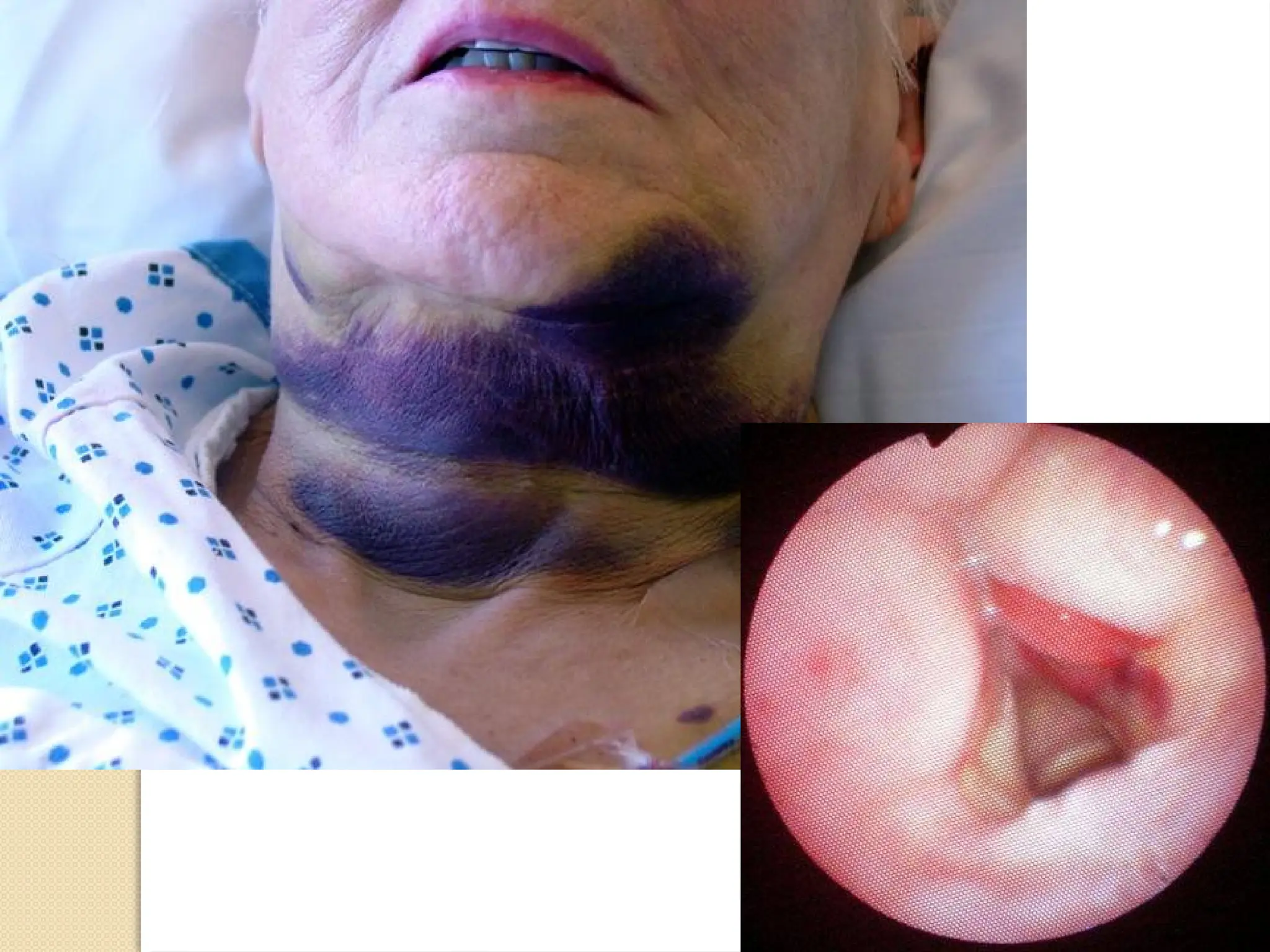
Airway
The passage throughwhich the air passes during
respiration
Nasal and oral cavities
Pharynx
Larynx
Trachea and large bronchi
3.
Why it isnecessary ??
Respiratory events are the most common anaesthetic related
injuries, following dental damage.Three main causes:
◦ Inadequate ventilation
◦ Oesophageal intubation
◦ Difficult tracheal intubation
Difficult tracheal intubation accounts for 17% of the
respiratory related injuries and results in significant morbidity
and mortality.
Estimated that up to 28% of all anaesthetic related deaths are
secondary to the inability to mask ventilate or intubate.
Prediction of the difficult airway allows time for proper
selection of equipment, technique and personnel experienced
in difficult airways
4.
Difficult airway
ASA definitionof difficult airway:
“The clinical situation in which a
conventionally trained anaesthetist
experiences difficulty with mask
ventilation, difficulty with tracheal
intubation or both.”
5.
Difficult ventilation
The inabilityof a trained anesthetist to
maintain the oxygen saturation > 90%
using a face mask for ventilation and 100%
inspired oxygen, provided that the pre-
ventilation oxygen saturation level was
within the normal range.
Prevalence
Difficult facemask
◦ 0.1% - 5%
Difficult LMA
◦ 0.2% - 1%
Difficult intubation
◦ 1-2% of normal surgical population
◦ 50% of rheumatic cervical disease
8.
Components of theAirway
Examination
Nostril patency
Length of the upper incisors, alignment
Condition of the teeth
Relationship of the upper (maxillary) incisors to the lower
(mandibular) incisors
Ability to protrude or advance the lower (mandibular) incisors in
front of the upper (maxillary) incisors
Interincisor or intergum (if edentulous) distance
Tongue size
Visibility of the uvula e.g. mallampati
Presence of heavy facial hair
Compliance of the mandibular space
Thyromental distance with the head in maximum extension
Length of the neck
Thickness or circumference of the neck
Range of motion of the head and neck
Cheek pad
9.
Causes of difficult
airway
Stiffness
◦ Arthritis of neck/jaw/larynx.
◦ Fixation devices
◦ Scleroderma
◦ Diabetes
Deformity
◦ Cervical and craniofacial
◦ Burns/trauma/infection
Swelling
◦ Infection/tumour/trauma/burns
◦ Anaphylaxis/haematoma/acromegaly
Reflexes
◦ Cough/breathholding
◦ Laryngospasm/salivation/regurgitation
Foreign body
Other – Pregnant/full stomach
10.
Airway assessment
History
◦Patient/notes/chart/medic-alert/spam letter
Difficulty
Surgery/burns
Concurrent disease
Reflux/recent meals
General examination
◦ Do they just look difficult?
Dentition (prominent upper incisors, receding chin)
Distortion (edema, blood, vomits, tumor, infection)
Disproportion (short chin-to-larynx distance, bull neck, large tongue, small
mouth)
Dysmobility (TMJ and cervical spine)
◦ Massively obese or pregnant
◦ Beards +/- tubes
Specific tests/indices
Investigations.
◦ Nasoendoscopy
◦ X-ray, CT/MRI
◦ Flow volume loop
11.
How do youassess ??
The airway may be assessed for difficult airway using :-
-Individual indices
-Group indices(with and without scoring)
Mask ventilation precedes laryngoscopy, which inturn
followed by, intubation.
So the assessment should be in a systemic manner.
12.
Predictors of difficultyto face mask
ventilate (OBESE)
1.The Obese (body mass index > 26
kg/m2)
2.The Bearded
3.The Elderly (older than 55 y)
4.The Snorers
5.The Edentulous
(=BONES)
13.
Predictors of difficultyto face mask
ventilate (MOANS)
MOANS
This is identicle to BONES except ‘M’.
-Mask seal difficult due to receding mandible,syndromes
with facial abnormalities,burn stricture etc.
-Obesity, upper airway Obstruction
-Advanced age
-No teeth
-Snorer
14.
Predictors of difficultlaryngoscopy
and intubation
Individual indices
-Physical examination indices
-radiological indices
-advanced indices
Group indices
- Wilson’s score
- Benumof’s analysis
- Saghei & safavi test
- Lemon assesment
- Arne’s simplified score
- Magboul’s 4 M’s
15.
Atlanto-occipital movement
Thepatient is asked to hold head erect, facing directly to the front, then
he is asked to extend the head maximally and the examiner estimates
the angle traversed by the occlusal surface of upper teeth.
◦ Visual assessment or using a goniometer.
Grade I >35 degrees
Grade II 22-34 degrees
Grade III 12–21 degrees
Grade IV <12 degrees
Assesses feasibility to make the optimal intubation position with
alignment of oral, pharyngeal and laryngeal axes into a straight line.
Limited A-O joint extension
◦ Spondylosis, rheumatoid arthritis, halo-jacket fixation, and in patients with
symptoms indicating nerve compression with cervical extension.
16.
Grade Reduction ofA.O.Extension
1 none
2 One third
3 Two third
4 complete
Grades 3 and 4 : Difficult laryngoscopy
Grading of reduction in A.O.Extension
Grade I : > 35°
Grade II : 22-34°
Grade III : 12-21°
Grade IV : < 12°
17.
• ASSESMENT OFA.O.
EXTENSION
• Flexion movement of the cervical spine can be assessed by
asking the patient to touch his manubrium sternii with his
chin. If done, the above maneuver assures a neck flexion of
25- 35 degree. Flexion and the extension movement if within
the normal range ,three axis ( oral,pharyngeal & laryngeal
axis) can be brought into a straight line.
can also be done by asking the patient to look at the
floor and at wall after fully flexing and fixing the neck as
shown
18.
Warning sign ofDELIKAN
Place the index finger of each hand, one underneath the
chin and one under the inferior occipital prominence with
the head in neutral position. The patient is asked to fully
extend the head on neck. If the finger under the chin is
seen to be higher than the other, there would appear to be
no difficulty with intubation. If level of both fingers remains
same or the chin finger remains lower than the
-: other, increased difficulty is predicted.
19.
PRAYER SIGN
A positive"prayer sign" can be
elicited on examination with the
patient unable to approximate the
palmar surfaces of the phalangeal
joints while pressing their hands
together.
Seen in diabeties
;This represents:- cervical spine
immobility and the potential for a
difficult endotracheal intubation.
20.
Palm Print test
Thepalm and fingers of the dominant hand of the
patient is painted with black writing ink using a brush.
The patient then presses the hand firmly against a white
sheet of paper on a hard surface. Scoring is done as:
* Grade 0 - All phalangeal areas visible.
* Grade 1 - Deficiency in the inter-phalangeal areas of
4th and/or 5th
digit.
* Grade2 - Deficiency in the inter-phalangeal areas of
2nd to 5th
digit.
* Grade 3 - Only the tips of digits seen.
ASSESSMENT OF TMJFUNCTION
TM joint exhibits 2 function.
1. Rotation of the condyle in the s.cavity.
2. Forward displacement of the condyle.
First movement is responsible for 2-3cm mouth opening & the
second is responsible for further 2-3cm mouth opening.
Index finger is placed in front of the tragus & the thumb is placed
in front of the the lower part of the mastoid process. patient is
asked to open his mouth as wide as possible. Index finger in front
of the tragus can be intented in its space and the thumb can feel
the sliding movement of the condyle as the condyle of the
mandible slides forward.
SUBLUXATION OFTHE
MANDIBLE
Assessment of mandibularspace
can be expressed as thyromental and
hyomental space.
This space determines how easily the
laryngeal and pharyngeal axis will fall in
line when the a-o joint is extended.
25.
Thyromental Distance
Measure fromupper edge of thyroid
cartilage to chin with the head fully
extended. Normal is approx 7cm.
If the thyromental distance is short, <3
finger widths, the laryngeal axis makes
a more acute angle with the pharyngeal
axis and it will be difficult to achieve
alignment.Less space to displace the
tongue
26.
Limitations
Little reliabilityin prediction
Variation according to height, ethnicity
Modification to improve the accuracy
Ratio of height to thyromental distance (RHTMD)
Useful bedside screening test
RHTMD > 23.5 – very sensitive predictor of difficult
laryngoscopy
Thyromental Distance
PATIL’S TEST
27.
HYO MENTAL DISTANCE
Distance between mentum and
hyoid bone
Grade I : > 6cm
Grade II: 4 – 6cm
Grade III : < 4cm – Impossible
laryngoscopy & Intubation
28.
INTER-INCISOR GAP
Inter-incisordistance with maximal mouth opening
Normal value > 5 cm / admits 3 fingers.
Significance :
Positive results: Easy insertion of a 3 cm deep flange of
the laryngoscope blade
< 3 cm: difficult laryngoscopy
< 2 cm: difficult LMA insertion
Affected by TMJ and upper cervical spine mobility
29.
STERNOMENTAL DISTANCE
(SAVVATEST)
Distancefrom the upper border of the manubrium to
the tip of mentum, neck fully extended, mouth closed
Minimal acceptable value – 12.5 cm
Single best predictor of difficult laryngoscopy and
intubation ( Has high sensitivity & specificity).
30.
UPPER LIP BITE/CATCHTEST
Class I: Lower incisors can bite the upper lip above
vermilion line
Class II: can bite the upper lip below vermilion line
Class III: cannot bite the upper lip
Significance
Assessment of mandibular movement and dental architecture
Less inter observer variability
31.
Test for assessingadequacy of the oropharynx for laryngoscopy and intubation
Mallampati grading (samsoon and young’s
modification)
Narrowness of the palate
32.
Mallampati Score
ClassI (easy)—visualization of the soft palate,
fauces, uvula, and both anterior and posterior
pillars
Class II—visualization of the soft palate, fauces,
and uvula
Class III—visualization of the soft palate and the
base of the uvula
Class IV (difficult)—the soft palate is not visible at all
Sensitivity: 44% - 81%
Specificity: 60% - 80%
Roughly corresponds to Cormack and Lehane’s
laryngoscopy views
34.
SIGNIFICANCE OF MMPSCORE
Class III or IV: signifies that the angle between the
base of tongue and laryngeal inlet is more acute and not
conducive for easy laryngoscopy
Limitations
◦ Poor interobserver reliability
◦ Limited accuracy
Good predictor in pregnancy, obesity, acromegaly
35.
Assessment for qualityof glottic
viewing during laryngoscopy
Indirect mirror laryngoscopic view
Direct laryngoscopy ‘awake look’
-cormack and lehane grading
Grading ease of intubation
POGO (percentage of glottic opening) scoring
36.
CORMACK - LEHANE
Gradingat direct laryngoscopy
Grade 1: Full exposure of glottis (anterior + posterior
commissure)
Grade 2: Anterior commissure not visualised
Grade3: Epiglottis only
Grade 4: No
glottic structure visible.
Grade I = success & ease of intubation
38.
Group indices
- Wilson’sscore
- Benumof’s analysis
- Saghei & safavi test
- Lemon assesment
- Arne’s simplified score
- Magboul’s 4 M’s
- 4D’s
39.
Wilson’s risk score
Score
Weight0=<90kg
1=>90kg
2=>110kg
Head and
neck
movement
0=Above 90degrees
1=About 90degrees
2=Below 90degrees
Jaw
movement
0=IG>5cm or SLux >0
1=IG<5cm and SLux = 0
2=IG<5cm and SLux<0
Receding
mandible
0=Normal
1=Moderate
2=Severe
Buck teeth 0=Normal
1=Moderate
2=Severe
• Head movement assessed
with pencil taped to a
patient’s forehead.
• IG = Interincisor gap
measured with mouth fully
open.
• SLux = Maximal forward
protrusion of the lower
incisors beyond the upper
incisors.
• score 5 or < =easy laryngoscopy
• Score 8-10 =severe difficulty in
laryngoscopy
40.
BENUMOF’S 11 PARAMETERANALYSIS
Parameter
1. Buck teeth
2. Subluxation
3. Interincisor gap
4. Palate configuration
5. Mallampati class
6. Upper inciors length
Minimum acceptable
value
<1.5cm
Absent
Yes
>3cm
No arching/narrowness
<2
7. TM distance
8. SMS compliance
9. Neck thickness
10. Length of neck
11. Head /neck mvt
> 5cm
Soft to palpation.
Qualitative ( >33cm DI)
>8cm
Normal range
2 for mandibular space
3 for neck examination.
4-2-2-3 rule
4 for tooth
2 for inside of mouth
41.
SAGHEI & SAFAVI’S
Weight
Tongue protrusion
Mouth opening
Upper incisor length
Mallampati class
Head extension
Any 3 indices if present
-
>80kg
< 3.2cm
<5cm
>1.5cm
>1
<70 degree
Prolonged laryngoscopy
42.
Arne’s simplified scoremodel
The points of simplified score were obtained by multiplying the points of the exact
score by 3.15 and then rounding the results to the nearest whole number.
Risk factor simplified score
Previous knowledge of difficult intubation
No 0
Yes 10
Pathologies associated with difficult intubation
No 0
Yes 5
Clinical symptoms of airway pathology
No 0
Yes 3
Inter-incisor gap (IG) and mandible luxatum (ML)
IG > 5 cm or ML >0 0
IG 3.5-5cm and ML=0 3
IG<3.5 cm and ML<0 13
43.
Arne’s simplified scorecontd.
Thyromental distance simplified score
>6.5cm 0
< 6.5cm 4
Maximum range of head & neck movement
Above 100° 0
About 90° (90° ± 10°) 2
Below 80° 5
Mallampati’s modified test
Class 1 0
Class 2 2
Class 3 6
Class 4 8
Total...... 48
Score of >11 is predictive of difficult tracheal intubation
Indian journal of anaesthesia,2002; 46(5) 347-352
44.
LEMON trial
Look
Facial trauma
Large incisors
Beard
Large tongue
Evaluate 3-3-2
Interincisor distance (3 fingers)
Hyoidmental distance (3 fingers)
Thyroid to floor of mouth (2fingers)
Mallampati
Obstruction
Neck movement – chin to chest
( Airway management in trauma
Indian J Anaesth. 2011 Sep-Oct; 55(5): 46)3–469)
45.
LOOK Externally
Beardsor facial hair
Short, fat neck
Morbidly obese patients
Facial or neck trauma
Broken teeth (can lacerate balloons)
Dentures (should be removed)
Large teeth
Protruding tongue
A narrow or abnormally shaped face
46.
EVALUATE 3-3-2
MouthOpens at least 3 finger widths.
Three finger widths thyromental distance.
Two finger widths mandibulohyoid
distance.
Upper & LowerFace
Measure the size of the upper face as compared to the
lower face.
Should be roughly the same.
If the lower face is longer than the upper face then you
should anticipate some degree of difficulty lining up the
structures
Obstruction
Laryngoscopy orintubation may be more
difficult in the presence of an obstruction
◦ Anatomy
◦ Trauma
◦ Foreign body obstruction
◦ Edema (burns)
52.
Neck Mobility
Ideallythe neck should be able to extend
back approximately 35°
Problems:
◦ Cervical Spine Immobilization
◦ Ankylosing Spondylitis
◦ Rheumatoid Arthritis
◦ Halo fixation
53.
Scene and Situation(SEE)
Scene safety
Environment
◦ Do you have a reasonable chance to get the
tube?
◦ Space, positioning, access
Egress
◦ Will you be able to ventilate during egress?
54.
Magboul’s 4 M’s
For Intubation remember the 4(M & Ms) with (STOP) sign
Mallampati
Measurement
Movement
Malformation & STOP
M =Malformation of the skull, teeth, obstruction, & Pathology (the Macros
and Micros).We can memorize them with the word (STOP)
S = Skull (Hydro and Microcephalus)
T = Teeth (Buck, protruded, & loose teeth. Macro and Micro mandibles)
O= Obstruction (due to obesity, short Bull Neck and swellings around the
head and neck)
P = Pathology (Craniofacial abnormalities & Syndromes:Treacher Collins,
Goldenhar's, Pierre Robin,Waardenburg syndromes) .
(The Internet Journal of Anesthesiology. 2005Volume 10 Number 1. DOI:
10.5580/1d0a)
55.
What are the4 Ds?
The following Four D's also suggest a difficult airway:
Dentition (prominent upper incisors, receding chin)
Distortion (edema, blood, vomits, tumor, infection)
Disproportion (short chin-to-larynx distance, bull neck,
large tongue, small mouth)
Dysmobility (TMJ and cervical spine)
56.
1. X-Ray neck(lateral view) :
Occiput - C1 spinous process
distance< 5mm.
Increase in posterior mandible
depth > 2.5cm.
Ratio of effective mandibular
length to its posterior depth
<3.6.
Tracheal compression.
RADIOGRAPHIC PREDICTORS
57.
2. CT Scan:
Tumors of floor of mouth, pharynx, larynx
Cervical spine trauma, inflammation
Mediastinal mass
3. Helical CT (3D-reconstruction):
Exact location and degree of airway compression
• Flow volume loop
• Acoustic response measurement
• Ultra sound guided
• CT / MRI
• Flexible bronchoscope
ADVANCED INDICES
Access Issues
Obesity
Halo
Short neck
SC Emphysema
Bushy beard
Flexion deformity of the spine
DOA
63.
How to predictdifficult placement of
supraglottic devices (RODS)
Restricted mouth opening
Obstruction of the upper airway
Distrupted upper airway as following
trauma,burn,caustic ingestion .
Stiff lung (poor lung or thoracic
compliance)
Suggested by Hung and Murphy
(Canadian journal of anesthesia 2004:10:963-8)
64.
How to predictdifficulty in creating
surgical airway (BANG)
Bleeding tendency
Agitated patient
Neck scarring
Growth or vascular abnormality in region
of surgical airway.
COPUR index assessingdifficult airway in
paediatric patient
C-chin From the side view the chin is: score
Normal 1
Small, moderately hypoplastic 2
Markedly recessive 3
Extremely hypoplastic 4
O-Opening of the mouth(Interdental space)
> 40mm 1
20-40 mm 2
10-20mm 3
<10 4
P-Previous Intubation or OSA
Previous attempt easy 1
No previous attempt, no hx OSA 2
OSA, previous hx difficult intubation 3
Extremely difficult previous intubation, trach,
or patient unable to lie supine 4
74.
COPUR index (contd)
U-Uvula (Mouth open tongue out)
Tip of uvula visible 1
Uvula partially visible 2
Uvula concealed, soft palate visible 3
Soft palate not visible 4
R Range (estimaterange of motion looking up and down)
>120° 1
60°-120° 2
30°-60° 3
< 30° 4
Prediction Points
5-7 Easy normal intubation score >10 predict difficult airway
8-10 laryngeal pressure may help
12 more difficult, fiberoptic may be less traumatic
14 Difficult intubation, fiberoptic or other advanced technique
16 Dangerous airway, consider awake intubation, potential trach
75.
Structured Approach toAirway
Management
MOUTHS
Component Description Assessment Activities
Mandible Length and subluxation Measure hyomental distance and
anterior displacement of
mandible
Opening Base, symmetry, range Assess and measure mouth
opening in centimetres
Uvula Visibility Assess pharyngeal structures and
classify
Teeth Dentition Assess for presence of loose teeth
and dental appliances
Head Flexion, extension,
rotation of head/neck and
cervical spine
Assess all ranges and movement
Silhouette Upper body abnormalities, Identify potential impact on
76.
Rule of 1-2-3
1 finger breadth for subluxation of mandible. Just to recall
2 finger breatdh for adequacy of mouth opening.
3 finger breathd for hyomental distance.
In emergency situation, above test can be rapidly performed within 15sec to
assess theTMJ function,mouth opening and SM Space. Significant difficulty in 2
or more of these components requires detailed examination.
• 4 finger breath for thyromental distance
• 5 movements- ability to flex the neck upto the manubrium sterni,
extension at the AOJ, rotation of the head along with right & left
movement of the head to touch the shoulder.
Rule of 1-2-3-4-5
• 3 finger in the interdental space.
• 3 finger between mentum and hyoid bone.
• 3 finger between thyroid cartilage & sternum.
RULE OFTHREE`S
77.
To Summarize
Airwayassessment is a critical part .
The difficult airway assessment must be
performed prior to ALL attempts.
While this criteria helps identify difficult
airways, it does not guarantee an easy
intubation—Be Prepared!
Nothing is more expensive than the missed
opportunity
78.
References
Airway managementin trauma
Indian J Anaesth. 2011 Sep-Oct; 55(5): 463–469.
The Internet Journal of Anesthesiology ISSN: 1092-406X
The Dilemma of Airway Assessment and Evaluation
Magboul M.Ali Magboul MD, FFARCSIClinical Assistant Professor, Director of
ACLS, PALS & Airway workshop, Department of Anesthesia, University of IowaIowa
City, Iowa U.S.A.
Citation: M.M.Ali Magboul:The Dilemma of Airway Assessment and Evaluation.The
Internet Journal of Anesthesiology. 2005Volume 10 Number 1. DOI: 10.5580/1d0a
Practice guidelines for management of the difficult airway: an updated report by the
American Society of Anesthesiologists Task Force on Management of the Difficult
Airway.Anesthesiology 2003; 98 (5):1269-77
Frerk CM. Predicting difficult intubation.Anaesthesia 1991; 46 (12):1005-8
Verghese C, Brimacombe JR. Survey of laryngeal mask airway usage in 11,910 patients:
safety and efficacy for conventional and nonconventional usage.Anesth Analg 1996;
82: 129–33
Gupta S, Sharma R, Jain D.Airway assessment – Predictors of a Difficult Airway.
Indian Journal Of Anaesthetics 2005; 49(4) : 257 -262
Editor's Notes
#15 Atlanto-Occipital Joint Distance
Atlantooccipital joint extension may be measured when the head is held erect and facing forward. The angle between the erect and extended planes of the occlusal surface of the upper teeth is measured and equals the degree of atlantooccipital joint extension. The "normal" amount of extension equals 35 degrees. Almost all extension of the head on the neck takes place at the atlantooccipital joint. The atlas or the first cervical vertebra is a ring of bone. It does not have a body or spine which would hamper the backward movement of the head. Therefore the greater the atlantooccipital distance in the neutral position, the greater degree of extension that is possible Conversely, if the occiput and the atlas are already in contact in the neutral position, no extension can take place at the atlantooccipital joint.
Because there is a wide variation in atlantooccipital joint distance in the population, it is important to assess head extension at the atlantooccipital joint. Additionally, limited A-O joint extension is present in certain pathological states such as spondylosis, rheumatoid arthritis, halo-jacket fixation, and in patients with symptoms indicating nerve compression with cervical extension. In these patients, it is even more important than usual to raise the occiput above the shoulders prior to laryngoscopy.
Check neck extension on to the chest. Limitation of neck extension (< 30 degrees) may interfere with the sniffing position and limit the laryngoscopic view
#32 This scoring system was first introduced in 1985 in the Canadian Anesthesia Society Journal based on the work of Mallampati. Place the patient in a seated position and have them hold head in a neutral position with mouth open wide and the tongue fully extended. MENTION MODIFIED -
#44 US national emergency airway management course devised score