
TOURISM ISSUES IN SOUTH ASIA
Md Shaifullar Rabbi
Assistant Manager
Customer Support and Training Department
Sabre Travel Network Bangladesh Limited
BBA & MBA
Major in Tourism and Hospitality Management
Faculty of Business Studies
University of Dhaka
FORMS OF TOURISM
• Eco-Tourism
• Agro Tourism
• Community Based Tourism
• Adventure Tourism
• Green Tourism
• Firm Tourism
• Rural Tourism
• Soft Tourism
• Heritage Tourism
• Cultural Tourism
• Ethnic Tourism
 Senior Citizen Tourism
 Sustainable Tourism
 Religious Tourism
 Medical Tourism
 Sports Tourism
 Educational Tourism
 Island Based Tourism
 Dark Tourism
 Recreational Tourism
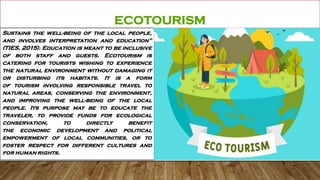
ECOTOURISM
Sustains the well-being of the local people,
and involves interpretation and education”
(TIES, 2015). Education is meant to be inclusive
of both staff and guests. Ecotourism is
catering for tourists wishing to experience
the natural environment without damaging it
or disturbing its habitats. It is a form
of tourism involving responsible travel to
natural areas, conserving the environment,
and improving the well-being of the local
people. Its purpose may be to educate the
traveler, to provide funds for ecological
conservation, to directly benefit
the economic development and political
empowerment of local communities, or to
foster respect for different cultures and
for human rights.
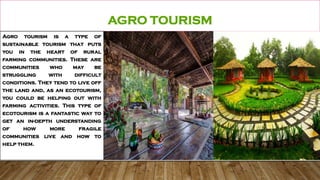
AGRO TOURISM
Agro tourism is a type of
sustainable tourism that puts
you in the heart of rural
farming communities. These are
communities who may be
struggling with difficult
conditions. They tend to live off
the land and, as an ecotourism,
you could be helping out with
farming activities. This type of
ecotourism is a fantastic way to
get an in-depth understanding
of how more fragile
communities live and how to
help them.
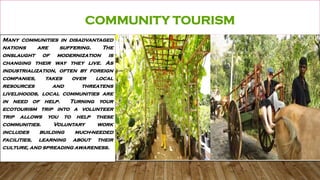
COMMUNITY TOURISM
Many communities in disadvantaged
nations are suffering. The
onslaught of modernization is
changing their way they live. As
industrialization, often by foreign
companies, takes over local
resources and threatens
livelihoods, local communities are
in need of help. Turning your
ecotourism trip into a volunteer
trip allows you to help these
communities. Voluntary work
includes building much-needed
facilities, learning about their
culture, and spreading awareness.
ADVENTURE TOURISM
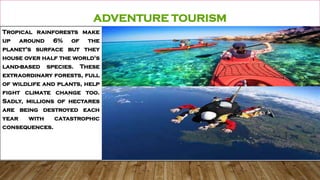
Tropical rainforests make
up around 6% of the
planet's surface but they
house over half the world's
land-based species. These
extraordinary forests, full
of wildlife and plants, help
fight climate change too.
Sadly, millions of hectares
are being destroyed each
year with catastrophic
consequences.
GREEN TOURISM
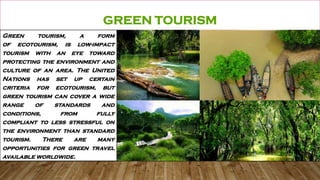
Green tourism, a form
of ecotourism, is low-impact
tourism with an eye toward
protecting the environment and
culture of an area. The United
Nations has set up certain
criteria for ecotourism, but
green tourism can cover a wide
range of standards and
conditions, from fully
compliant to less stressful on
the environment than standard
tourism. There are many
opportunities for green travel
available worldwide.
FARM TOURISM
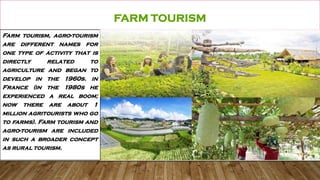
Farm tourism, agro-tourism
are different names for
one type of activity that is
directly related to
agriculture and began to
develop in the 1960s. in
France (in the 1980s he
experienced a real boom;
now there are about 1
million agritourists who go
to farms). Farm tourism and
agro-tourism are included
in such a broader concept
as rural tourism.
RURAL TOURISM
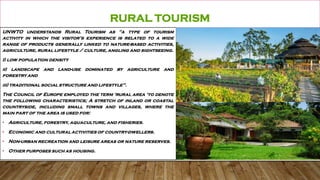
UNWTO understands Rural Tourism as "a type of tourism
activity in which the visitor’s experience is related to a wide
range of products generally linked to nature-based activities,
agriculture, rural lifestyle / culture, angling and sightseeing.
I) low population density
ii) landscape and land-use dominated by agriculture and
forestry and
iii) traditional social structure and lifestyle".
The Council of Europe employed the term ‘rural area ‘to denote
the following characteristics; A stretch of inland or coastal
countryside, including small towns and villages, where the
main part of the area is used for:
• Agriculture, forestry, aquaculture, and fisheries.
• Economic and cultural activities of country-dwellers.
• Non-urban recreation and leisure areas or nature reserves.
• Other purposes such as housing.
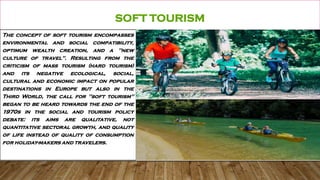
SOFT TOURISM
The concept of soft tourism encompasses
environmental and social compatibility,
optimum wealth creation, and a "new
culture of travel". Resulting from the
criticism of mass tourism (hard tourism)
and its negative ecological, social,
cultural and economic impact on popular
destinations in Europe but also in the
Third World, the call for "soft tourism"
began to be heard towards the end of the
1970s in the social and tourism policy
debate: its aims are qualitative, not
quantitative sectoral growth, and quality
of life instead of quality of consumption
for holiday-makers and travelers.
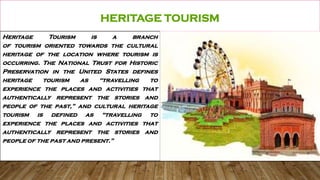
HERITAGE TOURISM
Heritage Tourism is a branch
of tourism oriented towards the cultural
heritage of the location where tourism is
occurring. The National Trust for Historic
Preservation in the United States defines
heritage tourism as “travelling to
experience the places and activities that
authentically represent the stories and
people of the past,” and cultural heritage
tourism is defined as “travelling to
experience the places and activities that
authentically represent the stories and
people of the past and present.”
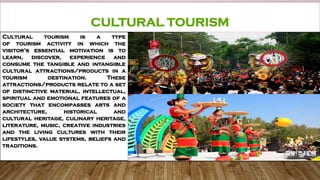
CULTURAL TOURISM
Cultural tourism is a type
of tourism activity in which the
visitor’s essential motivation is to
learn, discover, experience and
consume the tangible and intangible
cultural attractions/products in a
tourism destination. These
attractions/products relate to a set
of distinctive material, intellectual,
spiritual and emotional features of a
society that encompasses arts and
architecture, historical and
cultural heritage, culinary heritage,
literature, music, creative industries
and the living cultures with their
lifestyles, value systems, beliefs and
traditions.
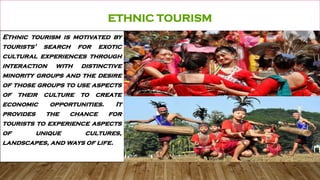
ETHNIC TOURISM
Ethnic tourism is motivated by
tourists’ search for exotic
cultural experiences through
interaction with distinctive
minority groups and the desire
of those groups to use aspects
of their culture to create
economic opportunities. It
provides the chance for
tourists to experience aspects
of unique cultures,
landscapes, and ways of life.
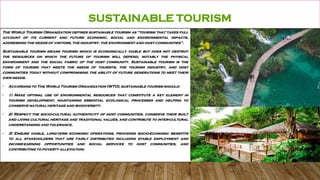
SUSTAINABLE TOURISM
The World Tourism Organization defines sustainable tourism as “tourism that takes full
account of its current and future economic, social and environmental impacts,
addressing the needs of visitors, the industry, the environment and host communities".
Sustainable tourism means tourism which is economically viable but does not destroy
the resources on which the future of tourism will depend, notably the physical
environment and the social fabric of the host community. Sustainable tourism is the
form of tourism that meets the needs of tourists, the tourism industry, and host
communities today without compromising the ability of future generations to meet their
own needs.
• According to The World Tourism Organization (WTO), sustainable tourism should:
• 1) Make optimal use of environmental resources that constitute a key element in
tourism development, maintaining essential ecological processes and helping to
conserve natural heritage and biodiversity.
• 2) Respect the socio-cultural authenticity of host communities, conserve their built
and living cultural heritage and traditional values, and contribute to inter-cultural
understanding and tolerance.
• 3) Ensure viable, long-term economic operations, providing socio-economic benefits
to all stakeholders that are fairly distributed including stable employment and
income-earning opportunities and social services to host communities, and
contributing to poverty alleviation.
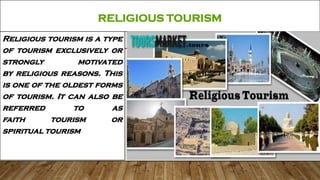
RELIGIOUS TOURISM
Religious tourism is a type
of tourism exclusively or
strongly motivated
by religious reasons. This
is one of the oldest forms
of tourism. It can also be
referred to as
faith tourism or
spiritual tourism
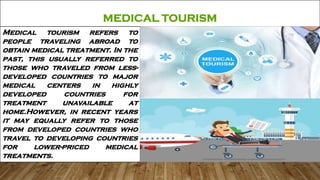
MEDICAL TOURISM
Medical tourism refers to
people traveling abroad to
obtain medical treatment. In the
past, this usually referred to
those who traveled from less-
developed countries to major
medical centers in highly
developed countries for
treatment unavailable at
home.However, in recent years
it may equally refer to those
from developed countries who
travel to developing countries
for lower-priced medical
treatments.
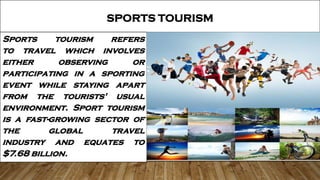
SPORTS TOURISM
Sports tourism refers
to travel which involves
either observing or
participating in a sporting
event while staying apart
from the tourists' usual
environment. Sport tourism
is a fast-growing sector of
the global travel
industry and equates to
$7.68 billion.
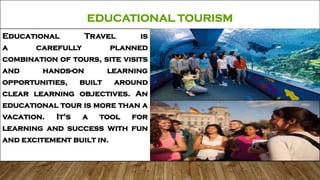
EDUCATIONAL TOURISM
Educational Travel is
a carefully planned
combination of tours, site visits
and hands-on learning
opportunities, built around
clear learning objectives. An
educational tour is more than a
vacation. It's a tool for
learning and success with fun
and excitement built in.
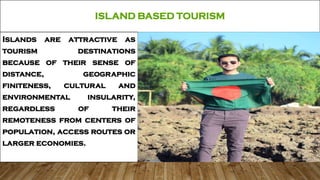
ISLAND BASED TOURISM
Islands are attractive as
tourism destinations
because of their sense of
distance, geographic
finiteness, cultural and
environmental insularity,
regardless of their
remoteness from centers of
population, access routes or
larger economies.
Chapter 6 Tourism issues in South Asia Perspectives