
Tourist Geography of
Bangladesh
Md Shaifullar Rabbi
Assistant Manager
Customer Support and Training Department
Sabre Travel Network Bangladesh Limited
BBA & MBA
Major in Tourism and Hospitality
Management
Faculty of Business Studies
University of Dhaka
Cultural Tourism in Bangladesh
Cultural tourism is a tool of bringing people together
from different cultures. This interaction and ways of life
can signify gigantic opportunity to advance tolerance,
respect and mutual understanding. Cultural Tourism
brings peace and cooperation among nations, and builds
bridges among the people of different cultural from
different countries.
Cultural Attractions
1. Mahasthangarh
2. Somapura Mahavihara
3. Kantajew Temple
4. Sixty dome mosque
5. Shalban Bihar
6. BOISABI Festival
Religious Attractions
Today, Bangladesh has got the status of containing the second highest number of Muslim
people (after Indonesia) in the world. Out of the population in Bangladesh, about 86.6%
are Muslims, 12.I% are Hindus, 0.6% are Buddhists, 0.4% are Christians and the rest 0.3%
are other tribes. People of all religions live here with full freedom and perfect harmony.
The easy relationships that appear to prevail among the different religious groups and the
participation in each other’s religious festivals are pleasant aspects of life in Bangladesh
(Pannell Kerr Forster Associates, 1988).
Religious Tourism can attract lot of Muslim tourists from around the world. People from
different religions live in relative harmony in Bangladesh. They have different cultures and
different festival throughout the years including Eid-ul-Fitr, Eid-ul-Azha, Eid-e-Miladunanbi,
Shab-e-Barat, Shab-e-Kadre, Muharram etc. In Bangladesh Hinduism culture have various
festivals like, Durga Puja, Kali Puja, Sarashati Puja etc.
Tribal Tourism
The colorful lifestyles of tribal can be an exceptional source of cultural tourism offerings for
the tourists. The tribal of Bangladesh have their own unique lifestyle and distinctive nature
of culture in their way of life. They are encapsulated from modern civilization of the plain
land. Tribal people live in bamboo huts raised on platform or on tree-tops, cultivate on the
slopes of high hills, rear pigs, chickens and cattle; smoke with queer looking like bamboo-
made hukkah, and follow their own age-old religion, culture, customs and traditions
(Hossain, 1992).
Self reliance, primitiveness, and simplicity are the common features in the way of life of
the tribal people. With their distinctive cultural entities the tribal people, who account for
less than one percent of the total population have ornamented the nation adding color,
shade, and variety (Joy, 1987). The unique custom and costumes of tribal families indicate
the ancient traditions and culture of heritage.
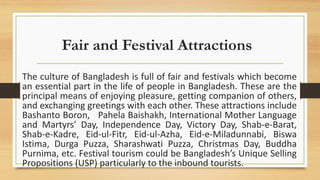
Fair and Festival Attractions
The culture of Bangladesh is full of fair and festivals which become
an essential part in the life of people in Bangladesh. These are the
principal means of enjoying pleasure, getting companion of others,
and exchanging greetings with each other. These attractions include
Bashanto Boron, Pahela Baishakh, International Mother Language
and Martyrs’ Day, Independence Day, Victory Day, Shab-e-Barat,
Shab-e-Kadre, Eid-ul-Fitr, Eid-ul-Azha, Eid-e-Miladunnabi, Biswa
Istima, Durga Puzza, Sharashwati Puzza, Christmas Day, Buddha
Purnima, etc. Festival tourism could be Bangladesh’s Unique Selling
Propositions (USP) particularly to the inbound tourists.
Top Nine Historic Places in Bangladesh
1. Lalbagh Fort in Dhaka
2. Kotila Mura in Comilla
3. The Liberation War Museum in Dhaka
4. Somapura Mahavira at Naogaon
5. Shalban Vihar at Comilla
6. Ahsan Manzil at Dhaka
7. The American Church in Dhaka
8. Mahasthangarh in Bogra
9. Kantanagar Tample
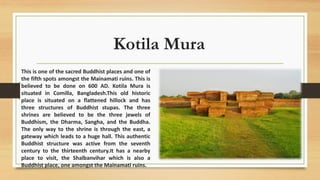
Kotila Mura
This is one of the sacred Buddhist places and one of
the fifth spots amongst the Mainamati ruins. This is
believed to be done on 600 AD. Kotila Mura is
situated in Comilla, Bangladesh.This old historic
place is situated on a flattened hillock and has
three structures of Buddhist stupas. The three
shrines are believed to be the three jewels of
Buddhism, the Dharma, Sangha, and the Buddha.
The only way to the shrine is through the east, a
gateway which leads to a huge hall. This authentic
Buddhist structure was active from the seventh
century to the thirteenth century.It has a nearby
place to visit, the Shalbanvihar which is also a
Buddhist place, one amongst the Mainamati ruins.
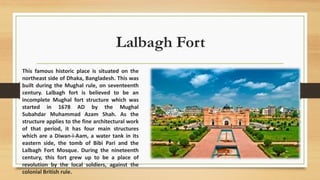
Lalbagh Fort
This famous historic place is situated on the
northeast side of Dhaka, Bangladesh. This was
built during the Mughal rule, on seventeenth
century. Lalbagh fort is believed to be an
incomplete Mughal fort structure which was
started in 1678 AD by the Mughal
Subahdar Muhammad Azam Shah. As the
structure applies to the fine architectural work
of that period, it has four main structures
which are a Diwan-i-Aam, a water tank in its
eastern side, the tomb of Bibi Pari and the
Lalbagh Fort Mosque. During the nineteenth
century, this fort grew up to be a place of
revolution by the local soldiers, against the
colonial British rule.
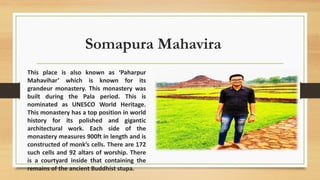
Somapura Mahavira
This place is also known as ‘Paharpur
Mahavihar’ which is known for its
grandeur monastery. This monastery was
built during the Pala period. This is
nominated as UNESCO World Heritage.
This monastery has a top position in world
history for its polished and gigantic
architectural work. Each side of the
monastery measures 900ft in length and is
constructed of monk’s cells. There are 172
such cells and 92 altars of worship. There
is a courtyard inside that containing the
remains of the ancient Buddhist stupa.
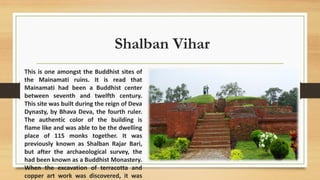
Shalban Vihar
This is one amongst the Buddhist sites of
the Mainamati ruins. It is read that
Mainamati had been a Buddhist center
between seventh and twelfth century.
This site was built during the reign of Deva
Dynasty, by Bhava Deva, the fourth ruler.
The authentic color of the building is
flame like and was able to be the dwelling
place of 115 monks together. It was
previously known as Shalban Rajar Bari,
but after the archaeological survey, the
had been known as a Buddhist Monastery.
When the excavation of terracotta and
copper art work was discovered, it was
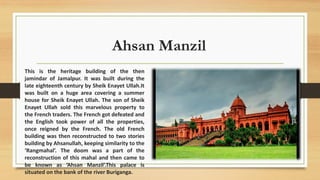
Ahsan Manzil
This is the heritage building of the then
jamindar of Jamalpur. It was built during the
late eighteenth century by Sheik Enayet Ullah.It
was built on a huge area covering a summer
house for Sheik Enayet Ullah. The son of Sheik
Enayet Ullah sold this marvelous property to
the French traders. The French got defeated and
the English took power of all the properties,
once reigned by the French. The old French
building was then reconstructed to two stories
building by Ahsanullah, keeping similarity to the
‘Rangmahal’. The doom was a part of the
reconstruction of this mahal and then came to
be known as ‘Ahsan Manzil’.This palace is
situated on the bank of the river Buriganga.
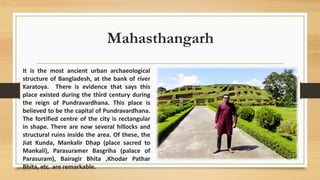
Mahasthangarh
It is the most ancient urban archaeological
structure of Bangladesh, at the bank of river
Karatoya. There is evidence that says this
place existed during the third century during
the reign of Pundravardhana. This place is
believed to be the capital of Pundravardhana.
The fortified centre of the city is rectangular
in shape. There are now several hillocks and
structural ruins inside the area. Of these, the
Jiat Kunda, Mankalir Dhap (place sacred to
Mankali), Parasuramer Basgriha (palace of
Parasuram), Bairagir Bhita ,Khodar Pathar
Bhita, etc. are remarkable.
Heritage tourism
Historical or heritage tourism means traveling with the primary purpose of exploring the
history and heritage of a place. It may mean simple sightseeing of renowned historical
architecture, visiting local museums that document the past through artifacts, art, and
literary remains, or even something as quaint as sampling authentic historical recipes in
their place of origin.
People often combine their love of history with other tourist delights like shopping,
amusement park visits, and luxurious resort stays. So places that have a rich heritage and
have, at the same time, designed a fine tourist infrastructure to cater to all categories of
tourists get rated the highest in terms of popularity as tourist destinations.
Take for an example Budapest – the city offers some marvelous delights including
architectural grandeur and historical baths that take one back in time – and all this
becomes all the more alluring when coupled with the fantastic nightlife, of which its
trademark ruin pubs are a prominent part.
UNESCO World Heritage Sites In Bangladesh
Bangladesh is represented on the UNESCO list by two religious
sites and one of South Asia's most biodiversity areas. Bangladesh,
a nation in the Indian sub-continent, with a population of 166
million people, has two significant religious sites as well as a
biodiversity area that has been listed by UNESCO as World
Heritage Sites. Two tourist destinations, the Ruins of the Buddhist
Vihara at Paharpur and the Historic Mosque City of Bagerhat have
been listed as cultural World Heritage Sites in Bangladesh. The
Sundarbans is designated as a natural World Heritage Site in the
country.
Historic Mosque City of Bagerhat
The Mosque City in Bargehat is located where the River Brahmaputra and
Gangel meet. It was inscribed as a World Heritage Site in 1985. The city was
founded by a Turkish-born Ulugh Khan Jahan in the 15th century and was built
using bricks. Forbes categorizes the city as one out of the fifteen lost cities of
the world. The city is a tourist destination, and some of its former structures
include 360 mosques, mausoleums, roads, bridges and other public buildings
constructed from baked bricks. However, the city was in ruins after the death of
the founder Ulukh Khan. Bagerhat Museum located next to sixty pillar mosque
contains pottery and ornamental bricks. The wall in the western part of the
nine-dome mosque faces Mecca, a religious pilgrim at the center of religion for
Muslims.
Ruins of the Buddhist Vihara
This World Heritage Sites, inscribed in 1985 by UNESCO, is located in the southwest
of the country and was built by Dharmapala Vikramshila between 770-810AD as a
monastery. At the base, are sixty stone sculptures that testify to the belief system of
Hinduism and it is the largest Buddhist monastery constructed at the time. It has
unique features such as the outside walls decorated with ornamental terracotta,
influenced by Hinduism, Jainism, and Buddhism art. The area is under the
government protection and managed by the local office. The department of
archaeology deals with the management and conservation aspects. The ruins play a
significant cultural role since the statues recovered from the area are a constant
reminder of the culture of the local people. The design was influenced by cultures
as far as Indonesia.
Sundarbans: The Abode of the Royal Bengal Tigers
The Sundarbans is a mangrove forest, which is approximately 140,000 hectares on the delta of
Ganges and Meghna rivers in Bengal Bay. It was inscribed in 1987 as a natural world heritage site by
UNESCO. It has unique features such as mudflats and tidal waterways. The Sundarban is located to
the southwest of Bangladesh and has been recognized internationally for having mangrove flora and
fauna on both land and water. It has around 260 different species of birds, Bengal Tiger; the only
family of cats that is almost instinct, and the famous Indian python.
The Sunderbans species attract tourists around the world. They come to carry out scientific research
as well as observe the diverse species of both plants and animals. Conservation efforts are
implemented to keep the Sundarbans safe from illegal hunting and other human activities like
agriculture. The government has passed a law to protect the ecosystem and maintain the
biodiversity.
Culinary Tourism
Culinary tourism or food tourism is the exploration of food as the purpose of tourism. It is now considered
a vital component of the tourism experience. Dining out is common among tourists and "food is believed to
rank alongside climate, accommodation, and scenery" in importance to tourists. Culinary or food tourism is
the pursuit of unique and memorable eating and drinking experiences, both near and far. Culinary tourism
differs from agritourism in that culinary tourism is considered a subset of cultural tourism (cuisine is a
manifestation of culture) whereas agritourism is considered a subset of rural tourism, but culinary tourism
and agritourism are inextricably linked, as the seeds of cuisine can be found in agriculture. Culinary/food
tourism is not limited to gourmet food. Food tourism can be considered a subcategory of experiential
travel.
Food tourism includes activities such as:
• Cooking classes
• Food tours
• Wine, beer and food festivals
• Specialty dining experiences
Ethnic Tourism
In the absence of a strict definition of ethnic tourism, there is need to clarify
the individual words of that definition. At first attention is called to the "tourist
character" of a trip. These are the journeys falling within the scope of tourism,
but they not include commercial activity and forced eviction to their own
country. Traveling within the country such as the trip to visit family also cannot
be called "ethnic" tourism. Such trips do not change the ethnic environment in
the country. As for the term "origin" it is dealing with people who, although not
they come from places visited, but have taken the trip because of a desire to
meet with the place of origin of their ancestors. An important term is "identity".
Thanks to him we can put in the context of ethnic tourism, numerous trips,
where people visit places important for the nation, its history and culture,
despite the lack of personal or family relationship with these areas.
Natural Tourism in Bangladesh
• Bandarbans
• Sundarbans
• Sylhet
• Cox’s Bazar
• Chattogram
• Khagrachari
• Rangamati
• Saint Martin’s Island
• Reserve Forest and centauries
• Beaches and Islands
Chapter 8 Tourist Geography of Bangladesh