Advancements in Power Electronics technologies h
ave been used widely in the aircraft industry.
POWER ELECTRONICS IN
AIRCRAFTS
Introduction
• In the competitive world of airline economics, where low cost carriers are driving d
awn profit margins on airline seat miles, techniques for reducing the direct operati
ng costs of aircraft are in great demand
• In effort to meet this demand, the aircraft manufacturing industry is placing great
er emphasis on the use of technology, which can influence maintenance costs and
fuel usage.
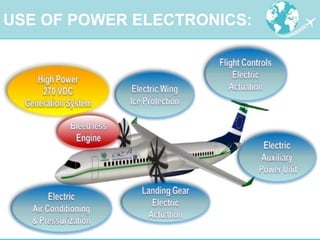
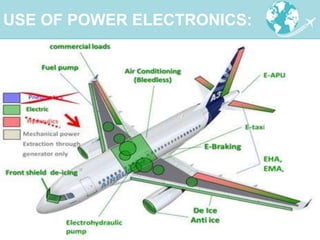
• There is a general move in the aircrafts industry to increase the amount of electric
ally powered equipments on future aircraft.
• This trend is referred to as the “More Electric Aircraft”.
• It assumes using electrical energy instead of hydraulic, pneumatic and mechanical
means to power virtually all aircraft subsystem including flight control actuation, e
nvironmental control system and utility function. The concept offers advantages of
reduced overall aircraft weight, reduced need for ground support equipment and
maintenance and increased reliability
• Many aircraft power systems are now operating with a variable frequency over a t
ypical range of 360 Hz to 800 Hz.
Introduction cont..
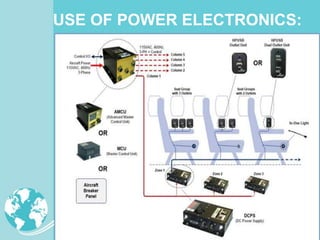
Distribution voltages for an aircraft system can be classified as:
Nominal 115/200 V rms and 230/400 V rms a
c, both one phase and three phase, over varia
ble frequency range.
Nominal 14, 28 and 42 V DC.
High DC voltage which could be suitable for u
se with an electric actuator (or other) aircraft l
oads.
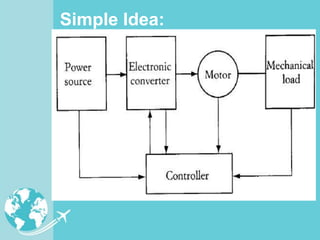
Simple Idea:
USE OF POWER ELECTRONICS:
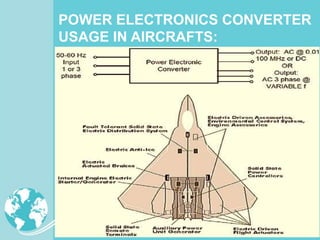
POWER ELECTRONICS CONVERTER
USAGE IN AIRCRAFTS:
USE OF POWER ELECTRONICS:
Advantages:
• Improve power system efficiency
• Improve Weight/Volume
• Reduce Total Cost
• Enhance Safety
• Improve Thermal Efficiency
• Improve Reliability
• Improve Maintainability
• Increase Functionality
• Cost Effective Rapid Technological Insertion
• Green Systems
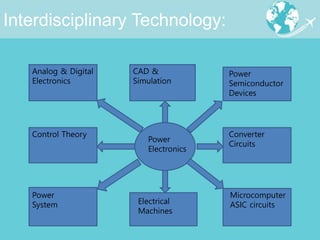
Interdisciplinary Technology:
Power
Electronics
Analog & Digital
Electronics
CAD &
Simulation
Power
Semiconductor
Devices
Control Theory Converter
Circuits
Power
System Electrical
Machines
Microcomputer
ASIC circuits
Conclusion:
• More-Electric-Airplanes are the industry trend.
• Power in Aircraft is an enabler for advances in future airplane
system design, operation and performance.
• This technology is enabler for energy generation, storage &
conversion systems and technologies.
• Power Electronics contributes to lower operating costs and
reduces fuel use, emissions and noise.
• Power Electronics, Intelligent Power Systems, and
alternative sources play a significant role for future Aircraft
System
References:
• http://ieeexplore.ieee.org/xpl/mostRece
ntIssue.jsp?punumber=6255
• http://www.cleansky.eu/green-regional-
aircraft-gra
• http://protorit.blogspot.com/2013/02/p
ower-electronics-applications.html
• http://cdn.intechopen.com/pdfs/28815/
InTech-Power_electronics_application_f
or_more_electric_aircraft.pdf
• https://en.wikipedia.org/wiki/Electric_air
craft

Aircraft

  • 1.
    Advancements in PowerElectronics technologies h ave been used widely in the aircraft industry. POWER ELECTRONICS IN AIRCRAFTS
  • 2.
    Introduction • In thecompetitive world of airline economics, where low cost carriers are driving d awn profit margins on airline seat miles, techniques for reducing the direct operati ng costs of aircraft are in great demand • In effort to meet this demand, the aircraft manufacturing industry is placing great er emphasis on the use of technology, which can influence maintenance costs and fuel usage. • There is a general move in the aircrafts industry to increase the amount of electric ally powered equipments on future aircraft. • This trend is referred to as the “More Electric Aircraft”. • It assumes using electrical energy instead of hydraulic, pneumatic and mechanical means to power virtually all aircraft subsystem including flight control actuation, e nvironmental control system and utility function. The concept offers advantages of reduced overall aircraft weight, reduced need for ground support equipment and maintenance and increased reliability • Many aircraft power systems are now operating with a variable frequency over a t ypical range of 360 Hz to 800 Hz.
  • 3.
    Introduction cont.. Distribution voltagesfor an aircraft system can be classified as: Nominal 115/200 V rms and 230/400 V rms a c, both one phase and three phase, over varia ble frequency range. Nominal 14, 28 and 42 V DC. High DC voltage which could be suitable for u se with an electric actuator (or other) aircraft l oads.
  • 4.
  • 5.
    USE OF POWERELECTRONICS:
  • 6.
    USE OF POWERELECTRONICS:
  • 7.
  • 8.
    USE OF POWERELECTRONICS:
  • 9.
    Advantages: • Improve powersystem efficiency • Improve Weight/Volume • Reduce Total Cost • Enhance Safety • Improve Thermal Efficiency • Improve Reliability • Improve Maintainability • Increase Functionality • Cost Effective Rapid Technological Insertion • Green Systems
  • 10.
    Interdisciplinary Technology: Power Electronics Analog &Digital Electronics CAD & Simulation Power Semiconductor Devices Control Theory Converter Circuits Power System Electrical Machines Microcomputer ASIC circuits
  • 11.
    Conclusion: • More-Electric-Airplanes arethe industry trend. • Power in Aircraft is an enabler for advances in future airplane system design, operation and performance. • This technology is enabler for energy generation, storage & conversion systems and technologies. • Power Electronics contributes to lower operating costs and reduces fuel use, emissions and noise. • Power Electronics, Intelligent Power Systems, and alternative sources play a significant role for future Aircraft System
  • 13.
    References: • http://ieeexplore.ieee.org/xpl/mostRece ntIssue.jsp?punumber=6255 • http://www.cleansky.eu/green-regional- aircraft-gra •http://protorit.blogspot.com/2013/02/p ower-electronics-applications.html • http://cdn.intechopen.com/pdfs/28815/ InTech-Power_electronics_application_f or_more_electric_aircraft.pdf • https://en.wikipedia.org/wiki/Electric_air craft