INTRODUCTION TO
POWER ELECTRONICS
Dr. S. Anbarasi, Associate Professor /EEE
P.S.R Engineering College, Sivakasi
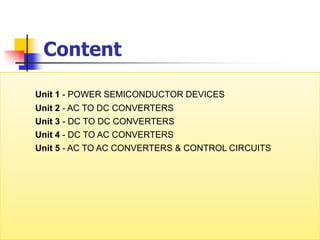
Content
Unit 1 - POWER SEMICONDUCTOR DEVICES
Unit 2 - AC TO DC CONVERTERS
Unit 3 - DC TO DC CONVERTERS
Unit 4 - DC TO AC CONVERTERS
Unit 5 - AC TO AC CONVERTERS & CONTROL CIRCUITS
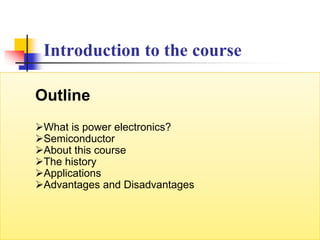
Introduction to the course
Outline
What is power electronics?
Semiconductor
About this course
The history
Applications
Advantages and Disadvantages
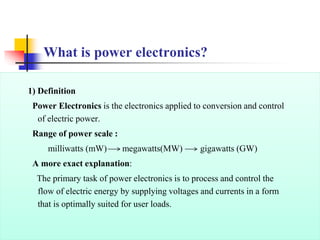
What is power electronics?
1) Definition
Power Electronics is the electronics applied to conversion and control
of electric power.
Range of power scale :
milliwatts (mW) megawatts(MW) gigawatts (GW)
A more exact explanation:
The primary task of power electronics is to process and control the
flow of electric energy by supplying voltages and currents in a form
that is optimally suited for user loads.
What is a Semiconductor?
Energy bands in Insulator
Energy bands in Conductor
Energy bands in Semiconductor
e- e- e-
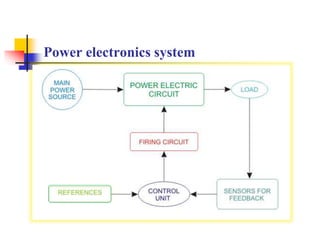
Power electronics system
Interdisciplinary nature
Electronics
Devices and Circuit
Power
Static and Rotating
Power equipment
Control
Continuous discrete
control
POWER
ELECTRONICS
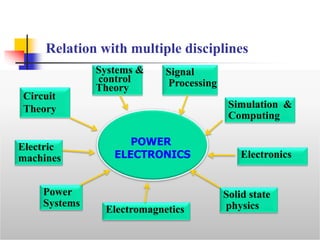
Relation with multiple disciplines
Power electronics is currently the most active discipline in electric power
engineering.
Circuit
Theory
Systems &
control
Theory
Signal
Processing
Simulation &
Computing
Electronics
Solid state
physics
Electromagnetics
Power
Systems
Electric
machines
POWER
ELECTRONICS
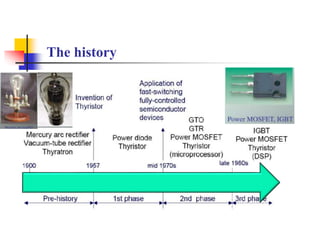
The history
Applications
Industrial applications
 Motor drives
 Electrolysis
 Electroplating
 Induction heating
 Welding
 Arc furnaces and ovens
 Lighting
Applications
Transportation applications
 Trains & locomotives
 Subways
 Trolley buses
 Magnetic levitation
 Electric vehicles
 Automotive electronics
 Ship power systems
 Aircraft power systems
Applications
Utility systems applications
 High- voltage dc transmission(HVDC)
 Flexible ac transmission(FACTS)
 Static var compensation & harmonics
 suppression: TCR, TSC, SVG, APF
 Custom power & power quality control
 Supplemental energy sources
 wind, photovoltaic, fuel cells
 Energy storage systems
Applications
Power supplies for electronic equipment
 Telecommunications
 Computers
 Office equipment
 Electronic instruments
 Portable or mobile electronics
Applications
Residential and home appliances
 Lighting
 Heating
 Air conditioning
 Refrigeration & freezers
 Cooking
 Cleaning
 Entertaining
Applications
Applications in space technology
 Spaceship power systems
 Satellite power systems
 Space vehicle power systems
Applications
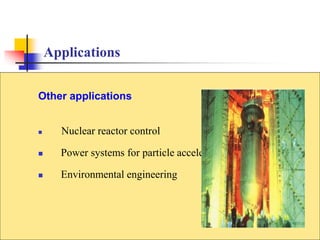
Other applications
 Nuclear reactor control
 Power systems for particle accelerators
 Environmental engineering
Advantages of power electronics converter
Fast dynamic response due to static device
Low losses so high efficiency
Compact size and light weight
Increased operating life and reduced maintenance
Power electronic controllers are useful digital/ microprocessor
based control system. So increased flexibility in control.
Drawbacks of Power Electronics converter
Production of harmonics
In some Power electronic devices power factor is low
power factor correction is needed
For simple conversion equipment power electronic
devices are very costly
Low overload capacity
References
https://www.youtube.com/watch?v=gUmDVe6C-BU
Power Electronics: Circuits, Devices and Applications By M. Rashid, Prentice-Hall.
Power Electronics: Converters, Applications and Design By N. Mohan, T. Undeland, and W.
Robins, John-Wiley.
Slide share: Power Electronics Lecture 1 by Prof. Mohammed Zeki Khedher Department of
Electrical Engineering, University of Jordan

Lecture 1 Introduction.ppsx

  • 1.
    INTRODUCTION TO POWER ELECTRONICS Dr.S. Anbarasi, Associate Professor /EEE P.S.R Engineering College, Sivakasi
  • 2.
    Content Unit 1 -POWER SEMICONDUCTOR DEVICES Unit 2 - AC TO DC CONVERTERS Unit 3 - DC TO DC CONVERTERS Unit 4 - DC TO AC CONVERTERS Unit 5 - AC TO AC CONVERTERS & CONTROL CIRCUITS
  • 3.
    Introduction to thecourse Outline What is power electronics? Semiconductor About this course The history Applications Advantages and Disadvantages
  • 4.
    What is powerelectronics? 1) Definition Power Electronics is the electronics applied to conversion and control of electric power. Range of power scale : milliwatts (mW) megawatts(MW) gigawatts (GW) A more exact explanation: The primary task of power electronics is to process and control the flow of electric energy by supplying voltages and currents in a form that is optimally suited for user loads.
  • 5.
    What is aSemiconductor?
  • 6.
    Energy bands inInsulator
  • 7.
    Energy bands inConductor
  • 8.
    Energy bands inSemiconductor e- e- e-
  • 9.
  • 10.
    Interdisciplinary nature Electronics Devices andCircuit Power Static and Rotating Power equipment Control Continuous discrete control POWER ELECTRONICS
  • 11.
    Relation with multipledisciplines Power electronics is currently the most active discipline in electric power engineering. Circuit Theory Systems & control Theory Signal Processing Simulation & Computing Electronics Solid state physics Electromagnetics Power Systems Electric machines POWER ELECTRONICS
  • 12.
  • 13.
    Applications Industrial applications  Motordrives  Electrolysis  Electroplating  Induction heating  Welding  Arc furnaces and ovens  Lighting
  • 14.
    Applications Transportation applications  Trains& locomotives  Subways  Trolley buses  Magnetic levitation  Electric vehicles  Automotive electronics  Ship power systems  Aircraft power systems
  • 15.
    Applications Utility systems applications High- voltage dc transmission(HVDC)  Flexible ac transmission(FACTS)  Static var compensation & harmonics  suppression: TCR, TSC, SVG, APF  Custom power & power quality control  Supplemental energy sources  wind, photovoltaic, fuel cells  Energy storage systems
  • 16.
    Applications Power supplies forelectronic equipment  Telecommunications  Computers  Office equipment  Electronic instruments  Portable or mobile electronics
  • 17.
    Applications Residential and homeappliances  Lighting  Heating  Air conditioning  Refrigeration & freezers  Cooking  Cleaning  Entertaining
  • 18.
    Applications Applications in spacetechnology  Spaceship power systems  Satellite power systems  Space vehicle power systems
  • 19.
    Applications Other applications  Nuclearreactor control  Power systems for particle accelerators  Environmental engineering
  • 20.
    Advantages of powerelectronics converter Fast dynamic response due to static device Low losses so high efficiency Compact size and light weight Increased operating life and reduced maintenance Power electronic controllers are useful digital/ microprocessor based control system. So increased flexibility in control.
  • 21.
    Drawbacks of PowerElectronics converter Production of harmonics In some Power electronic devices power factor is low power factor correction is needed For simple conversion equipment power electronic devices are very costly Low overload capacity
  • 22.
    References https://www.youtube.com/watch?v=gUmDVe6C-BU Power Electronics: Circuits,Devices and Applications By M. Rashid, Prentice-Hall. Power Electronics: Converters, Applications and Design By N. Mohan, T. Undeland, and W. Robins, John-Wiley. Slide share: Power Electronics Lecture 1 by Prof. Mohammed Zeki Khedher Department of Electrical Engineering, University of Jordan