ELECTRICAL DRIVES AND
CONTROL
Mr.C.Anandhakumar, AP / EEE, SRIT
BASICS OF ELECTRICAL DRIVES AND
CONTROL
By
ANANDHAKUMAR C
Assistant Professor / EEE
Sri Ramakrishna Institute of Technology
1
ELECTRICAL DRIVES AND
CONTROL
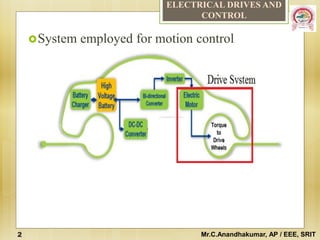
System employed for motion control
Mr.C.Anandhakumar, AP / EEE, SRIT
2
ELECTRICAL DRIVES AND
CONTROL
Mr.C.Anandhakumar, AP / EEE, SRIT
 In 1838 the First DC motor is tested with the help of
Energy storage battery in Russia
 Due to lack of electrical energy it can’t be used in
industries and other applications at that time
 After advent of AC power source many AC motors can be
employed in industrial at the time of 1890’s
 In 1890’s electric motors accounted for 5% of the total
power of all types of prime movers used by industries
HISTORY OF DRIVES
3
ELECTRICAL DRIVES AND
CONTROL
Mr.C.Anandhakumar, AP / EEE, SRIT
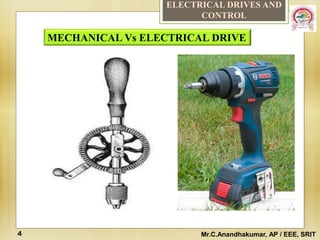
MECHANICAL Vs ELECTRICAL DRIVE
4
ELECTRICAL DRIVES AND
CONTROL
Mr.C.Anandhakumar, AP / EEE, SRIT
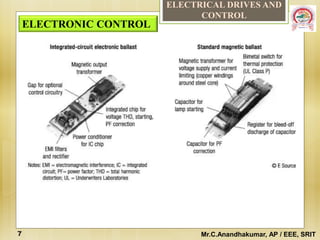
ELECTRONIC CONTROL
 After the advent of semiconductor switches the
controlling of
Current
Voltage
Power
Frequency
becomes effective
 For Controlling, the control unit is designed with
ICs
Microprocessor unit
VLSI technology
5
ELECTRICAL DRIVES AND
CONTROL
Mr.C.Anandhakumar, AP / EEE, SRIT
ELECTRONIC CONTROL
6
ELECTRICAL DRIVES AND
CONTROL
Mr.C.Anandhakumar, AP / EEE, SRIT
ELECTRONIC CONTROL
7
ELECTRICAL DRIVES AND
CONTROL
Mr.C.Anandhakumar, AP / EEE, SRIT
SOLID STATE CONTROL
 Electrical drives which employs solid state devices like
Thyristors for their control operation is termed as “Solid
State Control”
 Thyristors are invented at 1957 and replaced all the
components in the drive system
 Applications:
Paper mills
Cement mills
Battery chargers
Fork lift trucks
Machine tools
8
ELECTRICAL DRIVES AND
CONTROL
Mr.C.Anandhakumar, AP / EEE, SRIT
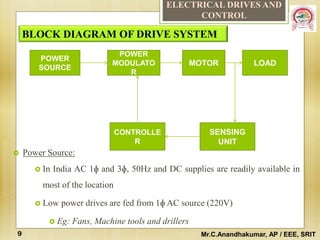
BLOCK DIAGRAM OF DRIVE SYSTEM
POWER
SOURCE
POWER
MODULATO
R
MOTOR LOAD
CONTROLLE
R
SENSING
UNIT
 Power Source:
 In India AC 1ɸ and 3ɸ, 50Hz and DC supplies are readily available in
most of the location
 Low power drives are fed from 1ɸ AC source (220V)
 Eg: Fans, Machine tools and drillers
9
ELECTRICAL DRIVES AND
CONTROL
Mr.C.Anandhakumar, AP / EEE, SRIT
BLOCK DIAGRAM OF DRIVE SYSTEM
 Power Source:
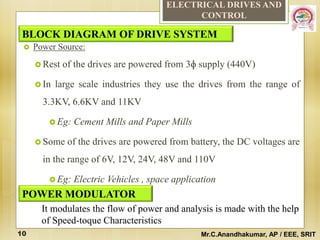
 Rest of the drives are powered from 3ɸ supply (440V)
 In large scale industries they use the drives from the range of
3.3KV, 6.6KV and 11KV
 Eg: Cement Mills and Paper Mills
 Some of the drives are powered from battery, the DC voltages are
in the range of 6V, 12V, 24V, 48V and 110V
 Eg: Electric Vehicles , space application
POWER MODULATOR
It modulates the flow of power and analysis is made with the help
of Speed-toque Characteristics
10
ELECTRICAL DRIVES AND
CONTROL
Mr.C.Anandhakumar, AP / EEE, SRIT
POWER MODULATOR
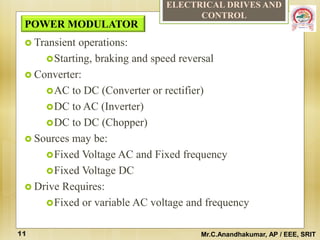
 Transient operations:
Starting, braking and speed reversal
 Converter:
AC to DC (Converter or rectifier)
DC to AC (Inverter)
DC to DC (Chopper)
 Sources may be:
Fixed Voltage AC and Fixed frequency
Fixed Voltage DC
 Drive Requires:
Fixed or variable AC voltage and frequency
11
ELECTRICAL DRIVES AND
CONTROL
Mr.C.Anandhakumar, AP / EEE, SRIT
POWER MODULATOR
 Types of converter:
Rectifiers
AC voltage controllers or AC regulators
Choppers
Inverters
Cyclo converter
 RECTIFIERS:
It converts AC supply to DC Supply
Types:
Diode rectifiers
Half controlled thyristor rectifiers
Fully controlled thyristor rectifiers
12
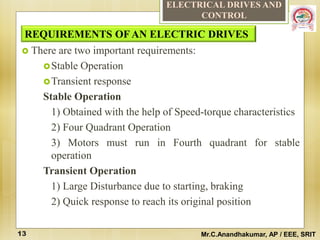
 There are two important requirements:
Stable Operation
Transient response
Stable Operation
1) Obtained with the help of Speed-torque characteristics
2) Four Quadrant Operation
3) Motors must run in Fourth quadrant for stable
operation
Transient Operation
1) Large Disturbance due to starting, braking
2) Quick response to reach its original position
ELECTRICAL DRIVES AND
CONTROL
Mr.C.Anandhakumar, AP / EEE, SRIT
REQUIREMENTS OFAN ELECTRIC DRIVES
13
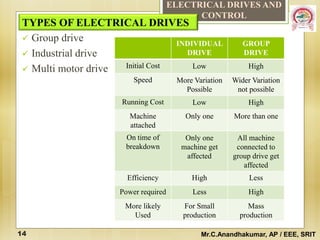
 Group drive
 Industrial drive
 Multi motor drive
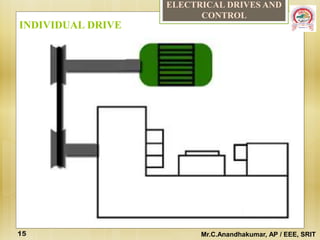
INDIVIDUAL
DRIVE
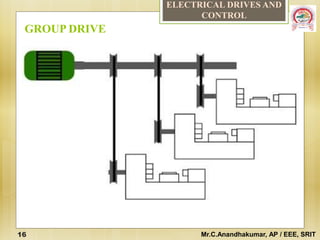
GROUP
DRIVE
Initial Cost Low High
Speed More Variation
Possible
Wider Variation
not possible
Running Cost Low High
Machine
attached
Only one More than one
On time of
breakdown
Only one
machine get
affected
All machine
connected to
group drive get
affected
Efficiency High Less
Power required Less High
More likely
Used
For Small
production
Mass
production
ELECTRICAL DRIVES AND
CONTROL
Mr.C.Anandhakumar, AP / EEE, SRIT
TYPES OF ELECTRICAL DRIVES
14
INDIVIDUAL DRIVE
ELECTRICAL DRIVES AND
CONTROL
Mr.C.Anandhakumar, AP / EEE, SRIT
15
GROUP DRIVE
ELECTRICAL DRIVES AND
CONTROL
Mr.C.Anandhakumar, AP / EEE, SRIT
16
Classifications according to Mode of Operation:
Continuous duty drives
Short time duty drives
Intermittent duty drives
Classifications according to Means of Control:
Manual
Semi automatic
Automatic
Classifications according to Dynamics and Transients:
Uncontrolled Transient period
Controlled transient period
ELECTRICAL DRIVES AND
CONTROL
Mr.C.Anandhakumar, AP / EEE, SRIT
17
ADVANTAGES OF ELECTRICAL DRIVES
 Flexible control
 Automatic fault detection system
 Available in wide range of torque, speed and power
 Adaptable to all operating conditions
(explosive and radioactive)
 Four quadrant operation
(FM,RM,FB and RB)
 Started instantly
 Simple and easy to operate
ELECTRICAL DRIVES AND
CONTROL
Mr.C.Anandhakumar, AP / EEE, SRIT
18
CHOICE OR SELECTION
OF DRIVES
 Steady State Operating conditions requirements
 Nature of speed torque characteristics, speed regulation, speed
range, efficiency, duty cycle, quadrants of operation, speed
fluctuations if any, ratings etc
 Transient operation requirements
 Values of acceleration and deceleration, starting, braking and
reversing performance.
 Requirements related to the source
 Types of source and its capacity, magnitude of voltage, voltage
fluctuations, power factor, harmonics and their effect on other
loads, ability to accept regenerative power
 Capital and running cost, maintenance needs life.
 Space and weight restriction if any.
 Environment and location.
 Reliability.
ELECTRICAL DRIVES AND
CONTROL
Mr.C.Anandhakumar, AP / EEE, SRIT
19
ELECTRICAL DRIVES AND
CONTROL
Mr.C.Anandhakumar, AP / EEE, SRIT
REFERENCES:
 Dubey G.K., “Fundamentals of Electrical Drives ”, Narosa
Publishing House, New Delhi, 2nd Ed. 2002.
 VedamSubramanyam, “ Electric Drives Concepts &
Applications” Tata McGraw Hill 2nd edition 2010.
 NisitK.De and PrashantaK.Sen, “ Electric Drives”, PHI.,
2001
 R.Krishnan, “Electric motor Drives: Modelling, Analysis and
control”, Prentice Hall,2001.
 Pillai S.K., “A First Course on Electrical Drives”,Wiley
Eastern Ltd.,Bombay,2nd Ed 2007
20

Electrical drives and control

  • 1.
    ELECTRICAL DRIVES AND CONTROL Mr.C.Anandhakumar,AP / EEE, SRIT BASICS OF ELECTRICAL DRIVES AND CONTROL By ANANDHAKUMAR C Assistant Professor / EEE Sri Ramakrishna Institute of Technology 1
  • 2.
    ELECTRICAL DRIVES AND CONTROL Systememployed for motion control Mr.C.Anandhakumar, AP / EEE, SRIT 2
  • 3.
    ELECTRICAL DRIVES AND CONTROL Mr.C.Anandhakumar,AP / EEE, SRIT  In 1838 the First DC motor is tested with the help of Energy storage battery in Russia  Due to lack of electrical energy it can’t be used in industries and other applications at that time  After advent of AC power source many AC motors can be employed in industrial at the time of 1890’s  In 1890’s electric motors accounted for 5% of the total power of all types of prime movers used by industries HISTORY OF DRIVES 3
  • 4.
    ELECTRICAL DRIVES AND CONTROL Mr.C.Anandhakumar,AP / EEE, SRIT MECHANICAL Vs ELECTRICAL DRIVE 4
  • 5.
    ELECTRICAL DRIVES AND CONTROL Mr.C.Anandhakumar,AP / EEE, SRIT ELECTRONIC CONTROL  After the advent of semiconductor switches the controlling of Current Voltage Power Frequency becomes effective  For Controlling, the control unit is designed with ICs Microprocessor unit VLSI technology 5
  • 6.
    ELECTRICAL DRIVES AND CONTROL Mr.C.Anandhakumar,AP / EEE, SRIT ELECTRONIC CONTROL 6
  • 7.
    ELECTRICAL DRIVES AND CONTROL Mr.C.Anandhakumar,AP / EEE, SRIT ELECTRONIC CONTROL 7
  • 8.
    ELECTRICAL DRIVES AND CONTROL Mr.C.Anandhakumar,AP / EEE, SRIT SOLID STATE CONTROL  Electrical drives which employs solid state devices like Thyristors for their control operation is termed as “Solid State Control”  Thyristors are invented at 1957 and replaced all the components in the drive system  Applications: Paper mills Cement mills Battery chargers Fork lift trucks Machine tools 8
  • 9.
    ELECTRICAL DRIVES AND CONTROL Mr.C.Anandhakumar,AP / EEE, SRIT BLOCK DIAGRAM OF DRIVE SYSTEM POWER SOURCE POWER MODULATO R MOTOR LOAD CONTROLLE R SENSING UNIT  Power Source:  In India AC 1ɸ and 3ɸ, 50Hz and DC supplies are readily available in most of the location  Low power drives are fed from 1ɸ AC source (220V)  Eg: Fans, Machine tools and drillers 9
  • 10.
    ELECTRICAL DRIVES AND CONTROL Mr.C.Anandhakumar,AP / EEE, SRIT BLOCK DIAGRAM OF DRIVE SYSTEM  Power Source:  Rest of the drives are powered from 3ɸ supply (440V)  In large scale industries they use the drives from the range of 3.3KV, 6.6KV and 11KV  Eg: Cement Mills and Paper Mills  Some of the drives are powered from battery, the DC voltages are in the range of 6V, 12V, 24V, 48V and 110V  Eg: Electric Vehicles , space application POWER MODULATOR It modulates the flow of power and analysis is made with the help of Speed-toque Characteristics 10
  • 11.
    ELECTRICAL DRIVES AND CONTROL Mr.C.Anandhakumar,AP / EEE, SRIT POWER MODULATOR  Transient operations: Starting, braking and speed reversal  Converter: AC to DC (Converter or rectifier) DC to AC (Inverter) DC to DC (Chopper)  Sources may be: Fixed Voltage AC and Fixed frequency Fixed Voltage DC  Drive Requires: Fixed or variable AC voltage and frequency 11
  • 12.
    ELECTRICAL DRIVES AND CONTROL Mr.C.Anandhakumar,AP / EEE, SRIT POWER MODULATOR  Types of converter: Rectifiers AC voltage controllers or AC regulators Choppers Inverters Cyclo converter  RECTIFIERS: It converts AC supply to DC Supply Types: Diode rectifiers Half controlled thyristor rectifiers Fully controlled thyristor rectifiers 12
  • 13.
     There aretwo important requirements: Stable Operation Transient response Stable Operation 1) Obtained with the help of Speed-torque characteristics 2) Four Quadrant Operation 3) Motors must run in Fourth quadrant for stable operation Transient Operation 1) Large Disturbance due to starting, braking 2) Quick response to reach its original position ELECTRICAL DRIVES AND CONTROL Mr.C.Anandhakumar, AP / EEE, SRIT REQUIREMENTS OFAN ELECTRIC DRIVES 13
  • 14.
     Group drive Industrial drive  Multi motor drive INDIVIDUAL DRIVE GROUP DRIVE Initial Cost Low High Speed More Variation Possible Wider Variation not possible Running Cost Low High Machine attached Only one More than one On time of breakdown Only one machine get affected All machine connected to group drive get affected Efficiency High Less Power required Less High More likely Used For Small production Mass production ELECTRICAL DRIVES AND CONTROL Mr.C.Anandhakumar, AP / EEE, SRIT TYPES OF ELECTRICAL DRIVES 14
  • 15.
    INDIVIDUAL DRIVE ELECTRICAL DRIVESAND CONTROL Mr.C.Anandhakumar, AP / EEE, SRIT 15
  • 16.
    GROUP DRIVE ELECTRICAL DRIVESAND CONTROL Mr.C.Anandhakumar, AP / EEE, SRIT 16
  • 17.
    Classifications according toMode of Operation: Continuous duty drives Short time duty drives Intermittent duty drives Classifications according to Means of Control: Manual Semi automatic Automatic Classifications according to Dynamics and Transients: Uncontrolled Transient period Controlled transient period ELECTRICAL DRIVES AND CONTROL Mr.C.Anandhakumar, AP / EEE, SRIT 17
  • 18.
    ADVANTAGES OF ELECTRICALDRIVES  Flexible control  Automatic fault detection system  Available in wide range of torque, speed and power  Adaptable to all operating conditions (explosive and radioactive)  Four quadrant operation (FM,RM,FB and RB)  Started instantly  Simple and easy to operate ELECTRICAL DRIVES AND CONTROL Mr.C.Anandhakumar, AP / EEE, SRIT 18
  • 19.
    CHOICE OR SELECTION OFDRIVES  Steady State Operating conditions requirements  Nature of speed torque characteristics, speed regulation, speed range, efficiency, duty cycle, quadrants of operation, speed fluctuations if any, ratings etc  Transient operation requirements  Values of acceleration and deceleration, starting, braking and reversing performance.  Requirements related to the source  Types of source and its capacity, magnitude of voltage, voltage fluctuations, power factor, harmonics and their effect on other loads, ability to accept regenerative power  Capital and running cost, maintenance needs life.  Space and weight restriction if any.  Environment and location.  Reliability. ELECTRICAL DRIVES AND CONTROL Mr.C.Anandhakumar, AP / EEE, SRIT 19
  • 20.
    ELECTRICAL DRIVES AND CONTROL Mr.C.Anandhakumar,AP / EEE, SRIT REFERENCES:  Dubey G.K., “Fundamentals of Electrical Drives ”, Narosa Publishing House, New Delhi, 2nd Ed. 2002.  VedamSubramanyam, “ Electric Drives Concepts & Applications” Tata McGraw Hill 2nd edition 2010.  NisitK.De and PrashantaK.Sen, “ Electric Drives”, PHI., 2001  R.Krishnan, “Electric motor Drives: Modelling, Analysis and control”, Prentice Hall,2001.  Pillai S.K., “A First Course on Electrical Drives”,Wiley Eastern Ltd.,Bombay,2nd Ed 2007 20