Airline Marketing 3: The
Airline Market
Dr Narudh Cheramakara
Bangkok University
1/2017
1. What is airline business?
1.1 Transportation
- A mode of air transport
- From A-B
- Speed v Cost
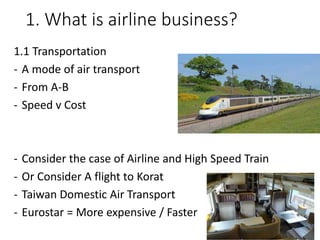
- Consider the case of Airline and High Speed Train
- Or Consider A flight to Korat
- Taiwan Domestic Air Transport
- Eurostar = More expensive / Faster
1. What is airline business?
1.2 Communication
Airlines are increasingly being competed with online
technology
- Replacing face-to-face communication
- Video conference
- Email
1. What is airline business?
1.3 Leisure – Competing on fares
1.4 Logistics – Air freights /Business Documents
- Business documents have – to a certain extent –
replaced by email and digital technology
- Air Freights can be seen as ancillary revenues from
the passenger flights
- Boom in online shops can result in increase in air
cargo demand
1.5 Selling Service = Asian Airlines are famous for
hospitality / Middles East for Hard products (seats,
IFEs)
2. Who are the airline customers?
• Consumers v Customers
• Consumer = Passengers
• Customer = Decision Makers
- It is important that effective marketing understands
and adjust their marketing strategy accordingly.
- Who is the decision maker for your trip?
• There are at least four customer decisions which must
be analysed:
2. Who are the airline customers?
2.1 Will a trip be made at all?
- The cost (and benefits) consideration for firms.
- What are the alternatives?
- The management has the final say on whether the
trip should go ahead (therefore they are the
decision maker)
2. Who are the airline customers?
2.2 What mode of transport will be selected?
- Speed (Including travel time to/from the airport)
- Cost
- Comfort
E.g. for family trip, the customer might be the family
member who has most influence in travel decisions.
2. Who are the airline customers?
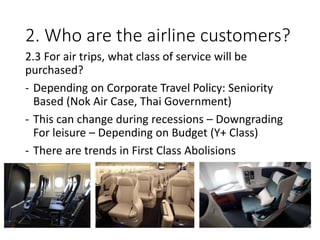
2.3 For air trips, what class of service will be
purchased?
- Depending on Corporate Travel Policy: Seniority
Based (Nok Air Case)
- This can change during recessions – Downgrading
to save
- For leisure – Depending on Budget (Premium
Economy Example)
2. Who are the airline customers?
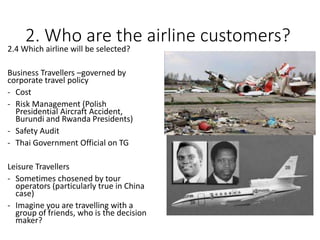
2.3 For air trips, what class of service will be
purchased?
- Depending on Corporate Travel Policy: Seniority
Based (Nok Air Case, Thai Government)
- This can change during recessions – Downgrading
For leisure – Depending on Budget (Y+ Class)
- There are trends in First Class Abolisions
2. Who are the airline customers?
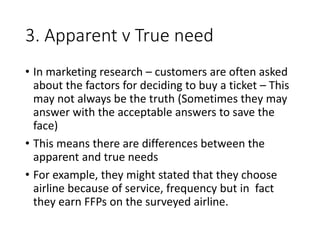
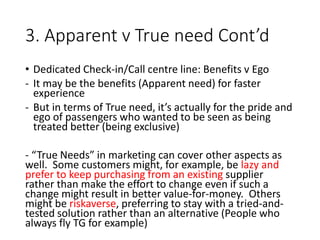
2.4 Which airline will be selected?
Business Travellers –governed by
corporate travel policy
- Cost
- Risk Management (Polish
Presidential Aircraft Accident,
Burundi and Rwanda Presidents)
- Safety Audit
- Thai Government Official on TG
Leisure Travellers
- Sometimes chosened by tour
operators (particularly true in China
case)
- Imagine you are travelling with a
group of friends, who is the decision
maker?
3. Apparent v True need
• In marketing research – customers are often asked
about the factors for deciding to buy a ticket – This
may not always be the truth (Sometimes they may
answer with the acceptable answers to save the
face)
• This means there are differences between the
apparent and true needs
• For example, they might stated that they choose
airline because of service, frequency but in fact
they earn FFPs on the surveyed airline.
3. Apparent v True need Cont’d
• Dedicated Check-in/Call centre line: Benefits v Ego
- It may be the benefits (Apparent need) for faster
experience
- But in terms of True need, it’s actually for the pride and
ego of passengers who wanted to be seen as being
treated better (being exclusive)
- “True Needs” in marketing can cover other aspects as
well. Some customers might, for example, be lazy and
prefer to keep purchasing from an existing supplier
rather than make the effort to change even if such a
change might result in better value-for-money. Others
might be riskaverse, preferring to stay with a tried-and-
tested solution rather than an alternative (People who
always fly TG for example)
3. Apparent v True need Cont’d
• “True Needs” are at the heart of successful
marketing. In many ways they reflect the
weaknesses of the human personality.
• They are also relatively constant in their
importance through time. No-one who is
concerned to make a success of an airline’s
marketing activities should make the mistake of
assuming that a declared customer requirement is
actually a true description of what is motivating
purchasing decisions.
4. Industrial Buying Behaviours
• In Consumer Marketing it is usually possible with
confidence to target the individual or the family. In
contrast, in Industrial Marketing, purchasing
decisions will often be made in a complex way with
different corporate executives interacting in
different ways through a so-called Decision-Making
Unit or DMU.
• Must understand ‘apparent’ and ‘true’ needs of
each DMU
4. Industrial Buying Behaviours:
DMUs
1. Deciders
- People who make final decision
- Apparent need: buying in the best interest for the
firm
- True need: There may be hidden agenda (Bribes,
corporate entertainment) or they can be risk averse
for fear of losing jobs
4. Industrial Buying Behaviours:
DMUs
2. Gatekeepers
- People who control the flow of information into the
Decision-Making Unit.
- Decider’s secretary or Personal Assistant: They can
stop timewasting from unwanted sale person, etc.
4. Industrial Buying Behaviours:
DMUs
3. Users
- The passenger (company’s employee, management)
- Care about the products and benefits than cost.
- They will lobby the “Decider” (commonly an
executive with a job title such as Corporate Travel
Manager) to use airlines with superb products and
services with FFPs
4. Industrial Buying Behaviours:
DMUs
4. Buyers
- People who negotiate the final deal with the
different airlines
- In terms of true needs: Job security, risk averse
4. Industrial Buying Behaviours:
DMUs
5. Influencers
Influencers are those people who do not use a
product, or become involved in detailed negotiations
with suppliers, but who do influence the final
outcome of the buying process.
- Influencers can come from both outside and inside
a firm. May be a domestic partner of the
user/decider
- Online influencer, reviews etc. Very important
nowadays
5. Market Segmentation
• Market segmentation consists of taking the total heterogeneous market
for a product and dividing it into several sub-markets or segments, each
of which tends to be homogeneous in all significant aspects.
• The purposes of market segmentation
• Market segmentation is conducted for two main purposes, including:
- A better allocation of a firm's finite resources (which are limited)
- To better serve the more diversified tastes
• Segmentation can be defined in terms of the STP acronym, meaning
Segment, Target, Position.
5. Market Segmentation Cont’d
1. Segment
• Segmentation involves the initial splitting up of
consumers into persons of like needs/wants/tastes.
• Geographical (a country, region, city, town, etc.)
• Psychographic (e.g. Lifestyle, personalities, beliefs)
• Demographic (e.g. age, gender, socio-economic class,
education, etc.)
• Behavioural (e.g. brand loyalty, usage rate, buying
channal etc.)
5. Market Segmentation Cont’d
2. Target
- Discernable - how a segment can be differentiated from other segments.
- Accessible - how a segment can be accessed via Marketing Communications
- Measurable - can the segment be quantified and its size determined?
- Profitable - ROI? Is it worthwhile?
• The next step in the targeting process is the level of differentiation involved in
a segment serving. Three modes of differentiation exist,
• Undifferentiated - same product for all of a market segment
• Differentiated - slight modifications of a product within a segment
• Niche - in which an organisation forges a product to satisfy a specialised target
market 3. Position
3. Positioning concerns how to position a product in the minds of consumers.
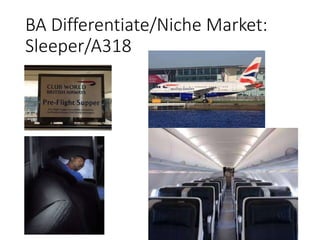
BA Differentiate/Niche Market:
Sleeper/A318
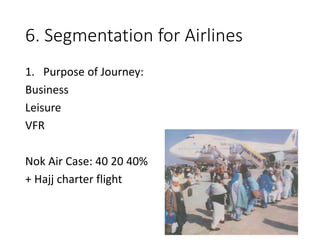
6. Segmentation for Airlines
1. Purpose of Journey:
Business
Leisure
VFR
Nok Air Case: 40 20 40%
+ Hajj charter flight
6. Segmentation for Airlines
Cont’d
2. Length of Journey
- Reasons why LCCs works with in 4 hours flying time
- Short haul, importance on airport and convenient on
the ground
- Long Haul, importance in-flights service (IFE, seats)
- Still air fare will always an important factor
Considering
- 1. BKK-CNX TG 4700, FD 2000
- 2. BKK FRA EK 36000, UIA 32000
6. Segmentation for Airlines
Cont’d
3. Country/Culture of Origin of the Travellers
- Different Requirements: Dietary, Religious, Booking
behavior, Linguistics
- National Airlines: TG, Thainess, Culture, Linguistic
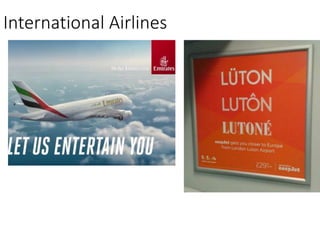
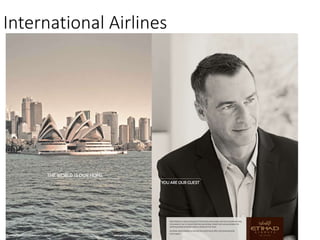
- Global Branding: Emirates, Etihad, Easyjet, Air Asia
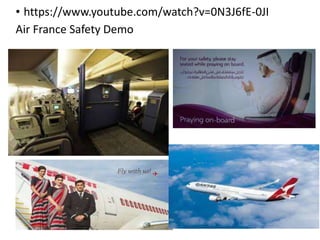
• https://www.youtube.com/watch?v=0N3J6fE-0JI
Air France Safety Demo
International Airlines
7. Customer Requirements
1. Frequencies and Timing
2. Punctuality
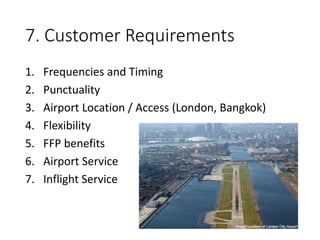
3. Airport Location / Access (London, Bangkok)
4. Flexibility
5. FFP benefits
6. Airport Service
7. Inflight Service
8. Segmentation for airlines cont’d
1) Business
- Frequency
- Flexibility
- Benefits (FFPs, Comfort)
- Company pays!!!!
- Thai Gov’t, MPs (Freebies, VIP treatments, Front row)
- Elasticity of demand:……………. Elastic or inelastic?
8. Segmentation for airlines
Cont’d
2) Leisure (+VFR)
- Price
- Self-paid
- Strong seasonal fluctuation
- Changing buying behaviours: Travel agents (commission
cuts) to direct sales -> Hugh effects on the travel industry
- Elastic or inelastic demand? Price sensitivity?
- Of the two, which group of passengers do airlines
preferred? Why?
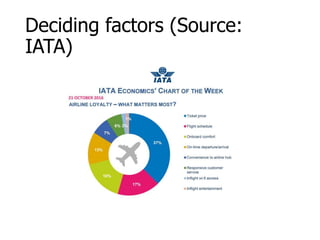
Deciding factors (Source:
IATA)