Management of
Transportation
Seventh Edition
Coyle, Novack, Gibson &
Bardi
© 2011 Cengage Learning
Chapter 7
The Airline
Industry
1© 2011 Cengage Learning. All Rights Reserved. May not be scanned, copied
or duplicated, or posted to a publicly accessible website, in whole or in part.
© 2011 Cengage Learning. All Rights Reserved. May not be scanned, copied
or duplicated, or posted to a publicly accessible website, in whole or in part.
2
Introduction
• Rail: dominant mode from 1850s to WW II
– Superior in both price and service quality to
road transport for most of this period
– Superior in service quality to water transport
• Development facilitated by standardization
of track gauge and rolling stock
• Pivotal role in U.S. economic development
– Great expansion in track mileage, post-1870s
– Financed by private capital
– Too much track mileage relative to demand
© 2011 Cengage Learning. All Rights Reserved. May not be scanned, copied or
duplicated, or posted to a publicly accessible website, in whole or in part.
3
Introduction
• Wright Brothers first flight: 1903
• Government development and promotion of air
transport begins in 1920s:
– U.S. Post Office air mail subsidy program helps
launch commercial passenger airline industry
• Competitive advantage: Speed (travel time
savings)
• Econ. Deregulation enables more competitive
pricing
© 2011 Cengage Learning. All Rights Reserved. May not be scanned, copied or
duplicated, or posted to a publicly accessible website, in whole or in part.
4
Types of Carriers
Private Carriers
• Definition:
– A firm that transports company personnel or
freight in planes to support its primary business
• Preponderance of use is for transport of
personnel
• Subject to federal safety regulations
administered by the Federal Aviation Adm.
(FAA)
Types of Carriers
For-Hire Carriers
• Several different classification schemes
– Classified by annual operating revenues
• Majors (revenues of >$1 billion)
• Nationals ($100 million - $1 billion)
• Regionals (revenues of <$100 million)
– Classified by type of service
• All-cargo
• Commuter
• Charter
• International
© 2011 Cengage Learning. All Rights Reserved. May not be scanned, copied or
duplicated, or posted to a publicly accessible website, in whole or in part.
5
© 2011 Cengage Learning. All Rights Reserved. May not be scanned, copied or
duplicated, or posted to a publicly accessible website, in whole or in part.
6
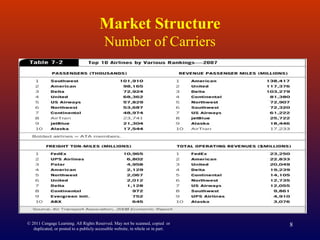
Market Structure
Number of Carriers
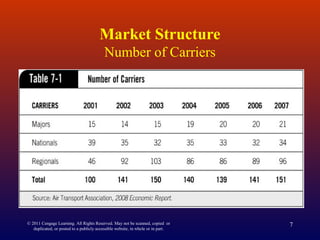
• Relatively small number of for-hire carriers
– Most revenues earned by small number of majors
– Several cycles of increasing, then decreasing
number of airlines after 1978 deregulation
• Private air transport
– Over 500 corporations own/operate aircraft
– About 60,000 corporate-owned planes exist
– Thousands of private aircraft used for personal,
recreational, and instructional purposes
Market Structure
Number of Carriers
© 2011 Cengage Learning. All Rights Reserved. May not be scanned, copied or
duplicated, or posted to a publicly accessible website, in whole or in part.
7
Market Structure
Number of Carriers
© 2011 Cengage Learning. All Rights Reserved. May not be scanned, copied or
duplicated, or posted to a publicly accessible website, in whole or in part.
8
© 2011 Cengage Learning. All Rights Reserved. May not be scanned, copied or
duplicated, or posted to a publicly accessible website, in whole or in part.
9
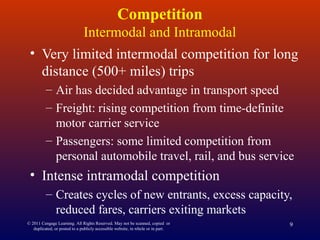
Competition
Intermodal and Intramodal
• Very limited intermodal competition for long
distance (500+ miles) trips
– Air has decided advantage in transport speed
– Freight: rising competition from time-definite
motor carrier service
– Passengers: some limited competition from
personal automobile travel, rail, and bus service
• Intense intramodal competition
– Creates cycles of new entrants, excess capacity,
reduced fares, carriers exiting markets
© 2011 Cengage Learning. All Rights Reserved. May not be scanned, copied or
duplicated, or posted to a publicly accessible website, in whole or in part.
10
Competition
Service Competition
• Nature of passenger service competition
– Flight frequency on given route
– Timing of flights
– Meals, in-flight communications, other services
– No-frills alternatives intensify competition
– Advertising used to differentiate carriers
• Nature of competition for cargo, express traffic
– Published schedules and rates
– Door-to-door, time-definite service
© 2011 Cengage Learning. All Rights Reserved. May not be scanned, copied or
duplicated, or posted to a publicly accessible website, in whole or in part.
11
Operating and Service Characteristics
General
• Due to value of time, air dominates for-
hire, long-distance passenger market
• When importance of speed outweighs cost,
then air is attractive for freight
– Emergency shipments
– Typical commodities
• Mail, fashion clothing, communications products,
fresh flowers, racehorses, jewelry
– Air freight cost vs. inventory cost tradeoff
© 2011 Cengage Learning. All Rights Reserved. May not be scanned, copied or
duplicated, or posted to a publicly accessible website, in whole or in part.
12
Operating and Service Characteristics
Speed of Service
• Speed, travel time advantage can be off-set by
– Low flight frequency, schedule timing
• Smaller communities have experienced reduced
frequencies
– In-direct routing due to hub and spoke networks
• Legacy majors moved to hub and spoke networks
following deregulation to improve load-factors
– Air traffic and ground congestion, security measures
• Most relevant at major airports
• Adds uncertainty to total travel time
© 2011 Cengage Learning. All Rights Reserved. May not be scanned, copied or
duplicated, or posted to a publicly accessible website, in whole or in part.
13
Operating and Service Characteristics
Length of Haul and Capacity
• Length of haul
– 2007 average air trip length for passengers:
1078 miles
• Aircraft capacity dependent on aircraft type
– Wide-body, 4 engine jet
• 370 passengers and all-cargo capacity of 16.6 tons
– Boeing 777 carries 263 passengers
– Most planes carry 120-260 passengers
Operating and Service Characteristics
Accessibility and Dependability
• Air travel is generally highly reliable
– Weather and congestion are the principal causes
of schedule disruptions
– Sophisticated navigation systems facilitate
operation in poor weather conditions
• Limited airport accessibility adds travel
time and cost to air travel
– Limited accessibility is the principal service
disadvantage of air travel
© 2011 Cengage Learning. All Rights Reserved. May not be scanned, copied or
duplicated, or posted to a publicly accessible website, in whole or in part.
14
© 2011 Cengage Learning. All Rights Reserved. May not be scanned, copied or
duplicated, or posted to a publicly accessible website, in whole or in part.
15
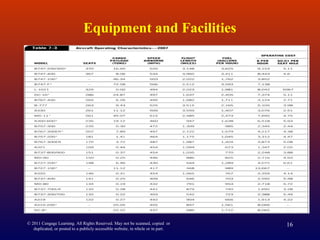
Equipment and Facilities
• Types of vehicles (aircraft)
– Many aircraft types
• Wide range of seating capacity, cargo payload,
speed, fuel consumption, operating costs/hour
• Key is to match operating characteristics to
demand needs of route
• Terminals (airports)
– Airports financed by government
• Federal construction assistance programs
• State and local governments operate and maintain
– Air carriers and users pay for use
Equipment and Facilities
© 2011 Cengage Learning. All Rights Reserved. May not be scanned, copied or
duplicated, or posted to a publicly accessible website, in whole or in part.
16
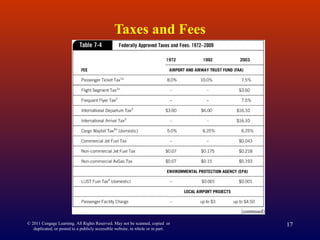
Taxes and Fees
© 2011 Cengage Learning. All Rights Reserved. May not be scanned, copied or
duplicated, or posted to a publicly accessible website, in whole or in part.
17
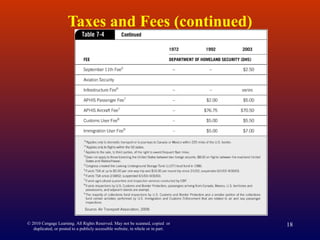
Taxes and Fees (continued)
© 2010 Cengage Learning. All Rights Reserved. May not be scanned, copied or
duplicated, or posted to a publicly accessible website, in whole or in part.
18
© 2011 Cengage Learning. All Rights Reserved. May not be scanned, copied or
duplicated, or posted to a publicly accessible website, in whole or in part.
19
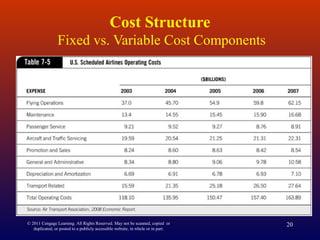
Cost Structure
Fixed vs. Variable Cost Components
• High variable costs (80% of total operation costs)
– About 38% attributable to flight operations
– About 10% for maintenance
– About 14% for aircraft and traffic servicing
• Low fixed costs
– Due to government investment in terminals and
operating infrastructure
• Increasing price competition creates pressure to
reduce labor costs, increase productivity
Cost Structure
Fixed vs. Variable Cost Components
© 2011 Cengage Learning. All Rights Reserved. May not be scanned, copied or
duplicated, or posted to a publicly accessible website, in whole or in part.
20
© 2011 Cengage Learning. All Rights Reserved. May not be scanned, copied or
duplicated, or posted to a publicly accessible website, in whole or in part.
21
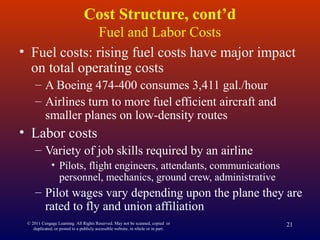
Cost Structure, cont’d
Fuel and Labor Costs
• Fuel costs: rising fuel costs have major impact
on total operating costs
– A Boeing 474-400 consumes 3,411 gal./hour
– Airlines turn to more fuel efficient aircraft and
smaller planes on low-density routes
• Labor costs
– Variety of job skills required by an airline
• Pilots, flight engineers, attendants, communications
personnel, mechanics, ground crew, administrative
– Pilot wages vary depending upon the plane they are
rated to fly and union affiliation
© 2011 Cengage Learning. All Rights Reserved. May not be scanned, copied or
duplicated, or posted to a publicly accessible website, in whole or in part.
22
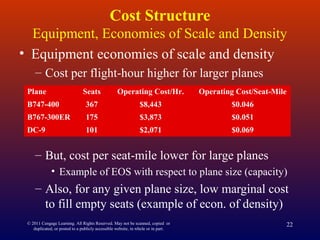
Cost Structure
Equipment, Economies of Scale and Density
• Equipment economies of scale and density
– Cost per flight-hour higher for larger planes
– But, cost per seat-mile lower for large planes
• Example of EOS with respect to plane size (capacity)
– Also, for any given plane size, low marginal cost
to fill empty seats (example of econ. of density)
Plane Seats Operating Cost/Hr. Operating Cost/Seat-Mile
B747-400 367 $8,443 $0.046
B767-300ER 175 $3,873 $0.051
DC-9 101 $2,071 $0.069
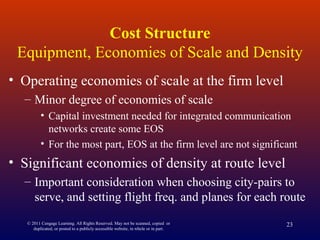
Cost Structure
Equipment, Economies of Scale and Density
• Operating economies of scale at the firm level
– Minor degree of economies of scale
• Capital investment needed for integrated communication
networks create some EOS
• For the most part, EOS at the firm level are not significant
• Significant economies of density at route level
– Important consideration when choosing city-pairs to
serve, and setting flight freq. and planes for each route
© 2011 Cengage Learning. All Rights Reserved. May not be scanned, copied or
duplicated, or posted to a publicly accessible website, in whole or in part.
23
© 2011 Cengage Learning. All Rights Reserved. May not be scanned, copied or
duplicated, or posted to a publicly accessible website, in whole or in part.
24
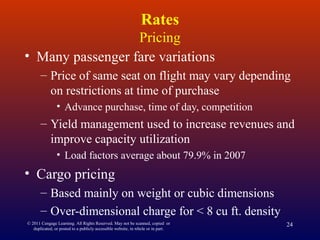
Rates
Pricing
• Many passenger fare variations
– Price of same seat on flight may vary depending
on restrictions at time of purchase
• Advance purchase, time of day, competition
– Yield management used to increase revenues and
improve capacity utilization
• Load factors average about 79.9% in 2007
• Cargo pricing
– Based mainly on weight or cubic dimensions
– Over-dimensional charge for < 8 cu ft. density
© 2011 Cengage Learning. All Rights Reserved. May not be scanned, copied
or duplicated, or posted to a publicly accessible website, in whole or in part.
25
Rates
Operating Efficiency
• Operating ratio = [Op. Exp./Op. Inc.] * 100
– Industry average: 1994-2000: 94.7-96.9
2007: 94.7
• Load Factor = [#Passengers/#Seats] * 100
– Industry average climbs above 70%
– Relationship between load factor, plane size,
and operating costPlane Seats Pass. Load Fac. Op. Cost/Hr. Op. Cost/Pass.-hr.
B747-400 367 239 65.1% $8,443 $35.32
B747-400 367 80 21.8% $8,443 $105.54
DC-10 101 80 79.2% $2,071 $25.89
© 2011 Cengage Learning. All Rights Reserved. May not be scanned, copied or
duplicated, or posted to a publicly accessible website, in whole or in part.
26
Current Issues
Safety and Security
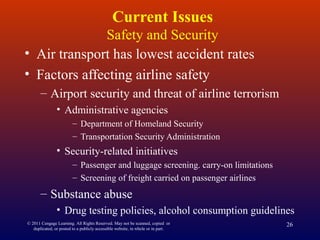
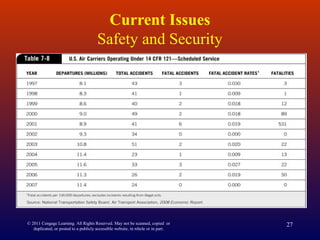
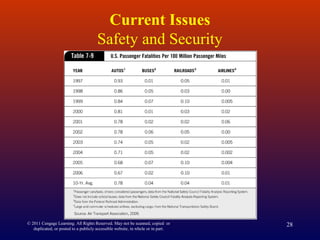
• Air transport has lowest accident rates
• Factors affecting airline safety
– Airport security and threat of airline terrorism
• Administrative agencies
– Department of Homeland Security
– Transportation Security Administration
• Security-related initiatives
– Passenger and luggage screening. carry-on limitations
– Screening of freight carried on passenger airlines
– Substance abuse
• Drug testing policies, alcohol consumption guidelines
Current Issues
Safety and Security
© 2011 Cengage Learning. All Rights Reserved. May not be scanned, copied or
duplicated, or posted to a publicly accessible website, in whole or in part.
27
Current Issues
Safety and Security
© 2011 Cengage Learning. All Rights Reserved. May not be scanned, copied or
duplicated, or posted to a publicly accessible website, in whole or in part.
28
Current Issues
Technology
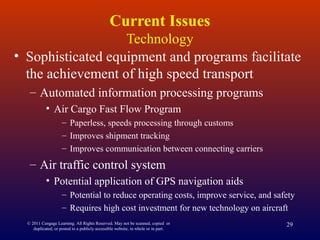
• Sophisticated equipment and programs facilitate
the achievement of high speed transport
– Automated information processing programs
• Air Cargo Fast Flow Program
– Paperless, speeds processing through customs
– Improves shipment tracking
– Improves communication between connecting carriers
– Air traffic control system
• Potential application of GPS navigation aids
– Potential to reduce operating costs, improve service, and safety
– Requires high cost investment for new technology on aircraft
© 2011 Cengage Learning. All Rights Reserved. May not be scanned, copied or
duplicated, or posted to a publicly accessible website, in whole or in part.
29

Transport Management & Theory Practices (7)

  • 1.
    Management of Transportation Seventh Edition Coyle,Novack, Gibson & Bardi © 2011 Cengage Learning Chapter 7 The Airline Industry 1© 2011 Cengage Learning. All Rights Reserved. May not be scanned, copied or duplicated, or posted to a publicly accessible website, in whole or in part.
  • 2.
    © 2011 CengageLearning. All Rights Reserved. May not be scanned, copied or duplicated, or posted to a publicly accessible website, in whole or in part. 2 Introduction • Rail: dominant mode from 1850s to WW II – Superior in both price and service quality to road transport for most of this period – Superior in service quality to water transport • Development facilitated by standardization of track gauge and rolling stock • Pivotal role in U.S. economic development – Great expansion in track mileage, post-1870s – Financed by private capital – Too much track mileage relative to demand
  • 3.
    © 2011 CengageLearning. All Rights Reserved. May not be scanned, copied or duplicated, or posted to a publicly accessible website, in whole or in part. 3 Introduction • Wright Brothers first flight: 1903 • Government development and promotion of air transport begins in 1920s: – U.S. Post Office air mail subsidy program helps launch commercial passenger airline industry • Competitive advantage: Speed (travel time savings) • Econ. Deregulation enables more competitive pricing
  • 4.
    © 2011 CengageLearning. All Rights Reserved. May not be scanned, copied or duplicated, or posted to a publicly accessible website, in whole or in part. 4 Types of Carriers Private Carriers • Definition: – A firm that transports company personnel or freight in planes to support its primary business • Preponderance of use is for transport of personnel • Subject to federal safety regulations administered by the Federal Aviation Adm. (FAA)
  • 5.
    Types of Carriers For-HireCarriers • Several different classification schemes – Classified by annual operating revenues • Majors (revenues of >$1 billion) • Nationals ($100 million - $1 billion) • Regionals (revenues of <$100 million) – Classified by type of service • All-cargo • Commuter • Charter • International © 2011 Cengage Learning. All Rights Reserved. May not be scanned, copied or duplicated, or posted to a publicly accessible website, in whole or in part. 5
  • 6.
    © 2011 CengageLearning. All Rights Reserved. May not be scanned, copied or duplicated, or posted to a publicly accessible website, in whole or in part. 6 Market Structure Number of Carriers • Relatively small number of for-hire carriers – Most revenues earned by small number of majors – Several cycles of increasing, then decreasing number of airlines after 1978 deregulation • Private air transport – Over 500 corporations own/operate aircraft – About 60,000 corporate-owned planes exist – Thousands of private aircraft used for personal, recreational, and instructional purposes
  • 7.
    Market Structure Number ofCarriers © 2011 Cengage Learning. All Rights Reserved. May not be scanned, copied or duplicated, or posted to a publicly accessible website, in whole or in part. 7
  • 8.
    Market Structure Number ofCarriers © 2011 Cengage Learning. All Rights Reserved. May not be scanned, copied or duplicated, or posted to a publicly accessible website, in whole or in part. 8
  • 9.
    © 2011 CengageLearning. All Rights Reserved. May not be scanned, copied or duplicated, or posted to a publicly accessible website, in whole or in part. 9 Competition Intermodal and Intramodal • Very limited intermodal competition for long distance (500+ miles) trips – Air has decided advantage in transport speed – Freight: rising competition from time-definite motor carrier service – Passengers: some limited competition from personal automobile travel, rail, and bus service • Intense intramodal competition – Creates cycles of new entrants, excess capacity, reduced fares, carriers exiting markets
  • 10.
    © 2011 CengageLearning. All Rights Reserved. May not be scanned, copied or duplicated, or posted to a publicly accessible website, in whole or in part. 10 Competition Service Competition • Nature of passenger service competition – Flight frequency on given route – Timing of flights – Meals, in-flight communications, other services – No-frills alternatives intensify competition – Advertising used to differentiate carriers • Nature of competition for cargo, express traffic – Published schedules and rates – Door-to-door, time-definite service
  • 11.
    © 2011 CengageLearning. All Rights Reserved. May not be scanned, copied or duplicated, or posted to a publicly accessible website, in whole or in part. 11 Operating and Service Characteristics General • Due to value of time, air dominates for- hire, long-distance passenger market • When importance of speed outweighs cost, then air is attractive for freight – Emergency shipments – Typical commodities • Mail, fashion clothing, communications products, fresh flowers, racehorses, jewelry – Air freight cost vs. inventory cost tradeoff
  • 12.
    © 2011 CengageLearning. All Rights Reserved. May not be scanned, copied or duplicated, or posted to a publicly accessible website, in whole or in part. 12 Operating and Service Characteristics Speed of Service • Speed, travel time advantage can be off-set by – Low flight frequency, schedule timing • Smaller communities have experienced reduced frequencies – In-direct routing due to hub and spoke networks • Legacy majors moved to hub and spoke networks following deregulation to improve load-factors – Air traffic and ground congestion, security measures • Most relevant at major airports • Adds uncertainty to total travel time
  • 13.
    © 2011 CengageLearning. All Rights Reserved. May not be scanned, copied or duplicated, or posted to a publicly accessible website, in whole or in part. 13 Operating and Service Characteristics Length of Haul and Capacity • Length of haul – 2007 average air trip length for passengers: 1078 miles • Aircraft capacity dependent on aircraft type – Wide-body, 4 engine jet • 370 passengers and all-cargo capacity of 16.6 tons – Boeing 777 carries 263 passengers – Most planes carry 120-260 passengers
  • 14.
    Operating and ServiceCharacteristics Accessibility and Dependability • Air travel is generally highly reliable – Weather and congestion are the principal causes of schedule disruptions – Sophisticated navigation systems facilitate operation in poor weather conditions • Limited airport accessibility adds travel time and cost to air travel – Limited accessibility is the principal service disadvantage of air travel © 2011 Cengage Learning. All Rights Reserved. May not be scanned, copied or duplicated, or posted to a publicly accessible website, in whole or in part. 14
  • 15.
    © 2011 CengageLearning. All Rights Reserved. May not be scanned, copied or duplicated, or posted to a publicly accessible website, in whole or in part. 15 Equipment and Facilities • Types of vehicles (aircraft) – Many aircraft types • Wide range of seating capacity, cargo payload, speed, fuel consumption, operating costs/hour • Key is to match operating characteristics to demand needs of route • Terminals (airports) – Airports financed by government • Federal construction assistance programs • State and local governments operate and maintain – Air carriers and users pay for use
  • 16.
    Equipment and Facilities ©2011 Cengage Learning. All Rights Reserved. May not be scanned, copied or duplicated, or posted to a publicly accessible website, in whole or in part. 16
  • 17.
    Taxes and Fees ©2011 Cengage Learning. All Rights Reserved. May not be scanned, copied or duplicated, or posted to a publicly accessible website, in whole or in part. 17
  • 18.
    Taxes and Fees(continued) © 2010 Cengage Learning. All Rights Reserved. May not be scanned, copied or duplicated, or posted to a publicly accessible website, in whole or in part. 18
  • 19.
    © 2011 CengageLearning. All Rights Reserved. May not be scanned, copied or duplicated, or posted to a publicly accessible website, in whole or in part. 19 Cost Structure Fixed vs. Variable Cost Components • High variable costs (80% of total operation costs) – About 38% attributable to flight operations – About 10% for maintenance – About 14% for aircraft and traffic servicing • Low fixed costs – Due to government investment in terminals and operating infrastructure • Increasing price competition creates pressure to reduce labor costs, increase productivity
  • 20.
    Cost Structure Fixed vs.Variable Cost Components © 2011 Cengage Learning. All Rights Reserved. May not be scanned, copied or duplicated, or posted to a publicly accessible website, in whole or in part. 20
  • 21.
    © 2011 CengageLearning. All Rights Reserved. May not be scanned, copied or duplicated, or posted to a publicly accessible website, in whole or in part. 21 Cost Structure, cont’d Fuel and Labor Costs • Fuel costs: rising fuel costs have major impact on total operating costs – A Boeing 474-400 consumes 3,411 gal./hour – Airlines turn to more fuel efficient aircraft and smaller planes on low-density routes • Labor costs – Variety of job skills required by an airline • Pilots, flight engineers, attendants, communications personnel, mechanics, ground crew, administrative – Pilot wages vary depending upon the plane they are rated to fly and union affiliation
  • 22.
    © 2011 CengageLearning. All Rights Reserved. May not be scanned, copied or duplicated, or posted to a publicly accessible website, in whole or in part. 22 Cost Structure Equipment, Economies of Scale and Density • Equipment economies of scale and density – Cost per flight-hour higher for larger planes – But, cost per seat-mile lower for large planes • Example of EOS with respect to plane size (capacity) – Also, for any given plane size, low marginal cost to fill empty seats (example of econ. of density) Plane Seats Operating Cost/Hr. Operating Cost/Seat-Mile B747-400 367 $8,443 $0.046 B767-300ER 175 $3,873 $0.051 DC-9 101 $2,071 $0.069
  • 23.
    Cost Structure Equipment, Economiesof Scale and Density • Operating economies of scale at the firm level – Minor degree of economies of scale • Capital investment needed for integrated communication networks create some EOS • For the most part, EOS at the firm level are not significant • Significant economies of density at route level – Important consideration when choosing city-pairs to serve, and setting flight freq. and planes for each route © 2011 Cengage Learning. All Rights Reserved. May not be scanned, copied or duplicated, or posted to a publicly accessible website, in whole or in part. 23
  • 24.
    © 2011 CengageLearning. All Rights Reserved. May not be scanned, copied or duplicated, or posted to a publicly accessible website, in whole or in part. 24 Rates Pricing • Many passenger fare variations – Price of same seat on flight may vary depending on restrictions at time of purchase • Advance purchase, time of day, competition – Yield management used to increase revenues and improve capacity utilization • Load factors average about 79.9% in 2007 • Cargo pricing – Based mainly on weight or cubic dimensions – Over-dimensional charge for < 8 cu ft. density
  • 25.
    © 2011 CengageLearning. All Rights Reserved. May not be scanned, copied or duplicated, or posted to a publicly accessible website, in whole or in part. 25 Rates Operating Efficiency • Operating ratio = [Op. Exp./Op. Inc.] * 100 – Industry average: 1994-2000: 94.7-96.9 2007: 94.7 • Load Factor = [#Passengers/#Seats] * 100 – Industry average climbs above 70% – Relationship between load factor, plane size, and operating costPlane Seats Pass. Load Fac. Op. Cost/Hr. Op. Cost/Pass.-hr. B747-400 367 239 65.1% $8,443 $35.32 B747-400 367 80 21.8% $8,443 $105.54 DC-10 101 80 79.2% $2,071 $25.89
  • 26.
    © 2011 CengageLearning. All Rights Reserved. May not be scanned, copied or duplicated, or posted to a publicly accessible website, in whole or in part. 26 Current Issues Safety and Security • Air transport has lowest accident rates • Factors affecting airline safety – Airport security and threat of airline terrorism • Administrative agencies – Department of Homeland Security – Transportation Security Administration • Security-related initiatives – Passenger and luggage screening. carry-on limitations – Screening of freight carried on passenger airlines – Substance abuse • Drug testing policies, alcohol consumption guidelines
  • 27.
    Current Issues Safety andSecurity © 2011 Cengage Learning. All Rights Reserved. May not be scanned, copied or duplicated, or posted to a publicly accessible website, in whole or in part. 27
  • 28.
    Current Issues Safety andSecurity © 2011 Cengage Learning. All Rights Reserved. May not be scanned, copied or duplicated, or posted to a publicly accessible website, in whole or in part. 28
  • 29.
    Current Issues Technology • Sophisticatedequipment and programs facilitate the achievement of high speed transport – Automated information processing programs • Air Cargo Fast Flow Program – Paperless, speeds processing through customs – Improves shipment tracking – Improves communication between connecting carriers – Air traffic control system • Potential application of GPS navigation aids – Potential to reduce operating costs, improve service, and safety – Requires high cost investment for new technology on aircraft © 2011 Cengage Learning. All Rights Reserved. May not be scanned, copied or duplicated, or posted to a publicly accessible website, in whole or in part. 29