1
WHY STUDY PSYCHROMETRY
If HVAC problems and challenges are to be
properly diagnosed and designed, it is
essential that the psychrometric chart and
psychrometrics in general be clearly
understood.
2
OBJECTIVE
This course will review the introductory
elements of psychrometrics (the behavior of
mixtures of air and water vapor under varying
conditions) and the chart that represents it.
3
OBJECTIVES
If HVAC problems and challenges are to be
properly diagnosed and designed, it is
essential that the psychrometric chart and
psychrometrics in general be clearly
understood.
4
OBJECTIVES
This course will review the essential elements of
psychrometrics (the behavior of mixtures of
air and water vapor under varying conditions
of heat) and the chart that represents it.
5
PSME COURSES
6
COURSE OUTLINE
 FUNDAMENTALS
– AIR AND WATER
 THE PSYCRHOMETRIC CHART
- PSYCHART PROCESSES
 PRACTICAL APPLICATIONS
 DISCUSSIONS
* with WORKSHOPS-PROBLEM SOLVING
7
Introduction
WHAT IS PSYCHROMETRY
Psychrometry
is the study of MOIST AIR:
-its properties
-changes in its conditions
8
Introduction
WHAT IS PSYCHROMETRY
 Psychrometrics deals with
thermodynamic properties of moist air
and uses these properties to analyze
conditions and processes involving
moist air'. (1997 ASHRAE Handbook,
6.1 p1)
9
Definitions and Concepts
What is AIR
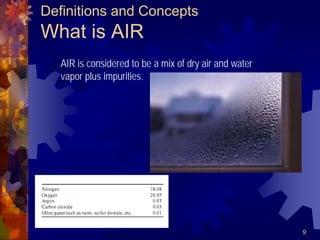
AIR is considered to be a mix of dry air and water
vapor plus impurities.
10
What is AIR
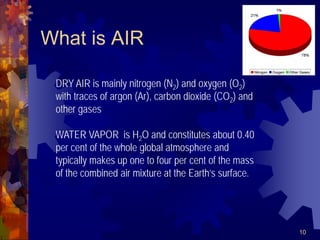
DRY AIR is mainly nitrogen (N2) and oxygen (O2)
with traces of argon (Ar), carbon dioxide (CO2) and
other gases
WATER VAPOR is H2O and constitutes about 0.40
per cent of the whole global atmosphere and
typically makes up one to four per cent of the mass
of the combined air mixture at the Earth’s surface.
11
AMOUNT OF MOISTURE IN AIR
12
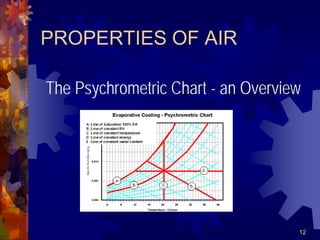
PROPERTIES OF AIR
The Psychrometric Chart - an Overview
13
BASIC PROPERTIES:
SEVEN (7) PROPERTIES OF MOIST AIR
Dry-bulb temperature
Wet-bulb temperature
Relative Humidity
Enthalpy
Specific volume
Absolute Humidity
Dew Point
Pressure (usually Atmospheric)
14
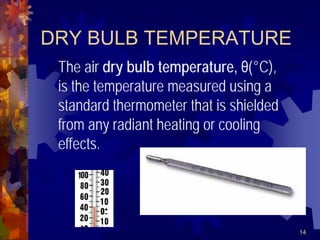
DRY BULB TEMPERATURE
The air dry bulb temperature, θ(°C),
is the temperature measured using a
standard thermometer that is shielded
from any radiant heating or cooling
effects.
15
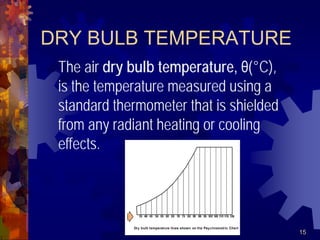
DRY BULB TEMPERATURE
The air dry bulb temperature, θ(°C),
is the temperature measured using a
standard thermometer that is shielded
from any radiant heating or cooling
effects.
16
WET BULB TEMPERATURE
WET BULB - the temperature
reading from a wetted bulb that
gives a direct indication as to
the total heat content of air
17
ADIABATIC WET BULB
WET BULB - the temperature
reading from a wetted bulb that
gives a direct indication as to
the total heat content of air
18
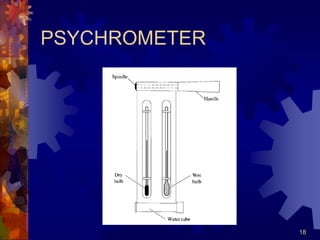
PSYCHROMETER
19
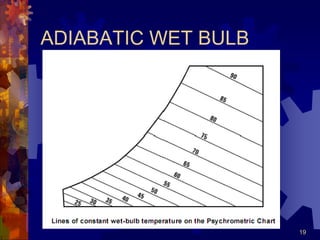
ADIABATIC WET BULB
WET BULB - the temperature
reading from a wetted bulb that
gives a direct indication as to
the total heat content of air
20
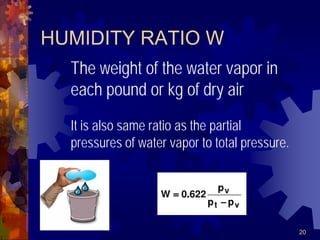
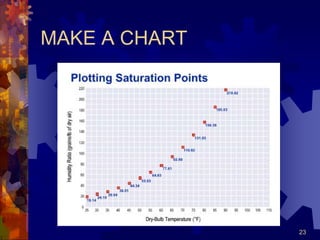
HUMIDITY RATIO W
The weight of the water vapor in
each pound or kg of dry air
It is also same ratio as the partial
pressures of water vapor to total pressure.
21
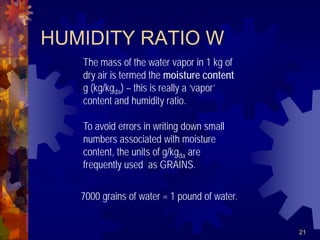
HUMIDITY RATIO W
The mass of the water vapor in 1 kg of
dry air is termed the moisture content
g (kg/kgda) – this is really a ‘vapor’
content and humidity ratio.
To avoid errors in writing down small
numbers associated with moisture
content, the units of g/kgda are
frequently used as GRAINS.
7000 grains of water = 1 pound of water.
22
MAKE A CHART
23
MAKE A CHART
24
MAKE A CHART
25
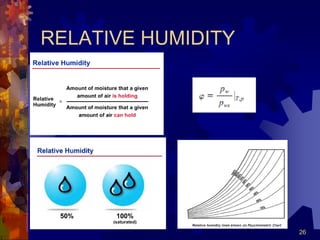
RELATIVE HUMIDITY
The amount of water vapor in the
air divided by the amount of water
vapor the air can hold (at
the same temperature and
pressure.)
26
RELATIVE HUMIDITY
27
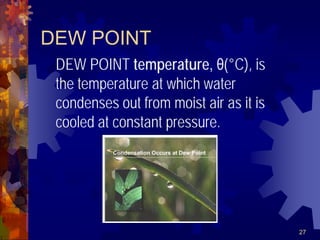
DEW POINT
DEW POINT temperature, θ(°C), is
the temperature at which water
condenses out from moist air as it is
cooled at constant pressure.
28
DEW POINT
29
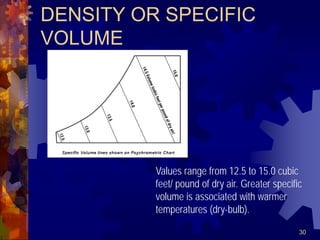
SPECIFIC VOLUME
Specific volume indicates
the space occupied by air.
It is expressed as a
volume per unit weight
(OPPOSITE of density -
weight per unit volume).
30
DENSITY OR SPECIFIC
VOLUME
Values range from 12.5 to 15.0 cubic
feet/ pound of dry air. Greater specific
volume is associated with warmer
temperatures (dry-bulb).
31
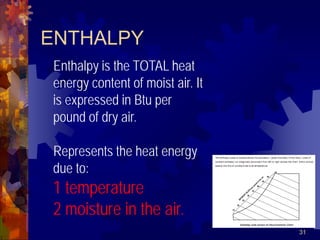
ENTHALPY
Enthalpy is the TOTAL heat
energy content of moist air. It
is expressed in Btu per
pound of dry air.
Represents the heat energy
due to:
1 temperature
2 moisture in the air.
32
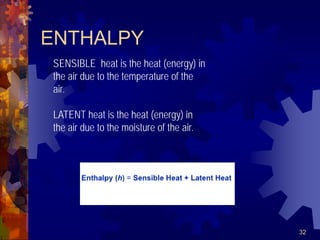
ENTHALPY
SENSIBLE heat is the heat (energy) in
the air due to the temperature of the
air.
LATENT heat is the heat (energy) in
the air due to the moisture of the air.
33
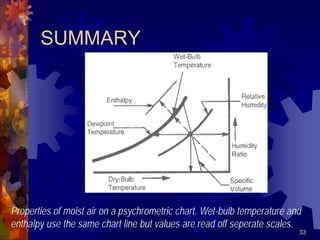
SUMMARY
Properties of moist air on a psychrometric chart. Wet-bulb temperature and
enthalpy use the same chart line but values are read off seperate scales.
34
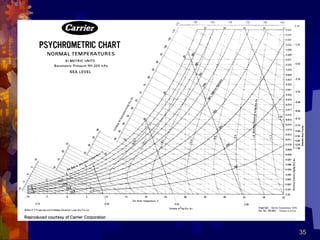
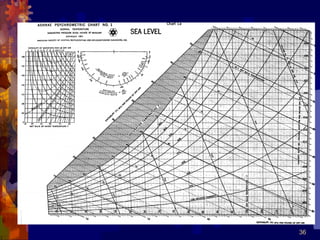
EIGHT (8) PSYCHART LINES
35
36
37
38
WORKSHOP
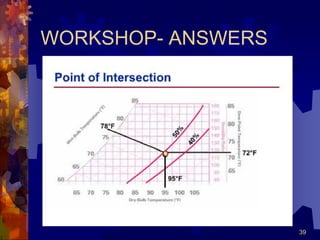
PLOT THE POINT
DRY BULB – 95 DEG F
WET BULB – 78 DEG F WHAT IS RH, HUMIDITY AND DEW
POINT?
And the…
Enthalpy
Specific volume
Absolute Humidity
Dew Point
Pressure (usually Atmospheric)
39
WORKSHOP- ANSWERS
40
WORKSHOP
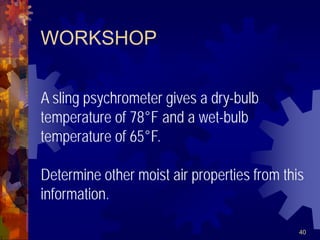
A sling psychrometer gives a dry-bulb
temperature of 78°F and a wet-bulb
temperature of 65°F.
Determine other moist air properties from this
information.
41
WORKSHOP-ANSWERS
42
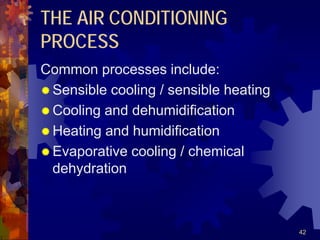
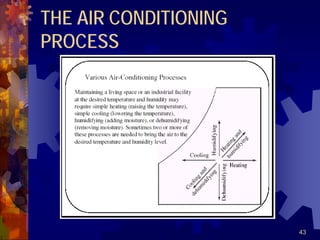
THE AIR CONDITIONING
PROCESS
Common processes include:
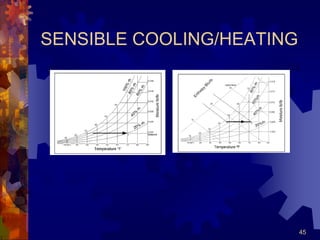
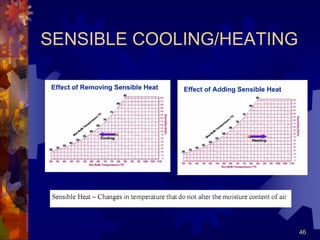
 Sensible cooling / sensible heating
 Cooling and dehumidification
 Heating and humidification
 Evaporative cooling / chemical
dehydration
43
THE AIR CONDITIONING
PROCESS
44
SENSIBLE COOLING/HEATING
45
SENSIBLE COOLING/HEATING
46
SENSIBLE COOLING/HEATING
47
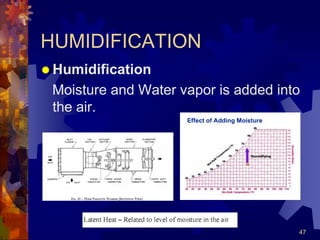
HUMIDIFICATION
 Humidification
Moisture and Water vapor is added into
the air.
48
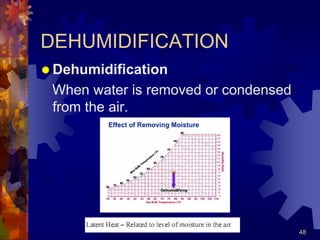
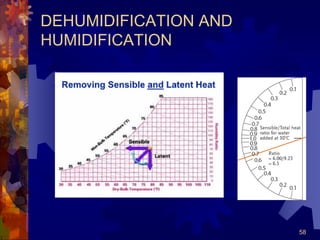
DEHUMIDIFICATION
 Dehumidification
When water is removed or condensed
from the air.
49
COMBINATIONS of
THE AIRCON PROCESS
50
THE COOLING COIL PROCESS
Cooling and dehumidifying is the process of
lowering both the dry-bulb temperature and the
humidity ratio of the moist air.
51
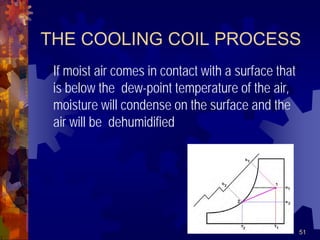
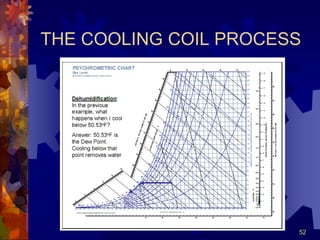
THE COOLING COIL PROCESS
If moist air comes in contact with a surface that
is below the dew-point temperature of the air,
moisture will condense on the surface and the
air will be dehumidified
52
THE COOLING COIL PROCESS
53
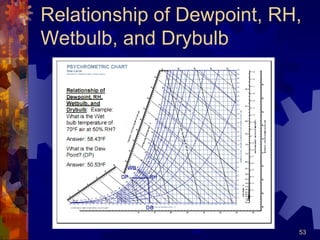
Relationship of Dewpoint, RH,
Wetbulb, and Drybulb
54
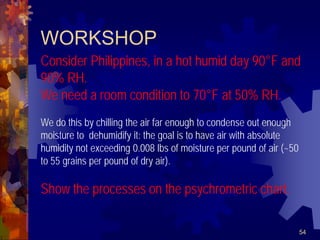
WORKSHOP
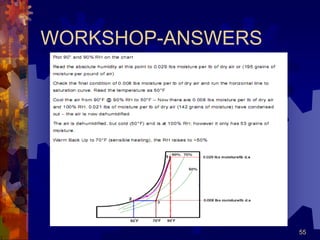
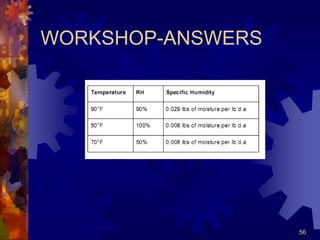
Consider Philippines, in a hot humid day 90°F and
90% RH.
We need a room condition to 70°F at 50% RH.
We do this by chilling the air far enough to condense out enough
moisture to dehumidify it: the goal is to have air with absolute
humidity not exceeding 0.008 lbs of moisture per pound of air (~50
to 55 grains per pound of dry air).
Show the processes on the psychrometric chart.
55
WORKSHOP-ANSWERS
56
WORKSHOP-ANSWERS
57
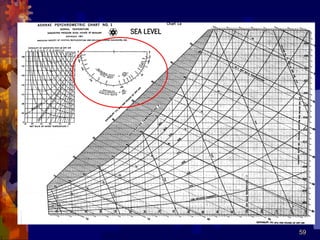
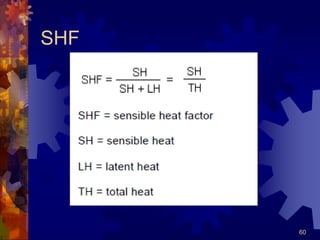
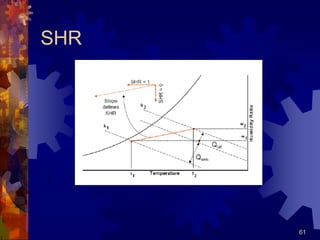
SENSIBLE HEAT FACTOR
or SHF RATIO
58
DEHUMIDIFICATION AND
HUMIDIFICATION
59
60
SHF
61
SHR
62
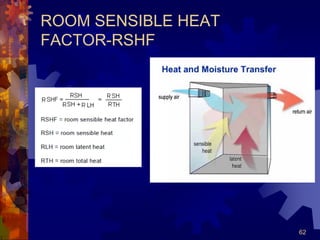
ROOM SENSIBLE HEAT
FACTOR-RSHF
63
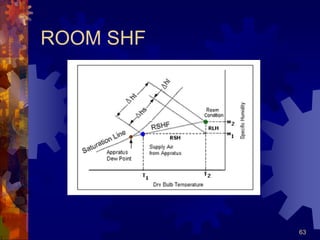
ROOM SHF
64
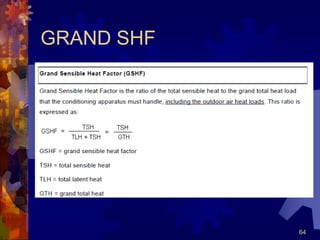
GRAND SHF
65
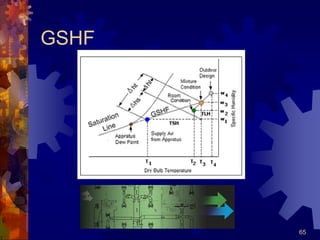
GSHF
66
TOTAL RELATIONSHIPS
GSHF AND ROOM SHF
67
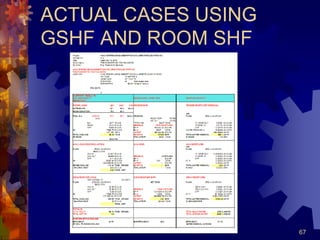
ACTUAL CASES USING
GSHF AND ROOM SHF
68
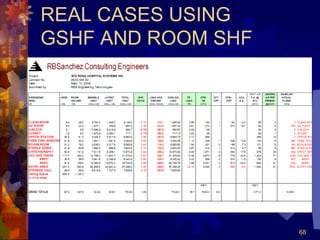
REAL CASES USING
GSHF AND ROOM SHF
69
REAL CASES USING
GSHF AND ROOM SHF
70
PRACTICE CASE STUDIES
71
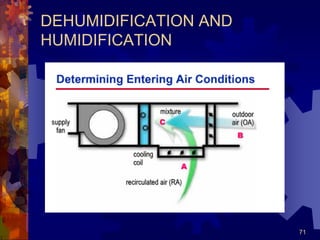
DEHUMIDIFICATION AND
HUMIDIFICATION
72
AHU PROCESS
73
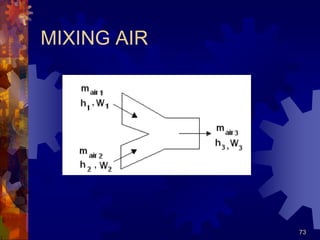
MIXING AIR
74
MIXING AIR
75
MIXING AIR
76
MIXING AIR
77
MIXING AIR
78
AIR MIXING
79
BLOW THRU AHU
80
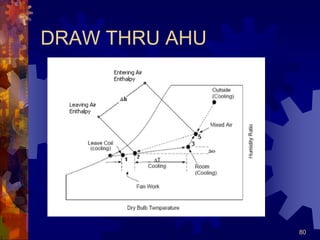
DRAW THRU AHU
81
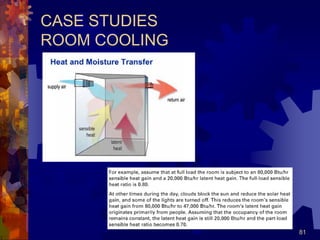
CASE STUDIES
ROOM COOLING
82
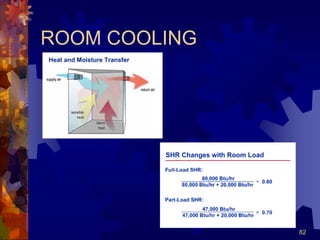
ROOM COOLING
83
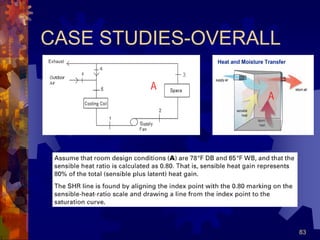
CASE STUDIES-OVERALL
A
A
84
ALIGN THE SHR LINE
@ 0.8 SCALE MARK
85
ALIGN THE SHR LINE
@ 0.8 SCALE MARK
86
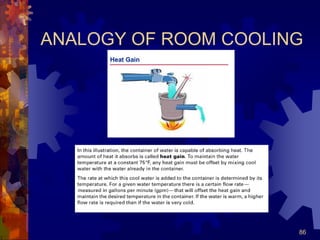
ANALOGY OF ROOM COOLING
87
SHR LINE @ 0.6 SCALE MARK
88
CASE STUDIES
89
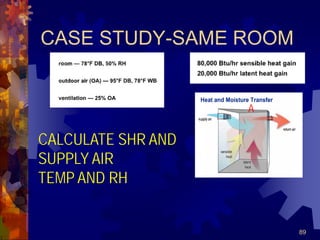
CASE STUDY-SAME ROOM
A
CALCULATE SHR AND
SUPPLY AIR
TEMP AND RH
90
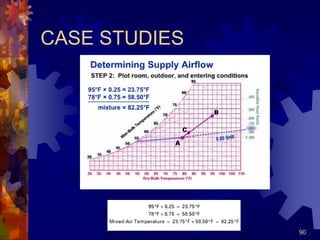
CASE STUDIES
91
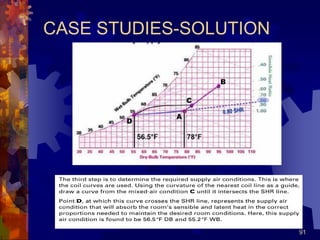
CASE STUDIES-SOLUTION
92
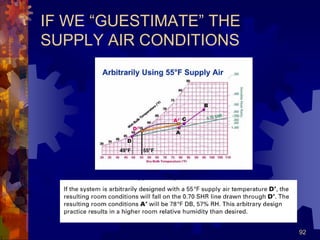
IF WE “GUESTIMATE” THE
SUPPLY AIR CONDITIONS
93
CASE STUDIES
THEREFORE, NO
PSYCHROMETRIC CHART
CALCULATIONS
CREATES PROBLEMS!
94
SUMMARY
PSYCHROMETRY IS A
VERY IMPORTANT
ASPECT OF HVAC
ENGINEERING!

29629597 psychrometric-course