www.cranfield.ac.uk
Hongmei (Mary) He
h.he@cranfield.ac.uk
IET Open Day (17 Mar 2018)
Updated
2
Outline
1. What is Robot & AI (RAI)?
2. The History of RAI
3. Types of Robotics Today
4. AI & Robotic Intelligence
5. Issues and Challenge of AI & Robotics in future
3
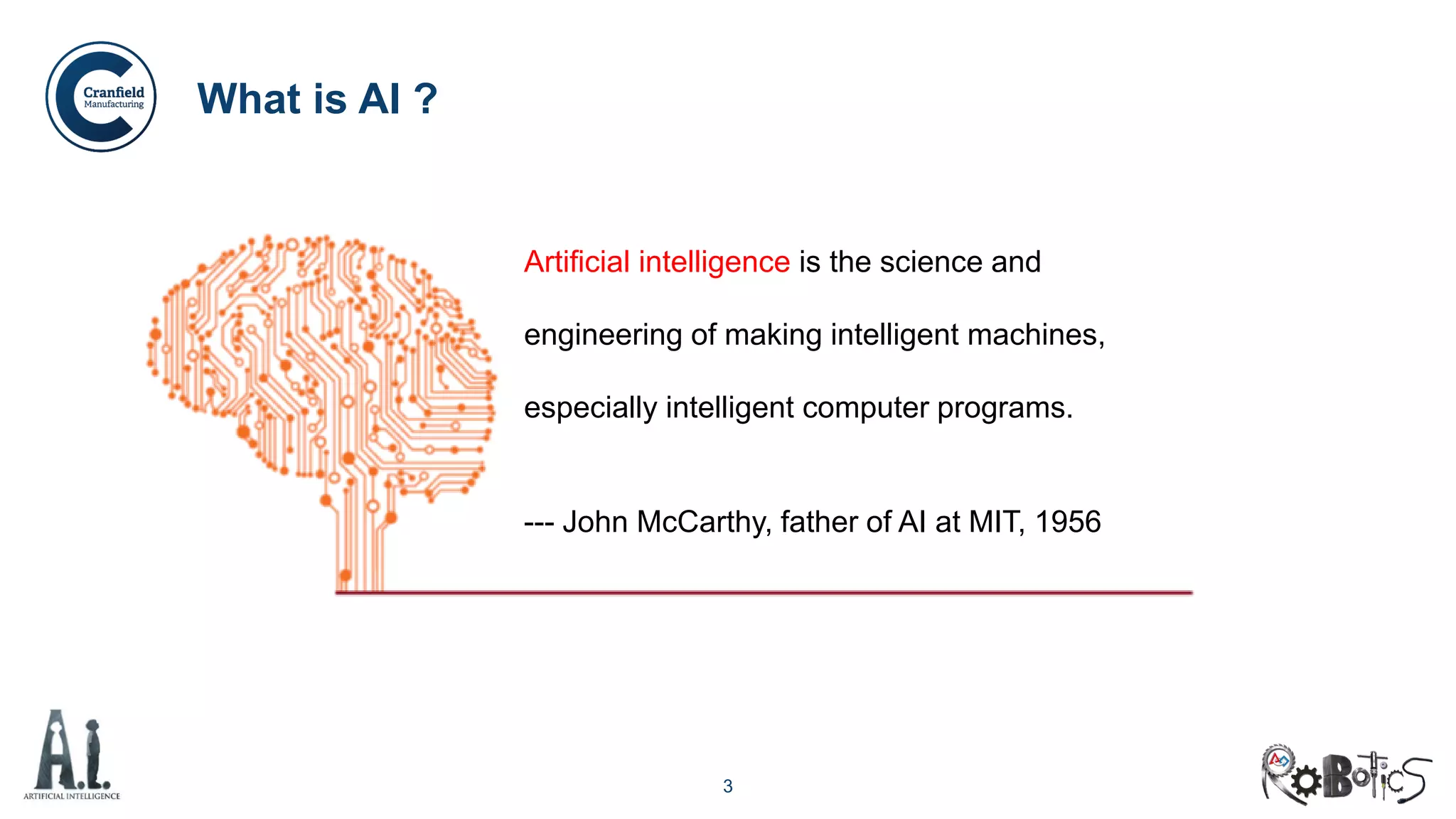
What is AI ?
Artificial intelligence is the science and
engineering of making intelligent machines,
especially intelligent computer programs.
--- John McCarthy, father of AI at MIT, 1956
4
Artificial Intelligence System [1]
[1] PwC Analysis: Sizing the prize -- What’s the real value of AI for your business and how can you capitalise?
5
What is a robot ?
A robot is…
 “An active artificial agent whose environment is the physical world”
--Russell and Norvig
 “A programmable, multifunction manipulator designed to move material,
parts, tools or specific devices through variable programmed motions for
the performance of a variety of tasks” --Robot Institute of America
 An active artificial agent, which exists in the physical world, autonomously
senses its environment and intelligently acts in the environment for a
specific purpose as human expects.
6
The Past of AI & Robotics
7
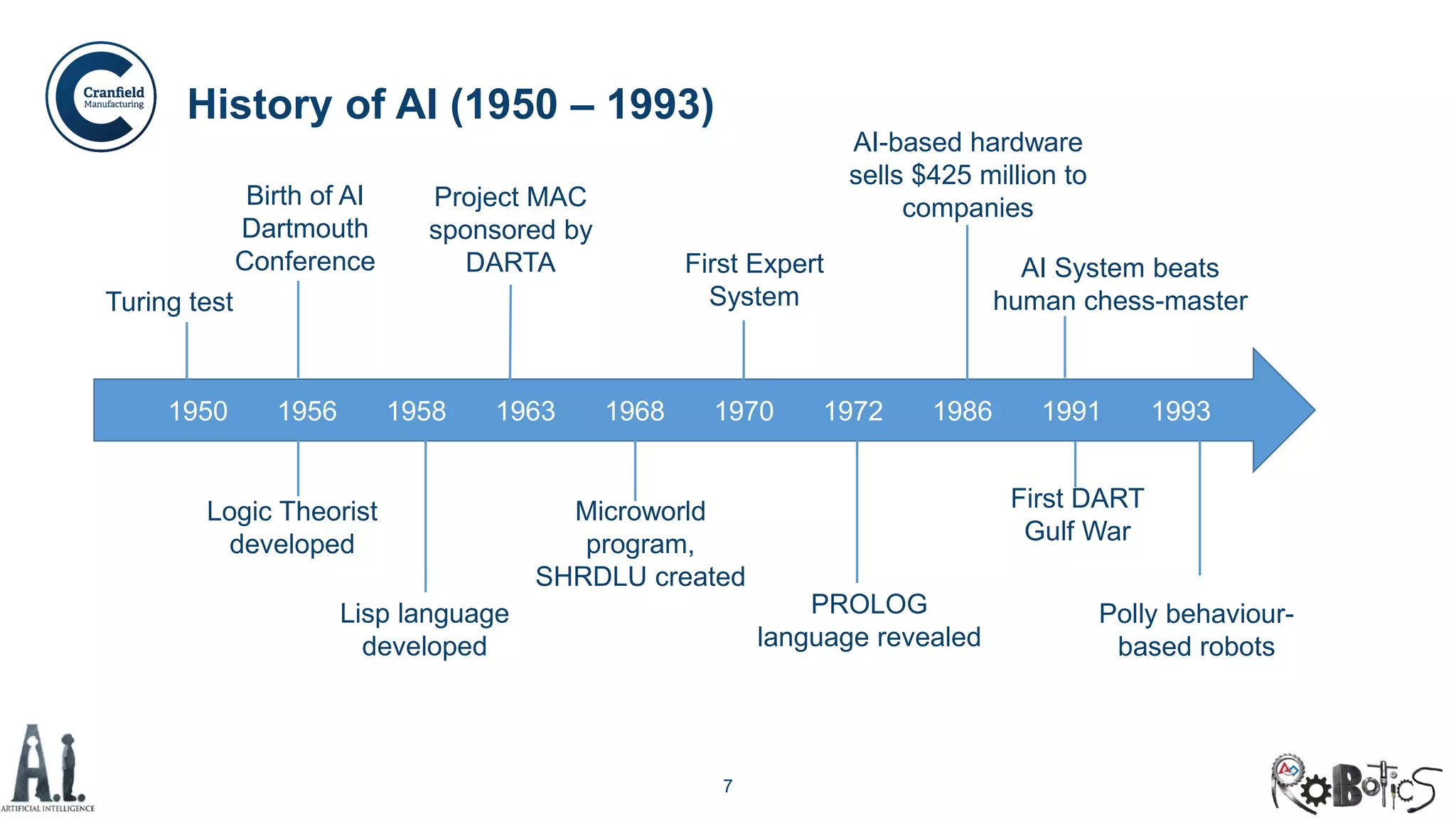
History of AI (1950 – 1993)
1950 1956 1958 1963 1968 1970 1972 1986 1991 1993
Birth of AI
Dartmouth
Conference
Project MAC
sponsored by
DARTA First Expert
System
AI-based hardware
sells $425 million to
companies
AI System beats
human chess-master
Logic Theorist
developed
Lisp language
developed
Microworld
program,
SHRDLU created
PROLOG
language revealed
Turing test
First DART
Gulf War
Polly behaviour-
based robots
8
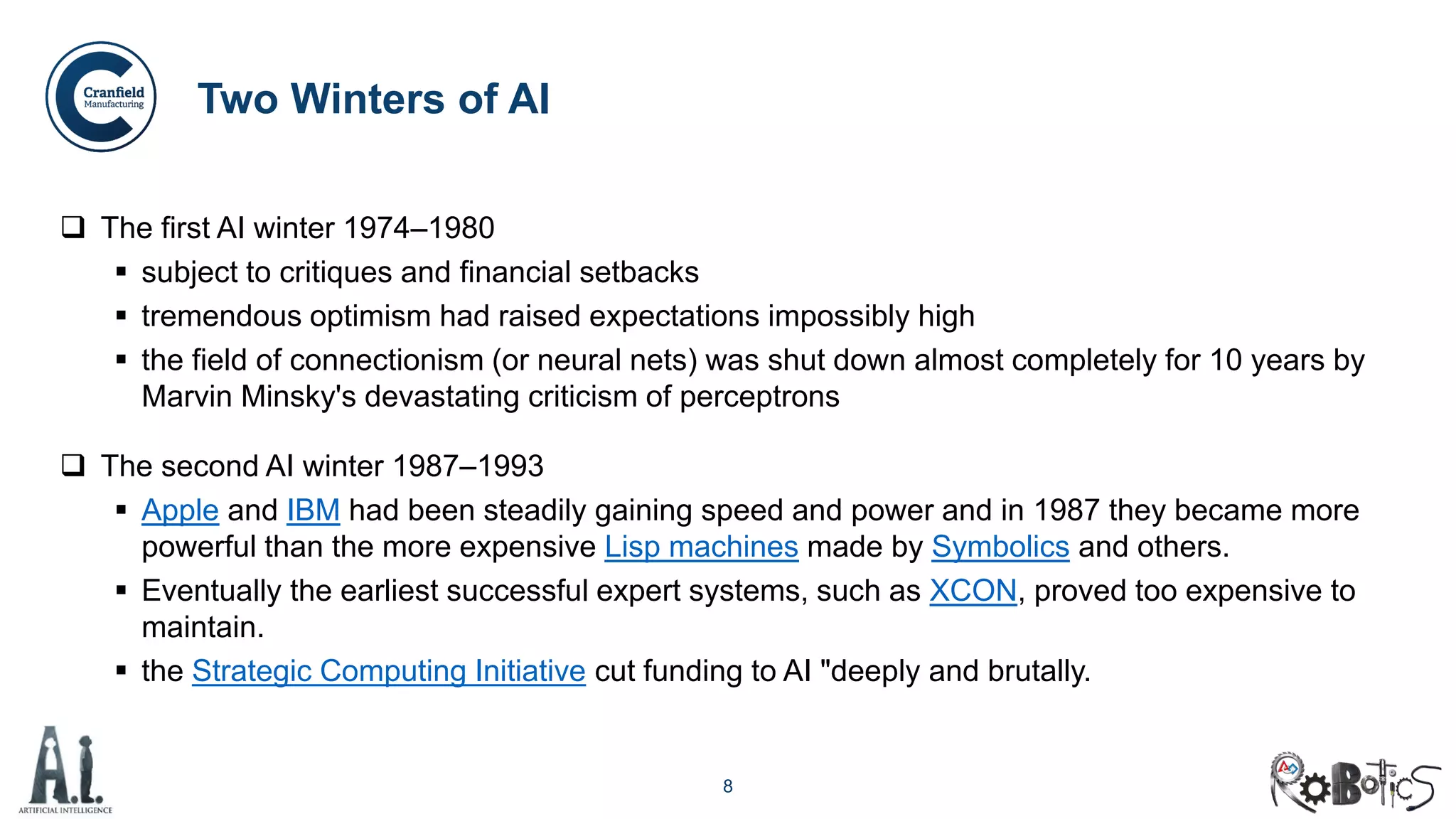
Two Winters of AI
 The first AI winter 1974–1980
 subject to critiques and financial setbacks
 tremendous optimism had raised expectations impossibly high
 the field of connectionism (or neural nets) was shut down almost completely for 10 years by
Marvin Minsky's devastating criticism of perceptrons
 The second AI winter 1987–1993
 Apple and IBM had been steadily gaining speed and power and in 1987 they became more
powerful than the more expensive Lisp machines made by Symbolics and others.
 Eventually the earliest successful expert systems, such as XCON, proved too expensive to
maintain.
 the Strategic Computing Initiative cut funding to AI "deeply and brutally.
9
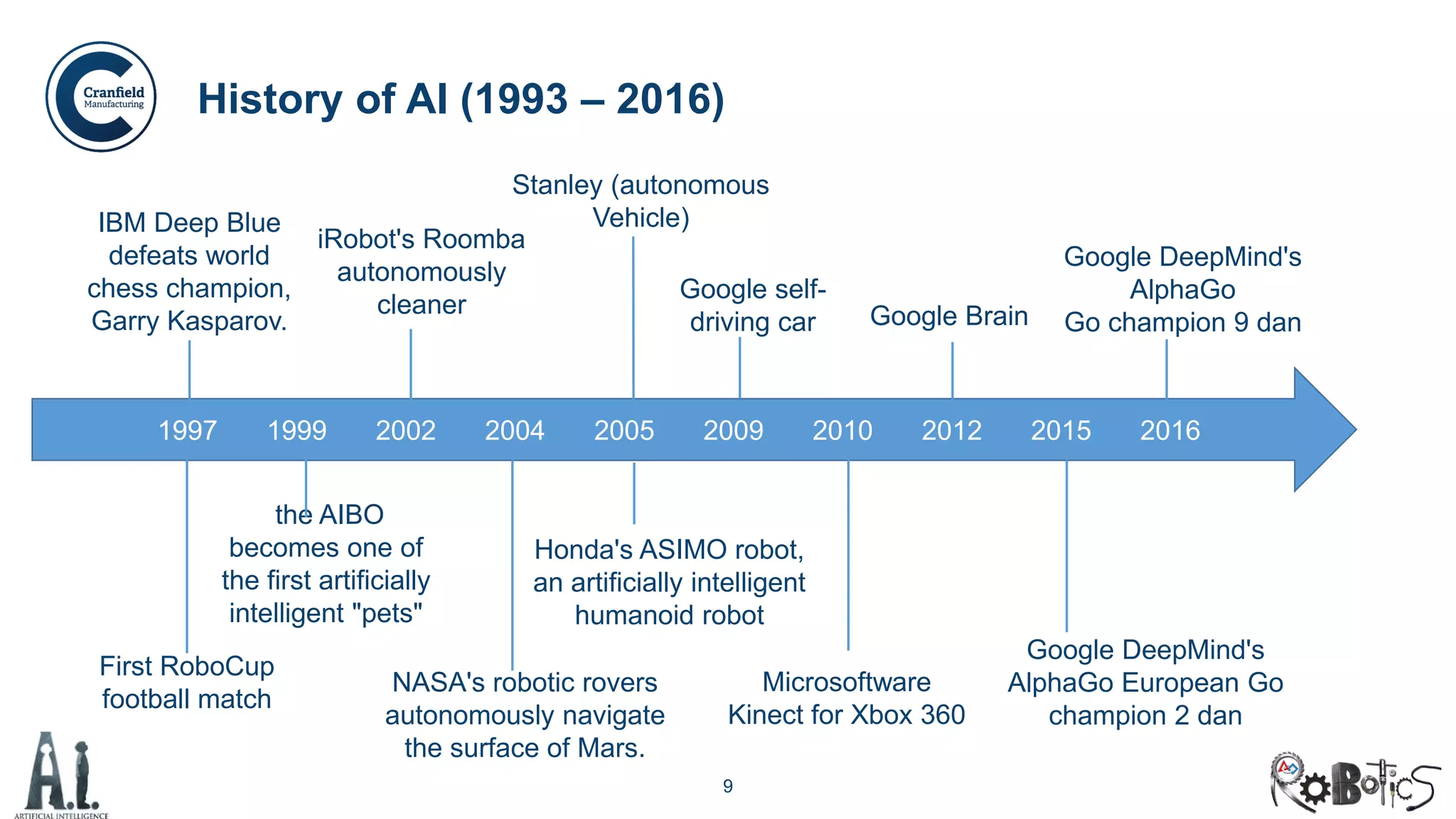
History of AI (1993 – 2016)
1997 1999 2002 2004 2005 2009 2010 2012 2015 2016
IBM Deep Blue
defeats world
chess champion,
Garry Kasparov.
the AIBO
becomes one of
the first artificially
intelligent "pets"
Honda's ASIMO robot,
an artificially intelligent
humanoid robot
Microsoftware
Kinect for Xbox 360
First RoboCup
football match
iRobot's Roomba
autonomously
cleaner
NASA's robotic rovers
autonomously navigate
the surface of Mars.
Stanley (autonomous
Vehicle)
Google DeepMind's
AlphaGo European Go
champion 2 dan
Google DeepMind's
AlphaGo
Go champion 9 dan
Google self-
driving car Google Brain
10
Ten Milestones of Robotics [2]
1941 1961 1964 1973 1985 1986 1997 2002 2011 2012
Isaac Asimov
Outlines Three
Laws of
Robotics
General Motors
Uses World’s First
Industrial Robot
U.S. Military
Begins Using
Drone Aircraft in
Vietnam"
Honda Begins Work
on Independent
Walking Robot
NASA Launches
First Human-Like
Robot Into Orbit
First
Anthropomorphic
Robot
Doctor Performs First
Robot-Assisted Surgery
Roomba Changes
Perception of
Robots
Google Self-Driving
Car Passes Driver’s
License Test
[2] http://listosaur.com/science-a-technology/10-milestones-robotics-history/
First RoboCup
football match
11
The Present of AI & Robotics
12
Artificial Intelligence Today [1]
Human in the loop No human in the loop
Hardware/Specific
System
Assisted intelligence:
Helping people to perform
tasks faster and better.
Automated intelligence:
Automation of
manual/cognitive and
routine/nonroutine tasks.
Adaptive Systems Augmented intelligence:
Helping people to make
better decisions.
Autonomous intelligence:
Automating decision making
processes without human
intervention.
13
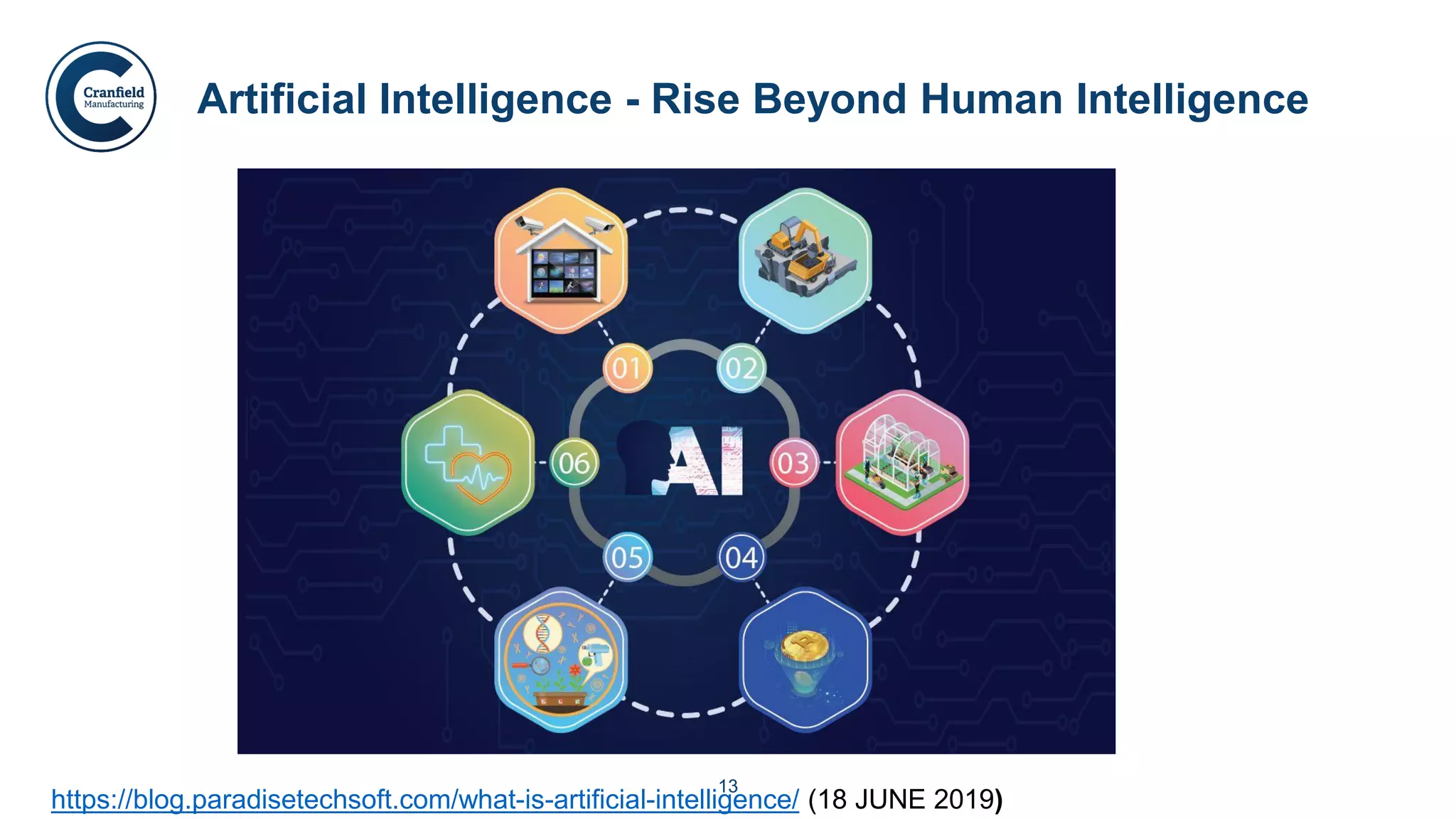
Artificial Intelligence - Rise Beyond Human Intelligence
https://blog.paradisetechsoft.com/what-is-artificial-intelligence/ (18 JUNE 2019)
14
Robots in Terms of the 4 AI Forms
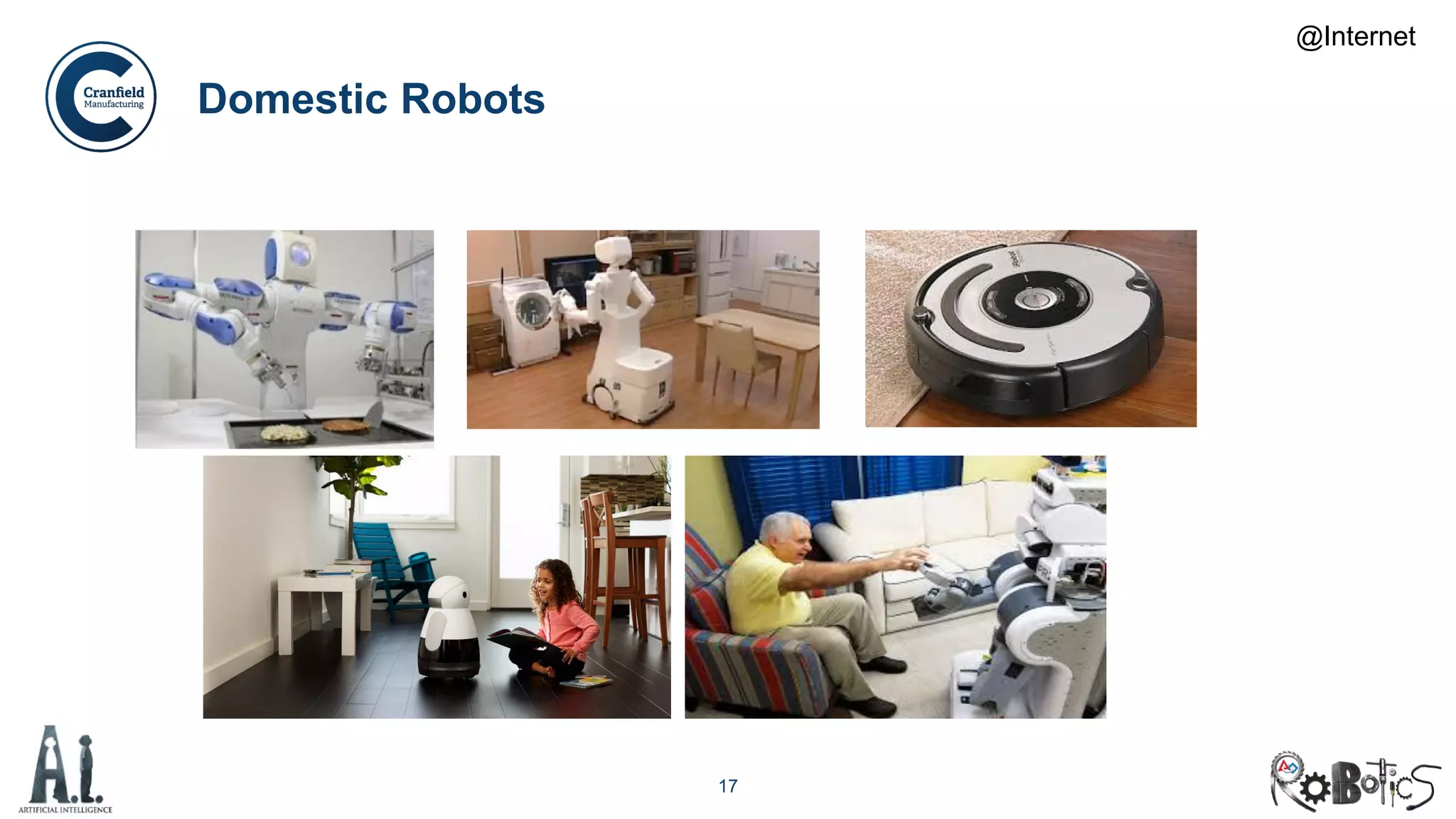
 Domestic robots
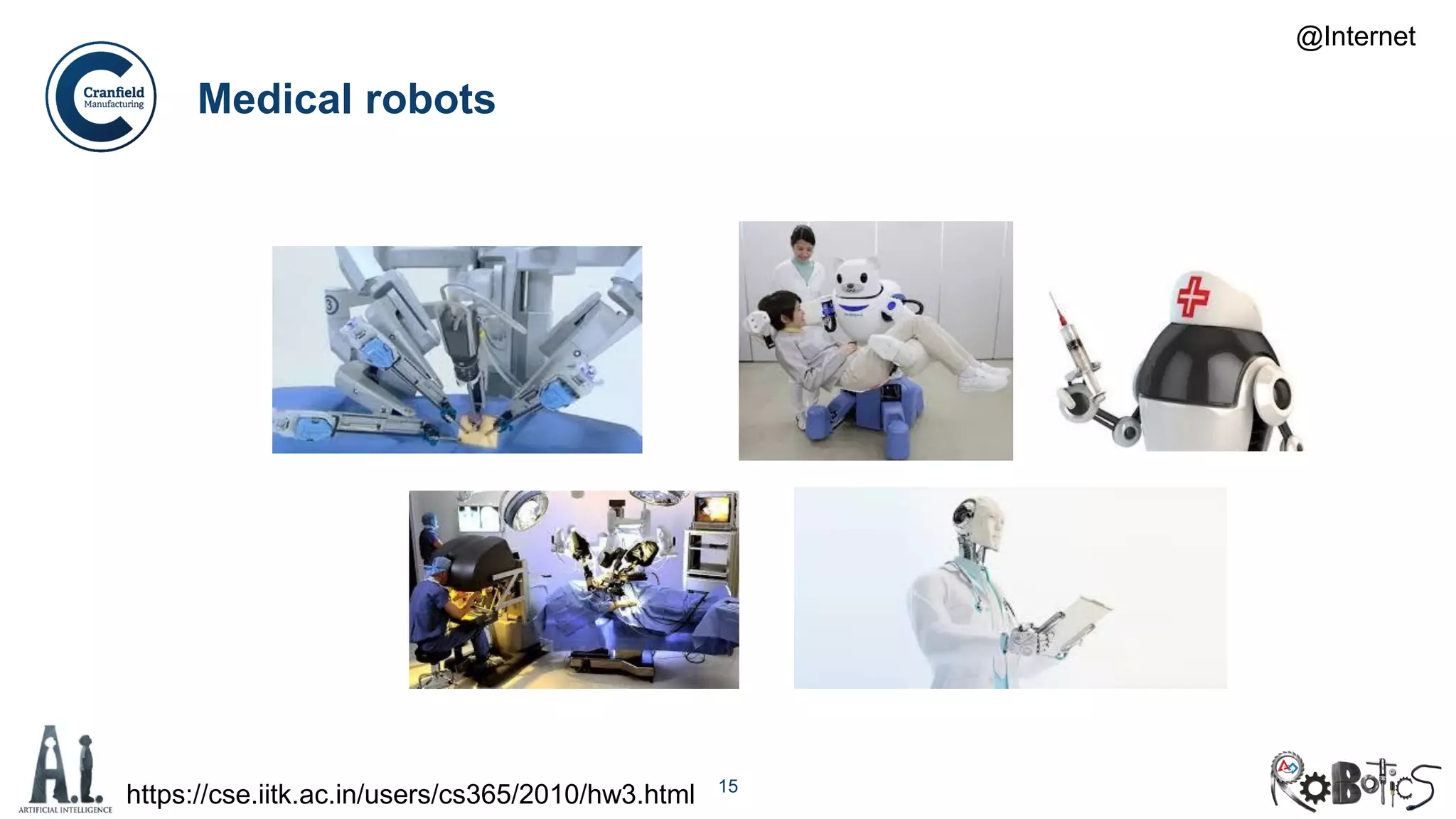
 Medical robots
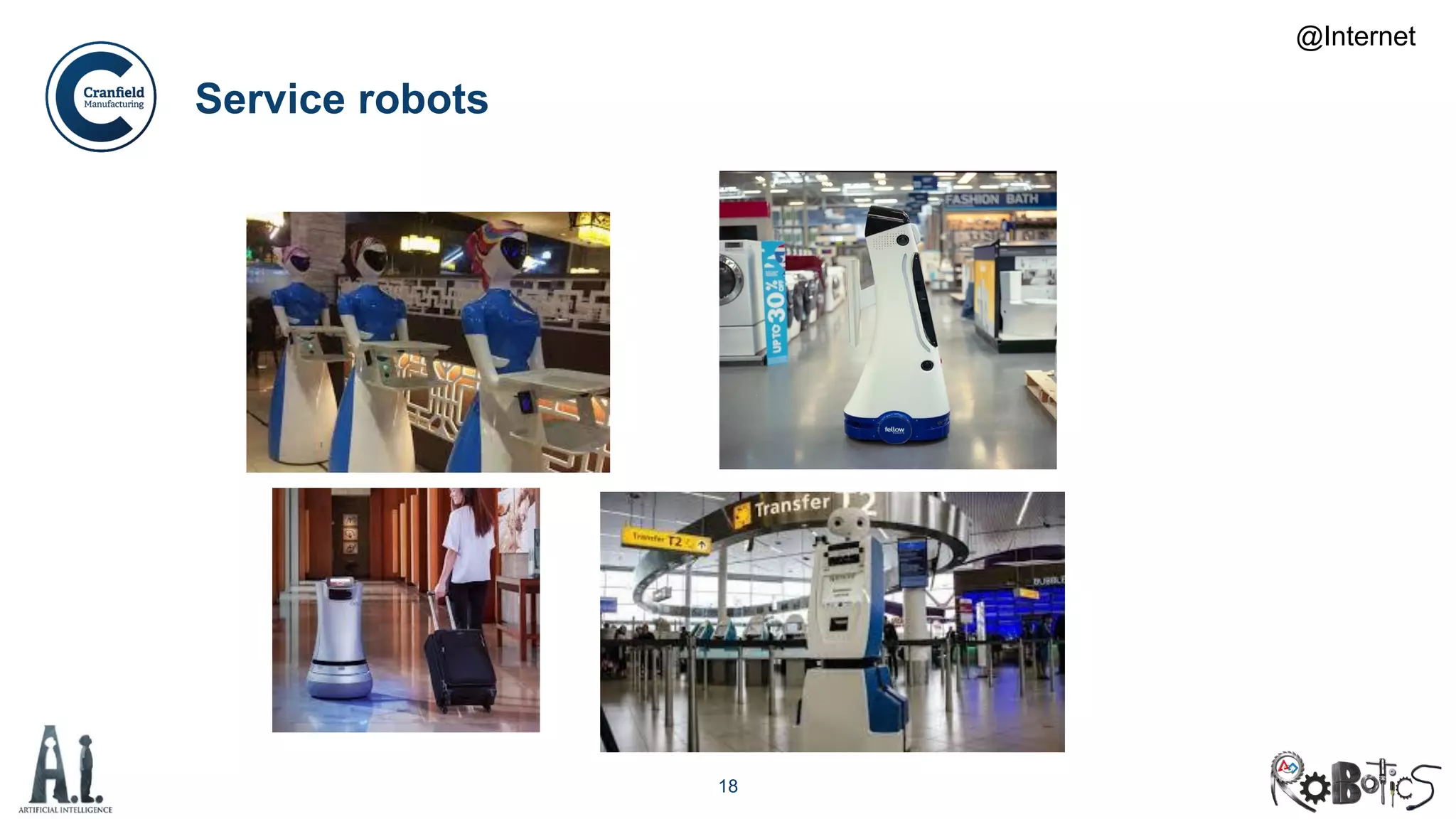
 Service robots
Assisted intelligence: Automated intelligence:
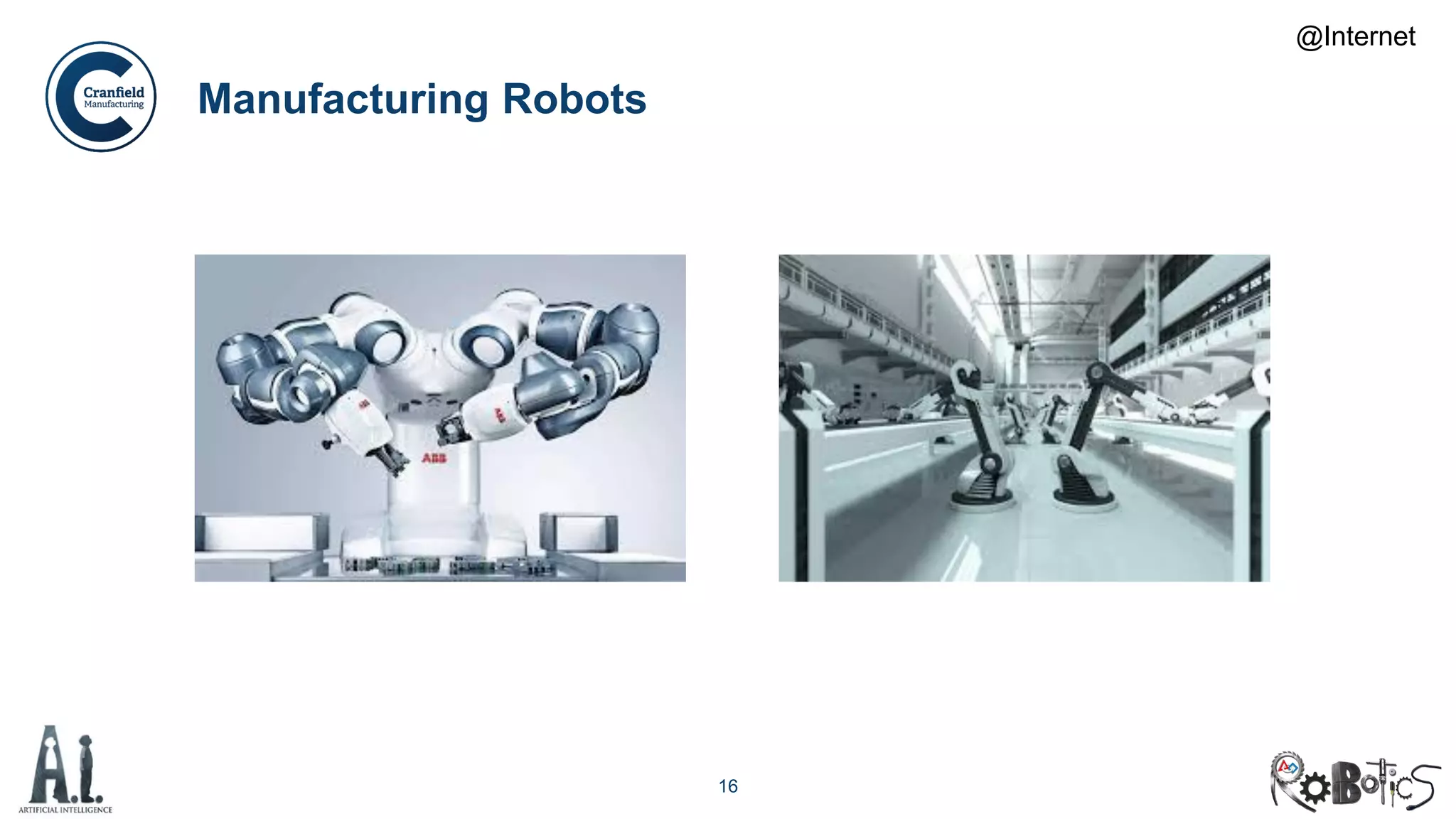
Medical robots (surgery robots) Manufacturing machines
Industry arms/hands/robots
Augmented intelligence: Autonomous intelligence:
Machine translators
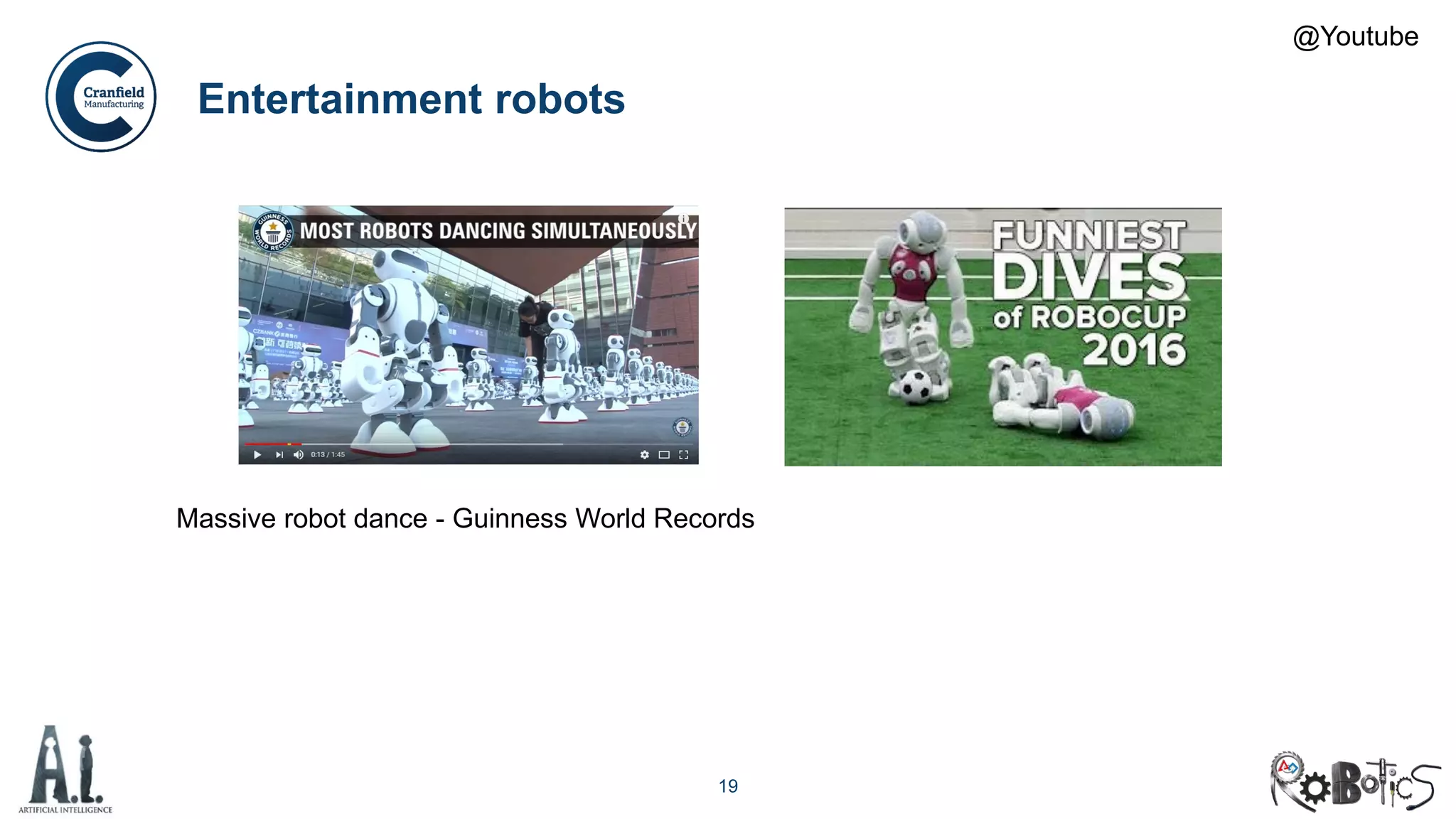
Entertainment robots (AlphaGo)
Domestic robots (home care robots)
Robotic nurses/doctors
(cannot replace human doctors) [3]
Entertainment robots (Robot Football)
Service robots
Domestic robots (robotic cleaner)
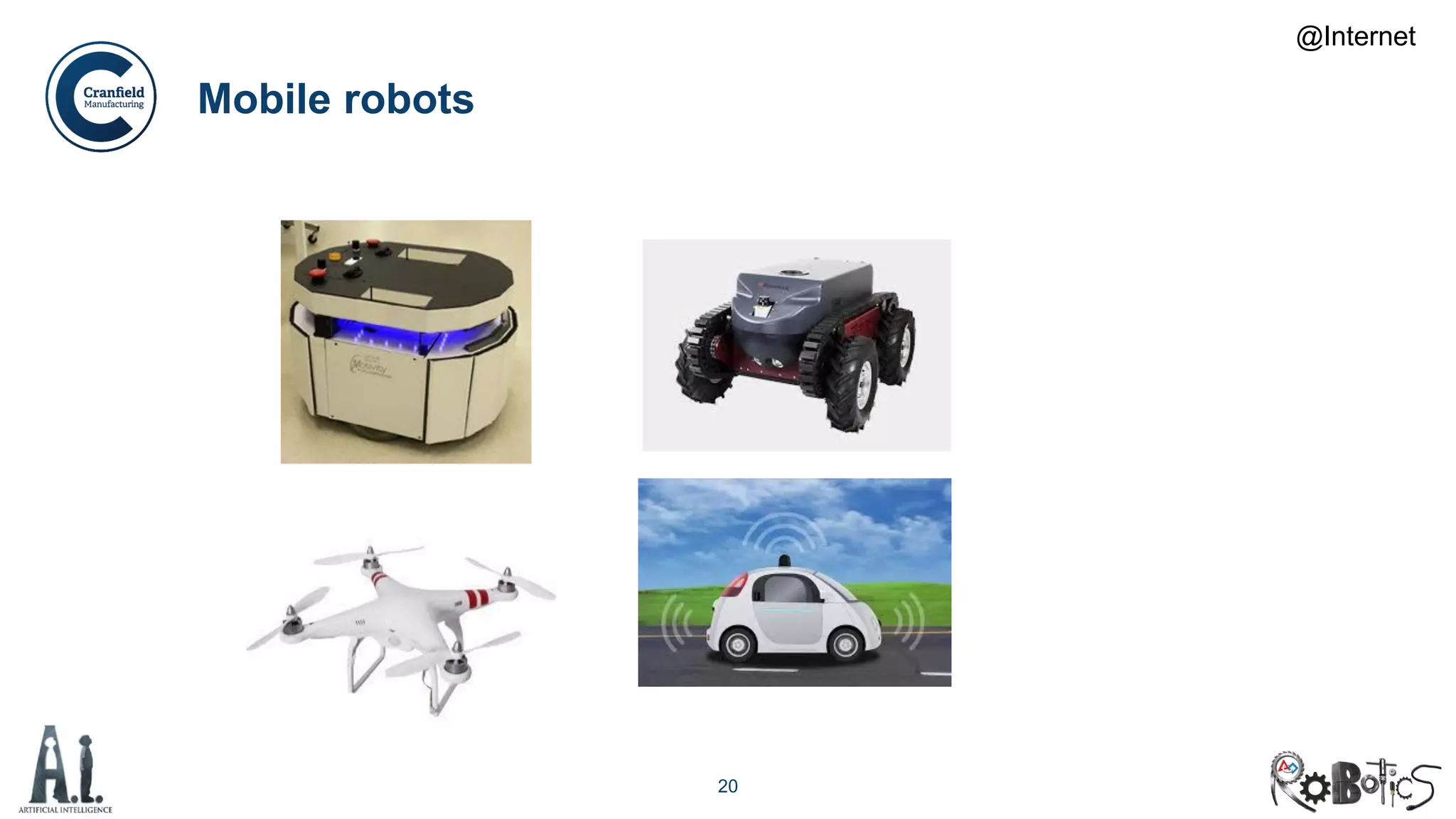
Mobile robots
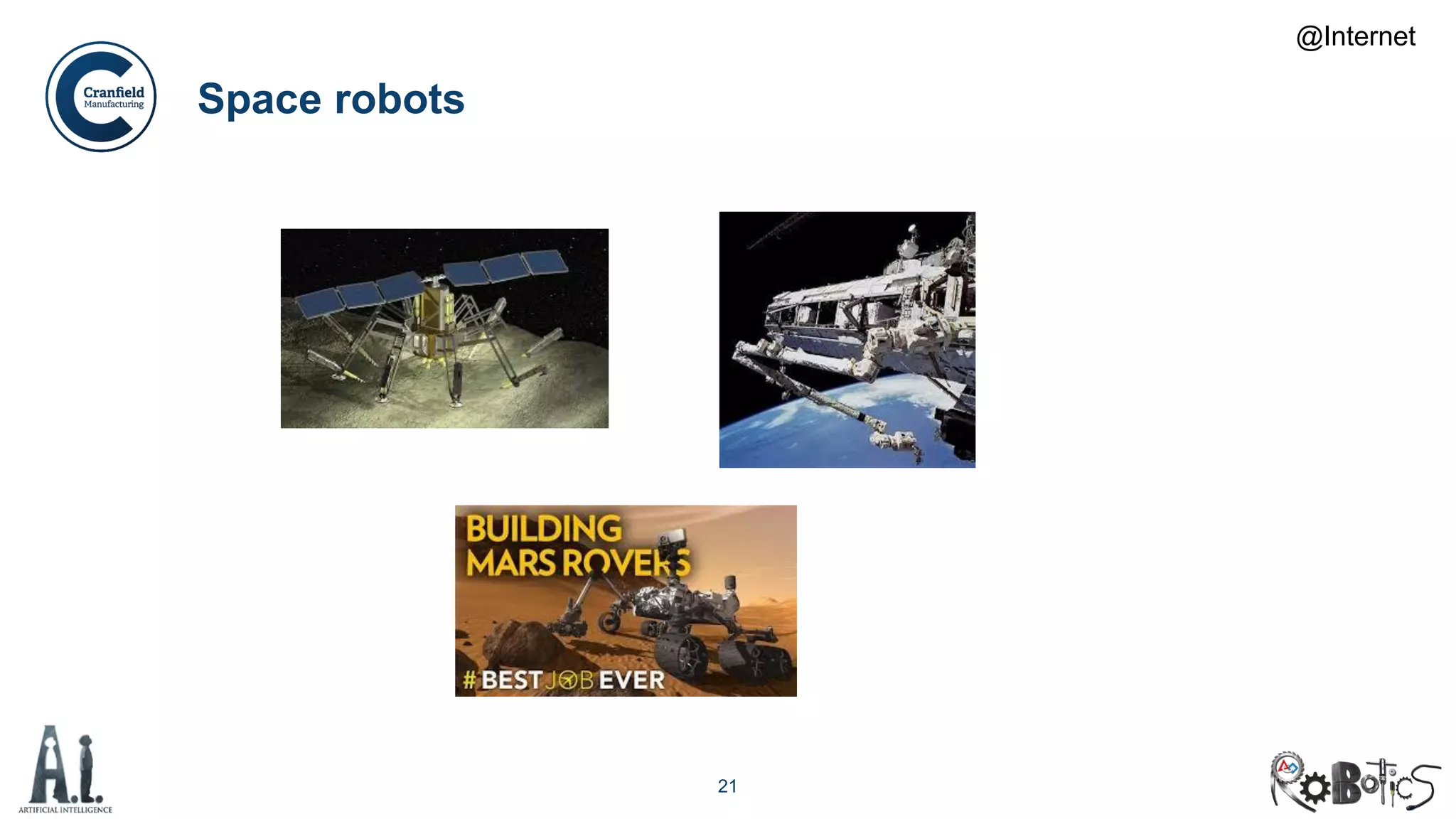
Space robots
Military robots
[3] Stephen K. Klasko , Robots, Augmented Intelligence, and Things Only Humans Can Do
MARY ANN LIEBERT, INC. • DOI:10.1089/heat.2016.29028.skk
15
Medical robots
https://cse.iitk.ac.in/users/cs365/2010/hw3.html
@Internet
16
Manufacturing Robots
@Internet
17
Domestic Robots
@Internet
18
Service robots
@Internet
19
Entertainment robots
Massive robot dance - Guinness World Records
@Youtube
20
Mobile robots
@Internet
21
Space robots
@Internet
22
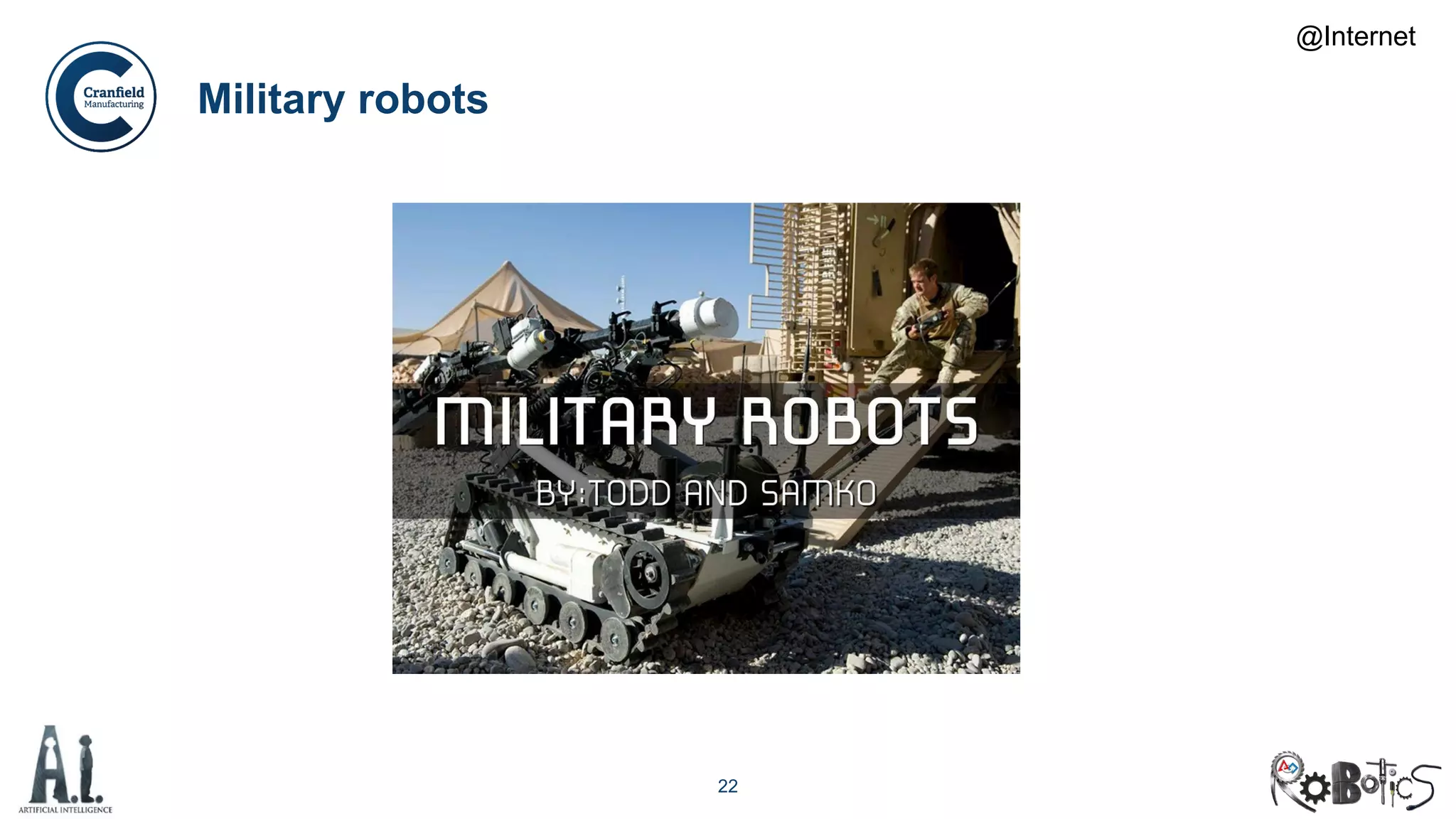
Military robots
@Internet
23
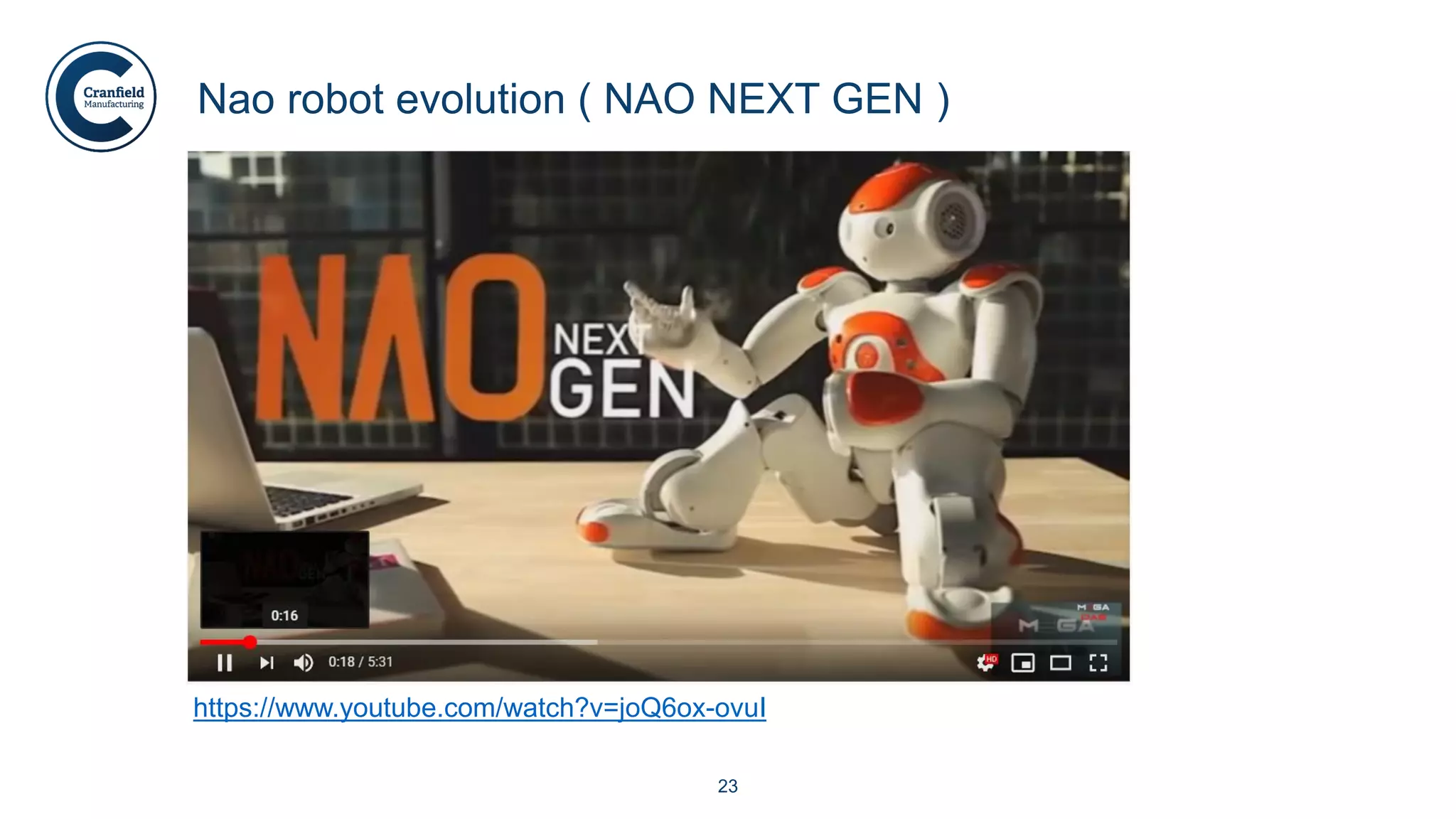
Nao robot evolution ( NAO NEXT GEN )
https://www.youtube.com/watch?v=joQ6ox-ovuI
24
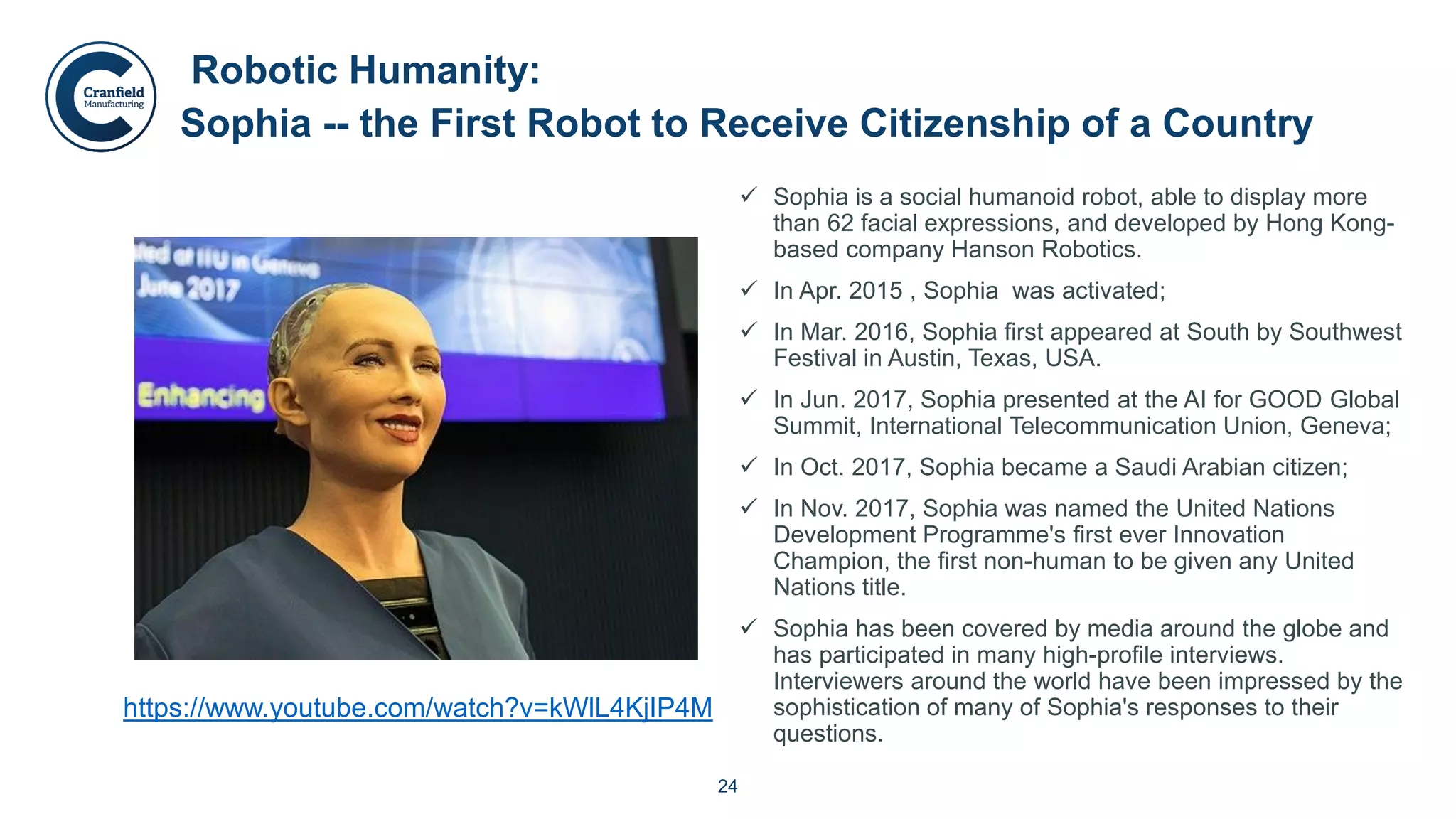
 Sophia is a social humanoid robot, able to display more
than 62 facial expressions, and developed by Hong Kong-
based company Hanson Robotics.
 In Apr. 2015 , Sophia was activated;
 In Mar. 2016, Sophia first appeared at South by Southwest
Festival in Austin, Texas, USA.
 In Jun. 2017, Sophia presented at the AI for GOOD Global
Summit, International Telecommunication Union, Geneva;
 In Oct. 2017, Sophia became a Saudi Arabian citizen;
 In Nov. 2017, Sophia was named the United Nations
Development Programme's first ever Innovation
Champion, the first non-human to be given any United
Nations title.
 Sophia has been covered by media around the globe and
has participated in many high-profile interviews.
Interviewers around the world have been impressed by the
sophistication of many of Sophia's responses to their
questions.
Robotic Humanity:
Sophia -- the First Robot to Receive Citizenship of a Country
https://www.youtube.com/watch?v=kWlL4KjIP4M
25
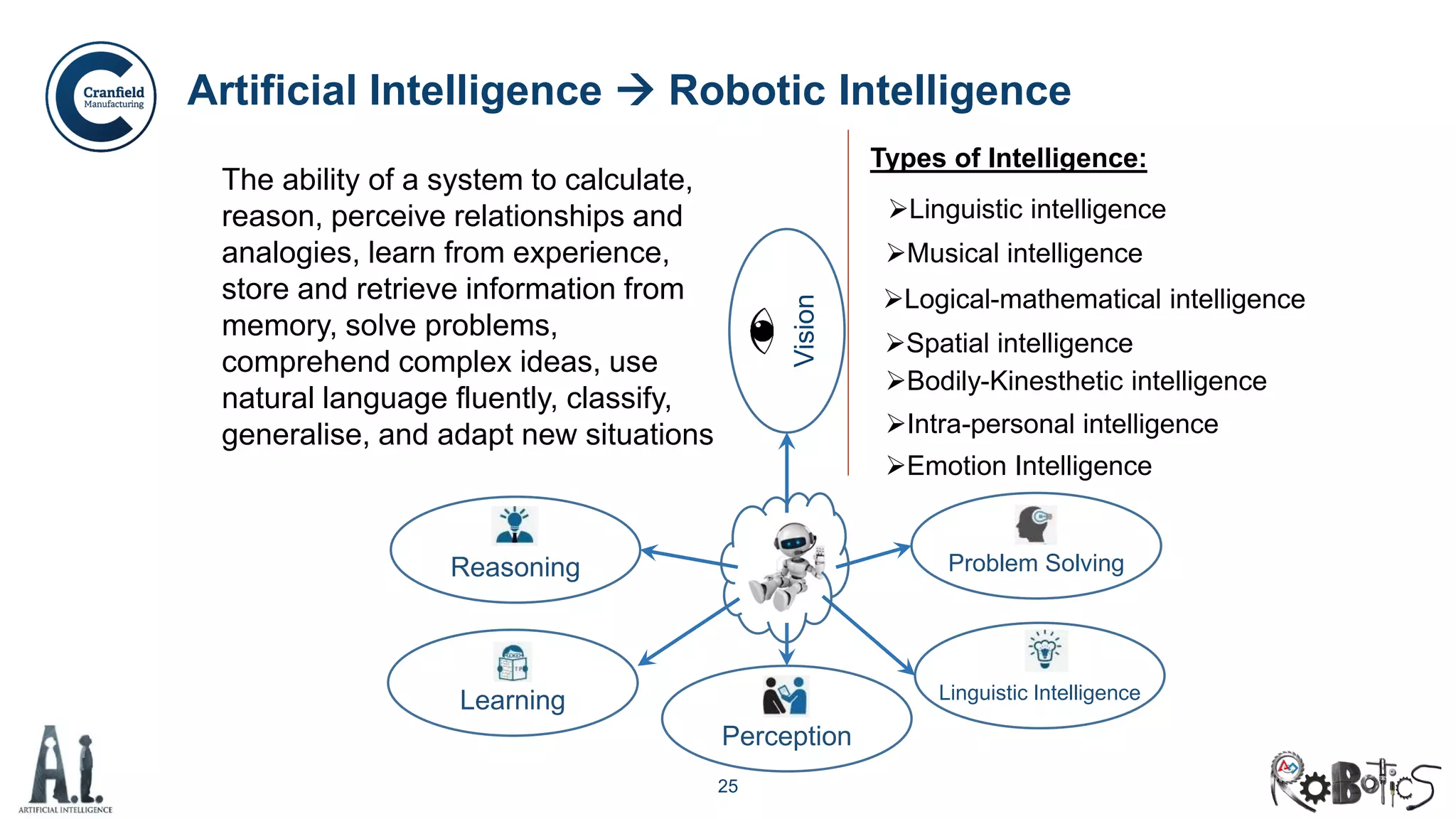
Artificial Intelligence  Robotic Intelligence
The ability of a system to calculate,
reason, perceive relationships and
analogies, learn from experience,
store and retrieve information from
memory, solve problems,
comprehend complex ideas, use
natural language fluently, classify,
generalise, and adapt new situations
Types of Intelligence:
Linguistic intelligence
Musical intelligence
Logical-mathematical intelligence
Spatial intelligence
Bodily-Kinesthetic intelligence
Emotion Intelligence
Vision
Reasoning
Learning
Perception
Problem Solving
Linguistic Intelligence
Intra-personal intelligence
26
Robotics Vision for Autonomous Vehicles [4]
 Background-absorbing Markov chain
 Spatial Pyramid Pooling (SPP) + CNN:
 Output:
• 7 classes
• {10, 20, 30, 40, 50, 60, 70}
 Recognition Rate: 98.98%
 The recognition rate is up to 9.32% higher than that obtained by SPP-CNN
working on raw dataset directly
[4] Z. L. Zhu, G. Xu, H. He, J. Jiang, Recognition of Speed Signs in Uncertain and Dynamic
Environments, 2018 3rd International Conference on Information Science, Computer Technology
and Transportation (ISCTT2018), Xi’an, Shanxi, China, 28-30 Dec. 2018.
.
Background-Absorbing Markov chain
27
A case study: Robot Route Learning with a Linguistic Decision Tree
Learning from experience [5]
 Human drives robot
along a path for several
times
 Record the data from
laser sensor, which scan
the environment when
robot is driven
 Robot has four basic
actions: turn left, turn
right, forward and
backward
[5] H. He, T. M. McGinnity, S. Coleman and B. Gardiner, Linguistic Decision Making for Robot Route Learning,
IEEE Transaction on Neural Networks and Learning Systems, 25(1), Jan 2014, pp. 203 – 215.
28
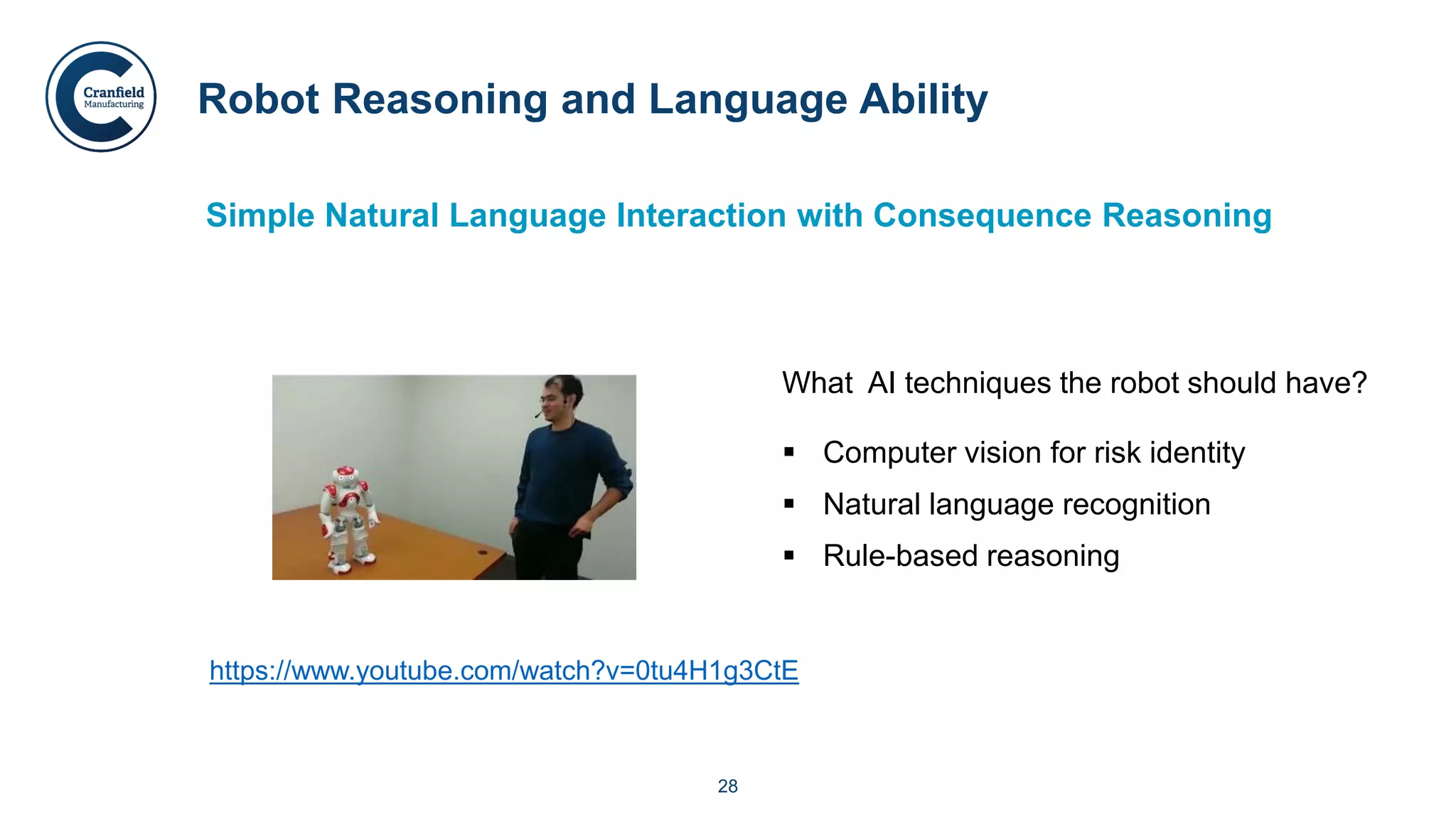
Simple Natural Language Interaction with Consequence Reasoning
Robot Reasoning and Language Ability
What AI techniques the robot should have?
 Computer vision for risk identity
 Natural language recognition
 Rule-based reasoning
https://www.youtube.com/watch?v=0tu4H1g3CtE
29
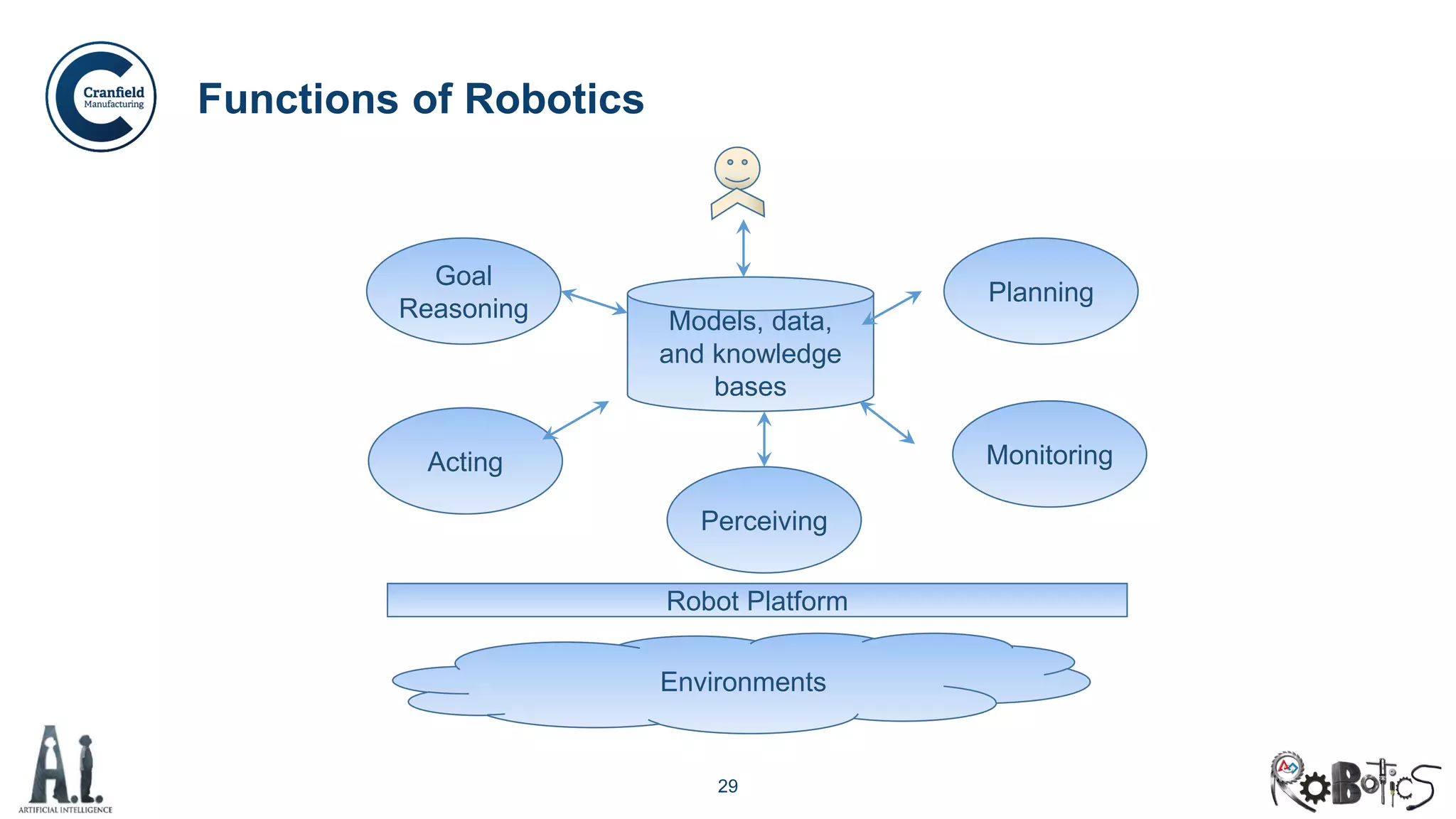
Functions of Robotics
Models, data,
and knowledge
bases
Planning
Goal
Reasoning
Monitoring
Perceiving
Acting
Robot Platform
Environments
30
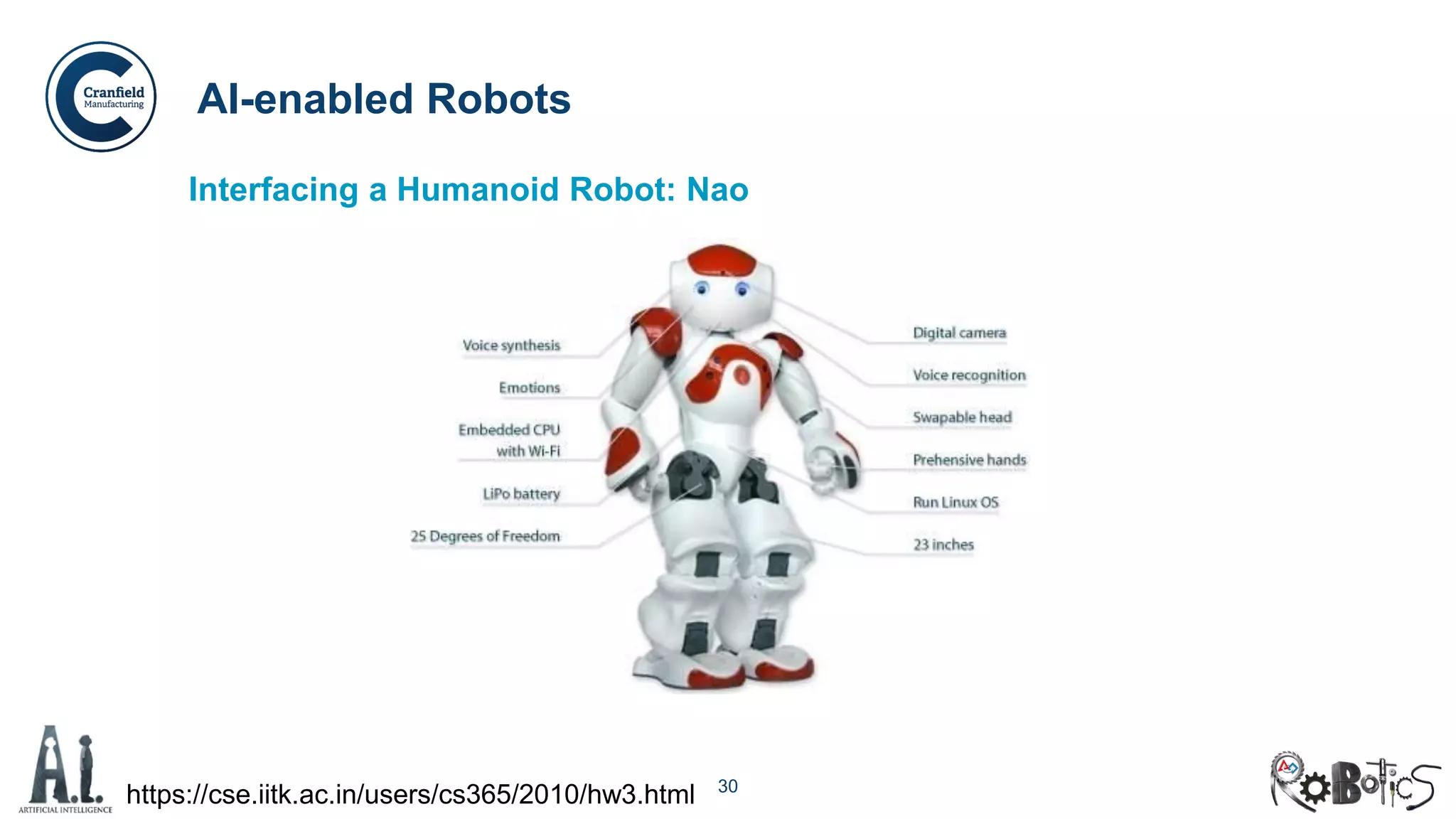
Interfacing a Humanoid Robot: Nao
AI-enabled Robots
https://cse.iitk.ac.in/users/cs365/2010/hw3.html
31
Implementation of Robot Intelligence
Sensors
Effectors
Framework of information fusion
Information Propagation
32
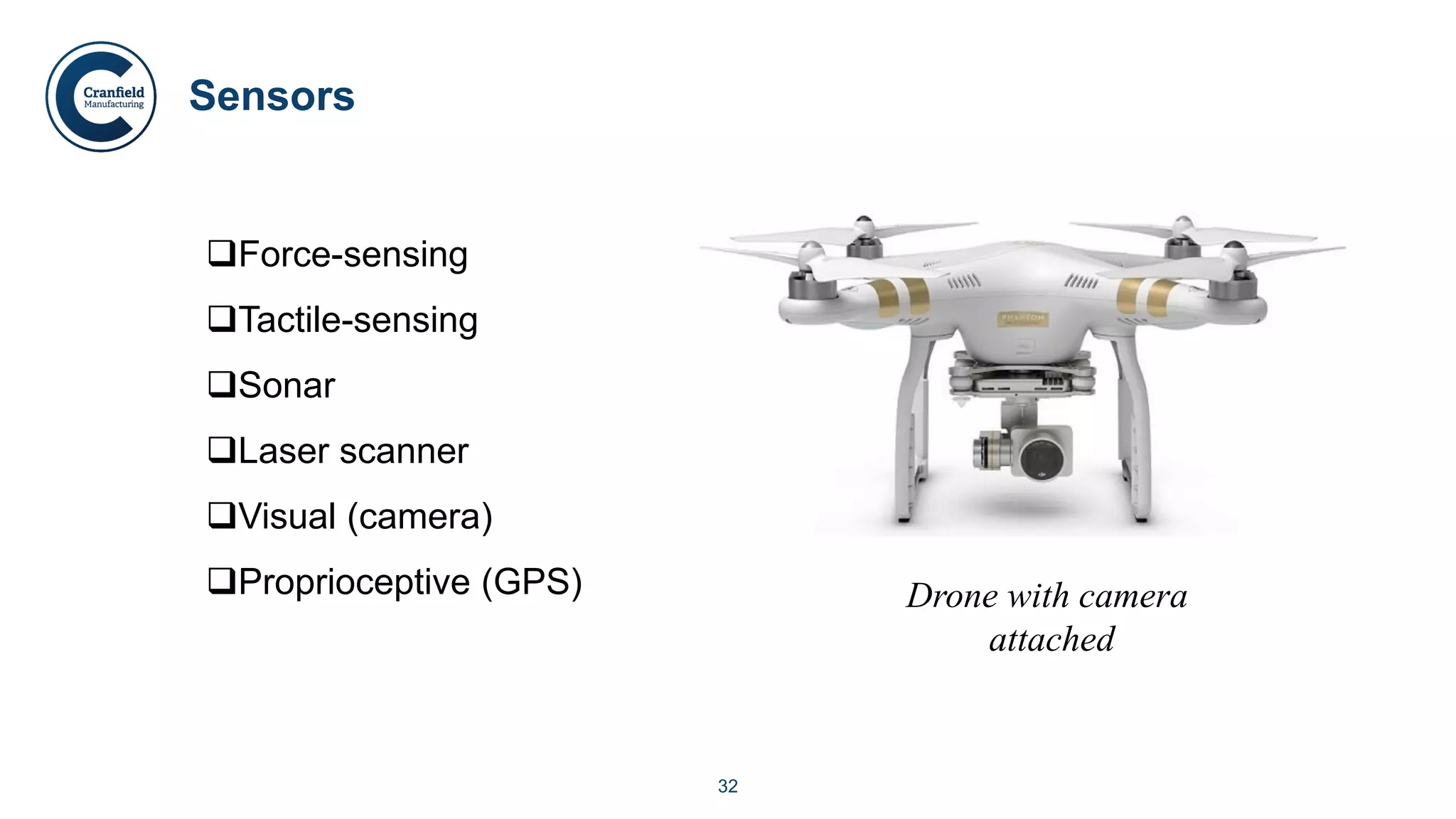
Sensors
Force-sensing
Tactile-sensing
Sonar
Laser scanner
Visual (camera)
Proprioceptive (GPS) Drone with camera
attached
33
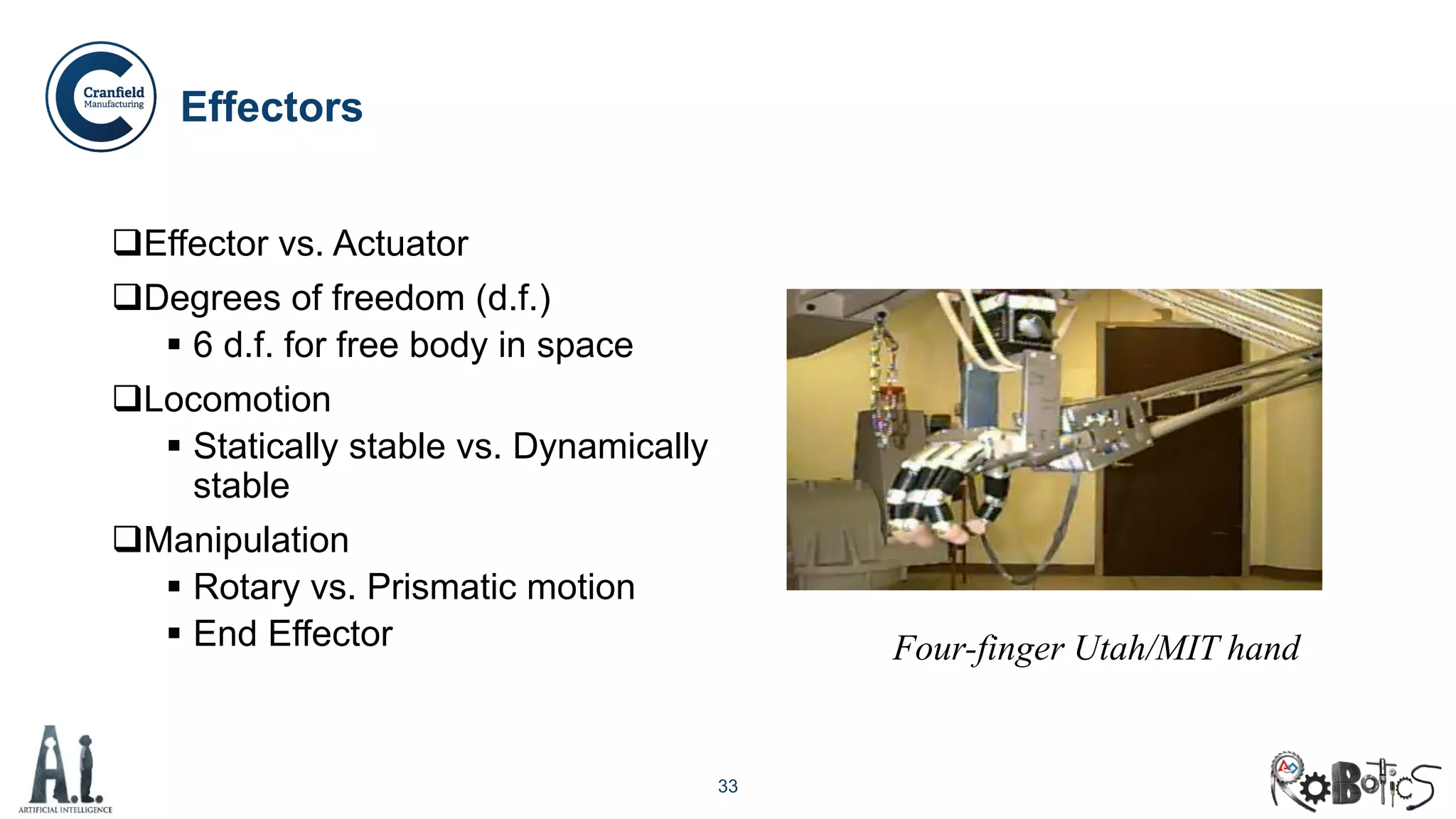
Effectors
Effector vs. Actuator
Degrees of freedom (d.f.)
 6 d.f. for free body in space
Locomotion
 Statically stable vs. Dynamically
stable
Manipulation
 Rotary vs. Prismatic motion
 End Effector Four-finger Utah/MIT hand
34
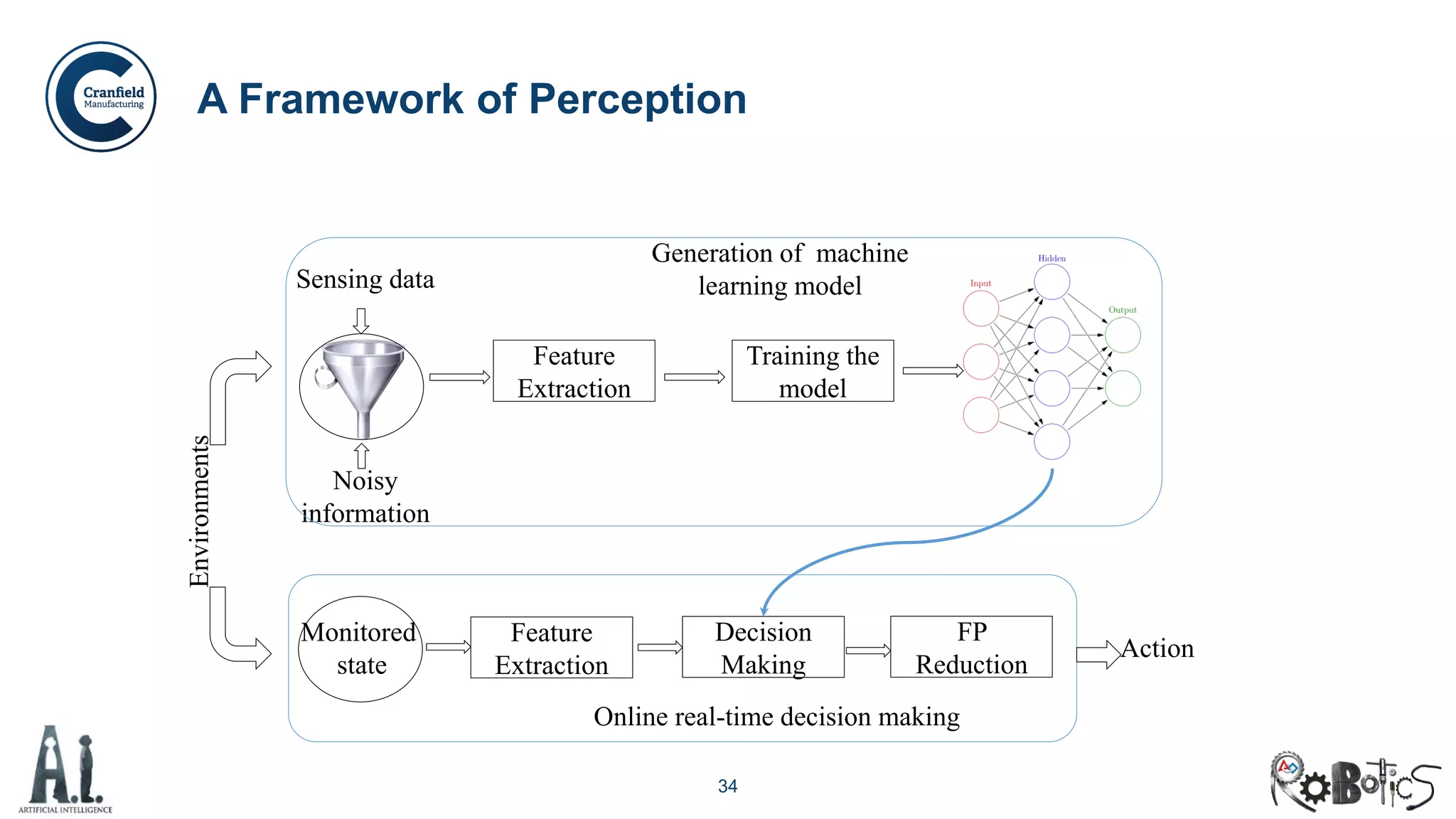
A Framework of Perception
Environments
Feature
Extraction
Training the
model
Feature
Extraction
Decision
Making
FP
Reduction
Action
Sensing data
Noisy
information
Monitored
state
Generation of machine
learning model
Online real-time decision making
35
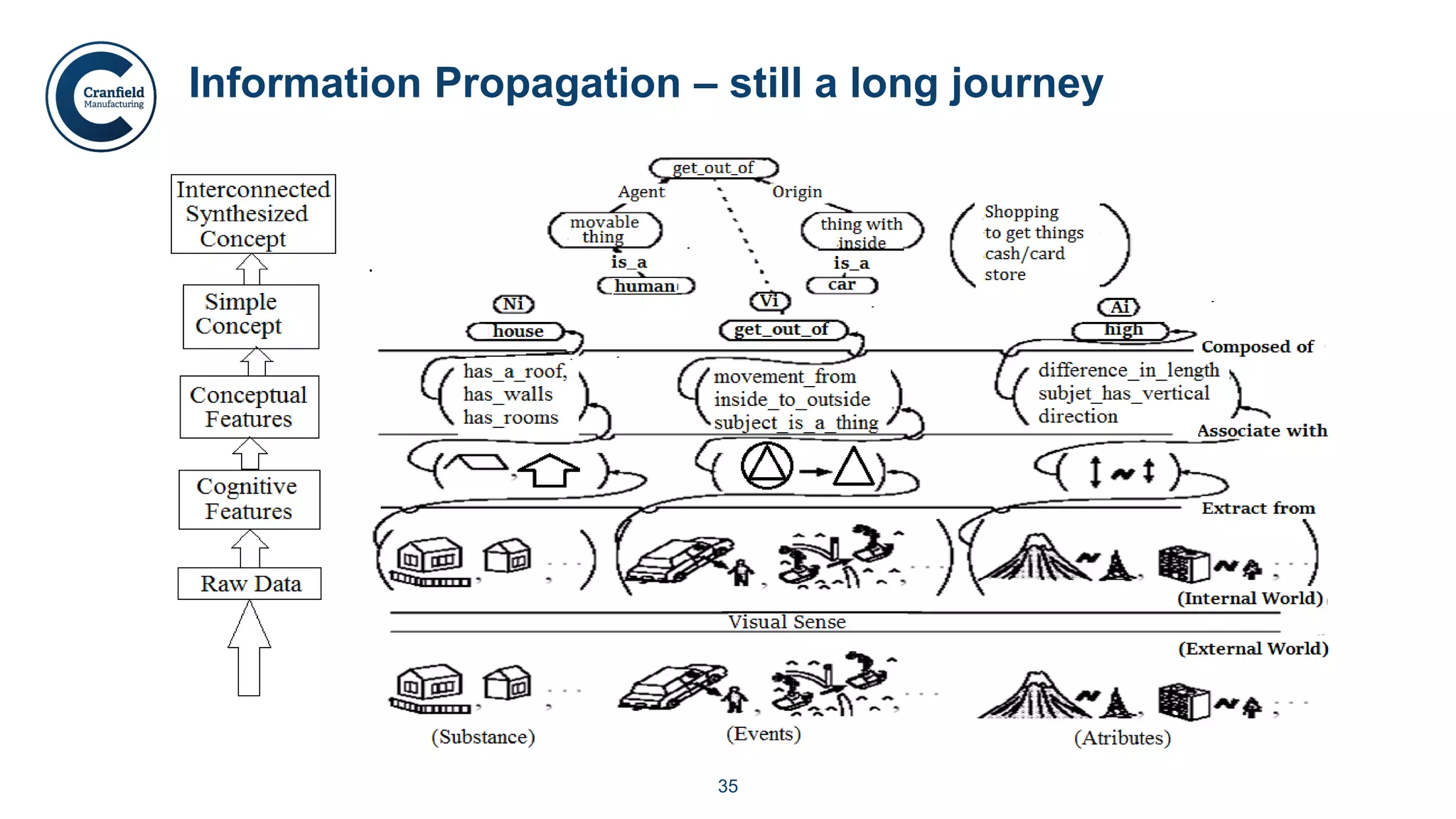
Information Propagation – still a long journey
36
Future of AI & Robotics
36
37
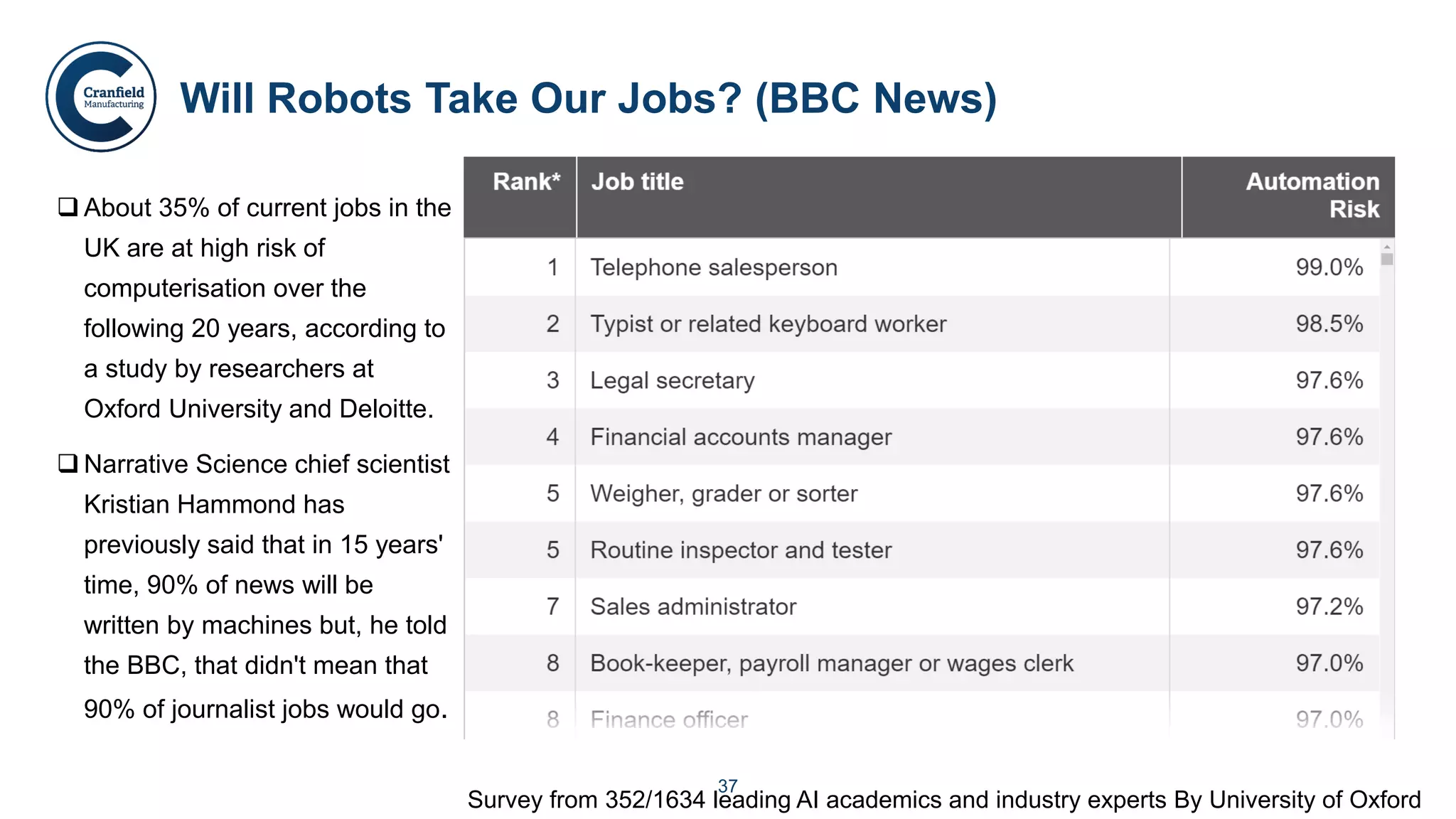
Will Robots Take Our Jobs? (BBC News)
 About 35% of current jobs in the
UK are at high risk of
computerisation over the
following 20 years, according to
a study by researchers at
Oxford University and Deloitte.
 Narrative Science chief scientist
Kristian Hammond has
previously said that in 15 years'
time, 90% of news will be
written by machines but, he told
the BBC, that didn't mean that
90% of journalist jobs would go.
Survey from 352/1634 leading AI academics and industry experts By University of Oxford
38
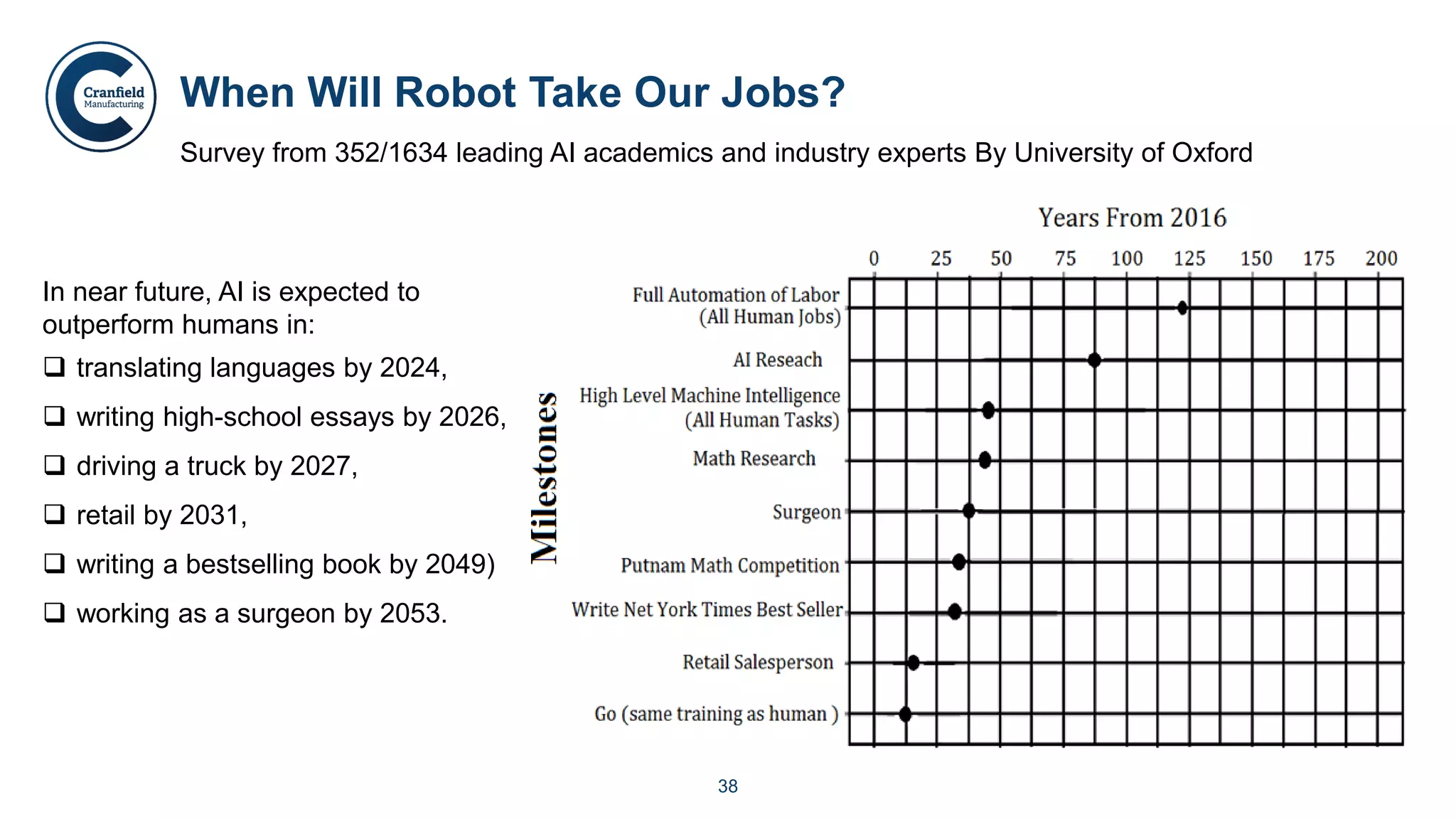
When Will Robot Take Our Jobs?
Survey from 352/1634 leading AI academics and industry experts By University of Oxford
In near future, AI is expected to
outperform humans in:
 translating languages by 2024,
 writing high-school essays by 2026,
 driving a truck by 2027,
 retail by 2031,
 writing a bestselling book by 2049)
 working as a surgeon by 2053.
39
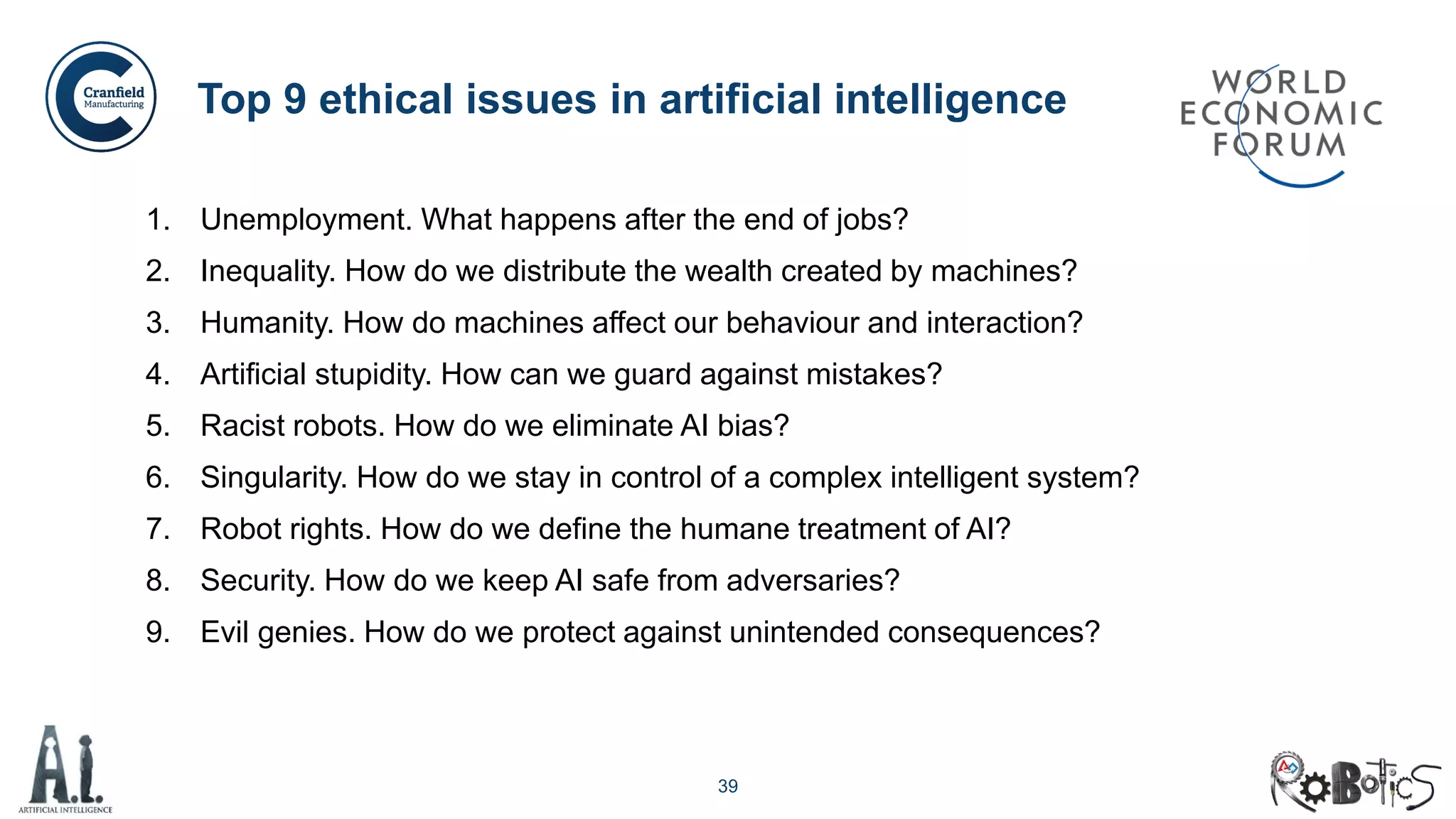
Top 9 ethical issues in artificial intelligence
1. Unemployment. What happens after the end of jobs?
2. Inequality. How do we distribute the wealth created by machines?
3. Humanity. How do machines affect our behaviour and interaction?
4. Artificial stupidity. How can we guard against mistakes?
5. Racist robots. How do we eliminate AI bias?
6. Singularity. How do we stay in control of a complex intelligent system?
7. Robot rights. How do we define the humane treatment of AI?
8. Security. How do we keep AI safe from adversaries?
9. Evil genies. How do we protect against unintended consequences?
40
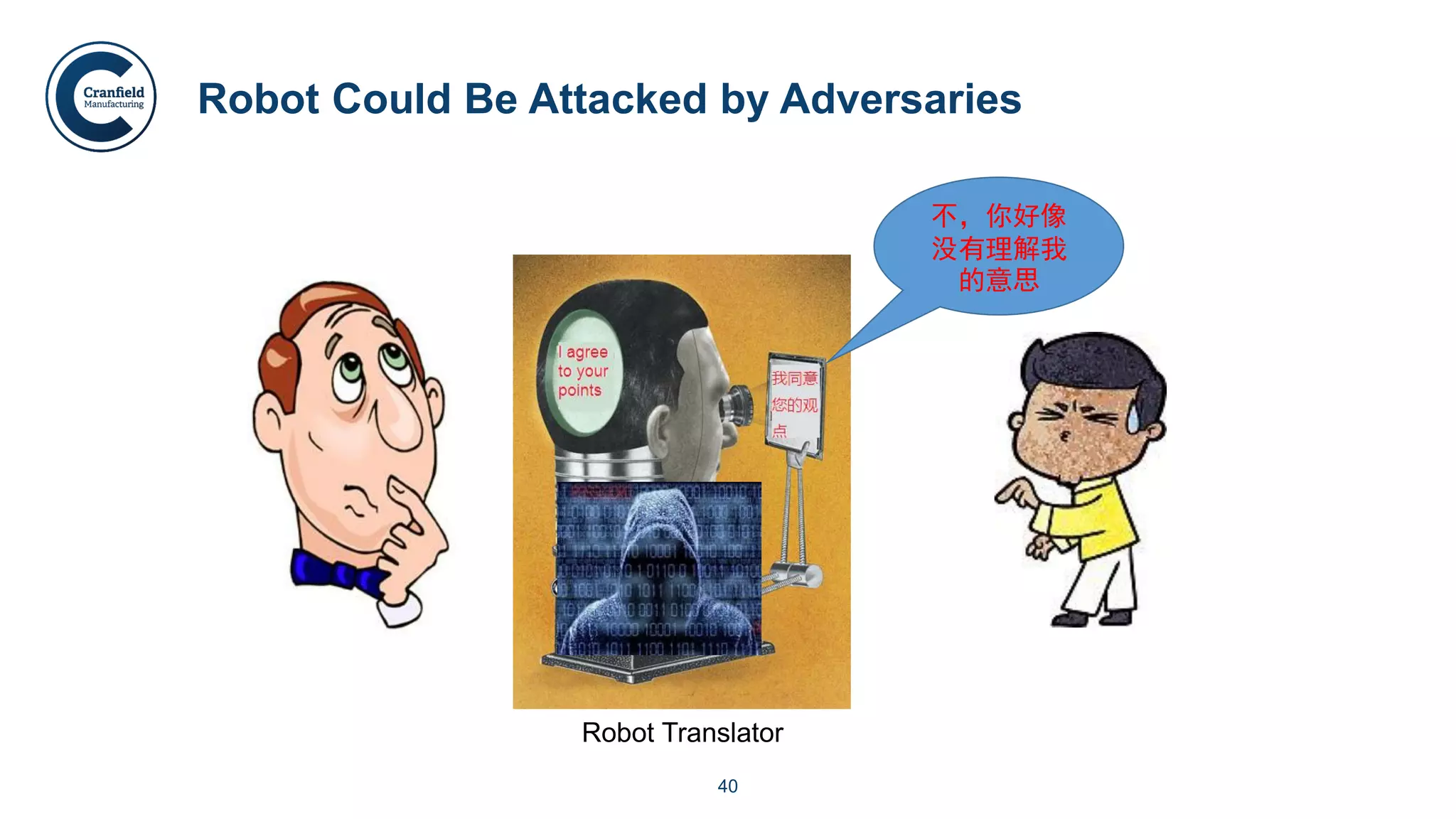
Robot Could Be Attacked by Adversaries
不,你好像
没有理解我
的意思
Robot Translator
41
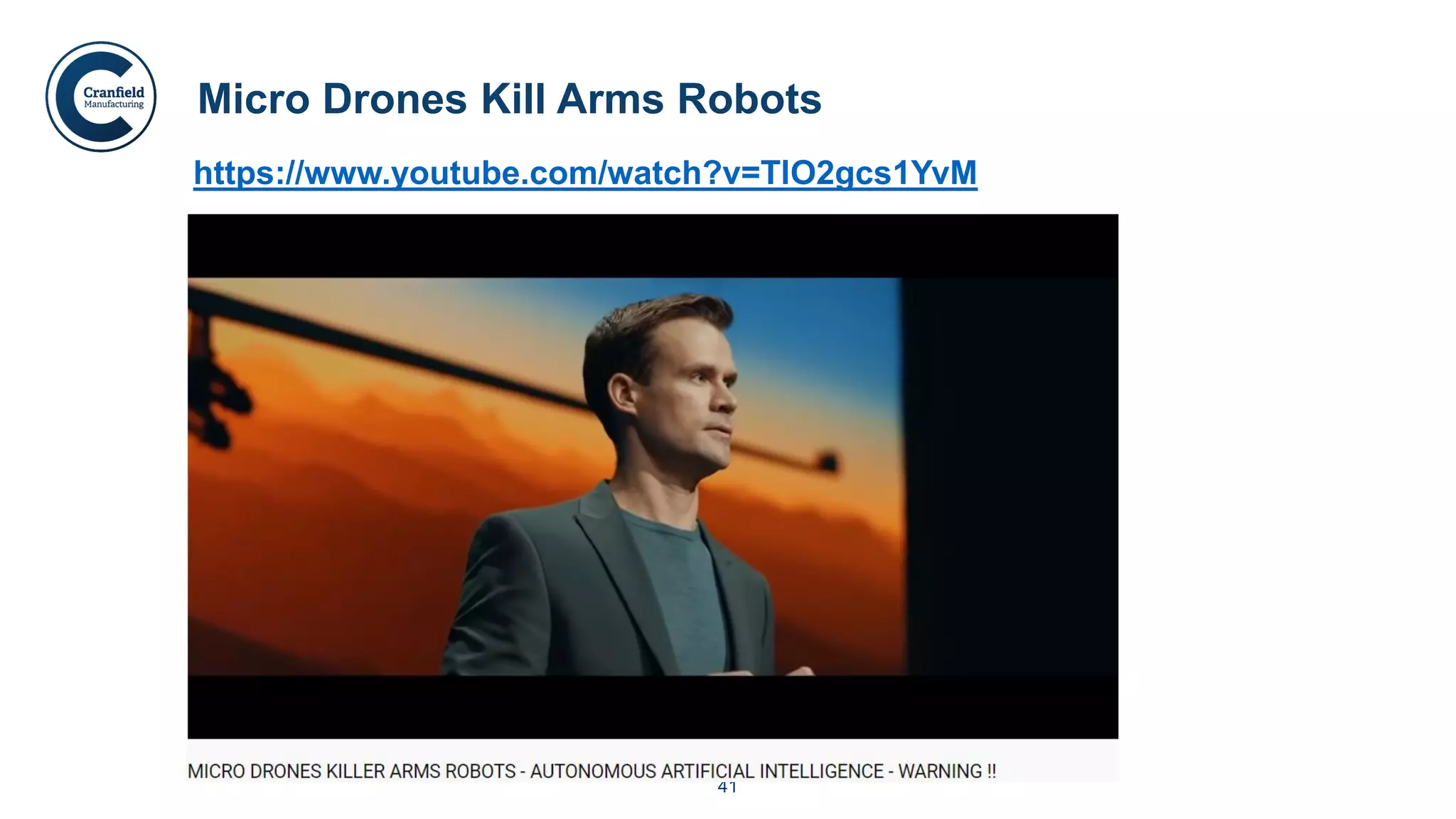
Micro Drones Kill Arms Robots
https://www.youtube.com/watch?v=TlO2gcs1YvM
42
The Zeroth Law of Robots
In later fiction where robots had taken responsibility for
government of whole planets and human civilizations,
Asimov also added a fourth, or zeroth law:
A robot may not harm humanity, or, by inaction, allow
humanity to come to harm.
43
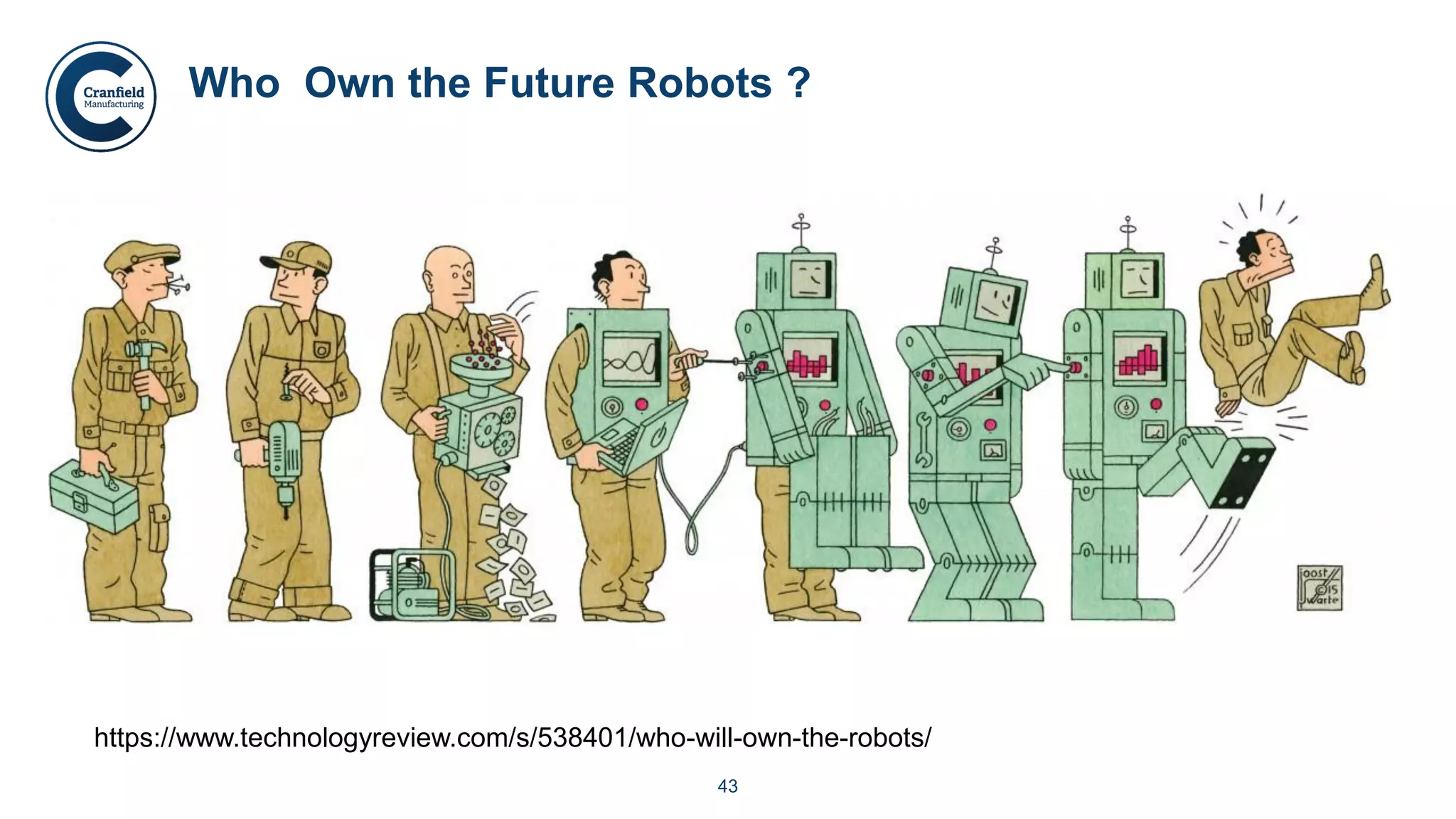
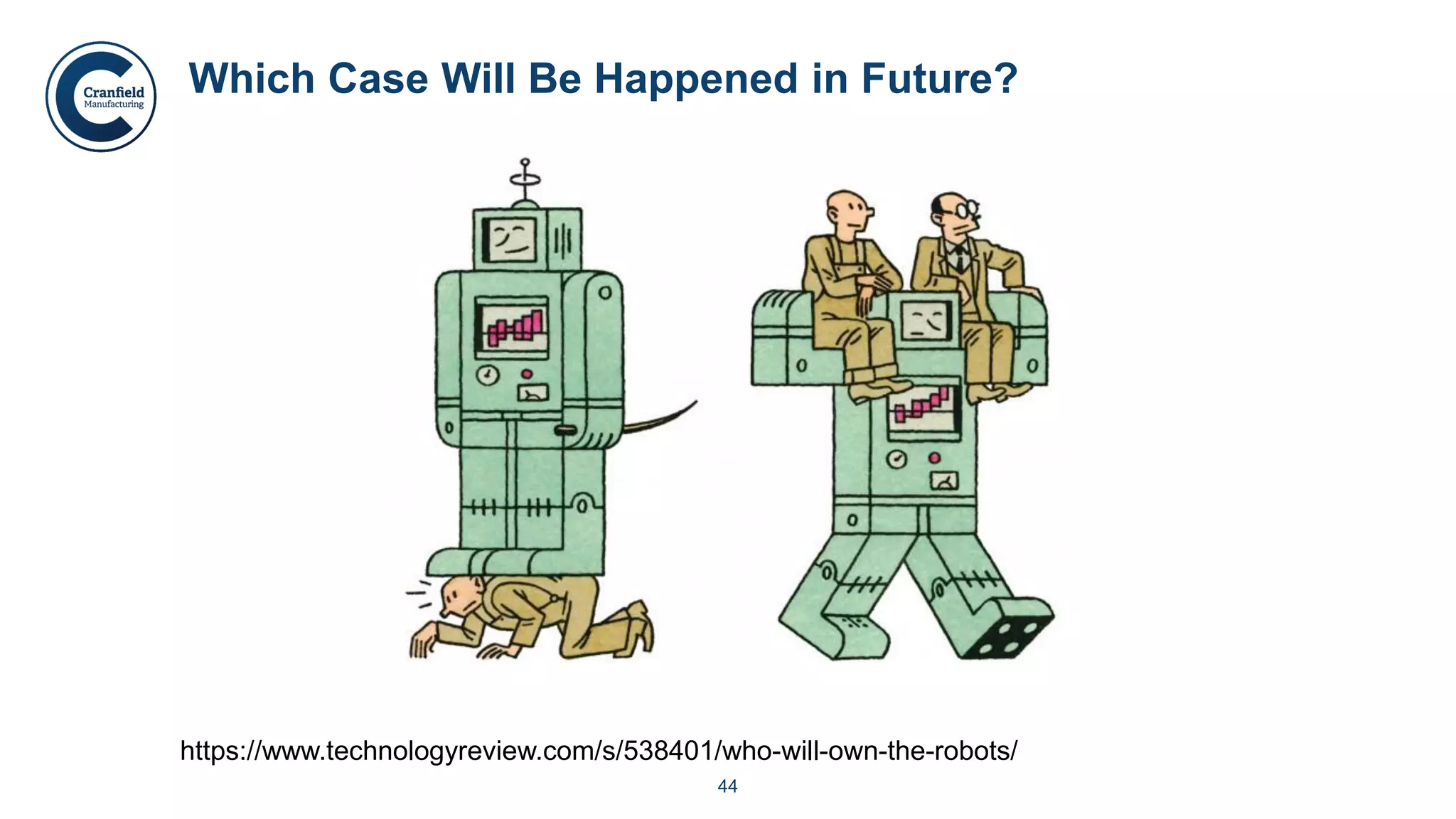
Who Own the Future Robots ?
https://www.technologyreview.com/s/538401/who-will-own-the-robots/
44
Which Case Will Be Happened in Future?
https://www.technologyreview.com/s/538401/who-will-own-the-robots/
45
Thank You Very Much for Your Attention !

AI & robotics: Past, Present and Future

  • 1.
  • 2.
    2 Outline 1. What isRobot & AI (RAI)? 2. The History of RAI 3. Types of Robotics Today 4. AI & Robotic Intelligence 5. Issues and Challenge of AI & Robotics in future
  • 3.
    3 What is AI? Artificial intelligence is the science and engineering of making intelligent machines, especially intelligent computer programs. --- John McCarthy, father of AI at MIT, 1956
  • 4.
    4 Artificial Intelligence System[1] [1] PwC Analysis: Sizing the prize -- What’s the real value of AI for your business and how can you capitalise?
  • 5.
    5 What is arobot ? A robot is…  “An active artificial agent whose environment is the physical world” --Russell and Norvig  “A programmable, multifunction manipulator designed to move material, parts, tools or specific devices through variable programmed motions for the performance of a variety of tasks” --Robot Institute of America  An active artificial agent, which exists in the physical world, autonomously senses its environment and intelligently acts in the environment for a specific purpose as human expects.
  • 6.
    6 The Past ofAI & Robotics
  • 7.
    7 History of AI(1950 – 1993) 1950 1956 1958 1963 1968 1970 1972 1986 1991 1993 Birth of AI Dartmouth Conference Project MAC sponsored by DARTA First Expert System AI-based hardware sells $425 million to companies AI System beats human chess-master Logic Theorist developed Lisp language developed Microworld program, SHRDLU created PROLOG language revealed Turing test First DART Gulf War Polly behaviour- based robots
  • 8.
    8 Two Winters ofAI  The first AI winter 1974–1980  subject to critiques and financial setbacks  tremendous optimism had raised expectations impossibly high  the field of connectionism (or neural nets) was shut down almost completely for 10 years by Marvin Minsky's devastating criticism of perceptrons  The second AI winter 1987–1993  Apple and IBM had been steadily gaining speed and power and in 1987 they became more powerful than the more expensive Lisp machines made by Symbolics and others.  Eventually the earliest successful expert systems, such as XCON, proved too expensive to maintain.  the Strategic Computing Initiative cut funding to AI "deeply and brutally.
  • 9.
    9 History of AI(1993 – 2016) 1997 1999 2002 2004 2005 2009 2010 2012 2015 2016 IBM Deep Blue defeats world chess champion, Garry Kasparov. the AIBO becomes one of the first artificially intelligent "pets" Honda's ASIMO robot, an artificially intelligent humanoid robot Microsoftware Kinect for Xbox 360 First RoboCup football match iRobot's Roomba autonomously cleaner NASA's robotic rovers autonomously navigate the surface of Mars. Stanley (autonomous Vehicle) Google DeepMind's AlphaGo European Go champion 2 dan Google DeepMind's AlphaGo Go champion 9 dan Google self- driving car Google Brain
  • 10.
    10 Ten Milestones ofRobotics [2] 1941 1961 1964 1973 1985 1986 1997 2002 2011 2012 Isaac Asimov Outlines Three Laws of Robotics General Motors Uses World’s First Industrial Robot U.S. Military Begins Using Drone Aircraft in Vietnam" Honda Begins Work on Independent Walking Robot NASA Launches First Human-Like Robot Into Orbit First Anthropomorphic Robot Doctor Performs First Robot-Assisted Surgery Roomba Changes Perception of Robots Google Self-Driving Car Passes Driver’s License Test [2] http://listosaur.com/science-a-technology/10-milestones-robotics-history/ First RoboCup football match
  • 11.
    11 The Present ofAI & Robotics
  • 12.
    12 Artificial Intelligence Today[1] Human in the loop No human in the loop Hardware/Specific System Assisted intelligence: Helping people to perform tasks faster and better. Automated intelligence: Automation of manual/cognitive and routine/nonroutine tasks. Adaptive Systems Augmented intelligence: Helping people to make better decisions. Autonomous intelligence: Automating decision making processes without human intervention.
  • 13.
    13 Artificial Intelligence -Rise Beyond Human Intelligence https://blog.paradisetechsoft.com/what-is-artificial-intelligence/ (18 JUNE 2019)
  • 14.
    14 Robots in Termsof the 4 AI Forms  Domestic robots  Medical robots  Service robots Assisted intelligence: Automated intelligence: Medical robots (surgery robots) Manufacturing machines Industry arms/hands/robots Augmented intelligence: Autonomous intelligence: Machine translators Entertainment robots (AlphaGo) Domestic robots (home care robots) Robotic nurses/doctors (cannot replace human doctors) [3] Entertainment robots (Robot Football) Service robots Domestic robots (robotic cleaner) Mobile robots Space robots Military robots [3] Stephen K. Klasko , Robots, Augmented Intelligence, and Things Only Humans Can Do MARY ANN LIEBERT, INC. • DOI:10.1089/heat.2016.29028.skk
  • 15.
  • 16.
  • 17.
  • 18.
  • 19.
    19 Entertainment robots Massive robotdance - Guinness World Records @Youtube
  • 20.
  • 21.
  • 22.
  • 23.
    23 Nao robot evolution( NAO NEXT GEN ) https://www.youtube.com/watch?v=joQ6ox-ovuI
  • 24.
    24  Sophia isa social humanoid robot, able to display more than 62 facial expressions, and developed by Hong Kong- based company Hanson Robotics.  In Apr. 2015 , Sophia was activated;  In Mar. 2016, Sophia first appeared at South by Southwest Festival in Austin, Texas, USA.  In Jun. 2017, Sophia presented at the AI for GOOD Global Summit, International Telecommunication Union, Geneva;  In Oct. 2017, Sophia became a Saudi Arabian citizen;  In Nov. 2017, Sophia was named the United Nations Development Programme's first ever Innovation Champion, the first non-human to be given any United Nations title.  Sophia has been covered by media around the globe and has participated in many high-profile interviews. Interviewers around the world have been impressed by the sophistication of many of Sophia's responses to their questions. Robotic Humanity: Sophia -- the First Robot to Receive Citizenship of a Country https://www.youtube.com/watch?v=kWlL4KjIP4M
  • 25.
    25 Artificial Intelligence Robotic Intelligence The ability of a system to calculate, reason, perceive relationships and analogies, learn from experience, store and retrieve information from memory, solve problems, comprehend complex ideas, use natural language fluently, classify, generalise, and adapt new situations Types of Intelligence: Linguistic intelligence Musical intelligence Logical-mathematical intelligence Spatial intelligence Bodily-Kinesthetic intelligence Emotion Intelligence Vision Reasoning Learning Perception Problem Solving Linguistic Intelligence Intra-personal intelligence
  • 26.
    26 Robotics Vision forAutonomous Vehicles [4]  Background-absorbing Markov chain  Spatial Pyramid Pooling (SPP) + CNN:  Output: • 7 classes • {10, 20, 30, 40, 50, 60, 70}  Recognition Rate: 98.98%  The recognition rate is up to 9.32% higher than that obtained by SPP-CNN working on raw dataset directly [4] Z. L. Zhu, G. Xu, H. He, J. Jiang, Recognition of Speed Signs in Uncertain and Dynamic Environments, 2018 3rd International Conference on Information Science, Computer Technology and Transportation (ISCTT2018), Xi’an, Shanxi, China, 28-30 Dec. 2018. . Background-Absorbing Markov chain
  • 27.
    27 A case study:Robot Route Learning with a Linguistic Decision Tree Learning from experience [5]  Human drives robot along a path for several times  Record the data from laser sensor, which scan the environment when robot is driven  Robot has four basic actions: turn left, turn right, forward and backward [5] H. He, T. M. McGinnity, S. Coleman and B. Gardiner, Linguistic Decision Making for Robot Route Learning, IEEE Transaction on Neural Networks and Learning Systems, 25(1), Jan 2014, pp. 203 – 215.
  • 28.
    28 Simple Natural LanguageInteraction with Consequence Reasoning Robot Reasoning and Language Ability What AI techniques the robot should have?  Computer vision for risk identity  Natural language recognition  Rule-based reasoning https://www.youtube.com/watch?v=0tu4H1g3CtE
  • 29.
    29 Functions of Robotics Models,data, and knowledge bases Planning Goal Reasoning Monitoring Perceiving Acting Robot Platform Environments
  • 30.
    30 Interfacing a HumanoidRobot: Nao AI-enabled Robots https://cse.iitk.ac.in/users/cs365/2010/hw3.html
  • 31.
    31 Implementation of RobotIntelligence Sensors Effectors Framework of information fusion Information Propagation
  • 32.
  • 33.
    33 Effectors Effector vs. Actuator Degreesof freedom (d.f.)  6 d.f. for free body in space Locomotion  Statically stable vs. Dynamically stable Manipulation  Rotary vs. Prismatic motion  End Effector Four-finger Utah/MIT hand
  • 34.
    34 A Framework ofPerception Environments Feature Extraction Training the model Feature Extraction Decision Making FP Reduction Action Sensing data Noisy information Monitored state Generation of machine learning model Online real-time decision making
  • 35.
    35 Information Propagation –still a long journey
  • 36.
    36 Future of AI& Robotics 36
  • 37.
    37 Will Robots TakeOur Jobs? (BBC News)  About 35% of current jobs in the UK are at high risk of computerisation over the following 20 years, according to a study by researchers at Oxford University and Deloitte.  Narrative Science chief scientist Kristian Hammond has previously said that in 15 years' time, 90% of news will be written by machines but, he told the BBC, that didn't mean that 90% of journalist jobs would go. Survey from 352/1634 leading AI academics and industry experts By University of Oxford
  • 38.
    38 When Will RobotTake Our Jobs? Survey from 352/1634 leading AI academics and industry experts By University of Oxford In near future, AI is expected to outperform humans in:  translating languages by 2024,  writing high-school essays by 2026,  driving a truck by 2027,  retail by 2031,  writing a bestselling book by 2049)  working as a surgeon by 2053.
  • 39.
    39 Top 9 ethicalissues in artificial intelligence 1. Unemployment. What happens after the end of jobs? 2. Inequality. How do we distribute the wealth created by machines? 3. Humanity. How do machines affect our behaviour and interaction? 4. Artificial stupidity. How can we guard against mistakes? 5. Racist robots. How do we eliminate AI bias? 6. Singularity. How do we stay in control of a complex intelligent system? 7. Robot rights. How do we define the humane treatment of AI? 8. Security. How do we keep AI safe from adversaries? 9. Evil genies. How do we protect against unintended consequences?
  • 40.
    40 Robot Could BeAttacked by Adversaries 不,你好像 没有理解我 的意思 Robot Translator
  • 41.
    41 Micro Drones KillArms Robots https://www.youtube.com/watch?v=TlO2gcs1YvM
  • 42.
    42 The Zeroth Lawof Robots In later fiction where robots had taken responsibility for government of whole planets and human civilizations, Asimov also added a fourth, or zeroth law: A robot may not harm humanity, or, by inaction, allow humanity to come to harm.
  • 43.
    43 Who Own theFuture Robots ? https://www.technologyreview.com/s/538401/who-will-own-the-robots/
  • 44.
    44 Which Case WillBe Happened in Future? https://www.technologyreview.com/s/538401/who-will-own-the-robots/
  • 45.
    45 Thank You VeryMuch for Your Attention !