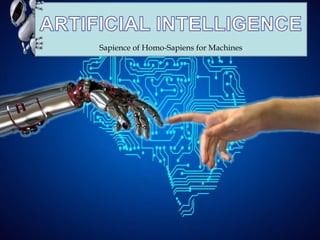
ARTIFICIAL INTELLIGENCE
Sapience of Homo-Sapiens for MachinesSapience of Homo-Sapiens for Machines
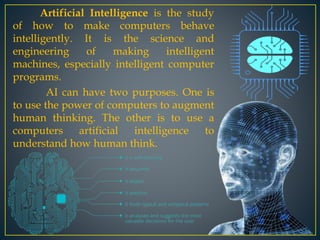
Artificial Intelligence is the study
of how to make computers behave
intelligently. It is the science and
engineering of making intelligent
machines, especially intelligent computer
programs.
AI can have two purposes. One is
to use the power of computers to augment
human thinking. The other is to use a
computers artificial intelligence to
understand how human think.
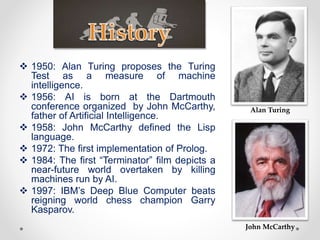
 1950: Alan Turing proposes the Turing
Test as a measure of machine
intelligence.
 1956: AI is born at the Dartmouth
conference organized by John McCarthy,
father of Artificial Intelligence.
 1958: John McCarthy defined the Lisp
language.
 1972: The first implementation of Prolog.
 1984: The first “Terminator” film depicts a
near-future world overtaken by killing
machines run by AI.
 1997: IBM’s Deep Blue Computer beats
reigning world chess champion Garry
Kasparov.
Alan Turing
John McCarthy
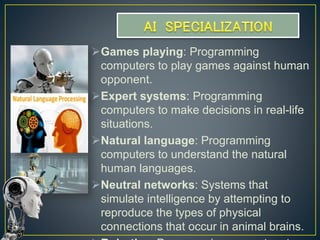
Games playing: Programming
computers to play games against human
opponent.
Expert systems: Programming
computers to make decisions in real-life
situations.
Natural language: Programming
computers to understand the natural
human languages.
Neutral networks: Systems that
simulate intelligence by attempting to
reproduce the types of physical
connections that occur in animal brains.
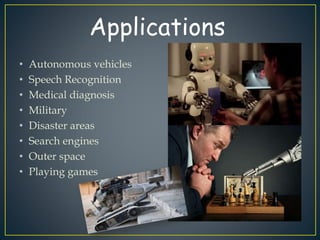
• Autonomous vehicles
• Speech Recognition
• Medical diagnosis
• Military
• Disaster areas
• Search engines
• Outer space
• Playing games
Applications
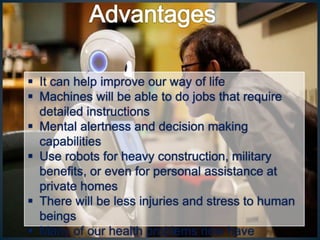
 It can help improve our way of life
 Machines will be able to do jobs that require
detailed instructions
 Mental alertness and decision making
capabilities
 Use robots for heavy construction, military
benefits, or even for personal assistance at
private homes
 There will be less injuries and stress to human
beings
 Many of our health problems now have
• This cause the loss of human control over those
“deemed machines”.
• They may dominate us in the near future.
• Sometimes it may cause the destruction if the
“entire beautiful human race”.
• Expensive technology.
• AI is at the centre of a new enterprise to build
computational models of intelligence.
• The main assumption is that intelligence
(Human or otherwise) can be represented in
terms of symbolic operations which can be
programmed in a digital computer.
Artificial inteligence

Artificial inteligence

  • 1.
    ARTIFICIAL INTELLIGENCE Sapience ofHomo-Sapiens for MachinesSapience of Homo-Sapiens for Machines
  • 4.
    Artificial Intelligence isthe study of how to make computers behave intelligently. It is the science and engineering of making intelligent machines, especially intelligent computer programs. AI can have two purposes. One is to use the power of computers to augment human thinking. The other is to use a computers artificial intelligence to understand how human think.
  • 5.
     1950: AlanTuring proposes the Turing Test as a measure of machine intelligence.  1956: AI is born at the Dartmouth conference organized by John McCarthy, father of Artificial Intelligence.  1958: John McCarthy defined the Lisp language.  1972: The first implementation of Prolog.  1984: The first “Terminator” film depicts a near-future world overtaken by killing machines run by AI.  1997: IBM’s Deep Blue Computer beats reigning world chess champion Garry Kasparov. Alan Turing John McCarthy
  • 6.
    Games playing: Programming computersto play games against human opponent. Expert systems: Programming computers to make decisions in real-life situations. Natural language: Programming computers to understand the natural human languages. Neutral networks: Systems that simulate intelligence by attempting to reproduce the types of physical connections that occur in animal brains.
  • 7.
    • Autonomous vehicles •Speech Recognition • Medical diagnosis • Military • Disaster areas • Search engines • Outer space • Playing games Applications
  • 9.
     It canhelp improve our way of life  Machines will be able to do jobs that require detailed instructions  Mental alertness and decision making capabilities  Use robots for heavy construction, military benefits, or even for personal assistance at private homes  There will be less injuries and stress to human beings  Many of our health problems now have
  • 10.
    • This causethe loss of human control over those “deemed machines”. • They may dominate us in the near future. • Sometimes it may cause the destruction if the “entire beautiful human race”. • Expensive technology.
  • 11.
    • AI isat the centre of a new enterprise to build computational models of intelligence. • The main assumption is that intelligence (Human or otherwise) can be represented in terms of symbolic operations which can be programmed in a digital computer.